The West is experiencing a severe drought; just how bad it was, was brought home to me when I visited the Los Angeles area this past week, after an absence of six years. I had always been surprised by the lush greenery, flowers, flowering trees and palms that lined the freeways of “Tinsel Town.” That is all gone. Streets, highways, homes and gardens now display signs that read “Brown is the new green.” What was once lush, verdant and colorful is now dry as dust, brown, and dead. The West is suffering from a great thirst for water. It is emblematic of its thirst for God.
“O God, you are my God, for you I long, for you my soul is thirsting, My body pines for you like dry, weary land without water…
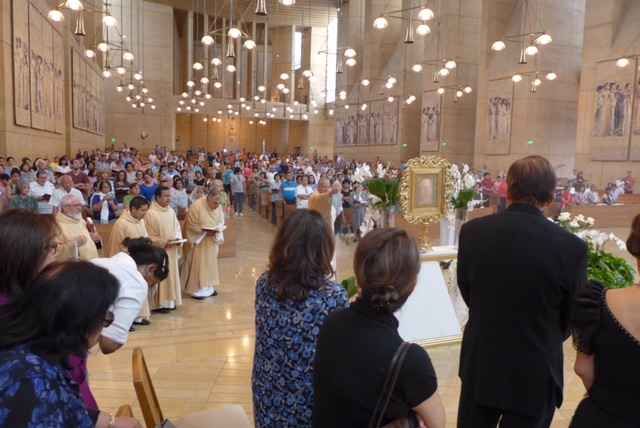
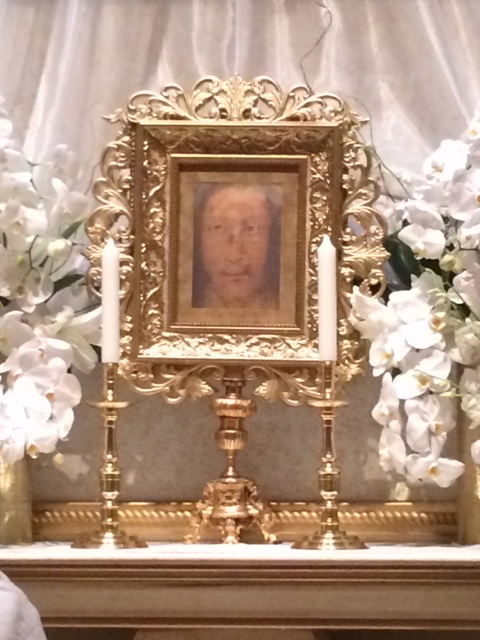
It is no secret that Los Angeles is mecca of images, idolatry and false faces. But on September 8th, the feast of the birth of the Blessed Mother, a replica of a miraculous image arrived in California, bearing the Face of Jesus Christ. It had traveled all the way from a shrine in a small mountain village in Italy called Manoppello, accompanied by the rector of the Holy Face Sanctuary, Fr. Carmine Cucinelli, OFM Capuchin and Mr. Paul Badde, journalist and author of several books about the Holy Face of Manoppello, who were there to give talks about the Holy Face. The first stop was the Carmelite Chapel of St. Joseph in Duarte, and the second stop, Our Lady of the Angels Cathedral in Los Angeles.
Blessed Replica image of the Holy Face of Manoppello, Mass at Our Lady of the Angels Cathedral Los Angeles.
“… So I gaze on you in the sanctuary to see your strength and your glory.” Ps. 63:1
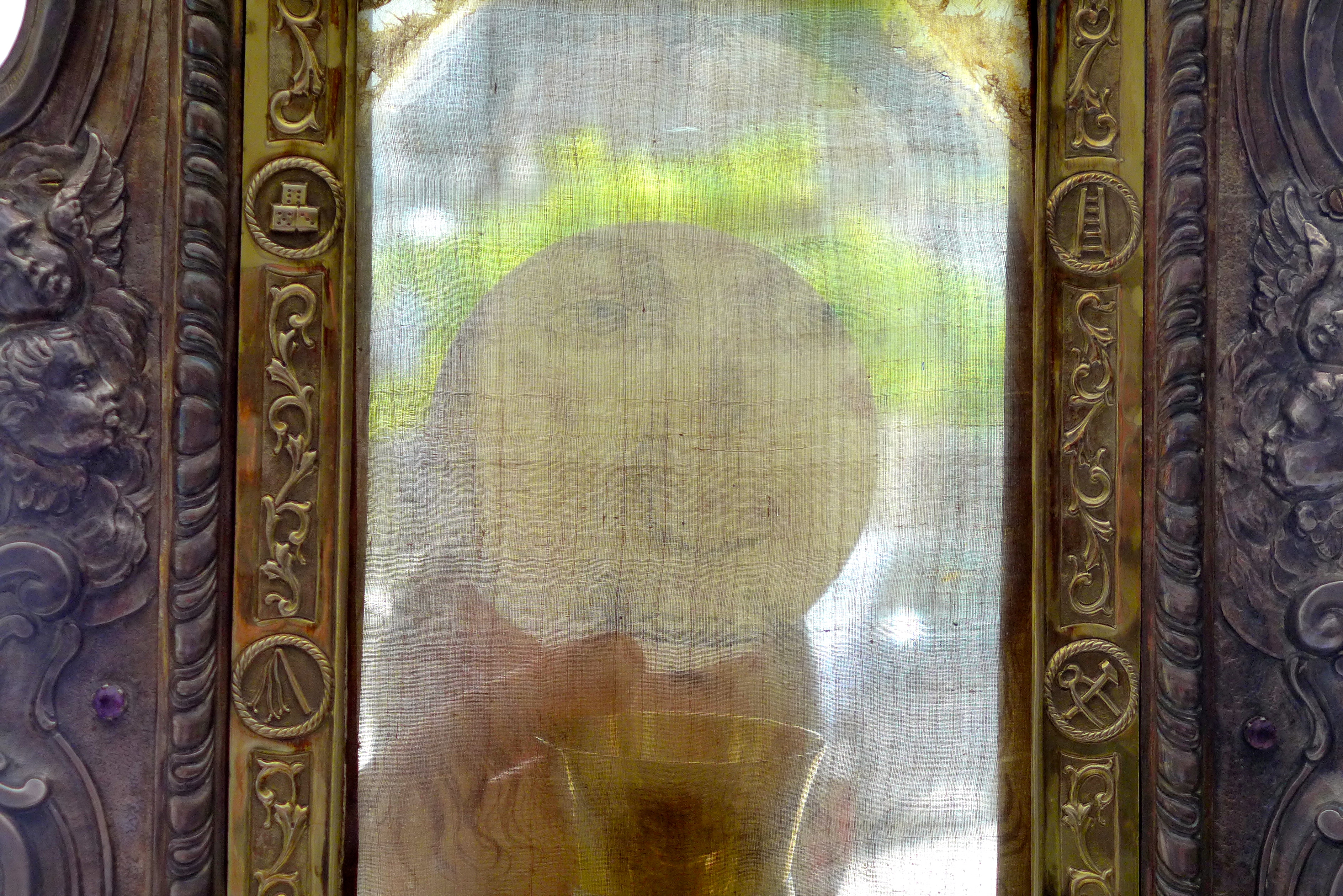
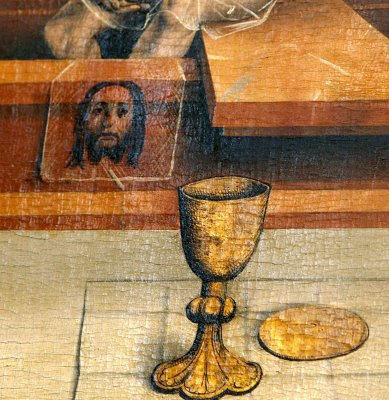
Jesus our Great High Priest offering Himself in the Eucharist, viewed through the miraculous Veil of Manoppello in Italy. Photo: Paul Badde
It is significant, that this holy image should come to this place, at this time. Images have great
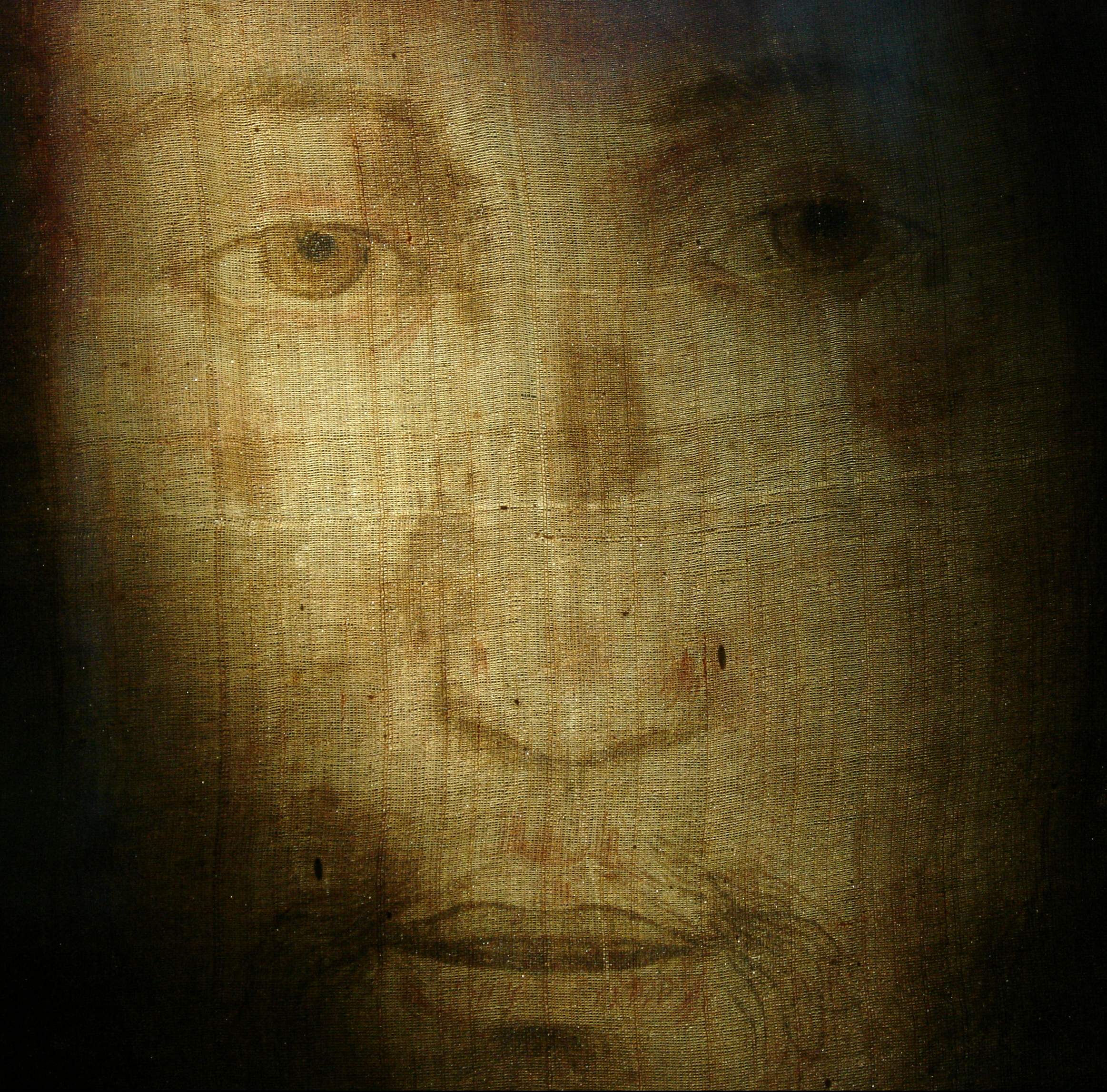
Miraculous “Holy Face of Manoppello” in Italy Photo:Paul Badde
impact on human beings, for good or evil, as everyone in Hollywood knows. When God became Man at the Incarnation, He made His Face known to us. As Pope Emeritus Benedict XVI has said, the Face of Christ is “the supreme revelation of Christ’s Mercy.” Pope Francis, has declared an “Extraordinary Jubilee of Mercy,” in a Bull of Indiction – THE FACE OF MERCY from the Feast of the Immaculate Conception, December 8, 2015 to the Feast of Christ, King of the Universe and Face of the Father’s Mercy” November 20th, 2016. The primary task of the Church, Pope Francis urges us, is to be “a herald of mercy,” “especially at a moment full of great hopes and signs of contradiction… to introduce everyone to the great mystery of God’s mercy by contemplation of the Face of Christ.”
As I departed Los Angeles, a rain shower fell. It made all the news programs, it was so rare. It seemed to me that the arrival of His Holy Face to Los Angeles was bringing blessings and showering grace on the City of Angels. The Face of Jesus is the antidote to the poison of sin and evil in the world. He comes to give us “Living Water.” Nothing less will quench our thirst.
Let us follow Pope Francis’ exhortation to contemplate the Face of Christ through discipleship, images of the Face of Christ and in the Eucharist, and be true “heralds of mercy” by spreading devotion to the Face of Christ.
Holy Face of Manoppello, Italy Photo: Paul Badde
A special thanks to Mr. Paul Badde for allowing me to use his beautiful photos of The Holy Face of Manoppello!
Alpha-Omega Holy Face of Jesus Novena Prayers and Consecration
Daily Preparatory Prayer
“Il Volto Santo” Holy Face of Manoppello, Italy
O Most Holy and Blessed Trinity, through the intercession of Holy Mary, whose soul was pierced through by a sword of sorrow at the sight of the passion of her Divine Son, we ask your help in making a perfect Novena of reparation with Jesus, united with His sorrows, love and total abandonment.
We now implore all the Angels and Saints to intercede for us as we pray this Holy Novena to the Most Holy Face of Jesus and for the glory of the most Holy Trinity, Father, Son and Holy Spirit. Amen.
Sixth Day
Psalm 51: 12-13
A pure heart create for me, O God, put a steadfast spirit within me. Do not cast me away from your presence not deprive me of your Holy Spirit.
Mary, Spouse of the Holy Spirit
May our hearts be cleansed, O Lord, by the in-pouring of the Holy Spirit, and may He render them fruitful by watering them with His heavenly dew. Mary, the most chaste spouse of the Holy Spirit, intercede for us, St. Joseph, pray for us.
Through the merits of your precious blood and your Holy Face, O Jesus, grant us our petition, …Pardon and mercy.
Prayer to Saint Michael the Archangel *
“Who is like God?” — St. Michael the Archangel
O Victorious Prince, most humble guardian of the Church of God and of faithful souls, who with such charity and zeal took part in so many conflicts and gained such great victories over the enemy, for the conservation and protection of the honor and glory we all owe to God, as well as for the promotion of our salvation; come, we pray Thee, to our assistance, for we are continually besieged with such great perils by our enemies, the flesh, the world and the devil; and as Thou wast a leader for the people of God through the desert, so also be our faithful leader, and companion through the desert of this world, until Thou conduct us safely into the happy land of the living, in that blessed fatherland from which we are all exiles. Amen. (St. Aloysius)
Pray one (1) Our Father, three (3) Hail Mary’s, one (1) Glory Be.
O Bleeding Face, O Face Divine, be every adoration Thine. (3 times)
*[St. Michael, whose battle-cry is “Who is like God?” is the Patron of the Arch-Confraternity of The Holy Face, which was canonically erected in the Chapel of the Discalced Carmelite nuns of New Orleans by Archbishop Perche in 1883, the first in The United States. From that humble oratory, devotion to The Holy Face spread throughout the Americas. Recently, Old St. Patrick’s Catholic Church in New Orleans has commissioned an exceptional statue of St. Michael bearing a shield with the Face of Jesus “Il Volto Santo” of Manoppello.
(full statue not shown) Shield bearing Volto Santo by sculptor Cody Swanson, study for St. Michael Statue.Sculptor Cody Swanson
Cody Swanson, is the artist of the awe-inspiring sculpture. Thanks to Mr. Paul Badde I’ve been fortunate enough to see photos of the color-study of the work. I have never seen a more powerful expression of St. Michael’s key question, “Who is like God?” Mr. Swanson, is an American Catholic convert and father of five, who has been described as “a young Michaelangelo.” Hmmm… Is that The Holy Spirit over his shoulder, or just a reflection on the glass? Either way, he certainly has been inspired!]
Today is The Feast of Our Lady of Lourdes and The World Day of the sick. There is also a special connection between Lourdes and The Holy Face of Jesus.
Sanctuary Basilica LourdesThe Most Reverend Bishop Perrier of Tarbes-Lourdes 2010 visit to Manoppello Shrine
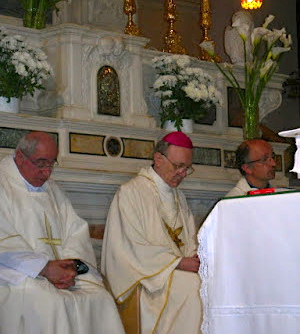
France is known for it’s special devotion to The Holy Face of Jesus. (Sr. Marie St. Pierre, The Holy Man of Tours, St. Therese of The Child Jesus and the Holy Face, to name a few examples.) In April of 2010, the bishop of the diocese of Tarbes-Lourdes, Monsignor Philippe Perrier, had visited the Shrine of the Holy Face of Manoppello, accompanied by a delegation which included Francois Vayne, editor of the Lourdes Magazine and Doctor Alessandro De Franciscis, director of the organism which documents and investigates miracles which take place in the Lourdes. The French Bishop was welcomed by the Archbishop of Chieti-Vasto Bruno Forte and by the rector of the Shrine, Fr. Carmine Cucinelli. Bishop Perrier celebrated the Mass in French, remaining in prayer before the Holy Face. Deeply moved, the Bishop stated that he had “seen in the suffering Face of Manoppello the sufferings of the Madonna of Lourdes”, inviting those present to “be worthy of this extraordinary treasure of grace”.
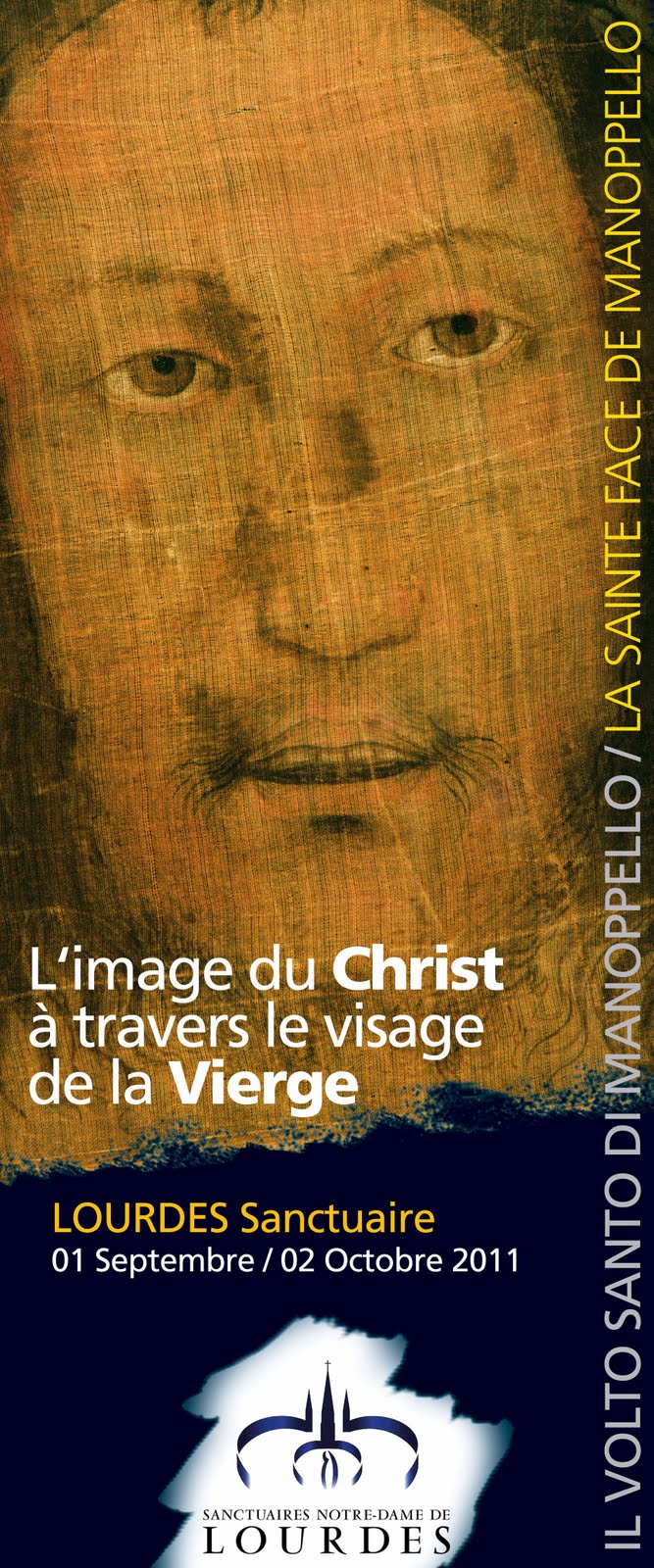
After his encounter with The Holy Face at The Shrine of Manoppello, Bishop Perrier proposed an extraordinary event; an exhibition titled “L’IMAGE DU CHRIST A TRAVERS LE VISAGE DE LA VIERGE” – “The image of Christ through the face of the Virgin” which was held in the exhibition hall of the famous Marian Shrine of Lourdes from September 1 – October 2 in 2011. A significant part of the exhibition focused on the relationship between the Holy Face and the Face of the Madonna in the various expressions of devotion and faith that are common to Lourdes and Manoppello, the faces of sick, suffering and pilgrims.
Sixth Station of the Cross at Lourdes, Veronica wipes the Face of Jesus
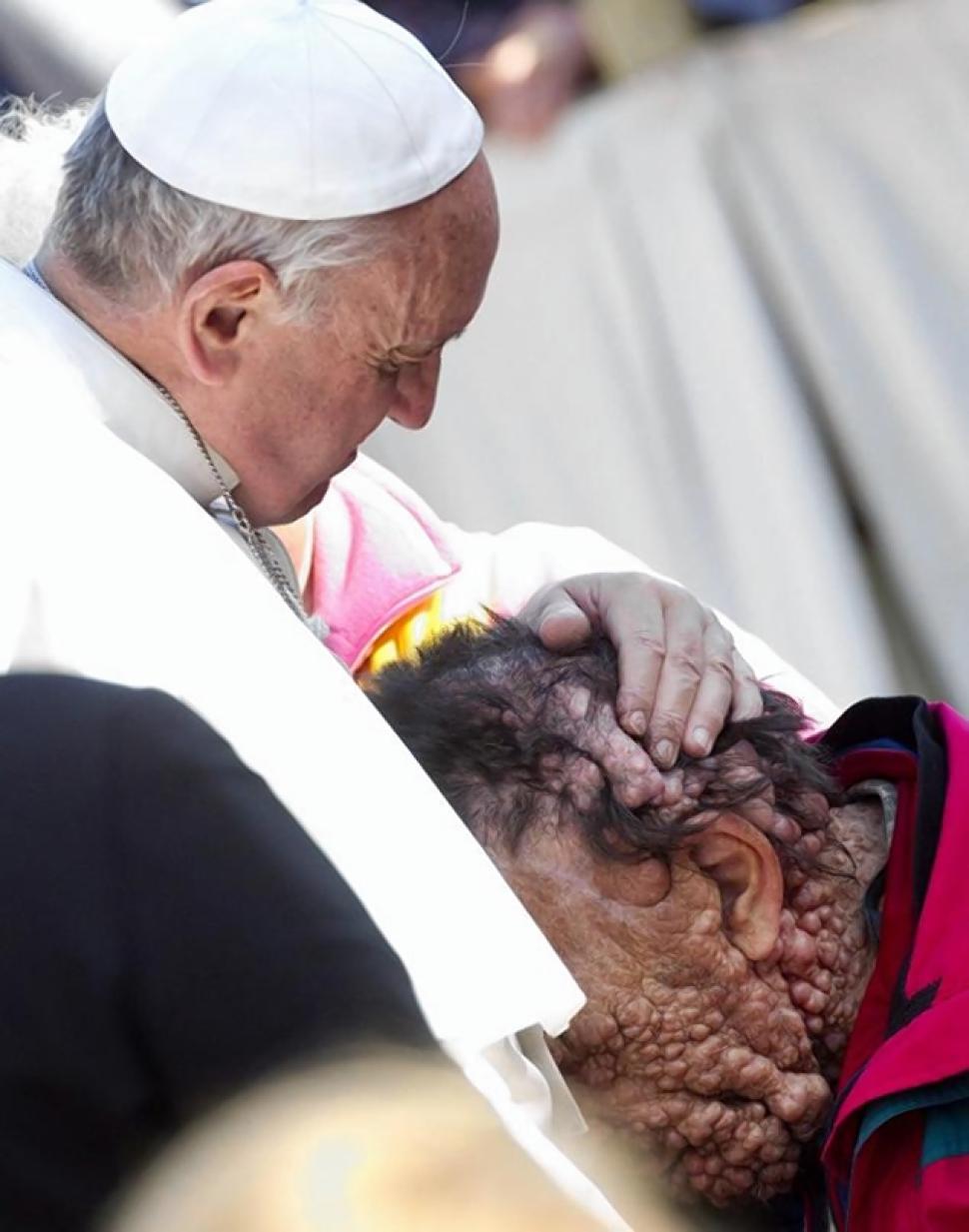
As Pope Francis reminds us so often, “Every sick and fragile person can see in your face the Face of Jesus, and you can also recognize in the suffering person the body of Christ.” He continually demonstrates that element of devotion to The Holy Face of discipleship in seeking the Face of Christ in the poor, the sick and the weak and by being the Face of Christ to them.
The world was stunned when Pope Francis embraced a severely disfigured man shown in the photo below. What compassion! Today is the 4th day of the Holy Face Novena, which can be found in the previous post. As we lift up the sick before the Holy Face of Jesus this day let us also place them in the most compassionate, Immaculate Heart of Our Lady of Lourdes who sees in them the Face of her Son. Remember, too, in our prayers doctors, nurses and all healthcare workers and caregivers, who make great sacrifices in order to show the loving Face of Christ to the sick. May God grant us all compassion for the sick and patience in suffering.
Pope Francis embracing the sick
May God bless them and shine His Face upon them!
Grotto of Lourdes
Our Lady of Lourdes Prayer
Be blessed, O most pure Virgin, for having vouchsafed to manifest your shining with life, sweetness and beauty, in the Grotto of Lourdes, saying to the child, St. Bernadette: “I am the Immaculate Conception.” A thousand times we congratulate you upon your Immaculate Conception. And now, O ever Immaculate Virgin, Mother of mercy, Health of the sick, Refuge of sinners, Comforter of the afflicted, you know our wants, our troubles, our sufferings deign to cast upon us a look of mercy.By appearing in the Grotto of Lourdes, you were pleased to make it a privileged sanctuary, whence you dispense your favors, and already many have obtained the cure of their infirmities, both spiritual and physical. We come, therefore, with the most unbounded confidence to implore your maternal intercession. Obtain for us, O loving Mother, the granting of our request.
(state your request)
Through gratitude for your favors, we will endeavor to imitate your virtues, that we may one day share your glory.
Our Lady of Lourdes, Mother of Christ, you had influence with your divine son while upon earth. You have the same influence now in Heaven. Pray for us; obtain for us from your Divine Son our special requests if it be the Divine Will. Amen.Our Lady of Lourdes, pray for us.Saint Bernadette, pray for us.
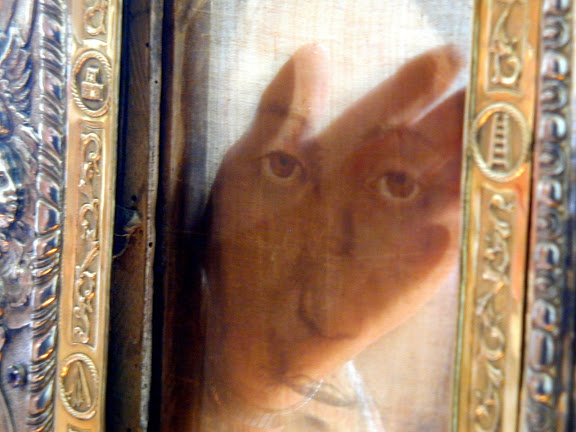
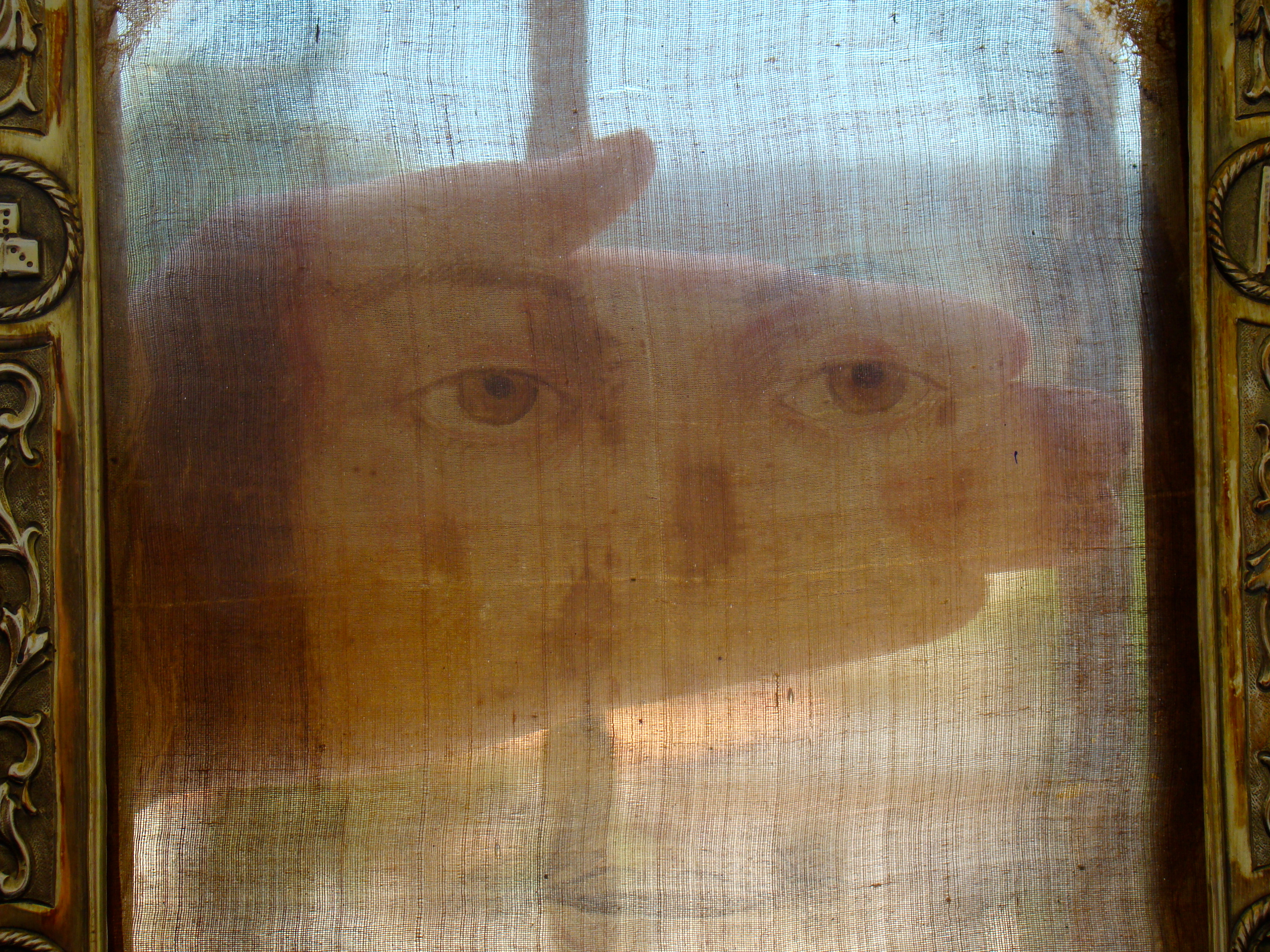
Gossamer-thin veil of Manoppello Photo: Paul Badde
Ever since I first laid eyes on the Holy Face of Manoppello, Italy, I have wanted to paint it. Surely every artist who has looked upon the image has felt the same desire. The “Il Volto Santo” seems to be the prototype of ancient images of the Face of Christ in the Eastern and Western Church as there is abundant evidence in museums and churches. There were more than a few obstacles to fulfill this desire of my heart to paint His Face. For one thing, I didn’t attempt to take a photograph when I saw the “Il Volto Santo” as I had come to pray as a pilgrim to the Basilica in Manoppello, and made up my mind to get a picture or holy card at the Sanctuary’s small gift shop. Also, I had seen numerous photographs–all different, some strange, flat or distorted, the color itself varying greatly from one picture to another. Some photos are very dark and the image appears covered with wounds, as one would see Christ in His Passion. Others bright, beautiful and fresh, with wounds healed as it must have appeared at the moment of The Resurrection.
The changeability of the image itself posed a great challenge. When standing by myself before “Il Volto Santo,” I saw the face with wounds, from a crown of thorns, bruises, blood, torn beard and red inflamed skin. But, upon kneeling … words cannot express what is felt, a living face of a man, wounds very faint and the eyes…! The eyes filled with mercy and peace more deep and still than if Jesus had stilled the waters of the ocean to it’s depths… Again, nothing could compare to what my eyes beheld. In addition, seeing was one thing and experiencing another. I knew that trying to use paint to convey that experience of God’s Mercy and Peace would fall infinitely short of the goal. Still, the desire to paint His Face remained.
More than two years passed before I even began. As I said, no photo I’ve seen would do, but finally I decided to look at several and use the elements that, for me, came close to my memory of the veil. Even though I cannot paint icons in the traditional sense, I do paint them in my own fashion, not having formal art education. Being a wife and raising six children has been my primary vocation in life, and I’ve fit my painting in between the many things that fill a mother’s day. So, when I got fed up with my own excuses not to begin to paint the Face of Jesus, I prepared an icon board, selected a few pictures and began to draw.
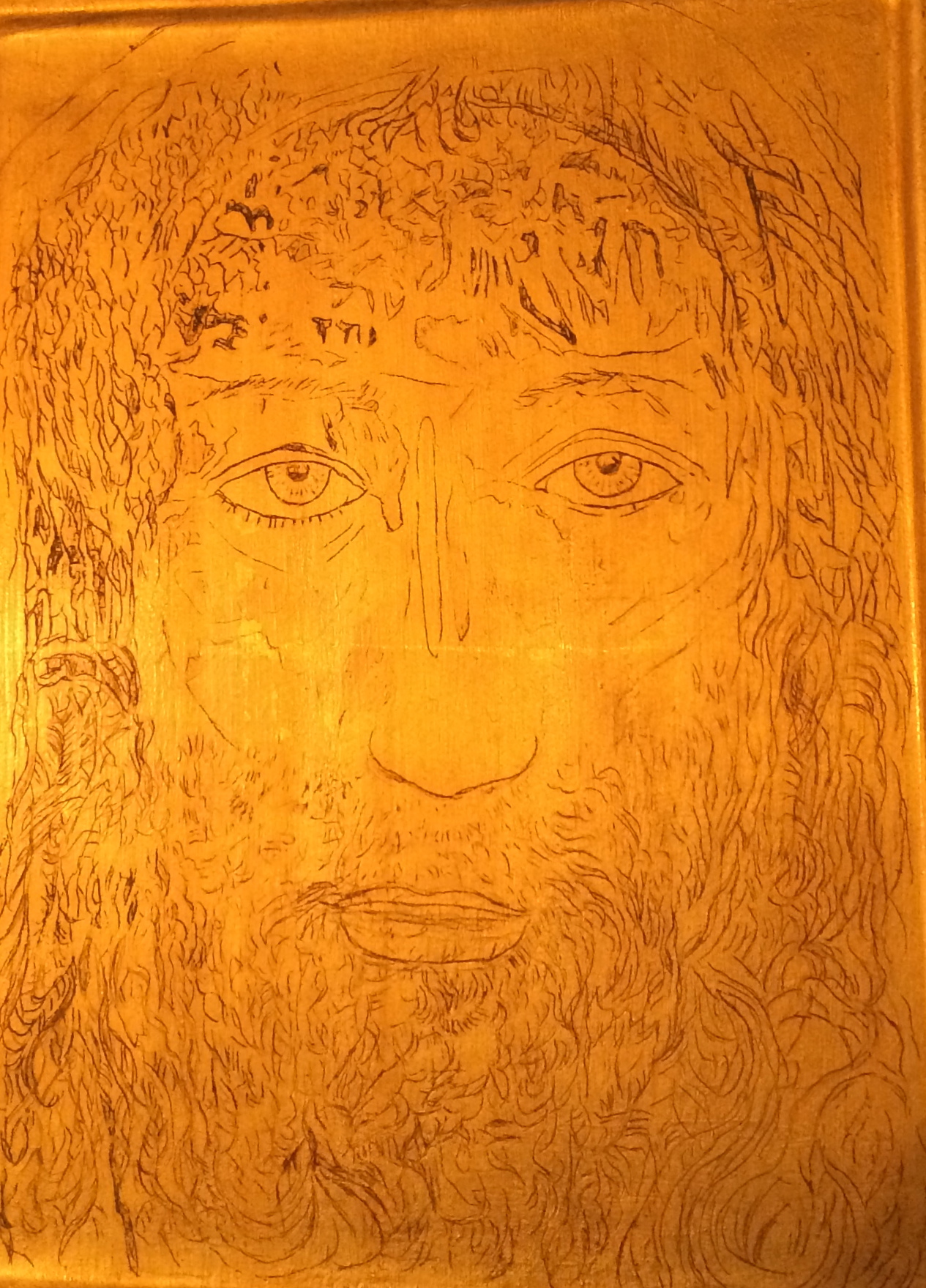
Artists look at things a little differently, I think. I had planned on making a simple outline of the main features of the face from a relatively clear photo of the Veil of Manoppello that I came across, but my plan took a different turn. Come to think of it, that is often how the Holy Spirit works. Icons are said to be “written” by the hand of the artist through the Holy Spirit. I drew the lines, and as other faint lines and shadows appeared to my eyes, I drew them as well with the same value or darkness as the most obvious lines.
My drawing on gold-leaf on board.
The results left me astonished. What isn’t readily apparent manifested itself in such a beautiful way. Faint marks on the forehead, for example, appeared as marks from thorns. Faint short lines on the face which turned this way and that were obviously the hair from a torn beard. Looking very closely and drawing each curved line became soft waves of hair. All were there, but faintly. The drawing just made the facts more noticeable. The concentration of the lines above the brow and below the nose accentuated the space surrounding the eyes as though a blindfold had protected them from some of the blows inflicted on the rest of the face.
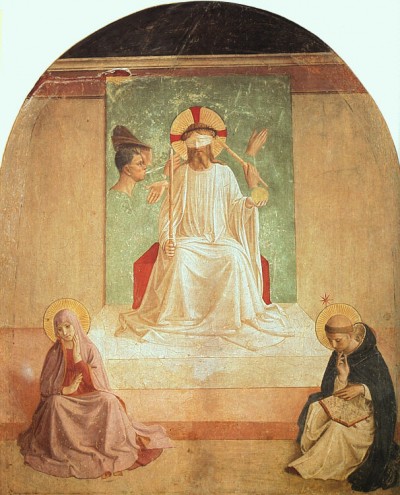
Painting by Fra Angelico showing Jesus blindfolded.
I began the painting in silent prayer. Although sacred music can elevate the mind and heart, I greatly prefer the “language of heaven” which is silence. My family would attest to the fact that when I paint, I tune out all noise anyway. The house could come down around my ears and I probably wouldn’t look up. St. Teresa of Avila spoke of ignoring “the mad-woman running around the house” referring to distractions while she was trying to pray. We probably all have our own “mad-woman” who tries to distract us with many cares, anxieties and trivialities as we try to turn our attention to God. Painting is a wonderful way to shut the door on the crazy lady and focus solely on listening to God.
It is true that God’s Face can be found in the Scriptures and in our neighbor, but I seek Him most often in images of Jesus and in particular, I love the image of “Il Volto Santo,” in Italy. It is for me an icon which encapsulates the whole of Divine Revelation in one Face. As I select colors and brush and begin my work, I gaze at Him, the words of Scripture are ever present in my mind, beginning with the longing of all mankind, “Your Face, O Lord, I seek. Hide not your Face from me.” (Psalm 27) “There was in him no stately bearing to make us look at him, nor appearance that would attract us to him.” “…a man of suffering, accustomed to infirmity”(Isaiah 53:2 – 3), “For God so loved the world that He gave it His only begotten Son.” (John 3:16) “The word became flesh, and dwelt among us.” (John 1:14) With sorrow, I look at the terrible wounds on the face of Christ, and the words of St. Pope John Paul II echo in my heart, “We cannot stop at the image of The Crucified One. He is the Risen One!” and St. Paul’s words, “All of us, with unveiled faces, seeing seeing the glory of the Lord as though reflected in a mirror, are being transformed into the same image.” (2 Cor 3:18) and more and more… There are no end to the depths of the treasures in His Face.
How could I hope a painting could ever match the beauties that are found in His Face? It can never be possible unless He painted it Himself, so I ask Him to paint His image in my heart. I knew at the outset I would be unsatisfied with the result of my painting, because only seeing Him face to face in eternity could satisfy that infinite desire. Still, I can look at the work of my hands, pray, and remember that there is always “more than meets the eye.”
Icon of “Il Volto Santo” by Patricia Enk
The words on the icon are: Illumina, Domine, Vultum Tuum Super Nos. or “Shine the light of Your Face on us, O Lord.”
Closeup of “Il Volto Santo” painting by Patricia Enk
May His Face shine upon you always!
“Faith is the realization of what is hoped for and evidence of things not seen.” –Hebrews 11:1
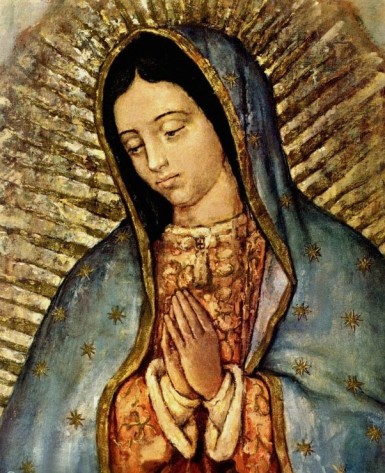
The miraculous image of Our Lady of Guadalupe, the Shroud of Turin, and “Il Volto Santo,” the veil of Manoppello all have something in common. They are all Acheiropoieta, a Greek word meaning: “made without hand.” They are said to have come into existence miraculously, not created by a human painter.
The Holy Face on the Shroud of Turin
The extensive research that has been done on these three images, and the results are astounding. Although I have not been to Mexico to view the miraculous tilma of Our Lady, I have seen both the Holy Shroud of Turin and the Veil of Manoppello in person. Studying them has been my own personal passion.
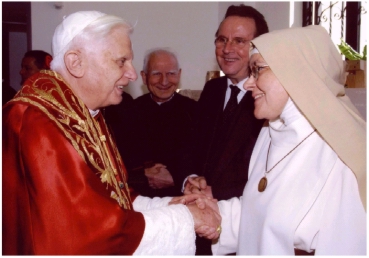
Being an artist, (and near-sighted) I tend to look at things more closely. I study each little detail, shape, line, form, color, and value. I may spend hundreds of hours studying while I work. I can’t help but know every little nuance by the time I am done painting. Sr. Blandina Paschalis Schloemer, a Trappist nun from Germany, is also an artist, a painter of icons. Icon painting is very exact when it is done in the traditional manner. Sr. Schloemer began to notice striking similarities between ancient icons and images of the Face of Christ, and the images on the Shroud of Turin and the Veil of Manoppello. With the permission of her order the research has become her life’s work as well as part of her vocation.
Pope Benedict meets Sr. Blandina at the Sanctuary Basilica for the Holy Face of Manoppello
Her research indicates that both images on the Shroud of Turin and the Manoppello Image are of the same man. I agree with her, wholeheartedly, although it is not at first glance apparent. There are also many similarities between these two images of Jesus’ Face and the image of Our Lady of Guadalupe. First, all are on a cloth. The image of Our Lady of Guadalupe is on cactus fiber, which should have disintegrated hundreds of years ago according to scientists. The Shroud of Turin is on linen and the Manoppello Image is on woven sea-silk, called byssus.
Our Lady of Guadalupe, pilgrim image beside the Veronica Altar, at St. Peter’s Basilica in Rome. Photo: Paul Badde, author of The Face of God: The Rediscovery of the True Face of Jesus, Ignatius Press.
Byssus is more rare and more precious than gold. Mentioned in the Bible, byssus, has a shimmering, iridescent quality which reflects light. Byssus is extremely delicate, yet strong at the same time. It resists water, weak acids, bases, ethers or alcohols. It can’t be painted, as it does not retain pigments, it can only be dyed; and then, only purple. Did I mention that it can last for more than 2000 years?
The veil of Manoppello, woven with byssus, is so sheer that you can read through it. Photo: Paul Badde
Another similarity between the Guadalupe image and the Manoppello image is the changeability of the images. Pilgrims have related how the image of Our Lady on the tilma appears to change in color, brightness and depth. Scientists can’t explain how the Guadalupe image appears on the tilma, it is not painted… it is “just there.” The Shroud of Turin has been described similarly. The veil of Manoppello, or “Il Volto Santo” as it is also known, is even more incredible, if that can be possible, because in addition to the image being on a veil so sheer that it can be read through, it also changes in detail, color, and shape. It even disappears… entirely. It is called a “living image” and so it is. No two people will see it in the same way. No single person will see it in the same way twice.
“Il Volto Santo of Manoppello”
Julian of Norwich, the English mystic of the 14th century, mentions changeability as a characteristic of the Veil of Veronica in Rome, “the diverse changing of color and countenance, sometime more comfortably life-like, sometime more rueful and death-like.” The Veil of Veronica, it is now believed, was most likely stolen a hundred years later, during the sack of Rome. But, Julian of Norwichs’ description of the Veil of Veronica certainly fits “Il Volto Santo” of Manoppello.
But, there is more. There is something about the faces… if you study the faces in particular, especially the eyes, as one opthamalogist did. On the eyes of Our Lady of Guadalupe, you will notice that something. Similar research has been done on the eyes of “Il Volto Santo.” There are delicate, natural, details in all three images that cannot be accomplished without the aid of paint or brush, on a rough, cactus cloth, or on a linen burial shroud or on gossamer-thin sea-silk. If you have an opportunity, look closely. Yes, there is something about the faces, and it is something supernatural. They are not made by human hands, but by the Hand of God.
“O Blessed Virgin Mary, Our Lady of Guadalupe,
By your presence you made the desert bloom with flowers
may your love transform us into the image of Your Son, Jesus Christ. Amen.”