St. Michael–his name was taken from his battlecry “Quit Ut Deus?!”–in answer to the rebellion of Satan, who attempted to make himself equal to God–St. Michael cried out “Who is like God?!” as he defeated Satan and other rebellious angels casting out of heaven.
“Then war broke out in heaven; Michael and his angels battled against the dragon. Although the dragon and his angels fought back, they were overpowered and lost their place in heaven. The huge dragon, the ancient serpent known as the devil or Satan, the seducer of the whole world, was driven out; he was hurled down to earth and his minions with him” (Rev. 12)
The center of this battle raging between Angels and demons — heaven and earth — is the Incarnate Word of God made flesh, Jesus Christ. It is Jesus who is rejected, reviled and persecuted. The devil wants to obliterate the Face of God, not only in churches that have vandalized and desecrated, but most especially, in the souls of human beings. The battle lines have been drawn between the culture of life and the culture of death. The devil’s particular object of hatred is the woman and the unborn. Some can no longer recognize that a child in the womb is a human being. Many persons reject their God-given identity as male and female. Racial hatred is causing deeper and deeper division, and human trafficking increases as humanity is blinded to the Face of God in their neighbor made in His image and likeness.
“When the dragon saw that it had been thrown down to earth, it pursued the woman who had given birth to a male child.” (Rev. 12:13)
Then I heard a loud voice in heaven say: “Now have salvation and power come, the reign of our God and the authority of his Anointed One. For the accuser of our brothers is cast out, who night and day accused then before our God. They defeated him by the blood of the Lamb and by the word of their testimony; love for life did not deter them from death. So rejoice, you heavens, and you the dwell therein! But woe to you, earth and sea, for the devil has come down upon you! His fury knows no limits, for he knows his time is short” (Rev 12). This battle has been fought since the beginning of Creation; between Christ’s Angels and the fallen angels or demons, with humanity at the center of the struggle. St. Michael and the Holy Angels have been given the authority from God by the power of the Holy Name of Jesus to protect and defend God’s people against both human and diabolical enemies.
Prayer to St. Michael:
St. Michael, the Archangel, defend us in battle. Be our protection against the wickedness and snares of the devil. May God rebuke him, we humbly pray, and do thou, O Prince of the Heavenly Host, by the power of God, cast into hell all the evil spirits, who prowl about the world, seeking the ruin of souls. Amen.
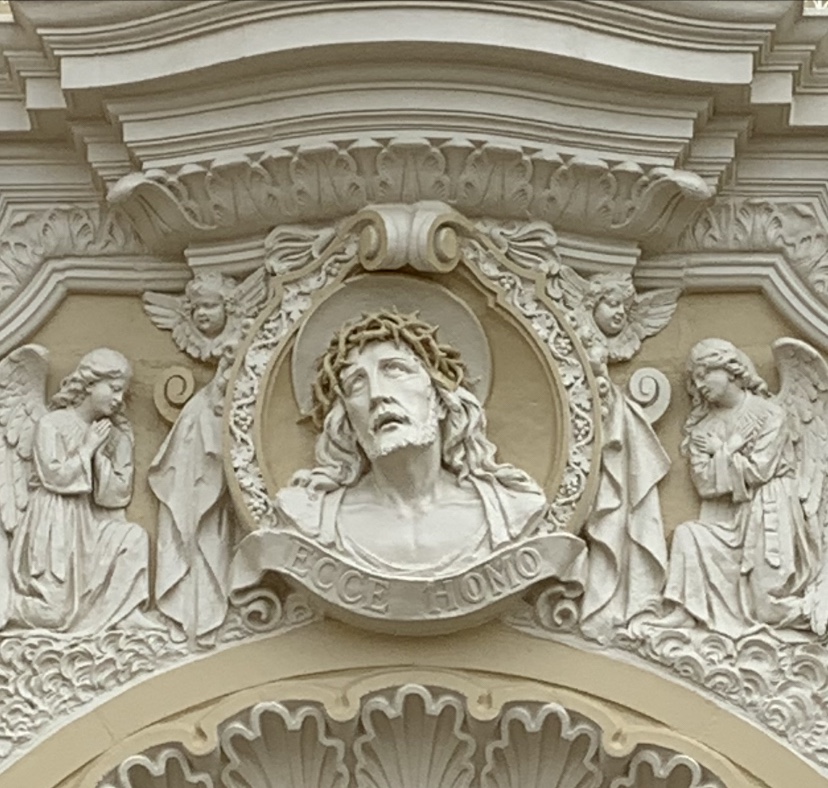
Holy Face surrounded by adoring Angels. (Photo: Mary Engler)
Devotion to the Face of Jesus is meant to repair mankind’s broken relationship with God, manifested in the world by the evil of blasphemy, sacrilege, and indifference. This work of reparation honoring His Holy Face and the Holy Name of Jesus–which is the concrete sign of God’s existence and our relationship with Him–has been given the protection and help of the Holy Angels. Sr. Marie St. Pierre was a French Discalced Carmelite nun to whom Our Lord gave revelations of the devotion to His Holy Face. She wrote on November 18, 1843…
Volto Santo in Sankt Michael (Photo: Paul Badde)
…“One day during prayer, our Lord warned me in advance about the fury of Satan against the holy devotion, but He also consoled me, saying: ‘I give you My Name to be your light in the darkness and your strength in battle. Satan will do all in his power to crush this Work at its roots. But I assure you that the Holy Name of God will triumph, and it will be the Holy Angels who will gain the victory in the conflict.”
“When Jesus is named, Satan is disarmed.” The victory will be won with devotion to the Holy Face of Jesus.
Pope Leo XIV invites us to contemplate the Face of Jesus, keeping in mind that human persons are made in the image and likeness of God:
“ I invite everyone to contemplate, in the Face of the Son of God, the grandeur of humanity that shines a light on the era of AI. In Christ, we are called to cooperate in the work of creation, rather than be disinterested observers of technological processes that limit our freedom and responsibility. The dignity inscribed in each of us by the Holy Spirit can also be seen in our capacity to reflect critically, choose and love freely, and form authentic relationships. No computational system, however sospisticated, can create a heart that gives itself, or a conscience that discerns good from evil. Even when machines excel in efficiency, a human face that asks to be gazed upon remains the center of our history. This human face is the fullness toward which history is moving. It is the mystery of “recapitulation”: the certainty that the Father has decreed to bring all things, those in heaven and those on earth back to Christ, the one Head (cf. Eph 1:10). In this plan, nothing will be lost that is authentically human. Indeed, everything will be purified and reunited in the One, who gathers every fragment of life, every tear and every authentically human achievement, rescuing them from nothingness and delivering then, redeemed, to the Father.” ~ Pope Leo XIV, Magnifica Humanitas #23
Prayer to Our Lady of the Angels, who in her humility, crushed the head of Satan:
Sublime Queen of Heaven, exalted Lady of the Angels, you have the power and commission given by God to crush the head of Satan. Therefore, we humbly beseech you to send to our aid your heavenly legions, so that, under your command and by your power, they may pursue the hellish spirits, fight them everywhere, ward off their impudent attacks, and fling them back into the abyss.
Who is like God? You holy angels and archangels, defend and protect us.
Good, kind mother, you remain always our love and our hope! Mother of God, send us the holy angels to defend us and keep the evil one far from us. Amen.
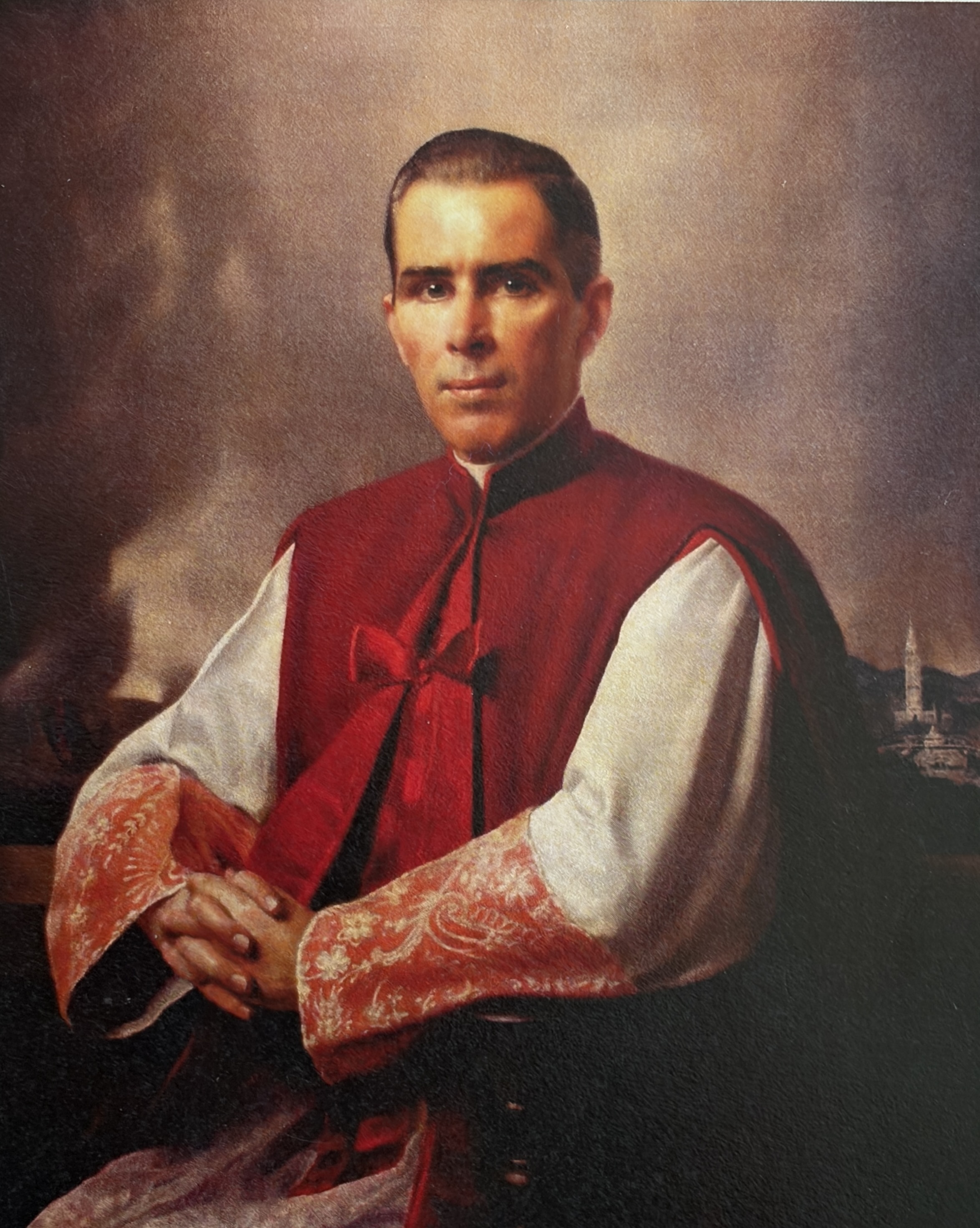
The Beatification of Archbishop Fulton J. Sheen will take place on Thursday, September 24, 2026. When Pope St. John Paul II embraced the suffering Archbishop Sheen in St. Patrick’s Cathedral on October 2nd, 1979, he told him, “You have written and spoken well of the Lord Jesus. You are a loyal son of the Church!” Just two months later, on December 9th, Fulton Sheen entered into Eternal Life.
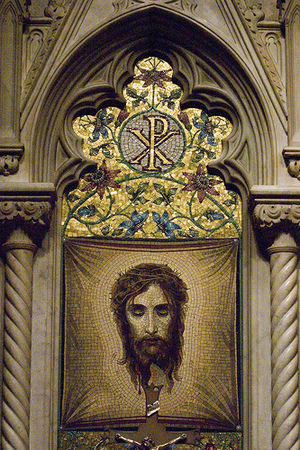
Beautiful mosaic of the Holy Face of Jesus in St. Patrick’s Cathedral in New York, where Archbishop Fulton J. Sheen served for many years.
Those who have heard or read Archbishop Sheen will know of his deep devotion to the Holy Face of Jesus. He has said that “The world’s greatest need is to rediscover the true image of Christ’s Face–a Face of mercy, not judgement; of tenderness, not wrath.” He knew from personal experience that devotion to the Holy Face is a powerful means of encounter and relationship with Jesus Christ.
Archbishop Fulton J. Sheen manifested his devotion by seeking His God’s Face through: Discipleship–to see Jesus in the Face of those in need; in the Passion of Jesus expressed in images of the wounded Face of Jesus; and through his life-long commitment to a daily “Holy Hour,” by contemplating the Face of Christ hidden in the Eucharist–where he learned to see the Face of God everywhere and in every person. These are the components of devotion to the Face of Jesus as characterized by Pope Benedict XVI, who also declared Archbishop Sheen “Venerable Servant of God,” in 2012; recognizing Sheen’s life of heroic Christian virtue. Archbishop Sheen has said, “We become what we adore.” In other words, as we contemplate the Face of Christ in these ways, we are transformed by the Holy Spirit into His Image.
Archbishop Sheen often wondered aloud if we could recognize Jesus in the many ways He comes to us? And if we did recognize Him, would we care? Would an encounter with Jesus change our life? We would have a choice to make in that moment: to either accept and embrace Him by accepting our crosses in this life, and all that it means to be a Christian; or to reject Him–or perhaps, to be indifferent. The most cruel choice of all is indifference to Him, Who died for us. Archbishop Sheen believed that indifference may have caused Christ even more pain than His suffering on Calvary.
A chilling warning to the indifferent is spoken of in the Book of Revelation when the Spirit speaks to the church in Laodicea…
“I know your works; I know that you are neither cold nor hot. I wish that you were either cold or hot. So because you are lukewarm, neither hot nor cold, I will spit you out of my mouth…” (Rev. 3:14-22)
One of the most powerful talks that Archbishop Sheen had ever given was for a Good Friday sermon–in which he recited a portion of the poem “Indifference or When Jesus Came to Golgotha” by Geoffrey Stuart-Kennedy (1883-1929)
Indifference
When Jesus came to Golgotha
They hanged Him on a tree,
They drove great nails through hands and feet,
And made a Calvary.
They crowned Him with a crown of thorns;
Red were His wounds and deep,
For those were crude and cruel days,
And human flesh was cheap.
When Jesus came to Birmingham,
They simply passed Him by;
They never hurt a hair of Him,
They only let Him die.
For men had gown more tender,
And they would not give pain;
They only just passed down the street,
And left Him in the winter rain
That drenched Him through and through.
The crowds went home and left the streets
Without a soul to see;
And Jesus crouched against a wall
And cried for Calvary.
When Jesus came to Golgotha
They hanged Him on a tree,
They drove great nails through hands and feet,
and made a Calvary.
They crowned Him with a crown of thorns;
Red were His wounds and deep,
For those were crude and cruel days,
And human life was cheap.
When Jesus came to Birmingham,
They simply passed Him by;
They never hurt a hair of Him,
They only let Him die.
For men had grown more tender,
And they would not give Him pain;
They only just passed down the street,
And left Him in the winter rain
That drenched Him through and through.
The crowds went home and left the streets
Without a soul to see;
And Jesus crouched against a wall
And cried for Calvary.
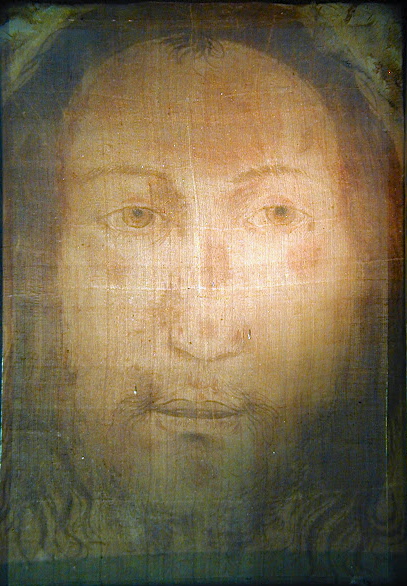
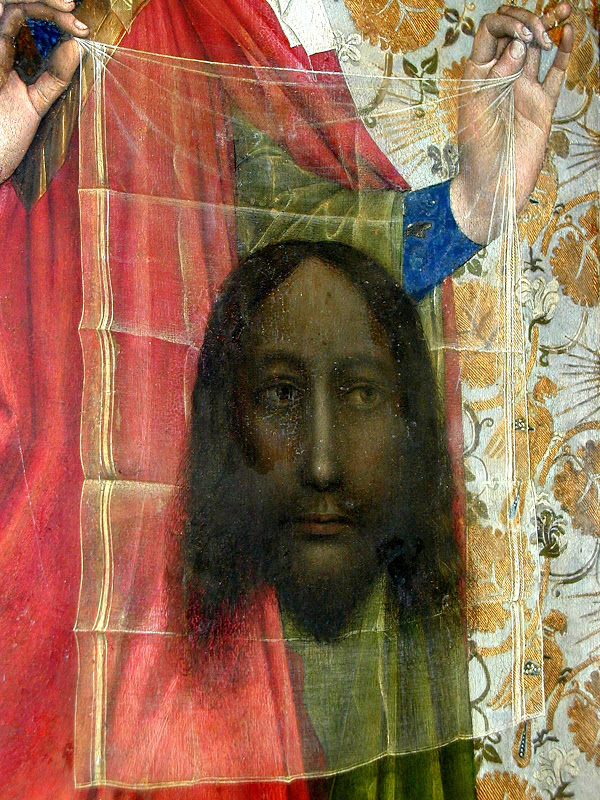
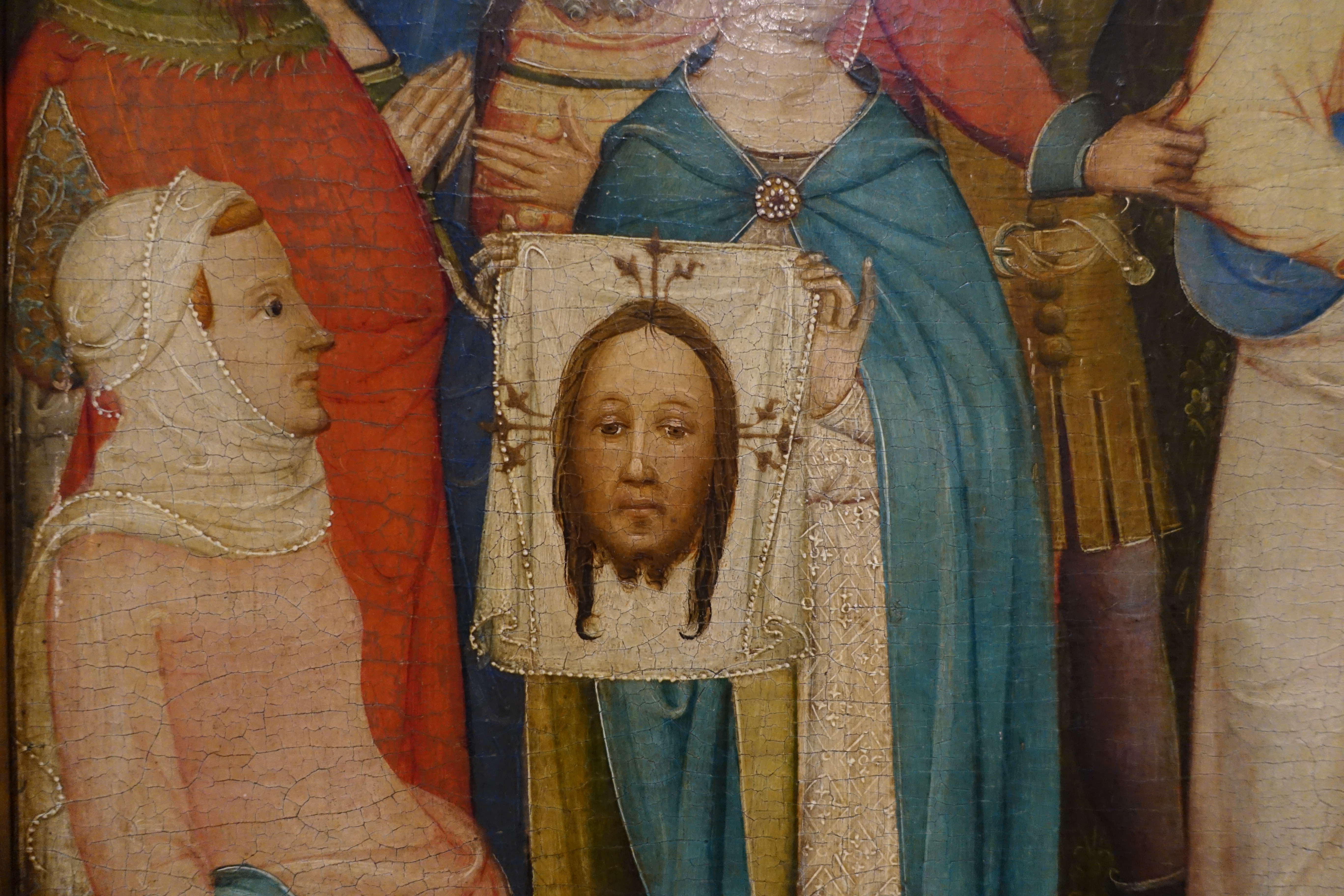
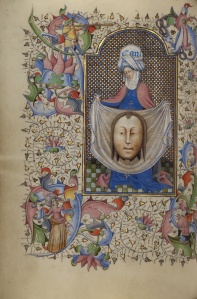
Veronica’s Veil, Flemish 15th Century
Archbishop Sheen prophetically spoke against the dangers of the spread of Communism–an evil ideology which has increased in the world, in spite of its devastating harm to humanity. He proposed in its place, the Christian alternative embodied in the figure of the charitable woman, traditionally known as “Veronica” (True icon), who, in an act of love, took her veil and wiped the Face of the suffering Christ–covered with blood, sweat, dust, and spittle–on His way to Calvary. And in return for her love, He left on her veil–as well as on the veil of her soul–the imprint of His Holy Face.
“Human Beings were not all meant to carry either a sickle or a hammer. Some are meant to carry towels — to wipe away the beads on feverish brows, to stroke the aching head, and to touch the worn face as with healing wings. Such was the mission of Veronica, who dared brave a violent mob to refresh the Savior and in reward to receive on her towel the imprint of the Face that saved the world.
By that miracle, Thou didst testify, Divine Savior, that society has a place not only for toilers but also for mourners, whose delicate sympathies lighten the burden of those who must carry a cross. Grant unto the world, which is rapidly becoming so violent, an army of “Veronica’s” to wipe away the tears of the victims of violence; and do Thou also let them see that when they do it to the least of their brethren, they, like Veronica of old, do it unto Thee.” ~ Archbishop Fulton J. Sheen
“And the King will say to them in reply, ‘Amen, I say to you, whatever you did for one of these least brothers of mine, you did it for me.” (Mt. 25:40)
“Your face, O Lord, I seek” (Psalm 27:8) Relecting on the Face of Jesus in his Apostolic Letter Novo Millennia Ineunte, Pope St. John Paul II writes: The ancient longing of the Psalmist could receive no fulfillment greater and more surprising than the contemplation of the face of Christ. God as truly blessed us in him and has made “his face to shine upon us” (Psalm 67:1). At the same time, God and man that he is, he reveals to us also the true face of man, “fully revealing man to man himself.” Pope St. John Paul II continues, “In order to “bring man back to the Father’s face, Jesus not only had to take on the face of man, [at the Incarnation] but he had to burden himself with the “face” of sin. “For our sake he made him to be sin who knew no sin, so that in him we might become the righteousness of God (2 Cor. 5:21)
JPII goes on to write, “we shall never exhaust the depths of this mystery.” “But her contemplation of Christ’s face cannot stop at the image of the Crucified One. He is the Risen One! Were this not so, our preaching would be in vain and our faith empty (cf. 1 Cor. 15:14) “The Resurrection was the Father’s response to Christ’s obedience. ” (Novo Millennia Ineunte)
The Devotion to the Holy Face is not meant to be solely a list of prayers to be recited, but is a means of encounter and relationship with Jesus Christ. Charity–Love of God and love of neighbor–are at the heart of this devotion to the Holy Face, which encompasses the whole spiritual life of a Christian and is intensely Eucharistic:
Benedict XVI has characterized devotion to The Holy Face as having three separate components: 1. Discipleship – an encounter with Jesus, to see Jesus in the Face of those in need. 2. The Passion of Jesus, and suffering expressed by images of the wounded Face of Jesus. 3. The Eucharist, “the great school in which we learn to see The Face of God”, which is woven between the other two. The eschatological element then builds on awakening to Christ by contemplating His Face hidden in The Eucharist.
“Our whole life should be directed toward encountering Him,” writes Benedict, “toward loving Him; and in it, a central place must be given to love of one’s neighbor, that love that in the light of The Crucified One, enables us to recognize the Face of Jesus in the poor, the weak, the suffering.” The pope goes on to explain the fruits of this contemplation: “From contemplation of the Face of God are born, joy, security, Peace.”
Pope St. John Paul II, in Veritatis Splendor, tells us that to win the battle for souls, we must first contemplate the Face of Christ ourselves in order to bring light into this darkened world that does not know God’s love:
“The light of God’s Face shines in all its beauty on the countenance of Jesus Christ, “the image of the invisible God” (Cor. 1:15), “the reflection of God’s glory” (Web 1:3), “full of grace and truth” (Jn1:14). Christ is “the way, and the truth, and the life” (Jn. 14:6). Consequently the decisive answer to every one of man’s questions is Jesus Christ himself, as the Second Vatican Council recalls: “In fact, it is only in the mystery of the Word Incarnate that light is shed on the mystery of man. For Adam, the first man, was a figure of the future man, namely, Christ the Lord. It is Christ, the last Adam, who fully discloses man to himself and unfolds his noble called by revealing the mystery of the Father and the Father’s love.” (Veritatis Splendor)
Contemplate with Mary the face of Christ in the Rosary!
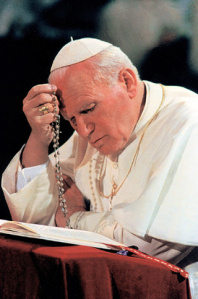
Contemplation of the Face of Jesus in the Rosary, together with the Blessed Virgin Mary, is another very important way, as Pope St. John Paul II writes in Rosarium Virginis Mariae: “to contemplate the face of Christ in union with, and at the school of, his Most Holy Mother. To recite the Rosary is nothing other than to contemplate with Mary the face of Christ...” “…to stand like your Virgin Mother, at the glorious Cross, and at the crosses of all people to bring consolation, hope, and comfort.”
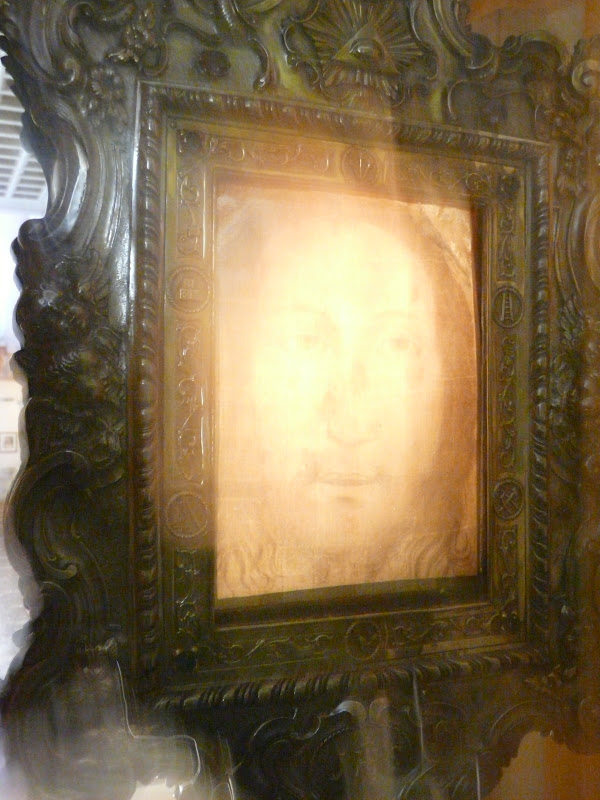
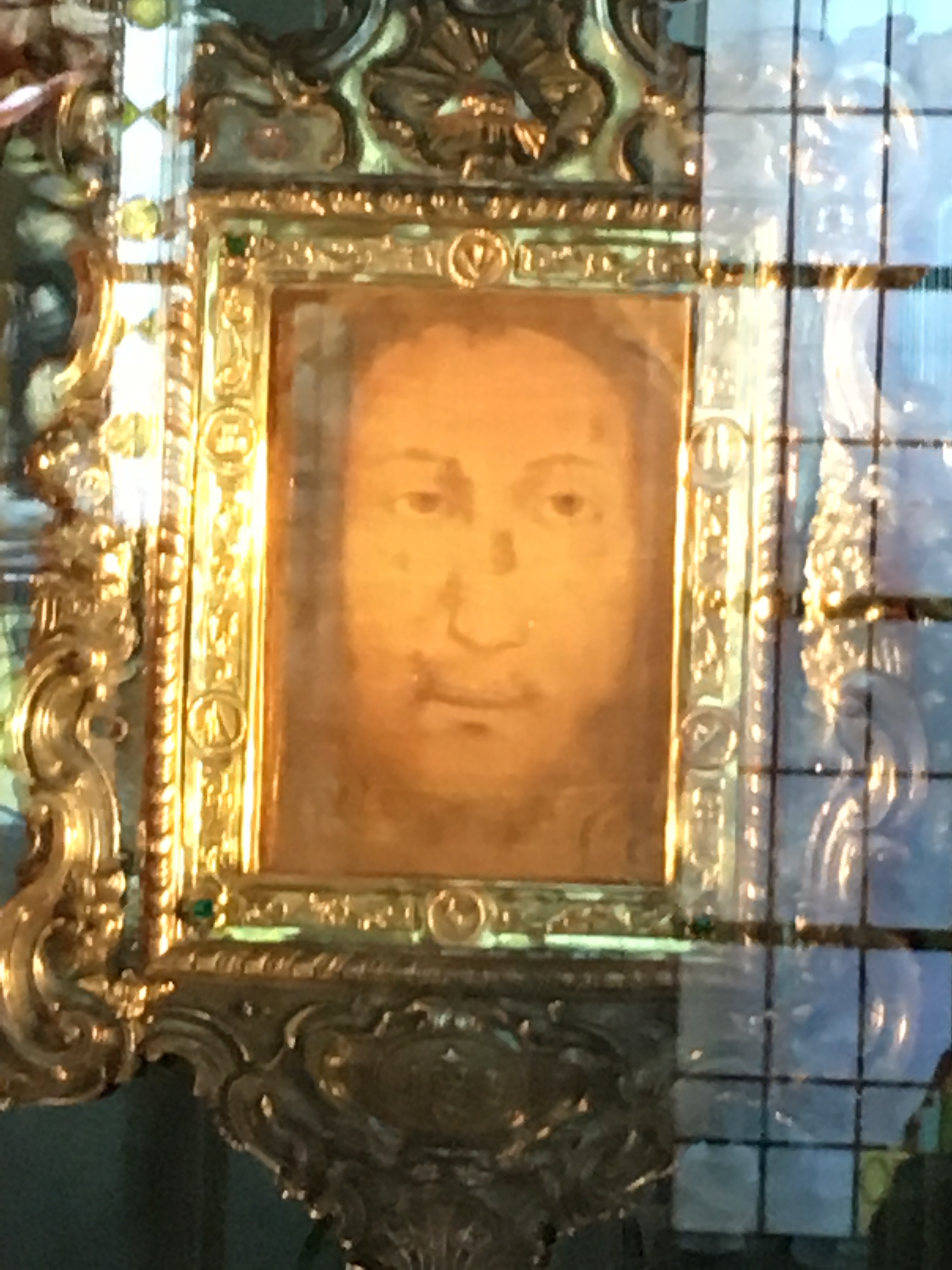
Holy Face Veil of Manoppello, Italy (Photo: Paul Badde/EWTN)
For God who said, “Let light shine out of darkness,” has shone in our hearts to bring to light the knowledge of the glory of God on the Face of Jesus Christ. (2 Cor. 4:6)
In his explanation of the Psalms, St. Ambrose explains these words of St. Paul:
“For God, who commanded the light to shine out of darkness, hath shined in our hearts, to give the light of the knowledge of the glory of God in the face of Jesus Christ.” (2 Cor. 4:6)
And also: “But remember the former days, when after being enlightened, you endured a great conflict of sufferings;” (Heb. 10:32) What we are to “remember” always is that “He has shone in our hearts” and that “we might make known the glory of God shining on the face of Christ Jesus.”
Why do you turn away your Face? We think God is turning His Face away from us when we find ourselves in such distress that our senses are clouded in darkness and we cannot see the glory of Him who is truth. We are convinced that if God would pay attention to our condition and be pleased to visit our souls, nothing could plunge us in gloom. If a person’s face is more enlightening that other parts of his body — so that when we look at someone we either see him as a stranger or recognize him as someone we know, whom or glance will not allow to pass unrecognized — how much more does the Face of God enlighten those on whom He directs His gaze.
In his usual way Saint Paul has something striking to say on this subject. He employs his gift for making Christ better understood to make Him closer to us through the use of appropriate ideas and expressions. He tells us: God, who commanded light to shine out of darkness, has caused light to shine in our hearts, so that we might receive the revelation of God’s glory in the Face of Jesus Christ. We know the place where Christ is shining within us. He is the eternal splendor enlightening our minds and our hearts. He was sent by the Father to shine on us in the glory of His Face, and so enable us to see what is eternal and heavenly, where before we were imprisoned in the darkness of this world.
The Divine Prisoner–for our sakes. The Holy Face of Jesus, on the Veil Manoppello. (photo: Patricia Enk)
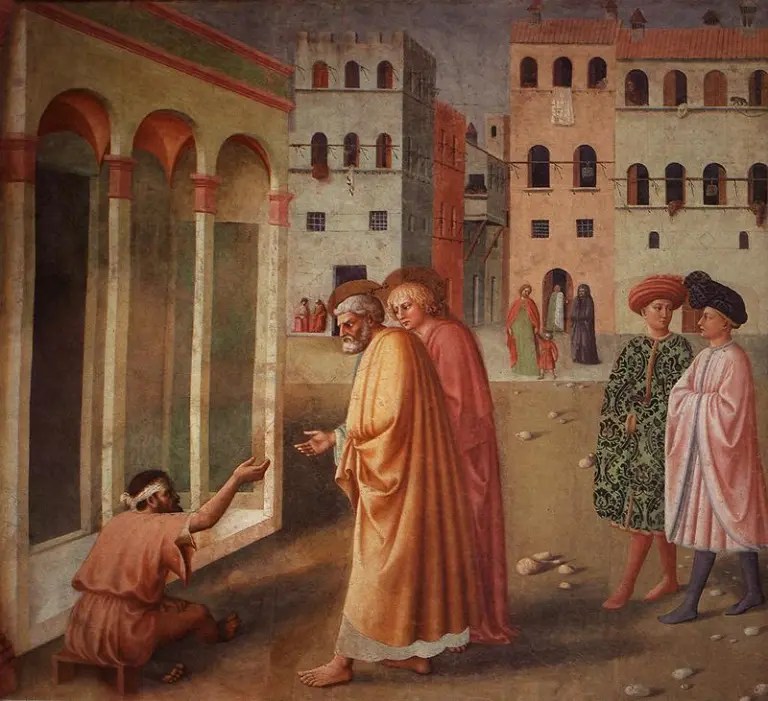
“Look at us” St. Peter healing the man born lame.
There should be no need for me to speak of Christ when even Peter the apostle said to the man born lame: “Look at us.” He looked at Peter and was enlightened by the grace of faith. He would not have received healing had he not believed with faith.
Such was the glory possessed by the apostles. Yet Zacchaeus, hearing that the Lord Jesus was passing by, climbed a tree, for he was small in stature and could not see him because of the crowd. He saw Christ and gave up what was his own, though he was a man who took what belonged to others.
Why do you turn away Your Face?
May we say it another way. Even, if, Lord, you turn Your Face away from us, yet we are sealed with the glory of Your Face. Your glory is in our hearts and shines in the deep places of our spirit. Indeed, no one can live if You should turn away Your Face.
God has said: Let light shine out of darkness — He has shone in our hearts that we might make known the glory of God shining on the Face of Christ Jesus.
Holy Face of Manoppello, an “achieropoieta” of the Face of Jesus Christ — made by the Hand of God. (Photo: Paul Badde)
The Face of Christ–“the love that moves the sun and other stars.” (~Dante) Venice, Angels of Heaven adoring the Face of Christ. Illustration for the Divine Comedy of Dante, 13th Century
In Dante Alighieri’s Divine Comedy, Dante journeys through Hell, Purgatory and Heaven, which culminates in a transcendent, and indescribable vision of God. In this symbolic vision, Dante perceives God as three, distinct, intersecting circles of light which represent the Most Holy Trinity — Father, Son, and Holy Spirit. As Dante gazes at the second circle (the Son), he sees a human face– the Face of Jesus Christ–the Word of God Incarnate. Before this great mystery of the Incarnation he finds himself speechless, but his will and desire are perfectly aligned with God’s infinite love; “the love that moves the sun and other stars,” which give life to the entire universe.
In his encyclical Magnifica Humanitas,Pope Leo XIV directs us to “the love that moves the sun and other stars” in a very powerful way, by pointing to the Human Face of Jesus Christ. It is the very love of God–made manifest on the human Face of Jesus Christ –that gives meaning and “dignity inscribed in each of us by the Holy Spirit” to the life every human being, made in God’s image, on this earth. But, there are also dangers lurking in the algorithms of AI that humanity must become aware of, and forcefully reject by discerning good and evil. Two evils are named in Magnifica Humanitas #115: “Trans-humanism” and post-humanism.” And as an antidote to these evils, we are invited to contemplate the Face of Christ. Pope Leo writes:
“ I invite everyone to contemplate, in the Face of the Son of God, the grandeur of humanity that shines a light on the era of AI. In Christ, we are called to cooperate in the work of creation, rather than be disinterested observers of technological processes that limit our freedom and responsibility. The dignity inscribed in each of us by the Holy Spirit can also be seen in our capacity to reflect critically, choose and love freely, and form authentic relationships. No computational system, however sospisticated, can create a heart that gives itself, or a conscience that discerns good from evil. Even when machines excel in efficiency, a human face that asks to be gazed upon remains the center of our history. This human face is the fullness toward which history is moving. It is the mystery of “recapitulation”: the certainty that the Father has decreed to bring all things, those in heaven and those on earth back to Christ, the one Head (cf. Eph 1:10). In this plan, nothing will be lost that is authentically human. Indeed, everything will be purified and reunited in the One, who gathers every fragment of life, every tear and every authentically human achievement, rescuing them from nothingness and delivering then, redeemed, to the Father.” ~ Pope Leo XIV, Magnifica Humanitas #233
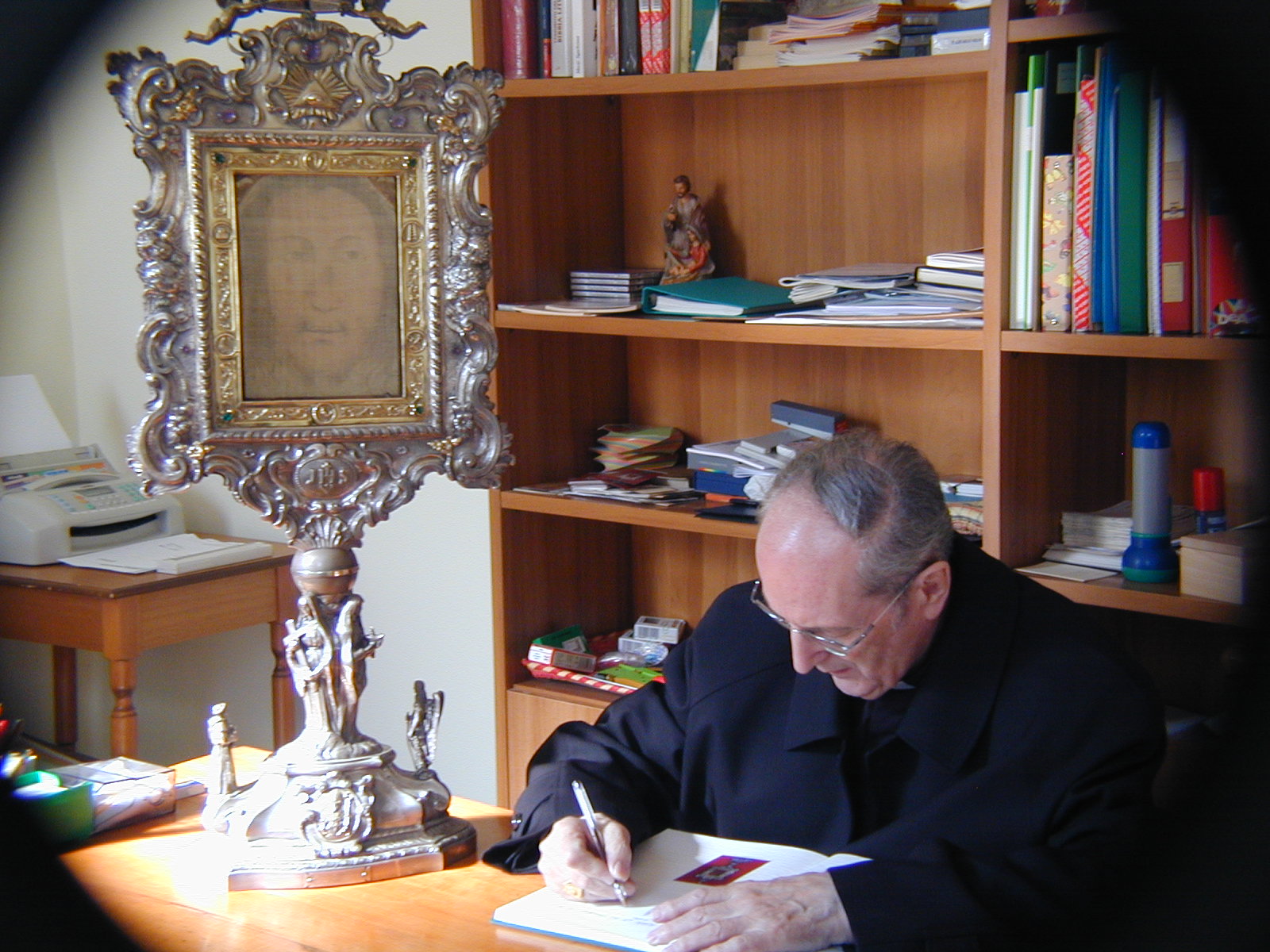
The Holy Face of Manoppello, Italy, and Joachim Cardinal Meisner, 1933-2017. (Photo: Paul Badde/EWTN)
Joachim Cardinal Meisner with Veil of the Holy Face of Manoppello (Photo: Paul Badde/EWTN)
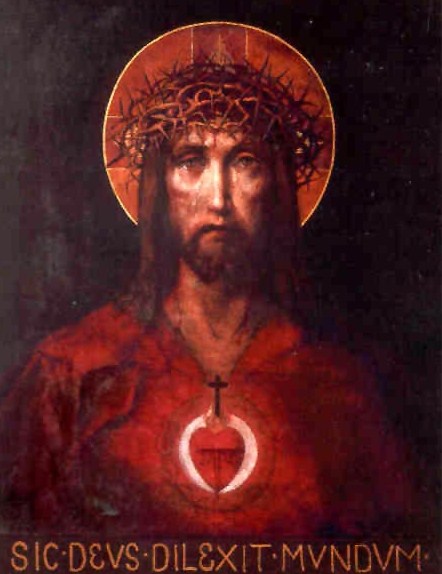
“For God so loved the world”
The late Cardinal Meisner, who had such a deep love and devotion to both the Sacred Heart of Jesus, and the Holy Face on the relic veil of Manoppello, Italy, expressed the connection between the two images so beautifully when he wrote:
“The Face is the monstrance of the heart. In the Holy Face the heart of God becomes visible.” –Joachim Cardinal Meisner, Archbishop of Cologne, April 4, 2005
“The Face is the monstrance of the heart. In the Holy Face the heart of God becomes visible.” –Joachim Cardinal Meisner (Photo: Padde Badde/EWTN)
There are two very important Catholic Feast days in June; the Sacred Heart and Corpus Christi; One celebrating the burning love of Christ for humanity, and the other celebrating reality of His True Presence in the Eucharist. Pope St. John Paul II, who first coined the phrase “Eucharistic Face of Jesus” in referring to the Blessed Sacrament, was pointing to the reality that is hidden by the veil of the Host: Christ is present there, Body, Blood, Soul and Divinity. And so, when we come before the Eucharist, we stand in God’s Presence; we come before His Holy Face as well as His Most Sacred Heart.
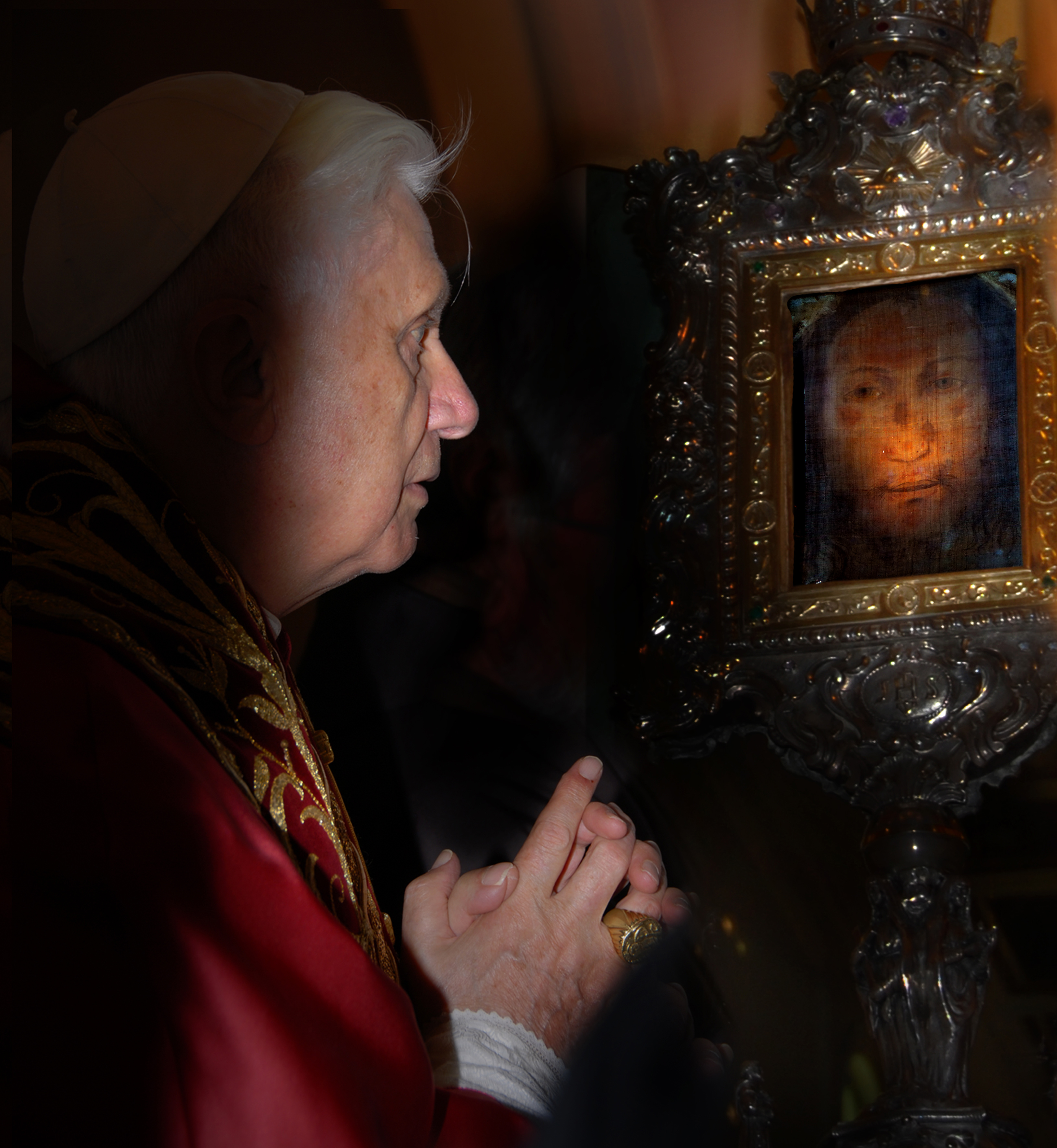
“The Face of Christ is the supreme revelation of Christ’s Mercy.”–Pope Benedict XVI gazing at the Eucharistic Face of Christ. (photo:Paul Badde/EWTN)
Devotion to the Holy Face of Jesus is the door through which we are invited to enter and pass, in Faith. In doing so, we are first reminded of His Sacred Humanity, and that the “Word became flesh” at the Incarnation:
“The Word became flesh and made his dwelling among us. We have seen his glory, the glory of the one and only Son, who came from the Father, full of grace and truth.” (John 1:14)
It is a tremendous gift that is being offered us–to encounter the Person of Our Lord Jesus as we come before His Face. In gratitude for this gift, we can be open to the transformation of our hearts that is wrought by being in the presence of His Most Sacred Heart burning with love for us — even if we are unable to visit the Blessed Sacrament — through His Holy Face–the monstrance of His Heart.
“While we too seek other signs, other wonders, we do not realize that He is the real sign, God made flesh; He is the greatest miracle of the universe: all the love of God hidden in a human heart, in a human Face.” ~ Pope Benedict XVI
The Holy Face of Jesus, is indeed the monstrance of His Heart!
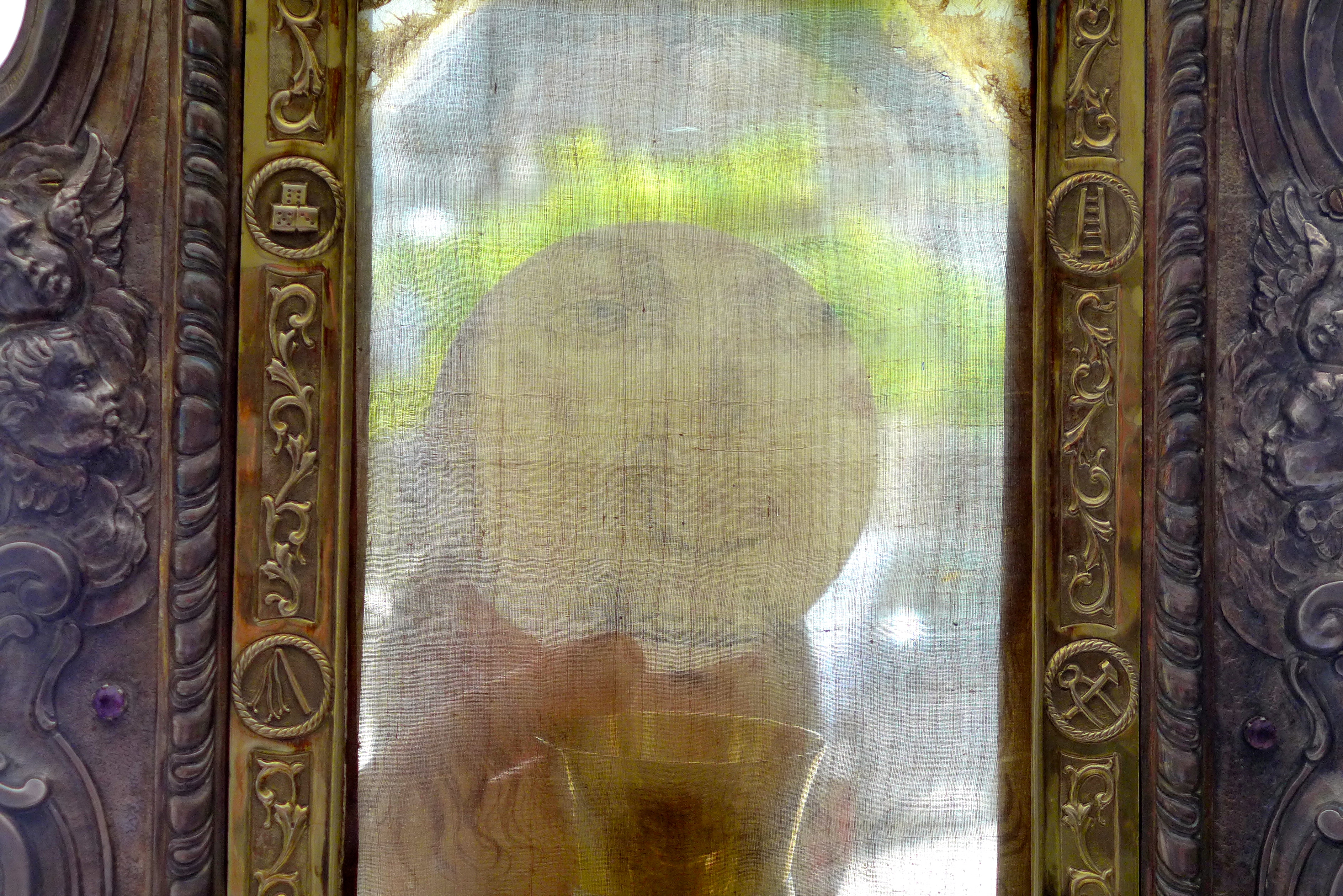
“Christ is the One who looks into our eyes and He wants us to look into His eyes: ‘He who has seen me has seen the Father.’ We are called to see God, we are continually called to look at Christ.” ~Pope St. John Paul II (Hand holding a Host viewed through the Face on Holy Veil of Manoppello in Italy. Photo: Paul Badde/EWTN)
The Radiant sign of the Face of Christ is Jesus’ Real Presence in the Eucharist
On the Solemnity of Corpus Christi, in 2001, Pope St. John Paul II wrote:
The invisible Face of Christ, the son of God, is manifest in His Body and Blood in the simplest and, at the same time, the most exalted way possible in this world.
The ecclesial community responds to people in every age who ask perplexed: “We wish to see Jesus” (Jn 12,21), by repeating what the Lord did for the disciples of Emmaus: He broke the bread. In the breaking of the bread, the eyes of those who seek Him with a sincere heart are opened. In the Eucharist, the intuition of the heart recognizes Jesus and His unmistakable love lived “to the end” (Jn 13,1). And in Him, in that gesture, it recognizes the Face of God!
— Pope St. John Paul II
Pope John Paul II: “The Eucharist is the great school in which we learn to see The Face of God.” “In The Eucharist, The Face of Christ is turned toward us.”
"Jesu, whom I look at shrouded here below,
I beseech thee send me what I thirst for so,
Some day to gaze on thee face to face in light
And be blest for ever with thy glory’s sight. Amen."
--Last Stanza of "Adoro Te Devote"
The Virgin of the Host, by Jean-Auguste-Dominique Ingres
“Jesus, has shown us the Face of God, One in substance and Triune in Persons; God is all and only Love, in a subsisting relationship that creates, redeems, and sanctifies all: Father, Son, and Holy Spirit.”
~Pope Francis
A Discalced Carmelite nun who lived in the mid-1800’s, Sr. Marie St. Pierre, had many interior visions regarding the Holy Face of Jesus — including a sublime conception of the The Holy Trinity and the Holy Face — which she tried to express in these words she received from Our Lord:
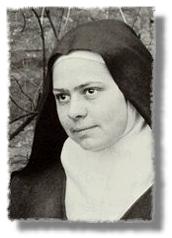
Sr. Marie St, Pierre
“Remember, O my soul, the instruction which thy celestial Spouse has given thee today on His adorable Face! Remember that this Divine Head represents the Father who is from all eternity, that the mouth of this Holy Face is a figure of the Divine Word, engendered by the Father, and that the eyes of this mysterious Face represent the reciprocal love of the Father and the Son; for these eyes have but one and the same light, the same knowledge, producing the same love, which is the Holy Spirit. In his beautiful silken hair contemplate the infinitude of the adorable perfections of the Most Holy Trinity in this majestic head, the most precious portion of the Sacred Humanity of thy Saviour; contemplate the image of the unity of God. This, then, is the adorable and mysterious Face of the Saviour, which blasphemers have the temerity to cover with opprobrium: thus they renew the sufferings of His Passion, by attacking the Divinity of which it is the image.”
Sacred Heart of Jesus, have mercy on us!
Our Lord told Sr. Marie St. Pierre that she could comfort and console Him by her praises, such as in The Golden Arrow Prayer: “May the most holy, most sacred, most incomprehensible and ineffable Name of God be forever praised, blessed, loved, adored and glorified by all the creatures of God, and by the Sacred Heart of Our Lord Jesus Christ in the Most Blessed Sacrament of the Altar. Amen.
Holy Face Veil of Manoppello, Italy (Photo: Paul Badde/EWTN)
“According to the diligence you will manifest in repairing my image disfigured by blasphemers, so will I have the same care in repairing your soul which has been disfigured by sin. I will imprint thereon my image, and I will render it as beautiful as when it came forth from the baptismal font… Oh! could you but behold the beauty of My Face!–But your eyes are yet too weak.” –Our Lord to Sr. Marie St. Pierre
St. Elizabeth of The Trinity
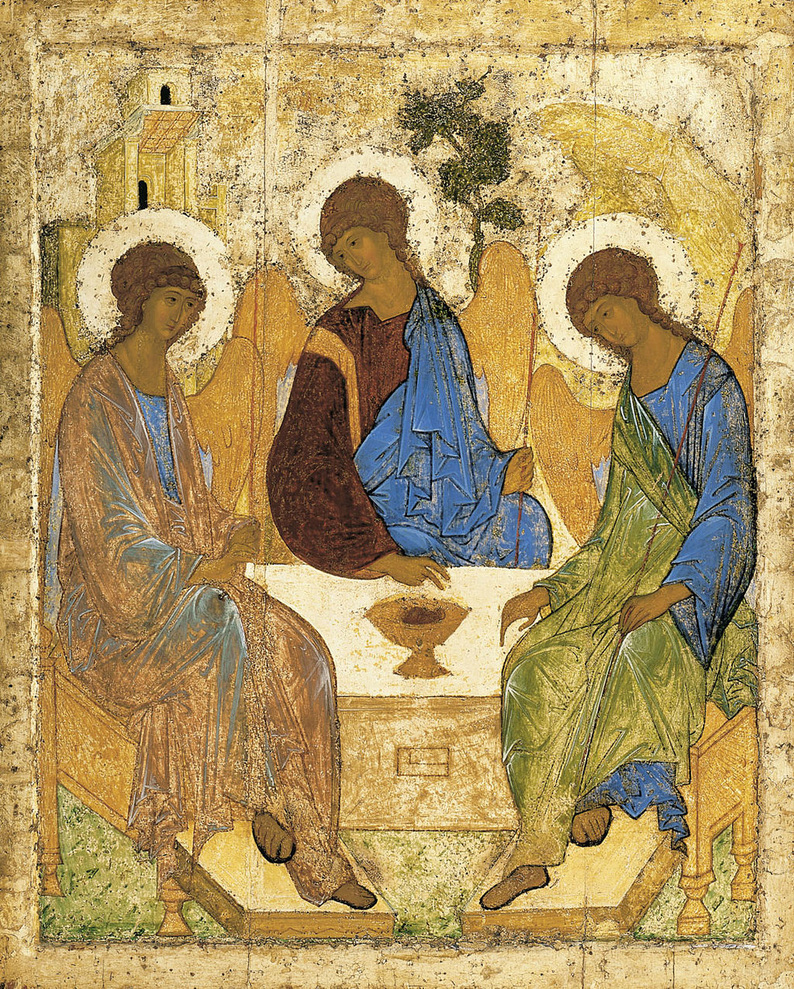
Another Discalced Carmelite Nun, St. Elizabeth of the Trinity, also directs our gaze to the Face of the Son in order to contemplate the beauty of the Holy Trinity and and reflect God’s image:
“It is Your continual desire to associate Yourself with Your creatures…How can I better satisfy Your desire than by keeping myself simply and lovingly turned towards You, so that You can reflect Your own image in me, as the sun is reflected through pure crystal? …We will be glorified in the measure in which we will have been conformed to the image of His divine Son. So, let us contemplate this adored Image, let us remain unceasingly under its radiance so that it may imprint itself on us.” –Saint Elizabeth of the Trinity, O.C.D.
O My God, Trinity Whom I Adore
O My God, Trinity whom I adore, help me to forget myself entirely that I may be established in You as still and as peaceful as if my soul were already in eternity. May nothing trouble my peace or make me leave You, O my unchanging One, but may each minute carry me further into the depths of Your Mystery. Give peace to my soul, make it Your heaven, Your beloved dwelling and Your resting place. May I never leave you there alone but be wholly present, my faith wholly vigilant, wholly adoring, and wholly surrendered to Your creative action. O my beloved Christ, crucified by love, I wish to be a bride for Your Heart; I wish to cover You with glory; I wish to love You…even unto death! But I feel my weakness, and I ask You to clothe me with Yourself, to identify my soul with all the movements of Your Soul, to overwhelm me, to posses me, to substitute Yourself for me that my life may be but a radiance of Your life. Come to me as Adorer, as Restorer, as Savior, O Word Eternal, Word of my God. I want to spend my life listening to You, to become wholly teachable that I may learn all from You. Then, through all nights, all voids, all helplessness, I want to gaze on You always and remain in Your great light. O my beloved Star, so fascinate me that that I may not withdraw from your radiance. O consuming Fire, Spirit of Love, come upon me, and create in my soul a kind of Incarnation of the Word; that I may be another humanity for Him, in which He can renew His whole Mystery. And You, O Father, bend lovingly over your poor little creature; cover her with your shadow, seeing in her only the Beloved in whom You are well pleased. O my Three, my All, my Beatitude, infinite Solitude, Immensity in which I love myself, I surrender myself to You as Your prey. Bury Yourself in me that I may bury myself in You until I depart to contemplate in Your light the abyss of Your greatness. November 21, 1904 — St. Elizabeth of the Trinity
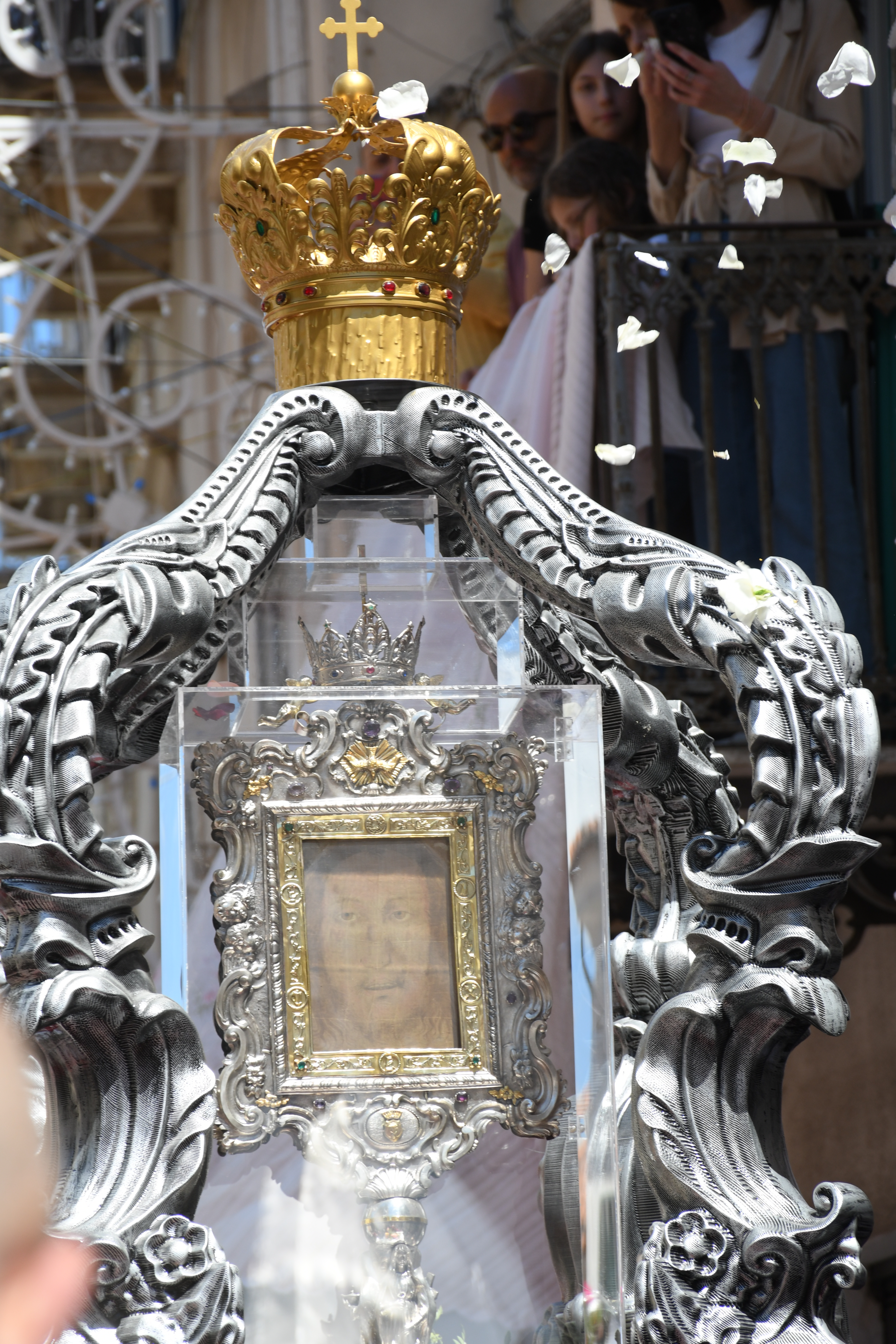
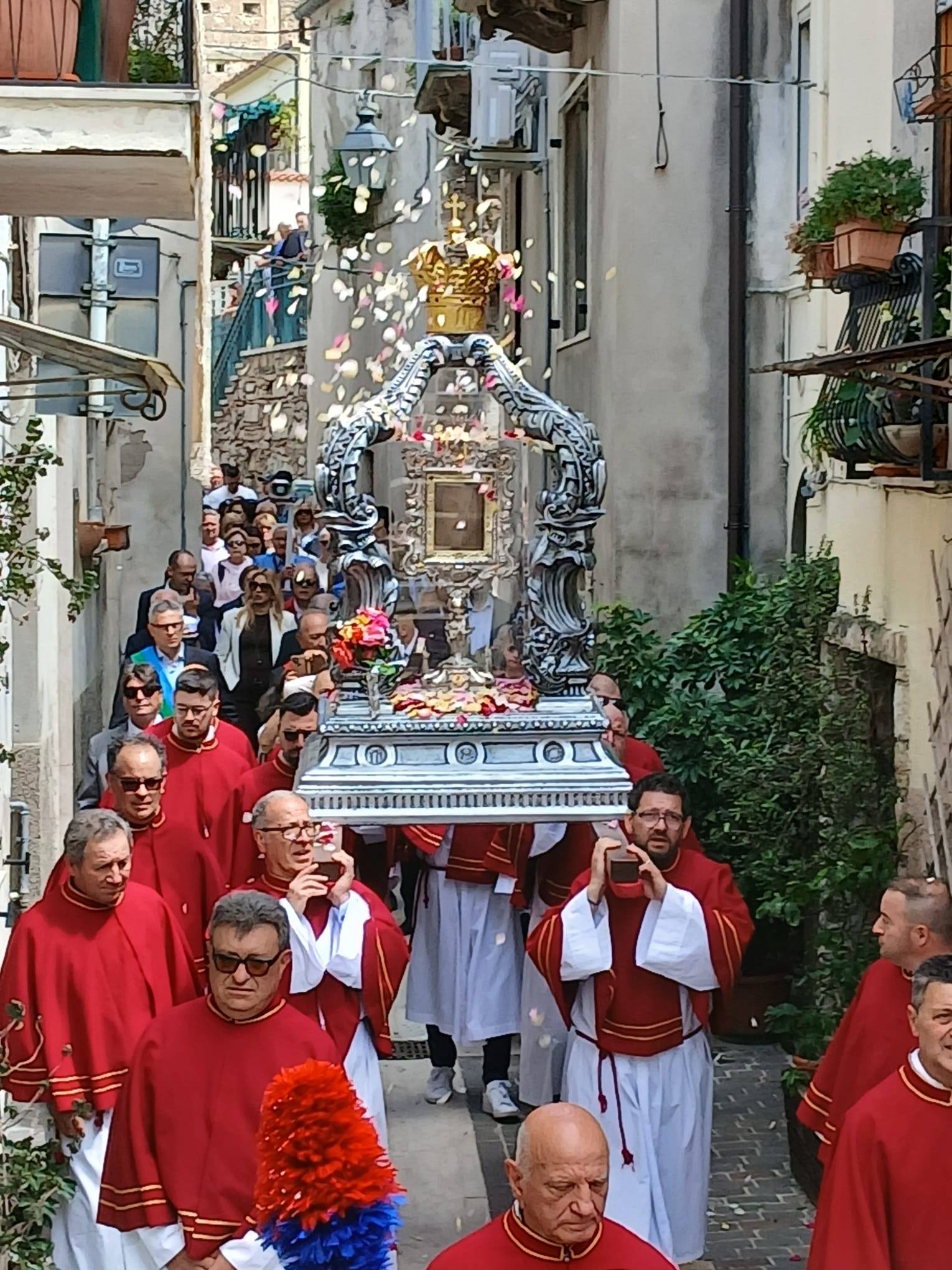
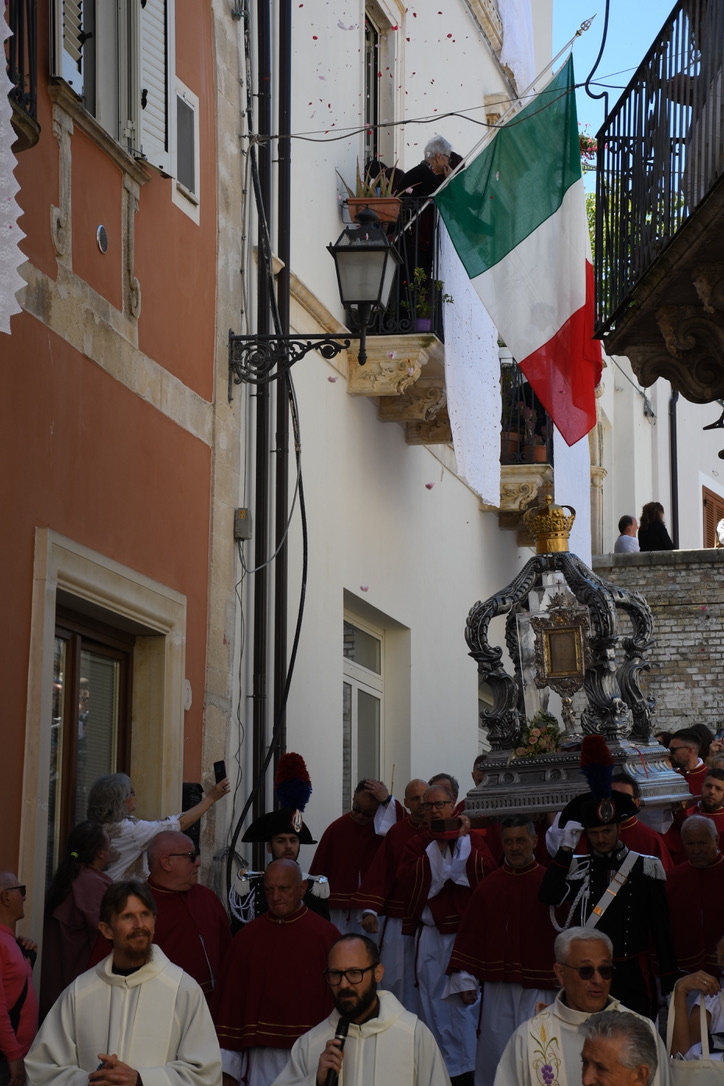
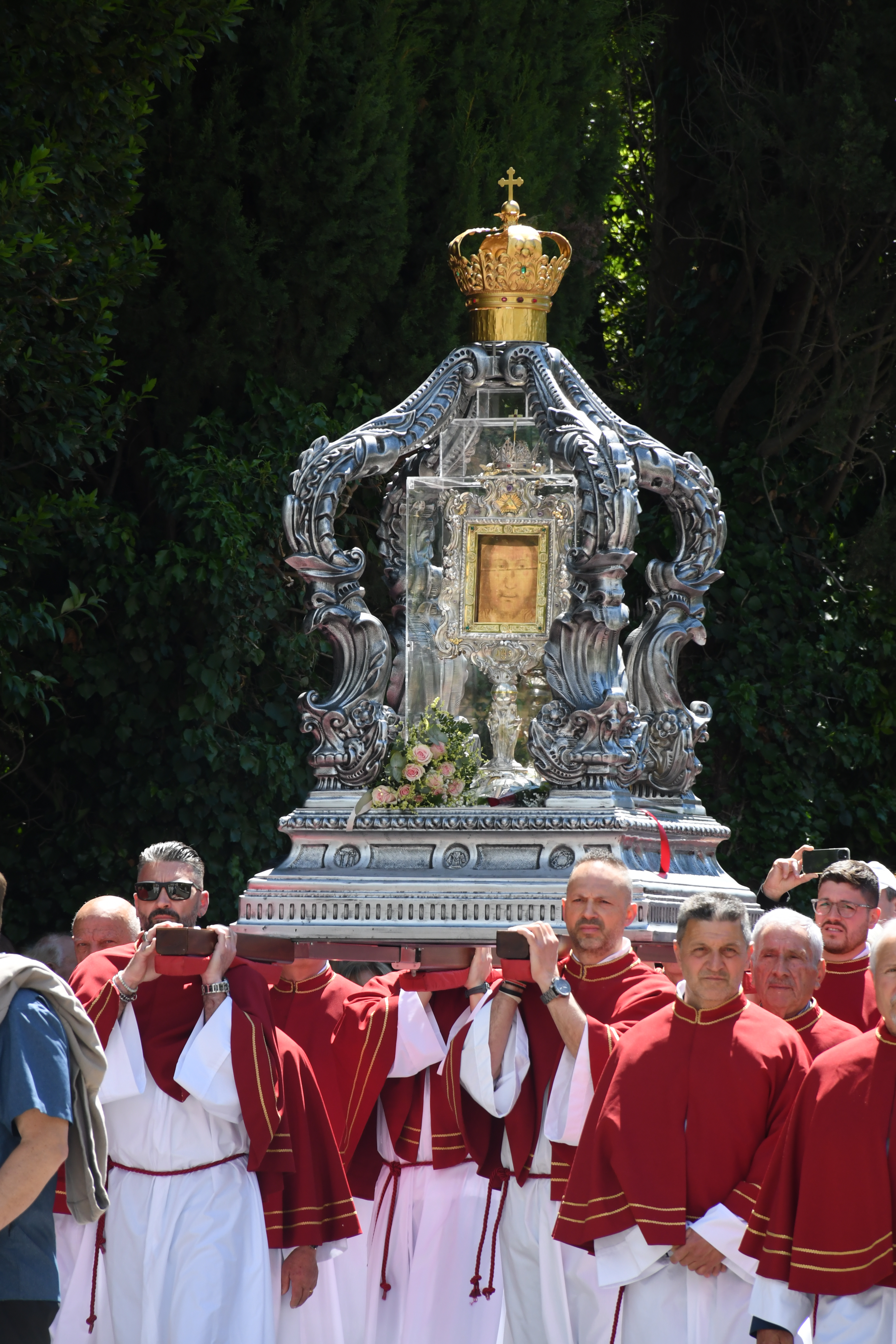
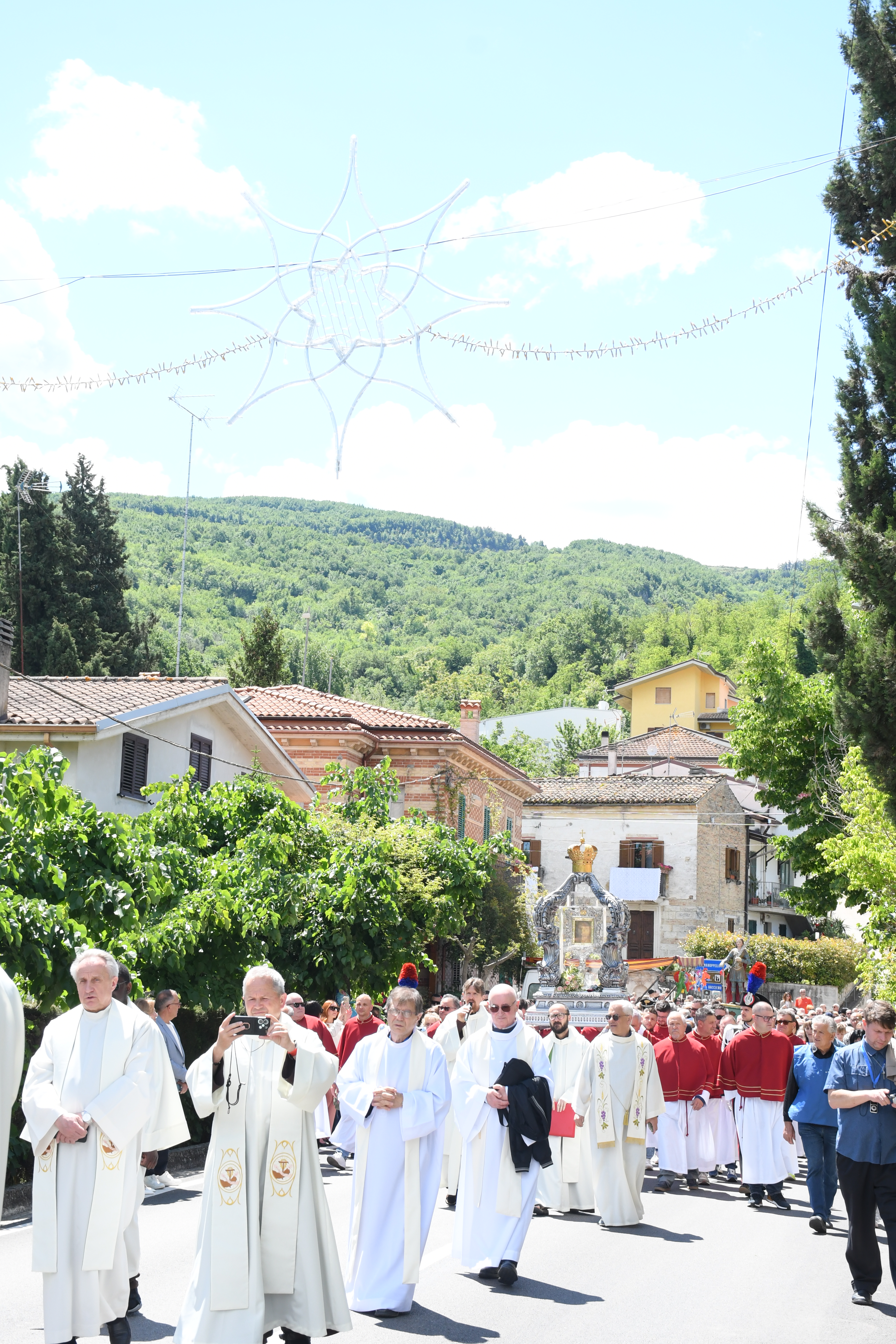
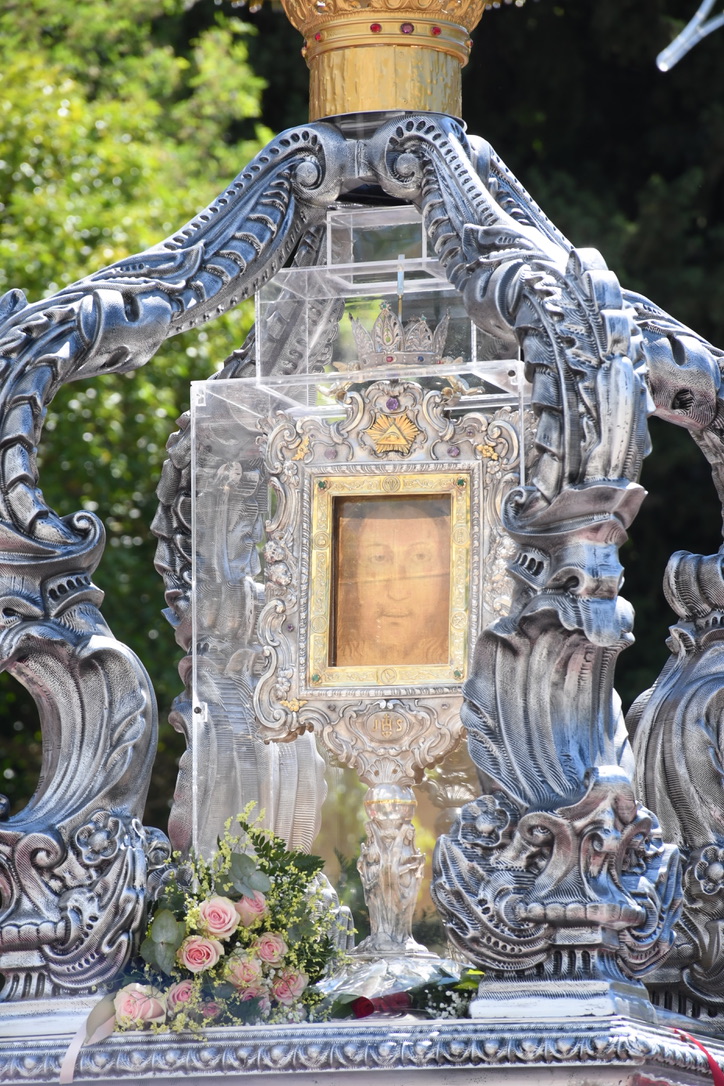
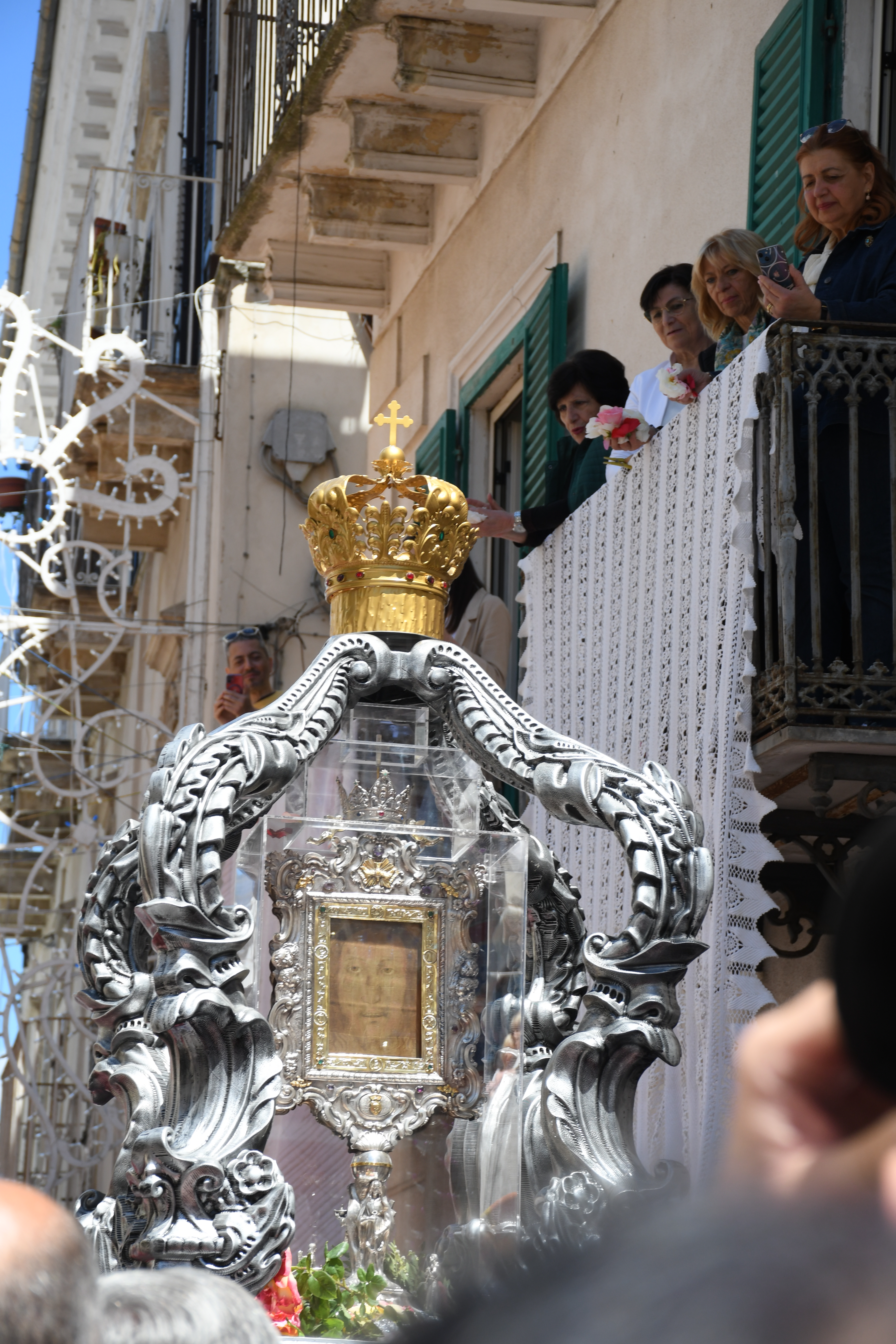
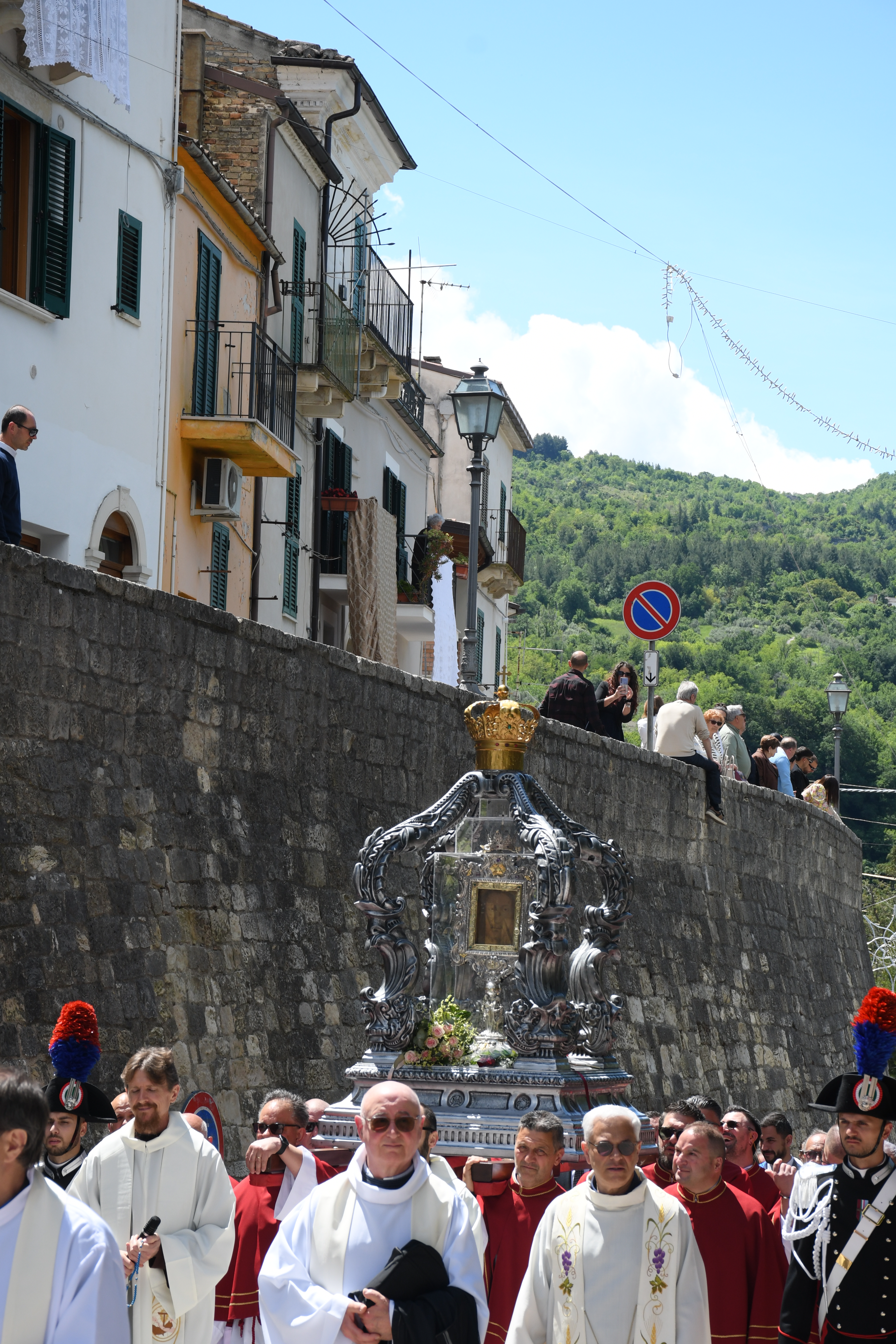
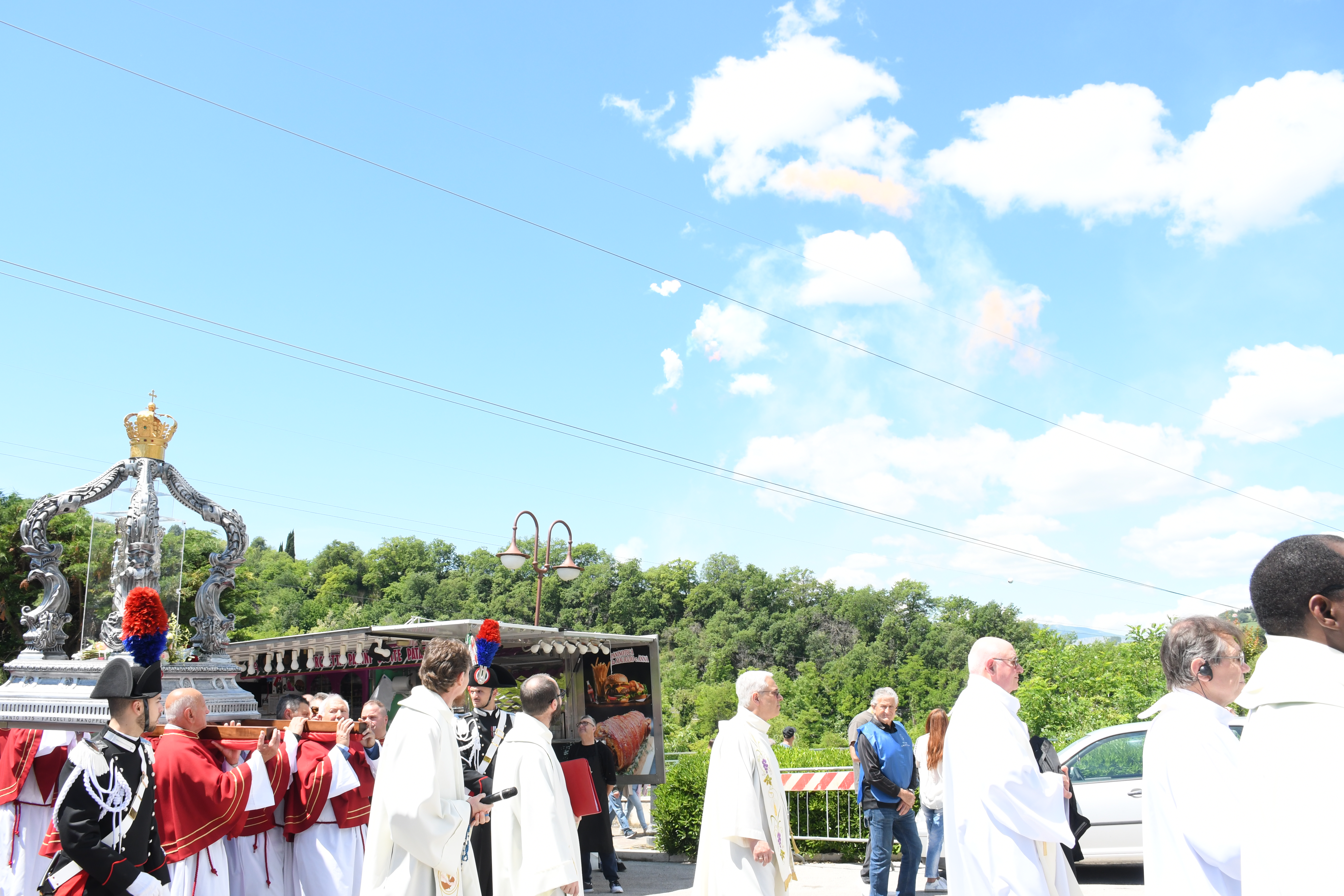
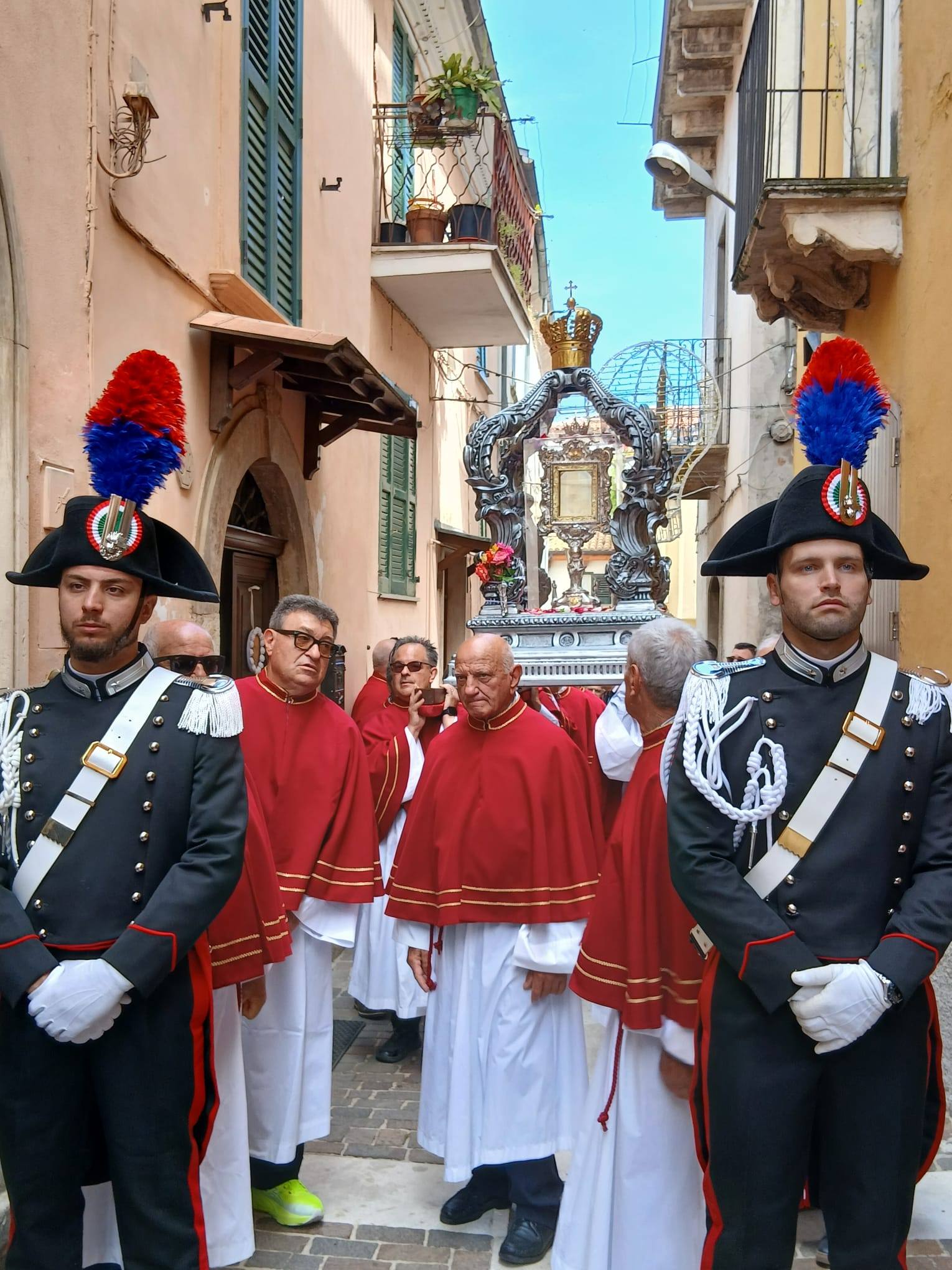
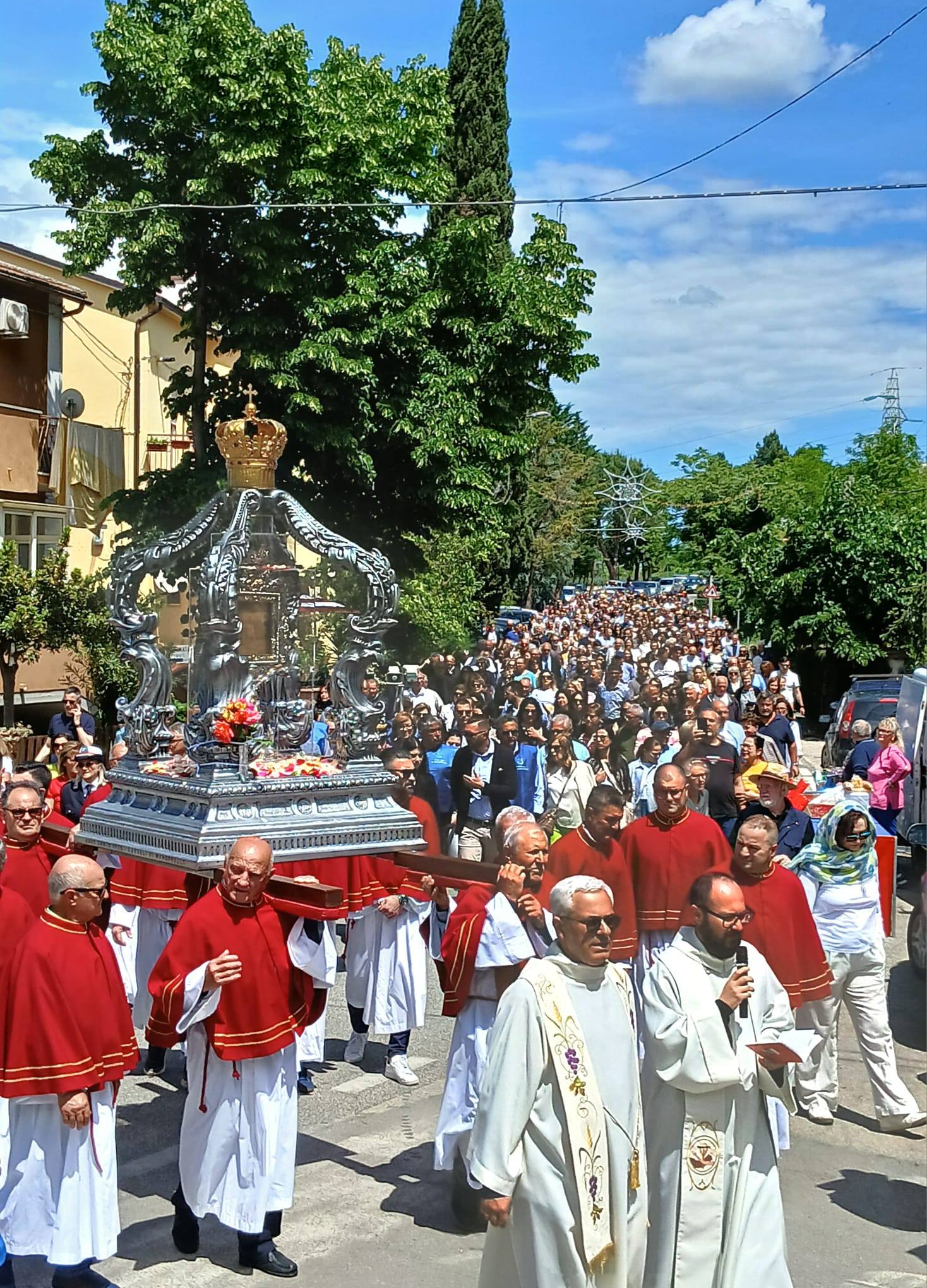
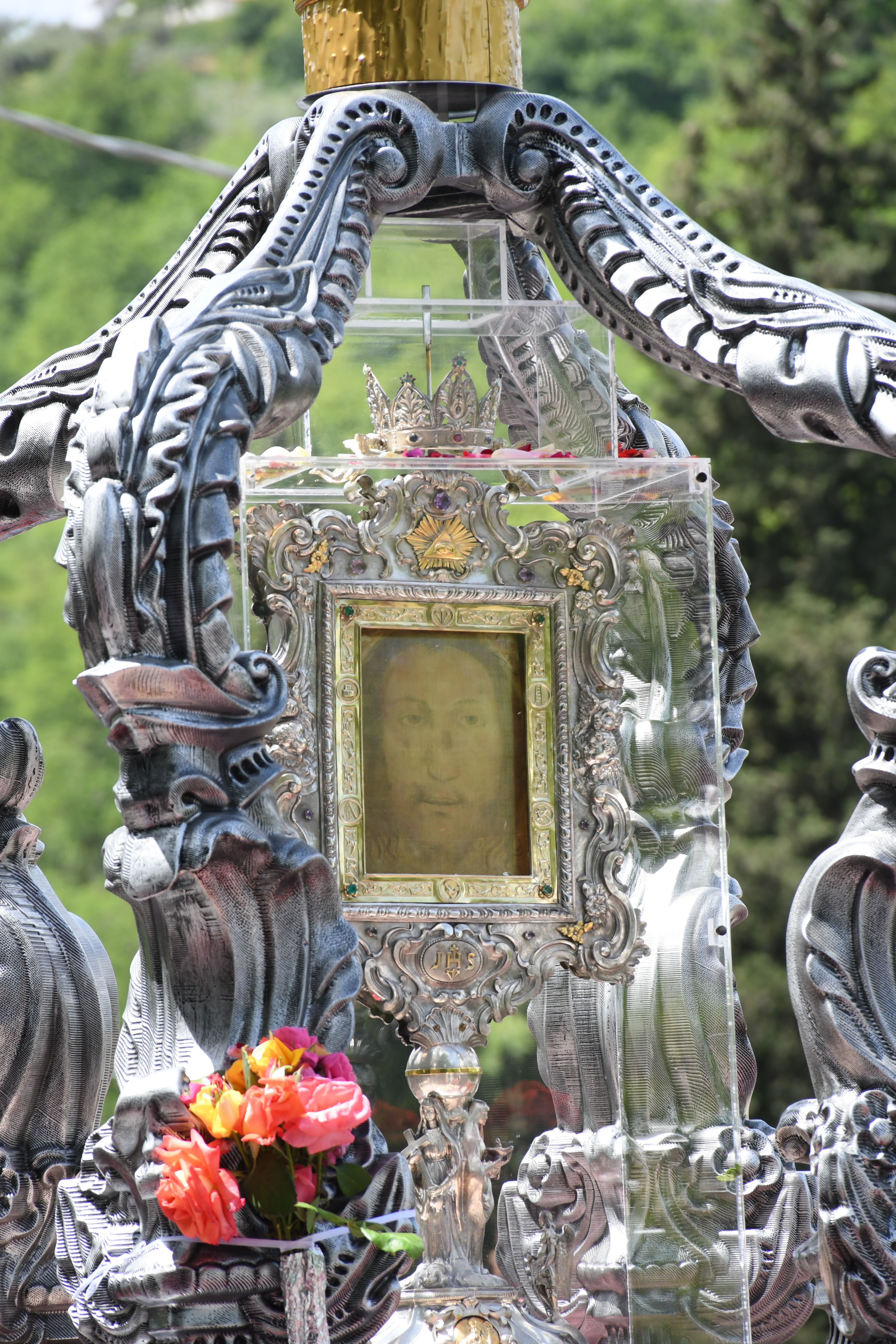
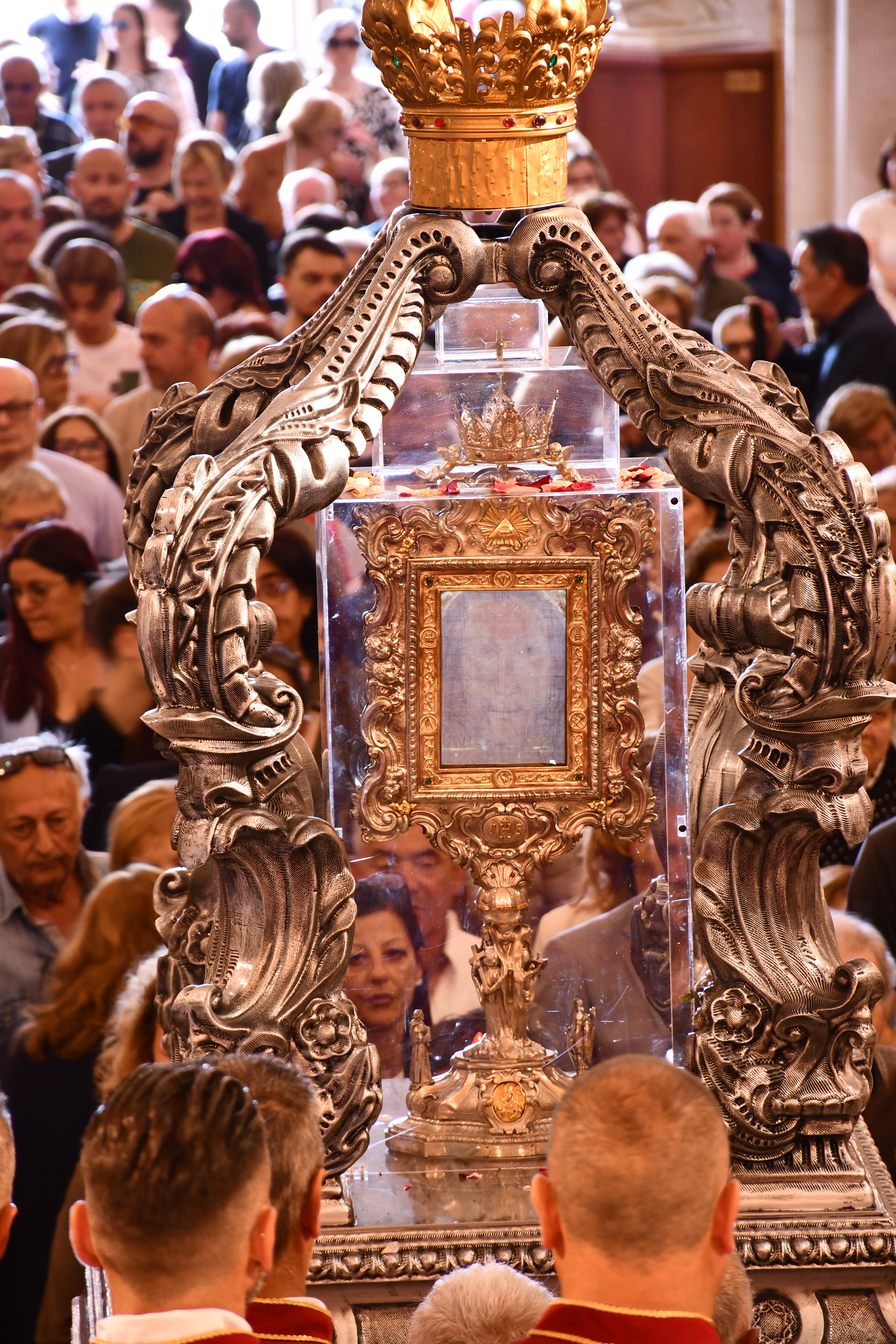
Relic of the Veil of the Holy Face, procession in Manoppello, Italy. Photo: Alexandra Prandell — May 2026
Each May the Basilica Shrine of the Holy Face in Manoppello, Italy, commemorates the mysterious arrival of their most treasured relic — a shimmering, transparent veil which, in a miraculous manner, bears the Holy Face of Jesus. May 15, 16, 17, and 18, 2026 were marked by solemn liturgies, Eucharistic adoration, and processions with the Holy Veil. The centuries-old story behind the joyous celebrations is an incredible one!
This 15th c. painting detail shows the relic veil of “Veronica,” as portrayed by the artist who saw the original at the Vatican before it disappeared from view after the Sack of Rome in 1527. Note the light transparency of the veil and its characteristic folds, the open eyes that gaze to one side or the other. Witnesses at that time described the Face on the Holy Veil as a changing, living image: “transparent, light, dark, bluish, or golden.”
The Vatican Museum now displays the broken Rock Crystal reliquary that held the “Veronica Veil” prior to the Sack of Rome in 1527.
Following the Sack of Rome in 1527, it had been widely reported that the most treasured relic of the Vatican — the “Veronica Veil” — had been stolen. A letter, written to the Duchess of Urbino by her representative Urban, dated May 21, 1527 read: “Holy relics have been thrown out onto the streets. The Veronica has been stolen and passed around in taverns from person to person without a word of protest.” The crystal reliquary that had displayed the sheer veil known as the “Veronica” or true image, was broken and empty. The relic veil was no longer seen in public. When the dust had settled somewhat by 1616, Pope Paul V had prohibited copies to be made of the “Veronica” to be made without permission. Later, Pope Urban VIII ordered that any copies of the Veronica were to be handed in to a local priest or Bishop under pain of excommunication. It appeared to many that a desperate effort was being made to recover that which had been lost.
More than a century later, In 1638, in the Abruzzo mountains, towards the Adriatic coast, “a devout and well-respected man” named Don Antonio Fabritiis donated a precious veil bearing the Face of Christ to the Capuchin monastery in the small, isolated mountain village of Manoppello, Italy. The story, of how the veil arrived and eventually had come into his possession, was carefully recorded and certified in a document entitled Relazione Historica.
The Relazione Historica told of the arrival of the Veil in Mannoppello, Italy, “in May,” around 1506, in the hands of a mysterious stranger who was thought to have been a holy angel, having had suddenly appeared and just as suddenly disappeared, after fulfilling a mission to put a miraculous relic into safe hands. Aside from the “angel,” all the main characters in the story have since been historically verified.
The re-telling the local legend of the Veil was written by Capuchin Donato da Bomba and notarized in 1646 and then, certified by sixteen local witnesses. The unusual number of witnesses — reflected the local peoples deep devotion and protectiveness of relic –also giving legal weight and credence to the miraculous account of the appearance of Holy Veil in Manoppello. However, the Relatzione’s recorded date of 1506 as being the actual date of arrival has been disputed by some. More than a century after the “Veronica Veil” in the Vatican had disappeared, the document seemed to conveniently date the arrival before 1527, thus avoiding the possible sanctions of Pope Paul V and Pope Urban VIII against possessing or copying the “True Image of the Face of Christ.”
The beautiful Basilica Shrine of “Il Volto Santo” –The Holy Face — nestled in the Abruzzo mountains. (Photo: by Paul Badde)
The recorded story told was this: “There lived in Manoppello the very famous Giacomo Antonio Leonelli, doctor in medicine…one day when he was out in the public square just outside of the door of the Mother church of the town of Manoppello, St. Nicholas Bari, in honest conversation with other peers, and while they were speaking a pilgrim arrived unknown by anyone, with a very venerable religious appearance, who having greeted this beautiful circle of citizens, he said, with many terms of manners, and of humility to Dr. Giacomo Antonio Leonelli that he had to speak with him about a secret thing which would be very pleasing, useful and profitable for him. And thus, taking him aside just inside the doorway of the church of St. Nicholas Bari, gave him a parcel, and without unfolding it told him that he ought to hold this devotion very dear, because God would do him many favors, so that in things both temporal and spiritual he would always prosper.” So the doctor took the parcel and turning towards the holy water fount carefully opened it, and “seeing the Most Sacred Face of Our Lord Christ…he burst into most tender tears…and thanking God for such a gift…turned to the unknown pilgrim to thank him…but he did not see him anymore.” When the good doctor, “shaken” and “filled with wonder,” went outside to his friends and asked where the man went, his friends replied that they never saw him exit the church. They searched high and low but never found the mysterious pilgrim, “hence all judged that the man in the form of a pilgrim to be a heavenly Angel, or else a Saint from Paradise.”
The Holy Veil remained the property of the Leonelli family for nearly a century, until a family member in need of money sold the Veil to Don Antonio Fabritiis, who in turn gave it to the Capuchins in 1638. The Holy Veil, called the “Il Volto Santo,” was kept in a dimly lit side chapel until the church was renovated in 1960, when it was decided that the Veil should be moved to a more prominent place behind the altar.
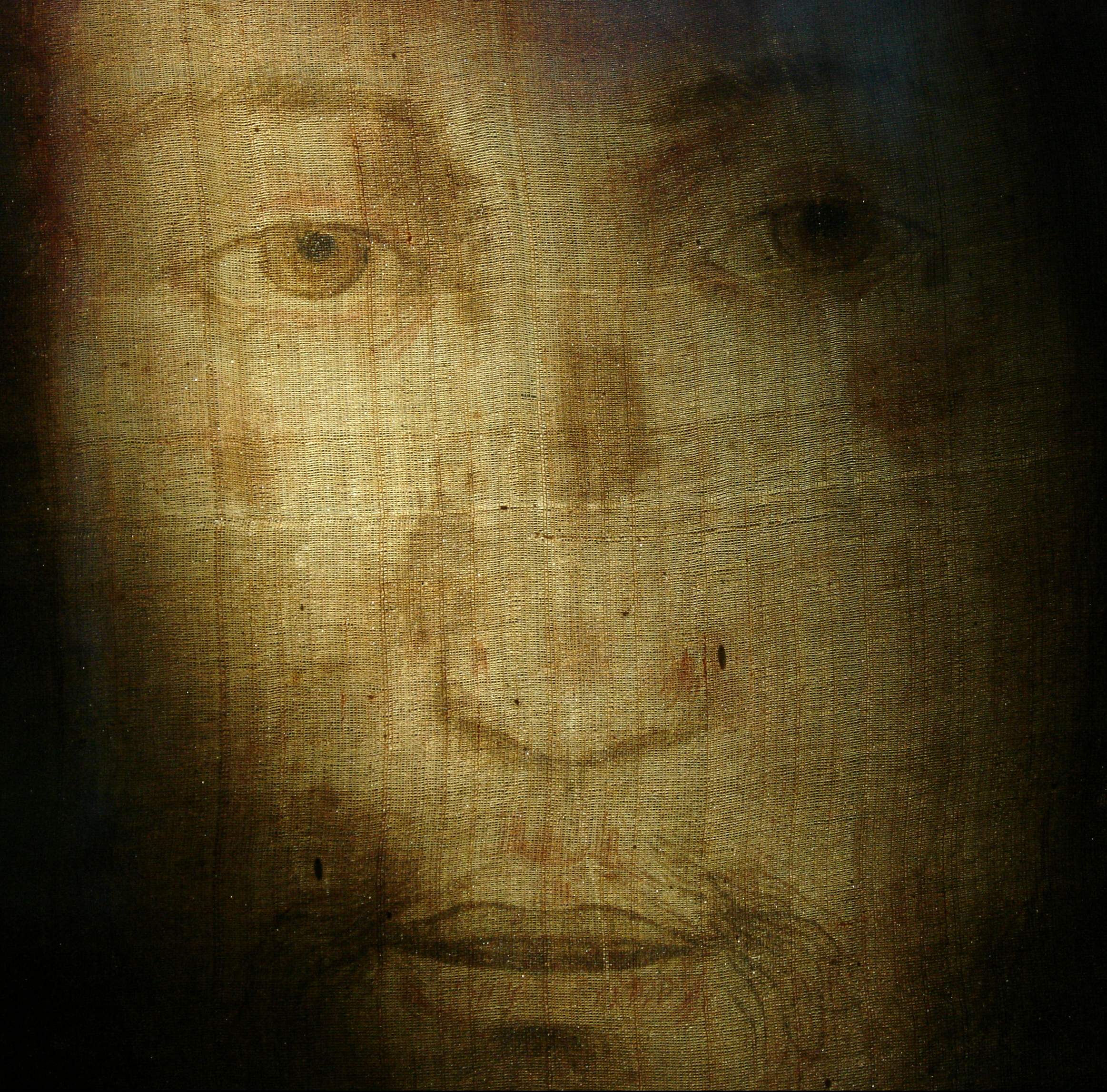
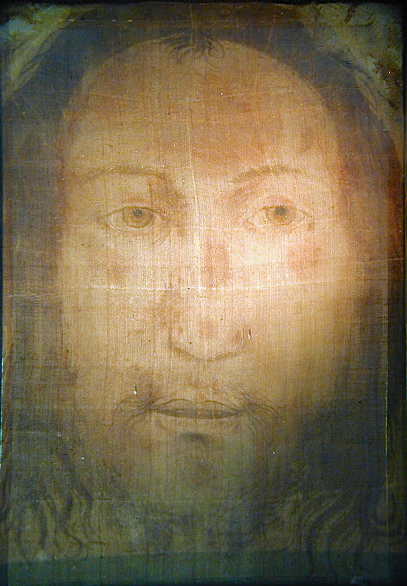
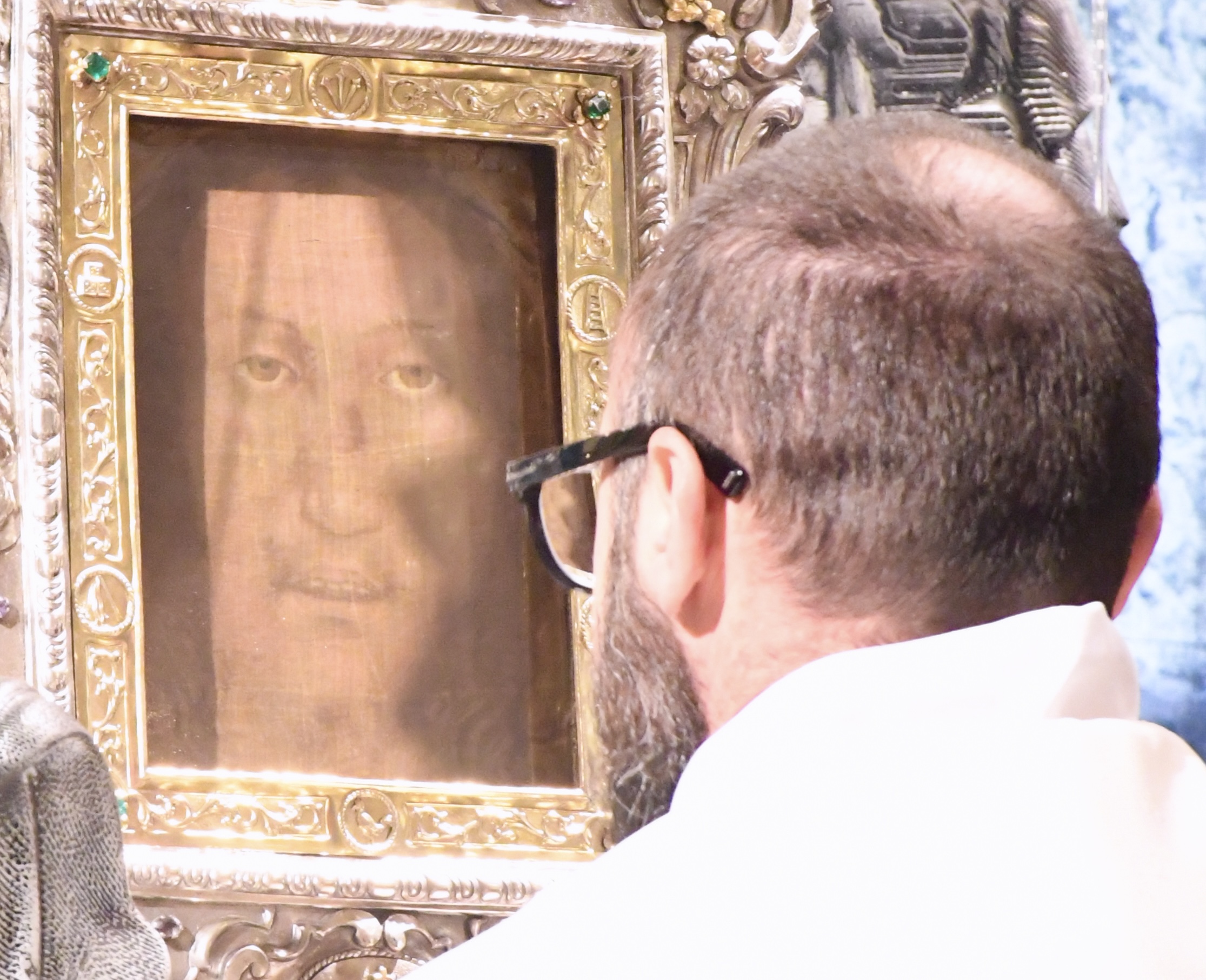
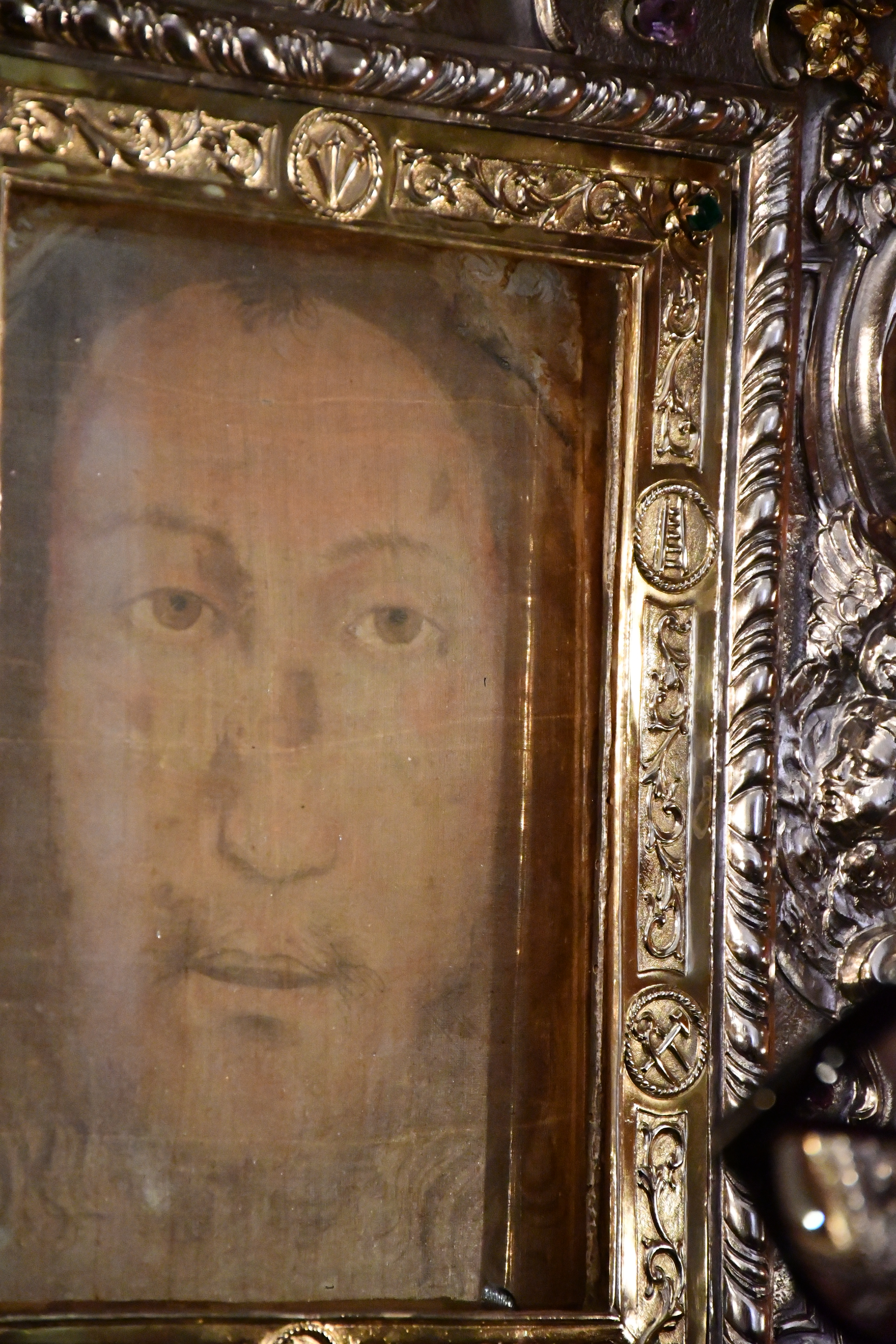
What did the Face on the gossamer-thin Veil look like? Here are portions of a description that Capuchin Donato da Bomba gave of the Holy Face: “He has a rather long, well-proportioned face, with a venerable and majestic look. His hair, or locks are long with thin twisted curls–in particular at the top of the forehead about fifty hairs wind into a little corkscrew, distinct from each other and well arranged. His left cheek is swollen and bigger than the other because of a strong blow across the cheek. The lips are very swollen. His teeth show. It seems the Holy Face is made of living flesh, but flesh that is afflicted, emaciated, sad, sorrowful, pale and covered in bruises around the eyes and on the forehead. The eyes of Christ are similar to those of a dove…He is serene and tranquil.”
Holy Face “Il Volto Santo” of Manoppello, Photo by the late Paul Badde
“Those who gaze on it are never satisfied with contemplating it, and wish to always have it before their eyes. And when they eventually leave it, with heavy sighs full of love, they are forced to leave Him their hearts, bathed in tears.” –Capuchin Donato da Bomba 1646
On September 1, 2006, another pilgrim (some also may say an “angelic pilgrim”) came to Manoppello to see for himself the Holy Face of Jesus on the Veil–Pope Benedict XVI, who has elevated the status of the Shrine to a Sanctuary Basilica. “Your Face O Lord I seek–seeking the Face of Jesus must be the longing of all Christians, indeed, we are ‘the generation’ which seeks His Face in our day, the Face of the ‘God of Jacob.’ If we persevere in our quest for the Face of the Lord, at the end of our earthly pilgrimage, He, Jesus, will be our eternal joy, our reward and glory forever.”–Pope Benedict XVI, September 1, 2006
“Come and you will see”(Jn 1:39) Pope Benedict XVI and the Holy Face of Manoppello
Mille Grazie! to Alexandra Prandell, of Manoppello, who has graciously shared her photos of the May festival in honor of the historic arrival of the Holy Face in Manoppello — enjoy!
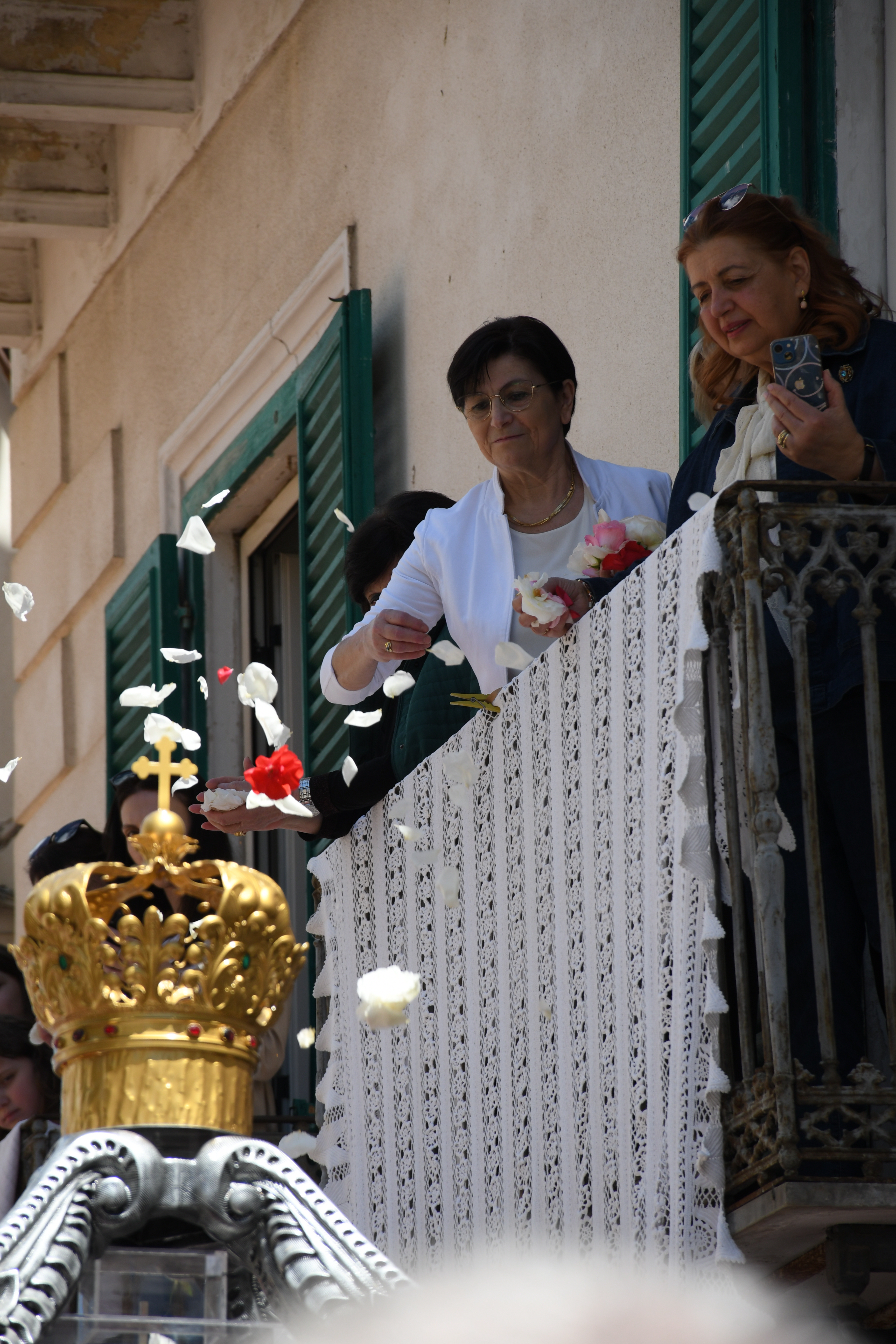
Roses lovingly dropped from balconies upon the relic veil of the Holy Face “Il Volto Santo” as it is processed through the streets. May 2026, (Photo: Alexandra Prandell)
May 2026 “Il Volto Santo” relic procession. (Photo: Alexandra Prandell)
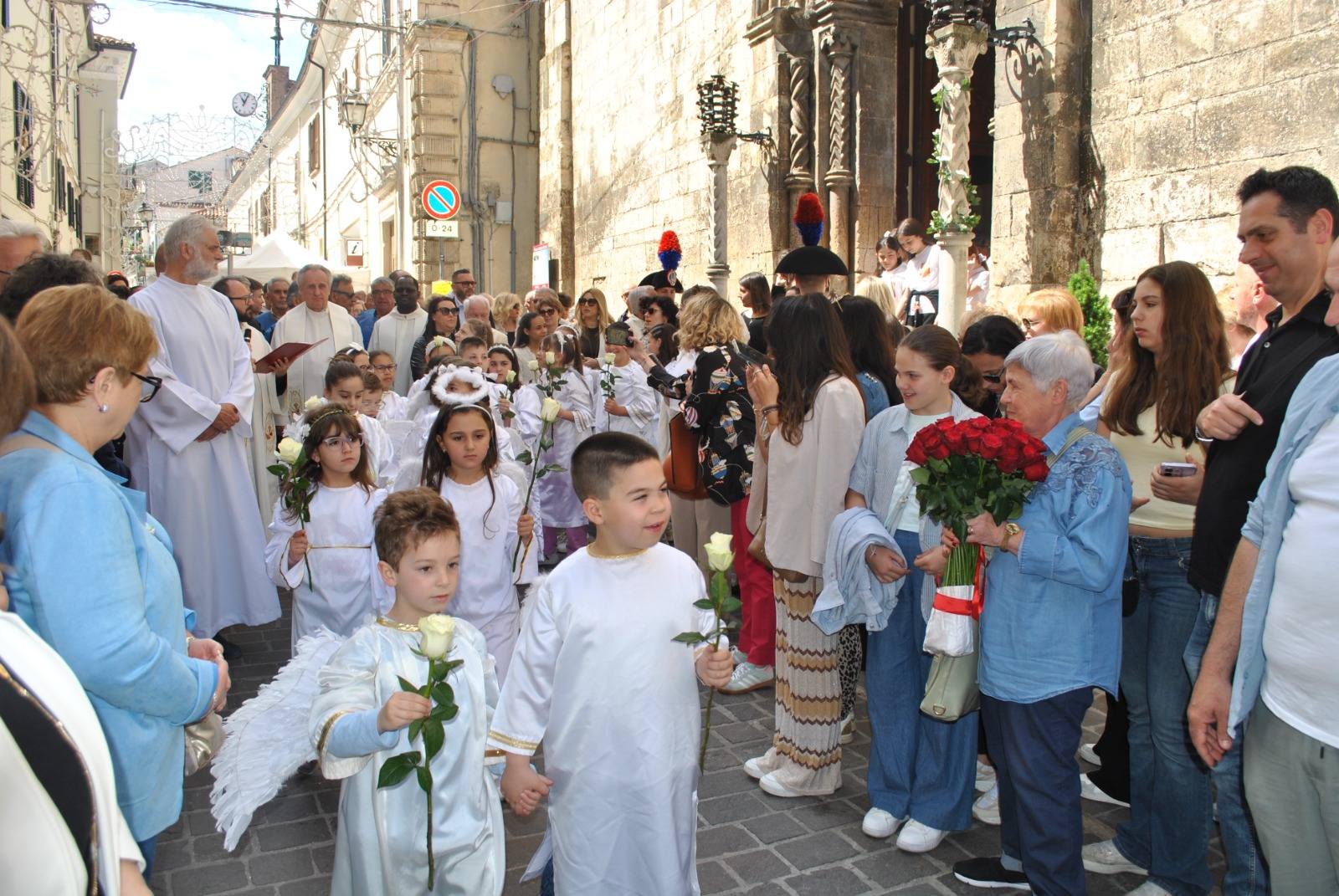
Precious little Angels join in the procession, May 2026. (Photo: Alexandra Prandell)
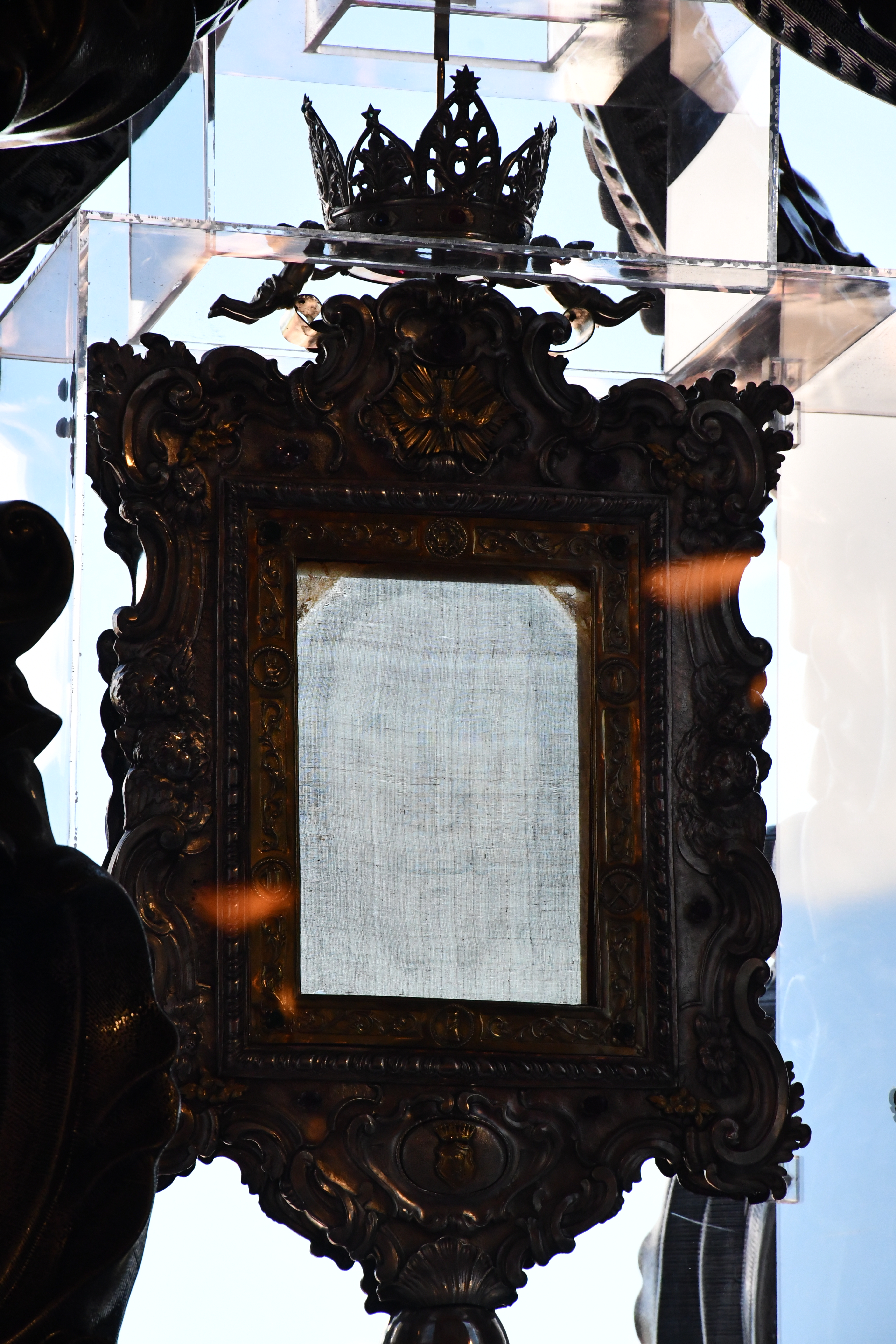
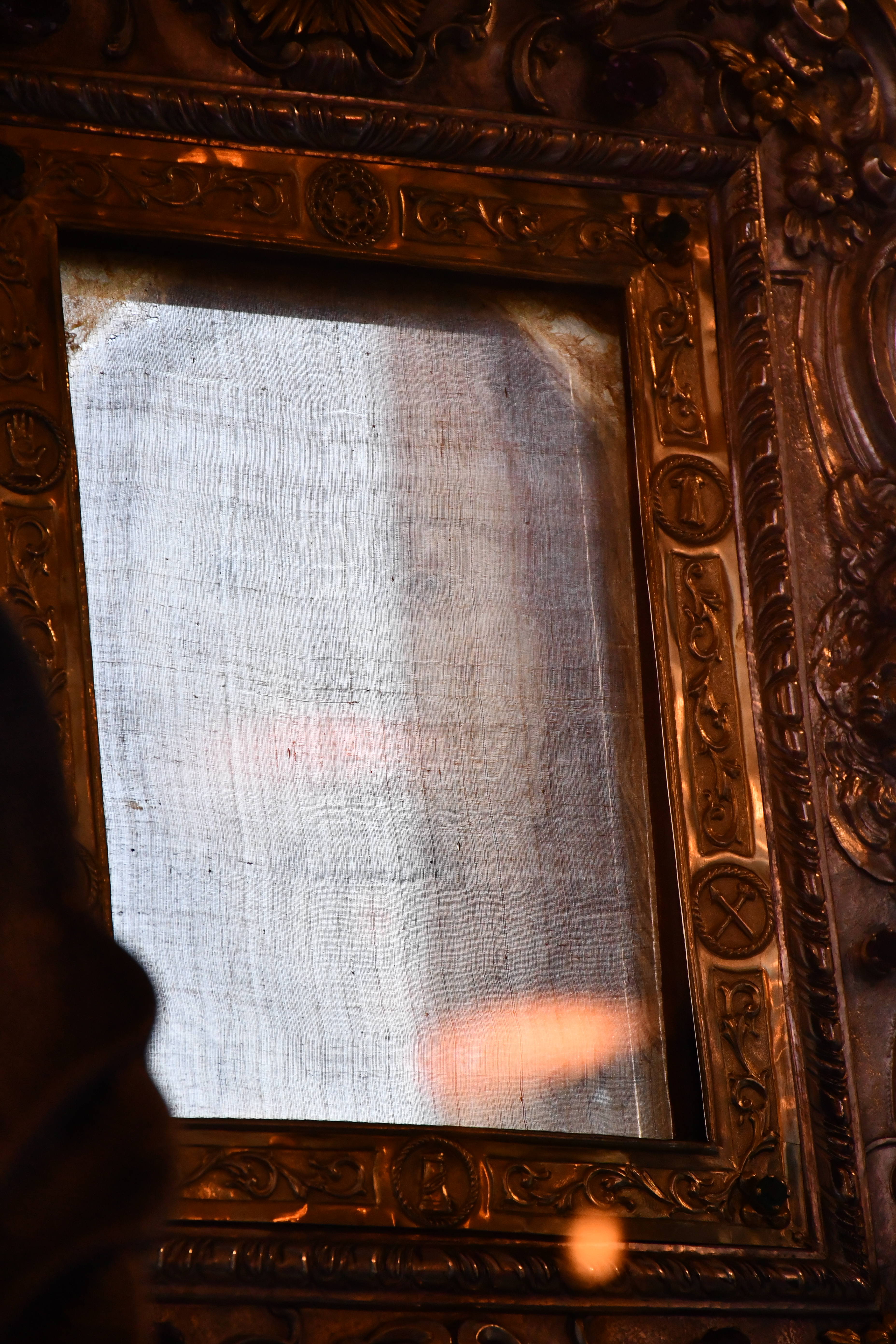
Face barely seen through the delicate fibers of the Holy Veil of Manoppello, May 2026 (Photo: Alexandra Prandell)
Procession with the relic of the Holy Face through the town. (Photo: Alexandra Prandell)
May Procession 2026, Holy Veil of Manoppello, Italy
May 2026 Procession in beautiful Manoppello, Italy. (Photo: Alexandra Prandell)
The Holy Face Veil of Manoppello is an Achieropoieta; “made without human hands,” but by the Hand of God. (Photo: Alexandra Prandell)
May 2026 Procession in Manoppello, Italy (Photo: Alexandra Prandell)
May 2026 Procession in Manoppello, Italy with the relic Veil of the Holy Face. (Photo: Alexandra Prandell)
May 2026 Procession in Manoppello, Italy (Photo: Alexandra Prandell)
The ever-changing Holy Veil of Manoppello! (Photo: Alexandra Prandell)
Padre Antonio Gentili gazes at “Il Volto Santo”–the True Image. May we too, be transformed into His likeness. (Photo: Alexandra Prandell)
“Il Volto Santo” Procession. (Photo: Alexandra Prandell)
“Il Volto Santo” Procession, Mary 2026. Both locals and pilgrims from all over the world came to honor His Holy Face. (Photo: Alexandra Prandell)
“Lord, God of Hosts, restore us; let your Face shine upon us, that we shall be saved!” (Psalm 80) (Photo: Alexandra Prandell)
May the gentle, merciful, peaceful and loving gaze of Our Lord bless you always. (Photo: Alexandra Prandell)
With grateful thanks for all God’s blessings, especially His great gift of the Holy Face Veil of Manoppello! (Photo: Alexandra Prandell)
Act of Consecration to the Holy Face
O Lord Jesus, we believe most firmly in You, we love You. You are the Eternal Son of God and the Son Incarnate of the Blessed Virgin Mary. You are the Lord and Absolute Ruler of all creation. We acknowledge You, therefore, as the Universal Sovereign of all creatures. You are the Lord and Supreme Ruler of all mankind, and we, in acknowledging this Your dominion, consecrate ourselves to You now and forever. Loving Jesus, we place our family under the protection of Your Holy Face, and of Your Virgin Mother Mary most sorrowful. We promise to be faithful to You for the rest of our lives and to observe with fidelity Your Holy Commandments. We will never deny before men, You and Your Divine rights over us and all mankind. Grant us the grace to never sin again; nevertheless, should we fail, O Divine Saviour, have mercy on us and restore us to Your grace. Radiate Your Divine Countenance upon us and bless us now and forever. Embrace us at the hour of our death in Your Kingdom for all eternity, through the intercession of Your Blessed Mother, of all Your Saints who behold You in Heaven, and the just who glorify You on earth. O Jesus, be mindful of us forever and never forsake us; protect our family. O Mother of Sorrows, by the eternal glory which you enjoy in Heaven, through the merits of your bitter anguish in the Sacred Passion of your Beloved Son, our Lord Jesus Christ, obtain for us the grace that the Precious Blood shed by Jesus for the redemption of our souls, be not shed for us in vain. We love you, O Mary. Embrace us and bless us, O Mother. Protect us in life and in death. Amen.
Glory to the Father, and to the Son, and to the Holy Spirit. As it was in the beginning, is now, and will be forever. Amen.
“Write this: before I come as the Just Judge, I am coming first as the King of Mercy.” –Our Lord to St. Faustina
“Jesus Christ is the face of the Father’s mercy. These words might well sum up the mystery of the Christian faith…Whoever sees Jesus sees the Father (cf. Jn 14:9). Jesus of Nazareth, by his words, his actions, and his entire person reveals the mercy of God.” (Misericordiae Vultus)
Divine Mercy in the waters of Baptism
St. Thomas Aquinas wrote in his Summa Theologiae that “It is proper to God to exercise mercy, and he manifests his omnipotence particularly in that way.” The greatness of God’s mercy reveals the great love of a Father for His only begotten Son, Jesus–and in Jesus–His great love for His children through the waters of Baptism. So then, throughout our lives as Christians, “with our eyes fixed on Jesus and his merciful gaze, we experience the love of the Most Holy Trinity.” (Misericordiae Vultus)
St. Faustina “Apostle of Mercy”
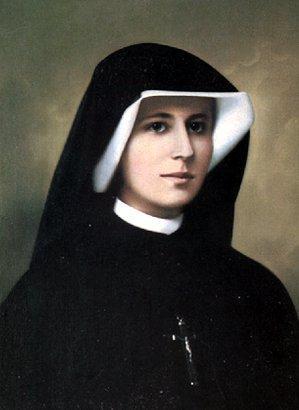
St. Faustina Kowalska, “the Apostle of Mercy” was known as a mystic and visionary. Her diary Divine Mercy in my Soul is a record of the journey of her soul, written under obedience to her spiritual director. Our Lord granted to St. Faustina a deep understanding of the love and mercy of God which she was to share with the world. Jesus emphasized to St. Faustina the need of putting mercy into action, Jesus told her: “I demand from you deeds of mercy which are to arise out of love for me. You are to show mercy to your neighbors always and everywhere. You must not shrink from this or try to excuse yourself from it.” These words of Jesus are meant for each of us as well and are to be carried out by practicing the “Corporal and Spiritual Works of Mercy.” We are called to be merciful to each other and seek the face of Christ in our neighbor. (Click here to answer “What are the Corporal and Spiritual Works of Mercy?)
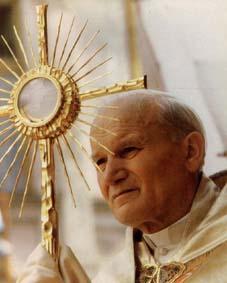
Pope St. John Paul II (CNS Photo)
“At no time…especially at a moment as critical as our own–can the Church forget the prayer that is a cry for the mercy of God. The Church has the right and duty to appeal to the God of mercy ‘with loud cries.'” (Pope St. John Paul II, Rich in Mercy, 15) “No one can escape from the fundamental questions: What must I do? How do I distinguish good from evil? The answer is only possible thanks to the splendor of the truth which shines forth deep within the human spirit, as the Psalmist bears witness: “There are many who say: “O that we might see some good! Let the light of your face shine upon us, O Lord'” (Psalm 4:6).
“The light of God’s face shines in all its beauty on the countenance of Jesus Christ, ‘the image of the invisible God’ (For 1:15), the reflection of God’s glory’ (Heb 1:13), ‘full of grace and truth’ (Jn 1:14). Christ is ‘the way, and the truth, and the life’ (Jn 12:6).'” Consequently the decisive answer to man’s questions in particular; is given by Jesus Christ himself, as the Second Vatican Council recalls: “In fact, it is only in the mystery of the Word Incarnate that light is shed on the mystery of man. For Adam, the first man, was a figure of the future man, namely, of Christ the Lord. It is Christ, the last Adam, who fully discloses man to himself and unfolds his noble calling by revealing the mystery of the Father and the Father’s love.” (Pope St. John Paul II, Veritatis Splendor 1993)
Mary adored Jesus beneath the Eucharistic Veil of the appearance of bread. The Virgin of the Host, by Jean-Auguste-Dominique Ingres
The devotion to the Holy Face has been characterized by Pope Benedict XVI as Discipleship — encountering Jesus in the Face of those in need; The Passion of Jesus, and suffering expressed by images of the Face of Jesus; and in the Eucharist, “the great school in which we learn to see the Face of God, which is woven between the other two. [elements of devotion] “Our whole life should be directed toward encountering Him; toward loving Him.” (Pope Benedict XVI)
In His infinite mercy, Jesus, descends to us in His Most Holy Sacrament of Love. St. Faustina wrote in her diary, “The mercy of God, hidden in the Blessed Sacrament, the voice of the Lord who speaks to us from the throne of mercy [says]: ‘Be not afraid of your Savior; O sinful soul. I make the first move to come to you, for I know that by yourself you are unable to give yourself to me. Child do not run away from your Father; be willing to talk openly with your God of Mercy who wants to speak words of pardon and lavish graces on you. How dear your soul is to me! I have inscribed your name upon my hand; you are engraved as a deep wound on my heart.” (Divine Mercy in My Soul, (1485)
We each have a precious opportunity that God has given us at this particular time in history to be instruments of His mercy, and to plead “with loud cries” for God’s “mercy on us and on the whole world.”
“This Mercy of God which has a concrete face, [is] the Face of Jesus, the risen Christ.” –Pope Francis
“Mercy has become living and visible in Jesus of Nazareth, reaching it’s culmination in Him…We need to constantly contemplate the mystery of mercy. It is a wellspring of joy, serenity, and peace. Our salvation depends on it…The mission Jesus received from the Father was that of revealing the mystery of Divine Love in its fullness. ‘God is love’ (1 Jn 4:8,16).'” (Misericordiae Vultus)
“Jesus is the face of the mercy of God the Father: ‘God so loved the world […] [that] the world might be saved through him [the Son]” (John 3:16, 17)
“The contemplation of Christ’s Face cannot stop at the image of the Crucified One. He is the Risen One!”~St. Pope John Paul II (Photo of the Holy Face of Manopello, Italy: Patricia Enk)
“Show us, O Lord, we pray you,, Your Face ever new; that mirror, mystery-laden, of God’s infinite mercy. Grant that we may contemplate it with the eyes of our mind and our hearts: the Son’s face, radiance of the Father’s glory and the imprint of His Nature (cf. Hb 1:3), the human Face of God that has burst into history to reveal the horizon’s of eternity. The silent Face of Jesus, suffering and risen, when loved and accepted changes our hearts and lives. ‘Your Face, Lord do I seek, do not hide Your Face from me. ‘ (Psalm 27, 8ff)” (Excerpt from the Prayer of Pope Benedict commemorating his pilgrimage to the Holy Face of Manoppello, Sanctuary in Manoppello, Italy. “That mirror mystery-laden of God’s infinite mercy!”2006)
Vera Icon, painted from the Holy Veil in the Vatican, which served as a model, by Meister von Sankt Lorenz, around 1415, nearly 100 years before the “Veronica” or “True Image/or Vera Icon” was said to have been stolen during the Sack of Rome. in 1527. (Photo: Paul Badde)
St. Veronica with the Sudarium C. 1480-1500
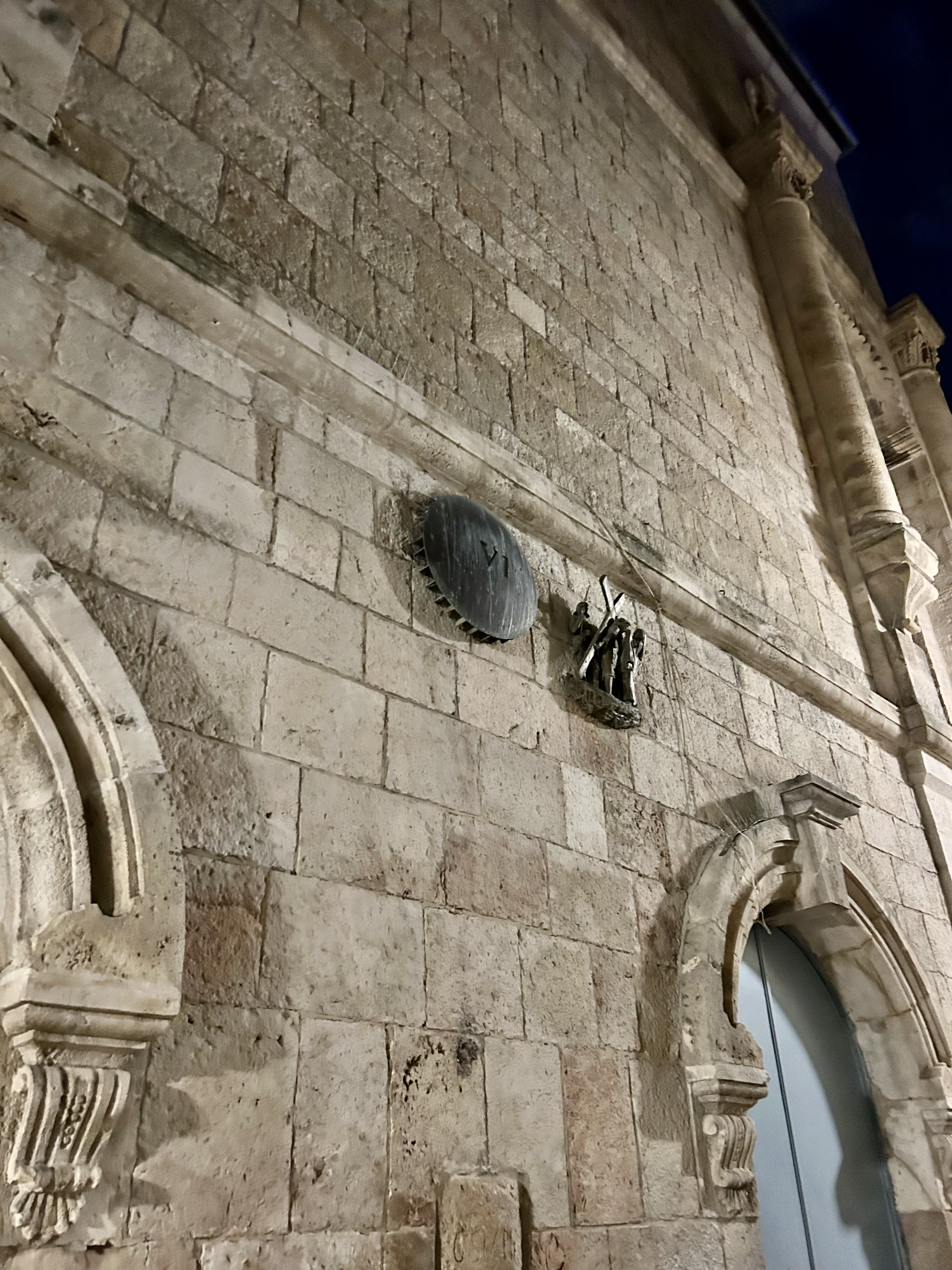
Was there actually a St. Veronica? It is an important question, and a very personal one to me and many others. According to tradition, “Veronica,” is the compassionate woman who wiped the Face of Jesus, who is commonly depicted in every Catholic church, at the Sixth Station of the Cross, yet her name does not appear in the Gospels, and the legends did not appear until the Middle Ages.
Pope St. John Paul II pondered this very question many years before dedicating the Millennium to the Holy Face of Jesus. The fruit of his prayerful contemplation unveils a profound truth for every Christian as he answers another question; What does it mean to be “a Veronica?”
The Sixth Station on the Via Dolorosa in Jerusalem
Veronica’s Veil, Flemish 15th Century–painted with the characteristic folds that are also found only on the Holy Veil of Manoppello.
“St. Veronica”
The Catholic Church tells us that a veil bearing a miraculous image of the Face of Jesus has existed since the earliest centuries, recorded in history and in art, such as the Camulia, or the Mandylion. Explanations for the existence of such a veil were all different (see “Four Stories, One Face“). About the time this miraculous veil first appeared in Rome, the name “Veronica” referred to the veil itself, and not a person–“Veronica” meaning “vera” or true, and “icon” meaning image, or even more precisely, “to be present.” Those who gazed upon the veil bearing the true Face of Jesus stood in God’s presence. They were turned toward His Face. The Veil became the greatest relic that Pilgrims traveled to see in the Vatican.
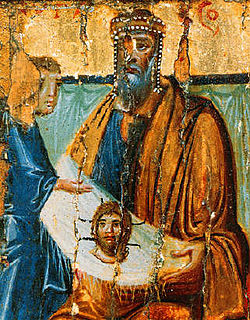
King of Edessa receiving the miraculous veil from St. Jude, and was healed of leprosy.
“Veronica” holding a sheer veil bearing the living Face of Christ on a sheer veil with distinctive folds.
Legends sprang up much later, in the Middle Ages, about a woman named “Veronica,” who was sometimes associated with the woman “Berenice” or “Bernice,” the bleeding woman who touches the hem of Jesus’s garment in the Gospel. There is a version, written in 1191 by Robert de Boron, that tells of a woman named “Veronica” wiping sweat from the Face of Jesus. The stories are many and varied, but the legend that most people are familiar with today is traced to a version by Roger d’Argenteuil in the 1300s, which tells of a woman “Veronica,” associated with the sixth station of the Cross–the compassionate woman, wiping the Face of Jesus on the way to Calvary with a cloth, upon which He leaves an image of His Face.
“These pious traditions cannot be documented, but there is no reason why the belief that such an act of compassion did occur should not find expression in the veneration paid to one called Veronica.” —The Catholic Encyclopedia
What did the Veil look like? A “living, changing, face” on a sheer veil, with distinctive folds, that could be viewed from either side; the eyes are open and glance to one side or the other; a lock of hair graces the center of the forehead; a sparse beard, wavy hair, as well as signs of bruising and trauma to the face are seen…. which despite the obvious suffering, remains peaceful and serene.
The Holy Veil of Manoppello- photo: Paul Badde/EWTN
Pope St. John Paul II expressed the answer to this profound question addressing the origin of the name of Veronica most beautifully in his poem, “The Name:”
The Name
In the crowd walking towards the place
[of the Agony]–
did you open up a gap at some point or were you
[opening it] from the beginning?
Veronica’s Veil by Hans Memling
And since when? You tell me, Veronica.
Your name was born in the very instant
in which your heart
became an effigy: the effigy of truth.
Your name was born from what you gazed upon.
–Karol Wojtyla
Miraculous Holy Face Veil Photo: Paul Badde (see “Manoppello Image” tab)
Since the detailed historical facts about the veil itself cannot be verified with absolute certainty in this life, the more important and answerable question is, “What does it mean to be a Veronica–a “true image?”
“Your name was born from what you gazed upon.”
When a soul performs an “act of compassion,” Jesus leaves His image on the “veil” of the soul. In other words, while contemplating the Face of Jesus in an image, in the Word of God in the Scriptures, in a person made in the image and likeness of God, or above all, in the Eucharist, the soul places itself in the Presence of God. When we are turned completely toward the Face of God, through a daily face-to-face encounter in prayer–by the power of the Holy Spirit–God gradually transforms the soul into the “True Image” of His Son, Jesus Christ. As Pope St. John Paul II says, our hearts must become an “effigy of truth,” a “true icon.” Then our name too will be born from what we gaze upon. It will be “Veronica.”
The Deepest Truth About St. Veronica
St. Veronica statue by Francesco Mochi, 1629
Within the center of St. Peter’s Basilica are four massive niches. In each niche there are four titanic statues of saints, standing 10 meters high: St. Andrew, the first disciple called by Christ, St. Longinus, the soldier who pierced Jesus’s side with his lance, St. Helena, who discovered the True Cross. The fourth statue depicts “St. Veronica,” an unknown woman, not mentioned in the Bible, yet immortalized in every Catholic church at the Sixth Station of the Cross, for her act of compassion to Jesus who left the image of His Face on her veil. (The relic that is now in the Veronica Pilar is quite different in description than what was previously recorded–a mystery yet to be solved. More may be read on the subject here: The Church, Testing of Relics, and the Holy Face)
Pope St. John Paul II wrote this beautiful meditation on St. Veronica in 2000, the same year in which he dedicated the millennium to the Face of Christ:
Sixth Station, St. Theresa Church, Ashburn, Virginia
“Veronica does not appear in the Gospels. Her name is not mentioned, even though the names of other women who accompanied Jesus do appear. It is possible, therefore, that the name refers more to what the woman did. In fact, according to tradition, on the road to Calvary a woman pushed her way through the soldiers escorting Jesus and with a veil wiped the sweat and blood from the Lord’s face. That face remained imprinted on the veil, a faithful reflection, a “true icon”. This would be the reason for the name Veronica. If this is so, the name which evokes the memory of what this woman did carries with it the deepest truth about her.
One day, Jesus drew the criticism of onlookers when he defended a sinful woman who had poured perfumed oil on his feet and dried them with her hair. To those who objected, he replied: “Why do you trouble this woman? For she has done a beautiful thing to me . . . In pouring this ointment on my body she has done it to prepare me for burial” (Mt 26:10, 12). These words could likewise be applied to Veronica. Thus we see the profound eloquence of this event.
The Redeemer of the world presents Veronica with an authentic image of his face. The veil upon which the face of Christ remains imprinted becomes a message for us.
In a certain sense it says: This is how every act of goodness, every gesture of true love toward’s one’s neighbor, strengthens the likeness of the Redeemer of the world in the one who acts that way. Acts of love do not pass away. Every act of goodness, of understanding, of service leaves on people’s hearts an indelible imprint and makes us ever more like the One who “emptied himself, taking the form of a servant” (Phil 2:7). This is what shapes our identity and gives us our true name.” –Pope St. John Paul II
This is the deep meaning and call to every Christian revealed in the presence of the unknown woman we call “St. Veronica”– each act of charity, every act of compassion will leave the imprint of the Face of Jesus in our souls, transforming us into His own Image.
Pope Benedict XVI looks at the ‘Veronica’s Veil’ during a visit to the Holy Veil monastery in Manoppello, central Italy, September 1, 2006.
Pope Benedict wrote, “To rejoice in the splendor of His Face means penetrating the mystery of His Name made known to us in Jesus, understanding something of His interior life and of His will, so that we can live according to His plan for humanity. Jesus lets us know the hidden Face of The Father through His human Face; by the gift of The Holy Spirit poured into our hearts.” This, the Pope says, is the foundation of our Peace, which nothing can take from us.
Benedict XVI has characterized devotion to The Holy Face as having three separate components: 1. Discipleship – an encounter with Jesus, to see Jesus in the Face of those in need. 2. The Passion of Jesus, and suffering expressed by images of the wounded Face of Jesus. 3. The Eucharist, “the great school in which we learn to see The Face of God”, which is woven between the other two. The eschatological element then builds on awakening to Christ by contemplating His Face hidden in The Eucharist.
“Our whole life should be directed toward encountering Him,” writes Benedict, “toward loving Him; and in it, a central place must be given to love of one’s neighbor, that love that in the light of The Crucified One, enables us to recognize the Face of Jesus in the poor, the weak, the suffering.” The pope goes on to explain the fruits of this contemplation: “From contemplation of the Face of God are born, joy, security, PEACE.”