Long before the legends of St. Veronica appeared in the Middle Ages, there were other ancient accounts of a miraculous veil bearing the living face of Jesus Christ. And like the story of St. Veronica, there is a very similar and deep meaning. One of these stories was associated with the Apostle St. Jude Thaddeus–the patron saint of impossible causes–who brought healing, restoration, and transformation by means of the Face of Jesus to a king with leprosy…

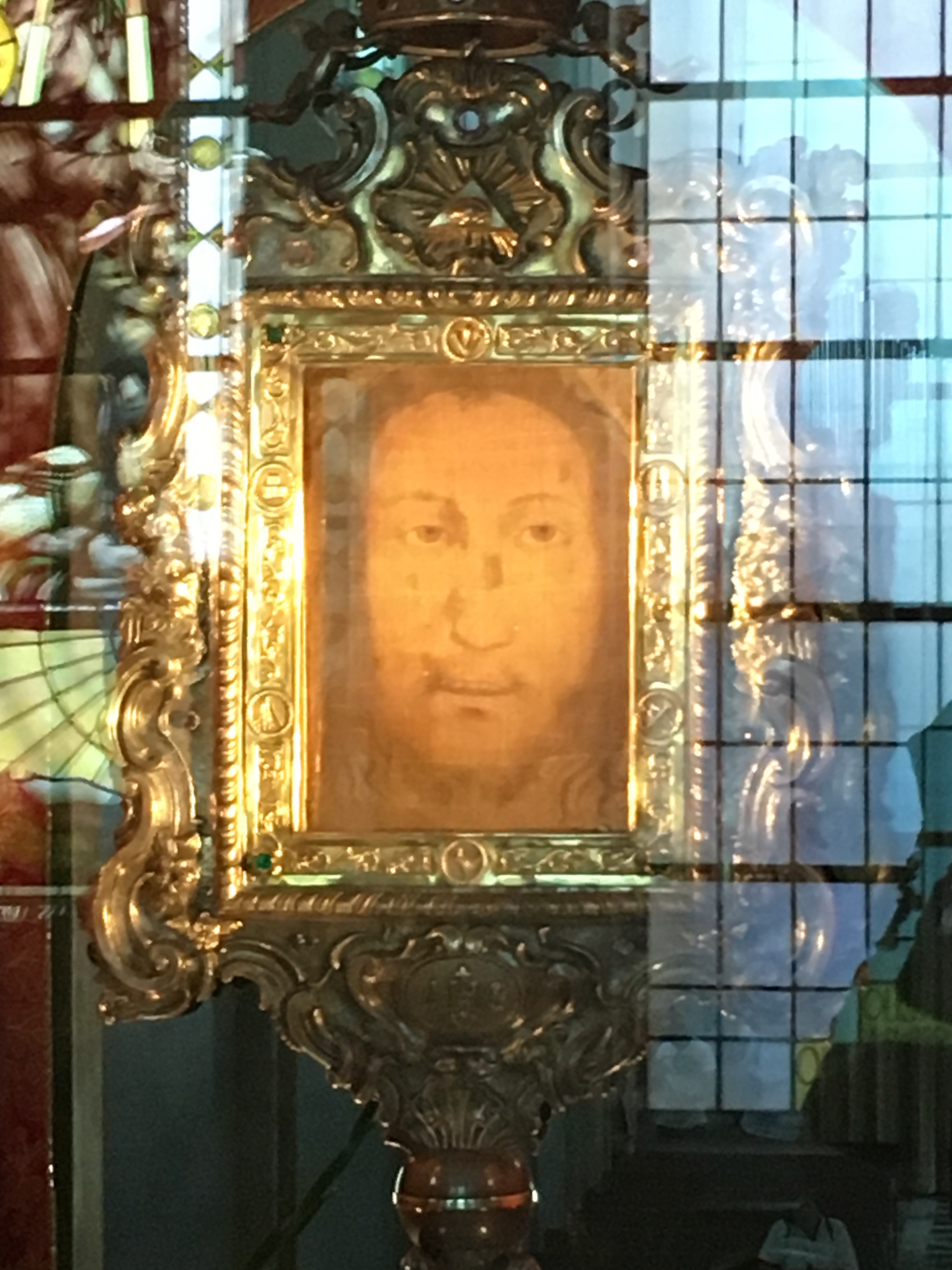
The Mandylion of Edessa
King Abgar V, (c. 1st century to 50 AD) was known as”the Black” or, as described by a contemporary historian, Tacitus, as “King of the Arabs.” St. John Damascene wrote this regarding “The Mandylion of Edessa,” (which means “towel” or “handkerchief in Arabic. Many versions of this legend may be found in historical sources dating back to 590 A.D.):
“King Abgar suffered from leprosy and hearing of the miracles of Jesus, sent a letter to Jesus with his secretary Ananias.” (Who also happened to be a wonderful painter.)
The king’s letter to Jesus had been recorded and copied many times, and have survived in Syriac, Armenian, and Greek on papyrus, parchment and stone. The text of the letter, and the response of Jesus, essentially read:
Abgar, ruler of Edessa, to Jesus the good physician who appeared in the country of Jerusalem, greeting. I have heard reports of you and of your cures as performed by you without medicines or herbs. For it is said that you make the blind to see and the lame to walk, that you cleanse lepers and cast our impure spirits and demons, and that you heal those afflicted with lingering disease, and raise the dead. And having heard all these things, concerning you, I have concluded that one of two things must be true: either you are God, and having come down from heaven, you do these things, or else you, who does these things, are the son of God. I have therefore written to you to ask you if you would take the trouble to come to me and heal all the ill which I suffer. For I have heard that the Jews are murmuring against you and are plotting to injure you. But I have a very small yet noble city which is great enough for us both.”
Jesus, it was written, gave the messenger the reply to return to Abgar:
Blessed are you who hast believed in me without having seen me. For it is written concerning me, that they who have seen me will not believe in me, and that they who have not seen me will believe and be saved. But in regard to what you have written me, that I should come to you, it is necessary for me to fulfill all things here for which I have been sent, and after I have fulfilled them, thus to be taken up again to him that sent me. But after I have been taken up, I will send to you one of my disciples, that he may heal your disease and give life to you and yours.
“It is said that the King Abgarus of Edessa had sent a painter to make a portrait of Christ. But he was not able to do it because of the light that shone out of the Lord’s Face. So, taking a veil and placing it before his holy and life-giving face, Jesus impressed his image on it and sent it to King Abgarus, thus satisfying his desire.” –St. John Damascene
It was St. Jude Thaddeus, one of Jesus’s seventy-two disciples, who brought the Holy veil to the king. After hearing St. Jude preach, and receiving the holy image, King Abgar was healed of his leprosy. King Abgarus, who brought Christianity to his kingdom, is venerated as a saint in the Eastern Church.

Arab sources also mention the cloth on which Jesus imprinted the image of His Face. Although there was disagreement over the centuries as to the question of how the image of the living face of Jesus was formed on the cloth, everyone agreed that it was indeed miraculous.
Through the centuries, many reproductions were made of the image, some appearing miraculously on tile that had covered the sacred cloth. The Mandylion was eventually brought to Constantinople, “The Queen of all cities,” on August 16th, 944, which is still celebrated as a feast day in the Eastern calendar. It was recorded as being kept in “a golden vessel,” and only taken out once a year from the Sacred Chapel, where other precious relics of the Passion of Christ were also kept until the sack of Constantinople in 1204.
The miraculous healing of the king’s leprosy was brought about through the Holy Face and the intercession of St. Jude. But the story of the “impossible” healing of the horrible, disfiguring disease of leprosy, gives not only hope of healing to the sick, but an even greater hope of spiritual healing, restoration, and transformation of the soul to each sinner in the Sacrament of Reconciliation. In that sacrament a repentant sinner, after coming face to face with the Person of Christ through the Priest to confess their sins, may once again have the image of Christ healed, restored, and transformed in their soul. It is an even greater miracle of divine grace: “Though your sins are like scarlet, they shall be as white as snow; though they are red as crimson, they shall be like wool.” (Isaiah 1:18)