In the Rule of his Order St. Benedict gives the key to discerning a true vocation in those seeking admittance to the Benedictine Order: “Let us examine whether the novice is truly seeking God.” (Ch. 58, Rule) Since the Order’s inception, up to this day, the sons and daughters of St. Benedict have taken for their motto “Ora et Labora.” This “Prayer and Work” for many Benedictines is truly seeking the Face of God in the “prayer” of contemplation and the “work” of reparation to the Face of God covered with the blood, wounds, dust and spittle of blasphemy–to stand, together with the Blessed Mother, before the endless crosses on which the Son of God continues to be crucified. If there is a common thread among the holy men and women of the Order, it is woven through the veil of the Face of Christ.
But, they will tell you in their own words…
St. Gertrude by Miguel Cabrera 1763
St. Gertrude (1256-1302), while making reparation to the Adorable Face of Jesus, wounded and disfigured, said to Him, “Tell me, O Lord, the remedy that can soothe the suffering of Thy Divine Face!” Jesus replied: “If anyone meditates upon my sufferings with tenderness and compassion, his heart will be to Me as a soothing balm for these wounds.” Jesus gave St. Gertrude this promise: “All those who meditate frequently on my Divine Face, attracted by the desires of love, shall receive within them, through My Humanity, a bright ray of My Divinity, which shall enlighten their inmost souls so that they shall reflect the light of My Countenance in a special manner throughout eternity.”
St. Mechtilde (1240-1299) once exclaimed to her sisters, “Let us all, full of holy desire, hasten to venerate the sweetest Countenance of Our Lord, which will in Heaven be our all–all that a glorified soul can desire!”
Bl. Columba Marmion
Blessed Columba MarmionO.S.B.(1858-1923) writes that our relationship with God hinge upon two things; our walking in the truth of our nature as creatures, who remain always in humble adoration before our Creator and our dignity as children of God. “Our adoption as children supposes that we act always as loving children towards Our Heavenly Father, constantly seeking His good pleasure: Seek His Face evermore! This Facies Dei, Face of God, is the smile of His loving approbation. If you always keep the truth of this twofold relation, you will be more and more fixed in truth and in peace.” “Look your Heavenly Father in the Face, and show him your soul in truth,” Bl. Marmion counsels, “…do not forget that He is God the Infinite! The love of the creature, in order to be true, must be the love of adoration; the spirit of fear of the Lord. If you keep the eye of your soul fixed on God alone, you will receive many graces.” “It is good sometimes, when alone with God, to stretch out our hands and look at Him in faith showing Him the depths of our soul that His eye may penetrate into those abysses that are hidden in the recesses of the heart. Then our prayer is pure and very powerful, for the child gazes into the Father’s Face, seeking His Face, that is to say His good pleasure: “Seek ye the Lord, seek His Face EVERMORE!”
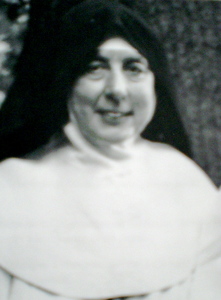
Mother Marie des Douluers, Foundress of the Benedictines of Jesus Crucified
Mother Marie des Douleurs (1902-1983) Foundress of the Congregation of the Benedictines of Jesus Crucified emphasizes the relationship between the Sacred Heart of Jesus and His Holy Face: “We must discover on this Face the revelation of the secrets of His Heart.” She also points to the Holy Spirit, whose work it is to restore the image of God in our souls: “Devotion to the Holy Face is the particular aspect by which the Holy Spirit makes us learn all we need to know to become the saints that Jesus desires. This devotion is of such central importance and so vital for us that we cannot live without it!”
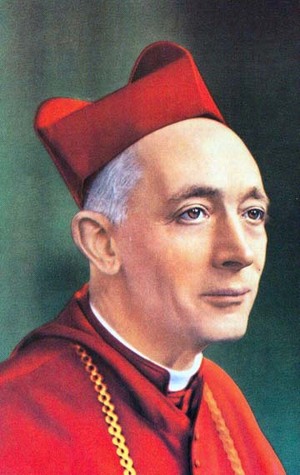
Bl. Ildephonsus Cardinal Shuster, O.S.B.
Blessed Ildephonsus Cardinal Shuster, O.S.B. (1880-1954) wrote, “The Face of Jesus in Heaven is the cause of joy to the angels, but on earth it is a token of pity for sinners. We say to the Father Respice in faciem Christi tui, (Ps 83:10) (Look upon the Face of Thy Christ) but let us fix our own gaze on that Face of Jesus, lest we lose sight of it. As the Eternal Father, when He beholds the Face of Jesus, is touched with compassion for the wretched children of Adam, so let us show a holy reverence for that Sacred Face and for those pure eyes that look on us so tenderly; let us take care that all our actions are worthy of the ineffable sanctity of that Divine regard.”
Last but not least, is the Servant of God, Ildebrando Gregori O.S.B. (1894-1985) founder of the women’s religious congregation the Benedictine Sisters of Reparation of the Holy Face. The devotion to the Holy Face was rooted and imprinted on his Congregation: “The title that sets you apart is Reparation of the Sacred Face of Our Lord Jesus Christ. It is the story of Jesus’ Passion that manifests itself, in a particular way, in the love which St. Benedict had for that Face. The Face of Jesus which was seen dripping blood, crowned with thorns, spat upon; His eyes were bruised, the broken eyebrows, broken lips. His Face, more beautiful than Paradise, appeared like the face of a leper. So Adorers of the Holy Face, Reparation of his wounds in the contemplation of prayer (Ora), in the service of the needy (Labora)… (adoration of the Face of Christ) is essential to make reparation, to create harmony with Christ Jesus who makes us love what the beloved loves, to want what He wants and rejecting what brings Him pain, injury, suffering.”
This apostle of devotion to the Face of Christ applied the Rule of St. Benedict to a work of human and spiritual formation for the poorest and most abandoned children, victims of World War II, in whom he saw the suffering face of Jesus. He later extended that work to include the elderly. At the time he was Abbot General he met Blessed Mother Maria Pierina de Micheli, of the Daughters of the Immaculate Conception, to whom Our Lord gave the mission of the propagation of the Holy Face Medal. He became her Spiritual father and director until the time of her death in 1945. Padre Gregori shared with Bl. Mother de Micheli the love, devotion and deep desire to make reparation to the Face of Jesus and to propagate the Holy Face Medal throughout the world.
Servant of God Idlebrando Gregori, OSB
“I wish that the Lord bless you as He blessed the holy pious women, that He will fill you with His holy Love. His Blessed Face is your ideal, and will piously torment you with the desire to give Him love and praise, this is the perfect reparation. “–Servant of God Ildebrando Gregori OSB
The Mass of St. Gregory I by Robert Campin 15th Century
The book of Revelation of St. John unveils for its reader the beauty of the liturgy of the Mass. “A throne stood in heaven, with one seated on the throne:” “The Lord God.” (Rev. 4:2) It then shows the Lamb (Jesus Christ), “standing, as though it had been slain” (Rev. 5:6): Christ crucified and risen, the one high priest of the true sanctuary, the same one “who offers and is offered, who gives and is given.” (St. John Chrysostom) All in heaven and on Earth who take part in the service of the praise of God participate in the eternal liturgy whenever we celebrate the mystery of salvation. The sacramental celebration is woven with signs and symbols which are rich in meaning. “God speaks to man through visible creation. The material cosmos is so presented to man’s intelligence that he can read there traces of its Creator.” (CCC 1147) “…these perceptible realities can become means of expressing the action of God who sanctifies men, and the action of men who offer worship to God.” (CCC 1148)
We may not know or appreciate the meaning of these “signs and symbols” in the liturgy, but they are there all the same. For example, We may give little thought to the meaning of a simple action by the priest or deacon of handling or folding the altar linen or the corporal, but a German theologian, Klaus Berger, has recently made a stunning discovery which shines a bright light on the deep symbolism contained in this humble action. Mr. Berger, while doing research for an extensive commentary on Revelation by St. John, uncovered the surprising connection between the altar linens prescribed for the liturgy and the burial cloths of Christ mentioned in the Gospels. Mr. Berger then shared his amazing discovery, which reveals the key liturgical role of the cloths, with Paul Badde, who has written extensively on the sudaria or burial cloths of Jesus (The True Icon). Paul has written a truly fascinating article about the discovery for Catholic News Agency (German) The translation may be found on Raymond Frost’s Manoppello blogspot (click here for full article in English).
In the article Paul Badde explains the theological connection between the burial cloths which touched the Body and Blood of Jesus and the altar cloth and corporal, the white linen napkin on which are placed the vessels containing the Body and Blood of Christ during Mass. The corporal, which was to be made of pure linen, could only be touched reverently by the priest with his thumb and forefinger in the old rite.
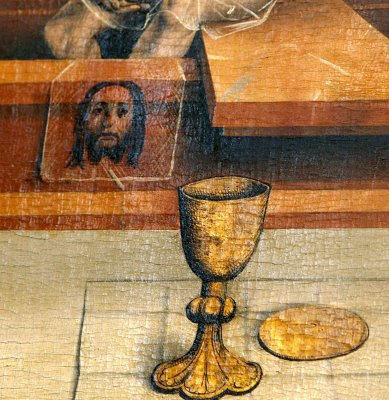
Detail of Mass of St. Gregory I
The connection between these altar cloths used in the liturgy and the sudarium, or burial cloths of Jesus (Shroud of Turin and Veil of Manoppello) says Paul Badde, can be understood in reference to a vision of Pope Gregory I during a Mass when Jesus, appeared as the Man of Sorrows during the Consecration of the Eucharist, reflecting the true Presence of Christ. Pope St. Gregory the Great, “The Father of Christian Worship,” is renown for his exceptional efforts is revising the liturgy of his day.
The cloths used in the liturgy are rich in symbol and meaning which can aid us in our devotion. During the Mass we may not see Christ with our bodily eyes, but He is present. Knowing our weakness, in His infinite mercy He has left us His image to contemplate on the Shroud of Turin and the Veil of Manoppello so that we may call them to mind when gazing with faith on the simple linen cloths used in the Mass. The images make manifest the “cloud of witnesses” (Heb. 12:1) mentioned in St. John’s Revelation: The Heavenly powers, all creation, the servants of the Old and New Covenants the new People of God especially the martyrs “slain for the word of God,” and the all-holy Mother of God (the Woman clothed with the sun with the moon at her feet), The Bride of the Lamb, and finally “a great multitude which no one could number, from every nation, from all tribes, and peoples and tongues.” (Rev.7:9)
Holy Face on The Shroud of Turin
“Illiterate men can contemplate in the lines of an image what they cannot learn by means of the written word.” – Pope St. Gregory the Great
“The beauty of the images moves me to contemplation, as a meadow delights the eyes and subtly infuses the soul with the glory of God.”–St. John Damascene
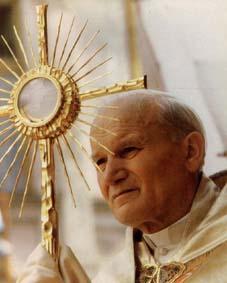
It was Pope St. John Paul II who first used the phrase, “Eucharistic Face of Christ,” which was previously unknown in the Church. Pope St. John Paul II, by dedicating the millennium to the Face of Christ, drew back the veil for us, so that like disciples on the road to Emmaus, who recognized Jesus in the “breaking of the bread,” (Luke 24:30-32) we too, may seek, find and adore His Face present and hidden in the Eucharist where we may gaze on Him freely in faith.
“May, O Lord, the light of Thy Face shine upon us.” These words were the inspiration for Pope St. John Paul II to place the 3rd Millennium under “the radiant sign of the Face of Christ.” He emphasized the importance of contemplation of the Face of Christ by stating: “And it is the Church’s task to reflect the light of Christ in every historical period, to make His face shine also before the generations of the new millennium. Our witness, however, would be hopelessly inadequate if we ourselves had not first contemplated His face.”
Face of Jesus on veil by Michael Wolgemut, teacher of Albrecht Durer. The “Veil of Veronica” in artwork before the early 1500’s resemble the “Il Volto Santo” of Manoppello.
“O my soul, you will always find in the Blessed Sacrament, great consolation and delight, and once you have begun to relish it, there will be no trials, persecutions, and difficulties which you cannot endure.”
“Let him who wills ask for ordinary bread. For my part, O Eternal Father, I ask to be permitted to receive the heavenly Bread with such dispositions that, if I have not the happiness of contemplating Jesus with the eyes of my body, I may at least contemplate Him with the eyes of my soul. This is Bread which contains all sweetness and delight, and sustains our life.” –St. Teresa of Jesus, “The Way of Perfection”
“He is always looking at you; can you not turn the eyes of your soul to look at Him?”–St. Teresa of Avila
Sacred Host viewed through the Holy Face Veil of Manoppello Photo Paul Badde
The importance of Devotion to the Holy Face has been underscored by our last three Popes: St. Pope John Paul II, Pope Benedict and Pope Francis. But, it was to a hidden, cloistered Carmelite nun in the mid-1800’s that Our Lord first entrusted what He called “The Most Beautiful Work Under the Sun!” It was the impetus for the resurgence of a forgotten devotion that has ultimately resulted in the dedication of the millennium to The Holy Face by St. Pope John Paul II and the emphasis on Jesus Christ, the Face of the Father’s Mercy by Pope Francis for the Jubilee Year of Mercy. Through the Merciful Face of Christ we may be reconciled with the Father, so that the Holy Spirit may restore God’s image in our souls.
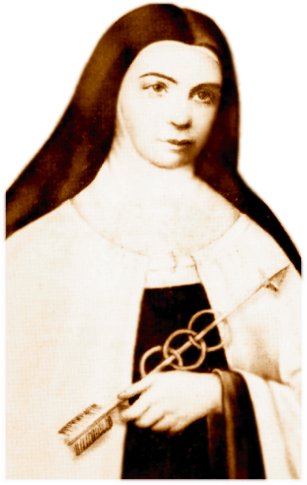
Discalced Carmelite Nun Sr. Marie St. Pierre holding “The Golden Arrow” The three circles representing the Holy Trinity
Sr. Marie St. Pierre, is best known for Devotion to the Holy Face and “The Golden Arrow” (prayer below) a prayer of reparation for blasphemy–sins against the Face of God. She had many interior visions regarding the Holy Face and the work of reparation, including a sublime conception of the The Holy Trinity and the Holy Face which she tried to express in these words she received from Our Lord:
“Holy Face of Tours”
“Remember, O my soul, the instruction which thy celestial Spouse has given thee today on His adorable Face! Remember that this Divine Head represents the Father who is from all eternity, that the mouth of this Holy Face is a figure of the Divine Word, engendered by the Father, and that the eyes of this mysterious Face represent the reciprocal love of the Father and the Son; for these eyes have but one and the same light, the same knowledge, producing the same love, which is the Holy Spirit. In his beautiful silken hair contemplate the infinitude of the adorable perfections of the Most Holy Trinity in this majestic head, the most precious portion of the Sacred Humanity of thy Saviour; contemplate the image of the unity of God. This, then, is the adorable and mysterious Face of the Saviour, which blasphemers have the temerity to cover with opprobrium: thus they renew the sufferings of His Passion, by attacking the Divinity of which it is the image.”
Our Lord told Sr. Marie St. Pierre that she could comfort and console Him by her praises, then He added:
“According to the diligence you will manifest in repairing my image disfigured by blasphemers, so will I have the same care in repairing your soul which has been disfigured by sin. I will imprint thereon my image, and I will render it as beautiful as when it came forth from the baptismal font… Oh! could you but behold the beauty of My Face!–But your eyes are yet too weak.”
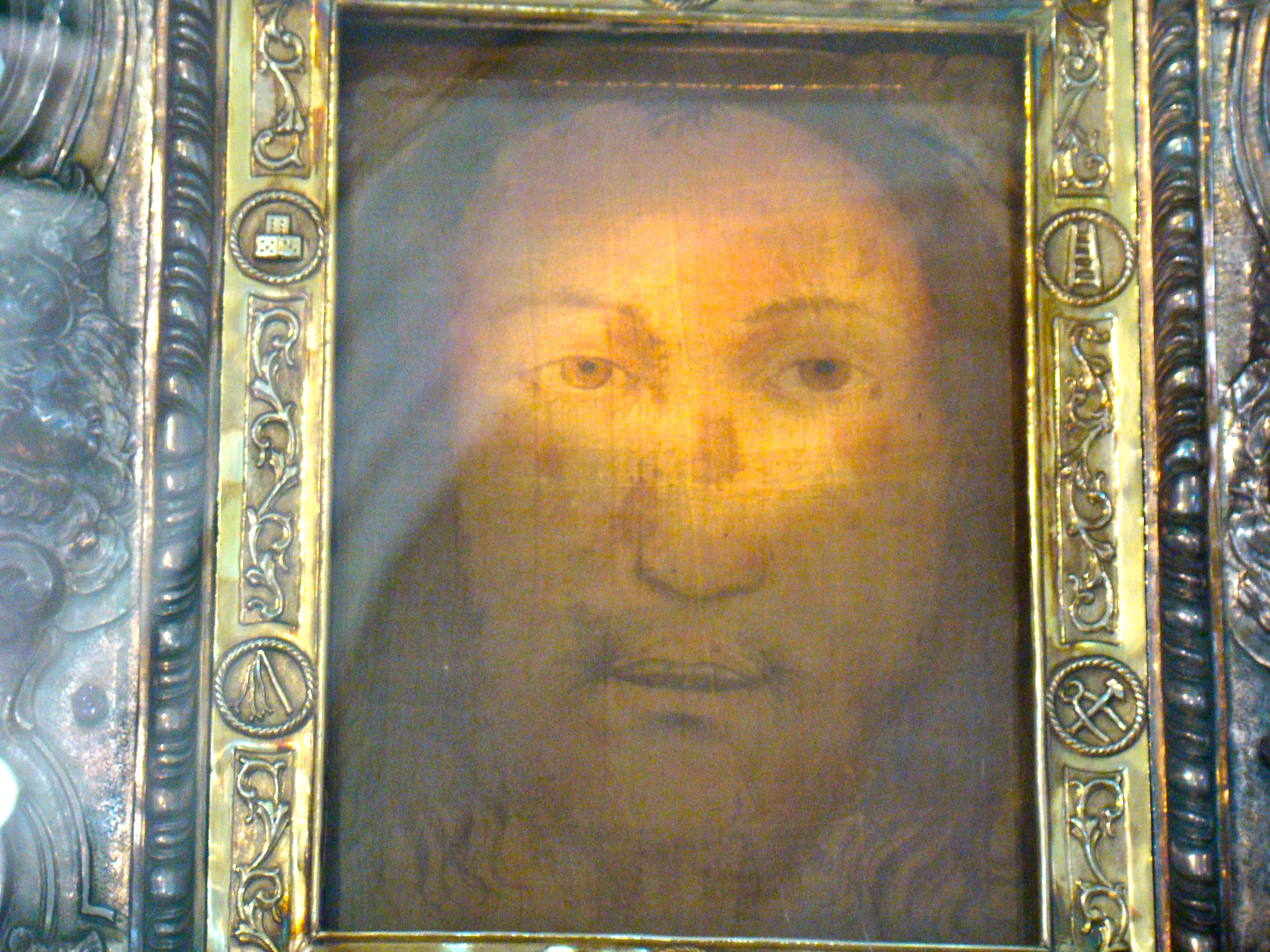
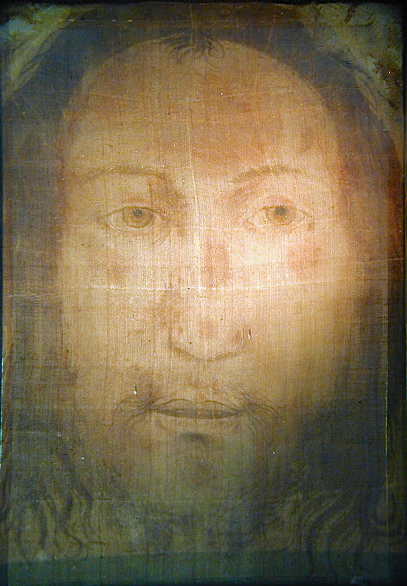
The beautiful Holy Face of Manoppello photo: Paul Badde
Below are two beautiful prayers of Sr. Marie St. Pierre “The Golden Arrow” praising the Holy Name, which is reparation for blasphemy and also a prayer to ask Our Lord to “reproduce the image of God in our souls.”
THE GOLDEN ARROW
MAY the most holy, most sacred, most adorable, most incomprehensible and ineffable Name of God, be forever praised, blessed, adored, loved and glorified, in heaven, on earth, and in the hells, by all the creatures of God, and by the Sacred Heart of Our Lord Jesus Christ in the most Holy Sacrament of the Altar. Amen.
Prayer to ask Our Lord to Reproduce the Image of God in Our Souls
I salute You! I adore You and I love you, Oh adorable face of my beloved Jesus, as the noble stamp of The Divinity! Completely surrendering my soul to You, I most humbly beg You to stamp this seal upon us all, so the image of God may once more be reproduced in our souls. Amen.
“By My Holy Face you will work marvels!” –Our Lord to Sr. Marie St. Pierre
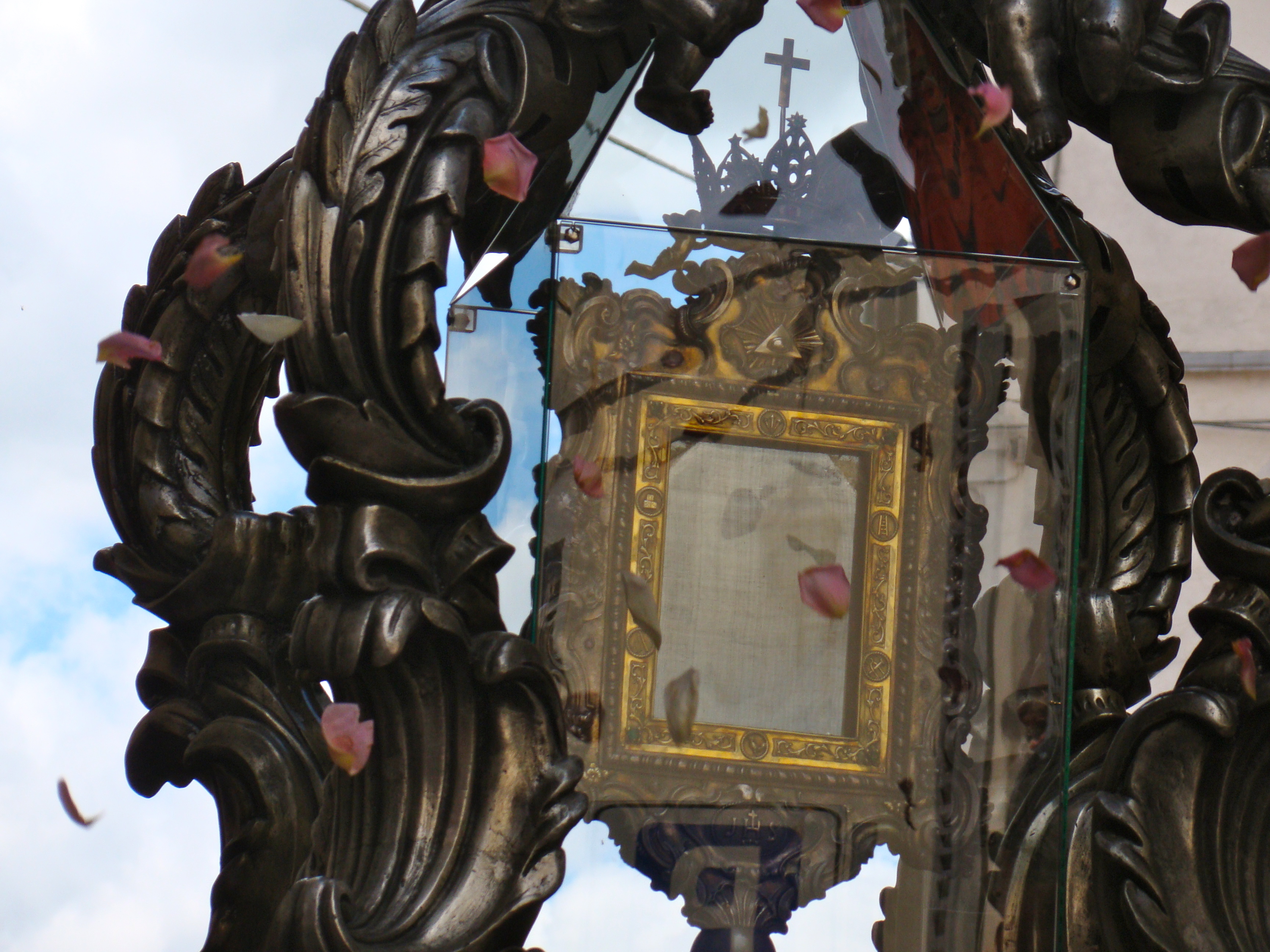
Rose petals like “tongues of fire of the Holy Spirit” tossed before the Holy Face on Pentecost. photo: Paul BaddeBeautiful photo of “Il Volto Santo” Pentecost 2016, by Paul BaddeSheer Veil of the Holy Face of Manoppello disappears in the light Photo: Paul Badde
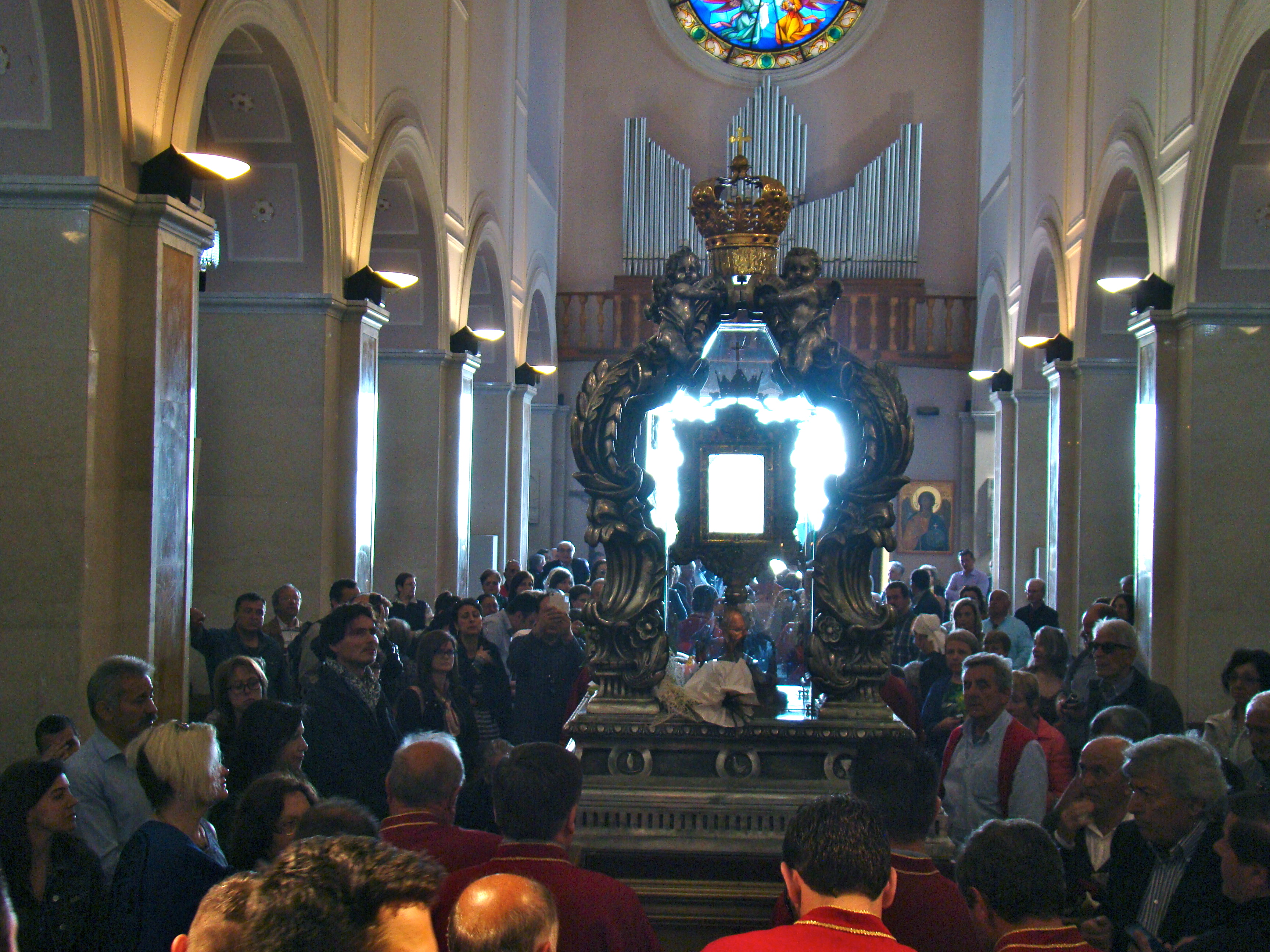
Journalist Paul Badde has generously shared these beautiful photos of “Il Volto Santo” the Holy Face of Manoppello, Italy, taken on the 15th of May for the great Feast of Pentecost. The photo images of the miraculous veil capture so well the changeability and infinite beauty, mercy and peace found by gazing on the Holy Face. The gossamer-thin byssus veil is not painted but seems to be “written by the Holy Spirit” as an icon in light, which according to the light, may be clearly seen with blood and wounds, or as fresh and healed, or disappear. As Pope Emeritus Benedict XVI has said, “Faith is seeing and hearing.” May those who contemplate His Holy Face, like St. Peter and St. John in the tomb on Easter, “see and believe,” and as we gaze upon His Face may we be attentive as well to hear the voice of the Holy Spirit in our hearts, who will lead us through Jesus to the Merciful Face of the Father.
Veil of the Holy Face of Manoppello, Pentecost 2016 photo: Paul BaddeVeil of Manoppello in procession, Pentecost 2016 photo: Paul Badde“Little Angels” in Holy Face Procession Photo: Paul BaddeHoly Face of Manoppello changes according to light. Pentecost 2016 photo: Paul BaddeMay the Lord bless and keep you; May He make His Face shine upon you and be merciful to you; May He turn His Countenance toward you and grant you His Peace!” (Num. 6: 22-27) Photo: Paul Badde Pentecost 2016
A “Must Read” on the Holy Face: There is an excellent post “More than an Abstraction,” the text from a conference given by Fr. Daren Zehnle. It is a very clear, well-documented and informative history of “The Veronica,” and the miraculous “Veil of Manoppello” in the context of the Jubilee Year of Mercy. It can be read on his “Servant and Steward”blog. (click here)
The word “veil” can have many meanings. A veil can cover the face, the head, or an object; it can cover, conceal, or separate. In ancient Jewish tradition a veil in the Holy of Holies in the Temple separated sinful man from the presence of God dwelling in the midst of His People. The holiness of God was not to be taken lightly. The blinding light of the purity and glory of the Face of God could not be looked upon by sinful eyes.
But when God chose Mary to be the Mother of His Son He created her to be all-pure and sinless from the moment of her conception through the merits of her Son, Jesus. In Matthew 5:8 we read, “Blessed are the pure of heart, for they shall see God.” What was to prevent Mary, the Immaculate Conception, who was free from all sin, from seeing the Face of God in all His glory even while she was still here on earth? The answer is, in a word, a veil.
When the Word of God became flesh in the womb of the Blessed Virgin Mary, at the Incarnation, Mary became His Tabernacle. Jesus’ human flesh was His veil: “by the new and living way he opened for us through the veil, that is His flesh” (Heb. 10:20). The Angel Gabriel told Mary that she would be the mother of the Son of God. But Mary, though “full of grace” and all-pure, would only gaze upon the human face of her child and upon the Face of her God through the veil of faith.
Elizabeth bore witness to Mary’s faith when “filled with the Holy Spirit” she greeted Mary with a loud cry: “Blessed are you among women, and blessed is the fruit of your womb! And why is this granted me, that the mother of my Lord should come to me?…“Blessed is she who believed that there would be a fulfillment of what was spoken to her from the Lord” (Lk. 1:45). As Pope St. John Paul II wrote in Redemptoris Mater, “Mary entrusted herself to God completely, with the full submission of intellect and will…this response of faith included both perfect cooperation with ‘the grace of God that precedes and assists’ and perfect openness to the action of the Holy Spirit, who constantly brings faith to completion by His gifts.”
Veil of Veronica C. 1618-22 National Gallery
In a truly heroic manner, in poverty and suffering, on her whole pilgrimage or journey towards God, Mary believed, in faith, though everything happening around her seemed to contradict God’s words to her: That “the Lord will give to him the throne of his father David.” And that “He will reign over the house of Jacob forever and of His kingdom there will be no end.” Mary believed these invisible truths about her Son, even as Jesus, suffered and died, hanging on the Cross. What was visible on an earthly level did not reflect the heavenly reality. Mary did not necessarily see her Son radiant in glory or angels ministering to Him in His Passion. At the foot of the Cross she saw His bruised and bloodied suffering Face.
Pope St. John Paul II tells us in Redemptoris Mater that “faith is contact with the mystery of God. Every day Mary is in constant contact with the ineffable mystery of God made-man, a mystery that surpasses everything revealed in the Old Covenant… Mary is in contact with the truth about her Son only in faith and through faith!” Though all-pure, she could not see, except through faith. “Blessed is she who believed” is a key, he says, which unlocks for us the innermost reality of Mary. Mary’s all-pure eyes looked on the glory of her Son through a veil of faith, “a dark night,” to use the words of St. John of the Cross, that feeling of darkness or emptiness when a soul draws near to the brightness and glory of God. Pope St. John Paul II writes in Redemptoris Mater that Mary’s faith is: “a kind of a veil though which one has to draw near to the Invisible One and to live in intimacy with the mystery.”
In this earthly pilgrimage of faith a veil lies over our hearts, as St. Paul writes: “To this day, in fact…a veil lies over their hearts, but whenever a person turns to the Lord the veil is removed… All of us, with unveiled face gazing on the glory of the Lord, are being transformed into the same image from glory to glory, as from the Lord who is the Spirit.” (2 Cor. 4:15-16, 18) As members of the Church, we can “look at” Jesus through Mary’s eyes of faith, in the Eucharist, in our neighbor; believing in His Word and following her example in our pilgrimage towards the Father until that time when the “veil” of faith will be finally lifted.
“Blessed is she who believed!”
“Faith is the realization of what is hoped for and evidence of things not seen.” (Heb. 11:1)
“This is the opportune moment to change our lives! This is the time to allow our hearts to be touched!” — quotes from Pope Francis, Misericordiae Vultus
“Jesus Christ is the Face of the Father’s Mercy.” — Pope Francis
“Jesus Christ is the Face of the Father’s Mercy. These words might well sum up the mystery of the Christian faith. Mercy has become living and visible in Jesus of Nazareth, reaching it’s culmination in Him…We need to constantly contemplate the mystery of mercy. It is a wellspring of joy, serenity, and peace. Our salvation depends on it. Mercy: the word reveals the very mystery of the Most Holy Trinity.” “With our eyes fixed on Jesus and His merciful gaze, we experience the love of the Most Holy Trinity. The mission Jesus received from the Father was that of revealing the mystery of Divine Love in its fullness. ‘God is love.'” (1Jn 4:8,16)
“…wherever there are Christians, everyone should find an oasis of mercy.”
“Mercy is not contrary to justice but is the behavior of God toward the sinner…God does not deny justice. He rather envelops it and surpasses it with an even greater event in which we experience love as the foundation of true justice” (MV, 21). Jesus is the face of the mercy of God the Father: “God so loved the world […] [that] the world might be saved through him [the Son]” (Jn 3:16, 17)
We are called to be merciful to each other and seek the Face of Jesus in our neighbor. “It is my burning desire that, during this Jubilee, the Christian people may reflect on the corporal and spiritual works of mercy. It will be a way to reawaken our conscience, too often grown dull in the face of poverty. And let us enter more deeply into the heart of the Gospel where the poor have a special experience of God’s mercy. Jesus introduces us to these works of mercy in His preaching so that know whether or not we are living as His disciples. Let us rediscover these corporal and spiritual works of mercy: to feed the hungry, give drink to the thirsty, clothe the naked, welcome the stranger, heal the sick, visit the imprisoned, and bury the dead. And let us not forget the spiritual works of mercy: to counsel the doubtful, instruct the ignorant, admonish sinners, comfort the afflicted, forgive offences, bear patiently those who do us ill, and pray for the living and the dead.”
“Life is a pilgrimage, and the human being is a viator, a pilgrim travelling along the road, making his way to the desired destination.” Let us keep our faces turned toward the Merciful Face of Jesus while on our pilgrimage, and “introduce everyone to the great mystery of God’s Mercy by contemplating the Face of Chirst.” (Misericordiae Vultus)
Prayer of Pope Francis for the Jubilee of Mercy
Have Mercy on us! Holy Face of Manoppello Photo: Paul Badde
Lord Jesus Christ, you have taught us to be merciful like the heavenly Father, and have told us that whoever sees you sees Him. Show us Your Face and we will be saved. Your loving gaze freed Zaccheus and Matthew from being enslaved by money; the adulteress and Magdalene from seeking happiness only in created things; made Peter weep after his betrayal, and assured Paradise to the repentant thief. Let us hear, as if addressed to each one of us, the words that You spoke to the Samaritan woman: “If you only knew the gift of God!”
You are the visible Face of the invisible Father, of the God Who manifests His power above all by forgiveness and mercy: let the Church be Your visible Face in the world, its Lord risen and glorified. You willed that your ministers would also be clothed in weakness in order that they may feel compassion for those in ignorance and error: and forgiven by God.
Come Holy Spirit!
Send Your Spirit and consecrate every one of us with its anointing, so that the Jubilee of Mercy may be a year of grace from the Lord, and Your Church, with renewed enthusiasm, may bring good news to the poor, proclaim liberty to captives and the oppressed, and restore sight to the blind.
We ask this through the intercession of Mary, Mother of Mercy, You Who live and reign with the Father and the Holy Spirit for ever and ever. Amen.
Pope Francis also recommends we pray the Salve Regina (Hail Holy Queen) so that Mary, our Mother of Mercy “may never tire of turning her merciful eyes towards us, and make us worthy to contemplate the Face of Mercy, her Son Jesus.”
The Salve Regina or “Hail, Holy Queen”
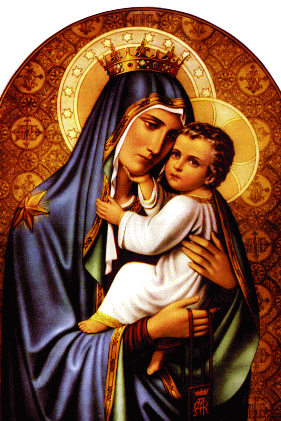
Queen Beauty of Carmel
Hail, Holy Queen, Mother of Mercy, our life, our sweetness and our hope! To thee do we cry, poor banished children of Eve. To thee do we send up our sighs, mourning and weeping in this valley of tears! Turn, then, O most gracious Advocate, thine eyes of mercy toward us, and after this, our exile, show unto us the blessed fruit of thy womb, Jesus. O clement, O loving, O sweet Virgin Mary.
V. Pray for us, O holy Mother of God.
R. That we may be made worthy of the promises of Christ.
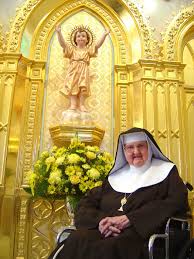
“In our life as Contemplatives, we may never see the fruit of all the prayers and penance we do. It isn’t easy at first, but after a while as you dig deeper into your interior and Jesus comes along with light–it dawns on you, as it must, that the only thing that the Eternal Father wants from you and from me is to become transformed in Love. Then, the Divine Image of His Son will be so clear in us that when He looks at us, He will see no one but Jesus.”
–Mother Angelica, born into Eternal Life, Easter Sunday 2016
Thank you, Jesus, for the beautiful life, inspiration and example of Your beloved spouse, Mother Angelica
“Whoever gazes on Me already consoles me.”–Our Lord to Bl. Mother Maria Pierina De Micheli
Volto Santo in St. Michael in Kochel a. See, Germany Photo: Paul Badde
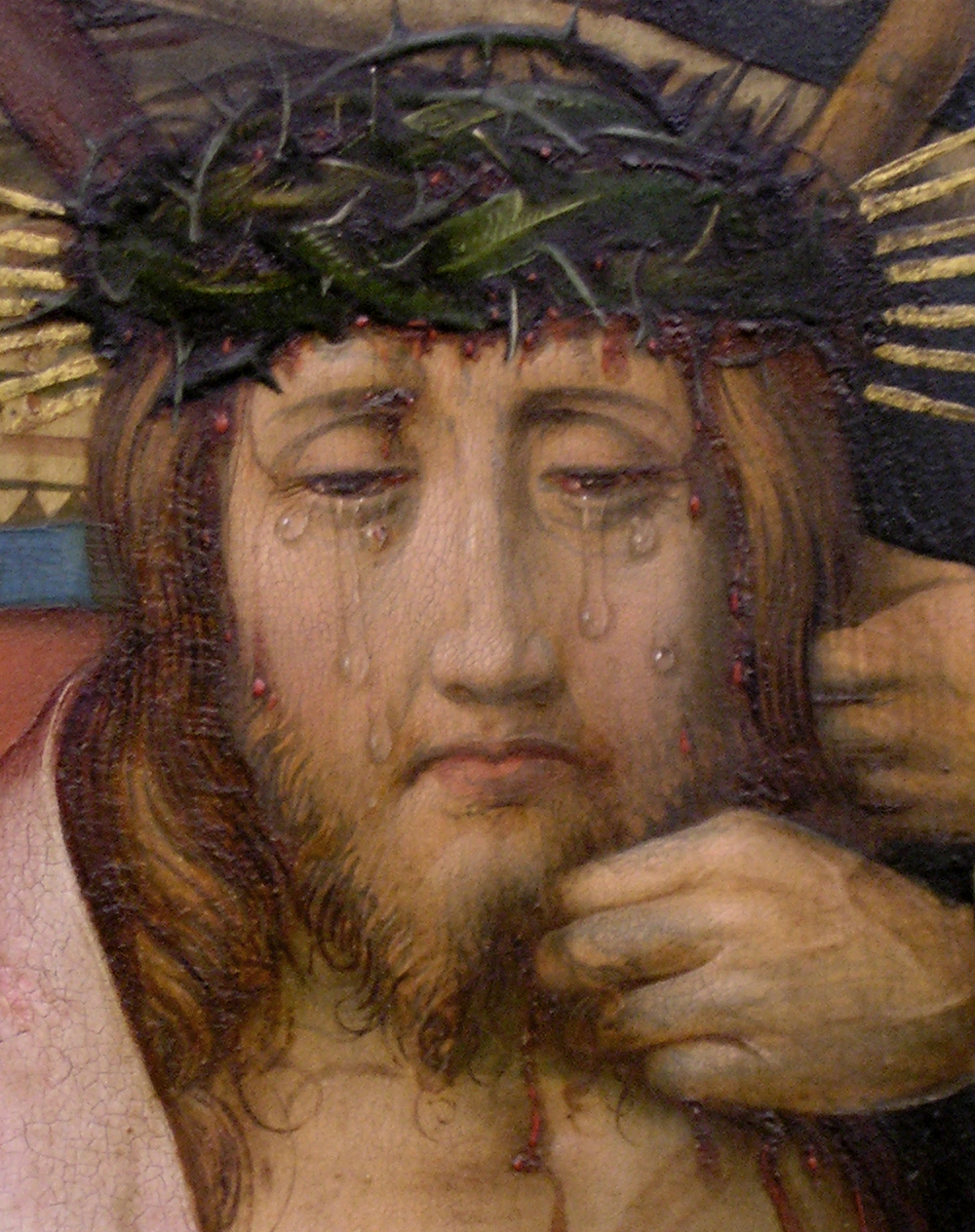
“He had no form or comeliness that we should look at him, and no beauty that we should desire him. He was despised and rejected by men; a man of sorrows, and acquainted with grief; and as one from whom men hide their faces he was despised, and we esteemed him not.” (Is. 53:2)
Act of Love to The Holy Face
Adorable Face of My Jesus, my only love, my light and my life, grant that I may see no one, except Thee, that I may love Thee alone, that I may live with Thee, of Thee, by Thee and for Thee. Amen.
The Golden Arrow
MAY the most holy, most sacred, most adorable, most incomprehensible and ineffable Name of God, be forever praised, blessed, adored, loved and glorified, in heaven, on earth, and in the hells, by all the creatures of God, and by the Sacred Heart of Our Lord Jesus Christ in the most Holy Sacrament of the Altar. Amen. (In Reparation for blasphemy)
Prayer of St. Therese
O Jesus, Who in Thy bitter Passion didst become “the most abject of men, a man of sorrows, “ I venerate Thy Sacred Face whereon once there did shine the beauty and sweetness of the Godhead; but now it has become for me as if it were the face of a leper! Nevertheless, under those disfigured features, I recognize Thy infinite Love and I am consumed with the desire to love Thee and make Thee loved by all men. The tears which well up abundantly in Thy sacred eyes appear to me as so many precious pearls that I love to gather up, in order to purchase souls of poor sinners by means of their infinite value.
O Jesus, Whose adorable Face ravishes my heart, I implore Thee to fix deep within me Thy Divine Image and to set me on fire with Thy Love, that I may be found worthy to come to the contemplation of Thy glorious Face in Heaven. Amen.
“Whoever who gazes upon me already consoles me.” –Our Lord to Bl. Mother Pierina De Michelli
















 Illumina Domine Blog - Devotion to The Holy Face