“As a deer yearns for running streams, so my soul is longing for you, my King and my God. My soul is thirsting for God, the living God, when shall I see Him face to face?”
Our souls are longing to see the Face of Jesus Christ our King, and the good news of the Gospel tells us what we must do to inherit the Kingdom of God:
‘Come, you who are blessed by my Father.
Inherit the kingdom prepared for you from the foundation of the world.
For I was hungry and you gave me food,
I was thirsty and you gave me drink,
a stranger and you welcomed me,
naked and you clothed me,
ill and you cared for me,
in prison and you visited me.’
Then the righteous will answer him and say,
‘Lord, when did we see you hungry and feed you,
or thirsty and give you drink?
When did we see you a stranger and welcome you,
or naked and clothe you?
When did we see you ill or in prison, and visit you?’
And the king will say to them in reply,
‘Amen, I say to you, whatever you did
for one of the least brothers of mine, you did for me.’ (Mt. 25:31-41)
To enter the Kingdom of God we must perform the works of mercy, however, there is yet another way to enter into Christ’s Kingdom; and that is to steal it! It is true–our Crucified King desires us to be with Him so much that He will even allow His Kingdom to be stolen. As Jesus was dying a shameful death on the Cross, crucified between two criminals, the crowds were shouting, “If he is the King of Israel; let him come down from the cross, and we will believe him.” One of the thieves hanging there reviled, and mocked Jesus to His Holy Face. “Are you not the Messiah? Save yourself and us!”
But the one called “the Good Thief” or “St. Dismas,” is also known as a saint of the Holy Face, because although he too was suffering on a cross, St. Dismas acknowledged his own guilt and publicly defended Jesus, rebuking the thief who had blasphemed Him, saying, “Have you no fear of God, for you are subject to the same condemnation? And indeed, we have been condemned justly, for the sentence we received corresponds to our crimes, but this man has done nothing criminal.” (Lk, 23:40-41) What came next is a testament to heroic faith, because although the thief saw the suffering, humiliated, and disfigured Face of Jesus, he called Him a king:
“Jesus, remember me when You come into Your Kingdom.”
St. Ambrose wrote that the Good Thief “prayed that the Lord would remember him when he reached His Kingdom, but the Lord responded, ‘Truly, I say to you, today you will be with me in paradise.’ Life is being with Christ, because where Christ is, there is His Kingdom.” Perhaps the Good Thief had not performed the works of mercy, but his story is an witness to the saving power of faith and devotion to the Face of Christ. The Good Thief had stolen the Kingdom through sharing in the suffering of Christ and reparation to the Holy Face of Jesus, and so entered into His divine glory.
Thy Kingdom come, O Lord!
Christ the King of the Universe
“Every time that anyone gazes at my Face, I will pour my love into hearts and by means of the Holy Face, the salvation of many souls will be obtained.” –Our Lord to Bl. Mother Pierina de Micheli, “Missionary of the Holy Face”
Pieta, with Holy Trinity, Blessed Mother and St. John (Jean Malouel 1400-1410 Met Museum)
The communication of the Most Holy Trinity is a communication of Persons– Father, Son and Holy Spirit — their communication is love. God also communicates His love to all mankind so that we may know Him and love Him. We learn about God not only from His creation, but through other human beings. We are all made in His image and likeness, after all, reflecting God’s truth, goodness, and beauty. As is written in the Book of Wisdom, “for from greatness and beauty of created things comes a corresponding perception of the Creator.”(Wis. 13:5)
We have the capacity to know God because we are created in His image and likeness; however, we also learn, from ourselves and those around us, how unlike God we are. St. Thomas Aquinas says, “concerning God, we cannot grasp what He is, but only what He is not, and how other beings stand in relation to Him.”The internet has a great potential for real communication; that is, to convey information exchanged between persons, that could really help us learn about the love of God. Unfortunately, mass communication, such as the internet, communicates more about what God is not, than what God is.
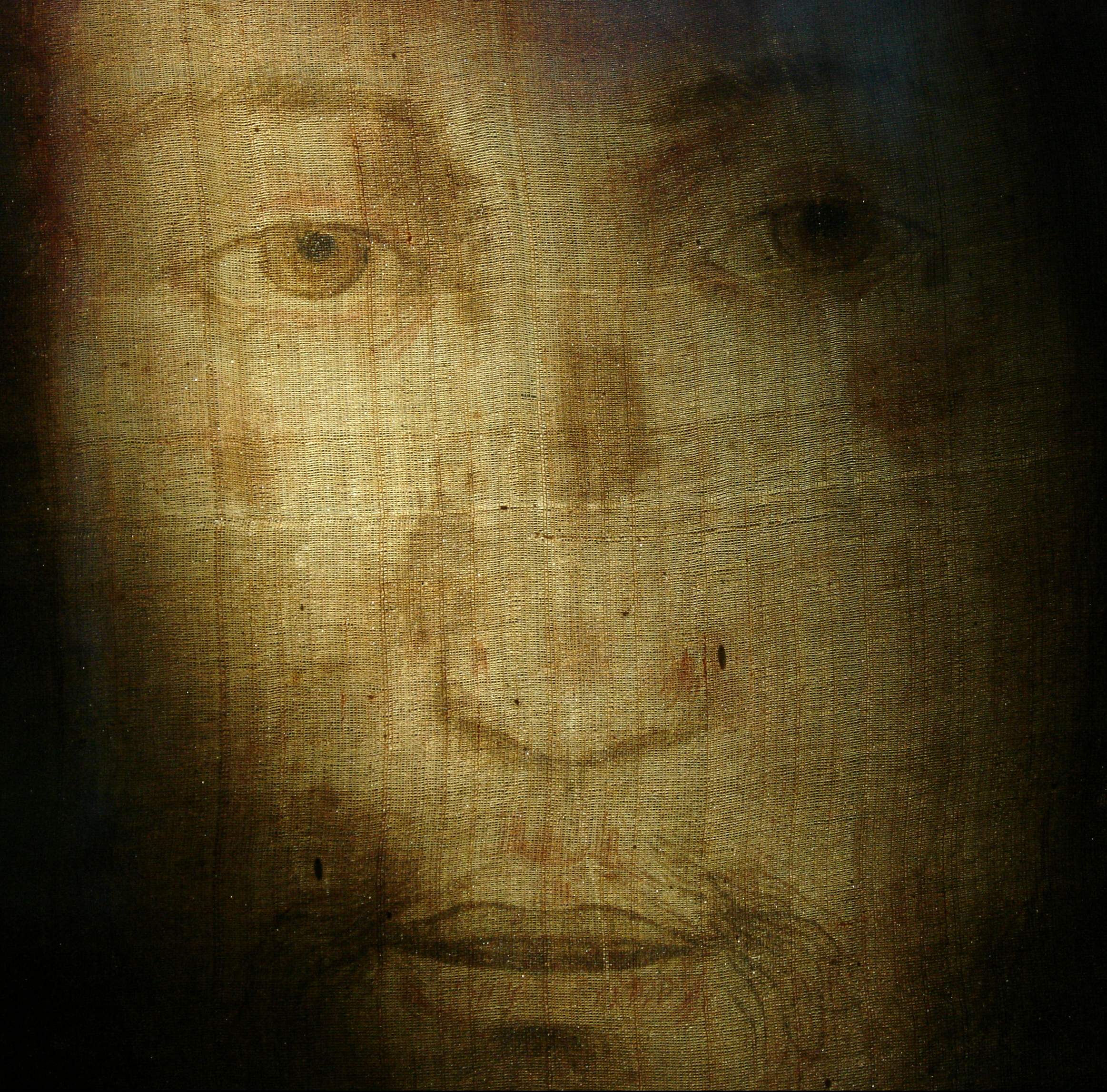
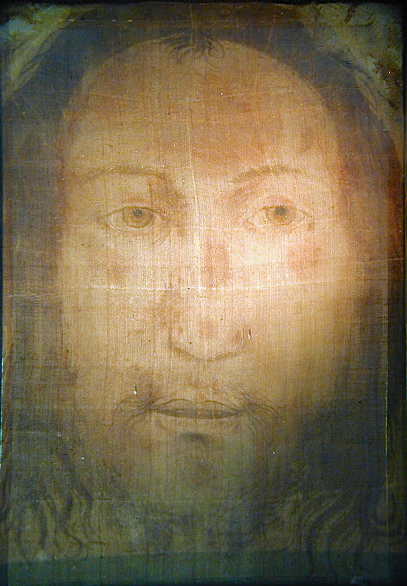
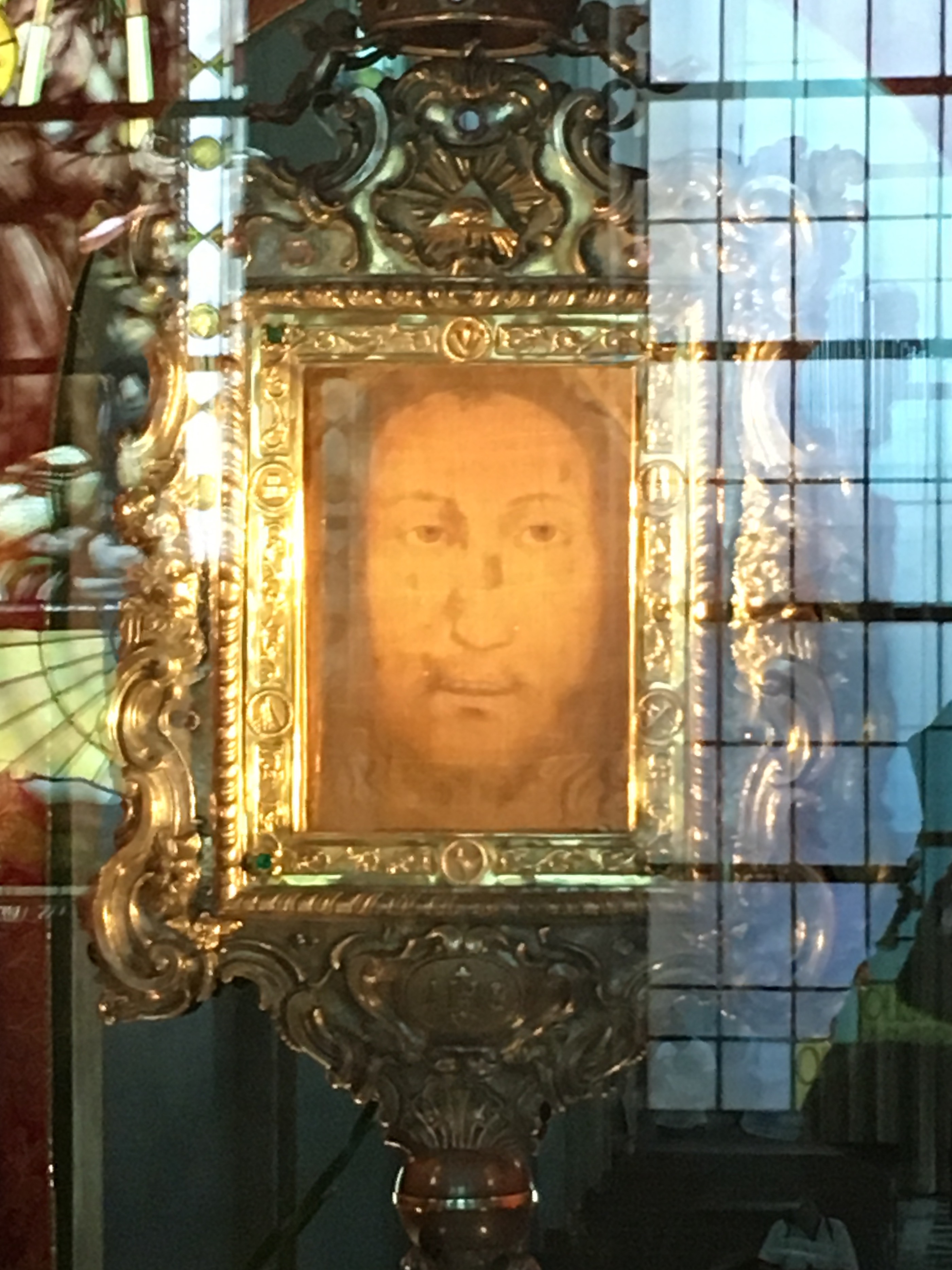
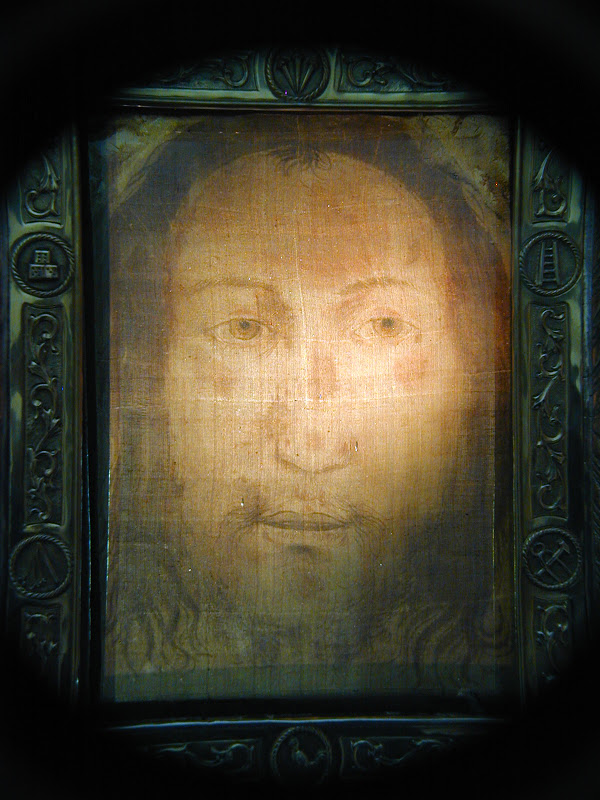
Holy Face Veil of Manoppello, Italy (Photo: Paul Badde/EWTN)
“In the world of the internet, which enables billions of images to appear on millions of screens throughout the world, the Face of Christ needs to be seen and his voice heard, for ‘if there is no room for Christ, there is no room for man’.” –Pope Benedict XVI, Verbum Domini
Those who love God, therefore, would naturally desire to communicate His love to other human beings through the Face of Christ–using the means which God Himself has chosen to communicate His love to us. The Face of Christ needs to “be seen and His voice heard” on the internet. But where do we see the Face of Christ on the internet? Where do we hear His voice?
Sadly, even some Christians on the internet present “a face and voice” more like the evil one, than that of Jesus Christ. Most often Jesus’s Face is hidden in a nauseating ocean of hatred, anger, banality, and filth. But He is still present there in our internet “neighbors” whose faces pass by as we scroll down our screens each day: The innocent children in danger, victims of natural disasters, violence, terrorism, addiction, human trafficking, the spiritually blind and lame — all manner of human suffering, together with perpetrators of crime equally in need of our prayers. Though we are separated from them by a computer screen, the suffering Face of Jesus is present in all their faces and voices.
The first element of Devotion to the Holy Face, says Pope Benedict XVI, is “discipleship and orientation of one’s life towards an encounter with Jesus, to see Jesus in the face of those in need.” We need to begin by seeking out the Divine Image in them, and also by becoming the “face and voice of Christ” to them. In order to do this, “believers first need to become better acquainted with Jesus through the Eucharist,” allowing ourselves first to be transformed by the Holy Spirit into His image, thereby reflecting the Face of Christ to other souls made in His image–to be communicators of His love.
Holy Face of Manoppelllo (Photo: Paul Badde/EWTN)
The Divine Image
To Mercy, Pity, Peace and Love All pray in their distress; And to these virtues of delight Return their thankfulness.
For Mercy, Pity, Peace and Love Is God, our Father dear, And Mercy, Pity, Peace and Love Is man, His child and care.
For Mercy has a human heart, Pity a human face, And Love, the human form divine, And Peace, the human dress.
Then every man, of every clime, That prays in his distress, Prays in the human for divine, Love, Mercy, Pity, Peace.
And all must love the human form, In heathen Turk, or Jew; Where Mercy, Love, and Pity dwell There God is dwelling too.
“The Word will imprint in your soul, as in a crystal, the image of His own beauty, so that you may be pure with His purity, luminous with His light.”
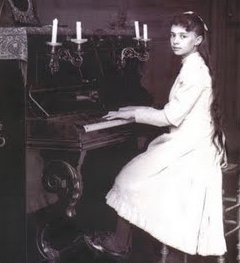
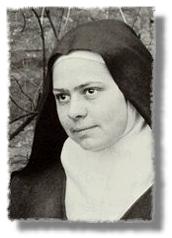
Ten years before entering the Carmelite Convent in Dijon, France, eleven year-old Elizabeth Catez met the prioress on the afternoon of her First Holy Communion. What the prioress told her on that occasion left a deep impression in her soul; upon learning Elizabeth’s name, the prioress told her that her name meant “House of God.” She later wrote on the back of a holy card for Elizabeth: “Your blessed name hides a mystery, accomplished on this great day. Child, your heart is the House of God on earth, of the God of love.”
“Do you not know that you are God’s temple and that God’s Spirit dwells in you?” (1 Cor 3:16)
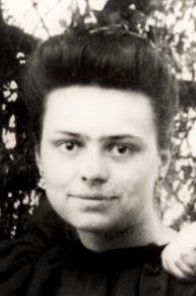
Waiting to enter Carmel–St. Elizabeth of the Trinity
Upon entering Carmel at the age of twenty-one, Elizabeth sought God’s Face within the temple of her own soul, in prayer and silence, with a growing desire to be united with Jesus, to share in His life and sufferings–to be transformed into His image–so that God the Father would find in her the image of His Son, in whom He was well-pleased. Elizabeth wrote, “God bends lovingly over this soul, His adopted daughter, who is so conformed to the image of His Son, the ‘first born among all creatures,’ and recognizes her as one of those whom He has ‘predestined, called, justified.’ And His Fatherly heart thrills as He thinks of consummating His work, that is of ‘glorifying her by bringing her into His kingdom, there to sing for ages unending’ the praise of His glory.” She prayed that the Holy Spirit “create in my soul a kind of incarnation of the Word: that I may be another humanity for Him in which He can renew His whole Mystery.”
“I want to gaze on You always and remain in Your great light.”~St. Elizabeth of the Trinity, OCD
“We must become aware that God dwells within us and do everything with Him; then we are never commonplace, even when performing the most ordinary tasks.”
This was the fruit of contemplation that St. Elizabeth of the Trinity wanted to share with everyone; the secret of transforming love hidden within our own hearts. By gazing steadfastly upon God, in faith and simplicity, the Word of God, Jesus Christ–as in the legend of St. Veronica’s Veil–will leave the imprint of His image on the veil of the soul. By her continual loving gaze at Him, St. Elizabeth of the Trinity was transformed into His image. When she died at the young age of twenty-six, she had already fulfilled her mission in the Church as a ceaseless “Praise of Glory,” reflecting the luminous, pure light of the Holy Trinity.
“It is Your continual desire to associate Yourself with Your creatures…How can I better satisfy Your desire than by keeping myself simply and lovingly turned towards You, so that You can reflect Your own image in me, as the sun is reflected through pure crystal? …We will be glorified in the measure in which we will have been conformed to the image of His divine Son. So, let us contemplate this adored Image, let us remain unceasingly under it’s radiance so that it may imprint itself on us.” –Saint Elizabeth of the Trinity, O.C.D.
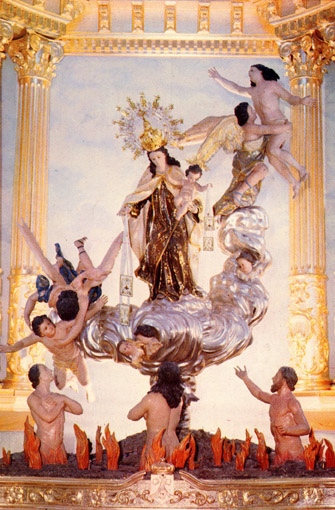
Our Lady of Mount Carmel with Angels and souls in Purgatory – Baroque Sculpture Beniajan, Spain
The sixth beatitude proclaims, “Blessed are the pure in heart, for they shall see God.” What does it mean to be “pure in heart” and how can we attain purity of heart in this life?
The Catechism of the Catholic Church says that the “heart is the seat of our moral personality.” and there is a connection between purity of heart, of body, and of faith. St. Augustine summed up this connection:
“The faithful must believe the articles of the Creed so that by believing they may obey God, by obeying may live well, by living well may purify their hearts, and with pure hearts may understand what they believe.”
The “pure in heart” are promised that they will see God face to face and be like him. “For now we see in a mirror dimly, but then face to face; now I know in part, but then I will know fully just as I also have been fully known.But now faith, hope, love, abide these three; but the greatest of these is love.” (1 Cor 13: 12-13)Purity of heart is the precondition of the vision of God.
But what happens to a soul who dies in God’s grace and friendship, but is not yet perfectly purified in these three areas of “heart, body, and faith” in order to see the Face of God? The Church teaches that these souls are assured of eternal salvation, “but after death they undergo purification, so as to achieve the holiness necessary to enter the joy of heaven.” (CCC 1030) The joy of Heaven–which is the joy of seeing God face to face eternally. The Church gives the name Purgatory to this final purification of souls that enables them to attain the beatific vision. Theologians have said that this purification or suffering of the souls in Purgatory is their intense longing for the Face of God.
“It is therefore a holy and wholesome thought to pray for the dead, that they may be loosed from sins.” (2 Macch. 12, 46)
The faithful departed being purified are also members of the communion of saints, however, they can no longer pray for themselves; the opportunity for them to gain merit and virtue ended with their lives. They are in need of our prayers.
“We must say many prayers for the souls of the faithful departed, for one must be so pure to enter Heaven.”–St. John Vianney
St. Teresa of Avila interceding for the Holy Souls in Purgatory
We can help these holy souls by our prayers, especially in the month of November, when the Church remembers the Faithful Departed in its prayers. There are many ways to obtain indulgence from God for the Holy Souls in Purgatory, through the Church, such as visiting a cemetery and praying for the dead. A plenary indulgence for the souls in Purgatory can be obtained by visiting a cemetery any day between November 1 and November 8 or by a visit to a church or public oratory on November 2nd and reciting the Our Father and the Creed. A partial indulgence can be obtained for the souls in Purgatory, especially in the month of November, when we recite:
Eternal rest grant unto them, O Lord, and let perpetual light shine upon them. May the souls of the faithful departed, through the mercy of God, rest in peace. Amen.
Purity of heart makes it possible to see God in heaven. So, we should strive to attain purity of heart here on earth which helps us to see things according to God in this life. To do this demands prayer, the practice of chastity, purity of intention and of vision. (CCC 2532). Purity of heart also requires the modesty which is patience, decency, and discretion. (CCC 2533). So, in charity, let us pray, not only for ourselves but for the souls of the departed, so that they may soon see God face to face.
Eternal Father I offer you the most precious blood of your divine Son Jesus, in union with the masses said throughout the world today, for all the holy souls in purgatory, for sinners everywhere, sinners in the universal church, those in my own home, and within my family. –St. Gertrude Prayer
__________________________________
Paul Badde pondering the Holy Veil of Manoppello
UPDATE: THE HUMAN FACE OF GOD IN THE HOLY VEIL OF MANOPPELLO(NEW- 2017) will air on EWTN, Tuesday, November 8th, at 6:30 pm Eastern time (U.S.). Filmed on location in Italy, host Paul Badde introduces the Veil of Manoppello as he relates it to other images of the Holy Face of Jesus. (30 minutes)
Holy Face of Jesus of Manoppello (photo: Paul Badde/EWTN)
“Whoever lives in the presence of so good a friend and excellent a leader as is Jesus Christ can endure all things. Christ helps us and strengthens us and never fails; he is a true friend. And I see clearly that God desires that if we are going to please him and receive his great favors this must come about through the most sacred humanity of Christ, in whom he takes his delight.”–St. Teresa of Jesus (Feast Day October 15)
(by Patricia Enk)
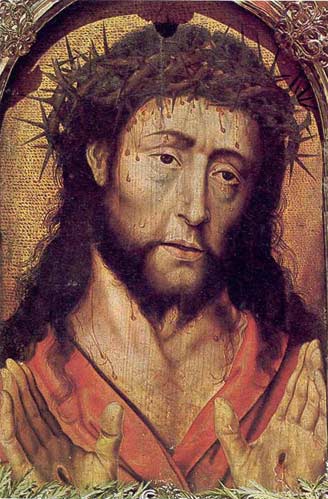
St. Teresa of Jesus, the foundress of the Discalced Carmelites, and Doctor of the Church tells us that when we pray we must be very careful never to set aside the sacred humanity of Jesus Christ. “Many, many times have I perceived this through experience. The Lord told it to me. I have definitely seen that we must enter by this gate if we desire his sovereign Majesty to show his great secrets. A person should desire no other path, even if he be at the summit of contemplation; on this road he walks safely. This Lord of ours is the one through whom all blessings come to us. He will teach us these things. In beholding his life we find that he is the best example.”
Painting of Christ by Dirk Bouts that captivated St. Teresa
“Blessed is the one who truly loves him and always keeps him near…As often as we think of Christ we should recall the love with which he bestowed on us so many favors, and the great things God showed in giving us a pledge like this of his love; for love begets love. Let us strive to keep this always before our eyes and to waken ourselves to love. For if at some time the Lord should grant us the favor of impressing this love on our hearts, all will become easy for us and we shall carry out our tasks quickly and without much effort.”
Christ giving His Blessing -Hans Memling
My beloved passing fair,
Love has drawn thy likeness, see,
In my inmost Heart, and there–
Lost or straying unaware–
Thou must seek thyself in me.
Well I know that thou shalt find
This thine image in my Heart,–
Pictured to the life, with art
So amazing, that thy mind
Sees thy very counterpart.
If by chance thou e’er shalt doubt
Where to turn in search of me,
Seek not all the world about;
Only this can find me out–
Thou must seek myself in thee.
In the mansions of thy mind
Is my dwelling-place; and more–
There I wander, unconfined,
Knocking loud if e’er I find
In thy thought a closed door.
Search for me without were vain,
Since, when thou hast need of me,
Only call me, and again
To thy side I haste amain;
Thou must seek myself in thee.
–St. Teresa of Jesus
Statue of Jesus Scourged St. Teresa’s moment of conversion occurred while praying before this image.
“Do not be afraid, I will not harm you. I come from heaven…Are you willing to offer yourselves to God and bear all sufferings He wills to send you, as an act of reparation for the conversion of sinners? Then you are going to have much to suffer, but the grace of God will be your comfort.” –The words of Our Lady to the three shepherd children of Fatima.
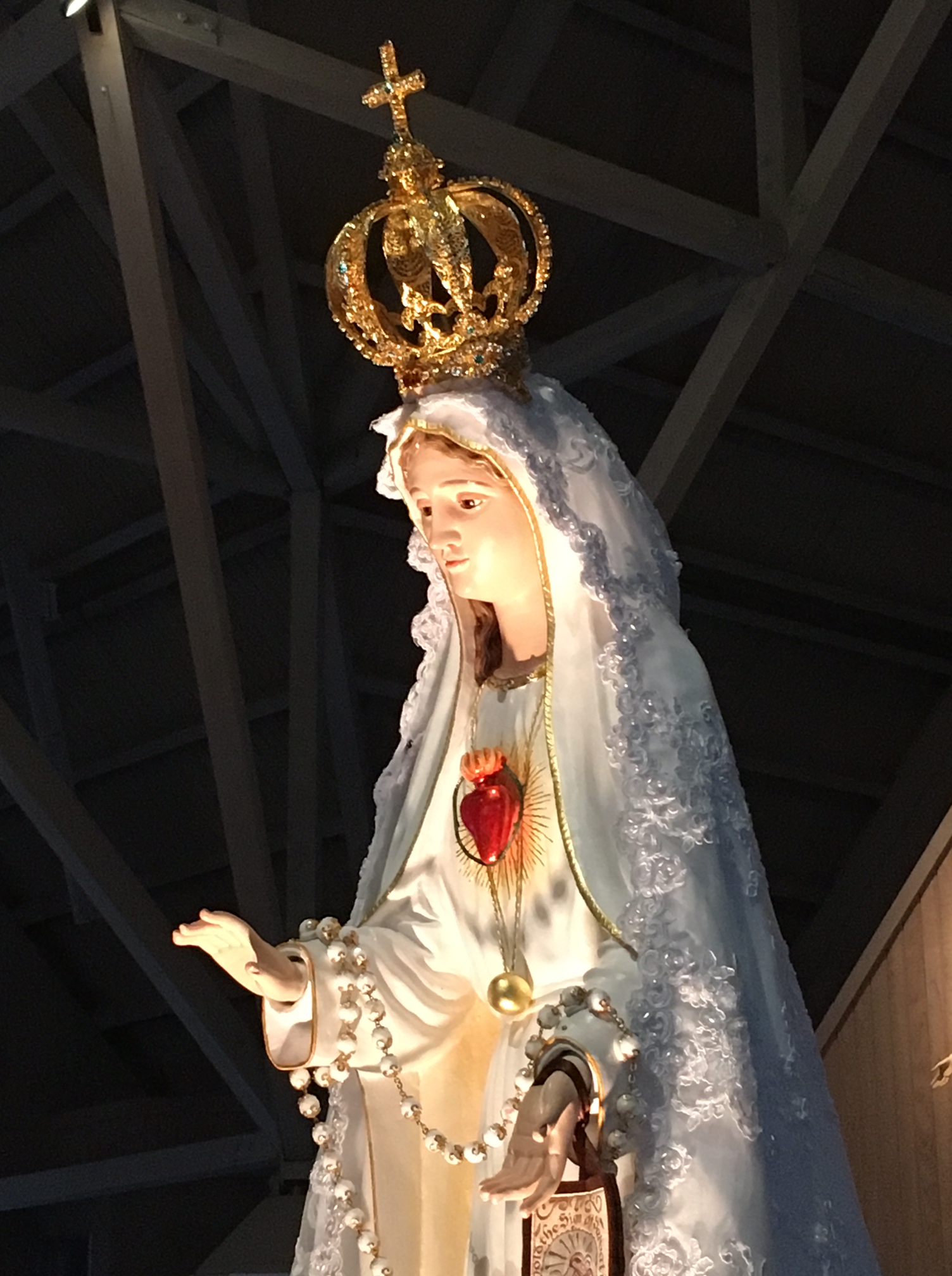
One hundred years ago, on May 13th, 1917, the Blessed Mother appeared to three children in Portugal with a message from Heaven for the world. She requested that the children, Lucia, Jacinta and Francisco, come on the 13th of the month for the next six months. Our Lady told the children that Jesus wanted to use the children to make His mother known and loved, and to establish devotion to the Immaculate Heart of Mary throughout the world. In each apparition, the Blessed Mother asked that the Rosary be prayed every day “to bring peace to the world.” In her last visit on October 13th, 1917, she told the children, “I am the Lady of the Rosary.”
“To bring peace to the world” is no little thing. The world is filled with division, violence, and death. It would take a miracle of God to bring peace from the chaos that surrounds us. God has always willed to show forth His power and glory through the smallest and weakest. He has sent his own Mother to earth with a delicate Rosary in her hands as an unlikely but powerful weapon against evil, if only we co-operate with His Divine Plan by praying it. It is not a vain repetition of words, but the contemplation of the Face of Christ through the eyes of His Mother; and therein lies its power.
Contemplating the Face of Christ with Mary
When he placed the New Millennium under “the Radiant sign of the Face of Christ” Pope St. John Paul II wrote:
“To contemplate the Face of Christ, and to contemplate it with Mary, is the ‘program’ which I have set before the Church at the dawn of the third millennium…It is the Church’s task to reflect the light of Christ in every historical period, to make His Face shine also before new generations of the new millennium. Our witness, however, would be hopelessly inadequate if we ourselves had not first contemplated His Face.”
The Rosary is a traditional Christian prayer directed to the contemplation of Christ’s Face. “Without contemplation, the Rosary is a body without a soul,” says Pope St. John Paul II, “and runs the risk of becoming a mechanical repetition of formulas, in violation of the admonition of Christ.”
Contemplation is a gift, a grace, from God. It is a communion in which God transforms a soul into His likeness. To put it more simply, as St. Teresa of Jesus says, contemplation is “a close sharing between friends…taking time frequently to be alone with Him who we know loves us.” Contemplation is not something beyond our reach however–we have an incomparable model in Mary; the eyes of her heart were always turned toward His Face. To dispose our souls to receive this great gift of God we need only reach for a Rosary and pray it with humility, listening attentively in the Spirit together with Mary, in silent love–that veil of mystery–to the Father’s voice. When we contemplate the scenes or mysteries of the Rosary in union with Mary, the Rosary becomes an unceasing praise of God; a way to learn from her about her son, Jesus, to discover His secrets and understand His message for us.
To recite the Rosary, which can be called a compendium of the Gospel, Pope St. John Paul II says, “is to contemplate the Face of Christ in union with, and at the school of, His Most Holy Mother…Against the background of the words of the Ave Maria the principal events of the life of Jesus Christ pass before the eyes of the soul. They take shape in the complete series of the joyful, [luminous,] sorrowful and glorious mysteries, and they put us in living communion with Jesus through–we might say through the heart of his Mother…The Rosary belongs among the finest and most praiseworthy traditions of Christian contemplation…To look upon the Face of Christ, to recognize its mystery amid the daily events and sufferings of His human life, and then to grasp the divine splendor definitively revealed in the Risen Lord, seated in glory at the right hand of the Father; this is the task of every follower of Christ and therefore the task of each one of us. In contemplating Christ’s Face we become open to receiving the mystery of Trinitarian life, experiencing ever anew the love of the Father and delighting in the joy of the Holy Spirit. St. Paul’s words can then be applied to us ‘Beholding the glory of the Lord, we are being changed into His likeness, from one degree of glory to another; for this comes from the Lord who is the Spirit.’” (Rosarium Virginus Mariae)
“The contemplation of Christ’s Face cannot stop at the image of the Crucified One. He is the Risen One!”~ Pope St. John Paul II (Holy Face of Manoppello (Photo: Patricia Enk)
The entire month of October is dedicated to the Holy Rosary and October 7th is celebrated as the feast of Our Lady of the Rosary. The feast, originally named for Our Lady of Victory, commemorated the stunning victory, against all odds, obtained by Our Lady in the Battle of Lepanto through the prayer of the Rosary–which saved Christendom on October 7th, in 1571. By keeping our eyes fixed on the Face of Jesus as we pray the Rosary, together with Mary, through her maternal intercession, we too may obtain great victories through the heart of her Son Jesus, who obtained for all mankind the greatest victory over sin and death by His Resurrection.
Venice, Illustration for the Divine Comedy of Dante, 13th Century”
“During meditation, the Lord gave me knowledge of the joy of Heaven and of the Saints on our arrival there; they love God as the sole object of their love, but they also have a tender and heartfelt love for us. It is from the Face of God that this joy flows out upon all, because we see Him face to Face. His Face is so sweet that the soul falls anew into ecstasy” (1592, “Divine Mercy in My Soul”).
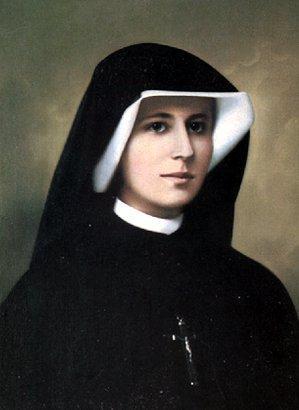
St. Faustina “Apostle of Mercy” Feast Day: October 5th
St. Faustina Kowalska, “The Apostle of Mercy,” was known as a mystic and visionary. Our Lord granted her a deep understanding of the love and mercy of God which she was to share with the world through her diary, “Divine Mercy in My Soul.” The Face of Christ had a prominent place in her spiritual journey:
Head of Christ, Petrus Christus ca. 1440 The Metropolitan Museum
“I have ever before my eyes His sorrowful Face, abused and disfigured. His Divine Heart pierced by our sins and especially by the ingratitude of chosen souls.” (Divine Mercy in my Soul, #487)
St.Faustina’s message of mercy was also intensely Eucharistic, recognizing the True Presence of Jesus in the Blessed Sacrament. She offered Him continually to the Father to implore His Mercy for the salvation of the world:
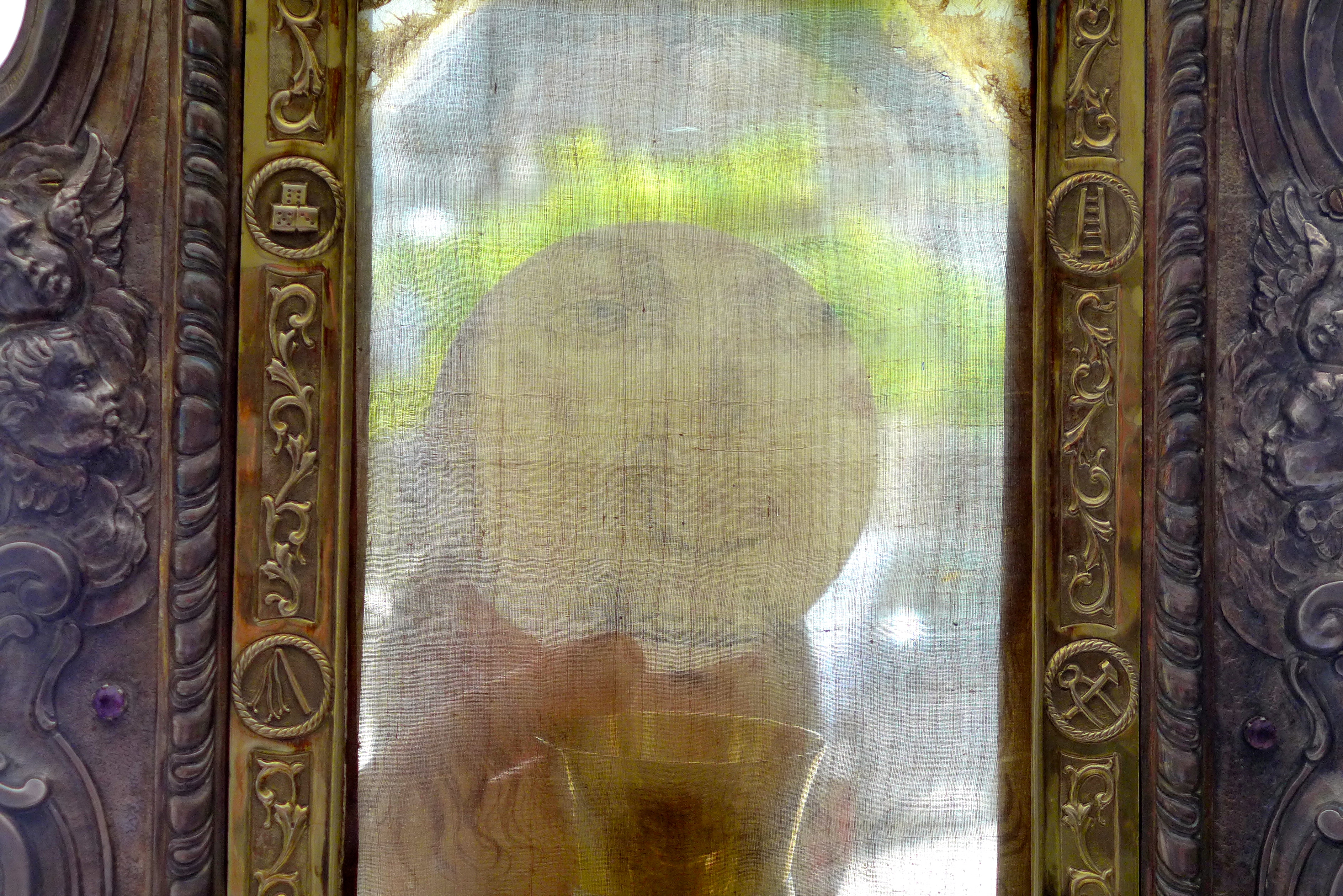
Host viewed through the Face of Jesus on the Veil of Manoppello in Italy. (Photo: Paul Badde/EWTN)
“Eternal Father, I offer You the Body, Blood, Soul and Divinity of Your dearly beloved Son, Our Lord Jesus Christ, in atonement for our sins, and those of the whole world. For the sake of His sorrowful Passion have mercy on us and on the whole world.”
The greatest sign of God’s continuing mercy for the people of the world is His hidden Presence in the Eucharist. By turning to His Eucharistic Face in prayer, St. Faustina says, “a change takes place” in our souls, because Jesus is also gazing at us.
“The Face of Christ is the supreme revelation of Christ’s Mercy.”–Pope Benedict XVI (photo:Paul Badde/EWTN)
“O Living Host, O hidden Jesus. You see the condition of my soul. Of myself, I am unable to utter Your Holy Name. I cannot bring forth from my heart the fire of love, but kneeling at Your feet, I cast upon the Tabernacle the gaze of my soul, a gaze of faithfulness. As for You, You are ever the same, while within my soul a change takes place. I trust that the time will come when You will unveil Your Countenance, and Your child will again see Your sweet Face. I am astonished, Jesus, that You can hide Your self from me for so long and that You can restrain the enormous love You have for me. In the dwelling of my heart, I am listening and waiting for Your coming, O only Treasure of my heart! (Divine Mercy in My Soul, #1146)
By contemplating His Holy Face, and making Him the “Treasure” of our hearts, we are transformed by the Holy Spirit, who restores God’s image and likeness in our souls. As St. Paul has written:
“but whenever a person turns to the Lord the veil is removed…All of us, gazing with unveiled face on the glory of the Lord, are being transformed into the same image from glory to glory, as from the Lord who is the Spirit. (2 Cor. 3:16, 18)
St. Faustina’s message of God’s Mercy is needed more with each passing day. Let us continue to pray for God’s Mercy, and pray as well for all the people of the world to turn back to the Face of God, so all may share in the joy of Heaven one day–to see Him face to Face.
“Write this: before I come as the Just Judge, I am coming first as the King of Mercy.” –Our Lord to St. Faustina
St. Faustina’s Prayer for Divine Mercy
O Greatly Merciful God, Infinite Goodness, today all mankind calls out from the abyss of its misery to Your mercy — to Your compassion, O God, and it is with its mighty voice of misery that it cries out: Gracious God, do not reject the prayer of this earth’s exiles! O Lord, Goodness beyond our understanding, Who are acquainted with our misery through and through and know that by our own power we cannot ascend to You, we implore You, anticipate us with Your grace and keep on increasing Your mercy in us, that we may faithfully do Your holy will all through our life and at death’s hour. Let the omnipotence of Your mercy shield us from the darts of our salvation’s enemies, that we may with confidence, as Your children, await Your final coming — that day known to You alone. And we expect to obtain everything promised us by Jesus in spite of all our wretchedness. For Jesus is our Hope: Through His merciful Heart as through an open gate we pass through to heaven.” (Divine Mercy in My Soul, #1570)
“Jesus Christ is the Face of the Father’s Mercy!”–Pope Francis
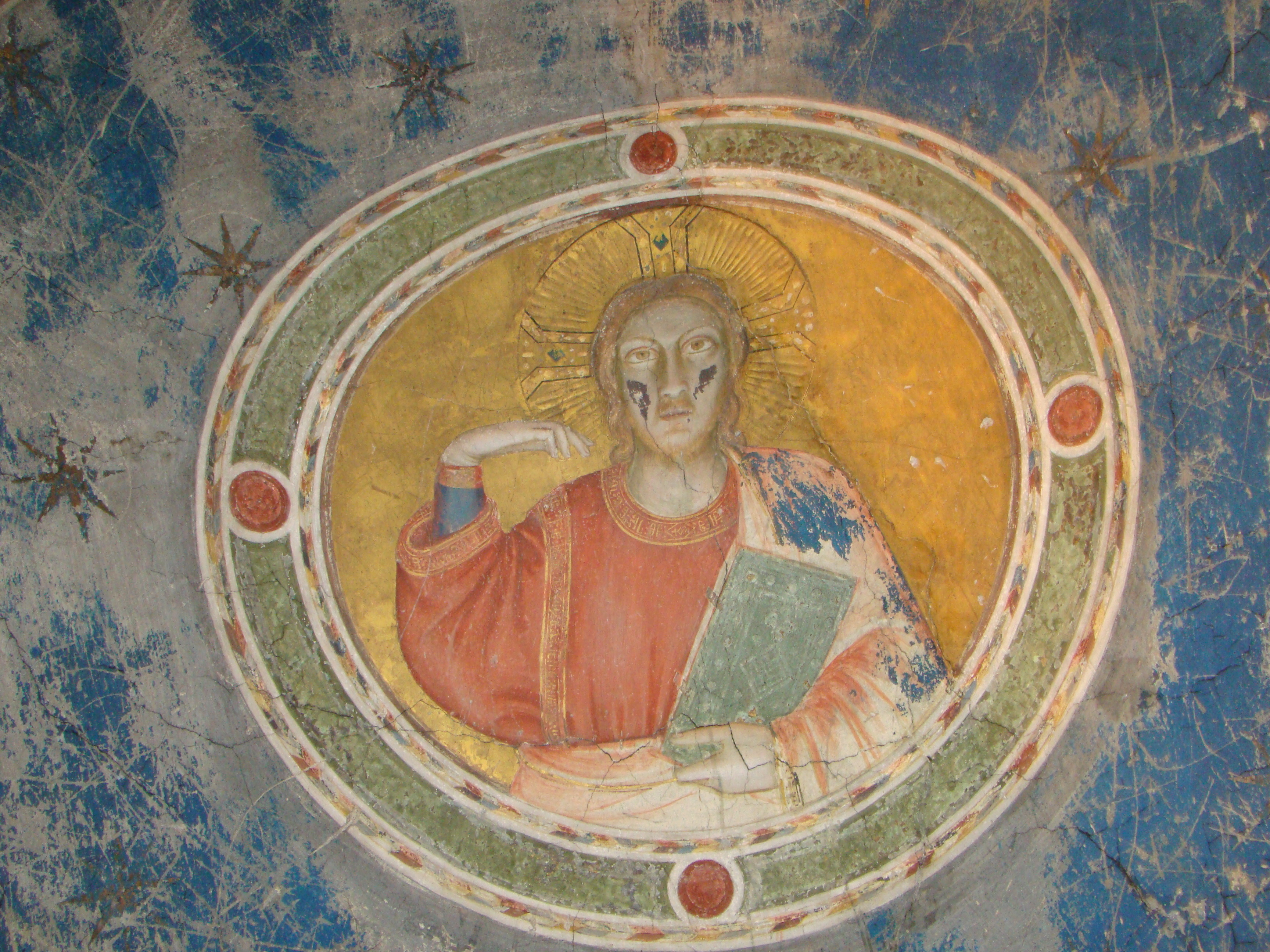
Fresco -Assisi (Photo: Paul Badde)“The Blessing of St. Francis” in reliquary.
Within the Basilica of St. Francis in Assisi is a precious relic: a small, crumpled piece of yellowed parchment with the writing of St. Francis, now displayed in a silver reliquary. It was written on Mount La Verna after St. Francis had received the stigmata. The first biographer of St. Francis, Bl. Thomas of Celano wrote that for a long time St. Francis’s friend, Brother Leo, had greatly desired to have some memorial from the words of Our Lord written by St. Francis:
St. Francis of Assisi
“One day Blessed Francis called him, saying, ‘Bring me paper and ink, for I wish to write the words of God and His praises which I have been meditating in my heart.’ What he asked for being straightway brought, he writes with his own hand the praises of God and the words which he [his companion] wished, and lastly a blessing of the brother, saying: ‘Take this sheet for thyself and until the day of thy death guard it carefully.’ All temptation was at once driven away; the letter is kept and worked wonders for the time to come.” Brother Leo kept it faithfully; folding it in four, he carried it in his pocket and guarded it jealously for a good forty-six years. The text in the middle, written in black, and marked with a large “Tau” cross is in Francis’s own handwriting, he writes the praises of God* and grants to Brother Leo the blessing from the Book of Numbers 6: 22-27 which later became known as “the Blessing of St. Francis.”
Pope Emeritus Benedict XVI, in his homily for the World Day of Peace, 2013, spoke of this blessing from the Book of Numbers:
“The blessing repeats the three times Holy Name of God, a Name not to be spoken, and each time linked to two words indicating an action in favor of man. Peace is the summit of these six actions of God in our favor, His most sublime gift, in which He turns toward us the splendor of His Face.”
Christus Imperat! – Assisi (photo: Patricia Enk)
This is the same, great blessing that St. Francis desired to impart to his friend, Brother Leo:
“May the Lord bless and keep you; may He make His Face shine upon you and be merciful to you; may He turn His Countenance toward you and give you His Peace!” (Num. 6:22-27)
Amen!
Altar in front of the tomb of St. Francis of Assisi (Photo:Patricia Enk)
*(St. Francis’s “Praises of God” are now now quite faded, but, this much can be still read: “Thou art holy, Lord God, who alone workest wonders. Thou art strong. Thou art great. Thou art most high. Thou art the Almighty King, Thou, holy Father, King of heaven and earth. Thou art the Lord God Triune and One; all good. Thou art good, all good, highest good, Lord God living and true. Thou art charity, love. Thou art wisdom. Thou art humility. Thou art patience. Thou art security. Thou art quietude. Thou art joy and gladness. Thou…”)
St. Francis, Pray for us!
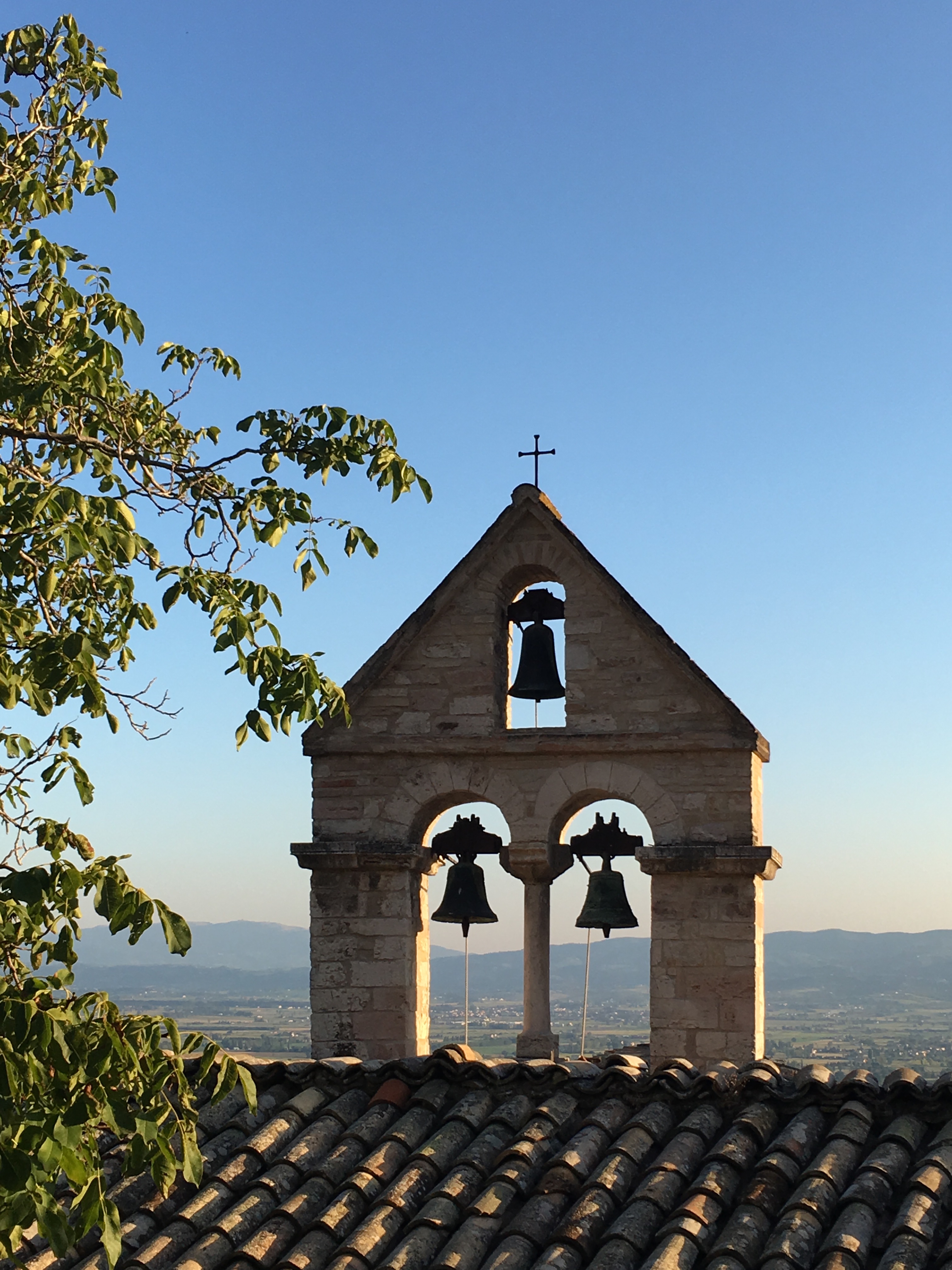
Assisi – The bells of the church of St. Stephen the Martyr which rang by themselves when St. Francis died.
A Beautiful Mass of the Roses in honor of St. Therese
Fr. Jorge Cabrera-Marrero, OCD, Main Celebrant for the Mass of the Roses (Photo: Patricia Enk)
Thank you, Lord, for a beautiful Mass of the Roses in honor of St. Therese. God’s Face shone upon all, reflecting the beauty, goodness, and innocence which is His Divine Presence in the world.
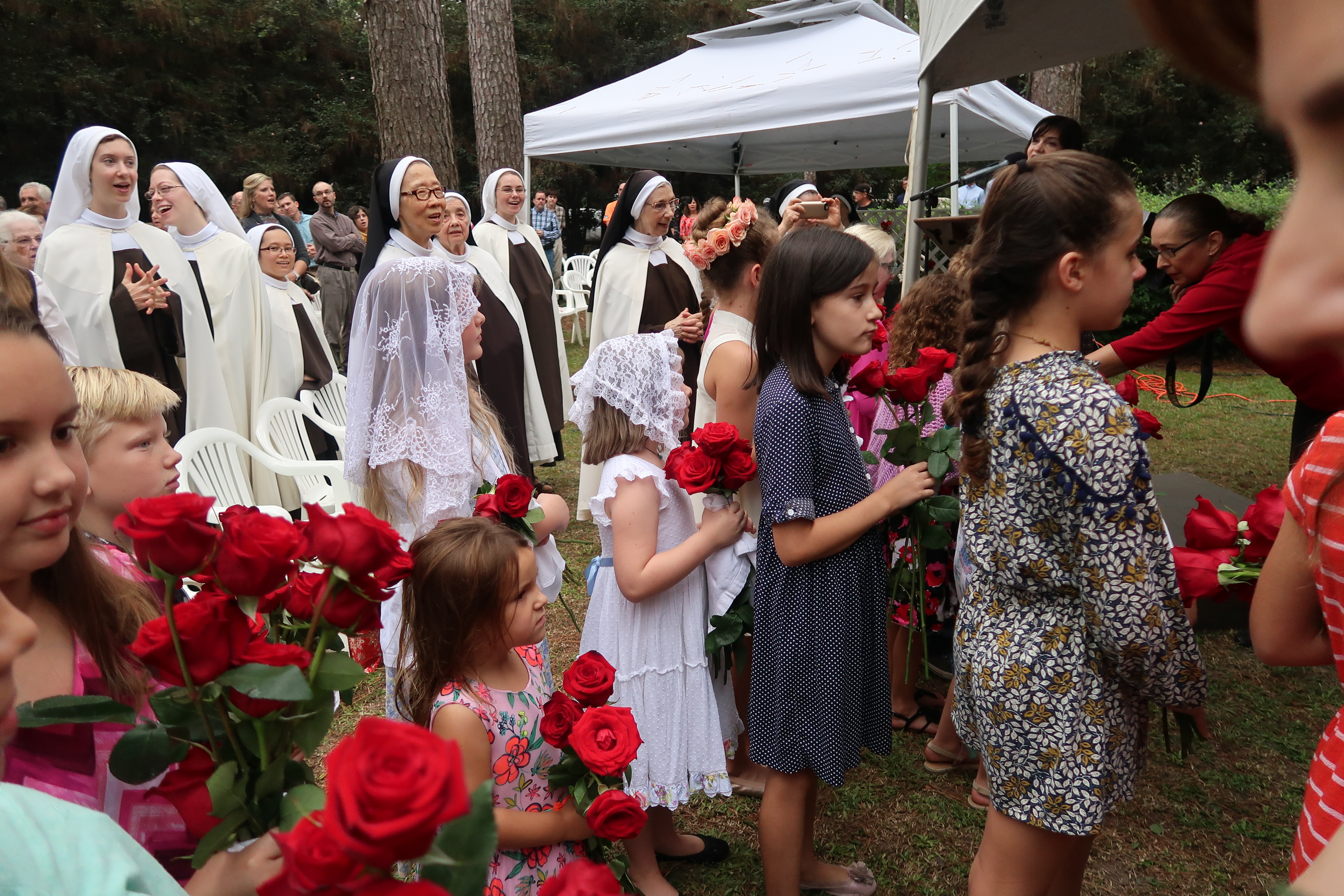
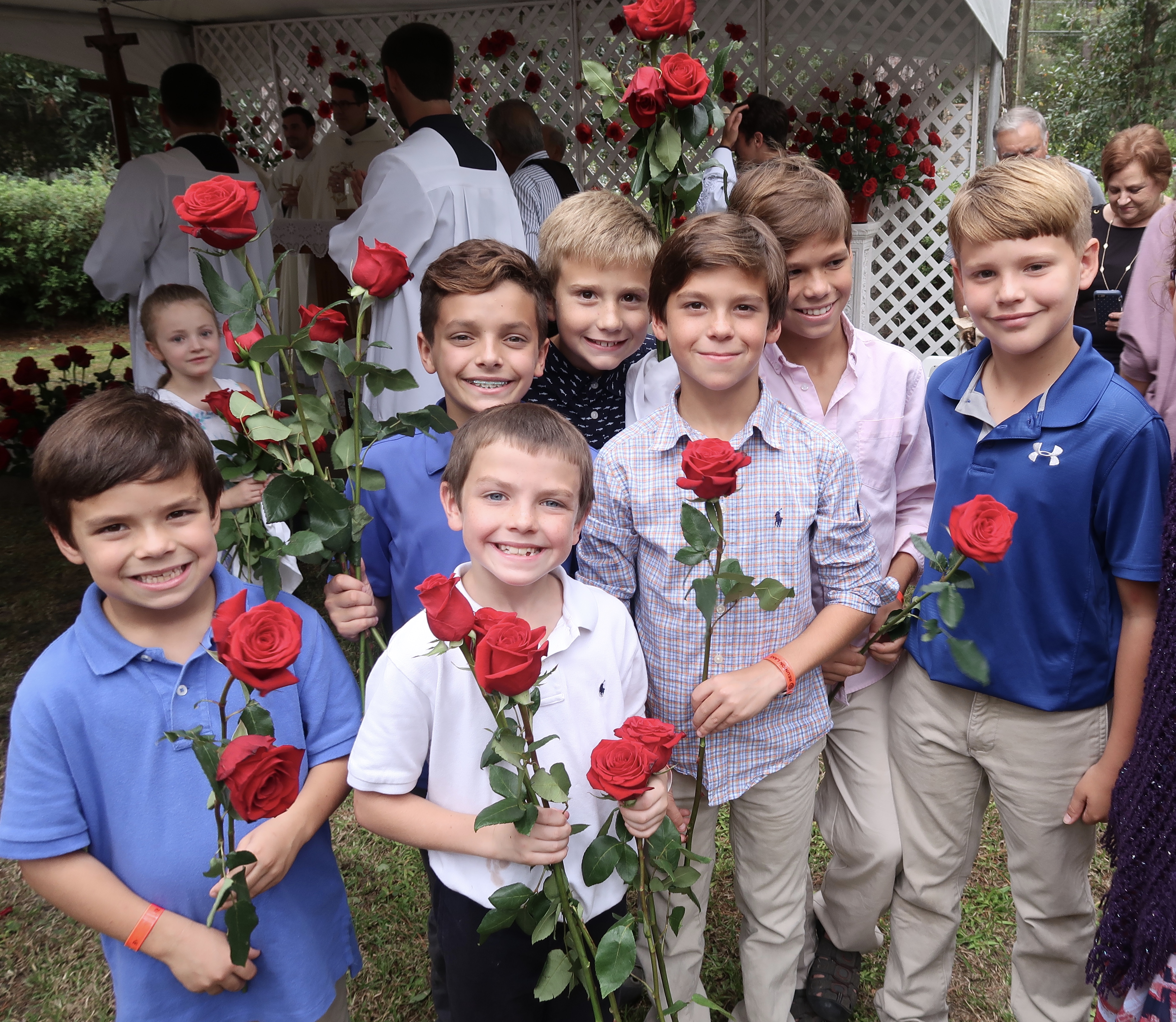
Discalced Carmelite Nuns, and children processing with Roses (Photo: Patricia Enk)Children in procession with Roses (photo: Patricia Enk)Fr. Jorge Cabrera-Marrero, OCD blesses the children’s roses (Photo:Patricia Enk)
“Let the ‘little ones’ come to Me” (Photo: Patricia Enk)
St. Therese reminds us to pray for vocations to the priesthood (Photo: Patricia Enk)
“The Dream of the Child Jesus” Oil painting by St. Therese of the Child Jesus contemplating His Holy Face on the Cross
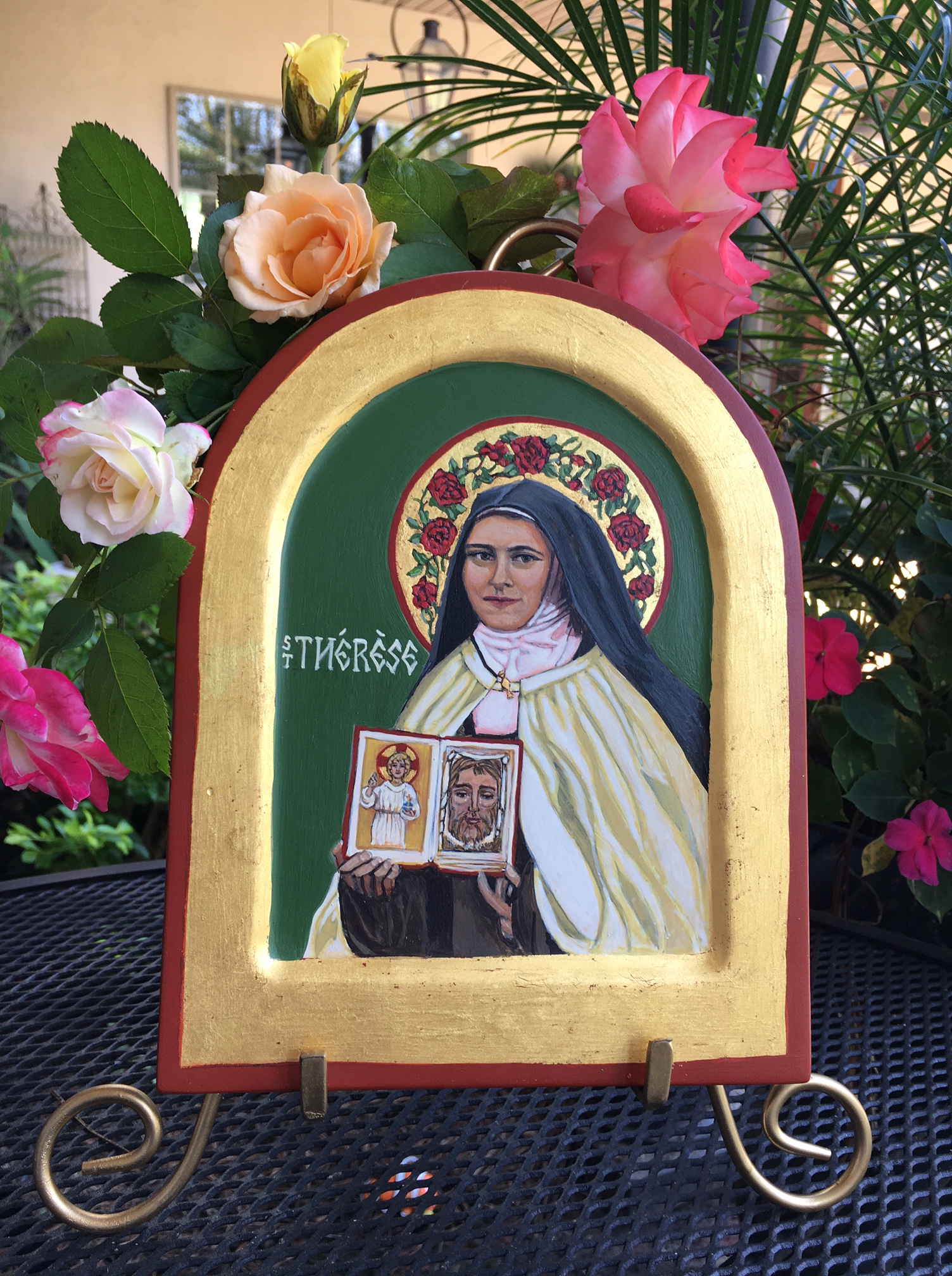
The Discalced Carmelite Nuns of Covington, Louisiana will again celebrate the solemn Feast Day of St. Therese of the Holy Face and the Child Jesus, also known as “the Little Flower,” with their annual “Mass of the Roses” on Sunday, October 1st, 2017. St. Therese was a French Discalced Carmelite Nun who died of tuberculosis at the age of 24. She became a Saint and Doctor of the Church, inspiring others by her “Little Way” of doing small things with great love to attain holiness. She promised that when she died “a shower of roses” would fall from Heaven in the graces obtained through her intercession.
The “Mass of the Roses.” will open with a flute prelude by Sr. Grace, OCD and Patti Adams, LPO. The Holy Eucharist will be celebrated at 9:30 am with Father Jorge Cabrera, OCD, as the main celebrant. Immediately following Mass, the children are invited to join in procession, carrying roses to the altar to be blessed and distributed.
Children come in procession for “the blessing of the roses.”
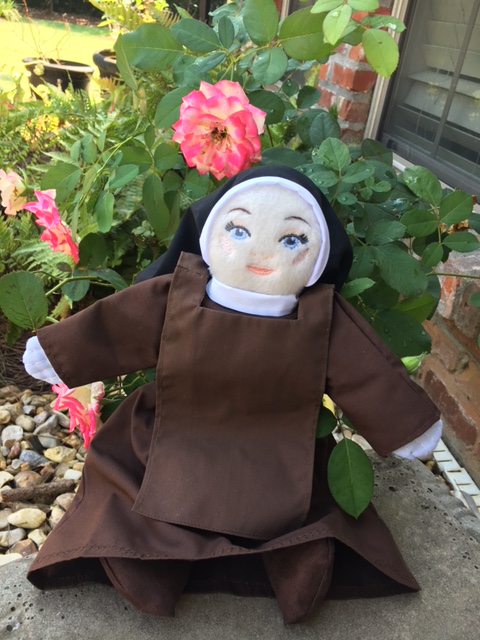
“St. Therese doll” handmade by the Carmelite nuns
Many gifts, food, and handmade items may be purchased; the proceeds will help the Carmelite nuns meet their financial needs for the year. Delicious refreshments will be served after the Mass, thanks to many gracious sponsors and volunteers. Hand-made items by the sisters, as well as cookies, pies and bread from the Sister’s kitchen will be for sale as well as a variety of religious articles, books and gifts. A children’s area will be set up for face-painting, artwork and other fun activities. A special table will also be set up for Holy Face books, Chaplets, Images and Medals.
Although, St. Therese is more commonly known for her way of “Spiritual Childhood” and devotion to The Child Jesus, her sister, Mother Agnes gave this testimony for St. Therese’ beatification:
“Devotion to the Holy Face was the Servant of God’s special attraction. As tender as was her devotion to the Child Jesus, it cannot be compared to her devotion to the Holy Face.”
This years St. Therese Icon for silent auction by Patricia Enk, OCDS
St. Therese’ sister Celine (Sr. Genevieve of the Holy Face), also wrote: “Devotion to the Holy Face was, for Therese, the crown and complement of her love for the Sacred Humanity of Our Lord. The Blessed Face was the mirror wherein she beheld the Heart and Soul of her Well-Beloved. Just as the picture of a loved one serves to bring the whole person before us, so in the Holy Face of Christ Therese beheld the entire Humanity of Jesus. We can say unequivocally that this devotion was the burning inspiration of the Saint’s life… Her devotion to the Holy Face transcended, or more accurately, embraced, all the other attractions of her spiritual life.”
Prayer of St. Therese to The Holy Face
“O adorable Face of Jesus, sole beauty which ravishes my heart, vouchsafe to impress on my soul Your divine likeness so that it may not be possible for You to look at Your spouse without beholding Yourself! O my Beloved, for love of You I am content not to see here on earth the sweetness of Your glance, nor to feel the ineffable kiss of Your sacred lips, but I beg of You to inflame me with Your love so that it may consume me quickly and that soon I may behold Your glorious countenance in Heaven.”
For more information on the “Mass of the Roses” (click here)
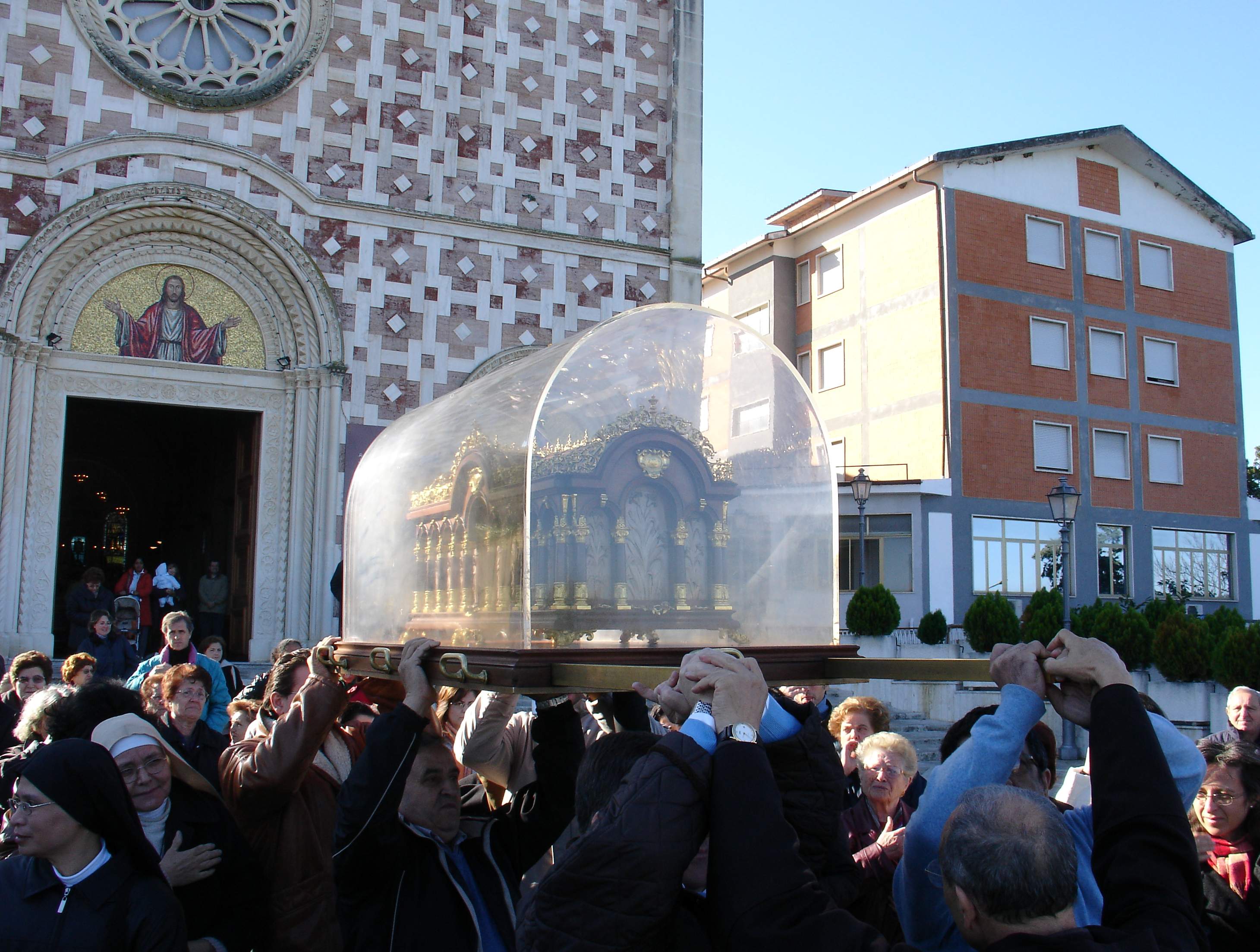
Below are some wonderful photos that journalist Paul Badde has sent of St. Therese’s relics visiting the Sanctuary Basilica of the Holy Face in Manoppello on November 4th, 2006.
Relics of St. Therese at the altar of the shrine of the Holy Face in Manoppello, November 4, 2006 (Photo: Paul Badde)St. Therese reliquary covered with rose petals. Shrine of the Holy Face of Manoppello. Nov. 4, 2006 (Photo: Paul Badde)St. Therese reliquary carried in procession in front of the Basilica Sanctuary of the Holy Face of Manoppello. Nov. 4, 2006. (Photo: Paul Badde)

 although he too was suffering on a cross, St. Dismas acknowledged his own guilt and publicly defended Jesus, rebuking the thief who had blasphemed Him, saying, “Have you no fear of God, for you are subject to the same condemnation? And indeed, we have been condemned justly, for the sentence we received corresponds to our crimes, but this man has done nothing criminal.” (Lk, 23:40-41) What came next is a testament to heroic faith, because although the thief saw the suffering, humiliated, and disfigured Face of Jesus, he called Him a king: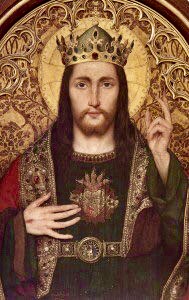





















 Illumina Domine Blog - Devotion to The Holy Face