“May the Lord grant that in the new millennium, the Church will grow ever more in holiness, that she may become in history a true epiphany of the merciful and glorious Face of Christ the Lord.” –Pope St. John Paul II
Illustration from Godescalc Illuminated manuscript, commissioned by King Charlemagne in 781, which may be considered the most important “missing link” in depictions of the Face of Christ from the Holy Sudarium. Information and photo:Paul Badde
Act of Consecration to the Holy Face
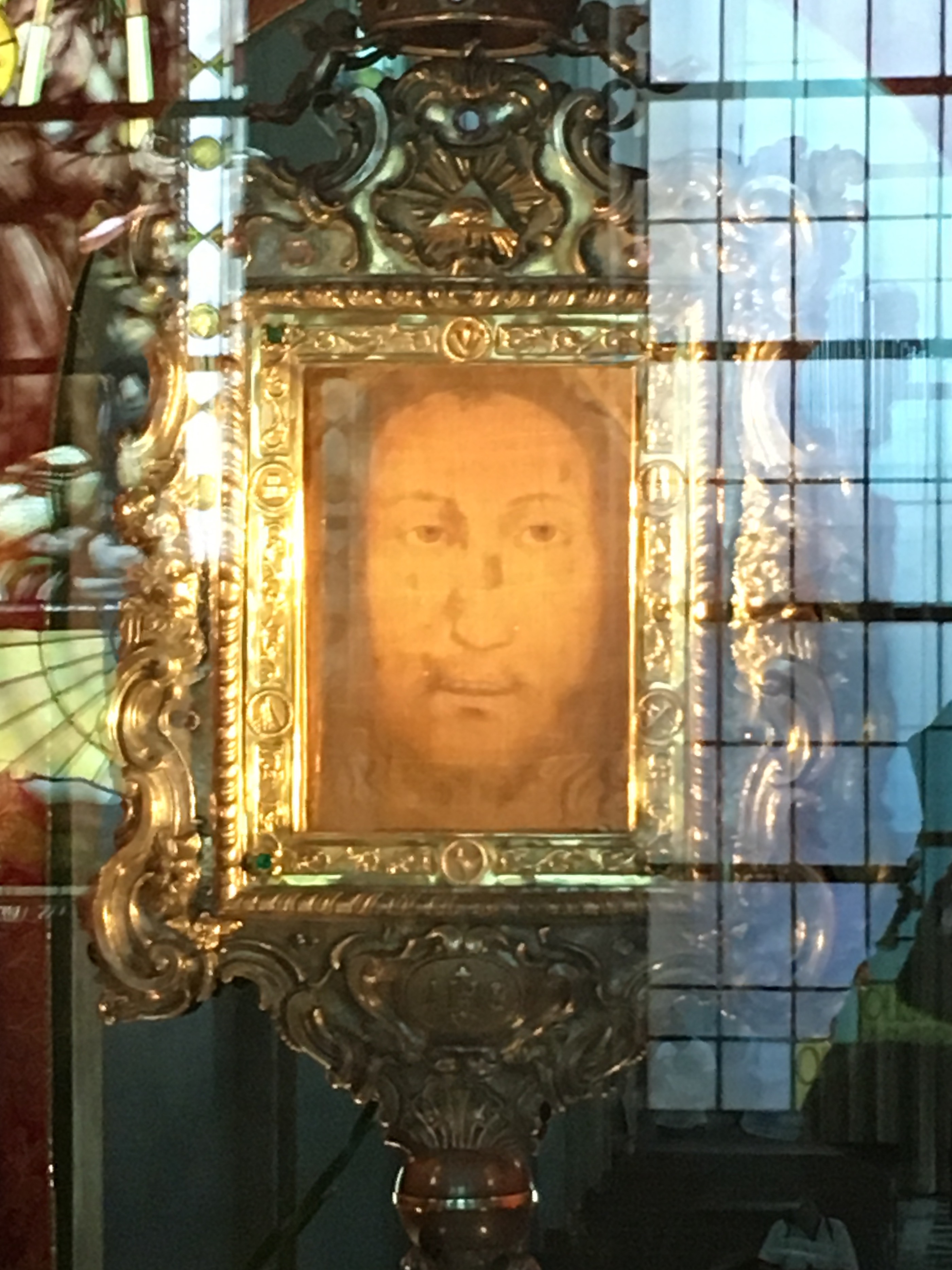
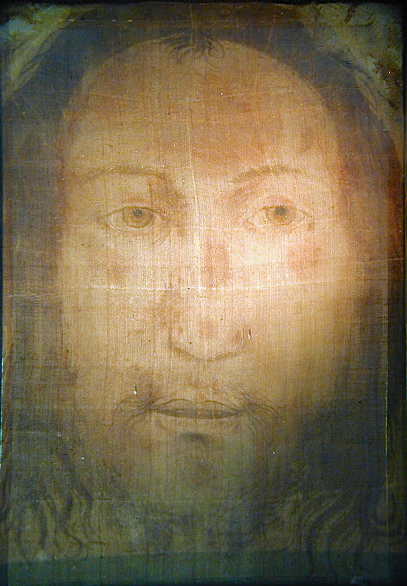
Holy Face of Manoppello, photo: Patricia Enk
O Lord Jesus, we believe most firmly in You, we love You. You are the Eternal Son of God and the Son Incarnate of the Blessed Virgin Mary. You are the Lord and Absolute Ruler of all creation. We acknowledge You, therefore, as the Universal Sovereign of all creatures. You are the Lord and Supreme Ruler of all mankind, and we, in acknowledging this Your dominion, consecrate ourselves to You now and forever. Loving Jesus, we place our family under the protection of Your Holy Face, and of Your Virgin Mother Mary most sorrowful. We promise to be faithful to You for the rest of our lives and to observe with fidelity Your Holy Commandments. We will never deny before men, You and Your Divine rights over us and all mankind. Grant us the grace to never sin again; nevertheless, should we fail, O Divine Saviour, have mercy on us and restore us to Your grace. Radiate Your Divine Countenance upon us and bless us now and forever. Embrace us at the hour of our death in Your Kingdom for all eternity, through the intercession of Your Blessed Mother, of all Your Saints who behold You in Heaven, and the just who glorify You on earth. O Jesus, be mindful of us forever and never forsake us; protect our family. O Mother of Sorrows, by the eternal glory which you enjoy in Heaven, through the merits of your bitter anguish in the Sacred Passion of your Beloved Son, our Lord Jesus Christ, obtain for us the grace that the Precious Blood shed by Jesus for the redemption of our souls, be not shed for us in vain. We love you, O Mary. Embrace us and bless us, O Mother. Protect us in life and in death. Amen.
Glory to the Father, and to the Son, and to the Holy Spirit. As it was in the beginning, is now, and will be forever. Amen.
Wishing you all a holy Lent under the gaze of the Holy Face of Jesus.
Holy Face “Il Volto Santo” of Manoppello, photo: Paul Badde
“All of us, with unveiled faces, seeing the glory of the Lord as though reflected in a mirror, are being transformed into the same image.” (2 Cor 3:18)
Prayer for Priests
Bl. Mother Maria Pierina De Micheli
“Eternal Father, we offer Thee, with the hands of Mary, the Holy Face of Jesus, Thy Son, and the entire generous holocaust of all that we are, in reparation for so many sins that are committed, and, especially, for offenses against the Most Holy Sacrament of the Altar. We make this offering, in a particular way, so that Priests, by the holiness of their lives, may show the world the adorable features of the Divine Countenance shining with the light of truth and love, for the triumph of the Church, and for the spread of the Kingdom.” Bl. Mother Maria Pierina De Micheli, “Missionary of the Holy Face”
Prayer to the Holy Face by Pope St. John Paul II
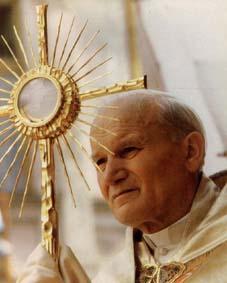
St. Pope John Paul II “In the Eucharist, the Face of Christ is turned towards us.”
Lord Jesus, Crucified and Risen; the image of the glory of the Father, Holy Face, which looks at us and searches for us, kind and merciful, You who call us to conversion and invite us for the fullness of love, we adore and bless You. In Your Luminous Face, we learn to love and to be loved, to find freedom and reconciliation, to promote peace, which radiates from You and leads to You.
In Your glorified Face we learn to overcome every form of egoism, to hope against hope, to choose works of life against the actions of death. Give us grace to place you at the centre of our life, to remain faithful amidst dangers and the changes of the world, to our Christian vocation; to announce to all people the power of the Cross and the Word which saves; to be watchful and active, to attend the needs of the little ones; to understand the need of true liberation, which had its beginning in You and will have its end in You.
Lord, grant to Your Church to stand like Your Virgin Mother, at the glorious Cross, and at the crosses of all people to bring about consolation, hope and comfort.
May the Holy Spirit which You have granted, bring to maturation Your work of salvation, through Your Holy Face, which shines forever and ever. Amen.
Mural by Dom Gregory DeWitt, St. Joseph Abbey, Louisiana
It was Pope St. John Paul II who first used the phrase, “Eucharistic Face of Christ,” which was previously unknown in the Church. Pope St. John Paul II, by dedicating the millennium to the Face of Christ, drew back the veil for us, so that like disciples on the road to Emmaus, who recognized Jesus in the “breaking of the bread,” (Luke 24:30-32) we too, may seek, find and adore His Face present and hidden in the Eucharist where we may gaze on Him freely in faith.
“May, O Lord, the light of Thy Face shine upon us.” These words were the inspiration for Pope St. John Paul II to place the 3rd Millennium under “the radiant sign of the Face of Christ.” He emphasized the importance of contemplation of the Face of Christ by stating: “And it is the Church’s task to reflect the light of Christ in every historical period, to make His face shine also before the generations of the new millennium. Our witness, however, would be hopelessly inadequate if we ourselves had not first contemplated His face.”
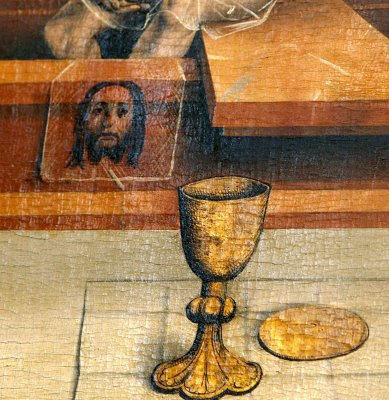
Face of Jesus on veil by Michael Wolgemut, teacher of Albrecht Durer. The “Veil of Veronica” in artwork before the early 1500’s resemble the “Il Volto Santo” of Manoppello.
“O my soul, you will always find in the Blessed Sacrament, great consolation and delight, and once you have begun to relish it, there will be no trials, persecutions, and difficulties which you cannot endure.”
“Let him who wills ask for ordinary bread. For my part, O Eternal Father, I ask to be permitted to receive the heavenly Bread with such dispositions that, if I have not the happiness of contemplating Jesus with the eyes of my body, I may at least contemplate Him with the eyes of my soul. This is Bread which contains all sweetness and delight, and sustains our life.” –St. Teresa of Jesus, “The Way of Perfection”
“He is always looking at you; can you not turn the eyes of your soul to look at Him?”–St. Teresa of Avila
Sacred Host viewed through the Holy Face Veil of Manoppello Photo Paul Badde
Immaculate Conception by Bartolome Esteban Murillo
“Blessed are the pure of heart, for they shall see God.”
Pope Francis has chosen December 8th, the Solemnity of the Immaculate Conception, as the opening of the Holy Jubilee Year of Mercy, “because of its rich meaning.” “After the sin of Adam and Eve, God did not wish to leave humanity alone in the throes of evil. So he turned his gaze to Mary, holy and immaculate in love (cf. Eph 1:4), choosing her to be the Mother of man’s Redeemer. When faced with the gravity of sin, God responds with the fullness of mercy.” Pope Francis (Face of Mercy)
Mary was “Blessed in Christ with every spiritual blessing,” (cf. Eph 1:3) chosen by God from all eternity to be the Mother of the Redeemer. It is she who leads us to Jesus, so that we may contemplate, together with her, the Face of Mercy. As the Immaculate Conception, Mary bears in herself the most perfect reflection of the face of God. Pope St. John Paul II wrote, “The Blessed Virgin saw shining upon her, as no other creature, the face of the Father, rich in grace and mercy.”
As the Jubilee Year of Mercy begins, let us fix our gaze on Mary rather than on the profane things of the world. We keep Mary before our eyes in order to contemplate in her everything that is good and true and beautiful. “She is the proclamation of a merciful God who does not surrender to the sin of his children,” Pope St. John Paul II tells us “in Mary shines forth God’s sublime and surprising tenderness for the entire human race. In her, humanity regains its former beauty and the divine plan is revealed to be stronger than evil…” In Mary “the Creator has kept the original beauty of creation uncontaminated” so that in the Immaculate Conception, “the Father’s original, wondrous plan of love was reestablished in an even more wondrous way.”
A Little Litany by G.K.Chesterton
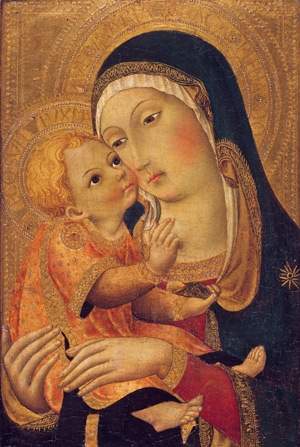
“Our Lady, in whose face – more than any other creature – we can recognize the features of the Incarnate Word.” –Pope Benedict XVI Madonna and Child from the Robert Lehman Collection, Metropolitan Museum of Art
When God turned back eternity and was young, Ancient of Days, grown little for your mirth (As under the low arch the land is bright) Peered through you, gate of heaven – and saw the earth.
Or shutting out his shining skies awhile Built you about him for a house of gold To see in pictured walls his storied world Return upon him as a tale is told.
Or found his mirror there; the only glass That would not break with that unbearable light Till in a corner of the high dark house God looked on God, as ghosts meet in the night.
Star of his morning; that unfallen star In the strange starry overturn of space When earth and sky changed places for an hour And heaven looked upwards in a human face.
Or young on your strong knees and lifted up Wisdom cried out, whose voice is in the street, And more than twilight of twiformed cherubim Made of his throne indeed a mercy-seat.
Or risen from play at your pale raiment’s hem God, grown adventurous from all time’s repose, Of your tall body climbed the ivory tower And kissed upon your mouth the mystic rose.
St. Teresa of Avila, Feast Day Oct. 15th Icon by Patricia Enk
“It is the Church’s task to reflect the light of Christ in every historical period, to make His Face shine also before the generations of the new millennium. Our witness, however, would be hopelessly inadequate if we ourselves had not first contemplated His Face.”
–Pope St. John Paul II
Contemplation is a gaze of faith fixed on Jesus in silent, loving, attentiveness. It is a gift and a grace from God. Theologians have written volumes about what has been called by the Catechism of the Catholic Church “the simplest expression of the mystery of prayer,” yet when the Catholic Church wants to teach anyone about contemplative prayer it invariably directs them to St. Teresa de Jesus, Doctor of the Church and Foundress of the Discalced Carmelite Order. St. Teresa is a “down-to-earth” sort of saint who can explain prayer to us in the most understandable terms. “Contemplative prayer” says Teresa, “in my opinion is nothing more than a close sharing between friends, it means taking time frequently to be alone with Him who we know loves us.”
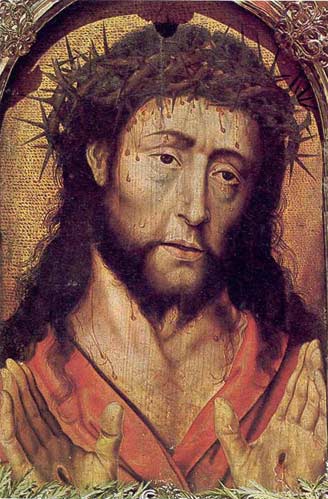
Image of the Holy Face of Jesus that captivated St. Teresa
St. Teresa suffered for years as a religious from an inability to pray, so she gives some solid advice to those who struggle as they seek the Face of God in prayer: “Never set aside the Sacred Humanity of Christ.” We cannot come to the Father except through Him. Intimacy with Jesus draws us into the life of the Trinity. “If we can, we should occupy ourselves in looking at Him Who is looking at us; keep Him company; talk with Him; pray to Him; humble ourselves before Him; have our delight in Him.” St. Teresa complained that she didn’t have much of an imagination, so she found it helpful to have an image of Christ to look at as she prayed, especially an image of Jesus in His Passion. “Speak with Him as with a Father, a Brother, a Lord and a Spouse–and, sometimes in one way and sometimes in another. He will teach you what you must do to please Him… Remember how important it is for you to have understood this truth–that the Lord is within us and that we should be there with Him.”







 Illumina Domine Blog - Devotion to The Holy Face