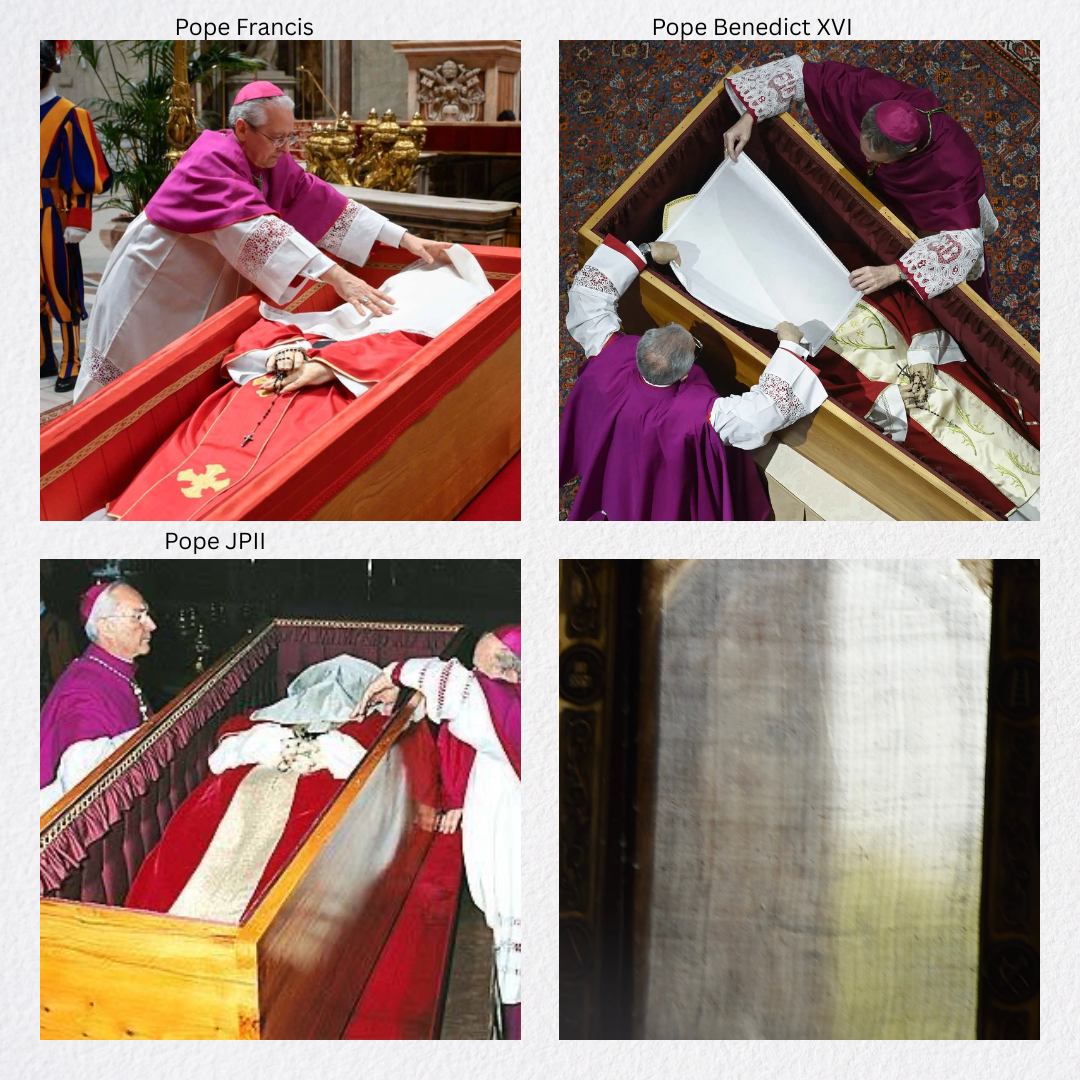
Photos of the Papal funeral ceremonies by Vatican Media. Bottom right photo — the Holy Veil of Manoppello. Thank you to Alexandra Prandell for putting these beautiful images together!
Although Pope Francis made many changes to the funeral traditions of the Popes, One deeply meaningful tradition was preserved — that of placing a sudarium veil over the face of the Holy Father — and it is connected to the Sudarium Cloth that would have been put on the Face of Christ in the Tomb. An unmistakable message! As we die with Him, we will rise with Him! Alleluia!
Padre Antonio Gentile before the Sudarium Veil of the Holy Face on Easter, at the Basilica Sanctuary of the Holy Face in Manoppello, Italy. Photo: Alexandra Prandell
“Once while some Israelites were burying a man, suddenly they saw a band of raiders; so they threw the man’s body into Elisha’s tomb. When the body touched Elisha’s bones, the man came to life and stood up on his feet.” (2 Kings 13:21)
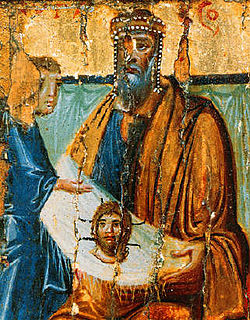
4th century fresco of the King of Edessa, who was healed of leprosy after being brought a miraculous face cloth of Jesus by St. Jude, according to one legend.
“So extraordinary were the mighty deeds God accomplished through the hands of Paul that when face cloths or aprons that touched his skin were applied to the sick, their diseases left them and the evil spirits came out of them.” (Acts 19: 1-12)
“A woman suffering hemorrhages for twelve years came up behind him [Jesus] and touched the tassel on his cloak. ‘She said to herself, ‘If only I can touch his cloak, I shall be cured.’ Jesus turned around and saw her, and said, ‘Courage, daughter! Your faith has saved you.'” (Mat 9:20-22)
The Catholic Church is often criticized for its veneration of relics, but who would not like to touch the “face cloth” mentioned in the Bible that St. Paul may have once used to wipe his brow, or touch the hem of Jesus’s garment? A letter written by Pope Pelagius II in the sixth century declared that any common object placed in contact with the grave of a saint would acquire its sanctifying power. St. Helena discovered the True Cross when God used that relic to bring a dead man from death to life the moment his body came in contact with it.
“How do we know if a relic is true?”
That is a question often heard regarding purported relics. Skeptics often cite the many dubious relics that were forged; such as the “heads” or “teeth” of St. John the Baptist that abounded in the Middle Ages. While the Church wants to treasure and preserve what is genuine, it also seeks answers to the question, “How do we know…?” How does the Church determine the authenticity of a relic? Outside of a miracle, today there are many forms of scientific research, such as carbon dating, that are now available. Naturally, this is a very controversial subject, as testing done the wrong way could degrade or destroy the relic itself. It may also be a very risky business spiritually, with a potential to do something far worse: Disputes over a relic’s authenticity or errors in testing have caused scandal, resulting in the loss of faith of many individuals.
Then, there are also many classes of relics to be considered: Relics are divided into three classifications. A first class relic is a body part of a saint, such as a bone, blood, or flesh. Second class relics are possessions that a saint owned, and third class relics are objects that have been touched to a first or second class relic or to the saints himself or herself. In verifying relics, there is also the great risk to be considered in exposing what may be a very precious ancient relic to invasive tests that could further degrade the relic. Great care must be taken, not only to preserve and protect the Church’s treasures, but also the souls of the faithful. This is why the Church sometimes moves so slowly in these matters.
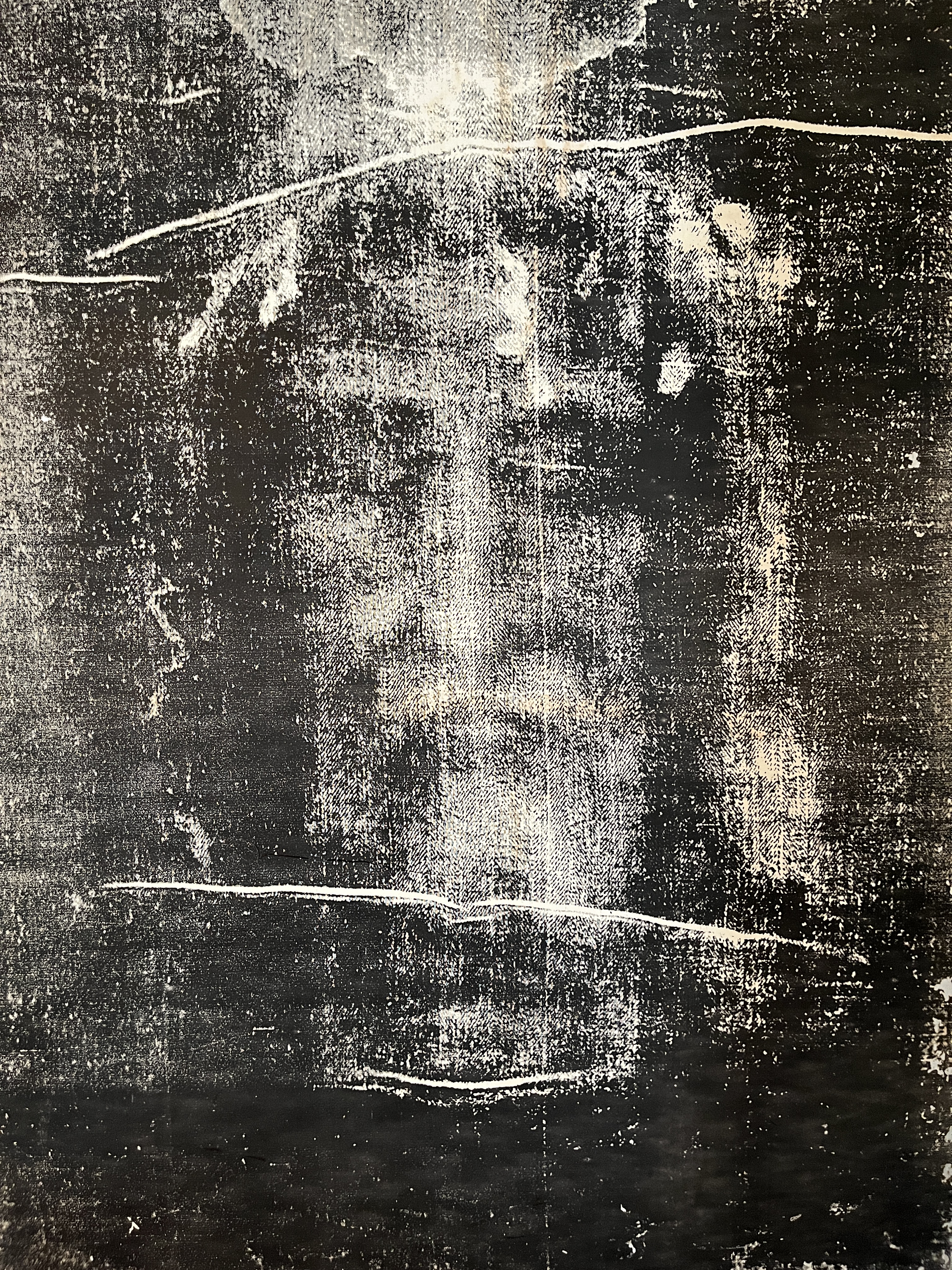
Digital scan of the Face of Christ on the Shroud of Turin
Despite the many scientific advances in carbon dating, and other testing, errors have been made in the past which have led to false results causing a great deal of harm; as was the case in the false carbon dating of the Shroud of Turin to medieval times, which made front page news at the time, labeling the Shroud of Turin a medieval fraud. It was later proven that the sample for the carbon dating of the Shroud was actually taken from a repair patch, and not the original shroud, which, when re-tested, was then dated to the first century–making the back page news, of course.
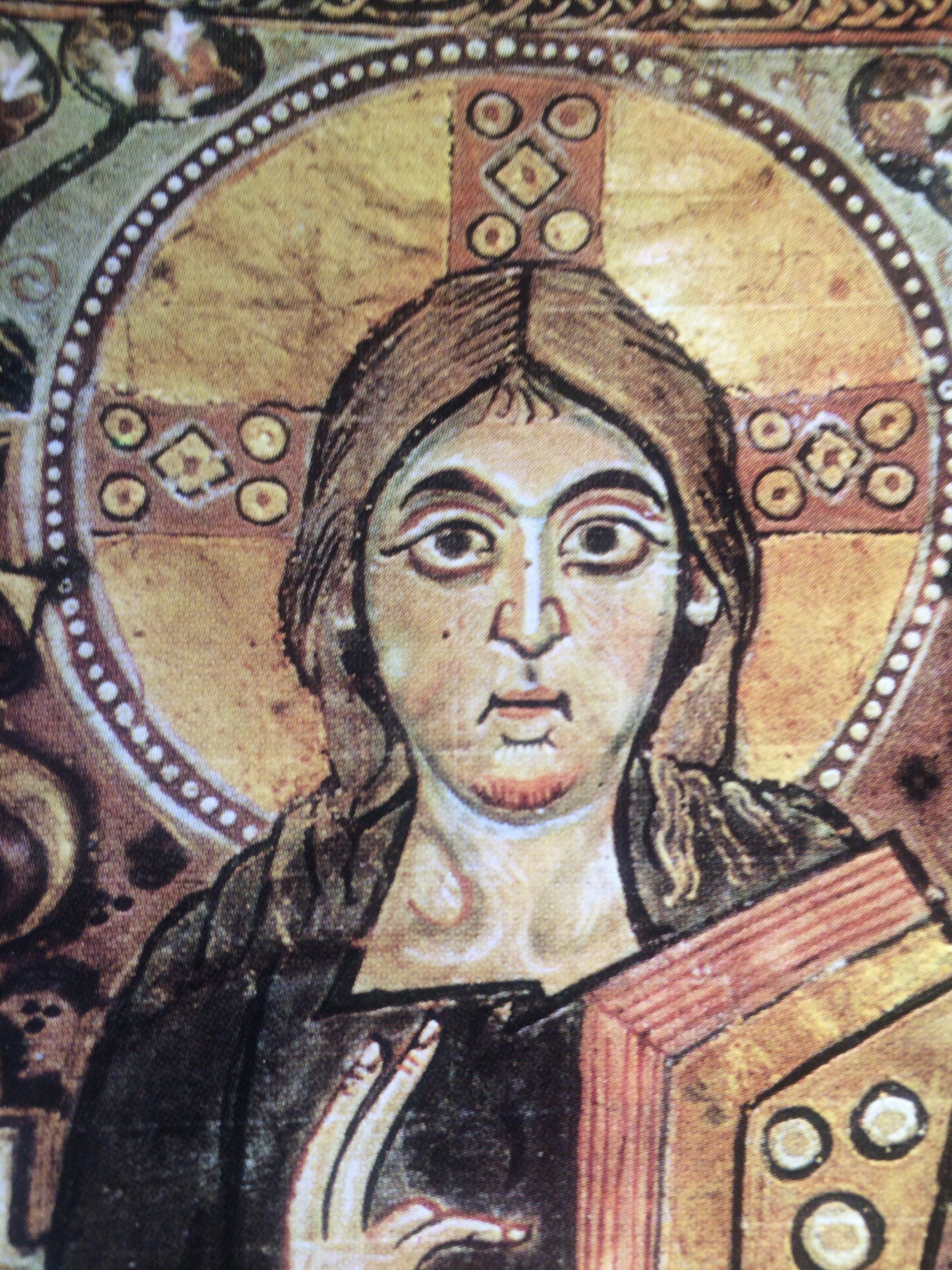
Face of Jesus known as the “Uronica” in the “Holy of Holies Chapel of Sancta Sanctorum in Rome.
Recently, the testing of relics is once more in the news. Most people who have traveled to Rome are familiar with the “Scala Sancta” or the “Holy Stairs,” near St. John Lateran. They are twenty-eight marble steps that were brought from Jerusalem that lead up to a chapel known as “Sancta Santorum or Holy of Holies.” Named for the original place in Jerusalem that contained the ark of the covenant, the chapel is said to contain the some of the holiest relics in Christendom, including relics of the earliest martyrs, and the “Uronica,” an “acheiropoieta,” not made by human hands, of Jesus, Ruler of the Universe, attributed to St. Luke–which, “according to legend,” was finished by the angels. In 816, Pope Leo III placed the reliquary box under the altar of the chapel. The relics remained hidden there, until 1903, when Pope Leo XIII permitted experts to examine them. It turned out to be an arduous task, and, unfortunately, later important data was lost due to a rivalry between French and German scholars. To protect the relics from falling into the wrong hands, they were eventually moved to the Vatican Library, and then, to the Vatican Museum.
Barbara Jatta, head of the Vatican museums, recently gave a press conference, on May 23, 2024, on the Catholic Church’s attempt to bring some “clarity and provenance” to two of the ancient relics that had been kept for centuries in the “Holy of Holies” chapel: the relic tunics of St. Peter and St. John the Evangelist. Jatta announced a new permanent exhibition that will display these two purported relics and the tests they have undergone that have shed light on which of the two may be authentic: EWTN Vatican has a good article by Matthew Santucci summarizing the conference: “The Tunics of St. Peter and St. John, Two Extraordinary Relics of the Sancta Sanctorum.” The Vatican Museum should be applauded for this admirable work that has been carefully carried out in pursuit of the truth.
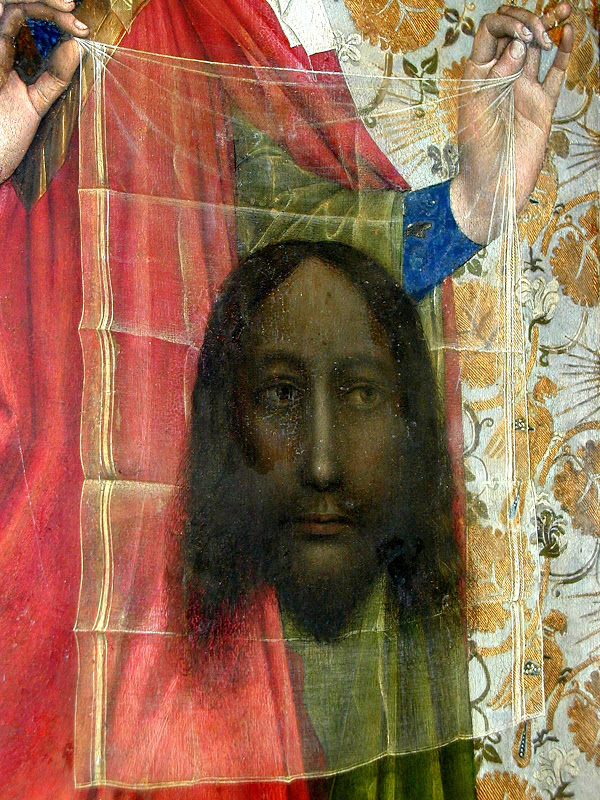
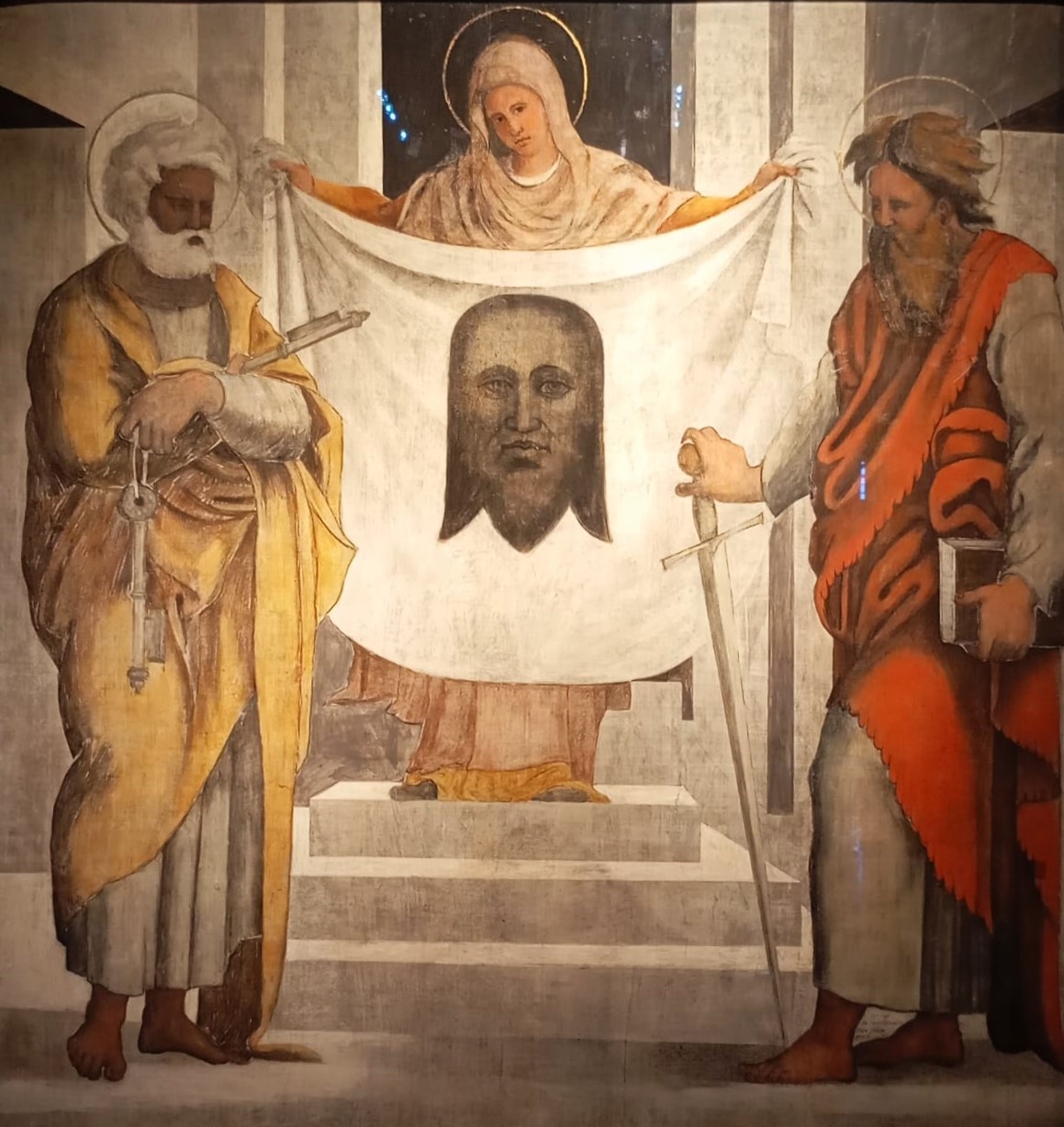
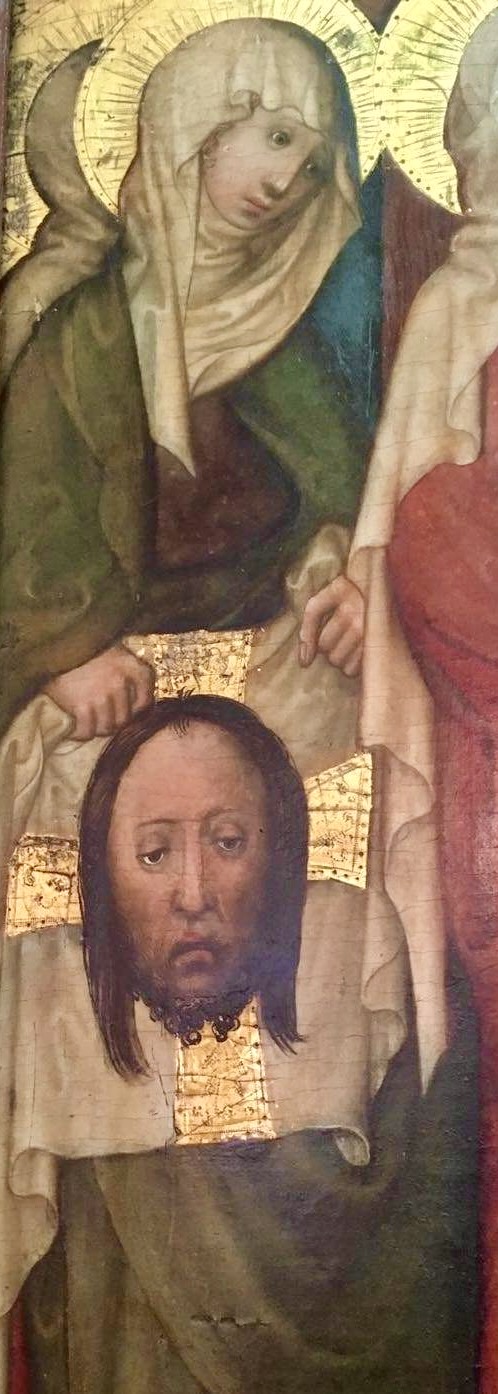
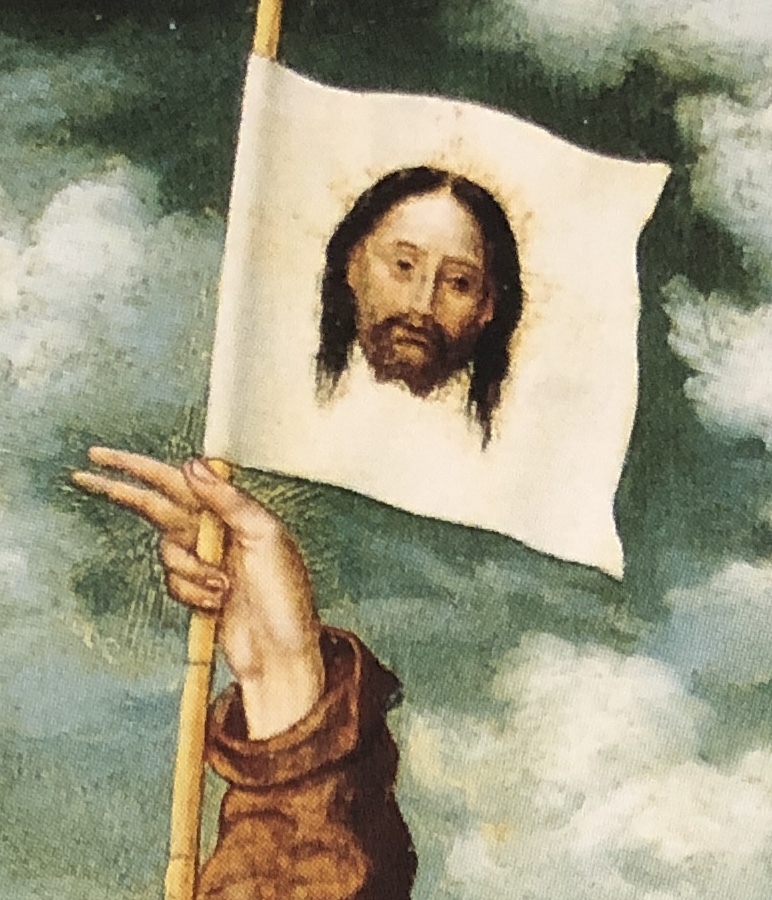
Note the distinctive folds of the veil in this painting detail.
“The Veronica Veils” and the question of which relic is true?
One hopes that the Vatican Museum will continue to seek the truth in the case of other controversial relics, by whatever reasonable means are available, to discover their origins. The issue of testing relics has increasingly been brought up in the case of two “Veronica Veils:” one, held at the Vatican, and another, known as the “Veil of Manoppello.” Acrimonious debates that have erupted in recent decades regarding the two veils have caused division among many Catholic devotees of the Holy Face. Some claim as well that the authority of the Church on the subject the devotion to the Holy Face ended with Pope Leo XIII; thus, passing over what has been been uncovered or written about regarding the devotion since that time, including: the discoveries and research on the Shroud of Turin, or writings by Pope St. John Paul II, Pope Benedict XVI, or Pope Francis; thus, making it very difficult to enter into dialog on the subject. It will ultimately be for the Church to decide whether or not to investigate the relics to help provide the “clarity and provenance” needed to confirm their authenticity.
Fresco of ciborium that existed in 708 containing sudarium of the “Veronic” True Icon
The authenticity of the Vatican relic of the “Veronica Veil” has come into question due to the abundant historic research that points to the relic “Veil of Manoppello” as being the original “proto-image” for icons, frescos, and paintings of the face of Jesus, as seen in so many of the earliest works of art depicting the “Veronica”; such as the “Liber Regulae Sancta Spiritus in Saxia,” or in other more ancient works, such as the “Godescic Manuscript” of 781, both pictured below:
Godescic Manuscript, 781
This illustration of the first public procession of the “Veronica” on the feast of “Omnis Terra” (All the Earth), depicts Pope Innocent III, in 1207, carrying the crystal reliquary displaying the “Veronica Veil” (from “Liber Regulae Sancti Spiritus in Saxia” manuscript ,1350).
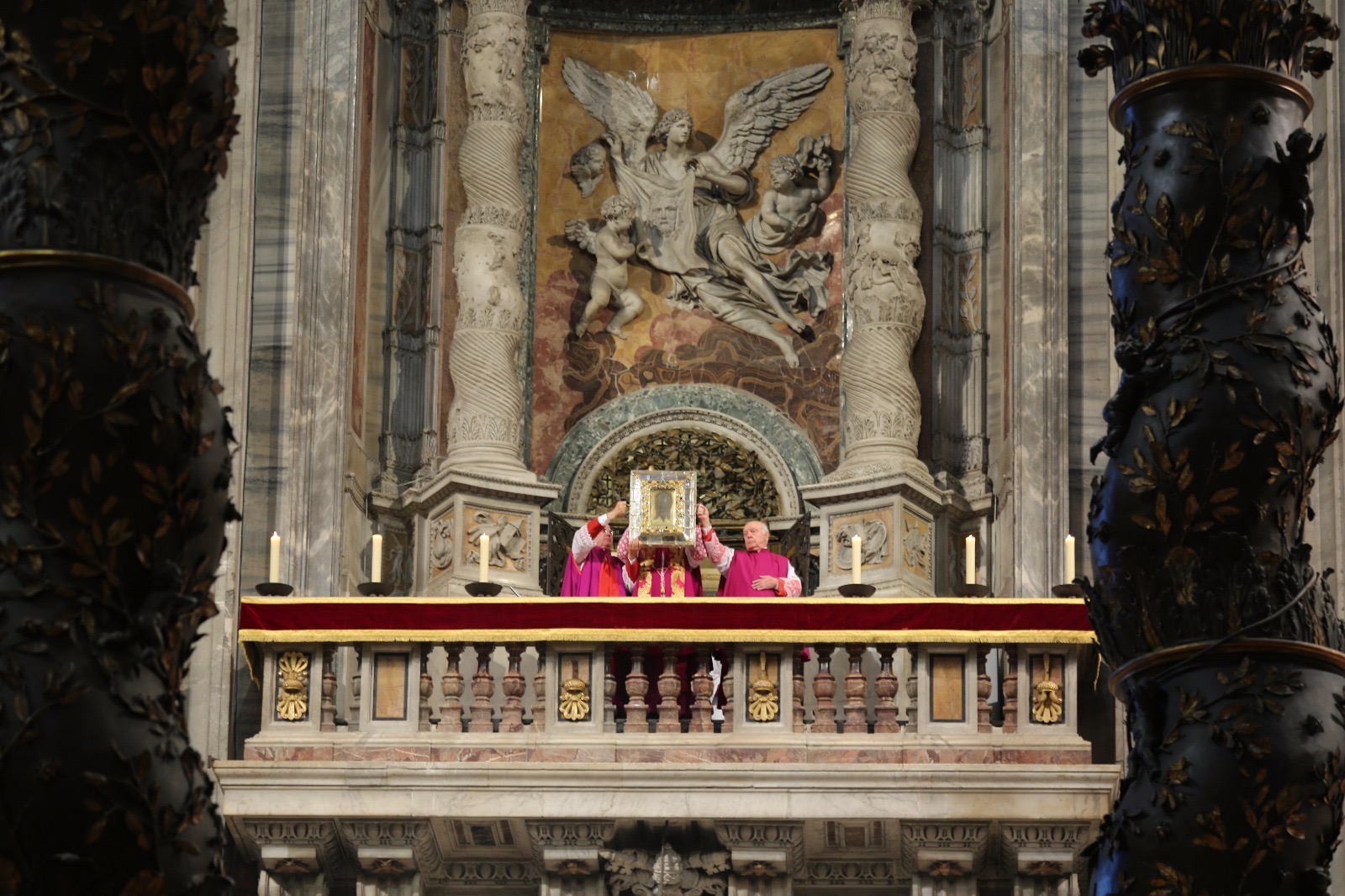
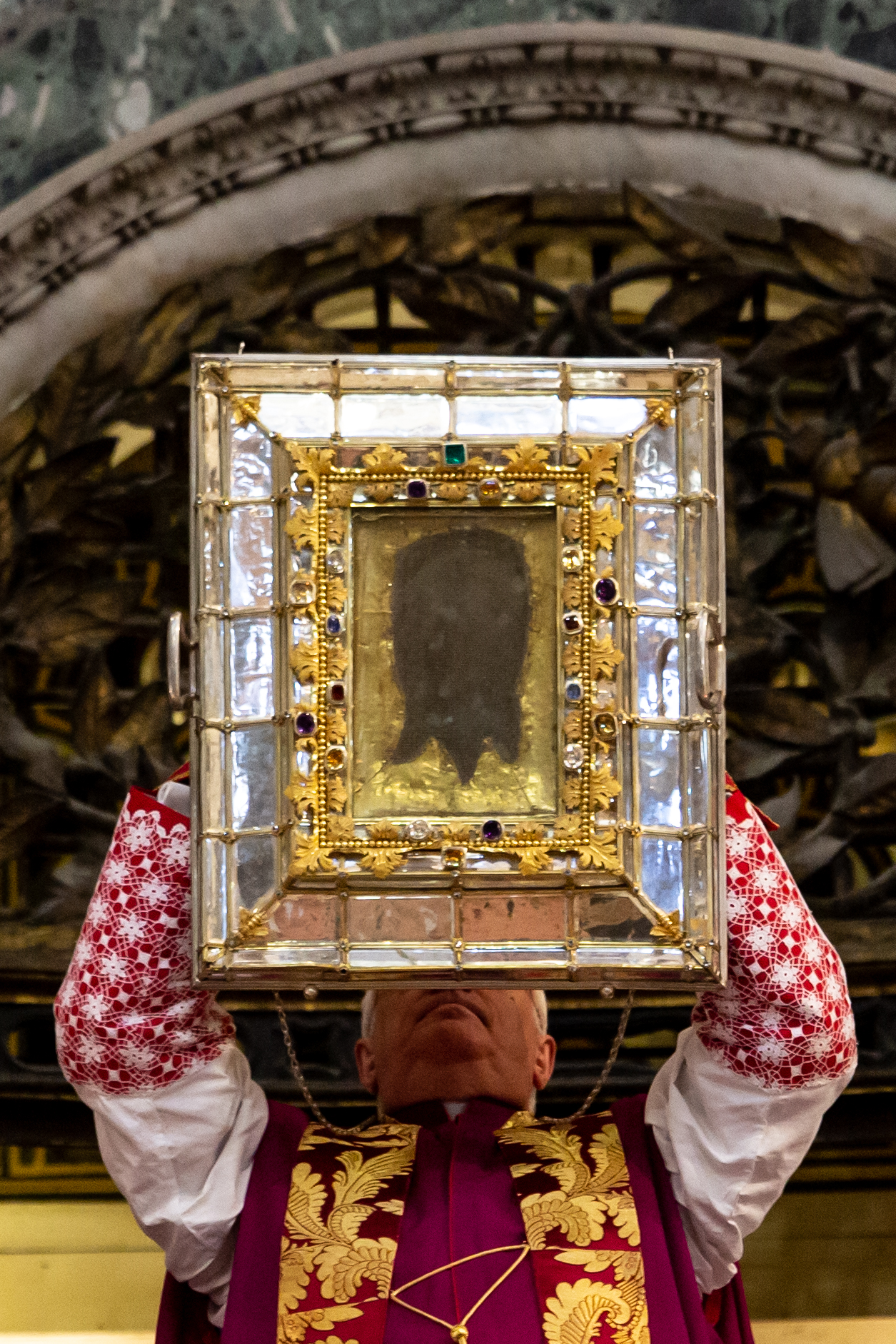
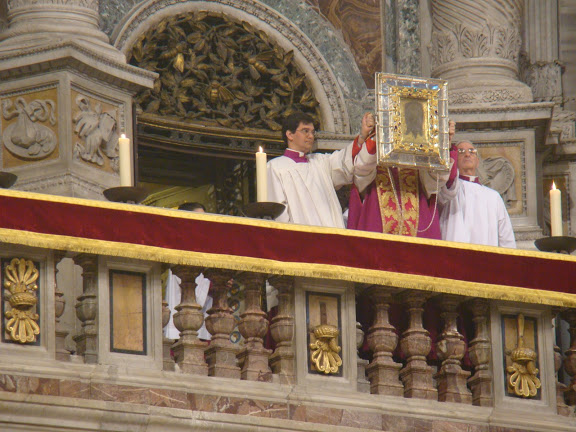
The Vatican “Veronica veil” is displayed at a great distance during Holy Week. No face can be discerned on the darkened cloth that is displayed in a face-shaped frame.
A closer look at the Veronica Veil being presented for veneration at the Vatican, April 7, 2019. Photo: Daniel Ibanez
First, in order to explain anything about the images known as “Veronicas,” it must be understood that the Church has a very rich 2,000 year history, and that there are hundreds, if not thousands, so-called “Veronicas” representing the true image of the Face of Christ in museums, churches and basilicas. Secondly, the term “Veronica” refers to the image itself, and not a Saint called Veronica. The various legends of a St. Veronica did not appear until the Middle Ages. There a many, many earlier legends that name other persons such as woman named Hypatia, who drew the miraculous image from a well; or a woman named Bernice, whose name is associated with the woman with the hemorrhage in the Gospels; or St. Jude; who was said to bring the Holy Face Veil to the King of Edessa to cure him.
The Veronica, Hans Memling, 1479
“These pious traditions cannot be documented, but there is no reason why the belief that such an act of compassion did occur should not find expression in the veneration paid to one called Veronica.” —The Catholic Encyclopedia
Pope St. John Paul II explored the deep meaning behind these legends before he dedicated the millennium to the Face of Christ (Found here) and has written beautifully on the compassionate woman who is known as “Veronica” and what the significance the Image of the Face of Christ on the veil has for Christians. Most “Veronica” images are copies of an original or “proto-image,” others are imaginative, and a few are believed to be of Divine origin, that is, “made by God’s Hand.” Only one, however, can be the original and true image.
For centuries following the first time the Veil was publicly displayed and processed by Pope Innocent III in 1207 any pilgrim could see for themselves the Holy Face of Jesus on a Veil from either side of the sometimes transparent veil. Artistic works also called “Veronicas” were produced at that time for the many pilgrims who flocked to Rome to gain an indulgence by seeing the relic Veil for themselves…and take home a souvenir, of course, of a copy for themselves, or for their local Church. That was up until the Sack of Rome in 1527, when it was feared that the Veronica Veil had been stolen:
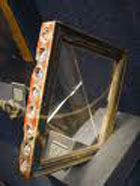
The broken crystal frame that displayed the Veronica, from the Vatican Museum
“A letter written to the Duchess of Urbino by her representative, Urban, dated May 21, 1527, reads, ‘Holy relics have been thrown out onto the streets. The Veronica has been stolen and passed around in taverns from person to person without a word of protest‘”
The large reliquary framed that was created to display the miraculous image from both sides, between two large crystal panes, was found broken. (It is now on display in the Vatican Museum.) When the dust settled, following the Sack of Rome, the image was no longer displayed publicly. Pope Paul V, in 1616, prohibited any copies to be made of the Veronica without permission, and later Pope Urban VII ordered that all copies of the Veronica be handed in to a local priest or bishop under pain of excommunication. In 1629, a noticeably different image with a death-like face was placed in the newly completed Veronica Altar in St. Peter’s basilica–covered with another outer veil–and a notice was placed nearby stating that anyone who removed the veil covering the Holy Face without papal approval would be excommunicated. Some have speculated that the “outer veil” mentioned may have been what remained after the Sack of Rome, and put in the place of the original, or possibly another of the many copies was put in its place–but that is only speculation. The facts were that from then forward, the darkened image was then only shown rarely, once a year from a distance of 20 meters, and its appearance was quite different than what was seen and copied by artists previously. In fact, the difference between early and later depictions of the “Veronica” was shocking. Not surprisingly, the interest in the Veronica and therefore devotion to the Holy Face soon dwindled.( More detail found in “Four Stories–One Face”)
Veronica’s Veil 1420 as it was depicted in paintings prior to the Sack of Rome.
BERTRAM, Holy Face c. 1390-1400
Painting made after the Sack of Rome, in 1617, by Pietro Strozzi
Painting of Veronica Veil which bears strong resemblance to the Holy Veil “Il Volto Santo” of Manoppello, Italy.
Which is the original “true image?” The two relic veils now in question are the Vatican “Veronica Veil” and the “Il Volto Santo” Holy Face Veil of Manoppello, both claiming to be the original Veil of the Face of Christ:
The Vatican “Veronica Veil” which is housed in St. Peter’s Basilica’s “Veronica Pillar” is a darkened brown cloth, in a frame shaped like a face. Pilgrims are now only permitted to see this relic from a great distance. The cloth does not appear to be transparent, and is only shown from one side. It’s measurements are larger than the original, broken frame.
The Vatican Veil Being displayed for veneration
During the exile of the Pope Pius IX at Gaeta in 1849, he ordered that the Veronica Veil be exposed, at a time of crisis, for public prayer and veneration, from Christmas to Epiphany. On the third day of exposition, the Veil, which had darkened to the point that a face could no longer be discerned, became visible, as if it were illuminated by a soft light. The Pope invited artists to make copies of the miraculous image, which were later touched to the relic of the veil, as well as the relics of the Passion, held in the Veronica Pillar at the Vatican.
This image is often associated with the revelations of of Sr. Marie St. Pierre, who died in 1848, and so had never seen the drawings. The “Epiphany Miracle,” as it was called, was regarded by some as a confirmation of her revelations regarding her devotion to the Holy Face. Although many of the prayers related to her revelations were approved, her writings as a whole were not. Sometime later, a layman, Leon Du Pont, who was a friend of Sr. Marie St. Pierre, placed an oil lamp before a reproduction of the image in his home. “The Holy Man of Tours,” as he was known, prayed for the sick there, and anointed them with oil from the lamp. It was said that hundreds of cures were obtained through his intercession before the image. St. Therese of the Child Jesus and the Holy Face had a copy of the image pinned to her bed curtains as she lay dying. She and her family had a great devotion to the Face of Jesus, and belonged to the Archconfraternity of the Holy Face that was in existence at that time, and into the 20th century, but no longer exists today.
“Vera Effigies” drawing of the wounded Holy Face, depicting closed, weeping eyes, and slightly parted lips. The upper forehead and other artistic elements were an imaginative addition to what was originally viewed by witnesses.
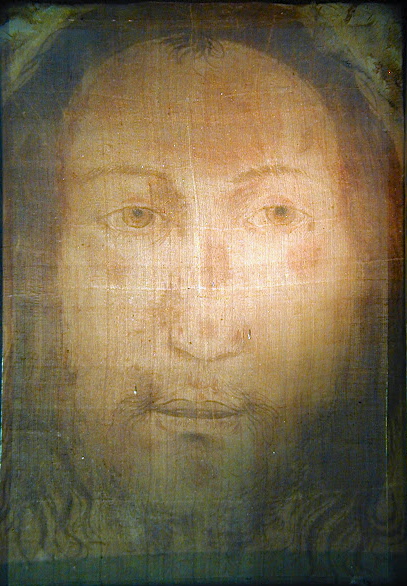
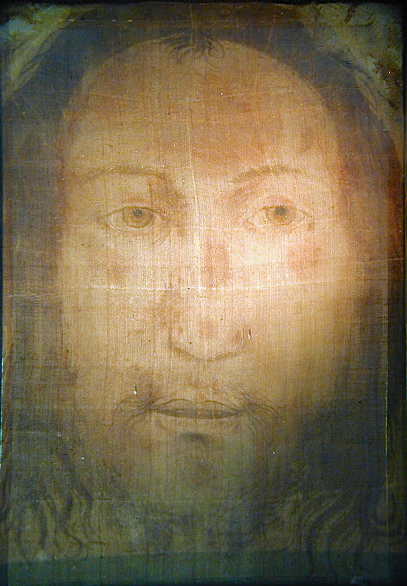
The Holy Face on the Veil of Manoppello (Photo: Paul Badde)The distinctive lock of hair, and folds on the veil may be seen in this photo.
Transparent Veil of Manoppello
The other “Veronica” relic is the Holy Veil of Manoppello. It is not a painting; the image is truly present in a mysterious way on a sheer veil, made of a precious sea-silk called byssus. The Veil and Image itself are a “miracle of light:” the delicate veil, held between two panes of glass, can appear transparent. The image of the Face appears and changes according to light and the direction from which it can be viewed from either side. The veil closely matches centuries-old artwork and written accounts of those witnesses who made pilgrimages to Rome when the “Veronica” was publicly displayed–including written accounts and works of art dating to the early Church–before the veil was known as “the Veronica,” but was known by other names such as the Camulia, or the Edessa, or the Mandylion. The veil was once much larger, but was trimmed down over the centuries. The wounded, yet peaceful countenance of Jesus is visible with open eyes and parted lips, sparse beard, wavy hair, and a distinctive lock of hair at the center of the forehead, which is often depicted in many eastern icons, and paintings of the face of Jesus through the centuries. The Manoppello Veil is not a painting, but an “achieropoieta”–an image not made by human hands.
Hand seen from the other side of the Veil of the Holy Face of Manoppello–which is so sheer a newspaper can be read through it. Photo: Paul Badde
Copy of the “Veronica” from 1373 painted on an altarpiece with the distinctive lock of hair at the center of Jesus’ forehead…
…Also seen in this beautiful depiction of the Veronica that is in the Getty Museum…
…as well as this manuscript and many others.
In this remarkable “Meister of St. Laurenz” painting of the Holy Trinity, the faces of both God the Father and the Son are portrayed similarly, each bearing a strong resemblance to the face on the Holy Veil of Manoppello. Photo taken in Cologne, Germany by Paul Badde.
The late, highly respected Heinrich Pfeiffer S.J. was an eminently qualified teacher of art history and Christian iconography at the Pontifical Gregorian University in Rome. He was also an expert “sindonologist.” Sindonology is the study of the Shroud of Turin, which is its own branch of science. In the course of his many years of research he traveled to the Shrine of the Holy Face in Manoppello. Upon seeing the Veil for himself, he immediately recognized it as the “proto-image” or original from which most icons, paintings, and other representations of “the Veronica” had been derived. The incredible “Veronica” of Manoppello was believed to be the veil that covered the Face of Jesus in the tomb. (Author Paul Badde has written much about this search for the “rediscovered face” in his books: The Face of God – the Rediscovery of the True Face of Jesus, The True Icon: From the Shroud of Turin to the Veil of Manoppello, and The Holy Veil of Manoppello: The Human Face of God.)
Christ’s Face being covered with a sheer veil or sudarium in the tomb.
When, as a scholar, Fr. Pfeiffer joyfully and dutifully reported the fruits of his research, “all hell broke loose.” Instead of being met with rejoicing over the historic discovery of the “proto-image” of the Veronica–a miraculous image that corresponds to historic accounts and countless works of art in museums and churches around the world–Fr. Pfeiffer was roundly vilified by persons who, while accusing him of perpetrating fraud, also refused to look at his evidence. Any requests that Fr. Pfieffer or other scholars and researchers made to look into the authenticity of the relic veil held in the Vatican were declined by bureaucrats.
The indisputable abundance of centuries of art history, that even a child can see, points to the Veil of Manoppello as the original proto-image. But piles of comparisons are not enough to satisfy the outraged critics. Fr. Pfeiffer’s vast research that led him to Manoppello continues to be rejected out of hand, and ignored by those who refuse to look at the data. Unless the relic at the Vatican is examined, the controversy between the two relics of the Face of Jesus will remain at a stalemate, and continue to be a unhappy source of division in the Body of Christ. It was the cause of much suffering for Fr. Pfeiffer in his lifetime, but he was committed to speaking and writing about what he had discovered until he died in 2021.
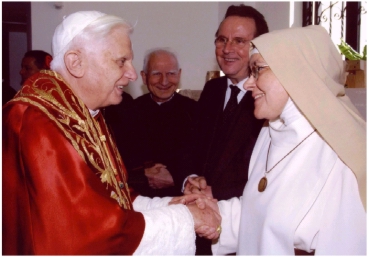
Pope Benedict XVI greets Sr. Blandina Paschalis Schlomer, an expert in iconography, renown for her expertise and forensic comparisons of ancient images of the Face of Christ. Looking on are Fr. Heinrich Pfeiffer S.J., and Paul Badde, author of many books about the Holy Veil of Manoppello (September 1, 2006).
Pope Benedict XVI gazes at the ‘Veronica’s Veil’ during a visit to the Holy Veil in Manoppello, Italy (September 1, 2006).
Streams of pilgrims, from the greatest to the least, have travelled the world to visit the Basilica Shrine of the Holy Face Veil in Manoppello, to see for themselves and experience the grace and peace flowing through their encounter with the Face of Christ. Hopefully, one day the Church will see the way clear to safely examine the relics, as it has done in the case of the relics of Sancta Santorum, to bring light, peace and truth once again to the faithful through their devotion to the Face of Jesus.
“To contemplate The Face of Christ, and to contemplate it with Mary, is the ‘program’ which I have set before The Church at the dawn of the third millennium.” — Pope St. John Paul II
“From contemplation of the Face of God are born, joy, security, PEACE”–Pope Benedict XVI
PAX ET BONUM!
UPDATE: Stunning results of testing on the Veil of Manoppello in November, 2024 conclude that the Holy Veil radiates light energy — May be read here.
“The waves of death rose about me; the pains of the nether world surrounded me. In my anguish I called to the Lord, and from His holy temple He heard my voice. (Psalm 18)
EWTN live-streamed video of Pope Francis’s Urbi et Orbi extraordinary blessing on March 27, 2020:
The Gospel from Mark 4:35-41 was first read:
On that day, when evening came, He said to them, “Let us go over to the other side.” Leaving the crowd, they took Him along with them in the boat, just as He was; and other boats were with Him. And there arose a fierce gale of wind, and the waves were breaking over the boat so much that the boat was already filling up. Jesus Himself was in the stern, asleep on the cushion; and they woke Him and said to Him, “Teacher, do You not care that we are perishing?” And He got up and rebuked the wind and said to the sea, “Hush, be still.” And the wind died down and it became perfectly calm. And He said to them, “Why are you afraid? Do you still have no faith?” They became very much afraid and said to one another, “Who then is this, that even the wind and the sea obey Him?”
Pope Francis then gave a beautiful meditation on the Gospel. In conclusion he said, “By His Cross we have been saved, in order to embrace hope…embracing the Lord in order to embrace hope. This is the strength of faith, which frees us from fear and gives us hope. Why are you afraid, have you yet no faith? Dear brothers and sisters from this place that tells of Peter’s rock solid faith, I would like this evening to entrust all of you to the Lord through the intercession of Mary, Health of the People and Star of the Stormy Sea. From this colonnade that embraces Rome, and the world may God’s blessing come down upon you as a consoling embrace: Lord, bless the world, give health to our bodies and comfort our hearts. You ask us not to be afraid, yet our faith is weak, Lord, and we are fearful. But you, Lord, do not leave us at the mercy of the storm. Tell us again, ‘Do not be afraid.’ And we, together with Peter, cast all our anxieties onto You, because we know that You care for us.”
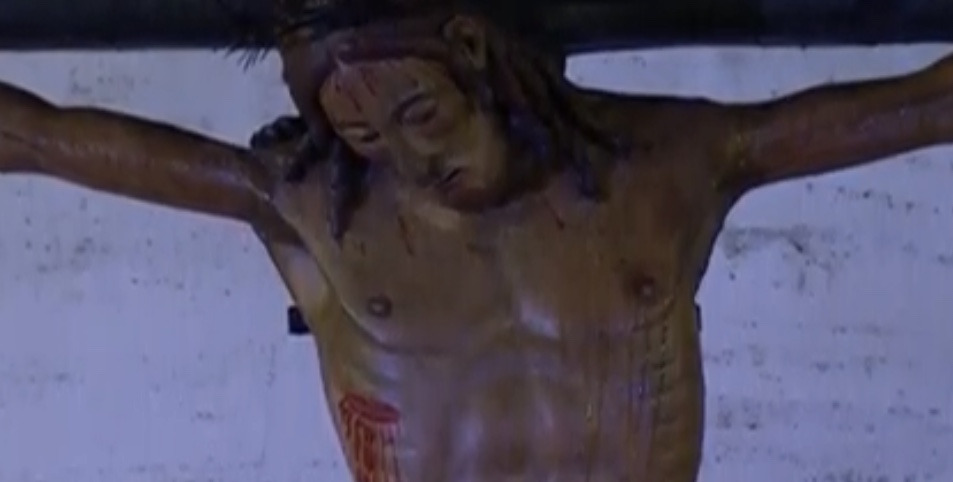
Miraculous Crucifix of San Marcello
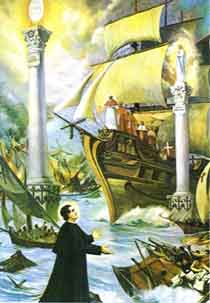
The Last Vision of St. John Bosco
After his meditation the Pope proceeded to the icon of Our Lady “Salus Populi Romani” where he prayed for several minutes before moving again to pray before the miraculous Crucifix of San Marcello. This was followed by prayers, and adoration of the Blessed Sacrament just inside the door of St. Peter’s Basilica. The powerful image called to mind the last vision of St. John Bosco: The pope on the deck of a large ship in a stormy sea, with no land in sight, being attacked on all sides by smaller vessels and trying to anchor the ship between two columns rising out of the sea — one with the Blessed Sacrament and the other with Our Lady, Help of Christians.
Pope Francis then proceeded out of St. Peter’s carrying the Blessed Sacrament, and with bells pealing, together with the sounds of sirens in the distance, he blessed the world, in the pouring rain, before a dark, empty St. Peter’s Square. The rain streaming down the side of the miraculous crucifix, recalling the blood and water which flowed from the side of Christ. Please, at least watch the blessing in the video, which begins around 54:54 minutes. One could not fail to be moved by such powerful imagery. This Urbi et Orbi blessing was like no other in history, and a decisive moment for the world to turn back to the Face of God.
Mother Angelica and Jesus
And how very fitting, that this historic, spiritual event would coincide with the anniversary of the death of Mother Angelica, Foundress of EWTN. It was Mother Angelica’s “Yes” to God that made it possible for millions around the world to see and hear the humble pleas of Pope Francis, and to receive his blessing!
“And we, with our unveiled faces, reflecting like mirrors the brightness of the Lord, all grow brighter and brighter as we are turned into the image that we reflect; This is the work of the Lord, who is the Spirit.” (2 Cor. 3:18) These are the words on Mother Angelica’s tomb.
2 Chronicles 7:14
“When I shut up the heavens so that there is no rain, or command locusts to devour the land or send a plague among my people, if my people, who are called by my name, will humble themselves and pray and seek my face and turn from their wicked ways, then I will hear from heaven, and I will forgive their sin and will heal their land. Now my eyes will be open and my ears attentive to the prayers offered in this place. I have chosen and consecrated this temple so that my Name may be there forever. My eyes and my heart will always be there.
“With Mary’s protection, may we be for our world sentinels of the dawn, contemplating the true Face of Jesus the Saviour, resplendent at Easter. Thus may we rediscover the young and beautiful face of the Church, which shines forth when she is missionary, welcoming, free, faithful, poor in means and rich in love.”–Pope Francis, canonization Mass of Jacinta & Francisco -homily
Pope Francis gave this address to the pilgrims at Fatima at the Rosary Procession and Vigil, teaching us to seek the Face of God with Mary, who, as “no other creature…basked in the light of the Face of God”:
Pope Francis at Fatima Vigil
Dear Pilgrims to Mary and with Mary!
Thank you for your welcome and for joining me on this pilgrimage of hope and peace. Even now, I want to assure all of you who are united with me, here or elsewhere, that you have a special place in my heart. I feel that Jesus has entrusted you to me (cf. Jn 21:15-17), and I embrace all of you and commend you to Jesus, “especially those most in need” – as Our Lady taught us to pray (Apparition of July, 1917). May she, the loving and solicitous Mother of the needy, obtain for them the Lord’s blessing! On each of the destitute and outcast robbed of the present, on each of the excluded and abandoned denied a future, on each of the orphans and victims of injustice refused a past, may there descend the blessing of God, incarnate in Jesus Christ.
“The Lord bless you and keep you. The Lord make his face to shine upon you, and be gracious to you. The Lord lift up his countenance upon you, and give you peace” (Num 6:24-26).
This blessing was fulfilled in the Virgin Mary. No other creature ever basked in the light of God’s face as did Mary; she in turn gave a human face to the Son of the eternal Father. Now we can contemplate her in the succession of joyful, luminous, sorrowful and glorious moments of her life, which we revisit in our recitation of the rosary.
With Christ and Mary, we abide in God. Indeed, “if we want to be Christian, we must be Marian; in a word, we have to acknowledge the essential, vital and providential relationship uniting Our Lady to Jesus, a relationship that opens before us the way leading to him” (PAUL VI, Address at the Shine of Our Lady of Bonaria, Cagliari, 24 April 1970). Each time we recite the rosary, in this holy place or anywhere else, the Gospel enters anew into the life of individuals, families, peoples and the entire world.
Pilgrims with Mary… But which Mary? A teacher of the spiritual life, the first to follow Jesus on the “narrow way” of the cross by giving us an example, or a Lady “unapproachable” and impossible to imitate? A woman “blessed because she believed” always and everywhere in God’s words (cf. Lk 1:42.45), or a “plaster statue” from whom we beg favours at little cost? The Virgin Mary of the Gospel, venerated by the Church at prayer, or a Mary of our own making: one who restrains the arm of a vengeful God; one sweeter than Jesus the ruthless judge; one more merciful than the Lamb slain for us?
“Jesus Christ is the Face of the Father’s mercy. These words might well sum up the mystery of the Christian faith.” –Pope Francis, Face of Mercy
The final stop of our pilgrimage was Rome and to enter the Holy Door of St. Peter’s Basilica on the Feast of the Assumption. Most pilgrims to Italy begin their pilgrimage in Rome, but there was a reason that I chose St. Peter’s for the final destination of our pilgrimage and it had to do with the pope. Sometimes our motivation for doing things isn’t always clear, not even to ourselves. It was upon reflection, in hindsight, that I understood why the order of the pilgrimage and also why seeing the Holy Father last, was so important to me.
Veil of the Holy Face of Manoppello Photo: Patricia Enk
Looking back on our pilgrimage for the Jubilee Year of Mercy, we began with the image of the Face of Jesus in the Veil of Manoppello. The bible tells us that there is only one mediator between God and man–Jesus Christ. (1 Tim 2:5) The Face of Jesus Christ is like a Door of Mercy–the face of the Church, through which we reach the Father. We enter this “door” through devotion to the Holy Face through prayers and contemplation of the wounded Face of Jesus; by discipleship, to see Jesus in the Face of our neighbors, in the poor, the sick and the suffering; and through the Eucharistic Face of Jesus, from which we draw the grace and strength needed for our journey. Then our faces, too, become like a “door” to our hearts and souls, and can radiate the Face of Jesus, the Face of Mercy to others. Therefore, the “door” of the Face of Jesus was the best place for us to begin, the start of the journey.
Adoration of the Eucharistic Face of Christ in Loreto
After the sanctuary of Manoppello there were other steps along our path to seek the Face of God. The next step was Loreto–entering the door of the Holy Home in Nazareth. God himself chose Mary as the ark of His dwelling place, by the power of the Holy Spirit, in this home. Through Mary and the Holy Family we learn the examples of humility, obedience, and love. Here we saw the Face of Jesus in the Eucharist and in the sick and suffering.
Face of Jesus in Assisi photo: Paul Badde
Next was Assisi–a powerful reminder of the Communion of Saints. We are not alone in our quest to see the Face of God but have brothers and sisters in Heaven who have gone before us and are ready to help us if we only ask their help and guidance in trials and tribulations. Their example encourages us to be a consolation and help, or a “Veronica,” to Jesus in our brothers and sisters here on earth. Reminding us that “…whatever you did for one of these least brothers of mine, you did it for me.” (Mt. 25:40)
Assisi Photo: Patricia Enk
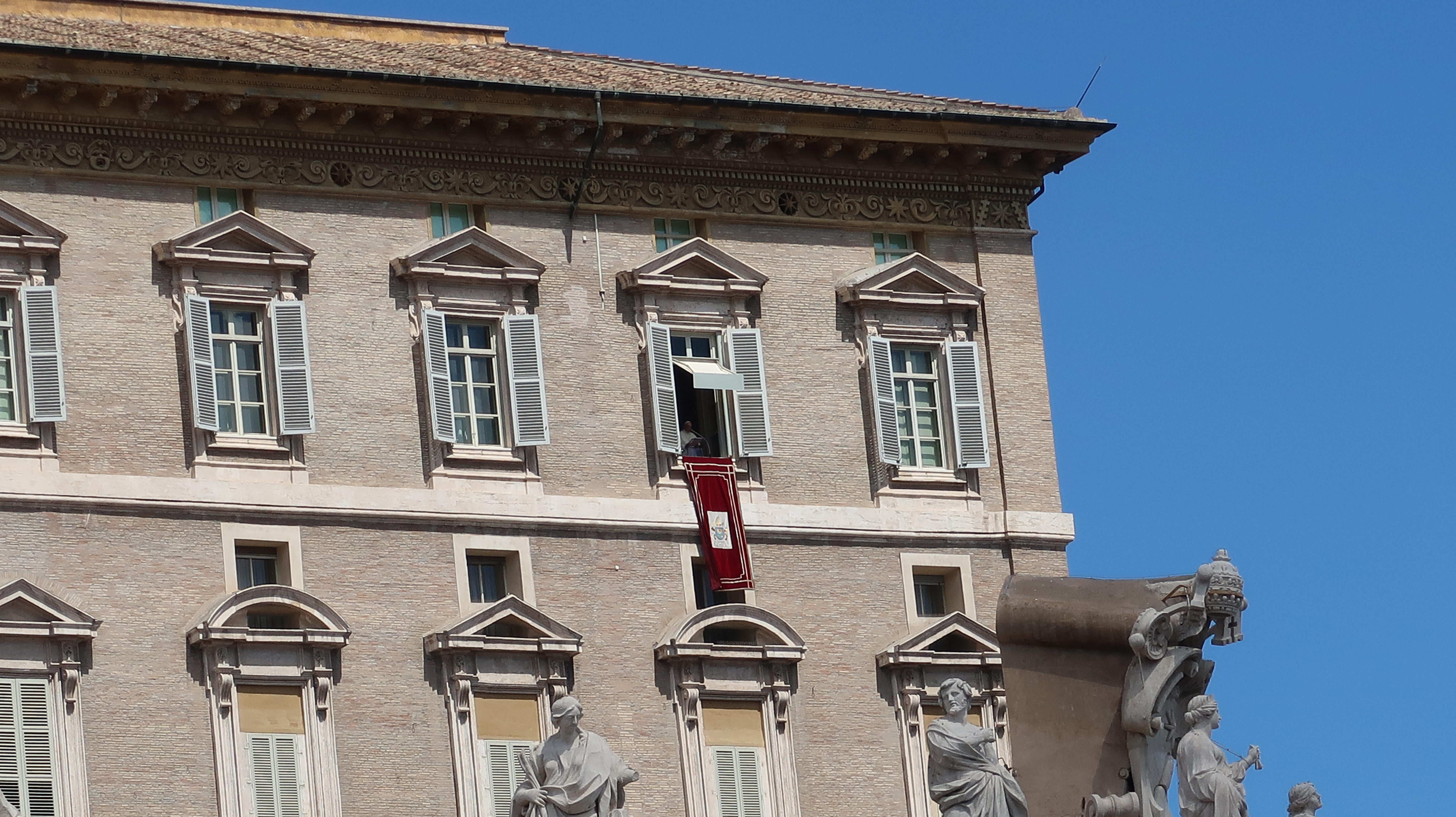
Catching a glimpse of the Holy Father, Pope Francis “While he was still a long way off, his father caught sight of him…”(Lk.15:20)
And lastly, Rome. Every year millions upon millions of people go to Rome just to get even a little glimpse of the pope. Most people consider those who actually have met the pope very fortunate. Why? After all, he is just a man like any other man, isn’t he? Well, yes and no. Yes, Jorge Bergolio is a man, but as Pope Francis he is the Vicar of Jesus Christ on earth, and, whoever sees Jesus, sees the Father. (Jn. 14:9) In a way, by seeking out the face of the pope, his words, and his blessing, we are seeking the Face of Our Father in Heaven. All mankind has been created in the image and likeness of God and we have a natural longing, therefore, to see His Face; to enter into relationship with Him. When the Word of God became man in Jesus Christ, at the Incarnation, what was previously impossible (to see God) became possible. In God’s infinite mercy He has not left us orphans; in and through Jesus He has given us His Church, His ministers, and His sacraments, so that is possible for us here on earth, albeit in an imperfect way, to see His Face.
Our pilgrimage mirrored the journey of the Christian soul on earth: through Jesus Christ, in the Holy Spirit, with the help of the Blessed Virgin Mary and the Saints toward the Face of the Father. Our pilgrimage did not end in Rome, but begins anew each day. We continue to seek His Face by taking up our cross and following Him in the hope that finally one day we will have the joy of truly seeing Him as He is in eternal glory.
Pilgrims carrying the Jubilee of Mercy Cross into the Holy Door of St. Peter’s
In Gratitude to God
“The grace of our Lord has been abundant, along with the faith and love that are in Christ Jesus. This saying is trustworthy and deserves full acceptance: Christ Jesus came into the world to save sinners. Of these I am foremost. But for that reason I was mercifully treated, so that in me, as the foremost, Christ Jesus might display all his patience as an example for those who would come to believe in Him for everlasting life. To the King of the ages, incorruptible, invisible, the only God, honor and glory forever and ever.” (1 Tim. 1:14-17)
While the world media moves on rather quickly from disasters, the Christian remains at the foot of the Cross, because it is Jesus who suffers in our neighbor. Though the cameras and reporters depart, for some, just recovering from shock, it is just the beginning: Suffering from the deaths of loved ones, loss of belongings and means of support, living in hot tents or shelters, burying the dead, trying to put back together their lives. These are the steps of our pilgrimage: “Amen, I say to you, whatever you did for one of these least brothers of mine, you did for me.” (Mt. 25:40) We can become the face of Jesus to others.
“The Lord Jesus shows us the steps of the pilgrimage to attain our goal: ‘Judge not, and you will not be judged; condemn not, and you will not be condemned; forgive, and you will be forgiven; give, and it will be given to you; good measure, pressed down, shaken together, running over, will be put into your lap. For the measure you give will be the measure you get back. (Lk 6:37-38) …It is my burning desire that, during this Jubilee, the Christian people may reflect on the corporal and spiritual works of mercy…to feed the hungry, give drink to the thirsty, clothe the naked, welcome the stranger, heal the sick, visit the imprisoned, and bury the dead. And let us not forget: to counsel the doubtful, instruct the ignorant, admonish sinners, comfort the afflicted, forgive offenses, bear patiently those who do us ill, and pray for the living and the dead.” –Pope Francis, Face of Mercy
Louisiana floods
As the rain poured down in Manoppello, we received word from our family that the state of Louisiana was once again flooding–which renewed anxiety and fear for our friends and loved ones back home. Our area had already suffered greatly from floods back in March. Facing our fears and trusting in God is always a part of pilgrimage. And now, the heartbreaking news of the devastating earthquake in central Italy as well as the ongoing suffering from the terrible floods here in Louisiana remind us to seek the Face of Jesus in our neighbor on our life’s pilgrimage.
Image of Jesus crucified which hung in Bl. Mother Teresa’s room. It was one of her last sights before dying.
In a few short days, we will celebrate the canonization of Mother Teresa of Calcutta. Blessed Mother Teresa heroically carried out the corporal and spiritual works of mercy by being the Merciful Face of Christ to others and by seeing the Merciful Face of Christ in others and most especially in the Eucharist, from which she and the Missionaries of Charity drew the grace and strength to serve Jesus “in the distressing disguise of the poor.”
“Seeking the Face of God in everything, everyone, all the time, and His hand in every happening; This is what it means to be contemplative in the heart of the world. Seeing and adoring the presence of Jesus, especially in the lowly appearance of bread, and in the distressing disguise of the poor.” –Bl. Mother Teresa of Calcutta
Mother Teresa source: Flickr
Let us follow the example of Mother Teresa and seek the face of Jesus in our neighbor by whatever means we have and remember in our prayers all those who have suffered and are continuing to suffer in the world. “Amen, I say to you, whatever you did for one of these least brothers of mine, you did for me.” (to be continued in Pt. 4...)
Manoppello, Sanctuary Basilica of the Holy Face, photo: Paul Badde
“The practice of pilgrimage has a special place in the Holy Year, because it represents the journey each of us makes in this life. Life itself is a pilgrimage, and the human being a viator, a pilgrim traveling along the road, making his way to the desired destination…each according to his or her ability will have to make a pilgrimage. This will be a sign that mercy is also a goal to reach and requires dedication and sacrifice. May pilgrimage be an impetus to conversion; by crossing the threshold of the Holy Door, we will find the strength to embrace God’s mercy and dedicate ourselves to being merciful with others as the Father has been with us.” –Pope Francis from The Face of Mercy, Misericordiae Vultus
Human beings are made in the image and likeness of God, and so our souls have a yearning, a natural longing for the infinite. We are called to communion with God, to see Him “face to face.” He is calling us to seek Him, to know Him, and love Him with all our heart, mind, and strength. The history of salvation can be described as a gradual discovery of the Face of God by nations and individuals, marked by their battles, falls and triumphs, as they turn toward or away from the Face of God, on a pilgrimage–a journey which will only end when each person comes “face to face” with God.
The Year of Mercy cannot be complete until we have made some sort of pilgrimage toward God. Although I had made a local pilgrimage to the Door of Mercy at St. Louis Cathedral in New Orleans, I had felt a very strong tug in my heart to return to Italy and re-visit places of pilgrimage that were especially meaningful to me. Together with my husband, I made the necessary preparations, but, the most important “packing” for the journey was to remember on our pilgrimage all those God has given us to love, and their intentions, people that we would like to have with us, but could not make the journey. We especially carried within our hearts those who were too sick, or too old, as well as those who have lost their faith, the deceased, and people in our country and in the world in need of someone’s prayers, placing all in our hearts so that we could carry them, in spirit, through the Doors of Mercy.
We began with the place in which I encountered the Face of Mercy in a very profound way in October of 2012: the Sanctuary Basilica of the Holy Face in the small mountain village of Manoppello. This humble, beautiful village has hidden in its heart, for centuries, what St. Pio of Pietrelcina called “The greatest relic of the Church”–a gossamer-thin byssus veil, bearing, in a miraculous way, an image of the human Face of Jesus.
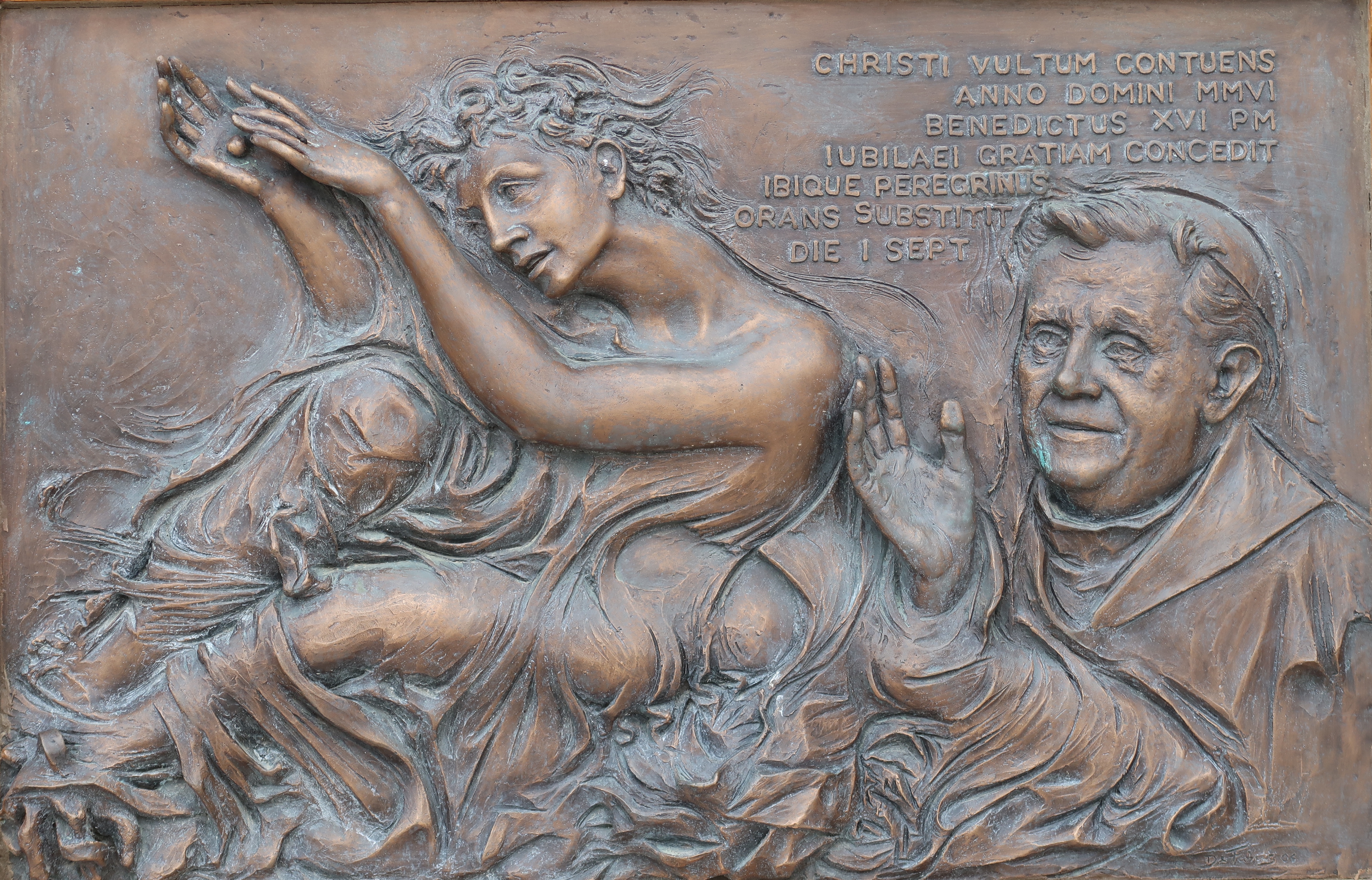
Panel on Holy Door of Shrine commemorating the visit of Pope Benedict XVI in 2006
We arrived very late at night after 28 hours of travel to a hotel in the village very near the Sanctuary. The next morning we walked to the Basilica for Mass, entering the beautiful dedicated Holy Door, engraved with depictions of events in the history of the Veil. My favorite was the panel recalling the visit of Pope Emeritus Benedict XVI to the Shrine in September of 2006. It was a year later, that he wrote his moving prayer to the Holy Face in honor of that occasion and elevated the Shrine to the status of a Basilica.
Rector of the Shrine Padre Carmine Cucinelli places the Holy Veil in the movable reliquary
The day after we arrived was a special occasion as well, as the next day, August 6th, was a Feast of the Holy Face, the Transfiguration. The Veil, normally kept in a special reliquary high above the back of the altar (but accessible by a stairway from behind) was to be brought down after the Mass and placed in another movable reliquary, used in processions, near the front of the altar. The Veil would remain there throughout the day for prayers and veneration of the faithful, then be returned to its place behind the altar for the night.
Earlier in the day, on the steps leading up to the relic, I bumped into journalist Paul Badde, who has taken more photos perhaps than anyone of the Holy Veil and written so much about its amazing re-discovery. I couldn’t have been more surprised than if I had bumped into Lazarus emerging from the tomb! Paul has been making an amazing recovery from heart surgery, stroke, and a coma which lasted for more than
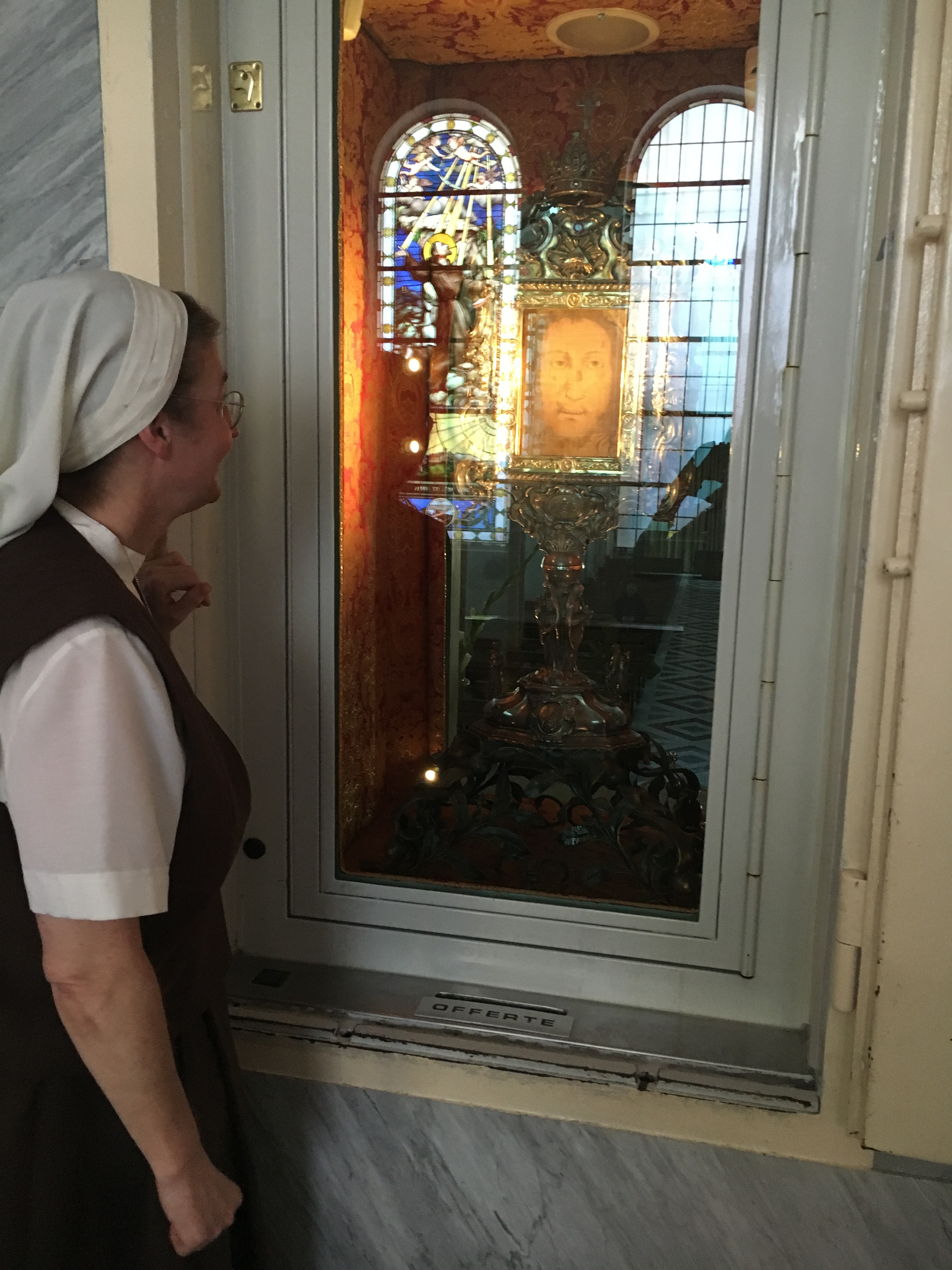
Sr. Petra-Maria gazes at the Veil of Manoppello
three weeks during Lent of 2016. Paul later introduced me to Sr. Petra-Maria, who, I soon discovered, shares with pilgrims her extensive knowledge and love for “Il Volto Santo.” Like two other nuns, who shared similar names–Sr. Marie St. Pierre, a Discalced Carmelite nun associated with the Holy Face in Tours, and Bl. Mother Maria Pierina, an Immaculate Conception nun associated with the Holy Face Medal–Sr. Petra-Maria is a true apostle of the Holy Face of Manoppello. The Holy Face draws her like a magnet; she never tires of gazing at His Face or drawing others to His peaceful, merciful countenance and telling and re-telling the incredible details of the features, the history, and especially, the spiritual significance of the miraculous image. (I’ll have to save those details for a special post.)
Basilica of the Holy Face of Manoppello on Vigil of the Transfiguartion
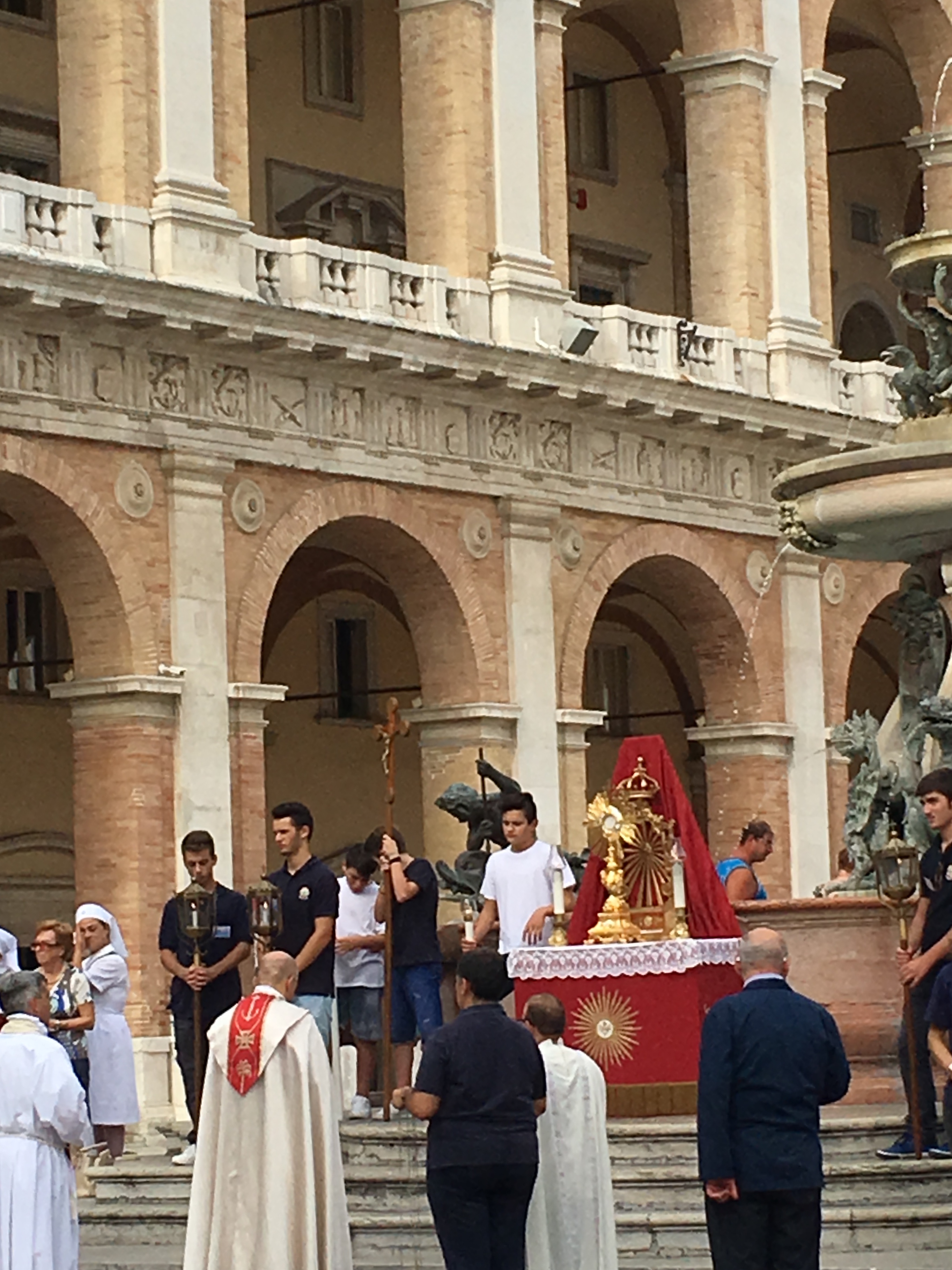
Celebrations and entertainment were held in honor the Holy Face in the piazza in front of the Basilica in the evening by local musicians and very talented young people of the community, who gave a very enjoyable musical performance of the life of St. Francis. I’ll never forget the line of young “Franciscan monks” on the stage singing “Andiamo! Andiamo!…” “We go! We go! For the Blessed Mother!” The next day the Holy Veil was brought out after Mass on the Feast of the Transfiguration for the day and in the evening there was planned a solemn procession with the Veil and benediction. But, as in all things in life, plans change… (To be continued in Pt.2)
“This is the opportune moment to change our lives! This is the time to allow our hearts to be touched!” — quotes from Pope Francis, Misericordiae Vultus
“Jesus Christ is the Face of the Father’s Mercy.” — Pope Francis
“Jesus Christ is the Face of the Father’s Mercy. These words might well sum up the mystery of the Christian faith. Mercy has become living and visible in Jesus of Nazareth, reaching it’s culmination in Him…We need to constantly contemplate the mystery of mercy. It is a wellspring of joy, serenity, and peace. Our salvation depends on it. Mercy: the word reveals the very mystery of the Most Holy Trinity.” “With our eyes fixed on Jesus and His merciful gaze, we experience the love of the Most Holy Trinity. The mission Jesus received from the Father was that of revealing the mystery of Divine Love in its fullness. ‘God is love.'” (1Jn 4:8,16)
“…wherever there are Christians, everyone should find an oasis of mercy.”
“Mercy is not contrary to justice but is the behavior of God toward the sinner…God does not deny justice. He rather envelops it and surpasses it with an even greater event in which we experience love as the foundation of true justice” (MV, 21). Jesus is the face of the mercy of God the Father: “God so loved the world […] [that] the world might be saved through him [the Son]” (Jn 3:16, 17)
We are called to be merciful to each other and seek the Face of Jesus in our neighbor. “It is my burning desire that, during this Jubilee, the Christian people may reflect on the corporal and spiritual works of mercy. It will be a way to reawaken our conscience, too often grown dull in the face of poverty. And let us enter more deeply into the heart of the Gospel where the poor have a special experience of God’s mercy. Jesus introduces us to these works of mercy in His preaching so that know whether or not we are living as His disciples. Let us rediscover these corporal and spiritual works of mercy: to feed the hungry, give drink to the thirsty, clothe the naked, welcome the stranger, heal the sick, visit the imprisoned, and bury the dead. And let us not forget the spiritual works of mercy: to counsel the doubtful, instruct the ignorant, admonish sinners, comfort the afflicted, forgive offences, bear patiently those who do us ill, and pray for the living and the dead.”
“Life is a pilgrimage, and the human being is a viator, a pilgrim travelling along the road, making his way to the desired destination.” Let us keep our faces turned toward the Merciful Face of Jesus while on our pilgrimage, and “introduce everyone to the great mystery of God’s Mercy by contemplating the Face of Chirst.” (Misericordiae Vultus)
Prayer of Pope Francis for the Jubilee of Mercy
Have Mercy on us! Holy Face of Manoppello Photo: Paul Badde
Lord Jesus Christ, you have taught us to be merciful like the heavenly Father, and have told us that whoever sees you sees Him. Show us Your Face and we will be saved. Your loving gaze freed Zaccheus and Matthew from being enslaved by money; the adulteress and Magdalene from seeking happiness only in created things; made Peter weep after his betrayal, and assured Paradise to the repentant thief. Let us hear, as if addressed to each one of us, the words that You spoke to the Samaritan woman: “If you only knew the gift of God!”
You are the visible Face of the invisible Father, of the God Who manifests His power above all by forgiveness and mercy: let the Church be Your visible Face in the world, its Lord risen and glorified. You willed that your ministers would also be clothed in weakness in order that they may feel compassion for those in ignorance and error: and forgiven by God.
Come Holy Spirit!
Send Your Spirit and consecrate every one of us with its anointing, so that the Jubilee of Mercy may be a year of grace from the Lord, and Your Church, with renewed enthusiasm, may bring good news to the poor, proclaim liberty to captives and the oppressed, and restore sight to the blind.
We ask this through the intercession of Mary, Mother of Mercy, You Who live and reign with the Father and the Holy Spirit for ever and ever. Amen.
Pope Francis also recommends we pray the Salve Regina (Hail Holy Queen) so that Mary, our Mother of Mercy “may never tire of turning her merciful eyes towards us, and make us worthy to contemplate the Face of Mercy, her Son Jesus.”
The Salve Regina or “Hail, Holy Queen”
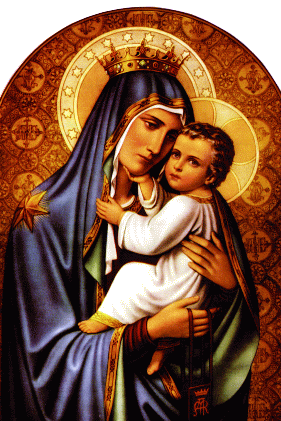
Queen Beauty of Carmel
Hail, Holy Queen, Mother of Mercy, our life, our sweetness and our hope! To thee do we cry, poor banished children of Eve. To thee do we send up our sighs, mourning and weeping in this valley of tears! Turn, then, O most gracious Advocate, thine eyes of mercy toward us, and after this, our exile, show unto us the blessed fruit of thy womb, Jesus. O clement, O loving, O sweet Virgin Mary.
V. Pray for us, O holy Mother of God.
R. That we may be made worthy of the promises of Christ.
“The Lord has always revealed to mortals the treasures of His Wisdom and His Spirit, but now that the face of evil bares itself more and more, so does the Lord bare His treasures more and more.” — St. John of the Cross
Drawing by Sr. Genevieve of the Holy Face (Celine Martin, the sister of St. Therese)*
A blindness has descended upon the world–a spiritual blindness. Society as a whole seems unable to distinguish what is good and true from evil and lies. Like Pontius Pilate, few can recognize Truth even when He (Jesus) is standing before them. The importance of being able to distinguish the Face of God from the face of Satan couldn’t be more serious; it is a matter of life and death for us.
Satan, first appearing as an angel of light, and proudly confident of his victory over mankind, now bares his “face of evil more and more,” but, “so does the Lord bare His treasures more and more.” God’s greatest treasures are hidden in His Holy Face. (To name a few: the virtues of humility, detachment, love of suffering, self sacrifice and love–the treasures of the Holy Face are infinite.) Perhaps that is why, in this crucial point in history, St. Pope John Paul II dedicated the millennium to the Holy Face of Christ; and why Pope Emeritus Benedict XVI called upon us to contemplate and shine the light of the Face of Christ on every human being through evangelization; and why Pope Francis holds out to mankind the Merciful Face of Jesus Christ. Mankind must turn back to the Face of God or perish!
But, in order to turn back to the Face of God, we must be capable of recognizing Him, in our neighbor, in the Scriptures, in the Holy Eucharist and in the Person of Jesus Christ who was born, suffered, died, and rose again for our sake. If we do not recognize Jesus, neither will we be able to recognize the face of Satan, who seeks to destroy us.
Scripture seems to contradict itself in describing Jesus Christ: “You are the fairest of the children of men, and graciousness is poured out upon you lips.” (Ps. 45) “He was transfigured before their eyes, His Face became as dazzling as the sun, His clothes as radiant as light.” (Mt. 17:2) “There was in Him no stately bearing to make us look at Him, no appearance that would attract us to Him. He was spurned and avoided by men, a man of suffering, accustomed to infirmity. One of those from whom men hide their faces, spurned and we held Him in no esteem. (Isaiah 53:2-3) It is not always easy to recognize Jesus, He may also be hidden in the poor, the suffering, the young the old.To truly recognize Jesus, we need to ask God for eyes of faith and the light of the Holy Spirit. As Pope Benedict XVI had said,“The Holy Spirit illuminates the reciprocity: Jesus has divine dignity and God has the human Face of Jesus. God shows Himself in Jesus and by doing so gives us the truth about ourselves.” The truth that He is God, Eternal Wisdom, Power, and Merciful Love… and we are not. We have nothing that does not first come from God. So, to recognize the Face of God we must be able to distinguish it from the face of the enemy.
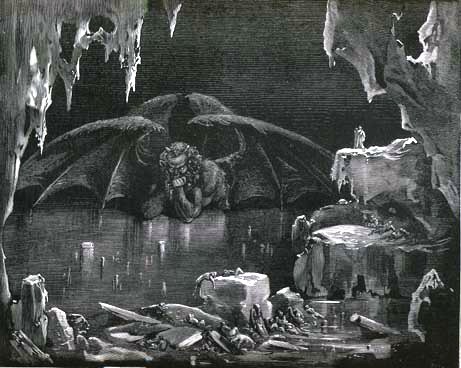
So, how then do we recognize “the face of evil,” especially when Satan may appear as an angel of light? When he announced the Jubilee Year of Mercy,Pope Francis also recommended the reading of Dante’s Divine Comedy as a spiritual preparation. There is a relevant passage in Canto 34 of Dante’s The Inferno that contains keen insights that can help us to recognize the face of Satan… or rather faces, as Dante gives Satan three faces in mimicry of the Blessed Trinity.
Gustav Dore’s illustration of Canto 34 of Dante’s Inferno
If once
He was as fair as he is ugly now,
and raised his brow against his Maker still,
he well is made the source of every woe.
But when I saw three faces in his head,
how great a marvel it appeared to me!
One face in front, and it was ruddy red;
the other two were joined to it upon
the middle of the shoulder on each side,
and joined above, where the cock sports his crown;
and the right was a kind of yellowish white,
and where the Nile comes rolling to the plains,
men’s faces are the color on the left.
Beneath each face extended two huge wings,
large enough to suffice for such a bird.
I never saw a sail at sea so broad.
They had no feathers, but were black and scaled
like a bat’s wings, and those he flapped, and flapped,
and from his flapping raised three gales that swept
Cocytus, and reduced it all to ice.
With his six eyes he wept, and down three chins
dribbled his tears and slaver slick with blood.
Anthony Esolen writes in his excellent commentary on The Divine Comedy:“At the center of evil there is nothing but a small, hard, cold kernel of self, transcendentally small, a something just this side of emptiness. Despite his apparent power in the world, that is what Lucifer finally is, and despite his threatening size, that is how Dante has portrayed him. That he flaps his wings everlastingly only underscores his impotence. He is the ‘evil worm’ who ‘gnaws a whole into the world.’ For Dante, escape from sin is escape from that tight little hole, to breathe the air of freedom and humanity, and to look upon those vast realms above–realms meant for the fire of love, and therefore also meant for man.”
….”Satan is an anti-Trinity. The power, wisdom, and love of God are inverted here into impotence, ignorance, and hate. The colors of the faces seem to correspond with the colors of the men of the three continents Dante knew: ruddy, (European), yellowish (Asian), and dusky (African).”
. . . “Satan’s action locks him in place. What should be a symbol of freedom–the flapping of wings–is the engine of his imprisonment. He who would be free of God is bound by his own will and shackled into a dumb, mechanical dullness.”
Satan’s face will always be always be one of impotence, ignorance, and hate and God’s Face will always be one of Divine Power, Wisdom and Love. One wonders how the world persists in blindness; how it calls good “evil” and evil “good” in failing to recognize either the Face of God or the face of Satan. We must pray for the “eyes of faith” and the light of the Holy Spirit for ourselves and the world. We must pray too, that as “evil bares it’s face more and more” that God will reveal the treasures of the Divine Power, Wisdom, and Merciful Love of His Holy Face more and more so that mankind will return to the Merciful Face of God!
************
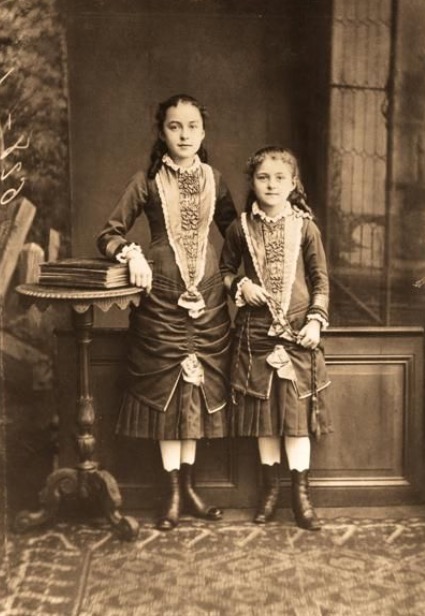
Young Celine (left) and St. Therese (right) 1881
*The drawing above is by Sr. Genevieve of the Holy Face (Celine Martin) the sister of St. Therese of The Child Jesus and the Holy Face. One year after the Saint’s death in 1898, the photographer Secondo Pia took the first photographs of the Shroud of Turin. He was shocked when on the photographic negatives, the “positive” image of a man who had endured terrible suffering appeared. While Celine was reading a book on the amazing discovery, she heard the voice of her sister St. Therese speak these words, “Paint Him, paint a new Holy Face, paint Him as He was!” In 1904, after praying and meditating hours before a print of the Holy Face on the Shroud of Turin she executed the charcoal drawing.
Celine has written this about St. Therese’s devotion to the Holy Face: “Devotion to the Holy Face was, for Therese, the crown and compliment of her love for the Sacred Humanity of Our Lord. This Blessed Face was the mirror wherein she beheld the Heart and Soul of her Well-Beloved. Just as the picture of a loved one serves to bring the whole person before us, so in the Holy Face of Christ, Therese beheld the entire Humanity of Jesus. We can say unequivocally that this devotion was the burning inspiration of the Saint’s life.
St. Therese of the Child Jesus and the Holy Face
St. Therese herself said, “Until my coming to Carmel, I had never fathomed the depths of the treasures hidden in the Holy Face... I understood what real glory was. He whose kingdom is not of this world (John 13:36) showed me that true wisdom consists in ‘desiring to be unknown and counted on as nothing’ (Imitation of Christ 1,2-3) ‘in placing one’s joys in the contempt of self.’Ah! I thirsted after suffering and I longed to be forgotten.” —The Last Conversations
“May the Lord bless and keep you, may He make His Face shine upon you and be merciful to you: May the Lord turn His Countenance toward you and give you His PEACE.” (Num. 6:22-27)
Peace, Pope Emeritus Benedict XVI has said, is the summit of the six actions of God in this blessing, which are in our favor; “His most sublime gift, in which He turns toward us the splendor of His Face.”
January 1st is the Feast of Mary, Mother of God, who is the Queen of Peace and this is also the World Day of Peace. Today Pope Francis said, “She is the Mother of Mercy, because she bore in her womb the very Face of Divine Mercy, Jesus, Emanuel, the Expectation of the nations, the “Prince of Peace.” (Is. 9:5) Jesus has given us His Mother so that we may never be left alone on our pilgrimage through life, especially in times of trouble and uncertainty.
Pope Francis has also said, “Our eyes need to focus on the particular signs God has given us, to see His merciful love first-hand.” The Holy Father recalled the suffering, violence and death of many innocent people in the previous year, but he also noted the many acts of kindness, love and solidarity that go unnoticed but should not be obscured “by the arrogance of evil.” “The good always wins,”said Pope Francis, “even if at times it can appear weak and hidden.”
One of the “particular signs God has given us, to see His merciful love first-hand” is the Face of Christ which He offers to all humanity as “the supreme revelation of the Father’s Mercy.” By contemplating and rejoicing in the splendor of His Face through devotion to the Holy Face we may obtain the peace that the world so desperately needs.
Pope Francis concluded his blessing by appealing to Mary saying, “Send us your blessing on this day consecrated to your honor. Show us the Face of Jesus your Son, who bestows upon the entire world mercy and peace.” Finally, the Pope concluded by calling on the faithful to pray each morning for God to “shine his face” on us, and invited those in the square to repeat after him:“Today, the Lord makes His Face to shine upon me.”
Pope Emeritus Benedict XVI has written, “To rejoice in the splendor of His Face means penetrating the mystery of His Name made known to us in Jesus, understanding something of His interior life and of His will, so that we can live according to His plan for humanity. Jesus lets us know the hidden Face of The Father through His human face; by the gift of The Holy Spirit poured into our hearts.” “This,” Pope Benedict XVI says, “is the foundation of our Peace, which nothing can take from us.”
+Peace and have a Blessed New Year!
“Mary, Mother of the Holy Face, help us to have ‘hands innocent and a heart pure,’ hands illumined by the truth of love and hearts enraptured by divine beauty, that transformed by the encounter with Christ, we may gift ourselves to the poor and the suffering, whose faces reflect the hidden presence of your Son Jesus. Amen.” — Pope Emeritus Benedict XVI






























 Illumina Domine Blog - Devotion to The Holy Face