Since I first came face-to-face with the Holy Veil of Manoppello, Italy, I desired to share this wonderful gift of God, but have always struggled to find the words to describe that life-changing encounter. The changing “living” image of light” that presents itself is beyond a single description. The history of the Holy Veil is ancient, deep, intriguing, profound — and controversial — as was Jesus Himself. Skeptics abound of course, and why not? Even Jesus’s closest friends did not recognize Him immediately after the Resurrection. However, there are now many “skeptics” who had initially dismissed the Manoppello Veil, but have paused to take a second look into His eyes, and in gazing, found themselves captivated by the returned peaceful, merciful gaze of Jesus Christ, Savior and Lord. Such was the experience of Mons. Walter Amaducci.
Mons. Walter Amaducci, episcopal vicar for pastoral care of the Cesena-Sarsina diocese, and director of the diocesan school of theology, has written an excellent, comprehensive, and concise book about the mysterious “Acheiropoeta” known as the Holy Face of Manoppello, Italy, which I can highly recommend to anyone, most especially to pilgrims, seeking to expand their love and knowledge of the Holy Face.
This wonderful Italian book, originally titled, “Il Volto Santo,” happily, has recently been translated into German, and also beautifully into English by Bernadette Orioli. The book is so fascinating and the translation flows so well that it may easily be read in a day. It seems to me to be a “Godsend” that it is now available on Amazon Kindle, making it readily available for everyone, and perfect Lenten reading.
“Come and see” (John 1:39) “Il Volto Santo” The Holy Face of Manoppello, Italy (Photo: Paul Badde)
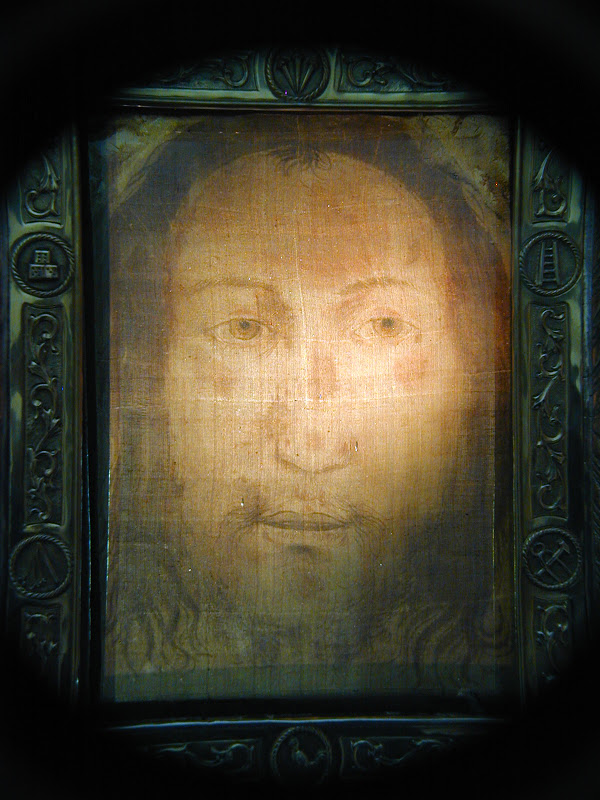
The Holy Face of Manoppello, (Photo: Paul Badde/EWTN) Unique among other images of the Holy Face, in that it is an “achieropoeta” (as is the Shroud of Turin), not made by human hands. This “living image” which bears traces of the Passion, is believed to have been created at the Resurrection. It could be said that it is an “Icon of Easter,” which we look forward to in Hope at the beginning of Lent.
I wish that all the world could celebrate the Face of my Beloved. If I could at least honor Him for all those who honor Him not.” –Bl. Mother Maria Pierina De Micheli
Consecration to the Holy Face
O Lord Jesus, we believe most firmly in You. You are the Son Incarnate of the Blessed Virgin Mary. You are the Lord and Absolute Ruler of all creation. We acknowledge you, therefore, as the Universal Sovereign of all creatures. You are the Lord and Supreme Ruler of all mankind, and we, in acknowledging this Your dominion, consecrate ourselves to You now and forever. Loving Jesus, we place our family under the protection of Your Holy Face, and of Your Virgin Mother Mary most sorrowful. We promise to be faithful to You for the rest of our lives and to observe with fidelity Your Holy Commandments. We will never deny before men, You and Your Divine rights over us and all mankind. Grant us the grace to never sin again; nevertheless, should we fail, O Divine Saviour, have mercy on us and restore us to Your grace. Radiate Your Divine Countenance upon us and bless us now and forever. Embrace us at the hour of our death in Your Kingdom for all eternity, through the intercession of Your Blessed Mother, of all Your Saints who behold You in Heaven, and the just who glorify You on earth. O Jesus, be mindful of us forever and never forsake us; protect our family. O Mother of Sorrows, by the eternal glory which you enjoy in Heaven, through the merits of your bitter anguish in the Sacred Passion of your Beloved Son, Our Lord Jesus Christ, obtain for us the grace that the Precious Blood shed by Jesus for the redemption of our souls, be not shed in vain. We love you, O Mary. Embrace us and bless us, O Mother. Protect us in life and in death. Amen.
Glory to the Father, and to the Son, and to the Holy Spirit. As it was in the beginning, is now, and will be forever. Amen.
1510, Piero de Cosimo, The Veronica Veil
“Christ’s response, ‘Whoever has seen me, has seen the Father, lead us into the heart of Christological faith.'” — Pope Benedict XVI
“Oh Savior Jesus, who did will that reparation should be as public and universal as had been the offense, penetrate us with the true spirit of reparation. Give us the grace to love Your Divine Face, to make it known and loved by the whole world, in order that it may be to us a source of light and means of salvation. Amen.” –Bl. Maria Pierina de Micheli, “Missionary of the Holy Face”
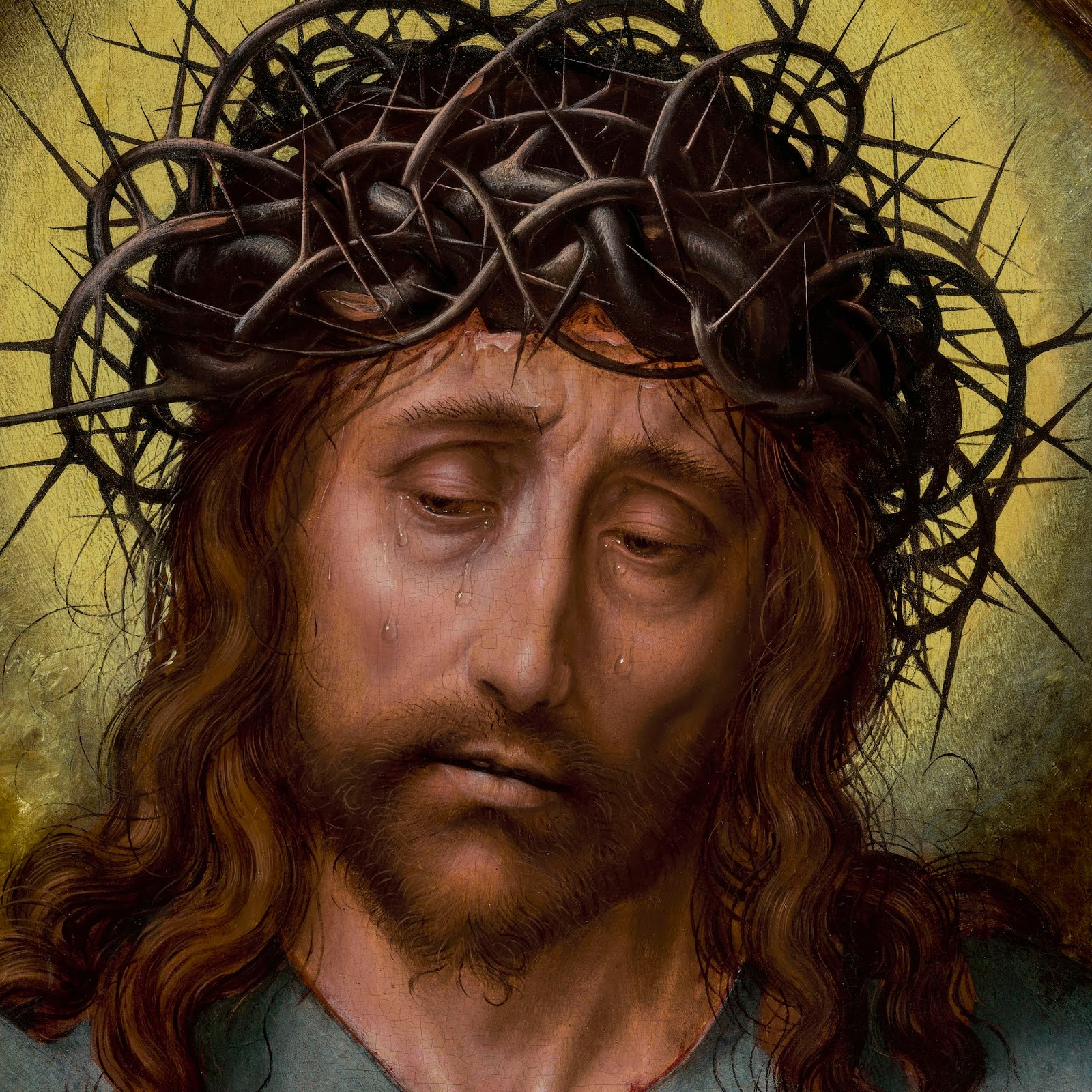
Christ as the Man of Sorrows; Quentin Metsys (Netherlandish, 1465 or 1466 – 1530); Belgium; 1520–1530
Lord Jesus Christ, Saviour of the World, by Thy Passion death and Ressurection, by Thy Holy Face and Holy Name Save us! Holy Mary, Intercede for your poor children around the world! Diptych with Christ as Salvator Mundi and Mary Praying by Quintin Metsys
Prayer to the Holy Trinity
The Man of Sorrows in the arms of the Virgin Mary, by Hans Memling
O Most Holy and Blessed Trinity, through the intercession of Holy Mary, whose soul was pierced through by a sword of sorrow at the sight of the passion of her Divine Son, we ask your help in making a perfect Novena of reparation with Jesus, united with His sorrows, love and total abandonment.
We now implore all the Angels and Saints to intercede for us as we pray this Holy Novena to the Most Holy Face of Jesus and for the glory of the most Holy Trinity, Father, Son and Holy Spirit. Amen.
Ninth Day
Psalm 51: 18-21
For in sacrifice you take no delight, burnt offering from me you would refuse, my sacrifice a
Altar of The Holy Face, St. Patrick’s Cathedral, New York
contrite spirit. A humbled, contrite heart you will not spurn. In your goodness, show favor to Zion; rebuild the walls of Jerusalem. Then you will be pleased with lawful sacrifice, holocausts offered on your altar.
Sacred Face of our Lord and our God, what words can we say to express our gratitude? How can we speak of our joy? That you have deigned to hear us, that you have chosen to answer us in our hour of need. We say this because we know that our prayers will be granted. We know that you, in your loving kindness, listened to our pleading hearts, and will give, out of your fullness, the answer to our problems.
Mary our Mother, intercede for us, St. Joseph, pray for us.
Through the merits of your precious blood and your Holy Face, O Jesus, grant us our petition, …Pardon and mercy.
Prayer to the Holy Trinity
Sr. Lucia’s vision of The Trinity
Most Holy Trinity, Godhead indivisible, Father, Son and Holy Spirit, our first beginning and our last end. Since you have made us after your own image and likeness, grant that all the thoughts of our minds, all the words of our tongues, all the affections of our hearts and all our actions may be always conformed to your most Holy Will, so that that after having seen you here on earth in appearances and in a dark manner by the means of faith, we may come at last to contemplate you face to face, in the perfect possession of you forever in paradise. Amen.
Pray one (1) Our Father, three (3) Hail Mary’s, one (1) Glory Be.
Tomorrow is the Feast of the Holy Feast and Act of Consecration
Our Lord told Sr. Marie St. Pierre that the image of His Holy Face is like a Divine stamp, which if applied to souls, through prayer, has the power of imprinting anew within them the Image of God.
Holy Face on the Shroud of Turin
Prayer to reproduce the Image of God in our souls
I salute You! I adore you and I love you, O adorable face of my beloved Jesus, as the noble stamp of the Divinity! Completely surrendering my soul to You, I most humbly beg You to stamp this seal upon us all, so the image of God may once more be reproduced in our souls. Amen.
Tomorrow, Tuesday, March 4th, will be The Feast of the Holy Face and The Act of Consecration to the Holy Face
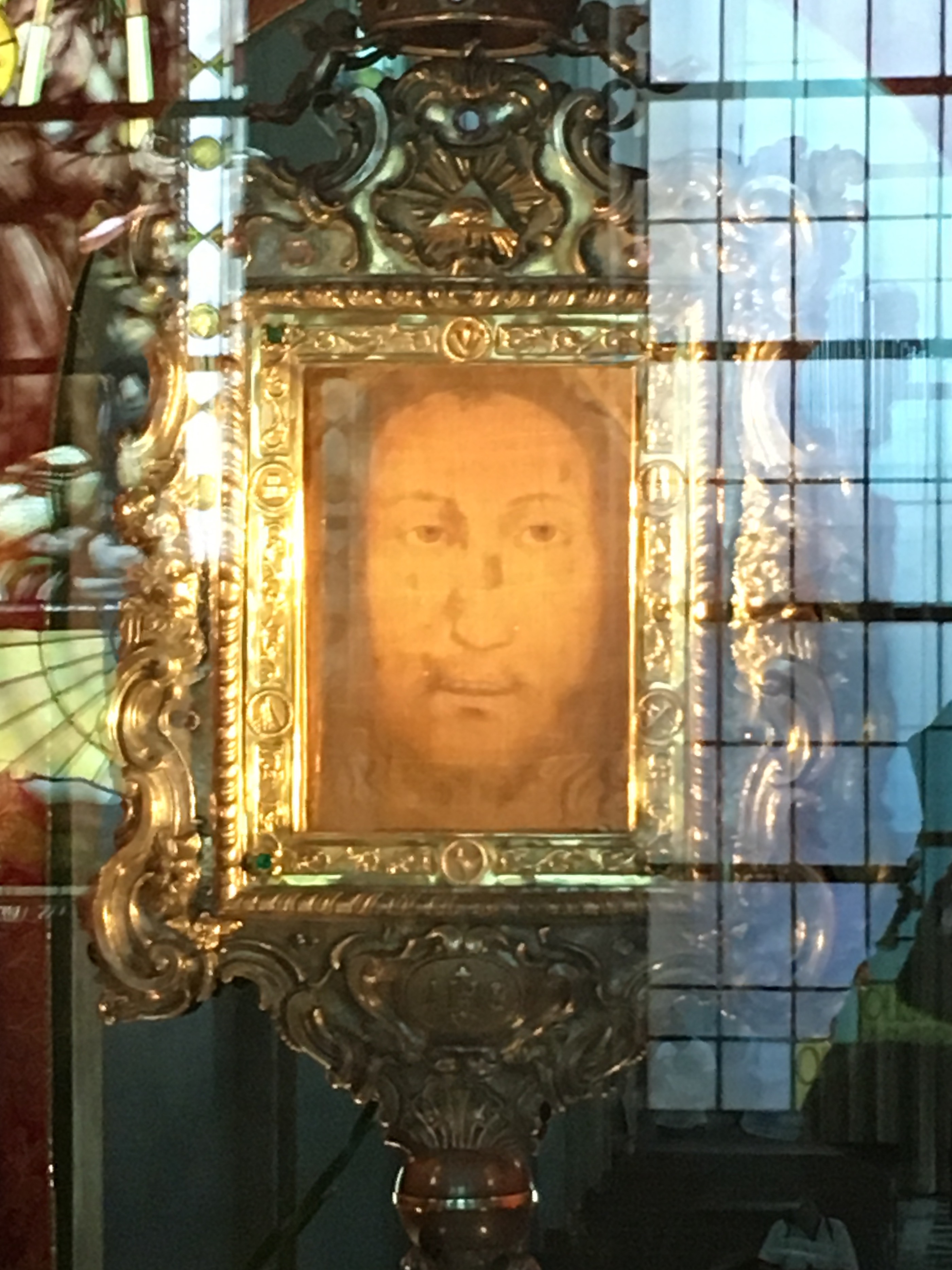
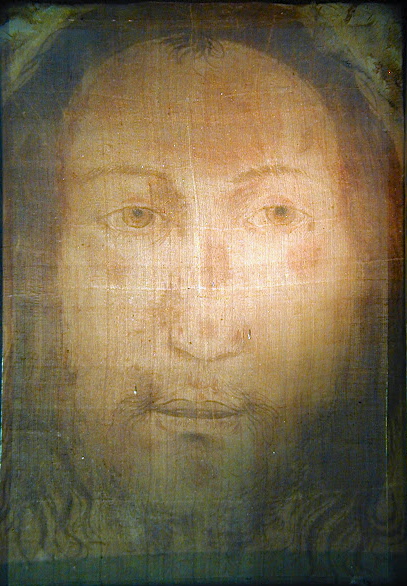
“Living” Face of Jesus on the miraculous Veil of Manoppello. Photo: Paul Badde/EWTN
“All of us, with unveiled faces, seeing the glory of the Lord as though reflected in a mirror, are being transformed into the same image.”
“It is the Church’s task to reflect the light of Christ in every historical period, to make His Face shine before the generations of the new millennium. Our witness, however, would be hopelessly inadequate if we ourselves had not first contemplated His FACE!” –St. Pope John Paul IIMay the Lord bless and keep you; may He make His Face shine upon and be merciful to you; may He turn His Countenance toward you and grant you His PEACE! (Num 6:22-27)
Padre Pio called the Holy Veil of Manoppello the “greatest relic of the Church” photo: Patricia Enk
What are our sufferings when we think of those of Jesus? Have we perhaps sweated blood? Have we received blows and spittle, been scourged and crowned with thorns?…And what can we possibly give Jesus save a heart desirous of loving Him…to desire nothing save His Will? — Bl. Mother Maria Pierina de Micheli
Daily Preparatory Prayer
O Most Holy and Blessed Trinity, through the intercession of Holy Mary, whose soul was pierced through by a sword of sorrow at the sight of the passion of her Divine Son, we ask your help in making a perfect Novena of reparation with Jesus, united with His sorrows, love and total abandonment.
We now implore all the Angels and Saints to intercede for us as we pray this Holy Novena to the Most Holy Face of Jesus and for the glory of the most Holy Trinity, Father, Son and Holy Spirit. Amen.
A pure heart create for me, O God, put a steadfast spirit within me. Do not cast me away from your presence not deprive me of your Holy Spirit.
Mary, Spouse of the Holy Spirit
May our hearts be cleansed, O Lord, by the in-pouring of the Holy Spirit, and may He render them fruitful by watering them with His heavenly dew. Mary, the most chaste spouse of the Holy Spirit, intercede for us, St. Joseph, pray for us.
Through the merits of your precious blood and your Holy Face, O Jesus, grant us our petition, …Pardon and mercy.
“Who is like God?” St. Michael holding high the Face of Jesus (Sculpture by Cody Swanson)
O Victorious Prince, most humble guardian of the Church of God and of faithful souls, who with such charity and zeal took part in so many conflicts and gained such great victories over the enemy, for the conservation and protection of the honor and glory we all owe to God, as well as for the promotion of our salvation; come, we pray Thee, to our assistance, for we are continually besieged with such great perils by our enemies, the flesh, the world and the devil; and as Thou wast a leader for the people of God through the desert, so also be our faithful leader, and companion through the desert of this world, until Thou conduct us safely into the happy land of the living, in that blessed fatherland from which we are all exiles. Amen. (St. Aloysius)
Pray one (1) Our Father, three (3) Hail Mary’s, one (1) Glory Be.
O Bleeding Face, O Face Divine, be every adoration Thine. (3 times)
St. Michael, sculpture by Cody Swanson, Old St. Patrick’s New Orleans (photo: Patricia Enk)
“Love is tireless, it feeds on silence and humility and is heart to heart with our Beloved, deriving from His Heart the powerful force which makes love tireless to do much, to do well the tiniest everyday things to please Him alone. How many pearls we can collect each day to make Jesus forget the insults He receives each day? How many kisses–it will be a smile–a word held back–an act of charity–docile obedience–temptation promptly resisted–and in moments in which nature, pride, self-love, sensuality, desire to hold sway–a glance at the Holy FACE–that blood, those Divine Eyes veiled with grief and love and we will say nothing?” –Blessed Mother Maria Pierina de Micheli, Missionary of the Holy Face
Day 4:
Alpha-Omega Holy Face of Jesus Novena Prayer
Veil of Veronica C. 1618-22 National Gallery
Daily Preparatory Prayer
O Most Holy and Blessed Trinity, through the intercession of Holy Mary, whose soul was pierced through by a sword of sorrow at the sight of the passion of her Divine Son, we ask your help in making a perfect Novena of reparation with Jesus, united with His sorrows, love and total abandonment.
We now implore all the Angels and Saints to intercede for us as we pray this Holy Novena to the Most Holy Face of Jesus and for the glory of the most Holy Trinity, Father, Son and Holy Spirit. Amen.
Fourth Day
Psalm 51: 8-9
Indeed you love truth in the heart; then in the secret of my heart teach me Wisdom. O purify me, then I shall be clean; O wash me, I shall be whiter than snow.
O Lord Jesus, who has said, learn of me for I am meek and gentle of heart, and who did manifest upon The Holy Face the sentiments of Thy divine heart, grant that we may love to come frequently and meditate upon Thy divine features. We may read there Thy gentleness and Thy humility, and learn how to form our hearts in the practice of these two virtues which Thou desires to see shine in Thy servants. Mary our Mother and St. Joseph, pray for us.
Through the merits of your precious blood and your Holy Face, O Jesus, grant us our petition, …Pardon and mercy.
Sorrowful Mother
“O Holy Face of my sweet Jesus, by the tenderness of the love and most deep sorrow with which Mary most holy contemplated You in Your Passion, grant to our souls to share in her love and grief and fulfill Your Most Holy Will as perfectly as possible. Amen. “
–Bl. Mother Maria Pierina de Micheli, “Missionary of the Holy Face”
Prayer in Honor of the Sorrows of The Blessed Virgin
O Most Holy and afflicted Virgin, Queen of Martyrs! Who stood beneath the Cross, witnessing the agony of your dying Son, look down with a mother’s tenderness and pity on us as we kneel before you to venerate your Sorrows and place our requests, with filial confidence, in the sanctuary of your wounded heart. Present them on our behalf to Jesus, through the merits of His most sacred Passion and Death, together with your sufferings at the foot of the Cross, and through the united efficacy of both, obtain the favor which we humbly ask. To whom shall we go in our wants and miseries if not to you. O Mother of Mercy, who having so deeply drunk of the chalice of your Son, graciously alleviate the sufferings of those who still sigh in this land of exile. Amen.
Prayer to the Souls in Purgatory
My Jesus, by the sorrows you suffered in your agony in the garden, in your scourging and crowning with thorns, in the way to Calvary, in your crucifixion and death, have mercy on the souls in Purgatory, and specially on those that are most forsaken. Deliver them from the dire torments they endure. Call them and admit them to your most sweet embrace in Paradise. Amen.
Pray one (1) Our Father, three (3) Hail Mary’s, one (1) Glory Be.
O Bleeding Face, O Face Divine, be every adoration Thine. (3 times)
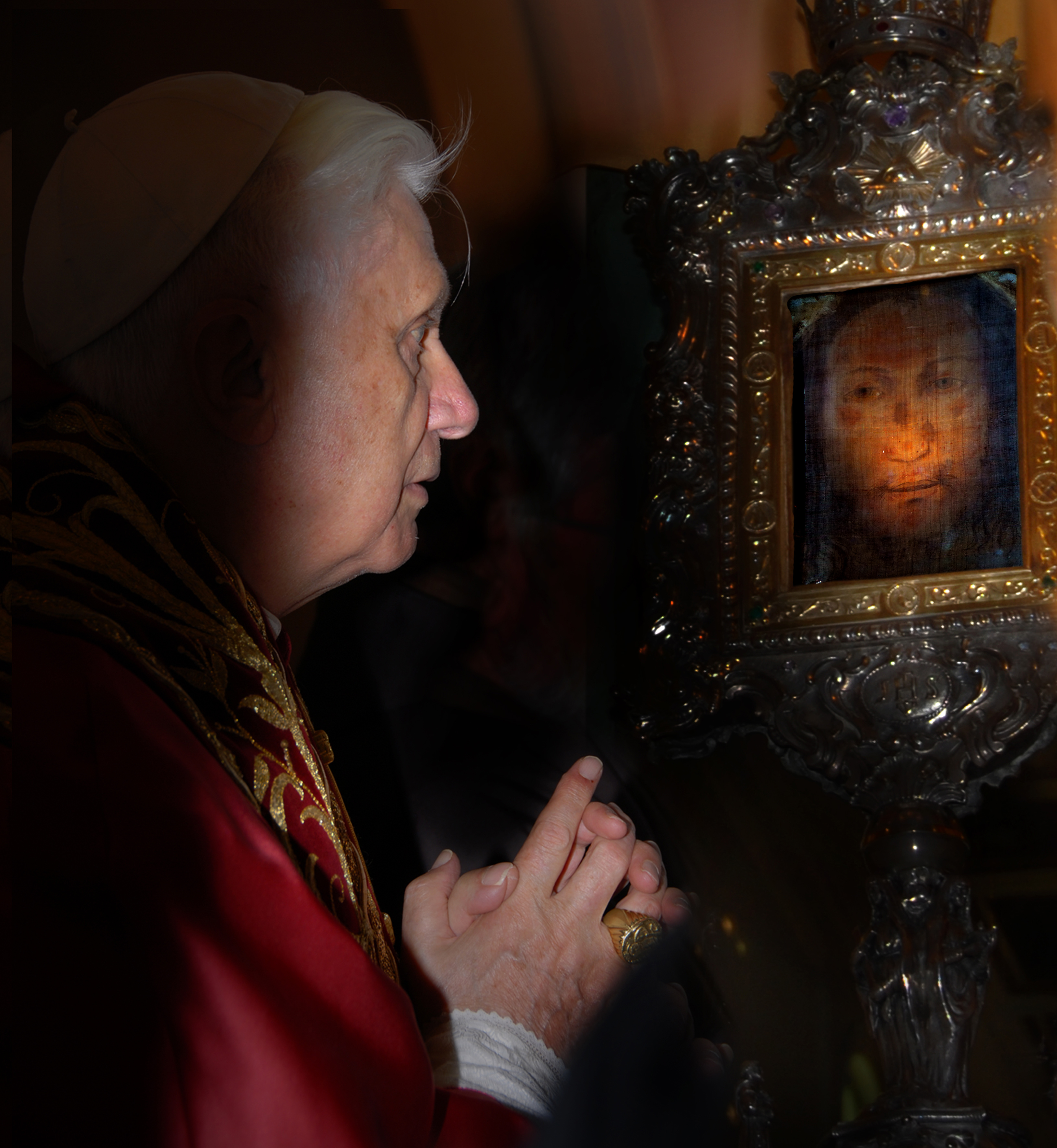
Pope Benedict XVI gazes at the Veil of the Holy Face of Manoppello. Photo: Paul Badde
“While we too seek other signs, other wonders, we do not realize that He is the real sign, God made flesh; He is the greatest miracle of the universe: all the love of God hidden in a human heart, in a human face.” — Pope Benedict XVI
“All those who attracted by my love, and venerating my countenance, shall receive, by virtue of my humanity, a brilliant and vivid impression of my divinity. This splendor shall enlighten the depths of their souls, so that in eternal glory the celestial court shall marvel at the marked likeness of their features with my divine countenance.” (Our Lord to St. Gertrude)
Daily Preparatory Prayer (to be said each day as you console the Holy Face) O Most Holy and Blessed Trinity, through the intercession of Holy Mary, whose soul was pierced through by a sword of sorrow at the sight of the passion of her Divine Son, we ask your help in making a perfect Novena of reparation with Jesus, united with His sorrows, love and total abandonment. We now implore all the Angels and Saints to intercede for us as we pray this Holy Novena to the Most Holy Face of Jesus and for the glory of the most Holy Trinity, Father, Son and Holy Spirit. Amen.
Second Day Psalm 51: 5-6 My offenses truly I know them; My sin is always before me. Against you, you alone, have I sinned; What is evil in your sight I have done. Most Holy Face of Jesus, we are truly sorry that we have hurt you so much by constantly doing what is wrong; and for all the good works we have failed to do. Immaculate Heart of Mary, Saint Joseph, intercede for us, help us to console the Most Holy Face of Jesus. Pray that we may share in the tremendous love Thou hast for one another, and for the most Holy and Blessed Trinity. Amen. Through the merits of your precious blood and your Holy Face, O Jesus, grant us our petition, …Pardon and mercy.
Prayer to The Holy Spirit
Come Holy Spirit
Come, Holy Spirit, Sanctifier, all powerful God of love, Thou who didst fill the Virgin Mary with grace, Thou who didst wonderfully transform the hearts of the apostles, Thou who didst endow all Thy martyrs with a miraculous heroism, come and sanctify us, illumine our minds, strengthen our wills, purify our consciences, rectify our judgments, set our hearts on fire and preserve us from the misfortune of resisting Thine inspirations. We consecrate to Thee our understanding, our heart and our will, our whole being for time and for eternity. May our understanding be always submissive to Thy heavenly inspirations and to the teachings of Thy Holy Catholic Church, of which Thou art the infallible guide; may our heart be ever inflamed with love of God and neighbor; may our will be ever conformed to the divine will, and may our whole life be a faithful imitation of the life and virtues of our Lord and Savior, Jesus Christ, to whom with the Father and Thee be honor and glory forever. Amen. Pray one (1) Our Father, three (3) Hail Mary’s, one (1) Glory Be.O Bleeding Face, O Face Divine, be every adoration Thine. (3 times)
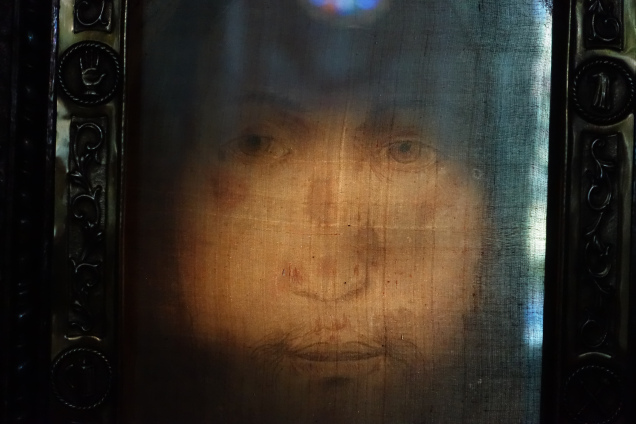
Holy Face Veil of Manoppello, which shows traces of bruises and wounds of the Passion. (photo: Paul Badde)
“O God, Who did constitute Your only begotten Son the Savior of mankind, and did command that He should be called JESUS; grant in Your kindness that our heart’s joy in Heaven may be the Face of Him Whose Holy Name we venerate on earth.” Amen. — Blessed Mother Pierina De Michelli, “Missionary of the Holy Face”
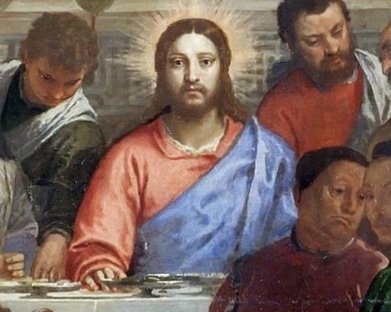
Detail from The Wedding at Cana by Paolo Veronese (1528-1588)
Omnis Terra, Latin for “All the Earth, ” is the name given to the Second Sunday in Ordinary time, when the Gospel of the Wedding at Cana is read. In the midst of the wedding feast, Mary whispers to her son Jesus, “They have no wine.” At Mary’s words, Jesus then performed his first miracle: “the beginning of his signs at Cana in Galilee, and so revealed His glory, and His disciples began to believe in Him.” (John 2: 1-11) The revelation of His glory is the cause for all the earth rejoicing, giving praise to His Name at the wedding feast of the Lamb!
Omnis Terra Celebration 2025
This Holy Jubilee Year of Hope pilgrims from all over the world will be very fortunate to have an opportunity to participate in a Eucharistic celebration, procession, and blessing at the Basilica Shrine of the Holy Face in Manoppello, Italy, on Omnis Terra Sunday, January 19th. The Eucharistic Celebration will be presided over by His Excellency, Mons. Bruno Forte, Metropolitan Archbishop of Chieti-Vasto. Concelebrants will be Fr. Simone Calvarese, Provincial Minister of the Capuchin Friars Minor of Central Italy, and Fr. Antonio Gentili, Rector of the Sanctuary. At the end of the celebration there will be a procession and blessing with the reliquary of the Holy Face.
“To rejoice in the splendor of His Face means penetrating the mystery of His Name made known to us in Jesus, understanding something of His Interior life and of His will, so that we can live according to His plan for humanity. Jesus lets us know the hidden Face of the Father through His human Face; by the gift of the Holy Spirit poured into our hearts.” ~Pope Benedict XVI
This Jubilee Year of Hope, 2024-2025, will mark ten years since the rite of “Omnis Terra,” which had originally begun in 1208, was once again renewed during the Jubilee Year of Mercy, 2015-2016. At that time, a facsimile of the Merciful Face of of Christ on the Holy Veil of Manoppello was carried in a historic procession once again through the streets of Rome. 2016 was the first year that the Holy Face was processed in Rome since the ancient procession of Pope Innocent III from St. Peter’s Basilica to the nearby hospital of Santo Spirito in Sassia in 1208. The Omnis Terra celebration was later continued at the Basilica Shrine of Il Volto Santo in Manoppello. This significant event, celebrating the revelation of His glory is certainly a reason for all the earth to rejoice, as though at a wedding feast!
The first “Omnis Terra” Procession of Pope Innocent III in 1208 carrying “the Veronica” Face of Christ (from “Liber Regulae Sancti Spiritus in Saxia” manuscript 1350)
detail of Face of Jesus on the Holy Veil from the precious manuscript “Liber Regulae Sancti Spiritus in Saxia”
Let all the earth worship and praise You, O God; may it sing in praise of Your Name, O Most High. Shout joyfully to the Lord all the earth; sing a psalm in honor of His Name, praise Him with magnificence!
–Omnis Terra Introit
Salve! Sancta Facies! Hail, Holy Face!
Salve, Sancta Facies! Hail, Holy Face (c. 1450-1455), Willem Vrelant (1481) and associates, Walters Art Gallery, Baltimore, MD.
The exquisite illuminated manuscripts of the Middle Ages reflect the great love and devotion shown to the Holy Face, as well as provide evidence of what the Holy Face of Jesus looked like, as it was seen on a miraculous veil, known as “the Veronica.” “The Veronica,” or Veil of the Holy Face of Jesus, was the greatest relic in Rome at that time. To gaze upon the veil was the great desire of pilgrims, who came from far and wide, to see for themselves the sheer veil bearing the Face of Jesus. Beginning with public exhibitions and processions of the Holy Veil by Pope Innocent III in the mid thirteenth century, the miraculous veil could be viewed by all. Then, the artists got to work on paintings, illustrations, poetry, prayers, and hymns in honor of the Holy Face. ( “The Veronica Route” website wonderfully catalogues many of these “Veronica” artworks that may be found throughout the world.)
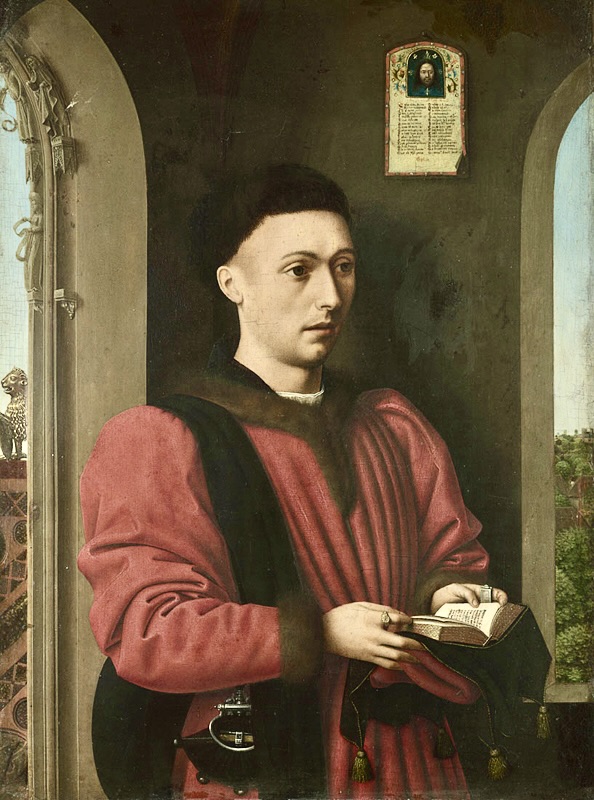
Portrait of a Young Man, 1450-60, Petrus Christus, London National Gallery. Seen above the prayerful young man, on the wall, the Holy Face and the Salve! Sancta Facies Hymn
Pope John XXII, who was elected Pope in 1316, composed a beautiful hymn in honor of the Holy Face, and he also granted a special indulgence to those who recited it — and for those who could could not read, the Pope granted the same indulgence to the faithful for reciting five Our Fathers, Hail Marys, and Glory Be’s. (For an understanding of indulgences, this EWTN article,Primer on Indulgences by James Akin is very helpful.)
Hymn in Honor of the Holy Face by Pope John XXII (translated from the original Latin)
Hail! Holy Face of our Redeemer, hail!
Which shines in all its majesty divine
Upon the spotless veil, a priceless gift
To Saint Veronica; of love the sign.

Hail! Glory of all time, mirror-glass of the Saints,
Wherein the blessed love for eye to gaze;
Destroy within us every stain of sin,
And with the elect our souls towards Thee raise.

Hail, Face of God! With His own gifts adorned,
Whose splendor through the ages shall not cease;
Oh! make Thy light descend into our hearts,
And from their earthly toils our souls release.

Hail! Mighty bulwark of the Christian faith,
Of heresy and lies the Victor Thou;
King in the Sacred Bread, renew the strength
Of all the faithful who before Thee bow.

Hail! all our joy in this hard life below,
So frail and fugitive, so quickly over;
Sweet Picture, lead us onwards to the skies,
That we may there the Face of Christ adore.

Hail! noblest of all gems, celestial pearl,
In Thee innumerable graces shine;
No hand depicted Thee, no chisel carved,
Thou wert of God alone the work divine.

The tints with which Thy features He has traced
Will never alter and will never fade;
Changeless amidst the ravages of time,
The everlasting King Thy Face may see.

Forever incorrupt and free from stain,
The living Christ we honour still in Thee;
Thou turnest into joy our sighs and tears,
Oh! grant that we, in heaven, thy Face may see.

Be thou, we pray, our buckler and defense,
Our consolation and refreshment sweet,
That nothing hostile may our spirits harm,
Till, after death, we rest at Jesus’ feet.  Amen.
Prayer
Shed, O Lord, joy over the faces of Thy faithful, and turn them away from the depths of hell, that, protected by the contemplation of Thy divine Face, we may have strength to tread underfoot the desires of the flesh, and that we may behold Thee face to face, without fear, Lord Jesus Christ, when Thou will come to judge us. Amen.
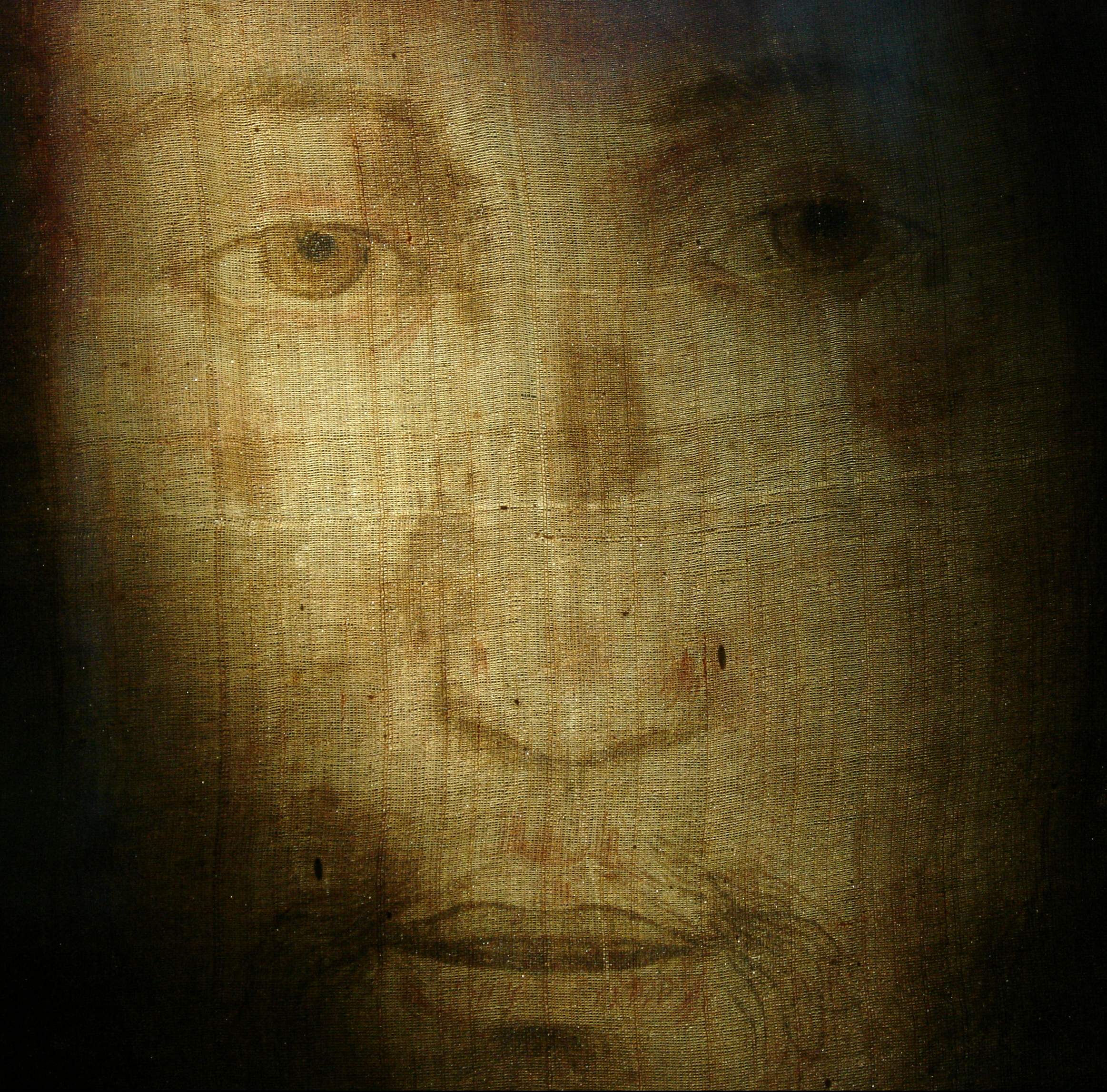
The “tints” of the image, written in light, have never altered or faded through the centuries. Holy Face Veil of Manoppello,( photo: Patricia Enk)
“The tints with which Thy features He has traced, Will never alter and will never fade; Changeless amidst the ravages of time, The everlasting King Thy Face may see.”
Below is a new video of a talk by Fr. Chris Alar, of the Divine Mercy Shrine in Stockbridge, Massachusetts that is well worth a watch!
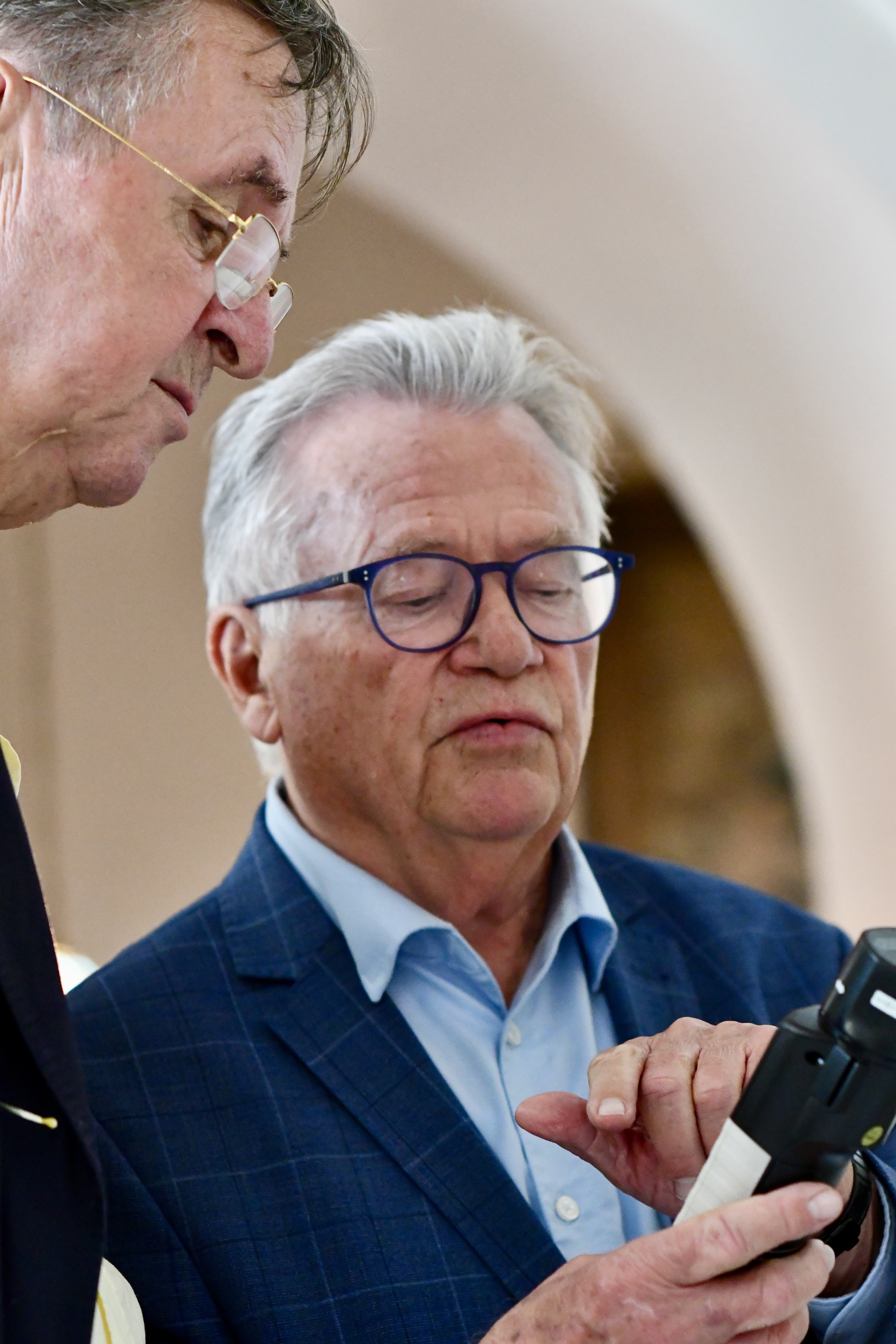
“The Holy Face contains light” Prof. Dr. Gosbert Weth holding the nuclear medicine measuring device used for examining the Veil of Manoppello. (Photo: Marco Gandolfo/EWTN)
The Holy Face Veil of Manoppello has been proven to radiate light energy!
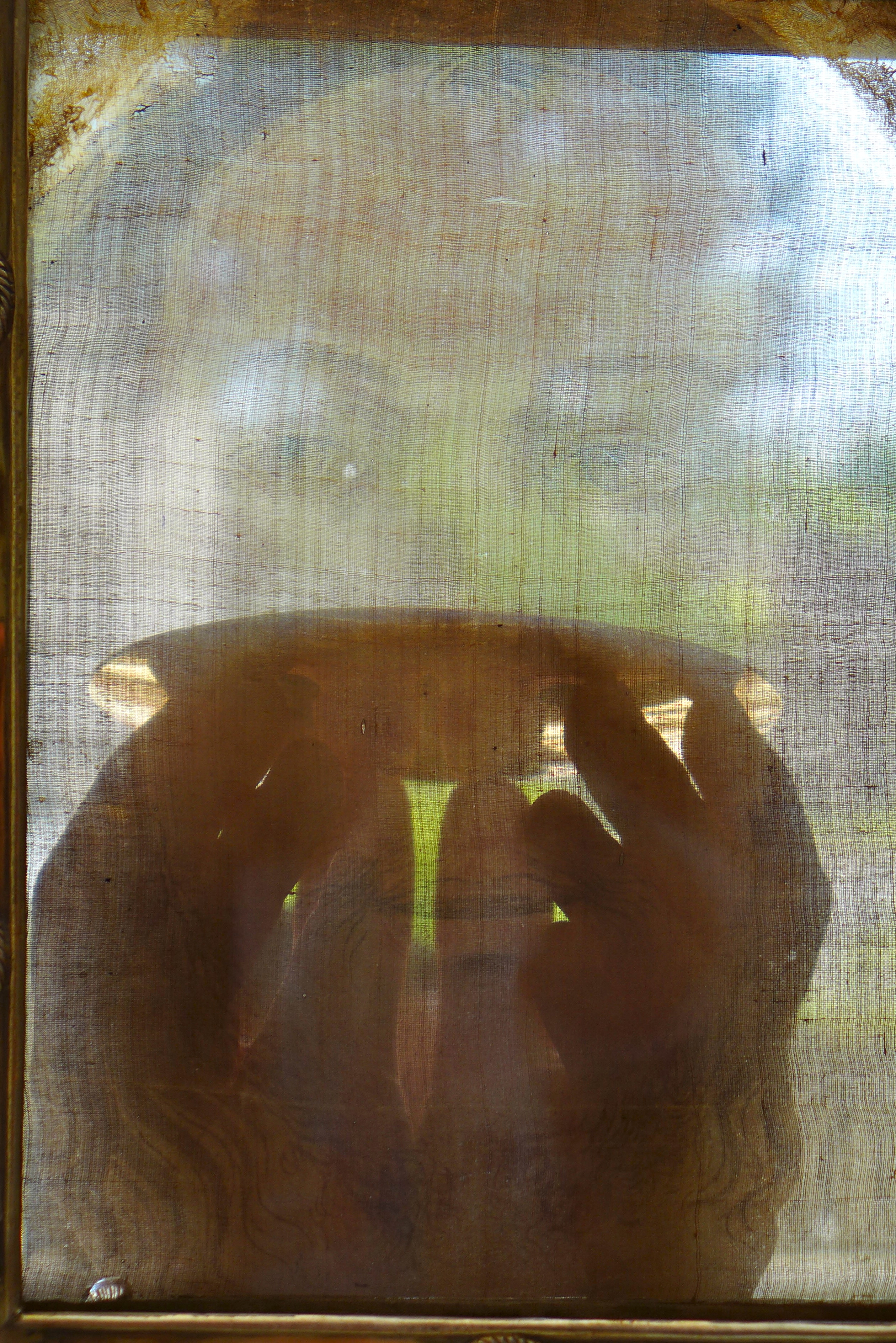
Hand viewed through the gossamer-thin Veil of the Holy Face (Photo: Paul Badde/EWTN)
It seems that in Manoppello, Italy, an intriguing and sacred mystery to mankind has been slowly unfolding for centuries: the existence of a changeable, “living” image of the face of Jesus; visible on a sheer veil, from either side. The presence of the image appears to be a miracle of light; seen without any traces of drawing, paint or brush. It is a contradiction–“an inexplicable phenomenon” which begs to be investigated by science. I had written earlier this year, a post on the topic of testing relics, specifically in regards to known Holy Face relics: “The Church, the testing of Relics, and the Holy Face.” The difficulty of conducting research on ancient relics is daunting, but not impossible. But who could undertake such a delicate task, and how…?
Enter an eminent German doctor, Gosbert Weth, who has recently conducted non-invasive investigations on the relic of the Holy Face Veil of Manoppello, using a special nuclear medicine device which measures alpha, beta, and gamma rays. Beta rays are invisible, energetic, and are released during nuclear fission. It has been determined that the veil of Manoppello has such a high level of beta radiation that it fills the Basilica!
EWTN and Ave Maria Radio host Teresa Tomeo has also interviewed Paul Badde, who is in Rome. The “Catholic Connections” interview may be listened to by clicking here: Catholic Connections interview with Paul Badde. There is a slight audio delay, coming from overseas, so it is a little difficult to hear Paul’s words in spots, but fortunately… With permission, Paul Badde has graciously allowed me to print a translation of his original piece on the examination of the relic, which provides additional precious details of the historic investigation of Dr. Weth, and the astounding conclusions:
“Il Volto Santo,” the sudarium veil of the Holy Face of Jesus (Photo: Paul Badde/EWTN)
Living Source for the Holy Year by Paul Badde
In the First Holy Year ever, which Pope Boniface VIII (1294-1303) introduced as a Christian jubilee for the year 1300, the most important destination for all pilgrims to Rome was not the Pope, nor even the tombs of the Apostles, but [to see] a gossamer-thin veil with the face of Christ. The veil was the greatest treasure of St. Peter’s Basilica, which at that time was called “Sanctum Sudarium” [meaning a burial face-cloth] in Latin, and was also known as the “Veronica.” The relic was considered to be the ‘Holy Sweat Cloth’ from the tomb of Christ, which is first mentioned in the account of the resurrection of the Evangelist John, together with the long linen cloth [Shroud] that is venerated today in Turin. In January 1208, Pope Innocent III was the first Pope to carry this Holy Veil in a crystal monstrance, publicly and barefoot, from St. Peter’s Basilica to the nearby Santo Spirito Hospital in Sassia in Rome, making it known throughout the Catholic world of the West.
Pope Innocent III carrying the reliquary with the Veil of the Holy Face in Procession.
Pope Benedict XVI praying before the ‘Veronica’s Veil’ during a visit to the Holy Face shrine in Manoppello, central Italy, September 1, 2006. (Osservatore Romano)
Since 1620, the same cloth has been venerated as the “Holy Face” (Volto Santo) in a Capuchin church on a hill outside Manoppello, on the slopes of Magellan massif in Abruzzo, where Pope Benedict XVI visited on September 1, 2006, becoming the first Pope [to visit] in over 400 years. It is a veil with many mysteries that has also puzzled Dr. Gosbert Weth from Schweinfurt in Germany ever since he heard about it and saw photos of the veil.
Rector Antonio Gentili OFM Capuchin, and Prof. Dr. Gosbert Weth in front of the relic Veil of the Holy Face. (Photo: Marco Gandolfo/EWTN)
Dr. Gosbert Weth is 78 years old, a former chief physician, doctor of medicine and natural sciences (chemistry), with a “picture-book” academic career. As senior physician and head of the hormone laboratory at the University of Würzburg, he worked on the largest centenarian study in the world with 575 participants, aged 100. He has developed groundbreaking developments for tumor therapies, has also received the German Inventor Award as the holder of several patents, and has been a speaker at the several world congresses for geriatrics and gerontology. Today he is involved in research into new uses of hydrogen, and is a doctor for hopeless cases in Bad Kissengen.
However, because he is convinced that the true “image” on the holy veil cannot have a paint or technical cause, Dr. Weth came to the Papal Basilica of the Holy Face in Manoppello on the eve of the next Holy Year 2025, on September 26th, with a special device from nuclear medicine for measuring alpha, beta, and gamma rays. Here, [in the Basilica] Rector Antonio Gentile of the Capuchin convent of the sanctuary, willingly opened the armored glass door of the display case in which the holy Sudarium has been sealed in its reliquary between two crystal panes in a frame made of walnut and fish glue since 1714. It was on the memorial feast of the holy doctors [of the Church] Cosmos and Damian, when the doctor from Bad Kissengen [Dr. Gosbert Weth] was given two hours here during the lunch break of the monks, and another hour on the following Saturday for his examinations.
Dr. Gosbert Weth examining the Veil of the Holy Face (Photo: Marco Gandolfo/EWTN)
“As a doctor, I can see,” he began his findings, “that this person must have suffered severe torture. Hematomas [bruises] are clearly visible on both the nose and in the area of the right cheek. Intense blows are necessary in order to cause these hematomas, which are always considered to be more serious injuries in medical examinations. There are no traces of paint or blood detected on the image. Therefore, the ‘image’ must have come into existence only after death. There is a pronounced hematoma on the nose (on the left side), which must be older than two to three days. No other bodily fluids such as blood or sweat are visible. This cloth can therefore only have been placed on a person who has already died. There is a double hematoma that can also be seen in the area of the right cheek. Normally, as is still the case in medicine today, the eyes of every dead person are closed. But the man in this portrait, however, has his eyes wide open. This ‘picture’ is an inexplicable phenomenon.”
Miraculous Veil of the”Holy Face of Manoppello” in Italy Photo: Paul Badde/EWTN
At the end of his investigation, however, Dr. Weth recorded the following: “All in all, there is only one explanation for the formation of the image of the sacred face. The atomic change from nitrogen (N14) to carbon (C14) must have occurred under the influence of enormous neutron radiation (light energy). The light energy present in the veil is the atomic evidence of the conversion of nitrogen (N14) to carbon (C14). Since the carbon is dark in color, the image is deposited as dark matter in the cloth. This also explains the alternating color shades. The ‘image’ is therefore not due to any application of paint, but to the nuclear-modified fibers of the carrier material.“
In this context, we must remember that most rays, in contrast to light rays, are invisible, but in many cases are extremely powerful–such as electromagnetic X-rays, or the almost invisible infrared light. All of these rays are full of energy.
Holy Face of Manoppello (photo: Paul Badde/EWTN)
Dr. Weth continued: “The radio carbon method provides evidence that carbon-C14 was formed. Carbon-C14 decays into nitrogen-N14 with a half-life of 5730 years, releasing beta radiation, which is produced by the radioactive decay of atomic nuclei. The formation of carbon-C14 leads back to nitrogen-N14. Since carbon is dark, this image is also darkly colored and optically visible due to the conversion of nitrogen to carbon. So once again: the image on the Manoppello [sudarium] cloth was not created by coloring, but by an atomic change to the nitrogen molecules present in the organic substance.”
“We therefore tried to measure the beta radiation released by the Manoppello cloth,” he said. “That was not so easy because the shroud is enclosed between two glass plates. Nevertheless, we were able to measure this radiation, which took place around 2000 years ago, and of which around 50 percent has already been consumed.”
We know that the decay of carbon C14 under beta radiation decays by half within 5730 years. It should therefore still be possible to measure this radiation– which was actually the case:
This basic radiation on the image veil was significantly higher than outside in the open air of nature. We therefore tried to measure this basic radiation as precisely and closely as possible. If we held the measuring device on the side of the reliquary, i.e. on the left and right at the places where there was no glass shielding, there was an increase of around 40 percent in beta radiation as a result of the conversion of carbon-C14 to nitrogen-N14. Overall, this beta radiation, which is also present everywhere outside in nature, was considerably higher in the protected basilica than [it is] outside. This is actually a contradiction. The reason for this higher density of beta rays can only lie in the existence of the Volto Santo [Holy Face Veil] inside the basilica.
“This can also explain the radiation of the Manoppello cloth at night,” Weth said with conviction. “It is visible in the dark because the conversion of C14 to nitrogen-N14 releases energy that is not one released from light quanta, but also from electrons, as they are raised to higher orbitals [wave function] in a conventional lamp. When the electrons fall back to their orbitals, light is released, which explains the radiance of the Manoppello sudarium cloth at night.”
Holy Face Veil of Manoppello (Photo: Paul Badde)
In one sentence: The Holy Face contains light within itself. The “True Icon” (Vera Eikon), as the veil has also been called for centuries, radiates from within itself. This image veil is therefore not only identical to the Holy Sudarium from Jerusalem and the “Veronica” from Rome. It is “the human face of God” that Pope Benedict XVI has repeatedly spoken of– and also a source of energy that inexplicably even fills the church’s interior, where rays should not normally be measured at all.
Basically, the experience that the Volto Santo is a source of power is nothing new. It is familiar to almost every pilgrim who has ever visited the shrine. However, since Dr. Gosbert Weth’s investigation before the next Jubilee Year, the statement is no longer a mere assertion, but a physical fact that can be measured. –Paul Badde
Paul Badde and Dr. Gosbert Weth (Photo: Marco Gandolfo/EWTN)
+
It makes one ponder…if a cloth that had been placed on Christ’s Holy Face in the tomb measurably radiates such powerful light energy that is not seen with our eyes, what tremendous power there must be when we come before His Eucharistic Face– where Jesus is fully present, Body, Blood, Soul and Divinity?
-Pope Benedict XVI (photo:Paul Badde/EWTN)
“O most awe-inspiring King, we bow before You and pray; May Your Reign, Your Kingdom, be recognized on earth!”
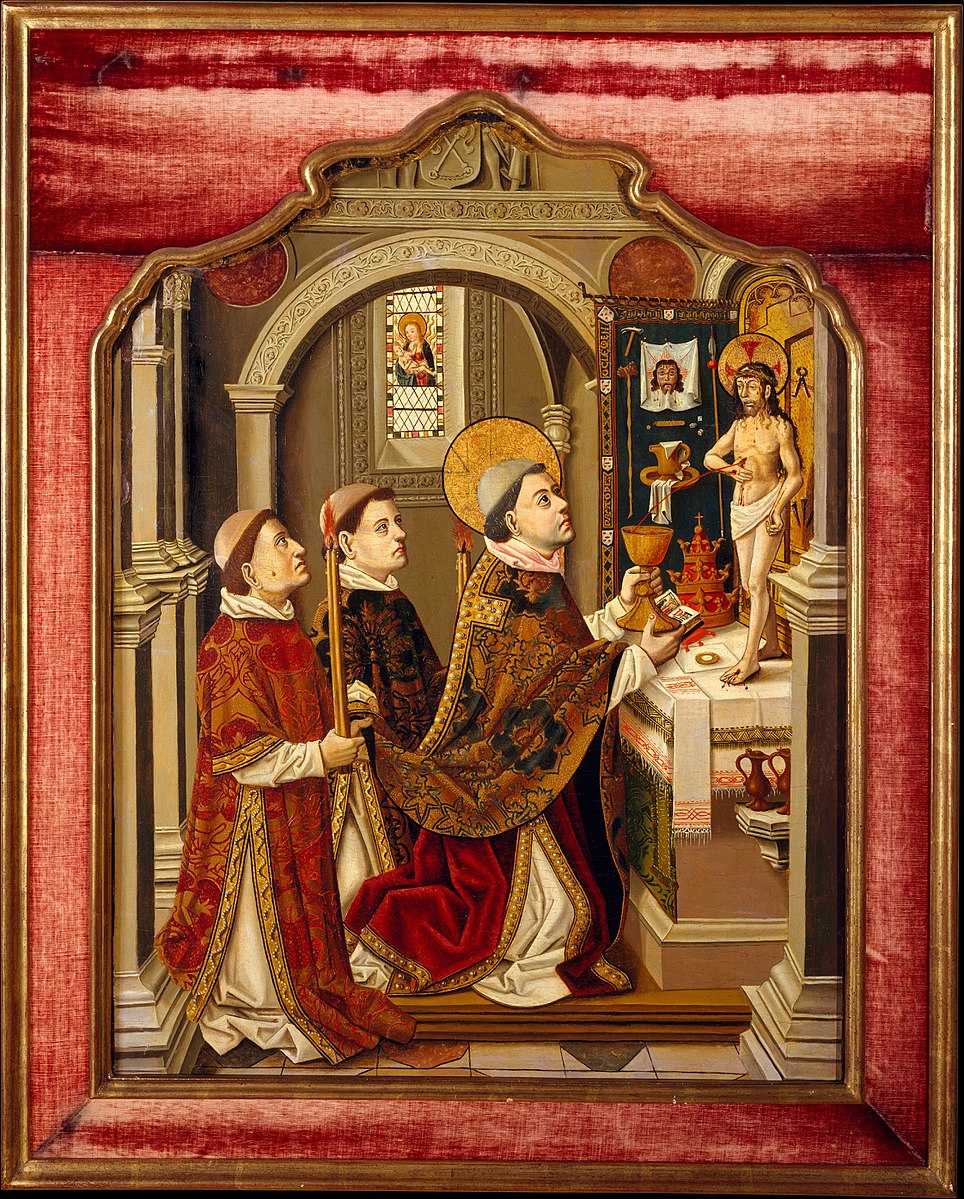
Mass of St. Gregory, attributed to Israel van Meckenem, circa 1440-1503
There are many beautiful versions of artworks portraying the story of the “Mass of St. Gregory.” The earliest version was found in an 8th-century biography of St. Gregory from the 8th century. One version, by John the Deacon, tells the story of Pope St. Gregory saying Mass when suddenly, from within the Church, a woman began to laugh. It was just at the moment of the Consecration. It turns out, that the laughing woman was the one who had baked, the bread to be consecrated, herself, and so told her companion that she didn’t believe that the host could be Jesus Christ. St. Gregory, when he heard the mocking laughter, prayed for a sign and the host began to bleed, thus confirming the True Presence of the Body and Blood of Jesus in the Eucharist.
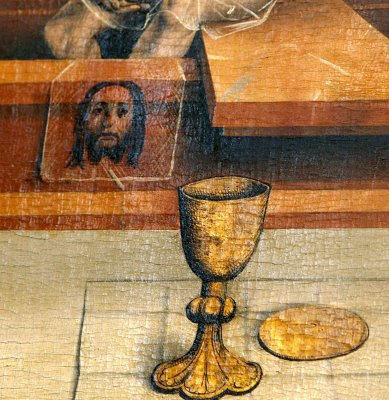
Other versions of the story also tell of St. Gregory’s vision of Jesus appearing on the altar in His Passion. Many works often included the instruments of the Passion, and prominent among them, one sees the Veil of the Holy Face of Jesus. Pilgrims to Rome, as well as many great artists, were able to see for themselves the “Greatest relic of the Church,” when the Holy Face Veil was publicly displayed from the reign of Pope Innocent III up until the Sack of Rome in 1527. Thankfully, therefore, we have many historic representations of what the Holy Veil actually looked like:
Detail of face of Jesus on veil in painting of the Mass of St. Gregory by Michael Wolgemut, who was the teacher of Albrecht Durer. The “Veil of Veronica” in artwork before the early 1500’s resemble the “Il Volto Santo” of Manoppello.“
The Mass of St. Gregory I by Robert Campin 15th Century
The Holy Face of Jesus on the Veil is a visible, tangible sign of the reality of Jesus’s presence in the world: He is “The Word made flesh” who dwells among us; Jesus Christ, who lived, suffered, died and rose again from the tomb, and who is truly present to us in the Eucharist at each Mass until the end of time.
St. Augustine in Meditation, Bartolome Esteban Murillo
“I have sought Thy face. I have sought for Thee and none other beside Thee. Thy face is my only reward. I will seek Thy face, O Lord: in this demand will I persevere. Indeed I will not look for any unworthy object, but only Thy face that I may love Thee more generously, because I find none other more precious. Thy face is the reward of the elect. The righteous shall dwell under Thine eyes, and when they will love Thy face, they will eat the bread of the sweat of their brow.
Let us return, wiping away the sweat, let us end the weariness and the weeping that we may shine in Thy all satisfying face. Neither let us search any more, because there is nothing better. Let us not abandon Thee, and we shall not be abandoned by Thee. Because what was said about the Lord, after the Resurrection? I will be filled with overflowing joy with Thy face, because without Thy face, there would not be joy for us.” ~ St. Augustine
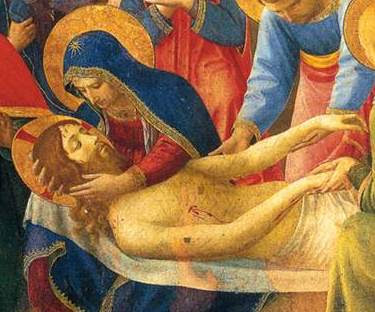
Boticelli’s Deposition
From the Confessions of Saint Augustine, bishop:
“Lord, you know me. Let me know you. Let me come to know you even as I am known. You are the strength of my soul; enter it and make it a place suitable for your dwelling, a possession without spot or blemish. This is my hope and the reason I speak. In this hope I rejoice rightly. As for the other things of this life, the less they be lamented; and the more they deserve tears, the less likely will men sorrow for them. For behold, you have loved the truth, because the one who does what is true enters into the light. I wish to do this truth before you alone by praising you, and before a multitude of witnesses by writing of you. O Lord, the depths of man’s conscience lie exposed before your eyes. Could anything remain hidden in me, even though I did not want to confess it to you? In that case I would only be hiding you from myself, not myself from you. But now my sighs are sufficient evidence that I am displeased with myself; that you are my light and the source of my joy; that you are loved and desired. I am thoroughly ashamed of myself; I have renounced myself and chosen you, recognizing that I can please neither you not myself unless you enable me to do so.
Whoever I may be, Lord, I lie exposed to your scrutiny. I have already told of the profit I gain when I confess to you. And I do not make my confession with bodily words, bodily speech, but with the words of my soul and the cry of my mind which you hear and understand. When I am wicked, my confession to you is an expression of displeasure with myself. But when I do good, it consists in not attributing this goodness to myself. For you, O Lord, bless the just man, but first you justify the wicked. And so I make my confession before you in silence, and yet not in silence. My voice is silent, but my heart cries out.
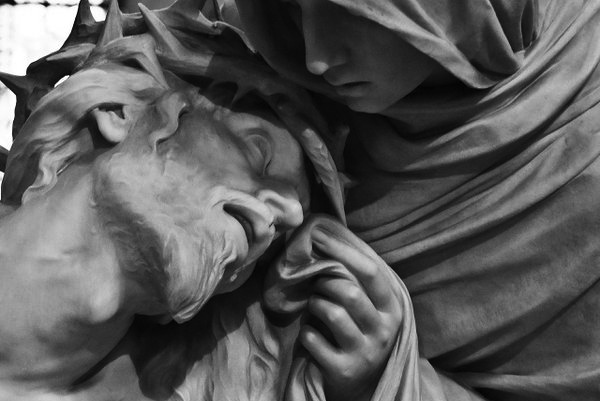
Joan Mates, Mourning over the body of Christ
You, O Lord, are my judge. For though no one knows a man’s innermost self except the man’s own spirit within him, yet there is something in a man which even his own spirit does not know. But you know all of him, for you have made him. As for me, I despise myself in your sight, knowing that I am but dust and ashes; yet I know something of you that I do not know of myself.
True, we see now indistinctly as in a mirror, but not yet face to face. Therefore, so long as I am in exile from you, I am more present to myself than to you. Yet I do know that you cannot be overcome, while I am uncertain which temptations I can resist and which I cannot. Nevertheless, I have hope, because you are faithful and do not allow us to be tempted beyond our endurance, but along with the temptation you give us the means to withstand it.
I will confess, therefore, what I know of myself, and also what I do not know. The knowledge that I have of myself, I possess because you have enlightened me, while the knowledge of myself that I do not yet possess will not be mine until my darkness shall be made as the noonday sun before your face.”
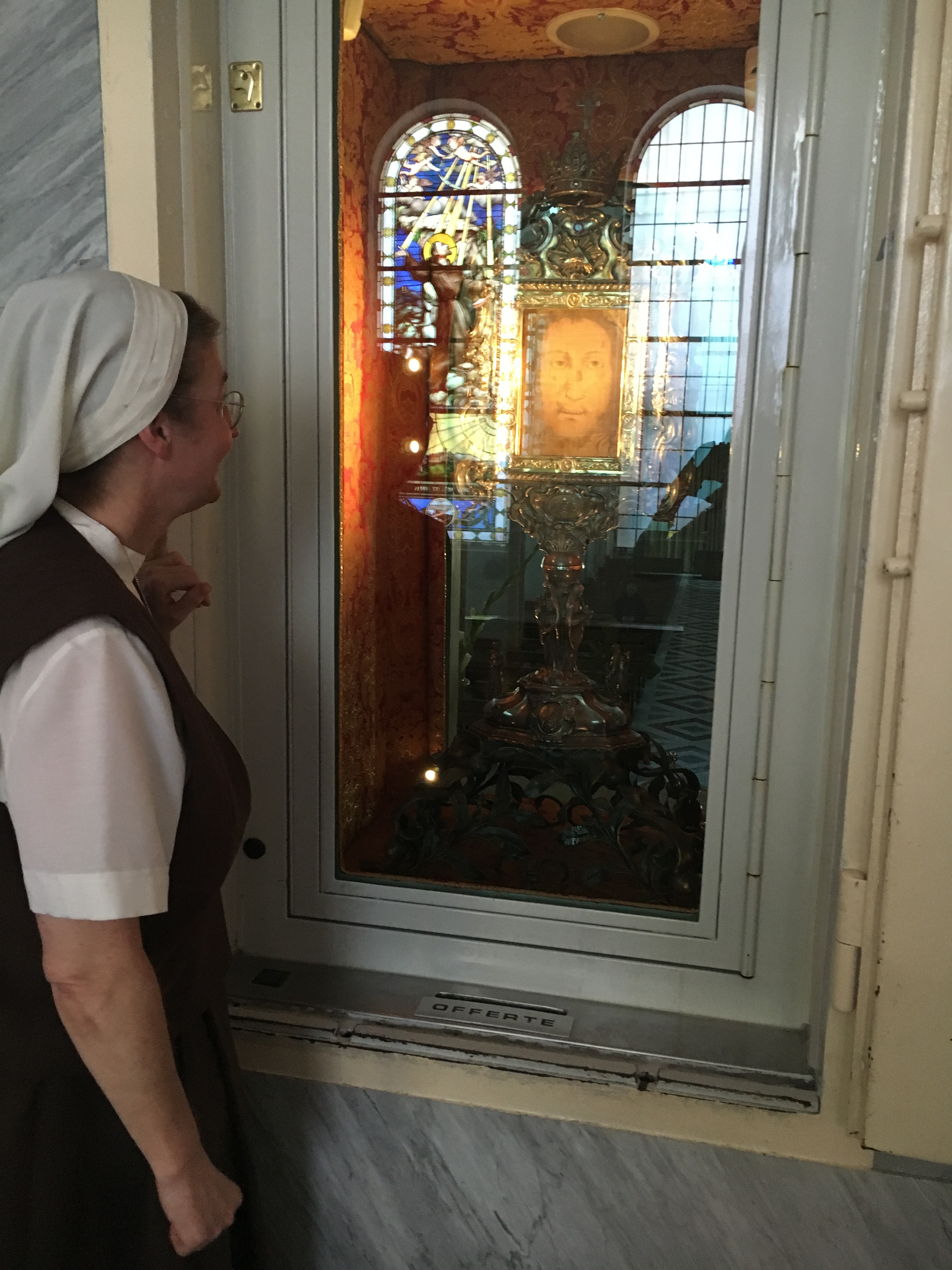
Sr. Petra-Maria before the Holy Face of Manoppello, Italy (Photo: Patricia Enk)




















 Illumina Domine Blog - Devotion to The Holy Face