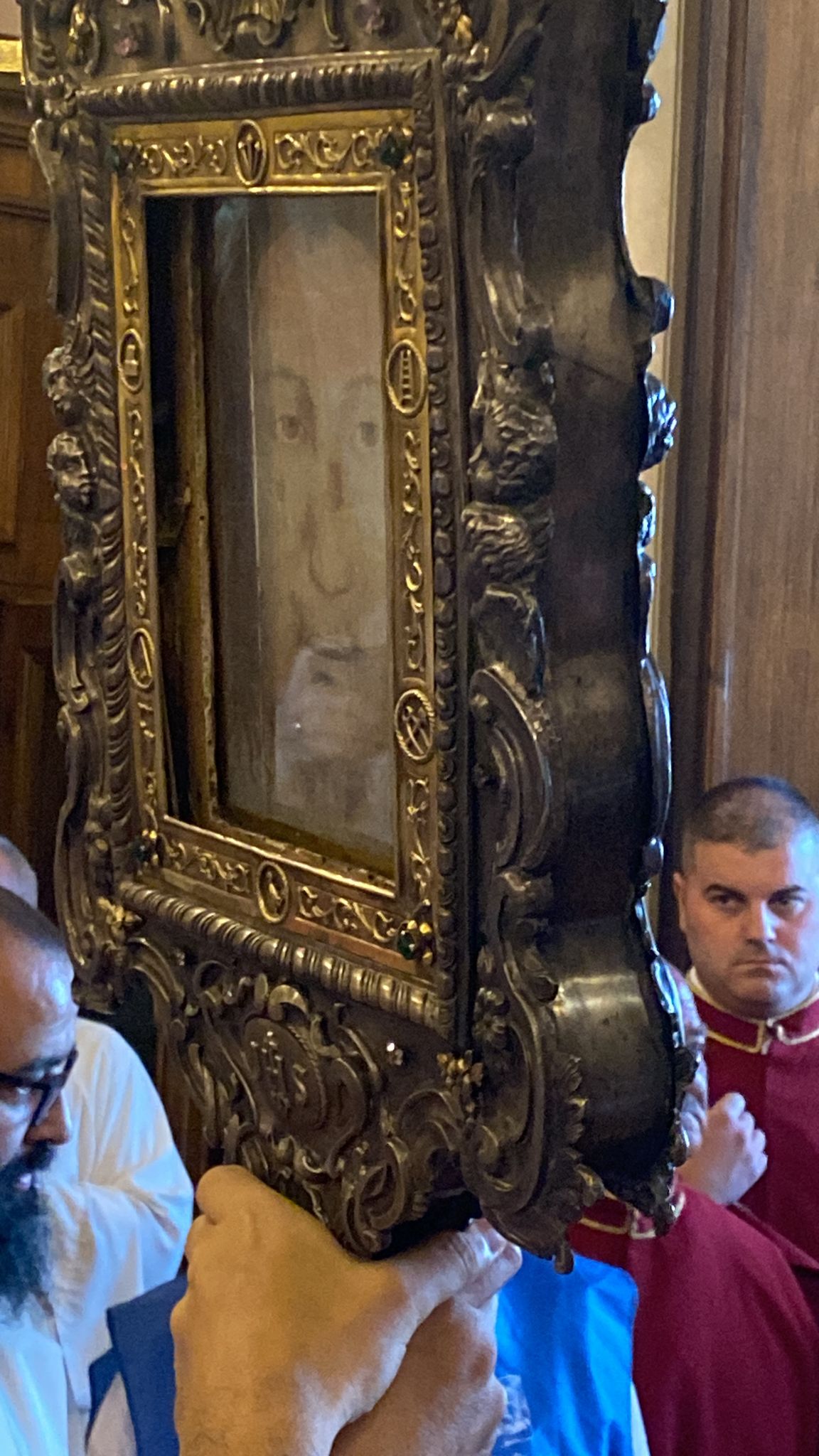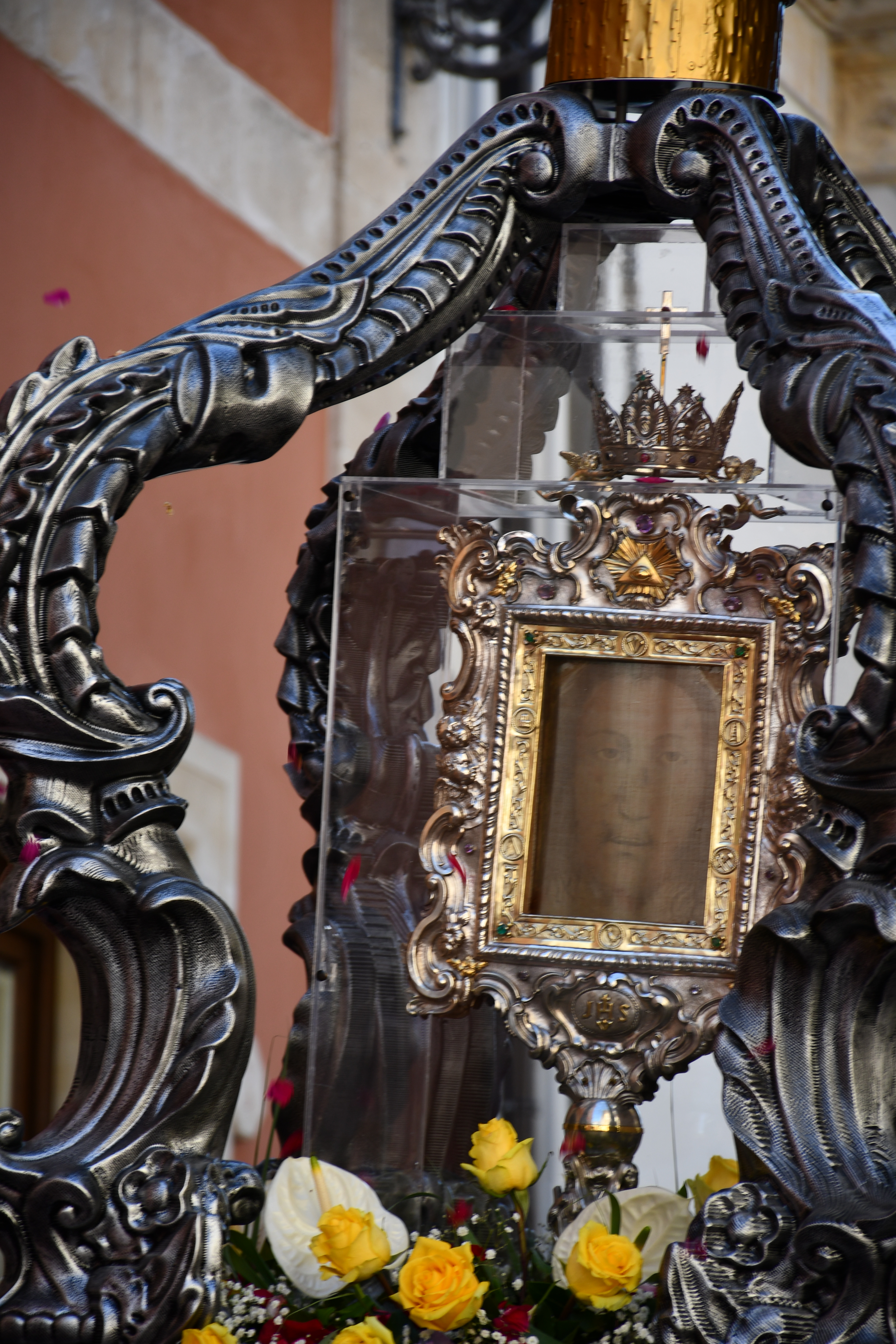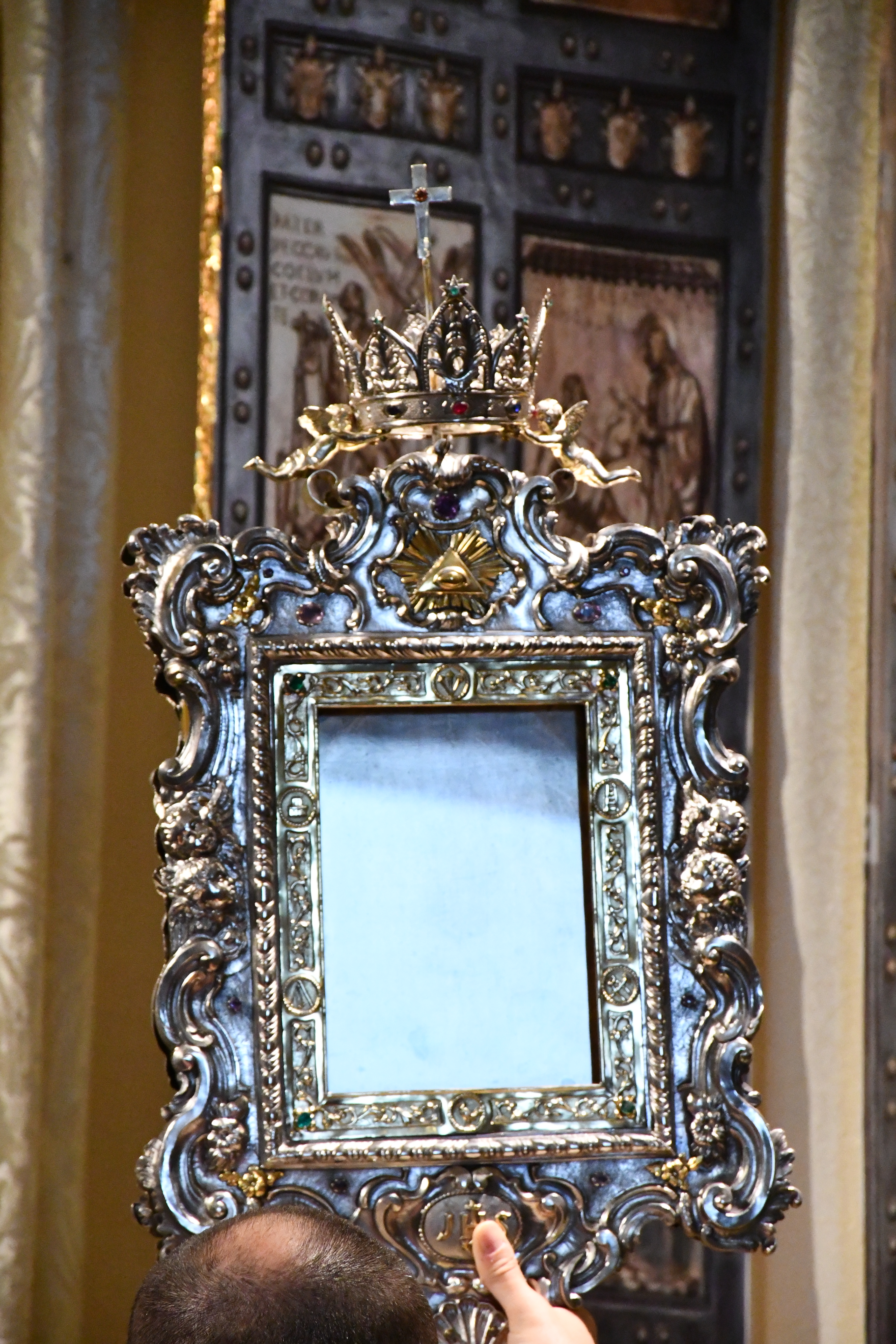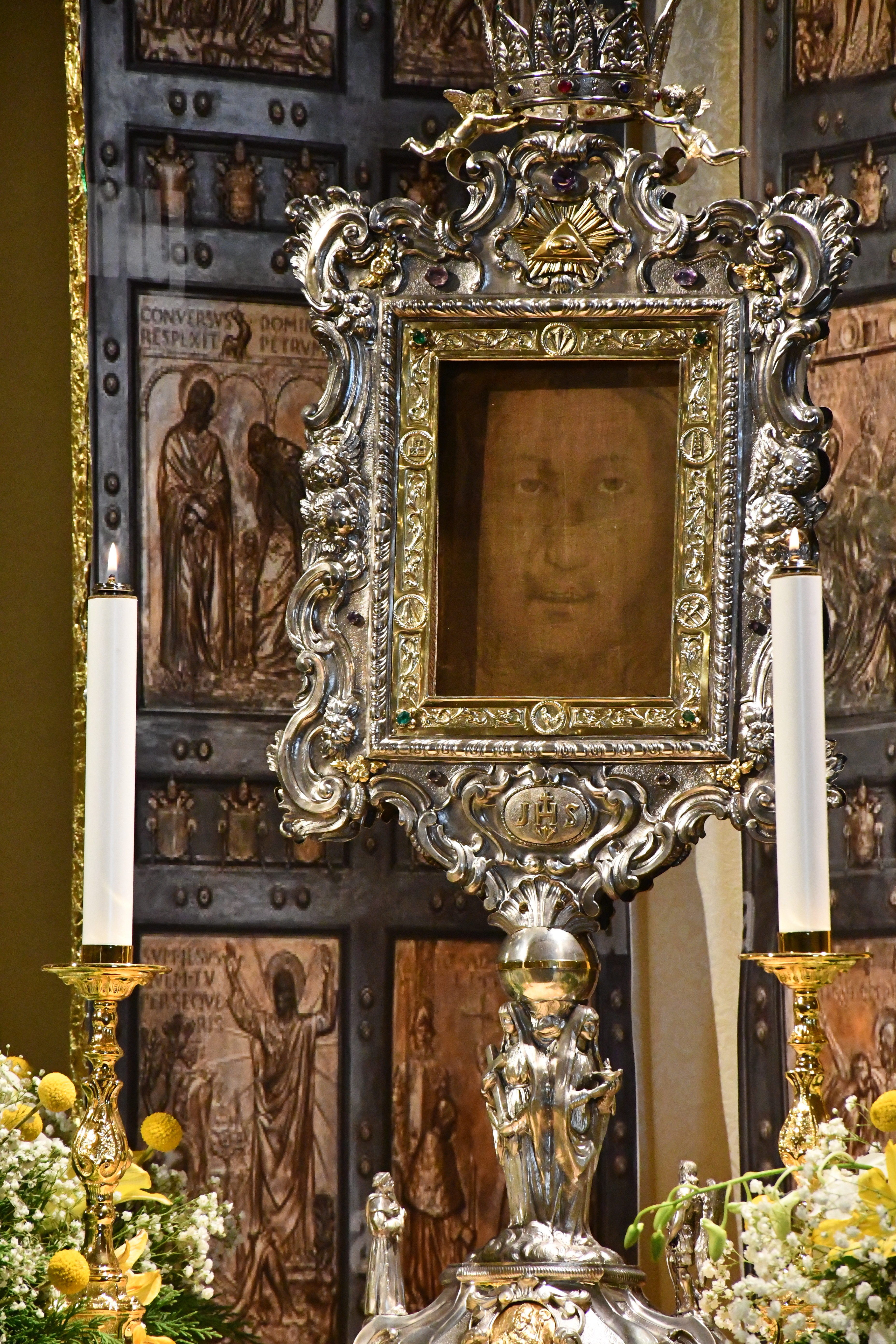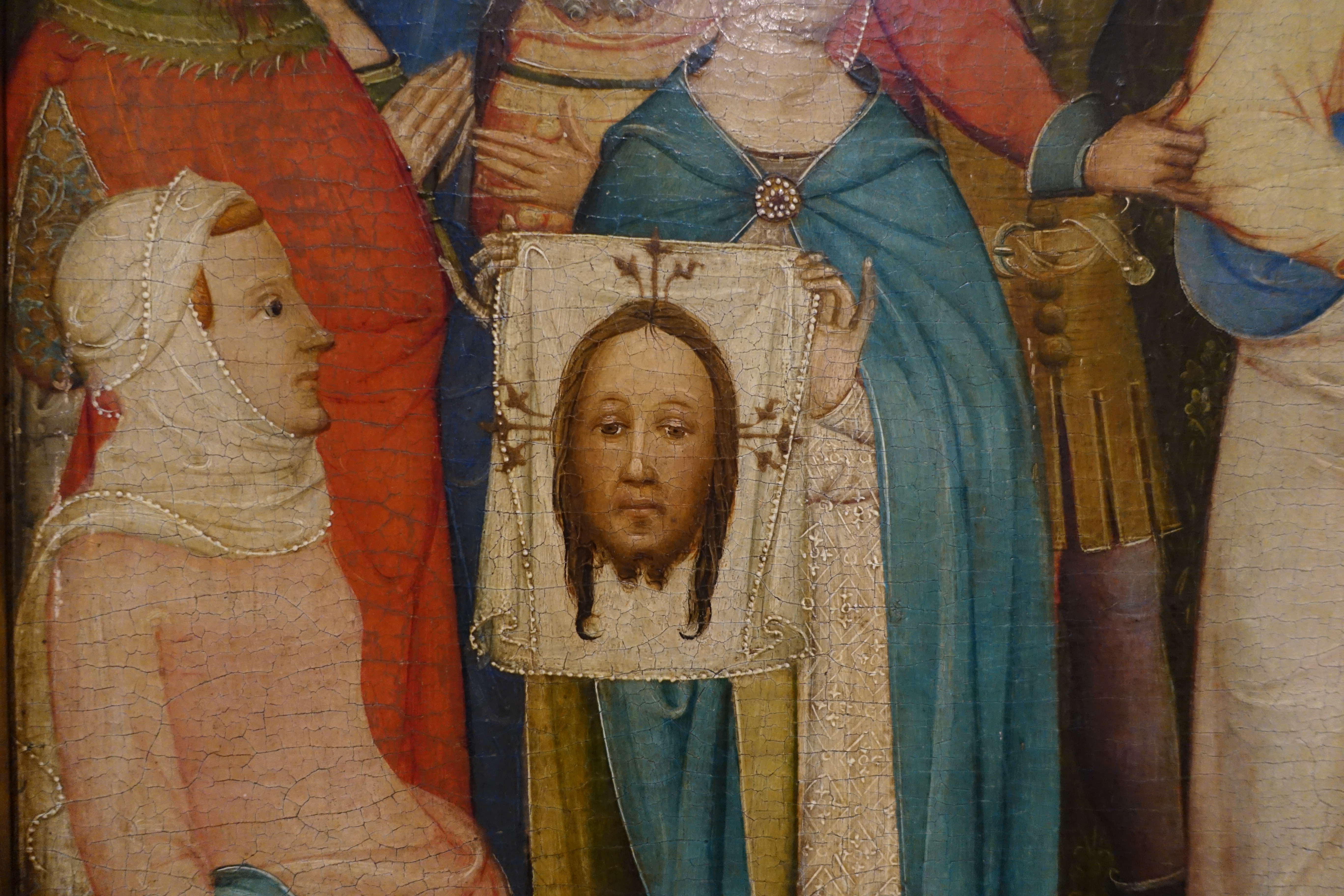
The liturgical distance between Christmas Day and the glory of the appearance of the Risen Christ on Easter are as short as a flash of lightening! The readings move swiftly from darkest night of the year, into which the light of the Face of the Infant Jesus first appears on Christmas Day, to the readings about the martyrdom of St. Stephen; his forgiveness of his murderers, and the Feast of St. John (Jn 20:1, 2 & 8) where we hear about St. John racing ahead of Peter to the tomb, where they find “the cloth that covered HIs Head;” the sight of which caused St. John “to see and believe.” Through the power of the Resurrection, God moves hearts swiftly from the darkness of sin, death, sorrow, and unbelief — to the radiant light of grace — new life, faith, joy and peace shining on the Face of the Risen Christ.
Pope Leo calls the peace of the risen Christ “the most silent revolution:” “The Good Shepherd, who gives his life for the flock and has other sheep not of this fold (John 10:11,16) is Christ, our peace,” he writes, “who has conquered death and broken down the walls of division that separate humanity (cf. Eph 2:14). His presence, his gift and his victory continue to shine through the perseverance of many witnesses through whom God’s work carries on in the world, becoming even more visible and radiant in the darkness of our time.” Peace is revolutionary, and takes tremendous courage and trust for a Christian to live as they truly believed — as did the martyrs of the past and the present — through trust in the power of the Risen Christ!
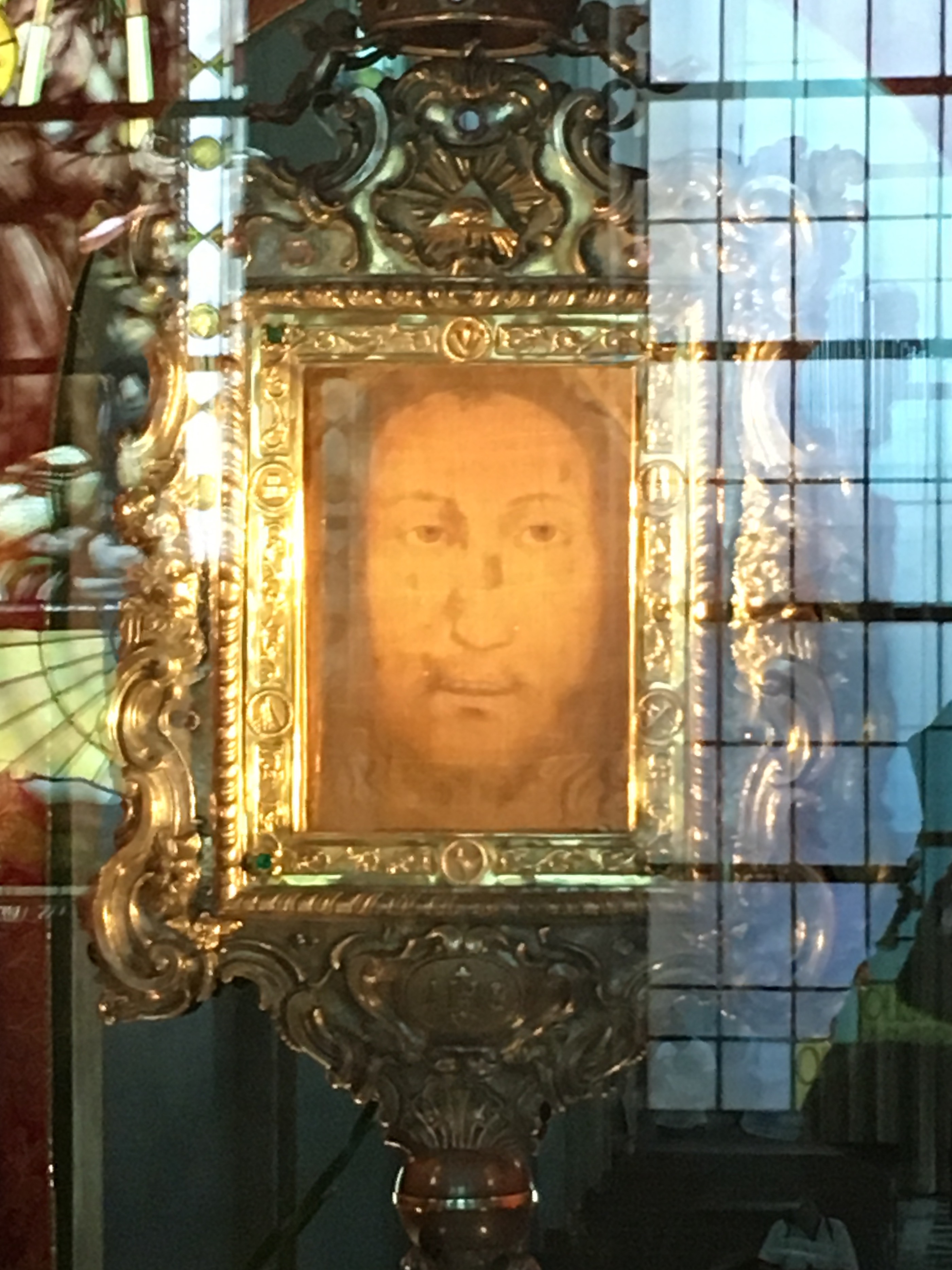
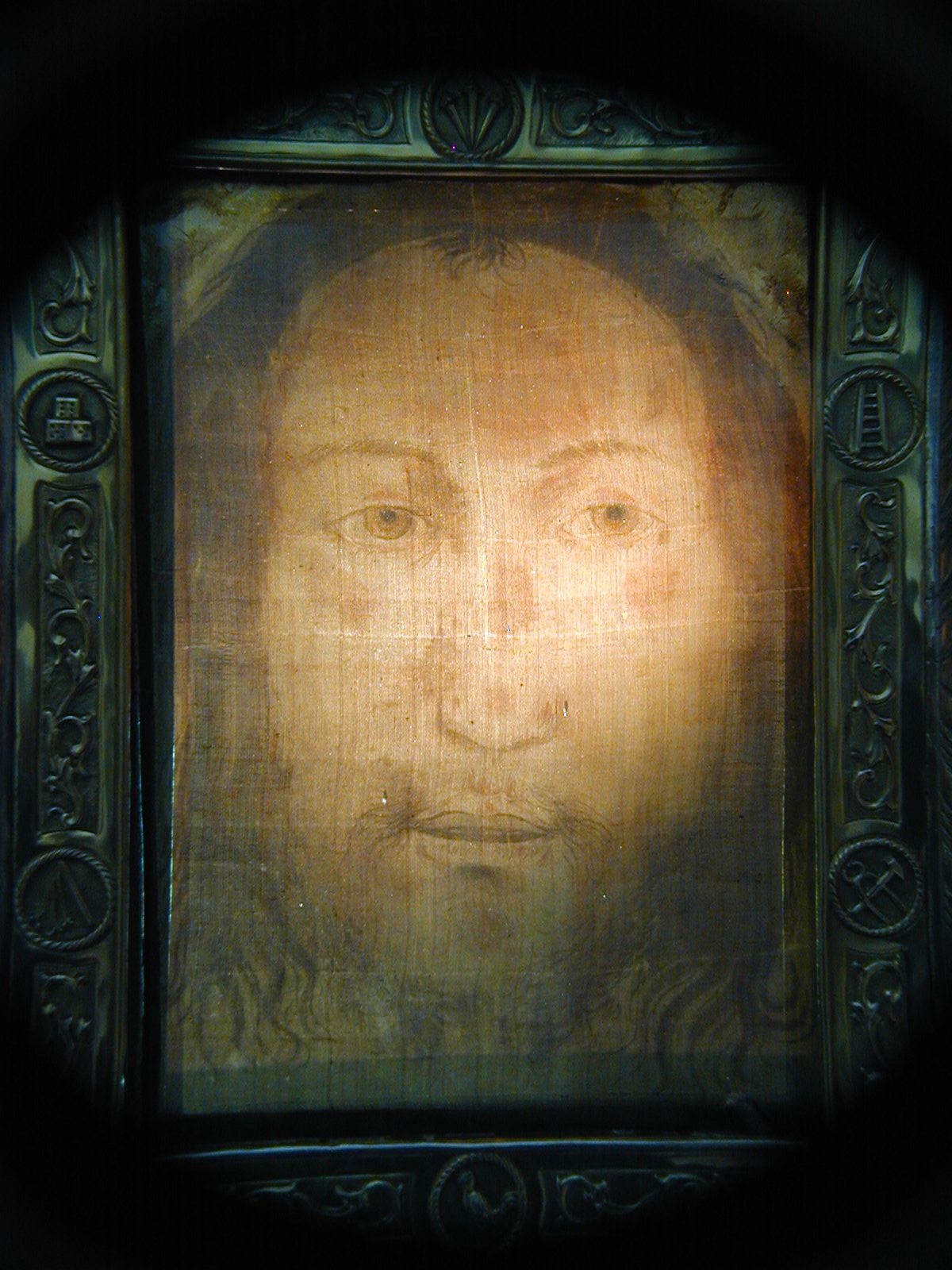
Pope Leo writes that the “contrast between darkness and light” is also “an experience that unsettles us and affects us amid trials we face in our historical circumstances. In order to overcome the darkness, it is necessary to see the light and believe in it.” We need to “see and believe” as St. John did when he saw the face of Risen Christ on the cloth; this is why I believe the Face of the Risen Christ on the Veil of Manoppello is a tangible sign for our time — a great gift to us from God! The world needs to turn to His Face once again if it desire to have peace.
We can begin by following the example of the Blessed Virgin Mary in contemplation of the Face of Jesus:
“The Virgin Mary is she who more than any other contemplated God in the human Face of Jesus. She saw Him as a newborn when, wrapped in swaddling clothes, He was placed in a manger; she saw Him when, just after His death, they took Him down from the Cross, wrapped Him in linen and placed Him in the sepulcher. Inside her was impressed the image of her martyred Son; but this image was then transfigured in the light of the Resurrection. Thus, in Mary’s heart, was carried the mystery of the Face of Christ, a mystery of death and glory. From her we can always learn how to look upon Jesus, with a gaze of love and faith, to recognize in that human countenance, the Face of God.” ~ Pope Benedict XVI
Peace is possible! When “we forget the light,” Pope Leo writes, “we lose our sense of realism and surrender to a partial distorted view of the world, disfigured by darkness and fear. ” Pope Leo recalled how St. Augustine urged Christians “to forge an unbreakable bond with peace, so that by cherishing it deeply in their hearts, they would be able to radiate its luminous warmth around them.” St. Augustine wrote: “If you wish to draw others to peace, first have it yourselves; be steadfast in peace yourselves. To inflame others, you must have the flame burning within.” Pope Leo reminds us that “Peace is more than just a goal; it is a presence and a journey.”
So, as we begin the New Year, I wish to all, and pray for “God’s greatest gift” of Peace. “Peace, wrote Pope Benedict XVI, for the World Day of Peace, 2013, “is God’s most sublime gift in which He turns towards us the splendor of His Face.”
“May the Lord bless and keep you; may He make His Face shine upon you and be merciful to you; may He turn His countenance toward you and grant you His peace.” (Numbers 6:24)
“For God, who said, ‘Let light shine out of darkness,’ made his light shine in our hearts to give us the light of knowledge of God’s glory shining on the face of Christ.” (2 Cor. 4:6)
Adoration of the Magi, Fra. Angelico & Fra. Lippi
“May the Lord, grant, in the New millennium, the Church will grow ever more in holiness, that she may become in history a true epiphany of the merciful and glorious face of Christ the Lord.” ~Pope St. John Paul II
+++
Benedict XVI has characterized devotion to The Holy Face as having three separate components: 1. Discipleship – an encounter with Jesus, to see Jesus in the Face of those in need. 2. The Passion of Jesus, and suffering expressed by images of the wounded Face of Jesus. 3. The Eucharist, “the great school in which we learn to see The Face of God”, which is woven between the other two. The eschatological element then builds on awakening to Christ by contemplating His Face hidden in The Eucharist.
“Our whole life should be directed toward encountering Him,” writes Benedict, “toward loving Him; and in it, a central place must be given to love of one’s neighbor, that love that in the light of The Crucified One, enables us to recognize the Face of Jesus in the poor, the weak, the suffering.” The pope goes on to explain the fruits of this contemplation: “From contemplation of the Face of God are born, joy, security, Peace.”
“Visible before to God alone and not to the world, God made the Word visible so that the world could be saved by seeing Him. This mind that entered our world was made known as the Son of God.”
~St. Hippolytus
“In the beginning was the Word, and the Word was with God, and the Word was God.
He was in the beginning with God. All things came to be through him,
and without him nothing came to be. What came to be through him was life,
and this life was the light of the human race; the light shines in the darkness,
and the darkness has not overcome it.
The true light, which enlightens everyone, was coming into the world.
He was in the world, and the world came to be through him, but the world did not know him.
He came to what was his own, but his own people did not accept him.
But to those who did accept him he gave power to become children of God, to those who believe in his name, who were born not by natural generation nor by human choice nor by a man’s decision but of God.
And the Word became flesh and made his dwelling among us, and we saw his glory, the glory as of the Father’s only Son, full of grace and truth.” (John 1:1-5, 9-14)
Kreuz als Krippe (Cross as a Crib), Oil on canvas, Unknown artist, 18th century (Photos: Paul Badde)
“While we too seek other signs, other wonders, we do not realize that He is the real sign, God made flesh; He is the greatest miracle of the universe: all the love of God hidden in a human heart, in a human Face.” ~ Pope Benedict XVI
+++
O that birth forever blessèd,
When the virgin, full of grace,
By the Holy Ghost conceiving,
Bore the Savior of our race;
And the Babe, the world’s Redeemer,
First revealed His sacred face,
evermore and evermore!
Merry Christmas! May His Face shine upon you and your loved ones, today and always!
“Thou art all fair, my love, there is no spot in thee.” (Song of Solomon 4:7)
“From the greatness and beauty of created things comes a corresponding perception of their Creator,” “for the author of beauty created them.” (Wisdom 13: 3, 5)
The spiritual beauty of God is reflected most perfectly in the woman He created to be His Mother. No stain of sin would mar the beauty of His reflection in her soul. Never for one instant would she be under the power of the devil. “The Blessed Virgin Mary, in the first instance of her conception, by a singular grace and privilege granted by Almighty God, in view of the merits of Jesus Christ, the Savior of the human race, was preserved free from all stain of original sin.” (Dogma of the Immaculate Conception) Mary herself proclaims, “My spirit has rejoiced in God my Savior.” (Luke 1:47)
As the Immaculate Conception, Mary bears in herself the most perfect reflection of the face of God. Pope St. John Paul II wrote, “The Blessed Virgin saw shining upon her, as no other creature, the face of the Father, rich in grace and mercy.” What in Heaven and on earth could be more beautiful than the Mother of God? It is God who has willed that Mary be beautiful, not only fair in face, but in the fullness of grace. Yet, beauty has a purpose, and that is to draw us by the beauty of the graces God has given her towards the Beatific Vision–the Face of God. Mary has no greater desire than that we turn towards the Face of her Son, as she does, with eyes of love.
Strangely, there are some who see the Blessed Mother not as a gift from God who leads us to her Son, but as an obstacle. We increasingly see acts of vandalism to statues and images of the Blessed Virgin Mary–the demons fear her beauty! They want to separate the Mother from the Son, even resorting to violence of smashing statues and slashing paintings of her, mistakenly thinking that somehow this could be pleasing to God, but it is only pleasing to the devil. It is blasphemy. When we separate ourselves from Mary, we separate ourselves from Christ. In The Everlasting Man G.K. Chesterton tells a story from his childhood, many years before he became a Catholic, which left a deep impression on his soul:
“When I was a boy a more Puritan generation objected to a statue upon my parish church representing the Virgin and Child. After much controversy, they compromised by taking away the Child. One would think that this was even more corrupted with Mariolatry, unless the mother was counted less dangerous when deprived of a sort of weapon. But the practical difficulty is also a parable. You cannot chip away the statue of a mother from all round that of a newborn child. You cannot suspend the new-born child in mid-air; indeed you cannot really have a statue of a newborn child at all. Similarly, you cannot suspend the idea of a newborn child in the void or think of him without thinking of his mother. You cannot visit the child without visiting the mother, you cannot in common human life approach the child except through the mother. If we are to think of Christ in this aspect at all, the other idea follows I as it is followed in history. We must either leave Christ out of Christmas, or Christmas out of Christ, or we must admit, if only as we admit it in an old picture, that those holy heads are too near together for the haloes not to mingle and cross.”
Jesus alone is “the Way” that leads to the Father, but Mary is the most beautiful image and likeness of Christ, which will lead us to Him. Dostoevsky once said that “Beauty will save the world!” Mary has a spiritual beauty to share with the world that attracts and expresses what is beyond words, in the depths of her heart, the love of a mother for her Savior and Son.
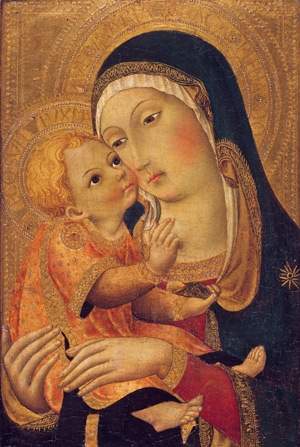
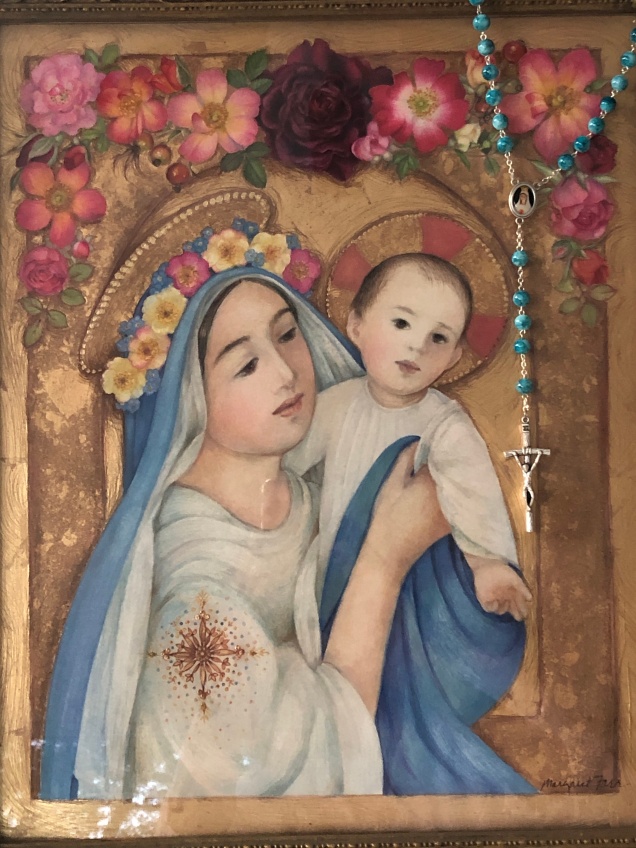
“Our Lady, in whose face – more than any other creature – we can recognize the features of the Incarnate Word.” –Pope Benedict XVI Madonna and Child from the Robert Lehman Collection, Metropolitan Museum of Art
A Little Litany by G.K.Chesterton
When God turned back eternity and was young, Ancient of Days, grown little for your mirth (As under the low arch the land is bright) Peered through you, gate of heaven – and saw the earth.
Or shutting out his shining skies awhile Built you about him for a house of gold To see in pictured walls his storied world Return upon him as a tale is told.
Or found his mirror there; the only glass That would not break with that unbearable light Till in a corner of the high dark house God looked on God, as ghosts meet in the night.
Star of his morning; that unfallen star In the strange starry overturn of space When earth and sky changed places for an hour And heaven looked upwards in a human face.
Or young on your strong knees and lifted up Wisdom cried out, whose voice is in the street, And more than twilight of twiformed cherubim Made of his throne indeed a mercy-seat.
Or risen from play at your pale raiment’s hem God, grown adventurous from all time’s repose, Of your tall body climbed the ivory tower And kissed upon your mouth the mystic rose.
Miraculous Image of Our Lady of Guadalupe “I am your merciful Mother.”
“Look Closely – Our Lady of Guadalupe – Not Made by Human Hands” click here.
Basilica of Il Volto Santo in Manoppello, Italy. (Photo:Paul Badde/EWTN)
St. Anselm wrote about the desire of every human soul created in the image and likeness of God; the desire to see God’s Face, especially in the midst of hectic days leading up to Christmas. It is a beautiful reflection for Advent, reminding us to pause often to seek God’s Face.
From the “Prosologian” — the words of St. Anselm, Bishop:
“Insignificant man, escape from your everyday business for a short while, hide for a moment from your restless thoughts. Break off from your cares and troubles and be less concerned about your tasks and labors. Make a little time for God and rest a while in him.
Enter into your mind’s inner chamber. Shut out everything but God and whatever helps you to seek him; and when you have shut the door, look for him. Speak now to God and say with your whole heart: I seek your face; your face, Lord, I desire.
Lord, my God, teach my heart where and how to seek you, where and how to find you. Lord, if you are not here where shall I look for you in your absence? Yet if you are everywhere, why do I not see you when you are present? But surely you dwell in ‘light inaccessible.’ And where is ‘light inaccessible? How shall I approach light inaccessible? Or who will lead me and bring me into it that I may see you there? And then, by what forms shall I seek you? I have never seen you, Lord my God; I do not know your face.
Lord most high, what shall this exile do, so far from you? What shall your servant do, tormented by love of you and cast so far from your face? He yearns to see you, and your face is too far from him. He desires to approach you, and your dwelling is unapproachable. He longs to find you, and does not know your dwelling place. He strives to look for you, and does not know your face.
Lord, you are my God and you are my Lord, and I have never seen you. You have made me, and remade me, and you have given me all the good things I possess and still I do not know you. I was made in order to see you, and I have not yet done that for which I was made.
Lord, how long will it be? How long, Lord, will you forget us? How long will you turn your face away from us? When will you look upon us and hear us? When will you enlighten our eyes and show us your face? When will you give yourself back to us?
Look upon us, Lord, hear us and enlighten us, show us your very self. Restore yourself to us that it may go well with us whose life is so evil without you. Take pity on our efforts and our striving toward you, for we have no strength apart from you.
Teach me to seek you, and when I seek you show yourself to me, for I cannot seek you unless you teach me, nor can I find you unless you show yourself to me. Let me seek you in desiring you and desire you in seeking you, find you in loving you and love you in finding you.”
“Make a little time for God.” Blessed Sacrament Chapel in the Loreto Shrine. (Photo: Patricia Enk)
Fr. Daren Zehnle, a 47-year old Roman Catholic priest from the Diocese of Springfield, Illinois, passed away on November 27th after suffering a stroke. He was born on March 26, 1978, in Quincy, Illinois. His short life was marked by profound loss–he was a twin, but had lost his brother Matthew shortly after birth. By the age of ten he had already lost both his parents; his father, Bill, at eight, and his mother, Pat, at the age of ten to brain cancer. Fr. Zehnle found solace in his faith, “It might seem strange to say that my parents’ death led me to God, but they did, I realized somehow that I needed to draw close to — and stay close –to God. I felt safe, at peace, and comforted when I prayed.” Fr. Daren was ordained a priest on May 28, 2005, by Bishop George J. Lucas.
Relic Veil of the Holy Face in Manoppello, Italy (Photo: Patricia Enk)
Fr. Daren Zehnle at the altar. (sent by Antonio Bini)
Fr. Zehnle had a deep love and devotion to the Holy Face of Manoppello in Italy, which he wrote about often on his “Servant and Steward” blog. (link is to a conference talk, in which he gave a beautiful reflection, on the Face of Mercy–the Holy Face of Manoppello.) It was through a shared devotion of the Holy Face that I was fortunate enough to get to know him while he was pursuing a Licentiate in Canon Law from the Pontifical Gregorian University in Rome. He went on to hold various positions, including Parochial Vicar at St. Anthony of Padua Parish. Pastor of Sacred Heart Parish, and director of campus ministry at Quincy University. Fr. Daren also had a very special devotion to Venerable Augustus Tolton, and St. Damien of Molokai. He was known as an extraordinary priest, and a faithful and good shepherd, and will be very missed by all who knew him. In an interview with “Catholic Times” last year, when asked what he would say to his loved ones when he meets them in heaven, he replied with moving simplicity: “I expect they will say to me what I will probably say to them, “I’ve missed you.”
Eternal rest grant unto him, O Lord, and let perpetual light shine upon him. Through the mercy of God, may he Rest In Peace. Amen.
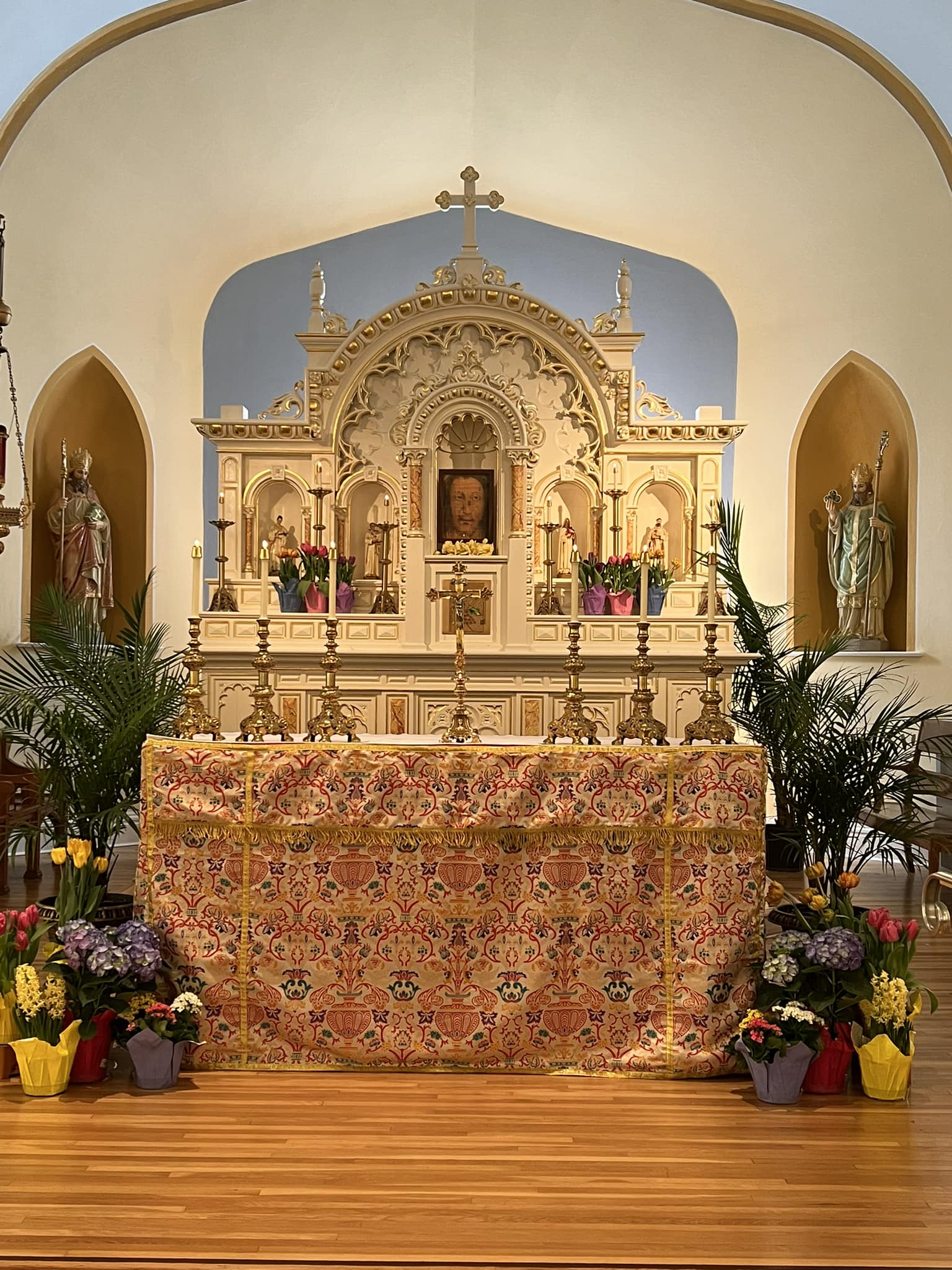
Fr. Zehnle sent Antonio Bini this photo as well. Antonio had met Fr. Zehnle many times when he visited The Basilica Shrine of the Holy Face in Manoppello–he remembers him as “Always smiling, positive, and deeply devoted to the Holy Face, which he enthroned on April 9, 2023, Easter Sunday, in St. Augustine Church in Ashland, Illinois, where he was a parish priest.
“Now faith is the assurance that what we hope for will come about and the certainty that what we cannot see exists.” (Heb. 11:1)
The Holy Face of Jesus Christ–the Beatific Vision–is at the center of the Angelic Worship.
Devotion to the Holy Face of Christ is a sign of hope for the world.
Although the world seems a hopeless mess, the Jubilee Year of Hope reminds us that there is indeed many reasons to hope. We can hope for eternal life with God in Heaven–to one day see Him face to face. “Hope is the confident expectations of divine blessing and the beatific vision of God; it is also the fear of offending God and incurring His punishment.” (CCC 2090) Hebrews 11:1 states: “…what we hope for can come about,” and we can also be certain that what we cannot see exists.”
Humanity is in the midst of a battle for souls, but those who follow Christ–God’s “little ones”–can be certain in the hope that they are also being defended and fought for by the Angels and Saints. But the greatest aid that falls within their own power is the devotion to the Face of Jesus Christ as characterized by Pope Benedict XVI:
1. Discipleship – an encounter with Jesus, to see Jesus in the Face of those in need. 2. The Passion of Jesus, and suffering expressed by images of the wounded Face of Jesus. 3. The Eucharist, “the great school in which we learn to see The Face of God”, which is woven between the other two. The eschatological element then builds on awakening to Christ by contemplating His Face hidden in The Eucharist.
Pope Benedict XVI contemplates the Face on the Veil of Manoppello. September 1, 2006. (Photo: Paul Badde/EWTN)
“Our whole life should be directed toward encountering Him,” writes Benedict, “toward loving Him; and in it, a central place must be given to love of one’s neighbor, that love that in the light of The Crucified One, enables us to recognize the Face of Jesus in the poor, the weak, the suffering.” The pope goes on to explain the fruits of this contemplation: “From contemplation of the Face of God are born, joy, security, Peace.”
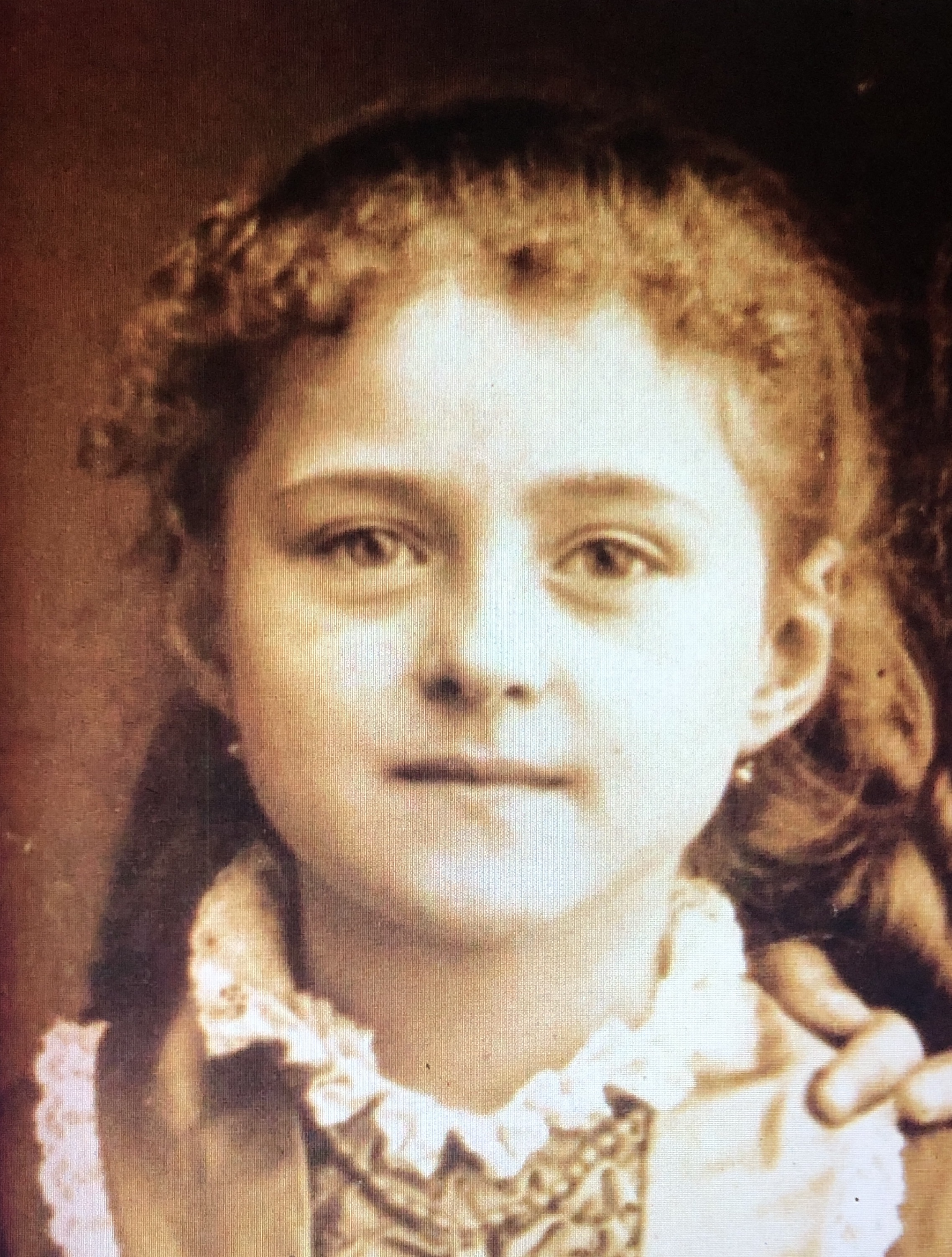
St. Therese of the Child Jesus and the Holy Face, Doctor of the Church, teaches us the “Little Way” of child-like confidence in God.
To be one of God’s “little ones” is to be the greatest in His Kingdom; requiring child-like confidence, humility and trust in God’s all-mighty power, mercy, and love. In the Gospel of Matthew we read: “Who is the greatest in the kingdom of heaven?” He called a child over, placed it in their midst, and said, “Amen I say to you, unless you turn and become like children, you will not enter the kingdom of heaven. Whoever humbles himself like this child is the greatest in the kingdom of heaven. and whoever receives one child such as this in my name receives me. Whoever causes one of these little ones who believe in me to sin, it would be better for him to have a great millstone hung around his neck and to be drowned in the depths of the sea… See that you do not despise one of the little ones, for I say to you that their angels in heaven always look upon the face of my heavenly Father.” (Mt. 18:2-7, 10)
The Holy Angels have worshipped and served Christ from the Incarnation to the Resurrection, and when He comes again, they will announce the Last Judgement. “With their whole beings the angels are servants and messengers of God. They ‘always behold the Face of my Father who is in heaven (Mt. 18:10) ‘they are the mighty ones who do his word, ‘hearkening to the voice of His word.(Ps 103:20)'” (CCC 329)
“When the dragon saw that it had been thrown down to each, it pursued the woman who had given birth to a male child.” (Rev. 12:13)
“Then war broke out in heaven; Michael and his angels battled against the dragon. Although the dragon and his angels fought back, they were overpowered and lost their place in heaven. The huge dragon, the ancient serpent known as the devil or Satan, the seducer of the whole world, was driven out; he was hurled down to earth and his minions with him” (Rev. 12)
“Who is like God!” St. Michael, holds before us the Holy Face of Jesus. (Sculpture by Cody Swanson, Old St. Patrick’s New Orleans. photo: Patricia Enk)
The center of this battle raging between Angels and demons –in heaven and on earth — is the Incarnate Word of God made flesh, Jesus Christ. It is Jesus–in His “little ones”–who is rejected, reviled and persecuted. The devil, who knows his time is short, wants to obliterate the Face of God, not only in churches that have vandalized and desecrated, but in the souls of human beings. The battle lines have been drawn between the culture of life and the culture of death–especially of the littlest and weakest among us. The devil’s particular object of hatred is the woman and the unborn. Some can no longer recognize that a child in the womb is a human being. Many persons reject their God-given identity as male and female. Racial hatred is causing deeper and deeper division, and human trafficking increases as humanity is blinded to the Face of God in their neighbor made in His image and likeness. Now Ai presents new threats to humanity, reducing a human person to a number; an algorithm.
The Holy Angels and the Saints point us to contemplation of the Face of Christ as a sign of hope for the world. Like the Holy Angels we should keep our eyes fixed on the Face of God in worship; Like St. Therese, and all the Saints, we need to become like a little child, who despite the darkness, surrenders to the crosses of life, and seeks the Face of God in humility and trust. We must also be like a “Veronica,” that is “a true image” of the Face of Jesus in our charity and compassion for others. Of course, the best example is set by Our Blessed Mother, who always looked at the Holy Face of her Son through the veil of faith; “Blessed is she who believed” in hope “that what was spoken to her by the Lord would be fulfilled!” (Luke 1:45) “To recite the Rosary is nothing other than to contemplate with Mary the Face of Christ.” (Rosarium Virginis Mariae)
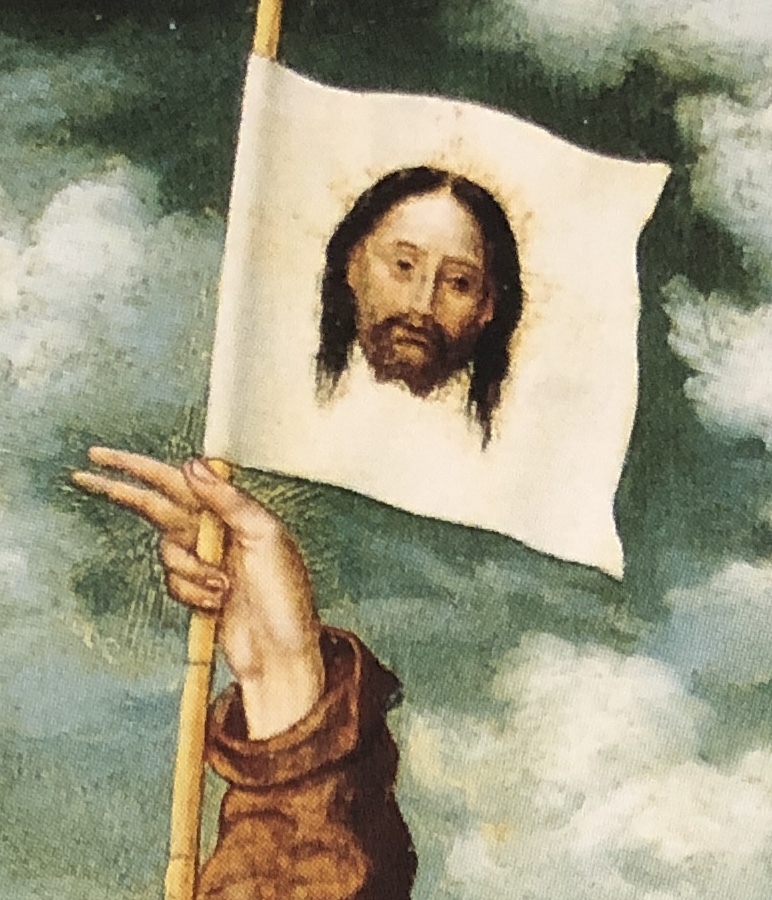
The Face of the Risen Christ is the banner of victory over sin and death!
“Then I heard a loud voice in heaven say: ‘Now have salvation and power come, the reign of our God and the authority of his Anointed One. For the accuser of our brothers is cast out, who night and day accused then before our God. They defeated him by the blood of the Lamb and by the word of their testimony; love for life did not deter them from death. So rejoice, you heavens, and you the dwell therein! But woe to you, earth and sea, for the devil has come down upon you! His fury knows no limits, for he knows his time is short’ (Rev 12).”
St. Michael Prayer — St. Michael, the Archangel, defend us in battle. Be our protection against the wickedness and snares of the Devil. May God rebuke him, we humbly pray, and do thou, O Prince of the heavenly hosts, by the power of God, thrust into hell Satan, and all the evil spirits, who prowl about the world seeking the ruin of souls. Amen.
Prayer to Our Lady of the Angels, who, by her great humility, crushed the head of Satan:
Sublime Queen of Heaven, exalted Lady of the Angels, you have the power and commission given by God to crush the head of Satan. Therefore, we humbly beseech you to send to our aid your heavenly legions, so that, under your command and by your power, they may pursue the hellish spirits, fight them everywhere, ward off their impudent attacks, and fling them back into the abyss. Who is like God? You holy angels and archangels, defend and protect us. Good, kind mother, you remain always our love and our hope! Mother of God, send us the holy angels to defend us and keep the evil one far from us. Amen.
Each year, the Feast of the Transfiguration, is marked by prayer, vigils and processions in honor of the Holy Face of Jesus. On this feast day St. Therese would toss roses and sprinkle perfume on the drawing of the Holy Face of Jesus that was so dear to her heart. At the Basilica Shrine of the Holy Face in Manoppello, Italy, local residents and pilgrims from all over the world take part in the joyous festivities in honor of the Holy Face. This year includes World Youth Day pilgrims! (Thank you to Alexandra Prandell for the video and photos!) (Enjoy as well, a few pictures from past celebrations below!) Wherever you may be on this holy feast day; come before His Holy Face–by entering into His Holy Presence in prayer–so together with the whole body of Christ, in Heaven and on earth, we may say, “Lord, it is good to be here.”
World Youth Day Pilgrims gather at the Basilica Shrine of “Il Volto Santo” The relic Veil of the Holy Face in Manoppello, Italy. (Photo: Alexandra Prandell)
Basilica Shrine of the Holy Face in the Abruzzo Mountains, Manoppello, Italy (Photo: Alexandra Prandell)
“It is good, Lord, to be here” before your Holy Face! (Photo: Alexandra Prandell)
“Jesus took with him Peter, James and John, and led them up a high mountain where they were alone. There, before their eyes, he was transfigured. His face shone like the sun, and his clothes became as white as light. Then the disciples saw Moses and Elijah appear, and they were talking to Jesus.”
~Matthew 17:2
Rays of light burst through the clouds above the Abruzzo Mountains. (2022 Photo: Paul Badde)
The following is a very beautiful sermon, by Bishop Anastasias of Sinai, on the Transfiguration of the Lord:
“Upon Mount Tabor, Jesus revealed to his disciples a heavenly mystery. While living among them he had spoken of the kingdom and of his second coming in glory, but to banish from their hearts any possible doubt concerning the kingdom and to confirm their faith in what lay in the future by its prefiguration in the present, he gave them on Mount Tabor a wonderful vision of his glory, a foreshadowing of the kingdom of heaven. It was as if he said to them: ‘As time goes by you may be in danger of losing your faith. To save you from this I tell you now that some standing here listening to me will not taste death until they have seen the Son of Man coming in the glory of his Father…'”
Along the Transfiguration Vigil Procession (Photo: Paul Badde)
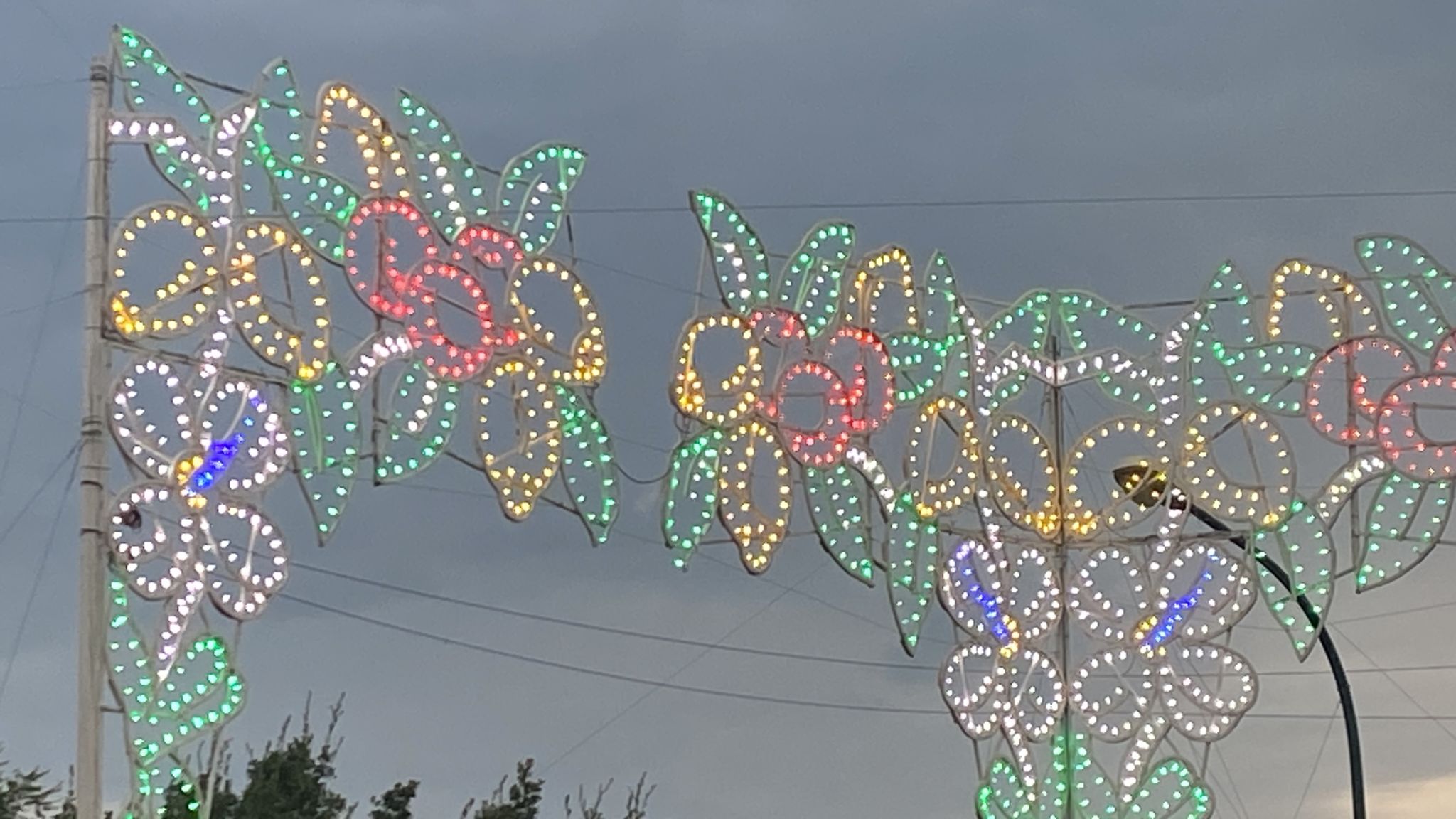
Colorful lights line the streets of Manoppello, Italy in preparation for the Vigil and Procession for the Feast of the Transfiguration. (Photo: 2023 Paul Badde)
The Manoppello Veil “as white as light,” yet the face on the sheer veil can still be faintly seen. (Photo: Paul Badde)
(The Holy Veil of Manoppello is an Achieropoeta–a supernatural image made by the Hand of God–that is present on a sheer veil, without the aid of paint, and may be viewed from both sides. The Face of Jesus becomes visible to the viewer according to the light. The relic Veil of the Holy Face has recently been proven to radiate light energy.)
Holy Face–eyes always looking toward the viewer–on the Veil of Manoppello. (Photo: Paul Badde)
Holy Face seen in candlelight (2023 Photo: Paul Badde)
Transfiguration by Carl Bloch
Continuing from the sermon on the Transfiguration of the Lord by Anastasius of Sinai, Bishop:
“These are the divine wonders we celebrate today; this is the saving revelation given us upon the mountain; this is the festival of Christ that has drawn us here. Let us listen, then, to the sacred voice of God so compellingly calling us from on high, from the summit of the mountain, so that with the Lord’s chosen disciples we may penetrate the deep meaning of these holy mysteries, so far beyond our capacity to express. Jesus goes before us to show us the way, both up the mountain and into heaven, and–I speak boldly–it is for us now to follow him with all speed, yearning for the heavenly vision that will give us a share in his radiance, renew our spiritual nature and transform us into his own likeness making us for ever sharers in his Godhead and raising us to heights as yet undreamed of.
Let us run with confidence and joy to enter into the cloud like Moses and Elijah, or like James and John. Let us be caught up like Peter to behold the divine vision and to be transfigured by that glorious transfiguration. Let us retire from the world, stand aloof from the earth, rise above the body, detach ourselves from creatures and run to the creator, to who Peter in ecstasy exclaimed: Lord, it is good for us to be here–here where all things shine with divine radiance, where there is joy and gladness and exultation; where there is nothing in our hearts but peace, serenity, stillness; where God is seen.”
Rector Padre Antonio Gentili (Photo: Alexandra Prandell)
“For here, in our hearts, Christ takes up his abode together with the Father, saying as he enters: Today salvation has come to this house. With Christ, our hearts receive all the wealth of his eternal blessings, and there where they are stored up for us in him, we see reflected as in a mirror both the first fruits and the whole of the world to come.”
“Il Volto Santo” of Manoppello, Italy (2023 Photo: Paul Badde)
All the mysteries of Jesus Christ, true God and true Man, are hidden and yet revealed in the transfigured Face of Jesus on the mountaintop. Jesus Christ unveils for us in this mystery the Paschal journey that He would suffer, and the glory that is already within Him. He invites us to follow Him, in taking up our own crosses in faith, hope and love. In order to see God the Father in His Glory–we must first pass through the door of the Holy Face of Jesus Christ, in imitation of Him–It is the only way to be transformed by the Holy Spirit of Love into His Image–to purify our eyes to see the glory of the Father in Heaven.
As we read in Scripture: “… He [Jesus] took along Peter John, and James, and went up on the mountain to pray. And while He was praying, the appearance of His face became different, and His clothes became white and gleaming. And behold, two men were talking with Him; and they were Moses and Elijah, who, appearing in glory, were speaking of His departure, which He was about to accomplish [through His Passion and Death] at Jerusalem.” (Luke 9:28-31) The light that shone from His Holy Face at the Transfiguration gives us hope in the glory of the Resurrection.
“For God who said, ‘Let light shine out of darkness,’ has shone into our hearts to bring the knowledge of the glory of God on the face of Christ.” (2 Cor. 4:6) As we follow Christ in carrying our crosses we will be transformed by the Holy Spirit into His Image, from glory unto even greater glory. “All of us, gazing with unveiled face on the glory of the Lord, are being transformed into the same image from glory to glory, as from the Lord who is the Spirit.” (2 Cor. 3:18)
Holy Face Relic of Manoppello, believed to the Face Cloth of the Resurrection. “At present we see indistinctly, as in a mirror, but then face to face. At present I know partially; then I shall know fully as I am known. So faith, hope, love remain, these three; but the greatest of these is love.” (1 Cor. 13: 12-13)
“O Beloved Face of Jesus! As we await the everlasting day when we contemplate Your infinite Glory our one desire is to charm Your Divine Eyes by hiding our faces too, so that here on earth no one can recognize us. O Jesus! Your veiled gaze is our heaven!”–St. Therese
Holy Veil of Manoppello (May 2025 Photo: Alexandra Prandell)
Procession of August 6th begins…(Photo: Alexandra Prandell)
(Photo: Alexandra Prandell)
Rector of and Basilica Shrine Padre Antonio Gentili carries the precious reliquary. (Photo: Alexandra Prandell)
Remarkable photo by Alexandra Prandell–the Face on the Holy Veil may be seen, but at the same time what it behind it may be seen as well.
In this photo by Alexandra Prandell, the image on the Veil has disappeared according to the angle of the viewer and the light.
(Photo: Alexandra Prandell)
The Veil of the Holy Face, “Il Volto Santo” of Manoppello, Italy. (Photo: Alexandra Prandell)
Holy Face Veil of Manoppello, Photo: Paul Badde/EWTN
“…and if my people, upon whom my name has been pronounced, humble themselves and pray, and seek My Face and turn from their evil ways, I will hear them from Heaven and pardon their sins and revive their land.” (2 Chr. 7:4)
Psalm 27
27 The Lord is my light and my salvation; whom shall I fear? the Lord is the strength of my life; of whom shall I be afraid?
2 When the wicked, even mine enemies and my foes, came upon me to eat up my flesh, they stumbled and fell.
3 Though an host should encamp against me, my heart shall not fear: though war should rise against me, in this will I be confident.
4 One thing have I desired of the Lord, that will I seek after; that I may dwell in the house of the Lord all the days of my life, to behold the beauty of the Lord, and to enquire in his temple.
5 For in the time of trouble he shall hide me in his pavilion: in the secret of his tabernacle shall he hide me; he shall set me up upon a rock.
6 And now shall mine head be lifted up above mine enemies round about me: therefore will I offer in his tabernacle sacrifices of joy; I will sing, yea, I will sing praises unto the Lord.
7 Hear, O Lord, when I cry with my voice: have mercy also upon me, and answer me.
8 When thou saidst, Seek ye my face; my heart said unto thee, Thy face, Lord, will I seek.
9 Hide not thy face far from me; put not thy servant away in anger: thou hast been my help; leave me not, neither forsake me, O God of my salvation.
10 When my father and my mother forsake me, then the Lord will take me up.
11 Teach me thy way, O Lord, and lead me in a plain path, because of mine enemies.
12 Deliver me not over unto the will of mine enemies: for false witnesses are risen up against me, and such as breathe out cruelty.
13 I had fainted, unless I had believed to see the goodness of the Lord in the land of the living.
14 Wait on the Lord: be of good courage, and he shall strengthen thine heart: wait, I say, on the Lord.
” I am giving you a new commandment, that you love one another’ just as I have loved you, that you also love one another.” (John !#:34) The Holy Face from the Shroud of Turin
The Creation of Adam by Michelangelo, in the Sistine Chapel
What does it mean to be human, and why does it matter? The understanding of the human person has tremendous consequences for the world, which can lead humanity to–or away from–the Face of God, because “it is only in God that man has meaning.” (Gaudium et Spes)
The newly elected Pope Leo XIV, when first meeting with the college of cardinals, mentioned serious challenges to human dignity, in particular, regarding “developments in the field of artificial intelligence:”(Read also: Pope Leo XIV to Cardinals: Church must respond to digital revolution ) This poses many questions: What are the “serious challenges” mentioned? What should our response be to this rapidly developing technology and its misuse? What exactly is “artificial intelligence,” and what does it mean to be a “human person?” And what does all this have to do with the Face of God?
Holy Face of Manoppello, an “achieropoieta” — made by the Hand of God. (Photo: Paul Badde)
Pope St. John Paul II dedicated the millennium to the Face of God. And it is my own belief that devotion to the Face of Christ, *as studied and characterized by Card. Ratzinger (Pope Benedict XVI) at the request of Pope St. John Paul II, is the answer to a rapidly approaching crisis that will soon face all humanity. God bless Pope Leo XIV, who has now brought the Church’s concerns about AI and human dignity to the forefront at the beginning of his pontificate.
Several news items that are related to artificial intelligence have caught my attention this past year: One was regarding an Apple advertisement for their new iPad which depicted crushing various instruments of human creativity, such as art objects and musical instruments, implying that the new iPad would take the place of human creativity, and unceremoniously dump it all in the ash heap of human history. The others were related to the “deep fakes” emerging from AI technology that are greatly alarming a great many people, notably in the entertainment industry, and the increasingly horrifying news related to the nefarious use of images of innocent persons to generate pornography.
Calling attention to the emerging, hyper-realistic, and increasingly disturbing AI capabilities, many writers, and artists, and people in all walks of life, have called on their governments to act to protect the creative works, images, and voices of persons living and dead, from being manipulated or stolen by unsavory persons lurking in the dark doorways of the internet.
One popular singer, Sheryl Crow, hit the nail on the head when said she was “terrified” by the AI fakes of her work; that AI “crushes the spirit of music.” “It feels like an assault on my spirit.” “It [AI technology] has consumed me with questions about who we will forever be in our humanity…” The music artist has touched on the deepest question of mankind–what does it mean to be human?
The great theologian John Zizioulas wrote in his book The Meaning of Being Human that “the key to understanding being human is understanding personhood as a relationship between the ‘giver,’ who is God, and the one who receives ‘the gift’ given them through the language of love.”
Mankind’s relationship with God seems to be gravely threatened in recent years by an iniquitous use of AI that begins in simple laziness. When AI makes it possible to take the easy path to get something done, very few may first look toward God for inspiration and help. A person need only ask AI for what he desires, and it appears within seconds on a screen effortlessly, and seemingly perfect. Or is it? AI seems to offer freedom, but it can lead to enslavement.
In our fast-paced world of technology we are losing the patience to think and create, and feel we lack the time to think, or learn the the skills to: create a job resume, a love letter, a song, a painting, or find a medical diagnosis. But we are meant to use our God-given gifts of intellect and free will — “to seek His Face” in all things –God, Our Father, Jesus, Our Savior, and the Holy Spirit, Our Advocate — the Holy Trinity with Whom mankind is made for relationship. However, in mankind’s inability to satisfy his desires quickly enough, many no longer look to God, who has given us the gifts we need to do the work, but instead reach for the easy, wide path of AI — an algorithm — thereby, gradually exchanging God’s gifts of freedom for slavery. The human ability to create is one of the ways we are imago Dei, the image of God; to shortcut our creativity is to violate, deny, or deprive that essential part of our identity as sons and daughters of God.
This is the truth which is amplified in Gaudium et Spes: “The truth is that only in the mystery of the Incarnate Word does the mystery of man take on light. For Adam, the first man, was a figure of Him Who was to come, namely Christ the Lord. Christ, the final Adam, by the revelation of the mystery of the Father and His love, fully reveals man to man himself and makes his supreme calling clear. It is not surprising, then, that in Him all the aforementioned truths find their root and attain their crown.”
“Veronica” is the example of the soul’s transformation in love into the Image of Christ through love of God and neighbor.
Human persons are made for relationship–in communion, freedom, and love with God. We are made in His Image and likeness in this way. God Himself is a personal being, eternally three persons in relationship–Trinity–and love. Therefore, as John Zizioulas writes, “the notion of a person is to be found only in God,” and human personhood is never satisfied with itself until it becomes an image of God.” Becoming an image of God requires a transformation in love that is needed to enable us to see God face to face in Heaven. And that requires a relationship with Him.
You cannot have a relationship with an algorithm.
As Pope Francis wrote in Evangelii Gaudium, “[Many people] want their interpersonal relationships provided by sophisticated equipment, by screens and systems which can be turned on and off on command. Meanwhile, the Gospel tells us constantly to run the risk of a face-to-face encounter with others. . . . True faith in the incarnate Son of God is inseparable from self-giving, from membership in the community, from service, from reconciliation with others.”
Pope Benedict XVI has written that in the Psalms we learn the attitude for seeing the face of God: “Let the hearts of those who seek the LORD rejoice! Seek the LORD and his strength, seek his presence continually” (Ps 105:3-4). In Psalm 24, we learn the prerequisites of “clean hands and a pure heart” “Such is the generation of those who seek him, who seek the face of the God of Jacob.”
John Zizioulas points out the tragedy of human personhood is manifested in his “capacity” and “incapacity;” these are the means, Zizioulas says, through which we relate to God and the rest of creation. Human capacity includes the intellect and the will. Intellectual human capacities are knowledge, creativity, and skills. Capacities of the will would be commitment, trust, perseverance, or the choice to sacrifice for a greater good. Our incapacities as human persons are as numerous as the sands on the seashore. But that is exactly the place where God meets us in the mystery of the Incarnate Word. It is the place where God reveals man to himself — where we recognize our need for His Love and salvation.
Being a person made in the image of God is the highest form of human “capacity.” We are capable of communion with God Himself! We are capable of creating, enabling our presence to be revealed even in our absence, as John Zizioulas demonstrates in his book The Meaning of Being Human by his analogy of the “absent artist.” By creating something himself, an artist’s presence is revealed in what he has created. We know from looking at the Pietà, for instance, there is such a person as Michelangelo who existed.
“In so far, therefore, as the human person is an entity whose being or particularity is realized by way of transcendence of its boundaries in an event of communion, its personhood reveals itself as presence.” ~ John Zizioulas
The one and only Elvis Presley
When AI produces something–for example an AI-generated Elvis Presley, singing new AI songs, generated by algorithm–it is not the true “presence in absence” of the human person known as Elvis; it is a perversion of truth and an assault on the dignity of his personhood, even in death.
In other words, human persons are capable of creating which enables the person’s presence to be revealed in absence. From the drawings of unknown artists on cave walls to Michelangelo’s Sistine Chapel, great symphonies, or even the songs of Elvis Presley, art testifies to a unique human person’s presence–their presence is revealed in what they have created. When someone manipulates the creation of another through AI, it is a misrepresentation of the person–a false face; a distortion of their unique personhood, a degradation of their humanity.
The Pietà by Michelangelo, 1499
The great paradox is that death through and in Jesus Christ becomes life! Or as St. Paul has written: “When I am weak, I am strong.” ( 2 Cor 12:10)
Our relationship with God is also one of “presence in absence,” writes Zizioulas. When sin entered the world as idolatry, freedom led to slavery, and communion with God was ruptured. Before that rupture caused by sin can be healed, we must first in His absence seek God’s Face, that is, His Divine Presence. It is only through Jesus Christ, and in communion with Him, that our lives have meaning, and that the image of God may be restored in our souls.
As a result of sin, mankind’s greatest incapacity came through death. But because Christ became man at the Incarnation, he became both the source and meaning of the human person, and his very death– which “signifies human incapacity par excellence,” per Zizioulas–paradoxically reverses that incapacity.
God has a face and a name: by His Incarnation, Jesus Christ gave us a human face that revealed the face of God. In our Baptism, we are united to Christ and find our identity by living in Christ, in love, which cannot be isolated from presence. Christianity is a loving relationship with Christ, who transforms us in himself. Through the incapacity of death Jesus restores “the communion of natures in and through his personhood, turns the created realm into a presence of God,” writes John Zizioulas, thus lifting all creation up to communion with God through man.
In communion with an immortal God — when we come before the face of Christ (in His Presence) — we are then capable of everything. “I can do all things in Christ.” (Phil. 4:13); the capacity of the human person is found only in the incapacity of our creature-hood in communion with Christ. This is especially true even in striving for holiness, as St. Bernard has written, “In our incapacity we can only appropriate holiness from Jesus himself, since only God is holy.”
The human person’s greatest freedom is in Christ, which destroys the slavery to sin; and it is surprisingly the freedom to choose to suffer with him. Zizioulas writes: “It is the capacity of man to fully embrace his incapacity, that is, to turn weakness into strength or rather to realize his power in weakness. This paradox is nothing other than what St. Paul means when he writes in 2 Cor 12:10– after mentioning his full acceptance of suffering: ‘for when I am weak, I am strong.'”
Zizioulas explains further that “human freedom in its true meaning, abolishes the scheme ‘capacity versus incapacity’ and replaces it with the paradox of ‘capacity in incapacity.'” In man’s fallen state, even the greatest sinner is still a person created in the image and likeness of God and thus deserving of the greatest respect, during their life and after their death. In communion with Christ, man has the freedom to suffer, and therefore, in Christ, it is possible to be transformed in love in Him. Embracing our weakness in the suffering of the Cross is the way to the Resurrection.
“The weak can manifest the Power of God. So when you yell and scream over all your faults and weaknesses and imperfections, you’re fighting against the very tool that God wants to make us holy.” ~ Mother Angelica
This understanding of the human person has tremendous consequences for the world, in relation to the use of AI, which can lead to God or away from God. Because “it is only in relationship with God that man has meaning.” Man has a capacity for faith, which is experienced as a painful absence which makes us long for God’s presence — the deep longing within our souls to see God’s Face. “Seeking the face of God,” writes Pope Benedict XVI, “is an attitude that embraces all of life; in order for man to see God’s face at last, he must himself be illuminated entirely by God.”
“Artificial intelligence” is actually a misnomer–even the name falls short of the truth. AI can only simulate intelligence. AI cannot create, therefore, it cannot communicate God’s love; it is a tool that can only generate data by imitation, manipulating or altering the creations of man. AI is incapable of relationship, even though some misguided lonely souls are deceived into believing it can. AI can never enter into communion with a human being, with God, or act as images of God, as a human person can.
Through the misuse of AI we run the risk of losing sight of what makes us distinctly unique as human persons. Only a person made in the image and likeness of God can have the intelligence to understand, contemplate, and grasp reality or be capable of insights, moral judgments, or an understanding of beauty, truth and goodness, or the freedom “to lay down one’s life for one’s friends (John 15:13).
In his own suffering, St. Dismas, the Good Thief, turns to the Face of Jesus on the Cross.
The act of human creation is only done in imitation of our Creator. The freedom of choosing to suffer for love in union with Jesus Christ, in imitation of Christ, is the greatest mystery of what Zizioulas calls “capacity in incapacity.” Through that union with Christ, God, in His infinite mercy, will grant grace to the smallest, most humble, weakest, the very least capable human person; even the worst sinner who turns toward His Face, in a relationship of love, as did the Good Thief on Calvary; so they may enter into the joy of eternal life with Him forever.
“Let Your Face shine, that we may be saved!” (Ps 80:3, 7, 19)
*Benedict XVI has characterized devotion to the Holy Face as having three separate components: 1. Discipleship – an encounter with Jesus, to see Jesus in the Face of those in need. 2. The Passion of Jesus, and suffering expressed by images of the wounded Face of Jesus. 3. The Eucharist, “the great school in which we learn to see the Face of God”, which is woven between the other two. The eschatological element then builds on awakening to Christ by contemplating His Face hidden in the Eucharist.
Shroud of Turin, Veil of Manoppello and Vilnius image of Divine Mercy are examined in new film THE FACE OF JESUS, a stunning documentary set for release in U.S. theatres nationwide on June 3 by Fathom Entertainment
MAY 1, 2025 –DENVER. Can we see the face of the invisible God? Do we know what our Savior looked like? Fathom Entertainment, Sonovision and Candelaria Productions Inc. announce the upcoming nationwide release of the new documentary feature The Face of Jesus in U.S. theatres for one-day only on June 3. Produced and directed by Polish filmmaker Jaroslaw Redziak, the movie brings audiences a powerful experience of the most mysterious, rare and revered images of Jesus and brings audiences a cinematic face-to-face encounter with God that is compelling, provocative and awe inspiring!
“There is endless fascination with who God is, what he looked like and if it’s possible that he has left us an image of himself,” said Jaroslaw Redziak, producer and director of The Face of Jesus. “We set out to examine three of the most popular images that reveal the face of God – two divine images not made by human hands – the famous Shroud of Turin and the Veil of Manoppello. We also weave in the third image of Jesus made by human hands, the divinely inspired image known as the Vilnius image of the Divine Mercy. Audiences will be fascinated by what they see and what they hear about these astounding images of the face of Jesus.”
Known throughout the world, the Shroud of Turin is an ancient linen cloth with the image of a man believed by many to be Jesus Christ and is kept in the Cathedral of St. John the Baptist in Turin, Italy. The Shroud has been the subject of extensive scrutiny, scientific study and thousands of news stories that have probed its authenticity. The Veil of Manoppello is another ancient cloth that is lesser known, discovered in the early 1900s, but gained wider awareness and popularity when the late Pope Benedict XVI made a visit during his Papacy in 2005 to the remote village to see for himself. This veil has been the subject of research and writing by documentary subject and renowned German journalist and historian Paul Badde whose work has exposed the veil to a global audience. The veil reveals another image of Jesus and according to experts corresponds to the face of Christ in the Shroud of Turin. The last image to be explored is the Vilnius image of the Divine Mercy, a divinely inspired image made by human hands based on visions and messages of Jesus given to Saint Faustina Kowalska. The image was painted by Eugeniusz Kazimirowski and created under the guidance of Saint Faustina and her confessor Blessed Michael Sopocko.
Throughout the film, several prominent experts from around the world bring forward the authenticity of the Shroud of Turin and the Veil of Manoppello as well as the story behind the painting of the stunning Vilnius image of the Divine Mercy that has become a central image within the popular contemporary Catholic devotion to the Divine Mercy.
“The compelling hypotheses, observations and even miracles connected to these images, will lead audiences to ponder the reality of the seen and unseen God,” said Konrad Sosnowski, President of Sonovision. “I am grateful that Fathom Entertainment is partnering with us to bring a film of deep mystery, inspiration and worthy consideration to U.S. movie-goers.”
Featured experts in the documentary include:
Fr. Zbigniew Drzal, author of “Show Me Your Face”
Marcin Kwaśny (narrator), acclaimed Polish actor (Triumph of the Heart), screenwriter and director
Krzysztof Sadlo, curator of the exhibition dedicated to the Turin Shroud at the John Paul II Center in Krakow
Professor Wojciech Kucewicz, expert in silicon detectors of ionizing radiation
Professor Tomasz Graff, Pontifical University of John Paul II in Krakow
Anna Krogulska, PhD, Polish lay missionary with a focus on the Shroud of Turin
Paul Badde, renowned German journalist and writer, author of best-sellers “Divine Face” and “Face to Face: Witness to the Resurrection”
Fr. Carmine Cucinelli, OFM Cap, Italian Capuchin friar and former custodian of the Shrine of the Holy Face in Manoppello; hosted Pope Benedict XVI at the Basilica
Sr. Petra-Maria Steiner, Vita Communis – Maria of the Holy Family and expert on the history of Manoppello
Following the main feature documentary, a short bonus presentation will include commentary from prominent U.S. clergy, Fr. Robert Altier, priest of the Diocese of St. Paul and author of God’s Plan for Your Marriage, and Fr. Lawrence Daniel Carney III, priest of the Diocese of Wichita, who eloquently add further context to The Face of Jesus, its themes and the growing devotion to the Holy Face in contemporary Catholicism.
“The U.S. clergy that we tapped for the bonus feature add beautiful spiritual context to what audiences will experience in the main film and will help people to go deeper,” said Oscar Delgado, producer and founder of Candelaria Productions Inc. “Did you know there is a secret to the Holy Face? Father Carney will teach and instruct about Jesus’ countenance and the yearning we all have to see the face of God. Father Altier will provide historical and theological context for greater understanding.”