To Resemble Jesus – A Radiant Transformation in Love

The life of a Christian should be the faithful reproduction of Jesus in their soul — this radiant transformation is the work of love of the Holy Spirit. “Those whom He had foreknown He has also predestined to become conformed to the image of His Son.” (Rom 8:29) He who loves will resemble the thing loved…

Come Holy Spirit!

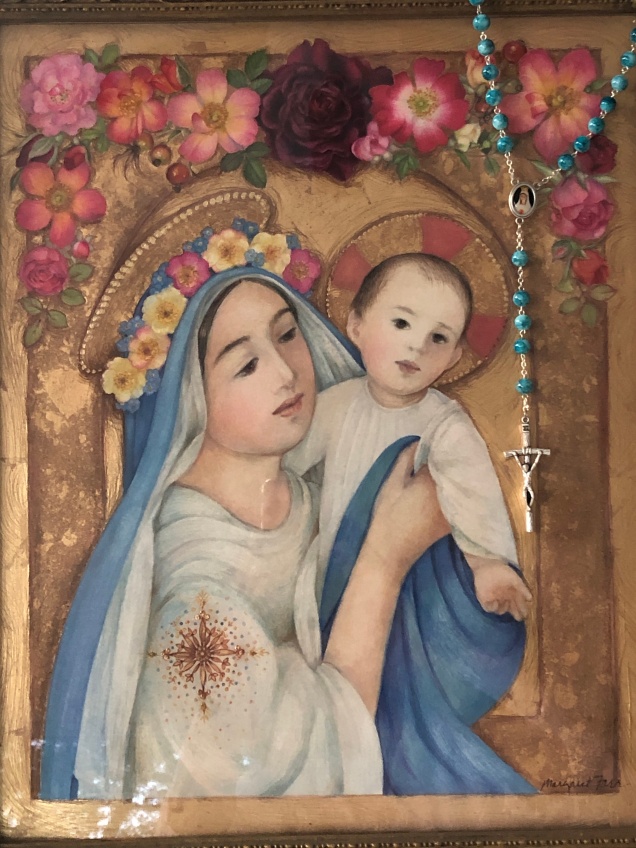
“God’s love has been poured into our hearts through the Holy Spirit who has been given to us.” (Rom 5:5) “Because we are dead or at least wounded through sin, the first effect of the gift of love is the forgiveness of our sins. The communion of the Holy Spirit (2 Cor 13:14) in the Church restores to the baptized the divine likeness lost through sin.” (CCC 734) The Holy Spirit perfects the soul with the first fruits of eternal glory–so we may more closely resemble Jesus Christ. No one has embodied these virtues more perfectly than the Blessed Virgin Mary, the Spouse of the Holy Spirit. She is the most perfect, pure, and faithful reflection of the Face of Christ.

In his classic work on the Holy Spirit, The Sanctifier, Archbishop Luis M. Martinez wrote of the the “mystical reproduction” that the Holy Spirit brings about in souls: “…because God gives a wonderful mark of unity to all His works…a most perfect unity shines forth from them because the are the fruit of wisdom. This divine contrast of unity and variety stamps the works of God with sublime and unutterable beauty.”

Jesus is reproduced in the soul of a Christian in the same way in which He was brought into the world–the way founded in love, caused by love, and which leads to love: “Jesus was conceived by the Holy Spirit…of the Virgin Mary. That is the way Jesus is always conceived.” That is the way He is reproduced in a Christian soul. Archbishop Martinez reminds us, too, that in order to resemble Christ, Our Lord, we must go through the pain and suffering of the Cross offered in love:

“He whom we love is a God nailed to a cross. Pain makes us resemble him. It is characteristic of love to have a tremendous desire to resemble the beloved. It is characteristic, too, for those who love to resemble each other.” But, as the soul is transformed, it is also filled with joy! Even as Mary suffered at the foot of the Cross she trusted, giving her “Fiat” as she had done at the Incarnation, with hope in the Resurrection; cooperating with God’s design. We, too, must be willing to cooperate with God’s design, as Mary did with docility to the Holy Spirit:

After Christ had completed his mission on earth, it still remained necessary for us to become sharers in the divine nature of the Word. We had to give up our own life and be so transformed that we would begin to live an entirely new kind of life that would be pleasing to God. This was something we could do only by sharing in the Holy Spirit. As St. Paul writes: ““But we all with unveiled faces, reflecting as in a mirror the glory of the Lord, are being transformed into His very image from glory to glory.” “(2 Cor 3:18)— St. Cyril of Alexandria

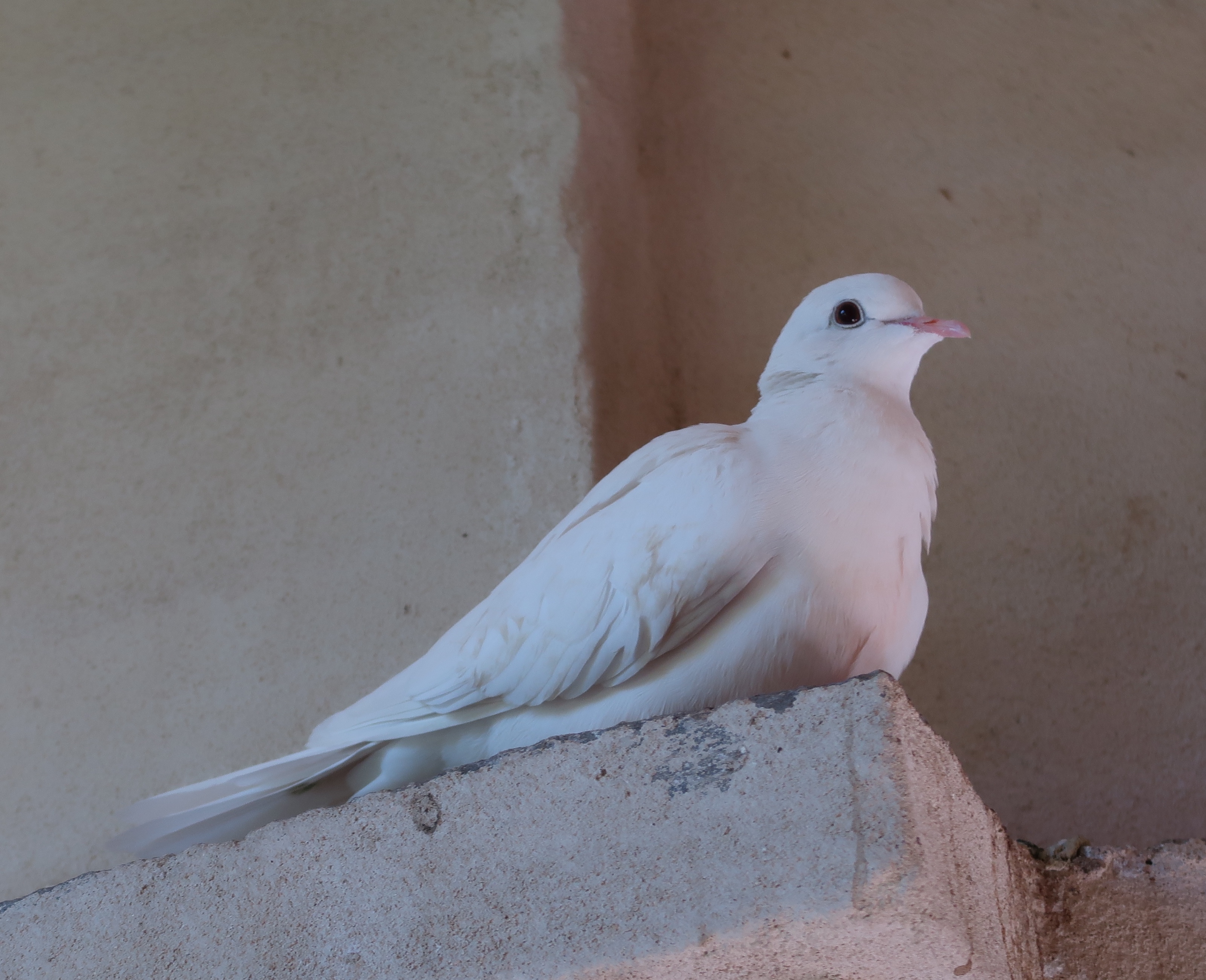
The Apostles, “with one accord devoted themselves to prayer, together with the women and Mary, the Mother of Jesus.” (Acts 1:14) Mary, as our mother, will also intercede for us, as she did at the first Pentecost to obtain the gifts of the Holy Spirit: wisdom, understanding, counsel, fortitude, knowledge, piety, and for of the Lord. The Holy Spirit then perfects the soul with the first fruits of eternal glory: charity, joy, peace kindness, goodness, generosity, gentleness, faithfulness, modesty, self-control, and chastity–so we may more closely resemble Jesus Christ.

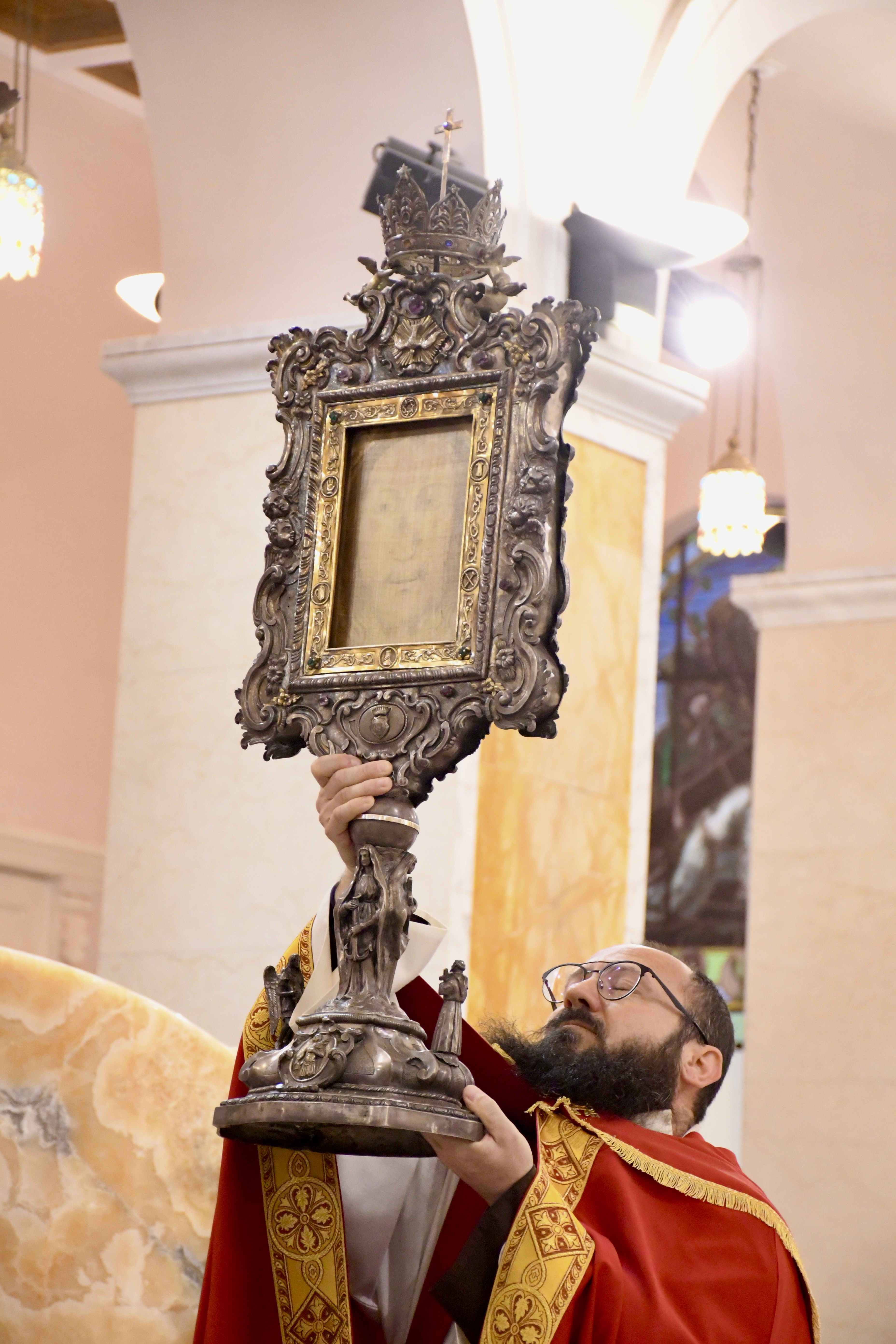
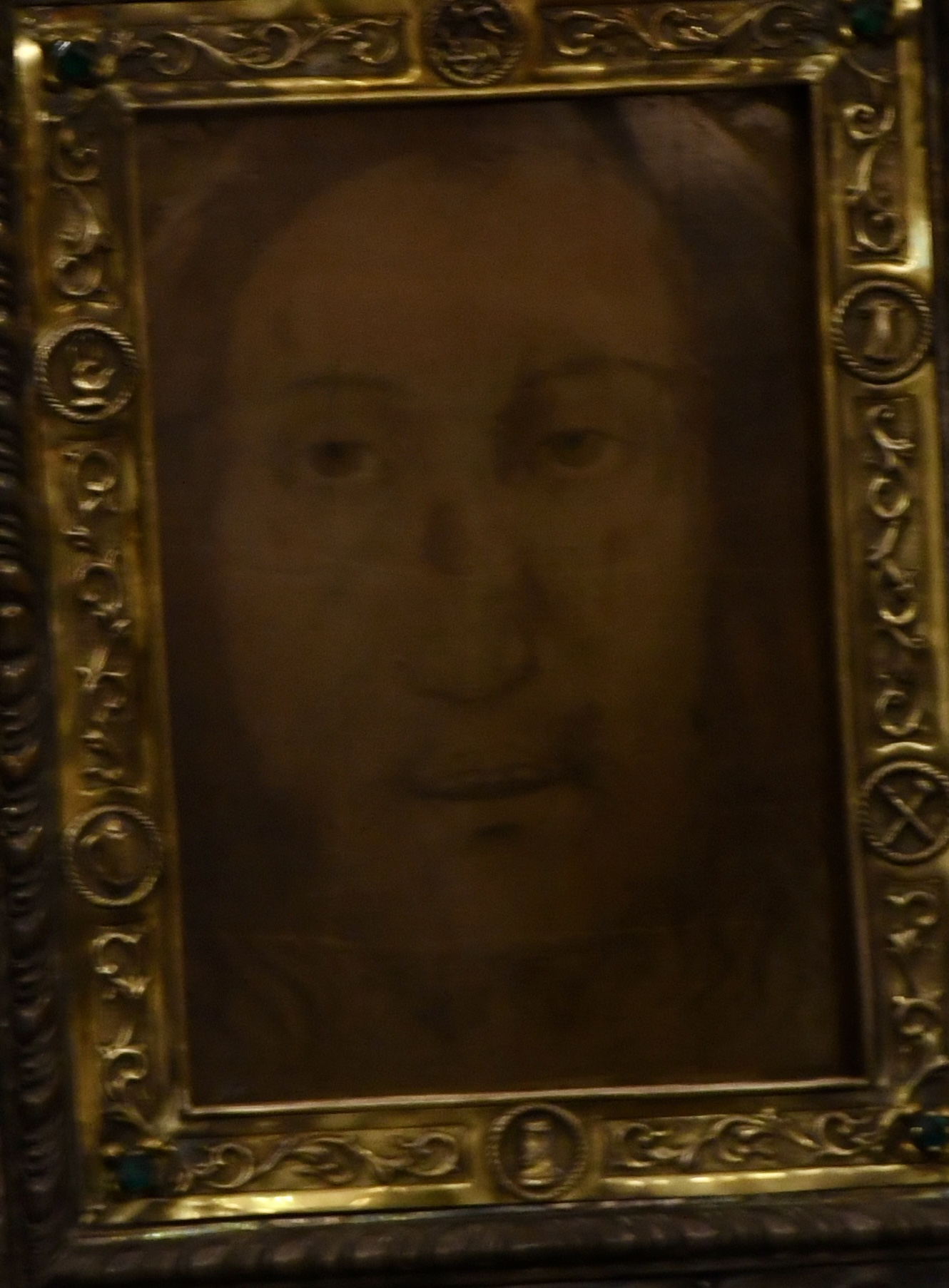
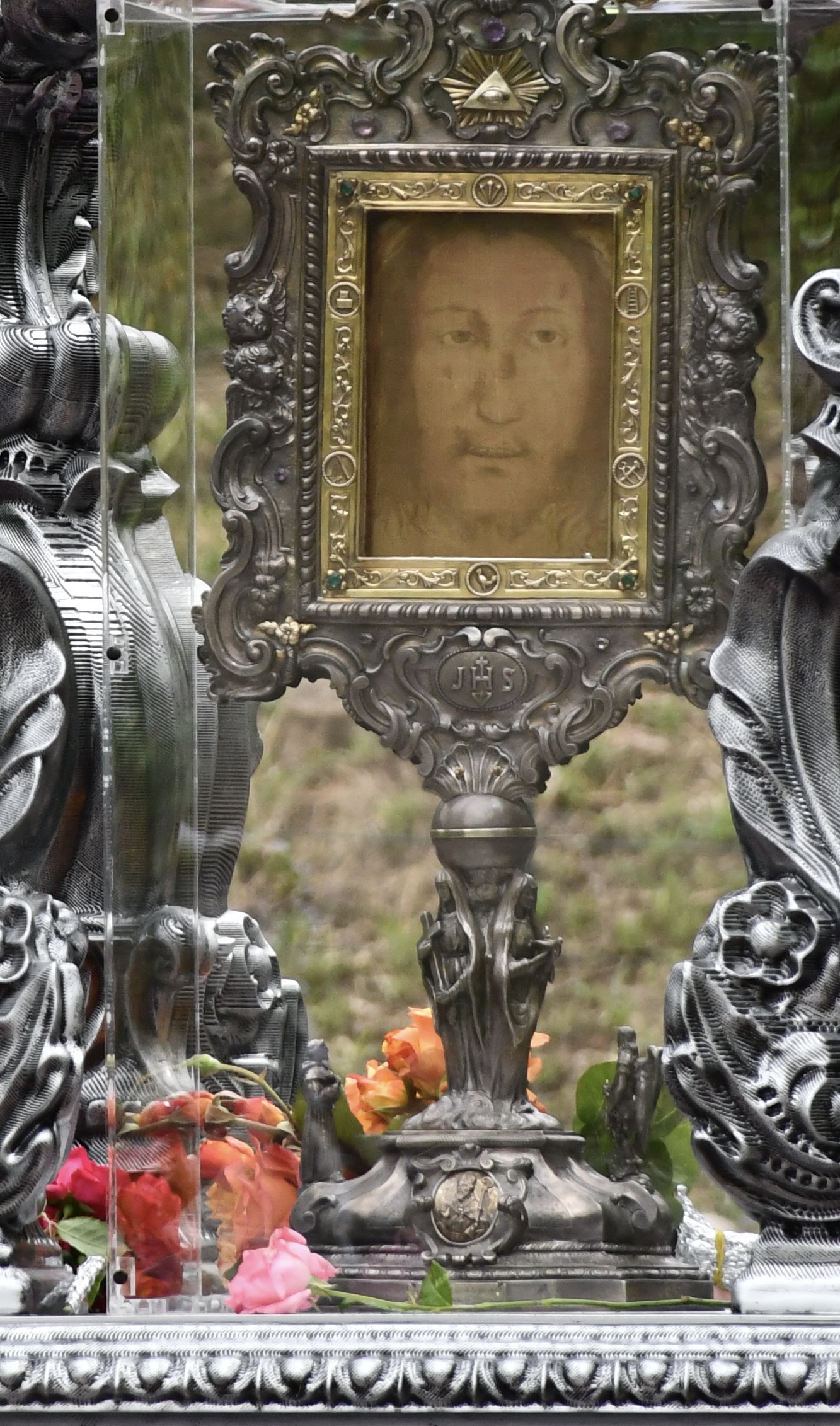
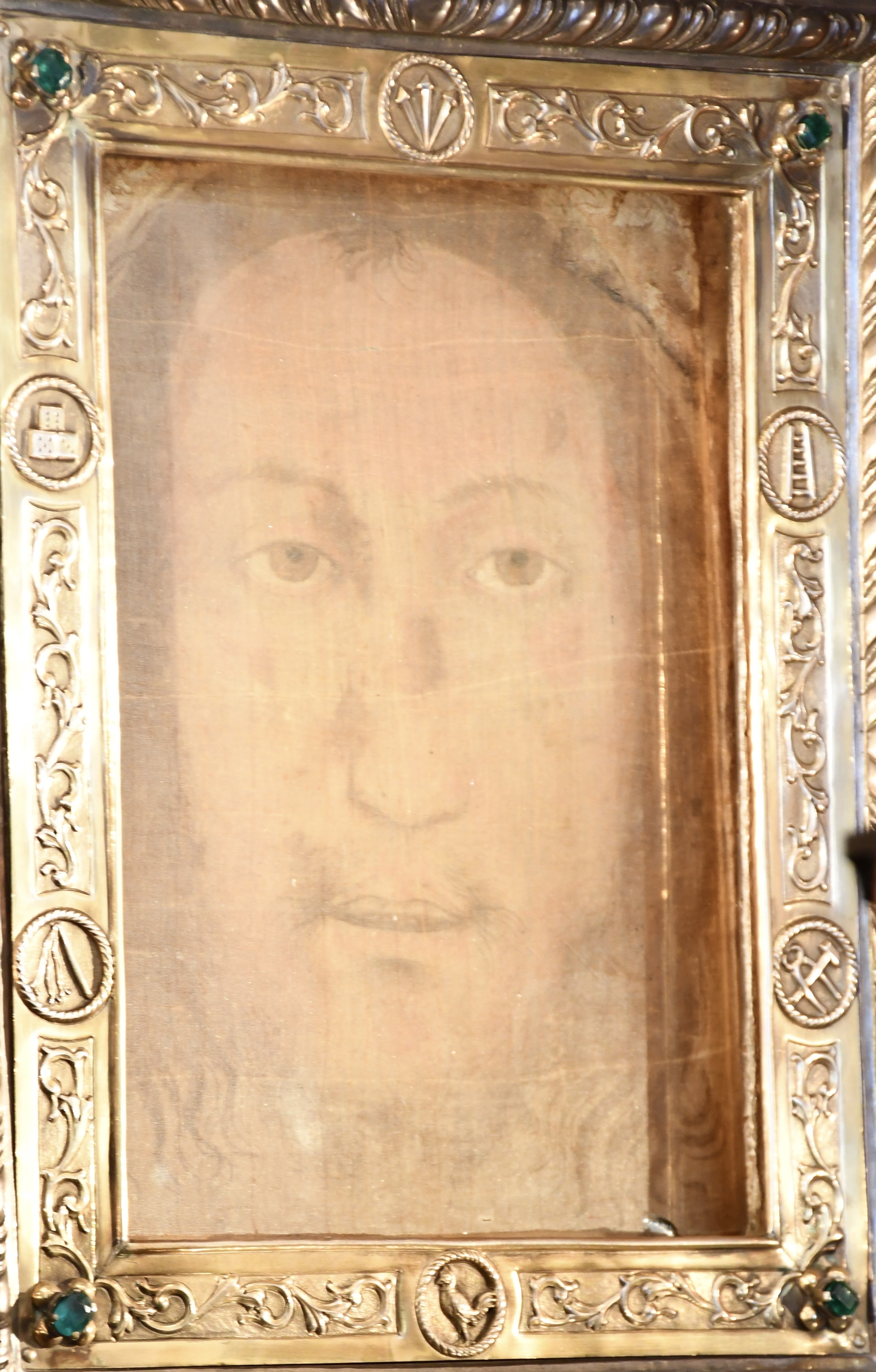
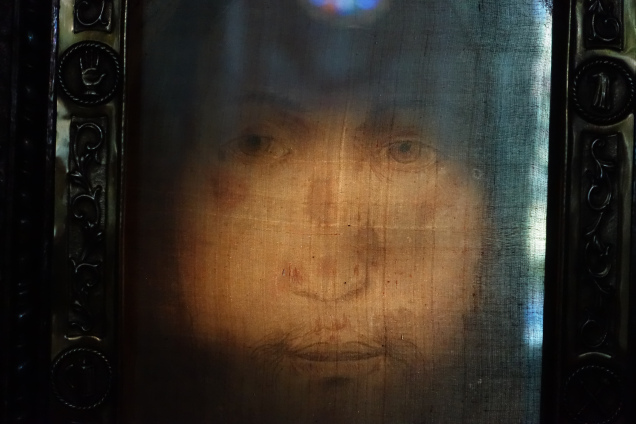
The Holy Face of Manoppello- photo: Paul Badde/EWTN
Divine Guest of our souls
(photo: Patricia Enk)

This is the work of the Holy Spirit of Love, who is the the light and fire of the Face of God: to sanctify our souls, shining upon us the radiance of His light, transforming us into the His own likeness. Holy Spirit wants to dwell in us and convert our bodies into His temple, as He did in the Virgin Mary to bring grace, mercy, and peace. “Love is not a passing visitor who pays us a call and then goes away. He establishes in us his permanent dwelling and lives in intimate union with our souls as their eternal Guest.”  (The Sanctifier by Archbishop Martinez)

As Jesus promised on the last night of His mortal life: “And I will ask the Father and He will give you another Advocate to dwell with you forever, the Spirit of truth whom the world cannot receive, because it neither sees Him nor knows Him. But you shall know Him because He will dwell with you and be in you.” (Jn 14: 16-17) So, let us remain, “with one accord in prayer,” with Mary as the Apostles did, for it is “through Mary the Holy Spirit begins to bring men, the objects of God’s merciful love, into communion with Christ.” (CCC 725) 

Mary, Spouse of the Holy Spirit

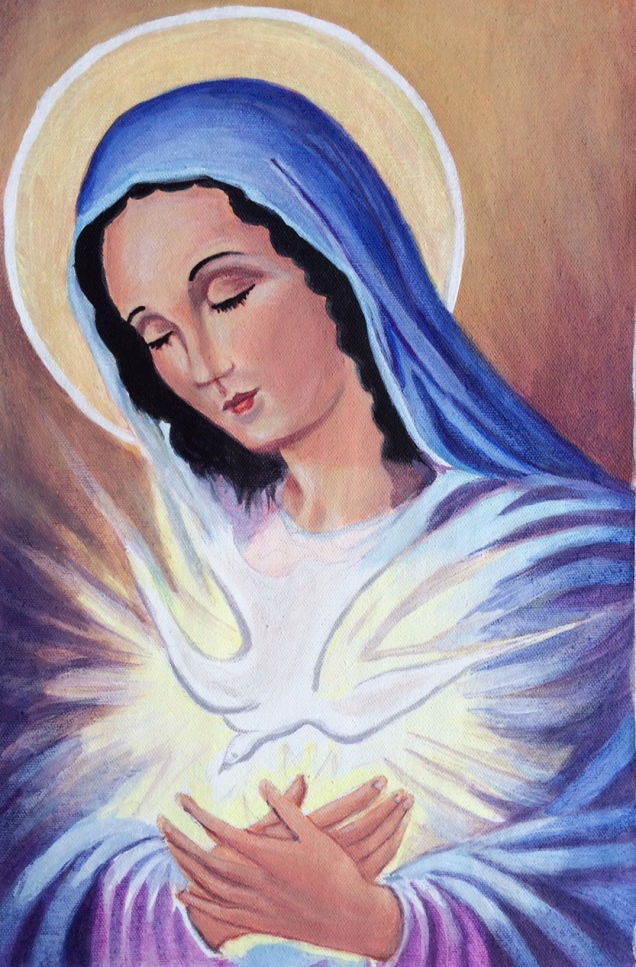
To Mary, Spouse of the Holy Spirit, Daughter of the Most High, Mother of God, faithful Spouse of the Holy Spirit — yet also Mary of Nazareth, Joseph’s wife, my mother– hear my prayer for grace, O Full of Grace. Pray your Spouse the Holy Spirit to come upon me — to shelter from all ill, to strengthen me to do what is right, to teach me all truth. Pray him come to me, and abide with me, and be within me a fountain springing up unto eternal life. May he sustain me in sorrow, sanctify me in life, and receive me at the hour of my death. Holy Mary, Mother of God, Mother of the Church, pray for us. 

“Hail Mary, Full of Grace, the Lord is with Thee” (Photo: Patricia Enk)

Prayer to Mary, Mother of the Church and Mother of Our Faith

Mother, help our faith! 
Open our ears to hear God’s word and to recognize his voice and call. 
Awaken in us a desire to follow in his footsteps, to go forth from our own land and to receive his promise. 
Help us to be touched by his love, that we may touch him in faith. 
Help us to entrust ourselves fully to him and to believe in his love, especially at times of trial, beneath the shadow of the cross, when our faith is called to mature. 
Sow in our faith the joy of the Risen One. 
Remind us that those who believe are never alone. 
Teach us to see all things with the eyes of Jesus, that he may be light for our path. And may this light of faith always increase in us, until the dawn of that undying day which is Christ himself, your Son, our Lord!

–Prayer at the conclusion of the Encyclical Lumen Fidei

God’s Patience, Forgiveness, and Mercy

God’s patience, forgiveness, and infinite mercy toward sinful mankind are incomprehensible, and yet may be seen in a small way in the images of Jesus’s Holy Face in His Passion.

This Holy Week, if possible, make the sacrifice of a little time spent in contemplating His Holy Face, and you will be richly rewarded by God; who desires to bestow many graces upon those who contemplate the suffering Face of Jesus. If we only ask, He will restore the image of His Son in our souls!

“Holy Face of Jesus, Sacred Countenance of God, how great is your patience with humankind, how infinite is your forgiveness. We are sinners, yet you love us. This gives us courage. For the glory of your Holy Face and of the Blessed Trinity, hear and answer our prayers.”

~ Excerpt from the Novena of the Holy Face

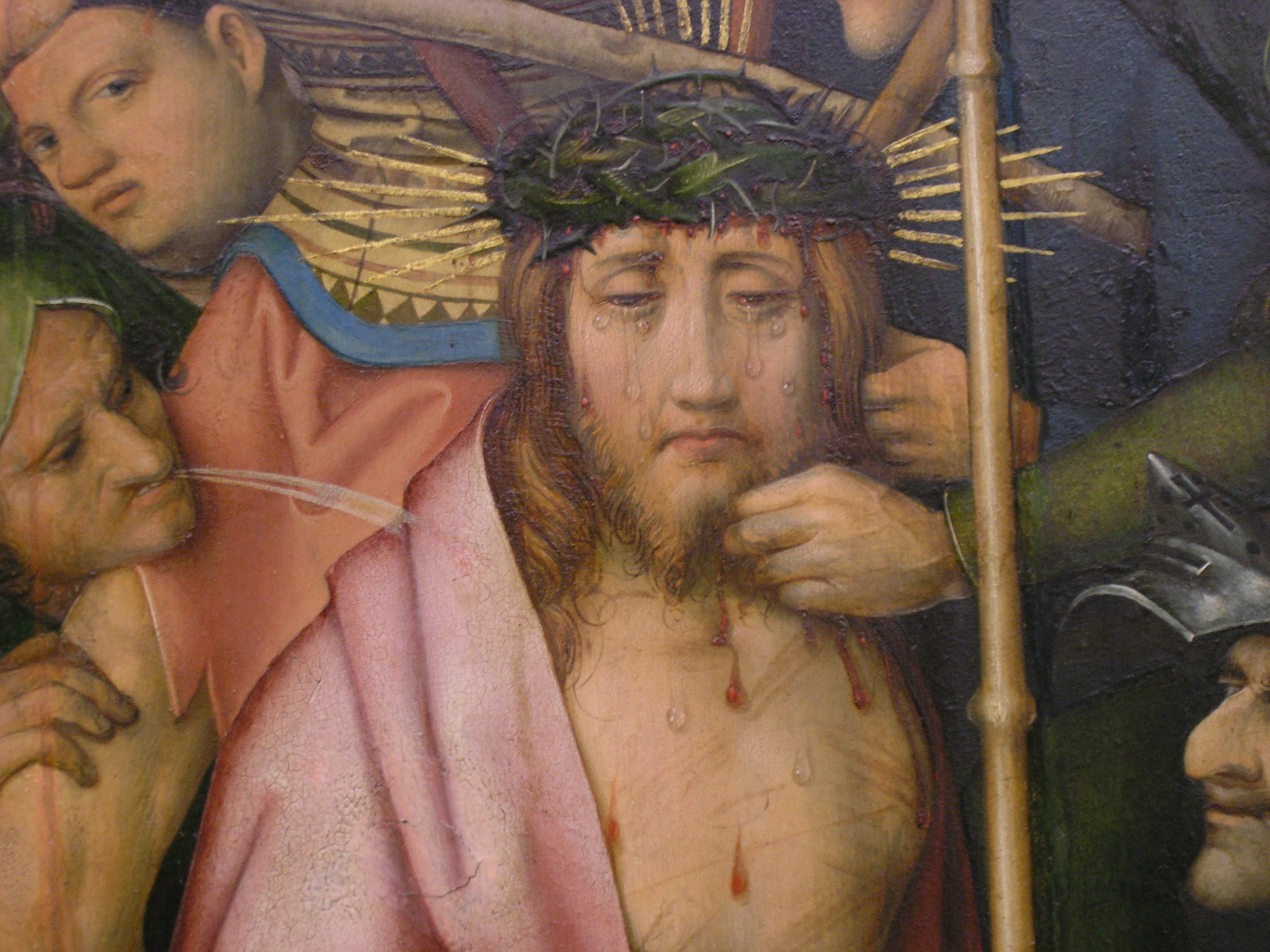
“He was despised and rejected by mankind, a man of suffering, and familiar with pain. Like one from whom people hide their faces he was despised, and we held him in low esteem.” (Isaiah 53:3)

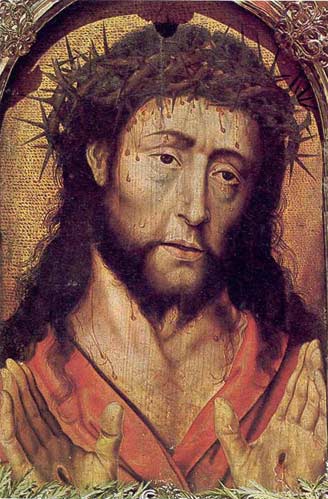
Hans Holbein der Altere. Munich, Germany

“I salute you! I adore you and I love you, Oh adorable face of my beloved Jesus, as the noble stamp of the Divinity! Completely surrendering my soul to you, I most humble beg you to stamp this seal upon us all, so the image of God may once more be reproduced by its imprint in our souls. Amen.”

Prayer of Sr. Marie St. Pierre

All the Earth Proclaims the Glory of God — Omnis Terra 2024

To those who placed idols before the living and true God, the prophet Micah warned: “One day they will invoke the Lord, but He will not answer them, and on that day He will hide His Face from them because of the evil of their conduct.” (Micah 3:4) 

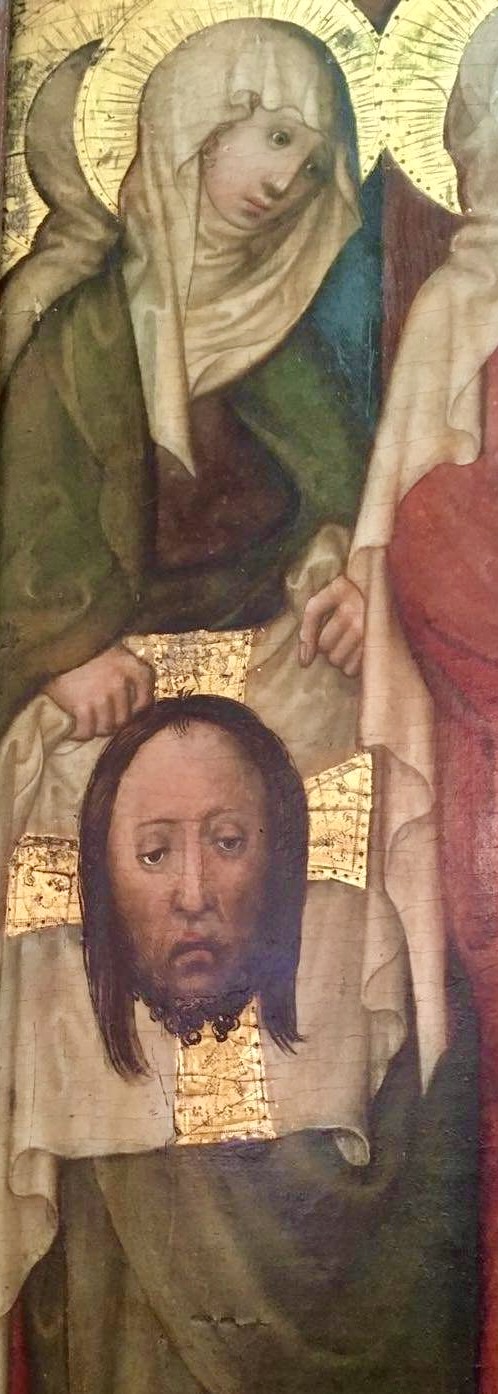
St. Veronica with Sudarium 1420

However, those who who honor and glorify God; those who seek and contemplate the Face of Jesus Christ — they will be transformed into His Image — According to Pope St. John Paul II this is the meaning of the action of the woman known as “Veronica” . The “Veronica” or “Vera Icon” historically referred the the image itself, however, there is a deep message imparted to each Christian in the legend of St. Veronica: each act of charity, every act of compassion will leave the imprint of the Face of Jesus in our souls, transforming us into His own Image.

“But we all, with unveiled face, beholding as in a mirror the glory of the Lord, are being transformed into the same image from glory to glory, just as by the Spirit of the Lord.”

(2 Cor. 3:18)

There is a “Vera Icon” or “True Image” of the Face of Christ, which is kept in the Basilica Shrine of the Holy Face in Manoppello, Italy. It is believed to be the sudarium cloth that covered Jesus head at his burial and found in the tomb after the Resurrection. All are invited to give honor and glory to God on January 28th, 2024, either in person, or via the internet, by joining in the celebration of “Omnis Terra” at the Basilica Shrine of the Holy Face… 

“Omnis terra adoret te, Deus, et psallat tibi!”

“The whole earth adores you, O God, and sing hymns to you” (Ps 65:4)

Procession of Pope Innocent II in 1208 carrying "the Veronica" Face of Christ (from "Liber Regulae Sancti Spiritus in Saxia" manuscript 1350)
The first “Omnis Terra” procession of Pope Innocent III in 1208 carrying “the Veronica” Face of Christ (from “Liber Regulae Sancti Spiritus in Saxia” manuscript 1350)*

Omnis Terra, is the Latin for “All the Earth.” The revelation of Jesus’s glory is the cause for all the earth rejoicing, giving praise to His Name! Omnis Terra will be celebrated with a solemn Mass and a procession at the Sanctuary Basilica of the Holy Face in Manoppello, Italy. The live-feed will begin at 11:00am local time (Rome time) Archbishop Bruno Forte will be presiding.  A blessing will be imparted with the reliquary of the Veil of the Holy Face during the celebration. (Link for Live-stream here)

Link to Livestream from the Basilica of Volto Santo in Manoppello: (Live-Stream) Basilica Facebook: https://www.facebook.com/basilicavoltosanto. (Last year’s procession will be seen on the link until then.)

+++

Since ancient times processions have been a reminder that our Christian life is a constant movement toward God and our eternal home. A procession is a type of pilgrimage and expression of beauty and piety that flows from the liturgy. There is power in this beautiful procession that terrifies the infernal foe and makes all of hell tremble.Processing with the Face of Jesus brings his whole person before us, and for all the earth to adore and glorify Him — to proclaim to the unbelieving world that Jesus Christ is LORD!

The world is not only unbelieving but publicly blasphemes God to His Face, and it is for this reason that Our Lord must be honored publicly.  Whether it is within the confines of a church or through the city streets, the procession is a public function of faith, hope, and love. It is an antidote to the poison disseminated by our culture which falsely asserts that religion is “private” and not something to be brought up in polite society or in the public square. 

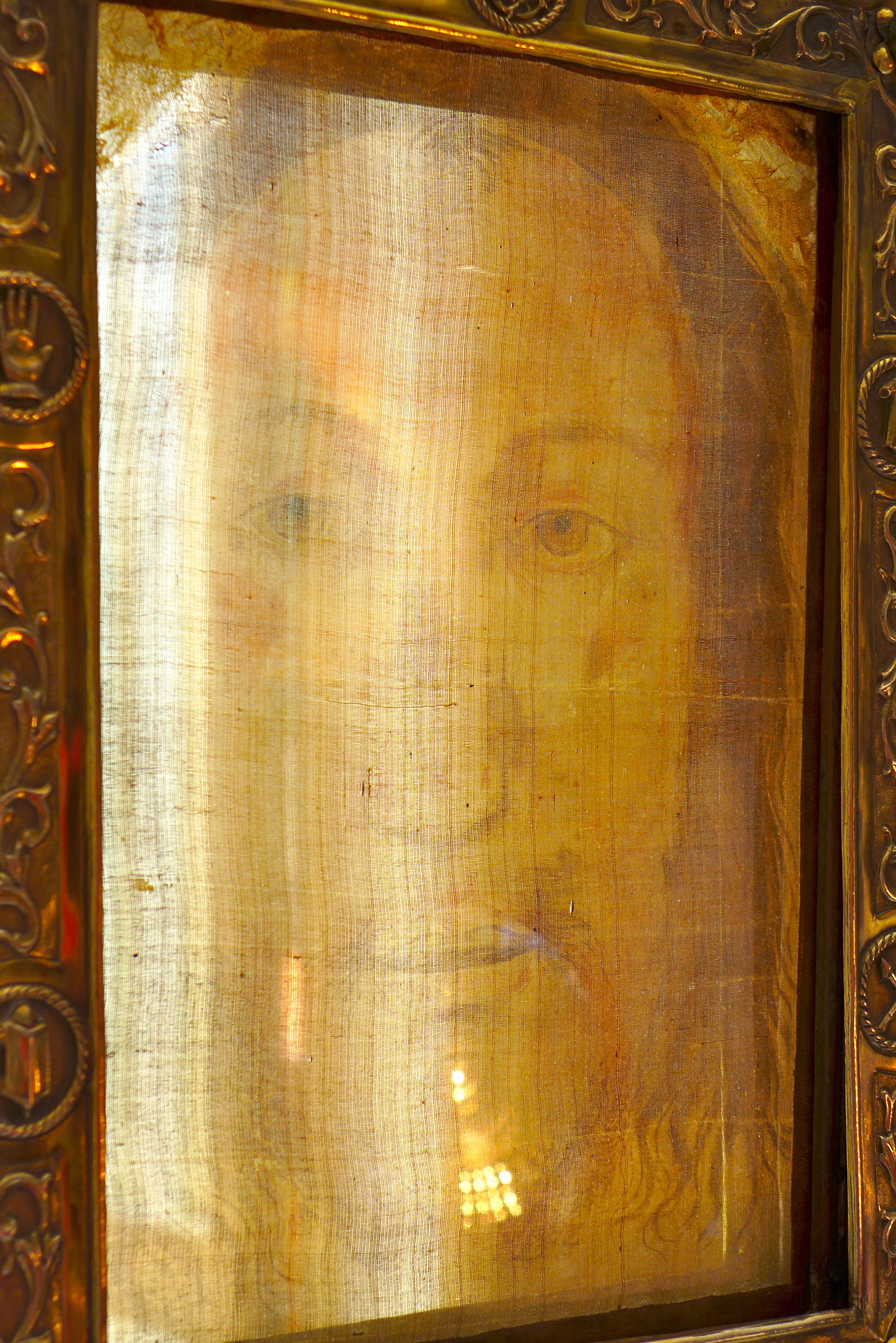
“Vera Icon” Holy Face of Manoppello (Photo: Paul Badde/EWTN)
The “Living Face” becomes visible on the Holy Veil of Manoppello. Photo: Paul Badde/EWTN
The eyes following the onlooker — Holy Veil of Manoppello (Photo: Paul Badde/EWTN)
Il Volto Santo – The Face of Love and Mercy (Photo: Paul Badde/EWTN

“We process toward our heavenly home in the company of God.  Procession is the function of faith, which burns in our hearts and beams in our faces, and makes our voices tremulous with emotion as our ‘Lauda Sion’ bids defiance to an unbelieving world.” ~Fr. Frederick W. Faber in his treatise on the Blessed Sacrament

detail of Face of Jesus on the Holy Veil from the precious manuscript "Liber Regulae Sancti Spiritus in Saxia"
Detail of Face of Jesus on the Holy Veil from the precious manuscript *”Liber Regulae Sancti Spiritus in Saxia”
Archbishop Salvatore Cordileone holding the reliquary containing the Veil of the Holy Face of Manoppello on the occasion of Omnis Terra in 2019. Photo: Paul Badde/EWTN

First, a bit of little-known, and fascinating ancient history regarding “Omnis Terra”– thanks to Raymond Frost, who sent this link to San Francisco Archbishop Cordileone’s homily of Sunday, January 21st, 2024:

“Do Whatever He Tells You, and You Will Spread the Face of His Love to the Whole World”

“The entrance chant for our Mass today – “All the earth will worship you, O God, and will sing to you, sing to your name” – happens to be the same entrance chant prescribed for last Sunday’s Mass, the Second Sunday in Ordinary Time, popularly referred to as “Omnis terra” Sunday, taken from the first words of the chant in Latin, as we just heard it at the beginning of Mass, “Omnis terra adoret te, Deus.”  Every Mass has a prescribed entrance chant, usually a Scripture verse, very often from one of the Psalms, and the Mass gets its name from the first word or two of that chant (such as “Gaudete” Sunday and “Laetare” Sunday).

The Holy Face of Jesus

Why do I bring this up?  It recalls a bit of Church history that underscores why Jesus came into the world.  The story is told that in pre-Christian Rome the Emperor decided to have all Roman residents originally from other places take soil from their homeland and deposit it in a designated place close to the Vatican Hill, less than a quarter of a mile away.  There he built a temple to honor the pagan Roman gods, as it contained soil from all the earth, “omnis terra.”

After Rome became Christian, the Pope built a church over that spot, which we know as the church of the Holy Spirit, and every year on that Sunday, “Omnis terra” Sunday, he would process from St. Peter’s Basilica to the church of the Holy Spirit with a veil bearing the face of Jesus.  The veil in question was preserved from antiquity as one of the burial cloths that covered Jesus’ face, and was believed to be such an accurate representation of his face that it was called “the true icon of Rome,” in Latin, vera icona Romana: “vera icona,” whence the name, “Veronica.”  This is how the story circulated later in the Middle Ages of a woman by that name who wiped our Lord’s face as he carried his Cross to Calvary. 

There are many truly remarkable, even miraculous, features about this cloth that point to its authenticity, but that is a subject for another discourse.  The point for us here today is that that procession instituted in the Middle Ages was to claim Jesus Christ as the one Savior of all the world, the Second Person of the Most Holy Trinity, the one, true God to whom all the earth owes worship and allegiance.  This is the spiritual lesson of the ritual that developed around that veil.

The story of Veronica, though, also bears for us a spiritual message.  As Pope St. John Paul II reflected in his meditation on the sixth Station of the Cross, every act of charity done in the name of Jesus Christ, with the spirit of his love, leaves the imprint of his image.  This is how we translate the universality of the salvation Jesus won for us into language people can understand in our own time and place.  The love of Christ is truly a universal language, understood everywhere and in every culture, leaving his image and thus changing both persons involved in that encounter of authentic Christian charity.”

–Excerpt from Homily of Archbishop Cordileone, January 21, 2024 (Click here for full homily)
Archbishop Ganswain holding the replica of the Holy Veil of Manoppello at Spirito Santo in Rome. 2016

History was also made on “Omnis Terra”(All the earth) Sunday in January of 2016, when bishops, priests, and pilgrims re-enacted the historic “Omnis Terra” Procession of Pope Innocent III (pictured above), carrying a reproduction of the precious image that many scholars identify with “the Veronica” or “true image” of the Face of Jesus. The pilgrim procession began at St. Peter’s in Rome and processed to  Spirito Santo church and hospital, drawing attention especially to the Face of Christ in the sick and the poor.

On the occasion of the first “Omnis Terra” procession in 1208, Pope Innocent III wrote this beautiful prayer of devotion to the Veil of Holy Face of Jesus:

“O God, who has marked us with the light of Thy Face as your memorial, and at the request of Veronica, left us Thy Image imprinted on the sudarium; grant we pray, that by your passion and death, to adore, venerate and honor you, in mystery and as through a mirror on earth, so that we might be able to certainly see you, face to face, when you come as our judge.”

On “Omnis Terra” Sunday, January 15, 2017, history was made once again at the Basilica Sanctuary of the Holy Face in Manoppello, Italy, when a third solemn annual procession was introduced–in addition to the two solemn processions already observed in May (commemorating the arrival of the Holy Veil to Manoppello), and the solemn procession in August (on the Feast of the Transfiguration). 

The addition of a third procession of the Holy Face at the Shrine of Manoppello is not only Trinitarian, it is a deeply significant and public witness of honor paid by the faithful to His Holy Face and thus also to the Holy Name of Jesus!  May all of hell tremble at the sight of His Holy Face!

A Hymn composed by Pope Innocent III from the year 1216:

“Sancte Salve Facies”

Procession of Pope Innocent II in 1208 carrying "the Veronica" *Face of Christ (from "Liber Regulae Sancti Spiritus in Saxia" manuscript 1350)
Procession of Pope Innocent II in 1208 carrying “the Veronica” *Face of Christ (from “Liber Regulae Sancti Spiritus in Saxia” manuscript 1350)

Hail Holy Face of Our Redeemer on which shines the appearance of divine splendor impressed upon a little cloth of snowy radiance and given to Veronica as a standard of love.

Hail beauty of the ages, mirror of the saints, which the spirits of the heavens desire to see.  Cleanse us from every stain of sin and guide us to the fellowship of the blessed.

Hail our glory amidst this hard life, so fragile and unstable, quickly passing away.  Point us, O happy figure, to the heavenly homeland to see the Face that is Christ indeed.

Hail, O sudarium, noble encased jewel, both our solace and the memorial of Him who assumed a little mortal body–our true joy and ultimate good!

*The precious miniature manuscript “Liber Regulae Sancti Spiritus in Saxia,” was published around 1350 and is preserved in the State Archives in Rome.  The illustration at the bottom of the first page of the Liber is one of the oldest illustrations of “the Veronica,” which depicts Pope Innocent III with “the Veronica” in his right hand and the Rule granted to the brothers of the hospital in his left.  Prior to the Jubilee of 2000, the French medievalist Jacques Le Goff wrote, “Over the centuries Rome was enriched with notable relics. One in particular acquired an exceptional prestige:  the sudarium of Christ known and revered by the name of “the Veronica.”  The circumstances by which the image first came to Rome is a mystery but was mentioned for the first time under Pope John VII (705-707)

Hail Holy Face of Jesus, our Redeemer!

Update: The 2024 Novena of the Holy Face will be from Sunday, February 4th to February 12th. The Feast of the Holy Face for 2024 is Tuesday, February 13th. The Novena will be posted each day on the Home Page, which subscribers will receive by email. The Novena may also be found in the Menu above.

Merry Christmas!

“The people living in darkness have seen a great light…” (Mt. 4:16).

As those who see light are in the light sharing its brilliance, so those who see God are in God sharing his glory, and the glory gives them life.  To see God is to share in life.”

~St. Ireneaus
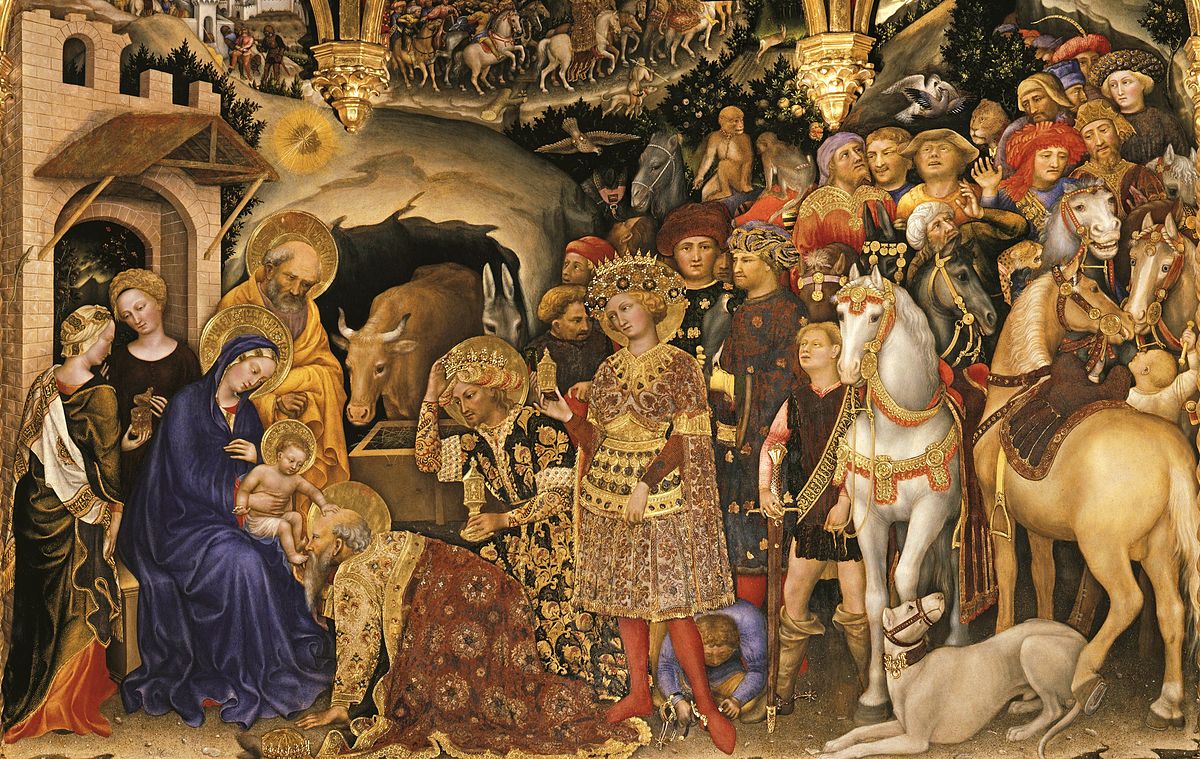
Adoration of the Magi – Gentile da Fabiano 1423

Love desires to see God.  So says St. Peter Chrysologus:  “When God saw the world falling to ruin because of fear, He immediately acted to call it back to Himself with love…” By an invitation of grace, love and compassion God called Noah, Abraham, Jacob and Moses–and a “flame of love” was enkindled in their hearts, “it’s intoxication overflowed into men’s senses. Wounded by love, they longed to look upon God with their bodily eyes, yet how could our narrow human vision apprehend God, whom the whole world cannot contain?” St. Chrysologus writes, “It is intolerable for love not to see the object of it’s longing!” No matter what good the saints did to merit a reward, they could not see the Lord.  A love that desires to see God may not have reasonableness on it’s side, but it is evidence of filial love.  It gave Moses the temerity to say: If I have found favor in your eyes, show me Your Face. It inspired the psalmist to make the same prayer: Show me Your Face.  Even the pagans made their images for this purpose: they wanted to see what they mistakenly revered.”  (from sermon of St. Peter Chrysologus)

Come, let us adore Him!

Infant Jesus wrapped in Byssus

“Visible before to God alone and not to the world, God made the Word visible so that the world could be saved by seeing Him.  This mind that entered our world was made known as the Son of God.”

~ St. Hippolytus

Blessed are the pure of heart, for they shall see God. (Mt. 5:8)

Adoration of the Shepherds – Gerard van Honthorst 1622

O that birth forever blessèd,

When the virgin, full of grace,

By the Holy Ghost conceiving,

Bore the Savior of our race;

And the Babe, the world’s Redeemer,

First revealed His sacred face,

evermore and evermore!

Merry Christmas! May His Face shine upon you and your loved ones, today and always!

Kreuz als Krippe (Cross as a Crib), Oil on canvas, Unknown artist, 18th century (Photo: Paul Badde)

“In Thee God will manifest the splendor of His presence, for the whole world to see”

~ Baruch 4

St. Joseph — Contemplating the Mystery of the Human Face of God

“The most illustrious thing the Church has is that which she hides most.” ~Bossuet

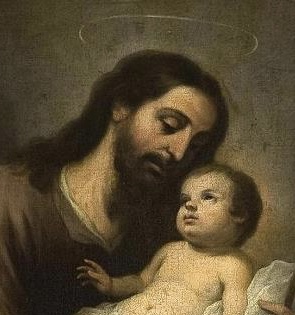
Detail, St. Joseph with the Child, by Alonso Miguel de Tovar

His countless virtues made him worthy to be the foster father of the Son of God. He was the first man to see the human Face of God; the first man to hear the cry of the Word of God. Yet for centuries the most just and humble St. Joseph was fairly hidden in the Church. Not a word is spoken by St. Joseph in the Gospels. But as Pope Benedict XVI wrote, “His is a silence permeated by contemplation of the mystery of God, in an attitude of total availability to His divine wishes.”

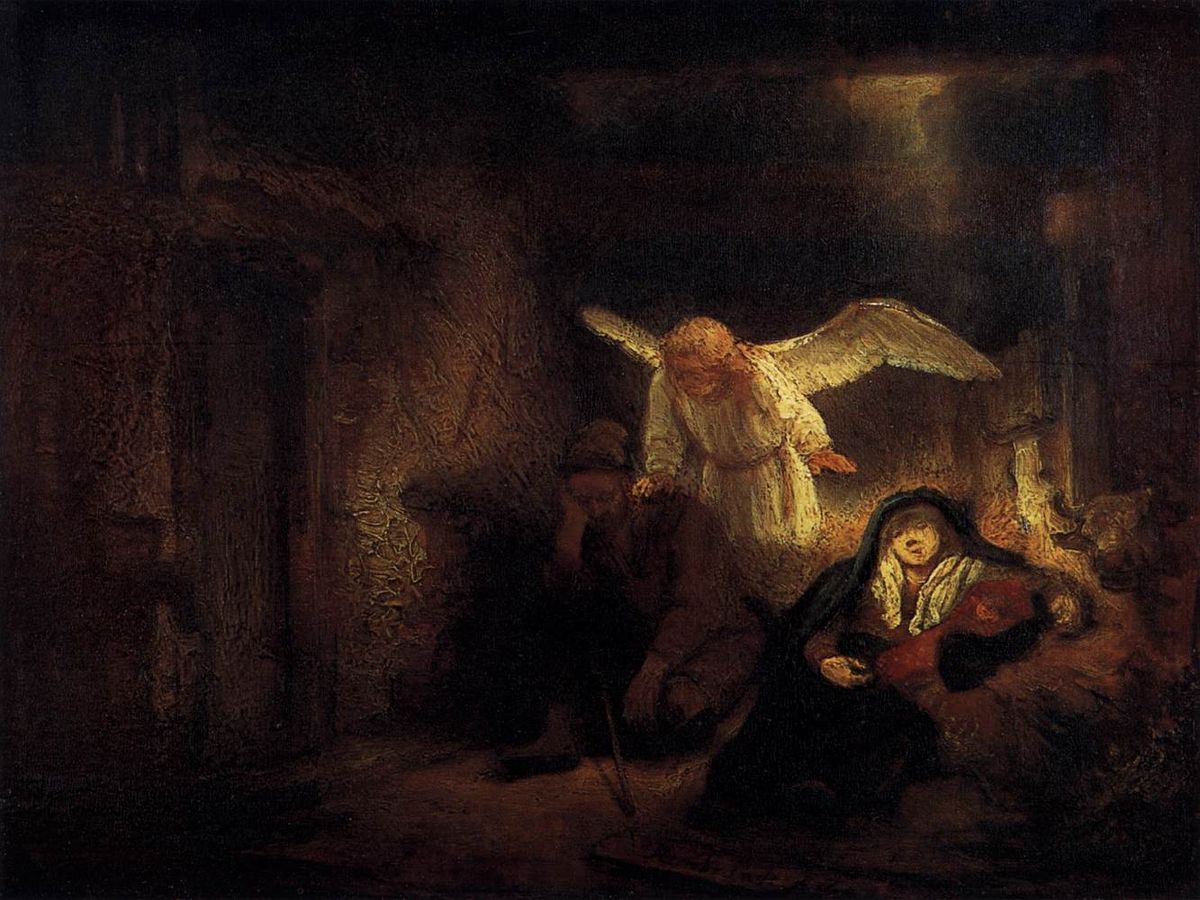
Josephs’s Dream by Rembrandt c.1645

It was St. Teresa of Avila who recognized St. Joseph as the model of contemplative prayer. She wrote: “Would that I could persuade all men to have devotion to this glorious Saint; for I know by long experience what blessings he can obtain for us from God.”  Because St. Joseph was silent, he was attuned to hear the voice of God, although it was in darkness and obscurity.  “Those who practice prayer,” says St. Teresa, “should have a tremendous devotion to him always.”

“Joseph, the honest man, seeks God. Joseph, the selfless man, finds God. Joseph, the hidden man, delights in God’s presence.” –Second Panegyric on St. Joseph by Bossuet

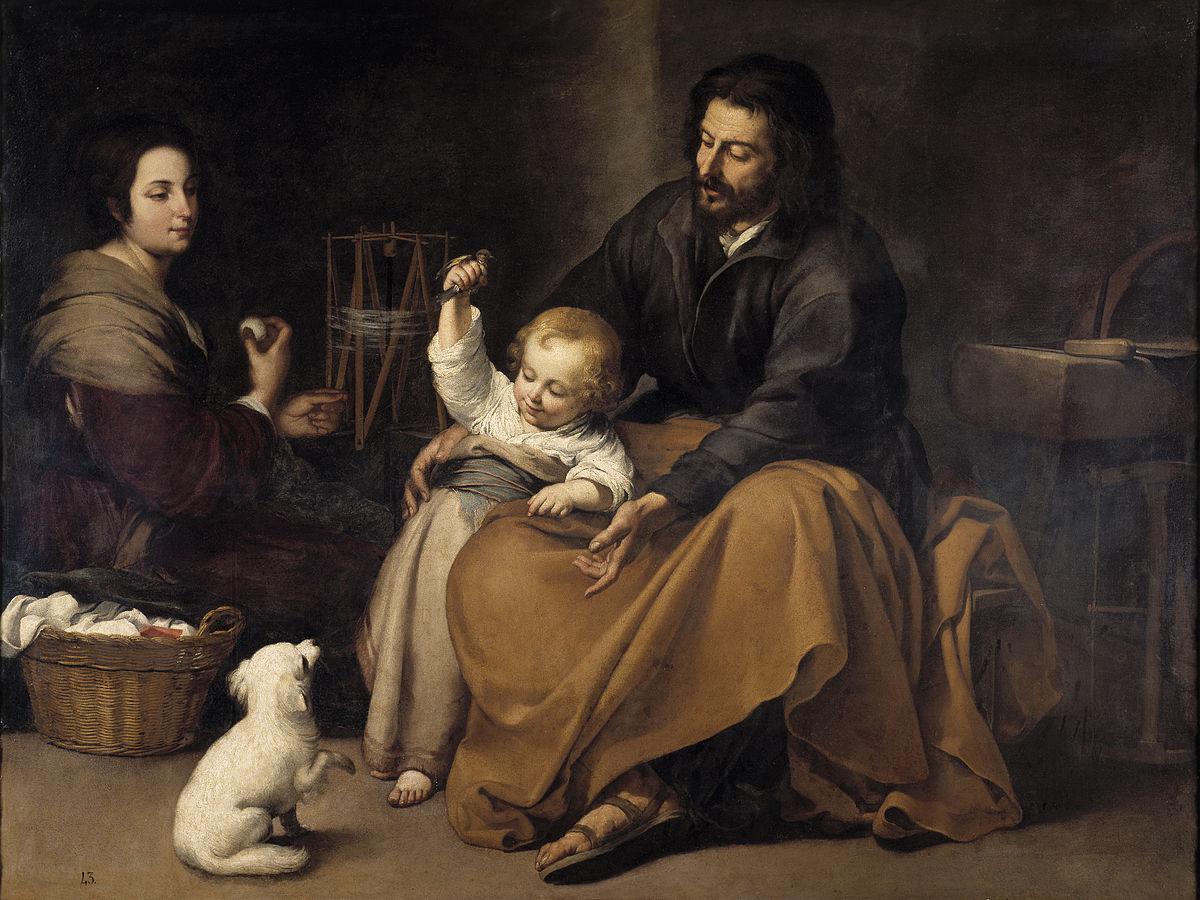
Holy Family with bird, c. 1650, by Murillo

St. Joseph, through continuous prayer, sought God’s Will in each present moment. St. Teresa writes that he is the master of the interior life.  “In human life Joseph was Jesus’ master in their daily contact, full of refined affection, glad to deny himself in order to take better care of Jesus.  Isn’t that reason enough for us to consider this just man, this holy patriarch, in whom the faith of the old covenant bears fruit, as master of interior life?  Interior life is nothing but continual and direct conversation with Christ, so as to become one with Him.  And Joseph can tell us many things about Jesus.”  St. Joseph reveals those hidden graces in our daily lives; gifts from God that are available in each ordinary moment, as well as in trials and times of suffering. St. Joseph teaches us to live by faith as he did, before the presence of such a great mystery, by contemplating the human Face of God with the eyes of faith.

“In the wonder of the Incarnation your Eternal Word has brought to the eyes of faith a new and radiant vision of your glory. In him we see our God made visible, and so are caught up in the love of the God we cannot see.”  (from the Christmas liturgy of the Mass)

w

“Blessed is she who believed” – Mary’s veil of faith

The Virgin of the Grapes by Pierre Mignard

The word “veil” can have many meanings. A veil can cover the face, the head, or an object; it can cover, conceal, or separate. In ancient Jewish tradition a veil in the Holy of Holies in the Temple separated sinful man from the presence of God dwelling in the midst of His People. The holiness of God was not to be taken lightly. The blinding light of the purity and glory of the Face of God could not be looked upon by sinful eyes.

But when God chose Mary to be the Mother of His Son He created her to be all-pure and sinless from the moment of her conception through the merits of her Son, Jesus. In Matthew 5:8 we read, “Blessed are the pure of heart, for they shall see God.” What was to prevent Mary, the Immaculate Conception, who was free from all sin, from seeing the Face of God in all His glory even while she was still here on earth? The answer is, in a word, a veil.

When the Word of God became flesh in the womb of the Blessed Virgin Mary, at the Incarnation, Mary became His Tabernacle. Jesus’ human flesh was His veil: “by the new and living way he opened for us through the veil, that is His flesh” (Heb. 10:20). The Angel Gabriel told Mary that she would be the mother of the Son of God.  But Mary, though “full of grace” and all-pure, would only gaze upon the human face of her child and upon the Face of her God through the veil of faith.

Elizabeth bore witness to Mary’s faith when “filled with the Holy Spirit” she greeted Mary with a loud cry: “Blessed are you among women, and blessed is the fruit of your womb! And why is this granted me, that the mother of my Lord should come to me?…“Blessed is she who believed that there would be a fulfillment of what was spoken to her from the Lord” (Lk. 1:45). As Pope St. John Paul II wrote in Redemptoris Mater, “Mary entrusted herself to God completely, with the full submission of intellect and will…this response of faith included both perfect cooperation with ‘the grace of God that precedes and assists’ and perfect openness to the action of the Holy Spirit, who constantly brings faith to completion by His gifts.”

Veil of Veronica C. 1618-22 National Gallery

In a truly heroic manner, in poverty and suffering, on her whole pilgrimage or journey towards God, Mary believed, in faith, though everything happening around her seemed to contradict God’s words to her: That “the Lord will give to him the throne of his father David.” And that “He will reign over the house of Jacob forever and of His kingdom there will be no end.” Mary believed these invisible truths about her Son, even as Jesus, suffered and died, hanging on the Cross. What was visible on an earthly level did not reflect the heavenly reality. Mary did not necessarily see her Son radiant in glory or angels ministering to Him in His Passion.  At the foot of the Cross she saw His bruised and bloodied suffering Face.

Pope St. John Paul II tells us in Redemptoris Mater that “faith is contact with the mystery of God. Every day Mary is in constant contact with the ineffable mystery of God made-man, a mystery that surpasses everything revealed in the Old Covenant… Mary is in contact with the truth about her Son only in faith and through faith!” Though all-pure, she could not see, except through faith. “Blessed is she who believed” is a key, he says, which unlocks for us the innermost reality of Mary. Mary’s all-pure eyes looked on the glory of her Son through a veil of faith, “a dark night,” to use the words of St. John of the Cross, that feeling of darkness or emptiness when a soul draws near to the brightness and glory of God. Pope St. John Paul II writes in Redemptoris Mater that Mary’s faith is: “a kind of a veil though which one has to draw near to the Invisible One and to live in intimacy with the mystery.”

In this earthly pilgrimage of faith a veil lies over our hearts, as St. Paul writes: “To this day, in fact…a veil lies over their hearts, but whenever a person turns to the Lord the veil is removed… All of us, with unveiled face gazing on the glory of the Lord, are being transformed into the same image from glory to glory, as from the Lord who is the Spirit.” (2 Cor. 4:15-16, 18) As members of the Church, we can “look at” Jesus through Mary’s eyes of faith, in the Eucharist, in our neighbor; believing in His Word and following her example in our pilgrimage towards the Father until that time when the “veil” of faith will be finally lifted.

“Blessed is she who believed!”

“Faith is the realization of what is hoped for and evidence of things not seen.” (Heb. 11:1)


St. Teresa of Avila – A gaze of faith fixed on Jesus

St. Teresa of Avila Icon by Patricia Enk
St. Teresa of Avila, Feast Day Oct. 15th Icon by Patricia Enk

“It is the Church’s task to reflect the light of Christ in every historical period, to make His Face shine also before the generations of the new millennium.  Our witness, however, would be hopelessly inadequate if we ourselves had not first contemplated His Face.”

–Pope St. John Paul II

Contemplation is a gaze of faith fixed on Jesus in silent, loving, attentiveness. It is a gift and a grace from God. Theologians have written volumes about what has been called by the Catechism of the Catholic Church “the simplest expression of the mystery of prayer,” yet when the Catholic Church wants to teach anyone about contemplative prayer it invariably directs them to St. Teresa de Jesus, Doctor of the Church and Foundress of the Discalced Carmelite Order.  St. Teresa is a “down-to-earth” sort of saint who can explain prayer to us in the most understandable terms.  “Contemplative prayer” says Teresa, “in my opinion is nothing more than a close sharing between friends, it means taking time frequently to be alone with Him who we know loves us.”

Image of the Holy Face of Jesus that captivated St. Teresa

St. Teresa suffered for years as a religious from an inability to pray, so she gives some solid advice to those who struggle as they seek the Face of God in prayer: “Never set aside the Sacred Humanity of Christ.” We cannot come to the Father except through Him.  Intimacy with Jesus draws us into the life of the Trinity. “If we can, we should occupy ourselves in looking at Him Who is looking at us; keep Him company; talk with Him; pray to Him; humble ourselves before Him; have our delight in Him.”  St. Teresa complained that she didn’t have much of an imagination, so she found it helpful to have an image of Christ to look at as she prayed, especially an image of Jesus in His Passion. “Speak with Him as with a Father, a Brother, a Lord and a Spouse–and, sometimes in one way and sometimes in another.  He will teach you what you must do to please Him… Remember how important it is for you to have understood this truth–that the Lord is within us and that we should be there with Him.”

He is only waiting for us to look at Him!

St. Teresa's statue of Jesus scourged
St. Teresa’s statue of Jesus scourged


Let me see your face! Terrorism and The Holy Face

“A human being instinctively senses that there is something about evil that seeks to hide its face.”

IMG_0892
Masked Boko Haram Terrorists

“Let Me See Your Face!” ~ Song of Solomon 2:14

What is the basis of a relationship? For a human person, it is recognizing a face and knowing a person’s name. The heart of every human being has an inexpressible longing to see the Face of God and a desire to enter into relationship with Him, to know His Name.

This is so integral to our Faith as to be indispensable. That is why Pope St. John Paul II dedicated the millennium to The Holy Face of Christ. That is why Pope Benedict has written so extensively on The Face of Christ throughout his pontificate, including in Lumen Fidei where he speaks of the light of the Face of Christ shining upon the faces of Christians and spreading as “the paschal candle lights countless other candles,” passing faith from one person to another. That is why Pope Francis directs us again and again to recognizing the Face of Jesus in one another. “Every sick and fragile person can see in your face the Face of Jesus, and you also can recognize in the suffering person the Face of Christ.”

IMG_0891
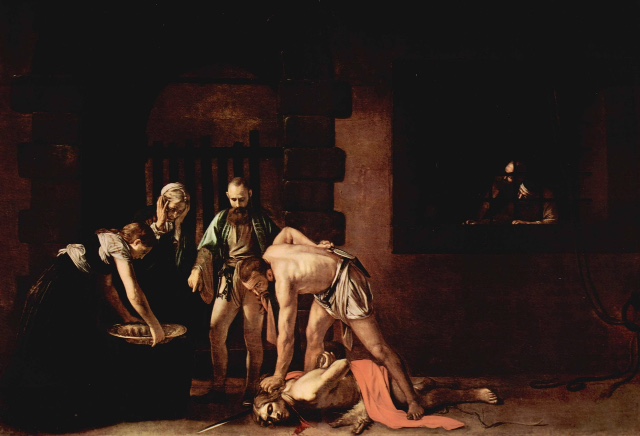
The Beheading of John the Baptist by Caravaggio (1608)

Watching the many world crises unfold, a particularly terrifying image sends a chill through viewers of the nightly news programs as it recurs again and again. This image, with which most people are now sadly familiar, has several forms: ISIS terrorists, “Russian separatist soldiers” invading the Ukraine,  Boko Haram, and rioters in Ferguson. The first instance, the ISIS terrorist, is cloaked in black from head to toe, posed like a hunter with its prey, preparing to behead a man.  The second image, “Russian separatists,” if  that is what they are, most often appear with black stocking caps or hoods that conceal their identities. Next, Boko Haram in black masks and assault weapons are pictured with the young helpless girls they have kidnapped. Then there are the images of rioters in Ferguson, Missouri, with bare chests and t-shirts wrapped around their heads to hide their faces as they smash and pillage.

A human being instinctively senses that there is something about evil that seeks to hide its face. Evil, that nameless, faceless entity manifesting itself in the world, is not content with cloaking the individual identity of its own slaves, but, above all, evil seeks to mar, disfigure, destroy, and even violently behead, the image and likeness of God found in the pinnacle of His creation: man. It is present in the evil of abortion, refusing to recognize the face of a human baby in the unborn, or in the evil of euthanasia in disposing of inconveniently elderly or sick persons. It is present in the evil of pornography, with the hidden viewer  lusting after nameless human beings, thereby deforming the image of God in both.

The wicked facelessness of violence, hatred, and evil is the inversion of the Christian call to holiness, which is seeking the Face of God. Climbing the mountain of the spiritual life toward God, the Christian abandons selfishness and vice, and then sacrifices even little attachments that hold him back, to grow closer to the summit of the mountain: unity with God, to reflect more perfectly His image in one’s heart. St. Paul said it best: “All of us, with unveiled faces, seeing the glory of the Lord as though reflected in a mirror, are being transformed into the same image” (2 Cor 3:18). This journey requires self-denial, courage, determination and zeal.

Evil, however, goes the opposite direction. In pride, in hatred, in violence, men who devote themselves to the destruction of the image of God in other men scale the upside-down mountain of pride toward the faceless evil that absorbs their identity and destroys their souls, like the fallen angels in G.K. Chesterton’s poem Gloria in Profundis:

For fear of such falling and failing,
the fallen angels fell,
Inverted in insolence, scaling,
the hanging mountain of hell.

We are not helpless, however, against the faceless foe. St. Pope John Paul II has stated, “It is the Church’s task to reflect the light of Christ in every historical period, to make His Face shine also before the generations of the new Millennium. Our witness, however, would be hopelessly inadequate if we ourselves had not first contemplated His Face.”

Pope Benedict XVI has characterized devotion to the Holy Face as having three separate components: “1) Discipleship—an orientation of one’s life towards an encounter with Jesus, to see Jesus in the face of those in need; 2) the Passion of Jesus, expressed by images of the wounded Face of Jesus. 3) the Eucharist—which is woven between the other two. The eschatological element then builds on awakening to Christ by contemplating His Face in the Eucharist.”

This is not merely a pious devotion, but a powerful weapon against the enemy. Its power does not, however, result in destruction. In his prayer to the Holy Face, St. John Paul II asks that The Holy Face, through The Holy Spirit, “bring to maturation your work of salvation.” The fruit of using this mighty weapon is peace. “From contemplation of the Face of God are born, joy, security, peace,” writes Pope Benedict XVI. As we are gazing at God, in the scriptures, in His images, in our neighbor and in the Eucharist, God is gazing at us. By this mutual gaze of love between the Face of God and the soul of man, God restores His Image in our souls. Moreover, Pope Benedict wrote, “To rejoice in the splendor or His Face means penetrating the mystery of His Name made known to us in Jesus, understanding something of His interior life and of His Will, so that we can live according to His plan for humanity. Jesus lets us know the hidden Face of the Father through His human Face; by the gift of the Holy Spirit poured into our hearts.”

This, as Benedict says, is the foundation of our peace, which nothing—not even nameless, faceless evil—can ever take from us.

“The Most Beautiful Work Under the Sun”

I Seek Your Face

Deep in his heart, man has an inexpressible longing to see the face of God. As Pope Benedict XVI writes beautifully in his homilies and in his book, On the Way to Jesus Christ, “The desire to know God truly, that is, to see the Face of God is inherent in every human being, even atheists.” This yearning for God has been expressed from antiquity in the Old Testament:

Listen to my voice, Lord, when I call
. . . Your Face, Lord, do I seek!
Hide not Your Face from me!
-Psalm 27

In fact, the Hebrew term, “panim”, which means “face” means to see the Face of God or the presence of God, occurs 400 times in the Old Testament, and 100 of these refer to God. The same word “panim”, Pope Benedict explains, is a term that describes relationships. The word “shem” meaning “name” is also a term of relationship. God has a face and a name!

How do we seek His Face?

Pope Benedict XVI tells us that we learn in the Psalms the attitude for seeing the Face of God: “Let the hearts of those who seek the LORD rejoice! Seek the LORD and his strength, seek his presence continually.” (Ps. 105:3-4) and in Psalm 24, the prerequisites of “clean hands and a pure heart” “Such is the generation of those who seek him, who seek the face of the God of Jacob.” “Seeking the face of God”, says Pope Benedict XVI, “is an attitude that embraces all of life; in order for a man to see God’s face at last, he must himself be illuminated entirely by God.” “Let your face shine, that we may be saved.” (Ps 80:3,7,19)

God turns His Face to Us

This deep longing of man to see the Face of God arises because of man’s desire for a personal relationship with His Creator. “God has a Face,” writes Benedict XVI, that is, He is a “You” who can enter into a relationship.” As the story of the people of Israel in the Old Testament reveals, God sees us, hears us, speaks to us, He makes covenants. He loves us. Throughout the Old Testament, He progressively reveals Himself to man, to allow mankind to see His Face Exodus tell us that “the LORD used to speak to Moses face to face, as a man speaks to his friend.” (Ex 33:11) Although Moses begs to see God’s face in his glory (Ex 33:11) he is only able to see God’s back as he passes. (Ex33:18-23) It is only by following Jesus (seeing his back) that we will be able to see in his face the glory of God made visible. (2 Cor 4:6)

God shows us His Face in The Incarnation

The revelation of the face of God took on a new and beautiful manifestation when God became man in the person of Jesus Christ. As fully God and fully man, Jesus Christ gave us a human face that revealed the face of God. “While we too seek other signs, other wonders,” Benedict XVI explains, “we do not realize that He is the real sign, God made flesh; He is the greatest miracle of the universe: all the love of God hidden in a human heart, in a human face!” Something new happens at The Incarnation, because now God’s Face can be seen: The Son of God was made man and He is given a Name, Jesus.

The Face and The Name

In fact, the Incarnation also reveals a direct connection between the Holy Face and the Name of God. Jesus shows us the Face of the Father, for as He told His disciples: “If you have seen me, you have seen the Father.” But Jesus also makes known to us the Name of God: as He said at the Last Supper when praying to His Father, “I have made Your Name known to them.”

The expression “Name of God” means God as He who is present among men. His Name is a concrete sign of His Existence.

Need for Reparation to The Holy Face and The Holy Name

Because of the profound connection between our relationship with God and His Name and Face, sins committed against this relationship with Him are reflected in the Face of Christ. When a man’s name is slandered or reviled, those insults are reflected on his face. So too, in the Passion, the Face of Our Lord was beaten, bloodied, bruised, spit upon.

How are our sins against our personal relationship with God revealed in His face? The manifestation of our sins on His Countenance come about through blasphemy, atheism, disrespect of God in Sacred Things, the profanation of Sunday, hatred of God’s Church. These indignities suffered by Our Lord in His Face represent the most serious sins, because they are against God Himself.

The damage done by our sins to our relationship with God are reflected in the Face of Jesus Christ. For this reason, devotion and reparation to the Holy Face is fitting in order to make amends for what we have done to Him.

History of the Devotion

Devotion to the Holy Face has existed since the beginning of the Christianity. For instance, the “Veil of Veronica” and other images, such as the Shroud of Turin and icons in the East, have been particular objects of devotion to the Face of Christ.

However, a change occurred in mid-1800’s, when Our Lord appeared to a Cloistered Carmelite nun, Sr. Marie St. Pierre, in Tours, France, at a time when the seeds of atheistic communism and revolution were being planted across Europe. Our Lord asked her for greater devotion to His Holy Face and acts of Reparation. Jesus said to her:

“Rejoice, My Daughter, because the hour approaches when the most beautiful work under the Sun will be here.”

The “Beautiful Work” referred to by Our Lord in this apparition is devotion to the Holy Face. This “Most Beautiful Work under the Sun,” spoken of by Our Lord, has dawned at the New Millennium. Through the inspiration of the Holy Spirit, begun by St.. Pope John Paul II in his last days, devotion to the Holy Face is spreading, and the Face of “The True Sun, Jesus Christ” is beginning to “Shine” in the world.

St. Pope John Paul II and “The Most Beautiful Work under the Sun”

In 1997, St. Pope John Paul II asked for an International Congress for studying the words on the Holy Face Medal and Devotion to The Holy Face as a preparation for the Millenium, which he later placed under “The Radiant sign of The Face of Christ.” The medal of the Holy Face of Jesus was made by Bl.Mother Marie Pierina De Micheli, following the request of Jesus and The Blessed Mother in 1936. One side the medal bears a replica of the Holy Face image and an inscription based on Psalm 66:2: “Illumina, Domine, vultum tuum super nos”, that is: “May, O Lord, the light of Thy countenance shine upon us.”  On the other side of the medal, there is an image of a radiant Sacred Host, the monogram of the Holy Name (“IHS”), and the inscription “Mane nobiscum, Domine” or “Stay with us, O Lord.”

In Novo Millenio Ineunte, St. Pope John Paul II emphasized the importance of contemplation of the Face of Christ by stating:

“To contemplate The Face of Christ, and to contemplate it with Mary, is the “program” which I have set before The Church at the dawn of the third millennium…To contemplate Christ involves being able to recognize Him wherever He manifests Himself, in His many forms of presence, but above all, in the living Sacrament of His Body and Blood.”

“It is the Church’s task to reflect the light of Christ in every historical period, to make His Face shine also before the generations of the new millennium. Our witness, however, would be hopelessly inadequate if we ourselves had not first contemplated His Face.”

God gazes at us
While we are gazing at God, He is gazing at us. St. John of the Cross says the gaze of God is active, “for God’s Gaze is to love and to work favors. His Gaze is love and love does things. God’s Gaze works four blessing in the soul: it cleanses her, makes her beautiful, enriches her and enlightens her . . . making her like Himself.” By this mutual gaze of love between the Face of God and the soul of man, God restores His Image in our souls.

We enter into this mystery, not by our own efforts, but by faith, grace, and by contemplating Him in silence and prayer, and by anchoring ourselves firmly in the Scriptures, contemplating His Face hidden in the womb of the Blessed Virgin Mary, and on through His Life, Death and Resurrection.

St. Pope John Paul II called such acts of reparation to The Holy Face the “unceasing effort to stand beside the endless crosses on which the Son of God continues to be crucified.”

Which Image of the Face of Jesus?

There are many images of the Face of Jesus, but the image of the Face of God is not confined merely to images of Him beaten and bloodied by his passion. St. Pope John Paul II states, “We cannot stop at the image of The Crucified One. He is the Risen One! As St. Paul remarks, the Resurrection is fundamental to the Christian’s relationship with God: if God were not risen, “our preaching would be in vain and our faith empty.” (cf. 1 Cor 15:14) During different seasons of the Church and moments in our faith journey we may feel drawn to contemplate the various aspects of The Holy Face of Jesus from his Incarnation in the womb of the Blessed Virgin Mary, through His Life, Passion, Death and Resurrection.

The Secrets of The Holy Face taught by Pope Benedict XVI

Carrying out St. Pope John Paul II’s “program” at the beginning of his Pontificate, Pope Benedict made a pilgrimage to the little mountain village of Manoppello, Italy, to venerate a veil with a miraculous image of The Face of The Risen Christ. The veil, which has been described as a “living image” due to its changing appearance, also known as “Il Volto Santo,” has been recently “re-discovered”: research reveals it to be the prototype of ancient images of Christ in both the Eastern and Western Church.

The face on veil forensically matches the Face on The Shroud of Turin. It is believed to be the “Veil of Veronica” which most likely disappeared or was stolen from the Vatican in the 1500’s.

Benedict later composed a prayer, in 2007, in commemoration of his visit to the Veil of Manoppello on September 1, 2006. Below is a portion of that prayer:

“Show us O Lord, we pray you, Your Face, ever new; that mirror, mystery-laden, of God’s Infinite Mercy. Grant that we may contemplate it with the eyes of our minds and our hearts: The Son’s Face, radiance of The Father’s Glory and the imprint of His nature. The human Face of God, suffering and risen, when loved and accepted, changes the heart and life, “Your Face, Lord, do I seek, do not hide Your Face from me!” (Psalm 27)

“To express ourselves in accordance with the paradox of the Incarnation we can certainly say that God gave himself a human face, the Face of Jesus, and consequently, from now on, if we truly want to know the Face of God, all we have to do is to contemplate the Face of Jesus! In His Face we truly see who God is and what He looks like!”

Benedict XVI, The Pope of the Face of God

The Face of God is a recurring motif in Benedict’s homilies (most recently on Jan. 1st on World Day of Peace, and on Jan. 16th Wed. audience). On January 1, 2013, Benedict spoke on the blessing of the priests of the people of Israel. The blessing repeats the three times Holy Name of God, a Name not to be spoken, and each time linked to two words indicating an action in favor of man: “May The Lord bless and keep you, may He make His Face shine upon you and be gracious to you: May the Lord turn His Face toward you and give you His PEACE.” Peace is the summit of these six actions of God in our favor, His most sublime gift, in which He turns toward us the splendor of His Face.”

These words of Benedict echo the words of St. Pope John Paul II, that “in The Eucharist, the Face of Christ is turned toward us.”

Moreover, Pope Benedict wrote, “To rejoice in the splendor of His Face means penetrating the mystery of His Name made known to us in Jesus, understanding something of His interior life and of His will, so that we can live according to His plan for humanity. Jesus lets us know the hidden Face of The Father through His human Face; by the gift of The Holy Spirit poured into our hearts.” This, the Pope says, is the foundation of our Peace, which nothing can take from us.

Benedict XVI has characterized devotion to The Holy Face as having three separate components:
1. Discipleship – an encounter with Jesus, to see Jesus in the Face of those in need.
2. The Passion of Jesus, and suffering expressed by images of the wounded Face of Jesus.
3. The Eucharist, “the great school in which we learn to see The Face of God”, which is woven between the other two. The eschatological element then builds on awakening to Christ by contemplating His Face hidden in The Eucharist.

“Our whole life should be directed toward encountering Him,” writes Benedict, “toward loving Him; and in it, a central place must be given to love of one’s neighbor, that love that in the light of The Crucified One, enables us to recognize the Face of Jesus in the poor, the weak, the suffering.” The pope goes on to explain the fruits of this contemplation: “From contemplation of the Face of God are born, joy, security, PEACE”

Indicating that he is truly the Pope of the Face of God, Pope Benedict’s last action as Pope was to request the Ostentation of the Shroud of Turin on Holy Saturday.

Pope Francis: Seeing the Face of Christ in Our Neighbor

From the beginning of his pontificate, Pope Francis has followed in the footsteps of Benedict XVI and St. Pope John Paul II by speaking often of the importance of the Face of God. Before all, Pope Francis seems to be imitating his patron St. Francis, in letting his actions speak, by demonstrating “Discipleship” seeking out the Face of Christ in the poor, the sick, and the weak and by BEING The Face of Christ to the poor, the sick and the weak.

In Pope Francis’ first homily he tells us, “The Face of God is like that of a merciful Father that always has patience and is willing to forgive.” “All of us have felt joy, sadness and sorrow in our lives,” Pope Francis reflected. “Have we wept during the darkest moment? Have we had that gift of tears that prepare the eyes to look, to see the Lord?” Here we see the need for repentance.

Francis’ message at the Ostentation of the Shroud reflected further on the Face of God and the gaze of love we exchange with Him. “We do not merely ‘look,’ but rather we venerate by a prayerful gaze,” he said, adding, “I would go further: we are looked at ourselves. This Face has eyes that are closed, it is the Face of the One Who is dead, and yet mysteriously he is watching us, and in silence He speaks to us…. This disfigured Face resembles all those faces of men and women marred by a life which does not respect their dignity, by war and violence which afflict the weakest… And yet, at the same time, the Face in The Shroud conveys a great Peace…”

The new pope continued this theme when on his Wednesday audience on April 3, 2013, he drew a particular connection between the Face of God and the role of women: “Women have had and still have a special role in opening doors to the Lord,” he said, “ in following Him and communicating His Face, because the eyes of faith always need the simple and profound look of love.” In fact, said Pope Francis, “The first witnesses of Christ’s Resurrection were women. “

The Face of God has, in fact, become a theme, which Francis has returned to again and again in his preaching.

On Divine Mercy Sunday (April 7th, 2013),“this Mercy of God which has a concrete face, the Face of Jesus, the Risen Christ.” “How beautiful is this gaze of Jesus – How much tenderness is there!” Francis added. “I have so often seen God’s merciful Countenance, His patience!”

On Trinity Sunday 2013, Pope Francis explained the Holy Trinity is not the product of human reasoning, but the Face with which God has revealed himself, walking with humanity.

Speaking to pilgrims June 13, World Refugee Day, “May people and institutions around the world never fail to assist them: their face, is the Face of Christ!”

The Holy Face in the work of Two Popes: The Encyclical Lumen Fidei

Popes Benedict XVI and Francis make clear the necessity of devotion to the Face of Christ in their encyclical Lumen Fidei, The Light of Faith, that “Faith consists in the willingness to let ourselves be constantly transformed and renewed by God’s call and rejecting idols. An idol is “The face which is NOT a face.”
“Those who believe come to see themselves in the light of the faith which they profess: Christ is the mirror in which they find their own image fully realized. And just as Christ gathers to himself all those who believe and makes them his body, so the Christian comes to see himself as a member of this body, in an essential relationship with all other believers.” Lumen Fidei sec.22

Reflected, as in a Mirror and Transformed into His Image

Section 37 of Lumen Fidei speaks of the effect of contemplating The Face of God and how by it, we are transformed into His Image.
“Those who have opened their hearts to God’s love, heard his voice and received his light, cannot keep this gift to themselves. Since faith is hearing and seeing, it is also handed on as word and light. Addressing the Corinthians, Saint Paul used these two very images. On the one hand he says: “But just as we have the same spirit of faith that is in accordance with scripture — ‘I believed, and so I spoke’ — we also believe, and so we speak” (2 Cor 4:13). The word, once accepted, becomes a response, a confession of faith, which spreads to others and invites them to believe.
Paul also uses the image of light: “All of us, with unveiled faces, seeing the glory of the Lord as though reflected in a mirror, are being transformed into the same image” (2 Cor 3:18). It is a light reflected from one face to another, even as Moses himself bore a reflection of God’s glory after having spoken with him: “God… has shone in our hearts to give the light of the knowledge of the glory of God in the Face of Christ” (2 Cor 4:6).

The light of Christ shines, as in a mirror, upon the face of Christians; as it spreads, it comes down to us, so that we too can share in that vision and reflect that light to others, in the same way that, in the Easter liturgy, the light of the paschal candle lights countless other candles. Faith is passed on, we might say, by contact, from one person to another, just as one candle is lighted from another. Christians, in their poverty, plant a seed so rich that it becomes a great tree, capable of filling the world with its fruit.” ~ Lumen Fidei

A Great gift to the Church – The Most Beautiful Work under the Sun!

The Devotion to the Holy Face of Jesus is great gift to the Church; as Jesus said, “The Most Beautiful work under the Sun”; the “program” set before the whole Church to follow for this millennium by Bl. John Paul II, continued by Pope Benedict XVI and now being carried out by Pope Francis: to contemplate the Face of Christ, with Mary, by grace, in Faith, silence and prayer. To seek Him everywhere: in the Scriptures, our neighbor by Discipleship, and most importantly in contemplating His Holy Face in the Eucharist. By carrying out our part of “the program” we hope to obtain the “most sublime gift of God”: His peace. This is “the beautiful work” which will bring about the Transformation of the Church, restoring the Splendor of the Face of Christ to His Mystical Body.

May The Lord bless us and keep us, may He make His Face shine upon us and be gracious to us: May the Lord turn His Face toward us and give us His PEACE!