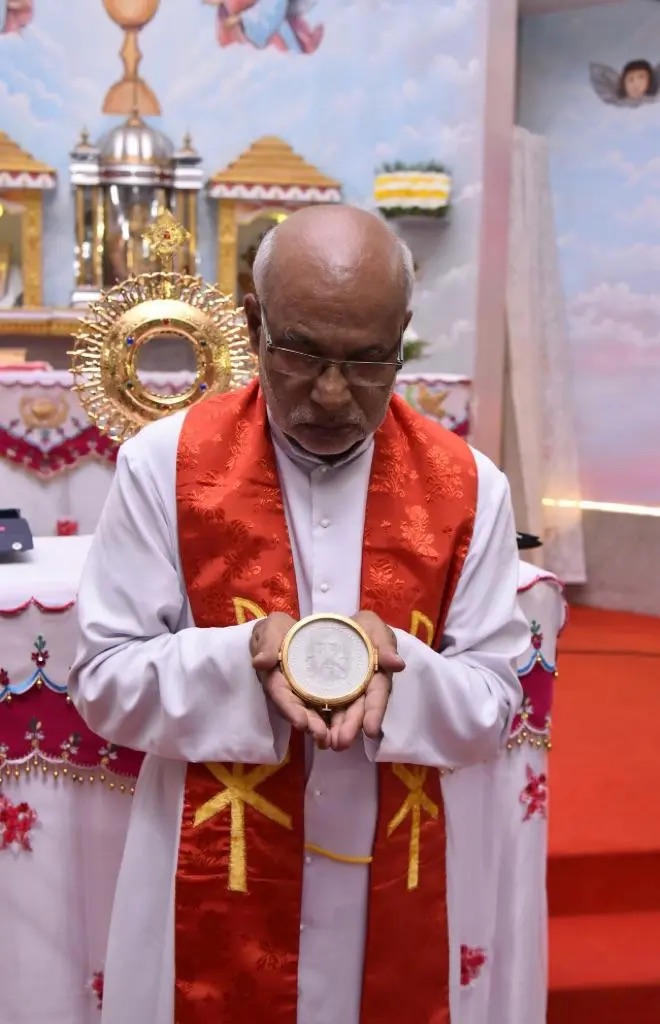
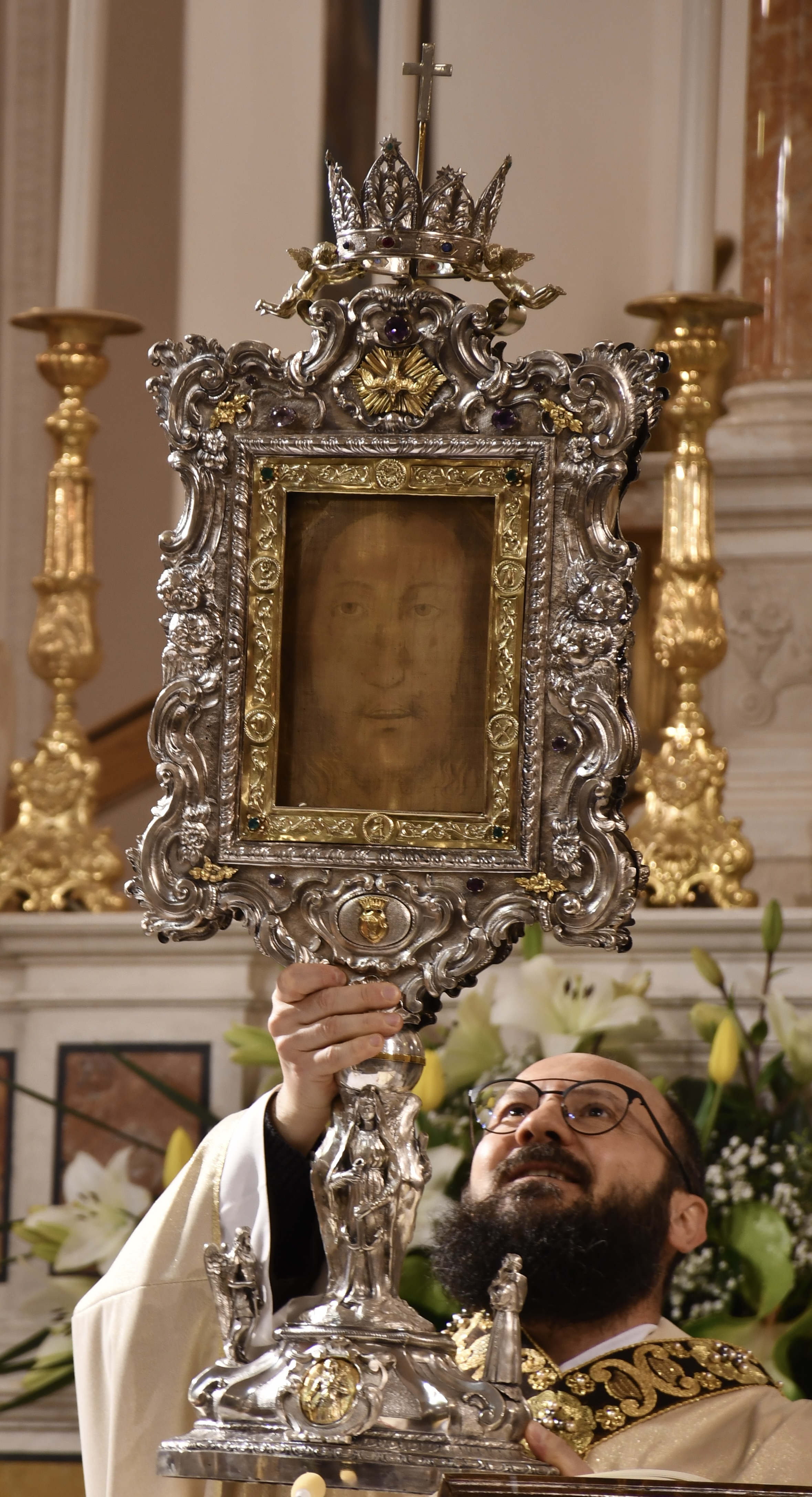
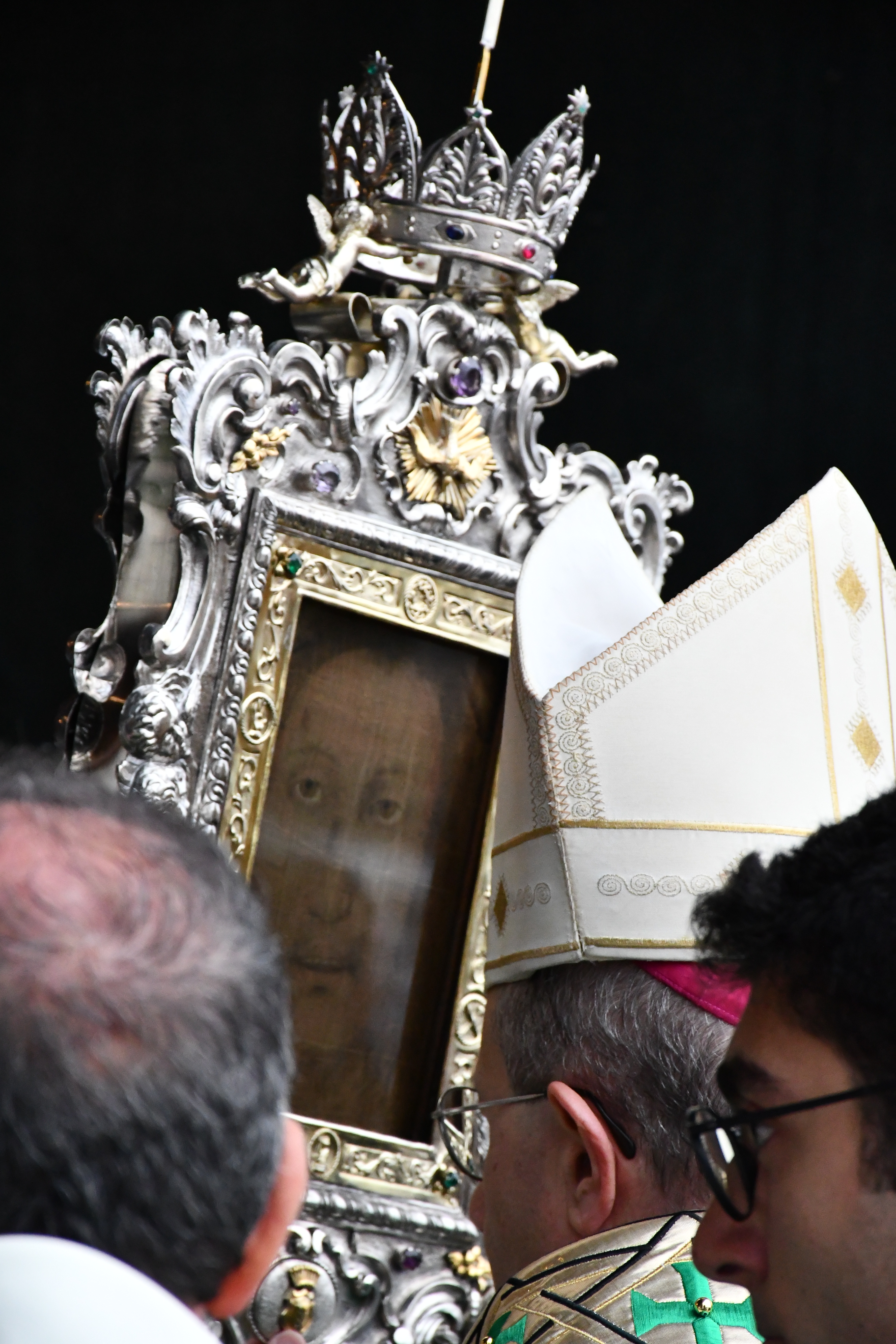
Vilakannur Miracle. The Priest carefully holds in his hands the Holy Eucharist on which the Face of Christ miraculously appeared during Mass.
“On November 15, 2013, a face resembling that of Jesus appeared on the host during Mass at the Christ the King Church, Vilakkannur, a parish under the Syro-Malabar Archdiocese of Tellicherry in the southern Indian state of Kerala.
The “Miracle” Host was sent to Rome for scientific study on January 10, 2020, through Apostolic Nuncio Archbishop Giambattista Diquattro who had come to the Syro-Malabar headquarters in Kochi, some 330 km south of Vilakkannur.
Devotion to the Holy Face of Jesus can be a helpful means to lead us to an encounter with Jesus in our life-long journey–enabling us to recognize Him–and He, to recognize us. This devotion is comprised of three elements–as characterized by Pope Benedict XVI: Discipleship, Images of the wounded Face of Christ , and the Eucharist.
Pope Benedict XVI writes, “The first element [of devotion to the Holy Face] is discipleship and the orientation of one’s life toward an encounter with Jesus in the face of those in need. In order to do this, believers first need to become better acquainted with Jesus through the Eucharist.
The second element is relating to the Passion of Jesus, and the suffering expressed by the images of the wounded Face of Jesus, relating this to the Eucharistic experience.
The third element, the Eucharist is woven between the other two. The eschatological element then builds on awakening to Christ by contemplating his face in the Eucharist.“
The Eucharistic Face of Jesus is central to the devotion of the Face of Christ! Clearly, the grace and strength flowing from worthy reception of the Sacrament of the Eucharist is vital to encountering Jesus in the faces of our brothers and sisters in need, as well as for the prayerful contemplation of Christ’s Face in images of His Passion. In Novo Millenio Ineunte, Pope St. John Paul II wrote, “And it is the Church’s task to reflect the light of Christ in every historical period, to make His face shine also before the generations of the new millennium. Our witness, however would be hopelessly inadequate if we ourselves have not first contemplated his face.”
Contemplation of the Face of Jesus is the veil of devotion, with which we may ‘wipe His bruised and wounded Face, ‘woven’ together with “discipleship, and the Eucharist,” which can lead Christians to “the love of God and love of neighbor” that will enable us to see Christ’s Face when He comes again in glory on the final day.
“The invisible Face of Christ,the son of God, is manifest in His Body an Blood in the simplest and, at the same time, the most exalted way possible in this world.
The ecclesial community responds to people in every age who ask perplexed: “We wish to see Jesus” (Jn 12,21), by repeating what the Lord did for the disciples of Emmaus: He broke the bread. In the breaking of the bread, the eyes of those who seek Him with a sincere heart are opened. In the Eucharist, the intuition of the heart recognizes Jesus and His unmistakable love lived “to the end” (Jn 13,1). And in Him, in that gesture, it recognizes the Face of God!“— Pope St. John Paul II
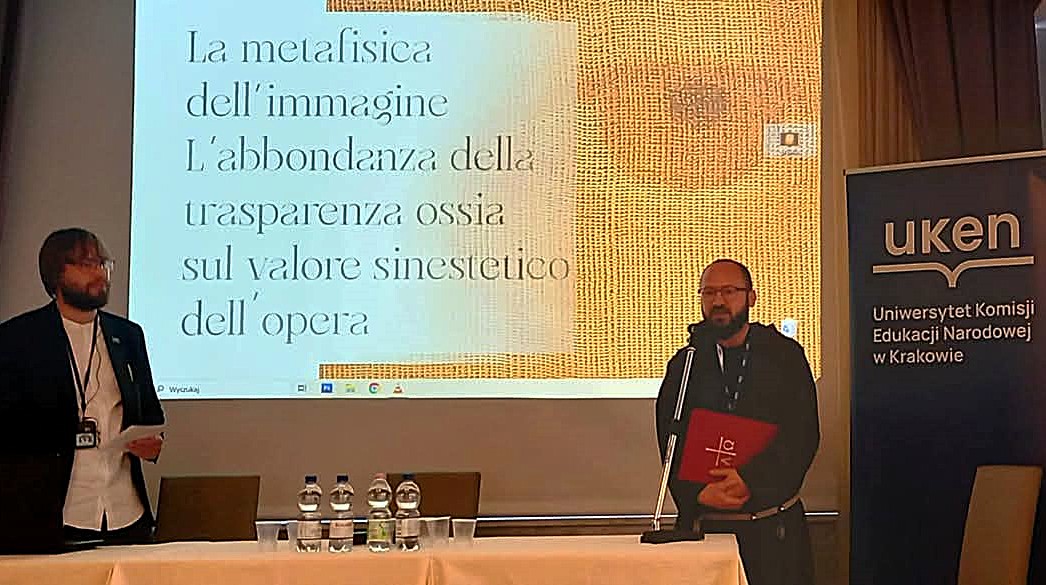
Rector of the Sanctuary Basilica of “Il Volto Santo,” Padre Antonio Gentili (R), greets Prof. Lukas Murzyn (L), and participants of the unique conference on the “Metaphysics of the Image.” Promoted by the UKEN University of Krakow, held at the Sanctuary of the Holy Face in Manoppello, Italy, on May 2-3, 2025.
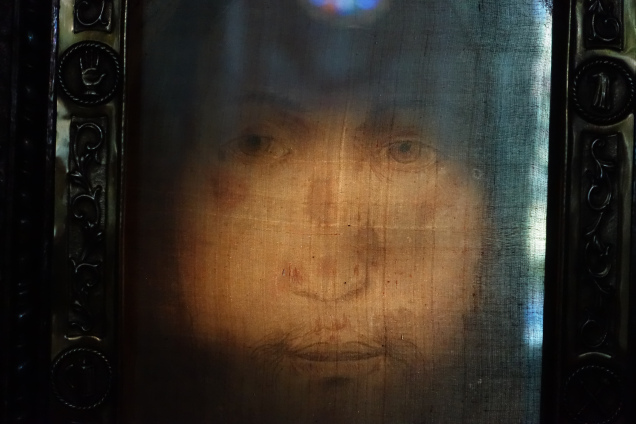
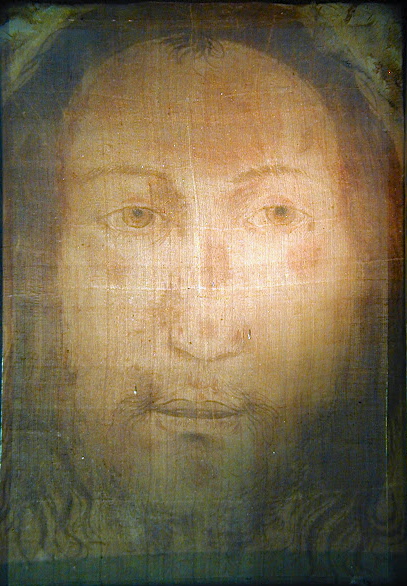
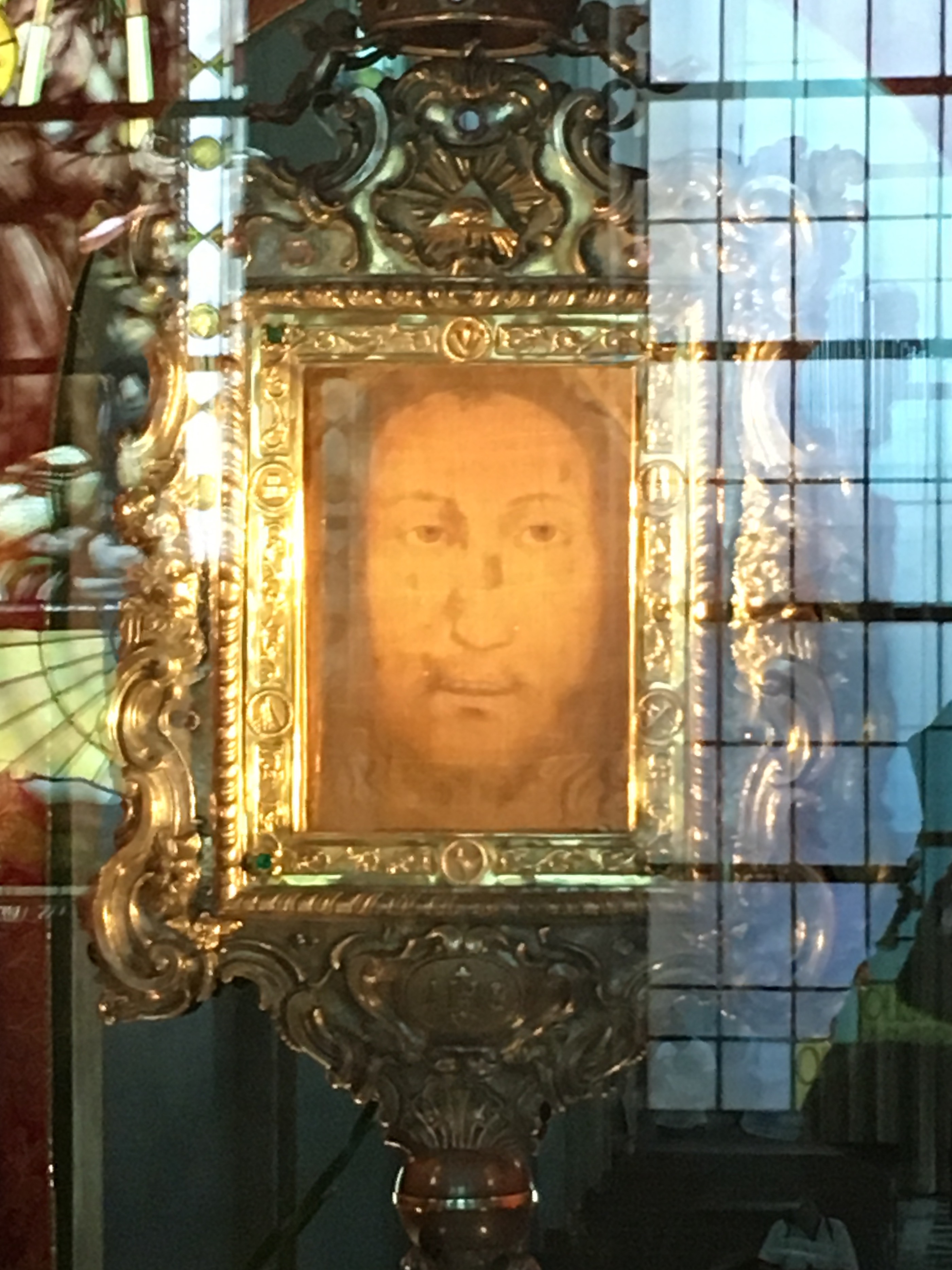
The Holy Veil of Manoppello –so sheer, and yet, without paint, an image my be seen of the Face of Jesus. (Photo: Paul Badde/EWTN)
For those who may be unfamiliar with “Il Volto Santo,” it is a precious relic veil considered to be an “Acheiropoieta” — meaning that its existence is supernatural — made by the Hand of God. The sheer veil, in a miraculous way, bears an image that is seemingly “written in light” of the Holy Face of Jesus Christ. This extraordinary relic has been the subject of intense study and renewed devotion at the dawn of this new millennium dedicated by Pope St. John Paul II to the Holy Face of Jesus Christ.
Padre Antonio Gentili, Rector of the Sanctuary Basilica, “face to face” with the Holy Veil of Manoppello. (Photo:Alexandra Prandell)
Antonio Bini, who was also invited to make a presentation on the important research on the Holy Veil by Fr. Heinrich Pfeiffer (1939-2021), has graciously provided a summary of a conference:
The Face of Christ on the Holy Veil becomes visible, according to the light, and at times appears to be a reflection of a living face. (Photo: Paul Badde/EWTN)
Antonio Bini writes: The relic veil of the Holy Face of Manoppello was the main focus of the conference, as it [The Holy Face of Manoppello] is considered “the source and root of the representations contained in tradition and an element of intellectual and supernatural conquests of Christian art,” as Prof. Lukas Murzyn, dean of the Faculty of Art and head of the Art and Metaphysics Study Group, explained in his introduction.
The Group, which operates at the Institute of Painting and Artistic Education of the Faculty of Fine Arts of the University of the National Commission for Education in Krakow (UKEN), promoted the conference held on May 2nd and 3rd, 2025, in Manoppello, Italy, having conducted research for several years on the changes in contemporary iconography, operating in the field of visual anthropology, the history of the philosophy of art, both in the field of experimental artistic activities and in that of the language of visual arts.
The professors of UKEN University during a break (Photo: Antonio Bini)
The speakers were welcomed in the conference room of the Casa del Pellegrino by the Rector of the Sanctuary, Padre Antonio Gentili and by the Mayor of Manoppello, Giorgio De Luca.
The conference was intended to respond to the question of what remains today of those roots [of representations of the Holy Face], how they are understood and what the metaphysics of the image can open up today.
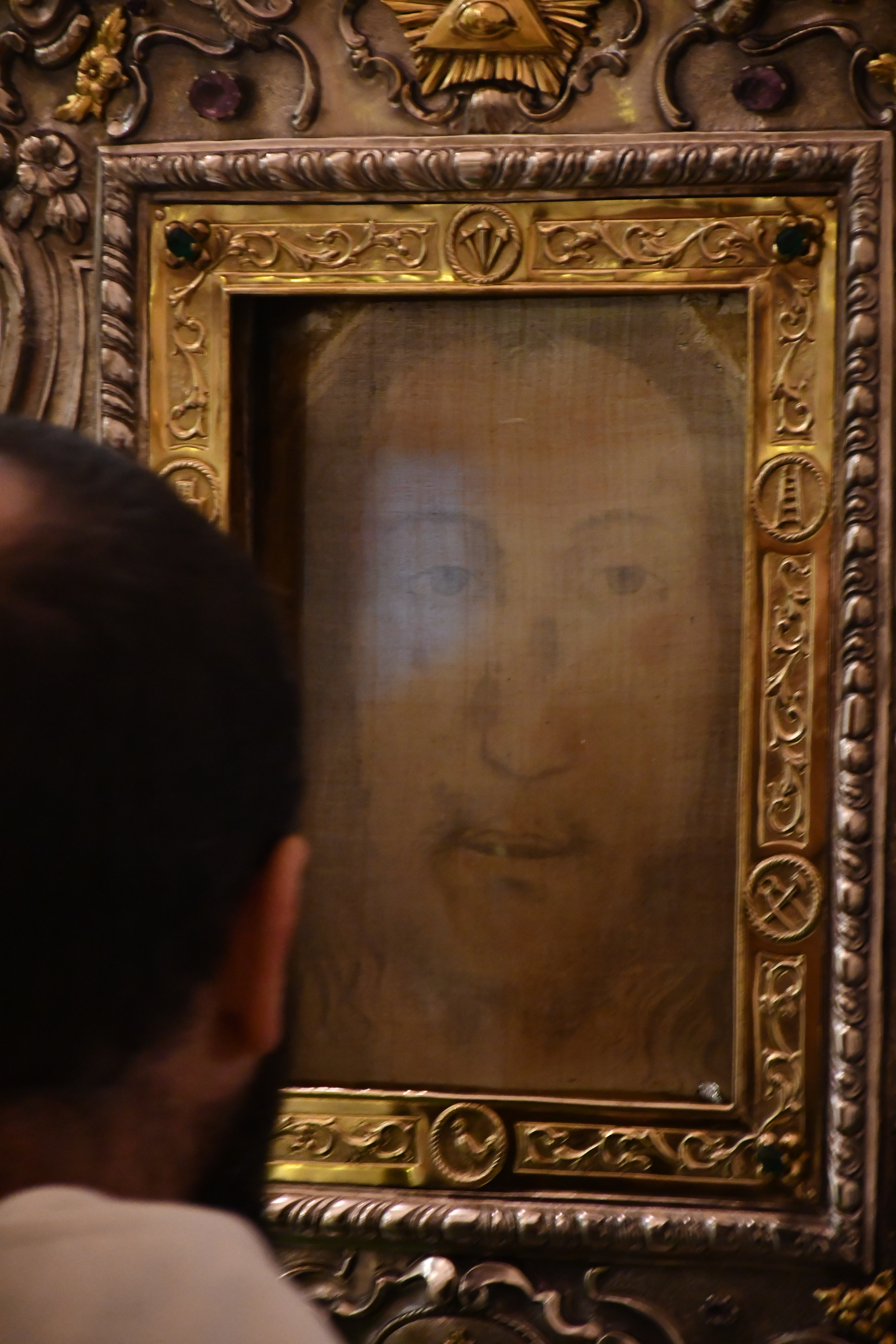
The Holy Face of Manoppello (Photo: Alexandra Prandell)
From the “Relatione Historic, 1640, a description of the Face by Padre Donato da Bomba: “He has a rather long, well-proportioned face, with a venerable and majestic look. His hair, or locks are long with thin twisted curls–in particular at the top of the forehead about fifty hairs wind into a little corkscrew, distinct from each other and well arranged. His left cheek is swollen and bigger than the other because of a strong blow across the cheek. The lips are very swollen. His teeth show. It seems the Holy Face is made of living flesh, but flesh that is afflicted, emaciated, sad, sorrowful, pale and covered in bruises around the eyes and on the forehead. The eyes of Christ are similar to those of a dove…He is serene and tranquil.”
Historical-religious themes were also developed, with the intervention of Padre Ceslao Gedacz OfmCap, who recalled some important figures in the history of the Holy Face belonging to the Capuchin order, such as Padre Donato da Bomba, who was responsible for drafting the Relatione Historic (1640), following the donation of the veil to the Capuchins. Padre Fillipo da Tussio, author of the first essay on the Holy Face published in 1875, and then Padre Domenico da Cese, the first to convincingly spread the divine nature of the sacred image. There were also references to some scientific tests and the findings of two commissions of doctors; the first composed of Germans and Austrians, the second of Italian doctors, who worked at the Sanctuary in 2011 and 2012, which Padre Ceslao himself followed, being part of the community of religious men of Manoppello at that time.
Servant of God Padre Domenico da Cese (1915-1978, former Rector of the Shrine) prays before the Veil of Manoppello.
Metaphysics of the Image conference hall. (Photo: Antonio Bini)
These researches were recently published in the essay by Sr. Blandina Paschalis Schloemer, with the title “Sali al tramonto”(2025), her first book published in Italian after various essays published in Austria, Germany, Poland, and France. The German iconographer was present at the proceedings.
Sr. Monika Gutowska of the Ancelle dei Santissimo Sangue in Manoppello, summarized her experience of welcoming and contact with many pilgrims, presenting several cases, including non-believers, of people who have seen their lives transformed, but also the desire of many devotees to return to the Sanctuary several times a year, from Italy and abroad, for a deep need to periodically encounter again that Holy Face, whose reproductions are present in many Polish homes. [And many others, as well, around the world!]
Among those present was also Padre Carmine Cucinelli, former rector of the Sanctuary, involved in recent years in enthronements of the Holy Face in Poland, and also in the Sanctuary of Krakow dedicated to Pope St. John Paul II.
In addition to the aforementioned Prof. Lukas Murzyn, the following speakers then gave presentations: Sebastian Stankiewicz, Rafal Slewski, Kazimierz Piotrowski, Bernadeta Stano, Anna Grabczewska, Agnieszka Daca, Jacek Pasieczny and Stanisław Wójcicki from the Study Group of the Uken University of Krakow.
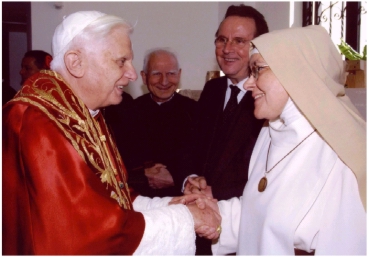
2006 – Pope Benedict XVI meets Sr. Blandina Paschalis Schlomer on his visit to the Sanctuary of the Holy Face in Manoppello, as Fr. Heinrich Pfeiffer, and Paul Badde look on.
We summarize the papers presented, whose simultaneous translation was edited by Agnieszka Kiedzik, from the University of Warsaw. The same papers may be the subject of further study in the publication of the proceedings, which will be edited by Sebastian Stankiewicz, with the title “Beautiful God: The Veil of Manoppello and the Iconography of the Incarnation,” with reference to a theological reflection on the “Beautiful God” present in the Middle Ages, expressed by Cardinal Joseph Ratzinger during a conference held at the Pontifical Urbaniana University in Rome, later taken up by Pope Benedict XVI.
“Being struck and overcome by the beauty of Christ is more real, more profound knowledge than mere rational deduction…We must rediscover this form of knowledge; it is a pressing need of our time.” ~ Excerpt from “The Feeling of Things, the Contemplation of Beauty” by Card. Joseph Ratzinger
The Group’s commitment also led to the creation of a portal — https://diafanitas.uken.cracow.pl — which collects experiences and initiatives on the study of the transparency of bodies crossed by light in a Christian dimension.
Dirk Bouts, 1400? – 1475
Christ Crowned with Thorns,about 1470
Various interpretative readings of the Holy Face have been developed, with the assumption that “whoever has come into contact with the Veil of Manoppello attests to its uniqueness and mystery.”
For representatives of the art sciences, many questions remain open: the origin of the image and history, the relationship between the relic and image, the role of the Veil of Manoppello in the creation of iconographic models in Christian art and in the evolution of ways of representation in Western Culture, the role of the veil among other representations considered acheiropoieta or formal similarities with the images of Christ depicted in the art of old masters; for example Dirk Bouts, Leonardo Da Vinci and Albrecht Durer, among others, and in the Eastern tradition. For contemporary art scholars, philosophers, theologians and anthropologists, the encounter with the Holy Face raises questions such as the relationship between sensual beauty and transcendent beauty, the idea of transparency and lights, the Christian sources of the idea and concept of a person, the meaning of the gaze and the encounter, the presence and contemporary reception of religious themes in art and sacred art and the importance of metaphysical references in contemporary art.
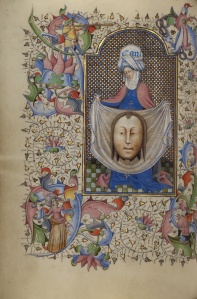
Veronica’s Veil Flemish 15th Century This is a fine example of the “Veronica” as portrayed by artists who saw the original for themselves, before it disappeared from view from the Vatican in 1527.
In my [Antonio Bini’s] presentation, I recalled the studies of Fr. Heinrich Pfeiffer (1939-2021), former professor of Christian history at the Gregorian University in Rome, who identified the Holy Face [of Manoppello] with the Veronica (vera icon), on the the occasion of the International Conference of the Institute for Research on the Face of Christ, chaired by Cardinal Fiorenzo Angelini, and then during a press conference held in Rome on May 31, 1999, on the eve of the Great Jubilee of 2000, which spread knowledge of the Abruzzo Sanctuary [of the Holy Face in Manoppello] throughout the world. Some sequences of that press conference with the interview of the German scholar, on Italian and foreign television, were repurposed in a video that the organizers wanted to show at the opening of the proceedings.
Fr. Pfeiffer’s position was then an isolated one, long contested, more or less openly. But his theses were later shared by Pope Benedict XVI, who visited the Shrine on September 1, 2006, composing a prayer that he dedicated to the “human face of God who entered history to reveal the horizons of eternity.”
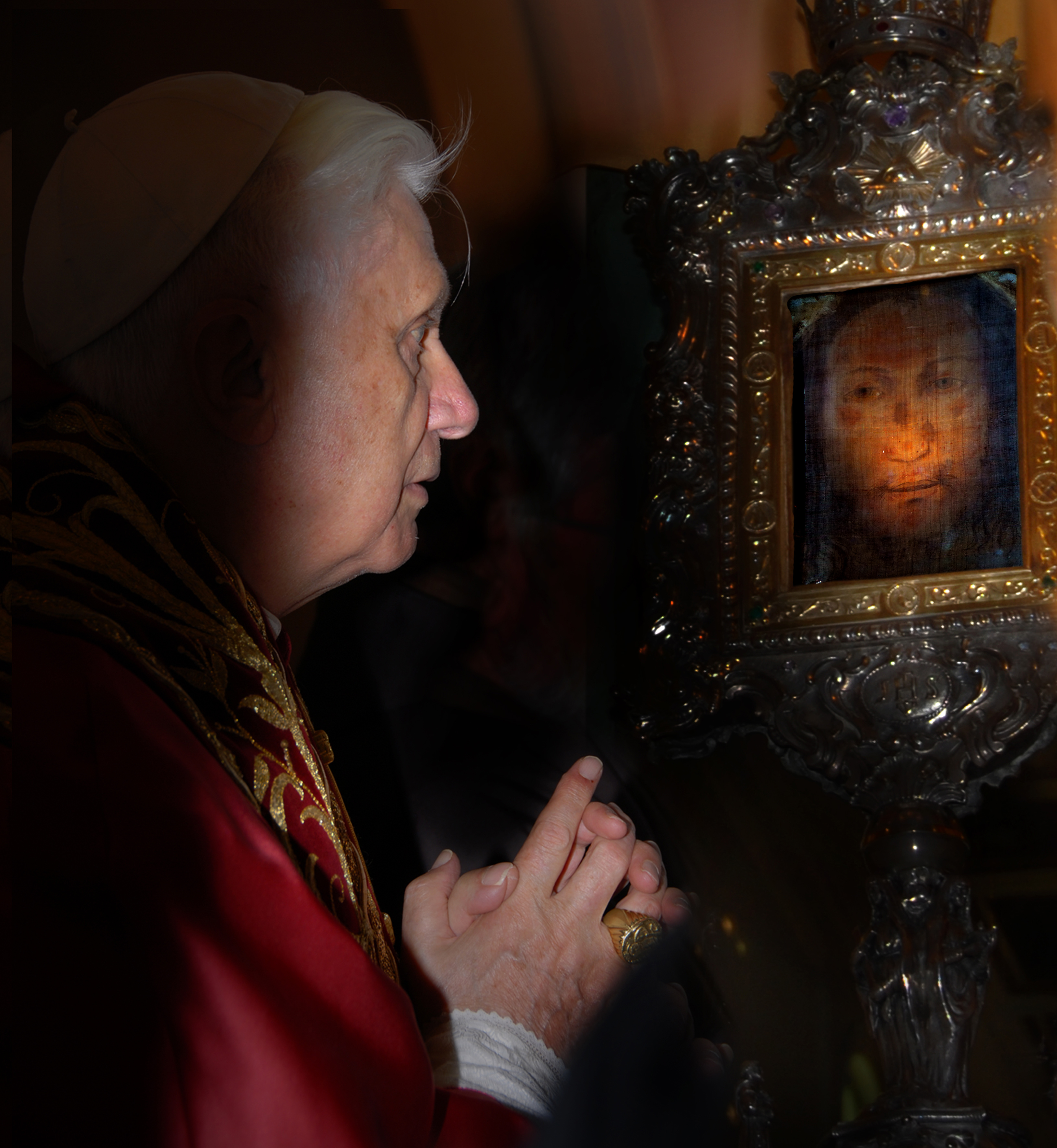
Pope Benedict XVI contemplates the Face on the Veil of Manoppello. September 1, 2006. (Photo: Paul Badde/EWTN)
Also under the pontificate of Pope Benedict XVI, a statement from the Holy See on July 11, 2011 reported that the “Veronica disappeared from St. Peter’s following the Sack of Rome in 1527.” This circumstance was confirmed by the (then) director of the Vatican Museums, Prof. Antonio Paolucci (Former Minister of Culture of the Italian Government), in an interview with the Bologna newspaper Il Resto del Carlino on August 11, 2011.
The admission [of the Director of the Vatican Museums] put an end to almost five centuries of silence that had fueled doubts and uncertainties for a long time, also through works of disinformation carried out also through modifications of the same original image, through reproductions that presented a “Veronica” with eyes closed. In this regard, the Veronica Route Project was started in recent years by a group of Milanese scholars, which led to a collective search, still ongoing, of 6200 ancient depictions of the true icon of Christ (Veronicas) with the eyes open, collected in a multimedia catalogue.
And yet, on April 6, an article published on the Vatican News website reported the presence of the “Veronica” in St. Peter’s (or, a copy of it, a black background. No image is seen.), while the Holy Face [of Manoppello] is indicated as a “shroud,” [A burial face-cloth] reiterating its acheiropoieta nature [As supernatural–made by the Hand of God]. Evidently, the writer was unaware of the painful path that led to the admissions [of the Director of the Vatican Museums] of 2011. Fr. Pfeiffer would still be busy arguing his reasons.
This is an example of a reproduction, made by Pietro Strozzi after 1527, when the original could no longer be viewed. The dark image of a dead man’s face bore no resemblance to previous descriptions and paintings of the Veil.
The dark cloth in a face-shaped frame that is currently presented, from a great distance, at the Vatican. (Photo: Daniel Ibanez)
Finally, during the conference, the exhibition of artist-teachers and students entitled “Face to Face” was presented, delicately entering the space of the Sanctuary, to offer a unique forum for interdisciplinary dialogue.
“At the basis of the concept of the exhibition,” declared the curator, Prof. Stanisla Wojcicki, “is the face-to-face encounter with the image of the Veil [Of the Holy Face of Manoppello], treated by scholars as a prototype of other representations of Christ. We would like our works to be considered a votive offering, something that we leave here to express gratitude, for the fact that we were able to meet in this place–particularly important to us.”
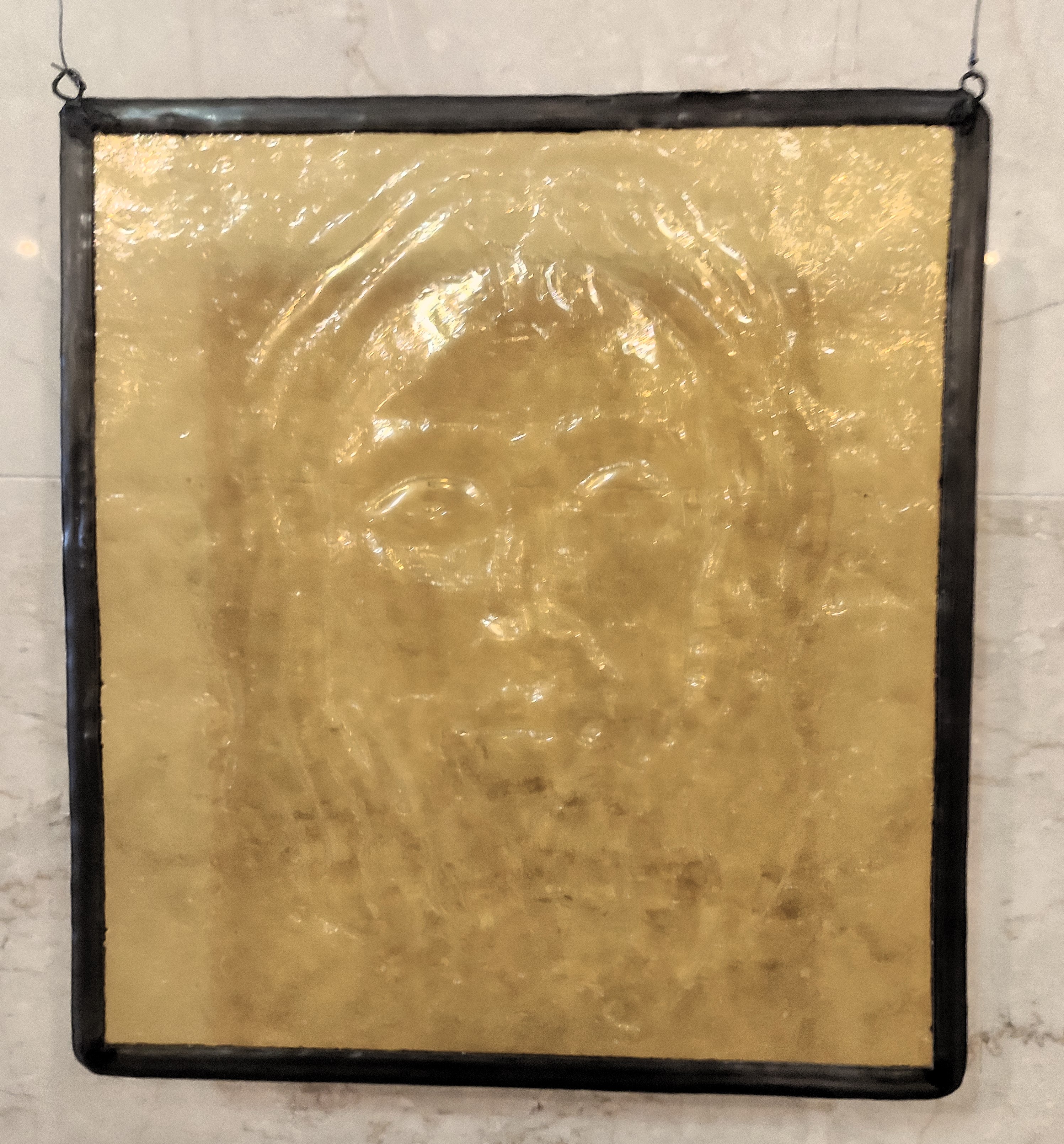
“Not matter but image,” a work by Jacek Pasieczny
“Not matter but image,” a work by Jacek Pasieczny, was exhibited in the Basilica as part of the “Face to Face” exhibition. The author described the work as “reflections of light, with the author” through the “use of glass of a particular color recalling golden byssus.” [of which the Holy Veil is believed to be woven.] The artist specified that it is not a copy of the original, but an attempt to paint a picture with light.
At the end of the conference we asked for an overall assessment from Don Arturo Alcántara Arcos, professor of spiritual theology and collaborator of the Soumaya Museum in Mexico City, also in Manoppello for the occasion, who stated: “It is particularly interesting to consider multidisciplinary points of view from a secular university. Here one can appreciate the different areas in which theology can be present, both directly and indirectly. The Uken of Krakow, inspired by the National Commission for Education established in the eighteenth century by the Polish King Poniatowski, open doors to a new dialogue between theology and the different artistic and aesthetic disciplines of our days in the contemplation of the Face of the Lord.” From what emerged during the conference and on the basis of the same conclusions of Prof. Lukas Murzyn, the belief that the Holy Face can also represent today the reference to the contemporaneity of Christ for art appears to be shared. An analytical perspective that the professors of the University of Krakow — the first to organize a similar event in Manoppello — intended to offer the art world.
Grazie Mille! Antonio Bini for this beautiful summary of the Conference on the Metaphysics of the Image!
One last thought from the beloved Cardinal Ratzinger — and later — Pope Benedict XVI:
Holy Face of Manoppello, (Photo: Paul Badde/EWTN)
“The encounter with the beautiful can become the wound of the arrow that strikes the heart and in this way opens our eyes…” “Inner perception must free itself from the impression of the merely sensible, and in prayer and ascetical effort acquire a new and deeper capacity to see, to perform the passage from what is merely external to the profundity of reality, in such a way the artist can see what the senses as such do not see, and what actually appears in what can be perceived: the splendor of the glory of God, the “glory of God shining on the face of Christ.” (11 For 4,6). –“The Feeling of Things, the Contemplation of Beauty” by Card. Joseph Ratzinger
Shroud of Turin, Veil of Manoppello and Vilnius image of Divine Mercy are examined in new film THE FACE OF JESUS, a stunning documentary set for release in U.S. theatres nationwide on June 3 by Fathom Entertainment
MAY 1, 2025 –DENVER. Can we see the face of the invisible God? Do we know what our Savior looked like? Fathom Entertainment, Sonovision and Candelaria Productions Inc. announce the upcoming nationwide release of the new documentary feature The Face of Jesus in U.S. theatres for one-day only on June 3. Produced and directed by Polish filmmaker Jaroslaw Redziak, the movie brings audiences a powerful experience of the most mysterious, rare and revered images of Jesus and brings audiences a cinematic face-to-face encounter with God that is compelling, provocative and awe inspiring!
“There is endless fascination with who God is, what he looked like and if it’s possible that he has left us an image of himself,” said Jaroslaw Redziak, producer and director of The Face of Jesus. “We set out to examine three of the most popular images that reveal the face of God – two divine images not made by human hands – the famous Shroud of Turin and the Veil of Manoppello. We also weave in the third image of Jesus made by human hands, the divinely inspired image known as the Vilnius image of the Divine Mercy. Audiences will be fascinated by what they see and what they hear about these astounding images of the face of Jesus.”
Known throughout the world, the Shroud of Turin is an ancient linen cloth with the image of a man believed by many to be Jesus Christ and is kept in the Cathedral of St. John the Baptist in Turin, Italy. The Shroud has been the subject of extensive scrutiny, scientific study and thousands of news stories that have probed its authenticity. The Veil of Manoppello is another ancient cloth that is lesser known, discovered in the early 1900s, but gained wider awareness and popularity when the late Pope Benedict XVI made a visit during his Papacy in 2005 to the remote village to see for himself. This veil has been the subject of research and writing by documentary subject and renowned German journalist and historian Paul Badde whose work has exposed the veil to a global audience. The veil reveals another image of Jesus and according to experts corresponds to the face of Christ in the Shroud of Turin. The last image to be explored is the Vilnius image of the Divine Mercy, a divinely inspired image made by human hands based on visions and messages of Jesus given to Saint Faustina Kowalska. The image was painted by Eugeniusz Kazimirowski and created under the guidance of Saint Faustina and her confessor Blessed Michael Sopocko.
Throughout the film, several prominent experts from around the world bring forward the authenticity of the Shroud of Turin and the Veil of Manoppello as well as the story behind the painting of the stunning Vilnius image of the Divine Mercy that has become a central image within the popular contemporary Catholic devotion to the Divine Mercy.
“The compelling hypotheses, observations and even miracles connected to these images, will lead audiences to ponder the reality of the seen and unseen God,” said Konrad Sosnowski, President of Sonovision. “I am grateful that Fathom Entertainment is partnering with us to bring a film of deep mystery, inspiration and worthy consideration to U.S. movie-goers.”
Featured experts in the documentary include:
Fr. Zbigniew Drzal, author of “Show Me Your Face”
Marcin Kwaśny (narrator), acclaimed Polish actor (Triumph of the Heart), screenwriter and director
Krzysztof Sadlo, curator of the exhibition dedicated to the Turin Shroud at the John Paul II Center in Krakow
Professor Wojciech Kucewicz, expert in silicon detectors of ionizing radiation
Professor Tomasz Graff, Pontifical University of John Paul II in Krakow
Anna Krogulska, PhD, Polish lay missionary with a focus on the Shroud of Turin
Paul Badde, renowned German journalist and writer, author of best-sellers “Divine Face” and “Face to Face: Witness to the Resurrection”
Fr. Carmine Cucinelli, OFM Cap, Italian Capuchin friar and former custodian of the Shrine of the Holy Face in Manoppello; hosted Pope Benedict XVI at the Basilica
Sr. Petra-Maria Steiner, Vita Communis – Maria of the Holy Family and expert on the history of Manoppello
Following the main feature documentary, a short bonus presentation will include commentary from prominent U.S. clergy, Fr. Robert Altier, priest of the Diocese of St. Paul and author of God’s Plan for Your Marriage, and Fr. Lawrence Daniel Carney III, priest of the Diocese of Wichita, who eloquently add further context to The Face of Jesus, its themes and the growing devotion to the Holy Face in contemporary Catholicism.
“The U.S. clergy that we tapped for the bonus feature add beautiful spiritual context to what audiences will experience in the main film and will help people to go deeper,” said Oscar Delgado, producer and founder of Candelaria Productions Inc. “Did you know there is a secret to the Holy Face? Father Carney will teach and instruct about Jesus’ countenance and the yearning we all have to see the face of God. Father Altier will provide historical and theological context for greater understanding.”
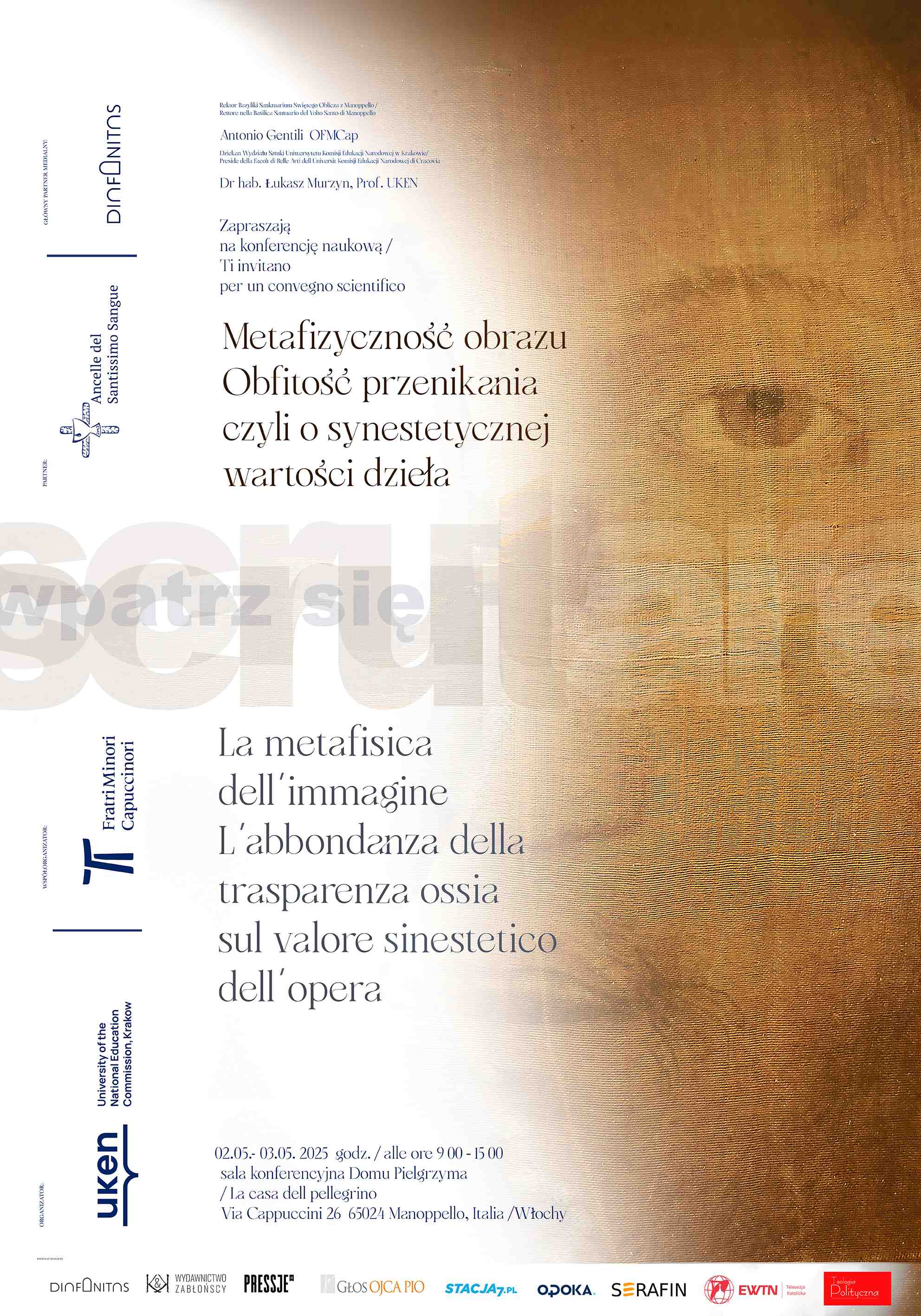
Poster for the upcoming May 2-3 conference to be held at the Sanctuary in Manoppello.
Pope St. John Paul II’s words “Be not afraid!” immediately came to mind after I read the daunting title of the unique scientific conference that will be hosted by the Sanctuary of the Holy Face in Manoppello, Italy, on May 2-3, 2025:
“The Metaphysics of the Image. The Abundance of Interpenetration, or on the Synesthetic Value of the Work.”
But, as intimidating as the title may be, the words are an open invitation to all (admission is free) for those who “seek the Face of God” to come to the Sanctuary Basilica of Manoppello to listen, prayerfully contemplate, and discuss the beautiful and profoundly deep meaning of the existence of the mysterious “Acheiropoieta”–made by the Hand of God–that is known as “Il Volto Santo” – a miraculous image of the Face of Jesus that is inexplicably present on sheer veil.
Veil of Manoppello,photo: Paul Badde/EWTN
“Duc in Altum”
One certainly must admire those who have organized this wonderful event, uniting science, faith, and art, for not fearing “to put out into the deep” (Luke 5:4): The Art and Metaphysics Research Team of the University of the Commission of National Education in Krakow, Poland, and the congregation of the Friars Minor Capuchin in Manoppello, Italy. The conference will take place in person and will be accompanied by an exhibition of artists, lecturers and students of the Uken University of Krakow entitled “Face to Face.”
The organizers have provided further details for those who may like to attend this important event:
The first day of the conference, May 2, the “speakers’ presentations and discussion will focus on the historical and contemporary contexts of the Holy Face, with particular emphasis on the influence of the centuries-old cultural and religious heritage of this image on the iconography of Christianity and the role it has to play in the contemporary world.” Prof. Antonio Bini will give a presentation on Fr. Heinrich Pfeiffer, S.J. and his great contribution to the research on the Holy Veil of Manoppello in the 1990’s.
The second day of the conference, May 3, a panel will be held on “contemporary religious art and its contexts. The topics of the presentations will include attempts to apply scientific interpretative tools from the fields of philosophy, theology, and art history to the Image of Manoppello and other relics ‘not made by human hands.’ Artists, participants of the ‘Face to Face’ exhibition, will also share their reflections on the influence of the Bible and hagiography on their creative process. It will therefore, not only be a space for the exchange of knowledge, but also for reflection on the role of the artist and the Church in the face of the challenges of modernity.”
The conference “is intended to be not only an opportunity for scientific reflection, but also to learn about the diverse attitudes and ways of expression represented in the environment of artists working our Art and Metaphysics Research Team. During the conference an exhibition of artists-pedagogues and students entitled ‘Face-to-Face’ will be presented. It is intended to enter the space of the Sanctuary in the most delicate way possible, but also to be a unique forum for interdisciplinary dialog.
The artists generously desired to leave the fruits of their work as a permanent exhibition in Manoppello for the edification of Pilgrims to the Sanctuary Basilica: “We would like our works to be a votive offering, something that we will leave to express our gratitude for being able to be in this place that is particularly important to us. Together with the works we bring, we would like to bring our own intentions and reflections related to the most intimate possible relationship, with God” –Declaration of the artists of the “Face-to-Face” exhibition
“This exhibition is a kind of prayer of thanksgiving and an introduction through artistic means to the contemplation of the Divine Face of Manoppello…and at the same time a preface (Latin: praefatio) for [the artists] further activities.
This photo was taken on Easter by Alexandra Prandell, of the Rector of the Shrine, Padre Antonio Gentili, whose face reflects the joy of the Risen Christ.
“The international scientific session at La Casa Pellegrino in Manoppello will be honored by the presence of His Excellency Mons. Archbishop Bruno Forte, Archbishop of the Diocese of Chieti, and will be attended by: clergy, journalists, researchers, art historians, philosophers and artists: Czeslaw Gadacz OFMCap, Prof. Antonio Bini, S.M. Monika Gutowska SAS, Prof. Lukas Murzyn, Dr. Sebastian Stankiewicz, Prof. Rafael Solewski, Dr. Bernadeta Stano, Anna Grąbczewska, Dr. Agnieszka Daca, Dr. Jacek Pasieczny, Mgr. Stanislaw Wojcicki.
During the session, the film directed by Jaroslaw Redziak entitled “The Face of Jesus” will also be presented.
This important event, I believe, will greatly enrich our understanding and knowledge of “Il Volto Santo.” The precious veil of the Holy Face is not a mere curiosity. Such a great gift from God must be taken very seriously and approached prayerfully, with reverence, love, and a deep desire for a better understanding of God’s ultimate Gift of His Son to us.
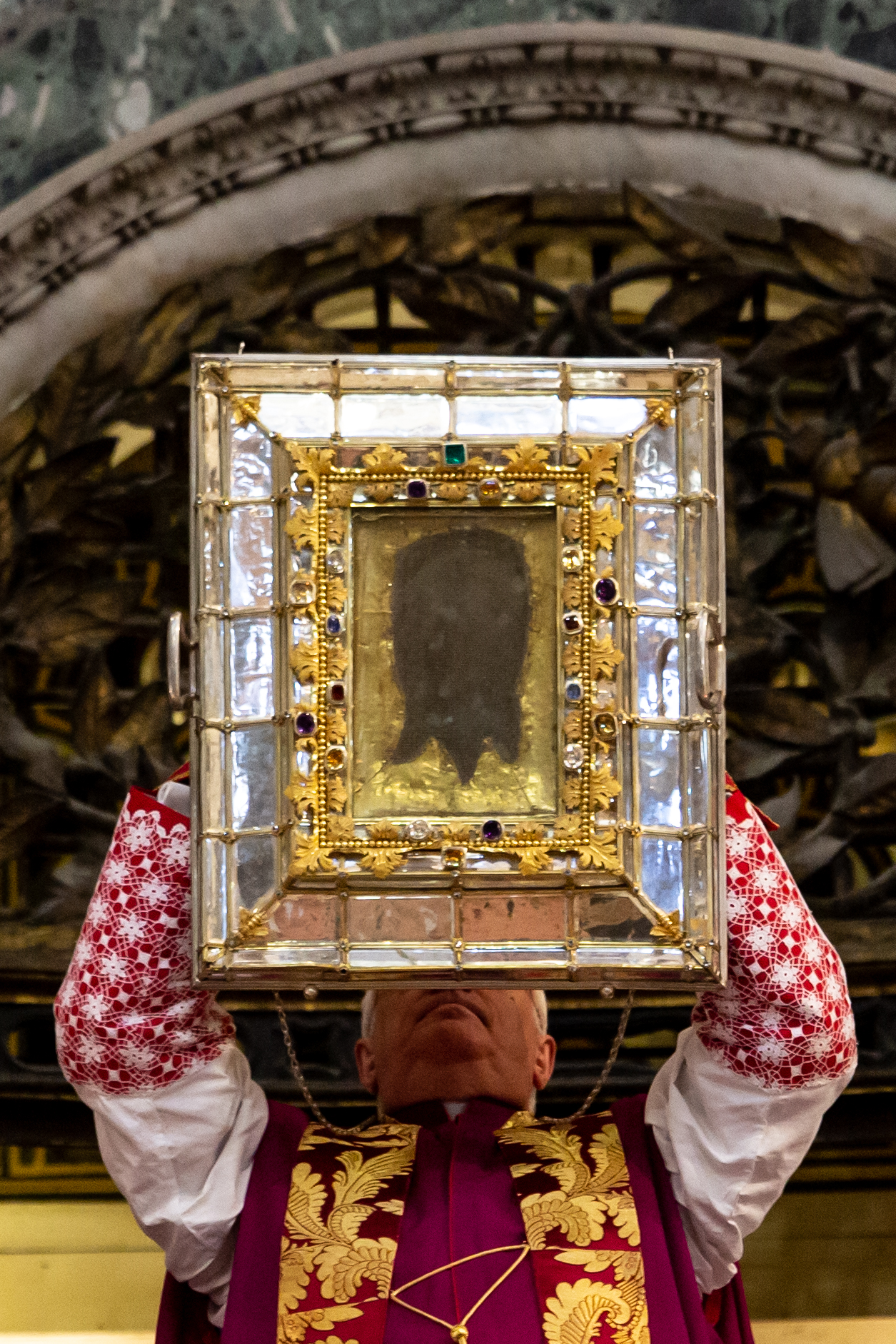
Padre Antonio Gentili elevates and contemplates the “Eucharistic Face of Christ” in the Host, where Jesus is truly present, “Body, Blood, Soul and Divinity.” Photo: Alexandra Prandell
One last thought… Do not be afraid to dive into “The Metaphysics of the Image of the Face of Christ.” The artists and Our Creator both know that “A picture paints a thousand words,” and prove the existence of the artist, as well as the Divine Artist!
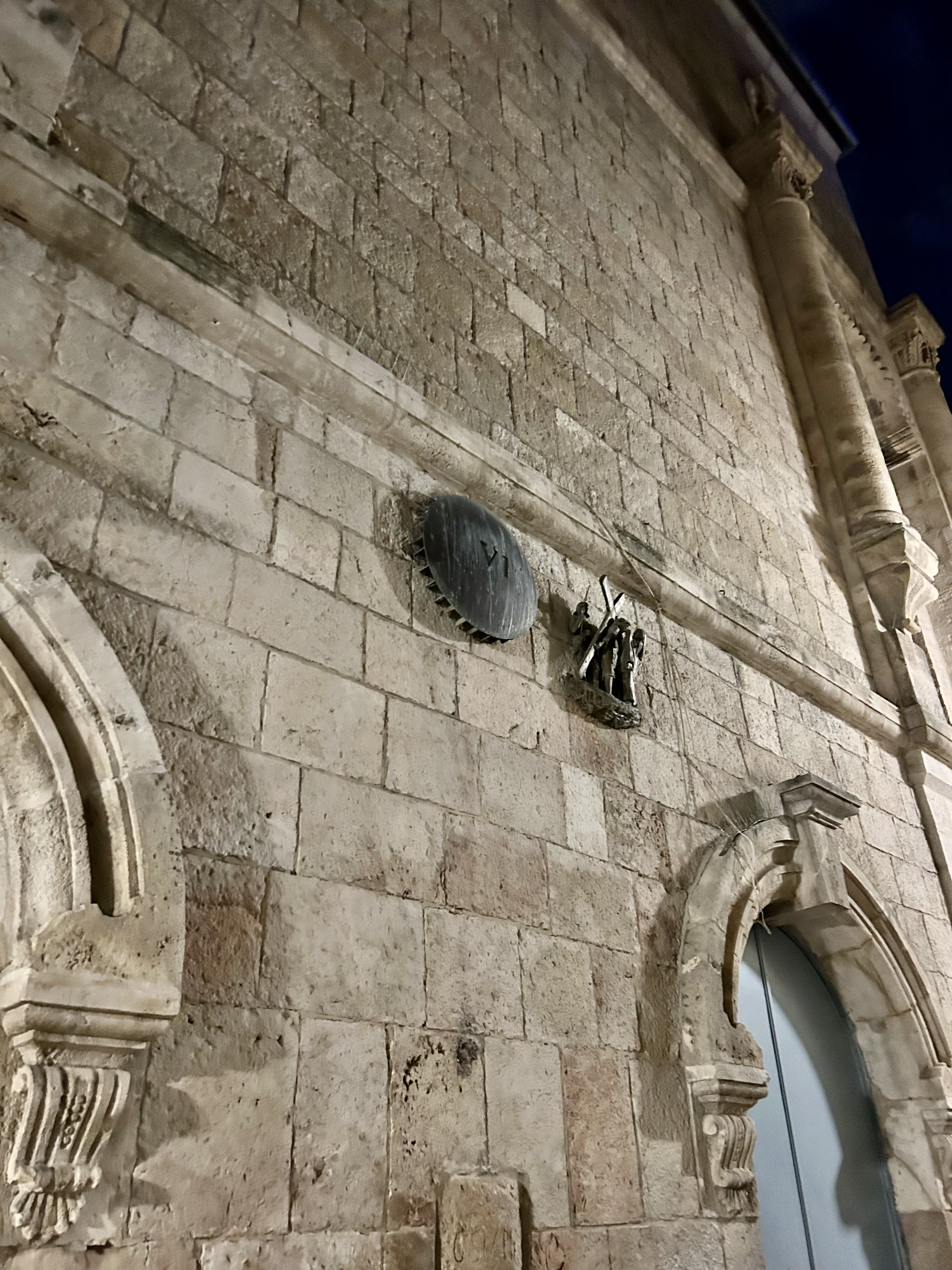
Was there actually a St. Veronica? It is an important question, and a very personal one to me and many others. According to tradition, “Veronica,” is the compassionate woman who wiped the Face of Jesus, who is commonly depicted in every Catholic church, at the Sixth Station of the Cross, yet her name does not appear in the Gospels, and the legends did not appear until the Middle Ages.
Pope St. John Paul II pondered this very question many years before dedicating the Millennium to the Holy Face of Jesus. The fruit of his prayerful contemplation unveils a profound truth for every Christian as he answers another question; What does it mean to be “a Veronica?”
The Sixth Station on the Via Dolorosa in Jerusalem
Veronica’s Veil, Flemish 15th Century
“St. Veronica”
The Catholic Church tells us that a veil bearing a miraculous image of the Face of Jesus has existed since the earliest centuries, recorded in history and in art, such as the Camulia, or the Mandylion. Explanations for the existence of such a veil were all different (see “Four Stories, One Face“). About the time this miraculous veil first appeared in Rome, the name “Veronica” referred to the veil itself, and not a person–“Veronica” meaning “vera” or true, and “icon” meaning image, or even more precisely, “to be present.” Those who gazed upon the veil bearing the true Face of Jesus stood in God’s presence. They were turned toward His Face. The Veil became the greatest relic that Pilgrims traveled to see in the Vatican.
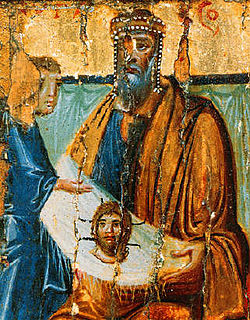
King of Edessa receiving the miraculous veil from St. Jude, and was healed of leprosy.
“Veronica” holding a sheer veil bearing the living Face of Christ on a sheer veil with distinctive folds.
Legends sprang up much later, in the Middle Ages, about a woman named “Veronica,” who was sometimes associated with the woman “Berenice” or “Bernice,” the bleeding woman who touches the hem of Jesus’s garment in the Gospel. There is a version, written in 1191 by Robert de Boron, that tells of a woman named “Veronica” wiping sweat from the Face of Jesus. The stories are many and varied, but the legend that most people are familiar with today is traced to a version by Roger d’Argenteuil in the 1300s, which tells of a woman “Veronica,” associated with the sixth station of the Cross–the compassionate woman, wiping the Face of Jesus on the way to Calvary with a cloth, upon which He leaves an image of His Face.
“These pious traditions cannot be documented, but there is no reason why the belief that such an act of compassion did occur should not find expression in the veneration paid to one called Veronica.” —The Catholic Encyclopedia
What did the Veil look like? A “living, changing, face” on a sheer veil, with distinctive folds, that could be viewed from either side; the eyes are open and glance to one side or the other; a lock of hair graces the center of the forehead; a sparse beard, wavy hair, as well as signs of bruising and trauma to the face are seen…. which despite the obvious suffering, remains peaceful and serene.
The Holy Veil of Manoppello- photo: Paul Badde/EWTN
Pope St. John Paul II expressed the answer to this profound question addressing the origin of the name of Veronica most beautifully in his poem, “The Name:”
The Name
In the crowd walking towards the place
[of the Agony]–
did you open up a gap at some point or were you
[opening it] from the beginning?
Veronica’s Veil by Hans Memling
And since when? You tell me, Veronica.
Your name was born in the very instant
in which your heart
became an effigy: the effigy of truth.
Your name was born from what you gazed upon.
–Karol Wojtyla
Miraculous Holy Face Veil Photo: Paul Badde (see “Manoppello Image” tab)
Since the detailed historical facts about the veil itself cannot be verified with absolute certainty in this life, the more important and answerable question is, “What does it mean to be a Veronica–a “true image?”
“Your name was born from what you gazed upon.”
When a soul performs an “act of compassion,” Jesus leaves His image on the “veil” of the soul. In other words, while contemplating the Face of Jesus in an image, in the Word of God in the Scriptures, in a person made in the image and likeness of God, or above all, in the Eucharist, the soul places itself in the Presence of God. When we are turned completely toward the Face of God, through a daily face-to-face encounter in prayer–by the power of the Holy Spirit–God gradually transforms the soul into the “True Image” of His Son, Jesus Christ. As Pope St. John Paul II says, our hearts must become an “effigy of truth,” a “true icon.” Then our name too will be born from what we gaze upon. It will be “Veronica.”
The Deepest Truth About St. Veronica
St. Veronica statue by Francesco Mochi, 1629
Within the center of St. Peter’s Basilica are four massive niches. In each niche there are four titanic statues of saints, standing 10 meters high: St. Andrew, the first disciple called by Christ, St. Longinus, the soldier who pierced Jesus’s side with his lance, St. Helena, who discovered the True Cross. The fourth statue depicts “St. Veronica,” an unknown woman, not mentioned in the Bible, yet immortalized in every Catholic church at the Sixth Station of the Cross, for her act of compassion to Jesus who left the image of His Face on her veil. (The relic that is now in the Veronica Pilar is quite different in description than what was previously recorded–a mystery yet to be solved. More may be read on the subject here: The Church, Testing of Relics, and the Holy Face)
Pope St. John Paul II wrote this beautiful meditation on St. Veronica in 2000, the same year in which he dedicated the millennium to the Face of Christ:
Sixth Station, St. Theresa Church, Ashburn, Virginia
“Veronica does not appear in the Gospels. Her name is not mentioned, even though the names of other women who accompanied Jesus do appear. It is possible, therefore, that the name refers more to what the woman did. In fact, according to tradition, on the road to Calvary a woman pushed her way through the soldiers escorting Jesus and with a veil wiped the sweat and blood from the Lord’s face. That face remained imprinted on the veil, a faithful reflection, a “true icon”. This would be the reason for the name Veronica. If this is so, the name which evokes the memory of what this woman did carries with it the deepest truth about her.
One day, Jesus drew the criticism of onlookers when he defended a sinful woman who had poured perfumed oil on his feet and dried them with her hair. To those who objected, he replied: “Why do you trouble this woman? For she has done a beautiful thing to me . . . In pouring this ointment on my body she has done it to prepare me for burial” (Mt 26:10, 12). These words could likewise be applied to Veronica. Thus we see the profound eloquence of this event.
The Redeemer of the world presents Veronica with an authentic image of his face. The veil upon which the face of Christ remains imprinted becomes a message for us.
In a certain sense it says: This is how every act of goodness, every gesture of true love toward’s one’s neighbor, strengthens the likeness of the Redeemer of the world in the one who acts that way. Acts of love do not pass away. Every act of goodness, of understanding, of service leaves on people’s hearts an indelible imprint and makes us ever more like the One who “emptied himself, taking the form of a servant” (Phil 2:7). This is what shapes our identity and gives us our true name.” –Pope St. John Paul II
This is the deep meaning and call to every Christian revealed in the presence of the unknown woman we call “St. Veronica”– each act of charity, every act of compassion will leave the imprint of the Face of Jesus in our souls, transforming us into His own Image.
Pope Benedict XVI looks at the ‘Veronica’s Veil’ during a visit to the Holy Veil monastery in Manoppello, central Italy, September 1, 2006.
Pope Benedict wrote, “To rejoice in the splendor of His Face means penetrating the mystery of His Name made known to us in Jesus, understanding something of His interior life and of His will, so that we can live according to His plan for humanity. Jesus lets us know the hidden Face of The Father through His human Face; by the gift of The Holy Spirit poured into our hearts.” This, the Pope says, is the foundation of our Peace, which nothing can take from us.
Benedict XVI has characterized devotion to The Holy Face as having three separate components: 1. Discipleship – an encounter with Jesus, to see Jesus in the Face of those in need. 2. The Passion of Jesus, and suffering expressed by images of the wounded Face of Jesus. 3. The Eucharist, “the great school in which we learn to see The Face of God”, which is woven between the other two. The eschatological element then builds on awakening to Christ by contemplating His Face hidden in The Eucharist.
“Our whole life should be directed toward encountering Him,” writes Benedict, “toward loving Him; and in it, a central place must be given to love of one’s neighbor, that love that in the light of The Crucified One, enables us to recognize the Face of Jesus in the poor, the weak, the suffering.” The pope goes on to explain the fruits of this contemplation: “From contemplation of the Face of God are born, joy, security, PEACE.”
Servant of God Ildebrando Gregori, OSB “Apostle of the Holy Face” and Spiritual Advisor of Bl. Pierina de Micheli
The great “Missionary of the Holy Face,” Blessed Mother Maria Pierina De Micheli, was asked by Our Lord to have a Feast of the Holy Face, which was to be preceded by a novena. (The Feast was approved in 1958 by Pope Pius XII, who formally declared the Feast of the Holy Face on “Shrove Tuesday” (The Tuesday which precedes Ash Wednesday.)
Bl. Mother Maria Pierina inspired her Daughters of the Immaculate Conception to make a novena with all the fervor of their hearts, uniting themselves to Jesus in grief and suffering, in the Garden of Gethsemane. She exhorted her nuns to honor the Face of Jesus by giving Him “a kiss of love.”
“Honor the Holy Face of our dear Jesus, sorrowful for the sins of men–ours–everyones–but specially for those who should be His intimate friends…Let us gaze profoundly at that Divine Face–speak heart to heart–and we will share His most bitter griefs–and He will say, ‘Console Me, you at least who say you love Me–in order to be all Mine.'” –Bl. Mother Pierina de Micheli, “Missionary of the Holy Face”
Day 1:
Daily Preparatory Prayer
(to be said each day as you console the Holy Face)
O Most Holy and Blessed Trinity, through the intercession of Holy Mary, whose soul was pierced through by a sword of sorrow at the sight of the passion of her Divine Son, we ask your help in making a perfect Novena of reparation with Jesus, united with His sorrows, love and total abandonment.
We now implore all the Angels and Saints to intercede for us as we pray this Holy Novena to the Most Holy Face of Jesus and for the glory of the most Holy Trinity, Father, Son and Holy Spirit. Amen.
First Day
Church of St. Veronica, Lecco, Italy c. 1280
Psalm 51: 3-4
Have mercy on me, O God in your goodness, in your great tenderness wipe away my faults; wash me clean of my guilt, purify me from my sin.
O most Holy Face of Jesus, look with tenderness on us who are sinners. You are a merciful God, full of love and compassion. Keep us pure of heart, so that we may see Thee always. Mary, our mother, intercede for us. Saint Joseph, pray for us.
Through the merits of your precious blood and your Holy Face, O Jesus, grant us our petition, …Pardon and mercy.
Prayer to Our Almighty Father
Almighty Father, come into our hearts, and so fill us with your love that forsaking all evil desires, we may embrace you, our only good. Show us, O Lord our God, what you are to us. Say to our souls, I am your salvation, speak so that we may hear. Our hearts are before you; open our ears; let us hasten after your voice. Hide not your Face from us, we beseech you, O Lord. Open our hearts so that you may enter in. Repair our ruined mansions, that you may dwell therein. Hear us, O Heavenly Father, for the sake of your only Son, Our Lord Jesus Christ, who lives and reigns with you and the Holy Spirit, one God, now and forever. Amen. (St. Augustine)
Pray one (1) Our Father, three (3) Hail Mary’s, one (1) Glory Be.
O Bleeding Face, O Face Divine, be every adoration Thine. (3 times)
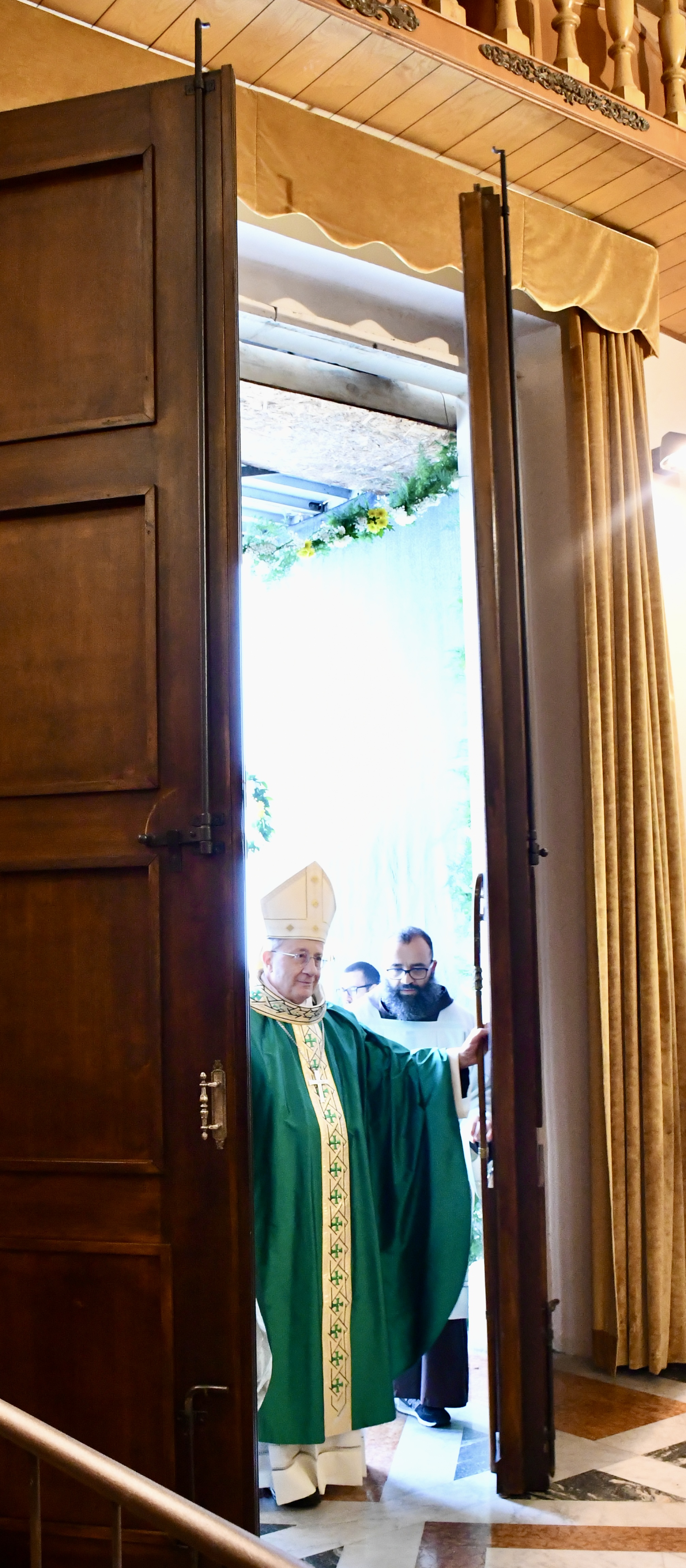
His Excellency Mons. Bruno Forte opens the Holy Door and enters the Holy Face Sanctuary. (Photo: Alexandra Prandell)
“All the Earth” shared in the joy of the Omnis Terra Eucharistic Celebration on Sunday, January 19th, at The Basilica Shrine of the Holy Face in Manoppello, Italy. The event was live-streamed around the world from the Sanctuary. The Eucharistic celebration was presided over by His Excellency Mons. Bruno Forte, Metropolitan Archbishop of Chieti-Vasto. Concelebrants were Fr. Simone Calvarese, Provincial Minister of the Capuchin Friars Minor of Central Italy, and Fr. Antonio Gentili, Rector of the Sanctuary of the Holy Face. The Mass was followed by a procession and blessing with the relic of the Holy Face Veil.
Many thanks to Alexandra Prandell, who has generously sent these beautiful photos for all devotees of the Holy Face to enjoy!
Fr. Antonio Gentili before the Holy Face Veil. (Photo: Alexandra Prandell)
Archbishop Forte carries the Holy Face Relic in procession (Photo: Alexandra Prandell
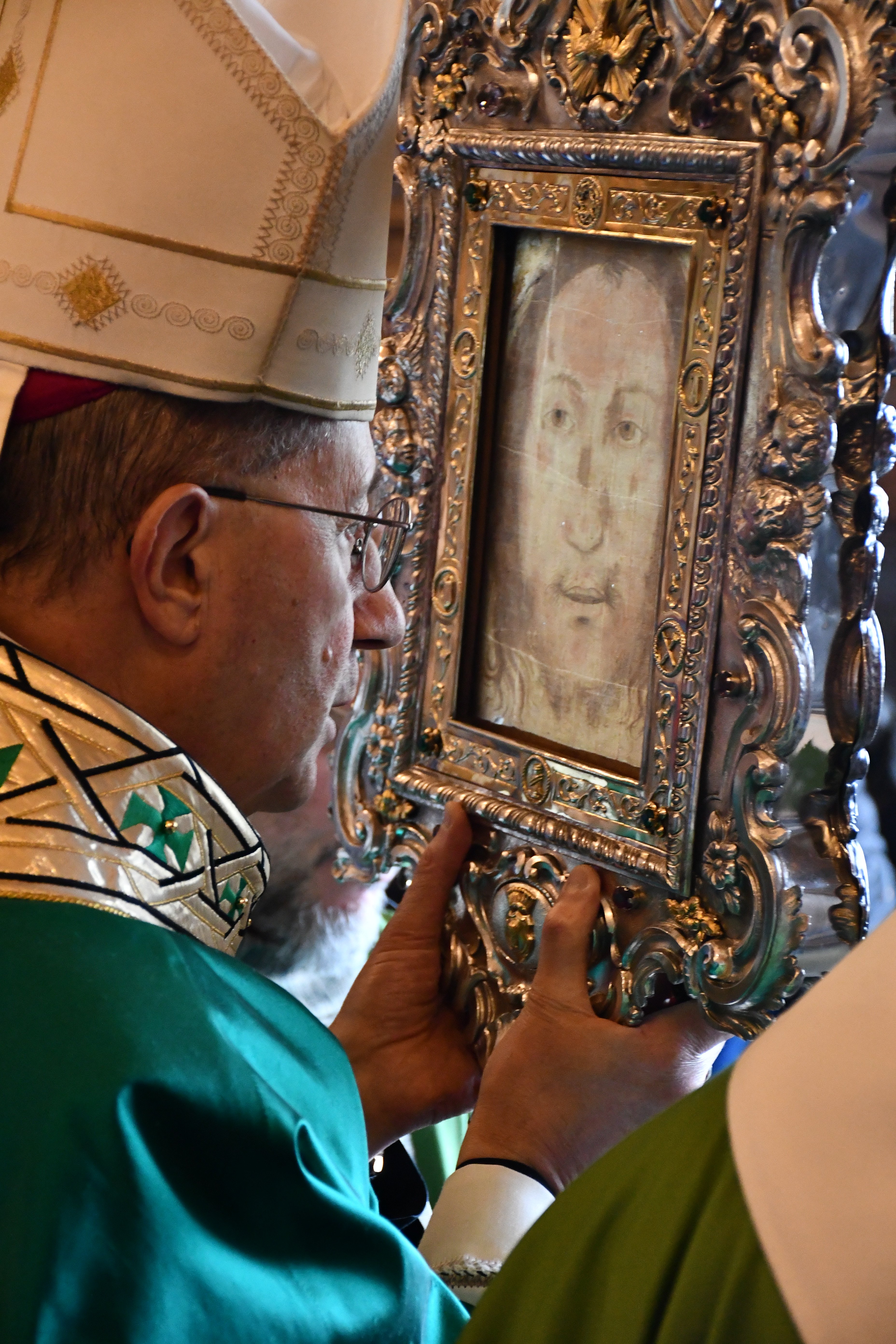
Archbishop Forte Face to Face with Il Volto Santo (Photo: Alexandra Prandell)
The Holy Face begins to disappear in the light as Archbishop Forte brings the relic out of the Basilica into the light of day. (Photo: Alexandra Prandell)
The Countenance of the Holy Face momentarily darkens. (Photo: Alexandra Prandell)
Archbishop Forte in prayer before His Face. (Photo: Alexandra Prandell)
Padre Antonio Gentili, Rector of the Sanctuary Basilica, before the relic of the Holy Veil (Photo: Alexandra Prandell) One never tires of gazing upon His Holy Face!
“Those who gaze on it are never satisfied with contemplating it, and wish to always have it before their eyes. And when they eventually leave it, with heavy sighs full of love, they are forced to leave Him their hearts, bathed in tears.” –Capuchin Donato da Bomba 1646, (Speaking of the Holy Veil of Manoppello)
“Previously, God, Who has not a body or a face, absolutely could not be represented by an image. But now, that He has made Himself visible in the flesh, and has lived with people, I can make an image of what we have seen of God…and contemplate the glory of the Lord, His Face unveiled.”–St. John Damascene
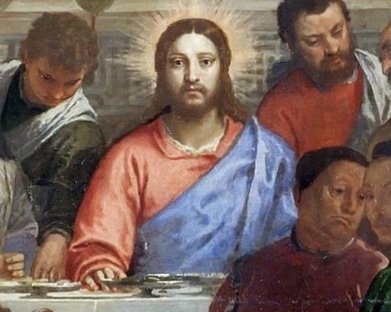
Detail from The Wedding at Cana by Paolo Veronese (1528-1588)
Omnis Terra, Latin for “All the Earth, ” is the name given to the Second Sunday in Ordinary time, when the Gospel of the Wedding at Cana is read. In the midst of the wedding feast, Mary whispers to her son Jesus, “They have no wine.” At Mary’s words, Jesus then performed his first miracle: “the beginning of his signs at Cana in Galilee, and so revealed His glory, and His disciples began to believe in Him.” (John 2: 1-11) The revelation of His glory is the cause for all the earth rejoicing, giving praise to His Name at the wedding feast of the Lamb!
Omnis Terra Celebration 2025
This Holy Jubilee Year of Hope pilgrims from all over the world will be very fortunate to have an opportunity to participate in a Eucharistic celebration, procession, and blessing at the Basilica Shrine of the Holy Face in Manoppello, Italy, on Omnis Terra Sunday, January 19th. The Eucharistic Celebration will be presided over by His Excellency, Mons. Bruno Forte, Metropolitan Archbishop of Chieti-Vasto. Concelebrants will be Fr. Simone Calvarese, Provincial Minister of the Capuchin Friars Minor of Central Italy, and Fr. Antonio Gentili, Rector of the Sanctuary. At the end of the celebration there will be a procession and blessing with the reliquary of the Holy Face.
“To rejoice in the splendor of His Face means penetrating the mystery of His Name made known to us in Jesus, understanding something of His Interior life and of His will, so that we can live according to His plan for humanity. Jesus lets us know the hidden Face of the Father through His human Face; by the gift of the Holy Spirit poured into our hearts.” ~Pope Benedict XVI
This Jubilee Year of Hope, 2024-2025, will mark ten years since the rite of “Omnis Terra,” which had originally begun in 1208, was once again renewed during the Jubilee Year of Mercy, 2015-2016. At that time, a facsimile of the Merciful Face of of Christ on the Holy Veil of Manoppello was carried in a historic procession once again through the streets of Rome. 2016 was the first year that the Holy Face was processed in Rome since the ancient procession of Pope Innocent III from St. Peter’s Basilica to the nearby hospital of Santo Spirito in Sassia in 1208. The Omnis Terra celebration was later continued at the Basilica Shrine of Il Volto Santo in Manoppello. This significant event, celebrating the revelation of His glory is certainly a reason for all the earth to rejoice, as though at a wedding feast!
The first “Omnis Terra” Procession of Pope Innocent III in 1208 carrying “the Veronica” Face of Christ (from “Liber Regulae Sancti Spiritus in Saxia” manuscript 1350)
detail of Face of Jesus on the Holy Veil from the precious manuscript “Liber Regulae Sancti Spiritus in Saxia”
Let all the earth worship and praise You, O God; may it sing in praise of Your Name, O Most High. Shout joyfully to the Lord all the earth; sing a psalm in honor of His Name, praise Him with magnificence!
–Omnis Terra Introit
Salve! Sancta Facies! Hail, Holy Face!
Salve, Sancta Facies! Hail, Holy Face (c. 1450-1455), Willem Vrelant (1481) and associates, Walters Art Gallery, Baltimore, MD.
The exquisite illuminated manuscripts of the Middle Ages reflect the great love and devotion shown to the Holy Face, as well as provide evidence of what the Holy Face of Jesus looked like, as it was seen on a miraculous veil, known as “the Veronica.” “The Veronica,” or Veil of the Holy Face of Jesus, was the greatest relic in Rome at that time. To gaze upon the veil was the great desire of pilgrims, who came from far and wide, to see for themselves the sheer veil bearing the Face of Jesus. Beginning with public exhibitions and processions of the Holy Veil by Pope Innocent III in the mid thirteenth century, the miraculous veil could be viewed by all. Then, the artists got to work on paintings, illustrations, poetry, prayers, and hymns in honor of the Holy Face. ( “The Veronica Route” website wonderfully catalogues many of these “Veronica” artworks that may be found throughout the world.)
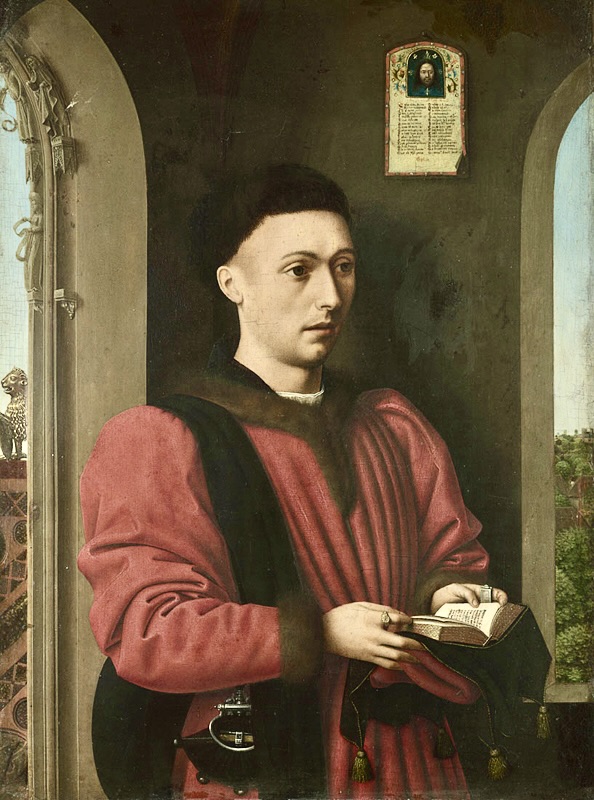
Portrait of a Young Man, 1450-60, Petrus Christus, London National Gallery. Seen above the prayerful young man, on the wall, the Holy Face and the Salve! Sancta Facies Hymn
Pope John XXII, who was elected Pope in 1316, composed a beautiful hymn in honor of the Holy Face, and he also granted a special indulgence to those who recited it — and for those who could could not read, the Pope granted the same indulgence to the faithful for reciting five Our Fathers, Hail Marys, and Glory Be’s. (For an understanding of indulgences, this EWTN article,Primer on Indulgences by James Akin is very helpful.)
Hymn in Honor of the Holy Face by Pope John XXII (translated from the original Latin)
Hail! Holy Face of our Redeemer, hail!
Which shines in all its majesty divine
Upon the spotless veil, a priceless gift
To Saint Veronica; of love the sign.

Hail! Glory of all time, mirror-glass of the Saints,
Wherein the blessed love for eye to gaze;
Destroy within us every stain of sin,
And with the elect our souls towards Thee raise.

Hail, Face of God! With His own gifts adorned,
Whose splendor through the ages shall not cease;
Oh! make Thy light descend into our hearts,
And from their earthly toils our souls release.

Hail! Mighty bulwark of the Christian faith,
Of heresy and lies the Victor Thou;
King in the Sacred Bread, renew the strength
Of all the faithful who before Thee bow.

Hail! all our joy in this hard life below,
So frail and fugitive, so quickly over;
Sweet Picture, lead us onwards to the skies,
That we may there the Face of Christ adore.

Hail! noblest of all gems, celestial pearl,
In Thee innumerable graces shine;
No hand depicted Thee, no chisel carved,
Thou wert of God alone the work divine.

The tints with which Thy features He has traced
Will never alter and will never fade;
Changeless amidst the ravages of time,
The everlasting King Thy Face may see.

Forever incorrupt and free from stain,
The living Christ we honour still in Thee;
Thou turnest into joy our sighs and tears,
Oh! grant that we, in heaven, thy Face may see.

Be thou, we pray, our buckler and defense,
Our consolation and refreshment sweet,
That nothing hostile may our spirits harm,
Till, after death, we rest at Jesus’ feet.  Amen.
Prayer
Shed, O Lord, joy over the faces of Thy faithful, and turn them away from the depths of hell, that, protected by the contemplation of Thy divine Face, we may have strength to tread underfoot the desires of the flesh, and that we may behold Thee face to face, without fear, Lord Jesus Christ, when Thou will come to judge us. Amen.
The “tints” of the image, written in light, have never altered or faded through the centuries. Holy Face Veil of Manoppello,( photo: Patricia Enk)
“The tints with which Thy features He has traced, Will never alter and will never fade; Changeless amidst the ravages of time, The everlasting King Thy Face may see.”
Below is a new video of a talk by Fr. Chris Alar, of the Divine Mercy Shrine in Stockbridge, Massachusetts that is well worth a watch!
“Thou art all fair, my love, there is no spot in thee.” (Song of Solomon 4:7)
“From the greatness and beauty of created things comes a corresponding perception of their Creator,” “for the author of beauty created them.” (Wisdom 13: 3, 5)
The spiritual beauty of God is reflected most perfectly in the woman He created to be His Mother. No stain of sin would mar the beauty of His reflection in her soul. Never for one instant would she be under the power of the devil. “The Blessed Virgin Mary, in the first instance of her conception, by a singular grace and privilege granted by Almighty God, in view of the merits of Jesus Christ, the Savior of the human race, was preserved free from all stain of original sin.” (Dogma of the Immaculate Conception) Mary herself proclaims, “My spirit has rejoiced in God my Savior.” (Luke 1:47)
As the Immaculate Conception, Mary bears in herself the most perfect reflection of the face of God. Pope St. John Paul II wrote, “The Blessed Virgin saw shining upon her, as no other creature, the face of the Father, rich in grace and mercy.” What in Heaven and on earth could be more beautiful than the Mother of God? It is God who has willed that Mary be beautiful, not only fair in face, but in the fullness of grace. Yet, beauty has a purpose, and that is to draw us by the beauty of the graces God has given her towards the Beatific Vision–the Face of God. Mary has no greater desire than that we turn towards the Face of her Son, as she does, with eyes of love.
Strangely, there are some who see the Blessed Mother not as a gift from God who leads us to her Son, but as an obstacle. They want to separate the Mother from the Son, even resorting to violence of smashing statues and slashing paintings of her, mistakenly thinking that somehow this could be pleasing to God, but it is only pleasing to the devil. It is blasphemy. When we separate ourselves from Mary, we separate ourselves from Christ. In The Everlasting Man G.K. Chesterton tells a story from his childhood, many years before he became a Catholic, which left a deep impression on his soul:
“When I was a boy a more Puritan generation objected to a statue upon my parish church representing the Virgin and Child. After much controversy, they compromised by taking away the Child. One would think that this was even more corrupted with Mariolatry, unless the mother was counted less dangerous when deprived of a sort of weapon. But the practical difficulty is also a parable. You cannot chip away the statue of a mother from all round that of a newborn child. You cannot suspend the new-born child in mid-air; indeed you cannot really have a statue of a newborn child at all. Similarly, you cannot suspend the idea of a newborn child in the void or think of him without thinking of his mother. You cannot visit the child without visiting the mother, you cannot in common human life approach the child except through the mother. If we are to think of Christ in this aspect at all, the other idea follows I as it is followed in history. We must either leave Christ out of Christmas, or Christmas out of Christ, or we must admit, if only as we admit it in an old picture, that those holy heads are too near together for the haloes not to mingle and cross.”
Jesus alone is “the Way” that leads to the Father, but Mary is the most beautiful image and likeness of Christ, which will lead us to Him. Dostoevsky once said that “Beauty will save the world!” Mary has a spiritual beauty to share with the world that attracts and expresses what is beyond words, in the depths of her heart, the love of a mother for her Savior and Son.
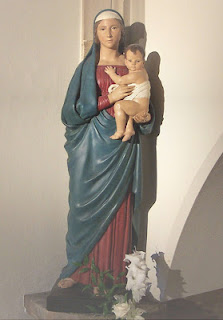
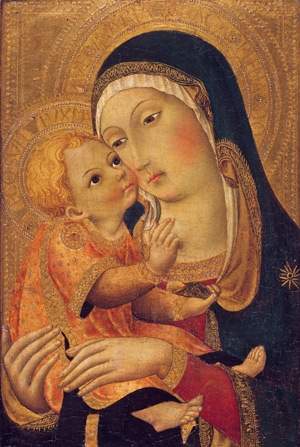
“Our Lady, in whose face – more than any other creature – we can recognize the features of the Incarnate Word.” –Pope Benedict XVI Madonna and Child from the Robert Lehman Collection, Metropolitan Museum of Art
A Little Litany by G.K.Chesterton
When God turned back eternity and was young, Ancient of Days, grown little for your mirth (As under the low arch the land is bright) Peered through you, gate of heaven – and saw the earth.
Or shutting out his shining skies awhile Built you about him for a house of gold To see in pictured walls his storied world Return upon him as a tale is told.
Or found his mirror there; the only glass That would not break with that unbearable light Till in a corner of the high dark house God looked on God, as ghosts meet in the night.
Star of his morning; that unfallen star In the strange starry overturn of space When earth and sky changed places for an hour And heaven looked upwards in a human face.
Or young on your strong knees and lifted up Wisdom cried out, whose voice is in the street, And more than twilight of twiformed cherubim Made of his throne indeed a mercy-seat.
Or risen from play at your pale raiment’s hem God, grown adventurous from all time’s repose, Of your tall body climbed the ivory tower And kissed upon your mouth the mystic rose.
Miraculous Image of Our Lady of Guadalupe “I am your merciful Mother.”
“Look Closely – Our Lady of Guadalupe – Not Made by Human Hands” click here.
Christ the king, seated on His throne. Illustration Godescalc Illuminated manuscript, commissioned by King Charlemagne in 781, may be the most important “missing link” in depictions of the Face of Christ from the Holy Sudarium. (Photo:Paul Badde)
The Solemnity of the Feast of Christ the King of the Universe comes at the end of the liturgical year, November 24th, 2024. The feast focuses on Jesus Christ coming in glory at the end of time. An important question for every Christian to ponder is: When Christ the King comes again will we recognize Him, and will he recognize us?
“When the Son of Man comes in his glory, and all the angels with him, he will sit upon his glorious throne, and all the nations will be assembled before him. And he will separate them one from another, as a shepherd separates the sheep from the goats. He will place the sheep on his right and the goats on his left. Then the kind will say to those on his right, ‘Come, you who are blessed by my Father. Inherit the kingdom prepared for you from the foundation of the world. For I was hungry and you gave me food, I was thirsty and you gave me drink, a stranger and you welcomed me, naked and you clothed me, ill and you cared for me, in prison and you visited me.’ Then the righteous will answer him and say, ‘Lord, when did we see you hungry and feed you, or thirsty and give you drink? When did we see you a stranger and welcome you, or naked and clothe you? When did we see you ill or in prison, and visit you?’ And the kind will say to them in replay, ‘Amen, I say to you, whatever you did for one of these least brothers of mine, you did for me.’ Then he will say to those on his left, ‘Depart from me, you accursed, into the eternal fire prepared for the devil and his angels. For I was hungry and you gave me no food, I was thirsty and you gave me no drink, a stranger and you gave me no welcome, naked and you gave me no clothing, ill and in prison, and you did not care for me.’ Then they will answer and say, ‘Lord, when did we see you hungry or thirsty or a stranger or naked or ill or in prison, and not minister to your needs?’ He will answer them, ‘Amen, I say to you, what you did not do for one of these least ones, you did not do for me. ‘And these will go off to eternal punishment, but the righteous to eternal life.” (Mt. 25:31-46)
Devotion to the Holy Face of Jesus can be a helpful means to lead us to an encounter with Jesus in our life-long journey–enabling us to recognize Him–and He, to recognize us. This devotion is comprised of three elements–as characterized by Pope Benedict XVI: Discipleship, Images of the wounded Face of Christ , and the Eucharist.
‘Amen, I say to you, whatever you did for one of these least brothers of mine, you did for me.’ (Pope Francis embracing a young man with special needs.)
Pope Benedict XVI writes, “The first element [of devotion to the Holy Face] is discipleship and the orientation of one’s life toward an encounter with Jesus in the face of those in need. In order to do this, believers first need to become better acquainted with Jesus through the Eucharist.
The second element is relating to the Passion of Jesus, and the suffering expressed by the images of the wounded Face of Jesus, relating this to the Eucharistic experience.
The third element, the Eucharist is woven between the other two. The eschatological element then builds on awakening to Christ by contemplating his face in the Eucharist.“
The Eucharistic Face of Jesus is central to the devotion of the Face of Christ! Clearly, the grace and strength flowing from worthy reception of the Sacrament of the Eucharist is vital to encountering Jesus in the faces of our brothers and sisters in need, as well as for the prayerful contemplation of Christ’s Face in images of His Passion. In Novo Millenio Ineunte, Pope St. John Paul II wrote, “And it is the Church’s task to reflect the light of Christ in every historical period, to make His face shine also before the generations of the new millennium. Our witness, however would be hopelessly inadequate if we ourselves have not first contemplated his face.”
Contemplation of the Face of Jesus is the veil of devotion, with which we may ‘wipe His bruised and wounded Face, ‘woven’ together with “discipleship, and the Eucharist,” which can lead Christians to “the love of God and love of neighbor” that will enable us to see Christ’s Face when He comes again in glory on the final day.
“The invisible Face of Christ,the son of God, is manifest in His Body an Blood in the simplest and, at the same time, the most exalted way possible in this world.
The ecclesial community responds to people in every age who ask perplexed: “We wish to see Jesus” (Jn 12,21), by repeating what the Lord did for the disciples of Emmaus: He broke the bread. In the breaking of the bread, the eyes of those who seek Him with a sincere heart are opened. In the Eucharist, the intuition of the heart recognizes Jesus and His unmistakable love lived “to the end” (Jn 13,1). And in Him, in that gesture, it recognizes the Face of God!“— Pope St. John Paul II
Pope Benedict XVI in prayerful contemplation before the veil of the Holy Face of Manoppello during a visit to the Basilica Shrine of the Holy Face in Manoppello, central Italy, September 1, 2006. (Photo: Paul Badde/EWTN)
***Important and exciting update on the Holy Veil of Manoppello:CNA Deutsch has reported a new discovery, in an article by Paul Badde, pertaining to “Il Volto Santo,” and the inexplicable presence of the Face of Jesus on the sheer veil, which has no traces of paint. An eminent German doctor, Gosbert Weth, has made non-invasive investigations on the relic, using a special nuclear medicine measuring device. The device measures alpha, beta, and gamma rays. Beta rays, which are invisible and energetic, are released during nuclear fission. It has been determined that the veil of Manoppello has such a high level of beta radiation that it fills the Basilica with it! It has also been observed that the veil gives off light in darkness. The upshot of this wonderful discovery is:The Veil of the Holy Face of Manoppello is a source of energy whose strength can be measured objectively.
I will post further details of Dr. Weth’s investigations very soon, but this is amazing news that should be shouted from the rooftops! Thanks be to God!
“O most awe-inspiring King, we bow before You and pray; May Your Reign, Your Kingdom, be recognized on earth.” (Host viewed through the miraculous Manoppello Veil the Holy Face, Photo: Paul Badde/ EWTN)
“Almighty ever-living God, whose will is to restore all things in your beloved Son, the King of the universe, grant, we pray, that the whole creation, set free from slavery, may render your majesty service and ceaselessly proclaim your praise. Through our Lord Jesus Christ, your Son, who lives and reigns with you in the unity of the Holy Spirit, God, for ever and ever.”
— Prayer for Feast of Solemnity of Jesus Christ, King of the Universe.
Novena to Christ the King
Almighty and merciful God, you break the power of evil and make all things new in your Son Jesus Christ, the King of the universe. May all in heaven and earth acclaim your glory and never cease to praise you.
We ask this through our Lord Jesus Christ, your Son, who lives and reigns with you and the Holy Spirit, one God, forever and ever. Amen.
Recite One Our Father, One Hail Mary, and One Glory Be per day followed by the Novena Prayer:
O Lord our God, You alone are the Most Holy King and Ruler of all nations. We pray to You, Lord, in the great expectation of receiving from You, O Divine King, mercy, peace, justice and all good things. Protect, O Lord our King, our families and the land of our birth. Guard us we pray Most Faithful One. Protect us from our enemies and from Your Just Judgment Forgive us, O Sovereign King, our sins against you. Jesus, You are a King of Mercy. We have deserved Your Just Judgment Have mercy on us, Lord, and forgive us. We trust in Your Great Mercy. O most awe-inspiring King, we bow before You and pray; May Your Reign, Your Kingdom, be recognized on earth.





























 Illumina Domine Blog - Devotion to The Holy Face