Silent night, Holy night
Son of God, love’s pure light
Radiant beams from thy holy face
With the dawn of redeeming grace,
Jesus, Lord at thy birth
Jesus, Lord at thy birth.
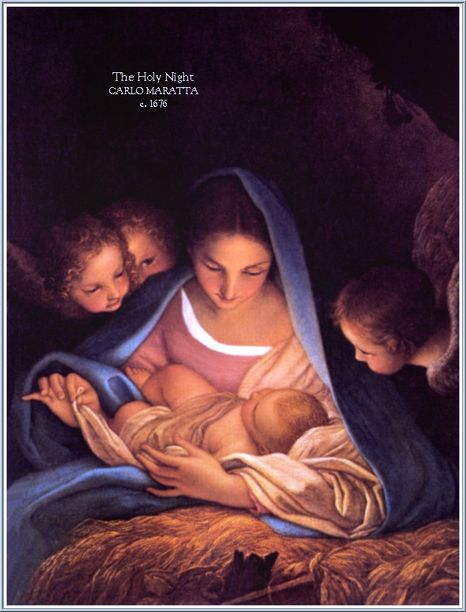
The Holy Night by Carlo Maratta, c.1676
Today, we contemplate the Holy Face of The Infant Jesus, together with Mary and Joseph. God descended to earth and became human to redeem us … but He is so weak, so poor, so helpless! Mary and Joseph knew, that their beautiful, perfect child was also born to suffer. They contemplate Him in silence, like all parents of newborns, because words are useless. Together, with them, we gaze with love on Jesus’ face as He lies in the manger and our gaze becomes our prayer. While we look at Him, he looks at us and loves us; He will give His life for us.
The beauty of the face of the Infant Jesus, draws us into the great mystery of redemptive suffering, to show us how God’s love was to be revealed, through self-sacrifice. Let us enter into this mystery today by gazing on the Holy Face of the newborn Jesus, and, in gazing at Him, discover the hope and joy of His redemptive LOVE!
“Holy Mary, Mother of the Savior, help us to bear witness to the joy and light that the birth of your Son, our Redeemer, brought to the world, and to seek him in all things.” (Contemplating The Face of Christ in the Rosary, Pauline Press.)
Merry Christmas!
Happy the people who know you, Lord, who walk in the radiance of your face. In your name they sing joyfully all the day; at your victory they raise the festal shout. (Psalm 89:16-17)
Blessed be the LORD, the God of Israel, who alone does wondrous deeds. And blessed forever be his glorious name; may the whole earth be filled with his glory.
Today we unite ourselves with The Blessed Virgin Mary, in her longing to see the Face of her Son and her God. Below is an excerpt from The Feasts of Mary by Fr. Lawrence Lovasik, SVD:
“Mary, Mother of God, make my interior life of union with Jesus more like your own. After Holy Communion Jesus is with me as God and Man, with His Body and Blood, soul and divinity. Jesus is in me, too, through sanctifying grace, I bear within me the supernatural image of the Divine Sonship. He works in my soul by His grace. He forms Himself in me by supernatural principles, which He implants in my mind; by supernatural intentions and meritorious actions. He follows up in my heart also the aim that brought Him into your womb—He wishes to be born in me, to grow, rule, and reveal Himself. Thus my soul in sanctifying grace is always, in a spiritual manner, like your womb—a sanctuary of the living God!”
“I earnestly want to be filled with the dispositions in which you expected the coming of the Savior and thus prepare myself for His coming into my soul by faith and divine charity, as well as for His coming at the hour of my death and judgment. In union with you may my heart yield itself up to childlike confidence in Jesus so that the graces of His Nativity may be brought to my soul in abundance, and He may be born anew within my heart.”
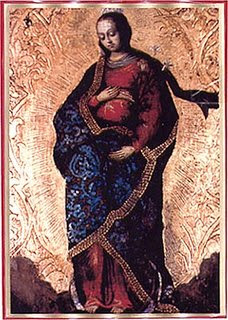
Let us also remember to pray today for all expectant mothers and unborn babies. O Jesus, whose Holy Face was formed and hidden for nine months in the womb of The Blessed Virgin Mary, your Mother, have mercy on us! Happy Feast Day!
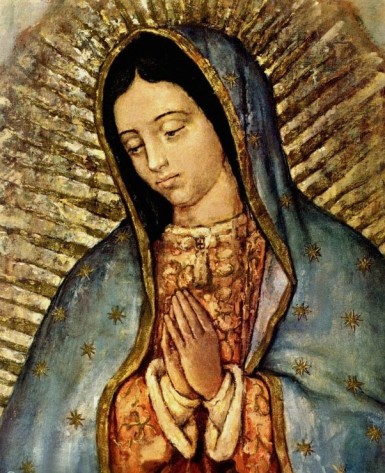
The miraculous image of Our Lady of Guadalupe, the Shroud of Turin, and “Il Volto Santo,” the veil of Manoppello all have something in common. They are all Acheiropoieta, a Greek word meaning: “made without hand.” They are said to have come into existence miraculously, not created by a human painter.
The Holy Face on the Shroud of Turin
The extensive research that has been done on these three images, and the results are astounding. Although I have not been to Mexico to view the miraculous tilma of Our Lady, I have seen both the Holy Shroud of Turin and the Veil of Manoppello in person. Studying them has been my own personal passion.
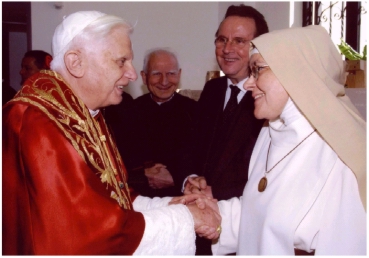
Being an artist, (and near-sighted) I tend to look at things more closely. I study each little detail, shape, line, form, color, and value. I may spend hundreds of hours studying while I work. I can’t help but know every little nuance by the time I am done painting. Sr. Blandina Paschalis Schloemer, a Trappist nun from Germany, is also an artist, a painter of icons. Icon painting is very exact when it is done in the traditional manner. Sr. Schloemer began to notice striking similarities between ancient icons and images of the Face of Christ, and the images on the Shroud of Turin and the Veil of Manoppello. With the permission of her order the research has become her life’s work as well as part of her vocation.
Pope Benedict meets Sr. Blandina at the Sanctuary Basilica for the Holy Face of Manoppello
Her research indicates that both images on the Shroud of Turin and the Manoppello Image are of the same man. I agree with her, wholeheartedly, although it is not at first glance apparent. There are also many similarities between these two images of Jesus’ Face and the image of Our Lady of Guadalupe. First, all are on a cloth. The image of Our Lady of Guadalupe is on cactus fiber, which should have disintegrated hundreds of years ago according to scientists. The Shroud of Turin is on linen and the Manoppello Image is on woven sea-silk, called byssus.
Our Lady of Guadalupe, pilgrim image beside the Veronica Altar, at St. Peter’s Basilica in Rome. Photo: Paul Badde, author of The Face of God: The Rediscovery of the True Face of Jesus, Ignatius Press.
Byssus is more rare and more precious than gold. Mentioned in the Bible, byssus, has a shimmering, iridescent quality which reflects light. Byssus is extremely delicate, yet strong at the same time. It resists water, weak acids, bases, ethers or alcohols. It can’t be painted, as it does not retain pigments, it can only be dyed; and then, only purple. Did I mention that it can last for more than 2000 years?
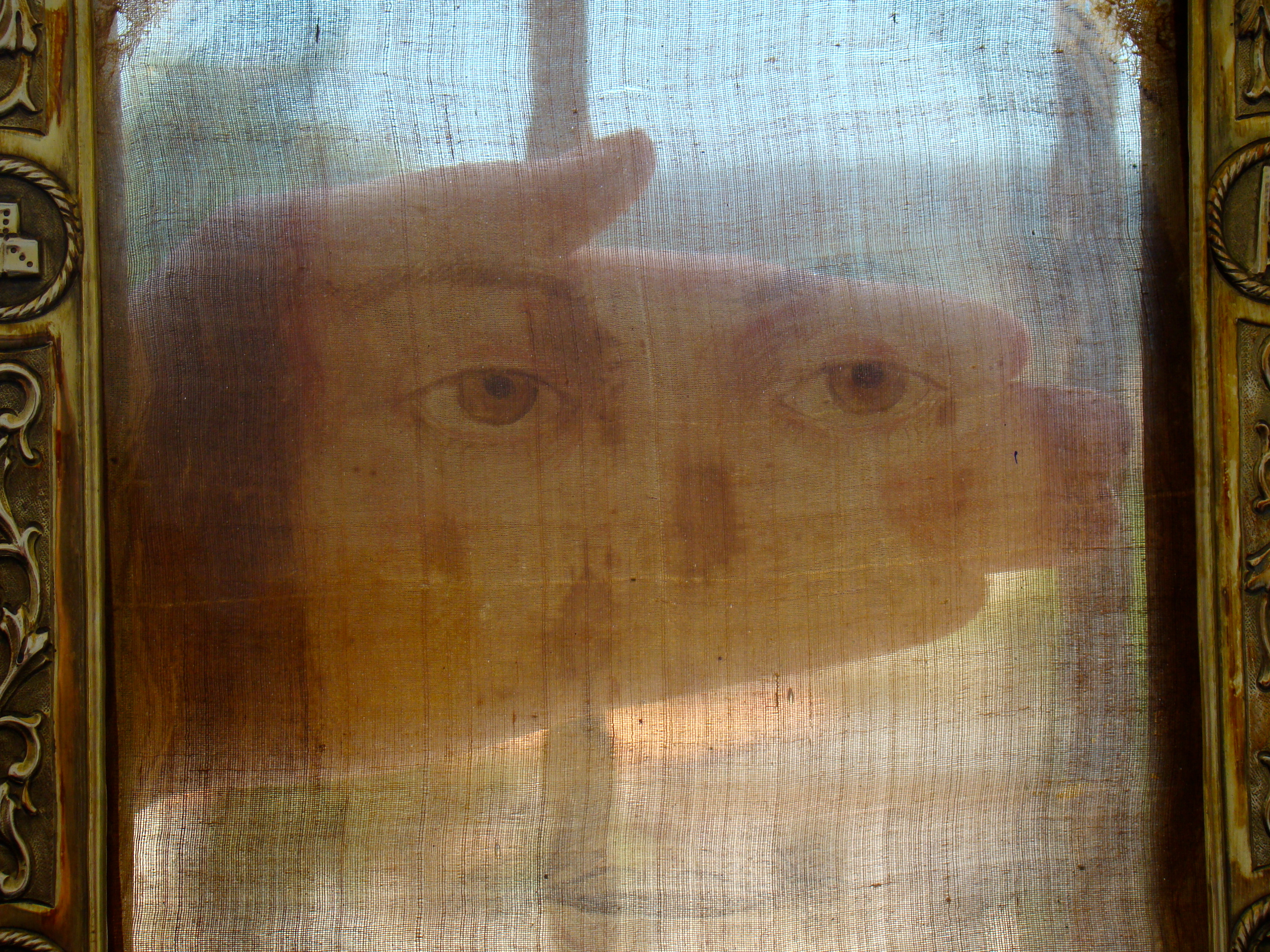
The veil of Manoppello, woven with byssus, is so sheer that you can read through it. Photo: Paul Badde
Another similarity between the Guadalupe image and the Manoppello image is the changeability of the images. Pilgrims have related how the image of Our Lady on the tilma appears to change in color, brightness and depth. Scientists can’t explain how the Guadalupe image appears on the tilma, it is not painted… it is “just there.” The Shroud of Turin has been described similarly. The veil of Manoppello, or “Il Volto Santo” as it is also known, is even more incredible, if that can be possible, because in addition to the image being on a veil so sheer that it can be read through, it also changes in detail, color, and shape. It even disappears… entirely. It is called a “living image” and so it is. No two people will see it in the same way. No single person will see it in the same way twice.
“Il Volto Santo of Manoppello”
Julian of Norwich, the English mystic of the 14th century, mentions changeability as a characteristic of the Veil of Veronica in Rome, “the diverse changing of color and countenance, sometime more comfortably life-like, sometime more rueful and death-like.” The Veil of Veronica, it is now believed, was most likely stolen a hundred years later, during the sack of Rome. But, Julian of Norwichs’ description of the Veil of Veronica certainly fits “Il Volto Santo” of Manoppello.
But, there is more. There is something about the faces… if you study the faces in particular, especially the eyes, as one opthamalogist did. On the eyes of Our Lady of Guadalupe, you will notice that something. Similar research has been done on the eyes of “Il Volto Santo.” There are delicate, natural, details in all three images that cannot be accomplished without the aid of paint or brush, on a rough, cactus cloth, or on a linen burial shroud or on gossamer-thin sea-silk. If you have an opportunity, look closely. Yes, there is something about the faces, and it is something supernatural. They are not made by human hands, but by the Hand of God.
“O Blessed Virgin Mary, Our Lady of Guadalupe,
By your presence you made the desert bloom with flowers
may your love transform us into the image of Your Son, Jesus Christ. Amen.”




 Illumina Domine Blog - Devotion to The Holy Face