The importance of Devotion to the Holy Face has been underscored by our last three Popes: St. Pope John Paul II, Pope Benedict and Pope Francis. But, it was to a hidden, cloistered Carmelite nun in the mid-1800’s that Our Lord first entrusted what He called “The Most Beautiful Work Under the Sun!” It was the impetus for the resurgence of a forgotten devotion that has ultimately resulted in the dedication of the millennium to The Holy Face by St. Pope John Paul II and the emphasis on Jesus Christ, the Face of the Father’s Mercy by Pope Francis for the Jubilee Year of Mercy. Through the Merciful Face of Christ we may be reconciled with the Father, so that the Holy Spirit may restore God’s image in our souls.
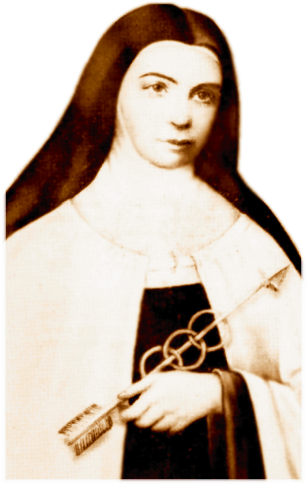
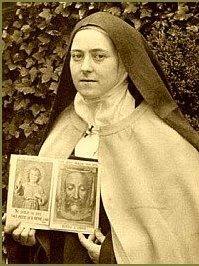
Discalced Carmelite Nun Sr. Marie St. Pierre holding “The Golden Arrow” The three circles representing the Holy Trinity
Sr. Marie St. Pierre, is best known for Devotion to the Holy Face and “The Golden Arrow” (prayer below) a prayer of reparation for blasphemy–sins against the Face of God. She had many interior visions regarding the Holy Face and the work of reparation, including a sublime conception of the The Holy Trinity and the Holy Face which she tried to express in these words she received from Our Lord:
“Holy Face of Tours”
“Remember, O my soul, the instruction which thy celestial Spouse has given thee today on His adorable Face! Remember that this Divine Head represents the Father who is from all eternity, that the mouth of this Holy Face is a figure of the Divine Word, engendered by the Father, and that the eyes of this mysterious Face represent the reciprocal love of the Father and the Son; for these eyes have but one and the same light, the same knowledge, producing the same love, which is the Holy Spirit. In his beautiful silken hair contemplate the infinitude of the adorable perfections of the Most Holy Trinity in this majestic head, the most precious portion of the Sacred Humanity of thy Saviour; contemplate the image of the unity of God. This, then, is the adorable and mysterious Face of the Saviour, which blasphemers have the temerity to cover with opprobrium: thus they renew the sufferings of His Passion, by attacking the Divinity of which it is the image.”
Our Lord told Sr. Marie St. Pierre that she could comfort and console Him by her praises, then He added:
“According to the diligence you will manifest in repairing my image disfigured by blasphemers, so will I have the same care in repairing your soul which has been disfigured by sin. I will imprint thereon my image, and I will render it as beautiful as when it came forth from the baptismal font… Oh! could you but behold the beauty of My Face!–But your eyes are yet too weak.”
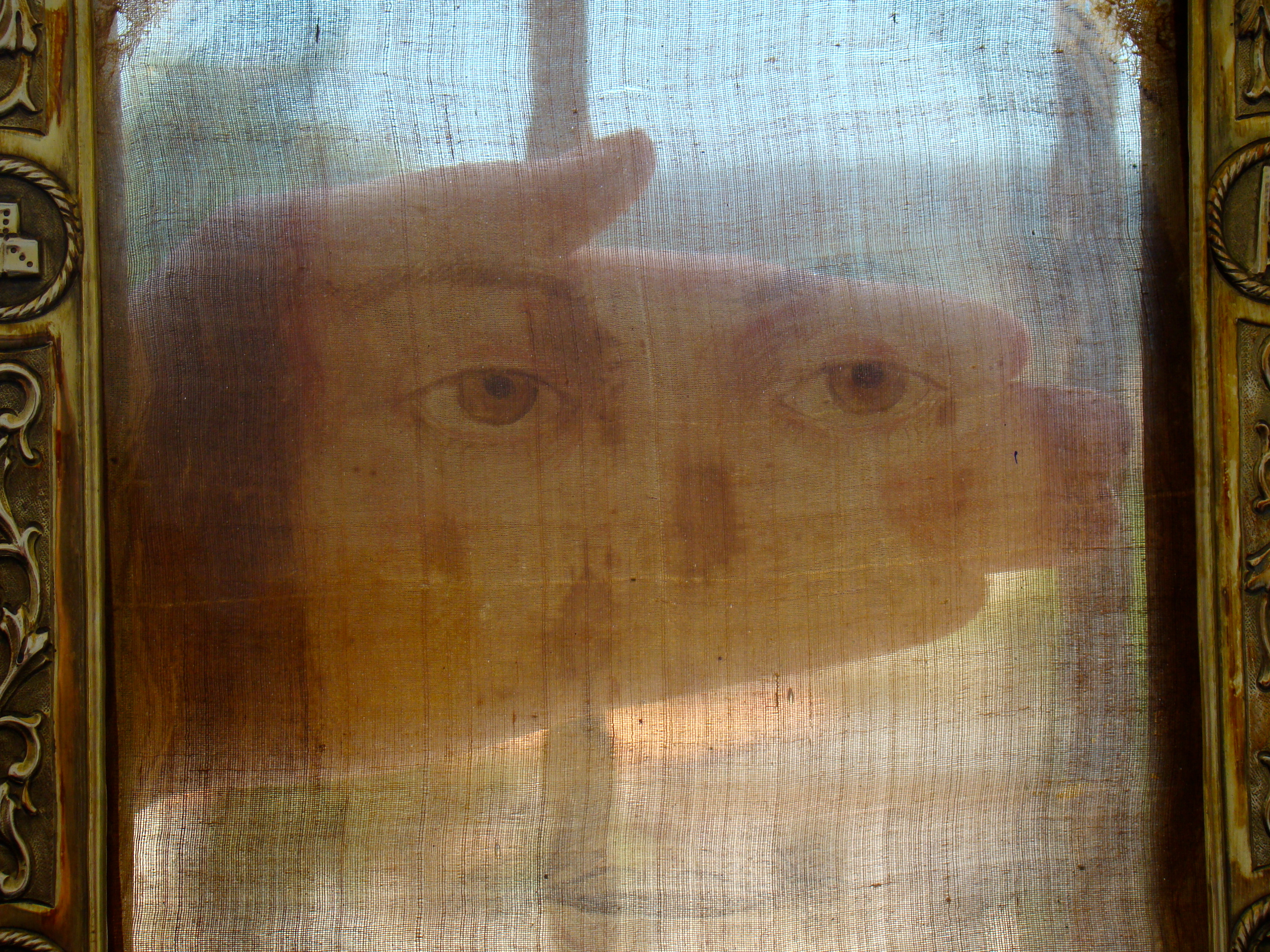
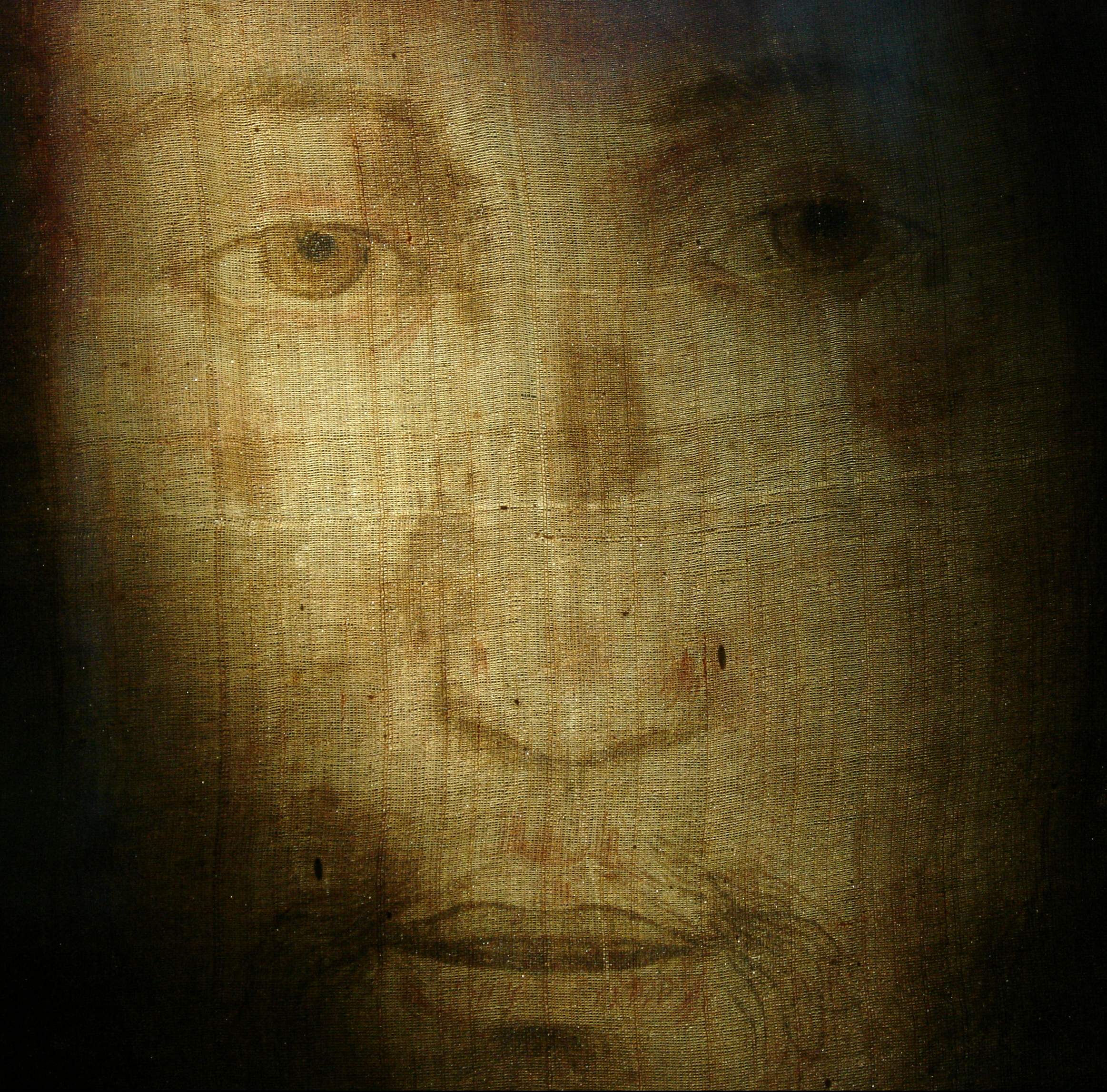
The beautiful Holy Face of Manoppello photo: Paul Badde
Below are two beautiful prayers of Sr. Marie St. Pierre “The Golden Arrow” praising the Holy Name, which is reparation for blasphemy and also a prayer to ask Our Lord to “reproduce the image of God in our souls.”
THE GOLDEN ARROW
MAY the most holy, most sacred, most adorable, most incomprehensible and ineffable Name of God, be forever praised, blessed, adored, loved and glorified, in heaven, on earth, and in the hells, by all the creatures of God, and by the Sacred Heart of Our Lord Jesus Christ in the most Holy Sacrament of the Altar. Amen.
Prayer to ask Our Lord to Reproduce the Image of God in Our Souls
I salute You! I adore You and I love you, Oh adorable face of my beloved Jesus, as the noble stamp of The Divinity! Completely surrendering my soul to You, I most humbly beg You to stamp this seal upon us all, so the image of God may once more be reproduced in our souls. Amen.
“By My Holy Face you will work marvels!” –Our Lord to Sr. Marie St. Pierre
“The Lord God opens my ear that I may hear; And I have not rebelled, have not turned back. I gave my back to those who beat me, my cheeks to those who plucked my beard: My face I did not shield from buffets and spitting. The Lord God is my help, therefore I am not disgraced; I have set my face like flint, knowing that I shall not be put to shame.” (Isaiah 50:4b-7)
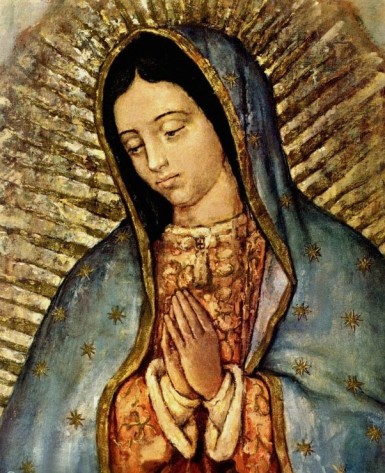
Miraculous Image of Our Lady of Guadalupe “I am your merciful Mother.”
Why does God work signs and wonders? There can only be one answer: His Merciful Love. Our Creator knows our human weakness. Our faith may be weak, or we may have no faith at all. We experience things and come to knowledge through our senses, so God grants us signs that we can see, hear, smell and touch signs of His goodness. The Old Testament is filled with signs and wonders that God granted to all mankind to reveal His Presence and show His power and might. But what could be more miraculous than the New Testament miracle that a virgin should be with child and bear a son? That God should become a tiny infant in the womb or that bread and wine should become the Body and Blood of Christ? Through these unimaginable signs God shows Himself to be not only all-powerful, but also all-good, all-humble, all-merciful, all-LOVE!
Signs and wonders do not end with the New Testament, but are on going. They continue today. For instance, in 1531, Our Lady appeared as a virgin with child to a humble Juan Diego and left an image of herself on his tilma as a sign for all peoples of her maternal love and of the merciful love of God. The wondrous image was “painted” not by brush and paint, but by the hands of Our Lady herself as she gently arranged miraculous Castillian roses in Juan Diego’s tilma as a proof for his Bishop that a church should be built at the site of her appearance. The image of Our Lady of Guadalupe speaks volumes to people of all times. As she told Juan Diego, “I am your merciful Mother, the Mother of all who live in this land and all of mankind. I hear the weeping and sorrows of those who love me, cry to me, and have confidence in me, and I will give them consolation and relief.”
Sheer Veil of the Holy Face of Manoppello Photo: Paul Badde
To enumerate the many scientific studies done on the miraculous images of the tilma of Our Lady of Guadalupe, or the Shroud of Turin, or the Holy Veil of Manoppello may demonstrate to those who need proof that they are indeed miracles. But faith is still required for belief and some, in spite of the facts or reliable testimony, may still have doubts or sadly choose not to believe.
Perhaps we have trouble believing miracles because at heart we have trouble believing that God loves us and that He would stoop down from Heaven to show that love in some tangible way. Proof or not, the gifts of the Love and Mercy of God are still there so that we may “see and believe.” God has given us these wondrous signs and they should not be taken for granted! He is communicating something to each individual through these signs. Let us pray for ourselves and for unbelievers, “Lord, help us in our unbelief.”
What greater sign of His Love than that the bread and wine become His Body and Blood?
************
(Below is a re-post from 12/2014 for the Feast of Our Lady of Guadalupe)
Look Closely – Our Lady of Guadalupe “Not made by Human Hands”
Miraculous image of Our Lady of Guadalupe
The miraculous image of Our Lady of Guadalupe, the Shroud of Turin, and “Il Volto Santo,” the veil of Manoppello all have something in common. They are all Acheiropoieta, a Greek word meaning: “made without hand.” They are said to have come into existence miraculously, not created by a human painter.
The Holy Face on the Shroud of Turin
The extensive research that has been done on these three images, and the results are astounding. Although I have not been to Mexico to view the miraculous tilma of Our Lady, I have seen both the Holy Shroud of Turin and the Veil of Manoppello in person. Studying them has been my own personal passion.
Being an artist, (and near-sighted) I tend to look at things more closely. I study each little detail, shape, line, form, color, and value. I may spend hundreds of hours studying while I work. I can’t help but know every little nuance by the time I am done painting. Sr. Blandina Paschalis Schloemer, a Trappist nun from Germany, is also an artist, a painter of icons. Icon painting is very exact when it is done in the traditional manner. Sr. Schloemer began to notice striking similarities between ancient icons and images of the Face of Christ, and the images on the Shroud of Turin and the Veil of Manoppello. With the permission of her order the research has become her life’s work as well as part of her vocation.
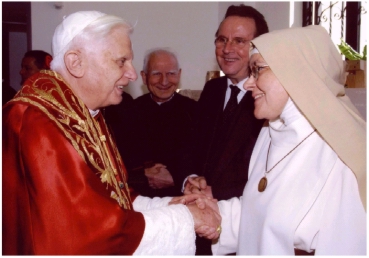
Pope Benedict meets Sr. Blandina at the Sanctuary Basilica for the Holy Face of Manoppello
Her research indicates that both images on the Shroud of Turin and the Manoppello Image are of the same man. I agree with her, wholeheartedly, although it is not at first glance apparent. There are also many similarities between these two images of Jesus’ Face and the image of Our Lady of Guadalupe. First, all are on a cloth. The image of Our Lady of Guadalupe is on cactus fiber, which should have disintegrated hundreds of years ago according to scientists. The Shroud of Turin is on linen and the Manoppello Image is on woven sea-silk, called byssus.
Our Lady of Guadalupe, pilgrim image beside the Veronica Altar, at St. Peter’s Basilica in Rome. Photo: Paul Badde, author of The Face of God: The Rediscovery of the True Face of Jesus, Ignatius Press.
Byssus is more rare and more precious than gold. Mentioned in the Bible, byssus, has a shimmering, iridescent quality which reflects light. Byssus is extremely delicate, yet strong at the same time. It resists water, weak acids, bases, ethers or alcohols. It can’t be painted, as it does not retain pigments, it can only be dyed; and then, only purple. Did I mention that it can last for more than 2000 years?
The veil of Manoppello, woven with byssus, is so sheer that you can read through it. Photo: Paul Badde
Another similarity between the Guadalupe image and the Manoppello image is the changeability of the images. Pilgrims have related how the image of Our Lady on the tilma appears to change in color, brightness and depth. Scientists can’t explain how the Guadalupe image appears on the tilma, it is not painted… it is “just there.” The Shroud of Turin has been described similarly. The veil of Manoppello, or “Il Volto Santo” as it is also known, is even more incredible, if that can be possible, because in addition to the image being on a veil so sheer that it can be read through, it also changes in detail, color, and shape. It even disappears… entirely. It is called a “living image” and so it is. No two people will see it in the same way. No single person will see it in the same way twice.
“Il Volto Santo of Manoppello”
Julian of Norwich, the English mystic of the 14th century, mentions changeability as a characteristic of the Veil of Veronica in Rome, “the diverse changing of color and countenance, sometime more comfortably life-like, sometime more rueful and death-like.” The Veil of Veronica, it is now believed, was most likely stolen a hundred years later, during the sack of Rome. But, Julian of Norwichs’ description of the Veil of Veronica certainly fits “Il Volto Santo” of Manoppello.
But, there is more. There is something about the faces… if you study the faces in particular, especially the eyes, as one opthamalogist did. On the eyes of Our Lady of Guadalupe, you will notice that something. Similar research has been done on the eyes of “Il Volto Santo.” There are delicate, natural, details in all three images that cannot be accomplished without the aid of paint or brush, on a rough, cactus cloth, or on a linen burial shroud or on gossamer-thin sea-silk. If you have an opportunity, look closely. Yes, there is something about the faces, and it is something supernatural. They are not made by human hands, but by the Hand of God.
“O Blessed Virgin Mary, Our Lady of Guadalupe,
By your presence you made the desert bloom with flowers
may your love transform us into the image of Your Son, Jesus Christ. Amen.”
Immaculate Conception by Bartolome Esteban Murillo
“Blessed are the pure of heart, for they shall see God.”
Pope Francis has chosen December 8th, the Solemnity of the Immaculate Conception, as the opening of the Holy Jubilee Year of Mercy, “because of its rich meaning.” “After the sin of Adam and Eve, God did not wish to leave humanity alone in the throes of evil. So he turned his gaze to Mary, holy and immaculate in love (cf. Eph 1:4), choosing her to be the Mother of man’s Redeemer. When faced with the gravity of sin, God responds with the fullness of mercy.” Pope Francis (Face of Mercy)
Mary was “Blessed in Christ with every spiritual blessing,” (cf. Eph 1:3) chosen by God from all eternity to be the Mother of the Redeemer. It is she who leads us to Jesus, so that we may contemplate, together with her, the Face of Mercy. As the Immaculate Conception, Mary bears in herself the most perfect reflection of the face of God. Pope St. John Paul II wrote, “The Blessed Virgin saw shining upon her, as no other creature, the face of the Father, rich in grace and mercy.”
As the Jubilee Year of Mercy begins, let us fix our gaze on Mary rather than on the profane things of the world. We keep Mary before our eyes in order to contemplate in her everything that is good and true and beautiful. “She is the proclamation of a merciful God who does not surrender to the sin of his children,” Pope St. John Paul II tells us “in Mary shines forth God’s sublime and surprising tenderness for the entire human race. In her, humanity regains its former beauty and the divine plan is revealed to be stronger than evil…” In Mary “the Creator has kept the original beauty of creation uncontaminated” so that in the Immaculate Conception, “the Father’s original, wondrous plan of love was reestablished in an even more wondrous way.”
A Little Litany by G.K.Chesterton
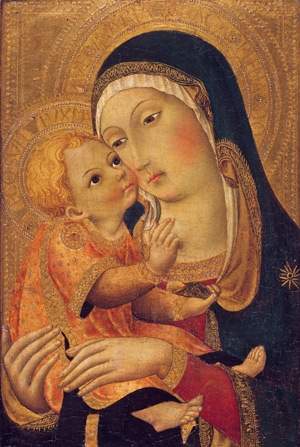
“Our Lady, in whose face – more than any other creature – we can recognize the features of the Incarnate Word.” –Pope Benedict XVI Madonna and Child from the Robert Lehman Collection, Metropolitan Museum of Art
When God turned back eternity and was young, Ancient of Days, grown little for your mirth (As under the low arch the land is bright) Peered through you, gate of heaven – and saw the earth.
Or shutting out his shining skies awhile Built you about him for a house of gold To see in pictured walls his storied world Return upon him as a tale is told.
Or found his mirror there; the only glass That would not break with that unbearable light Till in a corner of the high dark house God looked on God, as ghosts meet in the night.
Star of his morning; that unfallen star In the strange starry overturn of space When earth and sky changed places for an hour And heaven looked upwards in a human face.
Or young on your strong knees and lifted up Wisdom cried out, whose voice is in the street, And more than twilight of twiformed cherubim Made of his throne indeed a mercy-seat.
Or risen from play at your pale raiment’s hem God, grown adventurous from all time’s repose, Of your tall body climbed the ivory tower And kissed upon your mouth the mystic rose.
“Seeking the Face of God in everything, everyone, all the time, and His hand in every happening; This is what it means to be contemplative in the heart of the world. Seeing and adoring the presence of Jesus, especially in the lowly appearance of bread, and in the distressing disguise of the poor.” –Bl. Mother Teresa of Calcutta
Many Catholic faithful are hoping and praying for the possible canonization of Blessed Mother Teresa of Calcutta during The Holy Year for Mercy. During the upcoming Jubilee Year of Mercy Pope Francis wants us to “Keep our eyes fixed on Jesus and his merciful gaze, that we may experience the love of the Most Holy Trinity.” He calls us to be merciful to others and reflect on the corporal and spiritual works of mercy as a way of awakening our conscience and enter more deeply into the heart of the Gospel so that “we become merciful just as our heavenly Father is merciful.” (Lk 6:36)
Blessed Mother Teresa, by her heroic life’s witness of seeking the Face of Christ in the “distressing disguise of the poor,” perfectly exemplified how Christians can live the works of mercy. When someone would ask her what they could do to serve, she was known for taking the person’s hand and touching each finger, she would say, “You-did-it-to-me.” “I was hungry and you gave me to eat, I was naked and you clothed me, I was sick and you visited me. Whatever you did to the least of my brethren, you did it to me.”
Blessed Mother Teresa’s example points out to us the primary task of the Church, which, as Pope Francis urges us, is to be “a herald of mercy,” “especially at a moment full of great hopes and signs of contradiction, to introduce everyone to the great mystery of God’s mercy by contemplation of the Face of Christ.”
The greatest desire of Bl. Mother Teresa was “to satiate the thirst of Jesus by serving him in the poorest of the poor.” Though suffering spiritual darkness in her own soul, she allowed the blazing brilliance of Christ’s love to radiate through her face to others and she sought continually Jesus’ face in those she served. In photograph after photograph of Mother Teresa we can see her looking intensely into the faces of children, the poor, the sick and the dying, while tenderly caressing their faces, searching in their face for the face of her beloved, Jesus. Pope Francis tells us, “We must embrace with tender affection the whole of humanity, especially the poorest, the weakest, the least important, those whom Matthew lists in the final judgment on love: the hungry, the thirsty, the stranger, the naked, the sick and those in prison. “ (Mt 25:31) “To love God and neighbor is not something abstract, but profoundly concrete: it means seeing in every person the face of the Lord to be served, to serve him concretely. And you, dear brothers and sisters are the face of Jesus!”
Blessed Mother Teresa heroically carried out the corporal and spiritual works of mercy by being the Merciful Face of Christ to others and by seeing the Merciful Face of Christ in others. Pope Benedict XVI has characterized devotion to the Holy Face as having three separate components:
The first element is discipleship and orientation of one’s life towards an encounter with Jesus, to see Jesus in the face of those in need. In order to do this, believers first need to become better acquainted with Jesus through the Eucharist. Mother Teresa’s whole being was directed toward this encounter with Jesus in the poor.
Image of Jesus crucified which hung in Mother Teresa’s room. It was one of her last sights before dying.
The second element is relating to the Passion of Jesus, and the suffering expressed by the images of the wounded Face of Jesus, relating this to the Eucharistic experience. This image of Jesus Crucified hung on the wall of Mother Teresa’s room in Calcutta. It was one of her last sights before dying. She identified completely with the Crucified Jesus. “Jesus, I love with my whole heart, with my whole being, I have given Him all, even my sins, and He has espoused me to Himself in tenderness and love. Now and for life I am the spouse of my Crucified Spouse.”
The third element, the Eucharist, is woven between the other two. The eschatological element then builds on awakening to Christ by contemplating His face in the Eucharist. The Eucharist was central to Mother Teresa’s mission. “Seek him in the tabernacle. Fix your eyes on Him who is the Light. Bring your hearts close to His Divine Heart and ask Him to grant you the grace of knowing Him.” She insisted that each Missionary of Charity begin their day in prayerful silence before the Eucharistic Face of Jesus from Whom they drew the strength to serve the poor.
“Jesus gives us two faces,” Pope Francis says, “actually only one real face, that of God reflected in many faces, because in the face of each brother, especially the smallest, the most fragile, the defenseless and the needy, there is God’s own image. And we must ask ourselves: when we meet one of these brothers, are we able to recognize the face of God in him?”
If we hope one day to see the Face of God we must open our eyes to our neighbor. Pope Benedict XVI has said, “closing our eyes to our neighbor also blinds us to God.”
Bl. Mother Teresa, pray for us, help to recognize the Face of Jesus and carry out the “Works of Mercy,” so that we too may contemplate “the Living Face of Christ’s Mercy.”
The Corporal Works of Mercy The Spiritual Works of Mercy
Feed the Hungry Teach the ignorant
Give Drink to the thirsty Pray for the living and the dead
“IHS” Monogram of The Holy Name – Church of The Gesu, Rome
Any mother-to-be, poring over lists of baby names, knows the importance of choosing a name. She knows this is serious business. The name should have meaning, giving a clue to shed light on the mystery of the person. Our names, connected with our face become the basis of our relationship with others. When we give our own name, and turn our face to others, we are giving something of ourselves. So too, it is with God.
The Hebrew term for name is “shem” and for face, it is “panim.” These are both terms which describe relationships. In fact, “panim” means to see the face of God or the presence of God. God has a face and a name! The revelation of the face of God took on a new and beautiful manifestation when God became man in the person of Jesus Christ, as Pope Emeritus Benedict XVI has taught. As fully God and fully man, Jesus Christ gave us a human face that revealed the face of God. He says, “While we too seek other signs, other wonders, we do not realize that He is the real sign, God made flesh; He is the greatest miracle of the universe: all the love of God hidden in a human heart, in a human face!” The Son of God was made man He is given a Name, Jesus. The one who “saves His people from sin.” Through His Face and His Name, He gives us Himself.
There is a direct connection between the Holy Face and the Name of God. Jesus shows us the face of the Father, as He told His disciples: “If you have seen me, you have seen the Father.” Jesus also makes known to us the Name of God, as He said at the Last Supper when praying to His Father, “I have made Your Name known to them.” The expression “Name of God” means God as He who is present among men. His Name is a concrete sign of His Existence.
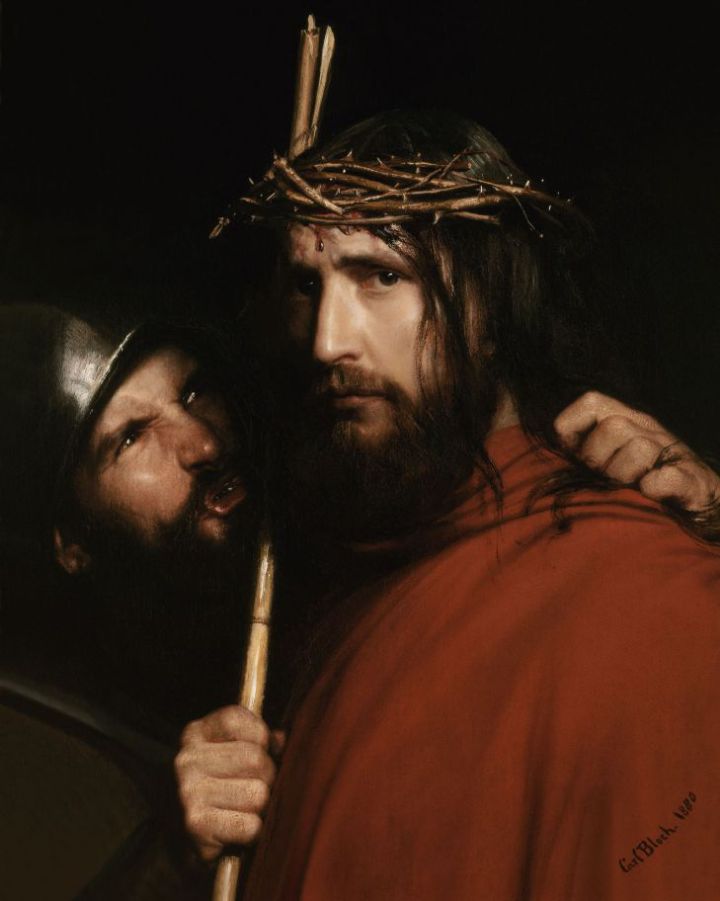
Because of the profound connection between our relationship with God and His Name and Face, sins committed against this relationship with Him are reflected in the Face of Jesus Christ. When a man’s name is slandered, or reviled, those insults are reflected on his face. So too, in the Passion, the Face of Our Lord was beaten, bloodied, bruised, spit upon.
How are sins against our personal relationship with God revealed in His Face? The manifestation of our sins on His Countenance come through blasphemy, atheism, disrespect of God in Sacred things, the profanation of Sunday, hatred of God’s Church. These indignities suffered by Our Lord in His Face represent the most serious sins, because they are against God Himself.
St. Veronica, model of reparation to The Holy Face
The damage done by our sins to our relationship with God are reflected in the Face of Jesus Christ. For this reason, devotion and reparation to the Holy Face is fitting in order to make amends for what we have done. By prayers and act of reparations we are performing the office of Veronica, the model of reparation to the Holy Face, in wiping the Face of Jesus and restoring dignity to His Holy Name and in a small way repairing mankind’s relationship with God.
Military Chaplain for the 8th Royal Irish Fusiliers WWI
We Christians are in the midst of a battle raging all around us. We are assailed on every side by terrorism, violence, murder, racism, human slavery, trafficking, degradation of the family and by the most deplorable evil of all, abortion. Videos that reveal horrors surpassing Nazi death camps, show babies ripped from the wombs of mothers, crushed, dissected and their parts sold off to the highest bidder. We pray and pray as it seems the battle has been lost. Battle-weary Christians are in danger of despair.
If Christians are indeed soldiers in Christ, then I would say at this point in the battle, we need a chaplain. I recommend one to you, my hero: Fr. Willie Doyle S.J. It may seem rather incongruous that a mother, grandmother and by all accounts a church-mouse, should have for her hero a WWI Irish Military Chaplain who traversed the bloody, muddy, battlefields of Ypres in 1917. Fr. Doyle ministered to exhausted soldiers of all faiths or none, with little or no sleep himself, little food, no relief, suffering from the cold, waist-deep mud in flooded, stagnant trenches, gas-attacks and all the horrors of war. Risking his own life at each moment, he administered absolution, anointing with oil faces smashed by shells, and then amid bursting shells buried the dead. Once, he even laid face down in the mud of a trench, in order that a sick doctor could get a little sleep by lying on his back. He died on August 16th, 1917, his body never found, he was last seen running back and forth across the battle fields giving absolution to dying men. But that is not why he is my hero.
Fr. Doyle’s life had a profound influence on the lives of a young Mother Teresa of Calcutta, as recounted in “Come Be My Light,” and on St. Josemaria Escriva and many others, not for what he did in the battlefields of Ypres, but in the battlefield of his own soul. Fr. Doyle’s great love of the Sacred Heart and the Holy Face of Jesus was made manifest in small sacrifices, born of a heartfelt desire to console Jesus, hated and outraged, blasphemed and spit upon. Like St. Therese of the Child Jesus and the Holy Face, to whom he had a great devotion, he followed her “Little Way” of abandonment and trust, practicing hidden works of virtue, accepting each little cross or small sacrifice. He wrote,
St. Therese of the Child Jesus and The Holy Face
“Kneeling at the grave of the Little Flower, I gave myself into her hands to guide and to make me a saint. I promised her to make it a rule of my whole life, every day without exception, to seek in all things my greater mortification, to give all and refuse nothing. I have made this resolution with great confidence, because I realize how utterly it is beyond my strength; but I feel the Little Flower will get me the grace to keep it perfectly.”
“How many deceive themselves in thinking sanctity consists in the ‘holy follies’ of the saints! How many look upon holiness as something beyond their reach or capability, and think that it is to be found only in the performance of extraordinary actions. Satisfied that they have not the strength for great austerities, the time for much prayer, or the courage for painful humiliations, they silence their conscience with the thought that great sanctity is not for them, that they have not been called to be saints. With their eyes fixed on the heroic deeds of the few, they miss the daily little sacrifices God asks them to make; and while waiting for something great to prove their love, they lose the countless little opportunities of sanctification each day bears within its bosom.”
Fr. Doyle made daily sacrifices that even I could handle, such as the first battle of getting out of bed when the alarm goes off. “Self-love,” Fr. Doyle has said, “is our own greatest enemy.” Yet we are all capable of “little things.” This is why he is my hero. St. Josemaria Escriva wrote to a friend of an example that set him on the road to sainthood. It was known as “The Butter Battle.”
“We were reading — you and I — the heroically ordinary life of that man of God. [Fr. Doyle] And we saw him fight whole months and years at breakfast time: today he won, tomorrow he was beaten… He noted: ‘Didn’t take butter…; did take butter!’ I have read quickly the life of Fr. Doyle: how well I understand the butter tragedy.” [For St. Josemaria, his own battle was not reading newspapers.] “Not reading newspapers, is for me no small mortification. Nevertheless, with God’s grace, I stayed faithful to it… What battles these struggles of mine were! These epics can be understood only by those who have gone through similar ones. Sometimes conquering; more often, being conquered.”
Inspired by the mortification of Carmelite Nuns to whom Fr. Doyle had given a retreat, he begged God earnestly for the grace to give up butter, sugar in his coffee, salt and so on. Little things are of great importance to God. It was by being “faithful in little things” those small sacrifices, that he was prepared to make the ultimate sacrifice “to lay down ones life for ones friends.” Let us pray, like Fr. Doyle, “to be faithful in little things.” Fr. Doyle knew better than anyone the value of making those small sacrifices of love that become mighty weapons in the hand of the Living God – and He will win the war!
Below is a passage from Fr. Doyle’s writing showing his devotion to the Face of Christ, and possibly the passage which most inspired Bl. Mother Teresa.
“The greatest thirst of Jesus on the Cross was His thirst for souls. He saw then the graces and inspirations He would give me to save souls for Him.
In what way shall I correspond and console my Savior? I went on
We don’t know the Crucifix Fr. Doyle spoke of but this is The Holy Face of The Miraculous “Limpias Crucifix”
to________and once more had an opportunity of a quiet prayer before the life-size crucifix in the church which I love so much. I could not remain at His feet but I climbed up until both my arms were around His neck. The figure seemed almost to live, and I think I loved Him then, for it was borne in upon me how abandoned and suffering and broken-hearted He was. It seemed to console Him when I kissed His eyes and pallid cheeks and swollen lips, and as I clung to Him I knew He has won the victory, and I gave Him all He asked.” ~Fr. William Doyle, S.J.
If you would like to read more about Fr. Doyle’s extraordinary life, please visit “Remembering Fr. William Doyle, S.J.” at http://fatherdoyle.com/
“Each child that is unborn… bears the Face of Christ.” –Pope Francis
The “safe, legal and rare” facade of Planned Parenthood is beginning to crack as videos emerge that reveal the reality of their cold, callous and gruesome practices. For far too long the evil of abortion has been carried out in this country and around the world. Surely, it should have come to an end after the trial of the infamous Kermit Gosnell, but it didn’t. What will it take? Unborn babies are not material to be used or blobs of tissue to be dissected and sold. We must recognize the humanity of the baby in the womb; we must look at their faces and see there the Face of Christ. Pope Francis has emphasized this truth, “Each child that is unborn, but is unjustly condemned to be aborted bears the Face of Christ. They cannot be discarded, as the culture of waste proposes! They cannot be discarded!”
Science and technology has made it possible to see this reality in an undeniable way, as shown in the ultrasound picture of the smiling baby in the photo above. They have a face and unique identity; he or she is created in the image and likeness of God! The Planned Parenthood videos are awakening some people to the truth, but until society as a whole acknowledges this reality and opens their eyes to recognize the face Jesus in the unborn, the horror of abortion will continue. May the aborted unborn souls gaze on the Face of God and intercede for our country before the throne of God. May He may remove the blindness from the eyes of those who perform and support abortion.
O Jesus, whose adorable Face was formed and hidden in the womb of the Blessed Virgin Mary for nine months — have mercy on us!
“How fair you are, O Virgin Mary. Your face is resplendent with grace.” –Carmelite Proper
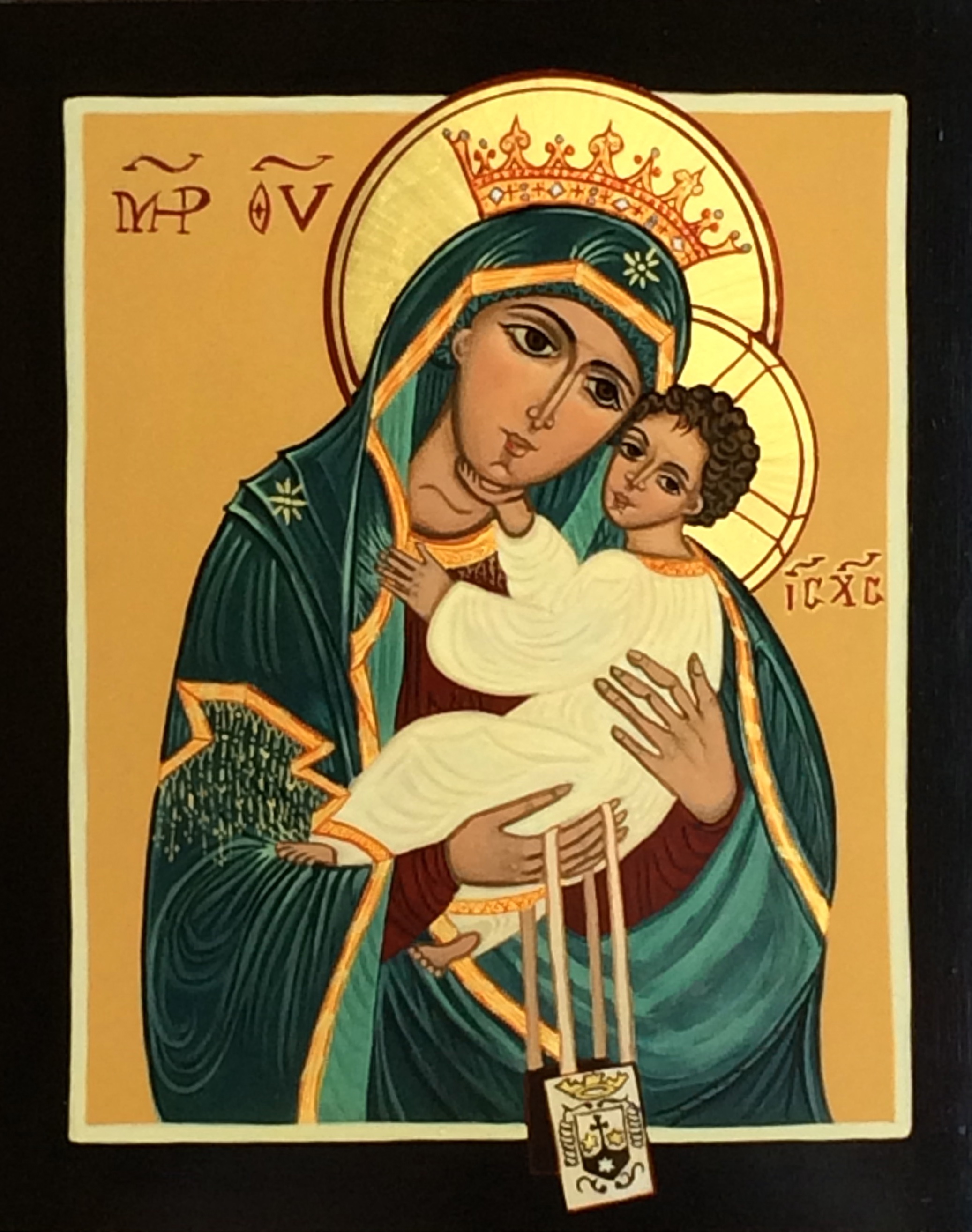
Our Lady of Mount Carmel icon by Patricia Enk
Seeking the Face of God through Mary
In the icon of “Queen Beauty and Mother of Carmel,” the Infant Jesus tenderly invites us to look at the face of His Mother, “resplendent with grace.” What makes the Virgin Mary’s face “resplendent with grace?” It is the light of the Face of Christ – just as the moon reflects the light of the sun, the face of Mary reflects the light of the true sun, Jesus Christ.
Mary is “The glory of Jerusalem, the joy of Israel, the highest honor of our race,” (Judith 15:9) because she sought the face of God, His holy will and pleasure, in all things. Just as it is possible for the moon to shine even in the brightness of day, Mary gives more beauty to the heavens, more glory to God than any other creature on earth. And when the dark night of faith is upon us and the sun is hidden from our view, Mary is there to enlighten our path and show us the way to her Son, until “In the tender compassion of our God the dawn from on high shall break upon us, to shine on those who dwell in darkness and the shadow of death, and to guide our feet into the way of peace.” (Luke 1: 78-79)
At the present moment, although the world is filled with darkness, we can turn to her for help in seeking His Face and leading souls to Him. Even pebbles on a path on the ground can reflect the light of the moon at night; and so the children of Mary by following her example, “to seek the Face of God in all things,” can guide others through the darkness by reflecting the light of the Face of Christ as does Mary.
It is Jesus Himself who desires that we turn to the face of His Mother. He created her with all the perfection and beauty that would be fitting for the Mother of God. Her soul, holy, immaculate and unstained by sin, is the perfect mirror in which He reflects His Face. He holds her up to us as the model for all His disciples as He did in Luke’s Gospel: “While He was speaking, a woman from the crowd called out and said to Him, ‘Blessed is the womb that carried you and the breasts at which you nursed.'” This singular praise of Mary from the woman in the crowd was not enough for her Son. And so Jesus replied, “Rather, blessed are those who hear the word of God and keep it.” (Luke 11:27) Mary is thus thrice blessed, first, in being chosen to be the Mother of God, second, in that Mary heard the word of God and third, because she kept His word in her heart.
Mary holds out to us her Scapular, a sacramental sign of being clothed in her own garment, to place over our shoulders, so that we may imitate her in faith, hope, charity and all the virtues that adorn her soul. By contemplating the Face of Jesus always, together with Mary, we can do our part in making His Face shine upon our world as well.
Flos Carmeli
composed by St. Simon Stock
Most Holy Virgin! Beauty of Carmel! Virgin flower forever in bloom! Bright ornament of Heaven! Thou Virgin Mother of the Man-God! Mother of holy love! Mother of mercy and meekness! Mother honored above all Mothers! Star of the Sea! be thou propitious to thy dear children of Carmel, and to all who have the happiness of wearing your holy Scapular. Amen.
“Our Lady in whose face – more than in any other creature – we can recognize the features of The Incarnate Word.” –Pope Benedict XVI
The Feast of St. Benedict on July 11th always reminds me of his Benedictine sons and daughters and their special devotion to the Face of Jesus. Certainly, all Benedictines make the Face of Christ in the Church shine through their beautiful liturgy. But, a few in particular come to mind when recalling the Holy Face. It was the Benedictines of Perpetual Adoration of the Most Blessed Sacrament, who through the influence of St. Gertrude the Great, gave the Carmelite Monastery in Tours, France reproductions of the Holy Face, in 1851 from the Basillica in Rome. This is the image became most closely associated with Carmelite Sr. Marie St. Pierre, who received the revelation of Devotion to the Holy Face, (although she had never seen the drawings from the Vatican in her lifetime. Her monastery had another image of the Holy Face known as the “Edessa,”) The Holy Man of Tours, Leo Du Pont, who devoted his life to promoting the devotion to the Holy Face of Tours, also worked toward establishing an ArchConfraternity. St. Therese of the Child Jesus and The Holy Face had an image of the Holy Face of Tours pinned to her bed curtains.
St. Gertrude, one of the great mystics of the 13th century and the only female Saint to be called “the Great,” was known for her special devotion to the Face of Christ. It was written that she wept each time she recalled the sorrowful vision of Our Lord in which she saw Him so severely disfigured by the executioners that her heart was filled with bitter grief. “Tell me, O Lord,” exclaimed St. Gertrude, “the remedy that can soothe the sufferings of Thy Divine Face.” Jesus replied: “If anyone meditates upon My sufferings with tenderness and compassion, his heart will be to Me as a soothing balm for these wounds.”
St. Gertrude often saw the Face of Jesus, in meditation, resplendent as the sun, illuminating priests, inflaming the devout and converting sinners. When she asked why the Face of Our Lord shone like the sun, and Jesus explained: “Like the sun, My Countenance illuminates, warms and fructifies.”
St. Gertrude the Great
On another occasion when St. Gertrude was making reparation to the Adorable Face, wounded and disfigured, she asked Jesus for a special grace for those who would practice devotion to His Holy Face. Jesus gave St. Gertrude this promise: “All those who meditate frequently on the vision of My Divine Face, attracted by the desires of love, shall receive within them, through My Humanity, a bright ray of My Divinity, which shall enlighten their inmost souls so that they shall reflect the light of My Countenance in a special manner throughout eternity.” (Click here to read about St. Gertrude’s description of the “Veronica” which she had seen displayed at the Vatican.)
St. Mechtilde, a contemporary of St. Gertrude, was also devoted to the Holy Face. She once exclaimed to her sisters, “Let us all, full of holy desire, hasten to venerate the sweetest Countenance of Our Lord, which will in Heaven be our all – all that a glorified soul can desire.” St. Mechtilde had once asked Our Lord to grant that those who celebrate the memory of His sweet Face should never be deprived of His amiable company. Jesus replied, “Not one of them shall be separated from Me.” Jesus then pronounced this blessing: “The splendor of My Countenance will be their eternal rejoicing.”
Bl. Columba Marmion
The other day I “accidentally” picked up a book, by an Irish Benedictine, while looking for a something else on my bookcase: “Union With God”, Letters of Spiritual Direction by Blessed Columba Marmion.” Remembering this book as a treasure of wise counsel and never one to resist opening and re-reading “just a few pages,”which ended up being most of the book, my eyes fell these words of Bl. Marmion, reminding me of God’s gaze upon us, working wonders in our souls as we gaze at Him: “God’s mercy is infinite like God Himself. If we lay open our soul to Him with all its infirmities and sins. His Divine gaze goes into the most hidden recess and brings us strength and light.”
Bl. Marmion writes that our relationship with God hinge upon two things; our walking in the truth of our nature as creatures, who remain always in humble adoration before our Creator, and our dignity as children of God: “Our adoption as children supposes that we act always as loving children towards our Heavenly Father, constantly seeking his good pleasure: “Seek His Face evermore.” This Facies Dei, Face of God, is the smile of His loving approbation. If you always keep the truth of this twofold relation, you will be more and more fixed in truth and in peace.” “Look your Heavenly Father in the face, and show him your soul in bare truth,” Bl. Marmion advises, “…do not forget that He is God the Infinite! The love of the creature, in order to be true, must be the love of adoration; the Sacred Humanity of Jesus stands before the face of the Father in the reverence of infinite love: “He shall be FILLED with the spirit of fear of the Lord.” and he goes on, “If you keep the eye of your soul fixed upon God alone, you will receive many graces.”Bl. Marmion writes too, of gazing at God in faith; “It is good sometimes, when alone with God, to stretch out our hands to Him and look at Him in faith showing Him the depths of our soul that His eye may penetrate into those abysses that are hidden in the recesses of the heart. Then our prayer is pure and very powerful, for the child gazes into the Father’s face, seeking this face, that is to say His good pleasure: “Seek ye the Lord, seek His face EVERMORE.”
I will end with these beautiful and inspired words of hope for the Feast of St. Benedict by Dom Mark Kirby of Silverstream Priory:
“The Sacred Name and Sacred Face of Jesus are fire and light in this world that is becoming colder and darker by the day. In the end, the darkness will be forever vanquished by the fire of His Name and by the light of His Face, and then there shall be peace in His Kingdom fully revealed, and in the company of His Saints who will sing praise to His Name and adore His Face, shining more brightly than a thousand suns, and this unto the ages of ages.” –Dom Mark Kirby, OSB
Happy Feast of St. Benedict! May His Face shine upon all Benedictines!













 Illumina Domine Blog - Devotion to The Holy Face