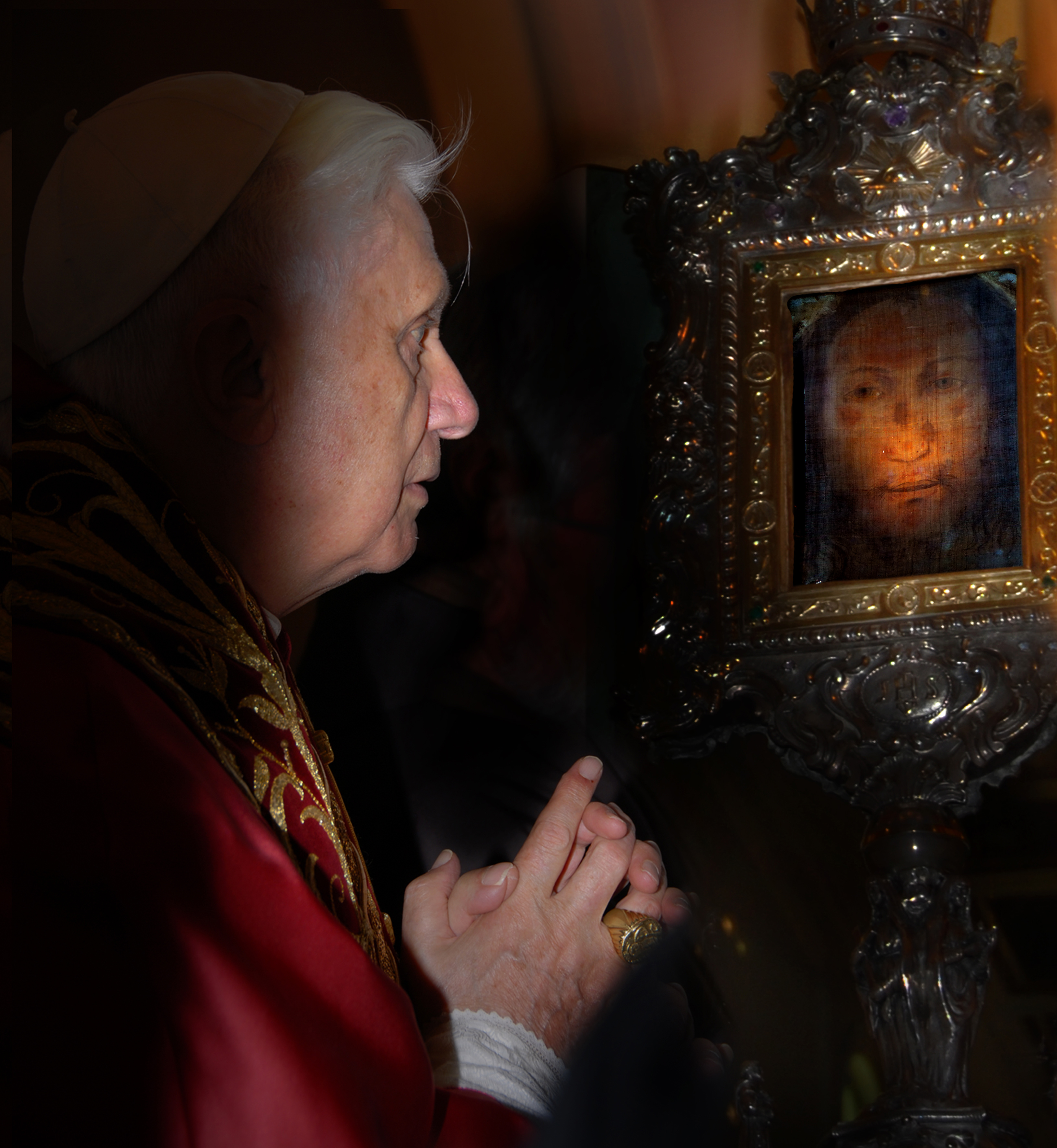
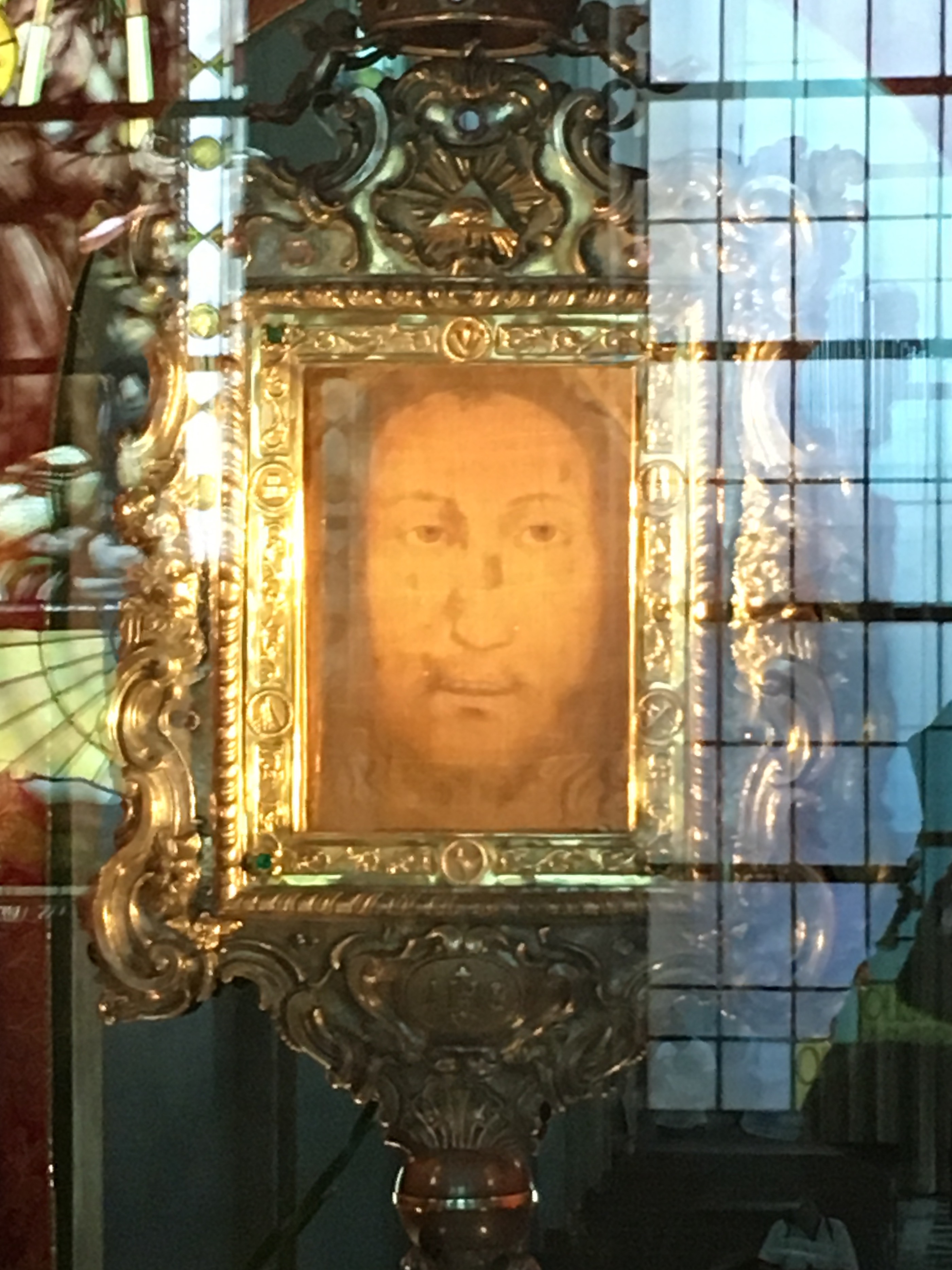
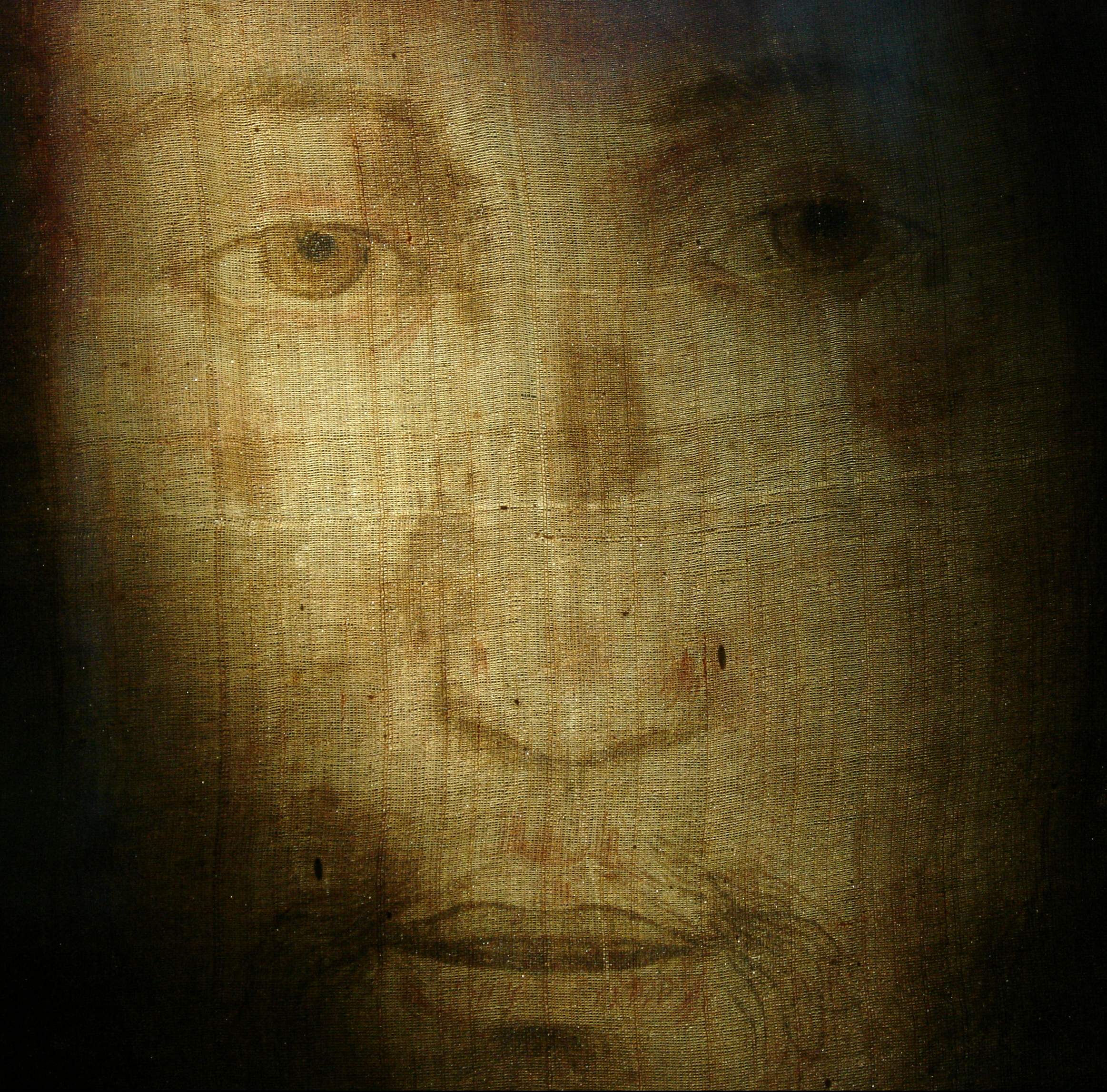
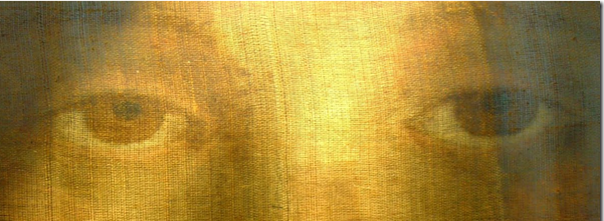
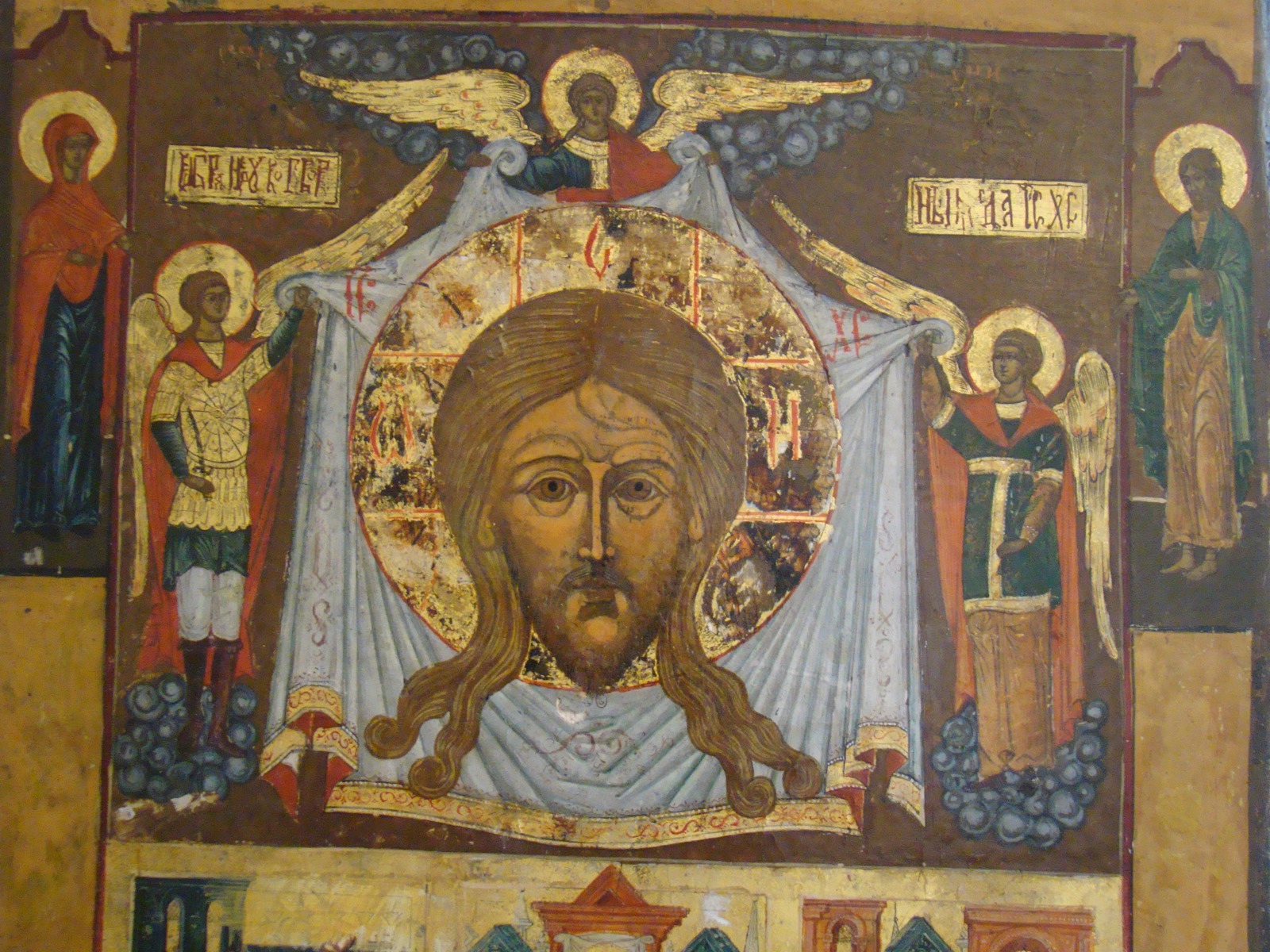
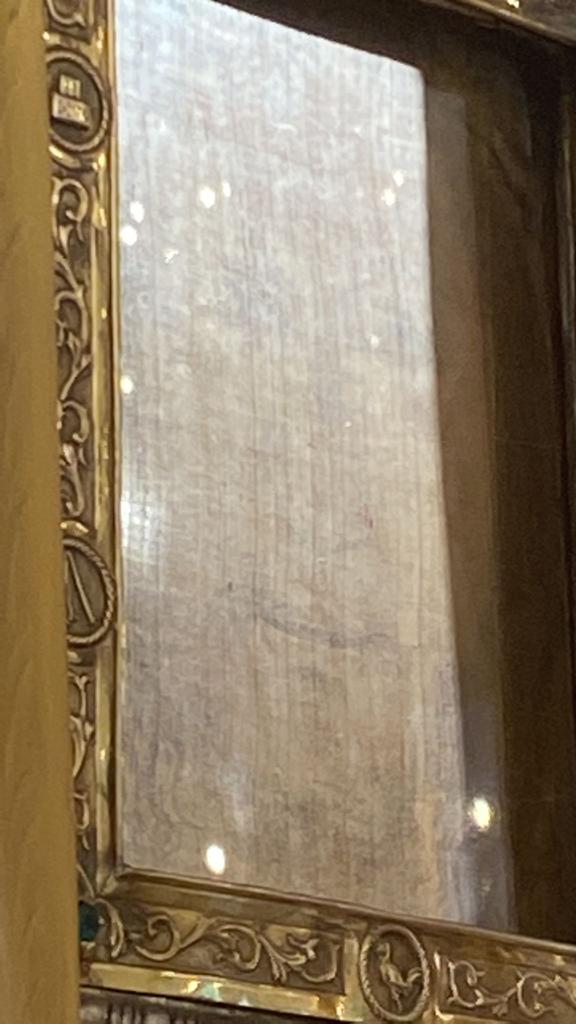
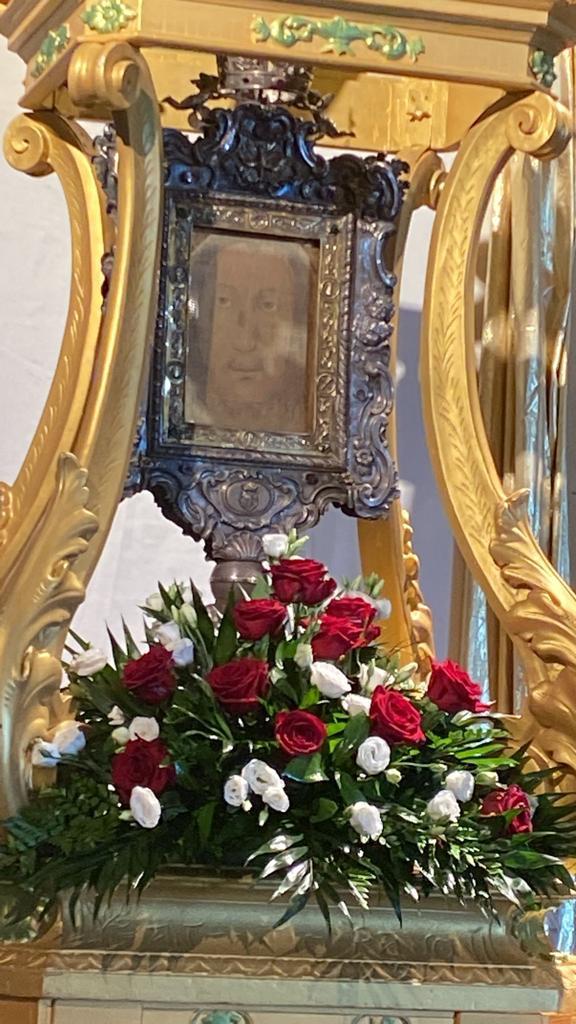
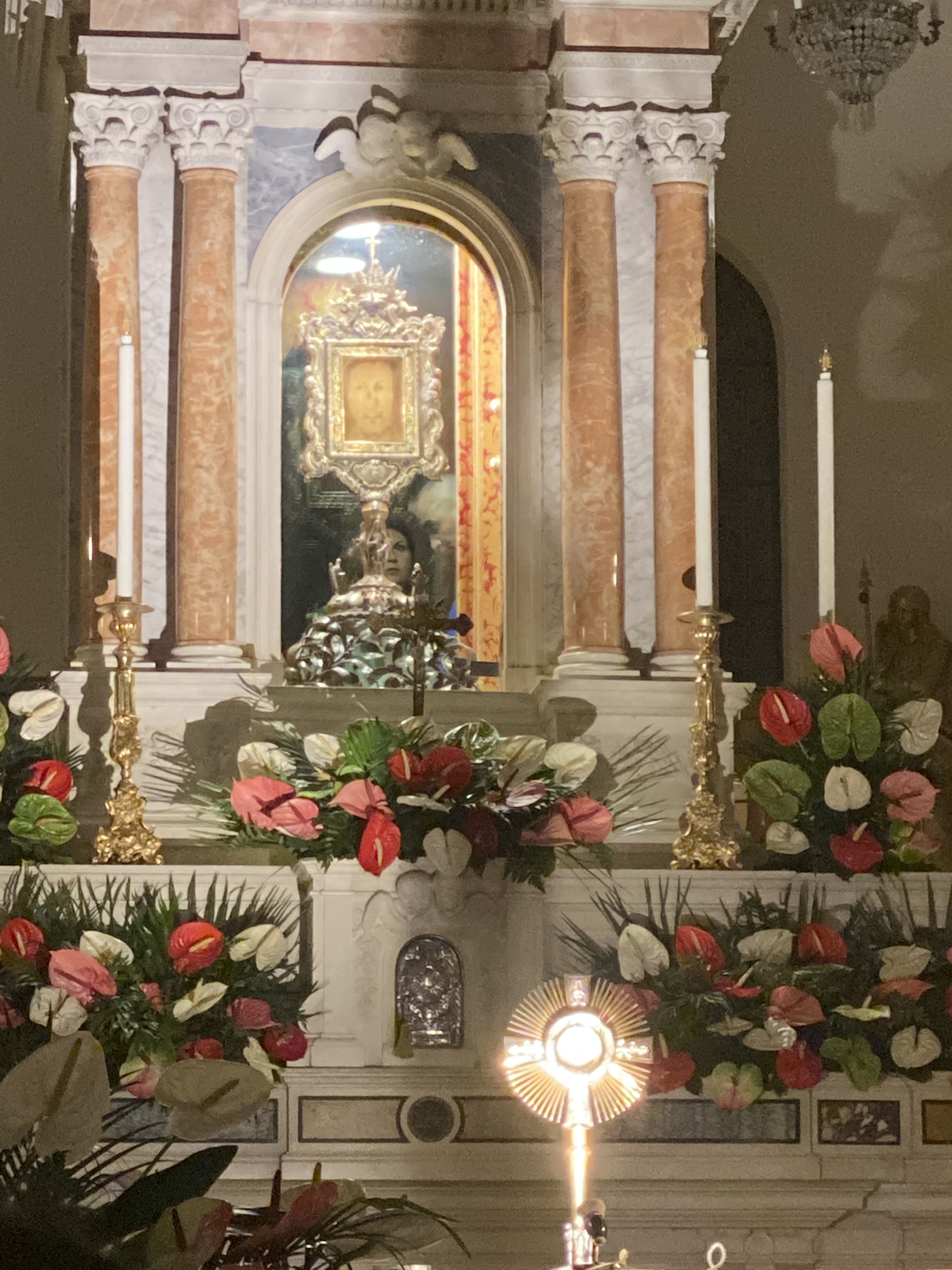
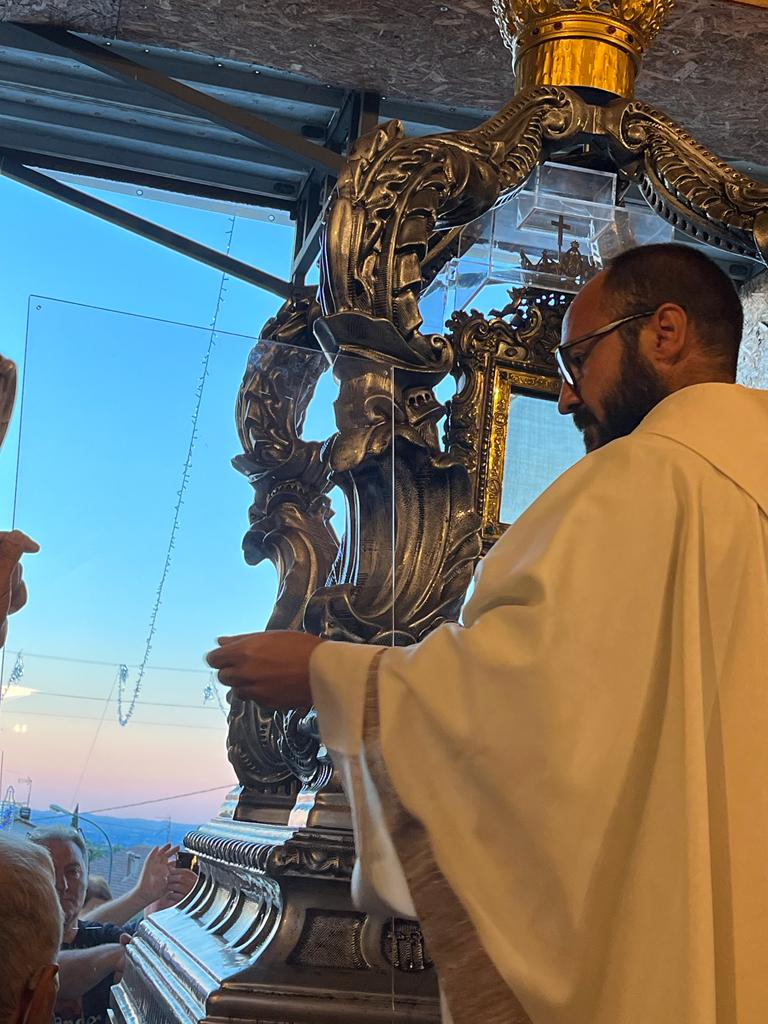
Offered for your contemplation — the Face of Jesus (Photo: Paul Badde)
We contemplate many things in the course of our day, and can make choices about what we give our attention to. Opening up a computer, or turning on a television or radio is an invitation for something, good or bad, to fill our eyes, ears, and souls.
Recently I learned about the creation of something called the “Metaverse,” a technology that people can use to experience with others a virtual reality. It is proposed as something beyond games and entertainment, but as an alternative to the universe we actually live in. The thought of such a thing fills me with an instinctive revulsion. The universe, created to be good, beautiful and true by God is worth contemplating as a hint of the good, truth, and beauty of the Face of the Creator. But the metaverse, rejecting that reality, offers instead a mask of non-reality, behind which is not a face, but an empty void. It is a rejection of God and His Creation.
What we are looking at matters. What we listen to matters. It’s not an understatement to say that the world is increasingly losing its grip on reality because it is no longer seeking the Face of God. It is running headlong off a cliff in pursuit of things to take the place of God; soul-destroying idols. Evil proposes, in a very seductive way naturally, that humanity contemplate the soul-less idols because they will separate us from God. God, on the other hand, proposes that we gaze upon the Face of His Son, Jesus Christ, who will unite us to Himself.
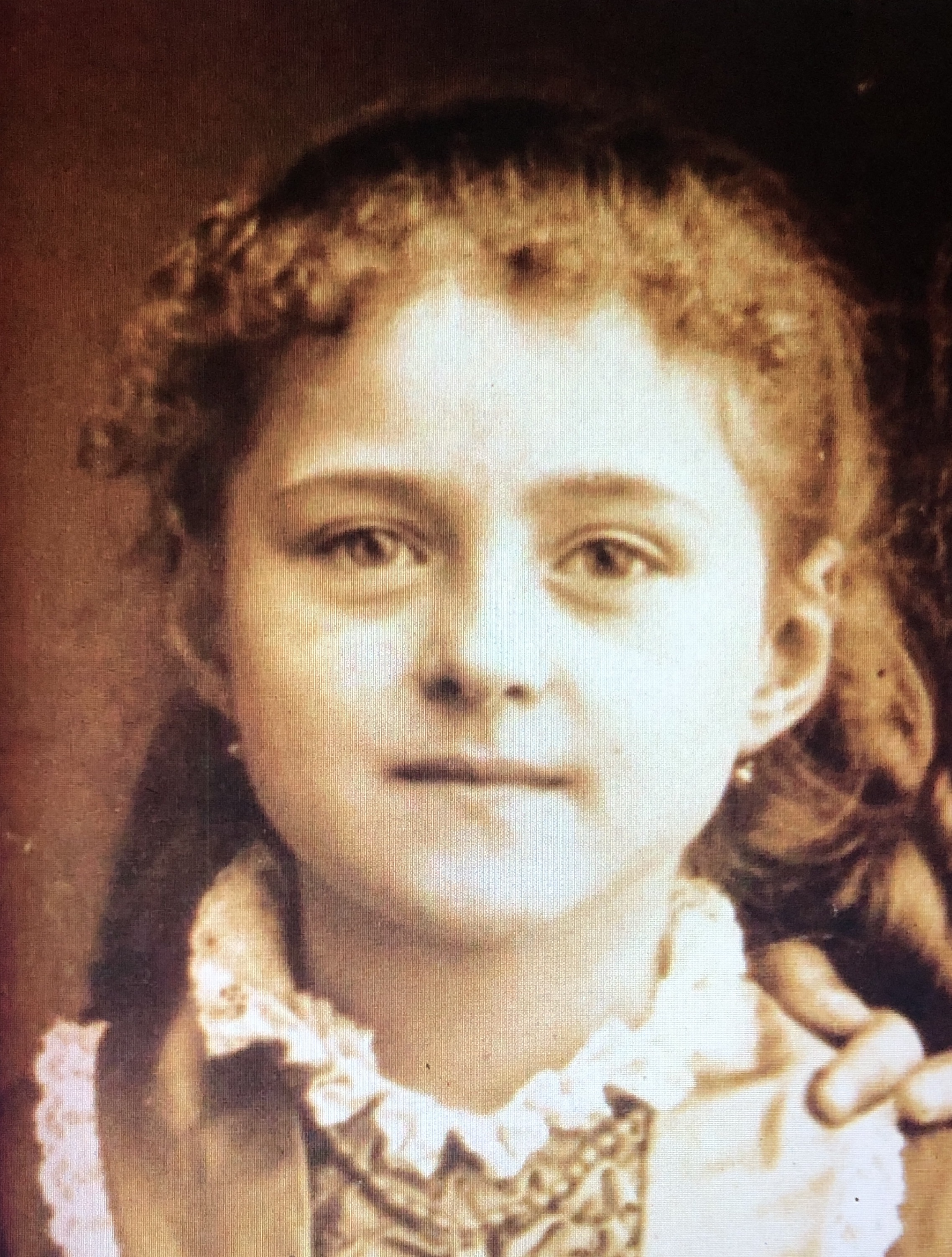
St. Therese
“We become what we contemplate. One who contemplates disfigured things becomes inwardly disfigured. One who contemplates transfigured things becomes inwardly transfigured. One who contemplates the all-beautiful Face of the Incarnate Word will be supernaturally beautified.”
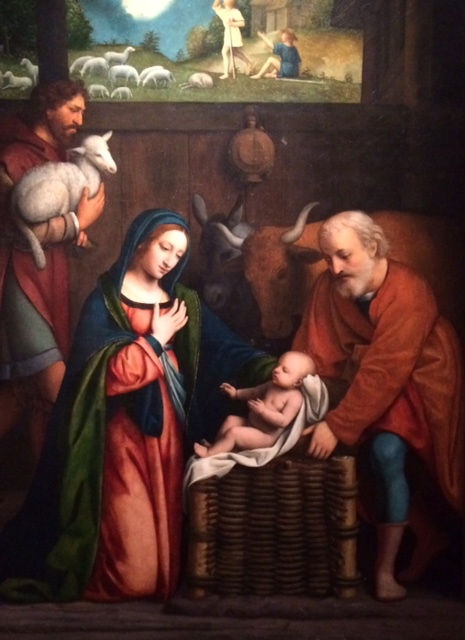
“The time came for Mary to be delivered. And she gave birth to her first-born son and wrapped him in swaddling clothes, and laid him in a manger, because there was no room for them in the inn.” (Lk 2:61f.).
At your door is a poor man with a small, young woman who is about to give birth. They won’t take up much space, all they ask for is shelter. Does your mind begin to calculate? “They are strangers, the house is a mess, it’s full of visiting relatives, I’ll have to get more food, I’m tired, it’s late…” The excuses are innumerable, but have pity! Surely, there is a small space somewhere for them to enter in.
The God of the Universe became incarnate in the womb of the Virgin Mary — a very small space — He needed only her “yes”. Say yes to Him, like Mary, allow the Word Incarnate to enter into your heart. Make room for Jesus. Take the cross you have been carrying and give it to Him. He will transform it into a manger, that will be a space for Him to lay His head. Wait then, in silence, together with Mary, and soon you will have the joy of gazing tenderly on the holy face of the Infant Jesus in the manger of your soul.
“The contemplation of Christ has an incomparable model in Mary. In a unique way the face of the Son belongs to Mary. It was in her womb that Christ was formed, receiving from her a human resemblance which points to an even greater spiritual closeness. No one has ever devoted himself to the contemplation of the face of Christ as faithfully as Mary. The eyes of her heart already turned to him at the Annunciation, when she conceived him by the power of the Holy Spirit. In the months that followed she began to sense his presence and to picture his features. When at last she gave birth to him in Bethlehem, her eyes were able to gaze tenderly on the face of her Son, as she ‘wrapped him in swaddling cloths, and laid him in a manger’ (Lk2:7).” (Pope St. John Paul II, Rosarium Virginis Mariae)
Fr. Heinrich Pfeiffer, S.J., looks on smiling, between Pope Benedict XVI, Paul Badde, and Sr. Blandina Paschalis Schloemer, on the occasion of the Pope’s pilgrimage to see the Holy Veil of Manoppello, Italy, in 2006.
Born on February 22, 1939, in Tübingen, Germany, Heinrich Pfeiffer had a passion for art history, philosophy, and theology. Answering God’s call, he entered the Society of Jesus in 1963, and was ordained a priest in 1969. As a teacher of art history and Christian iconography at the Pontifical Gregorian University in Rome, he quickly established a highly respected reputation for his expertise in art history, and as a “sindonologist” (Shroud of Turin studies). However, he risked the ridicule and scorn of others when he announced the discovery of the “True Icon” otherwise known as the “Veronica Veil,” in the small mountain Village of Manoppello, Italy. His joy in finding the veil became a heavy cross, as time and time again, he would defend the authenticity of veil to “experts,” who shut their eyes to the evidence, often denouncing the ancient holy relic without ever bothering to go see it for themselves.
Fr. Heinrich, however, could not deny what his years of study, and his own eyes knew to be true: the gossamer-thin, transparent veil that, in light, revealed the Face of Jesus in a miraculous way, was believed to be the veil placed on the Face of Jesus in the tomb, and received His first breath at the Resurrection.
This incredible, steadfast priest entered into eternal life, on the night of November 26, 2021, in Berlin. Germany. May he gaze on God’s Face now for all eternity. Requiescat in pace, Fr. Heinrich Pfeiffer.
The Holy Veil of Manoppello, Photo: Paul Badde/EWTN
Living on Love - Stanzas 9-11- by St. Therese of the Holy Face and the Child Jesus
Living on Love, when Jesus is sleeping
Is rest to stormy seas.
Oh! Lord, don't fear that I'll wake you.
I'm waiting in peace for Heaven's shore...
Faith will soon tear the veil.
My hope is to see you one day.
Charity swells and pushes my sail.
I live on Love!...
Living on Love, O my Divine Master,
is begging to spread your Fire
in the holy, sacred soul of your Priest.
May he be purer than the seraphim in Heaven!...
Ah! glorify your immortal Church!
Jesus, do not be deaf to my sighs.
I, her child, sacrifice myself for her.
I live on Love.
Living on Love, is wiping your Face,
It's obtaining the pardon of sinners.
O God of Love! may they return to your grace.
And may they forever bless your Name
To efface it. I always want to sing:
"I adore and love your Sacred Name.
I Live on Love!"
“The Word will imprint in your soul, as in a crystal, the image of His own beauty, so that you may be pure with His purity, luminous with His light.”
Ten years before entering the Carmelite Convent in Dijon, France, eleven year-old Elizabeth Catez met the prioress on the afternoon of her First Holy Communion. What the prioress told her on that occasion left a deep impression in her soul; upon learning Elizabeth’s name, the prioress told her that her name meant “House of God.” She later wrote on the back of a holy card for Elizabeth: “Your blessed name hides a mystery, accomplished on this great day. Child, your heart is the House of God on earth, of the God of love.”
“Do you not know that you are God’s temple and that God’s Spirit dwells in you?” (1 Cor 3:16)
Waiting to enter Carmel–St. Elizabeth of the Trinity
Upon entering Carmel at the age of twenty-one, Elizabeth sought God’s Face within the temple of her own soul, in prayer and silence, with a growing desire to be united with Jesus, to share in His life and sufferings–to be transformed into His image–so that God the Father would find in her the image of His Son, in whom He was well-pleased. Elizabeth wrote, “God bends lovingly over this soul, His adopted daughter, who is so conformed to the image of His Son, the ‘first born among all creatures,’ and recognizes her as one of those whom He has ‘predestined, called, justified.’ And His Fatherly heart thrills as He thinks of consummating His work, that is of ‘glorifying her by bringing her into His kingdom, there to sing for ages unending’ the praise of His glory.” She prayed that the Holy Spirit “create in my soul a kind of incarnation of the Word: that I may be another humanity for Him in which He can renew His whole Mystery.”
“I want to gaze on You always and remain in Your great light.”~St. Elizabeth of the Trinity, OCD
“We must become aware that God dwells within us and do everything with Him; then we are never commonplace, even when performing the most ordinary tasks.”
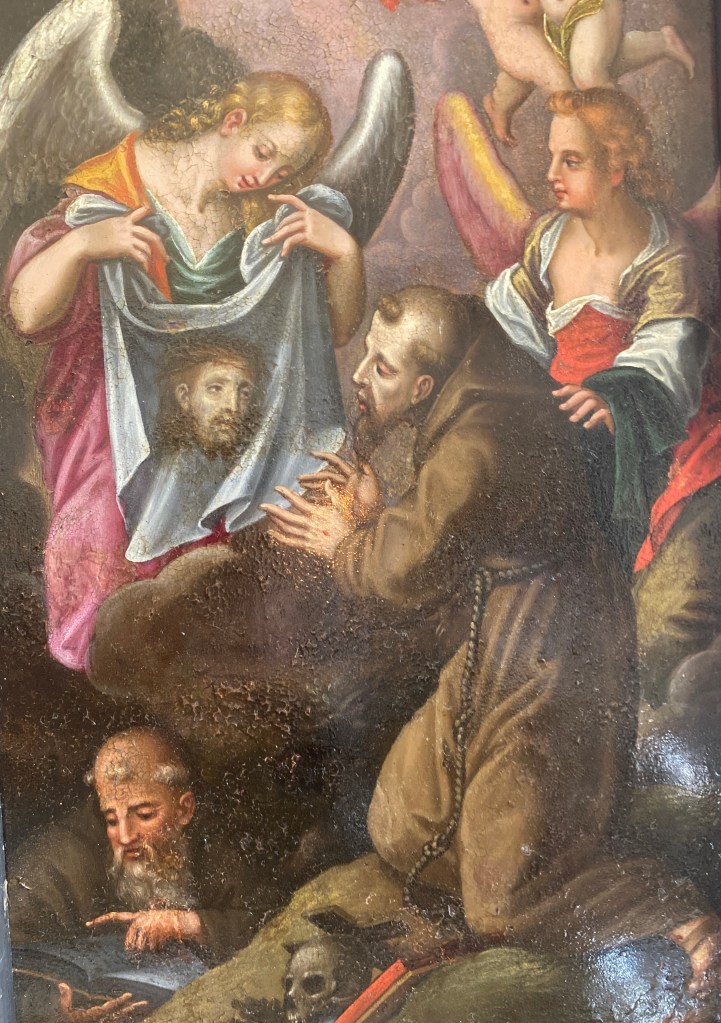
This was the fruit of contemplation that St. Elizabeth of the Trinity wanted to share with everyone; the secret of transforming love hidden within our own hearts. By gazing steadfastly upon God, in faith and simplicity, the Word of God, Jesus Christ–as in the legend of St. Veronica’s Veil–will leave the imprint of His image on the veil of the soul. By her continual loving gaze at Him, St. Elizabeth of the Trinity was transformed into His image. When she died at the young age of twenty-six, she had already fulfilled her mission in the Church as a ceaseless “Praise of Glory,” reflecting the luminous, pure light of the Holy Trinity.
“It is Your continual desire to associate Yourself with Your creatures…How can I better satisfy Your desire than by keeping myself simply and lovingly turned towards You, so that You can reflect Your own image in me, as the sun is reflected through pure crystal? …We will be glorified in the measure in which we will have been conformed to the image of His divine Son. So, let us contemplate this adored Image, let us remain unceasingly under its radiance so that it may imprint itself on us.”
— St. Elizabeth of the Trinity, OCD, Feast Day November 8.
St. Veronica with the Veil of the Holy Face, 1485, Maestro, Viennese
Her life was the stuff that great novels are made of: born on November 1, 1864, Elizabeth, or “Ella” as she was known to her loved ones, was described as “the most beautiful woman in Europe.” She was a Princess of Germany, her parents were the Princess Alice of England and Louis IV, Grand Duke of Hesse and by the Rhine; her maternal grandmother was Queen Victoria. She was brought up by Queen Victoria after being orphaned at the age of fourteen. “Ella” had many suitors, but rejected them all, choosing in the end, to marry for love, her childhood friend Sergei, who also happened to be the Grand Duke Sergei Alexandrovich of Russia, the fifth son of Emperor Alexander II of Russia and Princess Marie of Hesse and by the Rhine. “Everyone fell in love with her from the moment she came to Russia from her beloved Darmstadt” wrote one of Sergei’s cousins. This princess story was not the fluff of fairy tales, however. Elizabeth’s true beauty was hidden with Christ in the depth of her soul.
Elizabeth Feodorovna Romanova, Grand Duchess, Saint, Martyr
Elizabeth and Sergei were married at the Chapel of the Winter Palace in St. Petersburg in 1884. Before her marriage, Elizabeth was a Protestant, but after a trip to the Holy Land, she converted to the Orthodox Church in 1891. She took the name “Feodorovna,” in honor of the Feodorovskaya Icon of the Mother of God, patroness of the Romanov house.
The couple never had children of their own; they frequently organized parties for children, and eventually became foster parents of Sergei’s niece and nephew. Elizabeth had encouraged her youngest sister Alix to also convert to Orthodoxy after Alix had refused the first proposal of Sergei’s nephew, Tsar Nicholas II, on the basis of the difference of religion.
Feodorovskaya Icon which hung in Alesandra’s bedroom
The Duchess Elizabeth and her husband were deeply religious, and so she was greatly distressed when the Grand Duke made the decision to send soldiers to surround the homes of 20,000 Jews, who, with no notice, were suddenly expelled from Moscow. At the time she was heard to make a dark prophesy: “God will punish us severely.”
On February 17, 1905, Elizabeth felt the concussion of a bomb blast. Her beloved husband had been assassinated by a bomb thrown by the Socialist Revolutionary, Ivan Kalyayev.
Elizabeth and her husband Sergei
“Grand Duchess Elisabeth heard the explosion and felt the shock; she rushed outside and saw the dismembered body of her husband strewn around the square. She knelt in the snow and helped collect the remains and, almost incredibly found the strength to arrange for the transportation to a hospital of the grand duke’s coachman, who had been severely wounded. Visiting the dying man later, she told him that the grand duke was well and safe, and had in fact sent her, enabling the man to die peacefully.”
“The lofty spirit with which she took the tragedy astounded everyone: she had the moral strength even to visit in prison her husband’s assassin, Kaliaev, hoping to soften his heart, with her Christian forgiveness. ‘Who are you?’ he asked upon meeting her. ‘I am his widow,’ she replied, ‘why did you kill him?’ ‘I did not want to kill you,’ he said. ‘I saw him several times before when I had the bomb with me, but you were with him and I could not bring myself to touch him.’ ‘You did not understand that by killing him you were killing me,’ she said. Then she began to talk of the horror of his crime before God. The Gospel was in her hands and she begged the criminal to read it and left it in his cell. Leaving the prison, the Grand Duchess said: ‘My attempt was unsuccessful, but, who knows, perhaps at the last minute he will understand his sin and repent.“
— Ludmila Koehler, Saint Elisabeth the New Martyr
Grand Duchess Elizabeth as a nun
This was a turning point in Elizabeth’s life. Our Lord transformed her grief into a desire to serve God. From that point on, the only crown she would wear would be one of thorns — in imitation of her suffering Lord. She sold her possessions and jewels — even her wedding ring — and with the proceeds she opened the convent of Saints Martha and Mary, and other women joined her. Soon after, on the grounds, she opened a hospital, a chapel, pharmacy, and orphanage. Elizabeth and her nuns visited the worst slums in Moscow, working tirelessly to help the orphaned and the poor. Her convent handed out 300 meals to the poor each day, who called her “the Guardian Angel of Moscow.”
The last meeting she had with her sister Alix, now the Tsarina Alexandra, was in St. Petersburg, 1916. Elizabeth expressed to the Tsarina her deep concern about the influence the wicked Rasputin had over her sister. Alexandra didn’t heed her sister’s advice. In 1917, the Bolsheviks seized power. Elizabeth chose to remain in Russia to serve the poor.
Three days after Easter, in 1918, Vladimir Lenin ordered the Soviet Secret Police to arrest Elizabeth, together with another nun of her order and other members of the Royal family. Lenin was quoted as saying “virtue with the crown on it is a greater enemy to the revolution than a hundred tyrant tsars.” They were taken to an abandoned mine, beaten and thrown into a pit 66 feet (20 meters) deep, landing on an outcropping. Though injured in the fall, the sound of prayers and hymns rose from the pit for a long time, only resulting in rage from their captors, who threw down two grenades to silence them. One member died, but the singing continued, resulting in the Bolshevik leader ordering brushwood be thrown into the pit and set on fire.
“It is easier for a scrawny shrub,
to withstand a mighty fire
than for the nature of sin to [withstand]
the power of love.”
— St. Elizaveta
Three months later, the White Army discovered the bodies of Elizabeth and the others in the pit. Most had died of either injuries or starvation. As a last act of compassion, Sr. Elizabeth had used her own religious veil, or wimple, to bandage the head wound of the dying Prince Ioann — which calls to mind the compassion shown to Jesus by the holy woman known as “Veronica,” who, as legends of the middle ages told, wiped the bleeding Face of Jesus on the way to Calvary. Elizabeth’s body was first transferred in secret to Beijing, China, where she was buried in a Russian Orthodox cemetery. Later, her remains were taken to Jerusalem to the Church of St. Mary Magdalene at Gethsemane in Jerusalem, a church that she and her husband helped to build. She is venerated in the Russian Orthodox Church as a Saint and Martyr.
Icon of the Holy Face, embroidered in gold by Duchess Elizabeth Feodorovna — Косино
“… there are times, there are ages, when nothing is more desirable, nothing more beautiful than the crown of thorns.”
— Russian Poet, Nekrasov
“He is our head, crowned, not with glory, but with the thorns of our sins. As members of that head, crowned with thorns, we should be ashamed to live in luxury; His purple robes are a mockery rather than an honor. When Christ comes again, His death shall no longer be proclaimed, and we shall know that we also have died, and that our life is hidden with Him.”
— St. Bernard, Abbott
Many thanks to Paul Badde, who first told me about the extraordinary and holy Princess Elizabeth from his native land! This is a photo taken by Paul of “most beautiful church in Jerusalem, where she is buried, here seen from the temple-mount.”
“Dominus Illuminatio Mea” – “the Lord is my light” are the first words of Psalm 27…
“The LORD is my light and my salvation; whom shall I fear?
The LORD is the stronghold of my life; of whom shall I be afraid?“
Is the darkened state of the world wearing you down? You are not alone – the whole of humanity seems to be in the same miserable boat – fearing enemies around every corner. Jesus reminds us that “Fear is useless, what is needed is trust.” (Luke 8:50)
Pope St. John Paul II, “the light of Poland,” certainly lived through some very dark times, yet he never lost his faith, his hope, or his joy. He found profound inspiration, and comfort, in Psalm 27. From the time of King David, the psalms have been a source of comfort to souls living through the darkness of trials down through the centuries. The very meaning of the word “comfort” is “with strength.” It is the strength that comes from trusting in God, knowing that in spite of the odds, God will bring about our rescue.
“When evildoers come at me to devour my flesh,
These my enemies and foes themselves stumble and fall.
Though an army encamp against me, my heart does not fear;
Though war be waged against me, even then do I trust.”
Divine Mercy
We may “visit Him in His temple.” But, our bodies are also a temple; a temple of the Holy Spirit. We may seek God’s Face within the temple of our souls, “with shouts of joy, songs and praise,” in faith, hope, and trust. Jesus, I trust in You!
“One thing I ask of the LORD; this I seek:
To dwell in the LORD’s house all the days of my life,
To gaze on the LORD’s beauty, to visit his temple.
For God will hide me in his shelter in time of trouble,
Will conceal me in the cover of His tent;
and set me high upon a rock.
Even now my head is held high above my enemies on every side!
I will offer in his tent sacrifices with shouts of joy;
I will sing and chant praise to the LORD.“
“Illumina Domine Vultum Tuam Super Nos — Mane Nobiscum, Domine!” “Lord, let the light of Your Face shine upon us — Remain with us, Lord!”
As Bl. Carlo Acutis once said, “Sadness is looking at oneself, happiness is looking at God. Conversion is nothing but a movement of the eyes.” To seek God’s Face is to be in His life-giving presence. He will hear His children when they call. He does not abandon them to their enemies. His gaze is always upon us; we need only to turn the gaze of our hearts toward Him. He will not reject us, because He is love and mercy itself! He will guide us, defend us, save us…if only we “believe, take courage,” are “stouthearted,” and “wait”…for Him!
The Holy Face of Jesus, a miracle “written in light” on the Veil of Manoppello. (Photo: Paul Badde/EWTN)
“Hear my voice, LORD, when I call;
have mercy on me and answer me.
‘Come,’ says my heart, ‘Seek God’s face’;
your face, LORD, do I seek!
Do not hide your face from me;
do not repel your servant in anger.
You are my help; do not cast me off;
do not forsake me, God my savior!
Even if my father and mother forsake me,
the LORD will take me in.”
“LORD, show me your way;
lead me on a level path because of my enemies;
Do not abandon me to the will of my foes;
malicious and lying witnesses have risen against me.
But I believe I shall enjoy the LORD’s goodness
in the land of the living.
Wait for the LORD, take courage;
be stouthearted, wait for the LORD!“
–Psalm 27
St. Pope John Paul II
“In the Eucharist, the Face of Christ is turned towards us.”
“Your life must be woven around the Eucharist. Direct your eyes to Him, who is the Light; bring your hearts very close to His Divine Heart; Ask Him for the grace to know Him, for the charity to love Him, for the Courage to serve Him. Seek Him longingly.”
— St. Teresa of Calcutta
“It is the Church’s task to reflect the light of Christ in every historical period, to make His Face shine also before the generations of the new millennium. Our witness, however, would be hopelessly inadequate if we ourselves had not first contemplated His Face.”
“Now this is the message that we have heard from Him and proclaim to you; God is light, and in Him there is no darkness at all.”
(John 1:5)
The Holy Veil of Manoppello, a miracle of light. Photo: Paul Badde/EWTN
In 2012 I first made a pilgrimage to the Basilica Shrine of the Holy Face in Manoppello, Italy, to see for myself the ancient, mysterious relic that is the veil of the Holy Face. I took no pictures at that time as it was my sole intention to pray, and not be distracted by snapping photos. At the time, it was a sacrifice. But God blessed the small sacrifice with an unforgettable experience of prayer. Fortunately for me, and by God’s Providence, Paul Badde, who is an art historian, journalist, and champion of the Holy Face, had taken thousands upon thousands of amazing photos which he has generously permitted me to share over the years. I come back to them again and again to ponder this mysterious miracle of light which causes the Face of Jesus Christ to appear on the gossamer-thin transparent veil. Why has Our Lord chosen to show Himself by means of light?
As St. John wrote: “God is light,” and so it is fitting that God, who has revealed to us His human face in Jesus Christ, has left us this precious gift of a true icon of His Holy Face written in light – the Holy Veil of Manoppello. God knows our human weaknesses; the need to see and touch. He gives us lights to illumine our minds and hearts: the light of reason, of grace, and in heaven He will illumine our souls completely by the light of glory – the Beatific Vision – when we will see Him face to face. All these lights are the same Divine Light emanating from the Face of God. God has made us in His image and likeness, we have a capacity to know and love Him. We are made to resemble Him by knowing and loving Him, to participate in the Divine Light that shines into our souls when we turn to His Face, and to reflect that light to others.
“But we all, with unveiled face, beholding as in a mirror the glory of the Lord, are being transformed into the same image from glory to glory, just as by the Spirit of the Lord.”
2 Cor. 3:18
Face becomes visible on the Holy Veil of Manoppello.
Photo: Paul Badde/EWTN
To “behold His Face as in a mirror…” This is how I saw the Holy Veil of Manoppello as I knelt before it prayer. In that miraculous mirror the Face of Jesus turned toward me. When you love someone you want to see them more and more, but like Peter, James, and John on the mountain of the Transfiguration, we must descend the mountain and obey Jesus’s command to “Follow me” to the Cross. Though we are following, we can remain “turned to His Face,” where God perfects us by His Divine Gaze. We do this by prayer, reading the Scriptures, by living the Beatitudes, which is Jesus’s “self-portrait.” We remain under His gaze as we contemplate His Face in the Eucharist, in His images, especially as they relate to His Passion, or as we encounter Jesus in the poor, sick, and needy — in Jesus’s words, “Love God, and love our neighbor.” And here is the heart of this devotion to the Holy Face; it is charity. God has created us with a deep longing to see Him, and charity, is the means He has given us. This is what the light shimmering on the Holy Veil of the Face of Jesus says to me — Love is the light by which you will see God’s Face.
Below is a video taken by Agatha and Angelo Rytz of the Transfiguaration celebration in Manoppello, including the Solemn Mass, procession and fireworks:
There he came to a cave, where he took shelter. Then the Lord said: “Go outside and stand on the mountain before the Lord; the Lord willl be passing by.” A strong and heavy wind was rending the mountains and crushing rocks before the Lord–but the Lord was not in the wind. After the wind there was an earthquake–but the Lord was not in the earthquake. After the earthquake there was fire–but the Lord was not in the fire. After the fire there was a tiny whispering sound. When he heard this, Elijah hid his face in his cloak and went and stood at the entrance of the cave. A voice said to him, “Elijah, why are you here?” He replied, “I have been most jealous for the Lord, the God of Hosts.” (1 Kings 19)
Fixing our eyes on God
Pope St. Gregory explains why Elijah is described as standing at the mouth of the cave (“where we direct our mental gaze, there we may be said to stand.”) and veiling his face when he heard the voice of the Lord speaking to him: “…as soon as the voice of heavenly understanding enters the mind through the grace of contemplation, the whole man is no longer within the cave, for his soul is no longer taken up with matters of the flesh: intent on leaving the bounds of mortality, he stands at the cave’s mouth.”
Humility and Detachment – the keys to contemplation
“But if a man stands at the mouth of the cave and hears the word of God with his heart’s ear, he must veil his face. For when heavenly grace leads us to the understanding of higher things, the rarer the heights to which we are raised, the more we should abase ourselves in our own estimation by humility: we must not try to know ‘more than is fitting; we must know as it befits us to know.’ Otherwise, through over-familiarity with the invisible, we wish going astray; and we might perhaps look for material light in what is immaterial. For to cover the face while listening with the ear means hearing with our mind the voice of Him who is within us, yet averting the eyes of the heart from every bodily appearance. If we do this, there will be no risk of our spirit interpreting as something corporeal that which is everywhere in its entirety and everywhere uncircumscribed…while our feet stand within the walls of His holy Church, let us keep our eyes turned toward the door; let us mentally turn our backs on the corruption of this temporal life; let us keep our hearts facing toward the freedom of our heavenly fatherland.”
Almighty, ever-living God, your prophet Elijah, our Father, lived always in your presence and was jealous for the honor due to your name. May we, your servants, always seek your Face and bear witness to your love. We ask this through our Lord, Jesus Christ. Amen.
“Il Volto Santo” The Holy Face of Manoppello. (Photo by Paul Badde/EWTN)
The first thing I noticed, the very first time that I saw the Holy Face of Manoppello, was Jesus’s eyes filled with love and His Face covered with blood. The Precious Blood on His Holy Face from the strikes, blows, and thorns, and from His beard cruelly torn and ripped out. Like the image of the Holy Face on the Shroud of Turin, the sight affected me very deeply. Here is the proof of His love on His Face, and the “price of our salvation.”
“You were not redeemed with corruptible things as of gold or silver… but with the Precious Blood of Christ, as of a lamb unspotted and undefiled.”
(1 Peter 1:18)
What should be the response of the soul to our God who has given such costly proof of His love? The answer is: our devotion. Fr. John Hardon, S.J. wrote, “Devotion is a composite of three elements: It is first, veneration, it is secondly, invocation, and it is thirdly, imitation.” Veneration, he says, is “a composite of knowledge, love, and adoration.” By veneration we understand when we gaze on His Face what our sins have done. When a man’s name is reviled it is reflected on his face. The indignities suffered by Our Lord in His Passion represent the sins against the first three Commandments. Blasphemy, the disrespect of God and sacred things, atheism, and the profanation of the Holy Name and the Holy Day of Sunday are the greatest sins against God and are reflected in the Holy Face of Jesus Christ, stained, bloody, bruised, covered with filth, dirt, and spittle. As we look upon His Face, we are moved to console Him. “Whoever gazes on Me, already consoles Me.” — Our Lord to Bl. Mother Maria Pierina De Micheli
Next, devotion is manifested through invocations and prayers by which we give God the praise that is due Him, making reparation, and asking God’s help.
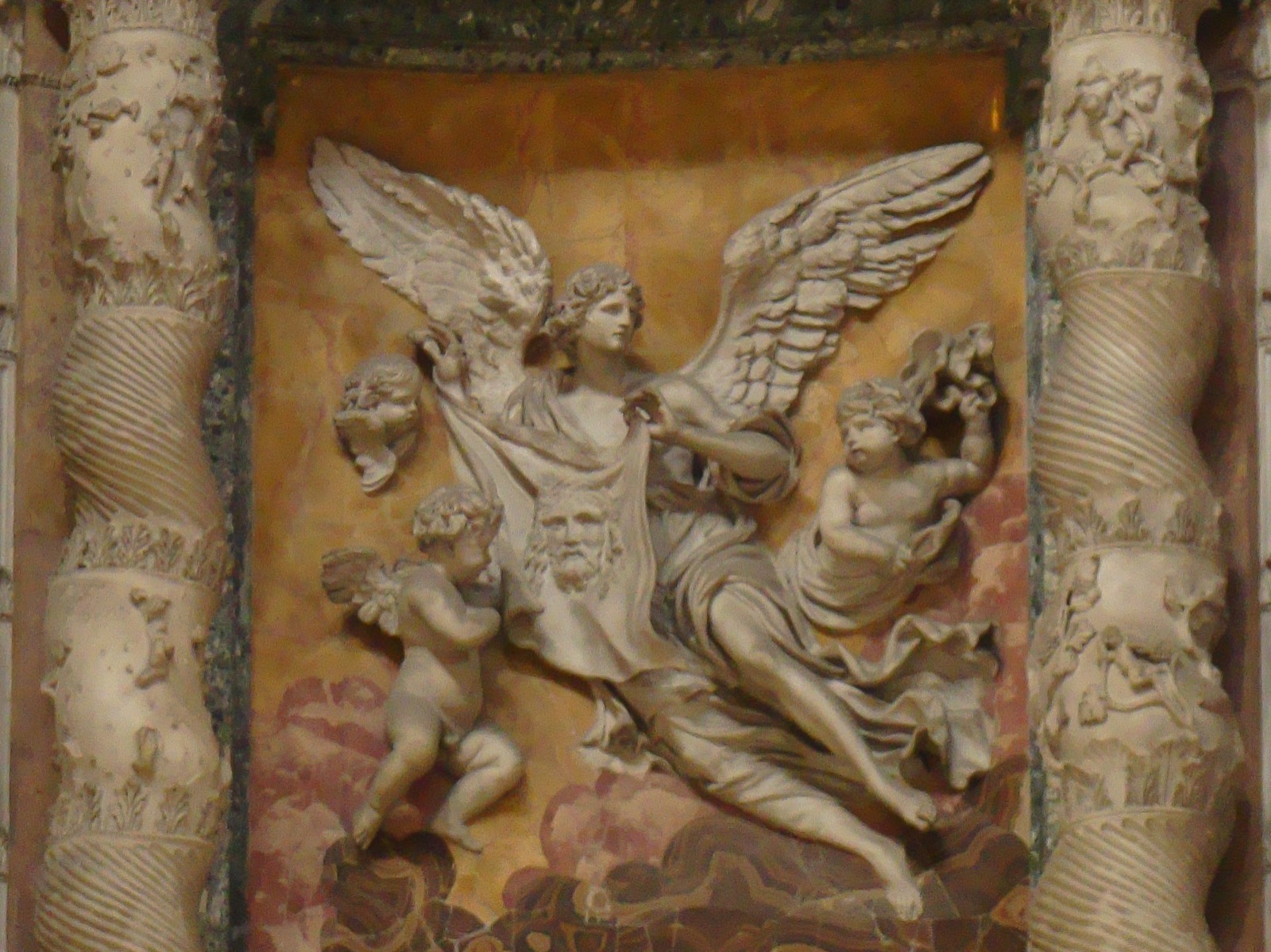
“Who is like God?” St. Michael holding high the Face of Jesus (Sculpture by Cody Swanson, which stands at the side of Old St. Patricks Catholic Church in New Orleans.) Photo: Patricia Enk
Ryan Matherne, OCDS, prepares for Holy Face Devotions
Devotional invocations and prayers may of course be private, but it should also, in some way, be public — because the sins against Our Lord were public. Although Holy Face Devotions had been held since the Discalced Carmelite nuns had founded their first monastery here in New Orleans, the regular public devotion had been interrupted by Hurricane Katrina in 2005. Ryan Matherne, President of the Secular Discalced Carmelites in New Orleans, moved by a strong desire to reinstate the public devotion to the Holy Face, led the way to making it possible for the devotions to be held for the first time since 2005 on Sunday, June 27th, 2021. They will continue to be held every fourth Sunday of the month, following the noon Mass at Old St. Patrick’s Catholic Church in New Orleans. Other new groups have sprung up here in the United States and around the world. Fr. Lawrence Carney, founder of the League of St. Martin, was also moved by his deep love and devotion to the Holy Face of Jesus, and “in response to the growing crisis in the Church,” has been encouraging and organizing groups to hold public devotions.
“Oh Savior Jesus, who didst will that reparation should be as public and universal as had been the offense, penetrate us with the true spirit of reparation. Give us the grace to love Thy Divine Face, to make it known and loved by the whole world, in order that it may be to us a source of light and means of salvation. Amen. ”
— Blessed Mother Maria Pierina De Micheli
Holy Face image at Sacred Heart side altar, Old St. Patrick’s Photo: Sally Vlosich, OCDS
Finally, as Fr. Hardon reminds us, devotion means imitation. We are able to show our love for Jesus by giving proof of our love through imitation of Jesus — in pain, humiliation, suffering, and by the shedding of His blood. “That is what the Church means when she has us say that when Christ offers Himself daily on the altar in the Sacrifice of the Mass, we are told to identify with that sacrifice. His and ours. He, the Head of the Mystical Body, can no longer suffer, but thank God, we can!” –Fr. John Hardon, S.J. We can offer any sufferings that will inevitably come to us in this life, in union with Jesus’s sacrifice, in imitation of Him, as a proof of our love, and in gratitude to the “Lamb who was slain for our salvation.”
Re-posting this from April 2020: “The Cloth That Covered His Head” About three of several burial cloths of Christ: the Shroud of Turin, the Cloth of Oviedo, and the precious byssus veil that was believed to cover the Face of Christ in the tomb – known as “Il Volto Santo” – The Holy Face of Manoppello. Possibly the very reason that St. John “Saw and believed.”
Holy Veil of Manoppello said to be the image of the Resurrected Christ Photo: Paul Badde/EWTN
The Disciples Peter and John Running to the Sepulchre on the Morning of the Resurrection, Eugene Burnand, 1898
So Peter and the other disciple went out and came to the tomb. They both ran, but the other disciple ran faster than Peter and arrived at the tomb first; he bent down and saw the burial cloths there, but did not go in. When Simon Peter arrived after him, he went into the tomb and saw the burial cloths there, and the cloth that had covered his head, not with the burial cloths but rolled up in a separate place. Then the other disciple also went in, the one who had arrived at the tomb first, and he saw and believed. For they did not yet understand the Scripture that he had to rise from the dead. (John 20: 1-9)
At the time of Jesus, the Jewish law required several “cloths” to be used for burial, and as many as six for someone who had died a violent death. Christian tradition has preserved six cloths as relics that are associated with the burial of Jesus – 1.) The Shroud of Turin, 2.) the Sudarium of Oviedo in Spain, 3.) The Sudarium Veil of Manoppello, 4.) The Sudarium of Kornelimunster in Germany, 5.) The SindonMunda of Aachen, Germany, 6.) The Cap of Cahors in France.
Three of the cloths in particular stand out as extraordinary “witnesses” to the Passion, Death, and Resurrection of Jesus, and together they bear a powerful testimony to the truth of the Gospels. Each one bearing an imprint or image of the Face of Jesus. They are: The Sudarium of Oviedo, The Shroud of Turin, and the Sudarium Veil of Manoppello. The remarkable relationship between these three “cloths” leave little doubt that each came in contact with the face of the same man at the time of burial.
Sudarium of Oviedo
The Sudarium of Oviedo directly touched Jesus’s head following His Crucifixion. Blood was considered sacred to the Jews, so this cloth was used to soak up the Precious Blood of Jesus, by wrapping it around Jesus’s Head, as He was taken down from the Cross. The largest bloodstains are from the nose, other stains are from the eyes and other parts of the face. There is also an imprint on the sudarium of the hand of the person who held this cloth to Jesus’s Face to staunch the flow of blood. It takes one’s breath away to see that the bloodstains on the Sudarium of Oviedo, when overlaid with the Face on the Shroud of Turin and the Sudarium Veil of Manoppello, correspond perfectly. The blood type is AB, the same as on the Shroud of Turin.
Face on the Shroud of Turin by photographer Secondo Pia, 1898
“He went into the tomb and saw the burial cloths there”
The Shroud of Turin; the sindone, or linen burial shroud, was believed to have been used to wrap the entire body of Christ. It is the most famous and studied of the three cloths. The faint but visible imprint on the Shroud of Turin gives witness to the violent torture of a man as described in the Passion and Death of Jesus in the Scripture. The world was amazed when Secondo Pia first photographed the Face on the Shroud in 1898; the negative of the photo incredibly became visible as a positive image. The Shroud of Turin caused an entire branch of science to be dedicated to its research called Sindonology.
The Sudarium Veil of the Face of Christ, Photo: Patricia Enk
The Sudarium Veil of Manoppello, Italy, is perhaps the least known of the three burial “cloths.” The Veil bears the image of the living Face of Jesus. This “miracle of light,” “not made by human hands,” was protected and hidden in an isolated church in the Abbruzzi Mountains for centuries. It is believed to be the “cloth” that covered the Face of Jesus in death, showing traces of the Passion: Bruises, swelling, wounds from the Crown of Thorns, and plucked beard. But, it is also believed to have recorded in light the Face of Jesus at the moment of His Resurrection. No, this is not a contradiction. Yes, the image changes. It shows suffering, but it also shows life!
“The cloth that had covered his head”
Funeral of Pope St. John Paul II, Archbishop Dziwisz covers the pope’s face with a veil.
An explanation about the tradition of a face cloth for burial may be helpful in understanding its profound significance: In the funeral rites for priests in some Eastern churches, the veil which was used to cover the chalice and paten were placed on the face of the deceased priest. (The cloth used to cover the chalice and paten had a particular liturgical symbolism linked to the Face of Christ as well.) It was done as a symbol of both the strength and protection of God, and also of the tomb of Christ–an expression of belief in the Resurrection. In Jewish burial custom, a deceased priest’s face would be anointed with oil and then covered with a white cloth, and would have been done for Jesus.
When Pope St. John Paul II was being laid in his coffin, Archbishops Marini and Stanley Dziwisz had the honor of placing a white silk veil over the face of the pope. Poignantly, the choir sang the words from Psalm 42, “My soul thirsts for God, the living God; when will I come and see the Face of the Lord?” Many wondered about the action of covering the pope’s face with a veil because this was the first time it had been done, but was at the request of Pope John Paul II, who had dedicated the millennium to the Face of Christ.
Byssus “Pinna Nobilis” fit for a King! Photo: Paul Badde/EWTN
The cloth that would cover the Face of Christ would have to be made of a material fit for a King, a High Priest, and a God. Byssus, mentioned in the Bible forty times, also known as “sea-silk,” is more rare and precious than gold and it has an exceedingly fine texture which can be woven. Made from the long tough silky filaments of Pinna Nobilis mollusks that anchor them to the seabed, it is strong enough to resist the extreme hydrodynamic forces of the sea. Byssus has a shimmering, iridescent quality which reflects light. It is extremely delicate, yet strong at the same time. It resists water, weak acids, bases, ethers, and alcohols. Byssus cannot be painted, as it does not retain pigments, it can only be dyed; and then, only purple. It can also last for more than 2000 years.
Kurt Cardinal Koch contemplates the Veil “not made by human hands” of Manoppello. Sheer and delicate, yet the Face is visible. Photo: Paul Badde/EWTN
The Sudarium Veil of Manoppello is also made of rare, precious, byssus silk. The skill needed to weave a byssus veil as fine as the Veil of the Holy Face of Manoppello is exceedingly great. Chiara Vigo, known as “the last woman who weaves byssus,” has said that neither she nor anyone alive today could duplicate the gossamer-thin veil, which is sheer enough to read a newspaper through. The weave is so delicate, she says, that only the nimble fingers of a very skillful child could weave something so fine.
Miraculous Holy Face Veil Photo: Paul Badde (see “Manoppello Image” tab)
It is only through light that this shimmering image of the Face of Jesus may be seen, and at times appears as a “living image” as though it were reflected in a mirror, at other times the image completely disappears. Although no camera can adequately capture the image, thanks to the many amazing photos of journalist Paul Badde, the changes that occur when viewing the veil may be better appreciated. (Click here for more photos, and information about Paul Badde’s books and videos about the Holy Face.)
Servant of God Padre Domenico da Cese (1915-1978) before the Veil of Manoppello
While the Face on the Shroud of Turin clearly shows the Face of Jesus in death with eyes closed, the Sudariam of Manoppello has eyes open–bearing witness to the Resurrection. That was the ardent belief of the former Rector of the Basilica Shrine of the Holy Face, Servant of God Padre Domenico da Cese.
There are many physiological reasons too for believing that the Face Cloth captures the first breath of the Resurrection. Sr. Blandina Paschalis Schlomer, who shares that belief, has provided meticulous research about the Veil in her book JESUS CHRIST, The Lamb and the Beautiful Shepherd, The Encounter with the Veil of Manoppello. Sr. Blandina together with Fr. Fr. Heinrich Pfeiffer, S.J., Professor at the Pontifical Gregorian University in Rome, have each demonstrated that the Holy Face on the Veil of Manoppello is the proto-image of the earliest icons, and other works of art depicting the Face of Jesus.
As the first rays of light entered the tomb, John and Peter, upon entering, “saw and believed.” Sudarium Veil of Manoppello, Photo: Paul Badde/EWTN
“…and he saw and believed. For they did not yet understand the Scripture that he had to rise from the dead.”
Pope Benedict XVI, who came as a pilgrim to Manoppello on September 1, 2006, Fr. Heinrich Pfeiffer, S.J., Paul Badde, and Sr. Blandina Schlomer
What did St. John see in the tomb that would cause him to believe? A cloth of blood, such as the Oviedo? The Shroud of Turin? It is a miraculous image, but shows the Face of a dead man. A third witness was needed in order for the disciple to believe. It could only have been evidence of something as astounding as the Resurrection; proof that Jesus was alive!
It is human nature to want to see things for ourselves. Many pilgrims, humble and great, have felt called to make the journey to visit the miraculous relic. If it is God’s handiwork, and I believe that is true, then one can only wonder at its existence, and gaze in silent contemplation, giving thanks for this tremendous gift of God… so we too may “see and believe.”
“We cannot stop at the image of the Crucified One; He is the Risen One!” –Pope St. John Paul II
Holy Face of Jesus of Manoppello (photo: Paul Badde/EWTN)
“”While we too seek other signs, other wonders, we do not realize that He is the real sign, God made flesh; He is the greatest miracle of the universe: all the love of God hidden in a human heart, in a human face.” ~ Pope Emeritus Benedict XVI
Pope Benedict XVI gazes at the Veil of the Holy Face in Manoppello, Photo:Paul Badde/EWTN
“Show us, O Lord, we pray you, Your Face ever new; that mirror, mystery-laden, of God’s infinite mercy. Grant that we may contemplate it with the eyes of our mind and our hearts: the Son’s Face, radiance of the Father’s glory and the imprint of His Nature (cf. Hb 1:3), the human Face of God that has burst into history to reveal the horizons of eternity. The silent Face of Jesus, suffering and risen, when loved and accepted, changes our hearts and lives. “Your Face, Lord, do I seek, do not hide Your Face from me.” (Ps. 27:8ff) How many times through the centuries and millennia has resounded the ardent invocation of the Psalmist among the faithful! Lord, with faith, we too repeat the same invocation: “Man of suffering, as one from whom other hide their faces.” (Is. 53:3) Do not hide your Face from us!” (Portion of a prayer in honor of the Holy Face of Manoppello by Pope Benedict XVI)
Happy Easter!
Jesus Christ has truly risen indeed! Alleluia! Alleluia! Alleluia!
The byssus Veil of Manoppello, which is thought to be one of the burial cloths of Jesus, photo: Paul Badde/EWTN
Prayer to the Holy Face for the liberation from the coronavirus
Lord Jesus, Savior of the world, hope that will never disappoint us, have mercy on us and deliver us from all evil! Please overcome the scourge of this virus which is spreading, heal the sick, preserve the healthy, support those who work for the health of all. Show us your face of mercy and save us in your great love. We ask you through the intercession of Mary, Your Mother and ours, who faithfully accompanies us. You who live and reign forever and ever. Amen.
+ Bruno Forte
Archbishop of Chieti – Vasto (Italy)
+++
To learn more about the history of the Holy Face of Manoppello, click here to read “Four Stories, One Face.”
Or watch this wonderful video below, “The Human Face of God.”