During Advent the Church celebrates the longing to see God’s Face, together with the Blessed Virgin Mary, with a Triduum (three days of prayer beginning on December 15) and a Feast (on December 18th)–It is called The Feast of the Expectation of the Blessed Virgin Mary, Longing to See His Face. (a bit of the history may be found here.) The prayer may also be continued until Christmas.
The Expectation of the Blessed Virgin Mary
On the days leading up to Christmas we are invited to contemplate, together with Mary, the Divine Child within her womb, who is Our Savior. We too, through sanctifying grace, bear the supernatural image of God within us. Like Mary, we desire to become a peaceful sanctuary for the living God. We are called to be attentive, in prayer, to the faint stirrings of His presence in our hearts, which will fill us with a deep longing to see His Face as we pray:
Prayer for the Triduum and Feast of the Expectation of the Blessed Virgin Mary, Longing to See His Face
“Mary, your life with Jesus was one of the purest, most fervent, most perfect emotions of longing and most eager expectation of the Birth of the Divine Child! How great must have been that longing! You were longing to see the Face of God and to be happy in the vision. You were soon really to see the Face of God, the created image of divine perfection, the sight of which rejoices heaven and earth, from which all being derive life and joy; the Face whose features enraptured God from all eternity, the Face for which all ages expectantly yearned. You were to see this Face unveiled, in all the beauty and grace as the face of your own child.
Most just indeed it is, O Holy Mother of God, that we should unite in that ardent desire which you had to see Him, who had been concealed for nine months in your chaste womb; to know the features of this Son of the heavenly Father, who is also your own; to come to that blissful hour of His birth, which will give glory to God in the highest, and on earth, peace to men of good will. Yes, dear Mother, the time is fast approaching, though not fast enough to satisfy your desires and ours. Make us re-double our attention to the great mystery; complete our preparation by your powerful prayers for us, so that when the solemn hour has come, our Jesus may find no obstacle to His entrance into our hearts. Amen.” (Prayer by Rev. Lawrence Lovasik, S.V.D.)
“Thou art all fair, my love, there is no spot in thee.” (Song of Solomon 4:7)
“From the greatness and beauty of created things comes a corresponding perception of their Creator,” “for the author of beauty created them.” (Wisdom 13: 3, 5)
The spiritual beauty of God is reflected most perfectly in the woman He created to be His Mother. No stain of sin would mar the beauty of His reflection in her soul. Never for one instant would she be under the power of the devil. “The Blessed Virgin Mary, in the first instance of her conception, by a singular grace and privilege granted by Almighty God, in view of the merits of Jesus Christ, the Savior of the human race, was preserved free from all stain of original sin.” (Dogma of the Immaculate Conception) Mary herself proclaims, “My spirit has rejoiced in God my Savior.” (Luke 1:47)
As the Immaculate Conception, Mary bears in herself the most perfect reflection of the face of God. Pope St. John Paul II wrote, “The Blessed Virgin saw shining upon her, as no other creature, the face of the Father, rich in grace and mercy.” What in Heaven and on earth could be more beautiful than the Mother of God? It is God who has willed that Mary be beautiful, not only fair in face, but in the fullness of grace. Yet, beauty has a purpose, and that is to draw us by the beauty of the graces God has given her towards the Beatific Vision–the Face of God. Mary has no greater desire than that we turn towards the Face of her Son, as she does, with eyes of love.
Strangely, there are some who see the Blessed Mother not as a gift from God who leads us to her Son, but as an obstacle. They want to separate the Mother from the Son, even resorting to violence of smashing statues and slashing paintings of her, mistakenly thinking that somehow this could be pleasing to God, but it is only pleasing to the devil. It is blasphemy. When we separate ourselves from Mary, we separate ourselves from Christ. In The Everlasting Man G.K. Chesterton tells a story from his childhood, many years before he became a Catholic, which left a deep impression on his soul:
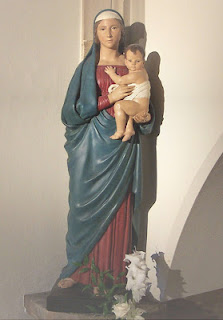
“When I was a boy a more Puritan generation objected to a statue upon my parish church representing the Virgin and Child. After much controversy, they compromised by taking away the Child. One would think that this was even more corrupted with Mariolatry, unless the mother was counted less dangerous when deprived of a sort of weapon. But the practical difficulty is also a parable. You cannot chip away the statue of a mother from all round that of a newborn child. You cannot suspend the new-born child in mid-air; indeed you cannot really have a statue of a newborn child at all. Similarly, you cannot suspend the idea of a newborn child in the void or think of him without thinking of his mother. You cannot visit the child without visiting the mother, you cannot in common human life approach the child except through the mother. If we are to think of Christ in this aspect at all, the other idea follows I as it is followed in history. We must either leave Christ out of Christmas, or Christmas out of Christ, or we must admit, if only as we admit it in an old picture, that those holy heads are too near together for the haloes not to mingle and cross.”
Jesus alone is “the Way” that leads to the Father, but Mary is the most beautiful image and likeness of Christ, which will lead us to Him. Dostoevsky once said that “Beauty will save the world!” Mary has a spiritual beauty to share with the world that attracts and expresses what is beyond words, in the depths of her heart, the love of a mother for her Savior and Son.
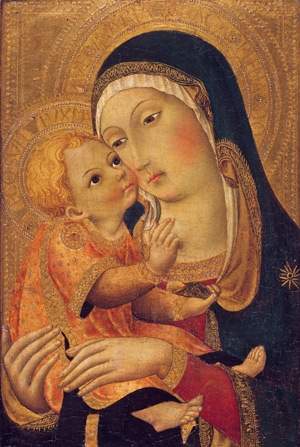
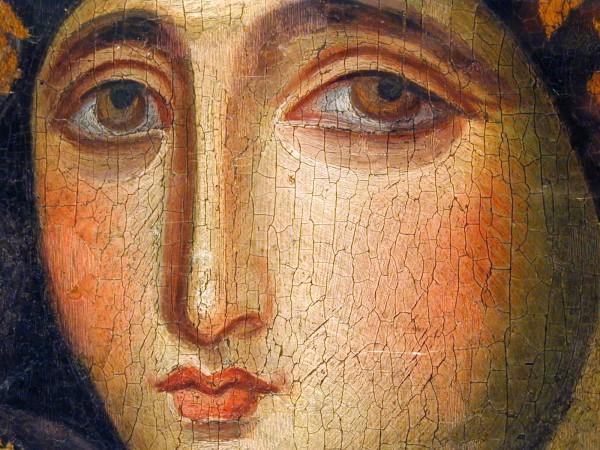
“Our Lady, in whose face – more than any other creature – we can recognize the features of the Incarnate Word.” –Pope Benedict XVI Madonna and Child from the Robert Lehman Collection, Metropolitan Museum of Art
A Little Litany by G.K.Chesterton
When God turned back eternity and was young, Ancient of Days, grown little for your mirth (As under the low arch the land is bright) Peered through you, gate of heaven – and saw the earth.
Or shutting out his shining skies awhile Built you about him for a house of gold To see in pictured walls his storied world Return upon him as a tale is told.
Or found his mirror there; the only glass That would not break with that unbearable light Till in a corner of the high dark house God looked on God, as ghosts meet in the night.
Star of his morning; that unfallen star In the strange starry overturn of space When earth and sky changed places for an hour And heaven looked upwards in a human face.
Or young on your strong knees and lifted up Wisdom cried out, whose voice is in the street, And more than twilight of twiformed cherubim Made of his throne indeed a mercy-seat.
Or risen from play at your pale raiment’s hem God, grown adventurous from all time’s repose, Of your tall body climbed the ivory tower And kissed upon your mouth the mystic rose.
Miraculous Image of Our Lady of Guadalupe “I am your merciful Mother.”
“Look Closely – Our Lady of Guadalupe – Not Made by Human Hands” click here.
Basilica of Il Volto Santo in Manoppello, Italy. (Photo:Paul Badde/EWTN)
St. Anselm wrote about the desire of every human soul created in the image and likeness of God; the desire to see God’s Face. It is a beautiful reflection for Advent! From the “Prosologian” — the words of St. Anselm, Bishop:
“Insignificant man, escape from your everyday business for a short while, hide for a moment from your restless thoughts. Break off from your cares and troubles and be less concerned about your tasks and labors. Make a little time for God and rest a while in him.
Enter into your mind’s inner chamber. Shut out everything but God and whatever helps you to seek him; and when you have shut the door, look for him. Speak now to God and say with your whole heart: I seek your face; your face, Lord, I desire.
Lord, my God, teach my heart where and how to seek you, where and how to find you. Lord, if you are not here where shall I look for you in your absence? Yet if you are everywhere, why do I not see you when you are present? But surely you dwell in ‘light inaccessible.’ And where is ‘light inaccessible? How shall I approach light inaccessible? Or who will lead me and bring me into it that I may see you there? And then, by what forms shall I seek you? I have never seen you, Lord my God; I do not know your face.
Lord most high, what shall this exile do, so far from you? What shall your servant do, tormented by love of you and cast so far from your face? He yearns to see you, and your face is too far from him. He desires to approach you, and your dwelling is unapproachable. He longs to find you, and does not know your dwelling place. He strives to look for you, and does not know your face.
Lord, you are my God and you are my Lord, and I have never seen you. You have made me, and remade me, and you have given me all the good things I possess and still I do not know you. I was made in order to see you, and I have not yet done that for which I was made.
Lord, how long will it be? How long, Lord, will you forget us? How long will you turn your face away from us? When will you look upon us and hear us? When will you enlighten our eyes and show us your face? When will you give yourself back to us?
Look upon us, Lord, hear us and enlighten us, show us your very self. Restore yourself to us that it may go well with us whose life is so evil without you. Take pity on our efforts and our striving toward you, for we have no strength apart from you.
Teach me to seek you, and when I seek you show yourself to me, for I cannot seek you unless you teach me, nor can I find you unless you show yourself to me. Let me seek you in desiring you and desire you in seeking you, find you in loving you and love you in finding you.”
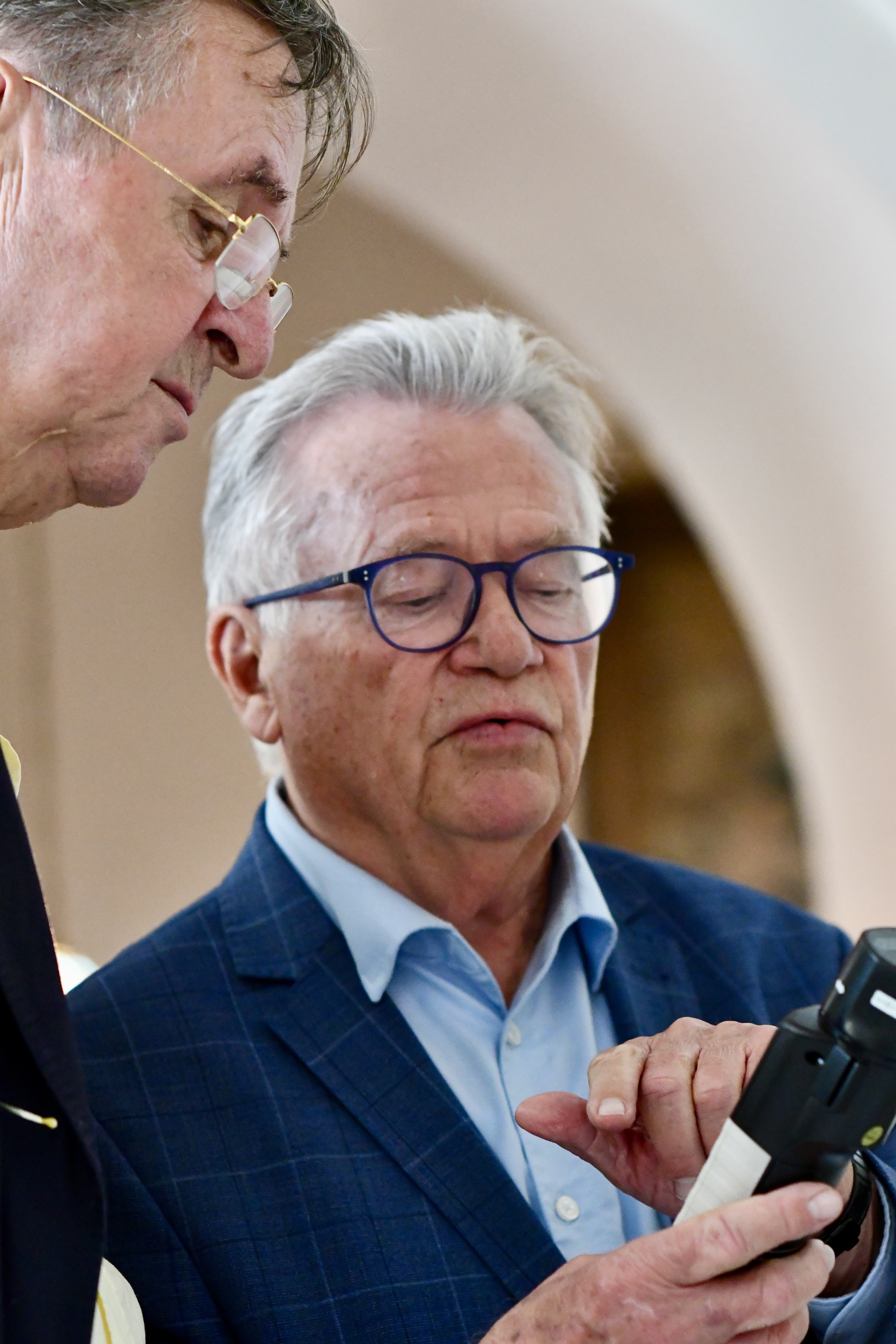
“The Holy Face contains light” Prof. Dr. Gosbert Weth holding the nuclear medicine measuring device used for examining the Veil of Manoppello. (Photo: Marco Gandolfo/EWTN)
The Holy Face Veil of Manoppello has been proven to radiate light energy!
Hand viewed through the gossamer-thin Veil of the Holy Face (Photo: Paul Badde/EWTN)
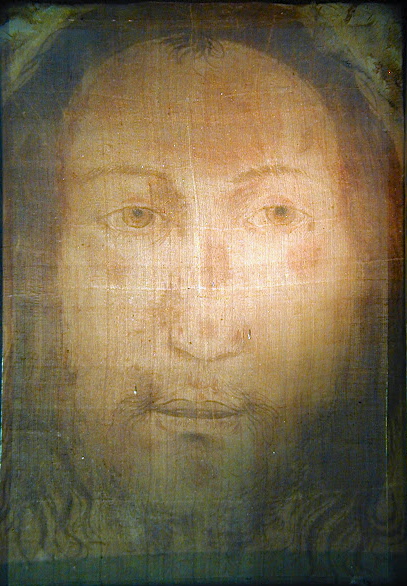
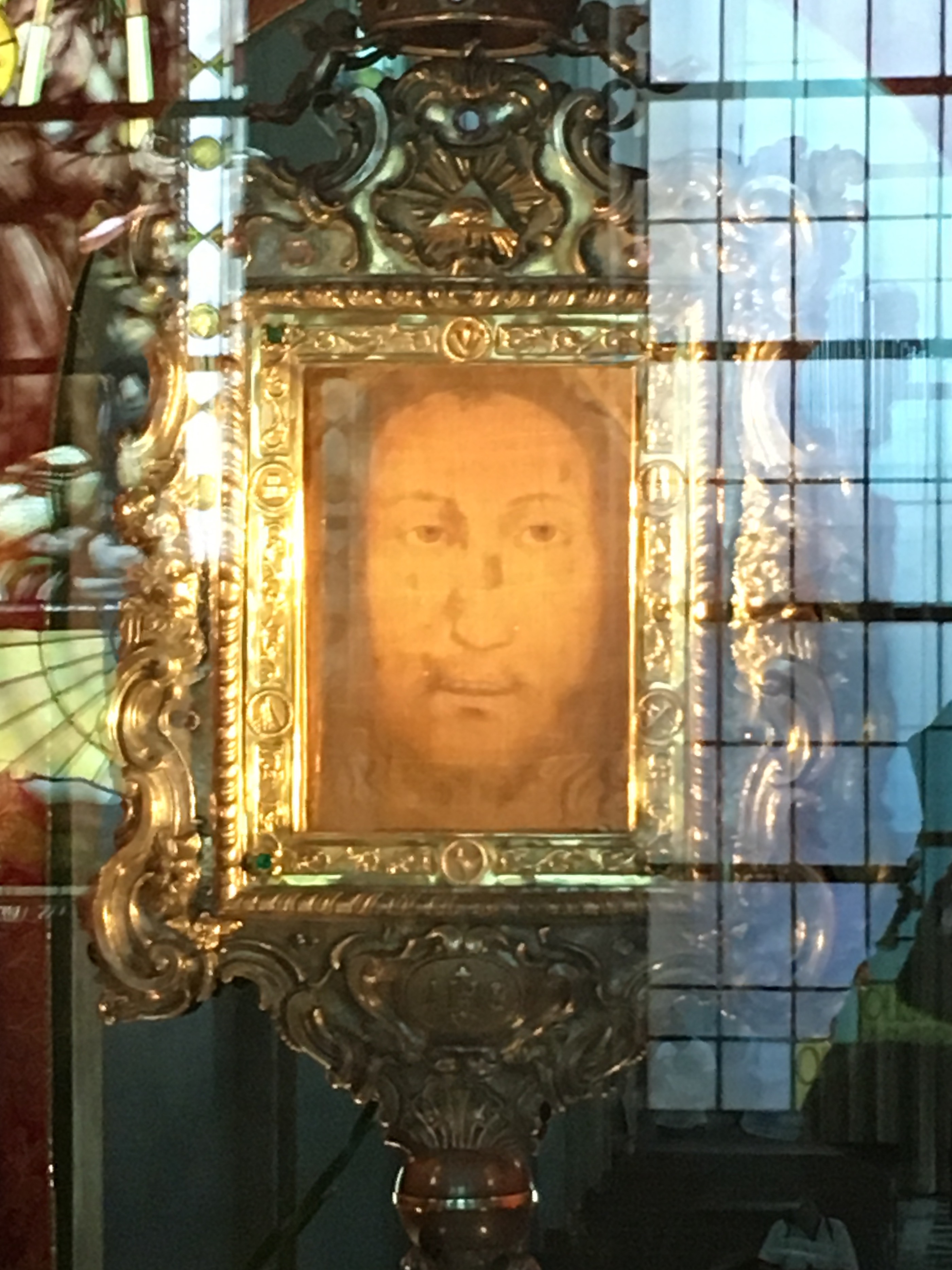
It seems that in Manoppello, Italy, an intriguing and sacred mystery to mankind has been slowly unfolding for centuries: the existence of a changeable, “living” image of the face of Jesus; visible on a sheer veil, from either side. The presence of the image appears to be a miracle of light; seen without any traces of drawing, paint or brush. It is a contradiction–“an inexplicable phenomenon” which begs to be investigated by science. I had written earlier this year, a post on the topic of testing relics, specifically in regards to known Holy Face relics: “The Church, the testing of Relics, and the Holy Face.” The difficulty of conducting research on ancient relics is daunting, but not impossible. But who could undertake such a delicate task, and how…?
Enter an eminent German doctor, Gosbert Weth, who has recently conducted non-invasive investigations on the relic of the Holy Face Veil of Manoppello, using a special nuclear medicine device which measures alpha, beta, and gamma rays. Beta rays are invisible, energetic, and are released during nuclear fission. It has been determined that the veil of Manoppello has such a high level of beta radiation that it fills the Basilica!
EWTN and Ave Maria Radio host Teresa Tomeo has also interviewed Paul Badde, who is in Rome. The “Catholic Connections” interview may be listened to by clicking here: Catholic Connections interview with Paul Badde. There is a slight audio delay, coming from overseas, so it is a little difficult to hear Paul’s words in spots, but fortunately… With permission, Paul Badde has graciously allowed me to print a translation of his original piece on the examination of the relic, which provides additional precious details of the historic investigation of Dr. Weth, and the astounding conclusions:
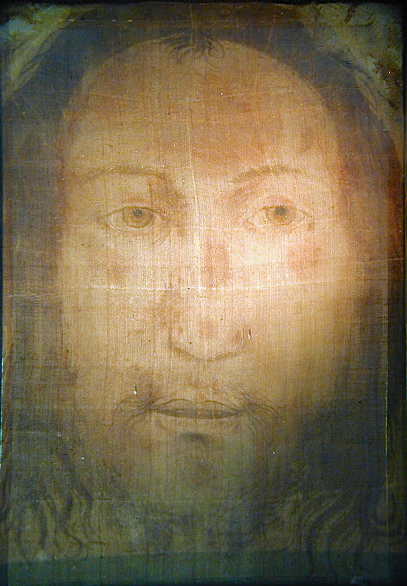
“Il Volto Santo,” the sudarium veil of the Holy Face of Jesus (Photo: Paul Badde/EWTN)
Living Source for the Holy Year by Paul Badde
In the First Holy Year ever, which Pope Boniface VIII (1294-1303) introduced as a Christian jubilee for the year 1300, the most important destination for all pilgrims to Rome was not the Pope, nor even the tombs of the Apostles, but [to see] a gossamer-thin veil with the face of Christ. The veil was the greatest treasure of St. Peter’s Basilica, which at that time was called “Sanctum Sudarium” [meaning a burial face-cloth] in Latin, and was also known as the “Veronica.” The relic was considered to be the ‘Holy Sweat Cloth’ from the tomb of Christ, which is first mentioned in the account of the resurrection of the Evangelist John, together with the long linen cloth [Shroud] that is venerated today in Turin. In January 1208, Pope Innocent III was the first Pope to carry this Holy Veil in a crystal monstrance, publicly and barefoot, from St. Peter’s Basilica to the nearby Santo Spirito Hospital in Sassia in Rome, making it known throughout the Catholic world of the West.
Pope Innocent III carrying the reliquary with the Veil of the Holy Face in Procession.
Pope Benedict XVI praying before the ‘Veronica’s Veil’ during a visit to the Holy Face shrine in Manoppello, central Italy, September 1, 2006. (Osservatore Romano)
Since 1620, the same cloth has been venerated as the “Holy Face” (Volto Santo) in a Capuchin church on a hill outside Manoppello, on the slopes of Magellan massif in Abruzzo, where Pope Benedict XVI visited on September 1, 2006, becoming the first Pope [to visit] in over 400 years. It is a veil with many mysteries that has also puzzled Dr. Gosbert Weth from Schweinfurt in Germany ever since he heard about it and saw photos of the veil.
Rector Antonio Gentili OFM Capuchin, and Prof. Dr. Gosbert Weth in front of the relic Veil of the Holy Face. (Photo: Marco Gandolfo/EWTN)
Dr. Gosbert Weth is 78 years old, a former chief physician, doctor of medicine and natural sciences (chemistry), with a “picture-book” academic career. As senior physician and head of the hormone laboratory at the University of Würzburg, he worked on the largest centenarian study in the world with 575 participants, aged 100. He has developed groundbreaking developments for tumor therapies, has also received the German Inventor Award as the holder of several patents, and has been a speaker at the several world congresses for geriatrics and gerontology. Today he is involved in research into new uses of hydrogen, and is a doctor for hopeless cases in Bad Kissengen.
However, because he is convinced that the true “image” on the holy veil cannot have a paint or technical cause, Dr. Weth came to the Papal Basilica of the Holy Face in Manoppello on the eve of the next Holy Year 2025, on September 26th, with a special device from nuclear medicine for measuring alpha, beta, and gamma rays. Here, [in the Basilica] Rector Antonio Gentile of the Capuchin convent of the sanctuary, willingly opened the armored glass door of the display case in which the holy Sudarium has been sealed in its reliquary between two crystal panes in a frame made of walnut and fish glue since 1714. It was on the memorial feast of the holy doctors [of the Church] Cosmos and Damian, when the doctor from Bad Kissengen [Dr. Gosbert Weth] was given two hours here during the lunch break of the monks, and another hour on the following Saturday for his examinations.
Dr. Gosbert Weth examining the Veil of the Holy Face (Photo: Marco Gandolfo/EWTN)
“As a doctor, I can see,” he began his findings, “that this person must have suffered severe torture. Hematomas [bruises] are clearly visible on both the nose and in the area of the right cheek. Intense blows are necessary in order to cause these hematomas, which are always considered to be more serious injuries in medical examinations. There are no traces of paint or blood detected on the image. Therefore, the ‘image’ must have come into existence only after death. There is a pronounced hematoma on the nose (on the left side), which must be older than two to three days. No other bodily fluids such as blood or sweat are visible. This cloth can therefore only have been placed on a person who has already died. There is a double hematoma that can also be seen in the area of the right cheek. Normally, as is still the case in medicine today, the eyes of every dead person are closed. But the man in this portrait, however, has his eyes wide open. This ‘picture’ is an inexplicable phenomenon.”
Miraculous Veil of the”Holy Face of Manoppello” in Italy Photo: Paul Badde/EWTN
At the end of his investigation, however, Dr. Weth recorded the following: “All in all, there is only one explanation for the formation of the image of the sacred face. The atomic change from nitrogen (N14) to carbon (C14) must have occurred under the influence of enormous neutron radiation (light energy). The light energy present in the veil is the atomic evidence of the conversion of nitrogen (N14) to carbon (C14). Since the carbon is dark in color, the image is deposited as dark matter in the cloth. This also explains the alternating color shades. The ‘image’ is therefore not due to any application of paint, but to the nuclear-modified fibers of the carrier material.“
In this context, we must remember that most rays, in contrast to light rays, are invisible, but in many cases are extremely powerful–such as electromagnetic X-rays, or the almost invisible infrared light. All of these rays are full of energy.
Holy Face of Manoppello (photo: Paul Badde/EWTN)
Dr. Weth continued: “The radio carbon method provides evidence that carbon-C14 was formed. Carbon-C14 decays into nitrogen-N14 with a half-life of 5730 years, releasing beta radiation, which is produced by the radioactive decay of atomic nuclei. The formation of carbon-C14 leads back to nitrogen-N14. Since carbon is dark, this image is also darkly colored and optically visible due to the conversion of nitrogen to carbon. So once again: the image on the Manoppello [sudarium] cloth was not created by coloring, but by an atomic change to the nitrogen molecules present in the organic substance.”
“We therefore tried to measure the beta radiation released by the Manoppello cloth,” he said. “That was not so easy because the shroud is enclosed between two glass plates. Nevertheless, we were able to measure this radiation, which took place around 2000 years ago, and of which around 50 percent has already been consumed.”
We know that the decay of carbon C14 under beta radiation decays by half within 5730 years. It should therefore still be possible to measure this radiation– which was actually the case:
This basic radiation on the image veil was significantly higher than outside in the open air of nature. We therefore tried to measure this basic radiation as precisely and closely as possible. If we held the measuring device on the side of the reliquary, i.e. on the left and right at the places where there was no glass shielding, there was an increase of around 40 percent in beta radiation as a result of the conversion of carbon-C14 to nitrogen-N14. Overall, this beta radiation, which is also present everywhere outside in nature, was considerably higher in the protected basilica than [it is] outside. This is actually a contradiction. The reason for this higher density of beta rays can only lie in the existence of the Volto Santo [Holy Face Veil] inside the basilica.
“This can also explain the radiation of the Manoppello cloth at night,” Weth said with conviction. “It is visible in the dark because the conversion of C14 to nitrogen-N14 releases energy that is not one released from light quanta, but also from electrons, as they are raised to higher orbitals [wave function] in a conventional lamp. When the electrons fall back to their orbitals, light is released, which explains the radiance of the Manoppello sudarium cloth at night.”
Holy Face Veil of Manoppello (Photo: Paul Badde)
In one sentence: The Holy Face contains light within itself. The “True Icon” (Vera Eikon), as the veil has also been called for centuries, radiates from within itself. This image veil is therefore not only identical to the Holy Sudarium from Jerusalem and the “Veronica” from Rome. It is “the human face of God” that Pope Benedict XVI has repeatedly spoken of– and also a source of energy that inexplicably even fills the church’s interior, where rays should not normally be measured at all.
Basically, the experience that the Volto Santo is a source of power is nothing new. It is familiar to almost every pilgrim who has ever visited the shrine. However, since Dr. Gosbert Weth’s investigation before the next Jubilee Year, the statement is no longer a mere assertion, but a physical fact that can be measured. –Paul Badde
Paul Badde and Dr. Gosbert Weth (Photo: Marco Gandolfo/EWTN)
+
It makes one ponder…if a cloth that had been placed on Christ’s Holy Face in the tomb measurably radiates such powerful light energy that is not seen with our eyes, what tremendous power there must be when we come before His Eucharistic Face– where Jesus is fully present, Body, Blood, Soul and Divinity?
-Pope Benedict XVI (photo:Paul Badde/EWTN)
“O most awe-inspiring King, we bow before You and pray; May Your Reign, Your Kingdom, be recognized on earth!”
Christ the king, seated on His throne. Illustration Godescalc Illuminated manuscript, commissioned by King Charlemagne in 781, may be the most important “missing link” in depictions of the Face of Christ from the Holy Sudarium. (Photo:Paul Badde)
The Solemnity of the Feast of Christ the King of the Universe comes at the end of the liturgical year, November 24th, 2024. The feast focuses on Jesus Christ coming in glory at the end of time. An important question for every Christian to ponder is: When Christ the King comes again will we recognize Him, and will he recognize us?
“When the Son of Man comes in his glory, and all the angels with him, he will sit upon his glorious throne, and all the nations will be assembled before him. And he will separate them one from another, as a shepherd separates the sheep from the goats. He will place the sheep on his right and the goats on his left. Then the kind will say to those on his right, ‘Come, you who are blessed by my Father. Inherit the kingdom prepared for you from the foundation of the world. For I was hungry and you gave me food, I was thirsty and you gave me drink, a stranger and you welcomed me, naked and you clothed me, ill and you cared for me, in prison and you visited me.’ Then the righteous will answer him and say, ‘Lord, when did we see you hungry and feed you, or thirsty and give you drink? When did we see you a stranger and welcome you, or naked and clothe you? When did we see you ill or in prison, and visit you?’ And the kind will say to them in replay, ‘Amen, I say to you, whatever you did for one of these least brothers of mine, you did for me.’ Then he will say to those on his left, ‘Depart from me, you accursed, into the eternal fire prepared for the devil and his angels. For I was hungry and you gave me no food, I was thirsty and you gave me no drink, a stranger and you gave me no welcome, naked and you gave me no clothing, ill and in prison, and you did not care for me.’ Then they will answer and say, ‘Lord, when did we see you hungry or thirsty or a stranger or naked or ill or in prison, and not minister to your needs?’ He will answer them, ‘Amen, I say to you, what you did not do for one of these least ones, you did not do for me. ‘And these will go off to eternal punishment, but the righteous to eternal life.” (Mt. 25:31-46)
Devotion to the Holy Face of Jesus can be a helpful means to lead us to an encounter with Jesus in our life-long journey–enabling us to recognize Him–and He, to recognize us. This devotion is comprised of three elements–as characterized by Pope Benedict XVI: Discipleship, Images of the wounded Face of Christ , and the Eucharist.
‘Amen, I say to you, whatever you did for one of these least brothers of mine, you did for me.’ (Pope Francis embracing a young man with special needs.)
Pope Benedict XVI writes, “The first element [of devotion to the Holy Face] is discipleship and the orientation of one’s life toward an encounter with Jesus in the face of those in need. In order to do this, believers first need to become better acquainted with Jesus through the Eucharist.
The second element is relating to the Passion of Jesus, and the suffering expressed by the images of the wounded Face of Jesus, relating this to the Eucharistic experience.
The third element, the Eucharist is woven between the other two. The eschatological element then builds on awakening to Christ by contemplating his face in the Eucharist.“
The Eucharistic Face of Jesus is central to the devotion of the Face of Christ! Clearly, the grace and strength flowing from worthy reception of the Sacrament of the Eucharist is vital to encountering Jesus in the faces of our brothers and sisters in need, as well as for the prayerful contemplation of Christ’s Face in images of His Passion. In Novo Millenio Ineunte, Pope St. John Paul II wrote, “And it is the Church’s task to reflect the light of Christ in every historical period, to make His face shine also before the generations of the new millennium. Our witness, however would be hopelessly inadequate if we ourselves have not first contemplated his face.”
Contemplation of the Face of Jesus is the veil of devotion, with which we may ‘wipe His bruised and wounded Face, ‘woven’ together with “discipleship, and the Eucharist,” which can lead Christians to “the love of God and love of neighbor” that will enable us to see Christ’s Face when He comes again in glory on the final day.
“The invisible Face of Christ,the son of God, is manifest in His Body an Blood in the simplest and, at the same time, the most exalted way possible in this world.
The ecclesial community responds to people in every age who ask perplexed: “We wish to see Jesus” (Jn 12,21), by repeating what the Lord did for the disciples of Emmaus: He broke the bread. In the breaking of the bread, the eyes of those who seek Him with a sincere heart are opened. In the Eucharist, the intuition of the heart recognizes Jesus and His unmistakable love lived “to the end” (Jn 13,1). And in Him, in that gesture, it recognizes the Face of God!“— Pope St. John Paul II
Pope Benedict XVI in prayerful contemplation before the veil of the Holy Face of Manoppello during a visit to the Basilica Shrine of the Holy Face in Manoppello, central Italy, September 1, 2006. (Photo: Paul Badde/EWTN)
***Important and exciting update on the Holy Veil of Manoppello:CNA Deutsch has reported a new discovery, in an article by Paul Badde, pertaining to “Il Volto Santo,” and the inexplicable presence of the Face of Jesus on the sheer veil, which has no traces of paint. An eminent German doctor, Gosbert Weth, has made non-invasive investigations on the relic, using a special nuclear medicine measuring device. The device measures alpha, beta, and gamma rays. Beta rays, which are invisible and energetic, are released during nuclear fission. It has been determined that the veil of Manoppello has such a high level of beta radiation that it fills the Basilica with it! It has also been observed that the veil gives off light in darkness. The upshot of this wonderful discovery is:The Veil of the Holy Face of Manoppello is a source of energy whose strength can be measured objectively.
I will post further details of Dr. Weth’s investigations very soon, but this is amazing news that should be shouted from the rooftops! Thanks be to God!
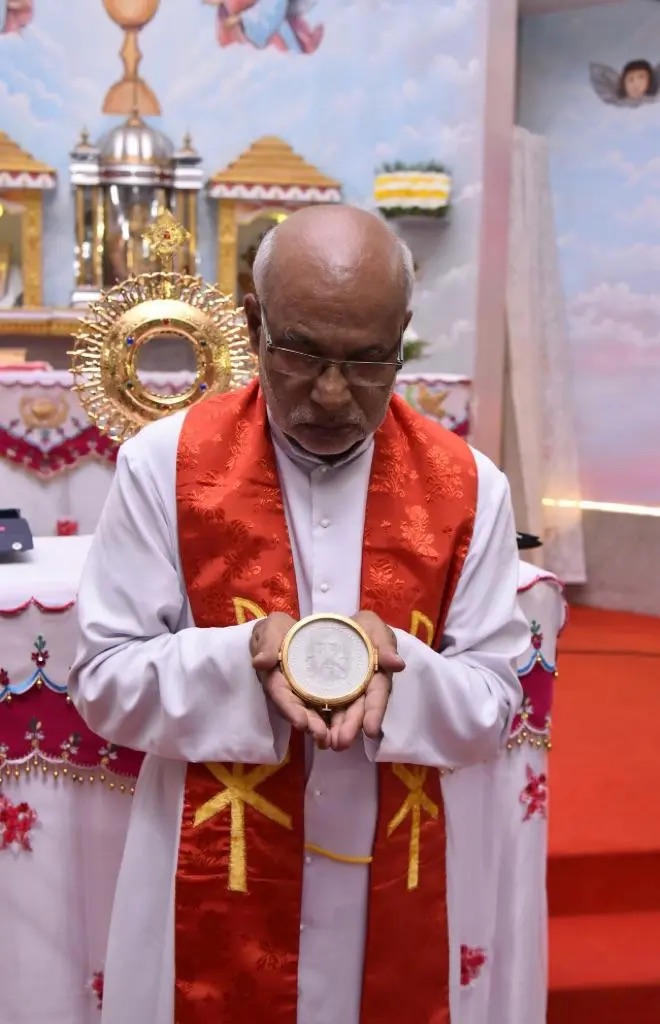
“O most awe-inspiring King, we bow before You and pray; May Your Reign, Your Kingdom, be recognized on earth.” (Host viewed through the miraculous Manoppello Veil the Holy Face, Photo: Paul Badde/ EWTN)
“Almighty ever-living God, whose will is to restore all things in your beloved Son, the King of the universe, grant, we pray, that the whole creation, set free from slavery, may render your majesty service and ceaselessly proclaim your praise. Through our Lord Jesus Christ, your Son, who lives and reigns with you in the unity of the Holy Spirit, God, for ever and ever.”
— Prayer for Feast of Solemnity of Jesus Christ, King of the Universe.
Novena to Christ the King
Almighty and merciful God, you break the power of evil and make all things new in your Son Jesus Christ, the King of the universe. May all in heaven and earth acclaim your glory and never cease to praise you.
We ask this through our Lord Jesus Christ, your Son, who lives and reigns with you and the Holy Spirit, one God, forever and ever. Amen.
Recite One Our Father, One Hail Mary, and One Glory Be per day followed by the Novena Prayer:
O Lord our God, You alone are the Most Holy King and Ruler of all nations. We pray to You, Lord, in the great expectation of receiving from You, O Divine King, mercy, peace, justice and all good things. Protect, O Lord our King, our families and the land of our birth. Guard us we pray Most Faithful One. Protect us from our enemies and from Your Just Judgment Forgive us, O Sovereign King, our sins against you. Jesus, You are a King of Mercy. We have deserved Your Just Judgment Have mercy on us, Lord, and forgive us. We trust in Your Great Mercy. O most awe-inspiring King, we bow before You and pray; May Your Reign, Your Kingdom, be recognized on earth.
“The Word will imprint in your soul, as in a crystal, the image of His own beauty, so that you may be pure with His purity, luminous with His light.”
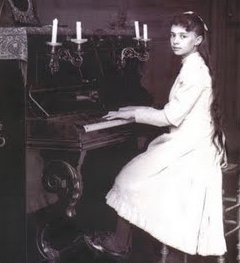
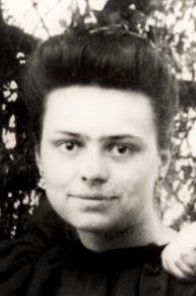
Ten years before entering the Carmelite Convent in Dijon, France, eleven year-old Elizabeth Catez met the prioress on the afternoon of her First Holy Communion. What the prioress told her on that occasion left a deep impression in her soul; upon learning Elizabeth’s name, the prioress told her that her name meant “House of God.” She later wrote on the back of a holy card for Elizabeth: “Your blessed name hides a mystery, accomplished on this great day. Child, your heart is the House of God on earth, of the God of love.”
“Do you not know that you are God’s temple and that God’s Spirit dwells in you?” (1 Cor 3:16)
Waiting to enter Carmel–St. Elizabeth of the Trinity
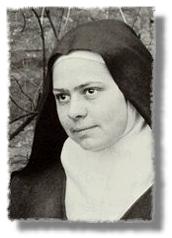
Upon entering Carmel at the age of twenty-one, Elizabeth sought God’s Face within the temple of her own soul, in prayer and silence, with a growing desire to be united with Jesus, to share in His life and sufferings–to be transformed into His image–so that God the Father would find in her the image of His Son, in whom He was well-pleased. Elizabeth wrote, “God bends lovingly over this soul, His adopted daughter, who is so conformed to the image of His Son, the ‘first born among all creatures,’ and recognizes her as one of those whom He has ‘predestined, called, justified.’ And His Fatherly heart thrills as He thinks of consummating His work, that is of ‘glorifying her by bringing her into His kingdom, there to sing for ages unending’ the praise of His glory.” She prayed that the Holy Spirit “create in my soul a kind of incarnation of the Word: that I may be another humanity for Him in which He can renew His whole Mystery.”
“I want to gaze on You always and remain in Your great light.”~St. Elizabeth of the Trinity, OCD
“We must become aware that God dwells within us and do everything with Him; then we are never commonplace, even when performing the most ordinary tasks.”
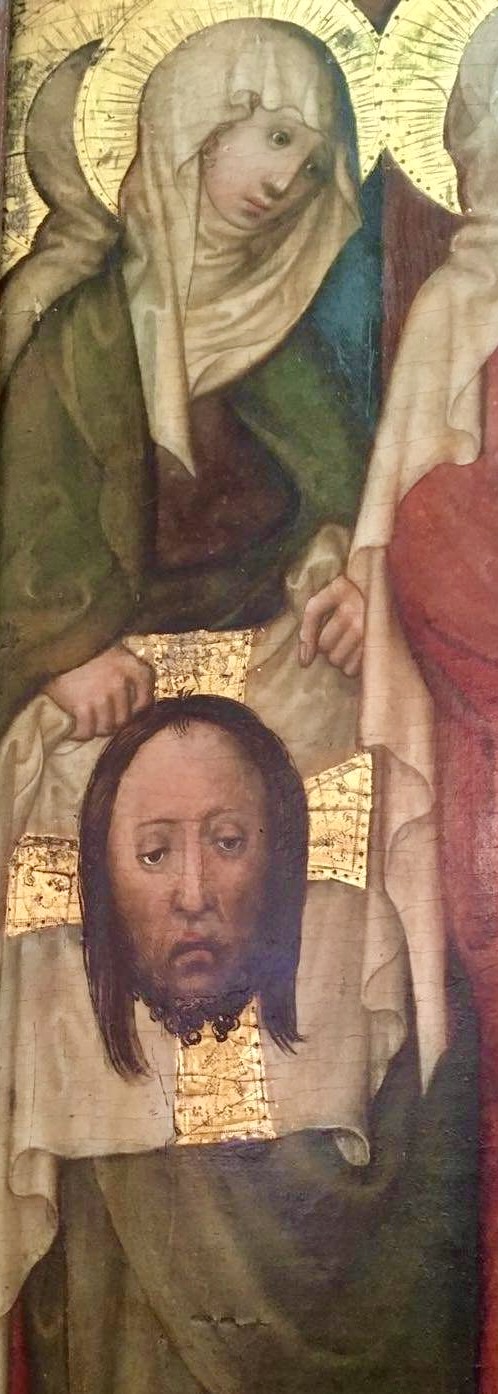
This was the fruit of contemplation that St. Elizabeth of the Trinity wanted to share with everyone; the secret of transforming love hidden within our own hearts. By gazing steadfastly upon God, in faith and simplicity, the Word of God, Jesus Christ–as in the legend of St. Veronica’s Veil–will leave the imprint of His image on the veil of the soul. By her continual loving gaze at Him, St. Elizabeth of the Trinity was transformed into His image. When she died at the young age of twenty-six, she had already fulfilled her mission in the Church as a ceaseless “Praise of Glory,” reflecting the luminous, pure light of the Holy Trinity.
“It is Your continual desire to associate Yourself with Your creatures…How can I better satisfy Your desire than by keeping myself simply and lovingly turned towards You, so that You can reflect Your own image in me, as the sun is reflected through pure crystal? …We will be glorified in the measure in which we will have been conformed to the image of His divine Son. So, let us contemplate this adored Image, let us remain unceasingly under its radiance so that it may imprint itself on us.”
— St. Elizabeth of the Trinity, OCD, Feast Day November 8.
St. Veronica with the Veil of the Holy Face 1485, Maestro, Viennese
When he placed the New Millennium under “the Radiant sign of the Face of Christ” Pope St. John Paul II wrote, “To contemplate the Face of Christ, and to contemplate it with Mary, is the ‘program’ which I have set before the Church at the dawn of the third millennium…It is the Church’s task to reflect the light of Christ in every historical period, to make His Face shine also before new generations of the new millennium. Our witness, however, would be hopelessly inadequate if we ourselves had not first contemplated His Face.” The Rosary is a traditional Christian prayer directed to the contemplation of Christ’s Face. “Without contemplation, the Rosary is a body without a soul,” says Pope St. John Paul II, “and runs the risk of becoming a mechanical repetition of formulas, in violation of the admonition of Christ.”
Contemplation is a gift, a grace, from God. It is a communion in which God transforms a soul into His likeness. To put it more simply, as St. Teresa of Jesus says, contemplation is “a close sharing between friends…taking time frequently to be alone with Him who we know loves us.” Contemplation is not something beyond our reach however–we have an incomparable model in Mary; the eyes of her heart were always turned toward His Face. To dispose our souls to receive this great gift of God we need only reach for a Rosary and pray it with humility, listening attentively in the Spirit together with Mary, in silent love–that veil of mystery–to the Father’s voice. When we contemplate the scenes or mysteries of the Rosary in union with Mary, the Rosary becomes an unceasing praise of God; a way to learn from her about her son, Jesus, to discover His secrets and understand His message for us.
To recite the Rosary, which can be called a compendium of the Gospel, Pope St. John Paul II says, “is to contemplate the Face of Christ in union with, and at the school of, His Most Holy Mother…Against the background of the words of the Ave Maria the principal events of the life of Jesus Christ pass before the eyes of the soul. They take shape in the complete series of the joyful, [luminous,] sorrowful and glorious mysteries, and they put us in living communion with Jesus through–we might say through the heart of his Mother…The Rosary belongs among the finest and most praiseworthy traditions of Christian contemplation…To look upon the Face of Christ, to recognize its mystery amid the daily events and sufferings of His human life, and then to grasp the divine splendor definitively revealed in the Risen Lord, seated in glory at the right hand of the Father; this is the task of every follower of Christ and therefore the task of each one of us. In contemplating Christ’s Face we become open to receiving the mystery of Trinitarian life, experiencing ever anew the love of the Father and delighting in the joy of the Holy Spirit. St. Paul’s words can then be applied to us ‘Beholding the glory of the Lord, we are being changed into His likeness, from one degree of glory to another; for this comes from the Lord who is the Spirit.'” (Rosarium Virginus Mariae)
“The contemplation of Christ’s Face cannot stop at the image of the Crucified One. He is the Risen One!”~ Pope St. John Paul II
The entire month of October is dedicated to the Holy Rosary and October 7th is celebrated as the feast of Our Lady of the Rosary. The feast, originally named for Our Lady of Victory, commemorated the stunning victory, against all odds, obtained by Our Lady in the Battle of Lepanto through the prayer of the Rosary–which saved Christendom on October 7th, in 1571. By keeping our eyes fixed on the Face of Jesus as we pray the Rosary, together with Mary, through her maternal intercession, we too may obtain great victories through the heart of her Son Jesus, who obtained for all mankind the greatest victory over sin and death by His Resurrection.
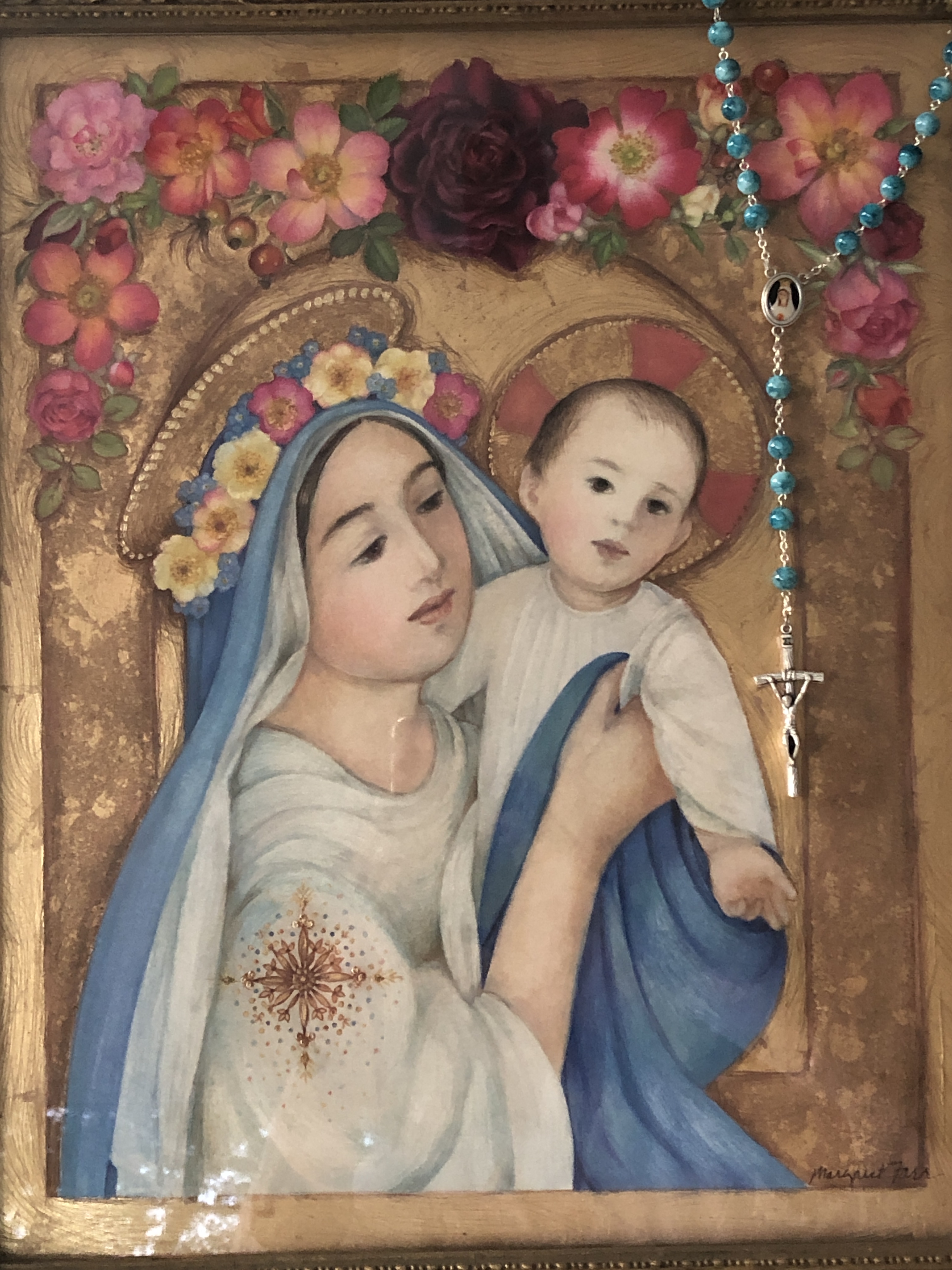
“Through her, may we see Him. Made sweeter, not made dim. And her hand leaves His light, sifted to suit our sight.” ~ Gerard Manley Hopkins (Painting of the Blessed Mother and the Child Jesus by Margaret Farr)
“The one you are looking for is the one who is looking.” ~St. Francis of Assisi
Within the Basilica of St. Francis in Assisi is a precious relic: a small, crumpled piece of yellowed parchment with the writing of St. Francis, now displayed in a silver reliquary. It was written on Mount La Verna after St. Francis received the stigmata. The first biographer of St. Francis, Bl. Thomas of Celano wrote that for a long time St. Francis’s friend, Brother Leo, had greatly desired to have some memorial from the words of Our Lord written by St. Francis to be prayed in times of temptation:
“One day Blessed Francis called him, saying, ‘Bring me paper and ink, for I wish to write the words of God and His praises which I have been meditating in my heart.’ What he asked for being straightway brought, he writes with his own hand the praises of God and the words which he [his companion] wished, and lastly a blessing of the brother, saying: ‘Take this sheet for thyself and until the day of thy death guard it carefully.’ All temptation was at once driven away; the letter is kept and worked wonders for the time to come.” Brother Leo kept it faithfully; folding it in four, he carried it in his pocket and guarded it jealously for a good forty-six years. The text in the middle, written in black, and marked with a large “Tau” cross is in Francis’s own handwriting, he writes the praises of God* and grants to Brother Leo the blessing from the Book of Numbers 6: 22-27 which later became known as “the Blessing of St. Francis.”
“The Blessing of St. Francis” in reliquary.
*(St. Francis’s “Praises of God” are now now quite faded, but, this much can be still read: “Thou art holy, Lord God, who alone workest wonders. Thou art strong. Thou art great. Thou art most high. Thou art the Almighty King, Thou, holy Father, King of heaven and earth. Thou art the Lord God Triune and One; all good. Thou art good, all good, highest good, Lord God living and true. Thou art charity, love. Thou art wisdom. Thou art humility. Thou art patience. Thou art security. Thou art quietude. Thou art joy and gladness. Thou…” That is all that has been preserved.)
St. Francis in Ecstasy before the Veil of the Holy Face, 17th century (photo:Paul Badde/EWTN)
Pope Emeritus Benedict XVI, in his homily for the World Day of Peace, 2013, spoke of this blessing from the Book of Numbers that was so precious to St. Francis:
“The blessing repeats the three times Holy Name of God, a Name not to be spoken, and each time linked to two words indicating an action in favor of man. Peace is the summit of these six actions of God in our favor, His most sublime gift, in which He turns toward us the splendor of His Face.”
This is the same, great blessing that St. Francis desired to impart to his friend, Brother Leo:
“May the Lord bless and keep you; may He make His Face shine upon you and be merciful to you; may He turn His Countenance toward you and give you His Peace!” (Num. 6:22-27)
Lady Jacoba was a noblewoman and widow, with two children from Rome, who became a follower of St. Francis. After having heard him preach she sought his guidance on how to be charitable. When Francis traveled to Rome, he would stay with Lady Jacoba as her guest and she cared for him when he was sick. She gave some of her property in Trastevere to the brothers, which they used to care for lepers. She gave up her life of comfort in order to help the poor. Woman were not normally permitted to be in company of the brothers, however, St. Francis made an exception in her case, jokingly referring to her as “Brother Jacoba.”
As Francis lay dying he sent an urgent letter by messenger to Lady Jacoba: “Brother Jacoba, the servant of the Most High, health in the Lord and communion in the Holy Ghost. Dearest, I want you to know that the blessed Lord has done the grace of revealing that the end of my life is nigh. So, if you want to find me still alive, hurry to Santa Maria degli Angeli as soon as you receive this letter.” He went on to request that she bring a gray cloth to wrap his body in, candles for burial, and almond cookies that she had made for him in Rome when he was sick. Before the messenger arrived in Rome, Lady Jacoba had already anticipated St. Francis’s needs by the light of the Holy Spirit and was on her way to Francis’s deathbed.
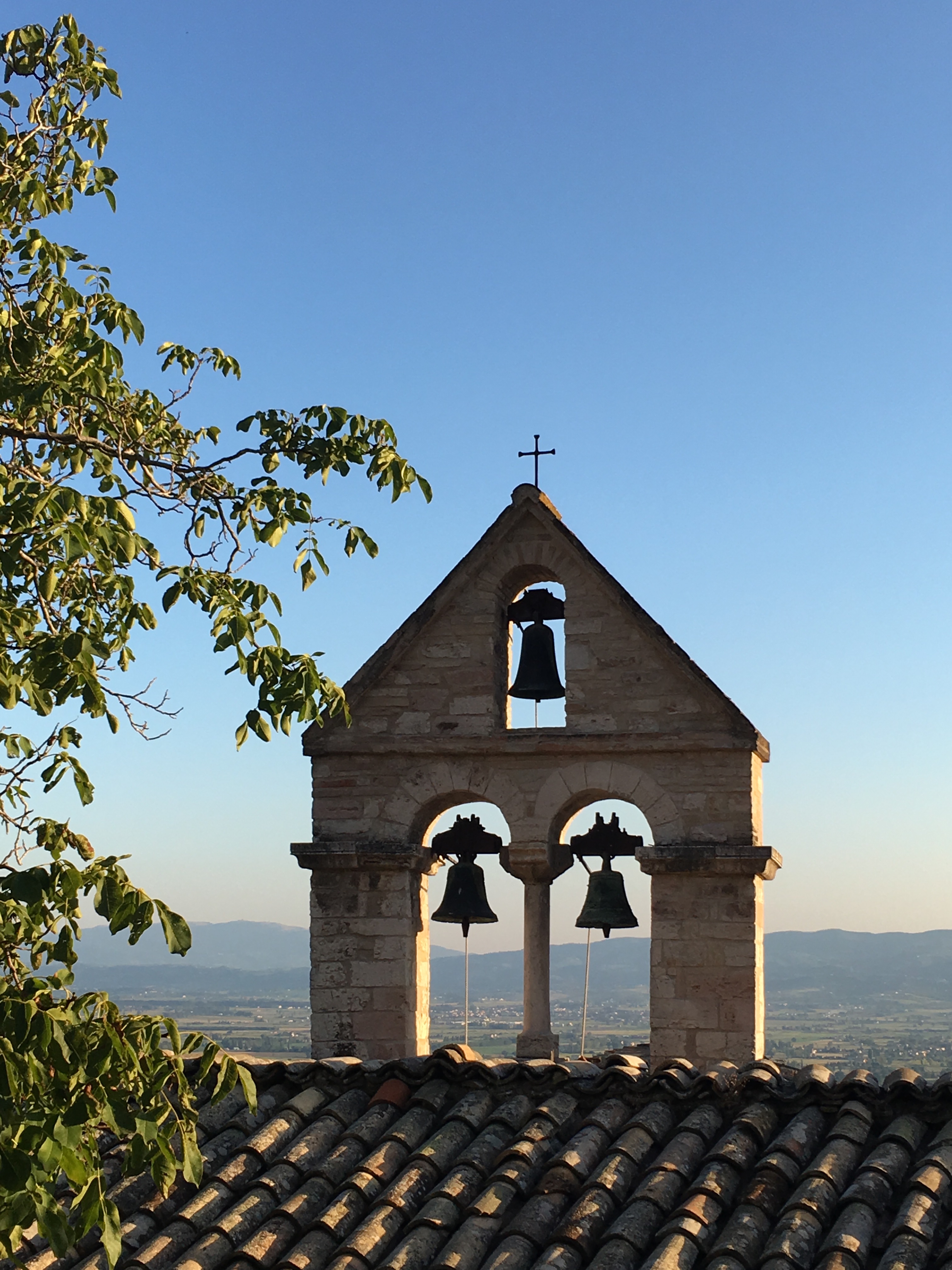
The bells of the church of Santo Stefano the Martyr which rang by themselves when St. Francis died.
St. Francis’s biographer, Bl. Thomas Celano, wrote that Lady Jacoba brought not only the gray cloth, the candles, and the almond cookies, but also a pillow for his head, and a“sindomen pro facie” (a veil to cover his face in death, which was displayed in the Relic Chapel). It had been her own sheer, embroidered wedding veil that she placed on the face of St. Francis in death. So, St. Francis, an alter Christus who bore the stigmata, also had his “Veronica” in Lady Jacoba, who brought him consolation in his passion.
“The Luke Icon: Rome’s Hidden Wonder of the World”
She is more than 2,000 years old, and for the greater part of seven centuries she has been mostly hidden in a cloister in Rome, known only by a few, footnoted in dusty books written by little known scholars. Many copies of the icon have been found around the world, but she is the original, surpassing all the others made by man in beauty and gracefulness. Her beautiful lips are closed, yet she speaks with her eyes. She is known as “Advocata Nostra.”
“Eia, Ergo, Advocata nostra, illos tuos misericordes oculos ad nos converte.” “Turn, then, most gracious Advocate, thine eyes of mercy towards us.” ~from the Salve Regina.
Among his many gifts, Paul has an amazing talent for finding lost, ancient relics–to bring them back from obscurity to light. Paul has recently published a very special book that has been twenty years in the making, or one could even say, “a lifetime in the making,” because his story truly begins with his earliest memories of being taught to love the Mother of God by his own dear mother in his native Germany.
The title of the book is: “The Luke Icon: Rome’s Hidden Wonder of the World”–which hides the fact that it is actually a love story–tells of Paul’s long search for the earliest icon of the Blessed Mother, known as “La Advocata” in Italy, which was said to have been painted by St. Luke in the first century.
The Holy Face of Manoppello and Paul Badde(CNS photo/Paul Haring)
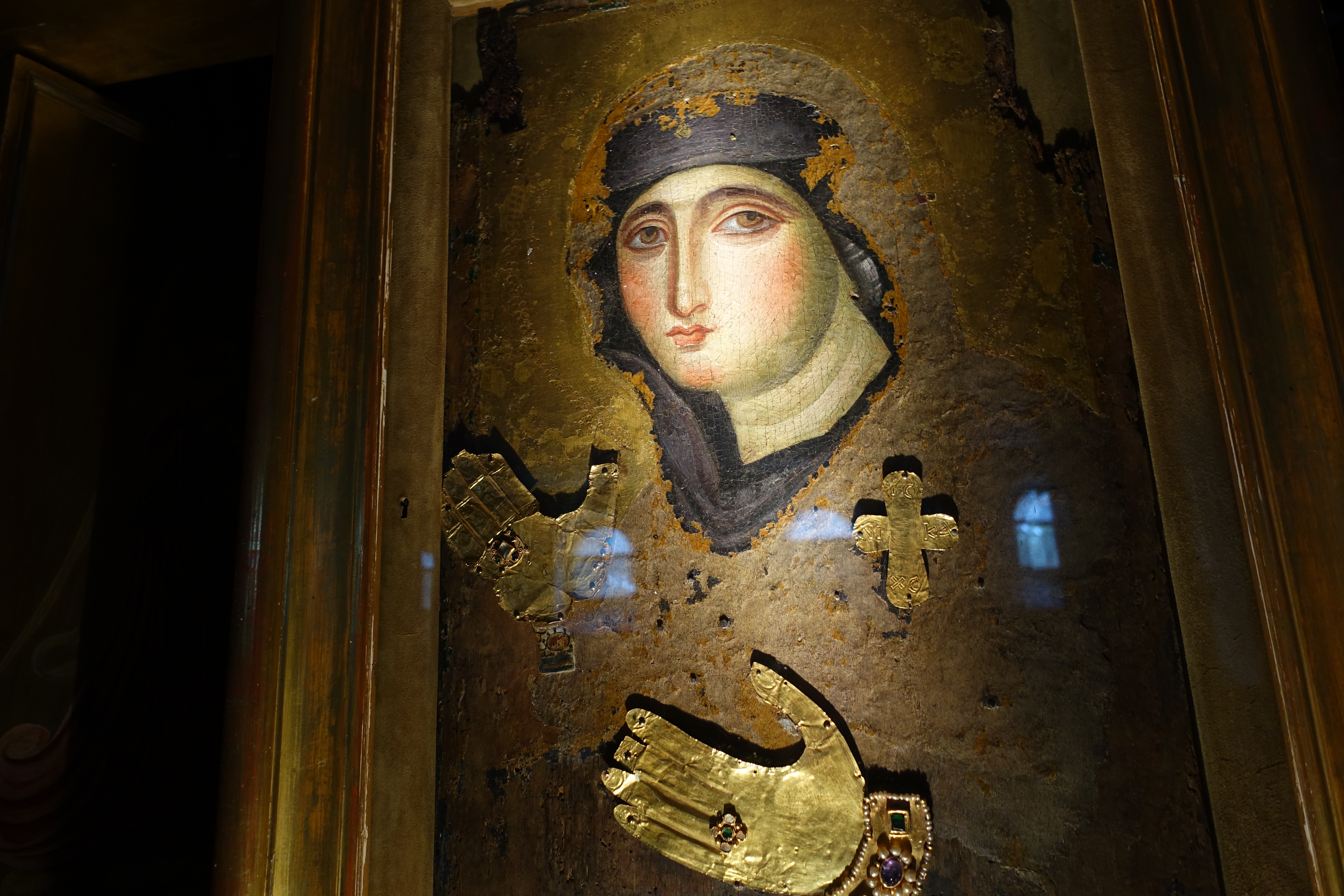
Advocata Nostra with golden hands and cross
Photo: Paul Badde/EWTN
The Luke Icon: Rome’s Hidden Wonder of the World is partly a biography–because Paul’s search is a very personal one. But since love unites us all in Christ, Paul’s story is woven together with many interesting people, as well as places, surprisingly very near and also far away; there is mystery, intrigue, long years of research, and providential clues that fell in his lap. Many times his holy quest was an uphill battle with crosses, delays, and roadblocks along the way. In the end–in God’s perfect timing–it seems that Divine Intervention cleared away obstacles to suddenly reveal the incredible and astonishing results of his long search.
As I read Paul’s book, (very slowly translating from German, as it is not yet available in English), an image kept coming into my mind of a little boy sitting on a stool watching his mother at work, twisting and knotting various colored threads, as she wove a tapestry. I was reminded of a story told by St. Pio of Pietrelcina, in which he explained why God permits suffering, and evil to exist on our lives, only to bring about a greater good:
“A mother was embroidering on a small weaving frame. Her young son was seated in front of her on a small low stool watching her work. But, as he is watching, he saw only the tangle of threads on the reverse side of the weaving frame, from underneath. And so he says, ‘But mother, what are you doing? The embroidery is so ugly!’ So what does the mother do? She lowers the weaving frame and shows him the other side of the work, the good side with all its colors in place and all the threads making a harmonious pattern…. Have you seen what evil is like? Evil is like the reverse side of that embroidery, and we’re all sitting on a small stool.” ~ St. Pio
Though paint has crumbled away after centuries, and restorations have been done, out of respect, sections of the original have not been touched. Advocata Nostra – Wiki Commons – Public Domain
Paul was looking at “tangles of thread” from over 2,000 years. In addition to the arduous task of finding the Luke Icon in the first place, very difficult questions needed to be answered, such as: Was it actually painted by St. Luke, despite Hebrew prohibitions on the painting of images? Is “La Advocata Nostra” indeed the original? Is there any evidence that the encaustic wax icon belonged to the first century? Was the icon restored? What is the meaning of the gesture of Our Lady’s hands? Are there copies? And more.
The Shroud of Turin and Holy Veil of Manoppello are known as “achieropoieta.” Meaning the miraculous sudarium veil of Jesus’s own human face was “written in light” by the Hand of God, and not human hands. An image created by God’s hand, of course, does not violate the prohibition on images. Paul writes, “This image [the veil of the Face of Jesus] was obviously needed before the first icon of Mary could be created later on, which really over-ruled the old ban on images.” Luke’s Icon of Mary is the iconoclast-breaker that removed the Hebrew prohibitions against painting any human image–“made in the image and likeness of God.” How fitting the Mother of God should be the first!
The position of her hands, raised as though she is interceding for us, caused her to be called by the unusual title of “Advocata Nostra.” She is our “lawyer,” but Advocata can have another meaning, “to call” or “summon.” Or as once Paul told me, “She is the one who is there when you call her.” Mary is ever pleading for us before the throne of God. However, the gesture of her hands, Paul discovered, turned out to mean much more. Paul had found some copies of the icon, made centuries before a restoration in the 1960’s, that reveal that before time had crumbled the paint away, she was holding something very precious in her hands that the restoration covered over. It would have been her most precious possession–a veil. A veil?…Why would she be showing us a veil? Paul makes a very good argument, that the veil that Our Lady holds in her hands is “The Cloth that covered Jesus’s Head” found in the tomb by Saints Peter and John-miraculously imprinted with His Face at the Resurrection–“Il Volto Santo,” the Holy Veil of Manoppello, Italy, is believed to be that veil. After all, it makes perfect sense, that of all of Jesus’s disciples, Saints Peter and John would have given “the cloth that covered His Head” to His own Mother.
It has been a long tradition of the Church that after a newly ordained priest has been anointed with blessed chrism, the oil is then wiped with a linen cloth, called a manutergium, representing the burial, or sudarium cloth of Christ, which is given to the priest’s mother, who keeps it throughout her lifetime, to be placed in her hands at her burial.
“Advocata Nostra” Photo: Paul Badde/EWTN “All generations will call me blessed.” (Luke 1:48)
When one looks into the eyes of Advocata Nostra, as a child of Mary, one encounters a person, a motherly presence–Mary looks at us, she listens to us. She holds out to us, in her pure hands, her most precious treasure: the veil of the Holy Face of her Son Jesus. Though she is silent, as she “turns her eyes of mercy toward us, Mary seems to say everything: ‘Take courage, my child’...”He is Risen!”
Veil of the Holy Face of Jesus of Manoppello, believed to be the cloth that covered Jesus’s Head at the Resurrection. (photo: Paul Badde/EWTN)
August 29, 2024: Antonio Bini, of Manoppello, has written many wonderful pieces, translated from Italian for Raymond’s blog. Most recently, he has written about a very positive developement– the uniting of devotees of the Holy Face in “The ‘Holy Face’ of Christ Unites.” The Holy Face of Jesus has been loved and adored under many different aspects over the centuries, such as The Face from the Shroud of Turin, “Il Volto Santo” Holy Veil of Manoppello, The Holy Face of Chiusa Sclarfani, Italy, The Holy Face of Tours, France, and under many other titles around the world. However, the intention to love, honor and adore the person of Jesus Christ in His Sacred Humanity is always the same… Be sure to give Antonio’s report from Manoppello a read!
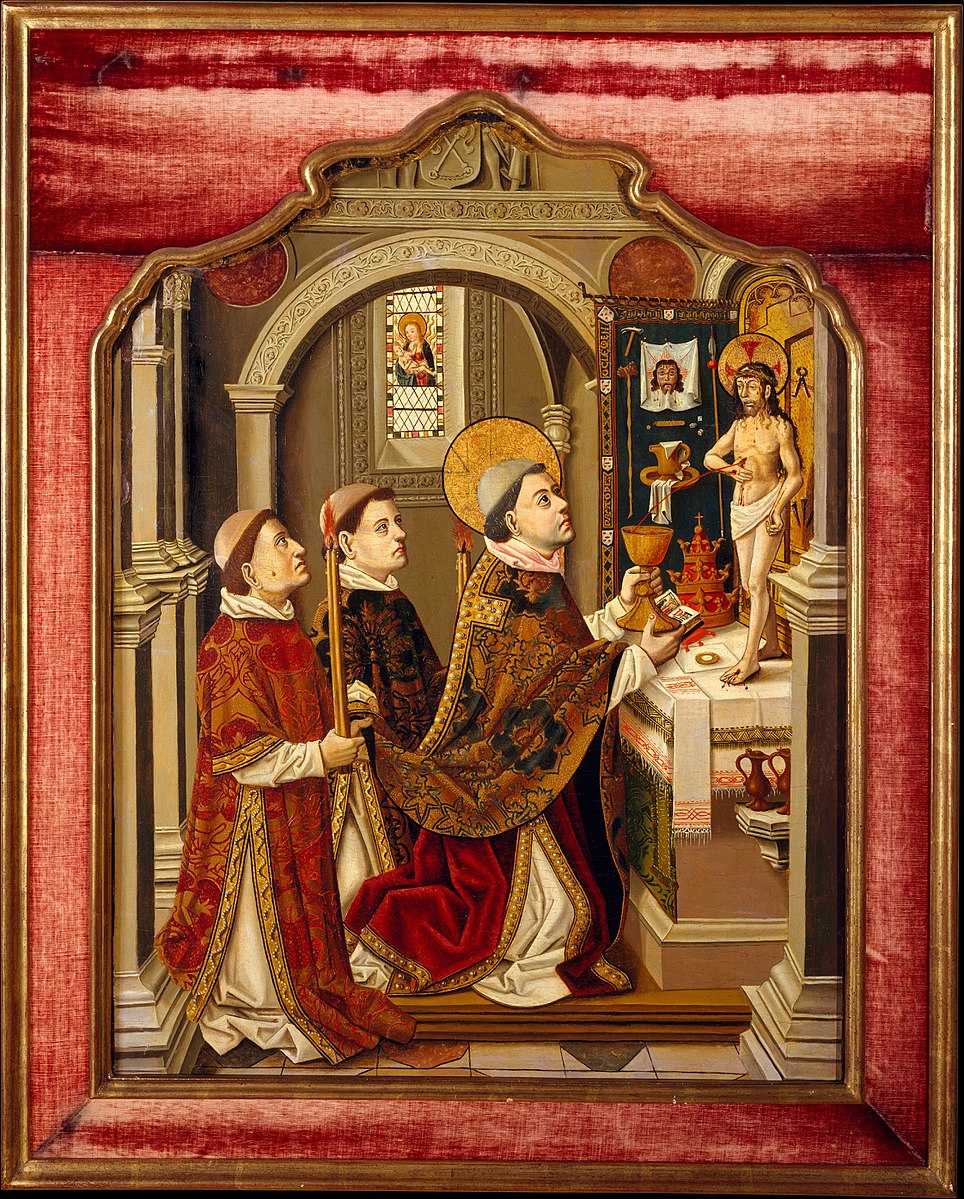
Mass of St. Gregory, attributed to Israel van Meckenem, circa 1440-1503
There are many beautiful versions of artworks portraying the story of the “Mass of St. Gregory.” The earliest version was found in an 8th-century biography of St. Gregory from the 8th century. One version, by John the Deacon, tells the story of Pope St. Gregory saying Mass when suddenly, from within the Church, a woman began to laugh. It was just at the moment of the Consecration. It turns out, that the laughing woman was the one who had baked, the bread to be consecrated, herself, and so told her companion that she didn’t believe that the host could be Jesus Christ. St. Gregory, when he heard the mocking laughter, prayed for a sign and the host began to bleed, thus confirming the True Presence of the Body and Blood of Jesus in the Eucharist.
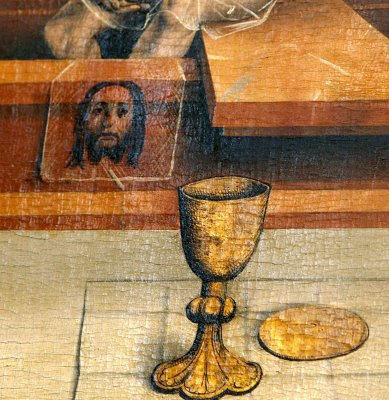
Other versions of the story also tell of St. Gregory’s vision of Jesus appearing on the altar in His Passion. Many works often included the instruments of the Passion, and prominent among them, one sees the Veil of the Holy Face of Jesus. Pilgrims to Rome, as well as many great artists, were able to see for themselves the “Greatest relic of the Church,” when the Holy Face Veil was publicly displayed from the reign of Pope Innocent III up until the Sack of Rome in 1527. Thankfully, therefore, we have many historic representations of what the Holy Veil actually looked like:
Detail of face of Jesus on veil in painting of the Mass of St. Gregory by Michael Wolgemut, who was the teacher of Albrecht Durer. The “Veil of Veronica” in artwork before the early 1500’s resemble the “Il Volto Santo” of Manoppello.“
The Mass of St. Gregory I by Robert Campin 15th Century
The Holy Face of Jesus on the Veil is a visible, tangible sign of the reality of Jesus’s presence in the world: He is “The Word made flesh” who dwells among us; Jesus Christ, who lived, suffered, died and rose again from the tomb, and who is truly present to us in the Eucharist at each Mass until the end of time.






















 Illumina Domine Blog - Devotion to The Holy Face