Antonio Bini presenting a book on the Holy Face to Archbishop Cordileone of San Francisco on the occasion of his pilgrimage to the Basilica Shrine of Il Volto Santo in 2019.
Antonio Bini, who communicates all the good news coming from the Shrine in Manoppello, Italy, has shared a new video put together by a filmmaker–it is a compilation of reports by news media from 1999–that was made to commemorate the historic work and discoveries of the late Father Heinrich Pfeiffer (1939-2021), a historian of Christian art at the Gregorian University in Rome, and who had studied the Holy Face for years. Antonio met Fr. Pfeiffer in 1998, and convinced him to make the results of his studies public at an international press conference that Antonio Bini had organized in Rome on May 31, 1999. “The conference reverberated throughout the world,” said Antonio.
(The video is in Italian, however, a closed-captioned translation is possible by clicking “cc” first; then “settings,” and next choose the option “auto translate” and the language of your choice.)
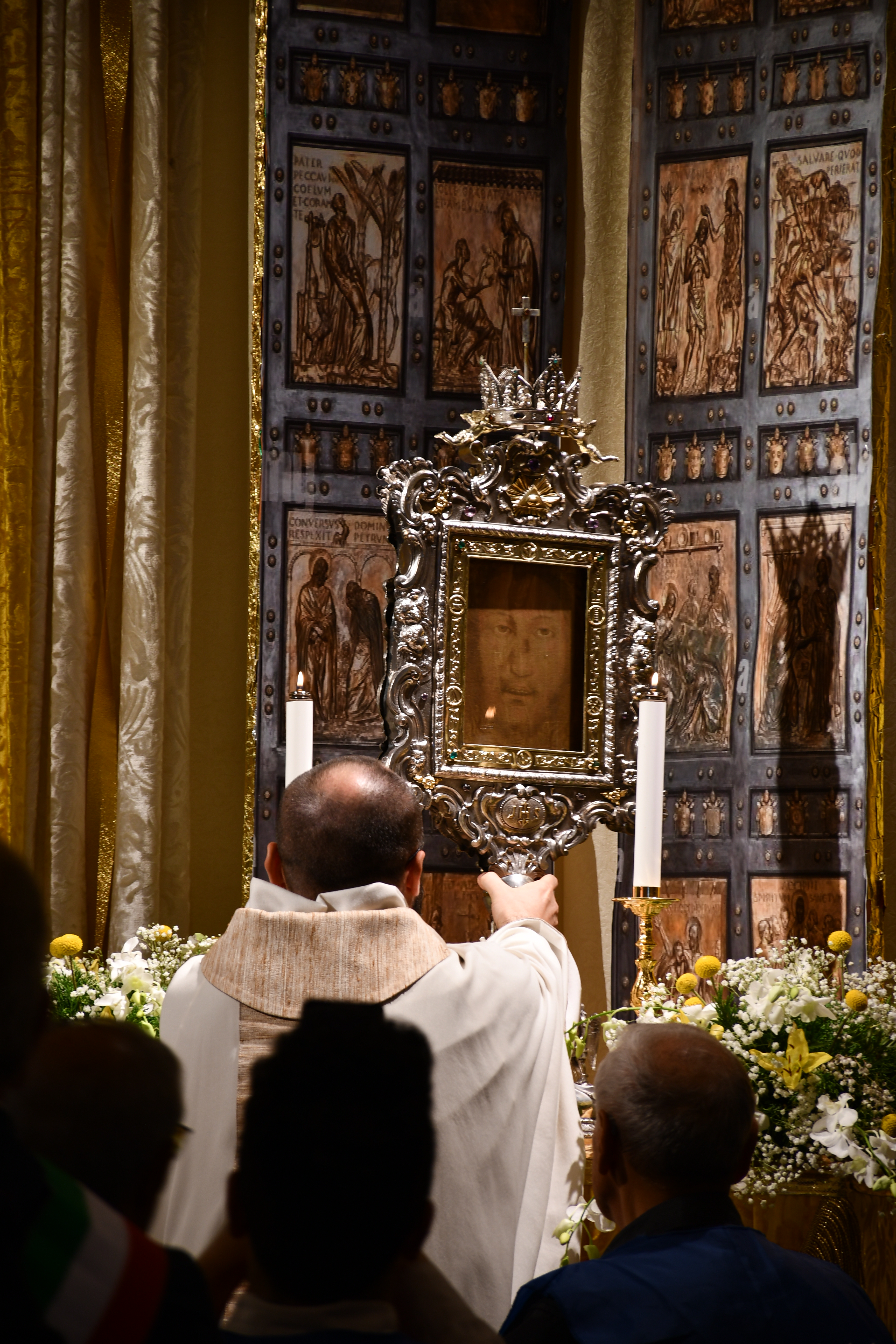
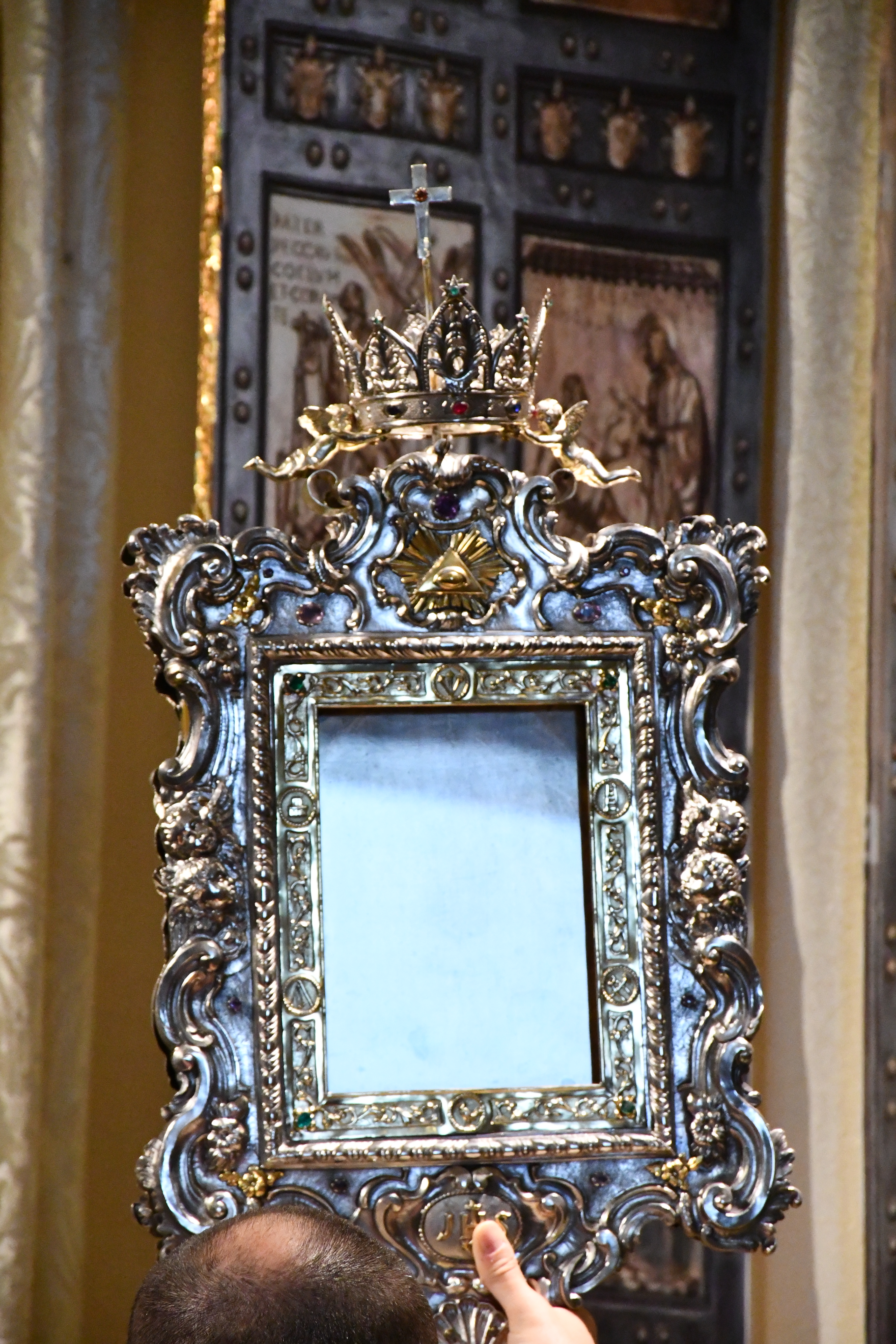
The Relic was recently removed from the glass enclosure for viewing and procession, on the Feast of the Transfiguration (Photo: Alexandra Prandell)
I can confirm the truth of Antonio’s statement about the news of the Veronica being heard throughout the world. As a life-long devotee of the True Face of Jesus known as the”Veronica,” I was most interested when I first read a U.S. news article about Fr. Pfeiffer’s startling claim of finding “the historic Veronica.” A very strong yearning grew in my heart each day and did not go away; the desire to see the Holy Veil of Manoppello, Italy with my own eyes. However, many more years passed before an opportunity would present itself to travel to Rome, and from there, to somehow find the way through the Abruzzo Mountains to Manoppello–which might as well have been the other side of the moon to me at that time.
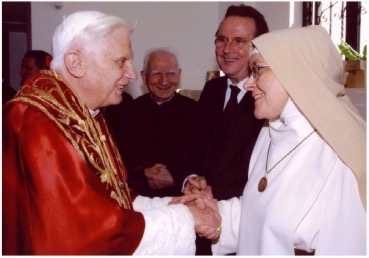
Fr. Heinrich Pfeiffer and Paul Badde look on as Pope Benedict XVI greets Sr. Blandina Paschalis Schloemer, whose forensic study comparisons of the Face of the Shroud of Turin and the Face on the Manoppello Veil were key to its rediscovery. Historic visit to the Shrine of Il Volto Santo in 2006.
Thanks to Paul Badde’s wonderful book, The Face of God: The Rediscovery of the True Face of Jesus, I learned that the Shrine of Il Volto Santo was much more accessible that I had first thought; providentially due to a new highway being completed close to the Shrine. The pilgrimage turned out to be a life-changing spiritual experience to say the least, as it has been for so many other pilgrims from all over the world.
Fr. Heinrich Pfeiffer’s important role in bringing the Holy Face of Manoppello, from obscurity to the world, was not an easy one, as his friend, Antonio Bini, reminded me. Therefore, this video was made for the growing community of faithful devotees of the Holy Face, and in gratitude and appreciation of the man who helped pave the way for pilgrims to the Basilica Shrine of Il Volto Santo in this millennium dedicated by Pope St. John Paul II to the Holy Face of Jesus Christ!
+
More beautiful photos below, sent by Alexandra Prandell, from the Feast of the Transfiguration celebration in Manoppello, Italy–not “on the other side of the moon,” but only two and a half hours from Rome, in the Abruzzo Mountains:
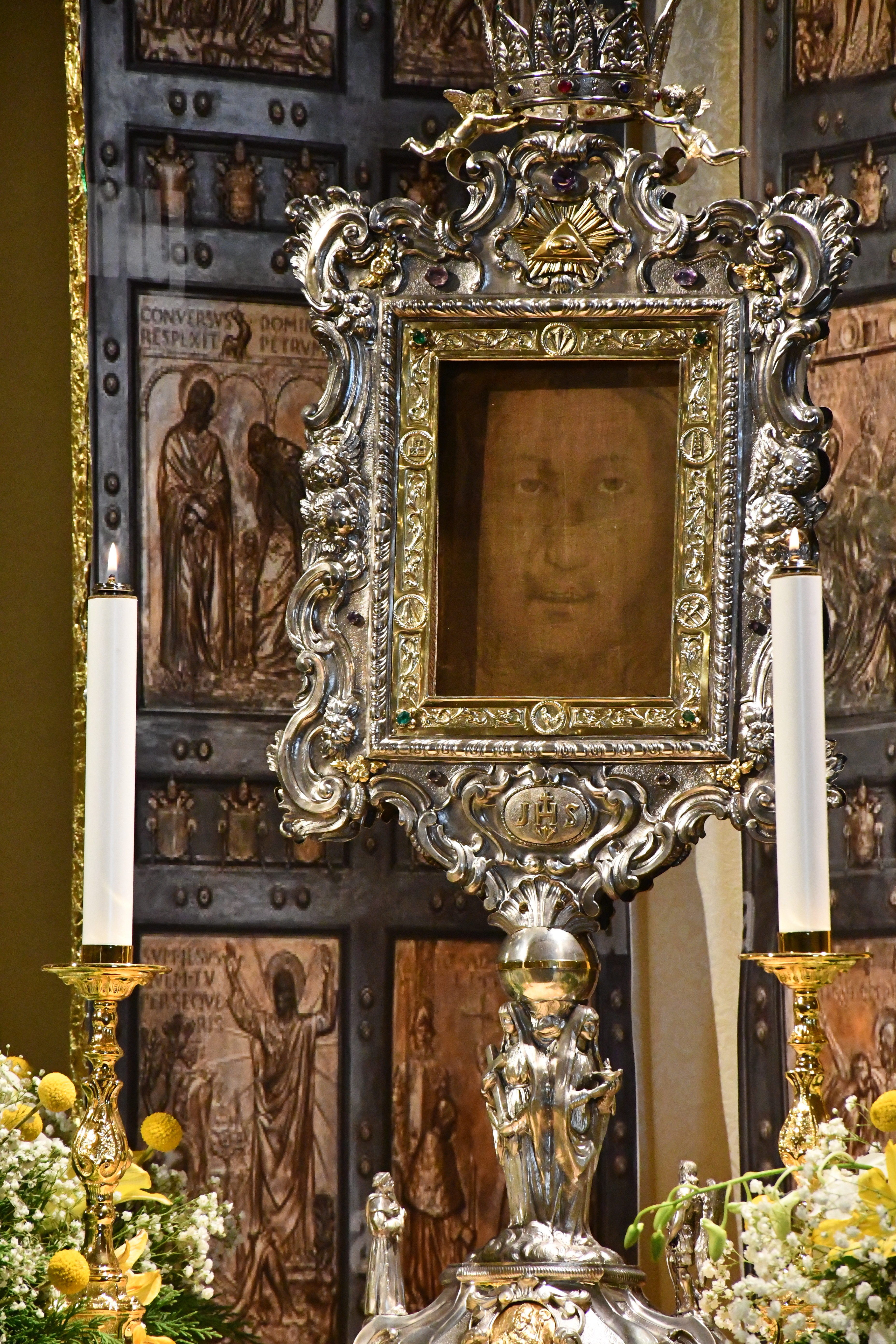
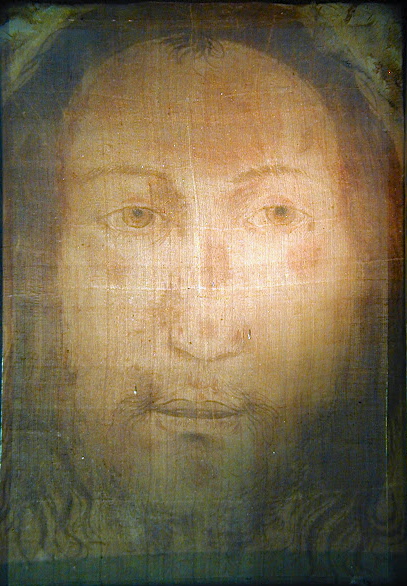
Holy Veil of Manoppello, Photo: Alexandra Prandell
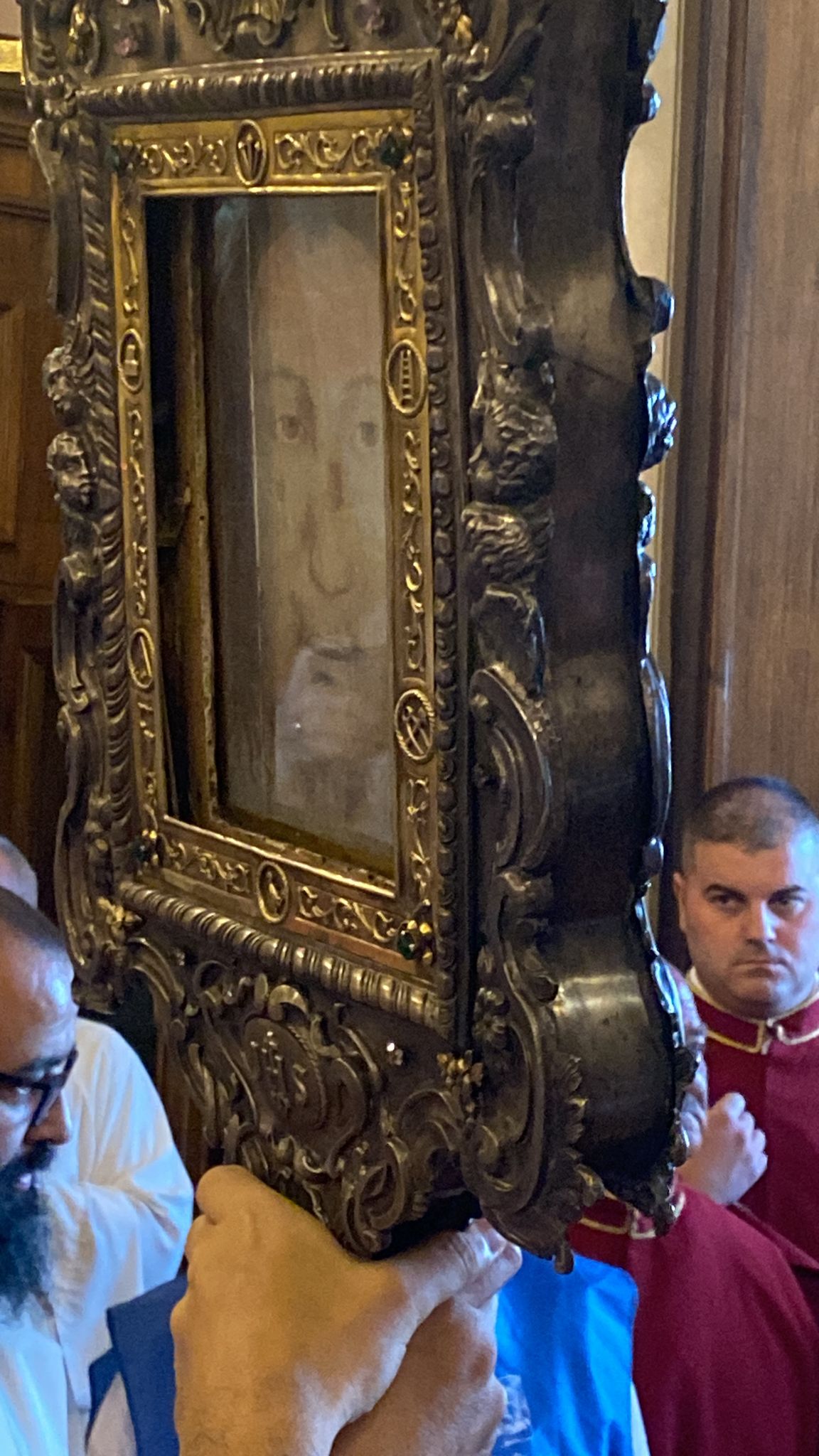
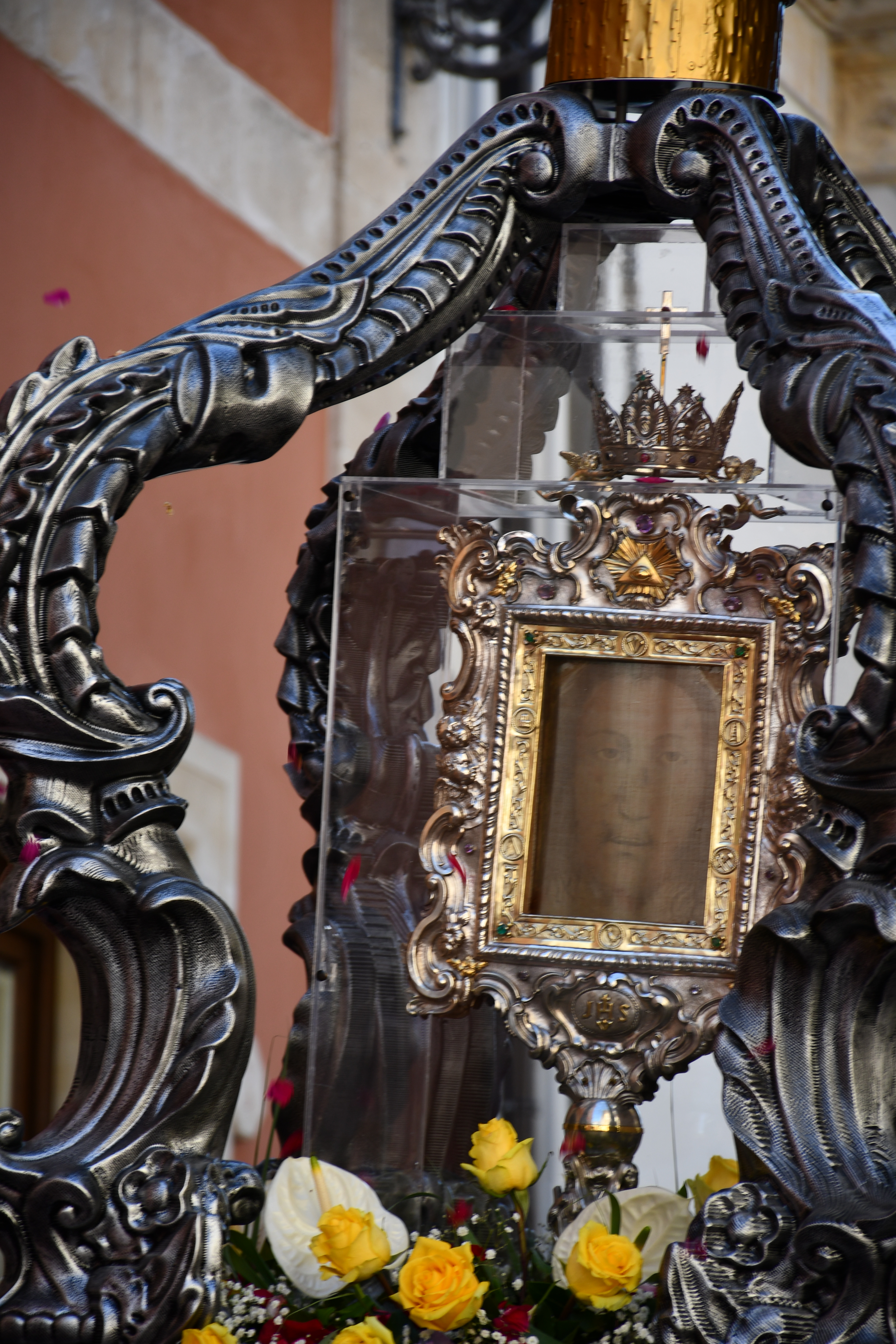
Relic of the Holy Face carried in procession through the streets. (Photo: Alexandra Prandell)
(Transfiguration procession of the relic) Photo: Alexandra Prandell)
Fireworks explode in the sky as the relic of the Holy Face Veil returns to the Basilica Shrine. (Photo: Alexandra Prandell)
The serene gaze of the Holy Face of Jesus, of Manoppello. (Photo: Alexandra Prandell)
Each year, the Feast of the Transfiguration, is marked by prayer, vigils and processions in honor of the Holy Face of Jesus. On this feast day St. Therese would toss roses and sprinkle perfume on the drawing of the Holy Face of Jesus that was so dear to her heart. At the Basilica Shrine of the Holy Face in Manoppello, Italy, local residents and pilgrims from all over the world take part in the joyous festivities in honor of the Holy Face. This year includes World Youth Day pilgrims! (Thank you to Alexandra Prandell for the video and photos!) (Enjoy as well, a few pictures from past celebrations below!) Wherever you may be on this holy feast day; come before His Holy Face–by entering into His Holy Presence in prayer–so together with the whole body of Christ, in Heaven and on earth, we may say, “Lord, it is good to be here.”
World Youth Day Pilgrims gather at the Basilica Shrine of “Il Volto Santo” The relic Veil of the Holy Face in Manoppello, Italy. (Photo: Alexandra Prandell)
Basilica Shrine of the Holy Face in the Abruzzo Mountains, Manoppello, Italy (Photo: Alexandra Prandell)
“It is good, Lord, to be here” before your Holy Face! (Photo: Alexandra Prandell)
“Jesus took with him Peter, James and John, and led them up a high mountain where they were alone. There, before their eyes, he was transfigured. His face shone like the sun, and his clothes became as white as light. Then the disciples saw Moses and Elijah appear, and they were talking to Jesus.”
~Matthew 17:2
Rays of light burst through the clouds above the Abruzzo Mountains. (2022 Photo: Paul Badde)
The following is a very beautiful sermon, by Bishop Anastasias of Sinai, on the Transfiguration of the Lord:
“Upon Mount Tabor, Jesus revealed to his disciples a heavenly mystery. While living among them he had spoken of the kingdom and of his second coming in glory, but to banish from their hearts any possible doubt concerning the kingdom and to confirm their faith in what lay in the future by its prefiguration in the present, he gave them on Mount Tabor a wonderful vision of his glory, a foreshadowing of the kingdom of heaven. It was as if he said to them: ‘As time goes by you may be in danger of losing your faith. To save you from this I tell you now that some standing here listening to me will not taste death until they have seen the Son of Man coming in the glory of his Father…'”
Along the Transfiguration Vigil Procession (Photo: Paul Badde)
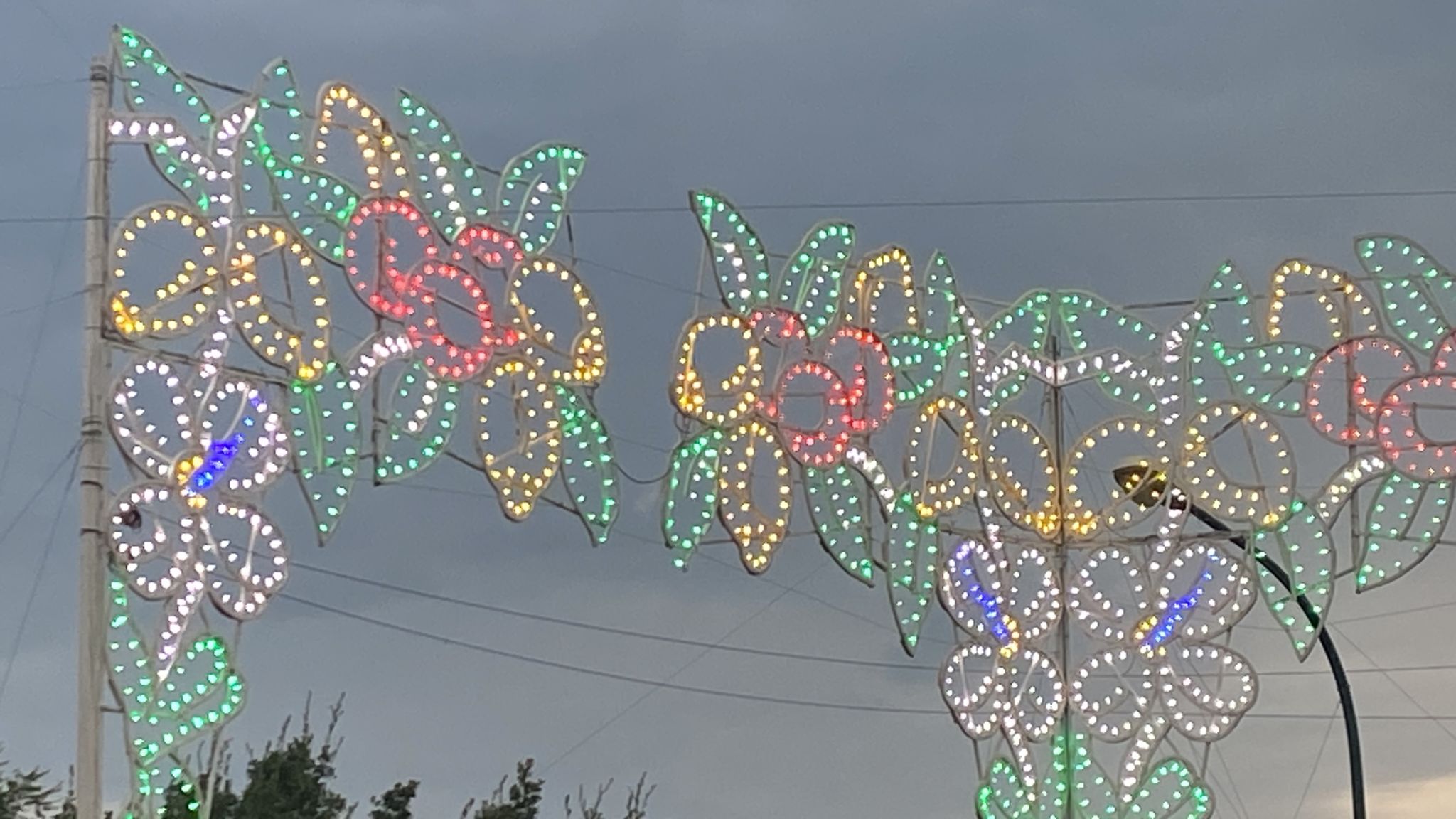
Colorful lights line the streets of Manoppello, Italy in preparation for the Vigil and Procession for the Feast of the Transfiguration. (Photo: 2023 Paul Badde)
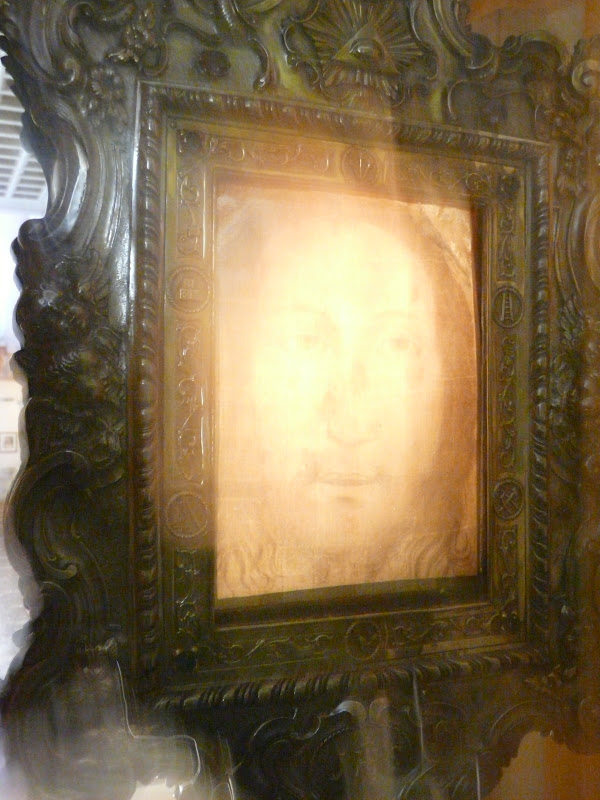
The Manoppello Veil “as white as light,” yet the face on the sheer veil can still be faintly seen. (Photo: Paul Badde)
(The Holy Veil of Manoppello is an Achieropoeta–a supernatural image made by the Hand of God–that is present on a sheer veil, without the aid of paint, and may be viewed from both sides. The Face of Jesus becomes visible to the viewer according to the light. The relic Veil of the Holy Face has recently been proven to radiate light energy.)
Holy Face–eyes always looking toward the viewer–on the Veil of Manoppello. (Photo: Paul Badde)
Holy Face seen in candlelight (2023 Photo: Paul Badde)
Transfiguration by Carl Bloch
Continuing from the sermon on the Transfiguration of the Lord by Anastasius of Sinai, Bishop:
“These are the divine wonders we celebrate today; this is the saving revelation given us upon the mountain; this is the festival of Christ that has drawn us here. Let us listen, then, to the sacred voice of God so compellingly calling us from on high, from the summit of the mountain, so that with the Lord’s chosen disciples we may penetrate the deep meaning of these holy mysteries, so far beyond our capacity to express. Jesus goes before us to show us the way, both up the mountain and into heaven, and–I speak boldly–it is for us now to follow him with all speed, yearning for the heavenly vision that will give us a share in his radiance, renew our spiritual nature and transform us into his own likeness making us for ever sharers in his Godhead and raising us to heights as yet undreamed of.
Let us run with confidence and joy to enter into the cloud like Moses and Elijah, or like James and John. Let us be caught up like Peter to behold the divine vision and to be transfigured by that glorious transfiguration. Let us retire from the world, stand aloof from the earth, rise above the body, detach ourselves from creatures and run to the creator, to who Peter in ecstasy exclaimed: Lord, it is good for us to be here–here where all things shine with divine radiance, where there is joy and gladness and exultation; where there is nothing in our hearts but peace, serenity, stillness; where God is seen.”
Rector Padre Antonio Gentili (Photo: Alexandra Prandell)
“For here, in our hearts, Christ takes up his abode together with the Father, saying as he enters: Today salvation has come to this house. With Christ, our hearts receive all the wealth of his eternal blessings, and there where they are stored up for us in him, we see reflected as in a mirror both the first fruits and the whole of the world to come.”
“Il Volto Santo” of Manoppello, Italy (2023 Photo: Paul Badde)
All the mysteries of Jesus Christ, true God and true Man, are hidden and yet revealed in the transfigured Face of Jesus on the mountaintop. Jesus Christ unveils for us in this mystery the Paschal journey that He would suffer, and the glory that is already within Him. He invites us to follow Him, in taking up our own crosses in faith, hope and love. In order to see God the Father in His Glory–we must first pass through the door of the Holy Face of Jesus Christ, in imitation of Him–It is the only way to be transformed by the Holy Spirit of Love into His Image–to purify our eyes to see the glory of the Father in Heaven.
As we read in Scripture: “… He [Jesus] took along Peter John, and James, and went up on the mountain to pray. And while He was praying, the appearance of His face became different, and His clothes became white and gleaming. And behold, two men were talking with Him; and they were Moses and Elijah, who, appearing in glory, were speaking of His departure, which He was about to accomplish [through His Passion and Death] at Jerusalem.” (Luke 9:28-31) The light that shone from His Holy Face at the Transfiguration gives us hope in the glory of the Resurrection.
“For God who said, ‘Let light shine out of darkness,’ has shone into our hearts to bring the knowledge of the glory of God on the face of Christ.” (2 Cor. 4:6) As we follow Christ in carrying our crosses we will be transformed by the Holy Spirit into His Image, from glory unto even greater glory. “All of us, gazing with unveiled face on the glory of the Lord, are being transformed into the same image from glory to glory, as from the Lord who is the Spirit.” (2 Cor. 3:18)
Holy Face Relic of Manoppello, believed to the Face Cloth of the Resurrection. “At present we see indistinctly, as in a mirror, but then face to face. At present I know partially; then I shall know fully as I am known. So faith, hope, love remain, these three; but the greatest of these is love.” (1 Cor. 13: 12-13)
“O Beloved Face of Jesus! As we await the everlasting day when we contemplate Your infinite Glory our one desire is to charm Your Divine Eyes by hiding our faces too, so that here on earth no one can recognize us. O Jesus! Your veiled gaze is our heaven!”–St. Therese
Holy Veil of Manoppello (May 2025 Photo: Alexandra Prandell)
Procession of August 6th begins…(Photo: Alexandra Prandell)
(Photo: Alexandra Prandell)
Rector of and Basilica Shrine Padre Antonio Gentili carries the precious reliquary. (Photo: Alexandra Prandell)
Remarkable photo by Alexandra Prandell–the Face on the Holy Veil may be seen, but at the same time what it behind it may be seen as well.
In this photo by Alexandra Prandell, the image on the Veil has disappeared according to the angle of the viewer and the light.
(Photo: Alexandra Prandell)
(Photo: Alexandra Prandell)
The Veil of the Holy Face, “Il Volto Santo” of Manoppello, Italy. (Photo: Alexandra Prandell)
“How fair you are, O Virgin Mary! Your face is resplendent with grace.” — Carmelite Proper
Mary has many titles, each having a special significance and meaning. “Queen Beauty of Carmel” recalls the ancient beauty of Mount Carmel in the Holy Land, the place where the prophet Elijah, zealous for the worship of the one, true, and living God, steadfastly sought the Face of God in silence and in prayer.
The Cave of Elijah on Mount Carmel
Mary, Queen Beauty of Mount Carmel personifies the”enclosed garden” created solely for God and watered by Him, containing all beauty, grace, and virtues. All mankind has been entrusted to her maternal heart; she gathers her children into the garden of Carmel to learn from her the way of perfection. The children of Our Lady of Mount Carmel are drawn by her — to “contemplate God in the human Face of Jesus” and follow in her footsteps which lead to fullness of prayer and communion with her Son. With docility to the Holy Spirit, Mary’s children seek to imitate their incomparable Mother in her pilgrimage of faith, hope in trials, and faithfulness in love, with trust in His mercy and purity of heart which will enable them to see the Father’s Face.
“The Beauty of Carmel has been given to them, they will see the glory of the Lord and the splendor of our God.”– Carmelite Proper
Devotion to the Holy Face, as characterized by Pope St. John Paul II, Pope Benedict, and Pope Francis, is not solely a devotion of reparation, but so much more. It is a means of living out the two greatest commandments given to us by Christ Jesus in the Gospel: to love the Lord, Our God, with all our mind, and all our heart and all our strength, and to love our neighbor as ourself (Mt. 22:40). It is the path of transformation of love into the image of Christ.
Here are a few sainted Discalced Carmelite children of Mary and what they have learned about seeking God’s Face in prayer …
St. Teresa of Jesus:“He is always looking at you; can you not turn the eyes of your soul to look at Him?”
“He will gaze on you with beautiful, compassionate eyes, and will forget His own grief to solace yours, only because you went to comfort Him, and turned to look at Him.”
“Never set aside the Sacred Humanity of Christ…If we can, we should occupy ourselves in looking at Him who is looking at us; keep Him company; talk with Him; humble ourselves before Him; have our delight in Him…the Lord is within us and we should be there with Him.”
St. John of the Cross
St. John of the Cross:“The soul can only be satisfied with God’s Face.” To seek God’s Face is to seek Him in prayer, to look at Him is to take the time to contemplate Him, even in the darkness of pure faith. When we do this, St. John of the Cross tells us, God is doing great things! He shines His Face upon us, to restore by a “gentle touch” His image in our souls.
“O my God, the more gently You touch, the more You are hidden in the purified souls of those who have made themselves aliens on earth, and whom You hide in the secret of Your Face.”
“Courage then, O soul most beautiful! You now know that your Beloved dwells hidden within your own breast. Endeavor therefore to be truly hidden with Him.”
St. Therese of the Child Jesus and the Holy Face: “Your Face is my only wealth./ I ask for nothing more./ Hiding myself in it unceasingly,/ I will resemble You, Jesus/ Leave in me, the Divine Impress/ of Your features filled with sweetness.”
“O Jesus, whose adorable Face ravishes my heart, I implore Thee to fix deep within me Thy Divine Image and to set me on fire with Thy Love, that I may be found worthy to come to the contemplation of Thy glorious Face in Heaven. Amen.”
St. Elizabeth the Trinity: “Nothing shows forth the love which the Heart of God bears for us as does the Eucharist. It means union, consummation, He in us and we in Him. Is not that heaven on earth, heaven in faith, while we await the face to face vision for which we so yearn? Then, when His glory appears, we shall be satisfied when we see Him in His light. Do you not find that it rests the soul to think about that meeting with Him whom we love supremely? Then all else vanishes and we feel that already we are penetrating into the Mystery of God!
“It is Your continual desire to associate yourself with your creatures…How can I better satisfy Your desire than by keeping myself lovingly turned towards You, so that You can reflect Your own image in me, as the sun is reflected through pure crystal?…We will be glorified in the measure in which we will have been conformed to the image of His Divine Son. So, let us contemplate this adored Image, let us remain unceasingly under it’s radiance so that it may imprint itself on us.”
St.Teresa Benedicta of the Cross:“Prayer is looking up into the face of the Eternal. We can do this only when the spirit is awake in it’s innermost depths, freed from all earthly occupations and pleasures that benumb it. being awake in body does not guarantee this consciousness, nor does rest required by nature interfere.”
“Contemplate the Lord who hangs before you on the wood, because he was obedient even to death of the cross. He came into the world not to do his own will but that of the Father. And if you wish to be the spouse of the Crucified, you must renounce completely your own will and have no other aspiration than to do the will of God…The eyes of the Crucified will gaze upon you. They question you and appeal to you…What will your response be? ‘Lord, where shall I go? You alone have the words of life.’ “Ave Crux, spes unica! Hail to the Cross our only hope!
St. Teresa of the Andes: “Are you perhaps afraid to draw near him? Look at him, surrounded by little children. He caresses them, he presses them to his heart. Look at him in the midst of his faithful flock, bearing the faithless lamb on his shoulders. Look at him in the tomb of Lazarus, And listen to what he says of the Magdalene: ‘Much has been forgiven her, because she has loved much.’ What do you discover in these flashes from the Gospel except a heart that is good, gentle, tender, compassionate; in other words, the heart of a God?”
+++
Mary, Queen Beauty of Carmel, Pray for us!
Flos Carmeli
Flower of Carmel, Tall vine blossom laden, Splendor of heaven, Child-bearing yet maiden. None equals thee.
Mother so tender, Whom no man didst know, On Carmel’s children Thy favors bestow. Star of the Sea.
Hail Gate of Heaven, With glory now crowned, Bring us to safety Where thy Son is found, true joy to see.
“How fair you are, O Virgin Mary! Your face is resplendent with grace.” –Carmelite Proper
“The Virgin Mary is she who more than any other contemplated God in the human Face of Jesus. She saw Him as a newborn when, wrapped in swaddling clothes, He was placed in a manger; she saw Him when, just after His death, they took Him down from the Cross, wrapped Him in linen and placed Him in the sepulcher. Inside her was impressed the image of her martyred Son; but this image was then transfigured in the light of the Resurrection. Thus, in Mary’s heart, was carried the mystery of the Face of Christ, a mystery of death and glory. From her we can always learn how to look upon Jesus, with a gaze of love and faith, to recognize in that human countenance, the Face of God.” –Pope Benedict XVI
Our Lady of Mount Carmel
Seeking the Face of Christ through Mary
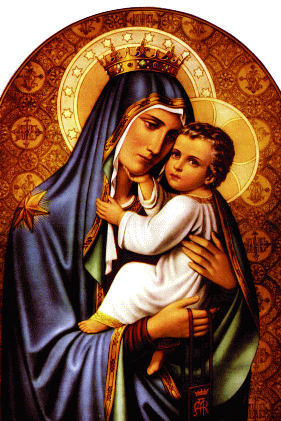
In the icon of “Queen Beauty and Mother of Carmel,” the Infant Jesus tenderly invites us to look at the face of His Mother, “resplendent with grace.” What makes the Virgin Mary’s face “resplendent with grace?” It is the light of the Face of Christ – just as the moon reflects the light of the sun, the face of Mary reflects the light of the true sun, Jesus Christ.
Mary is “The glory of Jerusalem, the joy of Israel, the highest honor of our race,” (Judith 15:9) because she sought the face of God every moment of life; that is, she sought His holy will and pleasure, in all things. Just as it is possible for the moon to shine even in the brightness of day, Mary gives more beauty to the heavens, more glory to God than any other creature on earth. And when the dark night of faith is upon us and the sun is hidden from our view, Mary is there to enlighten our path and show us the way to her Son, until “In the tender compassion of our God the dawn from on high shall break upon us, to shine on those who dwell in darkness and the shadow of death, and to guide our feet into the way of peace.” (Luke 1: 78-79)
At the present moment, although the world is filled with darkness, we can turn to her for help in seeking His Face and leading souls to Him. Even pebbles on a path on the ground can reflect the light of the moon at night; and so the children of Mary by following her example, “to seek the Face of God in all things,” can guide others through the darkness by reflecting the light of the Face of Christ as does Mary.
It is Jesus Himself who desires that we turn to the face of His Mother. He created her with all the perfection and beauty that would be fitting for the Mother of God. Her soul, holy, immaculate and unstained by sin, is the perfect mirror in which He reflects His Face. He holds her up to us as the model for all His disciples as He did in Luke’s Gospel: “While He was speaking, a woman from the crowd called out and said to Him, ‘Blessed is the womb that carried you and the breasts at which you nursed.’” This singular praise of Mary from the woman in the crowd was not enough for her Son. And so Jesus replied, “Rather, blessed are those who hear the word of God and keep it.” (Luke 11:27) Mary is thus thrice blessed, first, in being chosen to be the Mother of God, second, in that Mary heard the word of God and third, because she kept His word in her heart.
Mary holds out to us her Scapular, a sacramental sign of being clothed in her own garment, to place over our shoulders, so that we may imitate her in faith, hope, charity and all the virtues that adorn her soul. By contemplating the Face of Jesus always, together with Mary, we can do our part in making His Face shine upon our world as well.
Queen Beauty of Carmel Feast day: July 16th
Our Lady of Mount Carmel Novena Prayer:
O most beautiful flower of Mount Carmel, fruitful vine, splendor of heaven, blessed Mother of Christ, Immaculate Virgin, we praise and honor you as our Queen and Mother. Help us to persevere in constant prayer for the needs of our world and share with you in the work of redemption. Be with us, Holy Virgin, and guide us on our way, as we journey together in faith, hope and love to your Son, Jesus Christ Our Lord. Amen.
Holy Face Veil of Manoppello, Photo: Paul Badde/EWTN
“…and if my people, upon whom my name has been pronounced, humble themselves and pray, and seek My Face and turn from their evil ways, I will hear them from Heaven and pardon their sins and revive their land.” (2 Chr. 7:4)
Psalm 27
27 The Lord is my light and my salvation; whom shall I fear? the Lord is the strength of my life; of whom shall I be afraid?
2 When the wicked, even mine enemies and my foes, came upon me to eat up my flesh, they stumbled and fell.
3 Though an host should encamp against me, my heart shall not fear: though war should rise against me, in this will I be confident.
4 One thing have I desired of the Lord, that will I seek after; that I may dwell in the house of the Lord all the days of my life, to behold the beauty of the Lord, and to enquire in his temple.
5 For in the time of trouble he shall hide me in his pavilion: in the secret of his tabernacle shall he hide me; he shall set me up upon a rock.
6 And now shall mine head be lifted up above mine enemies round about me: therefore will I offer in his tabernacle sacrifices of joy; I will sing, yea, I will sing praises unto the Lord.
7 Hear, O Lord, when I cry with my voice: have mercy also upon me, and answer me.
8 When thou saidst, Seek ye my face; my heart said unto thee, Thy face, Lord, will I seek.
9 Hide not thy face far from me; put not thy servant away in anger: thou hast been my help; leave me not, neither forsake me, O God of my salvation.
10 When my father and my mother forsake me, then the Lord will take me up.
11 Teach me thy way, O Lord, and lead me in a plain path, because of mine enemies.
12 Deliver me not over unto the will of mine enemies: for false witnesses are risen up against me, and such as breathe out cruelty.
13 I had fainted, unless I had believed to see the goodness of the Lord in the land of the living.
14 Wait on the Lord: be of good courage, and he shall strengthen thine heart: wait, I say, on the Lord.
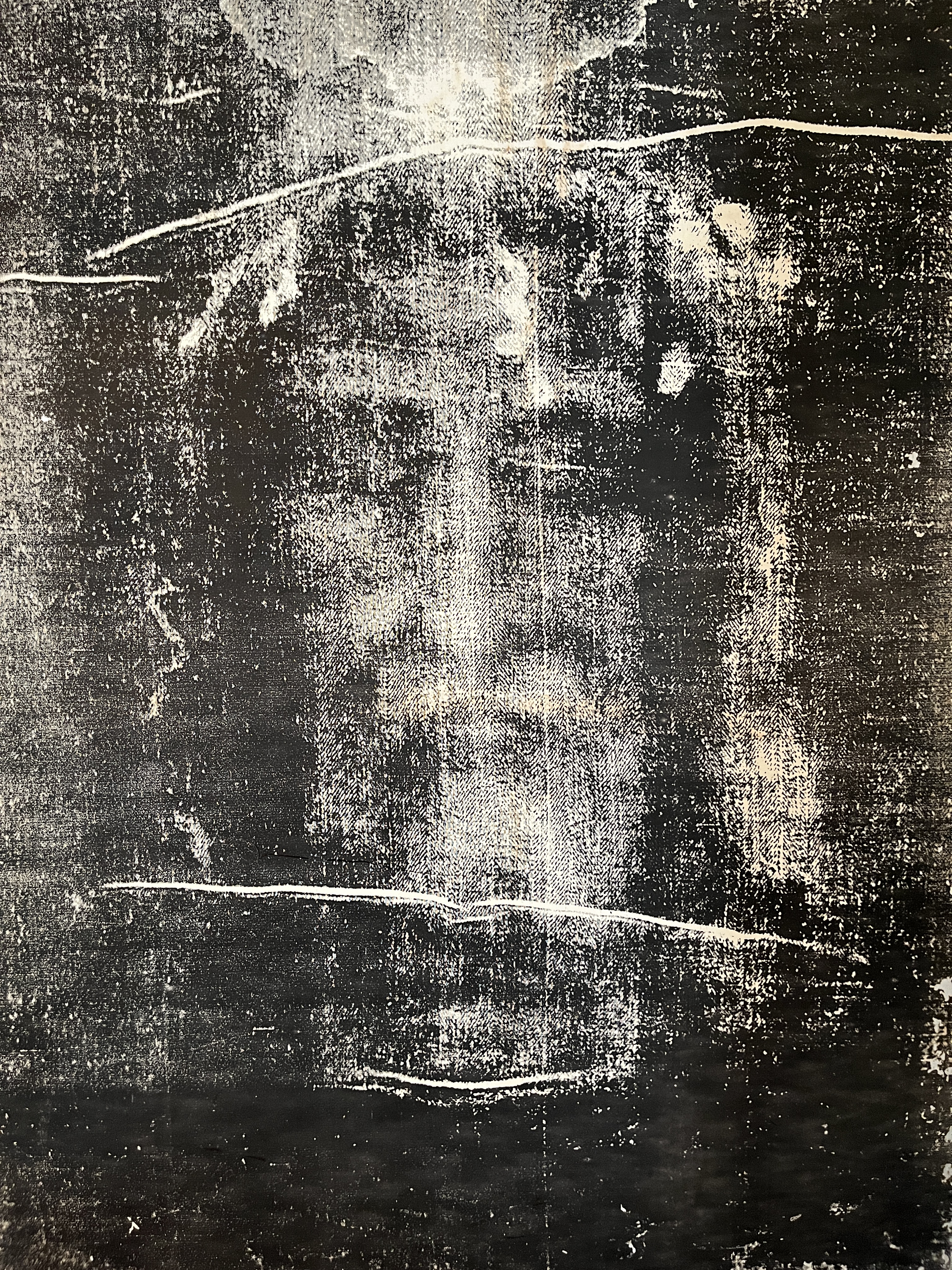
” I am giving you a new commandment, that you love one another’ just as I have loved you, that you also love one another.” (John !#:34) The Holy Face from the Shroud of Turin
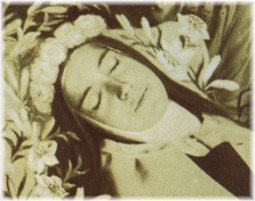
“You know that I myself do not see the Sacred Heart as everybody else. I think that the heart of my Spouse is mine alone, just as mine is His alone, and I speak to Him then in the solitude of this delightful heart to heart, while waiting to contemplate Him one day face to face.” — St. Therese of the Holy Face and the Child Jesus
To the Sacred Heart of Jesus
~by St. Therese of the Holy Face and the Child Jesus
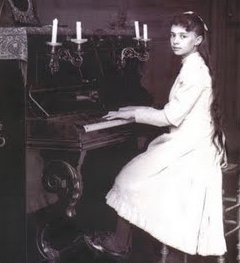
St. Therese of Lisieux
At the Holy Sepulcher, Mary Magdalene, Searching for her Jesus, stooped down in tears. The angels wanted to console her sorrow, But nothing could calm her grief. Bright angels, it was not you Whom this fervent soul came searching for. She wanted to see the Lord of the Angels, To take him in her arms, to carry him far away.
Close by the tomb, the last one to stay, She had come well before dawn. Her God also came, veiling his light. Mary could not vanquish him in love! Showing her at first his Blessed Face, Soon just one word sprang from his Heart. Whispering the sweet name of: Mary, Jesus gave back her peace, her happiness.
O my God, one day, like Mary Magdalene, I wanted to see you and come close to you. I looked down over the immense plain Where I sought the Master and King, And I cried, seeing the pure wave, The starry azure, the flower, and the bird: “Bright nature, if I do not see God, You are nothing to me but a vast tomb.
“I need a heart burning with tenderness, Who will be my support forever, Who loves everything in me, even my weakness… And who never leaves me day or night. ” I could find no creature Who could always love me and never die. I must have a God who takes on my nature And becomes my brother and is able to suffer!
You heard me, only Friend whom I love. To ravish my heart, you became man. You shed your blood, what a supreme mystery!.. And you still live for me on the Altar. If I cannot see the brilliance of your Face Or hear your sweet voice, O my God, I can live by your grace, I can rest on your Sacred Heart!
O Heart of Jesus, treasure of tenderness, You Yourself are my happiness, my only hope. You who knew how to charm my tender youth, Stay near me till the last night. Lord, to you alone I’ve given my life, And all my desires are well-known to you. It’s in your ever-infinite goodness That I want to lose myself, O Heart of Jesus!
Ah! I know well, all our righteousness Is worthless in your sight. To give value to my sacrifices, I want to cast them into your Divine Heart. You did not find your angels without blemish. In the midst of lightning you gave your law!… I hide myself in your Sacred Heart, Jesus. I do not fear, my virtue is You!…
To be able to gaze on your glory, I know we have to pass through fire. So I, for my purgatory, Choose your burning love, O heart of my God! On leaving this life, my exiled soul Would like to make an act of pure love, And then, flying away to Heaven, its Homeland, Enter straightaway into your Heart.
“O Lord, wealth of the poor, how admirably You can sustain souls, revealing Your great riches to them gradually and not permitting them to see them all at once. When I see Your great Majesty hidden in so small a thing as the Host, I cannot but marvel at Your great wisdom.” –St. Teresa of Jesus
The video above was posted on YouTube over eleven years ago of a Eucharistic Miracle that occurred on Friday, November 15, of 2013, at Christ the King Church in Vilakannur, Kerala, India. After twelve years of investigation, the Vatican has recently announced the approval of this “Relic of Divinity.” This is a powerful sign for our times at the beginning of this millennium dedicated by Pope St. John Paul II to the Holy Face of Jesus Christ. It seems as though Our Lord invites us to come to the banquet of His Love.
“The Face of Christ is the supreme revelation of Christ’s Mercy.”–Pope Benedict XVI gazing at the Eucharistic Face of Christ. (photo:Paul Badde/EWTN)
The Eucharist is the visible sign of the of the veiled presence of the invisible Face of God. In God’s great humility, mercy, and love, the grandeur of His Divine Presence is veiled in the Eucharist so that we may not fear to draw near and come into His Presence in the Bread of Life.
“Being Christian,” Pope Benedict XVI wrote, “is not the result of an ethical choice or a lofty idea, but an encounter… a Person, which gives life a new horizon and a decisive direction.” As often as we encounter the person of Christ, present Body, Blood, Soul and Divinity, in the Eucharist, we are being transformed into His Image. While He is the “Divine Prisoner” He is longing and waiting for us to come to Him.
Jesus is “the Divine Prisoner.” God points us to His Holy Face on the miraculous Veil of Manoppello. (photo: Patricia Enk)
Come and see that “Truth is a Person…a Presence, a Face: Jesus Christ.” — Pope St. John Paul II
Are you sorrowful, lonely, sick or fearful? Come to Him. Do you feel alienated, rejected, remorseful and in need of forgiveness? Come to Him. Are you angry and frustrated? Come. If your faith is little, come; if you long for Love Himself, come; if you are losing Hope, come.
Come, come, come! Your presence is requested.
Jesus waits for you. Come.
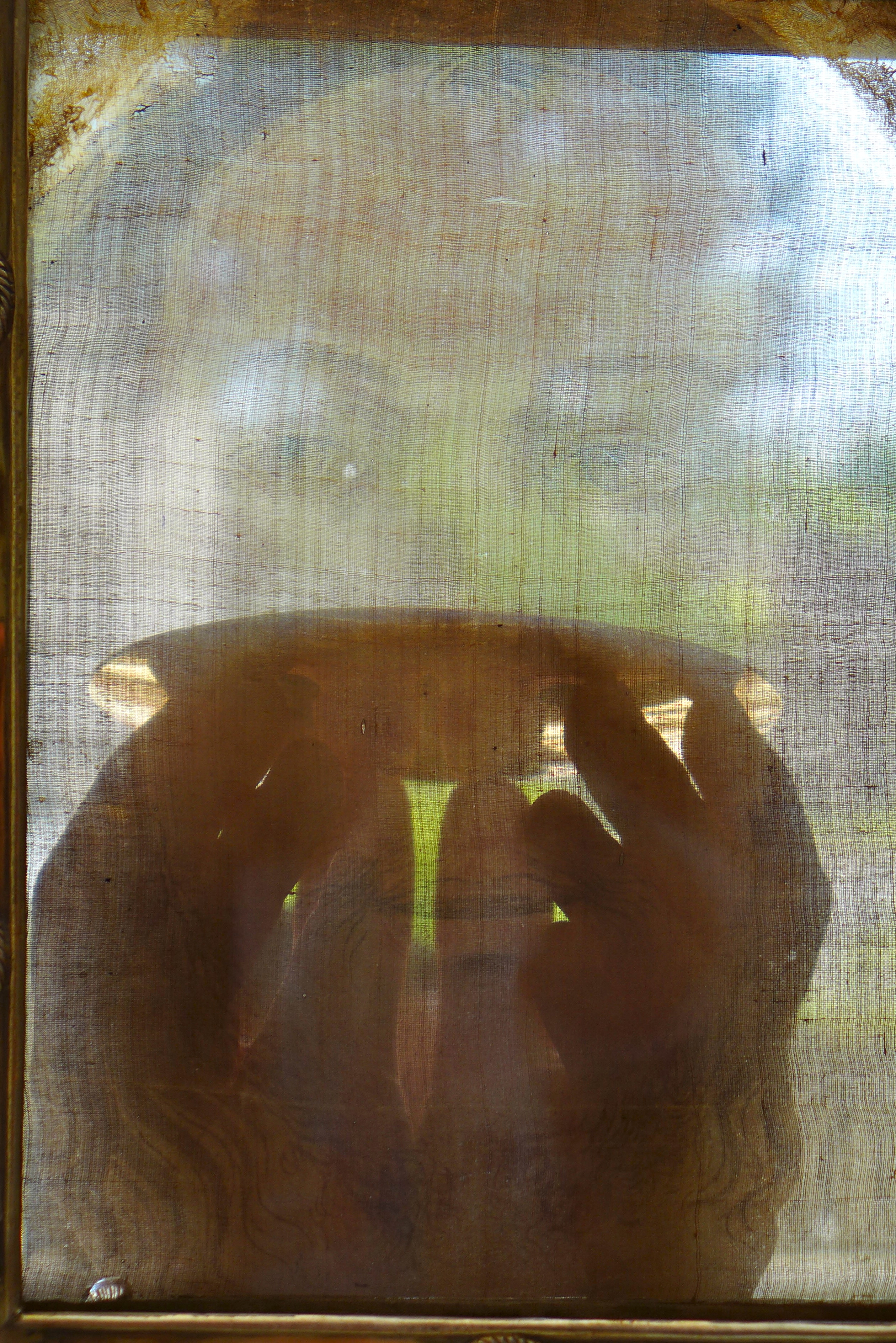
Paten viewed through the Veil of the Holy Face of Manoppello. (Photo: Paul Badde/EWTN)
The life of a Christian should be the faithful reproduction of Jesus in their soul — this radiant transformation is the work of love of the Holy Spirit. “Those whom He had foreknown He has also predestined to become conformed to the image of His Son.” (Rom 8:29) He who loves will resemble the thing loved.
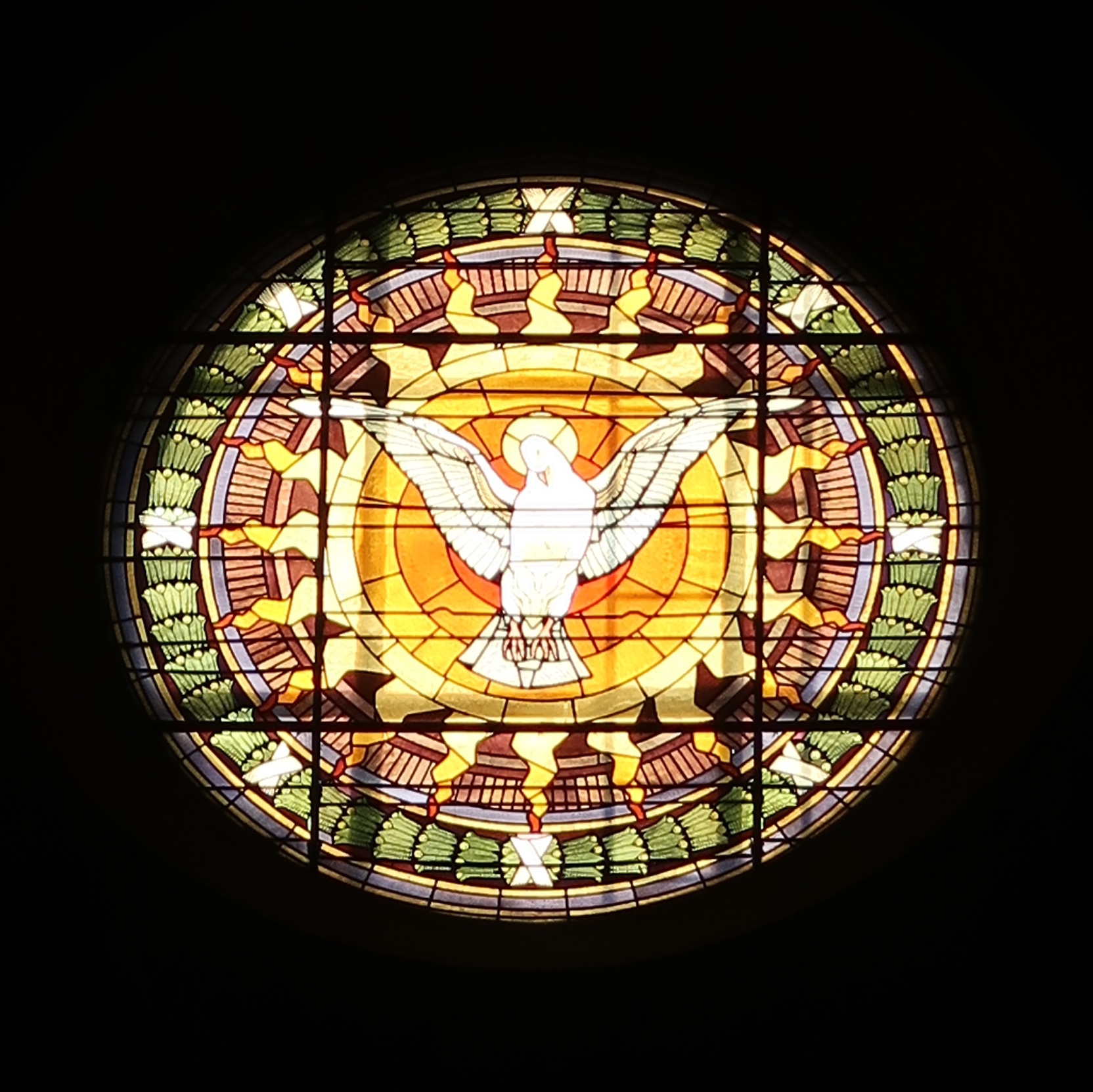
Holy Spirit Window in Loreto, Italy
“God’s love has been poured into our hearts through the Holy Spirit who has been given to us.” (Rom 5:5) “Because we are dead or at least wounded through sin, the first effect of the gift of love is the forgiveness of our sins. The communion of the Holy Spirit (2 Cor 13:14) in the Church restores to the baptized the divine likeness lost through sin.” (CCC 734) The Holy Spirit perfects the soul with the first fruits of eternal glory: charity, joy, peace, patience, kindness, goodness, generosity, gentleness, faithfulness, modesty, self-control, and chastity — so we may more closely resemble Jesus Christ.
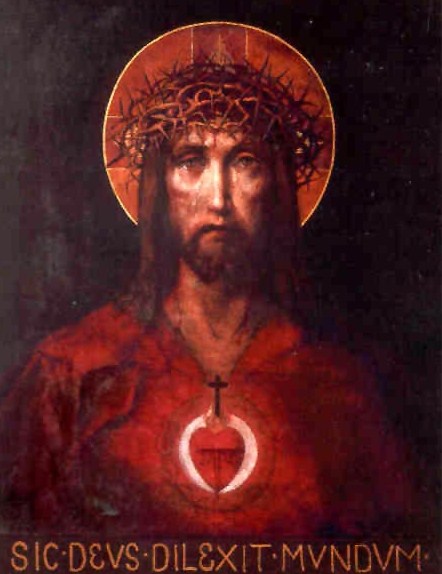
Face of Jesus Christ, crowned with thorns.
In his classic work on the Holy Spirit, The Sanctifier, Archbishop Luis M. Martinez reminds us that in order to resemble Christ, Our Lord, we must go through the pain and suffering of the Cross: “He whom we love is a God nailed to a cross. Pain makes us resemble him. It is characteristic of love to have a tremendous desire to resemble the beloved. It is characteristic, too, for those who love to resemble each other.” But, as the soul is transformed, it is also filled with joy!
After Christ had completed his mission on earth, it still remained necessary for us to become sharers in the divine nature of the Word. We had to give up our own life and be so transformed that we would begin to live an entirely new kind of life that would be pleasing to God. This was something we could do only by sharing in the Holy Spirit. As St. Paul writes: “But we all with unveiled faces, reflecting as in a mirror the glory of the Lord, are being transformed into His very image from glory to glory.” (2 Cor 3:18)
— St. Cyril of Alexandria
Divine Guest of our souls (photo: Patricia Enk)
This is the work of the Holy Spirit of Love, who is the the light and fire of the Face of God: to sanctify our souls, shining upon us the radiance of His light, transforming us into the His own likeness. Holy Spirit wants to dwell in us and convert our bodies into His temple, as He did in the Virgin Mary to bring grace, mercy, and peace. “Love is not a passing visitor who pays us a call and then goes away. He establishes in us his permanent dwelling and lives in intimate union with our souls as their eternal Guest.” (The Sanctifier) As Jesus promised on the last night of His mortal life: “And I will ask the Father and He will give you another Advocate to dwell with you forever, the Spirit of truth whom the world cannot receive, because it neither sees Him nor knows Him. But you shall know Him because He will dwell with you and be in you.” (Jn 14: 16-17)
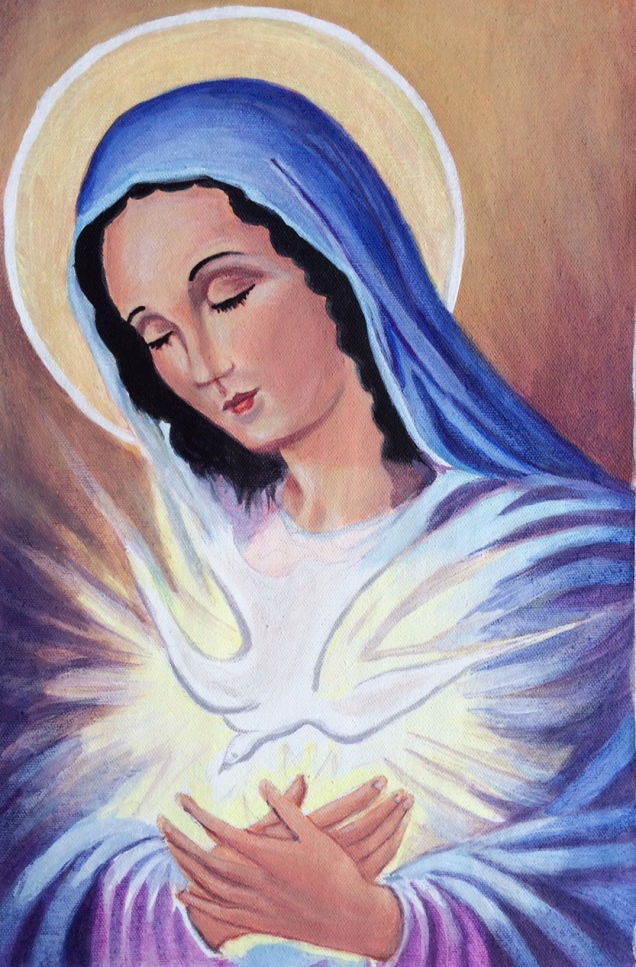
Mary, Spouse of the Holy Spirit
To Mary, Spouse of the Holy Spirit, Daughter of the Most High, Mother of God, faithful Spouse of the Holy Spirit — yet also Mary of Nazareth, Joseph’s wife, my mother– hear my prayer for grace, O Full of Grace. Pray your Spouse the Holy Spirit to come upon me — to shelter from all ill, to strengthen me to do what is right, to teach me all truth. Pray him come to me, and abide with me, and be within me a fountain springing up unto eternal life. May he sustain me in sorrow, sanctify me in life, and receive me at the hour of my death. Holy Mary, Mother of God, Mother of the Church, pray for us.
Derick Baegert, 1470 The Veronica — Acts of compassion and love never fade, but restore the image of God in our souls.
Prayer to Reproduce the Image of God in Our Souls
I salute You! I adore You and I love you, Oh adorable face of my beloved Jesus, as the noble stamp of The Divinity! Completely surrendering my soul to You, I most humbly beg You to stamp this seal upon us all, so the image of God may once more be reproduced in our souls. Amen.
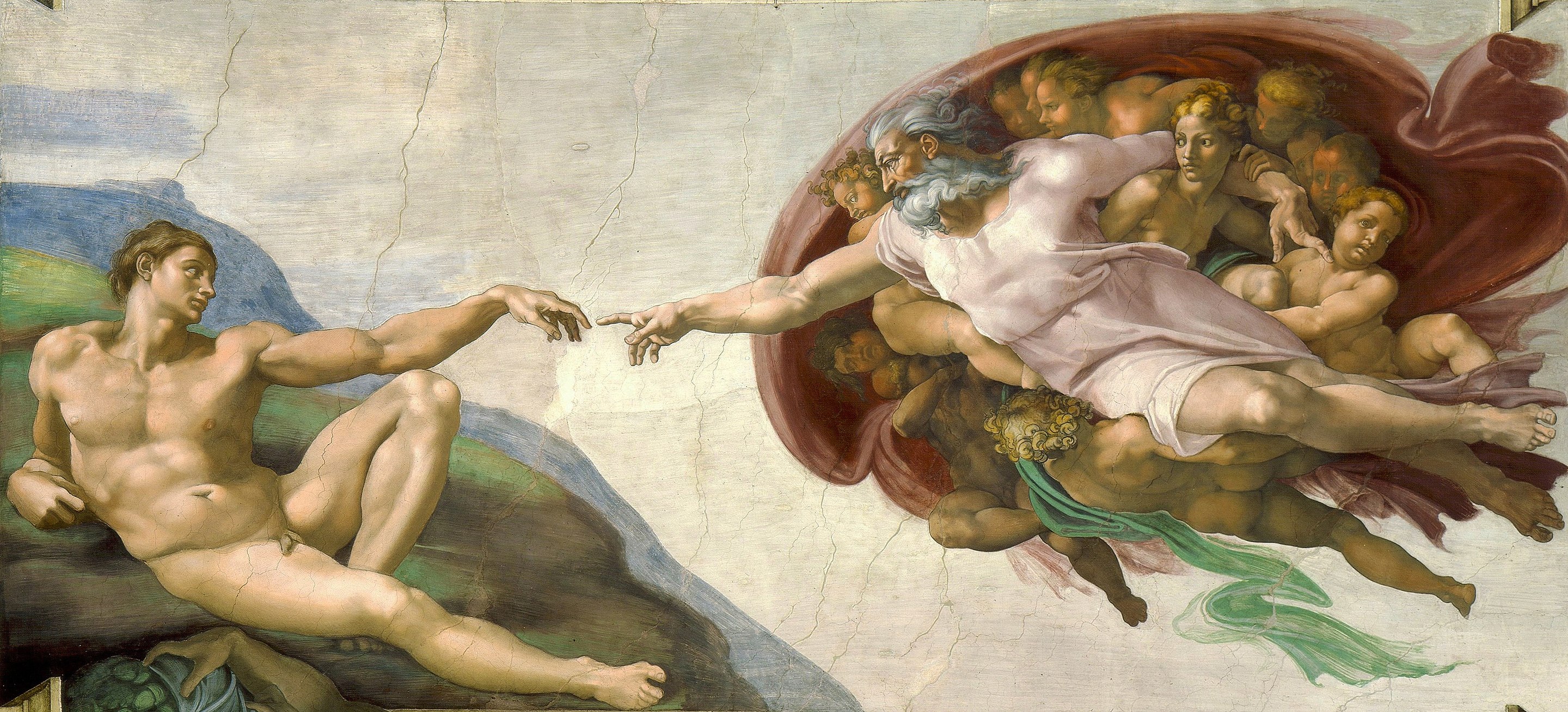
The Creation of Adam by Michelangelo, in the Sistine Chapel
What does it mean to be human, and why does it matter? The understanding of the human person has tremendous consequences for the world, which can lead humanity to–or away from–the Face of God, because “it is only in God that man has meaning.” (Gaudium et Spes)
The newly elected Pope Leo XIV, when first meeting with the college of cardinals, mentioned serious challenges to human dignity, in particular, regarding “developments in the field of artificial intelligence:”(Read also: Pope Leo XIV to Cardinals: Church must respond to digital revolution ) This poses many questions: What are the “serious challenges” mentioned? What should our response be to this rapidly developing technology and its misuse? What exactly is “artificial intelligence,” and what does it mean to be a “human person?” And what does all this have to do with the Face of God?
Holy Face of Manoppello, an “achieropoieta” — made by the Hand of God. (Photo: Paul Badde)
Pope St. John Paul II dedicated the millennium to the Face of God. And it is my own belief that devotion to the Face of Christ, *as studied and characterized by Card. Ratzinger (Pope Benedict XVI) at the request of Pope St. John Paul II, is the answer to a rapidly approaching crisis that will soon face all humanity. God bless Pope Leo XIV, who has now brought the Church’s concerns about AI and human dignity to the forefront at the beginning of his pontificate.
Several news items that are related to artificial intelligence have caught my attention this past year: One was regarding an Apple advertisement for their new iPad which depicted crushing various instruments of human creativity, such as art objects and musical instruments, implying that the new iPad would take the place of human creativity, and unceremoniously dump it all in the ash heap of human history. The others were related to the “deep fakes” emerging from AI technology that are greatly alarming a great many people, notably in the entertainment industry, and the increasingly horrifying news related to the nefarious use of images of innocent persons to generate pornography.
Calling attention to the emerging, hyper-realistic, and increasingly disturbing AI capabilities, many writers, and artists, and people in all walks of life, have called on their governments to act to protect the creative works, images, and voices of persons living and dead, from being manipulated or stolen by unsavory persons lurking in the dark doorways of the internet.
One popular singer, Sheryl Crow, hit the nail on the head when said she was “terrified” by the AI fakes of her work; that AI “crushes the spirit of music.” “It feels like an assault on my spirit.” “It [AI technology] has consumed me with questions about who we will forever be in our humanity…” The music artist has touched on the deepest question of mankind–what does it mean to be human?
The great theologian John Zizioulas wrote in his book The Meaning of Being Human that “the key to understanding being human is understanding personhood as a relationship between the ‘giver,’ who is God, and the one who receives ‘the gift’ given them through the language of love.”
Mankind’s relationship with God seems to be gravely threatened in recent years by an iniquitous use of AI that begins in simple laziness. When AI makes it possible to take the easy path to get something done, very few may first look toward God for inspiration and help. A person need only ask AI for what he desires, and it appears within seconds on a screen effortlessly, and seemingly perfect. Or is it? AI seems to offer freedom, but it can lead to enslavement.
In our fast-paced world of technology we are losing the patience to think and create, and feel we lack the time to think, or learn the the skills to: create a job resume, a love letter, a song, a painting, or find a medical diagnosis. But we are meant to use our God-given gifts of intellect and free will — “to seek His Face” in all things –God, Our Father, Jesus, Our Savior, and the Holy Spirit, Our Advocate — the Holy Trinity with Whom mankind is made for relationship. However, in mankind’s inability to satisfy his desires quickly enough, many no longer look to God, who has given us the gifts we need to do the work, but instead reach for the easy, wide path of AI — an algorithm — thereby, gradually exchanging God’s gifts of freedom for slavery. The human ability to create is one of the ways we are imago Dei, the image of God; to shortcut our creativity is to violate, deny, or deprive that essential part of our identity as sons and daughters of God.
This is the truth which is amplified in Gaudium et Spes: “The truth is that only in the mystery of the Incarnate Word does the mystery of man take on light. For Adam, the first man, was a figure of Him Who was to come, namely Christ the Lord. Christ, the final Adam, by the revelation of the mystery of the Father and His love, fully reveals man to man himself and makes his supreme calling clear. It is not surprising, then, that in Him all the aforementioned truths find their root and attain their crown.”
“Veronica” is the example of the soul’s transformation in love into the Image of Christ through love of God and neighbor.
Human persons are made for relationship–in communion, freedom, and love with God. We are made in His Image and likeness in this way. God Himself is a personal being, eternally three persons in relationship–Trinity–and love. Therefore, as John Zizioulas writes, “the notion of a person is to be found only in God,” and human personhood is never satisfied with itself until it becomes an image of God.” Becoming an image of God requires a transformation in love that is needed to enable us to see God face to face in Heaven. And that requires a relationship with Him.
You cannot have a relationship with an algorithm.
As Pope Francis wrote in Evangelii Gaudium, “[Many people] want their interpersonal relationships provided by sophisticated equipment, by screens and systems which can be turned on and off on command. Meanwhile, the Gospel tells us constantly to run the risk of a face-to-face encounter with others. . . . True faith in the incarnate Son of God is inseparable from self-giving, from membership in the community, from service, from reconciliation with others.”
Pope Benedict XVI has written that in the Psalms we learn the attitude for seeing the face of God: “Let the hearts of those who seek the LORD rejoice! Seek the LORD and his strength, seek his presence continually” (Ps 105:3-4). In Psalm 24, we learn the prerequisites of “clean hands and a pure heart” “Such is the generation of those who seek him, who seek the face of the God of Jacob.”
John Zizioulas points out the tragedy of human personhood is manifested in his “capacity” and “incapacity;” these are the means, Zizioulas says, through which we relate to God and the rest of creation. Human capacity includes the intellect and the will. Intellectual human capacities are knowledge, creativity, and skills. Capacities of the will would be commitment, trust, perseverance, or the choice to sacrifice for a greater good. Our incapacities as human persons are as numerous as the sands on the seashore. But that is exactly the place where God meets us in the mystery of the Incarnate Word. It is the place where God reveals man to himself — where we recognize our need for His Love and salvation.
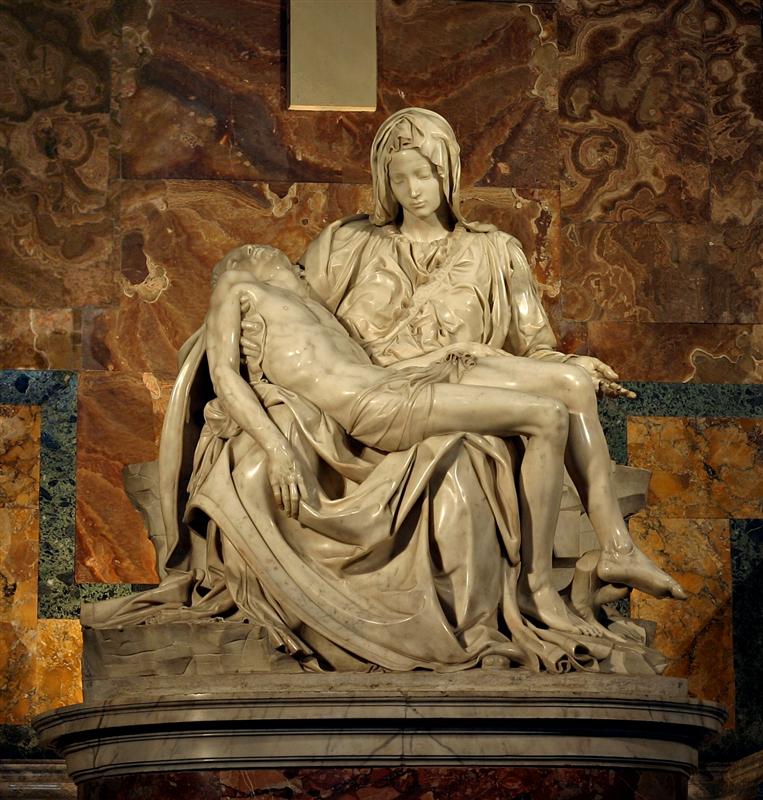
Being a person made in the image of God is the highest form of human “capacity.” We are capable of communion with God Himself! We are capable of creating, enabling our presence to be revealed even in our absence, as John Zizioulas demonstrates in his book The Meaning of Being Human by his analogy of the “absent artist.” By creating something himself, an artist’s presence is revealed in what he has created. We know from looking at the Pietà, for instance, there is such a person as Michelangelo who existed.
“In so far, therefore, as the human person is an entity whose being or particularity is realized by way of transcendence of its boundaries in an event of communion, its personhood reveals itself as presence.” ~ John Zizioulas
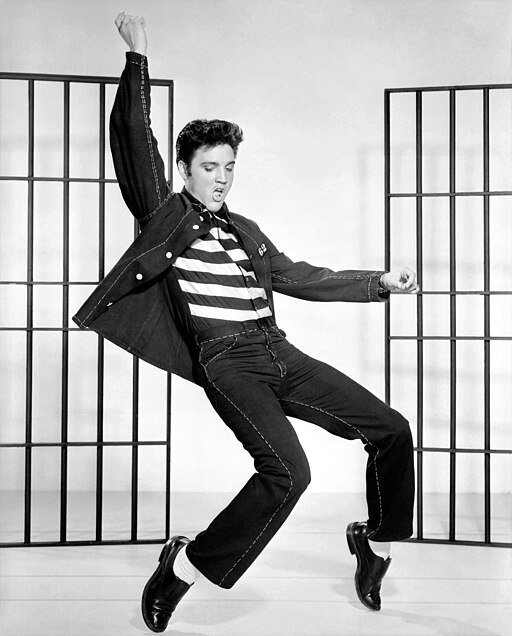
The one and only Elvis Presley
When AI produces something–for example an AI-generated Elvis Presley, singing new AI songs, generated by algorithm–it is not the true “presence in absence” of the human person known as Elvis; it is a perversion of truth and an assault on the dignity of his personhood, even in death.
In other words, human persons are capable of creating which enables the person’s presence to be revealed in absence. From the drawings of unknown artists on cave walls to Michelangelo’s Sistine Chapel, great symphonies, or even the songs of Elvis Presley, art testifies to a unique human person’s presence–their presence is revealed in what they have created. When someone manipulates the creation of another through AI, it is a misrepresentation of the person–a false face; a distortion of their unique personhood, a degradation of their humanity.
The Pietà by Michelangelo, 1499
The great paradox is that death through and in Jesus Christ becomes life! Or as St. Paul has written: “When I am weak, I am strong.” ( 2 Cor 12:10)
Our relationship with God is also one of “presence in absence,” writes Zizioulas. When sin entered the world as idolatry, freedom led to slavery, and communion with God was ruptured. Before that rupture caused by sin can be healed, we must first in His absence seek God’s Face, that is, His Divine Presence. It is only through Jesus Christ, and in communion with Him, that our lives have meaning, and that the image of God may be restored in our souls.
As a result of sin, mankind’s greatest incapacity came through death. But because Christ became man at the Incarnation, he became both the source and meaning of the human person, and his very death– which “signifies human incapacity par excellence,” per Zizioulas–paradoxically reverses that incapacity.
God has a face and a name: by His Incarnation, Jesus Christ gave us a human face that revealed the face of God. In our Baptism, we are united to Christ and find our identity by living in Christ, in love, which cannot be isolated from presence. Christianity is a loving relationship with Christ, who transforms us in himself. Through the incapacity of death Jesus restores “the communion of natures in and through his personhood, turns the created realm into a presence of God,” writes John Zizioulas, thus lifting all creation up to communion with God through man.
In communion with an immortal God — when we come before the face of Christ (in His Presence) — we are then capable of everything. “I can do all things in Christ.” (Phil. 4:13); the capacity of the human person is found only in the incapacity of our creature-hood in communion with Christ. This is especially true even in striving for holiness, as St. Bernard has written, “In our incapacity we can only appropriate holiness from Jesus himself, since only God is holy.”
The human person’s greatest freedom is in Christ, which destroys the slavery to sin; and it is surprisingly the freedom to choose to suffer with him. Zizioulas writes: “It is the capacity of man to fully embrace his incapacity, that is, to turn weakness into strength or rather to realize his power in weakness. This paradox is nothing other than what St. Paul means when he writes in 2 Cor 12:10– after mentioning his full acceptance of suffering: ‘for when I am weak, I am strong.'”
Zizioulas explains further that “human freedom in its true meaning, abolishes the scheme ‘capacity versus incapacity’ and replaces it with the paradox of ‘capacity in incapacity.'” In man’s fallen state, even the greatest sinner is still a person created in the image and likeness of God and thus deserving of the greatest respect, during their life and after their death. In communion with Christ, man has the freedom to suffer, and therefore, in Christ, it is possible to be transformed in love in Him. Embracing our weakness in the suffering of the Cross is the way to the Resurrection.
“The weak can manifest the Power of God. So when you yell and scream over all your faults and weaknesses and imperfections, you’re fighting against the very tool that God wants to make us holy.” ~ Mother Angelica
This understanding of the human person has tremendous consequences for the world, in relation to the use of AI, which can lead to God or away from God. Because “it is only in relationship with God that man has meaning.” Man has a capacity for faith, which is experienced as a painful absence which makes us long for God’s presence — the deep longing within our souls to see God’s Face. “Seeking the face of God,” writes Pope Benedict XVI, “is an attitude that embraces all of life; in order for man to see God’s face at last, he must himself be illuminated entirely by God.”
“Artificial intelligence” is actually a misnomer–even the name falls short of the truth. AI can only simulate intelligence. AI cannot create, therefore, it cannot communicate God’s love; it is a tool that can only generate data by imitation, manipulating or altering the creations of man. AI is incapable of relationship, even though some misguided lonely souls are deceived into believing it can. AI can never enter into communion with a human being, with God, or act as images of God, as a human person can.
Through the misuse of AI we run the risk of losing sight of what makes us distinctly unique as human persons. Only a person made in the image and likeness of God can have the intelligence to understand, contemplate, and grasp reality or be capable of insights, moral judgments, or an understanding of beauty, truth and goodness, or the freedom “to lay down one’s life for one’s friends (John 15:13).
In his own suffering, St. Dismas, the Good Thief, turns to the Face of Jesus on the Cross.
The act of human creation is only done in imitation of our Creator. The freedom of choosing to suffer for love in union with Jesus Christ, in imitation of Christ, is the greatest mystery of what Zizioulas calls “capacity in incapacity.” Through that union with Christ, God, in His infinite mercy, will grant grace to the smallest, most humble, weakest, the very least capable human person; even the worst sinner who turns toward His Face, in a relationship of love, as did the Good Thief on Calvary; so they may enter into the joy of eternal life with Him forever.
“Let Your Face shine, that we may be saved!” (Ps 80:3, 7, 19)
*Benedict XVI has characterized devotion to the Holy Face as having three separate components: 1. Discipleship – an encounter with Jesus, to see Jesus in the Face of those in need. 2. The Passion of Jesus, and suffering expressed by images of the wounded Face of Jesus. 3. The Eucharist, “the great school in which we learn to see the Face of God”, which is woven between the other two. The eschatological element then builds on awakening to Christ by contemplating His Face hidden in the Eucharist.
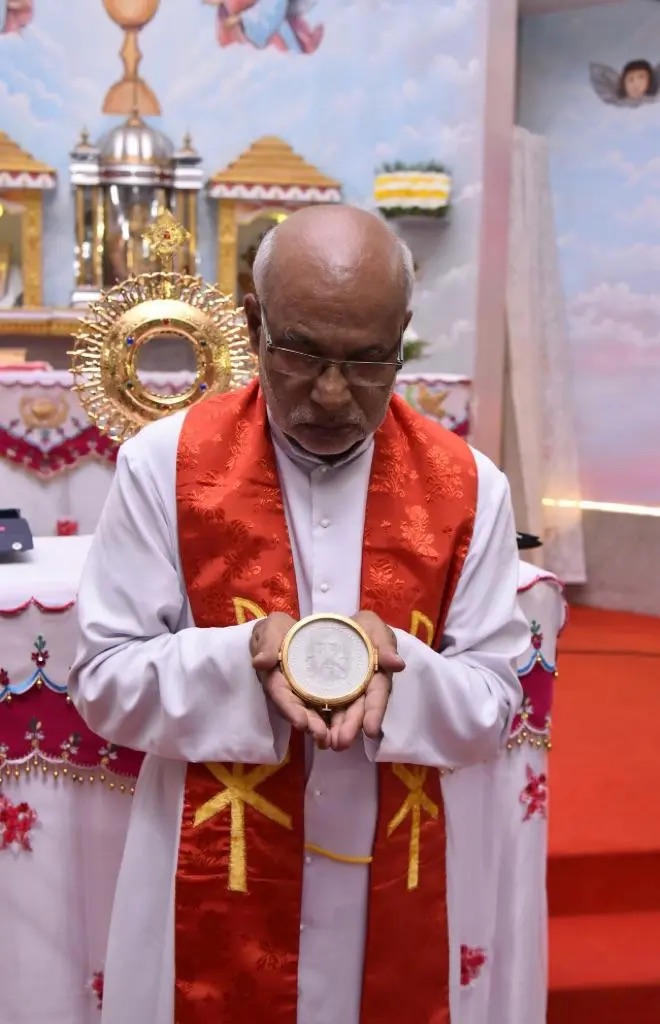
Vilakannur Miracle. The Priest carefully holds in his hands the Holy Eucharist on which the Face of Christ miraculously appeared during Mass.
“On November 15, 2013, a face resembling that of Jesus appeared on the host during Mass at the Christ the King Church, Vilakkannur, a parish under the Syro-Malabar Archdiocese of Tellicherry in the southern Indian state of Kerala.
The “Miracle” Host was sent to Rome for scientific study on January 10, 2020, through Apostolic Nuncio Archbishop Giambattista Diquattro who had come to the Syro-Malabar headquarters in Kochi, some 330 km south of Vilakkannur.
Devotion to the Holy Face of Jesus can be a helpful means to lead us to an encounter with Jesus in our life-long journey–enabling us to recognize Him–and He, to recognize us. This devotion is comprised of three elements–as characterized by Pope Benedict XVI: Discipleship, Images of the wounded Face of Christ , and the Eucharist.
Pope Benedict XVI writes, “The first element [of devotion to the Holy Face] is discipleship and the orientation of one’s life toward an encounter with Jesus in the face of those in need. In order to do this, believers first need to become better acquainted with Jesus through the Eucharist.
The second element is relating to the Passion of Jesus, and the suffering expressed by the images of the wounded Face of Jesus, relating this to the Eucharistic experience.
The third element, the Eucharist is woven between the other two. The eschatological element then builds on awakening to Christ by contemplating his face in the Eucharist.“
The Eucharistic Face of Jesus is central to the devotion of the Face of Christ! Clearly, the grace and strength flowing from worthy reception of the Sacrament of the Eucharist is vital to encountering Jesus in the faces of our brothers and sisters in need, as well as for the prayerful contemplation of Christ’s Face in images of His Passion. In Novo Millenio Ineunte, Pope St. John Paul II wrote, “And it is the Church’s task to reflect the light of Christ in every historical period, to make His face shine also before the generations of the new millennium. Our witness, however would be hopelessly inadequate if we ourselves have not first contemplated his face.”
Contemplation of the Face of Jesus is the veil of devotion, with which we may ‘wipe His bruised and wounded Face, ‘woven’ together with “discipleship, and the Eucharist,” which can lead Christians to “the love of God and love of neighbor” that will enable us to see Christ’s Face when He comes again in glory on the final day.
“The invisible Face of Christ,the son of God, is manifest in His Body an Blood in the simplest and, at the same time, the most exalted way possible in this world.
The ecclesial community responds to people in every age who ask perplexed: “We wish to see Jesus” (Jn 12,21), by repeating what the Lord did for the disciples of Emmaus: He broke the bread. In the breaking of the bread, the eyes of those who seek Him with a sincere heart are opened. In the Eucharist, the intuition of the heart recognizes Jesus and His unmistakable love lived “to the end” (Jn 13,1). And in Him, in that gesture, it recognizes the Face of God!“— Pope St. John Paul II






















 Illumina Domine Blog - Devotion to The Holy Face