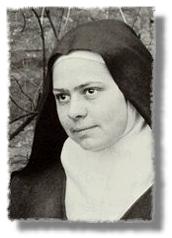
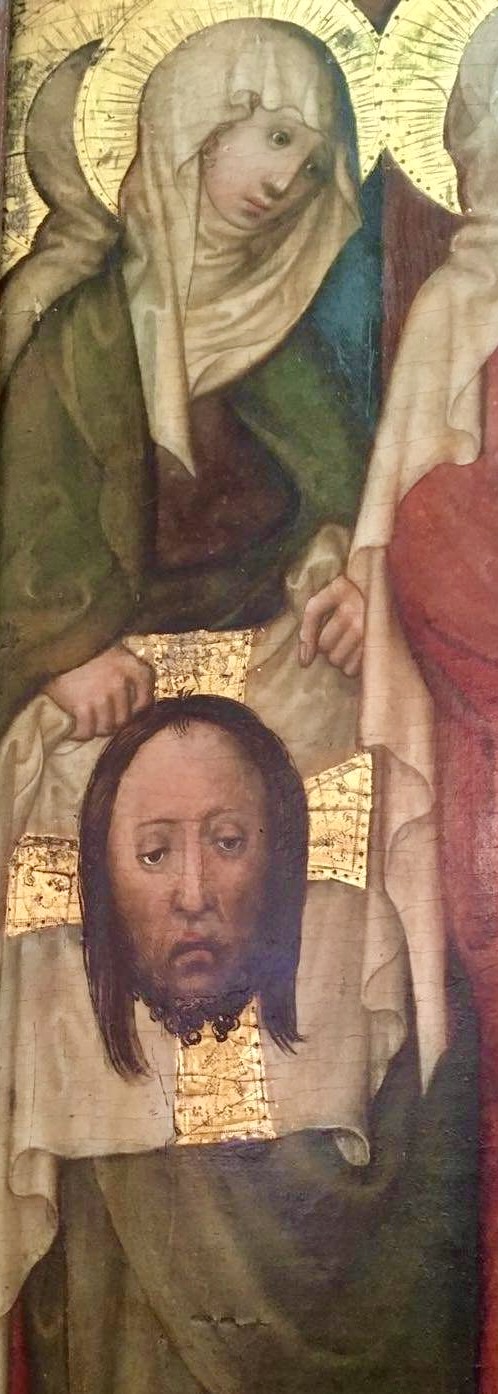
St. Therese of the Child Jesus and the Holy Face is more commonly known for her way of “Spiritual Childhood” and devotion to The Child Jesus, however, her sister, Mother Agnes gave this testimony for St. Therese’ beatification:
“Devotion to the Holy Face was the Servant of God’s special attraction. As tender as was her devotion to the Child Jesus, it cannot be compared to her devotion to the Holy Face.”
St. Therese’ sister Celine (Sr. Genevieve of the Holy Face), also wrote: “Devotion to the Holy Face was, for Therese, the crown and complement of her love for the Sacred Humanity of Our Lord. The Blessed Face was the mirror wherein she beheld the Heart and Soul of her Well-Beloved. Just as the picture of a loved one serves to bring the whole person before us, so in the Holy Face of Christ Therese beheld the entire Humanity of Jesus. We can say unequivocally that this devotion was the burning inspiration of the Saint’s life… Her devotion to the Holy Face transcended, or more accurately, embraced, all the other attractions of her spiritual life.”
St. Therese
Canticle to the Holy Face
Jesus, Your ineffable image Is the star which guides my steps. Ah, You know, Your sweet Face Is for me Heaven on earth. My love discovers the charms Of Your Face adorned with tears. I smile through my own tears When I contemplate Your sorrows.
Oh! To console You I want To live unknown on earth! Your beauty, which You know how to veil, Discloses for me all its mystery. I would like to fly away to You!
Your Face is my only homeland. It’s my Kingdom of love. It’s my cheerful meadow. Each day, my sweet sun. It’s the Lily of the Valley Whose mysterious perfume Consoles my exiled soul, Making it taste the peace of Heaven.
It’s my Rest, my Sweetness And my melodious Lyre Your Face, O my Sweet Savior, Is the Divine Bouquet of Myrrh I want to keep on my heart!
Your Face is my only wealth. I ask for nothing more. Hiding myself in it unceasingly, I will resemble You, Jesus Leave in me, the Divine Impress Of Your features filled with sweetness, And soon I’ll become holy. I shall draw hearts to You.
So that I may gather A beautiful golden harvest, Deign to set me aflame with Your Fire. With Your adorned mouth, Give me soon the Eternal Kiss!
~ St. Therese of the Holy Face and the Child Jesus
Detail of Holy Face from painting by St. Therese
“Look at His adorable Face, His glazed and sunken eyes, His wounds. Look Jesus in the Face. There you will see how He loves us.”
St. Therese reliquary carried in procession in front of the Basilica Sanctuary of the Holy Face of Manoppello. (Photo: Paul Badde)
St. Therese reliquary covered with rose petals. Shrine of the Holy Face of Manoppello. (Photo: Paul Badde)
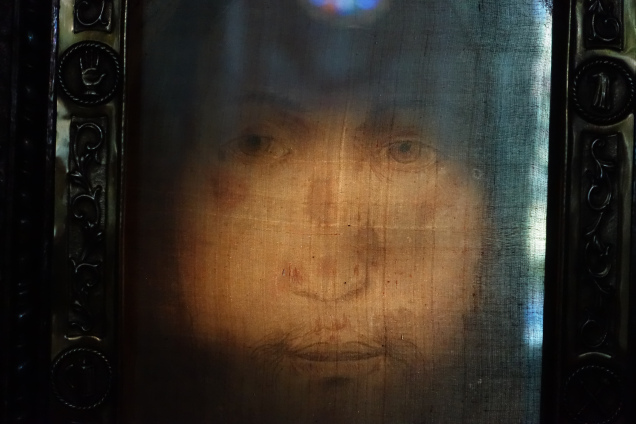
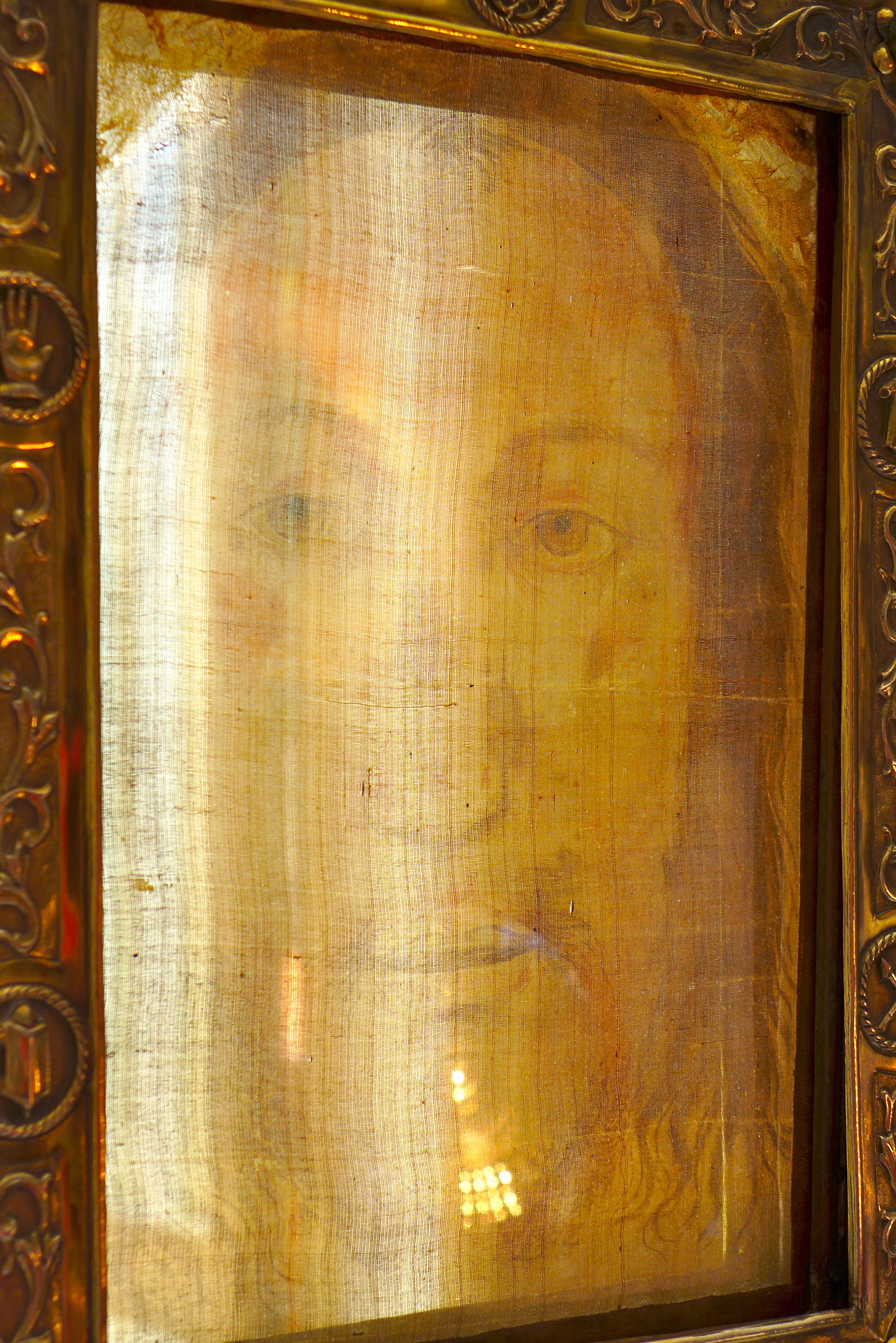
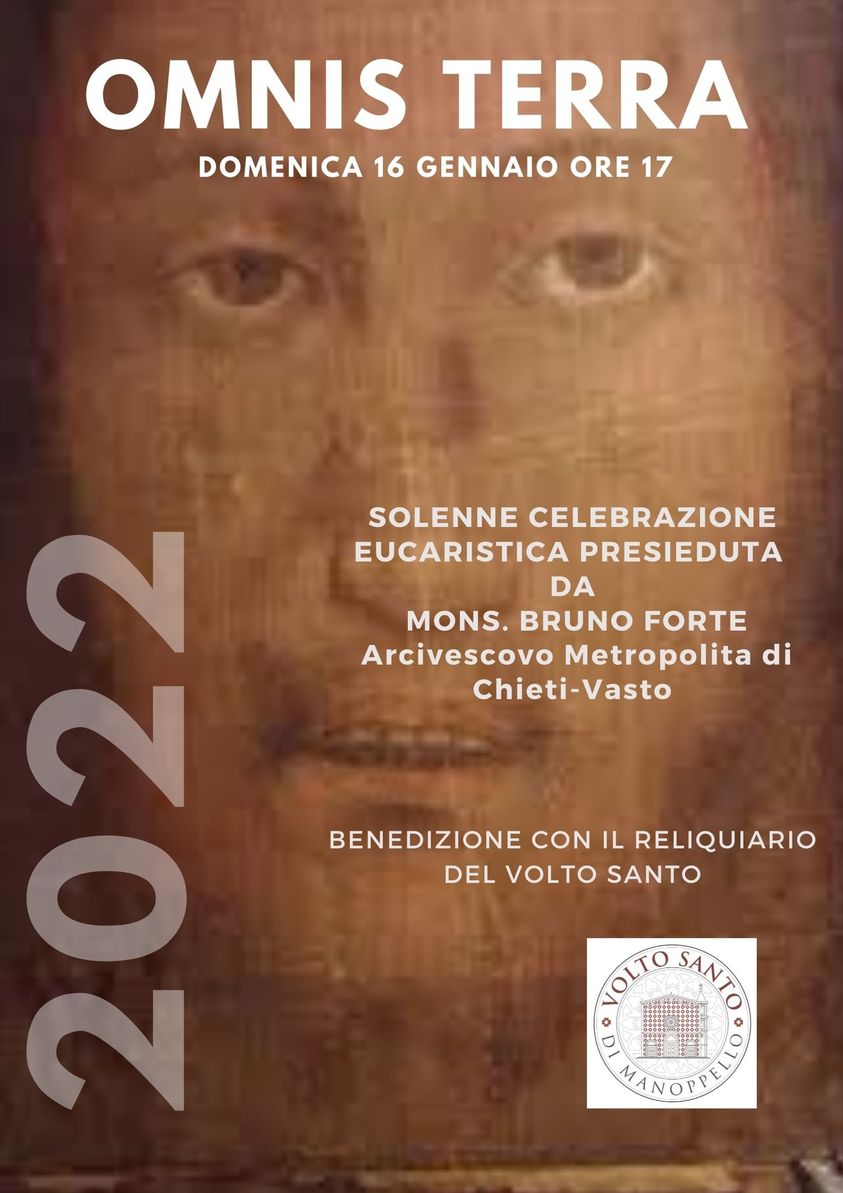
On November 4, 2006, the relics of St. Therese travelled to the Basilica Shrine of the “Il Volto Santo,” the Holy Face of Manoppello, Italy. Below is a beautiful, poem/meditation on the Holy Face by St. Therese together with images of that miraculous image on the Veil of Manoppello:
Holy Face Veil of Manoppello, Italy (Photo: Paul Badde/EWTN)
“O Adorable Face of Jesus! Our souls understand Your language of love; we want to dry Your gentle Face and to console You for the forgetfulness of the wicked. In their eyes You are still as one hidden; they look upon You as an object of contempt…
O Face more beautiful than the lilies and roses of springtime! You are not hidden from our eyes…The Tears that veil Your divine look seem to us like precious Diamonds which we want to collect to buy the souls of our brothers and sisters with their infinite value.
Veil of Manopello, Photo: Paul Badde/EWTN
From Your Adorable Mouth we have heard Your loving complaint. Since we know that the thirst which consumes You is a thirst for Love, we would wish to have an infinite Love to quench Your thirst…Beloved Bridegroom of our souls, if we had the love of all hearts, all that love would be for You! Then, heedless of our exile on the banks of Babylon, we will sing for your Ears the sweetest melodies. Since You are the true, the only Homeland of our hearts, we will not sing our songs in an alien land.
Eyes of Manoppello, photo: Paul Badde/EWTN
“The Living Face” of The Veil of Manoppello Photo: Paul Badde/EWTN
O Beloved Face of Jesus! As we await the everlasting day when we will contemplate Your infinite Glory, our one desire is to charm Your Divine Eyes by hiding our faces too so that here on earth no one can recognize us…O Jesus! Your Veiled Gaze is our Heaven!” –St. Therese of the Holy Face and the Child Jesus
+++
Hurricane Ida hits Discalced Carmelite Nuns in Louisiana
The Discalced Carmelite Nuns of Covington, Louisiana will not have the annual “Mass of the Roses” in honor of St. Therese this year. Last year, the special Mass was cancelled due to Covid; this year our nuns suffered damage to their monastery and property, from wind and fallen trees during Hurricane Ida. (Photos of the damage may be seen here.) Since it was their only fundraiser, it is hoped that generous souls might be moved to send a donation. Please pray for these dear Nuns who pray for us all! If you would like to contribute, donations may be mailed to:
The Discalced Carmelite Nuns, 73530 River Rd, Covington, LA, USA 70435
Some of the Discalced Carmelite Nuns, and friends at a past Mass of the Roses in honor of St. Therese
May God reward you for your generosity!
“Let the little children come to me.” Photo: Patricia Enk
“O Jesus, whose adorable Face ravishes my heart, I implore Thee to fix deep within me Thy divine image and to set me on fire with Thy Love, that I may be found worthy to come to the contemplation of Thy glorious Face in Heaven.”
“Then war broke out in heaven; Michael and his angels battled against the dragon. Although the dragon and his angels fought back, they were overpowered and lost their place in heaven. The huge dragon, the ancient serpent known as the devil or Satan, the seducer of the whole world, was driven out; he was hurled down to earth and his minions with him” (Rev. 12)
“Who is like God!” St. Michael, sculpture by Cody Swanson, Old St. Patrick’s New Orleans (photo: Patricia Enk)
The center of this battle raging between Angels and demons — heaven and earth — is the Incarnate Word of God made flesh, Jesus Christ. It is Jesus who is rejected, reviled and persecuted. The devil wants to obliterate the Face of God, not only in churches that have vandalized and desecrated, but in the souls of human beings. The battle lines have been drawn between the culture of life and the culture of death. The devil’s particular object of hatred is the woman and the unborn. Some can no longer recognize that a child in the womb is a human being. Many persons reject their God-given identity as male and female. Racial hatred is causing deeper and deeper division, and human trafficking increases as humanity is blinded to the Face of God in their neighbor made in His image and likeness.
“When the dragon saw that it had been thrown down to earth, it pursued the woman who had given birth to a male child.” (Rev. 12:13)
Then I heard a loud voice in heaven say: “Now have salvation and power come, the reign of our God and the authority of his Anointed One. For the accuser of our brothers is cast out, who night and day accused then before our God. They defeated him by the blood of the Lamb and by the word of their testimony; love for life did not deter them from death. So rejoice, you heavens, and you the dwell therein! But woe to you, earth and sea, for the devil has come down upon you! His fury knows no limits, for he knows his time is short” (Rev 12). This battle has been fought since the beginning of Creation; between Christ’s Angels and the fallen angels or demons, with humanity at the center of the struggle. St. Michael and the Holy Angels have been given the authority from God by the power of His Holy Name to protect and defend God’s people against both human and diabolical enemies.
Devotion to the Face of Jesus is meant to repair mankind’s broken relationship with God, manifested in the world by the evil of blasphemy, sacrilege, and indifference. This work of reparation honoring His Holy Face and His Name–which is the concrete sign of God’s existence and our relationship with Him–has been given the protection and help of the Holy Angels. Sr. Marie St. Pierre was a French Discalced Carmelite nun to whom Our Lord gave revelations of the devotion to His Holy Face. She wrote on November 18, 1843:
“One day during prayer, our Lord warned me in advance about the fury of Satan against the holy devotion, but He also consoled me, saying: ‘I give you My Name to be your light in the darkness and your strength in battle. Satan will do all in his power to crush this Work at its roots. But I assure you that the Holy Name of God will triumph, and it will be the Holy Angels who will gain the victory in the conflict.”
The victory will be won with devotion to the Holy Face
Prayer to Our Lady of the Angels, who in her humility, crushed the head of Satan: Sublime Queen of Heaven, exalted Lady of the Angels, you have the power and commission given by God to crush the head of Satan. Therefore, we humbly beseech you to send to our aid your heavenly legions, so that, under your command and by your power, they may pursue the hellish spirits, fight them everywhere, ward off their impudent attacks, and fling them back into the abyss. Who is like God? You holy angels and archangels, defend and protect us. Good, kind mother, you remain always our love and our hope! Mother of God, send us the holy angels to defend us and keep the evil one far from us. Amen.
Servant of God Padre Domenico da Cese (1915-1978) before the Veil of Manoppello
September 20th marked the anniversary of the death of the Holy Capuchin priest of Manoppello–the Servant of God, Padre Domenico da Cese. He was born on March 27, 1905, and was baptized Emidio Petracca, named for St. Emidio (c.279-309 AD), the saint who is invoked for protection in earthquakes. As a nine-year old boy in 1915, young Emidio (later Padre Domenico) predicted the devastating Avenzzano earthquake in Italy. A 6.7 earthquake hit that region the next morning, killing more than 30,000 people, including two of his sisters. He and his father were buried in the rubble of their church as they attended Mass that morning.
A man with a bloody face, who young Emidio Petracca didn’t recognize as a relative or friend, pulled him from the rubble to safety. Fifty years later, as a Capuchin priest, while visiting the Shrine of the Holy Face in Manoppello for the first time, he recognized the face of the man on the miraculous veil as the same man who saved him from the rubble. As Padre Domenico knelt before the holy relic “Il Volto Santo,” he exclaimed, “This is the man who saved me from the rubble!” He asked to be transferred to the shrine and remained at the Shrine as Rector until the time of his death.
Like his friend and fellow Capuchin, St. Padre Pio, the humble Padre Domenico was also a mystic and stigmatist who had extraordinary gifts of the Holy Spirit; such as the gift of “reading souls” and bi-location. Penitents who traveled from Manoppello to go to confession with Padre Pio were admonished by him for traveling such a distance when they already had a holy priest in Manoppello. He told them, ” Why did you come all the way here, so far? You’ve got a priest there, my spiritual son, he’s like me!” St. Padre Pio’s last documented case of bi-location, just before he died, was before the relic of the Holy Face of Jesus at the shrine of “Il Volto Santo” in Manoppello, where Padre Domenico was the rector. Padre Pio had told his fellow Capuchins that the Holy Face of Manoppello was “the greatest relic of the Church.”
In September of 1968, as Padre Pio lay dying in San Giovanni Rotundo (which is about 200 km south of Manoppello in Italy), his friend Padre Domenico da Cese had just unlocked the doors of the shrine of the Holy Face one morning, and was astounded to find Padre Pio in prayer, in the choir behind the altar before the sacred image of the Face of Jesus. St. Padre Pio spoke then to Padre Domenico saying, “I do not trust myself any more. I am coming to an end. Pray for me. Good-bye until we meet in Paradise.” Twenty-four hours later St. Padre Pio died in his cell in San Giovanni on September 23, 1968. Testimony was later given by witnesses that Padre Domenico da Cese was seen at Padre Pio’s funeral (another case of bi-location). A film was even taken (here) which shows Padre Domenico walking slowly in Padre Pio’s funeral procession, even though Padre Domenico had never left the shrine in Manoppello.
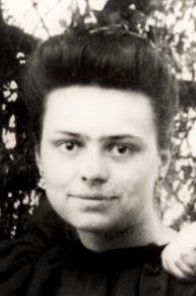
Padre Domenico shared with everyone his ardent love and devotion for the Holy Face of Manoppello, also known as “Il Volto Santo” — a miraculous veil which transmits supernatural beauty, and at the same time indescribable suffering. It is the Face of Mercy, Love and Peace. He would tell pilgrims, “This face is that of Jesus, and it is a great miracle, always love him.” Padre Domenico had done much research on the sheer byssus veil, the image of which is not made with any paint or pigment, and compared the iridescent quality of the colors to the wings of butterflies which also reflect iridescent color naturally. He also made studies of the Face on the Shroud of Turin, and its similarities to the Holy Face of Manoppello. He believed with all his heart that it was the face of the same man, and he was convinced that, like the Shroud of Turin, the Veil of Manoppello was one of the many burial cloths in Jesus’s tomb–the holy sudarium which covered the Face of Jesus in death–and also miraculously bears witness to His Resurrection.
In September of 1978 while visiting Turin to venerate the Holy Face on the Shroud during a rare exposition, Padre Domenico, who was a giant of a man, was hit by the smallest car, a Fiat, as he was stepping out into a street. After suffering for several days in a hospital, and forgiving the man who had hit him, he died on September 17th, offering his life for the Holy Face on the Veil–the Face of the man who saved him as a child.
The penetrating and gentle gaze of the Holy Face of Manoppello, Italy Photo: Paul Badde/EWTN
“I never cease to implore blessings for you from Jesus, and to beg the Lord to transform you totally in Him. How beautiful His Face, how sweet His eyes and what a good thing it is to stay close to Him…”
–St. Pio
St. Padre Pio gazes at the Eucharistic Face of Christ
St. Padre Pio, a Friar Minor Capuchin priest and mystic, was well-known for his many spiritual gifts such as the stigmata, bi-location, and for his ability to read the hearts of penitents who came to him in confession. During his life St. Padre Pio suffered as Our Lord did, not only through physical pain, but by humiliations, calumny, slander and mistrust that deeply wounded his heart, in this he shared in the suffering of the Face of Christ.
He wrote in his meditations on The Agony of Jesus of the Face of Jesus, the “Innocent Lamb,” “His Face covered with sadness and at the same time with love:”
“He [Jesus] seems to be at the extremity of suffering… He is prostrate with His Face to the ground before the majesty of His Father. The Sacred Face of Him Who enjoys through the hypostatic union the beatific vision of the Divine Glory accorded to both Angels and Saints in Heaven, lies disfigured on the ground. My God! My Jesus! Art Thou not the God of Heaven and earth, equal in all things to Thy Father, Who humiliates Thee to the point of losing even the semblance of man? …It is to repair and expiate for my haughtiness, that Thou bowest down thus before Thy Father.”
Pope Benedict XVI contemplates the Veil of the Holy Face in Manoppello, 2006. Photo:Paul Badde/EWTN
At the Last Supper Jesus offers His deeply moving prayer to the Father for his disciples, the priests, which begins, “Father the hour has come…” (John 17) Jesus prays that the Father glorify Him and that He may be glorified in them (his priests) and that He keep them in His name that “they may become one as we are.” Jesus prays too, “for those who will believe in me through their word.” “A priest is not a priest for himself,” St. John Vianney said, “he does not give himself absolution; he does not administer the Sacraments for himself. He is not for himself, he is for you.”
These men, like the first apostles, are fully human and share in the weakened condition of all of mankind since the fall of Adam. Yet they are called by God for the sanctification of God’s people. St. Paul writes: “Every high priest is taken from among men and made their representative before God, to offer gifts and sacrifices for sins. He is able to deal patiently with the ignorant and erring, for he himself is beset by weakness and so, for this reason, must make sin offerings for himself as well as for the people. No one takes this honor upon himself but only when called by God, just as Aaron was. In the same way, it was not Christ who glorified himself in becoming high priest, but rather the one who said to him: “You are my son; this day I have begotten you;” just as he says in another place: “You are a priest forever according to the order of Melchizedek.” In the days when he was in the flesh, he offered prayers and supplications with loud cries and tears to the one who was able to save him from death, and he was heard because of his reverence. Son though he was, he learned obedience from what he suffered; and when he was made perfect, he became the source of eternal salvation for all who obey him, declared by God high priest according to the order of Melchizedek. (Heb. 5:1-10)
The faithful are entrusted to the priest’s care, who as a Good Shepherd, walks with them on the path which leads to Christ. Through the gifts of the Holy Spirit, the priest brings the people to a true knowledge of the Father and the Son and “To the contemplation of the living and pulsating reality of the Trinity ‘faciem ad faciem’ (face to face).” (St. Pope John Paul II) “The Holy Spirit,” says St. Irenaeus, “the stairway of our ascent to God, draws the priest to the Father, stirring in his heart a burning desire to see God’s Face…the Paraclete illumines the priest about his own Person, that the priest may come to see the Spirit in his own heart and history.”
Priest elevating Eucharist on paten viewed through the Veil of the Holy Face of Manoppello. Photo: Paul Badde
Whenever a priest administers the sacraments, says St. Pope John Paul II, “the priest lends Christ his own face and voice:” “Do this in memory of Me.” (Luke 22:19) “Priests are called to show forth the Face of the Good Shepherd and therefore to have the Heart of Christ Himself.” (St. Pope John Paul II) Therefore, let us pray for all priests and bishops, that the Holy Spirit will strengthen them in all their gifts. St. Teresa of Avila once said, “When you see a priest you should say, ‘There is he who made me a child of God, and opened Heaven to me by Holy Baptism; he who purified me after I had sinned; who gives nourishment to my soul.’” St. Therese told her sister, Celine, “Let us live for souls, let us be apostles, let us save above all the souls of priests… let us pray and suffer for them and on the last day Jesus will be grateful!” [St. Therese of Lisieux, Letter 94] The Priest is the Face of Christ to us!
Prayers for Priests”Eternal Father, we offer Thee, with the hands of Mary, the Holy Face of Jesus, Thy Son, and the entire generous holocaust of all that we are, in reparation for so many sins that are committed, and, especially, for offenses against the Most Holy Sacrament of the Altar. We make this offering, in a particular way, so that Priests, by the holiness of their lives, may show the world the adorable features of the Divine Countenance shining with the light of truth and love, for the triumph of the Church, and for the spread of the Kingdom.” Bl. Mother Maria Pierina De Micheli
To learn more about his incredible life and passionate love for the Holy Face you can watch this wonderful video of his life, “The Long Road of Fr. Domenico, from Cese to Turin” by clicking here.
Servant of God, Padre Domenico da Cese… Pray for us!
Mary Magdalene embracing the Face of Jesus in Boticelli’s Deposition
Mary’s Veil of Faith
+ O Jesus, hidden God, my heart perceives You, though veils hide You, You know that I love You. ~Prayer of St. Faustina Kowalska
The strongest hurricane to hit Louisiana since the 1800’s descended on us on August 29th. Hurricane Ida brought 150 mph winds gusts, tornadoes, and where I live, 5 feet of water. We are so grateful to God that we were spared the loss of life, and have a big family who can help with the arduous task of cleaning up the trees, mud and mess that Ida left behind. As in all times of trial, our family turns to the Blessed Mother for help, inspiration, and endless source of grace — she is most importantly, the model of our faith. With that in mind, I am reposting here “Mary’s Veil of Faith,” with grateful thanks to our dear Blessed Mother for keeping us safe beneath her mantle, and for those who have prayed for us:
The word “veil” can have many meanings. A veil can cover the face, the head, or an object; it can cover, conceal, or separate. In ancient Jewish tradition a veil in the Holy of Holies in the Temple separated sinful man from the presence of God dwelling in the midst of His People. The holiness of God was not to be taken lightly. The blinding light of the purity and glory of the Face of God could not be looked upon by sinful eyes.
But when God chose Mary to be the Mother of His Son He created her to be all-pure and sinless from the moment of her conception through the merits of her Son, Jesus. In Matthew 5:8 we read, “Blessed are the pure of heart, for they shall see God.” What was to prevent Mary, the Immaculate Conception, who was free from all sin, from seeing the Face of God in all His glory even while she was still here on earth? The answer is, in a word, a veil.
The Virgin of the Grapes by Pierre Mignard
When the Word of God became flesh in the womb of the Blessed Virgin Mary, at the Incarnation, Mary became His Tabernacle. Jesus’ human flesh was His veil: “by the new and living way he opened for us through the veil, that is His flesh” (Heb. 10:20). The Angel Gabriel told Mary that she would be the mother of the Son of God. But Mary, though “full of grace” and all-pure, would only gaze upon the human face of her child and upon the Face of her God through the veil of faith.
Elizabeth bore witness to Mary’s faith when “filled with the Holy Spirit” she greeted Mary with a loud cry: “Blessed are you among women, and blessed is the fruit of your womb! And why is this granted me, that the mother of my Lord should come to me?…“Blessed is she who believed that there would be a fulfillment of what was spoken to her from the Lord” (Lk. 1:45). As Pope St. John Paul II wrote in Redemptoris Mater, “Mary entrusted herself to God completely, with the full submission of intellect and will…this response of faith included both perfect cooperation with ‘the grace of God that precedes and assists’ and perfect openness to the action of the Holy Spirit, who constantly brings faith to completion by His gifts.”
The Man of Sorrows in the arms of the Virgin Mary, by Hans Memling
In a truly heroic manner, in poverty and suffering, on her whole pilgrimage or journey towards God, Mary believed, in faith, though everything happening around her seemed to contradict God’s words to her: That “the Lord will give to him the throne of his father David.” And that “He will reign over the house of Jacob forever and of His kingdom there will be no end.” Mary believed these invisible truths about her Son, even as Jesus, suffered and died, hanging on the Cross. What was visible on an earthly level did not reflect the heavenly reality. Mary did not necessarily see her Son radiant in glory or angels ministering to Him in His Passion. At the foot of the Cross she saw His bruised and bloodied suffering Face.
Our Lady of Sorrows
Pope St. John Paul II tells us in Redemptoris Mater that “faith is contact with the mystery of God. Every day Mary is in constant contact with the ineffable mystery of God made-man, a mystery that surpasses everything revealed in the Old Covenant… Mary is in contact with the truth about her Son only in faith and through faith!” Though all-pure, she could not see, except through faith. “Blessed is she who believed” is a key, he says, which unlocks for us the innermost reality of Mary. Mary’s all-pure eyes looked on the glory of her Son through a veil of faith, “a dark night,” to use the words of St. John of the Cross, that feeling of darkness or emptiness when a soul draws near to the brightness and glory of God. Pope St. John Paul II writes in Redemptoris Mater that Mary’s faith is: “a kind of a veil though which one has to draw near to the Invisible One and to live in intimacy with the mystery.”
Joan Mates, Mourning over the body of Christ
The stone rolled in front of tomb is also a sort of veil — seemingly impervious, unmovable, like the hardened hearts of souls closed off from God — yet hiding Our Crucified Lord within. When Mary stood in bitter desolation before the massive stone of the tomb, she knew that Jesus was dead. Still, her heart was full of hope. She heroically believed that her Son would rise again in glory. Mary’s faith was so strong that her heart believed what her eyes could not perceive. We too must believe, although Jesus may be silent and hidden completely from our eyes. If we had a little of Mary’s faith, through her intercession, even the heaviest stone could be rolled away by Our Lord, as though it were the lightest veil. Then, the hardest of hearts could be changed, and her glorious Son would be revealed.
In this earthly pilgrimage of faith a veil lies over our hearts, as St. Paul writes: “To this day, in fact…a veil lies over their hearts, but whenever a person turns to the Lord the veil is removed… All of us, with unveiled face gazing on the glory of the Lord, are being transformed into the same image from glory to glory, as from the Lord who is the Spirit.” (2 Cor. 4:15-16, 18) As members of the Church, we can “look at” Jesus through Mary’s eyes of faith, in the Eucharist, in our neighbor; believing in His Word and following her example in our pilgrimage towards the Father until that time when the “veil” of faith will be finally lifted.
Mary adored Jesus beneath the Eucharistic Veil of the appearance of bread. The Virgin of the Host, by Jean-Auguste-Dominique Ingres
“Blessed is she who believed!”
“Faith is the realization of what is hoped for and evidence of things not seen.” (Heb. 11:1)
+++
The byssus Veil of Manoppello, which is thought to be one of the burial cloths of Jesus, photo: Paul Badde/EWTN
Prayer to the Holy Face for the liberation from the coronavirus
Lord Jesus, Savior of the world, hope that will never disappoint us, have mercy on us and deliver us from all evil! Please overcome the scourge of this virus which is spreading, heal the sick, preserve the healthy, support those who work for the health of all. Show us your face of mercy and save us in your great love. We ask you through the intercession of Mary, Your Mother and ours, who faithfully accompanies us. You who live and reign forever and ever. Amen.
“Dominus Illuminatio Mea” – “the Lord is my light” are the first words of Psalm 27…
“The LORD is my light and my salvation; whom shall I fear?
The LORD is the stronghold of my life; of whom shall I be afraid?“
Is the darkened state of the world wearing you down? You are not alone – the whole of humanity seems to be in the same miserable boat – fearing enemies around every corner. Jesus reminds us that “Fear is useless, what is needed is trust.” (Luke 8:50)
Pope St. John Paul II, “the light of Poland,” certainly lived through some very dark times, yet he never lost his faith, his hope, or his joy. He found profound inspiration, and comfort, in Psalm 27. From the time of King David, the psalms have been a source of comfort to souls living through the darkness of trials down through the centuries. The very meaning of the word “comfort” is “with strength.” It is the strength that comes from trusting in God, knowing that in spite of the odds, God will bring about our rescue.
“When evildoers come at me to devour my flesh,
These my enemies and foes themselves stumble and fall.
Though an army encamp against me, my heart does not fear;
Though war be waged against me, even then do I trust.”
Divine Mercy
We may “visit Him in His temple.” But, our bodies are also a temple; a temple of the Holy Spirit. We may seek God’s Face within the temple of our souls, “with shouts of joy, songs and praise,” in faith, hope, and trust. Jesus, I trust in You!
“One thing I ask of the LORD; this I seek:
To dwell in the LORD’s house all the days of my life,
To gaze on the LORD’s beauty, to visit his temple.
For God will hide me in his shelter in time of trouble,
Will conceal me in the cover of His tent;
and set me high upon a rock.
Even now my head is held high above my enemies on every side!
I will offer in his tent sacrifices with shouts of joy;
I will sing and chant praise to the LORD.“
“Illumina Domine Vultum Tuam Super Nos — Mane Nobiscum, Domine!” “Lord, let the light of Your Face shine upon us — Remain with us, Lord!”
As Bl. Carlo Acutis once said, “Sadness is looking at oneself, happiness is looking at God. Conversion is nothing but a movement of the eyes.” To seek God’s Face is to be in His life-giving presence. He will hear His children when they call. He does not abandon them to their enemies. His gaze is always upon us; we need only to turn the gaze of our hearts toward Him. He will not reject us, because He is love and mercy itself! He will guide us, defend us, save us…if only we “believe, take courage,” are “stouthearted,” and “wait”…for Him!
The Holy Face of Jesus, a miracle “written in light” on the Veil of Manoppello. (Photo: Paul Badde/EWTN)
“Hear my voice, LORD, when I call;
have mercy on me and answer me.
‘Come,’ says my heart, ‘Seek God’s face’;
your face, LORD, do I seek!
Do not hide your face from me;
do not repel your servant in anger.
You are my help; do not cast me off;
do not forsake me, God my savior!
Even if my father and mother forsake me,
the LORD will take me in.”
“LORD, show me your way;
lead me on a level path because of my enemies;
Do not abandon me to the will of my foes;
malicious and lying witnesses have risen against me.
But I believe I shall enjoy the LORD’s goodness
in the land of the living.
Wait for the LORD, take courage;
be stouthearted, wait for the LORD!“
–Psalm 27
St. Pope John Paul II
“In the Eucharist, the Face of Christ is turned towards us.”
“Your life must be woven around the Eucharist. Direct your eyes to Him, who is the Light; bring your hearts very close to His Divine Heart; Ask Him for the grace to know Him, for the charity to love Him, for the Courage to serve Him. Seek Him longingly.”
— St. Teresa of Calcutta
“It is the Church’s task to reflect the light of Christ in every historical period, to make His Face shine also before the generations of the new millennium. Our witness, however, would be hopelessly inadequate if we ourselves had not first contemplated His Face.”
“Now this is the message that we have heard from Him and proclaim to you; God is light, and in Him there is no darkness at all.”
(John 1:5)
The Holy Veil of Manoppello, a miracle of light. Photo: Paul Badde/EWTN
In 2012 I first made a pilgrimage to the Basilica Shrine of the Holy Face in Manoppello, Italy, to see for myself the ancient, mysterious relic that is the veil of the Holy Face. I took no pictures at that time as it was my sole intention to pray, and not be distracted by snapping photos. At the time, it was a sacrifice. But God blessed the small sacrifice with an unforgettable experience of prayer. Fortunately for me, and by God’s Providence, Paul Badde, who is an art historian, journalist, and champion of the Holy Face, had taken thousands upon thousands of amazing photos which he has generously permitted me to share over the years. I come back to them again and again to ponder this mysterious miracle of light which causes the Face of Jesus Christ to appear on the gossamer-thin transparent veil. Why has Our Lord chosen to show Himself by means of light?
As St. John wrote: “God is light,” and so it is fitting that God, who has revealed to us His human face in Jesus Christ, has left us this precious gift of a true icon of His Holy Face written in light – the Holy Veil of Manoppello. God knows our human weaknesses; the need to see and touch. He gives us lights to illumine our minds and hearts: the light of reason, of grace, and in heaven He will illumine our souls completely by the light of glory – the Beatific Vision – when we will see Him face to face. All these lights are the same Divine Light emanating from the Face of God. God has made us in His image and likeness, we have a capacity to know and love Him. We are made to resemble Him by knowing and loving Him, to participate in the Divine Light that shines into our souls when we turn to His Face, and to reflect that light to others.
“But we all, with unveiled face, beholding as in a mirror the glory of the Lord, are being transformed into the same image from glory to glory, just as by the Spirit of the Lord.”
2 Cor. 3:18
Face becomes visible on the Holy Veil of Manoppello.
Photo: Paul Badde/EWTN
To “behold His Face as in a mirror…” This is how I saw the Holy Veil of Manoppello as I knelt before it prayer. In that miraculous mirror the Face of Jesus turned toward me. When you love someone you want to see them more and more, but like Peter, James, and John on the mountain of the Transfiguration, we must descend the mountain and obey Jesus’s command to “Follow me” to the Cross. Though we are following, we can remain “turned to His Face,” where God perfects us by His Divine Gaze. We do this by prayer, reading the Scriptures, by living the Beatitudes, which is Jesus’s “self-portrait.” We remain under His gaze as we contemplate His Face in the Eucharist, in His images, especially as they relate to His Passion, or as we encounter Jesus in the poor, sick, and needy — in Jesus’s words, “Love God, and love our neighbor.” And here is the heart of this devotion to the Holy Face; it is charity. God has created us with a deep longing to see Him, and charity, is the means He has given us. This is what the light shimmering on the Holy Veil of the Face of Jesus says to me — Love is the light by which you will see God’s Face.
Below is a video taken by Agatha and Angelo Rytz of the Transfiguaration celebration in Manoppello, including the Solemn Mass, procession and fireworks:
There he came to a cave, where he took shelter. Then the Lord said: “Go outside and stand on the mountain before the Lord; the Lord willl be passing by.” A strong and heavy wind was rending the mountains and crushing rocks before the Lord–but the Lord was not in the wind. After the wind there was an earthquake–but the Lord was not in the earthquake. After the earthquake there was fire–but the Lord was not in the fire. After the fire there was a tiny whispering sound. When he heard this, Elijah hid his face in his cloak and went and stood at the entrance of the cave. A voice said to him, “Elijah, why are you here?” He replied, “I have been most jealous for the Lord, the God of Hosts.” (1 Kings 19)
Fixing our eyes on God
Pope St. Gregory explains why Elijah is described as standing at the mouth of the cave (“where we direct our mental gaze, there we may be said to stand.”) and veiling his face when he heard the voice of the Lord speaking to him: “…as soon as the voice of heavenly understanding enters the mind through the grace of contemplation, the whole man is no longer within the cave, for his soul is no longer taken up with matters of the flesh: intent on leaving the bounds of mortality, he stands at the cave’s mouth.”
Humility and Detachment – the keys to contemplation
“But if a man stands at the mouth of the cave and hears the word of God with his heart’s ear, he must veil his face. For when heavenly grace leads us to the understanding of higher things, the rarer the heights to which we are raised, the more we should abase ourselves in our own estimation by humility: we must not try to know ‘more than is fitting; we must know as it befits us to know.’ Otherwise, through over-familiarity with the invisible, we wish going astray; and we might perhaps look for material light in what is immaterial. For to cover the face while listening with the ear means hearing with our mind the voice of Him who is within us, yet averting the eyes of the heart from every bodily appearance. If we do this, there will be no risk of our spirit interpreting as something corporeal that which is everywhere in its entirety and everywhere uncircumscribed…while our feet stand within the walls of His holy Church, let us keep our eyes turned toward the door; let us mentally turn our backs on the corruption of this temporal life; let us keep our hearts facing toward the freedom of our heavenly fatherland.”
Almighty, ever-living God, your prophet Elijah, our Father, lived always in your presence and was jealous for the honor due to your name. May we, your servants, always seek your Face and bear witness to your love. We ask this through our Lord, Jesus Christ. Amen.
“Il Volto Santo” The Holy Face of Manoppello. (Photo by Paul Badde/EWTN)
The first thing I noticed, the very first time that I saw the Holy Face of Manoppello, was Jesus’s eyes filled with love and His Face covered with blood. The Precious Blood on His Holy Face from the strikes, blows, and thorns, and from His beard cruelly torn and ripped out. Like the image of the Holy Face on the Shroud of Turin, the sight affected me very deeply. Here is the proof of His love on His Face, and the “price of our salvation.”
“You were not redeemed with corruptible things as of gold or silver… but with the Precious Blood of Christ, as of a lamb unspotted and undefiled.”
(1 Peter 1:18)
What should be the response of the soul to our God who has given such costly proof of His love? The answer is: our devotion. Fr. John Hardon, S.J. wrote, “Devotion is a composite of three elements: It is first, veneration, it is secondly, invocation, and it is thirdly, imitation.” Veneration, he says, is “a composite of knowledge, love, and adoration.” By veneration we understand when we gaze on His Face what our sins have done. When a man’s name is reviled it is reflected on his face. The indignities suffered by Our Lord in His Passion represent the sins against the first three Commandments. Blasphemy, the disrespect of God and sacred things, atheism, and the profanation of the Holy Name and the Holy Day of Sunday are the greatest sins against God and are reflected in the Holy Face of Jesus Christ, stained, bloody, bruised, covered with filth, dirt, and spittle. As we look upon His Face, we are moved to console Him. “Whoever gazes on Me, already consoles Me.” — Our Lord to Bl. Mother Maria Pierina De Micheli
Next, devotion is manifested through invocations and prayers by which we give God the praise that is due Him, making reparation, and asking God’s help.
“Who is like God?” St. Michael holding high the Face of Jesus (Sculpture by Cody Swanson, which stands at the side of Old St. Patricks Catholic Church in New Orleans.) Photo: Patricia Enk
Ryan Matherne, OCDS, prepares for Holy Face Devotions
Devotional invocations and prayers may of course be private, but it should also, in some way, be public — because the sins against Our Lord were public. Although Holy Face Devotions had been held since the Discalced Carmelite nuns had founded their first monastery here in New Orleans, the regular public devotion had been interrupted by Hurricane Katrina in 2005. Ryan Matherne, President of the Secular Discalced Carmelites in New Orleans, moved by a strong desire to reinstate the public devotion to the Holy Face, led the way to making it possible for the devotions to be held for the first time since 2005 on Sunday, June 27th, 2021. They will continue to be held every fourth Sunday of the month, following the noon Mass at Old St. Patrick’s Catholic Church in New Orleans. Other new groups have sprung up here in the United States and around the world. Fr. Lawrence Carney, founder of the League of St. Martin, was also moved by his deep love and devotion to the Holy Face of Jesus, and “in response to the growing crisis in the Church,” has been encouraging and organizing groups to hold public devotions.
“Oh Savior Jesus, who didst will that reparation should be as public and universal as had been the offense, penetrate us with the true spirit of reparation. Give us the grace to love Thy Divine Face, to make it known and loved by the whole world, in order that it may be to us a source of light and means of salvation. Amen. ”
— Blessed Mother Maria Pierina De Micheli
Holy Face image at Sacred Heart side altar, Old St. Patrick’s Photo: Sally Vlosich, OCDS
Finally, as Fr. Hardon reminds us, devotion means imitation. We are able to show our love for Jesus by giving proof of our love through imitation of Jesus — in pain, humiliation, suffering, and by the shedding of His blood. “That is what the Church means when she has us say that when Christ offers Himself daily on the altar in the Sacrifice of the Mass, we are told to identify with that sacrifice. His and ours. He, the Head of the Mystical Body, can no longer suffer, but thank God, we can!” –Fr. John Hardon, S.J. We can offer any sufferings that will inevitably come to us in this life, in union with Jesus’s sacrifice, in imitation of Him, as a proof of our love, and in gratitude to the “Lamb who was slain for our salvation.”
(Photo: Randall Enk) Sculpture commemorating JPII visit to St. Peter’s Catholic Church in Stevens Point, Wisconsin, 1976. Inscription reads: “The joy which accompanies the birth of the Messiah is seen to be the foundation and fulfillment of the joy at every child born into the world.” —The Gospel of Life — Pope John Paul II
“We are now standing in the face of the greatest historical confrontation humanity has gone through…”
— Cardinal Karol Wojtyla
Pope St. John Paul II spoke these stunning and prophetic words while he was yet a Cardinal, during his visit to the United States in 1976. He went on to say:
“I do not think that wide circles of the Christian community realize it fully. We are now facing the final confrontation between the Church and the anti-Church, of the Gospel versus the anti-Gospel. This confrontation lies within the plans of divine Providence; it is a trial which the whole Church, and the Polish Church in particular, must take up. It is a trial of not only our nation and the Church, but, in a sense, a test of 2,000 years of culture and Christian civilization with all its consequences for human dignity, individual rights, human rights and the rights of nations.”
— Cardinal Karol Wojtyla, 1976
His prophecy has proven to be true. Most of the Christian community did not see it coming in 1976. But Cardinal Wojtyla, who had lived under a Communist government in Poland, was able to recognize the signs that the historic confrontation was at our doorstep. The Polish Church has certainly taken up the fight for Christianity, as they have for a thousand years. But, elsewhere in the world two thousand years of culture and Christian civilization has been rapidly disappearing before our eyes. Who could deny it? The trial that he spoke of is already upon us, the clash between “the Church and the anti-Church, of the Gospel versus the anti-Gospel.”
It should be no small consolation that although we are in in the midst of this historic confrontation between light and darkness, we are assured that it “lies within the plans of divine Providence.” Therefore, even little souls need not fear, because, as David said to Goliath, “I come against you in the name of the LORD of hosts… the battle is the Lord’s, and He shall deliver you into our hands.” (1 Sam 17: 45-47)
“The issue is now quite clear. It is between light and darkness and everyone must choose his side.”
— G. K. Chesterton, as he lay dying, 1936.
In order to fight and persevere, we must first choose our side. The spiritual battle is being fought on so many fronts that the battle lines have been obscured. The foremost battle being fought is over life itself. It is the grave evil of abortion, with over sixty-six million babies sacrificed in the name of “choice” since abortion was made legal in the United States. Yet, sadly, even Catholics will quarrel over that bloody fact, pointing to lesser evils occurring, that they deem equally important, as though that could ever justify perpetuating such an atrocity. The devil is busy doing what the devil does – sowing confusion and division, especially among Christians, and particularly within the Catholic Church where the worst harm can be done. Perhaps this is due to a rejection of authority, a lack of faith, trust, and humility, or the lack of willingness to suffer as Christ did. The remedy to the confusion and division is devotion to the Face of Christ – the contemplation of the splendor of the truth shining on the Face of Christ to bring light to our darkened world, and to reconcile us with the Father.
Mourning over the dead body of Christ, Joan Mates, 1492 (Photo: Paul Badde/EWTN)
“In contemplating Christ’s face, we confront the most paradoxical aspect of His mystery, as it emerges in His last hour, on the Cross. The mystery within the mystery, before which we cannot but prostate ourselves in adoration….In order to bring man back to the Father’s face, Jesus not only had to take on the face of man, but He also had to burden Himself with the ‘face’ of sin. ‘For our sake He made Him to be sin who knew no sin, so that in Him we might become the righteousness of God.'” (2 Cor 5:21)
— Pope St. John Paul II, Novo Millenio Ineunte
Like David, we may not have the power, armor, or strength to take down the enemies of God, whether they are within ourselves or the world. David put His trust in the Name of the Lord, as he picked up his sling and “five smooth stones from the wadi” (1 Sam 17:40). It only took one stone to bring Goliath down. We take up the “trial” as we take up our rosary beads, contemplating the Face of Christ with Mary as we pray the mysteries, giving honor and glory to His Holy Name. When we contemplate the Face of Christ by praying, and studying Scripture, we are being transformed by the Holy Spirit who restores God’s image in our souls, so we are prepared to evangelize by spreading the light on the Face of Christ to others. As we contemplate the Face of Jesus in the sick, suffering, and in those in need, we draw closer to His suffering Heart, and are able to extend compassion to our neighbor. As we contemplate and adore the Face (the Real Presence) of Jesus in the Eucharist, we cast away the false faces of idols, and are humbled before the Eucharistic Face of an all-powerful God who humbles Himself by remaining in the form of a small piece of bread out of love for us.
These are the simple means God has given us for the “test of 2,000 years of Christian culture and civilization with all its consequences for human dignity, individual rights, human rights, and the rights of nations” as prophesied by Pope St. John Paul II: God gives us His Name, His Face, and His own Mother. We can’t lose.
“You know that I myself do not see the Sacred Heart as everybody else. I think that the heart of my Spouse is mine alone, just as mine is His alone, and I speak to Him then in the solitude of this delightful heart to heart, while waiting to contemplate Him one day face to face.” — St. Therese of the Holy Face and the Child Jesus
“For God so loved the world”
To the Sacred Heart of Jesus
by St. Therese of the Holy Face and the Child Jesus
St. Therese of Lisieux
At the Holy Sepulcher, Mary Magdalene, Searching for her Jesus, stooped down in tears. The angels wanted to console her sorrow, But nothing could calm her grief. Bright angels, it was not you Whom this fervent soul came searching for. She wanted to see the Lord of the Angels, To take him in her arms, to carry him far away.
Close by the tomb, the last one to stay, She had come well before dawn. Her God also came, veiling his light. Mary could not vanquish him in love! Showing her at first his Blessed Face, Soon just one word sprang from his Heart. Whispering the sweet name of: Mary, Jesus gave back her peace, her happiness.
O my God, one day, like Mary Magdalene, I wanted to see you and come close to you. I looked down over the immense plain Where I sought the Master and King, And I cried, seeing the pure wave, The starry azure, the flower, and the bird: “Bright nature, if I do not see God, You are nothing to me but a vast tomb.
“I need a heart burning with tenderness, Who will be my support forever, Who loves everything in me, even my weakness… And who never leaves me day or night. ” I could find no creature Who could always love me and never die. I must have a God who takes on my nature And becomes my brother and is able to suffer!
You heard me, only Friend whom I love. To ravish my heart, you became man. You shed your blood, what a supreme mystery!.. And you still live for me on the Altar. If I cannot see the brilliance of your Face Or hear your sweet voice, O my God, I can live by your grace, I can rest on your Sacred Heart!
O Heart of Jesus, treasure of tenderness, You Yourself are my happiness, my only hope. You who knew how to charm my tender youth, Stay near me till the last night. Lord, to you alone I’ve given my life, And all my desires are well-known to you. It’s in your ever-infinite goodness That I want to lose myself, O Heart of Jesus!
Ah! I know well, all our righteousness Is worthless in your sight. To give value to my sacrifices, I want to cast them into your Divine Heart. You did not find your angels without blemish. In the midst of lightning you gave your law!… I hide myself in your Sacred Heart, Jesus. I do not fear, my virtue is You!…
To be able to gaze on your glory, I know we have to pass through fire. So I, for my purgatory, Choose your burning love, O heart of my God! On leaving this life, my exiled soul Would like to make an act of pure love, And then, flying away to Heaven, its Homeland, Enter straightaway into your Heart.