Thank you, to Paul Badde, for sending this beautiful video from Omnis Terra celebration at the Basilica Shrine of the Holy Face in Manoppello, Italy!
“Come apart for a little while and seek the Face of God.”
~St. Anselm
“It is the Church’s task to reflect the light of Christ in every historical period, to make His Face shine also before the generations of the new millennium. Our witness, however, would be hopelessly inadequate if we ourselves had not first contemplated His Face.”
–Pope St. John Paul II
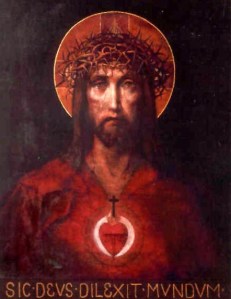
“For God so loved the world”
The Holy Face Novena will begin on Sunday, February 4th, and will be posted here for each day.
The Feast of the Holy Face for 2024 will fall on February 13th –“Shrove Tuesday” — the Tuesday before Ash Wednesday.
“Do you see how I suffer? Yet, very few understand me. Those who say they love me are very ungrateful! I have given my HEART as the sensible object of my great LOVE to men and I give my FACE as the sensible object of my sorrow for the sins of men. I wish that it be venerated by a special Feast on Tuesday, the day before Ash Wednesday. I wish that the feast be preceded by a novena in which the faithful make reparation with Me, joining together and sharing in my sorrow.” –Words of Our Lord to Bl. Mother Maria Pierina de Micheli (1890-1945)
Another holy nun, Sr. Marie St. Pierre (1816-1848) of Tours, France, was given revelations about devotion to the Face of Jesus. She received communications from Our Lord, who asked for a devotion to His Holy Face and a Work of Reparation: the offering His Holy Face to the Father in reparation for the sins of blasphemy, sacrilege, the crimes of atheistic communism, the profanation of the Holy Name, and the Holy Day of Sunday. The sins against the first three if the Ten Commandments are the greatest sins against God. The damage done by our sins to our relationship with God are reflected in the Face of of His Beloved Son, Jesus Christ. For this reason, devotion and reparation to the Holy Face is fitting in order to make amends for what we have done to Him.
Our Lord said to her, “I have taken upon my Head all the sins of mankind, so that my members may be spared. Therefore, offer my Face to the Father, this is the means of appeasing Him.”
“My daughter, I give you my Face and my Heart, I give you my Blood, and I open my wounds to you; draw from them and pour it out. Buy without money, my Blood that is the price of souls. Oh! What grief for my Heart to see the remedies which have cost me so dearly, scorned. Ask from my Father as many souls as the number of drops of Blood that I shed during my Passion.”
“All who will undertake this work and who will truly devote themselves to it will not die the eternal death. I will defend their cause before my Father and I will give them the kingdom of Heaven.”
“This work is the essence of charity!” — Our Lord to Sr. Marie St. Pierre
King Abgare recieving a miraculous image of the Holy Face
“To contemplate The Face of Christ, and to contemplate it with Mary, is the “program” which I have set before The Church at the dawn of the third millennium…To contemplate Christ involves being able to recognize Him wherever He manifests Himself, in His many forms of presence, but above all, in the living Sacrament of His Body and Blood.”
Pope St. John Paul II
“The Reparation is a Work destined to save society.” Pope Pius IX
To those who placed idols before the living and true God, the prophet Micah warned: “One day they will invoke the Lord, but He will not answer them, and on that day He will hide His Face from them because of the evil of their conduct.” (Micah 3:4)
St. Veronica with Sudarium 1420
However, those who who honor and glorify God; those who seek and contemplate the Face of Jesus Christ — they will be transformed into His Image — According to Pope St. John Paul II this is the meaning of the action of the woman known as “Veronica” . The “Veronica” or “Vera Icon” historically referred the the image itself, however, there is a deep message imparted to each Christian in the legend of St. Veronica: each act of charity, every act of compassion will leave the imprint of the Face of Jesus in our souls, transforming us into His own Image.
“But we all, with unveiled face, beholding as in a mirror the glory of the Lord, are being transformed into the same image from glory to glory, just as by the Spirit of the Lord.”
(2 Cor. 3:18)
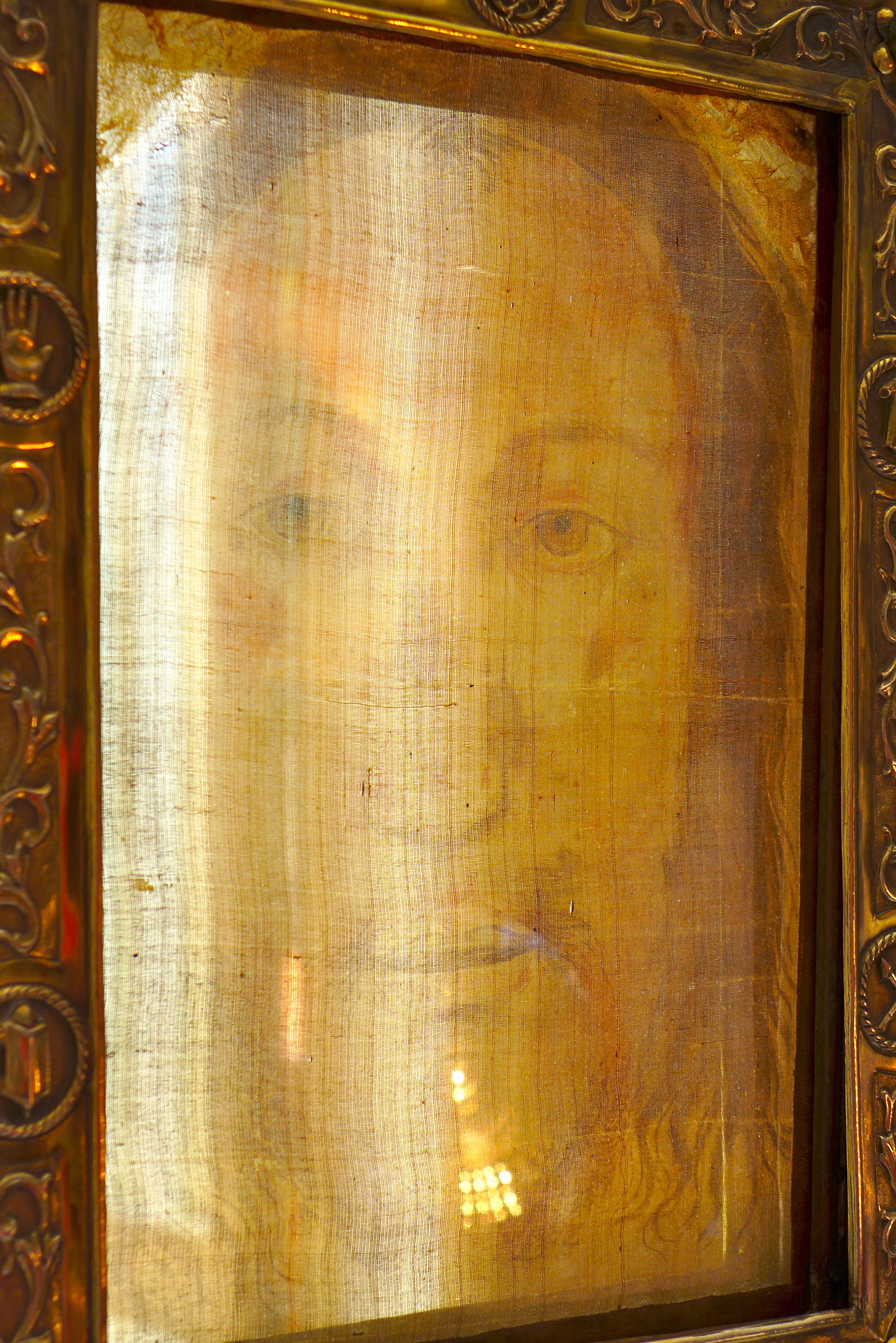
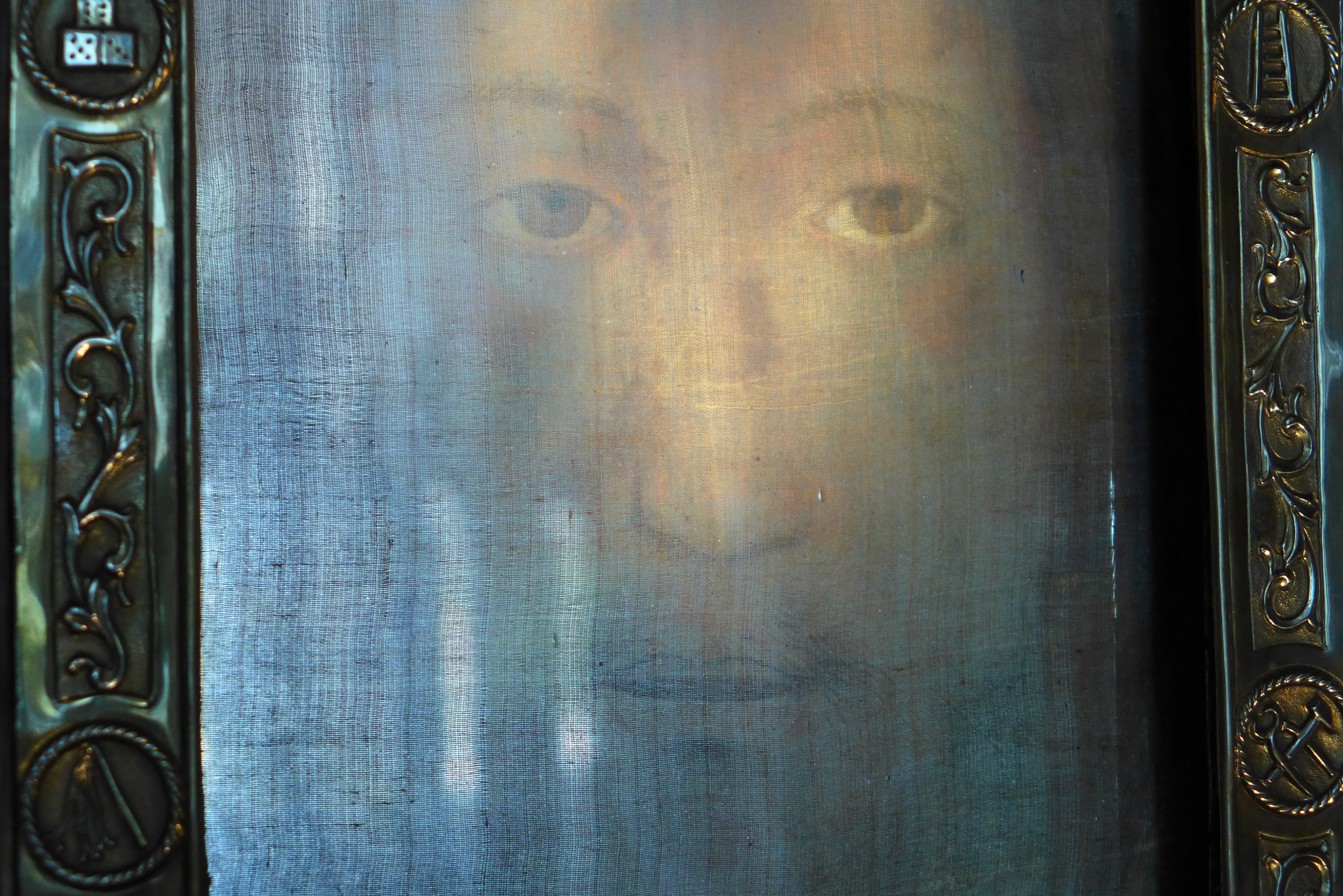
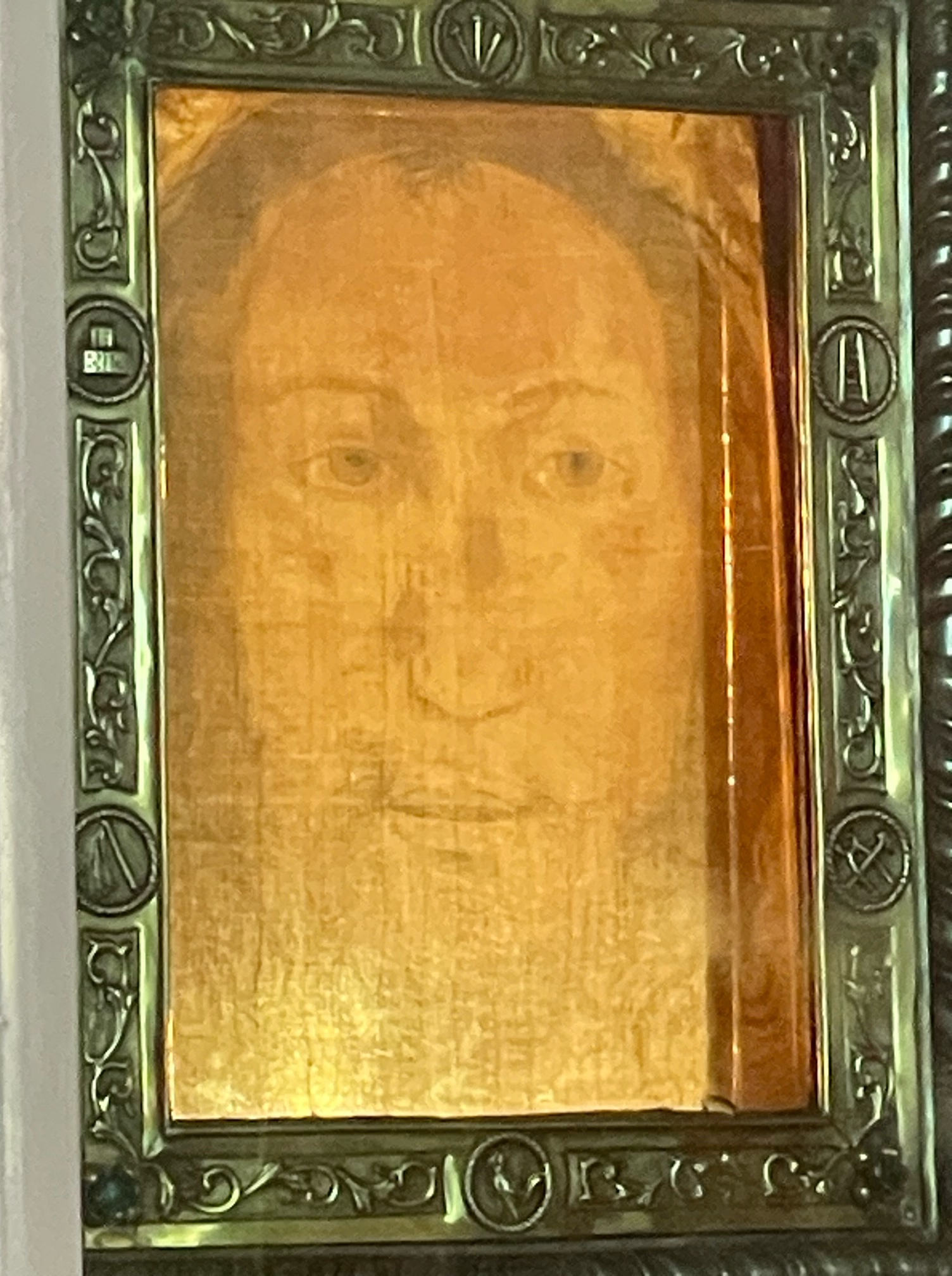
There is a “Vera Icon” or “True Image” of the Face of Christ, which is kept in the Basilica Shrine of the Holy Face in Manoppello, Italy. It is believed to be the sudarium cloth that covered Jesus head at his burial and found in the tomb after the Resurrection. All are invited to give honor and glory to God on January 28th, 2024, either in person, or via the internet, by joining in the celebration of “Omnis Terra” at the Basilica Shrine of the Holy Face…
“Omnis terra adoret te, Deus, et psallat tibi!”
“The whole earth adores you, O God, and sing hymns to you” (Ps 65:4)
The first “Omnis Terra” procession of Pope Innocent III in 1208 carrying “the Veronica” Face of Christ (from “Liber Regulae Sancti Spiritus in Saxia” manuscript 1350)*
Omnis Terra, is the Latin for “All the Earth.”The revelation of Jesus’s glory is the cause for all the earth rejoicing, giving praise to His Name! Omnis Terra will be celebrated with a solemn Mass and a procession at the Sanctuary Basilica of the Holy Face in Manoppello, Italy. The live-feed will begin at 11:00am local time (Rome time) Archbishop Bruno Forte will be presiding. A blessing will be imparted with the reliquary of the Veil of the Holy Face during the celebration. (Link for Live-stream here)
Since ancient times processions have been a reminder that our Christian life is a constant movement toward God and our eternal home. A procession is a type of pilgrimage and expression of beauty and piety that flows from the liturgy. There is power in this beautiful procession that terrifies the infernal foe and makes all of hell tremble.Processing with the Face of Jesus brings his whole person before us, and for all the earth to adore and glorify Him — to proclaim to the unbelieving world that Jesus Christ is LORD!
The world is not only unbelieving but publicly blasphemes God to His Face, and it is for this reason that Our Lord must be honored publicly. Whether it is within the confines of a church or through the city streets, the procession is a public function of faith, hope, and love. It is an antidote to the poison disseminated by our culture which falsely asserts that religion is “private” and not something to be brought up in polite society or in the public square.
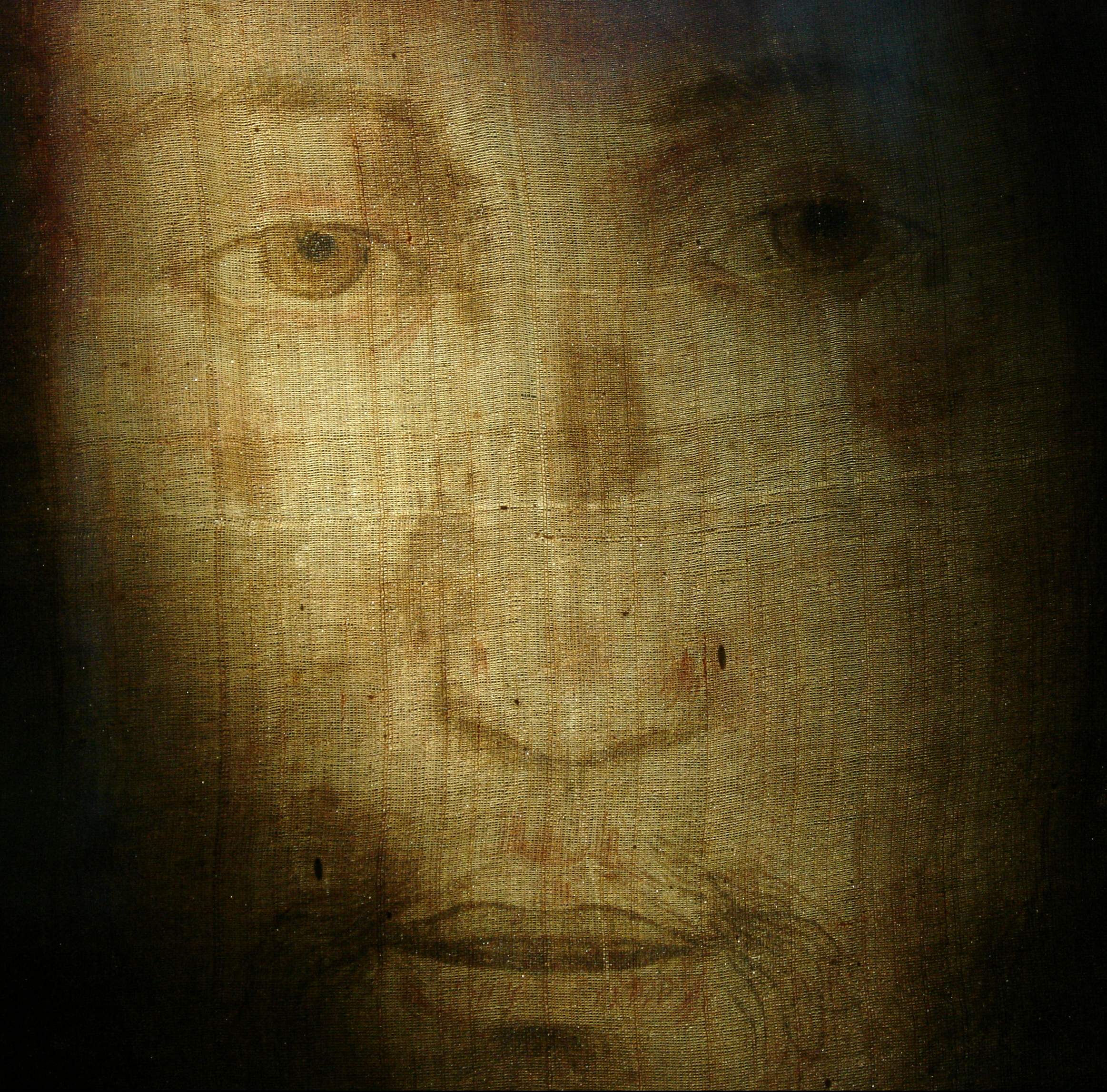
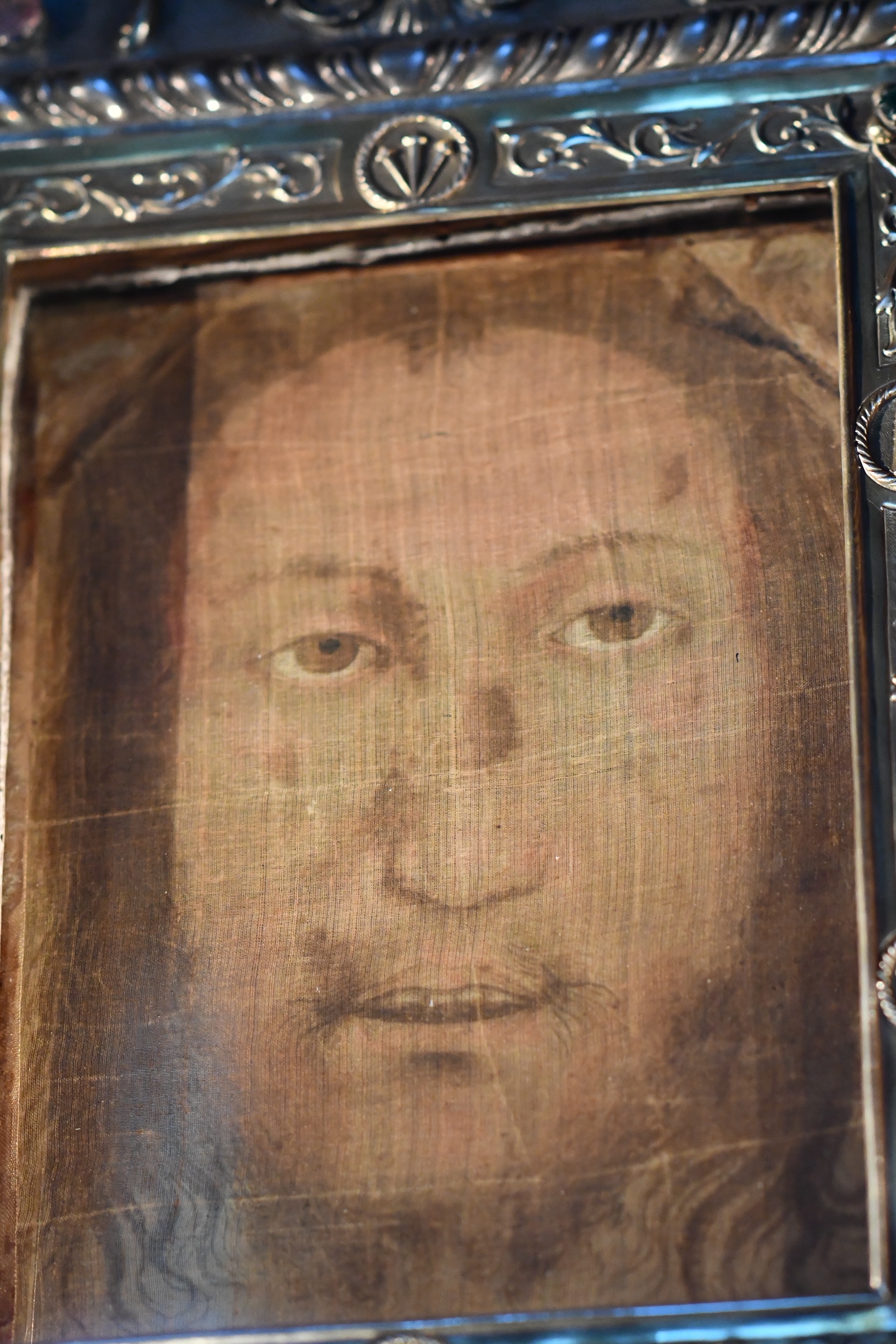
“Vera Icon” Holy Face of Manoppello (Photo: Paul Badde/EWTN)
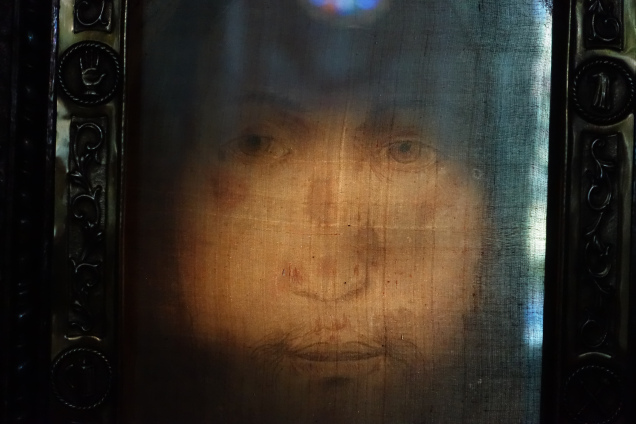
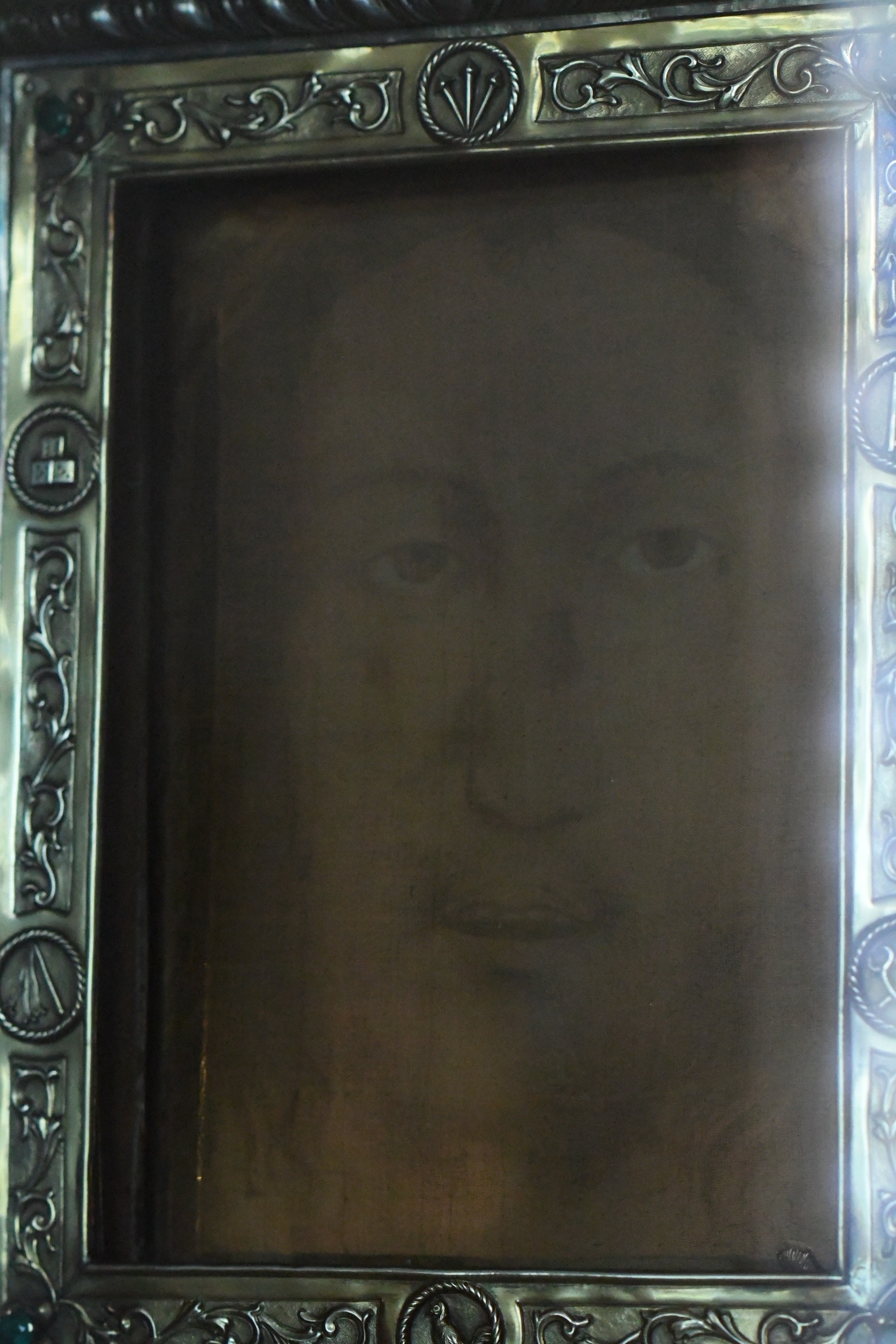
The “Living Face” becomes visible on the Holy Veil of Manoppello. Photo: Paul Badde/EWTN
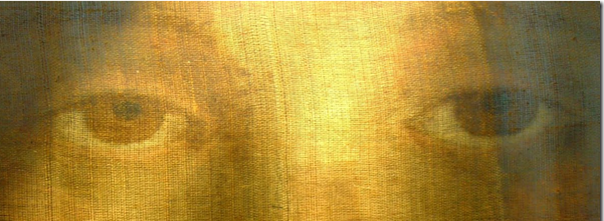
The eyes following the onlooker — Holy Veil of Manoppello (Photo: Paul Badde/EWTN)
Il Volto Santo – The Face of Love and Mercy (Photo: Paul Badde/EWTN
“We process toward our heavenly home in the company of God. Procession is the function of faith, which burns in our hearts and beams in our faces, and makes our voices tremulous with emotion as our ‘Lauda Sion’ bids defiance to an unbelieving world.” ~Fr. Frederick W. Faber in his treatise on the Blessed Sacrament
Detail of Face of Jesus on the Holy Veil from the precious manuscript *”Liber Regulae Sancti Spiritus in Saxia”
Archbishop Salvatore Cordileone holding the reliquary containing the Veil of the Holy Face of Manoppello on the occasion of Omnis Terra in 2019. Photo: Paul Badde/EWTN
“Do Whatever He Tells You, and You Will Spread the Face of His Love to the Whole World”
“The entrance chant for our Mass today – “All the earth will worship you, O God, and will sing to you, sing to your name” – happens to be the same entrance chant prescribed for last Sunday’s Mass, the Second Sunday in Ordinary Time, popularly referred to as “Omnis terra” Sunday, taken from the first words of the chant in Latin, as we just heard it at the beginning of Mass, “Omnis terra adoret te, Deus.” Every Mass has a prescribed entrance chant, usually a Scripture verse, very often from one of the Psalms, and the Mass gets its name from the first word or two of that chant (such as “Gaudete” Sunday and “Laetare” Sunday).
The Holy Face of Jesus
Why do I bring this up? It recalls a bit of Church history that underscores why Jesus came into the world. The story is told that in pre-Christian Rome the Emperor decided to have all Roman residents originally from other places take soil from their homeland and deposit it in a designated place close to the Vatican Hill, less than a quarter of a mile away. There he built a temple to honor the pagan Roman gods, as it contained soil from all the earth, “omnis terra.”
After Rome became Christian, the Pope built a church over that spot, which we know as the church of the Holy Spirit, and every year on that Sunday, “Omnis terra” Sunday, he would process from St. Peter’s Basilica to the church of the Holy Spirit with a veil bearing the face of Jesus. The veil in question was preserved from antiquity as one of the burial cloths that covered Jesus’ face, and was believed to be such an accurate representation of his face that it was called “the true icon of Rome,” in Latin, vera icona Romana: “vera icona,” whence the name, “Veronica.” This is how the story circulated later in the Middle Ages of a woman by that name who wiped our Lord’s face as he carried his Cross to Calvary.
There are many truly remarkable, even miraculous, features about this cloth that point to its authenticity, but that is a subject for another discourse. The point for us here today is that that procession instituted in the Middle Ages was to claim Jesus Christ as the one Savior of all the world, the Second Person of the Most Holy Trinity, the one, true God to whom all the earth owes worship and allegiance. This is the spiritual lesson of the ritual that developed around that veil.
The story of Veronica, though, also bears for us a spiritual message. As Pope St. John Paul II reflected in his meditation on the sixth Station of the Cross, every act of charity done in the name of Jesus Christ, with the spirit of his love, leaves the imprint of his image. This is how we translate the universality of the salvation Jesus won for us into language people can understand in our own time and place. The love of Christ is truly a universal language, understood everywhere and in every culture, leaving his image and thus changing both persons involved in that encounter of authentic Christian charity.”
Archbishop Ganswain holding the replica of the Holy Veil of Manoppello at Spirito Santo in Rome. 2016
History was also made on “Omnis Terra”(All the earth) Sunday in January of 2016, when bishops, priests, and pilgrims re-enacted the historic “Omnis Terra” Procession of Pope Innocent III (pictured above), carrying a reproduction of the precious image that many scholars identify with “the Veronica” or “true image” of the Face of Jesus. The pilgrim procession began at St. Peter’s in Rome and processed to Spirito Santo church and hospital, drawing attention especially to the Face of Christ in the sick and the poor.
On the occasion of the first “Omnis Terra” procession in 1208, Pope Innocent III wrote this beautiful prayer of devotion to the Veil of Holy Face of Jesus:
“O God, who has marked us with the light of Thy Face as your memorial, and at the request of Veronica, left us Thy Image imprinted on the sudarium; grant we pray, that by your passion and death, to adore, venerate and honor you, in mystery and as through a mirror on earth, so that we might be able to certainly see you, face to face, when you come as our judge.”
On “Omnis Terra” Sunday, January 15, 2017, history was made once again at the Basilica Sanctuary of the Holy Face in Manoppello, Italy, when a third solemn annual procession was introduced–in addition to the two solemn processions already observed in May (commemorating the arrival of the Holy Veil to Manoppello), and the solemn procession in August (on the Feast of the Transfiguration).
The addition of a third procession of the Holy Face at the Shrine of Manoppello is not only Trinitarian, it is a deeply significant and public witness of honor paid by the faithful to His Holy Face and thus also to the Holy Name of Jesus! May all of hell tremble at the sight of His Holy Face!
A Hymn composed by Pope Innocent III from the year 1216:
“Sancte Salve Facies”
Procession of Pope Innocent II in 1208 carrying “the Veronica” *Face of Christ (from “Liber Regulae Sancti Spiritus in Saxia” manuscript 1350)
Hail Holy Face of Our Redeemer on which shines the appearance of divine splendor impressed upon a little cloth of snowy radiance and given to Veronica as a standard of love.
Hail beauty of the ages, mirror of the saints, which the spirits of the heavens desire to see. Cleanse us from every stain of sin and guide us to the fellowship of the blessed.
Hail our glory amidst this hard life, so fragile and unstable, quickly passing away. Point us, O happy figure, to the heavenly homeland to see the Face that is Christ indeed.
Hail, O sudarium, noble encased jewel, both our solace and the memorial of Him who assumed a little mortal body–our true joy and ultimate good!
*The precious miniature manuscript “Liber Regulae Sancti Spiritus in Saxia,” was published around 1350 and is preserved in the State Archives in Rome. The illustration at the bottom of the first page of the Liber is one of the oldest illustrations of “the Veronica,” which depicts Pope Innocent III with “the Veronica” in his right hand and the Rule granted to the brothers of the hospital in his left. Prior to the Jubilee of 2000, the French medievalist Jacques Le Goff wrote, “Over the centuries Rome was enriched with notable relics. One in particular acquired an exceptional prestige: the sudarium of Christ known and revered by the name of “the Veronica.” The circumstances by which the image first came to Rome is a mystery but was mentioned for the first time under Pope John VII (705-707)
Hail Holy Face of Jesus, our Redeemer!
Update: The 2024 Novena of the Holy Face will be from Sunday, February 4th to February 12th. The Feast of the Holy Face for 2024 is Tuesday, February 13th. The Novena will be posted each day on the Home Page, which subscribers will receive by email. The Novena may also be found in the Menu above.
May God have pity on us and bless us;may He let his Face shine upon us. So may Your way be known upon earth;among all nations, Your salvation. (Ps. 67:1)
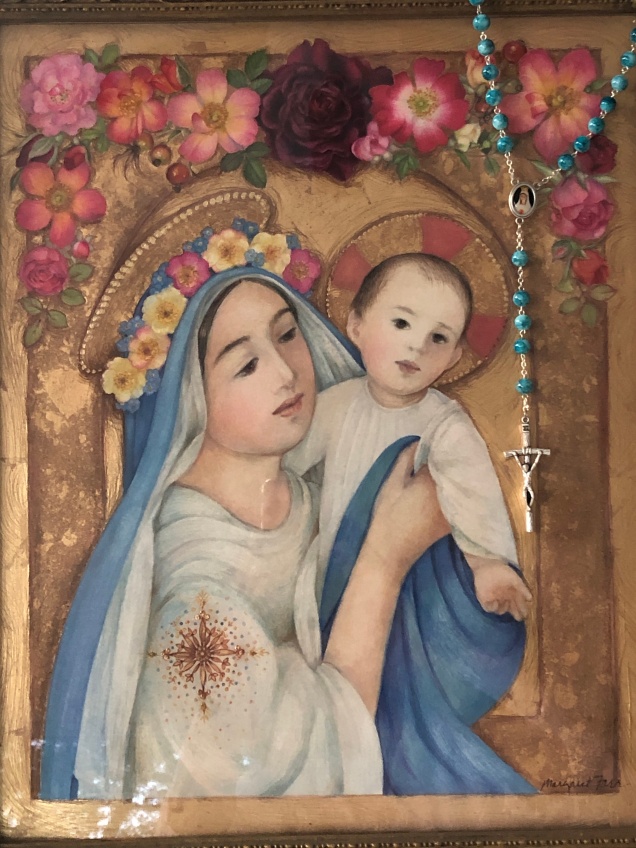
Painting by Margaret Farr
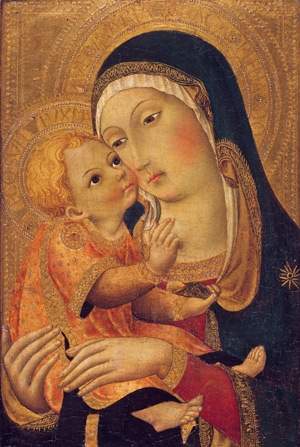
“Our Lady, in whose face – more than any other creature – we can recognize the features of the Incarnate Word.” –Pope Benedict XVI
The Feast of Mary, Mother of God
In God’s beautiful design, the Christmas liturgy continues at the beginning of the New Year by drawing us to the Face of Christ with three holy feast days. All three are tied together by a common, yet golden thread–A mother, sharing her precious Son with us, so we may see His Face.
We begin on January 1, with the Feast of Mary, Mother of God, who teaches us how to contemplate the Face of her Son by seeing the reflection of His beauty and goodness in her face. On the Solemnity of the Mother of God, Pope Francis said, “Begin the year recalling God’s goodness in the maternal face of Mary.” We see Jesus more clearly through His Mother’s eyes, especially when we pray the Rosary.
The first reading for this feast day is the priestly blessing on God’s chosen people from the book of Numbers:
The LORD said to Moses: “Speak to Aaron and his sons and tell them: This is how you shall bless the Israelites. Say to them: The LORD bless you and keep you! The LORD let his face shine upon you, and be gracious to you! The LORD look upon you kindly and give you peace! So shall they invoke my name upon the Israelites, and I will bless them.” (Num 6:22-27)
May Our Lord grant us His blessing in the New Year through intercession the Blessed Virgin Mary, Mother of God. As the Incarnation of the Son of God came into the world by the power of the Holy Spirit, at Mary’s “Fiat,” through her prayers, may we obtain the grace to contemplate His Holy Face, and receive God’s greatest gift of peace.
The next holy feast, on January 3 is…
The Feast of the Holy Name of Jesus
In sacred scripture the Angel Gabriel revealed the Holy Name of the Savior of mankind to the Blessed Virgin Mary: “You shall call His name Jesus.”
When Jesus was named, Satan was disarmed!
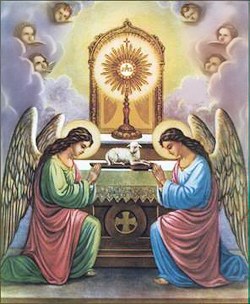
Mary, Mother of the Most Blessed Sacrament
Pope Benedict XVI had written that the expression “name of God” means God as He Who is present among men. His name, is the concrete sign of His Existence. The Hebrew term, “panim”, which means “face” means to see The Face of God, or the presence of God. “Panim” is a term that describes relationships. The Hebrew word “shem” meaning “name” is also a term of relationship. “Panim” is also the Hebrew word for “Face of God” and the same word is used for “Bread of the Presence” or “Bread of the Face.” (Exodus 25:30) The “Bread of Presence” mentioned in Exodus was not the actual Face of God, but the earthly sign of His Face. The Eucharist, instituted by Christ, however, is the actual Body, Blood, Soul and Divinity of Jesus. When we are gazing at the Eucharist, the sign of God’s love for us, in Adoration, we see His Holy Face veiled in the appearance of bread, and in doing so, we give honor to His Holy Name.
Who had a more tender relationship of love with Jesus than his mother Mary? Who spoke His name more lovingly? God has a Face and a Name — It is Jesus Christ, our Redeemer! The Blessed Mother invites us to rejoice in the splendor of His Face, and contemplate the mystery of His Holy Name by entering into a relationship with her Son Jesus, especially in the Most Holy Sacrament of the Eucharist.
“To rejoice in the splendor of His Face means penetrating the mystery of His name made known to us in Jesus, understanding something of His interior life and of His will, so that we can live according to His plan for humanity. Jesus lets us know the hidden Face of The Father through His human Face; by the gift of The Holy Spirit poured into our hearts. This,is the foundation of our peace, which nothing can take from us.” –Pope Benedict XVI
Blessed the Lord, O my soul, and let all that is within thee bless His Holy Name. Bless the Lord, O my soul, and never forget all He hath done for thee. (Ps. ci. i,2)
And the third great holy day drawing us to adore the Holy Face is…
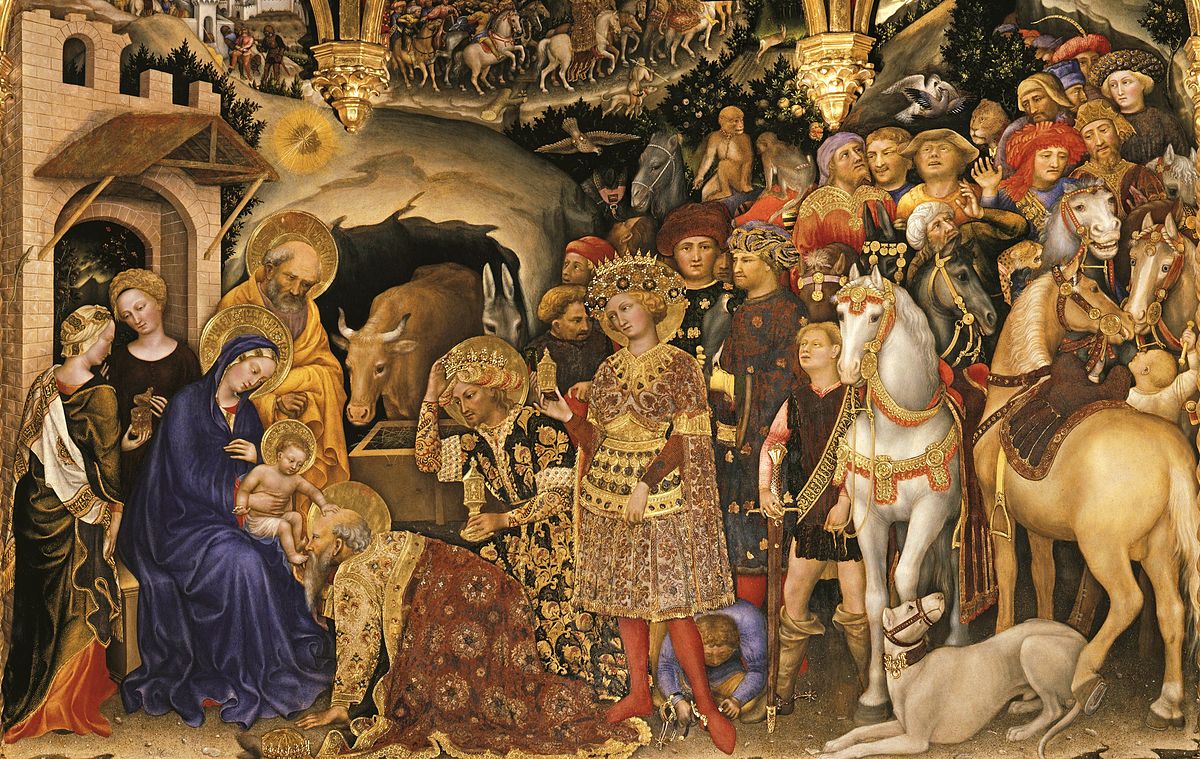
Christ has appeared to us; come, let us adore Him! Adoration of the Magi, Giotto, 1302
The Feast of the Epiphany
“See, darkness covers the earth, and thick clouds cover the peoples; But upon you the Lord shines, and over you appears his glory.”
Isaiah 60
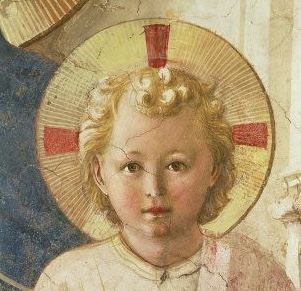
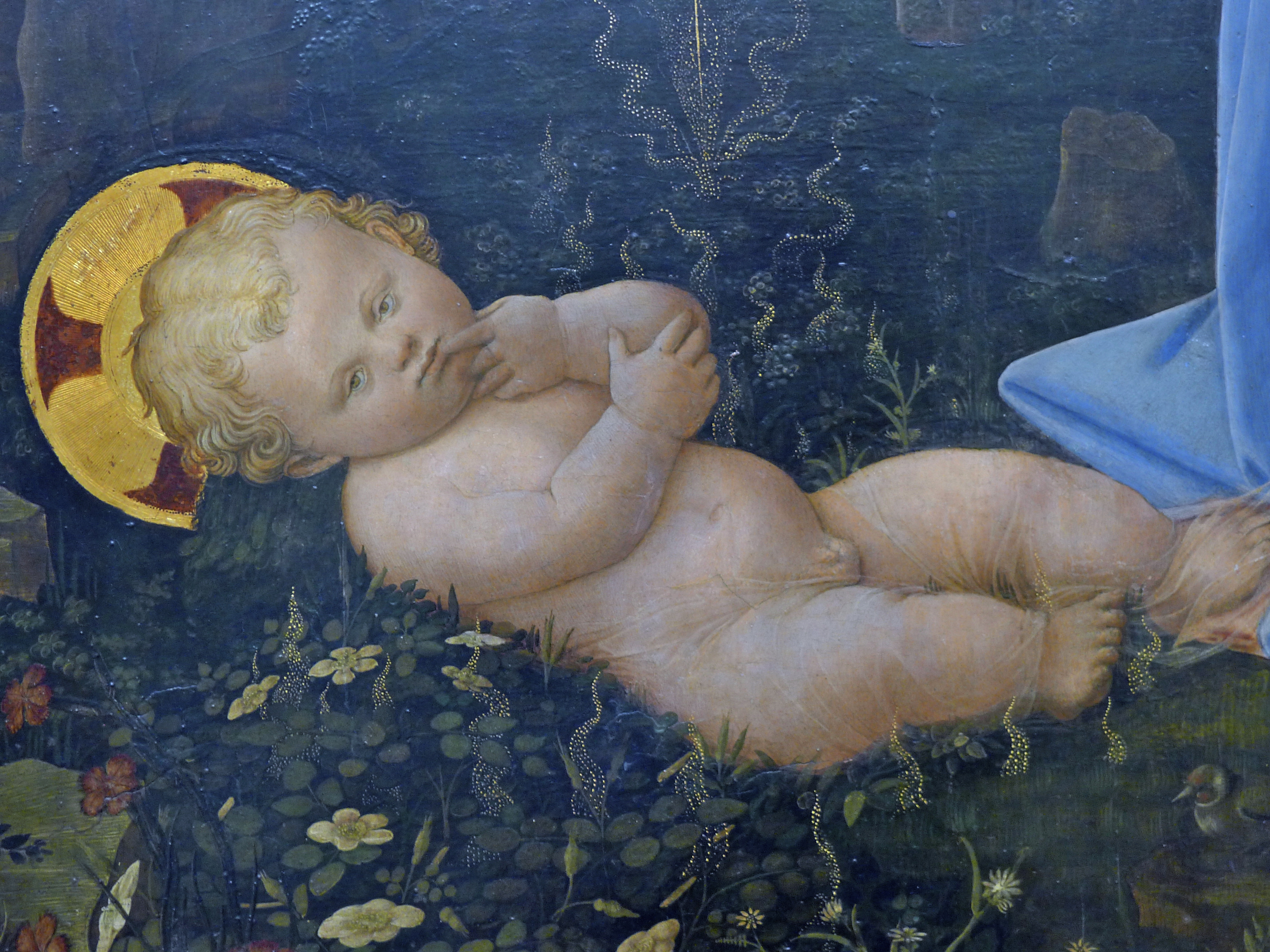
The Epiphany is closely linked to the Holy Face, as the Blessed Virgin Mary, Queen and mother, presents her Son, the King of Kings, to the Magi–because the Epiphany is the feast on which Jesus Christ first shows Himself to the world represented by the Magi–and He shows Himself through a human face, the face of an infant. On the feast of the Epiphany, we ask God to shine His Face upon us, to reveal His Face to us once more as we come before Him in adoration, so that, like the Blessed Virgin Mary, we may also reflect the light of His Face to the world.
“All the ends of the earth will behold the salvation of our God.”
Isaiah 52
“May the Lord grant that in the new millennium, the Church will grow ever more in holiness, that she may become in history a true epiphany of the merciful and glorious Face of Christ the Lord.” — Pope St. John Paul II at the Closing of the Holy Door, January 6, 2001
“The people living in darkness have seen a great light…” (Mt. 4:16).
As those who see light are in the light sharing its brilliance, so those who see God are in God sharing his glory, and the glory gives them life. To see God is to share in life.”
~St. Ireneaus
Adoration of the Magi – Gentile da Fabiano 1423
Love desires to see God. So says St. Peter Chrysologus: “When God saw the world falling to ruin because of fear, He immediately acted to call it back to Himself with love…” By an invitation of grace, love and compassion God called Noah, Abraham, Jacob and Moses–and a “flame of love” was enkindled in their hearts, “it’s intoxication overflowed into men’s senses. Wounded by love, they longed to look upon God with their bodily eyes, yet how could our narrow human vision apprehend God, whom the whole world cannot contain?” St. Chrysologus writes, “It is intolerable for love not to see the object of it’s longing!” No matter what good the saints did to merit a reward, they could not see the Lord. “A love that desires to see God may not have reasonableness on it’s side, but it is evidence of filial love. It gave Moses the temerity to say: If I have found favor in your eyes, show me Your Face. It inspired the psalmist to make the same prayer: Show me Your Face. Even the pagans made their images for this purpose: they wanted to see what they mistakenly revered.” (from sermon of St. Peter Chrysologus)
Come, let us adore Him!
Infant Jesus wrapped in Byssus
“Visible before to God alone and not to the world, God made the Word visible so that the world could be saved by seeing Him. This mind that entered our world was made known as the Son of God.”
~ St. Hippolytus
Blessed are the pure of heart, for they shall see God. (Mt. 5:8)
Adoration of the Shepherds – Gerard van Honthorst 1622
O that birth forever blessèd,
When the virgin, full of grace,
By the Holy Ghost conceiving,
Bore the Savior of our race;
And the Babe, the world’s Redeemer,
First revealed His sacred face,
evermore and evermore!
Merry Christmas! May His Face shine upon you and your loved ones, today and always!
Kreuz als Krippe (Cross as a Crib), Oil on canvas, Unknown artist, 18th century (Photo: Paul Badde)
“In Thee God will manifest the splendor of His presence, for the whole world to see”
During Advent the Church celebrates the longing to see God’s Face, together with the Blessed Virgin Mary, with a Triduum (three days of prayer beginning on December 15) and a Feast on December 18th –It is called The Feast of the Expectation of the Blessed Virgin Mary, Longing to See His Face. (a bit of the history may be found here.) The prayer may also be continued until Christmas.
The Expectation of the Blessed Virgin Mary
On the days leading up to Christmas we are invited to contemplate, together with Mary, the Divine Child within her womb, who is Our Savior. We too, through sanctifying grace, bear the supernatural image of God within us. Like Mary, we desire to become a peaceful sanctuary for the living God. We are called to be attentive, in prayer, to the faint stirrings of His presence in our hearts, which will fill us with a deep longing to see His Face as we pray:
Prayer for the Triduum and Feast of the Expectation of the Blessed Virgin Mary, Longing to See His Face
“Mary, your life with Jesus was one of the purest, most fervent, most perfect emotions of longing and most eager expectation of the Birth of the Divine Child! How great must have been that longing! You were longing to see the Face of God and to be happy in the vision. You were soon really to see the Face of God, the created image of divine perfection, the sight of which rejoices heaven and earth, from which all being derive life and joy; the Face whose features enraptured God from all eternity, the Face for which all ages expectantly yearned. You were to see this Face unveiled, in all the beauty and grace as the face of your own child.
Most just indeed it is, O Holy Mother of God, that we should unite in that ardent desire which you had to see Him, who had been concealed for nine months in your chaste womb; to know the features of this Son of the heavenly Father, who is also your own; to come to that blissful hour of His birth, which will give glory to God in the highest, and on earth, peace to men of good will. Yes, dear Mother, the time is fast approaching, though not fast enough to satisfy your desires and ours. Make us re-double our attention to the great mystery; complete our preparation by your powerful prayers for us, so that when the solemn hour has come, our Jesus may find no obstacle to His entrance into our hearts. Amen.” (Prayer by Rev. Lawrence Lovasik, S.V.D.)
Maranatha – Come Lord Jesus!
A Prophecy is fulfilled…
Il Volto Santo – Veil of the Holy Face of Manoppello. (Photo: Paul Badde)
Paul Badde, who has written so much about the Holy Face Veil of Manoppello, has sent this prophetic quote from Pope St. John Paul II, on the occasion of the 36th World Communications Day, “Internet: A New Forum for proclaiming the Gospel,” 2002:
“For the Church the new world of cyberspace is a summons to the great adventure of using its potential to proclaim the Gospel message… The Internet causes billions of images to appear on millions of computer monitors around the planet. From this galaxy of sight and sound will the face of Christ emerge and the voice of Christ be heard.”
— Pope St. John Paul II
Pope Benedict XVI echoed the words of John Paul II in Verbum Domini:
In the world of the internet, which enables billions of images to appear on millions of screens throughout the world, the face of Christ needs to be seen and his voice heard, for “if there is no room for Christ, there is no room for man”.
–Pope Benedict XVI, Verbum Domini
The Gospel message is indeed being proclaimed; “the face of Christ” seen, and His voice heard. A four part documentary series is now available on Netflix — “Mysteries of the Faith” — which explores the legendary relics and treasures of Christianity, including the miraculous Veil of the Holy Face of Manoppello, Italy: Il Volto Santo. Antonio Bini, has written on Holyfaceofmanoppelloblogspot.com :
“Millions of people — in over 190 countries of the world — were able to watch the documentary “Mysteries of the Faith.” Unprecedented access was given for the makers of the documentary to the most sacred places of the world. (Full article by Antonio Bini: click here). The official trailer is found below:
Let us make room for Christ, and help to the Holy Face of Jesus to made visible in the world and His voice to be heard!
Please share with others! Peace in Christ!
“Visible before to God alone and not to the world, God made the Word visible so that the world could be saved by seeing Him. This mind that entered our world was made known as the Son of God.”
“Thou art all fair, my love, there is no spot in thee.” (Song of Solomon 4:7)
“From the greatness and beauty of created things comes a corresponding perception of their Creator,” “for the author of beauty created them.” (Wisdom 13: 3, 5)
The spiritual beauty of God is reflected most perfectly in the woman He created to be His Mother. No stain of sin would mar the beauty of His reflection in her soul. Never for one instant would she be under the power of the devil. “The Blessed Virgin Mary, in the first instance of her conception, by a singular grace and privilege granted by Almighty God, in view of the merits of Jesus Christ, the Savior of the human race, was preserved free from all stain of original sin.” (Dogma of the Immaculate Conception) Mary herself proclaims, “My spirit has rejoiced in God my Savior.” (Luke 1:47)
As the Immaculate Conception, Mary bears in herself the most perfect reflection of the face of God. Pope St. John Paul II wrote, “The Blessed Virgin saw shining upon her, as no other creature, the face of the Father, rich in grace and mercy.” What in Heaven and on earth could be more beautiful than the Mother of God? It is God who has willed that Mary be beautiful, not only fair in face, but in the fullness of grace. Yet, beauty has a purpose, and that is to draw us by the beauty of the graces God has given her towards the Beatific Vision–the Face of God. Mary has no greater desire than that we turn towards the Face of her Son, as she does, with eyes of love.
Strangely, there are some who see the Blessed Mother not as a gift from God who leads us to her Son, but as an obstacle. They want to separate the Mother from the Son, even resorting to violence of smashing statues and slashing paintings of her, mistakenly thinking that somehow this could be pleasing to God, but it is only pleasing to the devil. It is blasphemy. When we separate ourselves from Mary, we separate ourselves from Christ. In The Everlasting Man G.K. Chesterton tells a story from his childhood, many years before he became a Catholic, which left a deep impression on his soul:
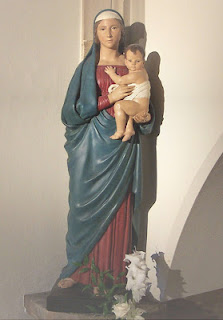
“When I was a boy a more Puritan generation objected to a statue upon my parish church representing the Virgin and Child. After much controversy, they compromised by taking away the Child. One would think that this was even more corrupted with Mariolatry, unless the mother was counted less dangerous when deprived of a sort of weapon. But the practical difficulty is also a parable. You cannot chip away the statue of a mother from all round that of a newborn child. You cannot suspend the new-born child in mid-air; indeed you cannot really have a statue of a newborn child at all. Similarly, you cannot suspend the idea of a newborn child in the void or think of him without thinking of his mother. You cannot visit the child without visiting the mother, you cannot in common human life approach the child except through the mother. If we are to think of Christ in this aspect at all, the other idea follows I as it is followed in history. We must either leave Christ out of Christmas, or Christmas out of Christ, or we must admit, if only as we admit it in an old picture, that those holy heads are too near together for the haloes not to mingle and cross.”
Jesus alone is “the Way” that leads to the Father, but Mary is the most beautiful image and likeness of Christ, which will lead us to Him. Dostoevsky once said that “Beauty will save the world!” Mary has a spiritual beauty to share with the world that attracts and expresses what is beyond words, in the depths of her heart, the love of a mother for her Savior and Son.
A Little Litany by G.K.Chesterton
“Our Lady, in whose face – more than any other creature – we can recognize the features of the Incarnate Word.” –Pope Benedict XVI Madonna and Child from the Robert Lehman Collection, Metropolitan Museum of Art
When God turned back eternity and was young, Ancient of Days, grown little for your mirth (As under the low arch the land is bright) Peered through you, gate of heaven – and saw the earth.
Or shutting out his shining skies awhile Built you about him for a house of gold To see in pictured walls his storied world Return upon him as a tale is told.
Or found his mirror there; the only glass That would not break with that unbearable light Till in a corner of the high dark house God looked on God, as ghosts meet in the night.
Star of his morning; that unfallen star In the strange starry overturn of space When earth and sky changed places for an hour And heaven looked upwards in a human face.
Or young on your strong knees and lifted up Wisdom cried out, whose voice is in the street, And more than twilight of twiformed cherubim Made of his throne indeed a mercy-seat.
Or risen from play at your pale raiment’s hem God, grown adventurous from all time’s repose, Of your tall body climbed the ivory tower And kissed upon your mouth the mystic rose.
For post “Look Closely – Our Lady of Guadalupe – Not Made by Human Hands” click here.
Miraculous Image of Our Lady of Guadalupe “I am your merciful Mother.”
“Let the little children come to me.” Photo: Patricia Enk
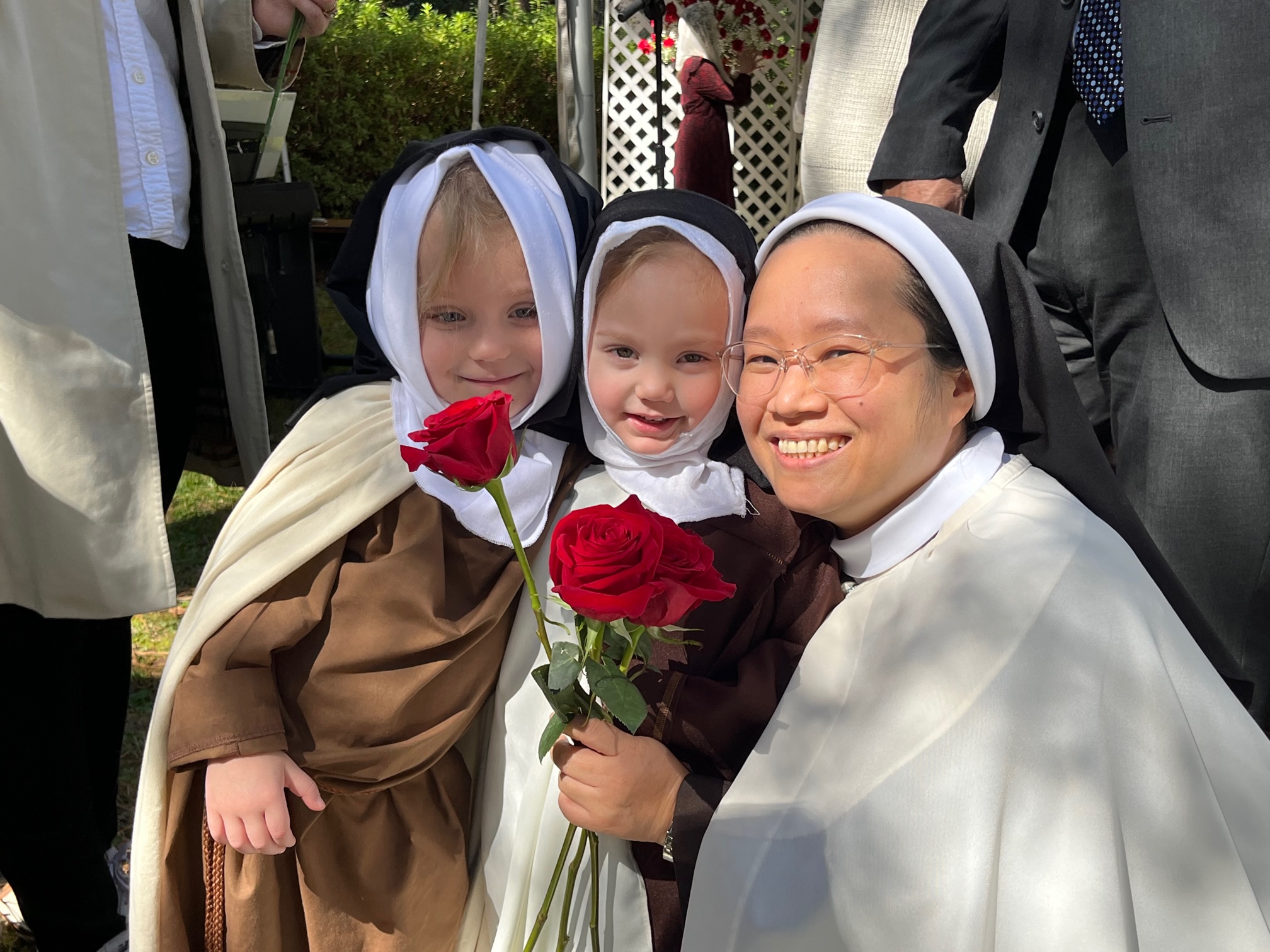
On Sunday, October 1st, the Discalced Carmelite Nuns of Covington, Louisiana will celebrate the annual “Mass of the Roses,” in honor of St. Therese, and the 150th anniversary of her birth. This beautiful event begins with a musical prelude, followed by the celebration of the Eucharist, and the blessing and distribution of roses by children. After the Mass, homemade goods, and treats are sold which help pay for the nuns needs for the year. The nuns most urgent need this year is to replace their electrical generator, which broke after 18 years of faithful service. The generator supplies emergency power, during storms and hurricanes, to the main monastery building and living quarters of the Sisters, and powers the water pump for their well.
St. Therese of the Child Jesus and the Holy Face is more commonly known for her way of “Spiritual Childhood” and devotion to The Child Jesus, however, her sister, Mother Agnes gave this testimony for St. Therese’ beatification:
“Devotion to the Holy Face was the Servant of God’s special attraction. As tender as was her devotion to the Child Jesus, it cannot be compared to her devotion to the Holy Face.”
St. Therese’ sister Celine (Sr. Genevieve of the Holy Face), also wrote: “Devotion to the Holy Face was, for Therese, the crown and complement of her love for the Sacred Humanity of Our Lord. The Blessed Face was the mirror wherein she beheld the Heart and Soul of her Well-Beloved. Just as the picture of a loved one serves to bring the whole person before us, so in the Holy Face of Christ Therese beheld the entire Humanity of Jesus. We can say unequivocally that this devotion was the burning inspiration of the Saint’s life… Her devotion to the Holy Face transcended, or more accurately, embraced, all the other attractions of her spiritual life.”
St. Therese
Canticle to the Holy Face
Jesus, Your ineffable image Is the star which guides my steps. Ah, You know, Your sweet Face Is for me Heaven on earth. My love discovers the charms Of Your Face adorned with tears. I smile through my own tears When I contemplate Your sorrows.
Oh! To console You I want To live unknown on earth! Your beauty, which You know how to veil, Discloses for me all its mystery. I would like to fly away to You!
Your Face is my only homeland. It’s my Kingdom of love. It’s my cheerful meadow. Each day, my sweet sun. It’s the Lily of the Valley Whose mysterious perfume Consoles my exiled soul, Making it taste the peace of Heaven.
It’s my Rest, my Sweetness And my melodious Lyre Your Face, O my Sweet Savior, Is the Divine Bouquet of Myrrh I want to keep on my heart!
Your Face is my only wealth. I ask for nothing more. Hiding myself in it unceasingly, I will resemble You, Jesus Leave in me, the Divine Impress Of Your features filled with sweetness, And soon I’ll become holy. I shall draw hearts to You.
So that I may gather A beautiful golden harvest, Deign to set me aflame with Your Fire. With Your adorned mouth, Give me soon the Eternal Kiss!
~ St. Therese
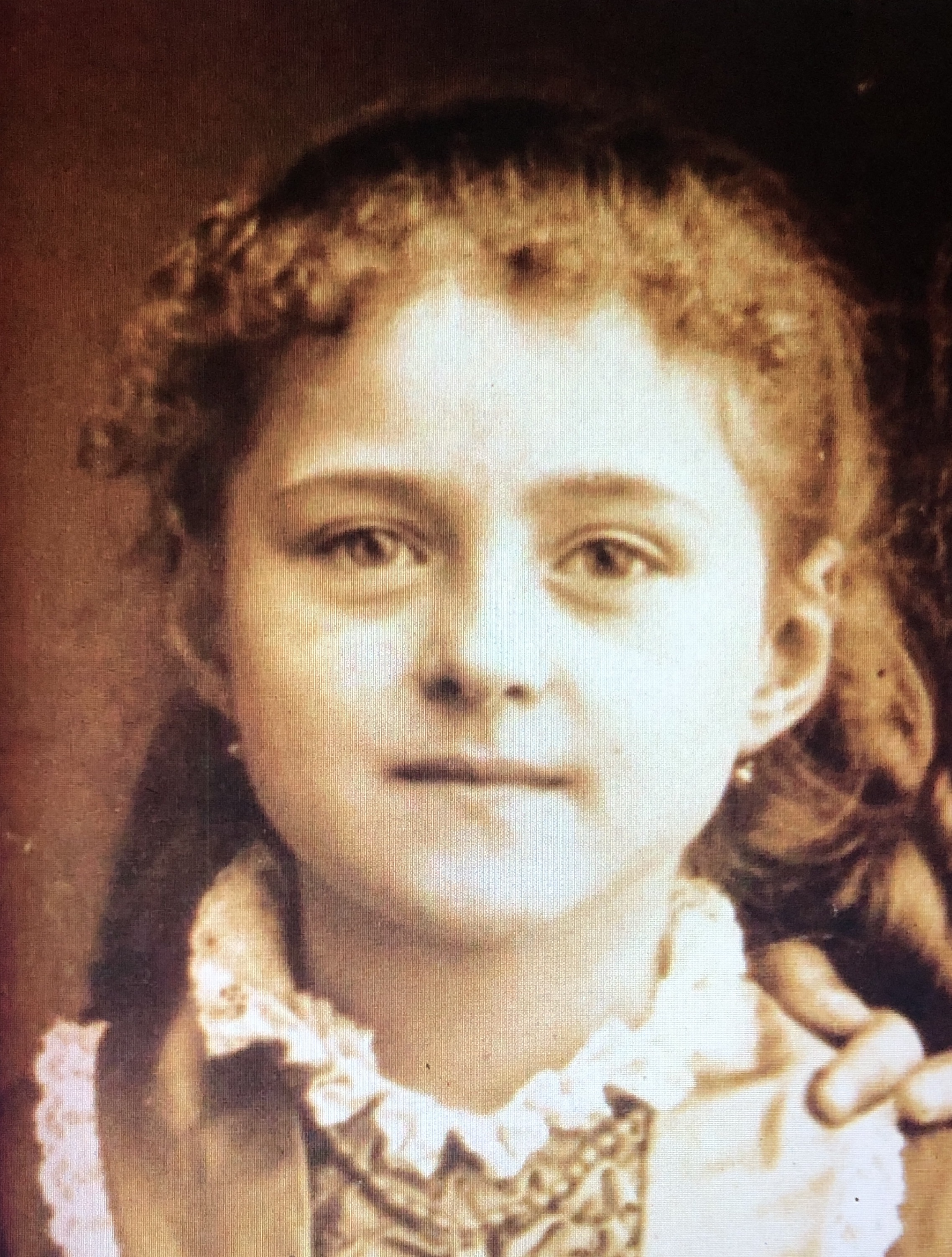
St. Therese shortly after her death
“Look at His adorable Face, His glazed and sunken eyes, His wounds. Look Jesus in the Face. There you will see how He loves us.”
“Your Veiled Gaze is Our Heaven…”
By St. Therese:
Holy Face Veil of Manoppello, Italy (Photo: Paul Badde/EWTN)
“O Adorable Face of Jesus! Our souls understand Your language of love; we want to dry Your gentle Face and to console You for the forgetfulness of the wicked. In their eyes You are still as one hidden; they look upon You as an object of contempt…
O Face more beautiful than the lilies and roses of springtime! You are not hidden from our eyes…The Tears that veil Your divine look seem to us like precious Diamonds which we want to collect to buy the souls of our brothers and sisters with their infinite value.
Veil of Manopello, Photo: Paul Badde/EWTN
From Your Adorable Mouth we have heard Your loving complaint. Since we know that the thirst which consumes You is a thirst for Love, we would wish to have an infinite Love to quench Your thirst…Beloved Bridegroom of our souls, if we had the love of all hearts, all that love would be for You! Then, heedless of our exile on the banks of Babylon, we will sing for your Ears the sweetest melodies. Since You are the true, the only Homeland of our hearts, we will not sing our songs in an alien land.
Eyes of Manoppello, photo: Paul Badde/EWTN
“The Living Face” of The Veil of Manoppello Photo: Paul Badde/EWTN
O Beloved Face of Jesus! As we await the everlasting day when we will contemplate Your infinite Glory, our one desire is to charm Your Divine Eyes by hiding our faces too so that here on earth no one can recognize us…O Jesus! Your Veiled Gaze is our Heaven!” –St. Therese of the Holy Face and the Child Jesus
St. Therese reliquary covered with rose petals. Shrine of the Holy Face of Manoppello. Nov. 4, 2006 (Photo: Paul Badde)
+++
Please pray for these dear Nuns who pray for us all. If you would like to contribute, donations may be mailed to:
The Discalced Carmelite Nuns, 73530 River Rd, Covington, LA 70435
Some of the Discalced Carmelite Nuns, and friends at a past Mass of the Roses in honor of St. Therese
May God reward you for your generosity!
Two “St. Therese” and one Sr. Teresita
Children distributing blessed roses photo: Patricia Enk
“O Jesus, whose adorable Face ravishes my heart, I implore Thee to fix deep within me Thy divine image and to set me on fire with Thy Love, that I may be found worthy to come to the contemplation of Thy glorious Face in Heaven.”
“Let the Little Ones come to Me” (Photo: Patricia Enk
“Then war broke out in heaven; Michael and his angels battled against the dragon. Although the dragon and his angels fought back, they were overpowered and lost their place in heaven. The huge dragon, the ancient serpent known as the devil or Satan, the seducer of the whole world, was driven out; he was hurled down to earth and his minions with him” (Rev. 12)
The center of this battle raging between Angels and demons — heaven and earth — is the Incarnate Word of God made flesh, Jesus Christ. It is Jesus who is rejected, reviled and persecuted. The devil wants to obliterate the Face of God, not only in churches that have vandalized and desecrated, but most especially, in the souls of human beings. The battle lines have been drawn between the culture of life and the culture of death. The devil’s particular object of hatred is the woman and the unborn. Some can no longer recognize that a child in the womb is a human being. Many persons reject their God-given identity as male and female. Racial hatred is causing deeper and deeper division, and human trafficking increases as humanity is blinded to the Face of God in their neighbor made in His image and likeness.
“When the dragon saw that it had been thrown down to earth, it pursued the woman who had given birth to a male child.” (Rev. 12:13)
Then I heard a loud voice in heaven say: “Now have salvation and power come, the reign of our God and the authority of his Anointed One. For the accuser of our brothers is cast out, who night and day accused then before our God. They defeated him by the blood of the Lamb and by the word of their testimony; love for life did not deter them from death. So rejoice, you heavens, and you the dwell therein! But woe to you, earth and sea, for the devil has come down upon you! His fury knows no limits, for he knows his time is short” (Rev 12). This battle has been fought since the beginning of Creation; between Christ’s Angels and the fallen angels or demons, with humanity at the center of the struggle. St. Michael and the Holy Angels have been given the authority from God by the power of His Holy Name to protect and defend God’s people against both human and diabolical enemies.
Holy Face surrounded by adoring Angels. St. Joseph’s Shrine in Gretna, Louisiana. Photo: Mary Engler
Devotion to the Face of Jesus is meant to repair mankind’s broken relationship with God, manifested in the world by the evil of blasphemy, sacrilege, and indifference. This work of reparation honoring His Holy Face and His Name–which is the concrete sign of God’s existence and our relationship with Him–has been given the protection and help of the Holy Angels. Sr. Marie St. Pierre was a French Discalced Carmelite nun to whom Our Lord gave revelations of the devotion to His Holy Face. She wrote on November 18, 1843:
Volto Santo in Sankt Michael (Photo: Paul Badde)
“One day during prayer, our Lord warned me in advance about the fury of Satan against the holy devotion, but He also consoled me, saying: ‘I give you My Name to be your light in the darkness and your strength in battle. Satan will do all in his power to crush this Work at its roots. But I assure you that the Holy Name of God will triumph, and it will be the Holy Angels who will gain the victory in the conflict.”
The victory will be won with devotion to the Holy Face
Prayer to Our Lady of the Angels, who in her humility, crushed the head of Satan:
Sublime Queen of Heaven, exalted Lady of the Angels, you have the power and commission given by God to crush the head of Satan. Therefore, we humbly beseech you to send to our aid your heavenly legions, so that, under your command and by your power, they may pursue the hellish spirits, fight them everywhere, ward off their impudent attacks, and fling them back into the abyss.
Who is like God? You holy angels and archangels, defend and protect us.
Good, kind mother, you remain always our love and our hope! Mother of God, send us the holy angels to defend us and keep the evil one far from us. Amen.
“Who is like God!” Detail – St. Michael holding the Holy Face by Cody Swanson
“This face is that of Jesus, and it is a great miracle, always love him.”
–Servant of God, Padre Domenico da Cese
Servant of God, Padre Domenico da Cese 1915-1978
In the photo above Padre Domenico appears to intently contemplate a square, white cloth. You will see in the many photos below, by Alexandra Prandell and Paul Badde, that what at first appears as a square, white cloth is actually the astounding Veil of Manoppello which bears the Holy Face of Jesus–a veil so sheer that one could read a book through it–and yet, according to the the light, the Face of Jesus appears. Padre Domenico personally believed that the veil was the Sudarium Veil placed on the Face of Jesus in the Tomb in addition to other burial cloths, and that the veil captured the first moment of the Resurrection.
Looking through the Veil of the Holy Face one may see through the open doors of the Basilica. (Photo: Alexandra Prandell)
Holy Face becomes visible in the light. (Photo: Alexandra Prandell)
The Holy Face as it appears in dim light. (Photo: Alexandra Prandell
The byssus Veil of Manoppello, which is thought to be one of the burial cloths of Jesus, photo: Paul Badde/EWTN
The Servant of God, known as Padre Domenico da Cese, was born on March 27, 1905; baptized Emidio Petracca, named for St. Emidio (c.279-309 AD), the saint who is invoked for protection in earthquakes. As a nine year old boy in 1915, young Emidio predicted the devastating Avenzzano earthquake in Italy. A 6.7 earthquake hit that region the next morning, killing more than 30,000 people, including two of his sisters and burying him and his father in the rubble of their church. A man he didn’t know pulled him from the rubble to safety, whose face he later recognized on his first visit as a friar to the Shrine of the Holy Face in Manoppello. When Padre Domenico knelt before the “Il Volto Santo” or Face of Jesus, the miraculous veil, he exclaimed, “This is the man who saved me from the rubble!”
A short time after Padre Domenico arrived in Manoppello the people were saying, “We have received a Saint!”
St. Pio called the Holy Face Veil of Manoppello “The greatest relic of the Church.”
Like his friend and fellow Capuchin, St. Padre Pio, the humble Padre Domenico was also a mystic and stigmatist who had extraordinary gifts of the Holy Spirit; such as the gift of “reading souls” and bi-location. Penitents who traveled from Manoppello to go to confession with Padre Pio were admonished by him for traveling such a distance when they already had a holy priest in Manoppello. He told them, ” Why did you come all the way here, so far? You’ve got a priest there, my spiritual son, he’s like me!” St. Padre Pio’s last documented case of bi-location, just before he died, was before the relic of the Holy Face of Jesus at the shrine of “Il Volto Santo” in Manoppello, where Padre Domenico was the rector. Padre Pio had told his fellow Capuchins that the Holy Face of Manoppello was the greatest relic of the Church.
In September of 1968, as Padre Pio lay dying in San Giovanni Rotundo (which is about 200 km south of Manoppello in Italy), his friend Padre Domenico da Cese had just unlocked the doors of the shrine of the Holy Face one morning, and was astounded to find Padre Pio in prayer, in the choir behind the altar before the sacred image of the Face of Jesus. St. Padre Pio spoke then to Padre Domenico saying, “I do not trust myself any more. I am coming to an end. Pray for me. Good-bye until we meet in Paradise.” Twenty-four hours later St. Padre Pio died in his cell in San Giovanni on September 23, 1968. Testimony was later given by witnesses that Padre Domenico da Cese was seen at Padre Pio’s funeral (another case of bi-location). A film was even taken (here) which shows Padre Domenico walking slowly in Padre Pio’s funeral procession, even though Padre Domenico had never left the shrine in Manoppello.
Padre Domenico shared with everyone his ardent love and devotion for the Holy Face of Manoppello, also known as “Il Volto Santo” — a miraculous veil which transmits supernatural beauty, and at the same time indescribable suffering. It is the Face of Mercy, Love and Peace. He would tell pilgrims, “This face is that of Jesus, and it is a great miracle, always love him.” Padre Domenico had done much research on the sheer byssus veil, the image of which is not made with any paint or pigment, and compared the iridescent quality of the colors to the wings of butterflies which also reflect iridescent color naturally. He also made studies of the Face on the Shroud of Turin, and its similarities to the Holy Face of Manoppello. He believed with all his heart that it was the face of the same man, and he was convinced that, like the Shroud of Turin, the Veil of Manoppello was one of the many burial cloths in Jesus’s tomb–the holy sudarium which covered the Face of Jesus in death–and also miraculously bears witness to His Resurrection.
The Holy Veil of Manoppello (Photo: Alexandra Prandell)
On September 13 of 1978 while visiting Turin to venerate the Holy Face on the Shroud during a rare exposition, Padre Domenico, who was a giant of a man, was hit by the smallest car, a Fiat, as he was stepping out into a street. After suffering for several days in a hospital, and forgiving the man who had hit him, he died on September 17th, offering his life for the Holy Face on the Veil–the Face of the man who saved him as a child.
The penetrating and gentle gaze of the Holy Face of Manoppello, Italy Photo: Paul Badde/EWTN
Prayer for the intercession of Servant of God Padre Domenico da Cese
Oh God, you gave Padre Domenico the capacity of recognizing in the poor and the suffering the very Holy Face of your beloved Son, whose devotion he promoted with such zeal, through his intercession obtain for me the humility of heart, and simplicity of the little ones to whom you have revealed the secrets of the Kingdom, and in my hour of trial give me the strength to overcome the seductions of evil in order to put Satan to flight, and to merit, at the end of my earthly pilgrimage, to be able to contemplate the Holy Face of Jesus in the glory of paradise.
Though unworthy as I am of your Divine favors, I ask that you might grant, through the intercession of your faithful servant Padre Domenico, the grace I humbly ask of you…
A dear friend and fellow Carmelite had been hospitalized not too long ago. She had an accident which caused multiple fractures and a great of deal pain. The next day, she sent a text which astonished me considering the suffering she was enduring. It was not a litany of complaints, but a testimony to her faith. The text read:
Where charity and love are… God is there!
(1 John 4:16)
This is wisdom. A life that is lived in love, seeking the Face of Christ, will find that love on the Cross. St. Louis de Montfort once wrote, “Wisdom is the Cross and the Cross is Wisdom.” The Cross is the school of Love. In order to love and seek Divine Incarnate Wisdom, who is Jesus, we need to know Him, and to know Him we must follow Him to the Cross. It is at the Cross that the Holy Spirit’s supreme gift of wisdom produces in us the most faithful resemblance to Jesus Christ.
Christ gave Himself to us by suffering on a Cross. When we suffer in Charity, and offer that suffering for the love of Jesus, we are giving something of ourselves that turns to joy. St. Therese of the Child Jesus and the Holy Face wrote about the profound mystery of the cross in her own spiritual life: “I found happiness and joy in the world, but only in pain.” The reason Therese said this was that she knew that the pain she suffered for souls, in the charity of total self-giving, purified her love and made it triumphant, resulting in a joy and a peace which nothing in the world could take away.
So many in the world are suffering now. Everywhere you turn, you meet the Cross! If only they would seek the Face of Christ in their pain, as my friend did, they would experience for themselves that Christian suffering is divinized suffering. Since incarnate Wisdom, Jesus Christ, had to enter heaven by the Cross, we must enter by the same way. In the pain that is offered through Christ, the Holy Spirit produces, by the gift of wisdom, a deep and profound peace in our soul, stilling the turbulent waters, and reflecting the most perfect image of the Face of the Son to the Father. As the Apostle Paul wrote, “But we all, with face unveiled, reflecting as in a mirror the glory of the Lord are being transformed into His very image from glory to glory, as through the spirit of the Lord” (2 Cor 3:18). Who can comprehend it? But this is the Wisdom of God: His Cross is His glory.
“Eternal Wisdom is a breath of the power of God, a pure emanation of the glory of the Almighty. Hence nothing defiled gains entrance into Him. He is the reflection of eternal light, the spotless mirror of God’s majesty, the image of His goodness” (Wisdom 7:25).
+
The ‘Wisdom’ Cross by St. Louis De Montfort
DENY
ONESELF
CARRY
ONE’S CROSS
TO FOLLOW
JESUS CHRIST
IF YOU ARE ASHAMED OF THE CROSS
OF JESUS CHRIST, HE WILL BE
ASHAMED OF YOU BEFORE HIS FATHER
LOVE
THE CROSS
DESIRE:
CROSSES
CONTEMPT
PAIN
ABUSE
INSULTS
DISGRACE
PERSECUTION
HUMILIATIONS
CALUMNIES
ILLNESS
INJURIES
MAY JESUS PREVAIL.
MAY HIS CROSS PREVAIL.
DIVINE LOVE
HUMILITY
SUBMISSION
OBEDIENCE:
COMPLETE
PROMPT
JOYFUL
BLIND
PERSEVERING
+
“Remember the surpassing worth of the wisdom that is yours. Bear in mind the kind of school in which you are to learn your skills, the rewards to which you are called. Mercy itself wishes you to be merciful, righteousness itself wishes you to be righteous, so that the Creator may shine forth in his creature, and the image of God be reflected in the mirror of the human heart as it imitates his qualities. The faith of those who live their faith is a serene faith. What you long for will be given you; what you love will be yours forever…Blessed are the pure of heart for they shall see God… what words can express the great happiness of seeing God? Yet human nature will achieve this when it has been transformed so that it sees the Godhead no longer in a mirror or obscurely but face to face–the Godhead that no man has been able to see. In the inexpressible joy of this eternal vision, human nature will possess what eye has not seen or ear heard, what man’s heart has never conceived.
The blessedness of seeing God is justly promised to the pure of heart. For the eye that is unclean would not be able to see the brightness of the true light, and what would be happiness to clear minds would be a torment to those that are defiled. Therefore, let the mists of worldly vanities be dispelled, and the inner eye be cleansed of all the filth of wickedness, so that the soul’s gaze may feast serenely upon the great vision of God.”
~Pope S. Leo the Great, from his sermon on the Beatitudes


























 Illumina Domine Blog - Devotion to The Holy Face