Pilgrimage – A Journey Toward the Face of God, Pt. 6

Pt. 6:  In Assisi – St. Francis “also had a Veronica”

St. Francis of Assisi

Assisi is an incredible and beautifully preserved medieval city, known best as the place where St. Francis was born, lived, and died. I had been in Assisi once before, in 2010, but during that time I saw only one site outside of the hotel–the tomb of St. Francis. There was a reason for that odd behavior, which I will explain. But, for this pilgrimage, I had wanted to include Assisi for the Year of Mercy pilgrimage, in thanksgiving to God for His infinite mercy, and for providing us here on earth with the help and friendship of the communion of saints in our most difficult trials on life’s journey.

Now, to explain why I had only seen St. Francis’s tomb on a previous pilgrimage–In 2010 I had been traveling with my husband and three youngest children, together with a pilgrimage group, primarily to see the Shroud of Turin, which at Pope Benedict XVI’s request, was being exhibited that year. While on the pilgrimage, my third son, back in the States, had fallen very ill. He had gone to the hospital and had been told it was most likely a virus from which he would eventually recover, but as the days went by, unable to eat, suffering from fever and chills; he could no longer even take care of himself. When we learned of the situation (communication was very difficult) we arranged for another older son to travel to help him, thinking any day he would improve.  However, it soon became clear there was something more serious going on. Jaundiced and very weak, he had lost nearly thirty pounds. He was dying. Doctors could find no cause for his illness from looking at x-rays and MRIs. One doctor reluctantly began an emergency exploratory surgery as there was nothing else left to do.

Altar in front of the tomb of St. Francis of Assisi

By the time we received this terrible news we were nearing the end of our trip and had arrived in Assisi.  Beset with grief and anxiety, unable to do anything for my son at that time, but pray, I went weeping to the tomb of St. Francis.  I prayed and cried, cried and prayed the entire day.  The friar stationed at the desk near the tomb gave me strange looks, for which I can hardly blame him.  I must have been a sight. When I tired of kneeling, I got up and walked along the tomb, and begged the intercession of the friends of St. Francis, as well, who are entombed in the surrounding walls.  Toward the back, behind the altar, in the same enclosure as the tomb of St. Francis, I found a name: “Here lies Jacoba, a holy Roman Noblewoman.”  A woman? Buried in the tomb by St. Francis? I knew nothing about her, but figured she must be someone holy if she’s buried with the saint, so I begged her intercession as well.

Toward evening we received news from the hospital–the surgeon had discovered that our son’s appendix had ruptured, weeks before, in an undetectable manner, leaking toxins into his body and closing off the portal vein to his liver.  He was still a very sick young man, but would recover.  (His recovery took nearly three months.)  I felt certain that I owed St. Francis  and the saints at his tomb a debt of gratitude for petitioning, on my behalf, for my son before the throne of God–which is why I wanted to return one day to offer thanks.  So, the day had come when we could give thanks at St. Francis’s tomb. We knelt in gratitude before the altar, and this time with the additional joy of thanksgiving that our son and his wife had just had their first child,a son.

Frate Jacopa de Settesoli
Frate Jacoba de Settesoli

We went on to see what I had missed in the Basilica; the incredible frescoes and relics. In the Relic Chapel after seeing St. Francis’s patched and tattered tunic and other precious relics, I stood in front of a display case which contained a beautifully embroidered silken veil and read the name, “Jacoba Settesoli.” I read on, “Like Jesus on his way to Calvary, Francis also had a Veronica.” (Veronica is the woman, tradition tells us, who wiped the Face of Jesus. She is the model of those who make reparation to the Face of Christ.)

Lady Jacoba was a noblewoman and widow, with two children from Rome, who became a follower of St. Francis. After having heard him preach she sought his guidance on how to be charitable.  When Francis traveled to Rome, he would stay with Lady Jacoba as her guest and she cared for him when he was sick. She gave some of her property in Trastevere to the brothers, which they used to care for lepers.  She gave up her life of comfort in order to help the poor.  Woman were not normally permitted to be in company of the brothers, however, St. Francis made an exception in her case, jokingly referring to her as “Brother Jacoba.”

As Francis lay dying he sent an urgent letter by messenger to Lady Jacoba: “Brother Jacoba, the servant of the Most High, health in the Lord and communion in the Holy Ghost.  Dearest, I want you to know that the blessed Lord has done the grace of revealing that the end of my life is nigh.  So, if you want to find me still alive, hurry to Santa Maria degli Angeli as soon as you receive this letter.”  He went on to request that she bring a gray cloth to wrap his body in, candles for burial, and almond cookies that she had made for him in Rome when he was sick. Before the messenger arrived in Rome, Lady Jacoba had already anticipated St. Francis’s needs by the light of the  Holy Spirit and was on her way to Francis’s deathbed.

St. Francis’s biographer, Bl. Thomas Celano, wrote that Lady Jacoba brought not only the gray cloth, the candles, and the almond cookies, but also a pillow for his head, and a “sindomen pro facie” (a veil to cover his face in death, which was displayed in the Relic Chapel). So, St. Francis, an alter Christus who bore the stigmata, also had his “Veronica” in Lady Jacoba, who brought him consolation in his passion.  (to be continued in Pt. 7)
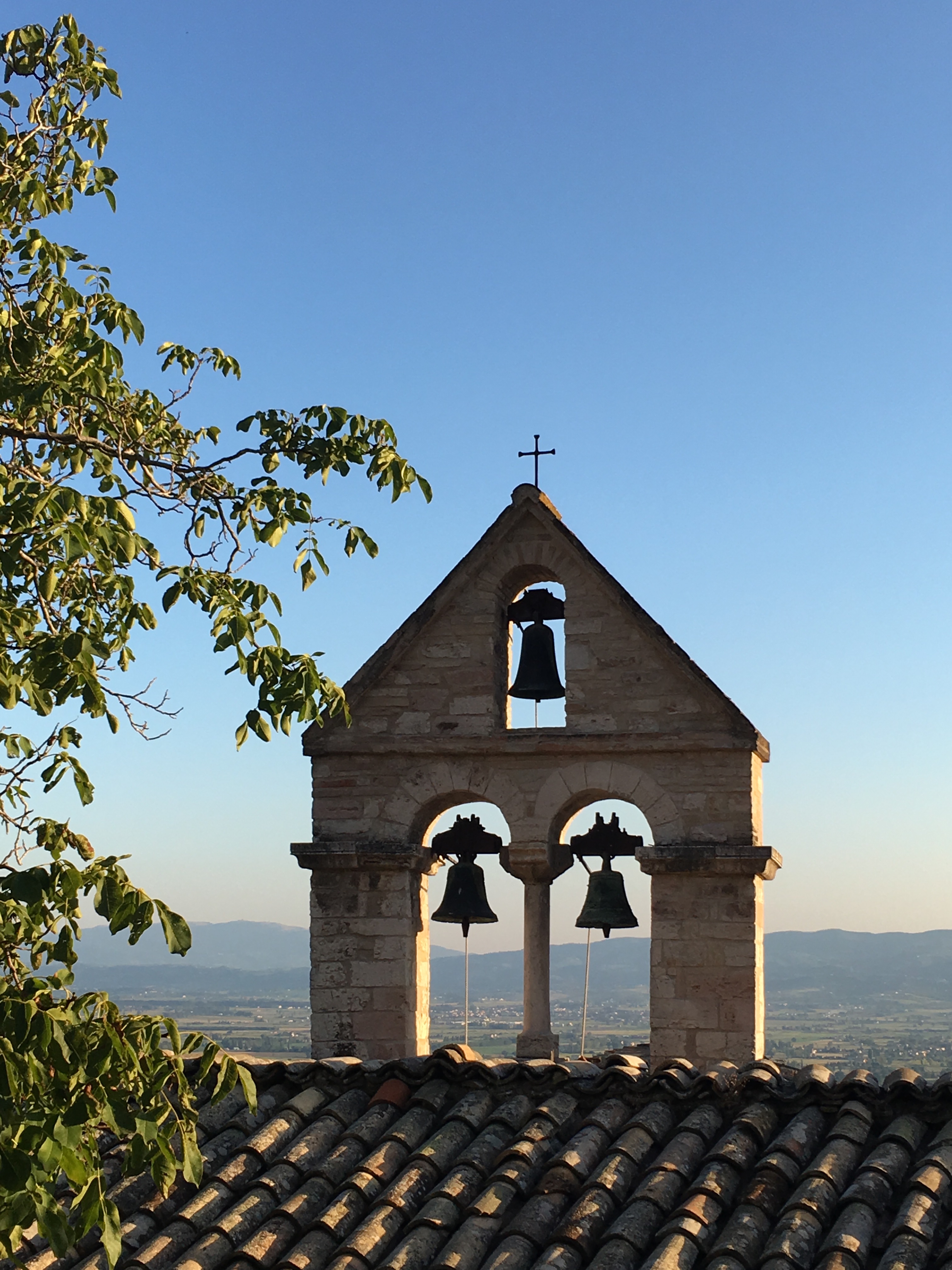
The bells of the church of St. Stephen the Martyr which rang by themselves when St. Francis died.
The bells of the church of St. Stephen the Martyr in Assisi which rang by themselves when St. Francis died.


Pilgrimage – A Journey toward the Face of God, Pt. 5

Pt. 5: The temple of the Holy Spirit in LoretoIMG_0611

Silent, peaceful, humble, gentle, pure…Immaculate! These words describe Mary, the first temple of the Holy Spirit, and may also be applied to the Holy House of Loreto as well.  One has a great sense of the presence of the Holy Spirit resting in this place. There is something very touching about the respectful way that the pilgrims silently enter the Holy House. They then stand or kneel, leaning against, or touching the holy walls in order to feel closer to Mary–touching the very walls that the Holy Family touched.  Just before the bells for the Angelus ring, the Holy House fills completely and the Angelus is recited, “The Angel of the Lord declared unto Mary, and she conceived by the Holy Spirit. Hail Mary, full of grace…” Here the Holy Face of Jesus was formed and hidden in the womb of the Blessed Virgin Mary. How great was her longing to see the Face of her Son and Messiah!

Back wall, with "Gabriel window" of the Holy House
Back wall, with “Gabriel window” of the Holy House

“The House of the Holy Family! It was the first temple, the first church, on which the Mother of God shed her light through motherhood. She irradiated it with the light which comes from the great mystery of the Incarnation; from the mystery of her Son.”–Pope St. John Paul II

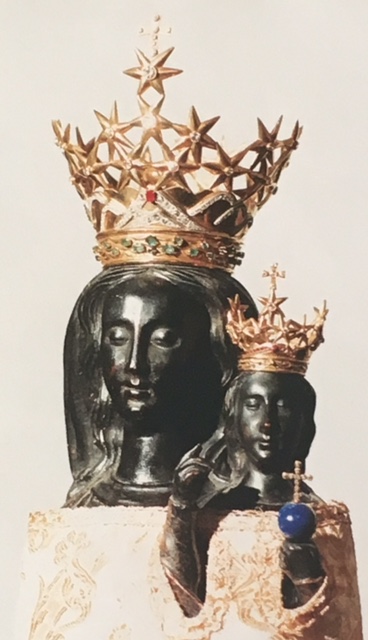
Our Lady of Loreto
Our Lady of Loreto

The grand exterior of the Basilica hides a message, just as it hides the humble Holy House in its bosom; it is a message for all pilgrims, that we must become like Mary, whose soul proclaimed only “the greatness of the Lord” (Lk. 1:46-55). The humble, simple work of everyday life was sanctified here, where the Face of God was present each day within the family. God was attracted by Mary’s lowliness and “He who is mighty” did great things for her–now all generations call her blessed!

Year of Mercy volunteers were available near the entrance of the Holy Door and handed us a very helpful pamphlet in English guiding us through the Basilica, both physically and spiritually. Using the guide, we offered prayers at particularly meaningful chapels beginning with the Baptismal Font inside the Holy Door where we renewed our baptismal promises. We spent the entire day in that sacred place and probably only saw a fraction of the beautiful artwork and craftsmanship lavished on the chapels, each one vying to give greater glory to God by the work of talented hands of many countries of the world.  Unfortunately, I have no pictures to share as a common phrase I heard in English everywhere was, “No photos, please!”

There is one more thing I’d like to mention about Loreto before moving on to Assisi and that is this: pilgrimages are filled not only with minor inconveniences, or events meant to help us grow in virtue, but also signs.  Signposts, you might say, along the pilgrimage path to remind us to keep going in the right direction.  We had a big sign, right outside the window of our hotel; it was not only one of sight, but of also sound–in fact, a never-ending “coo,” “coo,” “coo,” “coo.”  There was a pigeon coop directly outside the window of our room for some reason. Whereas Mary was a temple of the Holy Spirit, our temples, it seemed were more like a pigeon coop: Noisy, messy and in need of regular cleaning.  I’d say it was a good reminder to go to Confession.  God isn’t always silent; sometimes, He speaks loud and clear. We couldn’t miss that one. (to be continued in Assisi Pt. 6)

IMG_5711

Pilgrimage – A Journey Toward the Face of God, Pt. 4

Pt. 4: “Here the Word was made flesh” – The Holy House of Loreto

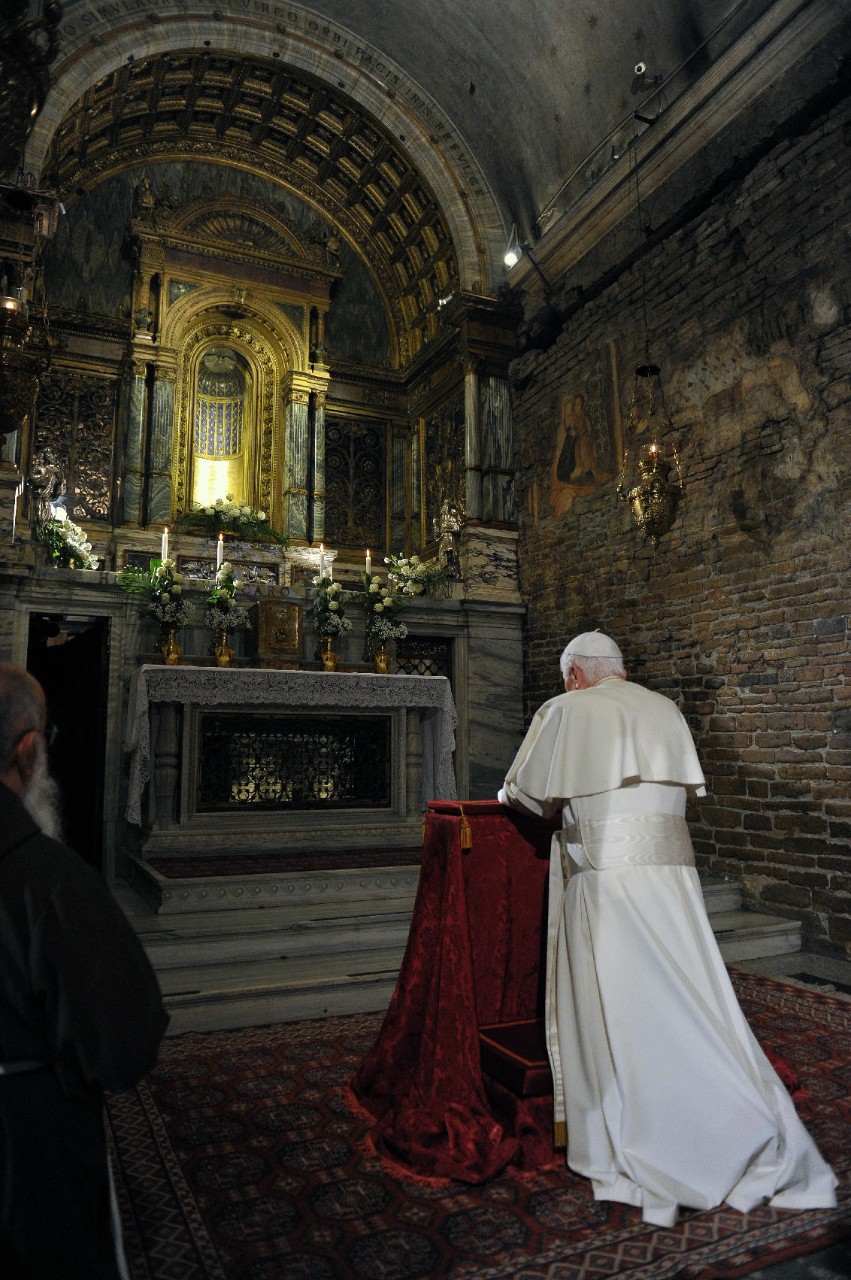
Pope Benedict XVI in the Holy House of Loreto

“While we too seek other signs, other wonders, we do not realize that He is the real sign, God made flesh; He is the greatest miracle of the universe: all the love of God hidden in a human heart, in a human FACE.”–Pope Benedict XVI

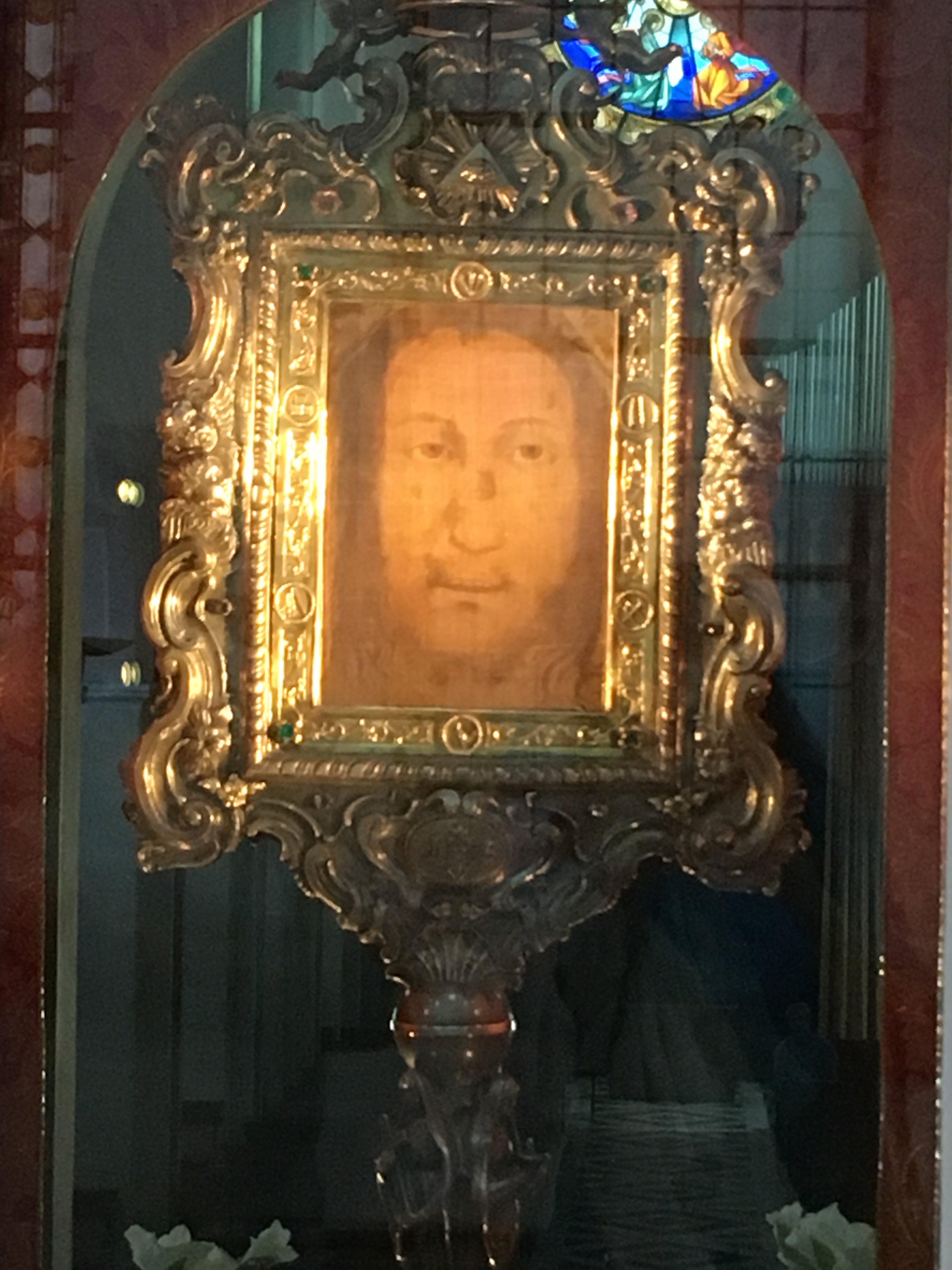
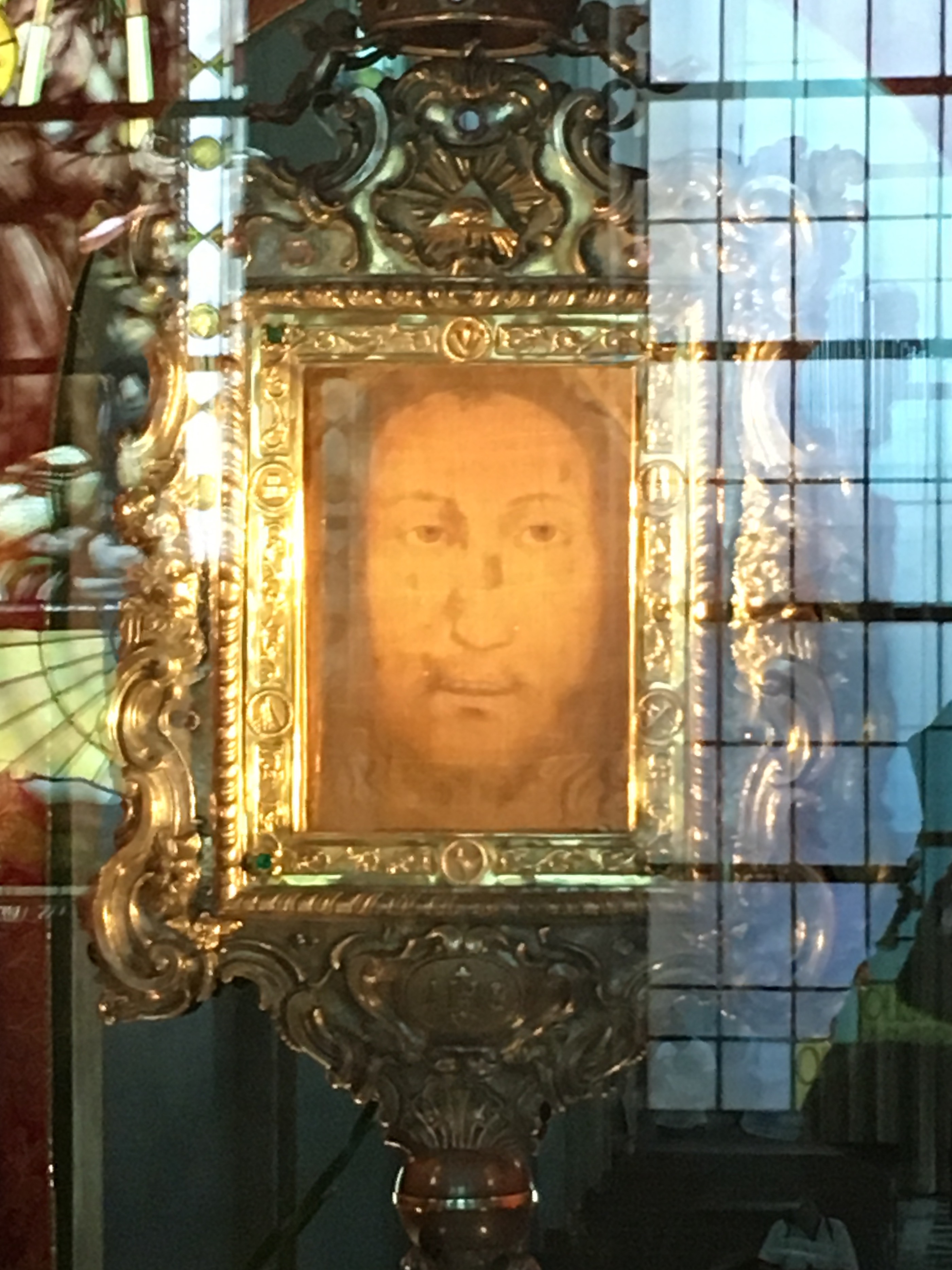
Holy Face of Manoppello Photo: Patricia Enk
Holy Face of Manoppello
Photo: Patricia Enk

Our last morning in Manoppello the skies cleared and it promised to be a beautiful day and evening on which to hold the procession in honor of the Holy Veil.  After Mass I spoke again to Sr. Petra-Maria about the miraculous image.  The Holy Veil of Manoppello seems to be an icon written in light by the Holy Spirit, telling the whole of the Gospel in one human Face–the Word became flesh and dwelt among us, He suffered and died for us, He rose again!  We walked slowly around the reliquary, looking at the Face of Jesus from each angle, His eyes following us.  I wondered if the world has gotten so accustomed to man-made marvels of technology, flashing images and special effects, that it can no longer recognize a true miracle.  Sr. Petra-Maria and I agreed that there was only one thing more marvelous and miraculous in this world than the Holy Veil and that is the continuing miracle of the Body, Blood, Soul and Divinity of Jesus in the Eucharist!

Sr. Petra-Maria had also had given me a glimmer of hope of attending the procession that nightIMG_5629 after all.  She said the Sanctuary of Loreto, where we were heading, was only an hour or so away.  We could possibly make it back for the procession after we checked into our hotel in Loreto.  I paid one more visit to the Holy Veil before regretfully parting. Later, we left Manoppello by taxi to pick up a rental car in Pescara and then drove north along the beautiful blue Adriatic Coast toward Loreto.  The drive was pleasant and filled with beautiful glimpses of the blue Adriatic.  About forty minutes into the drive, we suddenly slowed to a crawl–there had been an accident ahead that was being cleared.  The delay would take nearly 3 hours, making it too late to get back for the procession in Manoppello that night. For hundreds of years, the Veil of Manoppello was only taken out in procession once a year, on August 6th.  Later, there would be an additional procession on the third Sunday in May.  It had been very important to me, for reasons only God knows, to be part of that procession that evening, but now, it did not seem that it was God’s Will for us to be there.

The Basilica of the Holy House of Nazareth in Loreto, Italy

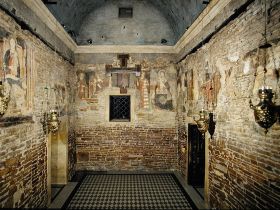
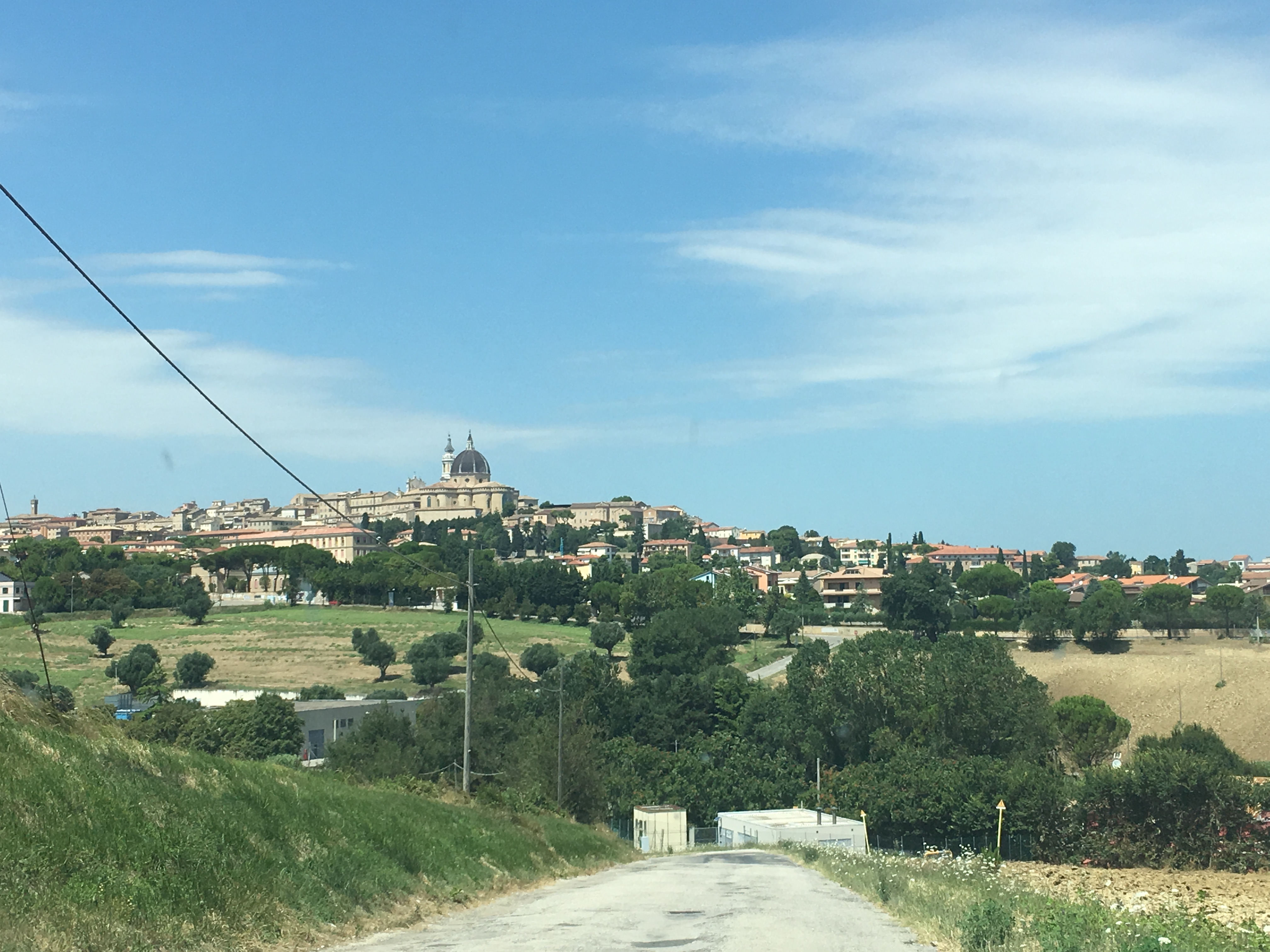
The Basilica of Loreto soon appeared on the horizon and I turned my thoughts to the Blessed Mother and the Holy Spirit.  “The Holy House of Loreto, the first shrine of international renown dedicated to the Blessed Virgin, has been a true Marian center of Christianity for several centuries.”–Pope St. John Paul II  According to tradition, the Basilica contains the Holy House of Nazareth– it was the birthplace of Mary, the place of the Annunciation, where the mystery of the Incarnation of the Word in Mary’s womb took place through the power of the Holy Spirit, and it was the home of the Holy Family.

The Angel said t Mary: "The Holy Spirit shall come upon thee and the power of the Most High shall overshadow thee." (Lk.1:35)
The Angel said to Mary: “The Holy Spirit shall come upon thee and the power of the Most High shall overshadow thee.” (Lk.1:35)

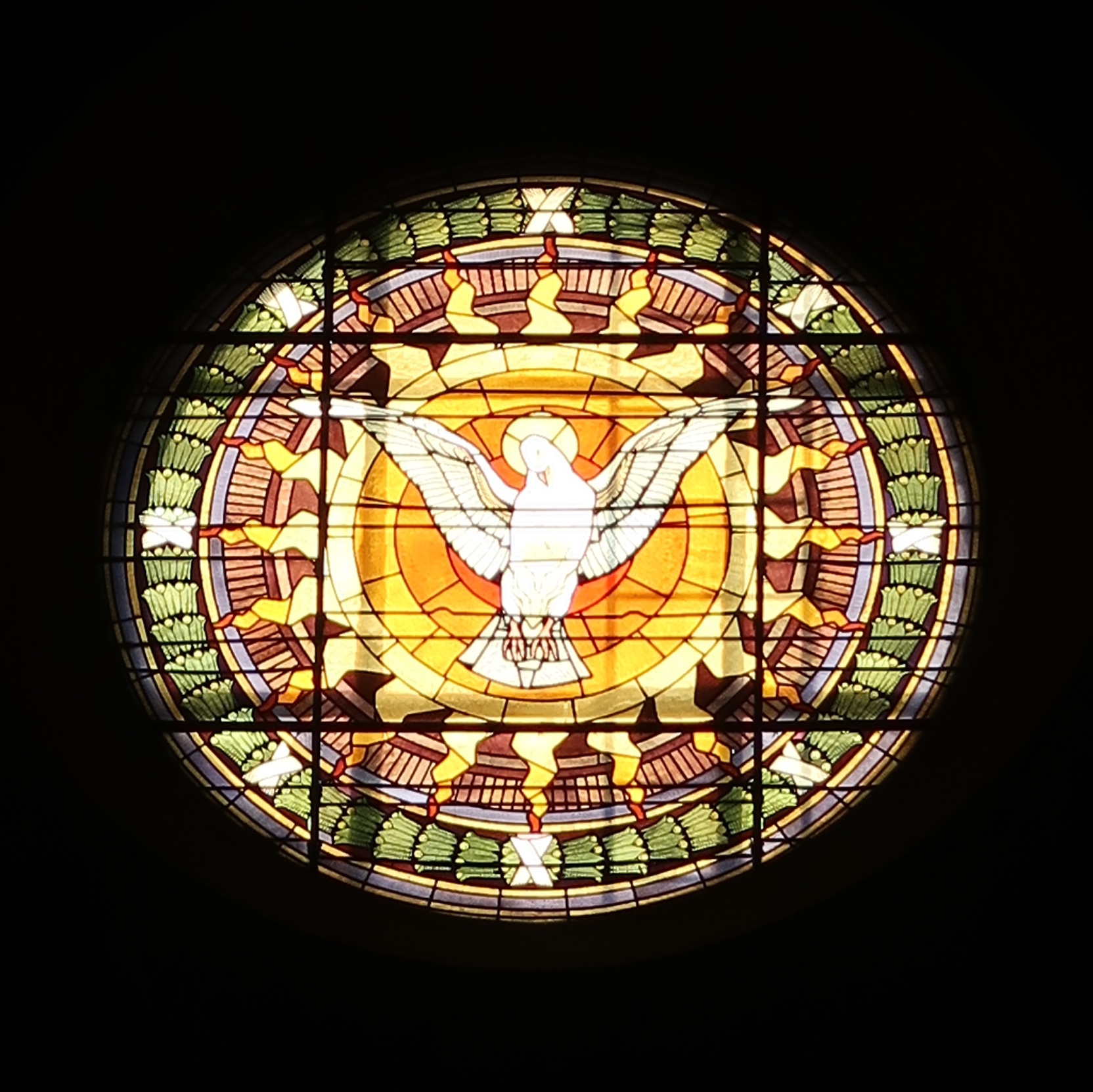
“And where could one speak more effectively of the Holy Spirit’s role than in the Shrine of Loreto, which recalls the moment and the place where He fulfilled the most supreme of His “life-giving” deeds, giving life to the humanity of the Saviour in Mary’s womb? For this reason the Holy House is first and foremost the shrine of the Holy Spirit. Christians who come here feel the need to invoke the Divine Paraclete to obtain His seven holy gifts in order to remain faithful to their baptism through which they were united to Christ and made to participate in His grace of Redemption.”–Pope St. John Paul II

If you have never heard of the Holy House of Loreto–to make a long history short–in 1291, when the Holy Home in Nazareth was in danger of being destroyed by the Muslims, it was transported by Angels across the Mediterranean Sea, then several more times before resting finally, on December 10th in 1294, in the middle of the road on the hill of Loreto.

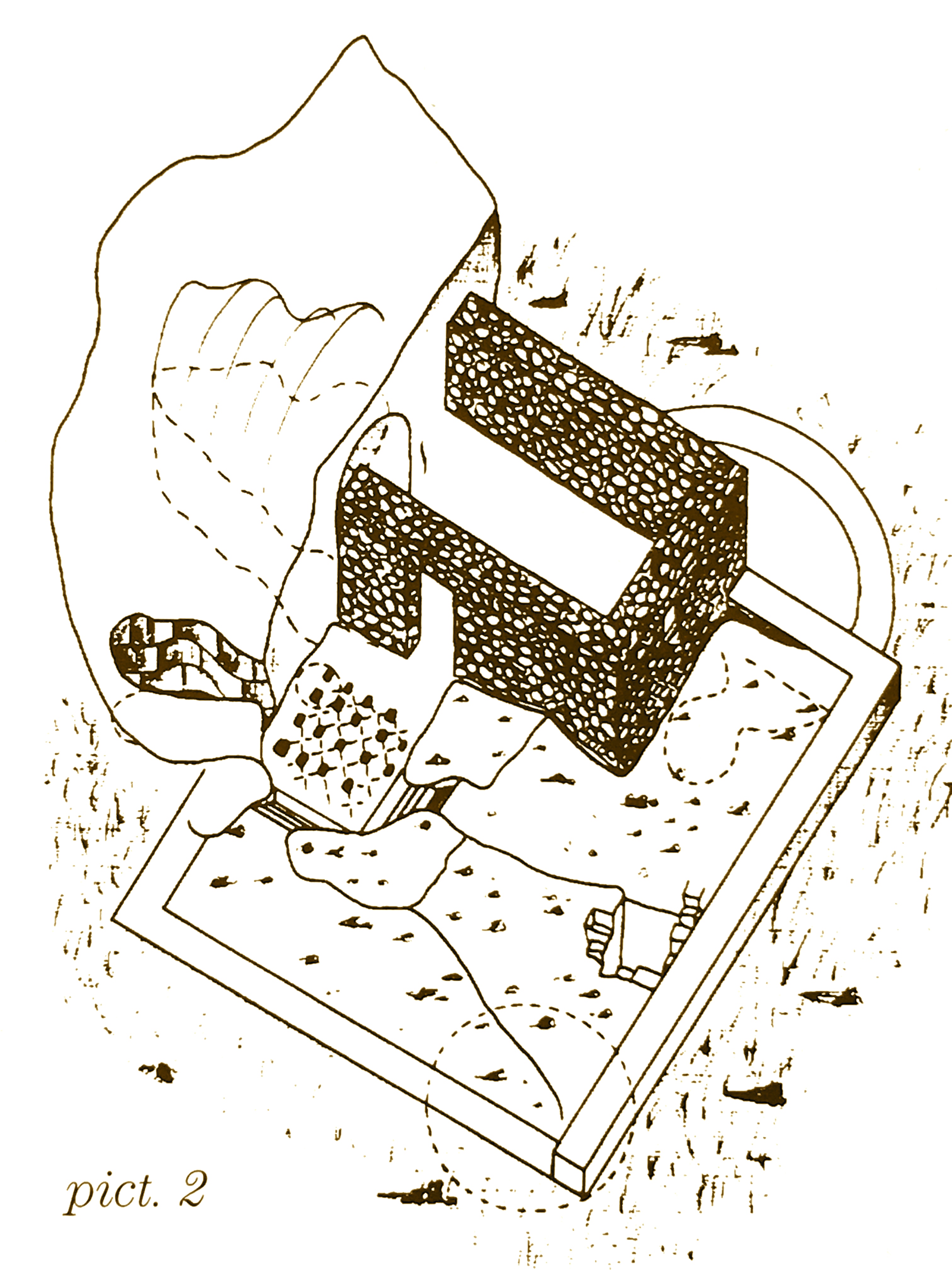
Diagram of the Home of Loreto and the Grotto at Nazareth in the Holy Land highlighting that the two parts were contiguous and coexisted.

Research has discovered that the small home consists of three original brick walls, approximately three meters high, complete with graffiti and relics from the Crusaders in Holy Land and is standing without foundation on an ancient road. In it’s original form, the Holy House has only three walls because the eastern side, where the altar stands, opened onto a Grotto. (diagram) The structure and the brick of the home is not of the type found in the area of Loreto. A technical comparison between the Holy House of Loreto and the Grotto at Nazareth show the three walls and measurements match exactly the fourth wall, which is a grotto and the original foundation which can still be seen in Nazareth. (Diagram of the Home of Loreto and the Grotto at Nazareth in the Holy Land highlighting that the two parts were contiguous and coexisted.)

We entered the shrine, prayed in the Holy House and then again in the exquisitely beautiful French Chapel which contains the Blessed Sacrament.  After leaving the shrine to find something to eat (gelato for dinner works for me) we took a walk around the outside walls. I was still feeling a little sad about missing out on the procession in Manoppello when we came back along the side of the Basilica toward the piazza.  Lo’ and behold! I found myself in a procession!

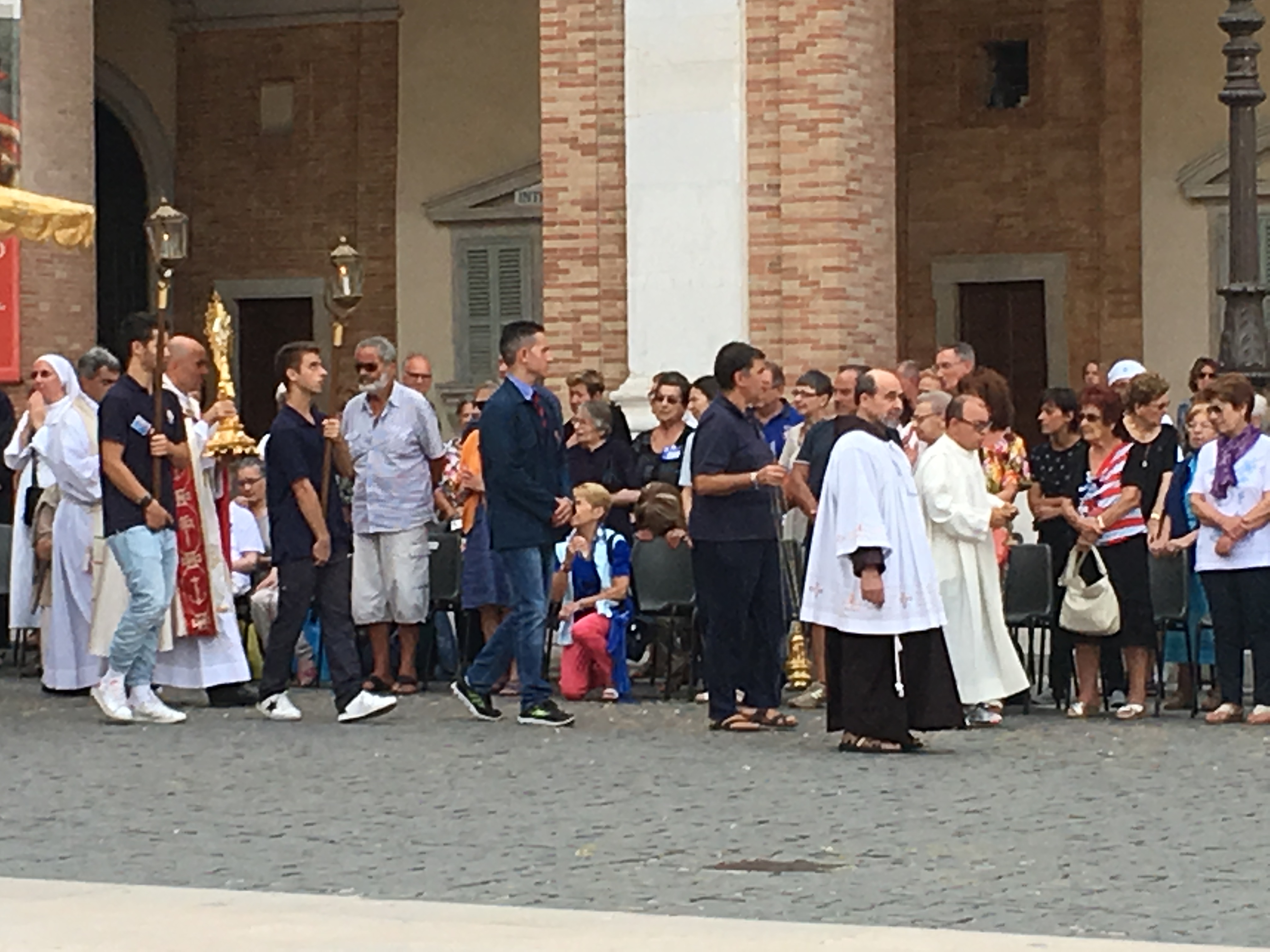
Eucharistic procession and rosary for the sick and disabled
“In the Eucharist, the Face of Christ is turned toward us.”–St. J.P.II     Eucharistic procession and rosary for the sick and disabled

As the priest holding the monstrance made his way around the piazza he paused and blessed us.  By seeking Mary in the Holy House of Loreto, she had led me to the Eucharistic Face of her Son and the Face of Jesus in my neighbors around me.  The Holy Spirit was at work! I was able to honor Him in a procession of the Holy Face after all.  Praised be Jesus!  (…to be continued in Pt. 5)


Pilgrimage – A Journey Toward the Face of God, Pt. 3

Pt. 3  The Steps of Pilgrimage – Works of Mercysteps

While the world media moves on rather quickly from disasters, the Christian remains at the foot of the Cross, because it is Jesus who suffers in our neighbor. Though the cameras and reporters depart, for some, just recovering from shock, it is just the beginning: Suffering from the deaths of loved ones, loss of belongings and means of support, living in hot tents or shelters, burying the dead, trying to put back together their lives. These are the steps of our pilgrimage: “Amen, I say to you, whatever you did for one of these least brothers of mine, you did for me.” (Mt. 25:40) We can become the face of Jesus to others.

“The Lord Jesus shows us the steps of the pilgrimage to attain our goal: ‘Judge not, and you will not be judged; condemn not, and you will not be condemned; forgive, and you will be forgiven; give, and it will be given to you; good measure, pressed down, shaken together, running over, will be put into your lap. For the measure you give will be the measure you get back. (Lk 6:37-38) …It is my burning desire that, during this Jubilee, the Christian people may reflect on the corporal and spiritual works of mercy…to feed the hungry, give drink to the thirsty, clothe the naked, welcome the stranger, heal the sick, visit the imprisoned, and bury the dead. And let us not forget: to counsel the doubtful, instruct the ignorant, admonish sinners, comfort the afflicted, forgive offenses, bear patiently those who do us ill, and pray for the living and the dead.” –Pope Francis, Face of Mercy 

Louisiana floods
Louisiana floods

As the rain poured down in Manoppello, we received word from our family that the state of Louisiana was once again flooding–which renewed anxiety and fear for our friends and loved ones back home.  Our area had already suffered greatly from floods back in March. Facing our fears and trusting in God is always a part of pilgrimage. And now, the heartbreaking news of the devastating earthquake in central Italy as well as the ongoing suffering from the terrible floods here in Louisiana remind us to seek the Face of Jesus in our neighbor on our life’s pilgrimage.

Image of Jesus crucified which hung in Bl. Mother Teresa's room. It was one of her last sights before dying.
Image of Jesus crucified which hung in Bl. Mother Teresa’s room. It was one of her last sights before dying.

In a few short days, we will celebrate the canonization of Mother Teresa of Calcutta.  Blessed Mother Teresa heroically carried out the corporal and spiritual works of mercy by being the Merciful Face of Christ to others and by seeing the Merciful Face of Christ in others and most especially in the Eucharist, from which she and the Missionaries of Charity drew the grace and strength to serve Jesus “in the distressing disguise of the poor.”

“Seeking the Face of God in everything, everyone, all the time, and His hand in every happening; This is what it means to be contemplative in the heart of the world.  Seeing and adoring the presence of Jesus, especially in the lowly appearance of bread, and in the distressing disguise of the poor.”  –Bl. Mother Teresa of Calcutta

Mother Teresa source: Flicker
Mother Teresa
source: Flickr

Let us follow the example of Mother Teresa and seek the face of Jesus in our neighbor by whatever means we have and remember in our prayers all those who have suffered and are continuing to suffer in the world. “Amen, I say to you, whatever you did for one of these least brothers of mine, you did for me.” (to be continued in Pt. 4...)

Please pray for the victims of Italian Earthquake

Please pray for those affected by the earthquake in Italy in Central Italy.  It looks like the area which was hit is perhaps within an hour of The Holy Face Sanctuary.  Jesus is present in all who suffer and can bring good, we pray, even out of this catastrophic event.

“O, Lord of Hosts, restore us; Let Your Face shine on us,that we may be saved.” (Ps. 80:4)

Venerable Padre Domenico da Cese, please intercede for the deceased, trapped

Servant of God, Padre Domenico da Cese

victims, and the rescuers. 

(Padre Domenico, predicted, in 1915, a devastating earthquake as a small boy, which hit that region the next morning, killing 30,000 people, including two of his sisters and burying he and his father in the rubble of their church.  A man he didn’t know, pulled him from the rubble to safety, whose face he later recognized when he first visited the Shrine of the Holy Face as the Face of Jesus on the miraculous veil.  When he knelt before the Holy Face on the Veil, he exclaimed, “This is the man who saved me from the rubble…” He asked to remain at the Shrine and was there until the time of his death.)

Pilgrimage – A Journey Toward the Face of God, Pt. 2


photo by Patricia Enk

Pt. 2: The Feast of the Transfiguration in Manoppello

“Jesus took Peter, James and John…and led them to a high mountain by themselves.  And He transfigured before them; His Face shone like the sun and His clothes became as white as light…Lord, it is good to be here.” (Mt. 17:1-2,4)

There are several important feasts of the Holy Face–Shrove Tuesday (the day preceding Ash Wednesday) and Good Friday are two, each focused on reparation to the Face of Christ. In Manoppello, the day the Holy Veil arrived in the hands of a mysterious stranger is celebrated as a joyful feast in May, as well as a celebration on August 6th, the feast of the Transfiguration.

Being in Manoppello on the feast of the Transfiguration reminded me of an important event in the life of  St. Therese. The day before the feast of the Transfiguration, a few weeks before her death,  St. Therese of the Holy Face and the Child Jesus lay dying.  Her sisters brought her a picture of the Holy Face and placed it where she could see it, pinned to her bed curtains.  St. Therese exclaimed, “Oh, how much good that Holy Face has done me in my life!” The Transfiguration was always celebrated in the Lisieux Carmelite convent by honoring the Holy Face.  St. Therese had, on a previous feast of the Transfiguration, sprinkled the image with perfume and tossed rose petals before it. (I always wondered why Discalced Carmelite nuns had the perfume, but, after all, it was France!) It was on the Transfiguration that Therese, along with a few companions, made a solemn consecration to the Holy Face as an extension of their Oblation to His Merciful Love, desiring to be “Veronicas” by consoling Jesus in His Passion and offering souls to Him. The Transfiguration is always a preparation for the mystery of the Cross.

The Divine Prisoner, Holy Face of Manoppello photo: Patricia Enk
The Divine Prisoner, Holy Face of Manoppello
photo: Patricia Enk

“O Beloved Face of Jesus!  As we await the everlasting day when we contemplate Your infinite Glory our one desire is to charm Your Divine Eyes by hiding our faces too, so that here on earth no one can recognize us. O Jesus!  Your veiled gaze is our heaven!”–St. Therese

When we visited Manoppello, the blessed day of the Transfiguration was to be celebrated at the Sanctuary Basilica of the Holy Face by bringing the Veil in procession from the reliquary high above the altar to another in front of the altar where it could be viewed and venerated on all sides by the faithful.  Music and celebrations were planned in the piazza for the day and in the evening there was to be a solemn procession through the lighted streets culminating with Benediction.

Lighted streets in Manoppello ready for the feast day
Lighted street in Manoppello ready for the feast day procession

I had planned my pilgrimage around the feast of the Transfiguration after seeing Paul Badde‘s beautiful photos of the procession in honor of the Holy Face on Pentecost, May 15th. I had such a great longing to honor His Holy Face in this way by participating in a jubilant procession such as the one on Pentecost!  It was the whole impetus for my making the pilgrimage and I looked forward to the event with great joy and expectation.  However, man’s plans are not God’s plans and “into every life a little rain must fall” and so it did. It rained, and it rained and it rained.  Cats and dogs!  The procession was cancelled, or rather post-poned till Sunday night when the weather was more favorable and when I would not be there.

Naturally, I was disappointed but, still, here He was before me in the church, so that is where I remained for the day. The previous day Sr. Petra-Maria had given me a tour of the beautiful museum and filled my mind and heart with the research, history, treasures, and mysteries of the Sacred Veil of Manoppello.  I haven’t spoken much about the Holy Veil itself so far, for one reason: that it is too great to be expressed in words.  But I will make a pitiful attempt, like the photographs, which–although some are quite beautiful–can never fully capture what is seen by the viewer. The Veil of Manoppello is an image “not made by human hands” it is a miracle of light and a reflection of Creation–ever changing, ever new.  It is dark, it is brilliant, it is somber, joyful, always merciful, always peaceful. If you see nothing, stand at a different angle–and there He is!  Sr. Petra-Maria told me that there is one angle from which you can always see the image–but “you must become like little children.” (Mt. 18:3)

Veil of Manoppello Photo: Paul Badde
Veil of Manoppello
Photo: Paul Badde

I can attest to the truth of what Sr. Petra-Maria said, “you must become like little children.” Back in 2012, when I first climbed the stairs and stood high behind the altar to view the Veil, the Face of Jesus appeared, bruised, bloodied, swollen. I could see the marks from thorns, the torn beard, His eyes peaceful yet filled with tears.  I then knelt down in prayer and sorrow.  From this angle, the perspective of a little child, I saw the Holy Face anew, no longer bloodied and bruised, but as though a living reflection in a mirror, and once held in that Gaze my heart has been captivated by it ever since.  It is the Face of Mercy!

Throughout the day, as I prayed,  I was greatly edified by the reactions of the people who streamed in to pay their reverence and express their love.  I stayed until evening when my husband arrived, umbrella in hand, and we made our way through the pouring rain back to the hotel. The next morning after Mass we would leave the Holy Face Sanctuary for the Sanctuary of the Holy House of Loreto. (to be continued in Pt. 3)

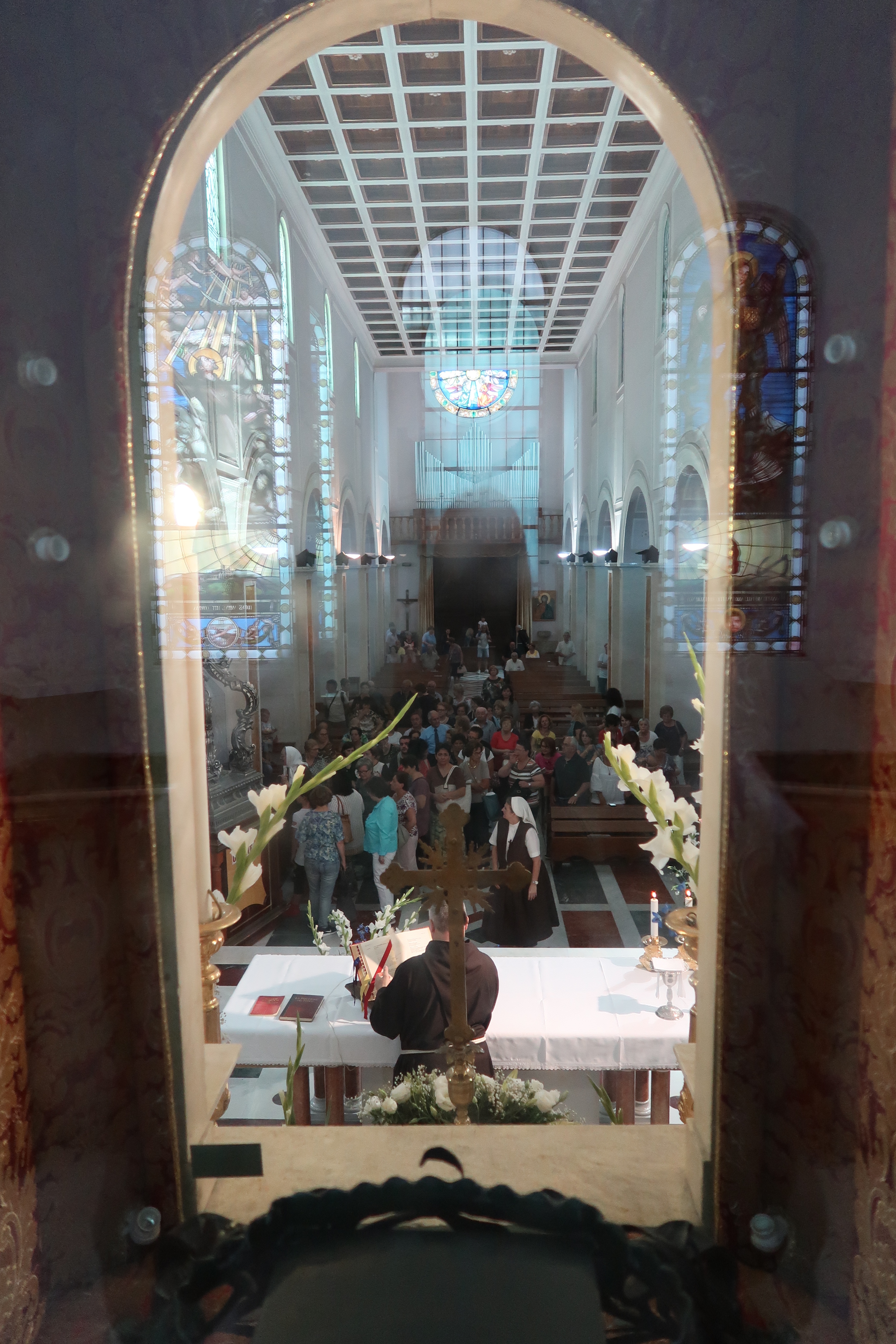
View from the empty window above the altar into the church photo: Patricia Enk
View from the empty window above the altar into the church
photo: Patricia Enk
Feast of the Transfiguration veneration of The Holy Face photo: Patricia Enk
Feast of the Transfiguration veneration of The Holy Face
photo: Patricia Enk
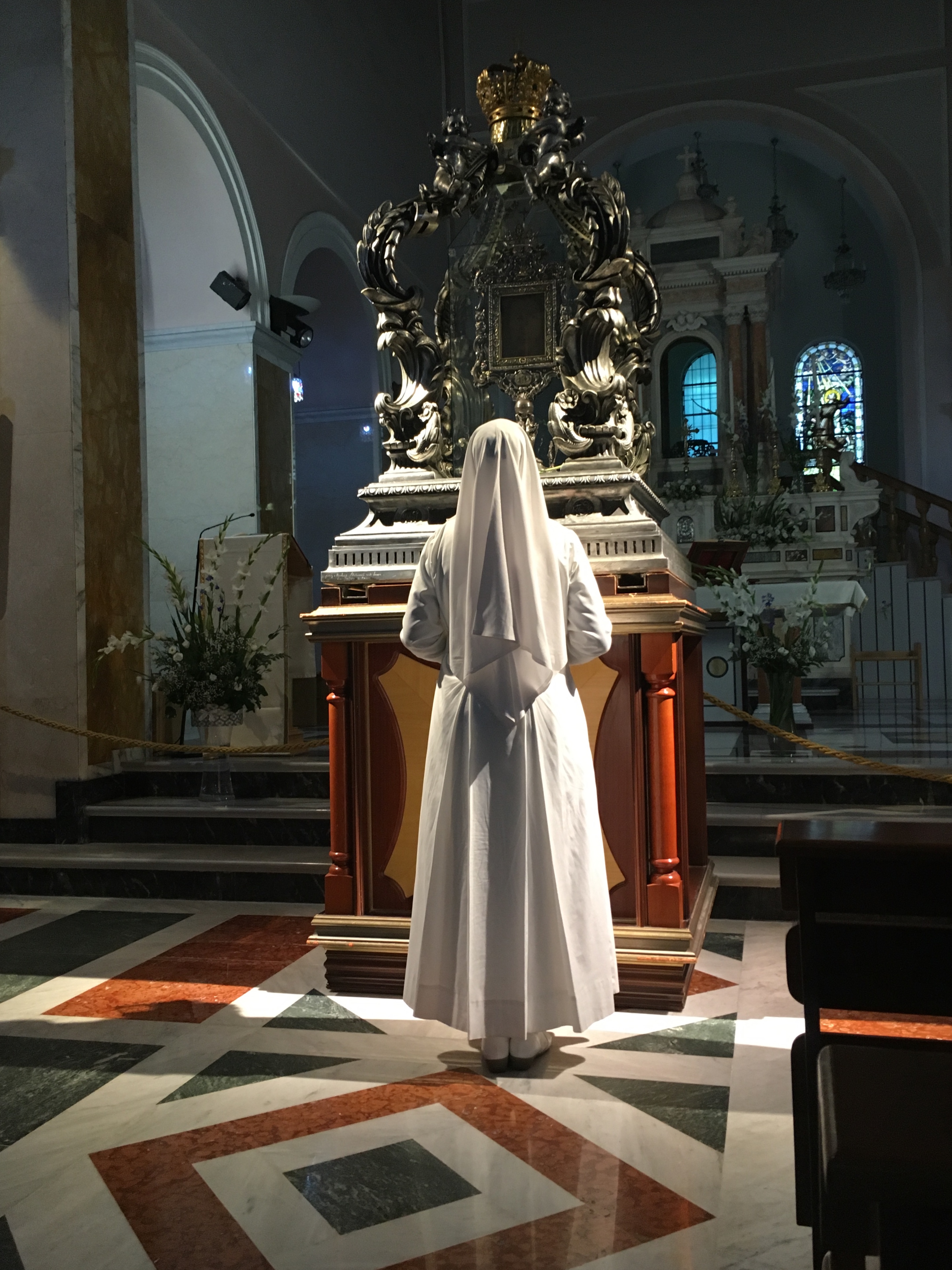
Sr. Petra-Maria, Cynthia Krystyna Simla and other religious before His Face
Sr. Petra-Maria, Cynthia Krystyna Simla Photo: Patricia Enk
Gazing at the Face of her Spouse in faith and love. photo: Patricia Enk
Gazing at the Face of her Spouse in faith and love.
photo: Patricia Enk


Pilgrimage – A Journey Toward the Face of God Pt. 1

Part 1:  The Face of Mercy in Manoppello

Manoppello, Sanctuary Basilica of the Holy Face, photo: Paul Badde

“The practice of pilgrimage has a special place in the Holy Year, because it represents the journey each of us makes in this life.  Life itself is a pilgrimage, and the human being a viator, a pilgrim traveling along the road, making his way to the desired destination…each according to his or her ability will have to make a pilgrimage. This will be a sign that mercy is also a goal to reach and requires dedication and sacrifice. May pilgrimage be an impetus to conversion; by crossing the threshold of the Holy Door, we will find the strength to embrace God’s mercy and dedicate ourselves to being merciful with others as the Father has been with us.”  –Pope Francis from The Face of Mercy, Misericordiae Vultus

Human beings are made in the image and likeness of God, and so our souls have a yearning, a natural longing for the infinite.  We are called to communion with God, to see Him “face to face.”  He is calling us to seek Him, to know Him, and love Him with all our heart, mind, and strength.  The history of salvation can be described as a gradual discovery of the Face of God by nations and individuals, marked by their battles, falls and triumphs, as they turn toward or away from the Face of God, on a pilgrimage–a journey which will only end when each person comes “face to face” with God.

The Year of Mercy cannot be complete until we have made some sort of pilgrimage toward God.  Although I had made a local pilgrimage to the Door of Mercy at St. Louis Cathedral in New Orleans, I had felt a very strong tug in my heart to return to Italy and re-visit places of pilgrimage that were especially meaningful to me. Together with my husband, I made the necessary preparations, but, the most important “packing” for the journey was to remember on our pilgrimage all those God has given us to love, and their intentions, people that we would like to have with us, but could not make the journey. We especially carried within our hearts those who were too sick, or too old, as well as those who have lost their faith, the deceased, and people in our country and in the world in need of someone’s prayers, placing all in our hearts so that we could carry them, in spirit, through the Doors of Mercy.

We began with the place in which I encountered the Face of Mercy in a very profound way in October of 2012: the Sanctuary Basilica of the Holy Face in the small mountain village of Manoppello. This humble, beautiful village has hidden in its heart, for centuries, what St. Pio of Pietrelcina called “The greatest relic of the Church”–a gossamer-thin byssus veil, bearing, in a miraculous way, an image of the human Face of Jesus.

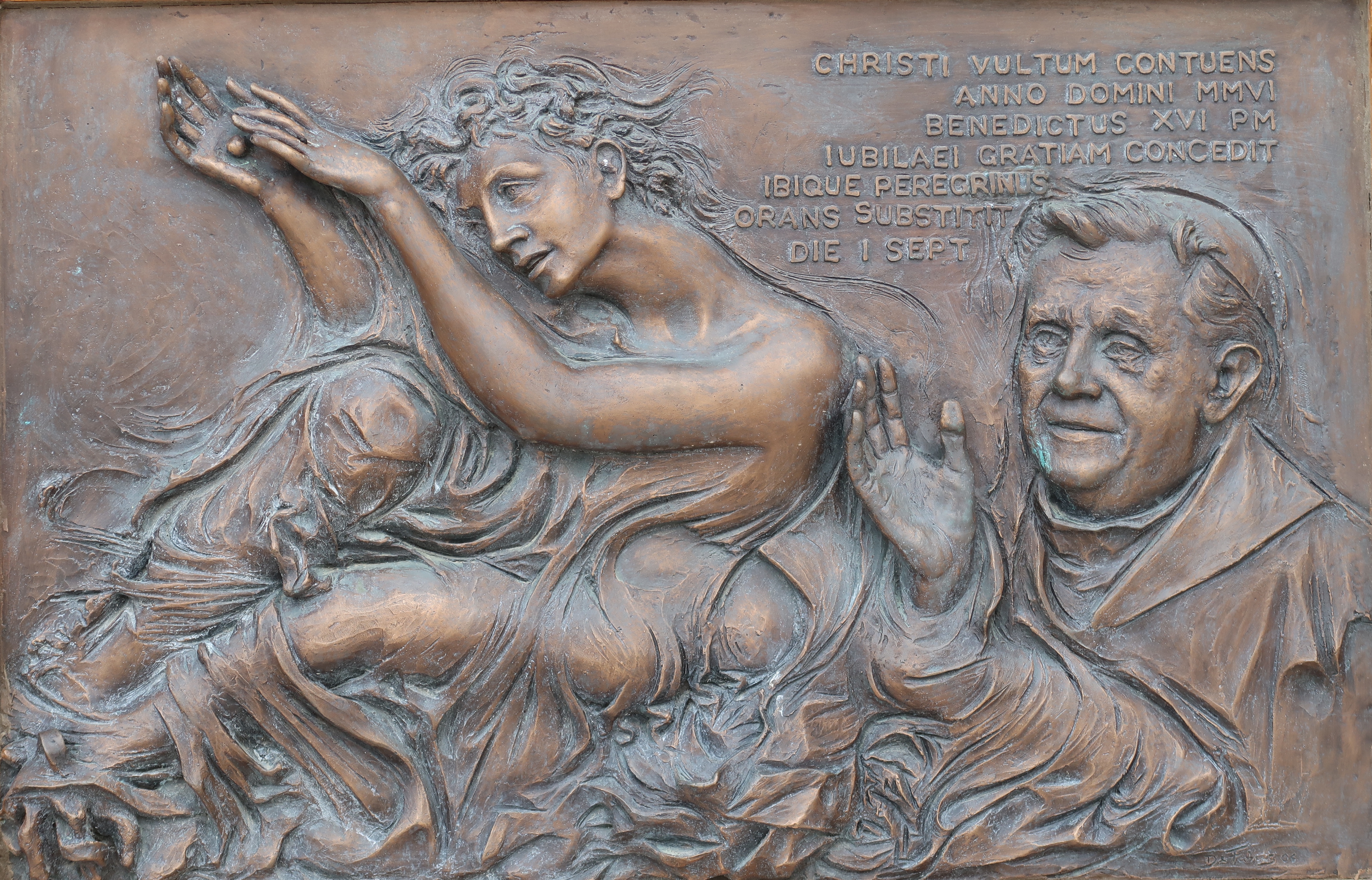
Panel on Holy Door of Shrine commemorating the visit of Pope Benedict XVI in 2006

We arrived very late at night after 28 hours of travel to a hotel in the village very near the Sanctuary.  The next morning we walked to the Basilica for Mass, entering the beautiful dedicated Holy Door, engraved with depictions of events in the history of the Veil.  My favorite was the panel recalling the visit of Pope Emeritus Benedict XVI to the Shrine in September of 2006.  It was a year later, that he wrote his moving prayer to the Holy Face in honor of that occasion and elevated the Shrine to the status of a Basilica.

Rector of the Shrine Padre Carmine Cucinelli places the Holy Veil in the movable reliquary

The day after we arrived was a special occasion as well, as the next day, August 6th, was a Feast of the Holy Face, the Transfiguration.  The Veil, normally kept in a special reliquary high above the back of the altar (but accessible by a stairway from behind) was to be brought down after the Mass and placed in another movable reliquary, used in processions, near the front of the altar. The Veil would remain there throughout the day for prayers and veneration of the faithful, then be returned to its place behind the altar for the night.

Earlier in the day, on the steps leading up to the relic, I bumped into journalist Paul Badde, who has taken more photos perhaps than anyone of the Holy Veil and written so much about its amazing re-discovery.  I couldn’t have been more surprised than if I had bumped into Lazarus emerging from the tomb!  Paul has been making an amazing recovery from heart surgery, stroke, and a coma which lasted for more than

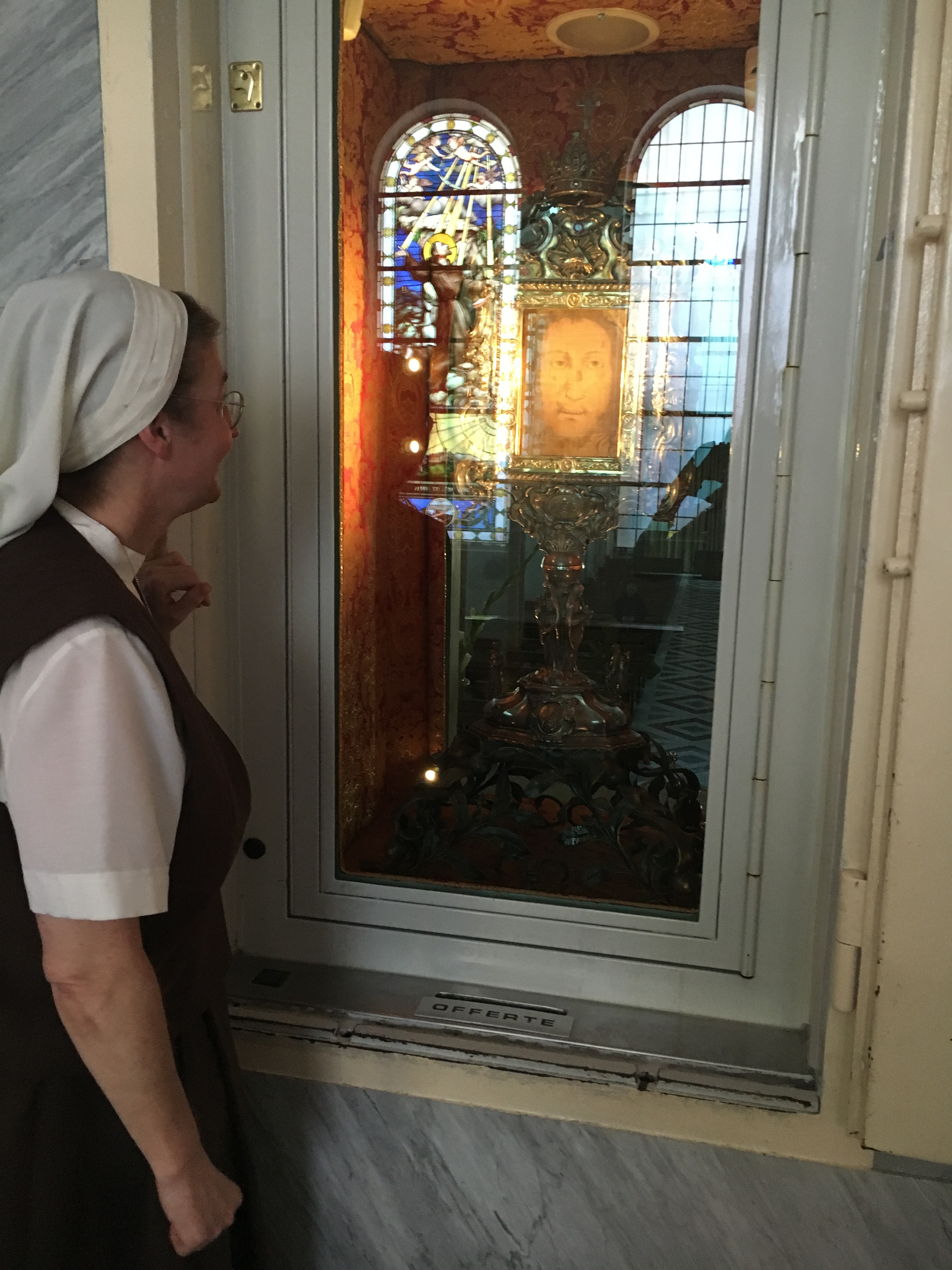
Sr. Petra-Maria gazes at the Veil of Manoppello

three weeks during Lent of 2016. Paul later introduced me to Sr. Petra-Maria, who, I soon discovered, shares with pilgrims her extensive knowledge and love for “Il Volto Santo.”  Like two other nuns, who shared similar names–Sr. Marie St. Pierre, a Discalced Carmelite nun associated with the Holy Face in Tours, and Bl. Mother Maria Pierina, an Immaculate Conception nun associated with the Holy Face Medal–Sr. Petra-Maria is a true apostle of the Holy Face of Manoppello.  The Holy Face draws her like a magnet; she never tires of gazing at His Face or drawing others to His peaceful, merciful countenance and telling and re-telling the incredible details of the features, the history, and especially, the spiritual significance of the miraculous image.  (I’ll have to save those details for a special post.)

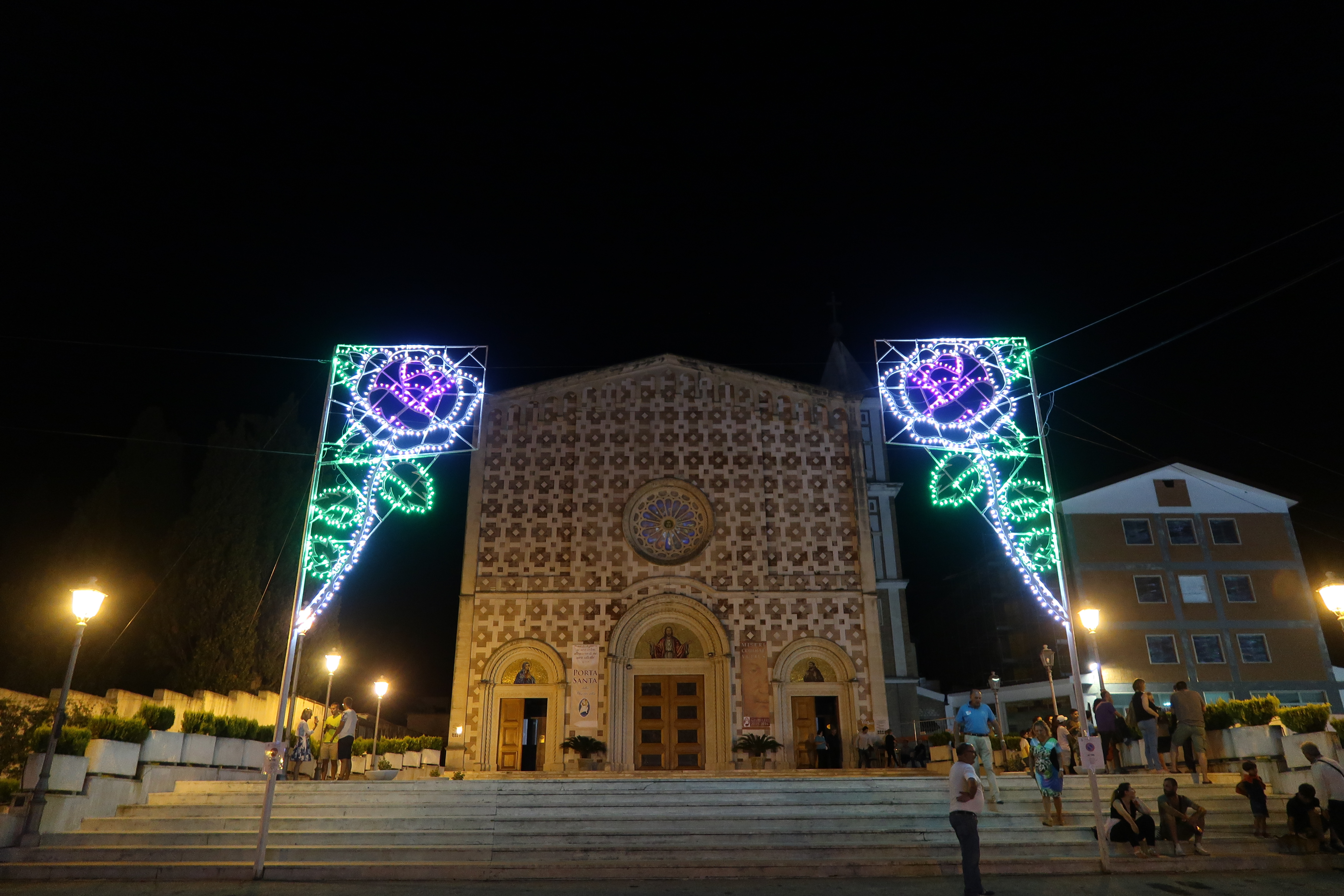
Basilica of the Holy Face of Manoppello on Vigil of the Transfiguartion

Celebrations and entertainment were held in honor the Holy Face in the piazza in front of the Basilica in the evening by local musicians and very talented young people of the community, who gave a very enjoyable musical performance of the life of St. Francis. I’ll never forget the line of young “Franciscan monks” on the stage singing “Andiamo! Andiamo!…” “We go! We go! For the Blessed Mother!”  The next day the Holy Veil was brought out after Mass on the Feast of the Transfiguration for the day and in the evening there was planned a solemn procession with the Veil and benediction.  But, as in all things in life, plans change… (To be continued in Pt.2)

"Andiamo! Andiamo!"
“Andiamo! Andiamo!”


From Manoppello With Love

image
The Holy Veil of Manoppello, Italy (photo by Patricia Enk)

“Il Volto Santo of Manopello” The Face of Mercy, Love and Peace!


UPDATE: CNA (Catholic News Agency) has recently featured a marvelous article about the Manopello image in which journalist Paul Badde interviews Archbishop Bruno Forte regarding his memories of the historic visit of Pope Benedict XVI to the Sanctuary: (click here for article) http://www.catholicnewsagency.com/news/an-encounter-with-the-manoppello-image-of-the-face-of-christ-95030/


“If you only knew the gift of God…”

The Woman at the Well by Carl Heinrich Bloch

If you only knew the gift of God, and who is saying to you, ‘Give me a drink,’ you would have asked him and he would have given you living water” (John 4:10).  These were Jesus’ words to the woman at the well and also the words that echoed in my own heart as I knelt before the miraculous image of the Face of Jesus, Il Volto Santo, at the Shrine in Manoppello, Italy, several years ago.  Like the woman at the well, I encountered there the Face of Mercy. “If you only knew the gift of God…” 

Pope Francis has incorporated these very words into his official Prayer for the Jubilee Year of Mercy:

“Lord Jesus Christ, you have taught us to be merciful like the heavenly Father, and have told us that whoever sees you, sees Him.  Show us Your Face and we will be saved!  Your loving gaze freed Zacchaeus and Matthew from being enslaved by money; the adulteress and Magdalene from seeking happiness only in created things; made Peter weep after his betrayal, and assured Paradise to the repentant thief.  Let us hear, as if addressed to each one of us, the words that you spoke to the Samaritan woman:

“If you only knew the gift of God!”

You are the visible face of the invisible Father, of the God who manifests His power above all by forgiveness and mercy:  let the Church be your invisible face in the world, its Lord risen and glorified.  You willed that your ministers would also be clothed in weakness in order that they may feel compassion for those in ignorance and error:  let everyone who approaches them feel sought after, loved, and forgiven by God.

Send your Spirit and consecrate every one of us with its anointing, so that the Jubilee of Mercy may be a year of grace from the Lord, and your Church, with renewed enthusiasm, may bring good news to the poor, proclaim liberty to captives and the oppressed, and restore sight to the blind.

We ask this of you, Lord Jesus, through the intercession of Mary, Mother of Mercy; you who live and reign with the Father and the Holy Spirit forever and ever.  Amen.

To know the gift of God, like Peter, Matthew, Zacchaeus, the adulteress, Madgalene, the repentant thief, and the woman at the well we must first look at the Face of Jesus and linger a moment in a mutual loving gaze.  Whoever sees Him sees the Father (John 14:9.) Under the gaze of the Father we will “feel sought after, loved and forgiven by God.” Jesus wants to give us the Gift of Himself, to draw us into His divine life, fill us with the “Living Water” of the Holy Spirit, so that we may then give Him to others. To “bring good news to the poor, proclaim liberty to captives and the oppressed, and restore sight to the blind”–in other words, by performing the corporal and spiritual Works of Mercy. We need only to take that first step by contemplating His Face.  “If you only knew the gift of God!”

Holy Face Veil of Manoppello Photo: Paul Badde

“While we too seek other signs, other wonders, we do not realize that He is the real sign, God made flesh; He is the greatest miracle of the universe:  all the love of God hidden in a human heart, in a human face.”  ~ Pope Benedict XVI

Your Face is resplendent with Grace – Our Lady of Mount Carmel

Queen Beauty of Carmel
Queen Beauty of Carmel Feast day: July 16th

“How fair you are, O Virgin Mary!  Your face is resplendent with grace.”– Carmelite Proper

Pope Emeritus Benedict XVI has written:

“The Virgin Mary is she who more than any other contemplated God in the human Face of Jesus.  She saw Him as a newborn when, wrapped in swaddling clothes, He was placed in a manger; she saw Him when, just after His death, they took Him down from the Cross, wrapped Him in linen and placed Him in the sepulcher.  Inside her was impressed the image of her martyred Son; but this image was then transfigured in the light of the Resurrection.  Thus, in Mary’s heart, was carried the mystery of the Face of Christ, a mystery of death and glory.  From her we can always learn how to look upon Jesus, with a gaze of love and faith, to recognize in that human countenance, the Face of God.” 

(Below is a re-post from the Feast of Our Lady of Mount Carmel 2015)

Our Lady of Mount Carmel

Seeking the Face of God through Mary

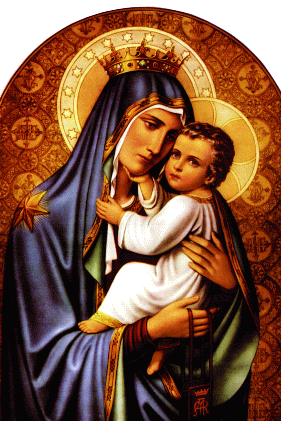
In the icon of “Queen Beauty and Mother of Carmel,” the Infant Jesus tenderly invites us to look at the face of His Mother, “resplendent with grace.” What makes the Virgin Mary’s face “resplendent with grace?”  It is the light of the Face of Christ – just as the moon reflects the light of the sun, the face of Mary reflects the light of the true sun, Jesus Christ.

Mary is “The glory of Jerusalem, the joy of Israel, the highest honor of our race,” (Judith 15:9) because she sought the face of God, His holy will and pleasure, in all things. Just as it is possible for the moon to shine even in the brightness of day, Mary gives more beauty to the heavens, more glory to God than any other creature on earth.  And when the dark night of faith is upon us and the sun is hidden from our view, Mary is there to enlighten our path and show us the way to her Son, until “In the tender compassion of our God the dawn from on high shall break upon us, to shine on those who dwell in darkness and the shadow of death, and to guide our feet into the way of peace.” (Luke 1: 78-79)

At the present moment, although the world is filled with darkness, we can turn to her for help in seeking His Face and leading souls to Him. Even pebbles on a path on the ground can reflect the light of the moon at night; and so the children of Mary by following her example, “to seek the Face of God in all things,” can guide others through the darkness by reflecting the light of the Face of Christ as does Mary.

It is Jesus Himself who desires that we turn to the face of His Mother. He created her with all the perfection and beauty that would be fitting for the Mother of God.  Her soul, holy, immaculate and unstained by sin, is the perfect mirror in which He reflects His Face. He holds her up to us as the model for all His disciples as He did in Luke’s Gospel:  “While He was speaking, a woman from the crowd called out and said to Him, ‘Blessed is the womb that carried you and the breasts at which you nursed.’” This singular praise of Mary from the woman in the crowd was not enough for her Son.  And so Jesus replied, “Rather, blessed are those who hear the word of God and keep it.” (Luke 11:27)  Mary is thus thrice blessed, first, in being chosen to be the Mother of God, second, in that Mary heard the word of God and third, because she kept His word in her heart.

Mary holds out to us her Scapular, a sacramental sign of being clothed in her own garment, to place over our shoulders, so that we may imitate her in faith, hope, charity and all the virtues that adorn her soul.  By contemplating the Face of Jesus always, together with Mary, we can do our part in making His Face shine upon our world as well.

img_1069Our Lady of Mount Carmel

O most beautiful flower of Mount Carmel, fruitful vine, splendor of heaven, blessed Mother of Christ, Immaculate Virgin, we praise and honor you as our Queen and Mother.

Help us to persevere in constant prayer for the needs of our world and share with you in the work of redemption.  Be with us, Holy Virgin, and guide us on our way, as we journey together in faith, hope and love to your Son, Jesus Christ Our Lord.

Amen.