St. Elizabeth of the Trinity–Luminous With His Light

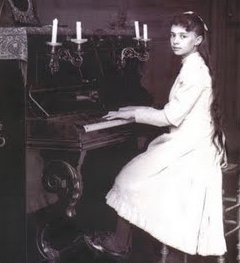
Young Elizabeth Catez

“The Word will imprint in your soul, as in a crystal, the image of His own beauty, so that you may be pure with His purity, luminous with His light.”  

Ten years before entering the Carmelite Convent in Dijon, France, eleven year-old Elizabeth Catez met the prioress on the afternoon of her First Holy Communion. What the prioress told her on that occasion left a deep impression in her soul; upon learning Elizabeth’s name, the prioress told her that her name meant “House of God.” She later wrote on the back of a holy card for Elizabeth: “Your blessed name hides a mystery, accomplished on this great day. Child, your heart is the House of God on earth, of the God of love.”

“Do you not know that you are God’s temple and that God’s Spirit dwells in you?” (1 Cor 3:16)
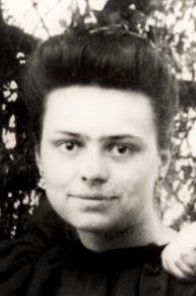
Waiting to enter Carmel–St. Elizabeth of the Trinity

Upon entering Carmel at the age of twenty-one, Elizabeth sought God’s Face within the temple of her own soul, in prayer and silence, with a growing desire to be united with Jesus, to share in His life and sufferings–to be transformed into His image–so that God the Father would find in her the image of His Son, in whom He was well-pleased. Elizabeth wrote, “God bends lovingly over this soul, His adopted daughter, who is so conformed to the image of His Son, the ‘first born among all creatures,’ and recognizes her as one of those whom He has ‘predestined, called, justified.’ And His Fatherly heart thrills as He thinks of consummating His work, that is of ‘glorifying her by bringing her into His kingdom, there to sing for ages unending’ the praise of His glory.”  She prayed that the Holy Spirit “create in my soul a kind of incarnation of the Word: that I may be another humanity for Him in which He can renew His whole Mystery.”
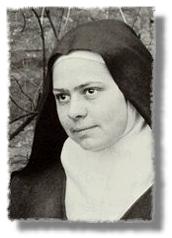
“I want to gaze on You always and remain in Your great light.”~St. Elizabeth of the Trinity, OCD

“We must become aware that God dwells within us and do everything with Him; then we are never commonplace, even when performing the most ordinary tasks.” 

This was the fruit of contemplation that St. Elizabeth of the Trinity wanted to share with everyone; the secret of transforming love hidden within our own hearts. By gazing steadfastly upon God, in faith and simplicity, the Word of God, Jesus Christ–as in the legend of St. Veronica’s Veil–will leave the imprint of His image on the veil of the soul. By her continual loving gaze at Him, St. Elizabeth of the Trinity was transformed into His image. When she died at the young age of twenty-six, she had already fulfilled her mission in the Church as a ceaseless “Praise of Glory,” reflecting the luminous, pure light of the Holy Trinity.

“It is Your continual desire to associate Yourself with Your creatures…How can I better satisfy Your desire than by keeping myself simply and lovingly turned towards You, so that You can reflect Your own image in me, as the sun is reflected through pure crystal? …We will be glorified in the measure in which we will have been conformed to the image of His divine Son.  So, let us contemplate this adored Image, let us remain unceasingly under its radiance so that it may imprint itself on us.”

— St. Elizabeth of the Trinity, OCD, Feast Day November 8.
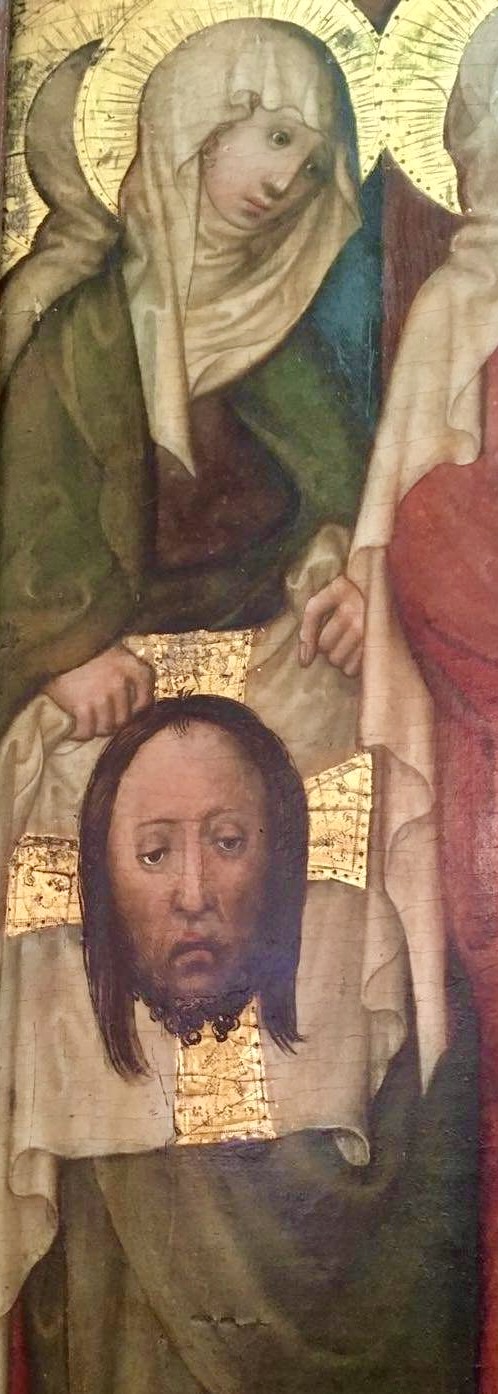
St. Veronica with the Veil of the Holy Face 1485, Maestro, Viennese

__________________________

The Beauty of the Holy Trinity in the Face of Jesus Christ

The Holy Trinity, Robert Campin, 1433

“Jesus, has shown us the Face of God, One in substance and Triune in Persons; God is all and only Love, in a subsisting relationship that creates, redeems, and sanctifies all: Father, Son, and Holy Spirit.”

~Pope Francis

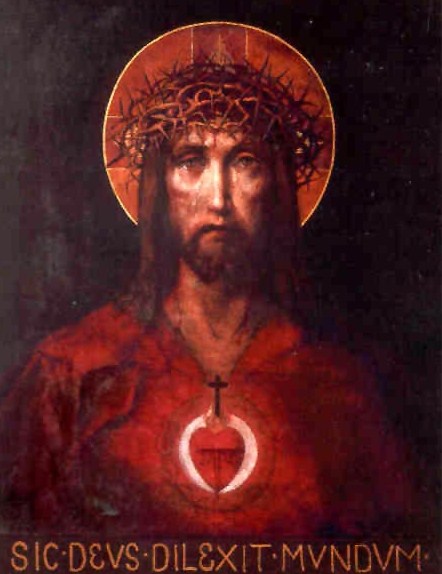
A Discalced Carmelite nun who lived in the mid-1800’s, Sr. Marie St. Pierre, had many interior visions regarding the Holy Face of Jesus — including a sublime conception of the The Holy Trinity and the Holy Face — which she tried to express in these words she received from Our Lord:

Sr. Marie St, Pierre

“Remember, O my soul, the instruction which thy celestial Spouse has given thee today on His adorable Face!  Remember that this Divine Head represents the Father who is from all eternity, that the mouth of this Holy Face is a figure of the Divine Word, engendered by the Father, and that the eyes of this mysterious Face represent the reciprocal love of the Father and the Son; for these eyes have but one and the same light, the same knowledge, producing the same love, which is the Holy Spirit.  In his beautiful silken hair  contemplate the infinitude of the adorable perfections of the Most Holy Trinity in this majestic head, the most precious portion of the Sacred Humanity of thy Saviour; contemplate the image of the unity of God.  This, then, is the adorable and mysterious Face of the Saviour, which blasphemers have the temerity to cover with opprobrium: thus they renew the sufferings of His Passion, by attacking the Divinity of which it is the image.”

Sacred Heart of Jesus, have mercy on us!

Our Lord told Sr. Marie St. Pierre that she could comfort and console Him by her praises, such as in The Golden Arrow Prayer: “May the most holy, most sacred, most incomprehensible and ineffable Name of God be forever praised, blessed, loved, adored and glorified by all the creatures of God, and by the Sacred Heart of Our Lord Jesus Christ in the Most Blessed Sacrament of the Altar. Amen.

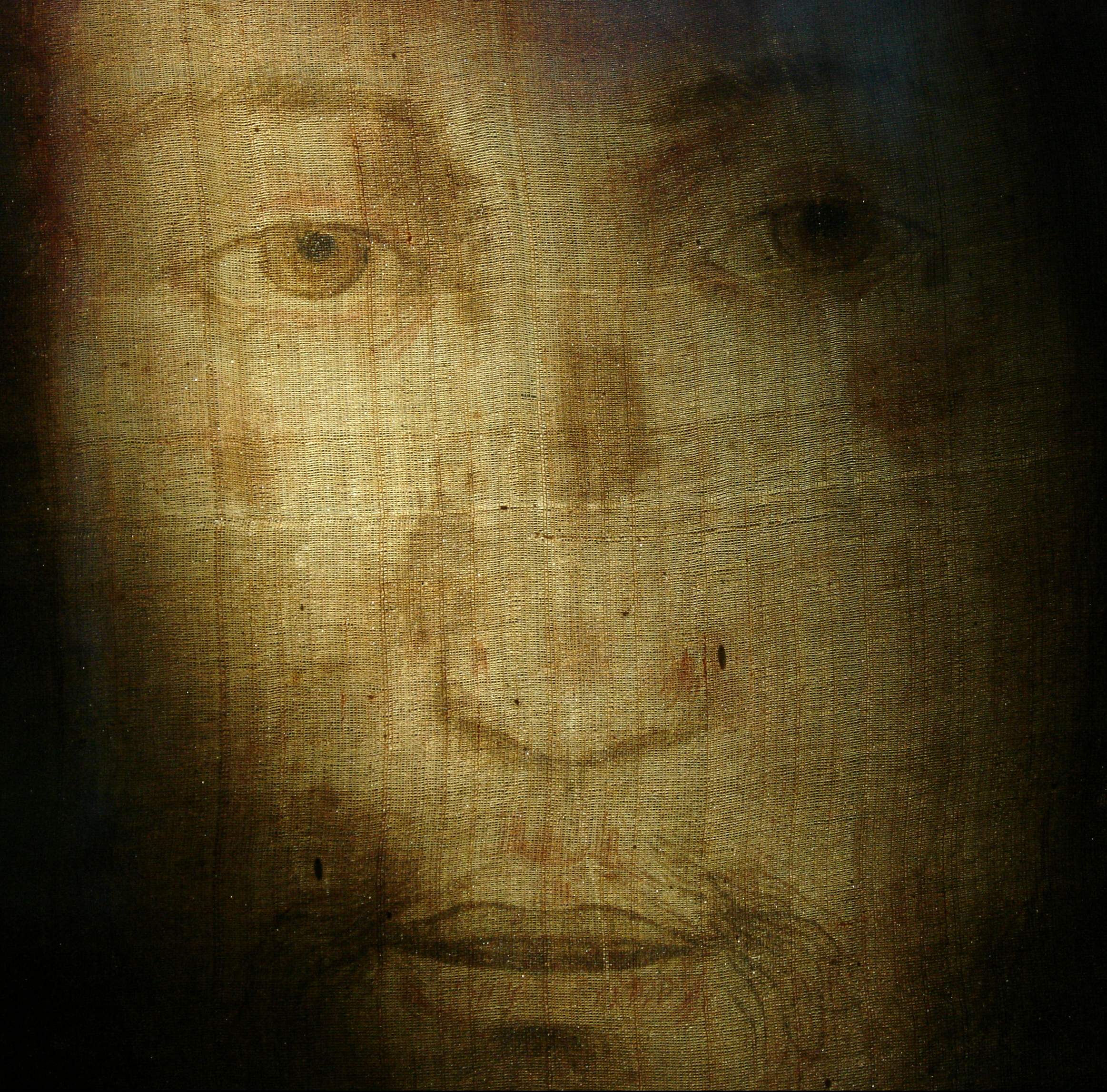
Holy Face Veil of Manoppello, Italy (Photo: Paul Badde/EWTN)

“According to the diligence you will manifest in repairing my image disfigured by blasphemers, so will I have the same care in repairing your soul which has been disfigured by sin.  I will imprint thereon my image, and I will render it as beautiful as when it came forth from the baptismal font… Oh! could you but behold the beauty of My Face!–But your eyes are yet too weak.”  –Our Lord to Sr. Marie St. Pierre 

St. Elizabeth of The Trinity

Another Discalced Carmelite Nun, St. Elizabeth of the Trinity, also directs our gaze to the Face of the Son in order to contemplate the beauty of the Holy Trinity and and reflect God’s image:

“It is Your continual desire to associate Yourself with Your creatures…How can I better satisfy Your desire than by keeping myself simply and lovingly turned towards You, so that You can reflect Your own image in me, as the sun is reflected through pure crystal? …We will be glorified in the measure in which we will have been conformed to the image of His divine Son.  So, let us contemplate this adored Image, let us remain unceasingly under its radiance so that it may imprint itself on us.” –Saint Elizabeth of the Trinity, O.C.D.

O My God, Trinity Whom I Adore

O My God, Trinity whom I adore,  help me to forget myself entirely that I may be established in You as still and as peaceful as if my soul were already in eternity.  May nothing trouble my peace or make me leave You, O my unchanging One, but may each minute carry me further into the depths of Your Mystery. Give peace to my soul, make it Your heaven, Your beloved dwelling and Your resting place.  May I never leave you there alone but be wholly present, my faith wholly vigilant, wholly adoring, and wholly surrendered to Your creative action.  O my beloved Christ, crucified by love, I wish to be a bride for Your Heart; I wish to cover You with glory; I wish to love You…even unto death!  But I feel my weakness, and I ask You to clothe me with Yourself, to identify my soul with all the movements of Your Soul, to overwhelm me, to posses me, to substitute Yourself for me that my life may be but a radiance of Your life.  Come to me as Adorer, as Restorer, as Savior, O Word Eternal, Word of my God.  I want to spend my life listening to You, to become wholly teachable that I may learn all from You.  Then, through all nights, all voids, all helplessness, I want to gaze on You always and remain in Your great light.  O my beloved Star, so fascinate me that that I may not withdraw from your radiance.  O consuming Fire, Spirit of Love, come upon me, and create in my soul a kind of Incarnation of the Word; that I may be another humanity for Him, in which He can renew His whole Mystery.  And You, O Father, bend lovingly over your poor little creature; cover her with your shadow, seeing in her only the Beloved in whom You are well pleased.  O my Three, my All, my Beatitude, infinite Solitude, Immensity in which I love myself, I surrender myself to You as Your prey.  Bury Yourself in me that I may bury myself in You until I depart to contemplate in Your light the abyss of Your greatness.  November 21, 1904 — St. Elizabeth of the Trinity

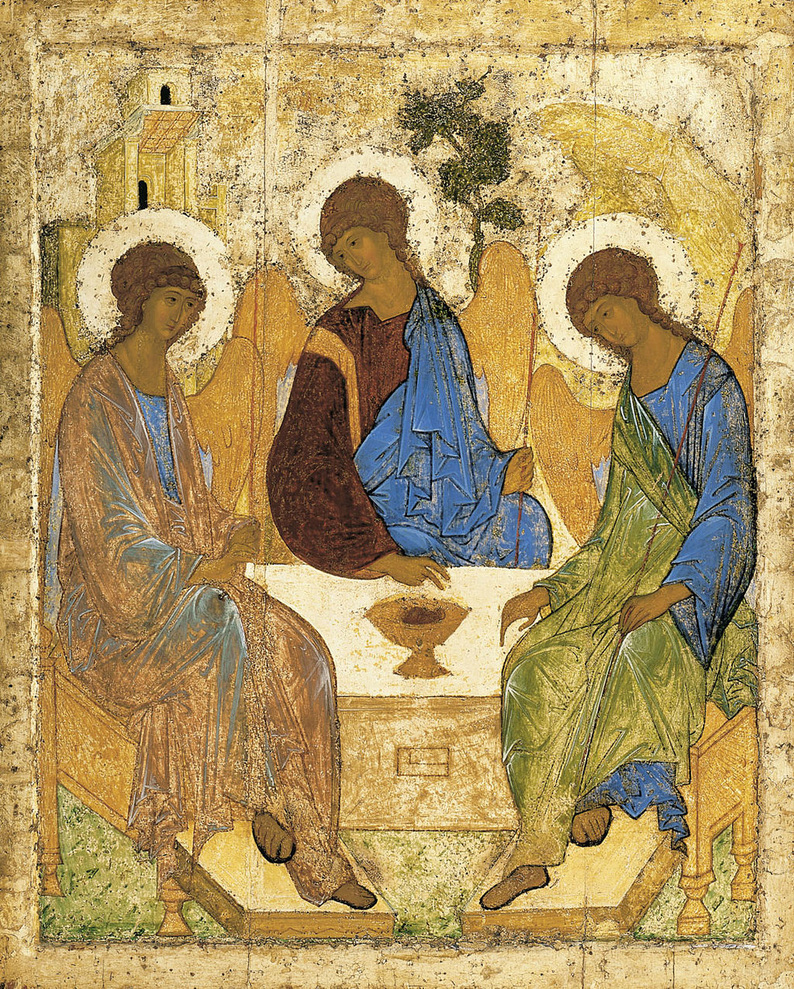
The Trinity, Andrei Rublev

The Perfect Love

The Trinity by Rublev

The great love stories in literature and real life have usually ended in tragedy: Romeo and Juliet, Napoleon and Josephine, Anna Karenina and her husband… that is, before her desire to be worshipped by Vronsky destroyed her. Then there are those great hidden and unknown lovers, whose romance was born in the heart of the Trinity and remained there in the darkness of faith, hope, and love. I have seen one such rare couple many times, in the pew in front of me at Mass. Bridegroom and bride are both in their late eighties now, snowy-haired, and frail. He gently leads her to the pew each week, tenderly unbuttons her red coat as he tells her how beautiful she is today. She has Alzheimers, but is like a lamb at his side; calm and docile. The husband gives himself in sacrificial love, doing all for the bride who is no longer capable of doing anything for herself. These beautiful lovers reflect the eternal love of the Trinity, and the sacrificial love of Christ for His bride, the Church, and with it, our own souls.

It is astounding that the most beautiful romantic poetry ever written was by the Carmelite Friar, St. John of the Cross, after having been kidnapped by his fellow friars, beaten and locked for months in a cold, narrow room that had been formerly used as a latrine for visitors. This is not the setting one would think of when one thinks of a great romance. And yet… it was in this darkness he wrote his Romances. John was seeking the Face of God in his anguish, and there discovered God was seeking him more.

St. John’s Romances were most likely written at the beginning of John’s imprisonment in Toledo during Advent of 1577. In his search for God, amidst terrible suffering and bewildering darkness, John expresses his hope in God by turning back to memories of the popular ballads of his childhood. He then stirs up his love, and gives voice to his faith, by recounting salvation history – the beautiful story of the immense mutual love of the Holy Trinity. In this overflowing love, the Father and Son each desire the glory of the other, and so creation comes into being. The Father creates a bride for the Son. The bride is the Church, and ourselves within the Church, created to share in the divine love. In Romances, the Incarnation, Stanza 7,  John writes of the loving exchange between the Father and the Son. The Word of God is presented with a bride who is made in his image, but she is “unlike in her flesh.”

“You see Son that your bride

 was made in your image,

and in so far as she is like you

she suits you very well;

but she is unlike in her flesh

which your simple substance lacks.

The pattern of gift, space, and God making the space himself are found in the verse. Father reveals his gift as “with love most tender” He speaks to the Son, who in accepting the gift knows that he must empty himself (making space), suffer, and die.

The next lines pierce one’s heart with a truth that is found in all John’s writing; that of the humility of God in emptying himself, becoming “like the one he loves” to unite himself with his bride, taking on her sins, suffering and dying for them himself, in order to redeem her.

“In perfect love

this law obtains;

that the lover should become

like the one he loves;

for the greater the likeness

the greater the delight;

would increase greatly if she saw you like her

in that flesh which is hers.”

This moment, before the Incarnation that will occur, evokes the memory of the night of the Last Supper when Jesus in his agony prays, “Father, not my will but yours be done:”

“My will is yours”, the Son replied,

“and the glory which I have

 is that your will be mine…”

Jesus, himself has made the space for the gift of redemption to be fulfilled in Him; willing his own suffering and death, and later, in His resurrection for the sake of his bride, enabling her to share in his risen life – so that the bridegroom and the bride will be one —  as he and the Father are one.

“I will die for her,

And lifting her out of that deep,

I will restore her to you.”

The pattern of “the perfect love” is a sign for all today, where it is repeated in each soul within the Body of Christ. The “perfect love” is seen in the example of the Virgin Mary, when she offered her “Fiat,” and Jesus became Incarnate in her womb, and each day until the foot of the Cross and the tomb. Following her example, in total “yes” to God’s will, we can trust that Jesus will ultimately make the space in our own pain, emptiness and darkness for the gift of the Holy Spirit; so that Jesus will become incarnate in our souls; transforming in love the lover, who, in union with Jesus will also become “like the one he loves:” a likeness of Jesus — to the Glory of God the Father, who delights in seeing the image of His Son in the soul of “the bride.”