“Abruzzo is a great producer of silence, wrote Georgio Manganelli.” Manoppello, Italy–hidden deep in the Abruzzo Mountains–had kept a secret: a holy relic veil of the Face of Jesus, treasuring and protecting it through five tumultuous centuries; effectively preventing it from being destroyed many times over. But now, in God’s Providence, the secret has come to light with the dawn of the millennium, which was dedicated to the Face of Christ by Pope St. John Paul II.
An eminent scholar, Fr. Heinrich Pfeiffer, uncovered the secret of Abruzzo and, at a great personal cost, presented his theses to the world. The news was embraced by some; and of course, rejected by others–there is nothing new in that. Opinions are like noses–everyone has one. We all make our own choices, for good or bad; but to make a choice, to believe or disbelieve, we first need an informed conscience, and the desire to know the truth in the first place.
For this reason Antonio Bini has published a free e-book (which is embedded below) which presents the background of the re-discovery of the relic of the Holy Veil of Manoppello bearing an image of the Face of Christ: “Heinrich Pfeiffer, The Scholar Who Recognized the Veronica in the Holy Face”. This essay commemorates Father Heinrich Pfeiffer (1939-2021), professor of Christian art history at the Pontifical Gregorian University in Rome and one of the leading contemporary scholars of the Church’s cultural heritage, who passed away in Berlin on November 26, 2021. With his studies on the Holy Face of Manoppello, which he identified as “the Veronica” (True Image).
Pope Benedict XVI contemplates the Face on the Veil of Manoppello. September 1, 2006. (Photo: Paul Badde/EWTN)
Pfeiffer was met with distrust and hostility from scholars and Church hierarchies for questioning centuries-old silences and beliefs regarding Christ’s burial cloths. The book reconstructs the author’s encounter with Fr. Pfeiffer, the background to the international press conference held in Rome on May 31, 1999, in which the scholar supported his theses. These attracted the interest of the media and many pilgrims to the sanctuary of Manoppello, which until then had been relatively unknown. Among these Pope Benedict XVI, This visit effectively confirmed the validity of Fr. Pfeiffer’s theses. The German Pope was impressed by his encounter with the Holy Face, immediately elevating the church to a basilica and dedicating an intense prayer a year after his visit.
References to the Sack of Rome are also included, when the Veronica disappeared from Rome, as the Vatican press office later admitted in 2011. The photographic and documentary material, much of it previously unpublished, is noteworthy. By the author’s wish, the book, a testimony to the events, is being distributed free of charge in English to promote broader knowledge of the Holy Face among the many interested in the recent history of the mysterious image.
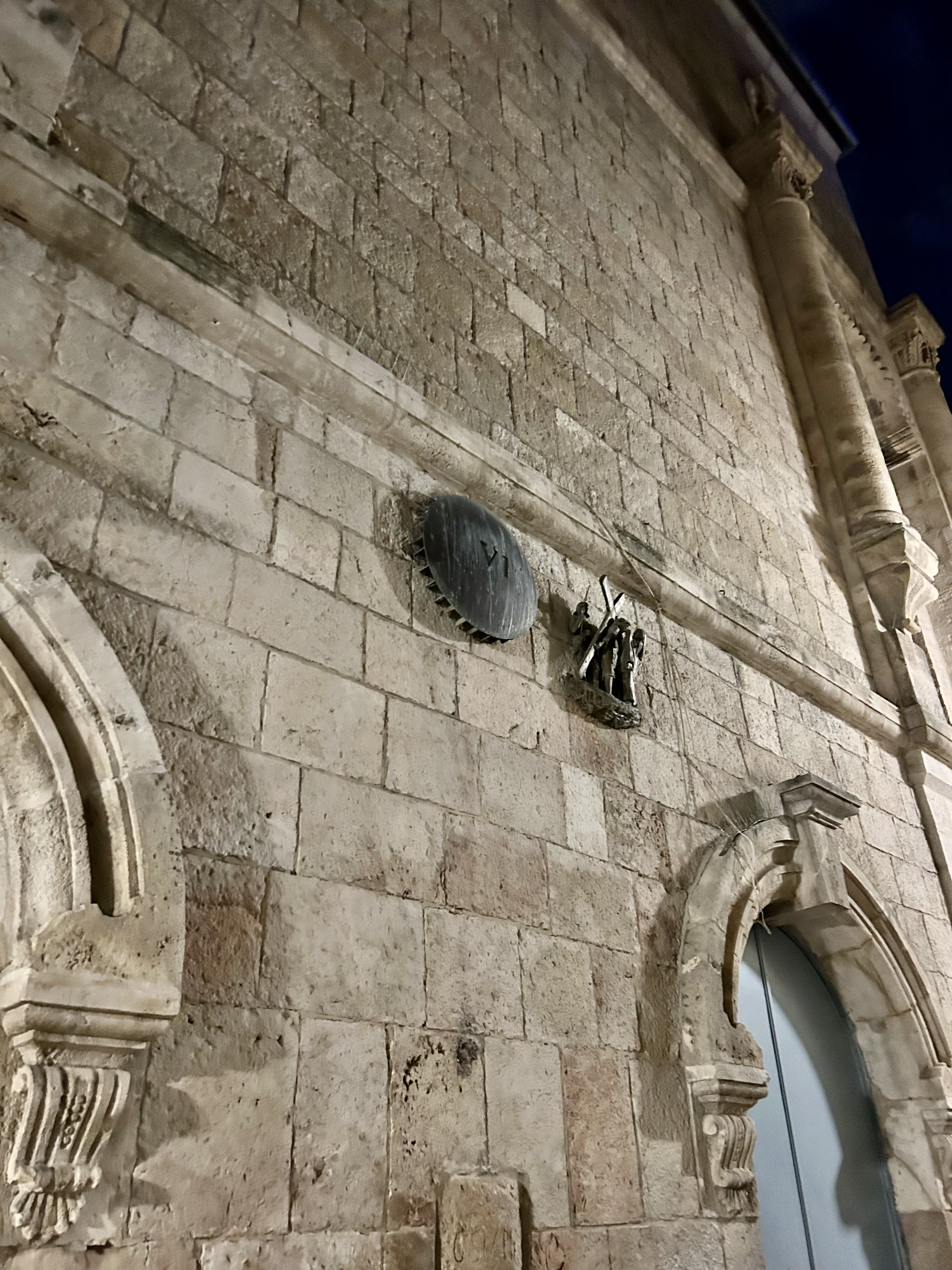
Was there actually a St. Veronica? It is an important question, and a very personal one to me and many others. According to tradition, “Veronica,” is the compassionate woman who wiped the Face of Jesus, who is commonly depicted in every Catholic church, at the Sixth Station of the Cross, yet her name does not appear in the Gospels, and the legends did not appear until the Middle Ages.
Pope St. John Paul II pondered this very question many years before dedicating the Millennium to the Holy Face of Jesus. The fruit of his prayerful contemplation unveils a profound truth for every Christian as he answers another question; What does it mean to be “a Veronica?”
The Sixth Station on the Via Dolorosa in Jerusalem
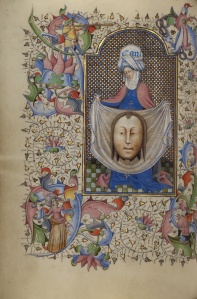
Veronica’s Veil, Flemish 15th Century
“St. Veronica”
The Catholic Church tells us that a veil bearing a miraculous image of the Face of Jesus has existed since the earliest centuries, recorded in history and in art, such as the Camulia, or the Mandylion. Explanations for the existence of such a veil were all different (see “Four Stories, One Face“). About the time this miraculous veil first appeared in Rome, the name “Veronica” referred to the veil itself, and not a person–“Veronica” meaning “vera” or true, and “icon” meaning image, or even more precisely, “to be present.” Those who gazed upon the veil bearing the true Face of Jesus stood in God’s presence. They were turned toward His Face. The Veil became the greatest relic that Pilgrims traveled to see in the Vatican.
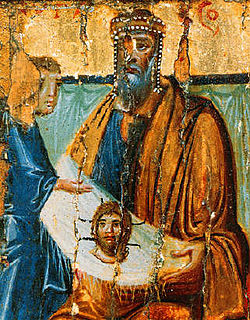
King of Edessa receiving the miraculous veil from St. Jude, and was healed of leprosy.
“Veronica” holding a sheer veil bearing the living Face of Christ on a sheer veil with distinctive folds.
Legends sprang up much later, in the Middle Ages, about a woman named “Veronica,” who was sometimes associated with the woman “Berenice” or “Bernice,” the bleeding woman who touches the hem of Jesus’s garment in the Gospel. There is a version, written in 1191 by Robert de Boron, that tells of a woman named “Veronica” wiping sweat from the Face of Jesus. The stories are many and varied, but the legend that most people are familiar with today is traced to a version by Roger d’Argenteuil in the 1300s, which tells of a woman “Veronica,” associated with the sixth station of the Cross–the compassionate woman, wiping the Face of Jesus on the way to Calvary with a cloth, upon which He leaves an image of His Face.
“These pious traditions cannot be documented, but there is no reason why the belief that such an act of compassion did occur should not find expression in the veneration paid to one called Veronica.” —The Catholic Encyclopedia
What did the Veil look like? A “living, changing, face” on a sheer veil, with distinctive folds, that could be viewed from either side; the eyes are open and glance to one side or the other; a lock of hair graces the center of the forehead; a sparse beard, wavy hair, as well as signs of bruising and trauma to the face are seen…. which despite the obvious suffering, remains peaceful and serene.
The Holy Veil of Manoppello- photo: Paul Badde/EWTN
Pope St. John Paul II expressed the answer to this profound question addressing the origin of the name of Veronica most beautifully in his poem, “The Name:”
The Name
In the crowd walking towards the place
[of the Agony]–
did you open up a gap at some point or were you
[opening it] from the beginning?
Veronica’s Veil by Hans Memling
And since when? You tell me, Veronica.
Your name was born in the very instant
in which your heart
became an effigy: the effigy of truth.
Your name was born from what you gazed upon.
–Karol Wojtyla
Miraculous Holy Face Veil Photo: Paul Badde (see “Manoppello Image” tab)
Since the detailed historical facts about the veil itself cannot be verified with absolute certainty in this life, the more important and answerable question is, “What does it mean to be a Veronica–a “true image?”
“Your name was born from what you gazed upon.”
When a soul performs an “act of compassion,” Jesus leaves His image on the “veil” of the soul. In other words, while contemplating the Face of Jesus in an image, in the Word of God in the Scriptures, in a person made in the image and likeness of God, or above all, in the Eucharist, the soul places itself in the Presence of God. When we are turned completely toward the Face of God, through a daily face-to-face encounter in prayer–by the power of the Holy Spirit–God gradually transforms the soul into the “True Image” of His Son, Jesus Christ. As Pope St. John Paul II says, our hearts must become an “effigy of truth,” a “true icon.” Then our name too will be born from what we gaze upon. It will be “Veronica.”
The Deepest Truth About St. Veronica
St. Veronica statue by Francesco Mochi, 1629
Within the center of St. Peter’s Basilica are four massive niches. In each niche there are four titanic statues of saints, standing 10 meters high: St. Andrew, the first disciple called by Christ, St. Longinus, the soldier who pierced Jesus’s side with his lance, St. Helena, who discovered the True Cross. The fourth statue depicts “St. Veronica,” an unknown woman, not mentioned in the Bible, yet immortalized in every Catholic church at the Sixth Station of the Cross, for her act of compassion to Jesus who left the image of His Face on her veil. (The relic that is now in the Veronica Pilar is quite different in description than what was previously recorded–a mystery yet to be solved. More may be read on the subject here: The Church, Testing of Relics, and the Holy Face)
Pope St. John Paul II wrote this beautiful meditation on St. Veronica in 2000, the same year in which he dedicated the millennium to the Face of Christ:
Sixth Station, St. Theresa Church, Ashburn, Virginia
“Veronica does not appear in the Gospels. Her name is not mentioned, even though the names of other women who accompanied Jesus do appear. It is possible, therefore, that the name refers more to what the woman did. In fact, according to tradition, on the road to Calvary a woman pushed her way through the soldiers escorting Jesus and with a veil wiped the sweat and blood from the Lord’s face. That face remained imprinted on the veil, a faithful reflection, a “true icon”. This would be the reason for the name Veronica. If this is so, the name which evokes the memory of what this woman did carries with it the deepest truth about her.
One day, Jesus drew the criticism of onlookers when he defended a sinful woman who had poured perfumed oil on his feet and dried them with her hair. To those who objected, he replied: “Why do you trouble this woman? For she has done a beautiful thing to me . . . In pouring this ointment on my body she has done it to prepare me for burial” (Mt 26:10, 12). These words could likewise be applied to Veronica. Thus we see the profound eloquence of this event.
The Redeemer of the world presents Veronica with an authentic image of his face. The veil upon which the face of Christ remains imprinted becomes a message for us.
In a certain sense it says: This is how every act of goodness, every gesture of true love toward’s one’s neighbor, strengthens the likeness of the Redeemer of the world in the one who acts that way. Acts of love do not pass away. Every act of goodness, of understanding, of service leaves on people’s hearts an indelible imprint and makes us ever more like the One who “emptied himself, taking the form of a servant” (Phil 2:7). This is what shapes our identity and gives us our true name.” –Pope St. John Paul II
This is the deep meaning and call to every Christian revealed in the presence of the unknown woman we call “St. Veronica”– each act of charity, every act of compassion will leave the imprint of the Face of Jesus in our souls, transforming us into His own Image.
Pope Benedict XVI looks at the ‘Veronica’s Veil’ during a visit to the Holy Veil monastery in Manoppello, central Italy, September 1, 2006.
Pope Benedict wrote, “To rejoice in the splendor of His Face means penetrating the mystery of His Name made known to us in Jesus, understanding something of His interior life and of His will, so that we can live according to His plan for humanity. Jesus lets us know the hidden Face of The Father through His human Face; by the gift of The Holy Spirit poured into our hearts.” This, the Pope says, is the foundation of our Peace, which nothing can take from us.
Benedict XVI has characterized devotion to The Holy Face as having three separate components: 1. Discipleship – an encounter with Jesus, to see Jesus in the Face of those in need. 2. The Passion of Jesus, and suffering expressed by images of the wounded Face of Jesus. 3. The Eucharist, “the great school in which we learn to see The Face of God”, which is woven between the other two. The eschatological element then builds on awakening to Christ by contemplating His Face hidden in The Eucharist.
“Our whole life should be directed toward encountering Him,” writes Benedict, “toward loving Him; and in it, a central place must be given to love of one’s neighbor, that love that in the light of The Crucified One, enables us to recognize the Face of Jesus in the poor, the weak, the suffering.” The pope goes on to explain the fruits of this contemplation: “From contemplation of the Face of God are born, joy, security, PEACE.”







 Illumina Domine Blog - Devotion to The Holy Face