
“The Luke Icon: Rome’s Hidden Wonder of the World”
She is more than 2,000 years old, and for the greater part of seven centuries she has been mostly hidden in a cloister in Rome, known only by a few, footnoted in dusty books written by little known scholars. Many copies of the icon have been found around the world, but she is the original, surpassing all the others made by man in beauty and gracefulness. Her beautiful lips are closed, yet she speaks with her eyes. She is known as “Advocata Nostra.”
“Eia, Ergo, Advocata nostra, illos tuos misericordes oculos ad nos converte.” “Turn, then, most gracious Advocate, thine eyes of mercy towards us.” ~from the Salve Regina.
Paul Badde is a historian and journalist, the former editor of the German newspaper Welt, and a Rome correspondent for EWTN. He is primarily known for his many fine books–to name just a few: Maria of Guadalupe, The Face of God: The Rediscovery of the True Face of Jesus, The Holy Veil of Manoppello: The Human Face of God, The True Icon: From the Shroud of Turin to the Veil of Manoppello, and Benedict Up Close: The Inside Story of Eight Dramatic Years.
Among his many gifts, Paul has an amazing talent for finding lost, ancient relics–to bring them back from obscurity to light. Paul has recently published a very special book that has been twenty years in the making, or one could even say, “a lifetime in the making,” because his story truly begins with his earliest memories of being taught to love the Mother of God by his own dear mother in his native Germany.
The title of the book is: “The Luke Icon: Rome’s Hidden Wonder of the World”–which hides the fact that it is actually a love story–tells of Paul’s long search for the earliest icon of the Blessed Mother, known as “La Advocata” in Italy, which was said to have been painted by St. Luke in the first century.

Paul also uncovered the stunning connection between “La Advocata” and the Holy Face Veil of Manoppello, Italy, which he has written so much about. “In my search for the oldest image of the mother,” Paul wrote,”I had discovered the first image of her son.”
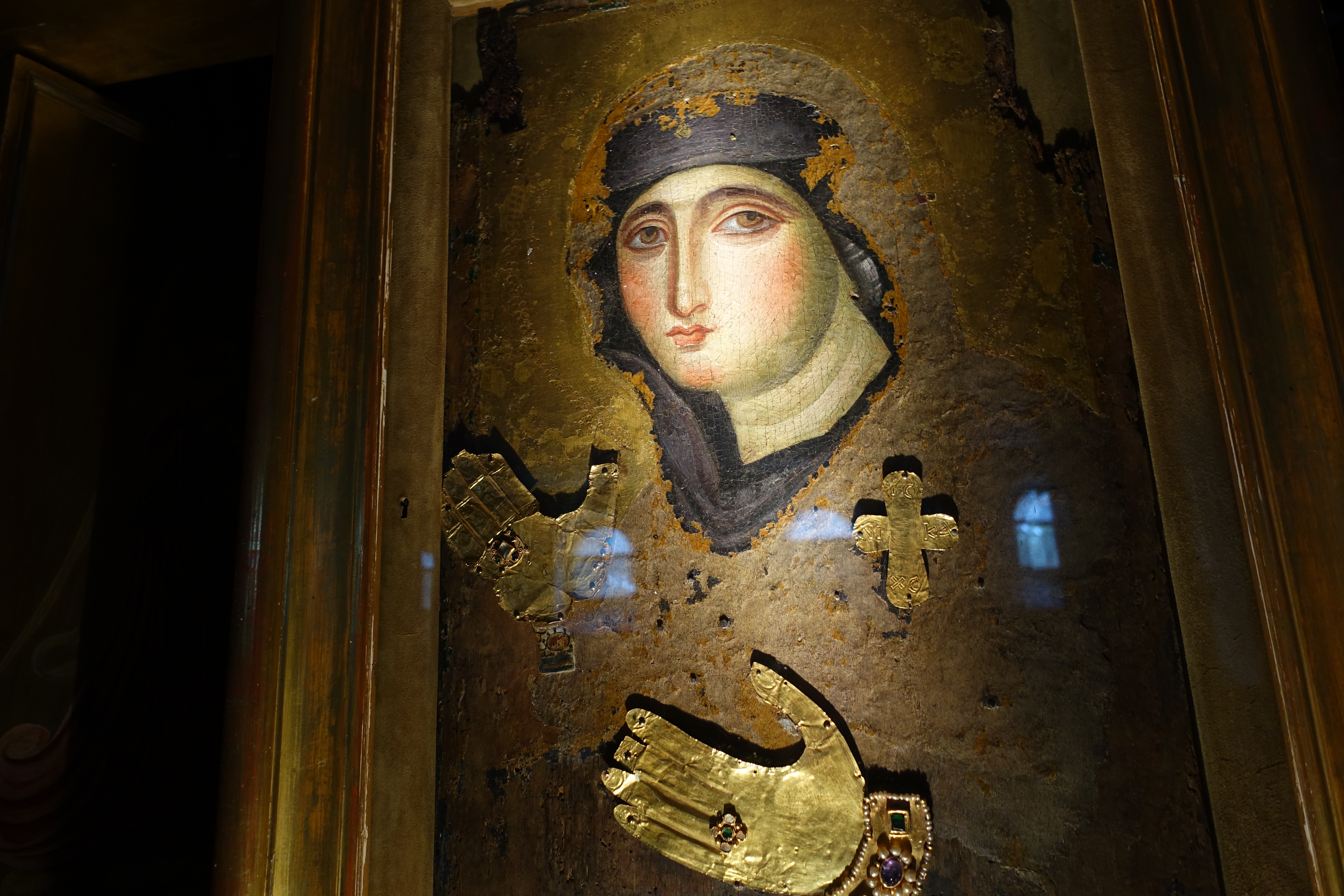
The Luke Icon: Rome’s Hidden Wonder of the World is partly a biography–because Paul’s search is a very personal one. But since love unites us all in Christ, Paul’s story is woven together with many interesting people, as well as places, surprisingly very near and also far away; there is mystery, intrigue, long years of research, and providential clues that fell in his lap. Many times his holy quest was an uphill battle with crosses, delays, and roadblocks along the way. In the end–in God’s perfect timing–it seems that Divine Intervention cleared away obstacles to suddenly reveal the incredible and astonishing results of his long search.
As I read Paul’s book, (very slowly translating from German, as it is not yet available in English), an image kept coming into my mind of a little boy sitting on a stool watching his mother at work, twisting and knotting various colored threads, as she wove a tapestry. I was reminded of a story told by St. Pio of Pietrelcina, in which he explained why God permits suffering, and evil to exist on our lives, only to bring about a greater good:
“A mother was embroidering on a small weaving frame. Her young son was seated in front of her on a small low stool watching her work. But, as he is watching, he saw only the tangle of threads on the reverse side of the weaving frame, from underneath. And so he says, ‘But mother, what are you doing? The embroidery is so ugly!’ So what does the mother do? She lowers the weaving frame and shows him the other side of the work, the good side with all its colors in place and all the threads making a harmonious pattern…. Have you seen what evil is like? Evil is like the reverse side of that embroidery, and we’re all sitting on a small stool.” ~ St. Pio

Paul was looking at “tangles of thread” from over 2,000 years. In addition to the arduous task of finding the Luke Icon in the first place, very difficult questions needed to be answered, such as: Was it actually painted by St. Luke, despite Hebrew prohibitions on the painting of images? Is “La Advocata Nostra” indeed the original? Is there any evidence that the encaustic wax icon belonged to the first century? Was the icon restored? What is the meaning of the gesture of Our Lady’s hands? Are there copies? And more.
Paul has uncovered many answers, though some questions remain. Maike Hickson has written a fine piece detailing some of Paul’s fascinating research: “This author may have discovered the original painting of Our Lady by St. Luke” (with wonderful photos as well.)
As to the first most basic and important question, regarding the Hebrew taboo on painting images; Paul provides a very solid theological answer to the question: Because the “Word of God” became man at the Incarnation, and because He has given mankind His own uncreated human face in the cloths of the Resurrection.
The Shroud of Turin and Holy Veil of Manoppello are known as “achieropoieta.” Meaning the miraculous sudarium veil of Jesus’s own human face was “written in light” by the Hand of God, and not human hands. An image created by God’s hand, of course, does not violate the prohibition on images. Paul writes, “This image [the veil of the Face of Jesus] was obviously needed before the first icon of Mary could be created later on, which really over-ruled the old ban on images.” Luke’s Icon of Mary is the iconoclast-breaker that removed the Hebrew prohibitions against painting any human image–“made in the image and likeness of God.” How fitting the Mother of God should be the first!
The position of her hands, raised as though she is interceding for us, caused her to be called by the unusual title of “Advocata Nostra.” She is our “lawyer,” but Advocata can have another meaning, “to call” or “summon.” Or as once Paul told me, “She is the one who is there when you call her.” Mary is ever pleading for us before the throne of God. However, the gesture of her hands, Paul discovered, turned out to mean much more. Paul had found some copies of the icon, made centuries before a restoration in the 1960’s, that reveal that before time had crumbled the paint away, she was holding something very precious in her hands that the restoration covered over. It would have been her most precious possession–a veil. A veil?…Why would she be showing us a veil? Paul makes a very good argument, that the veil that Our Lady holds in her hands is “The Cloth that covered Jesus’s Head” found in the tomb by Saints Peter and John-miraculously imprinted with His Face at the Resurrection–“Il Volto Santo,” the Holy Veil of Manoppello, Italy, is believed to be that veil. After all, it makes perfect sense, that of all of Jesus’s disciples, Saints Peter and John would have given “the cloth that covered His Head” to His own Mother.
It has been a long tradition of the Church that after a newly ordained priest has been anointed with blessed chrism, the oil is then wiped with a linen cloth, called a manutergium, representing the burial, or sudarium cloth of Christ, which is given to the priest’s mother, who keeps it throughout her lifetime, to be placed in her hands at her burial.
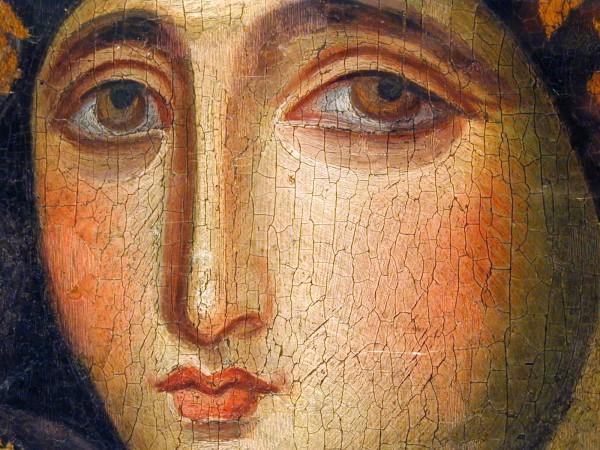
When one looks into the eyes of Advocata Nostra, as a child of Mary, one encounters a person, a motherly presence–Mary looks at us, she listens to us. She holds out to us, in her pure hands, her most precious treasure: the veil of the Holy Face of her Son Jesus. Though she is silent, as she “turns her eyes of mercy toward us, Mary seems to say everything: ‘Take courage, my child’...”He is Risen!”
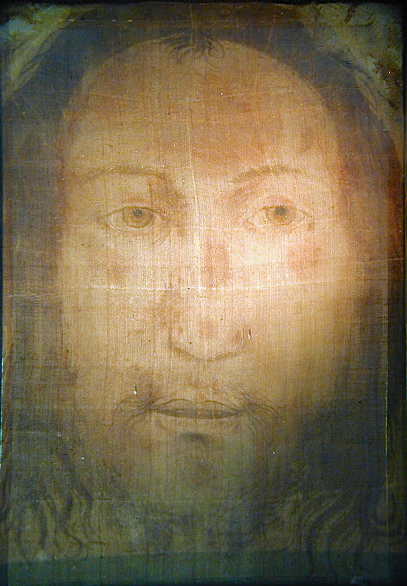
UPDATES: Raymond Frost’s blog “Holy Face of Manoppello Blogspot always has the latest news regarding the Holy Face of Manoppello, Italy.
August 29, 2024: Antonio Bini, of Manoppello, has written many wonderful pieces, translated from Italian for Raymond’s blog. Most recently, he has written about a very positive developement– the uniting of devotees of the Holy Face in “The ‘Holy Face’ of Christ Unites.” The Holy Face of Jesus has been loved and adored under many different aspects over the centuries, such as The Face from the Shroud of Turin, “Il Volto Santo” Holy Veil of Manoppello, The Holy Face of Chiusa Sclarfani, Italy, The Holy Face of Tours, France, and under many other titles around the world. However, the intention to love, honor and adore the person of Jesus Christ in His Sacred Humanity is always the same… Be sure to give Antonio’s report from Manoppello a read!
 Illumina Domine Blog - Devotion to The Holy Face