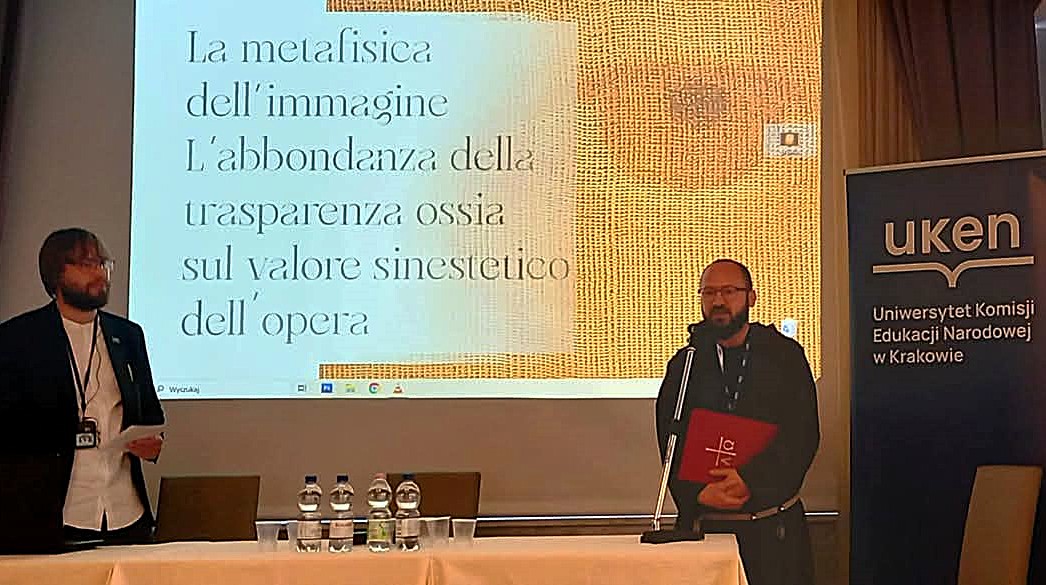
Rector of the Sanctuary Basilica of “Il Volto Santo,” Padre Antonio Gentili (R), greets Prof. Lukas Murzyn (L), and participants of the unique conference on the “Metaphysics of the Image.” Promoted by the UKEN University of Krakow, held at the Sanctuary of the Holy Face in Manoppello, Italy, on May 2-3, 2025.
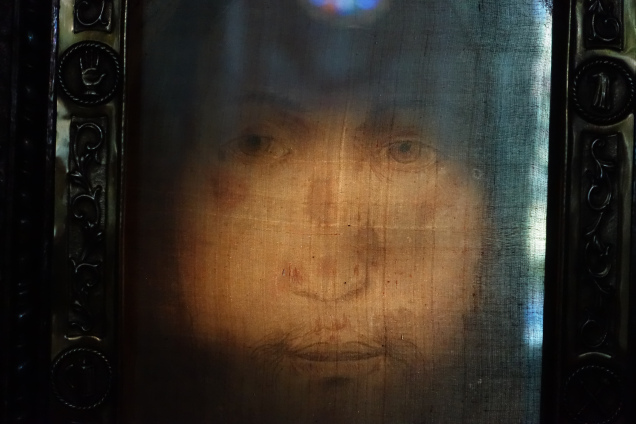
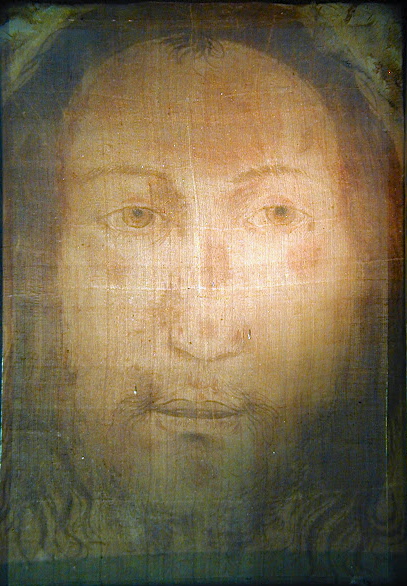
The Holy Veil of Manoppello –so sheer, and yet, without paint, an image my be seen of the Face of Jesus. (Photo: Paul Badde/EWTN)
For those who may be unfamiliar with “Il Volto Santo,” it is a precious relic veil considered to be an “Acheiropoieta” — meaning that its existence is supernatural — made by the Hand of God. The sheer veil, in a miraculous way, bears an image that is seemingly “written in light” of the Holy Face of Jesus Christ. This extraordinary relic has been the subject of intense study and renewed devotion at the dawn of this new millennium dedicated by Pope St. John Paul II to the Holy Face of Jesus Christ.
Padre Antonio Gentili, Rector of the Sanctuary Basilica, “face to face” with the Holy Veil of Manoppello. (Photo:Alexandra Prandell)
Antonio Bini, who was also invited to make a presentation on the important research on the Holy Veil by Fr. Heinrich Pfeiffer (1939-2021), has graciously provided a summary of a conference:
The Face of Christ on the Holy Veil becomes visible, according to the light, and at times appears to be a reflection of a living face. (Photo: Paul Badde/EWTN)
Antonio Bini writes: The relic veil of the Holy Face of Manoppello was the main focus of the conference, as it [The Holy Face of Manoppello] is considered “the source and root of the representations contained in tradition and an element of intellectual and supernatural conquests of Christian art,” as Prof. Lukas Murzyn, dean of the Faculty of Art and head of the Art and Metaphysics Study Group, explained in his introduction.
The Group, which operates at the Institute of Painting and Artistic Education of the Faculty of Fine Arts of the University of the National Commission for Education in Krakow (UKEN), promoted the conference held on May 2nd and 3rd, 2025, in Manoppello, Italy, having conducted research for several years on the changes in contemporary iconography, operating in the field of visual anthropology, the history of the philosophy of art, both in the field of experimental artistic activities and in that of the language of visual arts.
The professors of UKEN University during a break (Photo: Antonio Bini)
The speakers were welcomed in the conference room of the Casa del Pellegrino by the Rector of the Sanctuary, Padre Antonio Gentili and by the Mayor of Manoppello, Giorgio De Luca.
The conference was intended to respond to the question of what remains today of those roots [of representations of the Holy Face], how they are understood and what the metaphysics of the image can open up today.
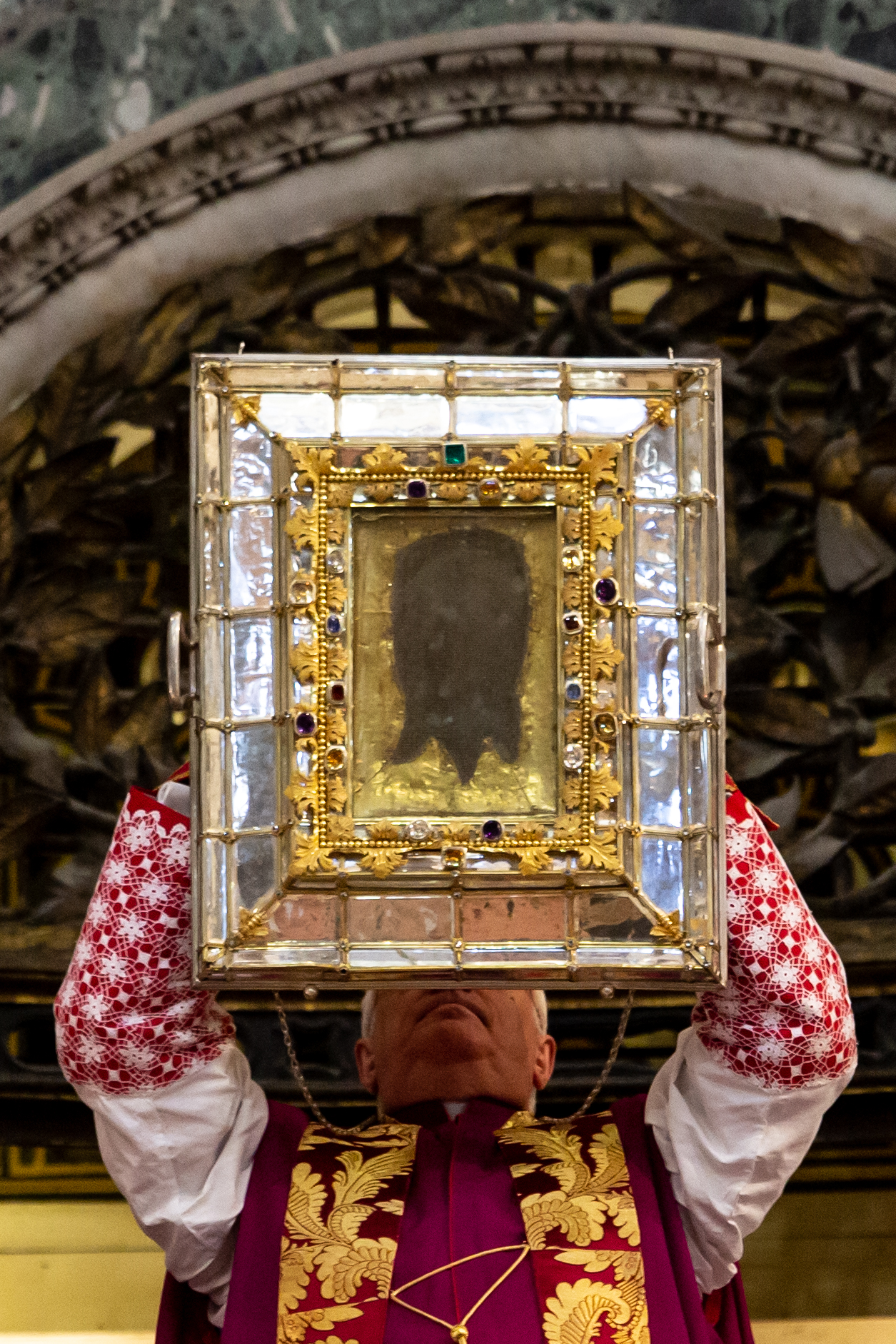
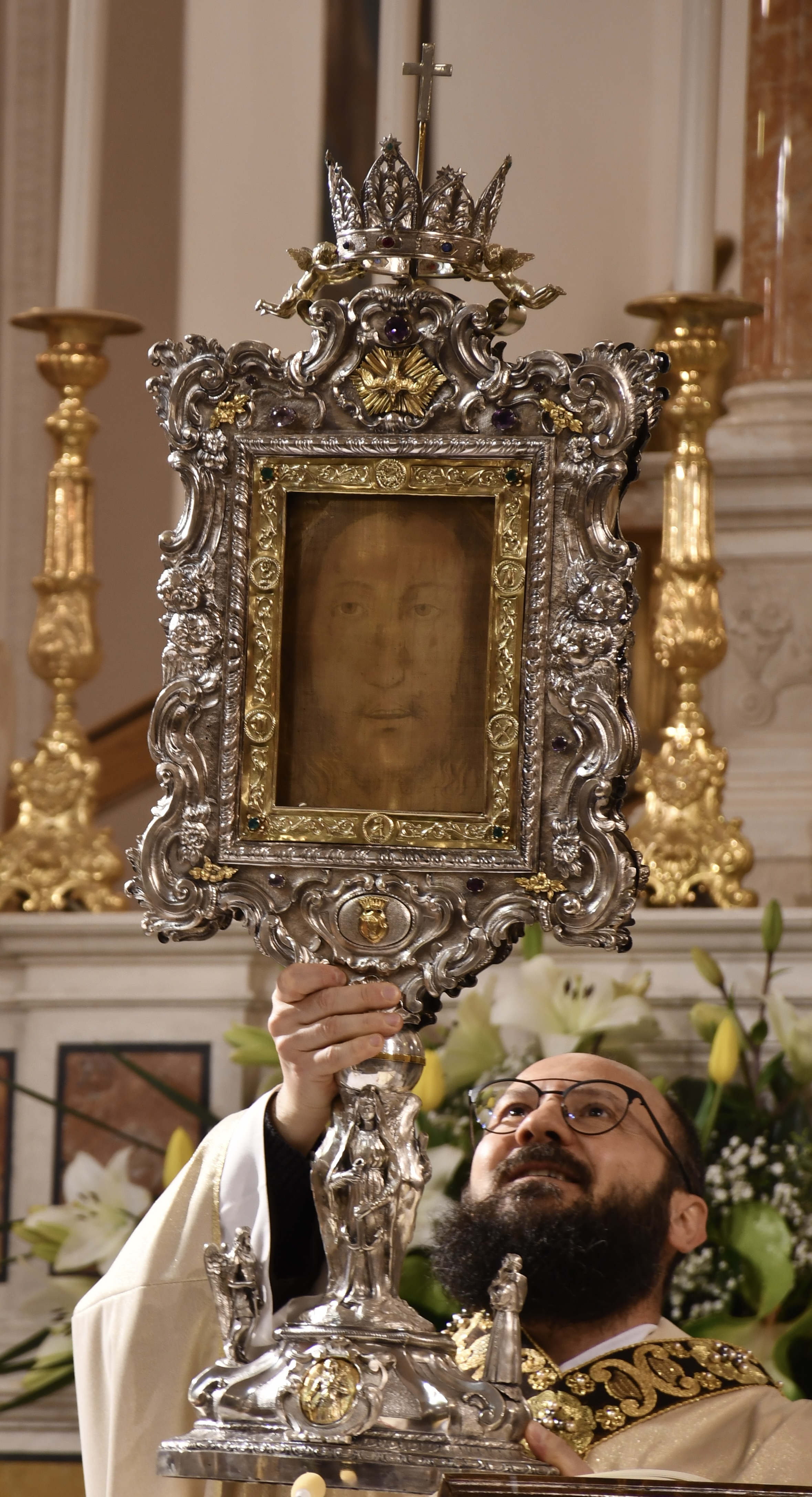
The Holy Face of Manoppello (Photo: Alexandra Prandell)
From the “Relatione Historic, 1640, a description of the Face by Padre Donato da Bomba: “He has a rather long, well-proportioned face, with a venerable and majestic look. His hair, or locks are long with thin twisted curls–in particular at the top of the forehead about fifty hairs wind into a little corkscrew, distinct from each other and well arranged. His left cheek is swollen and bigger than the other because of a strong blow across the cheek. The lips are very swollen. His teeth show. It seems the Holy Face is made of living flesh, but flesh that is afflicted, emaciated, sad, sorrowful, pale and covered in bruises around the eyes and on the forehead. The eyes of Christ are similar to those of a dove…He is serene and tranquil.”
Historical-religious themes were also developed, with the intervention of Padre Ceslao Gedacz OfmCap, who recalled some important figures in the history of the Holy Face belonging to the Capuchin order, such as Padre Donato da Bomba, who was responsible for drafting the Relatione Historic (1640), following the donation of the veil to the Capuchins. Padre Fillipo da Tussio, author of the first essay on the Holy Face published in 1875, and then Padre Domenico da Cese, the first to convincingly spread the divine nature of the sacred image. There were also references to some scientific tests and the findings of two commissions of doctors; the first composed of Germans and Austrians, the second of Italian doctors, who worked at the Sanctuary in 2011 and 2012, which Padre Ceslao himself followed, being part of the community of religious men of Manoppello at that time.
Servant of God Padre Domenico da Cese (1915-1978, former Rector of the Shrine) prays before the Veil of Manoppello.
Metaphysics of the Image conference hall. (Photo: Antonio Bini)
These researches were recently published in the essay by Sr. Blandina Paschalis Schloemer, with the title “Sali al tramonto”(2025), her first book published in Italian after various essays published in Austria, Germany, Poland, and France. The German iconographer was present at the proceedings.
Sr. Monika Gutowska of the Ancelle dei Santissimo Sangue in Manoppello, summarized her experience of welcoming and contact with many pilgrims, presenting several cases, including non-believers, of people who have seen their lives transformed, but also the desire of many devotees to return to the Sanctuary several times a year, from Italy and abroad, for a deep need to periodically encounter again that Holy Face, whose reproductions are present in many Polish homes. [And many others, as well, around the world!]
Among those present was also Padre Carmine Cucinelli, former rector of the Sanctuary, involved in recent years in enthronements of the Holy Face in Poland, and also in the Sanctuary of Krakow dedicated to Pope St. John Paul II.
In addition to the aforementioned Prof. Lukas Murzyn, the following speakers then gave presentations: Sebastian Stankiewicz, Rafal Slewski, Kazimierz Piotrowski, Bernadeta Stano, Anna Grabczewska, Agnieszka Daca, Jacek Pasieczny and Stanisław Wójcicki from the Study Group of the Uken University of Krakow.
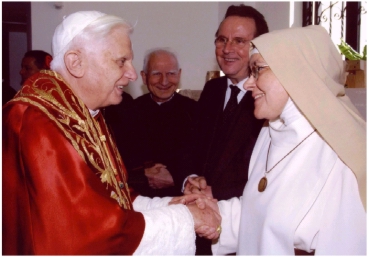
2006 – Pope Benedict XVI meets Sr. Blandina Paschalis Schlomer on his visit to the Sanctuary of the Holy Face in Manoppello, as Fr. Heinrich Pfeiffer, and Paul Badde look on.
We summarize the papers presented, whose simultaneous translation was edited by Agnieszka Kiedzik, from the University of Warsaw. The same papers may be the subject of further study in the publication of the proceedings, which will be edited by Sebastian Stankiewicz, with the title “Beautiful God: The Veil of Manoppello and the Iconography of the Incarnation,” with reference to a theological reflection on the “Beautiful God” present in the Middle Ages, expressed by Cardinal Joseph Ratzinger during a conference held at the Pontifical Urbaniana University in Rome, later taken up by Pope Benedict XVI.
“Being struck and overcome by the beauty of Christ is more real, more profound knowledge than mere rational deduction…We must rediscover this form of knowledge; it is a pressing need of our time.” ~ Excerpt from “The Feeling of Things, the Contemplation of Beauty” by Card. Joseph Ratzinger
The Group’s commitment also led to the creation of a portal — https://diafanitas.uken.cracow.pl — which collects experiences and initiatives on the study of the transparency of bodies crossed by light in a Christian dimension.
Dirk Bouts, 1400? – 1475
Christ Crowned with Thorns,about 1470
Various interpretative readings of the Holy Face have been developed, with the assumption that “whoever has come into contact with the Veil of Manoppello attests to its uniqueness and mystery.”
For representatives of the art sciences, many questions remain open: the origin of the image and history, the relationship between the relic and image, the role of the Veil of Manoppello in the creation of iconographic models in Christian art and in the evolution of ways of representation in Western Culture, the role of the veil among other representations considered acheiropoieta or formal similarities with the images of Christ depicted in the art of old masters; for example Dirk Bouts, Leonardo Da Vinci and Albrecht Durer, among others, and in the Eastern tradition. For contemporary art scholars, philosophers, theologians and anthropologists, the encounter with the Holy Face raises questions such as the relationship between sensual beauty and transcendent beauty, the idea of transparency and lights, the Christian sources of the idea and concept of a person, the meaning of the gaze and the encounter, the presence and contemporary reception of religious themes in art and sacred art and the importance of metaphysical references in contemporary art.
Veronica’s Veil Flemish 15th Century This is a fine example of the “Veronica” as portrayed by artists who saw the original for themselves, before it disappeared from view from the Vatican in 1527.
In my [Antonio Bini’s] presentation, I recalled the studies of Fr. Heinrich Pfeiffer (1939-2021), former professor of Christian history at the Gregorian University in Rome, who identified the Holy Face [of Manoppello] with the Veronica (vera icon), on the the occasion of the International Conference of the Institute for Research on the Face of Christ, chaired by Cardinal Fiorenzo Angelini, and then during a press conference held in Rome on May 31, 1999, on the eve of the Great Jubilee of 2000, which spread knowledge of the Abruzzo Sanctuary [of the Holy Face in Manoppello] throughout the world. Some sequences of that press conference with the interview of the German scholar, on Italian and foreign television, were repurposed in a video that the organizers wanted to show at the opening of the proceedings.
Fr. Pfeiffer’s position was then an isolated one, long contested, more or less openly. But his theses were later shared by Pope Benedict XVI, who visited the Shrine on September 1, 2006, composing a prayer that he dedicated to the “human face of God who entered history to reveal the horizons of eternity.”
Pope Benedict XVI contemplates the Face on the Veil of Manoppello. September 1, 2006. (Photo: Paul Badde/EWTN)
Also under the pontificate of Pope Benedict XVI, a statement from the Holy See on July 11, 2011 reported that the “Veronica disappeared from St. Peter’s following the Sack of Rome in 1527.” This circumstance was confirmed by the (then) director of the Vatican Museums, Prof. Antonio Paolucci (Former Minister of Culture of the Italian Government), in an interview with the Bologna newspaper Il Resto del Carlino on August 11, 2011.
The admission [of the Director of the Vatican Museums] put an end to almost five centuries of silence that had fueled doubts and uncertainties for a long time, also through works of disinformation carried out also through modifications of the same original image, through reproductions that presented a “Veronica” with eyes closed. In this regard, the Veronica Route Project was started in recent years by a group of Milanese scholars, which led to a collective search, still ongoing, of 6200 ancient depictions of the true icon of Christ (Veronicas) with the eyes open, collected in a multimedia catalogue.
And yet, on April 6, an article published on the Vatican News website reported the presence of the “Veronica” in St. Peter’s (or, a copy of it, a black background. No image is seen.), while the Holy Face [of Manoppello] is indicated as a “shroud,” [A burial face-cloth] reiterating its acheiropoieta nature [As supernatural–made by the Hand of God]. Evidently, the writer was unaware of the painful path that led to the admissions [of the Director of the Vatican Museums] of 2011. Fr. Pfeiffer would still be busy arguing his reasons.
This is an example of a reproduction, made by Pietro Strozzi after 1527, when the original could no longer be viewed. The dark image of a dead man’s face bore no resemblance to previous descriptions and paintings of the Veil.
The dark cloth in a face-shaped frame that is currently presented, from a great distance, at the Vatican. (Photo: Daniel Ibanez)
Finally, during the conference, the exhibition of artist-teachers and students entitled “Face to Face” was presented, delicately entering the space of the Sanctuary, to offer a unique forum for interdisciplinary dialogue.
“At the basis of the concept of the exhibition,” declared the curator, Prof. Stanisla Wojcicki, “is the face-to-face encounter with the image of the Veil [Of the Holy Face of Manoppello], treated by scholars as a prototype of other representations of Christ. We would like our works to be considered a votive offering, something that we leave here to express gratitude, for the fact that we were able to meet in this place–particularly important to us.”
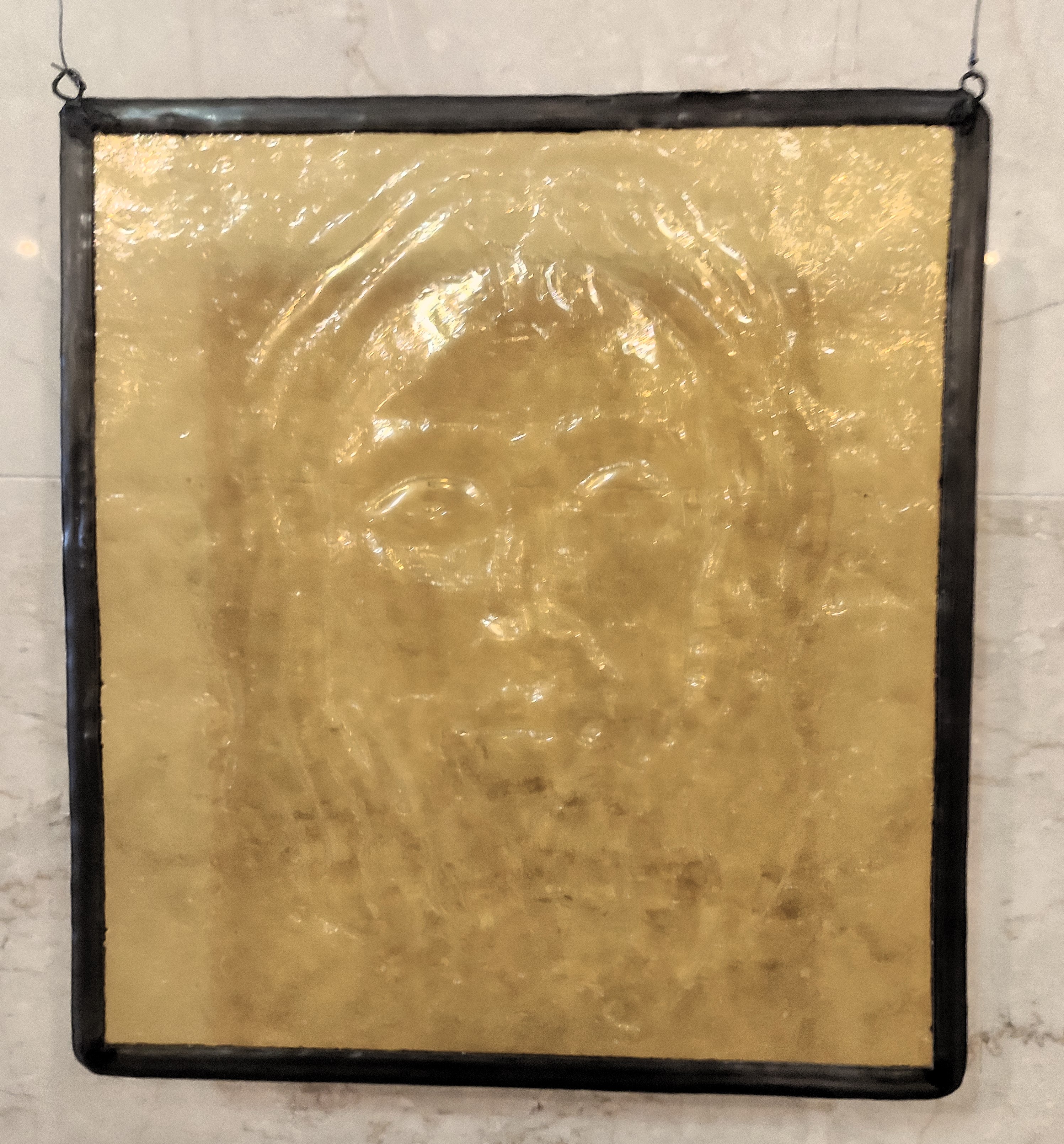
“Not matter but image,” a work by Jacek Pasieczny
“Not matter but image,” a work by Jacek Pasieczny, was exhibited in the Basilica as part of the “Face to Face” exhibition. The author described the work as “reflections of light, with the author” through the “use of glass of a particular color recalling golden byssus.” [of which the Holy Veil is believed to be woven.] The artist specified that it is not a copy of the original, but an attempt to paint a picture with light.
At the end of the conference we asked for an overall assessment from Don Arturo Alcántara Arcos, professor of spiritual theology and collaborator of the Soumaya Museum in Mexico City, also in Manoppello for the occasion, who stated: “It is particularly interesting to consider multidisciplinary points of view from a secular university. Here one can appreciate the different areas in which theology can be present, both directly and indirectly. The Uken of Krakow, inspired by the National Commission for Education established in the eighteenth century by the Polish King Poniatowski, open doors to a new dialogue between theology and the different artistic and aesthetic disciplines of our days in the contemplation of the Face of the Lord.” From what emerged during the conference and on the basis of the same conclusions of Prof. Lukas Murzyn, the belief that the Holy Face can also represent today the reference to the contemporaneity of Christ for art appears to be shared. An analytical perspective that the professors of the University of Krakow — the first to organize a similar event in Manoppello — intended to offer the art world.
Grazie Mille! Antonio Bini for this beautiful summary of the Conference on the Metaphysics of the Image!
One last thought from the beloved Cardinal Ratzinger — and later — Pope Benedict XVI:
Holy Face of Manoppello, (Photo: Paul Badde/EWTN)
“The encounter with the beautiful can become the wound of the arrow that strikes the heart and in this way opens our eyes…” “Inner perception must free itself from the impression of the merely sensible, and in prayer and ascetical effort acquire a new and deeper capacity to see, to perform the passage from what is merely external to the profundity of reality, in such a way the artist can see what the senses as such do not see, and what actually appears in what can be perceived: the splendor of the glory of God, the “glory of God shining on the face of Christ.” (11 For 4,6). –“The Feeling of Things, the Contemplation of Beauty” by Card. Joseph Ratzinger
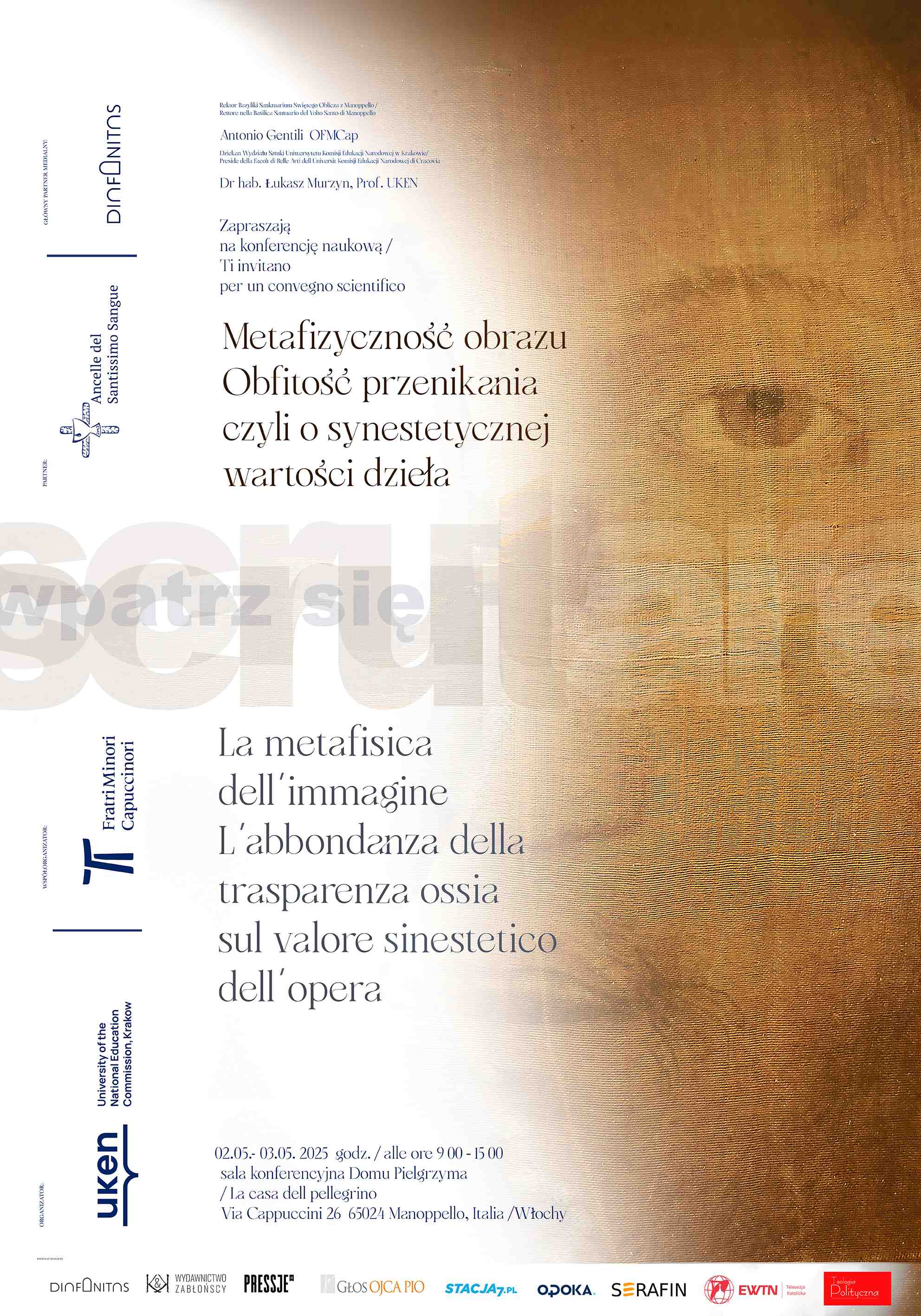
Poster for the upcoming May 2-3 conference to be held at the Sanctuary in Manoppello.
Pope St. John Paul II’s words “Be not afraid!” immediately came to mind after I read the daunting title of the unique scientific conference that will be hosted by the Sanctuary of the Holy Face in Manoppello, Italy, on May 2-3, 2025:
“The Metaphysics of the Image. The Abundance of Interpenetration, or on the Synesthetic Value of the Work.”
But, as intimidating as the title may be, the words are an open invitation to all (admission is free) for those who “seek the Face of God” to come to the Sanctuary Basilica of Manoppello to listen, prayerfully contemplate, and discuss the beautiful and profoundly deep meaning of the existence of the mysterious “Acheiropoieta”–made by the Hand of God–that is known as “Il Volto Santo” – a miraculous image of the Face of Jesus that is inexplicably present on sheer veil.
Veil of Manoppello,photo: Paul Badde/EWTN
“Duc in Altum”
One certainly must admire those who have organized this wonderful event, uniting science, faith, and art, for not fearing “to put out into the deep” (Luke 5:4): The Art and Metaphysics Research Team of the University of the Commission of National Education in Krakow, Poland, and the congregation of the Friars Minor Capuchin in Manoppello, Italy. The conference will take place in person and will be accompanied by an exhibition of artists, lecturers and students of the Uken University of Krakow entitled “Face to Face.”
The organizers have provided further details for those who may like to attend this important event:
The first day of the conference, May 2, the “speakers’ presentations and discussion will focus on the historical and contemporary contexts of the Holy Face, with particular emphasis on the influence of the centuries-old cultural and religious heritage of this image on the iconography of Christianity and the role it has to play in the contemporary world.” Prof. Antonio Bini will give a presentation on Fr. Heinrich Pfeiffer, S.J. and his great contribution to the research on the Holy Veil of Manoppello in the 1990’s.
The second day of the conference, May 3, a panel will be held on “contemporary religious art and its contexts. The topics of the presentations will include attempts to apply scientific interpretative tools from the fields of philosophy, theology, and art history to the Image of Manoppello and other relics ‘not made by human hands.’ Artists, participants of the ‘Face to Face’ exhibition, will also share their reflections on the influence of the Bible and hagiography on their creative process. It will therefore, not only be a space for the exchange of knowledge, but also for reflection on the role of the artist and the Church in the face of the challenges of modernity.”
The conference “is intended to be not only an opportunity for scientific reflection, but also to learn about the diverse attitudes and ways of expression represented in the environment of artists working our Art and Metaphysics Research Team. During the conference an exhibition of artists-pedagogues and students entitled ‘Face-to-Face’ will be presented. It is intended to enter the space of the Sanctuary in the most delicate way possible, but also to be a unique forum for interdisciplinary dialog.
The artists generously desired to leave the fruits of their work as a permanent exhibition in Manoppello for the edification of Pilgrims to the Sanctuary Basilica: “We would like our works to be a votive offering, something that we will leave to express our gratitude for being able to be in this place that is particularly important to us. Together with the works we bring, we would like to bring our own intentions and reflections related to the most intimate possible relationship, with God” –Declaration of the artists of the “Face-to-Face” exhibition
“This exhibition is a kind of prayer of thanksgiving and an introduction through artistic means to the contemplation of the Divine Face of Manoppello…and at the same time a preface (Latin: praefatio) for [the artists] further activities.
This photo was taken on Easter by Alexandra Prandell, of the Rector of the Shrine, Padre Antonio Gentili, whose face reflects the joy of the Risen Christ.
“The international scientific session at La Casa Pellegrino in Manoppello will be honored by the presence of His Excellency Mons. Archbishop Bruno Forte, Archbishop of the Diocese of Chieti, and will be attended by: clergy, journalists, researchers, art historians, philosophers and artists: Czeslaw Gadacz OFMCap, Prof. Antonio Bini, S.M. Monika Gutowska SAS, Prof. Lukas Murzyn, Dr. Sebastian Stankiewicz, Prof. Rafael Solewski, Dr. Bernadeta Stano, Anna Grąbczewska, Dr. Agnieszka Daca, Dr. Jacek Pasieczny, Mgr. Stanislaw Wojcicki.
During the session, the film directed by Jaroslaw Redziak entitled “The Face of Jesus” will also be presented.
This important event, I believe, will greatly enrich our understanding and knowledge of “Il Volto Santo.” The precious veil of the Holy Face is not a mere curiosity. Such a great gift from God must be taken very seriously and approached prayerfully, with reverence, love, and a deep desire for a better understanding of God’s ultimate Gift of His Son to us.
Padre Antonio Gentili elevates and contemplates the “Eucharistic Face of Christ” in the Host, where Jesus is truly present, “Body, Blood, Soul and Divinity.” Photo: Alexandra Prandell
One last thought… Do not be afraid to dive into “The Metaphysics of the Image of the Face of Christ.” The artists and Our Creator both know that “A picture paints a thousand words,” and prove the existence of the artist, as well as the Divine Artist!
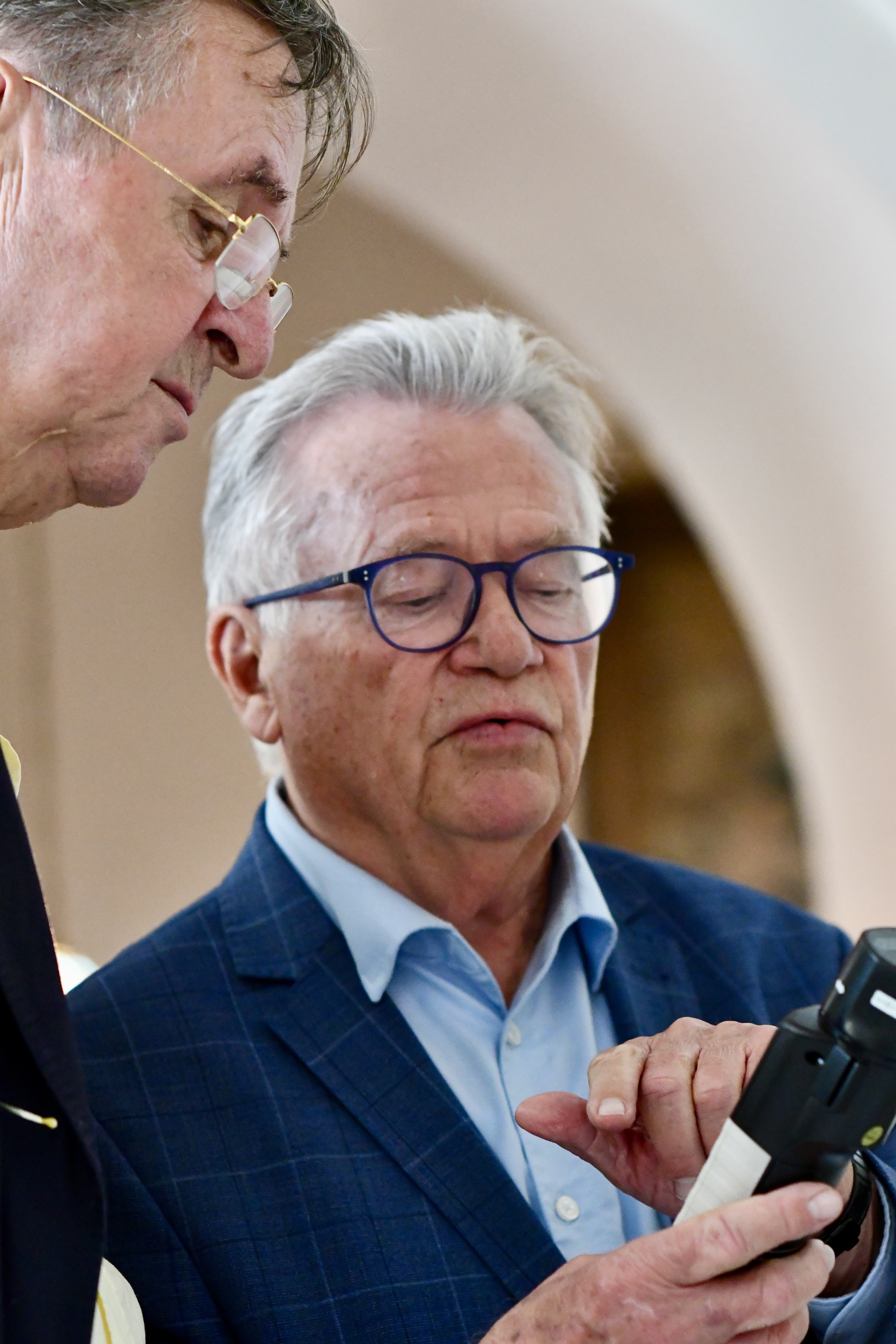
“The Holy Face contains light” Prof. Dr. Gosbert Weth holding the nuclear medicine measuring device used for examining the Veil of Manoppello. (Photo: Marco Gandolfo/EWTN)
The Holy Face Veil of Manoppello has been proven to radiate light energy!
Hand viewed through the gossamer-thin Veil of the Holy Face (Photo: Paul Badde/EWTN)
It seems that in Manoppello, Italy, an intriguing and sacred mystery to mankind has been slowly unfolding for centuries: the existence of a changeable, “living” image of the face of Jesus; visible on a sheer veil, from either side. The presence of the image appears to be a miracle of light; seen without any traces of drawing, paint or brush. It is a contradiction–“an inexplicable phenomenon” which begs to be investigated by science. I had written earlier this year, a post on the topic of testing relics, specifically in regards to known Holy Face relics: “The Church, the testing of Relics, and the Holy Face.” The difficulty of conducting research on ancient relics is daunting, but not impossible. But who could undertake such a delicate task, and how…?
Enter an eminent German doctor, Gosbert Weth, who has recently conducted non-invasive investigations on the relic of the Holy Face Veil of Manoppello, using a special nuclear medicine device which measures alpha, beta, and gamma rays. Beta rays are invisible, energetic, and are released during nuclear fission. It has been determined that the veil of Manoppello has such a high level of beta radiation that it fills the Basilica!
EWTN and Ave Maria Radio host Teresa Tomeo has also interviewed Paul Badde, who is in Rome. The “Catholic Connections” interview may be listened to by clicking here: Catholic Connections interview with Paul Badde. There is a slight audio delay, coming from overseas, so it is a little difficult to hear Paul’s words in spots, but fortunately… With permission, Paul Badde has graciously allowed me to print a translation of his original piece on the examination of the relic, which provides additional precious details of the historic investigation of Dr. Weth, and the astounding conclusions:
“Il Volto Santo,” the sudarium veil of the Holy Face of Jesus (Photo: Paul Badde/EWTN)
Living Source for the Holy Year by Paul Badde
In the First Holy Year ever, which Pope Boniface VIII (1294-1303) introduced as a Christian jubilee for the year 1300, the most important destination for all pilgrims to Rome was not the Pope, nor even the tombs of the Apostles, but [to see] a gossamer-thin veil with the face of Christ. The veil was the greatest treasure of St. Peter’s Basilica, which at that time was called “Sanctum Sudarium” [meaning a burial face-cloth] in Latin, and was also known as the “Veronica.” The relic was considered to be the ‘Holy Sweat Cloth’ from the tomb of Christ, which is first mentioned in the account of the resurrection of the Evangelist John, together with the long linen cloth [Shroud] that is venerated today in Turin. In January 1208, Pope Innocent III was the first Pope to carry this Holy Veil in a crystal monstrance, publicly and barefoot, from St. Peter’s Basilica to the nearby Santo Spirito Hospital in Sassia in Rome, making it known throughout the Catholic world of the West.
Pope Innocent III carrying the reliquary with the Veil of the Holy Face in Procession.
Pope Benedict XVI praying before the ‘Veronica’s Veil’ during a visit to the Holy Face shrine in Manoppello, central Italy, September 1, 2006. (Osservatore Romano)
Since 1620, the same cloth has been venerated as the “Holy Face” (Volto Santo) in a Capuchin church on a hill outside Manoppello, on the slopes of Magellan massif in Abruzzo, where Pope Benedict XVI visited on September 1, 2006, becoming the first Pope [to visit] in over 400 years. It is a veil with many mysteries that has also puzzled Dr. Gosbert Weth from Schweinfurt in Germany ever since he heard about it and saw photos of the veil.
Rector Antonio Gentili OFM Capuchin, and Prof. Dr. Gosbert Weth in front of the relic Veil of the Holy Face. (Photo: Marco Gandolfo/EWTN)
Dr. Gosbert Weth is 78 years old, a former chief physician, doctor of medicine and natural sciences (chemistry), with a “picture-book” academic career. As senior physician and head of the hormone laboratory at the University of Würzburg, he worked on the largest centenarian study in the world with 575 participants, aged 100. He has developed groundbreaking developments for tumor therapies, has also received the German Inventor Award as the holder of several patents, and has been a speaker at the several world congresses for geriatrics and gerontology. Today he is involved in research into new uses of hydrogen, and is a doctor for hopeless cases in Bad Kissengen.
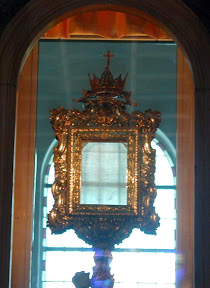
However, because he is convinced that the true “image” on the holy veil cannot have a paint or technical cause, Dr. Weth came to the Papal Basilica of the Holy Face in Manoppello on the eve of the next Holy Year 2025, on September 26th, with a special device from nuclear medicine for measuring alpha, beta, and gamma rays. Here, [in the Basilica] Rector Antonio Gentile of the Capuchin convent of the sanctuary, willingly opened the armored glass door of the display case in which the holy Sudarium has been sealed in its reliquary between two crystal panes in a frame made of walnut and fish glue since 1714. It was on the memorial feast of the holy doctors [of the Church] Cosmos and Damian, when the doctor from Bad Kissengen [Dr. Gosbert Weth] was given two hours here during the lunch break of the monks, and another hour on the following Saturday for his examinations.
Dr. Gosbert Weth examining the Veil of the Holy Face (Photo: Marco Gandolfo/EWTN)
“As a doctor, I can see,” he began his findings, “that this person must have suffered severe torture. Hematomas [bruises] are clearly visible on both the nose and in the area of the right cheek. Intense blows are necessary in order to cause these hematomas, which are always considered to be more serious injuries in medical examinations. There are no traces of paint or blood detected on the image. Therefore, the ‘image’ must have come into existence only after death. There is a pronounced hematoma on the nose (on the left side), which must be older than two to three days. No other bodily fluids such as blood or sweat are visible. This cloth can therefore only have been placed on a person who has already died. There is a double hematoma that can also be seen in the area of the right cheek. Normally, as is still the case in medicine today, the eyes of every dead person are closed. But the man in this portrait, however, has his eyes wide open. This ‘picture’ is an inexplicable phenomenon.”
Miraculous Veil of the”Holy Face of Manoppello” in Italy Photo: Paul Badde/EWTN
At the end of his investigation, however, Dr. Weth recorded the following: “All in all, there is only one explanation for the formation of the image of the sacred face. The atomic change from nitrogen (N14) to carbon (C14) must have occurred under the influence of enormous neutron radiation (light energy). The light energy present in the veil is the atomic evidence of the conversion of nitrogen (N14) to carbon (C14). Since the carbon is dark in color, the image is deposited as dark matter in the cloth. This also explains the alternating color shades. The ‘image’ is therefore not due to any application of paint, but to the nuclear-modified fibers of the carrier material.“
In this context, we must remember that most rays, in contrast to light rays, are invisible, but in many cases are extremely powerful–such as electromagnetic X-rays, or the almost invisible infrared light. All of these rays are full of energy.
Holy Face of Manoppello (photo: Paul Badde/EWTN)
Dr. Weth continued: “The radio carbon method provides evidence that carbon-C14 was formed. Carbon-C14 decays into nitrogen-N14 with a half-life of 5730 years, releasing beta radiation, which is produced by the radioactive decay of atomic nuclei. The formation of carbon-C14 leads back to nitrogen-N14. Since carbon is dark, this image is also darkly colored and optically visible due to the conversion of nitrogen to carbon. So once again: the image on the Manoppello [sudarium] cloth was not created by coloring, but by an atomic change to the nitrogen molecules present in the organic substance.”
“We therefore tried to measure the beta radiation released by the Manoppello cloth,” he said. “That was not so easy because the shroud is enclosed between two glass plates. Nevertheless, we were able to measure this radiation, which took place around 2000 years ago, and of which around 50 percent has already been consumed.”
We know that the decay of carbon C14 under beta radiation decays by half within 5730 years. It should therefore still be possible to measure this radiation– which was actually the case:
This basic radiation on the image veil was significantly higher than outside in the open air of nature. We therefore tried to measure this basic radiation as precisely and closely as possible. If we held the measuring device on the side of the reliquary, i.e. on the left and right at the places where there was no glass shielding, there was an increase of around 40 percent in beta radiation as a result of the conversion of carbon-C14 to nitrogen-N14. Overall, this beta radiation, which is also present everywhere outside in nature, was considerably higher in the protected basilica than [it is] outside. This is actually a contradiction. The reason for this higher density of beta rays can only lie in the existence of the Volto Santo [Holy Face Veil] inside the basilica.
“This can also explain the radiation of the Manoppello cloth at night,” Weth said with conviction. “It is visible in the dark because the conversion of C14 to nitrogen-N14 releases energy that is not one released from light quanta, but also from electrons, as they are raised to higher orbitals [wave function] in a conventional lamp. When the electrons fall back to their orbitals, light is released, which explains the radiance of the Manoppello sudarium cloth at night.”
Holy Face Veil of Manoppello (Photo: Paul Badde)
In one sentence: The Holy Face contains light within itself. The “True Icon” (Vera Eikon), as the veil has also been called for centuries, radiates from within itself. This image veil is therefore not only identical to the Holy Sudarium from Jerusalem and the “Veronica” from Rome. It is “the human face of God” that Pope Benedict XVI has repeatedly spoken of– and also a source of energy that inexplicably even fills the church’s interior, where rays should not normally be measured at all.
Basically, the experience that the Volto Santo is a source of power is nothing new. It is familiar to almost every pilgrim who has ever visited the shrine. However, since Dr. Gosbert Weth’s investigation before the next Jubilee Year, the statement is no longer a mere assertion, but a physical fact that can be measured. –Paul Badde
Paul Badde and Dr. Gosbert Weth (Photo: Marco Gandolfo/EWTN)
+
It makes one ponder…if a cloth that had been placed on Christ’s Holy Face in the tomb measurably radiates such powerful light energy that is not seen with our eyes, what tremendous power there must be when we come before His Eucharistic Face– where Jesus is fully present, Body, Blood, Soul and Divinity?
-Pope Benedict XVI (photo:Paul Badde/EWTN)
“O most awe-inspiring King, we bow before You and pray; May Your Reign, Your Kingdom, be recognized on earth!”














 Illumina Domine Blog - Devotion to The Holy Face