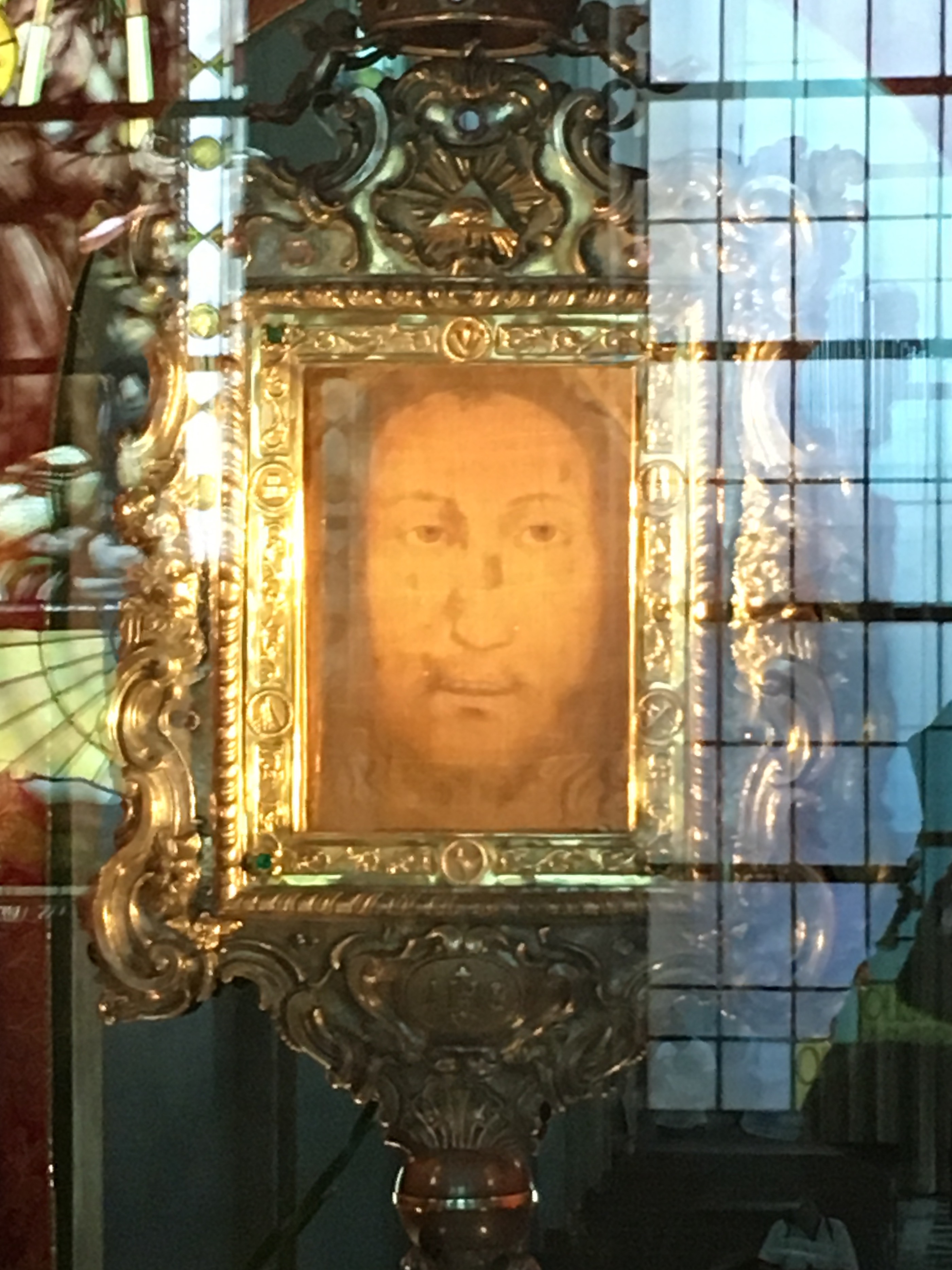
Jesus Christ is Risen! “The Cloth That Covered His Head”

There were several burial cloths of Christ that were found in the tomb; and among them: the Shroud of Turin, the Cloth of Oviedo, and the precious byssus veil that was believed to cover the Face of Christ in the tomb – known as “Il Volto Santo” – The Holy Face of Manoppello. Possibly the very reason that St. John “Saw and believed.”
The Disciples Peter and John Running to the Sepulchre on the Morning of the Resurrection, Eugene Burnand, 1898

So Peter and the other disciple went out and came to the tomb.
They both ran, but the other disciple ran faster than Peter
and arrived at the tomb first;
he bent down and saw the burial cloths there, but did not go in.
When Simon Peter arrived after him,
he went into the tomb and saw the burial cloths there,
and the cloth that had covered his head,
not with the burial cloths but rolled up in a separate place.
Then the other disciple also went in,
the one who had arrived at the tomb first,
and he saw and believed.
For they did not yet understand the Scripture that he had to rise from the dead.  (John 20: 1-9)

At the time of Jesus, the Jewish law required several “cloths” to be used for burial, and as many as six for someone who had died a violent death. Christian tradition has preserved six cloths as relics that are associated with the burial of Jesus – 1.) The Shroud of Turin, Italy 2.) the Sudarium of Oviedo in Spain, 3.) The Sudarium Veil of Manoppello, Italy 4.) The Sudarium of Kornelimunster in Germany, 5.) The Sindon Munda of Aachen, Germany, 6.) The Cap of Cahors in France.

Three  of the cloths in particular stand out as extraordinary “witnesses” to the Passion, Death, and Resurrection of Jesus, and together they bear a powerful testimony to the truth of the Gospels. Each one bearing an imprint or image of the Face of Jesus. They are: The Sudarium of Oviedo, The Shroud of Turin, and the Sudarium Veil of Manoppello. The remarkable relationship between these three “cloths” leave little doubt that each came in contact with the face of the same man at the time of burial.

The Sudarium of Oviedo directly touched Jesus’s head following His Crucifixion. Blood was considered sacred to the Jews, so this cloth was used to soak up the Precious Blood of Jesus, by wrapping it around Jesus’s Head, as He was taken down from the Cross. The largest bloodstains are from the nose, other stains are from the eyes and other parts of the face.  There is also an imprint on the sudarium of the hand of the person who held this cloth to Jesus’s Face to staunch the flow of blood. It takes one’s breath away to see that the bloodstains on the Sudarium of Oviedo, when overlaid with the Face on the Shroud of Turin and the Sudarium Veil of Manoppello, correspond perfectly. The blood type is AB, the same as on the Shroud of Turin.
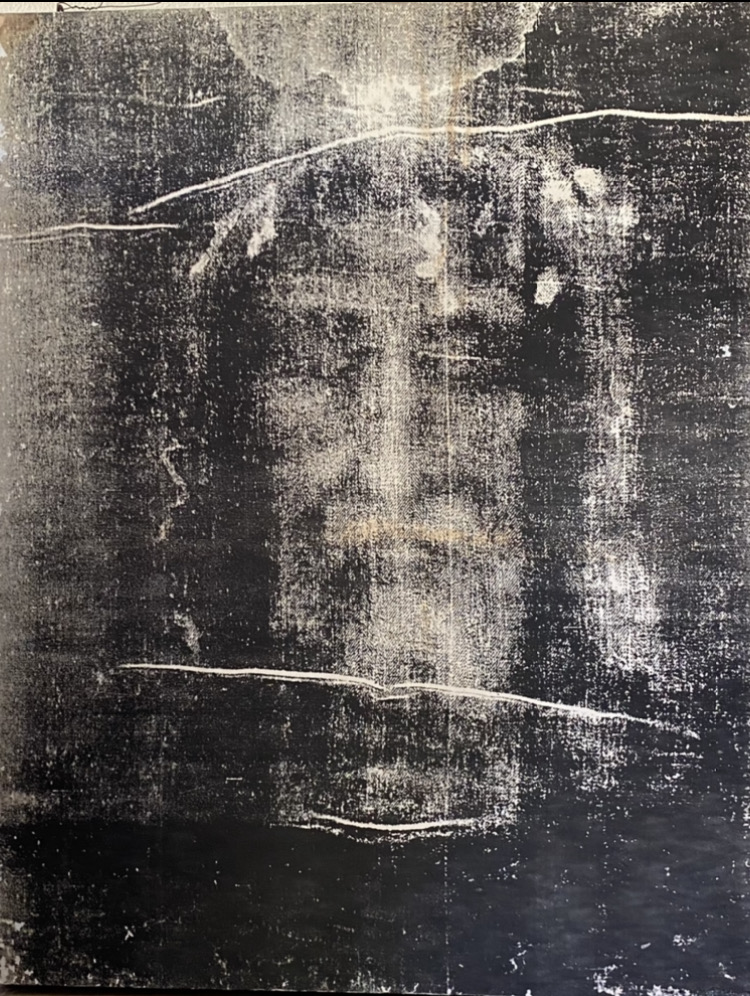
Photo of the Face on the Shroud of Turin

“He went into the tomb and saw the burial cloths there.

The Shroud of Turin; the sindone, or linen burial shroud, was believed to have been used to wrap the entire body of Christ. It is the most famous and studied of the three cloths. The faint but visible imprint on the Shroud of Turin gives witness to the violent torture of a man as described in the Passion and Death of Jesus in the Scripture. The world was amazed when Secondo Pia first photographed the Face on the Shroud in 1898; the negative of the photo incredibly became visible as a positive image. The Shroud of Turin caused an entire branch of science to be dedicated to its research called Sindonology.
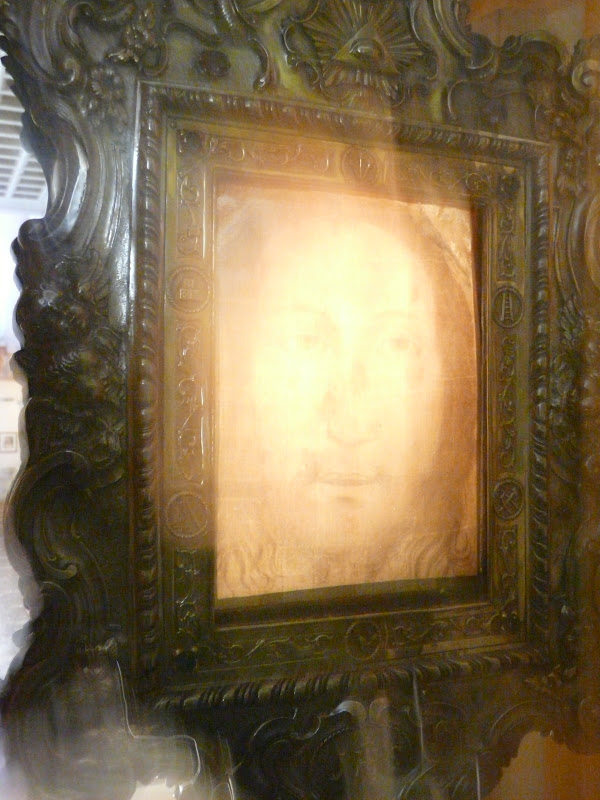
Photo: Holy Face Veil of Manoppello, Italy (Paul Badde/EWTN)

‘…and the cloth that had covered his head,
not with the burial cloths but rolled up in a separate place.

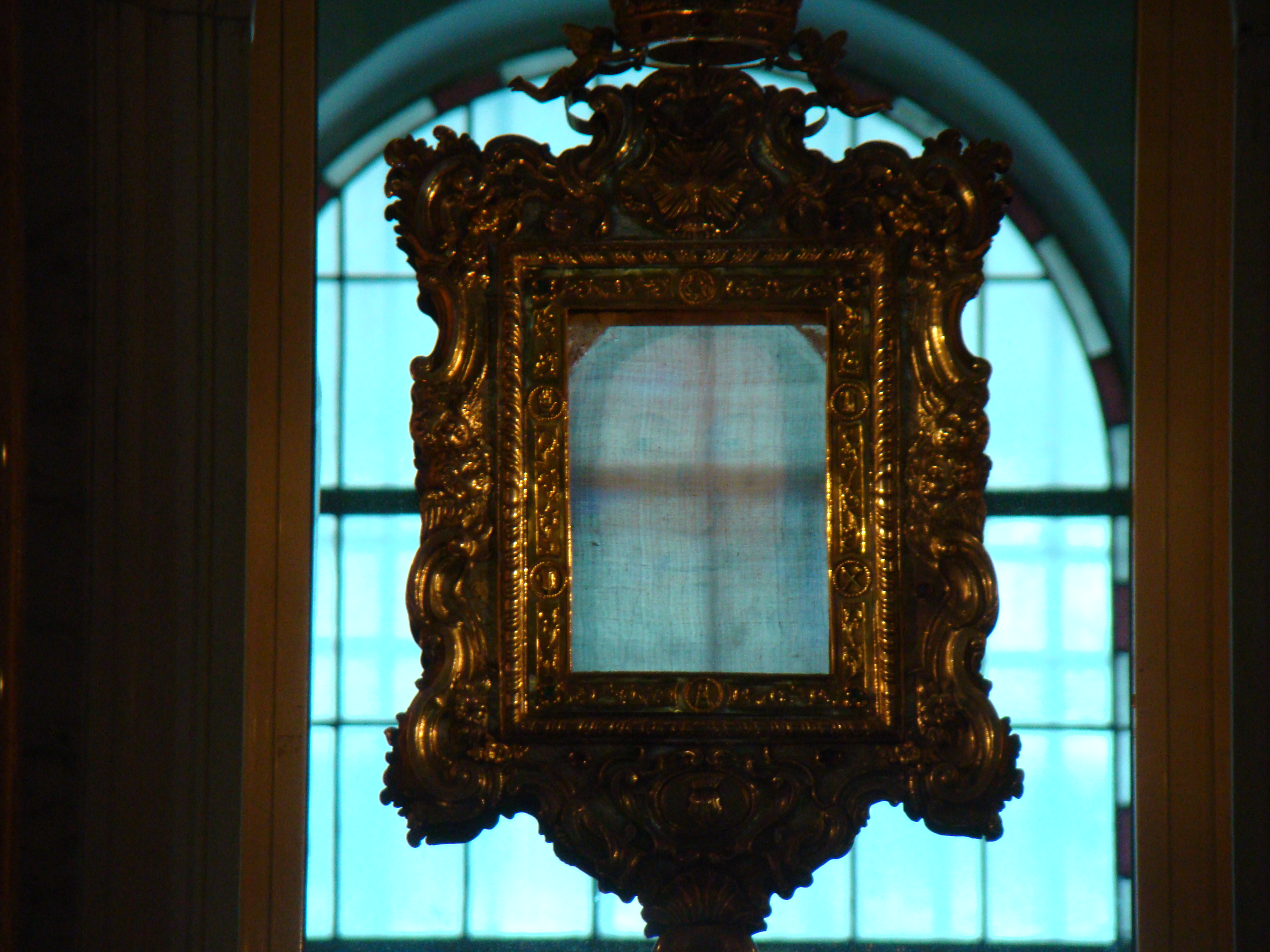
Reliquary containing the transparent veil on which the image of the Holy Face becomes visible, according to the light and position of the viewer. Photo: Paul Badde

The Sudarium Veil of the Holy Face of Manoppello, Italy is perhaps the least known of the three burial “cloths.” The Veil bears the image of the living Face of Jesus. This “miracle of light,” “not made by human hands,” was protected and hidden in an isolated church in the Abbruzzi Mountains for centuries. It is believed to be the “cloth” that covered the Face of Jesus in death, showing traces of the Passion: Bruises, swelling, wounds from the Crown of Thorns, and plucked beard.  But, it is also believed to have recorded in light the Face of Jesus at the moment of His Resurrection. No, this is not a contradiction. Yes, the image changes. It shows suffering, but it also shows life! It is believed to be “The cloth that covered His head.”

“Il Volto Santo” The Holy Face Veil of Manoppello.
Photo: Patricia Enk

An explanation about the tradition of a face cloth for burial may be helpful in understanding its profound significance:  In the funeral rites for priests in some Eastern churches, the veil which was used to cover the chalice and paten were placed on the face of the deceased priest. (The cloth used to cover the chalice and paten had a particular liturgical symbolism linked to the Face of Christ as well.) It was done as a symbol of both the strength and protection of God, and also of the tomb of Christ–an expression of belief in the Resurrection. In Jewish burial custom, a deceased priest’s face would be anointed with oil and then covered with a white cloth, and would have been done for Jesus.
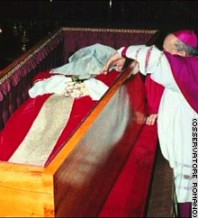
Funeral of Pope St. John Paul II, Archbishop Dziwisz covers the pope’s face with a veil.

When Pope St. John Paul II was being laid in his coffin, Archbishops Marini and Stanley Dziwisz had the honor of placing a white silk veil over the face of the pope. Poignantly, the choir sang the words from Psalm 42, “My soul thirsts for God, the living God; when will I come and see the Face of the Lord?” Many wondered about the action of covering the pope’s face with a veil because this was the first time it had been done, but was at the request of Pope John Paul II, who had dedicated the millennium to the Face of Christ.

Byssus “Pinna Nobilis” fit for a King! Photo: Paul Badde/EWTN

The cloth that would cover the Face of Christ would have to be made of a material fit for a King, a High Priest, and a God. Byssus, mentioned in the Bible forty times, also known as “sea-silk,” is more rare and precious than gold and it has an exceedingly fine texture which can be woven. Made from the long tough silky filaments of Pinna Nobilis mollusks that anchor them to the seabed, it is strong enough to resist the extreme hydrodynamic forces of the sea. Byssus has a shimmering, iridescent quality which reflects light. It is extremely delicate, yet strong at the same time. It resists water, weak acids, bases, ethers, and alcohols. Byssus cannot be painted, as it does not retain pigments, it can only be dyed; and then, only purple.  It can also last for more than 2000 years.

Kurt Cardinal Koch contemplates the Veil “not made by human hands” of Manoppello. Sheer and delicate, yet the Face is visible. Photo: Paul Badde/EWTN

The Sudarium Veil of Manoppello is also made of rare, precious, byssus silk.  The skill needed to weave a byssus veil as fine as the Veil of the Holy Face of Manoppello is exceedingly great.  Chiara Vigo, known as “the last woman who weaves byssus,” has said that neither she nor anyone alive today could duplicate the gossamer-thin veil, which is sheer enough to read a newspaper through.  The weave is so delicate, she says, that only the nimble fingers of a very skillful child could weave something so fine.

Photo: Paul Badde

It is only through light that this shimmering image of the Face of Jesus may be seen, and at times appears as a “living image” as though it were reflected in a mirror, at other times the image completely disappears.  Although no camera can adequately capture the image, thanks to the many amazing photos of journalist Paul Badde, the changes that occur when viewing the veil may be better appreciated.  (Click here for more photos, and information about Paul Badde’s books and videos about the Holy Face.)

While the Face on the Shroud of Turin clearly shows the Face of Jesus in death with eyes closed, the Sudariam of Manoppello has eyes open–bearing witness to the Resurrection. That was the ardent belief of the former Rector of the Basilica Shrine of the Holy Face, Servant of God Padre Domenico da Cese.  

Sevant of of God Padre Doemnico da Cese, former Rector of the Shrine of “Il Volto Santo.”
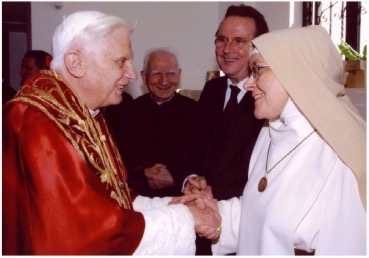
L to R: Pope Benedict XVI came as a pilgrim to Manoppello on September 1, 2006, Fr. Heinrich Pfeiffer, S.J., Paul Badde, and Sr. Blandina Schlomer

There are many physiological reasons too for believing that the Face Cloth captures the first breath of the Resurrection. Sr. Blandina Paschalis Schlomer, who shares that belief, has provided meticulous research about the Veil in her book JESUS CHRIST, The Lamb and the Beautiful Shepherd, The Encounter with the Veil of Manoppello.  Sr. Blandina together with Paul Badde, and Fr. Fr. Heinrich Pfeiffer, S.J., Professor at the Pontifical Gregorian University in Rome, have each demonstrated that the Holy Face on the Veil of Manoppello is the proto-image of the earliest icons, and other works of art depicting the Face of Jesus.

“…and he saw and believed. For they did not yet understand the Scripture that He had to rise from the dead.”

What did St. John see in the tomb that would cause him to believe? A cloth of blood, such as the Oviedo? The Shroud of Turin? The Shroud bears a miraculous image, but it shows the Face of a dead man. A third witness was needed in order for the disciple to believe. It could only have been evidence of something as astounding as the Resurrection; proof that Jesus was alive!

Holy Veil of Manoppello. Photo: Paul Badde/EWTN

It is human nature to want to see things for ourselves. Many pilgrims, humble and great, have felt called to make the journey to visit the miraculous relic. If it is God’s handiwork, and I believe that is true, then one can only wonder at its existence, and gaze in silent contemplation, giving thanks for this tremendous gift of God… so we too may “see and believe.”
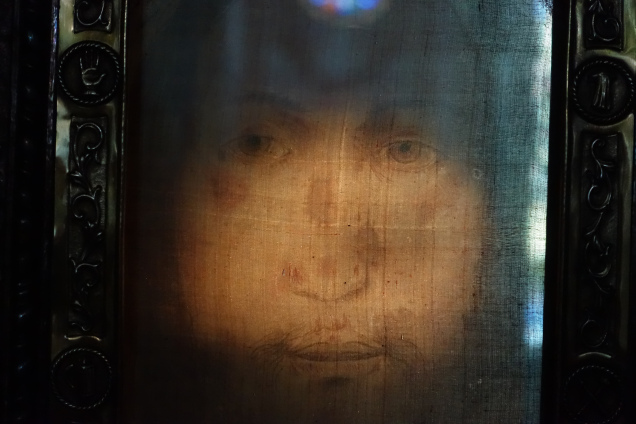
As the first rays of light entered the tomb, John and Peter, upon entering, “saw and believed.”   Sudarium Veil of Manoppello, Photo: Paul Badde/EWTN
Pope Benedict XVI contemplates the ‘Veronica’s Veil’ during a visit to the Shrine of the Holy Face in Manoppello, central Italy, September 1, 2006.

“While we too seek other signs, other wonders, we do not realize that He is the real sign, God made flesh; He is the greatest miracle of the universe: all the love of God hidden in a human heart, in a human face.”

~ Pope Benedict XVI
Holy Face of Jesus of Manoppello (photo: Paul Badde/EWTN)

“We cannot stop at the image of the Crucified One; He is the Risen One!”

~ Pope St. John Paul II

Alleluia! Alleluia! Alleluia!

“The Icon of Easter”

“This veil over the large linen has a liveliness, as if wind were blowing into it. And under its right edge we can still see parts of the pattern of the shroud through the fabric. Making the veil completely transparent has obviously overwhelmed the capacity of the author of this almost childlike drawing.”

— Paul Badde from “The Icon of Easter – Forensic Evidence from the Resurrection of the Son of God,” referring to the Sudarium Veil depicted in the ancient “Codex Pray” drawing.https://de.catholicnewsagency.com/article/ikone-der-dna-des-gottessohnes-1312
Paul Badde pondering the Holy Veil of Manoppello Photo: Alan Holdren

Ever since one of the premier art historians in the world, Fr. Heinrich Pfeiffer, S.J., told Paul Badde that the Veronica Veil had been found in a small Capuchin church in the Abruzzi Mountains in Italy, Paul, himself an art historian, has been searching through centuries of art for the forensic evidence to verify this earth-shaking claim. Why earth-shaking? Because the burial cloths of Christ, such as the Shroud of Turin and the Oviedo, not only contain the DNA of Jesus Christ in His Sacred Blood, and witness to the horrible torture He endured in His Passion, but one of those cloths, though without a trace of blood or paint, bears witness to the power of the Resurrection — it is the transparent veil that covered the Holy Face of Jesus.

Around 1410, Master Joan Mates depicted the Lamentation and Entombment of Christ, Joseph of Arimathea places a veil over Jesus Face, National Museum of Catalonia, Barcelona

“There are no witnesses to the act of Christ’s resurrection from the dead. But the apostles were able to secure cloths and evidence with DNA from Him.”–Paul Badde, Vatican Magazin – The Icon of Easter

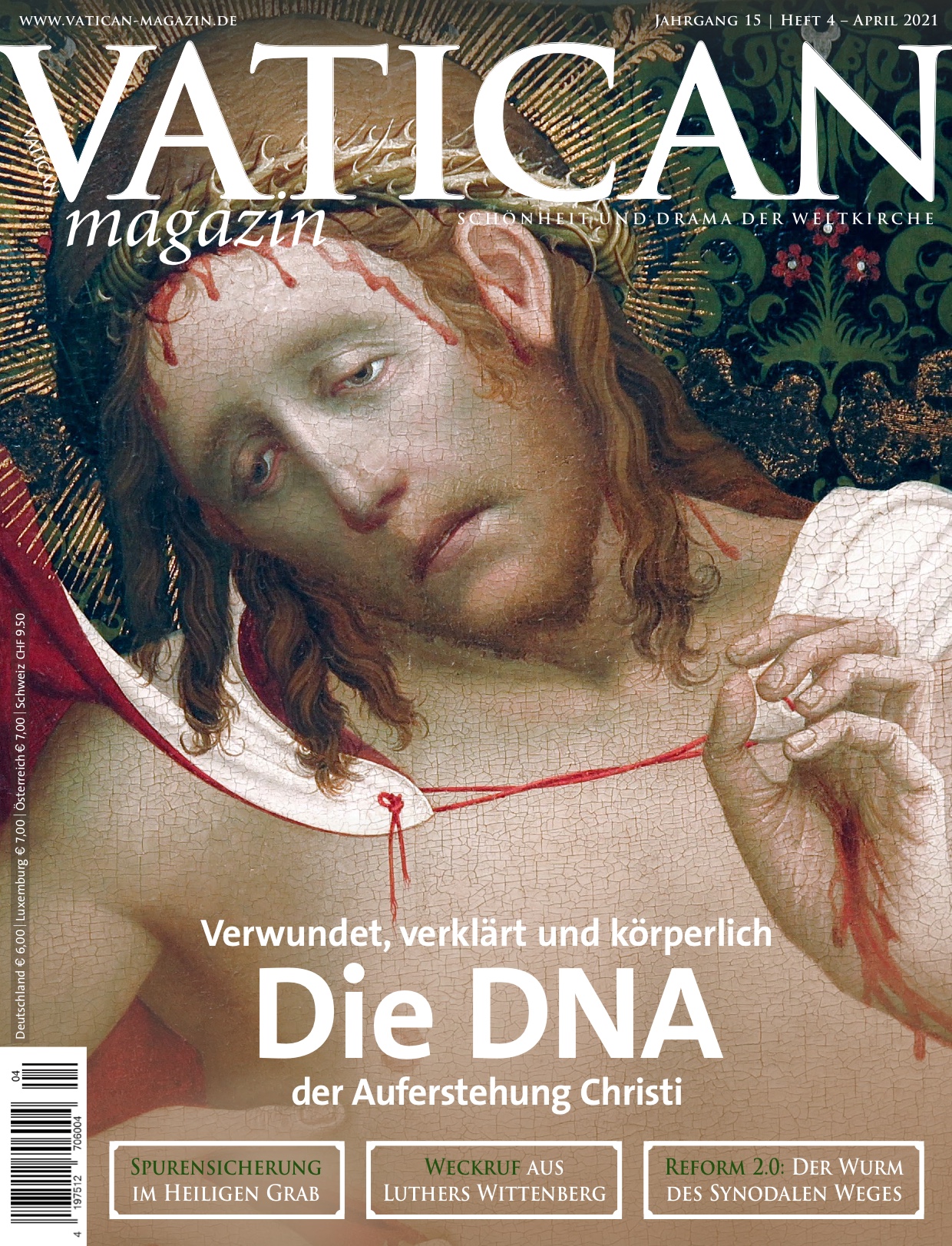
Cover Vatican Magazine “God’s DNA”

Paul Badde has uncovered many works of art, and other evidence as well, which support this astounding claim. But his trained eyes have noticed crucial details previously passed over by many art historians. He has written a remarkable piece for Vatican Magazine highlighting an “extremely important link for the history of the authenticity” of both the Shroud of Turin and the Holy Veil of Manoppello, Italy — the ancient “Codex Pray” of Hungary. The Codex Pray dates to about 1192 at the latest.

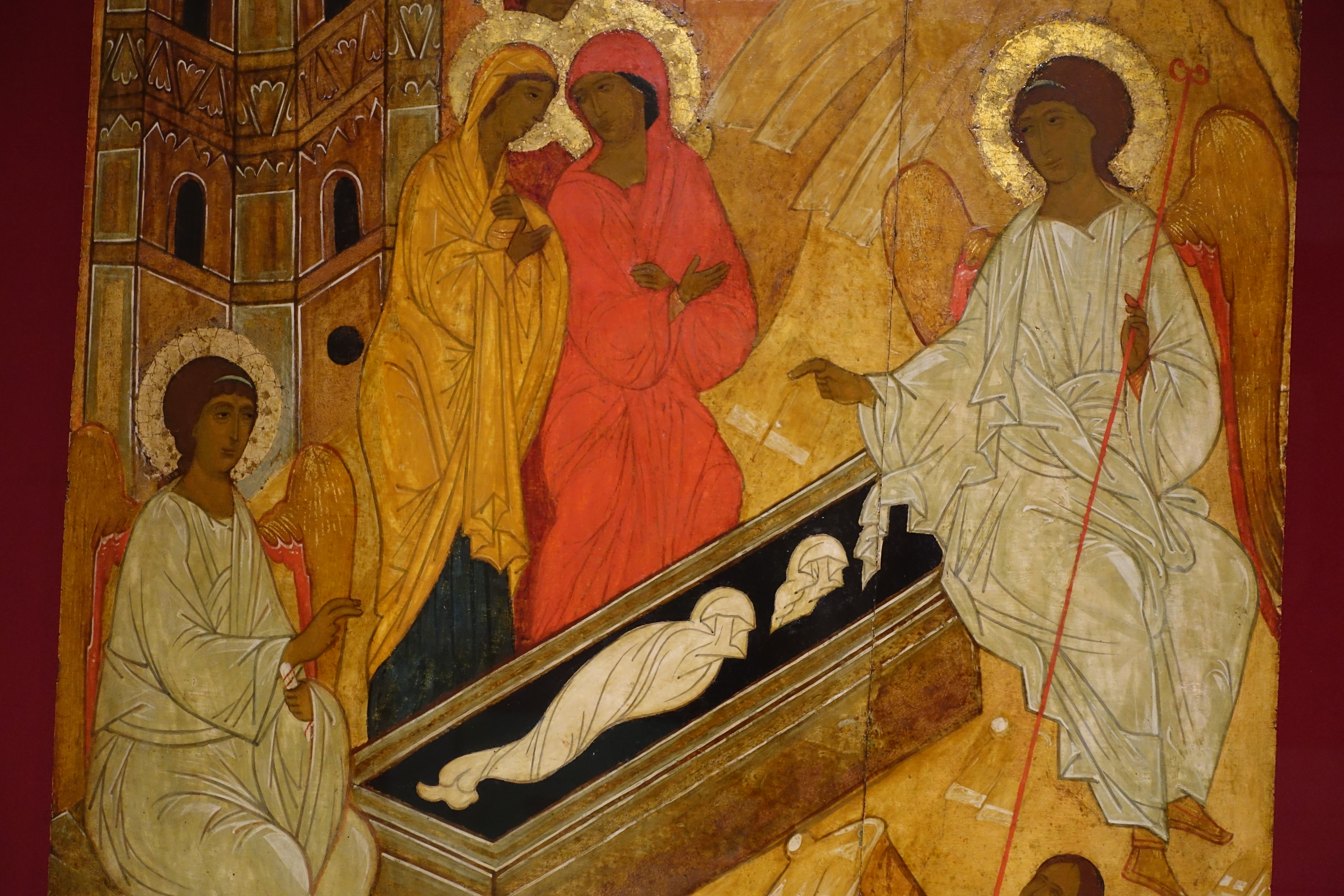
The “Codex Pray” drawing tells the story, in a simple yet clever way, of the Resurrection of Jesus. It has been the earliest artwork found which shows the Shroud of Turin, indicated by the artist’s attempt to draw the herringbone weave pattern that is a particular feature of the Shroud that scholars say dates to the first century. And although faulty carbon dating in 1988 claimed the Shroud was a medieval forgery dating back to between 1260-1380, the Codex Pray was made 133 years before that. As Paul Badde points out in his article that the Codex was made in the 1100’s – and the Shroud of Turin hadn’t been seen in public before it “appeared in Lirey in Champagne in 1355.” If that were not remarkable enough, there is another cloth in the drawing — a transparent one — and this is the one being pointed out to the three women at the tomb by an angel. “He is not here; He has risen, just as He said.” (Mt. 28:6)

“In the Codex Pray in Budapest, the shrouds (burial cloths) of Christ from the zero hour of Christianity appear for the first time around the year 1180 almost realistically in this drawing.” – Paul Badde

“The most significant detail of this depiction is, however, often overlooked in the many debates about the burial cloths of Christ. In this representation of the Codex Pray from Budapest, the extremely important link for the history of the authenticity of the Shroud of Turin is that the angel doesn’t point to the big, long linen but to the transparent sudarium. which like no other “image” allows us to gaze into the paschal mystery of the paschal hour.”

–Paul Badde, “Icon of Easter”

“Transparency is the key.”

— Paul Badde
Transparent Veil of Manoppello, Photo: Paul Badde/EWTN

The delicate sudarium veil that covered the Face of Jesus in the tomb was transparent, and light enough to move “as if wind were blowing into it,” as the artist of the Codex attempts to show. In 1511, when Martin Luther went to see the greatest relic in Rome known as “the Veronica” or “True Icon,” he testified to this fact when he gave a rather incredulous description of what he saw in a letter to a friend:

“It is simply a square black board on which a transparent piece of cloth hangs and above this is another veil.  There poor Jena Hans cannot have seen anything more than a piece of transparent cloth that covers a black board. This is the Veronica which is shown.” 

–Martin Luther

Although Martin Luther’s purpose in pointing out the transparency of the cloth in his the letter was to debunk the relic of the Veronica, he actually affirms the most extraordinary characteristic of the veil — it is transparent, and yet, seen in certain light, the proto-image of the Face of Jesus, as it has been recognized throughout history, is revealed.

Veil of Manoppello,photo: Paul Badde/EWTN

This veil…was transparent and enigmatic as the resurrection itself, at the heart of our faith.”

–Paul Badde
Miraculous Transparent Veil of the”Holy Face of Manoppello” in Italy Photo:Paul Badde/EWTN
Hand viewed through the miraculous Veil of Manoppello. Photo: Paul Badde/EWTN

The full translation of the German article may be read below:

The Icon of Easter – Forensic evidence from the Resurrection of the Son of God by Paul Badde

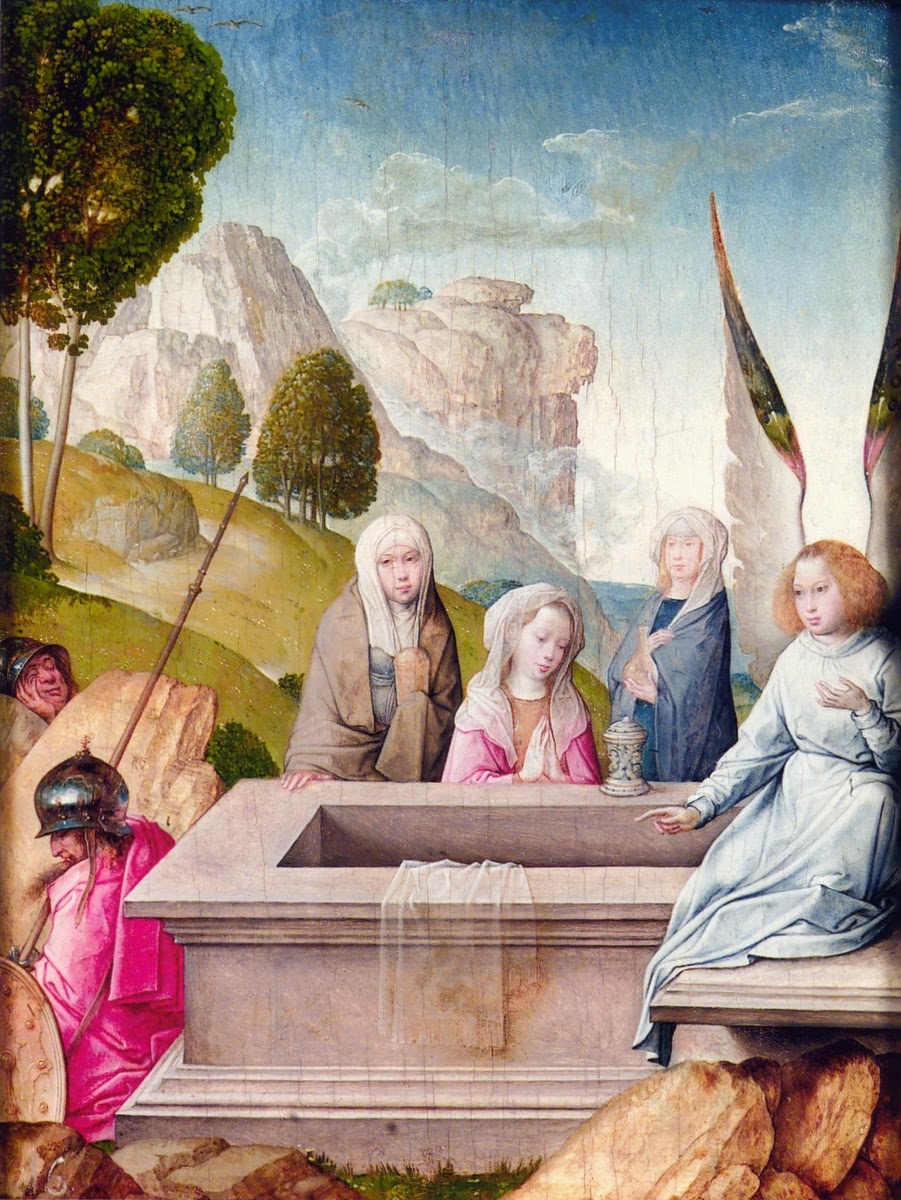
The Flemish painter Juan de Flandes painted around 1498 “The Resurrection of Christ and three women at the grave.” Palacio Real de Madrid. “The angel points to the key relic that was known to thousands of pilgrims to Rome during the artist’s lifetime…”

The icon of the resurrection — the napkin (or sudarium) from the tomb of Christ — is essentially transparent. as we were able to marvel at again three years ago on the booklet that Pope Francis prepared in 2019 for the participants in the liturgy of his Easter Mass at St. Peter’s Basilica which displayed a panel from 1498 by Juan de Flandes, depicting the moment when “ Mary Magdalene, Mary, the mother of James, and Salome “came to the tomb”, as Mark says. “They saw a young man sitting on the right side, clothed in a white robe; they were very amazed. But he said to them: Don’t be amazed! You are looking for Jesus of Nazareth, who was crucified. He is risen; he is not here. Behold, the place where they laid him. ” The Flemish painter in Spain incorrectly depicted the empty tomb as an open sarcophagus, which demonstrates that he had never been to Jerusalem. On the other hand, he obviously knew Rome and was familiar with its treasures, as shown here. Because over the edge of this sarcophagus hangs very realistically a transparent veil to which the angel points –the sudarium — the key relic of the Lord that was known to thousands of pilgrims to Rome during the artist’s lifetime and ever since Pope Innocent VIII had first carried this veil barefoot on a Sunday in January 1208 from Peter’s Basilica to the nearby hospital church of Santo Spirito. This veil, too, was transparent and enigmatic like the resurrection itself, at the heart of our faith.

Pope Francis’ Easter liturgy booklet 2018
Omnis Terra Procession of Pope Innocent III in 1208 carrying “the Veronica” Face of Christ (from “Liber Regulae Sancti Spiritus in Saxia” manuscript 1350)

Because the essence of Christianity is neither the cathedral of Cologne nor St. Peter’s Basilica, but only the resurrection of Christ from the kingdom of the dead to Life in the land of the living, however impossible it may seem. But without the belief in precisely this impossibility, our whole faith would be filth, says Paul. Then we could leave the church immediately with the multitudes of all the others who have left without even having to ask as Peter did: “Lord, where should we go?” Because first of all Christ would no longer be our Lord and secondly we would already know where we wanted to escape to with the money from the church assessment we no longer pay, no matter that it is impossible to find a place or a society of people without abuse and without lies, fraud, crime, and violence.

If, on the other hand, Christ has truly risen from the dead, then anything is possible. Then the church will wake up again from the death zone of abuse and flourish again, in Cologne, throughout  Germany and everywhere. Nevertheless, many theologians over the past centuries have tried to minimize the offensive nature of the challenge to believe in the resurrection of Christ by using scriptural tricks and to make it more compatible with the spirit of the age (“zeitgeist”). These kind of “glass bead games” however were never possible for icon writers or visual artists as long as they were serious about the core of their beliefs.

“There are no witnesses to the act of Christ’s Resurrection from the dead. But the apostles were able to secure cloths and evidence with the DNA from Him.”

–Paul Badde, The Icon of Easter

Theologians and artists share a common problem, however: there were no witnesses to the act of Christ’s resurrection from the dead. None of the evangelists were there. All four only report what it looked like in Jesus’ tomb after the resurrection. Matthew tells of an “angel” in a snow-white robe who says to three women in the burial chamber: “He is not here”. It is similar with Mark. Luke speaks of “two men in shining robes”. And with John we learn how Peter and the “disciple whom Jesus loved” looked into the tomb of Christ early in the morning. – There is only one thing that none of the four evangelists say: that the tomb was empty. Obviously, it wasn’t. Jesus was no longer there. But there were cloths at the scene of which the poet Wipo (+ 1048) spoke in his Easter sequence “Victimae paschali laudes”, Mary had seen two “angelic witnesses”, namely the “napkin and linen cloths” (Latin: sudarium et vestes). These witnesses and forensic traces of evidence have, thank God, been preserved uncorrupted  and materially, with the DNA of the Son of God.

First there is the sacred Sudarium from Rome, which is now in Manoppello, and then there is the Holy Shroud, the world-famous linen in Turin. We encounter both fabrics for the first time in the testimony of John, who described Easter morning in this way: “Then Simon Peter, who had followed him, arrived and went into the tomb (which was a cave hewn in the rock). He saw the linen cloths lying there and the napkin (Greek: soudarion) that had been lying on Jesus’ head; but it was not with the linen cloths but rolled up in a place by itself. Then the other disciple, who had come to the tomb first, also went in; he saw and believed.” – That is the key passage in this gospel, which, however, only becomes plausible when read in conjunction with the specific cloths that John mentions here.

The “Holy Shroud” or the Shroud of Turin is only rarely shown and yet has been researched as has no other textile in the world, by a genuine and separate science, Sindonology, which in the last century has focused on this linen cloth with the dimensions of 14 feet 3 inches by 3 feet 7 inches (436cm by 110 cm) and which captures the panorama and the torture of the flagellation, the crowning of thorns and the crucifixion of Christ in an inexplicable way, as in a detailed script, as well as the subsequent piercing of his heart and the extinction of his last spark of life by means of a lance. This cloth contains blood and water.

The burial cloths of Jesus, Moscow, 15th Century

The sudarium, on the other hand, is a very delicate veil that was kept in Rome for centuries and then for a long time in Manoppello, where it was locked away until 1923, in similar fashion to the shroud in Turin. Nevertheless, for almost a century, unlike the situation of the Shroud in Turin, every pilgrim to Manoppello has been able to observe and study the sudarium at close quarters every day from morning to evening above the main altar as never before. At certain times and in certain light it shows the face of Christ with open eyes and healed wounds.

Yet when unshadowed, the veil reveals, above all, complete transparency as its inner characteristic – as if Easter were the festival of transparency towards heaven and God’s eternity in another world. A good hundred years before Juan de Flandes, the Catalan painter Joan Mates (1370 – 1431) masterfully expressed this characteristic of the napkin of Christ in his panel of the “Lamentation of Christ”, where we see Nicodemus, who after Jesus’ deposition from the cross is putting a transparent fabric over His face. The model for this depiction here can only have been the Roman “Sudarium” of the Popes from St. Peter’s Basilica, the “true icon”, which has also been called “Veronica” there since the Middle Ages. Countless images in the history of art attest to this Easter transparency.  One of the key witnesses to this mystery, moreover, is Dr. Martin Luther, who saw the veil on his trip to Rome in 1511 and who still sneered in 1545 that the “Lord’s face in his little sweat cloth”, which was regularly shown and displayed at Saint Peter’s, was nothing but „ein klaret lin“ in other words: Doctor Luther had only seen a “transparent linen” here.

The large shroud, which is by no means transparent, appeared for the first time in Lirey in Champagne in 1355 and was only brought through the efforts of St. Charles Borromeo from Chambéry in Savoy to Turin in 1578, 233 years later, which began the process of western Christendom gradually getting to know it.  Previously, the Shroud had been the most precious part of the treasures of the emperor of Byzantium remaining more or less a rumor for the pilgrims of Europe until 1578. 

An image- document in the Széchényi library of the National Museum of Budapest dates back to 1192 (at the latest), and for decades has become something of a new founding document for all shroud researchers and their highly complex science. It is a small colored drawing on parchment in a codex measuring 9.5 inches by 5.9 inches, which also highlights the resurrection of Christ from the dead – and the burial of the crucified Lord. Above we therefore see Jesus dead, lying with a peaceful face, on a sheet that has been rolled out on a stone. His eyes and mouth are closed, with a sparse beard and long hair parted in the middle which hide his ears and frame his face. At the head of Jesus stands Joseph of Arimathea, the councilor of the Sanhedrin, at the feet of the Lord stands John. Both grasp the cloth with which the body was removed from the cross, while Nicodemus empties a bottle with precious spices over the body, as we read in the Gospel of John (19:39). The stone slab underneath is reminiscent of the so-called “anointing stone” from the Jerusalem Church of the Holy Sepulcher, which has long been venerated as the most important relic of the Pantocrator Church of Constantinople. Three striking details are unique in this representation. First, the body of Jesus is naked. Second, he keeps his hands crossed over the pubic area, his right hand over the left. Third, both hands only show four fingers and no thumb. So Jesus is depicted here as a real victim of an ancient, real, and concrete crucifixion, in which the nails were driven through the roots of his wrists (and not the palms of the hands). During this torture, the thumbs cramped inward into the palms of the hands due to the injury to the median nerve. And for this representation there is only a single “picture” in the vast array of pictures throughout History, which must have served as an exemplar and model. This is the Shroud of Christ in Turin which shows these significant details, but long before this linen even had appeared in Europe!

The Codex Pray of Budapest, Hungary 1150-1192

And this drawing from the library of Budapest was also made at least 133 years before the date assigned to the Shroud, resulting from a sensational radiocarbon investigation in 1988, according to which the shroud was supposed to have been woven between 1260 and 1390. This drawing from Budapest, which documents its evidence as if with a photo proof, dates from 1192 at the latest. For in 1150, on the occasion of an arranged wedding in Constantinople, the ambassador of Hungary was received by Manuel II Komnenos, and the Emperor of Byzantium showed him and his delegation the hidden treasures of his Blachern Chapel. In the process, the Shroud of Christ must have impressed itself in detail on one of the participants of the Hungarian delegation. Below the entombment we see – as centuries later with Juan de Flandes – three women come to the grave at the right, where an angel on the left with an outstretched right forefinger indicates the resurrection of Christ on this first Easter morning. Between the angel and the women we see a large, folded sheet of fabric, which is covered on the inside with Greek crosses and on the outside with zigzag lines, which are interpreted in research as an attempt to draw the herringbone pattern of the shroud. Four small holes depict four very old fire damage holes that can still be found in the “Holy Shroud” today.   But above this shroud, under the angel’s finger, we see another folded little cloth, as if blowing, or as “rolled up, next to it, in a special place”, which had been lying on the face of the dead Jesus, as we came to know by the gospel of John.

This veil over the large linen has a liveliness, as if wind were blowing into it. And under its right edge we can still see parts of the pattern of the shroud through the fabric. Making the veil completely transparent has obviously overwhelmed the capacity of the author of this almost childlike drawing. Nevertheless, in contrast to the large shroud, the sudarium appears as animated as the stole of the angel next to it. And in any case, we encounter the two cloths together in an almost realistic way for the first time in the picture, from the zero hour of Christianity. And both without “pictures”, without a body image and without a face, at least to our eyes.

The most significant detail of this depiction is, however, often overlooked in many debates about the burial cloths of Christ. In this representation in the Codex Pray from Budapest, the extremely important link for the history of the authenticity  of the shroud of Turin the angel doesn’t point to the big, long linen but to the transparent sudarium which like no other “image” allows us to gaze into the paschal mystery of the paschal hour.

Holy Face Veil of Manoppello, photo: Patricia Enk