“So when we hear tell of the birth of Christ, let us be silent and let the Child speak. Let us take his words to heart in rapt contemplation of his face.” –Pope Francis
The desire to see the Face of God has been the deep longing of all humanity “since the world began to be.” Yet deeper still is God’s desire to show His Face to us…
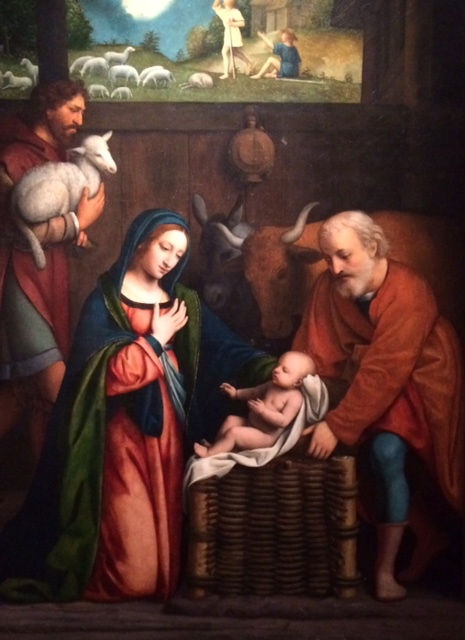
Adoration of the Christ Child and Annunciation to the Shepherds by Bernardino Luini
God’s love for mankind is so great that He desired to become visible to men. In the fullness of time, when earth was covered in darkness, the bright dawn of the Word made flesh descended to the womb of a Virgin, so that, for the first time in the history of the world, on the day of His birth, God’s Face could be seen. He could be looked upon without fear and trembling because in the supreme manifestation of His merciful love He allowed us to gaze upon Him as a tiny baby, who is the redemption and light of all mankind.
The darkness of sin and death is overcome by the light emanating from the Face of the Infant Jesus, shining first upon the Blessed Virgin Mary, then St. Joseph, the humble shepherds and kings and on and on. The divine light extends to all peoples, down through the centuries to each of us. As we contemplate and adore Jesus, we in turn, must make the light of His Face shine to others, to all we meet, until finally the darkness is dispelled forever by the Glory of His Face… “evermore and evermore.”
Below is the beautiful Christmas Hymn “Of the Father’s Love Begotten,” sung by the Benedictine Sisters of Mary. Enjoy!
Of the Father’s love begotten, Ere the worlds began to be, He is Alpha and Omega, He the source, the ending He, Of the things that are, that have been, And that future years shall see, Evermore and evermore!
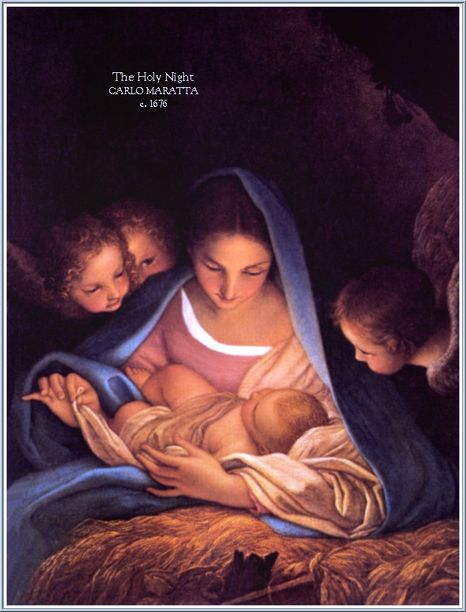
“He comes in splendor, the King who is our peace; the whole world longs to see Him.” The Holy Night by Carlo Maratta
O that birth forever blessèd, When the virgin, full of grace, By the Holy Ghost conceiving, Bore the Savior of our race; And the Babe, the world’s Redeemer, First revealed His sacred face, evermore and evermore!
O ye heights of heaven adore Him; Angel hosts, His praises sing; Powers, dominions, bow before Him, and extol our God and King! Let no tongue on earth be silent, Every voice in concert sing, Evermore and evermore!
Christ, to Thee with God the Father, And, O Holy Ghost, to Thee, Hymn and chant with high thanksgiving, And unwearied praises be: Honor, glory, and dominion, And eternal victory, Evermore and evermore!
Merry Christmas! May His Face shine upon you today and always!
Immaculate Conception by Bartolome Esteban Murillo
“Blessed are the pure of heart, for they shall see God.”
Pope Francis has chosen December 8th, the Solemnity of the Immaculate Conception, as the opening of the Holy Jubilee Year of Mercy, “because of its rich meaning.” “After the sin of Adam and Eve, God did not wish to leave humanity alone in the throes of evil. So he turned his gaze to Mary, holy and immaculate in love (cf. Eph 1:4), choosing her to be the Mother of man’s Redeemer. When faced with the gravity of sin, God responds with the fullness of mercy.” Pope Francis (Face of Mercy)
Mary was “Blessed in Christ with every spiritual blessing,” (cf. Eph 1:3) chosen by God from all eternity to be the Mother of the Redeemer. It is she who leads us to Jesus, so that we may contemplate, together with her, the Face of Mercy. As the Immaculate Conception, Mary bears in herself the most perfect reflection of the face of God. Pope St. John Paul II wrote, “The Blessed Virgin saw shining upon her, as no other creature, the face of the Father, rich in grace and mercy.”
As the Jubilee Year of Mercy begins, let us fix our gaze on Mary rather than on the profane things of the world. We keep Mary before our eyes in order to contemplate in her everything that is good and true and beautiful. “She is the proclamation of a merciful God who does not surrender to the sin of his children,” Pope St. John Paul II tells us “in Mary shines forth God’s sublime and surprising tenderness for the entire human race. In her, humanity regains its former beauty and the divine plan is revealed to be stronger than evil…” In Mary “the Creator has kept the original beauty of creation uncontaminated” so that in the Immaculate Conception, “the Father’s original, wondrous plan of love was reestablished in an even more wondrous way.”
A Little Litany by G.K.Chesterton
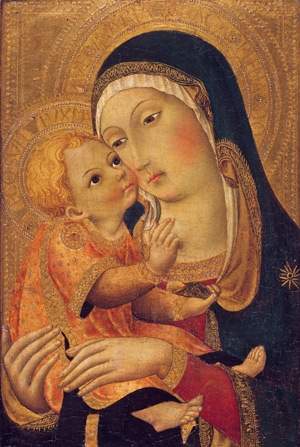
“Our Lady, in whose face – more than any other creature – we can recognize the features of the Incarnate Word.” –Pope Benedict XVI Madonna and Child from the Robert Lehman Collection, Metropolitan Museum of Art
When God turned back eternity and was young, Ancient of Days, grown little for your mirth (As under the low arch the land is bright) Peered through you, gate of heaven – and saw the earth.
Or shutting out his shining skies awhile Built you about him for a house of gold To see in pictured walls his storied world Return upon him as a tale is told.
Or found his mirror there; the only glass That would not break with that unbearable light Till in a corner of the high dark house God looked on God, as ghosts meet in the night.
Star of his morning; that unfallen star In the strange starry overturn of space When earth and sky changed places for an hour And heaven looked upwards in a human face.
Or young on your strong knees and lifted up Wisdom cried out, whose voice is in the street, And more than twilight of twiformed cherubim Made of his throne indeed a mercy-seat.
Or risen from play at your pale raiment’s hem God, grown adventurous from all time’s repose, Of your tall body climbed the ivory tower And kissed upon your mouth the mystic rose.
“As a deer yearns for running streams, so my soul is longing for you, my King and my God. My soul is thirsting for God, the living God, when shall I see Him face to face?” (Ps. 42)
Jesus Christ King of the Universe…”and living face of the Father’s Mercy.”–Pope Francis
“I would like to ask many of you to think about this: “There will be a day in which I encounter the Lord face to face.” And this is our goal, our encounter. We do not await a time or a place; rather we are going to encounter a person: Jesus. Thus, the problem is not “when” these premonitory signs of the last days will occur, but rather that we find ourselves prepared. It’s also not about knowing “how” these things will happen, but instead “how” we have to act today, in awaiting these things.”–Pope Francis (Angelus Address November 15, 2015)
On the last Sunday of the liturgical year before Advent, November 22, 2015, we celebrate the coming of the King – “The Solemnity of Jesus Christ King of the Universe,” the majestic title given by Pope Paul VI in 1969. When referring to this feast day Pope Francis has added seven words, “– and living face of the Father’s Mercy,” in Misericordiae Vultus, the document declaring the upcoming Jubilee Year of Mercy.
The Feast of Christ the King was instituted in 1925 by Pope Pius XI in response to the world’s increasing secularization. He wrote in Quas Primas:
“While nations insult the beloved name of our Redeemer by suppressing all mention of it in their conferences and parliaments, we must all the more loudly proclaim His kingly dignity and power, all the more universally affirm His rights.”
The virtue of Christ’s claim to kingship, which embraces the whole of mankind, as Creator and Redeemer, Pope Pius XI explained, is that societies as well as individuals owe Him obligations as King. Pope Pius XI also asserted the Church’s right to be free from secular authority.
“When we pay honor to the princely dignity of Christ, men will doubtless be reminded that the Church, founded by Christ as a perfect society, has a natural and inalienable right to perfect freedom and immunity from the power of the state; and that in fulfilling the task committed to her by God or teaching, ruling, and guiding to eternal bliss those who belong to the kingdom of Christ, she cannot be subject to any external power.”
This assertion was true and necessary to proclaim in 1925 and even more true and necessary today as the Church’s freedom to govern itself and proclaim the Gospel is seriously threatened. We must also defend and honor the name of our God and King as well, particularly when the name of God is used to carry out barbaric and horrific acts of violence against mankind, made in His Image. As Pope Francis stated in his Angelus address, “to use the name of God to justify this path is blasphemy.” Blasphemy is the greatest sin against the face of God. (Prayers of reparation may be found here.)
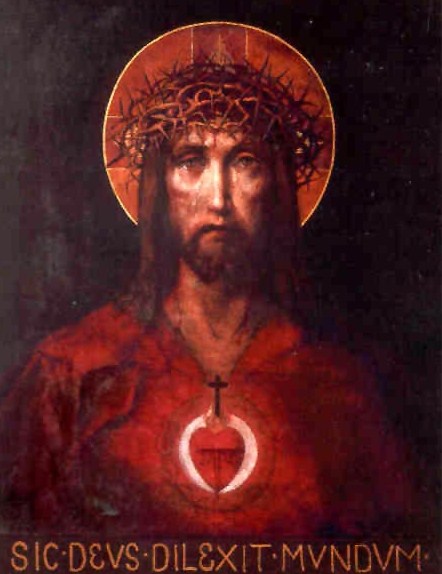
Our Crucified King of Mercy
The date for the Feast of Christ the King, which was originally set by Pope Pius XI as the Sunday preceding All Saints Day, was moved by Pope Paul VI to the end of the liturgical calendar, the last Sunday preceding Advent, to more perfectly anticipate the “Coming of the King,” and look forward to His coming, that day when we will see our King face to face in hope.
“Hope: this virtue that is so hard to live.” says Pope Francis. “The smallest of the virtues, but the strongest. And our hope has a face: the face of the Risen Lord, who comes “with great power and glory,” and this will manifest his love, crucified and transfigured in the Resurrection. The triumph of Jesus at the end of time will be the triumph of the cross, the demonstration that the sacrifice of oneself for love of neighbor, in imitation of Christ, is the only victorious power, the only stable point in the midst of the upheavals of the world.”
While earthly “kings” may forcibly impose their power over their subjects, Jesus Christ Our King comes to us as a Good Shepherd and Servant of all. Though “All power in Heaven and on earth has been given Him ,” the Almighty King of the Universe, the Alpha and the Omega is also our Crucified King. When we turn back to His Face in repentance and love, He “Who loves us and has freed us from our sins by His blood,”turns His Merciful Face towards us.
We can look forward in hope to His coming again. But He must reign in our minds, in our wills, and in our hearts. We must desire to love and serve Our King, Christ Jesus alone, for “Behold, he is coming amid the clouds, and every eye will see him, even those who pierced him. All the peoples of the earth will lament him. Yes. Amen.” (Rv 1:7)
Prayer to Christ the King
O Lord our God, You alone are the Most Holy King and Ruler of all nations.
We pray to You, Lord, in the great expectation of receiving from You, O Divine King, mercy, peace, justice and all good things.
Protect, O Lord our King, our families and the land of our birth.
Guard us we pray Most Faithful One.
Protect us from our enemies and from Your Just Judgment
Forgive us, O Sovereign King, our sins against you.
Jesus, You are a King of Mercy.
We have deserved Your Just Judgment
Have mercy on us, Lord, and forgive us.
We trust in Your Great Mercy.
O most awe-inspiring King, we bow before You and pray;
May Your Reign, Your Kingdom, be recognized on earth.
Amen.
The Next Solemnity of Christ the King will be at the conclusion of the Jubilee Year November 20, 2016, on the Sunday dedicated to “Our Lord Jesus Christ, King of the Universe–and living Face of the Father’s Mercy.” (The Face of Mercy, Bull of Indiction–Pope Francis)
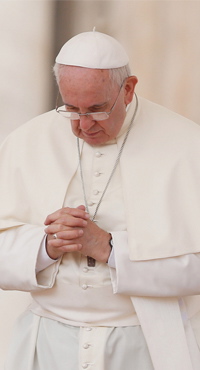
On November 10th, during his visit to the beautiful city of Florence, Italy, Pope Francis spoke about the Holy Face of Jesus and the authentic face of man:
Pope Francis
“We can speak about humanism only by starting from the centrality of Jesus, discovering in Him the features of the authentic face of man. And the contemplation of the face of the dead and risen Jesus that recomposes our humanity, fragmented as it may be by the hardships of life, or marked by sin. We must not domesticate the power of the face of Christ. The face is the image of His transcendence…. I do not wish here to draw an abstract image of the ‘new humanism,’ a certain idea of man, but to present with simplicity some features of Christian humanism, which is that of the sentiments, the mind of Christ. These are not abstract temporary sensations but rather represent the warm interior force that makes us able to live and to make decisions:”
Humility
“The first sentiment is humility. The obsession preserving one’s own glory and ‘dignity,” one’s own influence, must not form part of our sentiments. We must seek God’s glory, that does not coincide with ours. God’s glory that shines in the humility of the stable in Bethlehem or in the dishonor of Christ’s cross always surprises us.”
Selflessness
“Another sentiment is selflessness; The humanity of the Christian is always outward-looking. Please, let us avoid ‘remaining shut up within structures which give us a false sense of security, within rules which make us harsh judges, within habits that make us feel safe.’ Our duty is to make this world a better place, and to fight. Our faith is revolutionary because of the inspiration that comes from the Holy Spirit.”
Beautitude
“Another of Jesus Christ’s sentiments is beatitude. The Christian is blessed. In the Beatitudes, the Lord shows us the path. By taking it, we human beings can arrive at the most authentically human and divine happiness. For the great saints, beatitude is about humiliation and poverty. But also in the most humble of our people there is much of this beatitude: it is that of he who knows the richness of solidarity, of sharing the little he possesses. The Beatitudes we read in the Gospel begin with a blessing and end with a promise of consolation. They introduce us to a path of possible greatness, that of the spirit, and when the spirit is ready all the rest comes by itself.”
“Every family has an Uncle Louie.” I was told this fact while discussing funerals with a priest. “Uncle Louie” represented those “black sheep,” who, though beloved by their family and friends, we all knew were no saints and unless Heaven had lowered the bar considerably, didn’t stand much chance of walking straight through the Pearly Gates when they died. However, as Christians we hope that through the mercy of God and the prayers of the Church that “Uncle Louie” did make it into Purgatory. Perhaps before he died, “Uncle Louie” mumbled a heartfelt pray from childhood and turned back to God.
“All who die in God’s grace and friendship, but still imperfectly purified, are indeed assured of their eternal salvation; but after death they undergo purification, so as to achieve the holiness necessary to enter the joy of heaven.” (CCC 1030) The Church gives the name Purgatory to this final purification of souls that they may attain the beatific vision, or gaze on the Face of God. Theologians have said that the purification or suffering of the souls in Purgatory is their intense longing for the Face of God. This is expressed beautifully in Dante’s Divine Comedy, which is recommended reading by Pope Francis for the Year of Mercy. In the poem, a soul in Purgatory proclaims:
“We were all sinners till our latest hour/… when light from Heaven made us wise to see our sins,/ and we repented and forgave,/ leaving our lives at last in peace with God,/ who now torments our hearts with the desire,/ to see His Face.”
Since the faithful departed being purified are also members of the communion of saints, we can help obtain indulgences for them, so that temporal punishments due for their sins may be remitted through the merits of Jesus Christ. (Explanation of indulgences here.) Throughout November the Church, in charity, remembers the Faithful Departed in its prayers. “It is therefore a holy and wholesome thought to pray for the dead, that they may be loosed from sins.” (2 Macch. 12, 46) There are many ways to obtain indulgence from God through the Church such as visiting a cemetery and praying for the dead. A plenary indulgence for the souls in Purgatory can be obtained by visiting a cemetery each day between November 1 and November 8 or by a visit to a church or public oratory on November 2nd and reciting the Our Father and The Creed. A partial indulgence can be obtained for the souls in Purgatory, especially in the month of November, when we recite:
Eternal rest grant unto them, O Lord, and let perpetual light shine upon them. May the souls of the faithful departed, through the mercy of God, rest in peace. Amen.
In your charity, please pray for the souls in Purgatory, so that they may soon see God face to face.
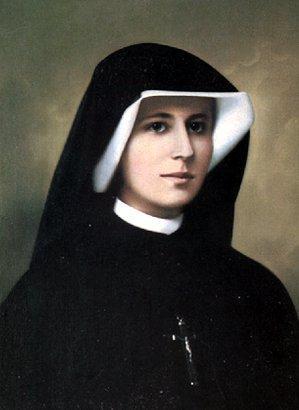
St. Faustina Kowalska, “The Apostle of Mercy,” whose feast day is October 5th, was known as a mystic and visionary. Her diary Divine Mercy in My Soul is a record of the journey of her soul. Our Lord granted St. Faustina a deep understanding of the love and mercy of God which she was to share with the world. Because Pope Francis has declared a “Jubilee Year of Mercy” beginning December 8, 2015, it would be beneficial to read St. Faustina’s message of mercy to better understand the significance of the upcoming holy year.
Our Lord spoke strongly to St. Faustina about putting mercy into action:
“I demand from you deeds of mercy which are to arise out of love for me. You are to show mercy to your neighbors always and everywhere. You must not shrink from this or try to excuse yourself from it.” (742)
Pope Francis exhorts us in the Jubilee Year “to introduce everyone to the great mystery of God’s mercy by contemplating the face of Christ.” Practicing the Corporal and Spiritual Works of Mercy will also enable us to fulfill the Lord’s command to let your light “shine before people, so that they will see the good things you do and praise your Father in heaven.” (Mt. 5:16) Pope Emeritus Benedict XVI has said, “The Face of Christ is the supreme revelation of Christ’s Mercy.”
“I have ever before my eyes His sorrowful Face, abused and disfigured. His divine Heart pierced by our sins and especially by the ingratitude of chosen souls.” (487) –St. Faustina
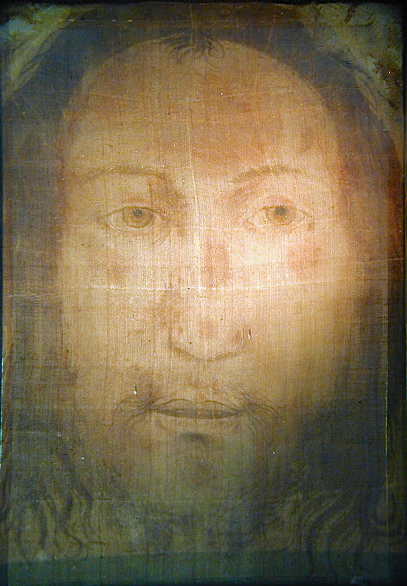
“O King of Glory, though You hide Your beauty, yet the eye of my soul rends the veil” — St Faustina Veil of Manoppello in Italy. Photo: Paul Badde
The Jubilee Year will also have a “door”—a “Door of Mercy”—a Holy Door at St. Peter’s Basilica and other designated churches through which “anyone who enters will experience the love of God who consoles, pardons and instills hope.” (The Face of Mercy) St. Faustina, in her diary, wrote of “a door of mercy”: “While there is yet time, let them have recourse to the fountain of my mercy.” (848) … He who refuses to pass through the door of My mercy must pass through the door of My justice.” (1146)
I have often reflected on the meaning of this Holy Door and the Face of Mercy. I believe they are both one and the same: The Face of Jesus Christ, the face of the Church, who leads us to the Father. We enter this “door” through devotion to the Holy Face by discipleship, to see Jesus in the faces our neighbors, through prayer and contemplation of the wounded Face of Jesus and through contemplation of the Eucharistic Face of Jesus. Our faces, too, are like a “door” to our hearts and souls, which can radiate the Face of Jesus, the Face of Mercy to others. When Pope Francis came to the United States he spoke to the homeless in St. Patrick’s Parish in Washington, D.C., “Jesus keeps knocking on our door in the faces of our brothers and sisters, in the faces of our neighbors, in the face of those at our side.”
“Jesus Christ is the Face of the Father’s Mercy.” — Pope Francis
“Write this: before I come as the just Judge, I am coming first as the King of Mercy.” — Our Lord to St. Faustina
The Jubilee Year will end on November 20, 2016, on the Sunday dedicated to “Our Lord Jesus Christ, King of the Universe–and living Face of the Father’s Mercy.” (The Face of Mercy, Bull of Indiction)
St. Faustina’s Prayer for Divine Mercy
O Greatly Merciful God, Infinite Goodness, today all mankind calls out from the abyss of its misery to Your mercy — to Your compassion, O God, and it is with its mighty voice of misery that it cries out: Gracious God, do not reject the prayer of this earth’s exiles! O Lord, Goodness beyond our understanding, Who are acquainted with our misery through and through and know that by our own power we cannot ascend to You, we implore You, anticipate us with Your grace and keep on increasing Your mercy in us, that we may faithfully do Your holy will all through our life and at death’s hour. Let the omnipotence of Your mercy shield us from the darts of our salvation’s enemies, that we may with confidence, as Your children, await Your final coming — that day known to You alone. And we expect to obtain everything promised us by Jesus in spite of all our wretchedness. For Jesus is our Hope: Through His merciful Heart as through an open gate we pass through to heaven. (1570).
The West is experiencing a severe drought; just how bad it was, was brought home to me when I visited the Los Angeles area this past week, after an absence of six years. I had always been surprised by the lush greenery, flowers, flowering trees and palms that lined the freeways of “Tinsel Town.” That is all gone. Streets, highways, homes and gardens now display signs that read “Brown is the new green.” What was once lush, verdant and colorful is now dry as dust, brown, and dead. The West is suffering from a great thirst for water. It is emblematic of its thirst for God.
“O God, you are my God, for you I long, for you my soul is thirsting, My body pines for you like dry, weary land without water…
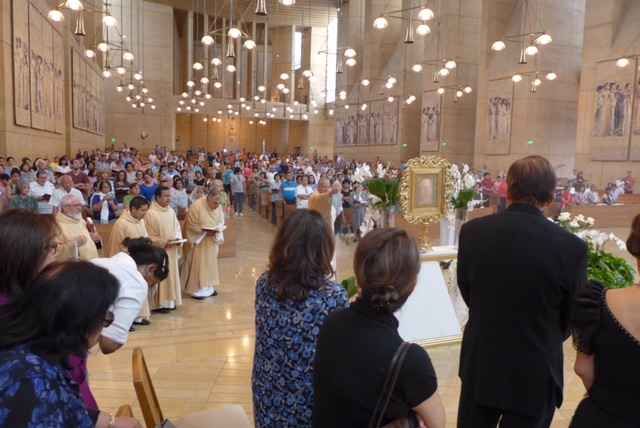
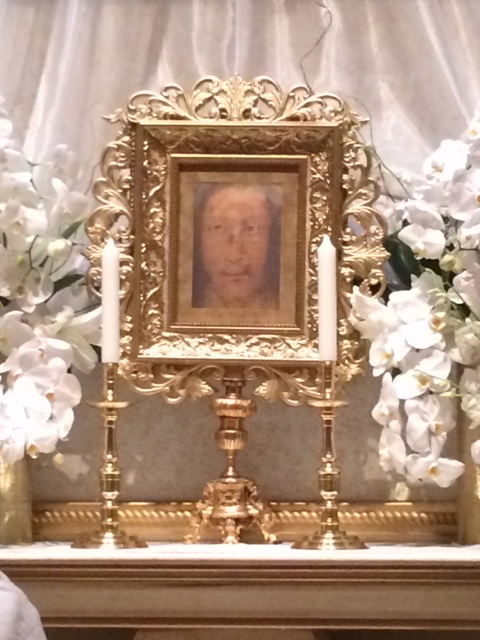
It is no secret that Los Angeles is mecca of images, idolatry and false faces. But on September 8th, the feast of the birth of the Blessed Mother, a replica of a miraculous image arrived in California, bearing the Face of Jesus Christ. It had traveled all the way from a shrine in a small mountain village in Italy called Manoppello, accompanied by the rector of the Holy Face Sanctuary, Fr. Carmine Cucinelli, OFM Capuchin and Mr. Paul Badde, journalist and author of several books about the Holy Face of Manoppello, who were there to give talks about the Holy Face. The first stop was the Carmelite Chapel of St. Joseph in Duarte, and the second stop, Our Lady of the Angels Cathedral in Los Angeles.
Blessed Replica image of the Holy Face of Manoppello, Mass at Our Lady of the Angels Cathedral Los Angeles.
“… So I gaze on you in the sanctuary to see your strength and your glory.” Ps. 63:1
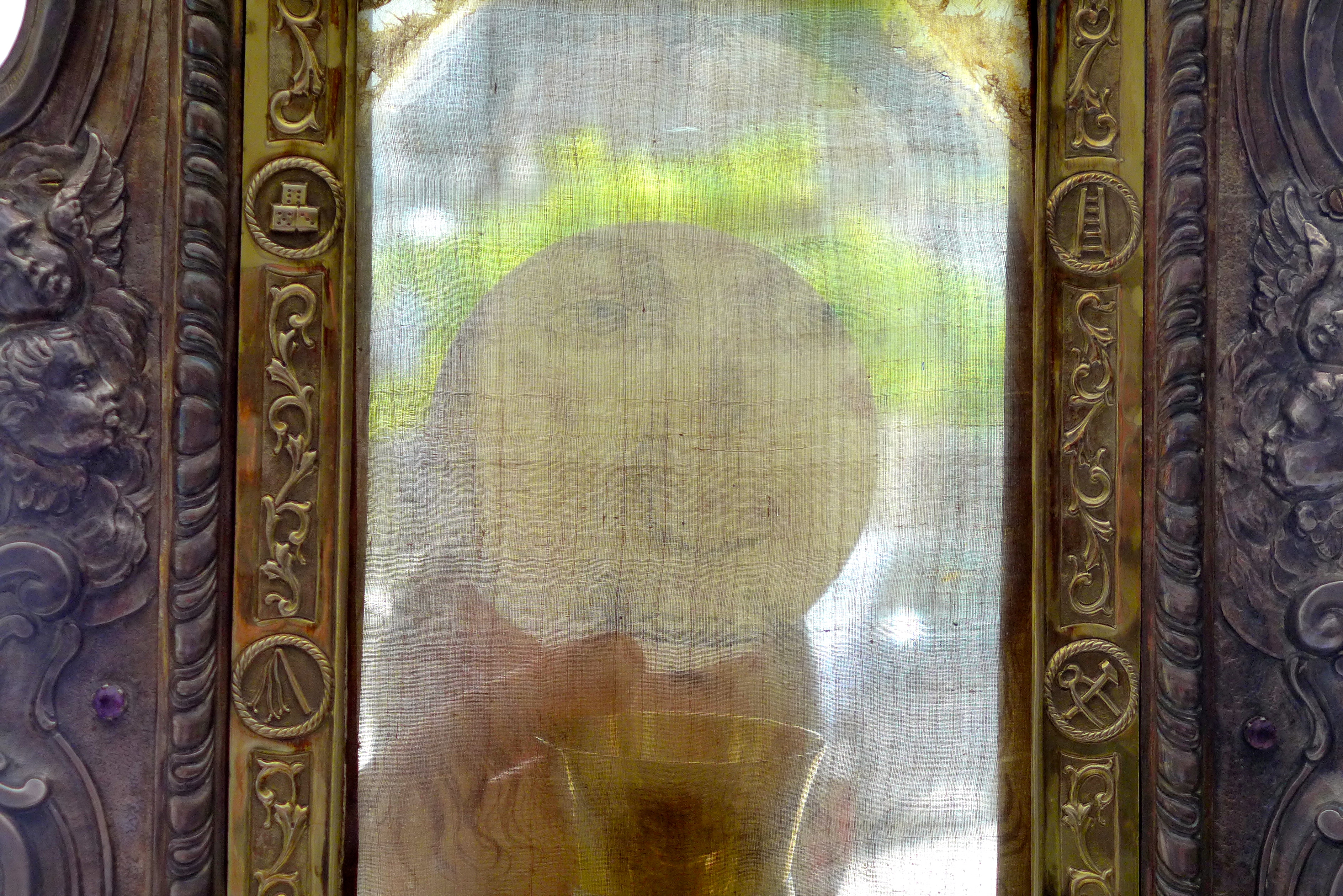
Jesus our Great High Priest offering Himself in the Eucharist, viewed through the miraculous Veil of Manoppello in Italy. Photo: Paul Badde
It is significant, that this holy image should come to this place, at this time. Images have great
Miraculous “Holy Face of Manoppello” in Italy Photo:Paul Badde
impact on human beings, for good or evil, as everyone in Hollywood knows. When God became Man at the Incarnation, He made His Face known to us. As Pope Emeritus Benedict XVI has said, the Face of Christ is “the supreme revelation of Christ’s Mercy.” Pope Francis, has declared an “Extraordinary Jubilee of Mercy,” in a Bull of Indiction – THE FACE OF MERCY from the Feast of the Immaculate Conception, December 8, 2015 to the Feast of Christ, King of the Universe and Face of the Father’s Mercy” November 20th, 2016. The primary task of the Church, Pope Francis urges us, is to be “a herald of mercy,” “especially at a moment full of great hopes and signs of contradiction… to introduce everyone to the great mystery of God’s mercy by contemplation of the Face of Christ.”
As I departed Los Angeles, a rain shower fell. It made all the news programs, it was so rare. It seemed to me that the arrival of His Holy Face to Los Angeles was bringing blessings and showering grace on the City of Angels. The Face of Jesus is the antidote to the poison of sin and evil in the world. He comes to give us “Living Water.” Nothing less will quench our thirst.
Let us follow Pope Francis’ exhortation to contemplate the Face of Christ through discipleship, images of the Face of Christ and in the Eucharist, and be true “heralds of mercy” by spreading devotion to the Face of Christ.
Holy Face of Manoppello, Italy Photo: Paul Badde
A special thanks to Mr. Paul Badde for allowing me to use his beautiful photos of The Holy Face of Manoppello!
“Seeking the Face of God in everything, everyone, all the time, and His hand in every happening; This is what it means to be contemplative in the heart of the world. Seeing and adoring the presence of Jesus, especially in the lowly appearance of bread, and in the distressing disguise of the poor.” –Bl. Mother Teresa of Calcutta
Many Catholic faithful are hoping and praying for the possible canonization of Blessed Mother Teresa of Calcutta during The Holy Year for Mercy. During the upcoming Jubilee Year of Mercy Pope Francis wants us to “Keep our eyes fixed on Jesus and his merciful gaze, that we may experience the love of the Most Holy Trinity.” He calls us to be merciful to others and reflect on the corporal and spiritual works of mercy as a way of awakening our conscience and enter more deeply into the heart of the Gospel so that “we become merciful just as our heavenly Father is merciful.” (Lk 6:36)
Blessed Mother Teresa, by her heroic life’s witness of seeking the Face of Christ in the “distressing disguise of the poor,” perfectly exemplified how Christians can live the works of mercy. When someone would ask her what they could do to serve, she was known for taking the person’s hand and touching each finger, she would say, “You-did-it-to-me.” “I was hungry and you gave me to eat, I was naked and you clothed me, I was sick and you visited me. Whatever you did to the least of my brethren, you did it to me.”
Blessed Mother Teresa’s example points out to us the primary task of the Church, which, as Pope Francis urges us, is to be “a herald of mercy,” “especially at a moment full of great hopes and signs of contradiction, to introduce everyone to the great mystery of God’s mercy by contemplation of the Face of Christ.”
The greatest desire of Bl. Mother Teresa was “to satiate the thirst of Jesus by serving him in the poorest of the poor.” Though suffering spiritual darkness in her own soul, she allowed the blazing brilliance of Christ’s love to radiate through her face to others and she sought continually Jesus’ face in those she served. In photograph after photograph of Mother Teresa we can see her looking intensely into the faces of children, the poor, the sick and the dying, while tenderly caressing their faces, searching in their face for the face of her beloved, Jesus. Pope Francis tells us, “We must embrace with tender affection the whole of humanity, especially the poorest, the weakest, the least important, those whom Matthew lists in the final judgment on love: the hungry, the thirsty, the stranger, the naked, the sick and those in prison. “ (Mt 25:31) “To love God and neighbor is not something abstract, but profoundly concrete: it means seeing in every person the face of the Lord to be served, to serve him concretely. And you, dear brothers and sisters are the face of Jesus!”
Blessed Mother Teresa heroically carried out the corporal and spiritual works of mercy by being the Merciful Face of Christ to others and by seeing the Merciful Face of Christ in others. Pope Benedict XVI has characterized devotion to the Holy Face as having three separate components:
The first element is discipleship and orientation of one’s life towards an encounter with Jesus, to see Jesus in the face of those in need. In order to do this, believers first need to become better acquainted with Jesus through the Eucharist. Mother Teresa’s whole being was directed toward this encounter with Jesus in the poor.
Image of Jesus crucified which hung in Mother Teresa’s room. It was one of her last sights before dying.
The second element is relating to the Passion of Jesus, and the suffering expressed by the images of the wounded Face of Jesus, relating this to the Eucharistic experience. This image of Jesus Crucified hung on the wall of Mother Teresa’s room in Calcutta. It was one of her last sights before dying. She identified completely with the Crucified Jesus. “Jesus, I love with my whole heart, with my whole being, I have given Him all, even my sins, and He has espoused me to Himself in tenderness and love. Now and for life I am the spouse of my Crucified Spouse.”
The third element, the Eucharist, is woven between the other two. The eschatological element then builds on awakening to Christ by contemplating His face in the Eucharist. The Eucharist was central to Mother Teresa’s mission. “Seek him in the tabernacle. Fix your eyes on Him who is the Light. Bring your hearts close to His Divine Heart and ask Him to grant you the grace of knowing Him.” She insisted that each Missionary of Charity begin their day in prayerful silence before the Eucharistic Face of Jesus from Whom they drew the strength to serve the poor.
“Jesus gives us two faces,” Pope Francis says, “actually only one real face, that of God reflected in many faces, because in the face of each brother, especially the smallest, the most fragile, the defenseless and the needy, there is God’s own image. And we must ask ourselves: when we meet one of these brothers, are we able to recognize the face of God in him?”
If we hope one day to see the Face of God we must open our eyes to our neighbor. Pope Benedict XVI has said, “closing our eyes to our neighbor also blinds us to God.”
Bl. Mother Teresa, pray for us, help to recognize the Face of Jesus and carry out the “Works of Mercy,” so that we too may contemplate “the Living Face of Christ’s Mercy.”
The Corporal Works of Mercy The Spiritual Works of Mercy
Feed the Hungry Teach the ignorant
Give Drink to the thirsty Pray for the living and the dead
“Each child that is unborn… bears the Face of Christ.” –Pope Francis
The “safe, legal and rare” facade of Planned Parenthood is beginning to crack as videos emerge that reveal the reality of their cold, callous and gruesome practices. For far too long the evil of abortion has been carried out in this country and around the world. Surely, it should have come to an end after the trial of the infamous Kermit Gosnell, but it didn’t. What will it take? Unborn babies are not material to be used or blobs of tissue to be dissected and sold. We must recognize the humanity of the baby in the womb; we must look at their faces and see there the Face of Christ. Pope Francis has emphasized this truth, “Each child that is unborn, but is unjustly condemned to be aborted bears the Face of Christ. They cannot be discarded, as the culture of waste proposes! They cannot be discarded!”
Science and technology has made it possible to see this reality in an undeniable way, as shown in the ultrasound picture of the smiling baby in the photo above. They have a face and unique identity; he or she is created in the image and likeness of God! The Planned Parenthood videos are awakening some people to the truth, but until society as a whole acknowledges this reality and opens their eyes to recognize the face Jesus in the unborn, the horror of abortion will continue. May the aborted unborn souls gaze on the Face of God and intercede for our country before the throne of God. May He may remove the blindness from the eyes of those who perform and support abortion.
O Jesus, whose adorable Face was formed and hidden in the womb of the Blessed Virgin Mary for nine months — have mercy on us!
“Seeking the Face of God in everything, everyone, all the time, and His hand in every happening; This is what it means to be contemplative in the heart of the world. Seeing and adoring the presence of Jesus, especially in the lowly appearance of bread, and in the distressing disguise of the poor.” –Bl. Mother Teresa of Calcutta
Many Catholic faithful are hoping and praying for the possible canonization of Blessed Mother Teresa of Calcutta during The Holy Year for Mercy. During the upcoming Jubilee Year of Mercy Pope Francis wants us to “Keep our eyes fixed on Jesus and his merciful gaze, that we may experience the love of the Most Holy Trinity.” He calls us to be merciful to others and reflect on the corporal and spiritual works of mercy as a way of awakening our conscience and enter more deeply into the heart of the Gospel so that “we become merciful just as our heavenly Father is merciful.” (Lk 6:36)
Blessed Mother Teresa, by her heroic life’s witness of seeking the Face of Christ in the “distressing disguise of the poor,” perfectly exemplified how Christians can live the works of mercy. When someone would ask her what they could do to serve, she was known for taking the person’s hand and touching each finger, she would say, “You-did-it-to-me.” “I was hungry and you gave me to eat, I was naked and you clothed me, I was sick and you visited me. Whatever you did to the least of my brethren, you did it to me.”
Blessed Mother Teresa’s example points out to us the primary task of the Church, which, as Pope Francis urges us, is to be “a herald of mercy,” “especially at a moment full of great hopes and signs of contradiction, to introduce everyone to the great mystery of God’s mercy by contemplation of the Face of Christ.”
The greatest desire of Bl. Mother Teresa was “to satiate the thirst of Jesus by serving him in the poorest of the poor.” Though suffering spiritual darkness in her own soul, she allowed the blazing brilliance of Christ’s love to radiate through her face to others and she sought continually Jesus’ face in those she served. In photograph after photograph of Mother Teresa we can see her looking intensely into the faces of children, the poor, the sick and the dying, while tenderly caressing their faces, searching in their face for the face of her beloved, Jesus. Pope Francis tells us, “We must embrace with tender affection the whole of humanity, especially the poorest, the weakest, the least important, those whom Matthew lists in the final judgment on love: the hungry, the thirsty, the stranger, the naked, the sick and those in prison. “ (Mt 25:31) “To love God and neighbor is not something abstract, but profoundly concrete: it means seeing in every person the face of the Lord to be served, to serve him concretely. And you, dear brothers and sisters are the face of Jesus!”
Blessed Mother Teresa heroically carried out the corporal and spiritual works of mercy by being the Merciful Face of Christ to others and by seeing the Merciful Face of Christ in others. Pope Benedict XVI has characterized devotion to the Holy Face as having three separate components:
The first element is discipleship and orientation of one’s life towards an encounter with Jesus, to see Jesus in the face of those in need. In order to do this, believers first need to become better acquainted with Jesus through the Eucharist. Mother Teresa’s whole being was directed toward this encounter with Jesus in the poor.
Image of Jesus crucified which hung in Mother Teresa’s room. It was one of her last sights before dying.
The second element is relating to the Passion of Jesus, and the suffering expressed by the images of the wounded Face of Jesus, relating this to the Eucharistic experience. This image of Jesus Crucified hung on the wall of Mother Teresa’s room in Calcutta. It was one of her last sights before dying. She identified completely with the Crucified Jesus. “Jesus, I love with my whole heart, with my whole being, I have given Him all, even my sins, and He has espoused me to Himself in tenderness and love. Now and for life I am the spouse of my Crucified Spouse.”
The third element, the Eucharist, is woven between the other two. The eschatological element then builds on awakening to Christ by contemplating His face in the Eucharist. The Eucharist was central to Mother Teresa’s mission. “Seek him in the tabernacle. Fix your eyes on Him who is the Light. Bring your hearts close to His Divine Heart and ask Him to grant you the grace of knowing Him.” She insisted that each Missionary of Charity begin their day in prayerful silence before the Eucharistic Face of Jesus from Whom they drew the strength to serve the poor.
“Jesus gives us two faces,” Pope Francis says, “actually only one real face, that of God reflected in many faces, because in the face of each brother, especially the smallest, the most fragile, the defenseless and the needy, there is God’s own image. And we must ask ourselves: when we meet one of these brothers, are we able to recognize the face of God in him?”
If we hope one day to see the Face of God we must open our eyes to our neighbor. Pope Benedict XVI has said, “closing our eyes to our neighbor also blinds us to God.”
Bl. Mother Teresa, pray for us, help to recognize the Face of Jesus and carry out the “Works of Mercy,” so that we too may contemplate “the Living Face of Christ’s Mercy.”
The Corporal Works of Mercy The Spiritual Works of Mercy
Feed the Hungry Teach the ignorant
Give Drink to the thirsty Pray for the living and the dead
Clothe the naked Correct sinners
Shelter the homeless Counsel those in doubt
Comfort the prisoners Console the sorrowful
Visit the sick Bear wrongs patiently
Bury the dead Forgive wrongs willingly
Radiating Christ by Bl. John Henry Cardinal Newman was one of Mother Teresa’s favorite prayers…
Dear Jesus, help me to spread your fragrance every I go.
Flood my soul with your Spirit and Life.
Penetrate and possess my whole being so utterly that my life may only be a radiance of Yours.
Shine through me and be so in me that every soul I come in contact with may feel Your presence in my soul.
Let them look up, and see no longer me, but only Jesus!
Stay with me and then I will begin to shine as You shine, so to shine as to be a light to others.
The light, O Jesus, will be all from You; none of it will be mine.
It will be You, shining on others through me.
Let me thus praise You in the way You love best, by shining on those around me.
Let me preach You without preaching, not by words but by example, by the catching force, the sympathetic influence of what I do, the evident fullness of the love my heart bears for You. Amen.







 Illumina Domine Blog - Devotion to The Holy Face