
The Holy Face Veil of Manoppello has been proven to radiate light energy!
On the eve of the upcoming Jubilee Year, CNA Deutsch had first reported the new discovery, in an article by Paul Badde, regarding “Il Volto Santo,” the relic veil of the Holy Face which has been venerated for centuries in the Papal Basilica Shrine in Manoppello, Italy. Paul has written many fine books about the re-discovery of this Holy Veil, but this recent news is earth-shaking!
The National Catholic Register soon followed with the Headline: “Manoppello’s Holy Veil: Light of Faith for a New Jubilee“:

It seems that in Manoppello, Italy, an intriguing and sacred mystery to mankind has been slowly unfolding for centuries: the existence of a changeable, “living” image of the face of Jesus; visible on a sheer veil, from either side. The presence of the image appears to be a miracle of light; seen without any traces of drawing, paint or brush. It is a contradiction–“an inexplicable phenomenon” which begs to be investigated by science. I had written earlier this year, a post on the topic of testing relics, specifically in regards to known Holy Face relics: “The Church, the testing of Relics, and the Holy Face.” The difficulty of conducting research on ancient relics is daunting, but not impossible. But who could undertake such a delicate task, and how…?
Enter an eminent German doctor, Gosbert Weth, who has recently conducted non-invasive investigations on the relic of the Holy Face Veil of Manoppello, using a special nuclear medicine device which measures alpha, beta, and gamma rays. Beta rays are invisible, energetic, and are released during nuclear fission. It has been determined that the veil of Manoppello has such a high level of beta radiation that it fills the Basilica!
EWTN and Ave Maria Radio host Teresa Tomeo has also interviewed Paul Badde, who is in Rome. The “Catholic Connections” interview may be listened to by clicking here: Catholic Connections interview with Paul Badde. There is a slight audio delay, coming from overseas, so it is a little difficult to hear Paul’s words in spots, but fortunately… With permission, Paul Badde has graciously allowed me to print a translation of his original piece on the examination of the relic, which provides additional precious details of the historic investigation of Dr. Weth, and the astounding conclusions:
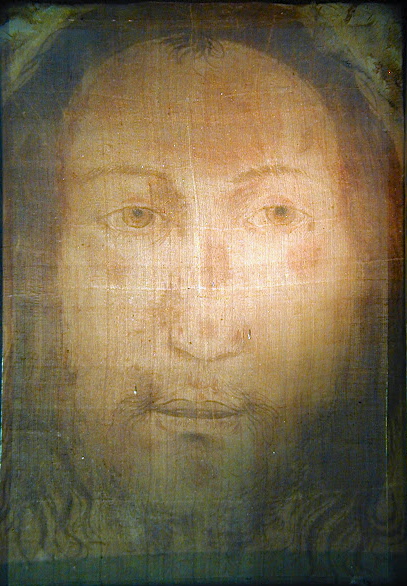
Living Source for the Holy Year by Paul Badde
In the First Holy Year ever, which Pope Boniface VIII (1294-1303) introduced as a Christian jubilee for the year 1300, the most important destination for all pilgrims to Rome was not the Pope, nor even the tombs of the Apostles, but [to see] a gossamer-thin veil with the face of Christ. The veil was the greatest treasure of St. Peter’s Basilica, which at that time was called “Sanctum Sudarium” [meaning a burial face-cloth] in Latin, and was also known as the “Veronica.” The relic was considered to be the ‘Holy Sweat Cloth’ from the tomb of Christ, which is first mentioned in the account of the resurrection of the Evangelist John, together with the long linen cloth [Shroud] that is venerated today in Turin. In January 1208, Pope Innocent III was the first Pope to carry this Holy Veil in a crystal monstrance, publicly and barefoot, from St. Peter’s Basilica to the nearby Santo Spirito Hospital in Sassia in Rome, making it known throughout the Catholic world of the West.


Since 1620, the same cloth has been venerated as the “Holy Face” (Volto Santo) in a Capuchin church on a hill outside Manoppello, on the slopes of Magellan massif in Abruzzo, where Pope Benedict XVI visited on September 1, 2006, becoming the first Pope [to visit] in over 400 years. It is a veil with many mysteries that has also puzzled Dr. Gosbert Weth from Schweinfurt in Germany ever since he heard about it and saw photos of the veil.

Dr. Gosbert Weth is 78 years old, a former chief physician, doctor of medicine and natural sciences (chemistry), with a “picture-book” academic career. As senior physician and head of the hormone laboratory at the University of Würzburg, he worked on the largest centenarian study in the world with 575 participants, aged 100. He has developed groundbreaking developments for tumor therapies, has also received the German Inventor Award as the holder of several patents, and has been a speaker at the several world congresses for geriatrics and gerontology. Today he is involved in research into new uses of hydrogen, and is a doctor for hopeless cases in Bad Kissengen.
However, because he is convinced that the true “image” on the holy veil cannot have a paint or technical cause, Dr. Weth came to the Papal Basilica of the Holy Face in Manoppello on the eve of the next Holy Year 2025, on September 26th, with a special device from nuclear medicine for measuring alpha, beta, and gamma rays. Here, [in the Basilica] Rector Antonio Gentile of the Capuchin convent of the sanctuary, willingly opened the armored glass door of the display case in which the holy Sudarium has been sealed in its reliquary between two crystal panes in a frame made of walnut and fish glue since 1714. It was on the memorial feast of the holy doctors [of the Church] Cosmos and Damian, when the doctor from Bad Kissengen [Dr. Gosbert Weth] was given two hours here during the lunch break of the monks, and another hour on the following Saturday for his examinations.

“As a doctor, I can see,” he began his findings, “that this person must have suffered severe torture. Hematomas [bruises] are clearly visible on both the nose and in the area of the right cheek. Intense blows are necessary in order to cause these hematomas, which are always considered to be more serious injuries in medical examinations. There are no traces of paint or blood detected on the image. Therefore, the ‘image’ must have come into existence only after death. There is a pronounced hematoma on the nose (on the left side), which must be older than two to three days. No other bodily fluids such as blood or sweat are visible. This cloth can therefore only have been placed on a person who has already died. There is a double hematoma that can also be seen in the area of the right cheek. Normally, as is still the case in medicine today, the eyes of every dead person are closed. But the man in this portrait, however, has his eyes wide open. This ‘picture’ is an inexplicable phenomenon.”

At the end of his investigation, however, Dr. Weth recorded the following: “All in all, there is only one explanation for the formation of the image of the sacred face. The atomic change from nitrogen (N14) to carbon (C14) must have occurred under the influence of enormous neutron radiation (light energy). The light energy present in the veil is the atomic evidence of the conversion of nitrogen (N14) to carbon (C14). Since the carbon is dark in color, the image is deposited as dark matter in the cloth. This also explains the alternating color shades. The ‘image’ is therefore not due to any application of paint, but to the nuclear-modified fibers of the carrier material.“
In this context, we must remember that most rays, in contrast to light rays, are invisible, but in many cases are extremely powerful–such as electromagnetic X-rays, or the almost invisible infrared light. All of these rays are full of energy.

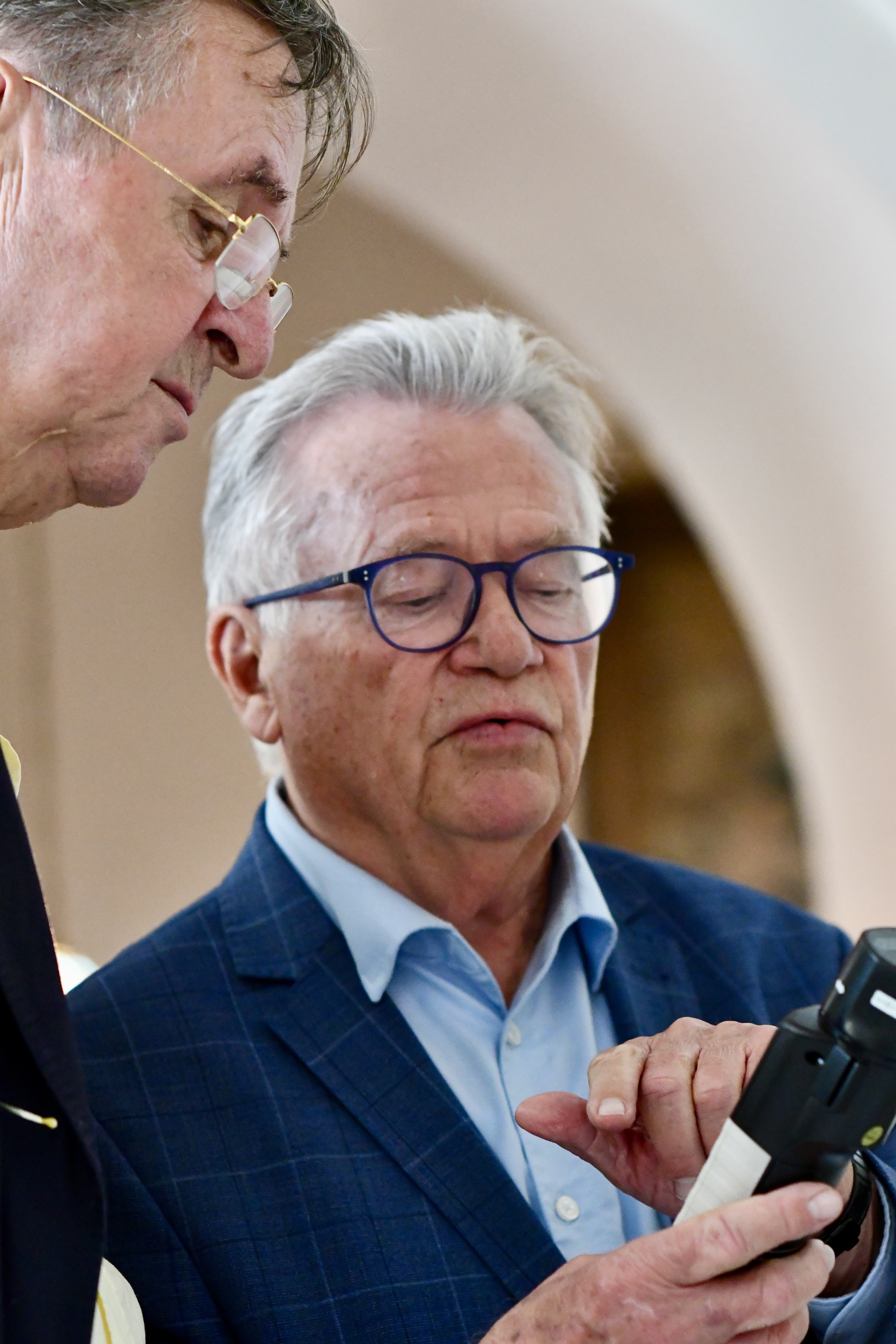
(photo: Paul Badde/EWTN)
Dr. Weth continued: “The radio carbon method provides evidence that carbon-C14 was formed. Carbon-C14 decays into nitrogen-N14 with a half-life of 5730 years, releasing beta radiation, which is produced by the radioactive decay of atomic nuclei. The formation of carbon-C14 leads back to nitrogen-N14. Since carbon is dark, this image is also darkly colored and optically visible due to the conversion of nitrogen to carbon. So once again: the image on the Manoppello [sudarium] cloth was not created by coloring, but by an atomic change to the nitrogen molecules present in the organic substance.”
“We therefore tried to measure the beta radiation released by the Manoppello cloth,” he said. “That was not so easy because the shroud is enclosed between two glass plates. Nevertheless, we were able to measure this radiation, which took place around 2000 years ago, and of which around 50 percent has already been consumed.”
We know that the decay of carbon C14 under beta radiation decays by half within 5730 years. It should therefore still be possible to measure this radiation– which was actually the case:
This basic radiation on the image veil was significantly higher than outside in the open air of nature. We therefore tried to measure this basic radiation as precisely and closely as possible. If we held the measuring device on the side of the reliquary, i.e. on the left and right at the places where there was no glass shielding, there was an increase of around 40 percent in beta radiation as a result of the conversion of carbon-C14 to nitrogen-N14. Overall, this beta radiation, which is also present everywhere outside in nature, was considerably higher in the protected basilica than [it is] outside. This is actually a contradiction. The reason for this higher density of beta rays can only lie in the existence of the Volto Santo [Holy Face Veil] inside the basilica.
“This can also explain the radiation of the Manoppello cloth at night,” Weth said with conviction. “It is visible in the dark because the conversion of C14 to nitrogen-N14 releases energy that is not one released from light quanta, but also from electrons, as they are raised to higher orbitals [wave function] in a conventional lamp. When the electrons fall back to their orbitals, light is released, which explains the radiance of the Manoppello sudarium cloth at night.”

In one sentence: The Holy Face contains light within itself. The “True Icon” (Vera Eikon), as the veil has also been called for centuries, radiates from within itself. This image veil is therefore not only identical to the Holy Sudarium from Jerusalem and the “Veronica” from Rome. It is “the human face of God” that Pope Benedict XVI has repeatedly spoken of– and also a source of energy that inexplicably even fills the church’s interior, where rays should not normally be measured at all.
Basically, the experience that the Volto Santo is a source of power is nothing new. It is familiar to almost every pilgrim who has ever visited the shrine. However, since Dr. Gosbert Weth’s investigation before the next Jubilee Year, the statement is no longer a mere assertion, but a physical fact that can be measured. –Paul Badde
+
It makes one ponder…if a cloth that had been placed on Christ’s Holy Face in the tomb measurably radiates such powerful light energy that is not seen with our eyes, what tremendous power there must be when we come before His Eucharistic Face– where Jesus is fully present, Body, Blood, Soul and Divinity?

“O most awe-inspiring King, we bow before You and pray;
May Your Reign, Your Kingdom, be recognized on earth!”
 Illumina Domine Blog - Devotion to The Holy Face