“Visible before to God alone and not to the world, God made the Word visible so that the world could be saved by seeing Him. This mind that entered our world was made known as the Son of God.”
~St. Hippolytus
“In the beginning was the Word, and the Word was with God, and the Word was God.
He was in the beginning with God. All things came to be through him,
and without him nothing came to be. What came to be through him was life,
and this life was the light of the human race; the light shines in the darkness,
and the darkness has not overcome it.
The true light, which enlightens everyone, was coming into the world.
He was in the world, and the world came to be through him, but the world did not know him.
He came to what was his own, but his own people did not accept him.
But to those who did accept him he gave power to become children of God, to those who believe in his name, who were born not by natural generation nor by human choice nor by a man’s decision but of God.
And the Word became flesh and made his dwelling among us, and we saw his glory, the glory as of the Father’s only Son, full of grace and truth.” (John 1:1-5, 9-14)
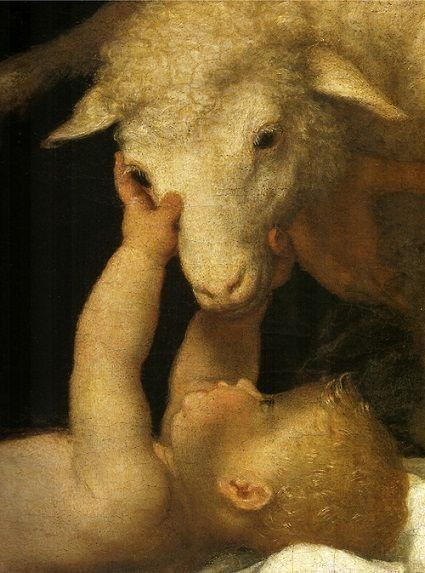
Kreuz als Krippe (Cross as a Crib), Oil on canvas, Unknown artist, 18th century (Photos: Paul Badde)
“While we too seek other signs, other wonders, we do not realize that He is the real sign, God made flesh; He is the greatest miracle of the universe: all the love of God hidden in a human heart, in a human Face.” ~ Pope Benedict XVI
+++
O that birth forever blessèd,
When the virgin, full of grace,
By the Holy Ghost conceiving,
Bore the Savior of our race;
And the Babe, the world’s Redeemer,
First revealed His sacred face,
evermore and evermore!
Merry Christmas! May His Face shine upon you and your loved ones, today and always!
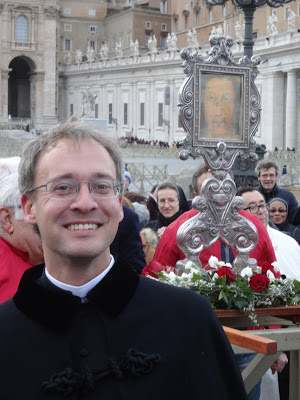
Fr. Daren Zehnle, a 47-year old Roman Catholic priest from the Diocese of Springfield, Illinois, passed away on November 27th after suffering a stroke. He was born on March 26, 1978, in Quincy, Illinois. His short life was marked by profound loss–he was a twin, but had lost his brother Matthew shortly after birth. By the age of ten he had already lost both his parents; his father, Bill, at eight, and his mother, Pat, at the age of ten to brain cancer. Fr. Zehnle found solace in his faith, “It might seem strange to say that my parents’ death led me to God, but they did, I realized somehow that I needed to draw close to — and stay close –to God. I felt safe, at peace, and comforted when I prayed.” Fr. Daren was ordained a priest on May 28, 2005, by Bishop George J. Lucas.
Relic Veil of the Holy Face in Manoppello, Italy (Photo: Patricia Enk)
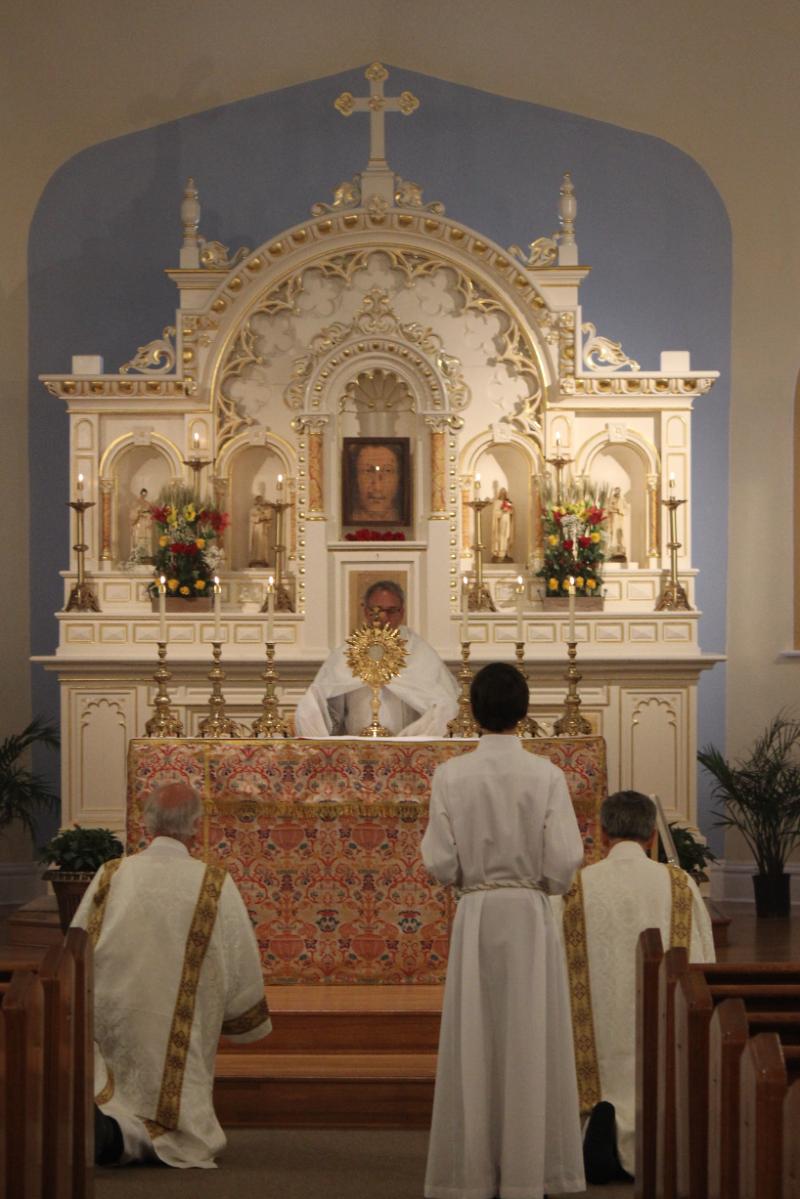
Fr. Daren Zehnle at the altar. (sent by Antonio Bini)
Fr. Zehnle had a deep love and devotion to the Holy Face of Manoppello in Italy, which he wrote about often on his “Servant and Steward” blog. (link is to a conference talk, in which he gave a beautiful reflection, on the Face of Mercy–the Holy Face of Manoppello.) It was through a shared devotion of the Holy Face that I was fortunate enough to get to know him while he was pursuing a Licentiate in Canon Law from the Pontifical Gregorian University in Rome. He went on to hold various positions, including Parochial Vicar at St. Anthony of Padua Parish. Pastor of Sacred Heart Parish, and director of campus ministry at Quincy University. Fr. Daren also had a very special devotion to Venerable Augustus Tolton, and St. Damien of Molokai. He was known as an extraordinary priest, and a faithful and good shepherd, and will be very missed by all who knew him. In an interview with “Catholic Times” last year, when asked what he would say to his loved ones when he meets them in heaven, he replied with moving simplicity: “I expect they will say to me what I will probably say to them, “I’ve missed you.”
Eternal rest grant unto him, O Lord, and let perpetual light shine upon him. Through the mercy of God, may he Rest In Peace. Amen.
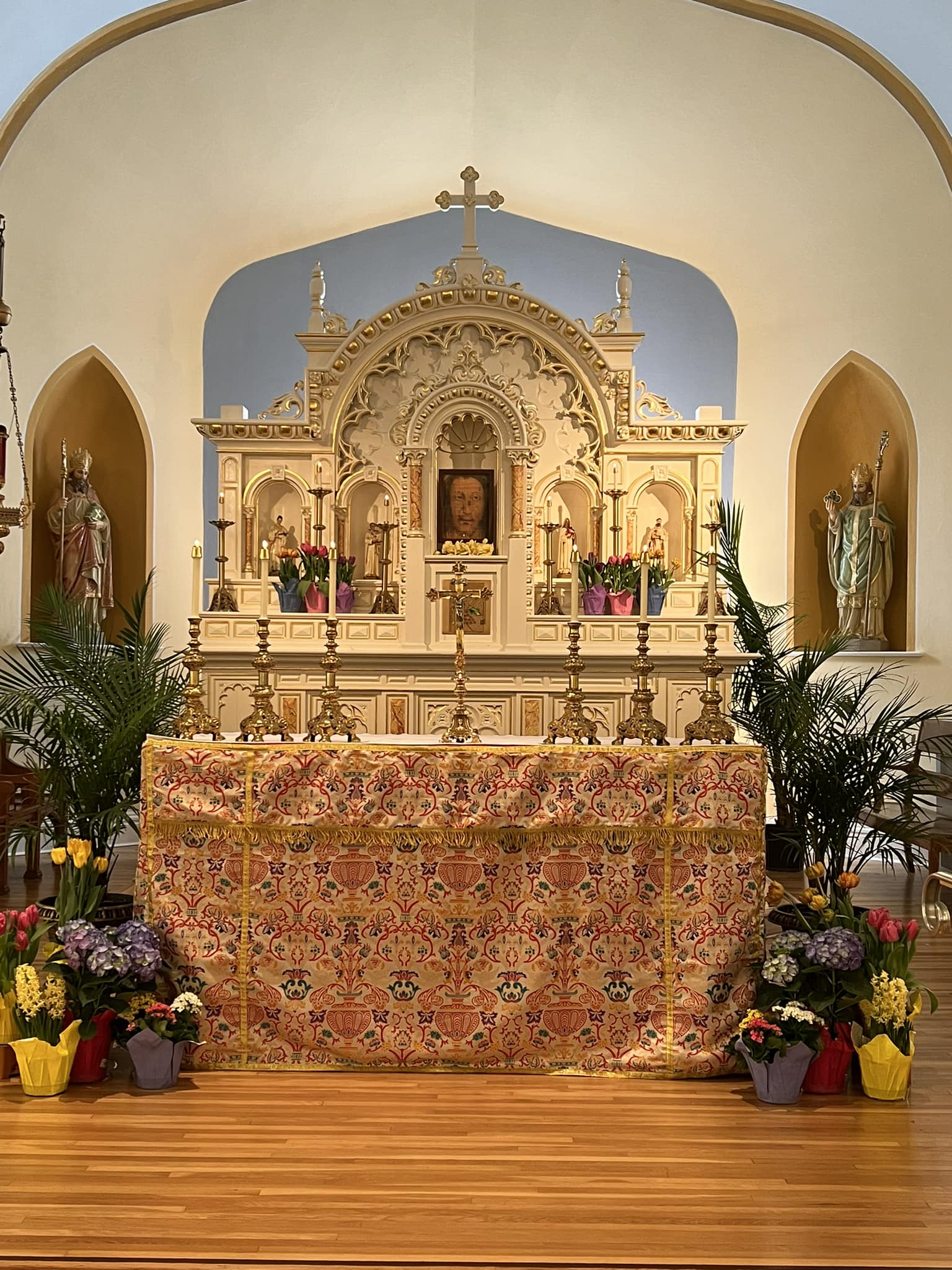
Fr. Zehnle sent Antonio Bini this photo as well. Antonio had met Fr. Zehnle many times when he visited The Basilica Shrine of the Holy Face in Manoppello–he remembers him as “Always smiling, positive, and deeply devoted to the Holy Face, which he enthroned on April 9, 2023, Easter Sunday, in St. Augustine Church in Ashland, Illinois, where he was a parish priest.
“The people living in darkness have seen a great light…” (Mt. 4:16).
As those who see light are in the light sharing its brilliance, so those who see God are in God sharing his glory, and the glory gives them life. To see God is to share in life.”
~St. Ireneaus
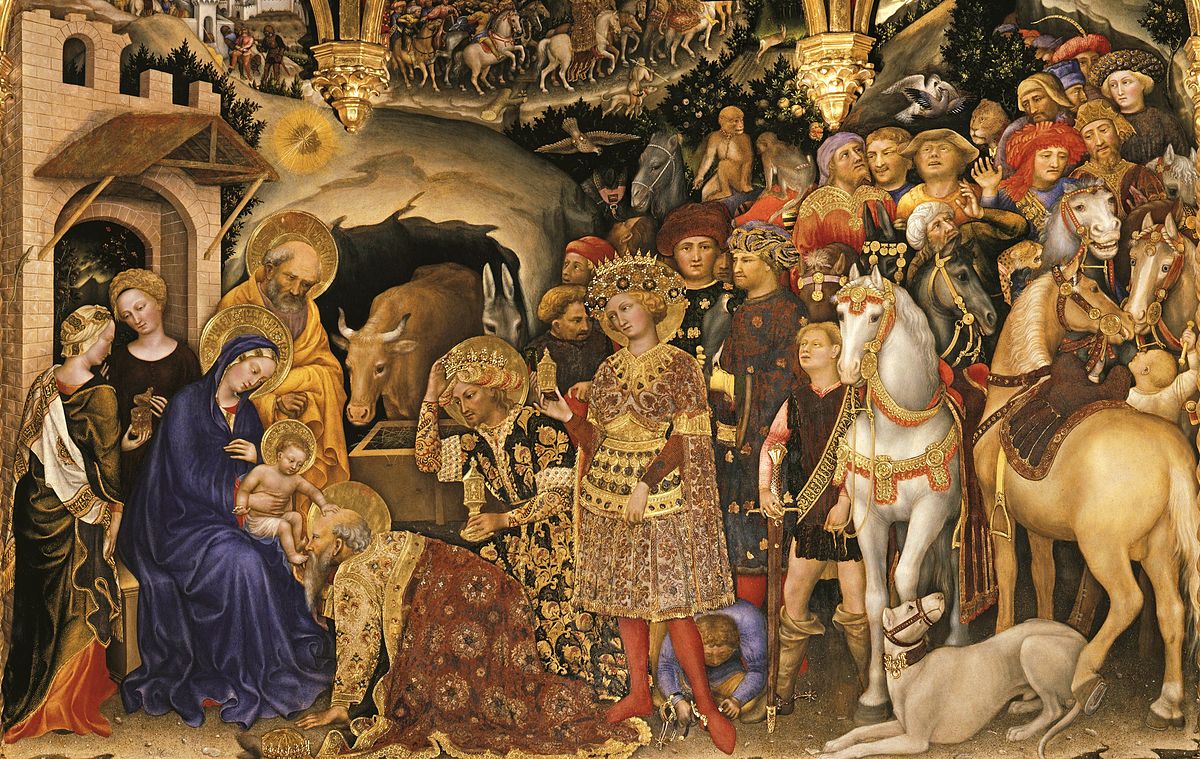
Adoration of the Magi – Gentile da Fabiano 1423
Love desires to see God. So says St. Peter Chrysologus: “When God saw the world falling to ruin because of fear, He immediately acted to call it back to Himself with love…” By an invitation of grace, love and compassion God called Noah, Abraham, Jacob and Moses–and a “flame of love” was enkindled in their hearts, “it’s intoxication overflowed into men’s senses. Wounded by love, they longed to look upon God with their bodily eyes, yet how could our narrow human vision apprehend God, whom the whole world cannot contain?” St. Chrysologus writes, “It is intolerable for love not to see the object of it’s longing!” No matter what good the saints did to merit a reward, they could not see the Lord. “A love that desires to see God may not have reasonableness on it’s side, but it is evidence of filial love. It gave Moses the temerity to say: If I have found favor in your eyes, show me Your Face. It inspired the psalmist to make the same prayer: Show me Your Face. Even the pagans made their images for this purpose: they wanted to see what they mistakenly revered.” (from sermon of St. Peter Chrysologus)
Come, let us adore Him!
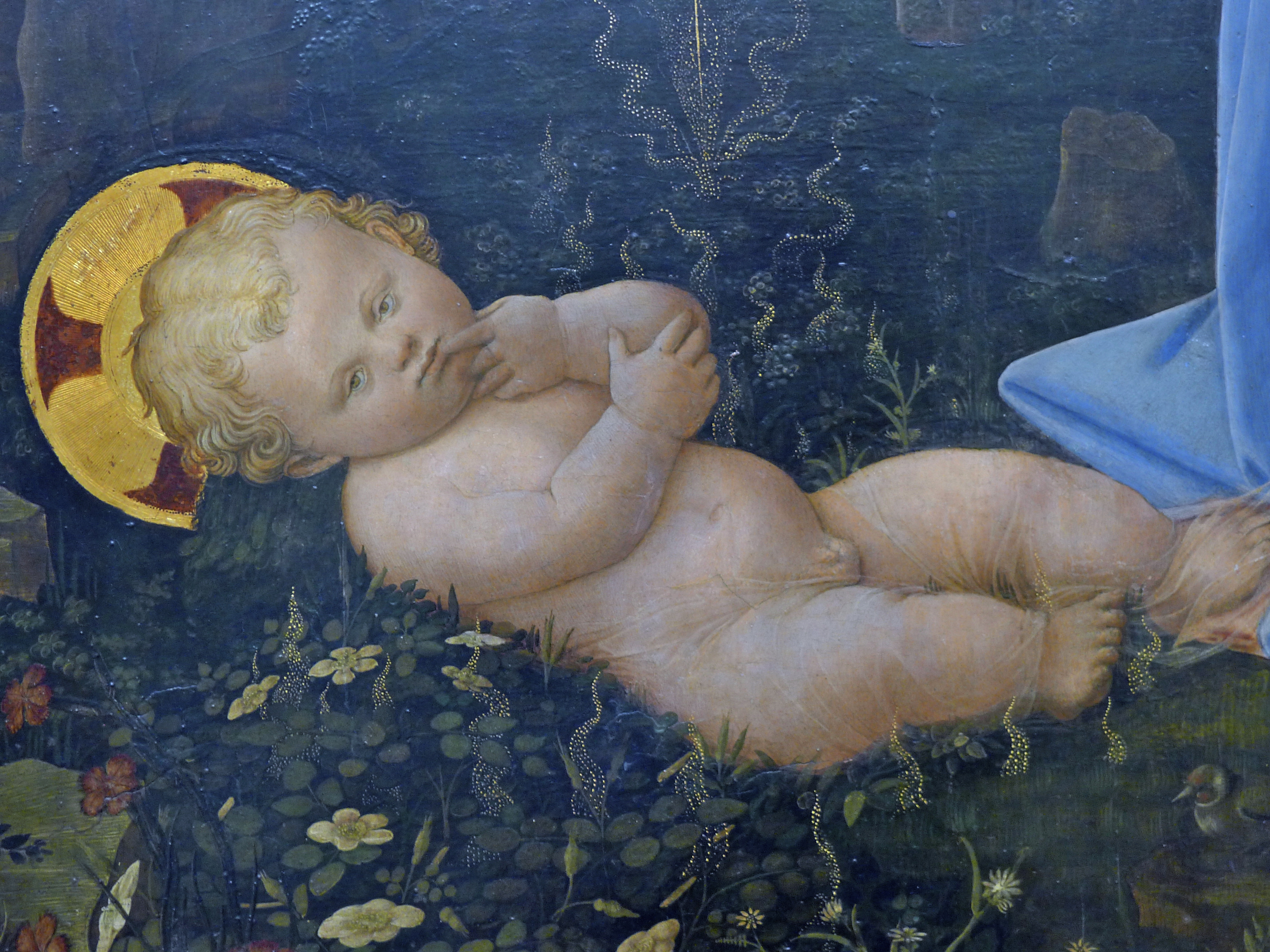
Infant Jesus wrapped in Byssus
“Visible before to God alone and not to the world, God made the Word visible so that the world could be saved by seeing Him. This mind that entered our world was made known as the Son of God.”
~ St. Hippolytus
Blessed are the pure of heart, for they shall see God. (Mt. 5:8)
Adoration of the Shepherds – Gerard van Honthorst 1622
O that birth forever blessèd,
When the virgin, full of grace,
By the Holy Ghost conceiving,
Bore the Savior of our race;
And the Babe, the world’s Redeemer,
First revealed His sacred face,
evermore and evermore!
Merry Christmas! May His Face shine upon you and your loved ones, today and always!
Kreuz als Krippe (Cross as a Crib), Oil on canvas, Unknown artist, 18th century (Photo: Paul Badde)
“In Thee God will manifest the splendor of His presence, for the whole world to see”
The great love stories in literature and real life have usually ended in tragedy: Romeo and Juliet, Napoleon and Josephine, Anna Karenina and her husband… that is, before her desire to be worshipped by Vronsky destroyed her. Then there are those great hidden and unknown lovers, whose romance was born in the heart of the Trinity and remained there in the darkness of faith, hope, and love. I have seen one such rare couple many times, in the pew in front of me at Mass. Bridegroom and bride are both in their late eighties now, snowy-haired, and frail. He gently leads her to the pew each week, tenderly unbuttons her red coat as he tells her how beautiful she is today. She has Alzheimers, but is like a lamb at his side; calm and docile. The husband gives himself in sacrificial love, doing all for the bride who is no longer capable of doing anything for herself. These beautiful lovers reflect the eternal love of the Trinity, and the sacrificial love of Christ for His bride, the Church, and with it, our own souls.
It is astounding that the most beautiful romantic poetry ever written was by the Carmelite Friar, St. John of the Cross, after having been kidnapped by his fellow friars, beaten and locked for months in a cold, narrow room that had been formerly used as a latrine for visitors. This is not the setting one would think of when one thinks of a great romance. And yet… it was in this darkness he wrote his Romances. John was seeking the Face of God in his anguish, and there discovered God was seeking him more.
St. John’s Romances were most likely written at the beginning of John’s imprisonment in Toledo during Advent of 1577. In his search for God, amidst terrible suffering and bewildering darkness, John expresses his hope in God by turning back to memories of the popular ballads of his childhood. He then stirs up his love, and gives voice to his faith, by recounting salvation history – the beautiful story of the immense mutual love of the Holy Trinity. In this overflowing love, the Father and Son each desire the glory of the other, and so creation comes into being. The Father creates a bride for the Son. The bride is the Church, and ourselves within the Church, created to share in the divine love. In Romances, the Incarnation, Stanza 7, John writes of the loving exchange between the Father and the Son. The Word of God is presented with a bride who is made in his image, but she is “unlike in her flesh.”
“You see Son that your bride
was made in your image,
and in so far as she is like you
she suits you very well;
but she is unlike in her flesh
which your simple substance lacks.
The pattern of gift, space, and God making the space himself are found in the verse. Father reveals his gift as “with love most tender” He speaks to the Son, who in accepting the gift knows that he must empty himself (making space), suffer, and die.
The next lines pierce one’s heart with a truth that is found in all John’s writing; that of the humility of God in emptying himself, becoming “like the one he loves” to unite himself with his bride, taking on her sins, suffering and dying for them himself, in order to redeem her.
“In perfect love
this law obtains;
that the lover should become
like the one he loves;
for the greater the likeness
the greater the delight;
would increase greatly if she saw you like her
in that flesh which is hers.”
This moment, before the Incarnation that will occur, evokes the memory of the night of the Last Supper when Jesus in his agony prays, “Father, not my will but yours be done:”
“My will is yours”, the Son replied,
“and the glory which I have
is that your will be mine…”
Jesus, himself has made the space for the gift of redemption to be fulfilled in Him; willing his own suffering and death, and later, in His resurrection for the sake of his bride, enabling her to share in his risen life – so that the bridegroom and the bride will be one — as he and the Father are one.
“I will die for her,
And lifting her out of that deep,
I will restore her to you.”
The pattern of “the perfect love” is a sign for all today, where it is repeated in each soul within the Body of Christ. The “perfect love” is seen in the example of the Virgin Mary, when she offered her “Fiat,” and Jesus became Incarnate in her womb, and each day until the foot of the Cross and the tomb. Following her example, in total “yes” to God’s will, we can trust that Jesus will ultimately make the space in our own pain, emptiness and darkness for the gift of the Holy Spirit; so that Jesus will become incarnate in our souls; transforming in love the lover, who, in union with Jesus will also become “like the one he loves:” a likeness of Jesus — to the Glory of God the Father, who delights in seeing the image of His Son in the soul of “the bride.”
“Come,” says my heart, “seek God’s face”; your face, LORD, do I seek! Do not hide your face from me…” (Ps. 27:8-9)
The Face of Jesus can be found in Sacred Scripture “God is Love, and whoever remains in love remains in God and God in him. (1 John 4:16)
Human beings are made in the image and likeness of God, and so our souls have a yearning, a natural longing for the infinite; we are called to communion with God, to see Him “face to face.” He is calling us to seek Him, to know Him, and love Him with all our strength. Because we are made in His image, we have a capacity to know God through the truth and beauty of the created world, through moral goodness and our human reason, but there are many things that stand in our way; we are in need of enlightenment. God has said everything in His Word, so we must “seek the Beloved” in the Scriptures. As St. Jerome said, “Ignorance of Scripture is ignorance of Christ.”
Through all the words of Sacred Scripture, God speaks only one single Word: Jesus Christ, the Word Incarnate. And there, in the Scriptures, we contemplate His Face. “Sacred Tradition and Sacred Scripture make up a single sacred deposit of the Word of God, in which, as in a mirror, the pilgrim Church contemplates God, the source of all her riches.” (CCC 97) The Word of God, which is Truth, acts as a mirror held before our gaze in which we may see our sins more clearly and feel the heartfelt sorrow of repentance, which can be the impetus for conversion or turning back to the Face of God.
“Your Face, LORD, do I seek!”
Beginning in Genesis, the Sacred Scriptures reveal the pilgrimage: the struggles of nations and individuals in pilgrimage, as they turn toward or away from the Face of God–their battles, falls and triumphs. In “The Face of Mercy” Pope Francis speaks of the importance of the practice of pilgrimage, which has a special place in the Holy Jubilee Year of Mercy. He says “everyone, each according to his or her ability, will be asked to make a pilgrimage. This will be a sign that mercy is also a goal to reach and requires dedication and sacrifice.” Through the Scriptures, “The Lord Jesus shows us the steps of the pilgrimage to attain our goal: ‘Judge not, and you will not be judged; condemn not, and you will not be condemned; forgive, and you will be forgiven; give, and it will be given to you; good measure, pressed down, shaken together, running over, will be poured into your lap. For the measure you give will be the measure you get back’ (Lk 6:37-38)” —Face of MercyScripture guides us in our pilgrimage by keeping our eyes fixed on Christ…and NOT on the world.
Denial of St. Peter by Carl Bloch
In seeking the Face of Jesus in the Scripture we also experience His loving and powerful gaze. The power of the gaze of Jesus in this journey is illustrated unforgettably in chapter 22 of Luke’s gospel which tells of Peter’s denial of Christ. When Jesus is arrested, Peter was “following at a distance” then sat near a fire in a courtyard. When he is accused of being a follower of Jesus, Peter denies Him, through fear, choosing to be viewed as part of the crowd, and seeking instead the approval of the world. “Just as he was saying this, the cock crowed, and the Lord turned and looked at Peter; and Peter remembered the word of the Lord…He went out and wept bitterly.”(Lk. 22:60-62) From Jesus’s merciful gaze came Peter’s repentance and second conversion.
Jesus Blindfolded Fra Angelico
Interestingly, the next few lines of Luke’s gospel also demonstrate the attitude of those who refuse to look at the merciful gaze of the Face of Jesus: “The men who held Jesus in custody were ridiculing and beating Him. They blindfolded Him and questioned Him, saying, ‘Prophesy! Who is it that struck you?’ And they reviled Him in saying many other things against Him.” (Lk. 22:63-65) These blasphemous men could not bear the gaze of Jesus, so they blindfolded Him, refusing to look in the mirror of Truth, which is the Face of Jesus. No one can receive mercy who refuses to acknowledge their sins.
When we seek the Face of God by reading and praying with the Scriptures, we discover the true Face of Jesus, our Beloved, the Innocent Lamb, who is meek and humble of heart. St. Paul wrote that “a veil” lies over our hearts, “but whenever a person turns to the Lord, the veil is removed… All of us gazing with unveiled face on the glory of the Lord, are being transformed into the same image from glory to glory, as the Lord who is the Spirit.” (2 Cor. 3:18) His gaze transforms our hearts from darkness to light as we strive to mirror His life. “For God who has said, ‘Let light shine out of darkness,’ has shone in our hearts to bring to light knowledge of the glory of God on the Face of Jesus Christ.” (2 Cor. 4:6)






 Illumina Domine Blog - Devotion to The Holy Face