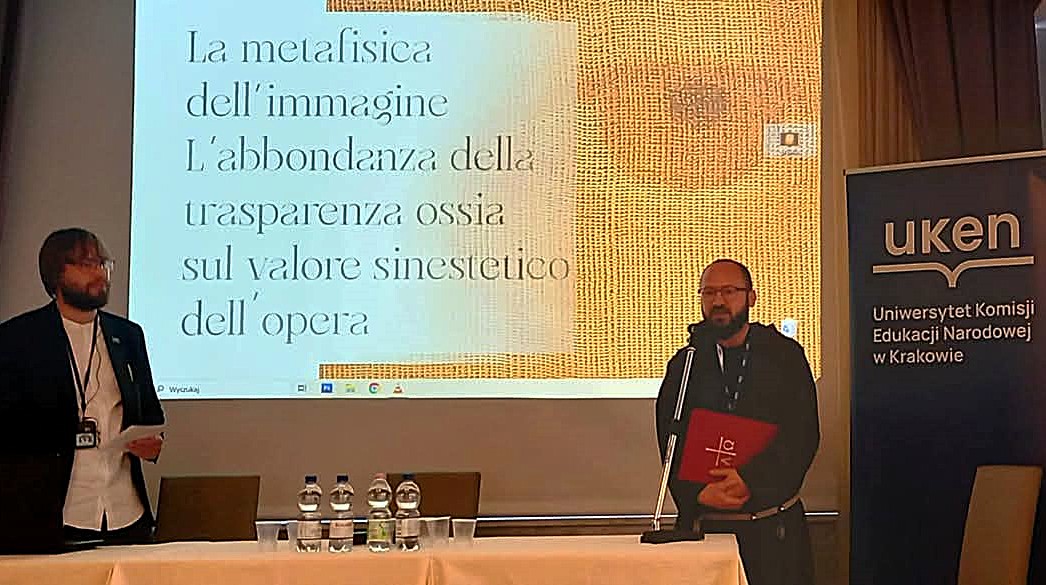
Rector of the Sanctuary Basilica of “Il Volto Santo,” Padre Antonio Gentili (R), greets Prof. Lukas Murzyn (L), and participants of the unique conference on the “Metaphysics of the Image.” Promoted by the UKEN University of Krakow, held at the Sanctuary of the Holy Face in Manoppello, Italy, on May 2-3, 2025.
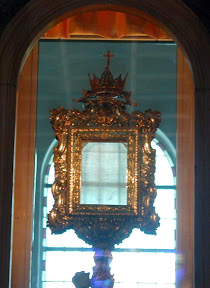
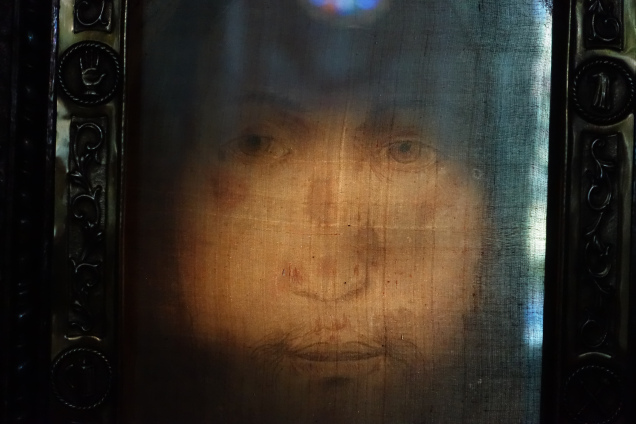
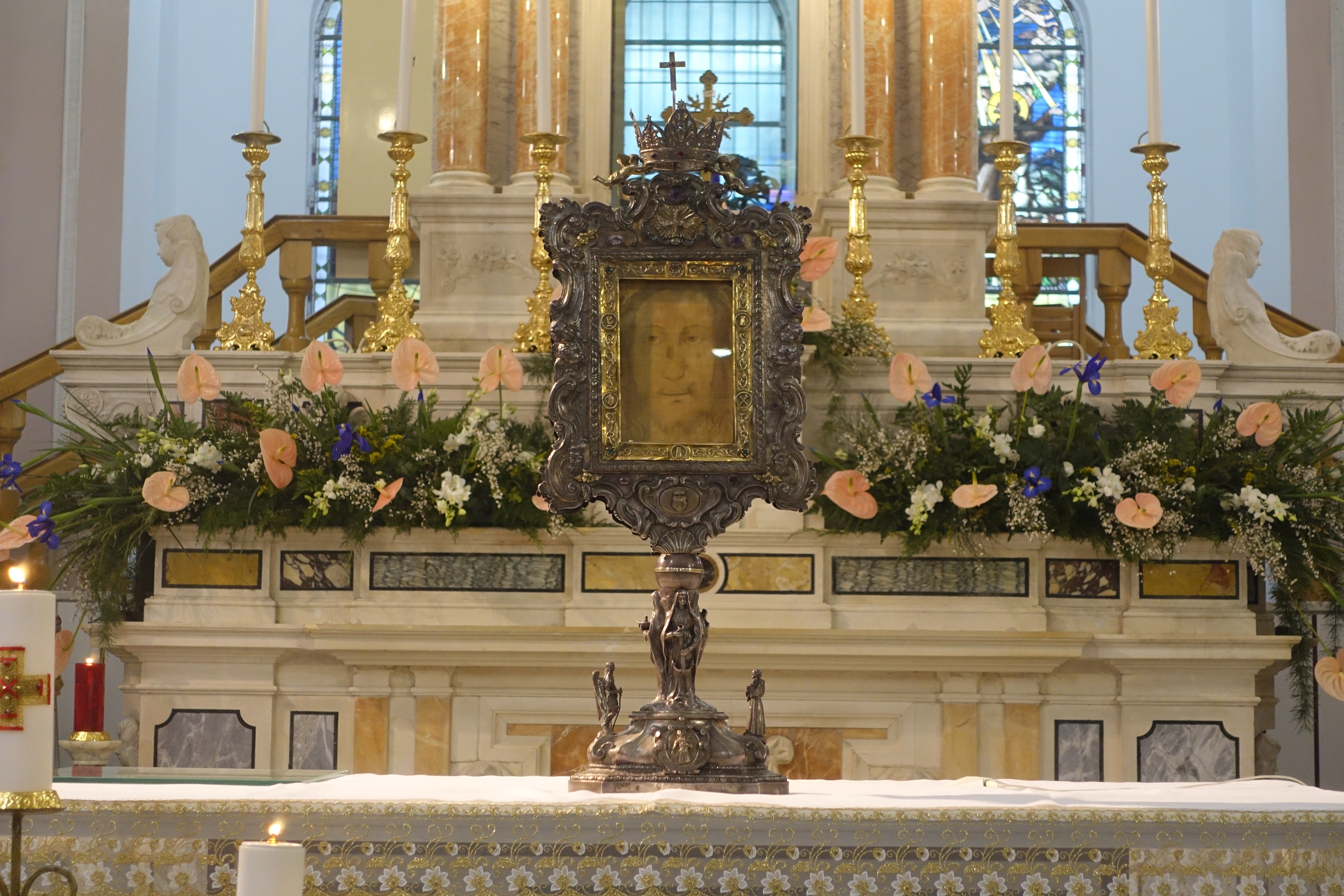
The Holy Veil of Manoppello –so sheer, and yet, without paint, an image my be seen of the Face of Jesus. (Photo: Paul Badde/EWTN)
For those who may be unfamiliar with “Il Volto Santo,” it is a precious relic veil considered to be an “Acheiropoieta” — meaning that its existence is supernatural — made by the Hand of God. The sheer veil, in a miraculous way, bears an image that is seemingly “written in light” of the Holy Face of Jesus Christ. This extraordinary relic has been the subject of intense study and renewed devotion at the dawn of this new millennium dedicated by Pope St. John Paul II to the Holy Face of Jesus Christ.
Padre Antonio Gentili, Rector of the Sanctuary Basilica, “face to face” with the Holy Veil of Manoppello. (Photo:Alexandra Prandell)
Antonio Bini, who was also invited to make a presentation on the important research on the Holy Veil by Fr. Heinrich Pfeiffer (1939-2021), has graciously provided a summary of a conference:
The Face of Christ on the Holy Veil becomes visible, according to the light, and at times appears to be a reflection of a living face. (Photo: Paul Badde/EWTN)
Antonio Bini writes: The relic veil of the Holy Face of Manoppello was the main focus of the conference, as it [The Holy Face of Manoppello] is considered “the source and root of the representations contained in tradition and an element of intellectual and supernatural conquests of Christian art,” as Prof. Lukas Murzyn, dean of the Faculty of Art and head of the Art and Metaphysics Study Group, explained in his introduction.
The Group, which operates at the Institute of Painting and Artistic Education of the Faculty of Fine Arts of the University of the National Commission for Education in Krakow (UKEN), promoted the conference held on May 2nd and 3rd, 2025, in Manoppello, Italy, having conducted research for several years on the changes in contemporary iconography, operating in the field of visual anthropology, the history of the philosophy of art, both in the field of experimental artistic activities and in that of the language of visual arts.
The professors of UKEN University during a break (Photo: Antonio Bini)
The speakers were welcomed in the conference room of the Casa del Pellegrino by the Rector of the Sanctuary, Padre Antonio Gentili and by the Mayor of Manoppello, Giorgio De Luca.
The conference was intended to respond to the question of what remains today of those roots [of representations of the Holy Face], how they are understood and what the metaphysics of the image can open up today.
The Holy Face of Manoppello (Photo: Alexandra Prandell)
From the “Relatione Historic, 1640, a description of the Face by Padre Donato da Bomba: “He has a rather long, well-proportioned face, with a venerable and majestic look. His hair, or locks are long with thin twisted curls–in particular at the top of the forehead about fifty hairs wind into a little corkscrew, distinct from each other and well arranged. His left cheek is swollen and bigger than the other because of a strong blow across the cheek. The lips are very swollen. His teeth show. It seems the Holy Face is made of living flesh, but flesh that is afflicted, emaciated, sad, sorrowful, pale and covered in bruises around the eyes and on the forehead. The eyes of Christ are similar to those of a dove…He is serene and tranquil.”
Historical-religious themes were also developed, with the intervention of Padre Ceslao Gedacz OfmCap, who recalled some important figures in the history of the Holy Face belonging to the Capuchin order, such as Padre Donato da Bomba, who was responsible for drafting the Relatione Historic (1640), following the donation of the veil to the Capuchins. Padre Fillipo da Tussio, author of the first essay on the Holy Face published in 1875, and then Padre Domenico da Cese, the first to convincingly spread the divine nature of the sacred image. There were also references to some scientific tests and the findings of two commissions of doctors; the first composed of Germans and Austrians, the second of Italian doctors, who worked at the Sanctuary in 2011 and 2012, which Padre Ceslao himself followed, being part of the community of religious men of Manoppello at that time.
Servant of God Padre Domenico da Cese (1915-1978, former Rector of the Shrine) prays before the Veil of Manoppello.
Metaphysics of the Image conference hall. (Photo: Antonio Bini)
These researches were recently published in the essay by Sr. Blandina Paschalis Schloemer, with the title “Sali al tramonto”(2025), her first book published in Italian after various essays published in Austria, Germany, Poland, and France. The German iconographer was present at the proceedings.
Sr. Monika Gutowska of the Ancelle dei Santissimo Sangue in Manoppello, summarized her experience of welcoming and contact with many pilgrims, presenting several cases, including non-believers, of people who have seen their lives transformed, but also the desire of many devotees to return to the Sanctuary several times a year, from Italy and abroad, for a deep need to periodically encounter again that Holy Face, whose reproductions are present in many Polish homes. [And many others, as well, around the world!]
Among those present was also Padre Carmine Cucinelli, former rector of the Sanctuary, involved in recent years in enthronements of the Holy Face in Poland, and also in the Sanctuary of Krakow dedicated to Pope St. John Paul II.
In addition to the aforementioned Prof. Lukas Murzyn, the following speakers then gave presentations: Sebastian Stankiewicz, Rafal Slewski, Kazimierz Piotrowski, Bernadeta Stano, Anna Grabczewska, Agnieszka Daca, Jacek Pasieczny and Stanisław Wójcicki from the Study Group of the Uken University of Krakow.
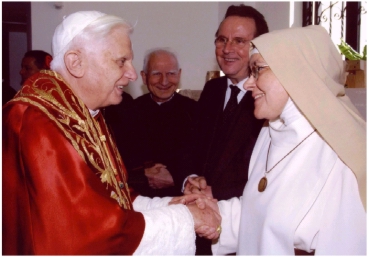
2006 – Pope Benedict XVI meets Sr. Blandina Paschalis Schlomer on his visit to the Sanctuary of the Holy Face in Manoppello, as Fr. Heinrich Pfeiffer, and Paul Badde look on.
We summarize the papers presented, whose simultaneous translation was edited by Agnieszka Kiedzik, from the University of Warsaw. The same papers may be the subject of further study in the publication of the proceedings, which will be edited by Sebastian Stankiewicz, with the title “Beautiful God: The Veil of Manoppello and the Iconography of the Incarnation,” with reference to a theological reflection on the “Beautiful God” present in the Middle Ages, expressed by Cardinal Joseph Ratzinger during a conference held at the Pontifical Urbaniana University in Rome, later taken up by Pope Benedict XVI.
“Being struck and overcome by the beauty of Christ is more real, more profound knowledge than mere rational deduction…We must rediscover this form of knowledge; it is a pressing need of our time.” ~ Excerpt from “The Feeling of Things, the Contemplation of Beauty” by Card. Joseph Ratzinger
The Group’s commitment also led to the creation of a portal — https://diafanitas.uken.cracow.pl — which collects experiences and initiatives on the study of the transparency of bodies crossed by light in a Christian dimension.
Dirk Bouts, 1400? – 1475
Christ Crowned with Thorns,about 1470
Various interpretative readings of the Holy Face have been developed, with the assumption that “whoever has come into contact with the Veil of Manoppello attests to its uniqueness and mystery.”
For representatives of the art sciences, many questions remain open: the origin of the image and history, the relationship between the relic and image, the role of the Veil of Manoppello in the creation of iconographic models in Christian art and in the evolution of ways of representation in Western Culture, the role of the veil among other representations considered acheiropoieta or formal similarities with the images of Christ depicted in the art of old masters; for example Dirk Bouts, Leonardo Da Vinci and Albrecht Durer, among others, and in the Eastern tradition. For contemporary art scholars, philosophers, theologians and anthropologists, the encounter with the Holy Face raises questions such as the relationship between sensual beauty and transcendent beauty, the idea of transparency and lights, the Christian sources of the idea and concept of a person, the meaning of the gaze and the encounter, the presence and contemporary reception of religious themes in art and sacred art and the importance of metaphysical references in contemporary art.
Veronica’s Veil Flemish 15th Century This is a fine example of the “Veronica” as portrayed by artists who saw the original for themselves, before it disappeared from view from the Vatican in 1527.
In my [Antonio Bini’s] presentation, I recalled the studies of Fr. Heinrich Pfeiffer (1939-2021), former professor of Christian history at the Gregorian University in Rome, who identified the Holy Face [of Manoppello] with the Veronica (vera icon), on the the occasion of the International Conference of the Institute for Research on the Face of Christ, chaired by Cardinal Fiorenzo Angelini, and then during a press conference held in Rome on May 31, 1999, on the eve of the Great Jubilee of 2000, which spread knowledge of the Abruzzo Sanctuary [of the Holy Face in Manoppello] throughout the world. Some sequences of that press conference with the interview of the German scholar, on Italian and foreign television, were repurposed in a video that the organizers wanted to show at the opening of the proceedings.
Fr. Pfeiffer’s position was then an isolated one, long contested, more or less openly. But his theses were later shared by Pope Benedict XVI, who visited the Shrine on September 1, 2006, composing a prayer that he dedicated to the “human face of God who entered history to reveal the horizons of eternity.”
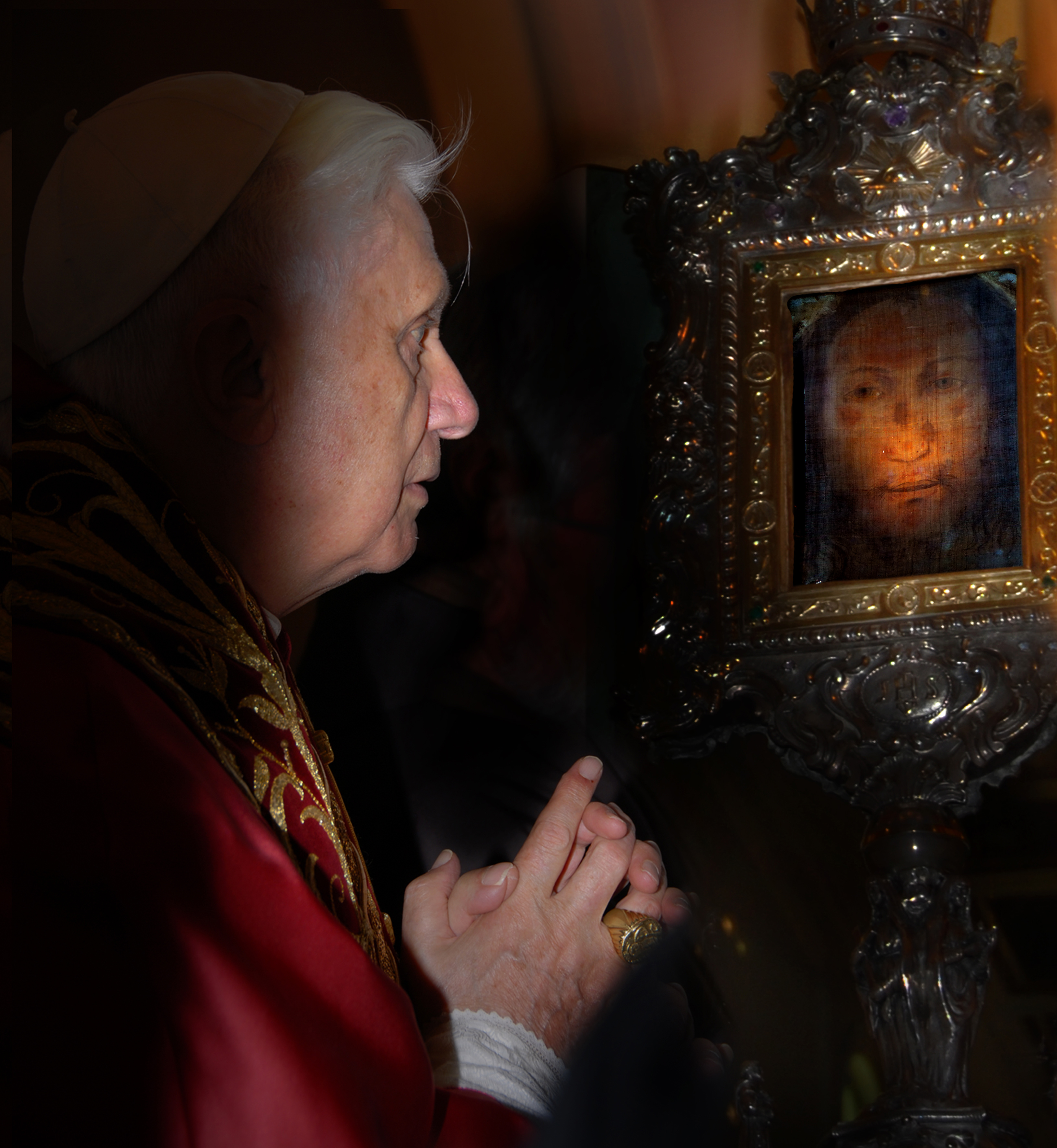
Pope Benedict XVI contemplates the Face on the Veil of Manoppello. September 1, 2006. (Photo: Paul Badde/EWTN)
Also under the pontificate of Pope Benedict XVI, a statement from the Holy See on July 11, 2011 reported that the “Veronica disappeared from St. Peter’s following the Sack of Rome in 1527.” This circumstance was confirmed by the (then) director of the Vatican Museums, Prof. Antonio Paolucci (Former Minister of Culture of the Italian Government), in an interview with the Bologna newspaper Il Resto del Carlino on August 11, 2011.
The admission [of the Director of the Vatican Museums] put an end to almost five centuries of silence that had fueled doubts and uncertainties for a long time, also through works of disinformation carried out also through modifications of the same original image, through reproductions that presented a “Veronica” with eyes closed. In this regard, the Veronica Route Project was started in recent years by a group of Milanese scholars, which led to a collective search, still ongoing, of 6200 ancient depictions of the true icon of Christ (Veronicas) with the eyes open, collected in a multimedia catalogue.
And yet, on April 6, an article published on the Vatican News website reported the presence of the “Veronica” in St. Peter’s (or, a copy of it, a black background. No image is seen.), while the Holy Face [of Manoppello] is indicated as a “shroud,” [A burial face-cloth] reiterating its acheiropoieta nature [As supernatural–made by the Hand of God]. Evidently, the writer was unaware of the painful path that led to the admissions [of the Director of the Vatican Museums] of 2011. Fr. Pfeiffer would still be busy arguing his reasons.
This is an example of a reproduction, made by Pietro Strozzi after 1527, when the original could no longer be viewed. The dark image of a dead man’s face bore no resemblance to previous descriptions and paintings of the Veil.
The dark cloth in a face-shaped frame that is currently presented, from a great distance, at the Vatican. (Photo: Daniel Ibanez)
Finally, during the conference, the exhibition of artist-teachers and students entitled “Face to Face” was presented, delicately entering the space of the Sanctuary, to offer a unique forum for interdisciplinary dialogue.
“At the basis of the concept of the exhibition,” declared the curator, Prof. Stanisla Wojcicki, “is the face-to-face encounter with the image of the Veil [Of the Holy Face of Manoppello], treated by scholars as a prototype of other representations of Christ. We would like our works to be considered a votive offering, something that we leave here to express gratitude, for the fact that we were able to meet in this place–particularly important to us.”
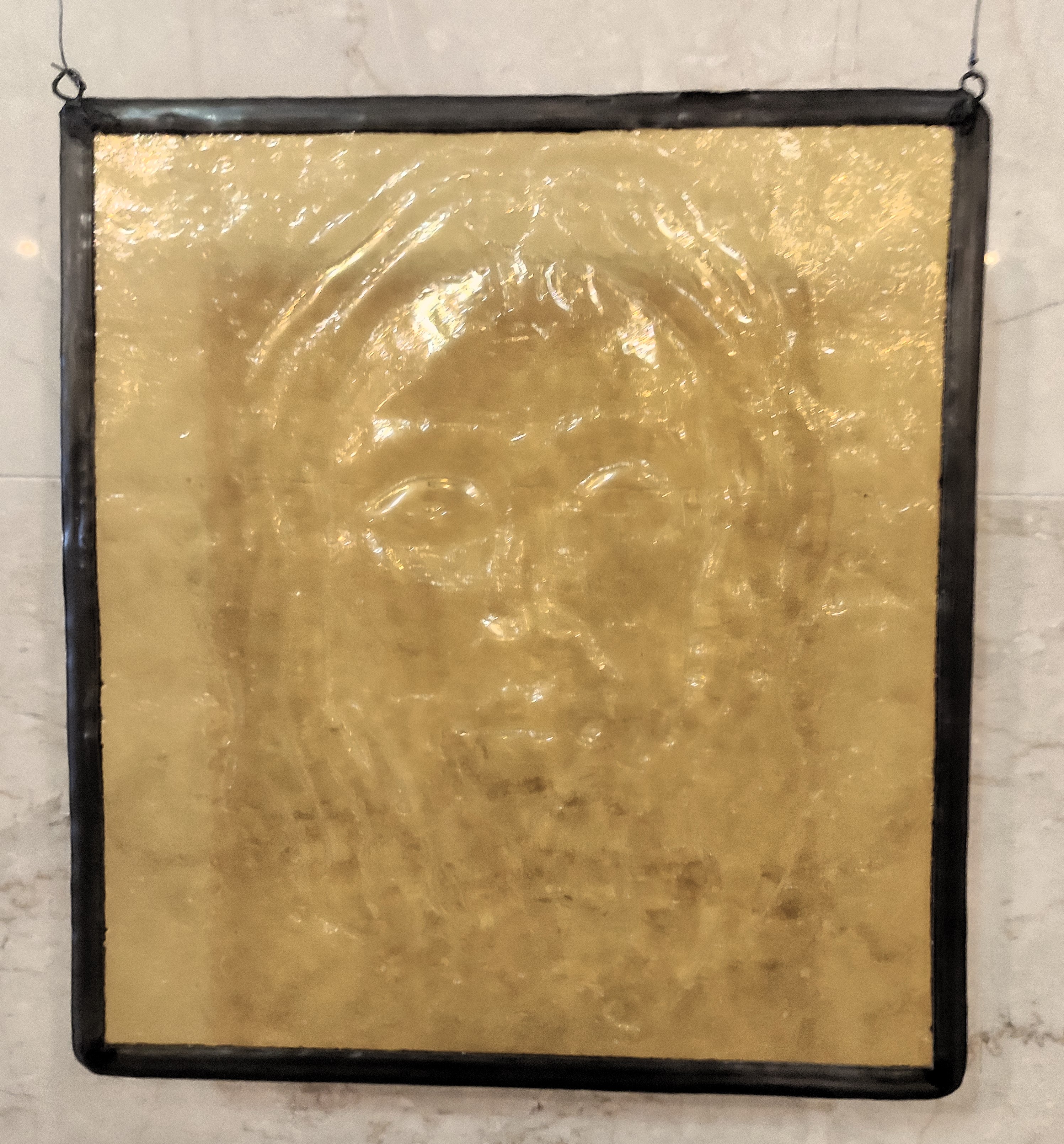
“Not matter but image,” a work by Jacek Pasieczny
“Not matter but image,” a work by Jacek Pasieczny, was exhibited in the Basilica as part of the “Face to Face” exhibition. The author described the work as “reflections of light, with the author” through the “use of glass of a particular color recalling golden byssus.” [of which the Holy Veil is believed to be woven.] The artist specified that it is not a copy of the original, but an attempt to paint a picture with light.
At the end of the conference we asked for an overall assessment from Don Arturo Alcántara Arcos, professor of spiritual theology and collaborator of the Soumaya Museum in Mexico City, also in Manoppello for the occasion, who stated: “It is particularly interesting to consider multidisciplinary points of view from a secular university. Here one can appreciate the different areas in which theology can be present, both directly and indirectly. The Uken of Krakow, inspired by the National Commission for Education established in the eighteenth century by the Polish King Poniatowski, open doors to a new dialogue between theology and the different artistic and aesthetic disciplines of our days in the contemplation of the Face of the Lord.” From what emerged during the conference and on the basis of the same conclusions of Prof. Lukas Murzyn, the belief that the Holy Face can also represent today the reference to the contemporaneity of Christ for art appears to be shared. An analytical perspective that the professors of the University of Krakow — the first to organize a similar event in Manoppello — intended to offer the art world.
Grazie Mille! Antonio Bini for this beautiful summary of the Conference on the Metaphysics of the Image!
One last thought from the beloved Cardinal Ratzinger — and later — Pope Benedict XVI:
Holy Face of Manoppello, (Photo: Paul Badde/EWTN)
“The encounter with the beautiful can become the wound of the arrow that strikes the heart and in this way opens our eyes…” “Inner perception must free itself from the impression of the merely sensible, and in prayer and ascetical effort acquire a new and deeper capacity to see, to perform the passage from what is merely external to the profundity of reality, in such a way the artist can see what the senses as such do not see, and what actually appears in what can be perceived: the splendor of the glory of God, the “glory of God shining on the face of Christ.” (11 For 4,6). –“The Feeling of Things, the Contemplation of Beauty” by Card. Joseph Ratzinger
The Feast of the Presentation of Christ in the temple is a feast of light, signifying by the lighting of the candles that Christ our radiant Light shines in the world. Mary carried the Christ Child, the true Light of the World, to present Him in the Temple, but so few recognized Him, because the world had been eclipsed in darkness. It was only the prophetess Anna, “who spent night and day praying in the Temple,” and the aged Simeon, who longed to see the Messiah before he died, who saw the light on the face of the Child Jesus and recognized their Lord.
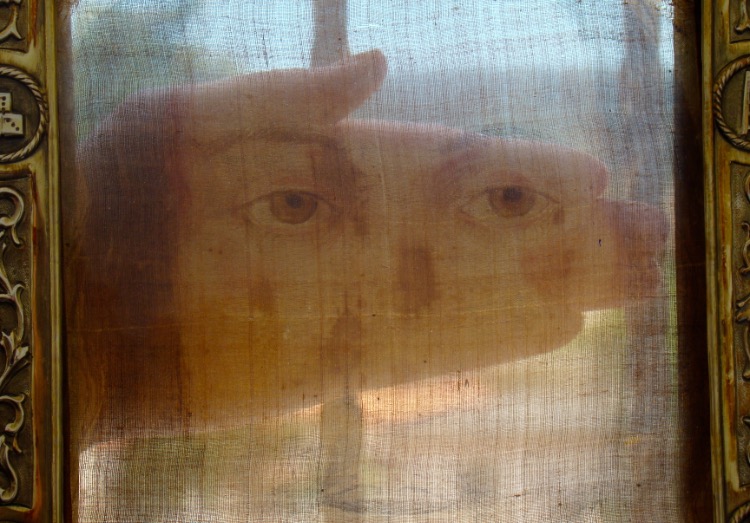
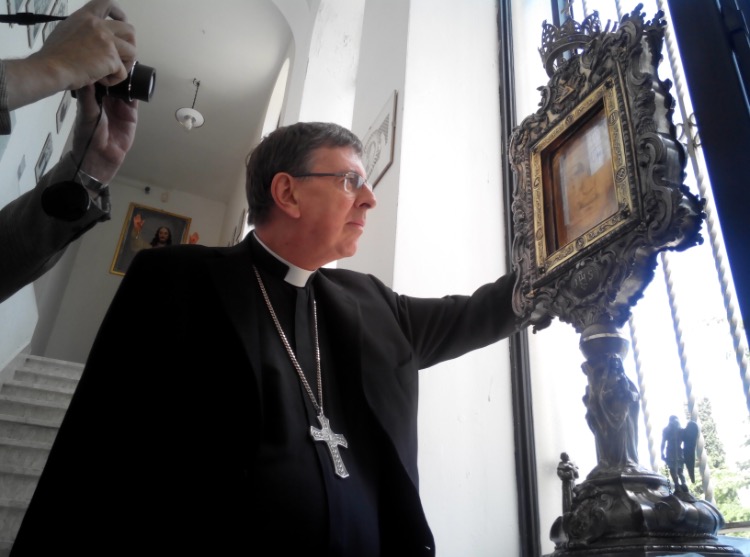
The transparent veil on which, by a “miracle of light” the Face of Christ is visible. Hand of Cardinal Koch Photo: Paul Badde
The world today is also eclipsed in darkness, but a glimmer of light still shines, bringing hope and peace to souls. If you are prayerful, like Anna, if you long to see His Face, like Simeon the high priest, you too will recognize your Lord — in the Scripture, in the faces of those around you, and in the Most Holy Eucharist.
There is yet another “miracle of light,” a means by which the Face of Jesus shines: It is called the Veil of Manoppello. It is a sign to a darkened world that God became man for our salvation. As was true at the Presentation in the Temple, there are few that recognize this great sign for what it is: An *”Iconic Turn,” a gift from God to draw mankind back “to seek His Face.”
Paul Badde has written a wonderful article for Vatican Magazine, on the Omnis Terra celebration honoring the “miracle of light,” the Face of Christ on the Veil of Manoppello, and the humble men who recognized their Lord there. Thank you, Paul, for the permission to post this article, and thanks too, to Raymond Frost for your translation in English from the original German.
*”An Iconic turn…a new picture that is essentially true: with the sun in the center! –Paul Badde”
Veil of Manoppello, photo: Paul Badde/EWTN
Omnis terra in Manoppello
A Copernican turn in the fog of Abruzzo
BY PAUL BADDE
“Omnis terra adorate, Deus, et psallat tibi”
(Let all the world adore you, O God and sing psalms to you).
Psalm 100
Cardinal Muller, Photo: Paul Badde/EWTN
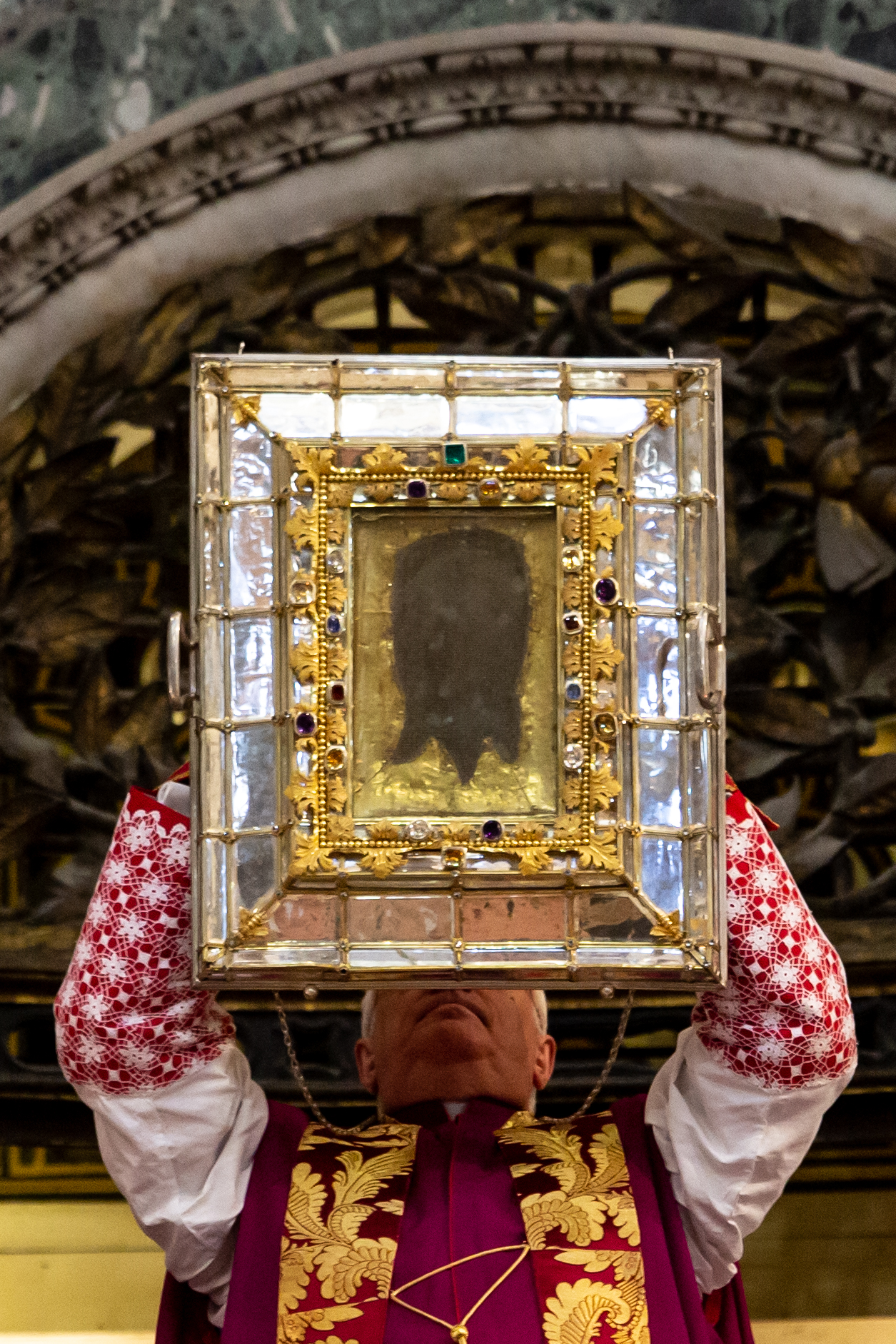
On the feast day of St. Agnes the Virgin, martyred for Christ in the third century in Rome, there appeared in the New York Magazine a glossy cover story about the “gay church” by the avowed gay writer Andrew Sullivan. That was to be expected sooner rather than later. What was wholly unexpected was that, a day before, Gerhard Ludwig Cardinal Müller, the prefect of the Catholic Church’s Congregation for the Doctrine of the Faith from 2012 to 2017, arrived in Manoppello to come together with the archbishops Bruno Forte from Chieti-Vasto in Abruzzo and Salvatore Cordileone from San Francisco, California, to bless the city, the world and the Church with the face of Christ on his sudarium.
In Hebrew, kohanim birkat םיִנֲהֹּכ תַּכְרִּב, by which God is entreated that his face might shine upon us, is the oldest recorded blessing of the whole entire Bible. But this blessing is not given to be received from the outstretched hands of the priests, but with the “true Icon “of the human face of God- from the hands of three bishops from Germany, Italy and America –
This was unheard of and has never been this way before. The American news outlet Catholic News Service CNS had beforehand pointed to the event and could not guess what was about to happen.
Pope Benedict XVI gazes at the Veil of the Holy Face in Manoppello, Photo:Paul Badde/EWTN
Because as Benedict XVI on September 1, 2006, as the first Pope after four hundred years for the first time who again had bent his knee and bowed to the true facecloth of Christ,
Nevertheless, the circumstances and much resistance had allowed him little more time before the precious icon than would any Japanese tourist be allowed. Neither the local bishop nor the guardian of the shrine could not then dare to ask the Pontiff to bless the world with the true icon. So this Sunday it was no less than a theological turning point, as Cardinal Gerhard Ludwig Müller with two chief shepherds from the Old and the New Worlds, blessed the city of Manoppello, the world and the church with the face of Christ.
Omnis Terra Procession of Pope Innocent II in 1208 carrying “the Veronica” Face of Christ (from “Liber Regulae Sancti Spiritus in Saxia” manuscript 1350)
It was an unprecedented celebration dating back to 1208 when Pope Innocent III first made known in Rome the face of God to the Latin world of the West on the second Sunday after the feast of the apparition to the peoples (Epiphany), bearing in his hands the hitherto unknown Sanctissimo Sudarium in a solemn procession from St. Peter’s Basilica to the nearby Hospital Church of Sancto Spirito in Sassia.
This Sunday bears the name “Omnis Terra” after the Latin entrance psalm for the day. This tradition was renewed again in the same churches three years ago by the archbishops Georg Gänswein and Edmond Farhat from Lebanon with pilgrims from Manoppello. It was in the “Year of Mercy ” which Pope Francis had proclaimed. And it borders on a miracle that the spark only three years later jumped to California where the brave archbishop, whose diocese adjoins the Silicon Valley and includes the headquarters of YouTube and Facebook, on the same evening sent the following statement on the internet:
Archbishop Salvatore Cordileone, Photo: Paul Badde/EWTN
“My visit to the Volto Santo of Manoppello was moving and profound. It took a very cherished idea and made it personal and real. I will always treasure the half-hour I had to pray privately before the holy image. It is alive; even the expression changes from different angles and with different lighting. It is like looking at a real human face, looking into the face of Jesus. The eyes, especially, are very alive and penetrating. My love for Jesus Christ has become much more personal now.
Archbishop Bruno Forte and Archbishop Salvatore Cordileone, Photo: Paul Badde/EWTN
I will also always be thankful for the opportunity to concelebrate the Mass with Cardinal Muller, along with the Archbishop of Chieti-Vasto, the Most Reverend Bruno Forte, the next day – “Omnis terra” Sunday. To participate with them in blessing the people with the Holy Face and then having the privilege to carry it in returning it to its place of safe keeping was a blessing I will never forget.
I encourage everyone who professes faith in Jesus Christ and love for him to cultivate a devotion to this holy image he has left us – a picture of the first instant of the Resurrection.”
. – Salvatore Cordileone, Archbishop of San Francisco, California,
– Manoppello, on January 20, 2019 ”
L-R: Archbishop Bruno Forte, Cardinal Gerhard Muller holding the Veil of the Holy Face, and Archbishop Salvatore Cordileone, Photo: Paul Badde/EWTN
The American archbishop “Lionheart” from San Francisco and his Italian brother and Manoppello’s local bishop Bruno Forte, fellow celebrities at the side of the German cardinal, could not be more different from each other. The savvy Monsignor Forte had already fourteen years prior laconically stated that the enigmatic veil icon “sorrow and Light are brought so close together, as only love can do “. Since then – and especially after the visit of Pope Benedict XVI -numerous Cardinals have streamed here and are so very enthusiastic in their homage to the image, as the evangelist Matthew related of the biblical wise men from the East in front of the child in Bethlehem.
Kurt Cardinal Koch observes the transparency of the Veil of Manoppello. Photo: Paul Badde
Cardinal Tagle delivers homily at the Basilica Sanctuary of the Holy Face (Photo: Paul Badde/EWTN)
Robert Cardinal Sarah (photo: Paul Badde/EWTN)
Most recently it was the Cardinals Kurt Koch from Switzerland, Robert Sarah from Africa and Antonio Tagle from Asia. Who knows the portrait, knows: the power of silence rests in it. It has been scientifically proven for decades that it is not painted and contains no imaging color or blood traces. Nevertheless, there is a decades long conspiracy of professors and experts (who have for the most part never seen it) against the spiderwebs sheath made of mussel silk, since it was first identified in the seventies of the last century by the Capuchin Domenico da Cese as the hagion soudarion, which the evangelist John prominently mentioned next to other cloths in the empty tomb of Christ in his report on the resurrection of Christ from the dead. The dispute should be no surprise. Already in the first millennium the Soudarion led to the extremely violent wars and dislocations of the “iconoclast controversy”. In fact, the issue raised today is not about images but about the question of God: “You, who do you think I am?”. The spectacular response of Cardinal Muller, is even more of a breakthrough than the visit of Pope Benedict to Manoppello, in which one of the most prominent Church theologians at the end of the Gutenberg Age (dominated by Dr. Luther’s maxim “Sola scriptura”) in front of this great icon and mother of the images not made by human hands, but still, so to speak, before the book of evidence has been closed, and without even speaking in his homily of the day’s Gospel (the wedding of Cana), but said the following: link to homily
“Il Volto Santo” the Holy Face of Manoppello, Photo: Paul Badde
Thus the words of Cardinal Muller’s sermon. Even more telling, however, were the photos taken at the end of the solemn pontifical Mass with his brothers in their common blessing gesture with the facecloth.. It was a Copernican revolution, and yes, it really was a breakthrough that in its meaning must be compared with the book “De Revolutionibus Orbium Coelestium” of Nicolaus Copernicus of 1543. The analogy is neither reckless nor indiscriminate. A lot of the facts of Copernicus were wrong and almost all the details. Nevertheless, we honor him for being one who has drawn a new picture that is essentially true: with the sun in the center!
Archbishop Bruno Forte (L), Cardinal Gerhard Muller (Center), Archbishop Salvatore Cordileone (R) Photo: Paul Badde/EWTN
And now the three bishops raised like hardly ever before in the liturgy this new blessing with the human face –God’s return of the visible Jesus Christ to the center of the world and the Church– and made it clearer than ever that the Creator of the Heaven and the earth has not become a book at the end of days, but man, and with it also picture. It was an unprecedented translation of all theology into the new and universal imagery that has become the digital revolution of the world in its entirety
“Iconic Turn” as a new means of communication.
Now it was suddenly as if the time of the eclipse haunting the earth, the world and the church finally ends in the misty Abruzzo with the look into the merciful eyes of Christ by the three shepherds
Venice, Illustration for the Divine Comedy of Dante, 13th Century”
There was no further dispute on the overwhelming, sometimes almost suffocating, problems and capital sins that the Church of our day poses, but with the holy facecloth Christ has steered a whole new look towards his face, as the head of the church and the face of love, “that moves the sun and the other stars” as Dante, the prince among poets, still formulated at the goal of the cosmic pilgrimage in his Divine Comedy. Ω
Miraculous Veil of the”Holy Face of Manoppello” in Italy Photo:Paul Badde/EWTN
The Holy Sudarium: the Veil of Manoppello, Italy Cardinal Gerhard Muller, Photo: Paul Badde/EWTN















 Illumina Domine Blog - Devotion to The Holy Face