“Abruzzo is a great producer of silence, wrote Georgio Manganelli.” Manoppello, Italy–hidden deep in the Abruzzo Mountains–had kept a secret: a holy relic veil of the Face of Jesus, treasuring and protecting it through five tumultuous centuries; effectively preventing it from being destroyed many times over. But now, in God’s Providence, the secret has come to light with the dawn of the millennium, which was dedicated to the Face of Christ by Pope St. John Paul II.
An eminent scholar, Fr. Heinrich Pfeiffer, uncovered the secret of Abruzzo and, at a great personal cost, presented his theses to the world. The news was embraced by some; and of course, rejected by others–there is nothing new in that. Opinions are like noses–everyone has one. We all make our own choices, for good or bad; but to make a choice, to believe or disbelieve, we first need an informed conscience, and the desire to know the truth in the first place.
For this reason Antonio Bini has published a free e-book (which is embedded below) which presents the background of the re-discovery of the relic of the Holy Veil of Manoppello bearing an image of the Face of Christ: “Heinrich Pfeiffer, The Scholar Who Recognized the Veronica in the Holy Face”. This essay commemorates Father Heinrich Pfeiffer (1939-2021), professor of Christian art history at the Pontifical Gregorian University in Rome and one of the leading contemporary scholars of the Church’s cultural heritage, who passed away in Berlin on November 26, 2021. With his studies on the Holy Face of Manoppello, which he identified as “the Veronica” (True Image).
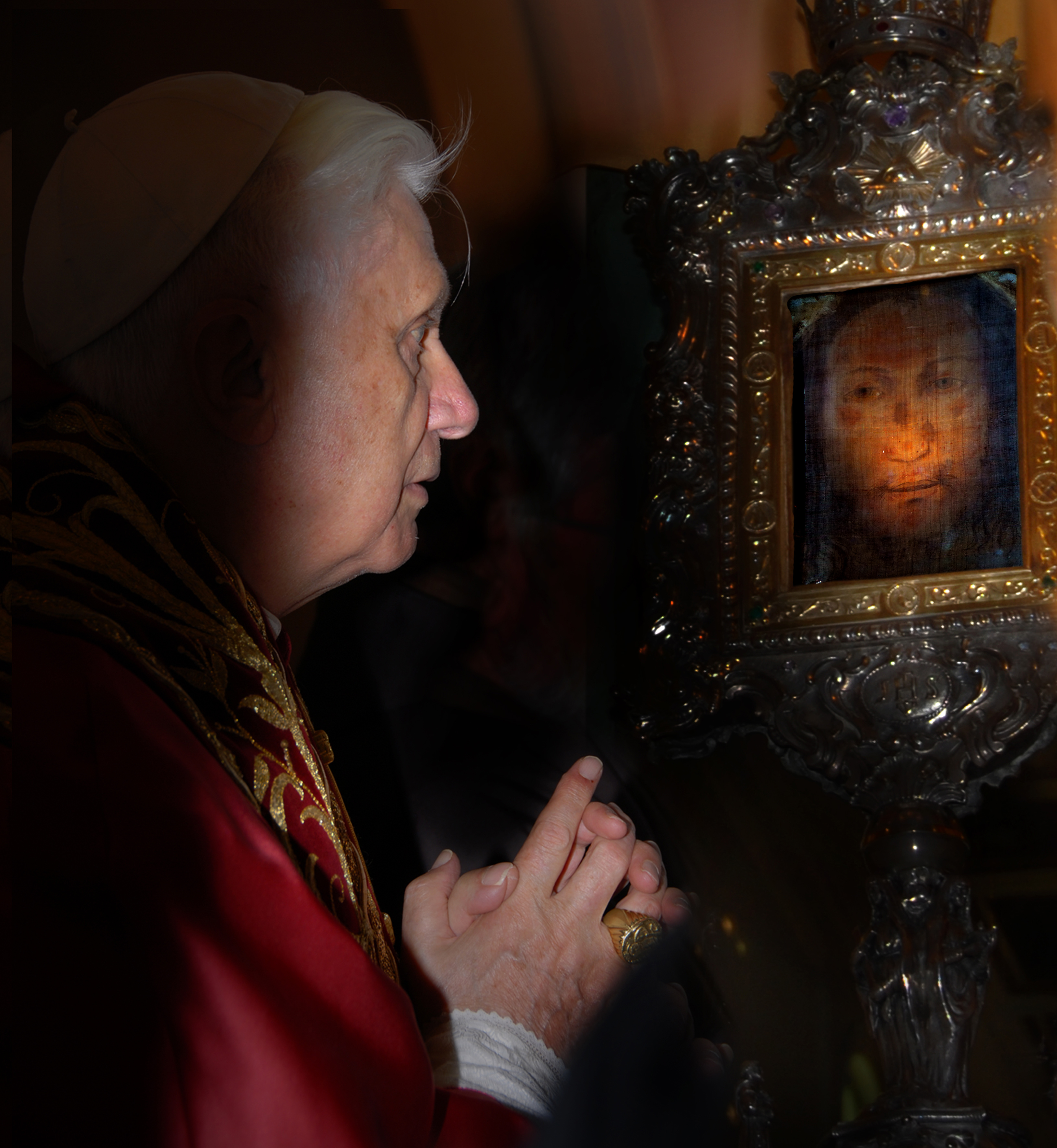
Pope Benedict XVI contemplates the Face on the Veil of Manoppello. September 1, 2006. (Photo: Paul Badde/EWTN)
Pfeiffer was met with distrust and hostility from scholars and Church hierarchies for questioning centuries-old silences and beliefs regarding Christ’s burial cloths. The book reconstructs the author’s encounter with Fr. Pfeiffer, the background to the international press conference held in Rome on May 31, 1999, in which the scholar supported his theses. These attracted the interest of the media and many pilgrims to the sanctuary of Manoppello, which until then had been relatively unknown. Among these Pope Benedict XVI, This visit effectively confirmed the validity of Fr. Pfeiffer’s theses. The German Pope was impressed by his encounter with the Holy Face, immediately elevating the church to a basilica and dedicating an intense prayer a year after his visit.
References to the Sack of Rome are also included, when the Veronica disappeared from Rome, as the Vatican press office later admitted in 2011. The photographic and documentary material, much of it previously unpublished, is noteworthy. By the author’s wish, the book, a testimony to the events, is being distributed free of charge in English to promote broader knowledge of the Holy Face among the many interested in the recent history of the mysterious image.
Holy Face Veil of Manoppello, Photo: Paul Badde/EWTN
“…and if my people, upon whom my name has been pronounced, humble themselves and pray, and seek My Face and turn from their evil ways, I will hear them from Heaven and pardon their sins and revive their land.” (2 Chr. 7:4)
Psalm 27
27 The Lord is my light and my salvation; whom shall I fear? the Lord is the strength of my life; of whom shall I be afraid?
2 When the wicked, even mine enemies and my foes, came upon me to eat up my flesh, they stumbled and fell.
3 Though an host should encamp against me, my heart shall not fear: though war should rise against me, in this will I be confident.
4 One thing have I desired of the Lord, that will I seek after; that I may dwell in the house of the Lord all the days of my life, to behold the beauty of the Lord, and to enquire in his temple.
5 For in the time of trouble he shall hide me in his pavilion: in the secret of his tabernacle shall he hide me; he shall set me up upon a rock.
6 And now shall mine head be lifted up above mine enemies round about me: therefore will I offer in his tabernacle sacrifices of joy; I will sing, yea, I will sing praises unto the Lord.
7 Hear, O Lord, when I cry with my voice: have mercy also upon me, and answer me.
8 When thou saidst, Seek ye my face; my heart said unto thee, Thy face, Lord, will I seek.
9 Hide not thy face far from me; put not thy servant away in anger: thou hast been my help; leave me not, neither forsake me, O God of my salvation.
10 When my father and my mother forsake me, then the Lord will take me up.
11 Teach me thy way, O Lord, and lead me in a plain path, because of mine enemies.
12 Deliver me not over unto the will of mine enemies: for false witnesses are risen up against me, and such as breathe out cruelty.
13 I had fainted, unless I had believed to see the goodness of the Lord in the land of the living.
14 Wait on the Lord: be of good courage, and he shall strengthen thine heart: wait, I say, on the Lord.
” I am giving you a new commandment, that you love one another’ just as I have loved you, that you also love one another.” (John !#:34) The Holy Face from the Shroud of Turin
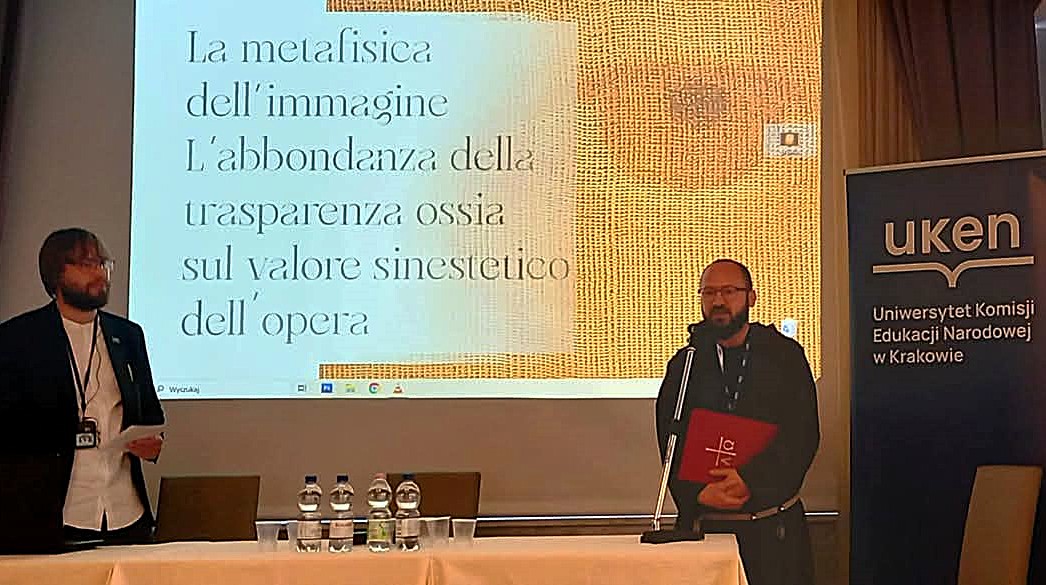
Rector of the Sanctuary Basilica of “Il Volto Santo,” Padre Antonio Gentili (R), greets Prof. Lukas Murzyn (L), and participants of the unique conference on the “Metaphysics of the Image.” Promoted by the UKEN University of Krakow, held at the Sanctuary of the Holy Face in Manoppello, Italy, on May 2-3, 2025.
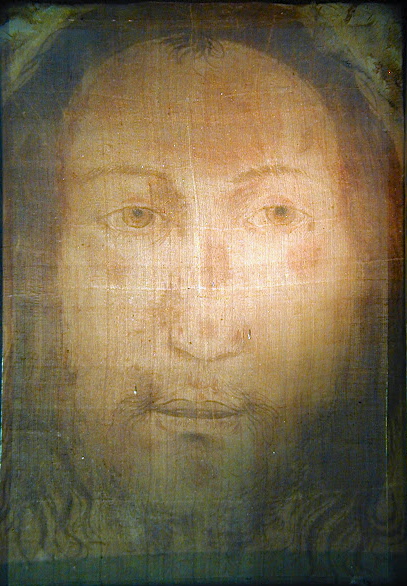
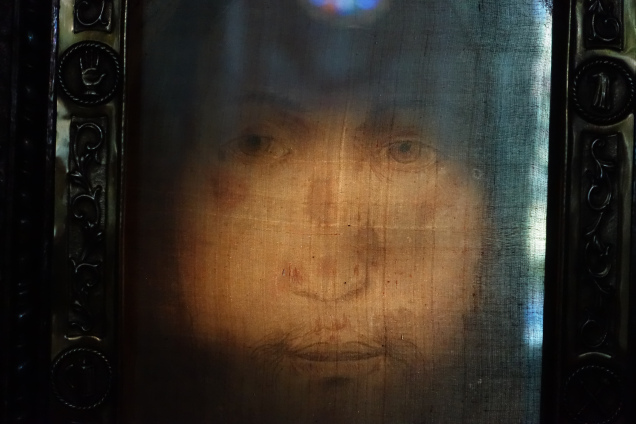
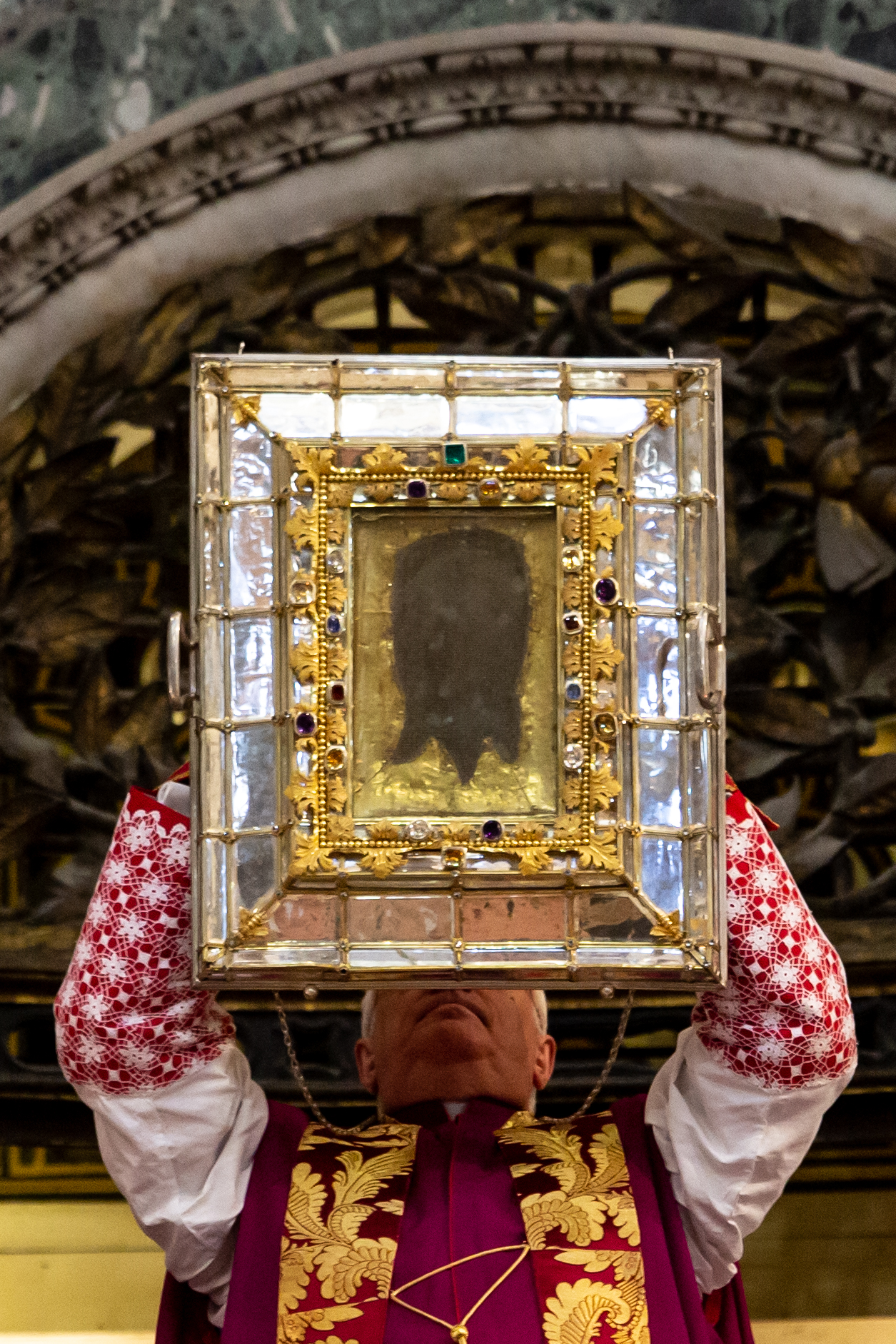
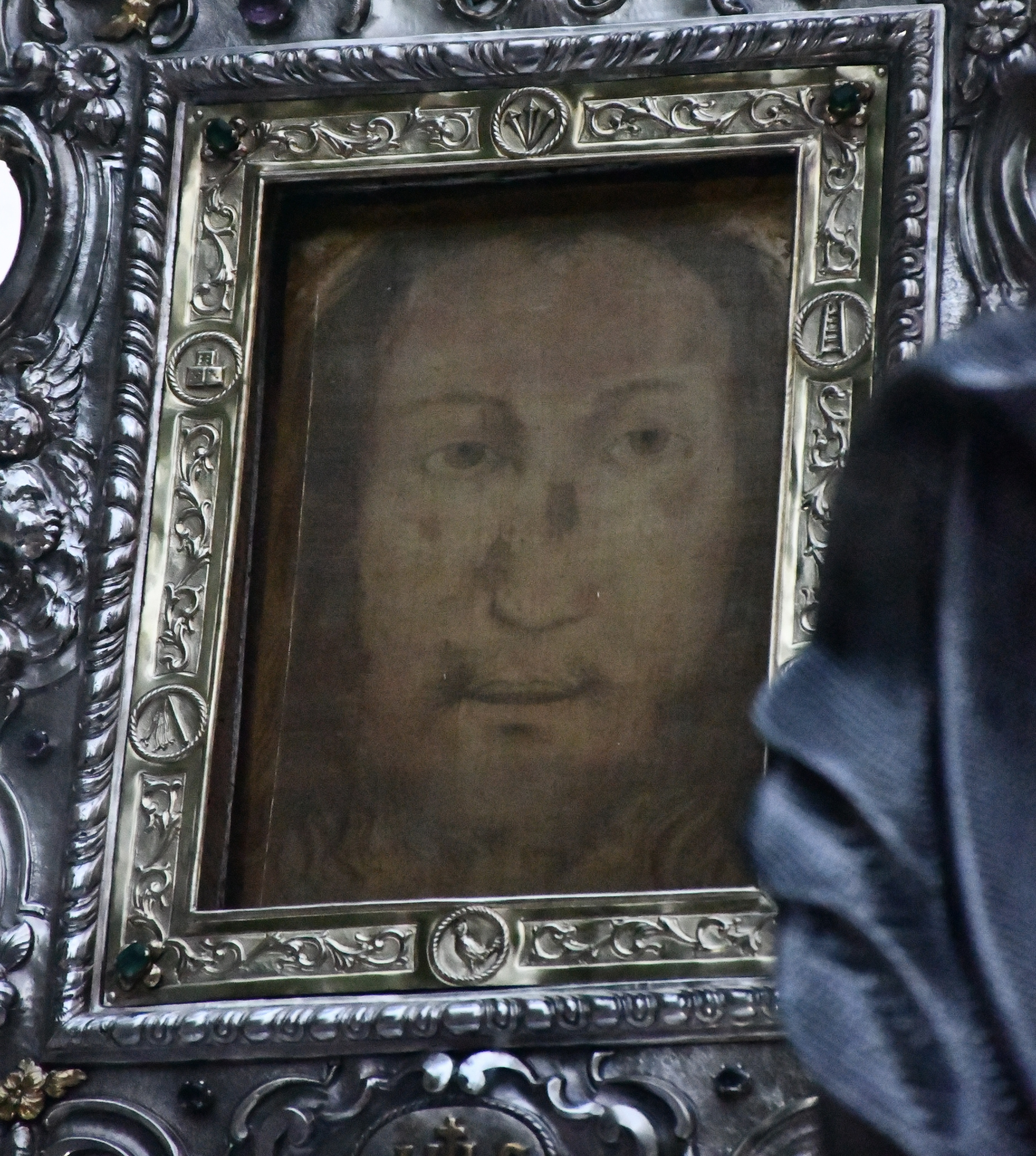
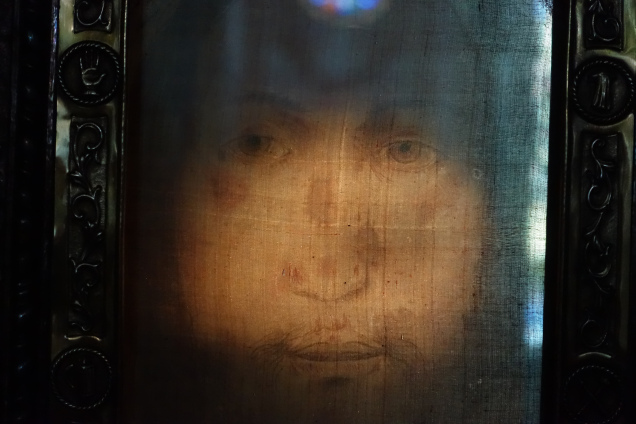
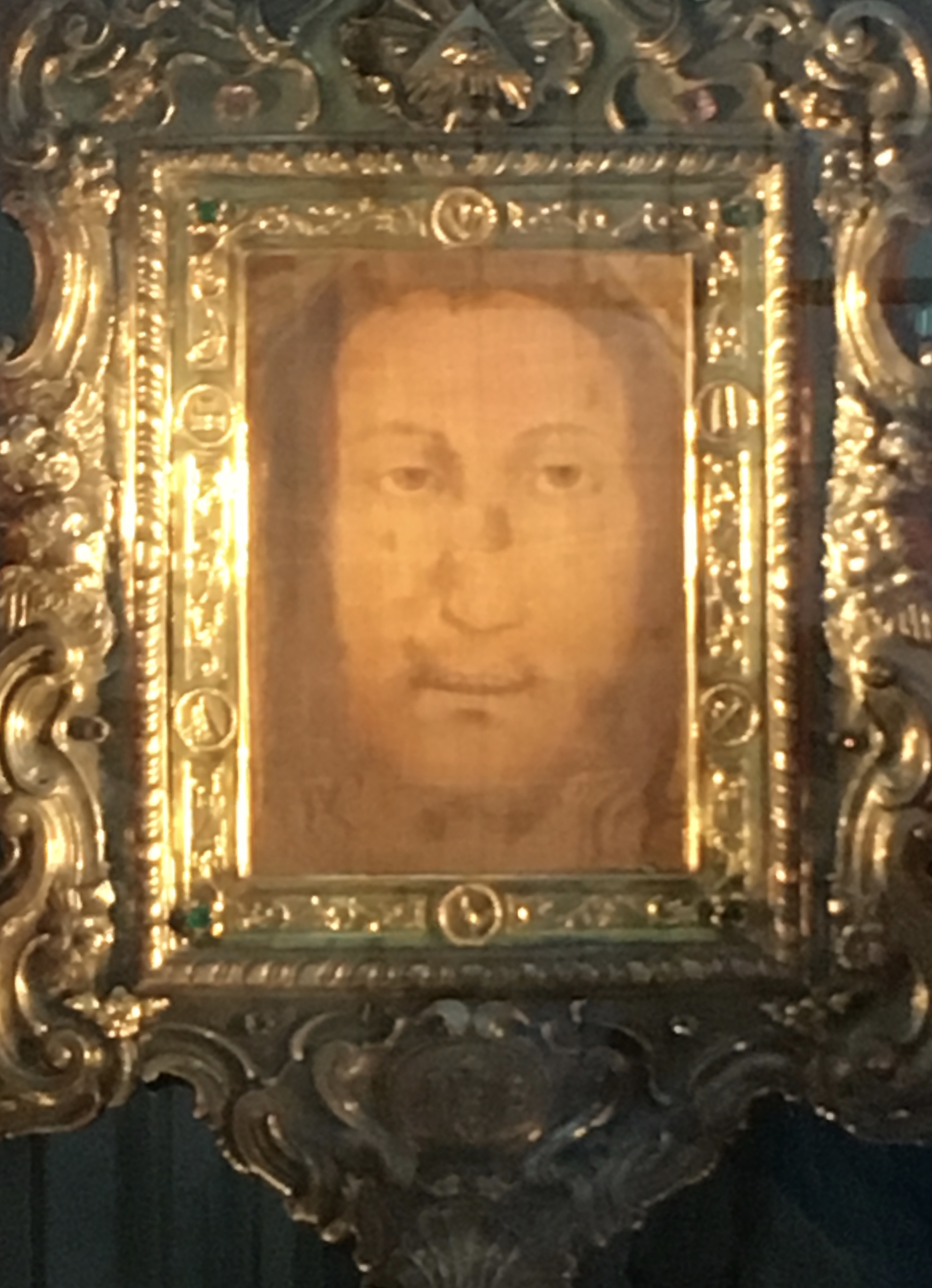
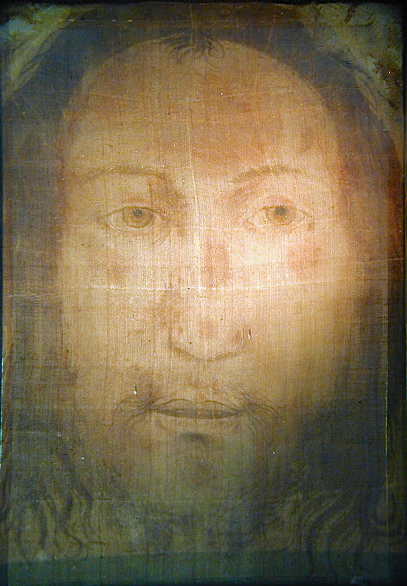
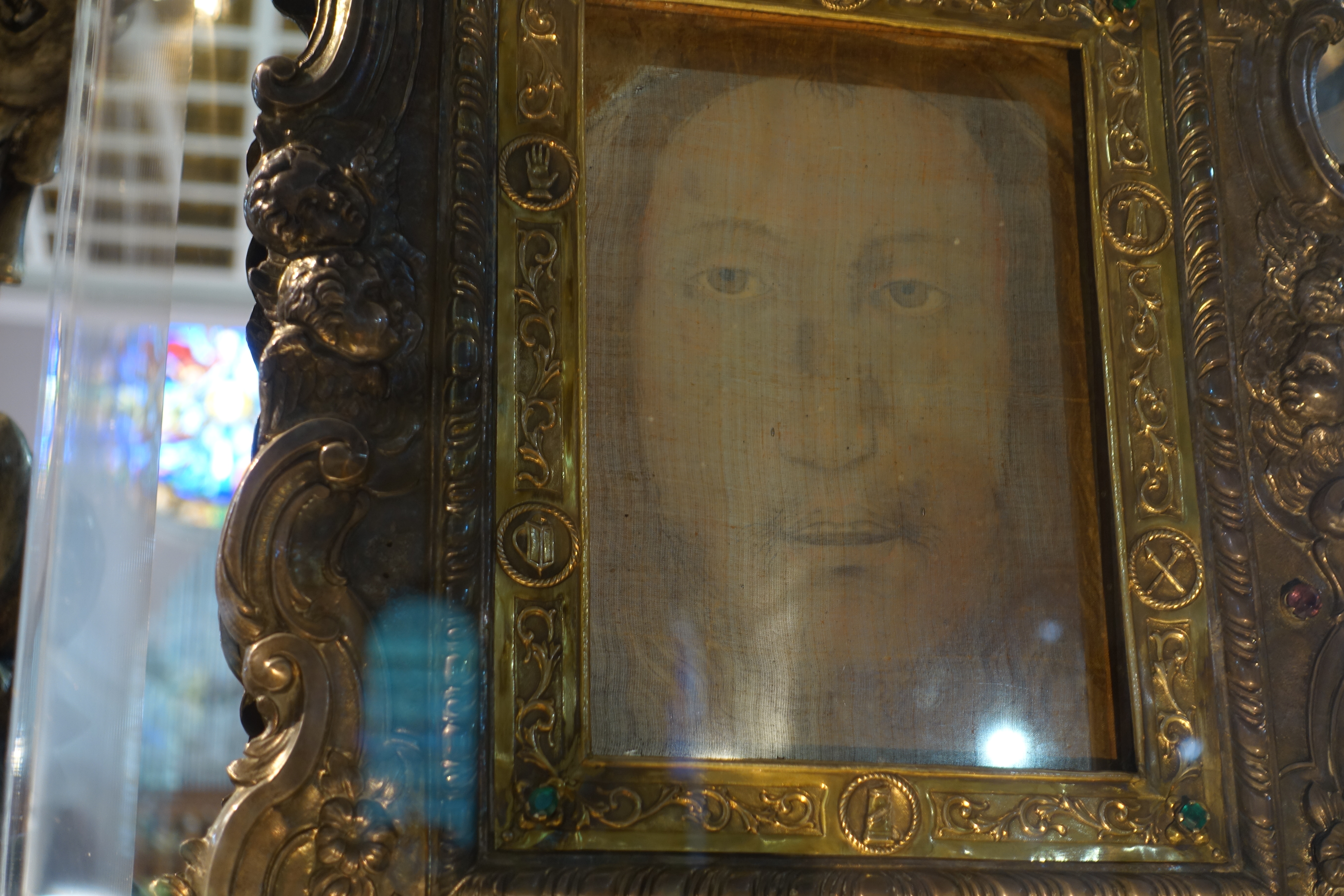
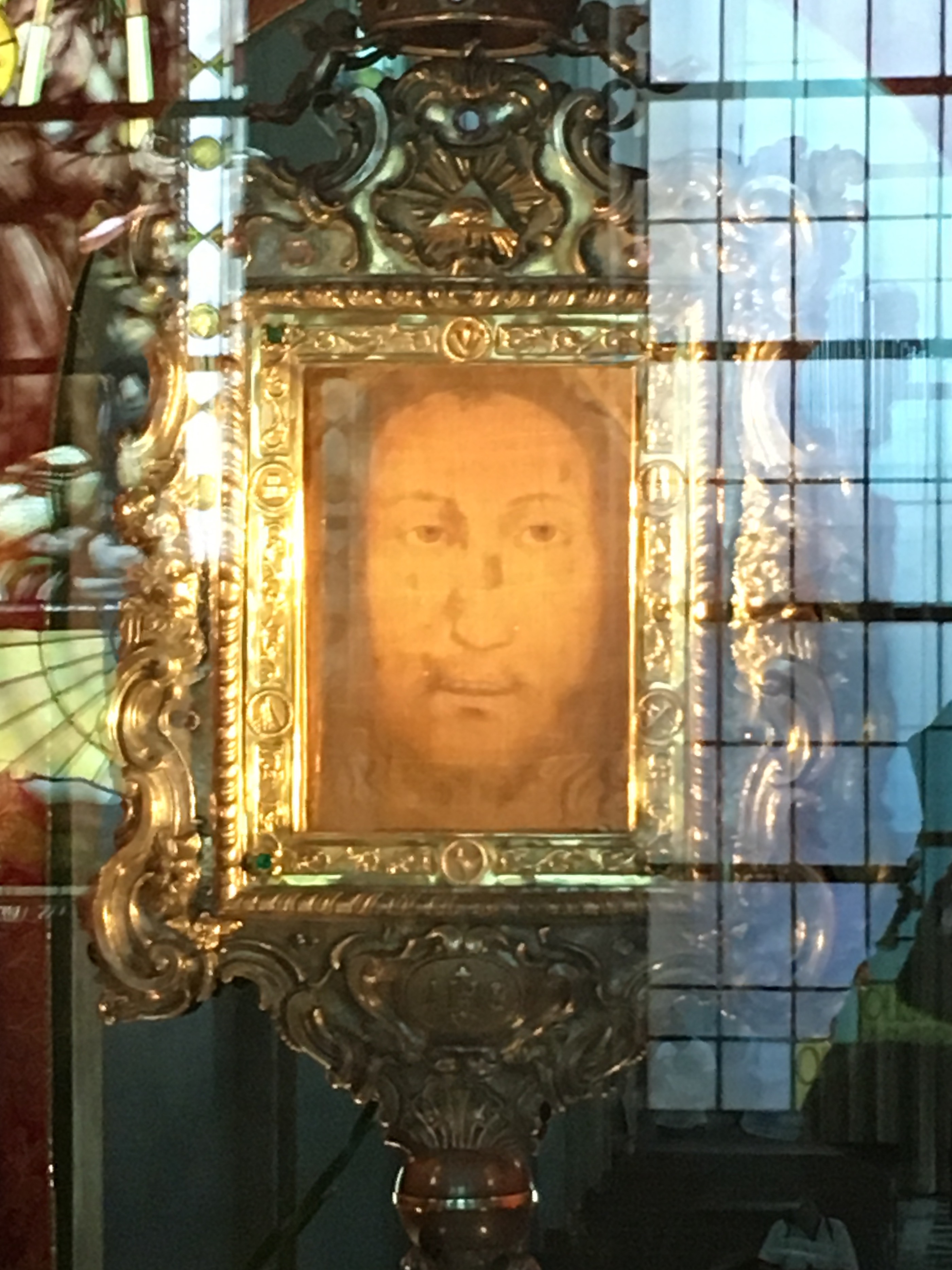
The Holy Veil of Manoppello –so sheer, and yet, without paint, an image my be seen of the Face of Jesus. (Photo: Paul Badde/EWTN)
For those who may be unfamiliar with “Il Volto Santo,” it is a precious relic veil considered to be an “Acheiropoieta” — meaning that its existence is supernatural — made by the Hand of God. The sheer veil, in a miraculous way, bears an image that is seemingly “written in light” of the Holy Face of Jesus Christ. This extraordinary relic has been the subject of intense study and renewed devotion at the dawn of this new millennium dedicated by Pope St. John Paul II to the Holy Face of Jesus Christ.
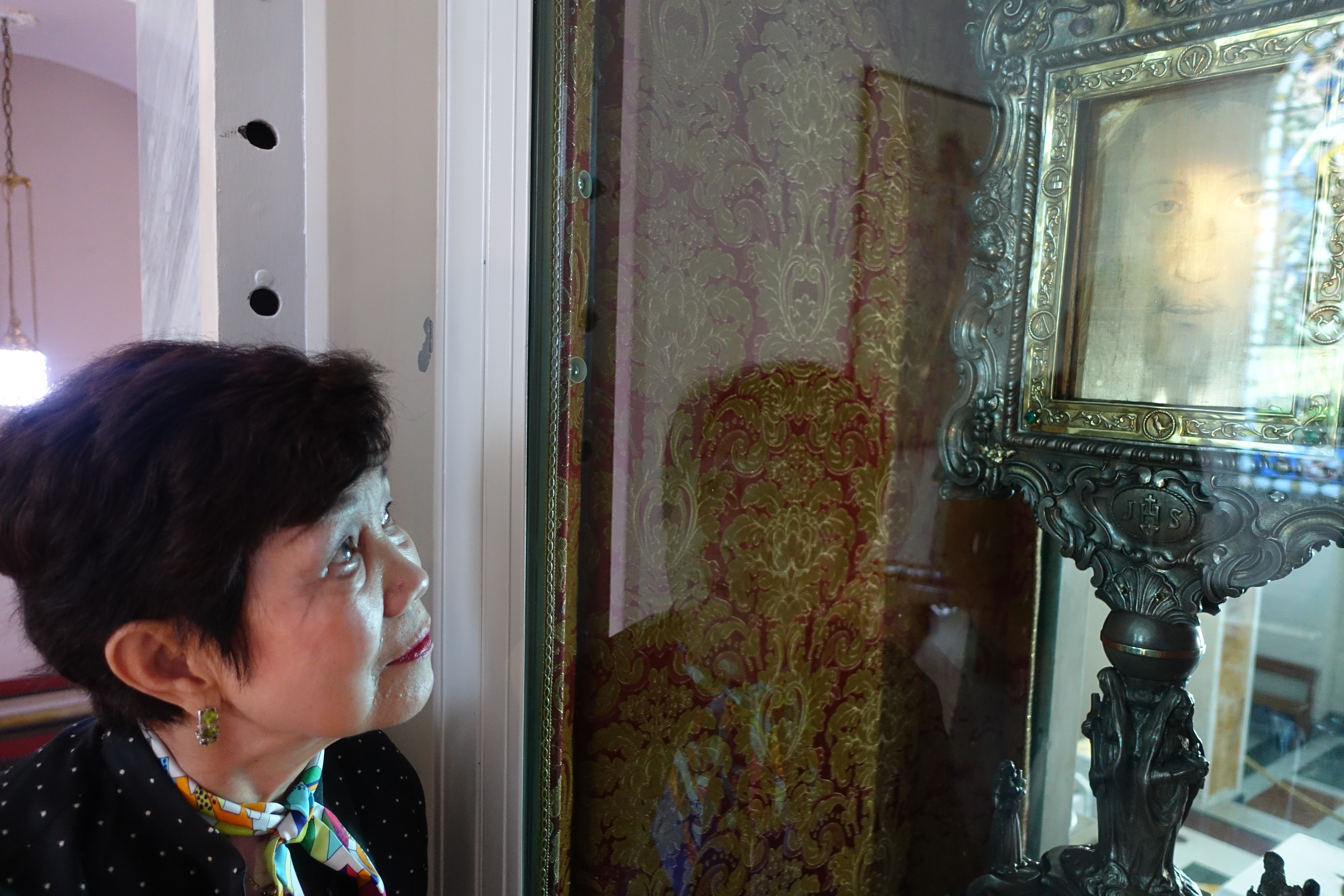
Padre Antonio Gentili, Rector of the Sanctuary Basilica, “face to face” with the Holy Veil of Manoppello. (Photo:Alexandra Prandell)
Antonio Bini, who was also invited to make a presentation on the important research on the Holy Veil by Fr. Heinrich Pfeiffer (1939-2021), has graciously provided a summary of a conference:
The Face of Christ on the Holy Veil becomes visible, according to the light, and at times appears to be a reflection of a living face. (Photo: Paul Badde/EWTN)
Antonio Bini writes: The relic veil of the Holy Face of Manoppello was the main focus of the conference, as it [The Holy Face of Manoppello] is considered “the source and root of the representations contained in tradition and an element of intellectual and supernatural conquests of Christian art,” as Prof. Lukas Murzyn, dean of the Faculty of Art and head of the Art and Metaphysics Study Group, explained in his introduction.
The Group, which operates at the Institute of Painting and Artistic Education of the Faculty of Fine Arts of the University of the National Commission for Education in Krakow (UKEN), promoted the conference held on May 2nd and 3rd, 2025, in Manoppello, Italy, having conducted research for several years on the changes in contemporary iconography, operating in the field of visual anthropology, the history of the philosophy of art, both in the field of experimental artistic activities and in that of the language of visual arts.
The professors of UKEN University during a break (Photo: Antonio Bini)
The speakers were welcomed in the conference room of the Casa del Pellegrino by the Rector of the Sanctuary, Padre Antonio Gentili and by the Mayor of Manoppello, Giorgio De Luca.
The conference was intended to respond to the question of what remains today of those roots [of representations of the Holy Face], how they are understood and what the metaphysics of the image can open up today.
The Holy Face of Manoppello (Photo: Alexandra Prandell)
From the “Relatione Historic, 1640, a description of the Face by Padre Donato da Bomba: “He has a rather long, well-proportioned face, with a venerable and majestic look. His hair, or locks are long with thin twisted curls–in particular at the top of the forehead about fifty hairs wind into a little corkscrew, distinct from each other and well arranged. His left cheek is swollen and bigger than the other because of a strong blow across the cheek. The lips are very swollen. His teeth show. It seems the Holy Face is made of living flesh, but flesh that is afflicted, emaciated, sad, sorrowful, pale and covered in bruises around the eyes and on the forehead. The eyes of Christ are similar to those of a dove…He is serene and tranquil.”
Historical-religious themes were also developed, with the intervention of Padre Ceslao Gedacz OfmCap, who recalled some important figures in the history of the Holy Face belonging to the Capuchin order, such as Padre Donato da Bomba, who was responsible for drafting the Relatione Historic (1640), following the donation of the veil to the Capuchins. Padre Fillipo da Tussio, author of the first essay on the Holy Face published in 1875, and then Padre Domenico da Cese, the first to convincingly spread the divine nature of the sacred image. There were also references to some scientific tests and the findings of two commissions of doctors; the first composed of Germans and Austrians, the second of Italian doctors, who worked at the Sanctuary in 2011 and 2012, which Padre Ceslao himself followed, being part of the community of religious men of Manoppello at that time.
Servant of God Padre Domenico da Cese (1915-1978, former Rector of the Shrine) prays before the Veil of Manoppello.
Metaphysics of the Image conference hall. (Photo: Antonio Bini)
These researches were recently published in the essay by Sr. Blandina Paschalis Schloemer, with the title “Sali al tramonto”(2025), her first book published in Italian after various essays published in Austria, Germany, Poland, and France. The German iconographer was present at the proceedings.
Sr. Monika Gutowska of the Ancelle dei Santissimo Sangue in Manoppello, summarized her experience of welcoming and contact with many pilgrims, presenting several cases, including non-believers, of people who have seen their lives transformed, but also the desire of many devotees to return to the Sanctuary several times a year, from Italy and abroad, for a deep need to periodically encounter again that Holy Face, whose reproductions are present in many Polish homes. [And many others, as well, around the world!]
Among those present was also Padre Carmine Cucinelli, former rector of the Sanctuary, involved in recent years in enthronements of the Holy Face in Poland, and also in the Sanctuary of Krakow dedicated to Pope St. John Paul II.
In addition to the aforementioned Prof. Lukas Murzyn, the following speakers then gave presentations: Sebastian Stankiewicz, Rafal Slewski, Kazimierz Piotrowski, Bernadeta Stano, Anna Grabczewska, Agnieszka Daca, Jacek Pasieczny and Stanisław Wójcicki from the Study Group of the Uken University of Krakow.
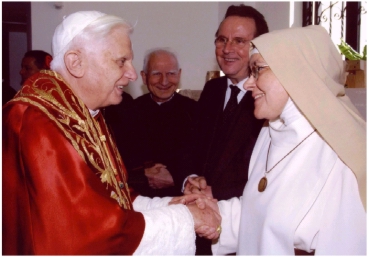
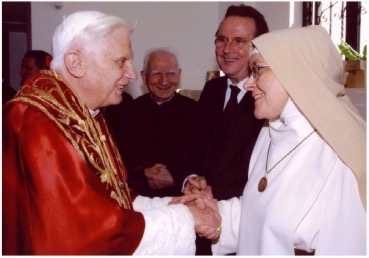
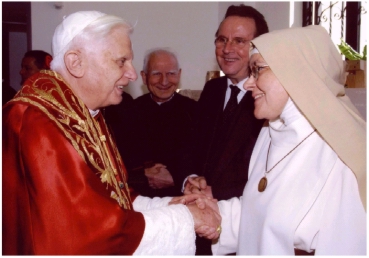
2006 – Pope Benedict XVI meets Sr. Blandina Paschalis Schlomer on his visit to the Sanctuary of the Holy Face in Manoppello, as Fr. Heinrich Pfeiffer, and Paul Badde look on.
We summarize the papers presented, whose simultaneous translation was edited by Agnieszka Kiedzik, from the University of Warsaw. The same papers may be the subject of further study in the publication of the proceedings, which will be edited by Sebastian Stankiewicz, with the title “Beautiful God: The Veil of Manoppello and the Iconography of the Incarnation,” with reference to a theological reflection on the “Beautiful God” present in the Middle Ages, expressed by Cardinal Joseph Ratzinger during a conference held at the Pontifical Urbaniana University in Rome, later taken up by Pope Benedict XVI.
“Being struck and overcome by the beauty of Christ is more real, more profound knowledge than mere rational deduction…We must rediscover this form of knowledge; it is a pressing need of our time.” ~ Excerpt from “The Feeling of Things, the Contemplation of Beauty” by Card. Joseph Ratzinger
The Group’s commitment also led to the creation of a portal — https://diafanitas.uken.cracow.pl — which collects experiences and initiatives on the study of the transparency of bodies crossed by light in a Christian dimension.
Dirk Bouts, 1400? – 1475
Christ Crowned with Thorns,about 1470
Various interpretative readings of the Holy Face have been developed, with the assumption that “whoever has come into contact with the Veil of Manoppello attests to its uniqueness and mystery.”
For representatives of the art sciences, many questions remain open: the origin of the image and history, the relationship between the relic and image, the role of the Veil of Manoppello in the creation of iconographic models in Christian art and in the evolution of ways of representation in Western Culture, the role of the veil among other representations considered acheiropoieta or formal similarities with the images of Christ depicted in the art of old masters; for example Dirk Bouts, Leonardo Da Vinci and Albrecht Durer, among others, and in the Eastern tradition. For contemporary art scholars, philosophers, theologians and anthropologists, the encounter with the Holy Face raises questions such as the relationship between sensual beauty and transcendent beauty, the idea of transparency and lights, the Christian sources of the idea and concept of a person, the meaning of the gaze and the encounter, the presence and contemporary reception of religious themes in art and sacred art and the importance of metaphysical references in contemporary art.
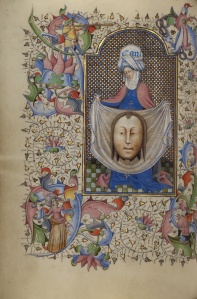
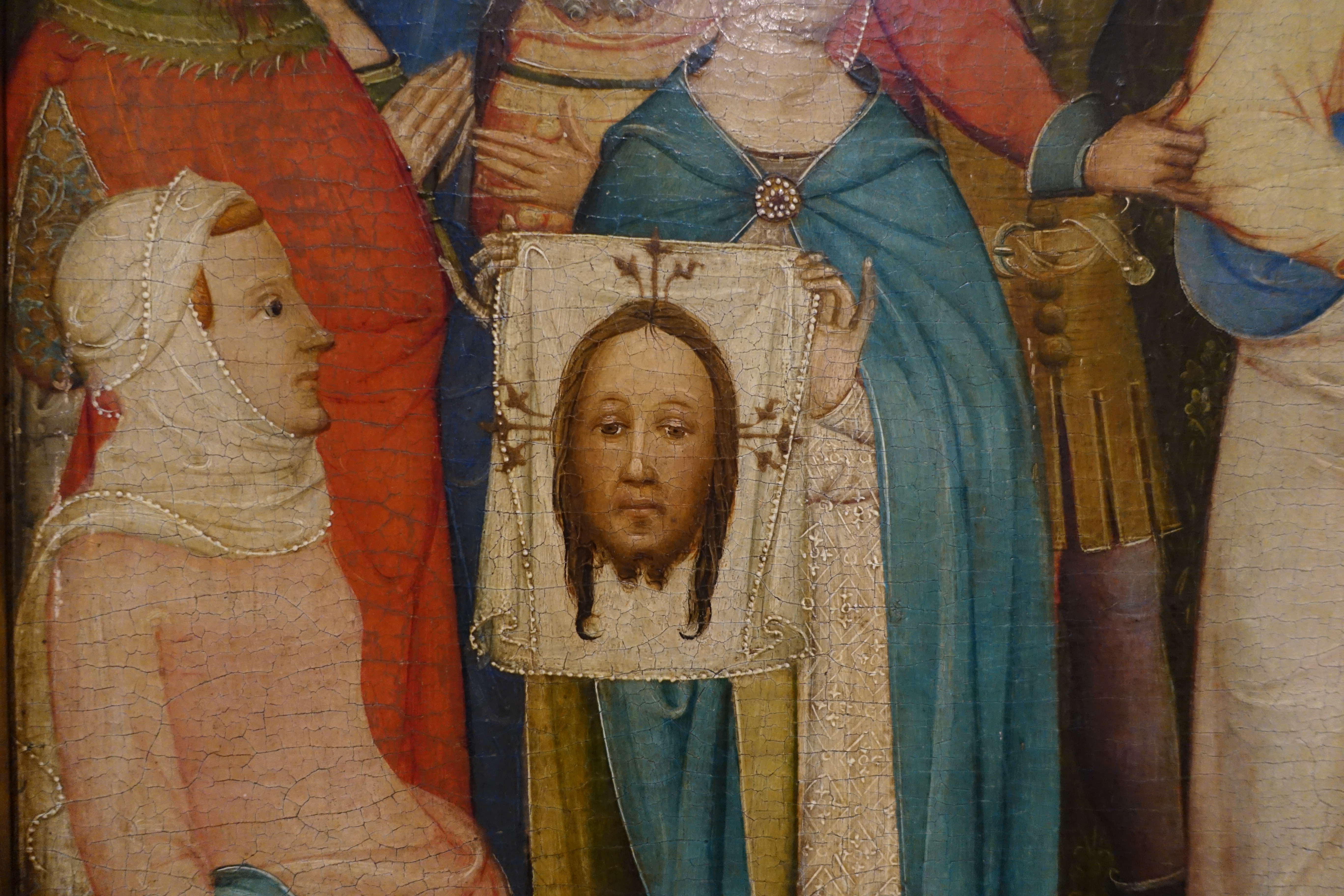
Veronica’s Veil Flemish 15th Century This is a fine example of the “Veronica” as portrayed by artists who saw the original for themselves, before it disappeared from view from the Vatican in 1527.
In my [Antonio Bini’s] presentation, I recalled the studies of Fr. Heinrich Pfeiffer (1939-2021), former professor of Christian history at the Gregorian University in Rome, who identified the Holy Face [of Manoppello] with the Veronica (vera icon), on the the occasion of the International Conference of the Institute for Research on the Face of Christ, chaired by Cardinal Fiorenzo Angelini, and then during a press conference held in Rome on May 31, 1999, on the eve of the Great Jubilee of 2000, which spread knowledge of the Abruzzo Sanctuary [of the Holy Face in Manoppello] throughout the world. Some sequences of that press conference with the interview of the German scholar, on Italian and foreign television, were repurposed in a video that the organizers wanted to show at the opening of the proceedings.
Fr. Pfeiffer’s position was then an isolated one, long contested, more or less openly. But his theses were later shared by Pope Benedict XVI, who visited the Shrine on September 1, 2006, composing a prayer that he dedicated to the “human face of God who entered history to reveal the horizons of eternity.”
Pope Benedict XVI contemplates the Face on the Veil of Manoppello. September 1, 2006. (Photo: Paul Badde/EWTN)
Also under the pontificate of Pope Benedict XVI, a statement from the Holy See on July 11, 2011 reported that the “Veronica disappeared from St. Peter’s following the Sack of Rome in 1527.” This circumstance was confirmed by the (then) director of the Vatican Museums, Prof. Antonio Paolucci (Former Minister of Culture of the Italian Government), in an interview with the Bologna newspaper Il Resto del Carlino on August 11, 2011.
The admission [of the Director of the Vatican Museums] put an end to almost five centuries of silence that had fueled doubts and uncertainties for a long time, also through works of disinformation carried out also through modifications of the same original image, through reproductions that presented a “Veronica” with eyes closed. In this regard, the Veronica Route Project was started in recent years by a group of Milanese scholars, which led to a collective search, still ongoing, of 6200 ancient depictions of the true icon of Christ (Veronicas) with the eyes open, collected in a multimedia catalogue.
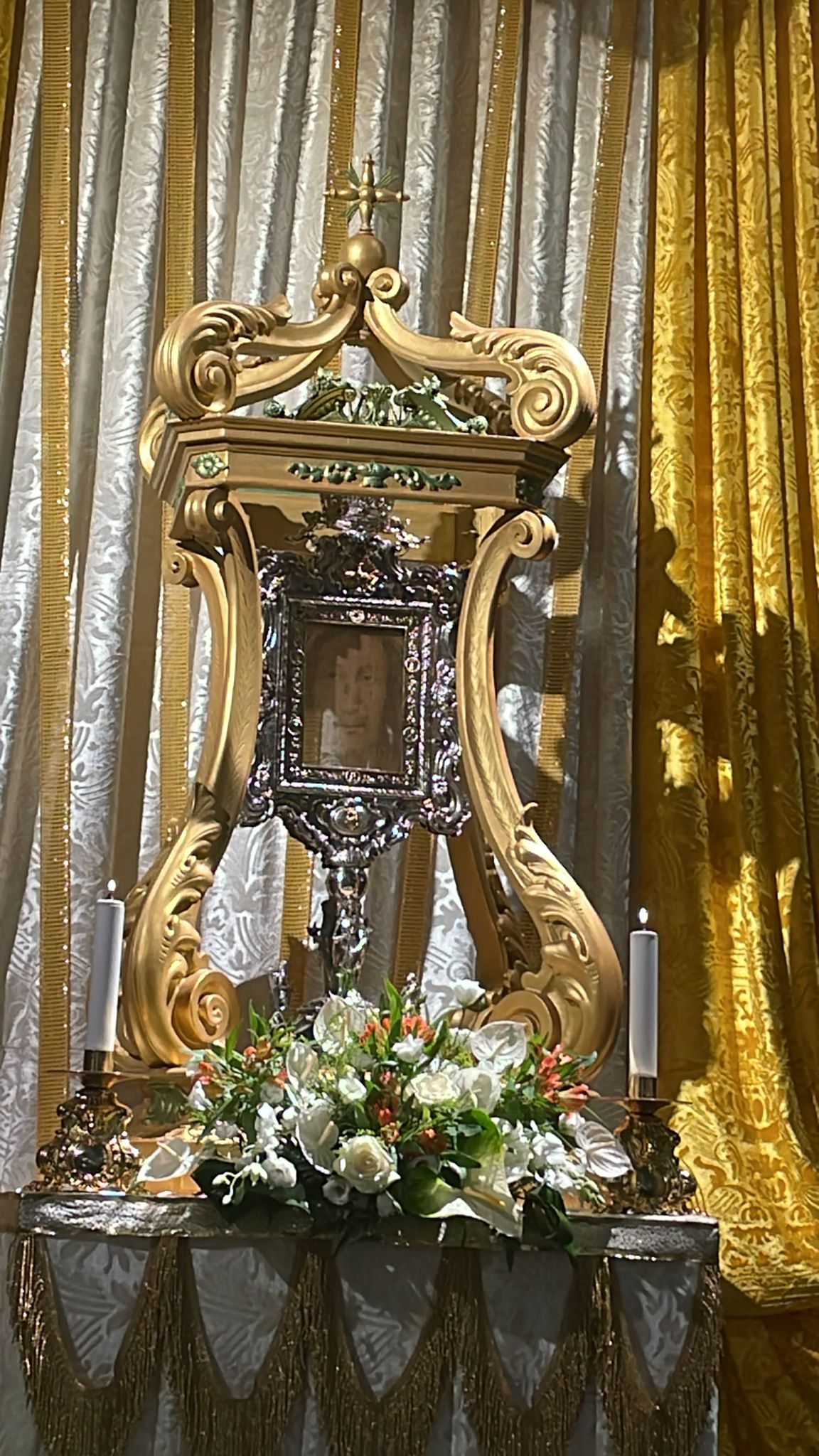
And yet, on April 6, an article published on the Vatican News website reported the presence of the “Veronica” in St. Peter’s (or, a copy of it, a black background. No image is seen.), while the Holy Face [of Manoppello] is indicated as a “shroud,” [A burial face-cloth] reiterating its acheiropoieta nature [As supernatural–made by the Hand of God]. Evidently, the writer was unaware of the painful path that led to the admissions [of the Director of the Vatican Museums] of 2011. Fr. Pfeiffer would still be busy arguing his reasons.
This is an example of a reproduction, made by Pietro Strozzi after 1527, when the original could no longer be viewed. The dark image of a dead man’s face bore no resemblance to previous descriptions and paintings of the Veil.
The dark cloth in a face-shaped frame that is currently presented, from a great distance, at the Vatican. (Photo: Daniel Ibanez)
Finally, during the conference, the exhibition of artist-teachers and students entitled “Face to Face” was presented, delicately entering the space of the Sanctuary, to offer a unique forum for interdisciplinary dialogue.
“At the basis of the concept of the exhibition,” declared the curator, Prof. Stanisla Wojcicki, “is the face-to-face encounter with the image of the Veil [Of the Holy Face of Manoppello], treated by scholars as a prototype of other representations of Christ. We would like our works to be considered a votive offering, something that we leave here to express gratitude, for the fact that we were able to meet in this place–particularly important to us.”
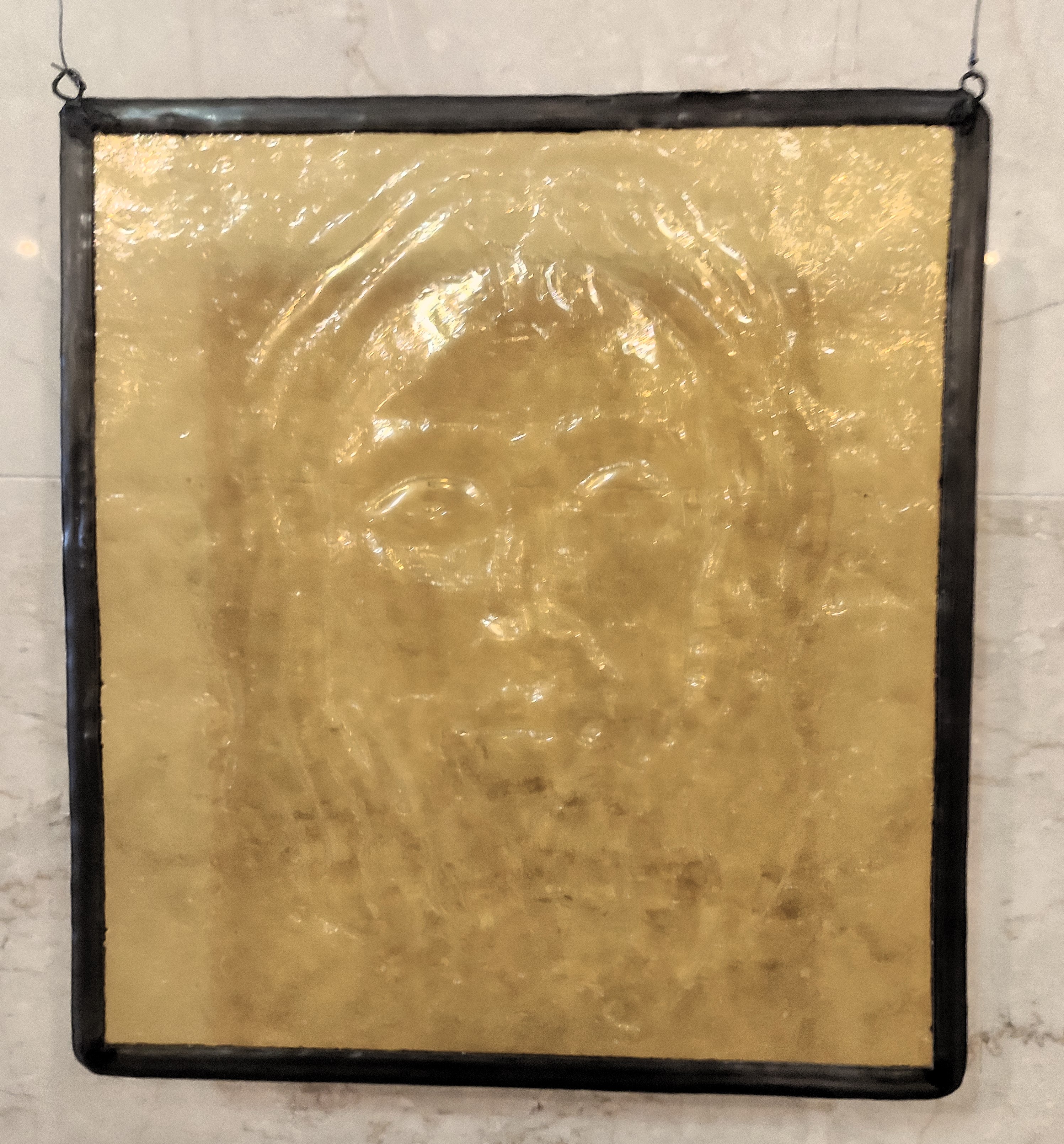
“Not matter but image,” a work by Jacek Pasieczny
“Not matter but image,” a work by Jacek Pasieczny, was exhibited in the Basilica as part of the “Face to Face” exhibition. The author described the work as “reflections of light, with the author” through the “use of glass of a particular color recalling golden byssus.” [of which the Holy Veil is believed to be woven.] The artist specified that it is not a copy of the original, but an attempt to paint a picture with light.
At the end of the conference we asked for an overall assessment from Don Arturo Alcántara Arcos, professor of spiritual theology and collaborator of the Soumaya Museum in Mexico City, also in Manoppello for the occasion, who stated: “It is particularly interesting to consider multidisciplinary points of view from a secular university. Here one can appreciate the different areas in which theology can be present, both directly and indirectly. The Uken of Krakow, inspired by the National Commission for Education established in the eighteenth century by the Polish King Poniatowski, open doors to a new dialogue between theology and the different artistic and aesthetic disciplines of our days in the contemplation of the Face of the Lord.” From what emerged during the conference and on the basis of the same conclusions of Prof. Lukas Murzyn, the belief that the Holy Face can also represent today the reference to the contemporaneity of Christ for art appears to be shared. An analytical perspective that the professors of the University of Krakow — the first to organize a similar event in Manoppello — intended to offer the art world.
Grazie Mille! Antonio Bini for this beautiful summary of the Conference on the Metaphysics of the Image!
One last thought from the beloved Cardinal Ratzinger — and later — Pope Benedict XVI:
Holy Face of Manoppello, (Photo: Paul Badde/EWTN)
“The encounter with the beautiful can become the wound of the arrow that strikes the heart and in this way opens our eyes…” “Inner perception must free itself from the impression of the merely sensible, and in prayer and ascetical effort acquire a new and deeper capacity to see, to perform the passage from what is merely external to the profundity of reality, in such a way the artist can see what the senses as such do not see, and what actually appears in what can be perceived: the splendor of the glory of God, the “glory of God shining on the face of Christ.” (11 For 4,6). –“The Feeling of Things, the Contemplation of Beauty” by Card. Joseph Ratzinger
“Now about eight days after these sayings he took with him Peter and John and James, and went up on the mountain to pray. And as he was praying the appearance of his countenance was altered, and his raiment became dazzling white. And behold, two men talked with him, Moses and Elijah, who appeared in glory and spoke of his departure, which he was to accomplish at Jerusalem. Now Peter and those who were with him were heavy with sleep but kept awake, and they saw his glory and the two men who stood with him. And as the men were parting from him, Peter said to Jesus, “Master, it is well that we are here; let us make three booths, one for you and one for Elijah” –not knowing what he said. As her said this, a cloud came and overshadowed them, and they were afraid as they entered the cloud. And a voice came out of the cloud, saying, “This is my Son, my Chosen, listen to him!” And when the voice had spoken, Jesus was found alone. And they kept silence and told no one in those days anything of what they had seen” ~From the Gospel of Luke
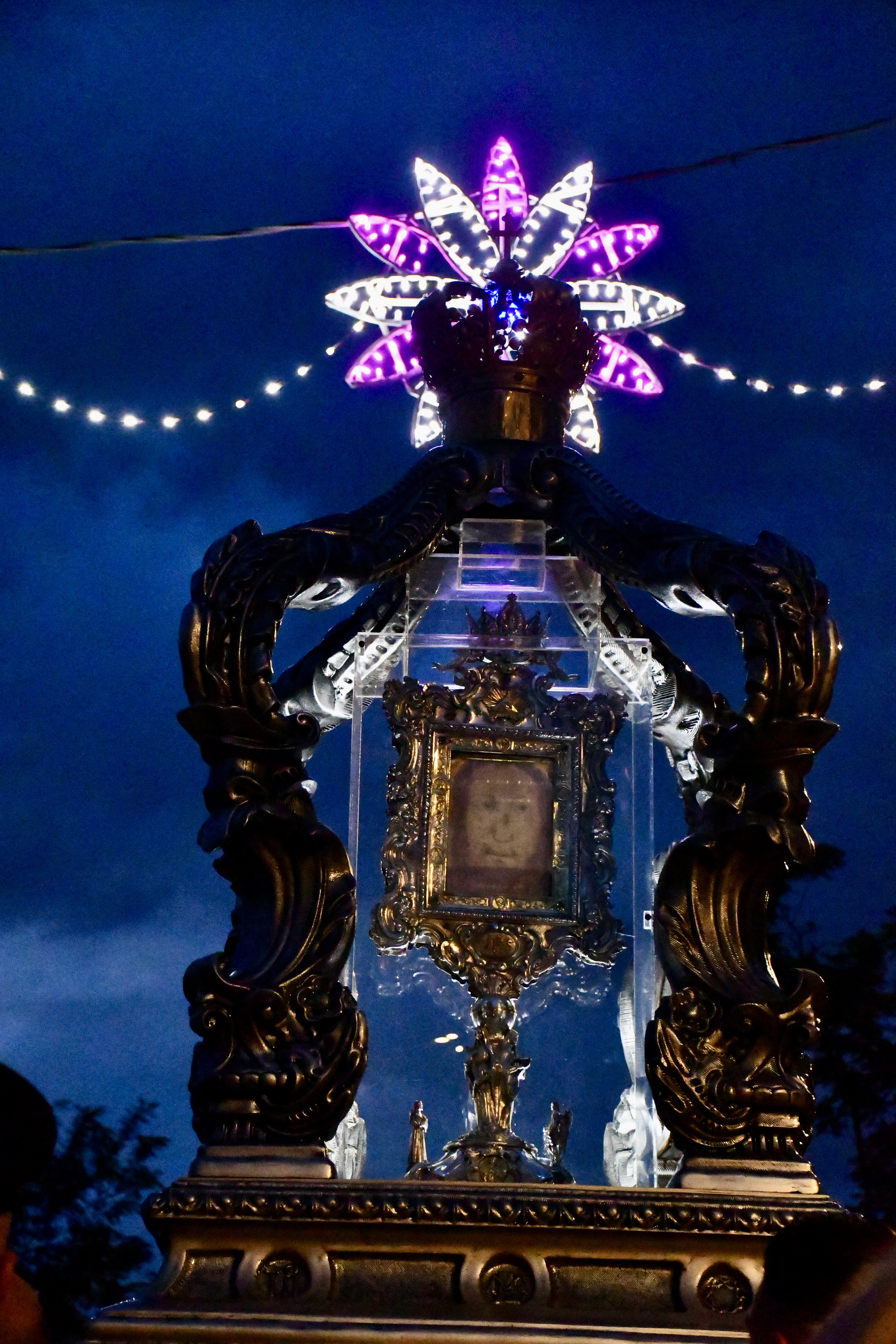
Miraculous Veil of the Holy Face of Manoppello, Italy. Photo: Paul Badde
Many special events are held at the Basilica Shrine of the Il Volto Santo in Manoppello, Italy, leading up to the Feast of the Transfiguration of Our Lord Jesus. The Basilica contains a very precious relic veil, on which one may see–according to the light–the Holy Face of Jesus. The conference speakers included Author Paul Badde, who gave an intriguing talk on the message that God has bestowed on the world, through the means of a gift: a miraculous veil bearing the Holy Face of the Father’s “Beloved Son.” Paul’s talk, which has been translated by Raymond Frost, may be read in its entirety by clicking here: “The Medium is the Message,” on The Holy Face of Manoppello Blogspot.
“Let us ask God, through the intercession of Mary, Teacher of faith and contemplation, to enable us to receive within us the light that shines brightly on the Face of Christ, so that we may reflect its image on everyone we meet.” ~Pope St. John Paul II
Reliquary containing God’s “gift” of the precious relic veil of the Holy Face. Photo: Paul Badde
“This veil of the ‘Sanctissimum Sudarium’ with the ‘human face of God’ (Benedict XVI) was in some way conceived as the foundation of the largest and most important church in Christianity.” –Excerpt from Paul Badde’s talk “The Medium is the Message.” (Photo: Paul Badde)
All of us, gazing on the Lord’s glory with unveiled faces, are being transformed from glory to glory into his very image by the Lord who is the Spirit.
For God, who said, “Let light shine out of darkness,” has shone in our hearts, that we in turn might make known the glory shining on the face of Christ.
(2 Cor. 3: 18 – 4:6)
Rector of the Basilica Shrine of the Holy Face, Padre Antonio Gentile gazes at the Veil as the appearance and disappearance of the Holy Face changes according to the light. (Photo: Alexandra Prandell)
Photo: Alexandra Prandell
Light shines through the sheer veil. (Photo: Alexandra Prandell)
Thank you to Alexandra Prandell for the following beautiful photos taken by her at the evening procession of the relic veil of Holy Face on the Feast of the Transfiguration in Manoppello, Italy:
Relic of the Holy Face of Manoppello, (Photo: Alexandra Prandell)
Holy Face Veil, (Photo: Alexandra Prandell)
Reliquary carried through the streets, (Photo: Alexandra Prandell)
“Il Volto Santo” (Photo: Alexandra Prandell)
The light of His Face shines in the darkness, (Photo: Alexandra Prandell)
The gaze of the Holy Face of Jesus penetrating the darkness,( Photo: Alexandra Prandell)
Let your Face shine on us, and we shall be saved! (Photo: Alexandra Prandell)
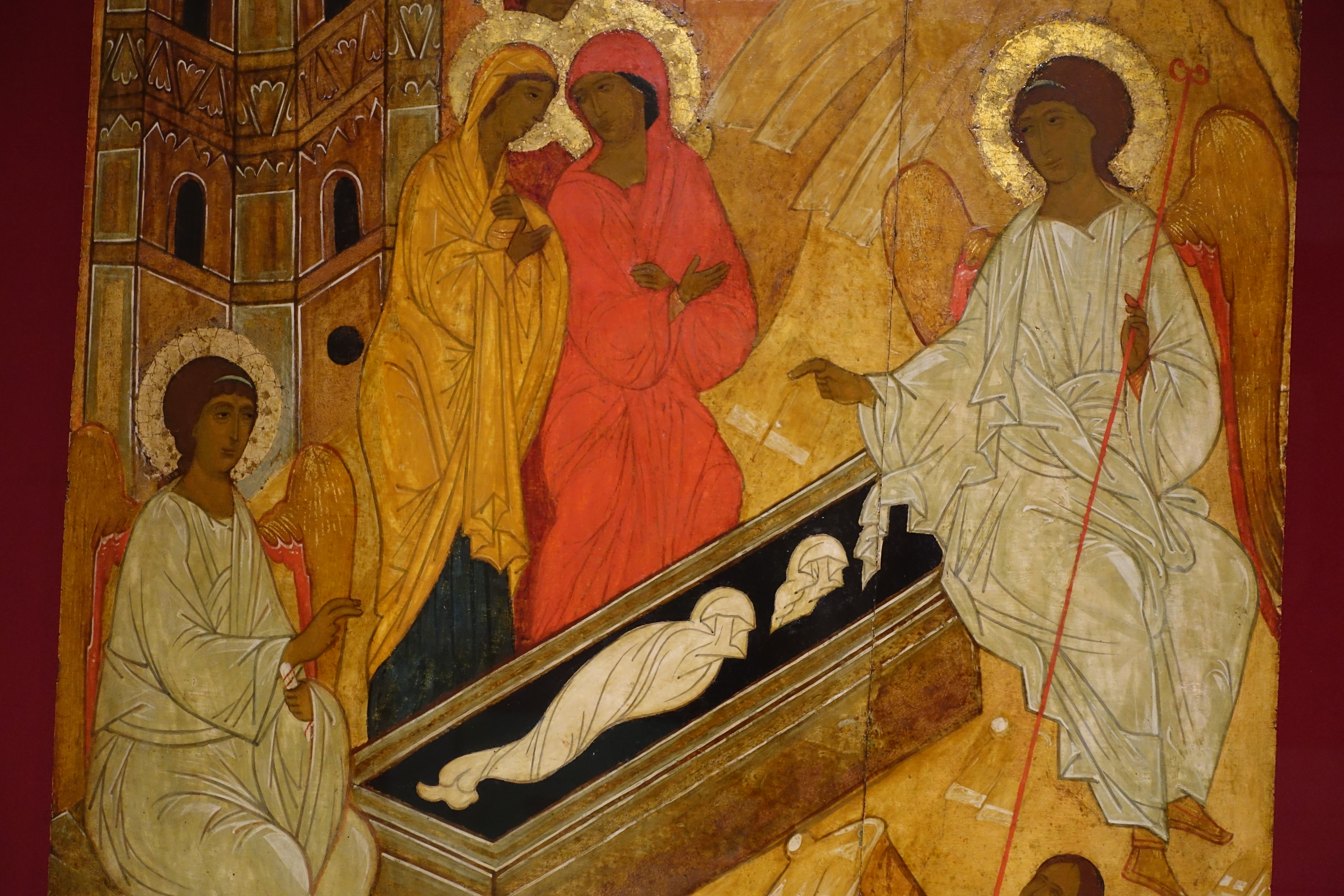
There were several burial cloths of Christ that were found in the tomb; and among them: the Shroud of Turin, the Cloth of Oviedo, and the precious byssus veil that was believed to cover the Face of Christ in the tomb – known as “Il Volto Santo” – The Holy Face of Manoppello. Possibly the very reason that St. John “Saw and believed.”
The Disciples Peter and John Running to the Sepulchre on the Morning of the Resurrection, Eugene Burnand, 1898
So Peter and the other disciple went out and came to the tomb. They both ran, but the other disciple ran faster than Peter and arrived at the tomb first; he bent down and saw the burial cloths there, but did not go in. When Simon Peter arrived after him, he went into the tomb and saw the burial cloths there, and the cloth that had covered his head, not with the burial cloths but rolled up in a separate place. Then the other disciple also went in, the one who had arrived at the tomb first, and he saw and believed. For they did not yet understand the Scripture that he had to rise from the dead. (John 20: 1-9)
At the time of Jesus, the Jewish law required several “cloths” to be used for burial, and as many as six for someone who had died a violent death. Christian tradition has preserved six cloths as relics that are associated with the burial of Jesus – 1.) The Shroud of Turin, Italy 2.) the Sudarium of Oviedo in Spain, 3.) The Sudarium Veil of Manoppello, Italy 4.) The Sudarium of Kornelimunster in Germany, 5.) The Sindon Munda of Aachen, Germany, 6.) The Cap of Cahors in France.
Three of the cloths in particular stand out as extraordinary “witnesses” to the Passion, Death, and Resurrection of Jesus, and together they bear a powerful testimony to the truth of the Gospels. Each one bearing an imprint or image of the Face of Jesus. They are: The Sudarium of Oviedo, The Shroud of Turin, and the Sudarium Veil of Manoppello. The remarkable relationship between these three “cloths” leave little doubt that each came in contact with the face of the same man at the time of burial.
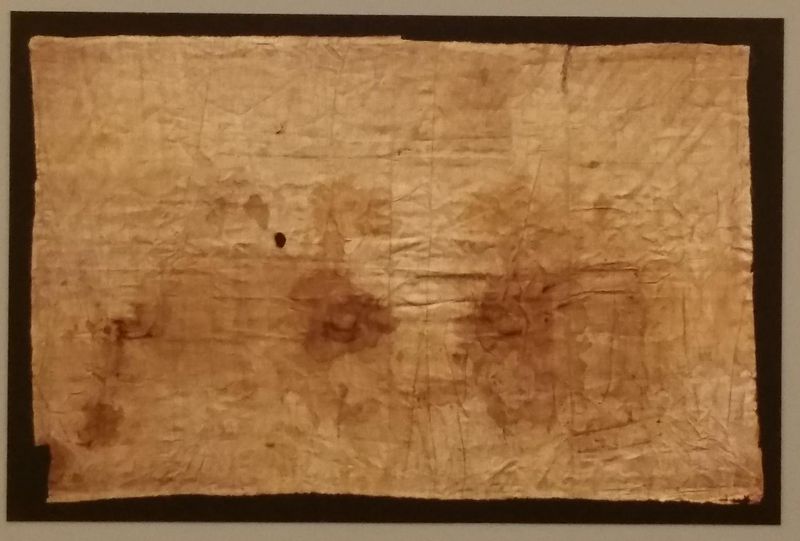
The Sudarium of Oviedo directly touched Jesus’s head following His Crucifixion. Blood was considered sacred to the Jews, so this cloth was used to soak up the Precious Blood of Jesus, by wrapping it around Jesus’s Head, as He was taken down from the Cross. The largest bloodstains are from the nose, other stains are from the eyes and other parts of the face. There is also an imprint on the sudarium of the hand of the person who held this cloth to Jesus’s Face to staunch the flow of blood. It takes one’s breath away to see that the bloodstains on the Sudarium of Oviedo, when overlaid with the Face on the Shroud of Turin and the Sudarium Veil of Manoppello, correspond perfectly. The blood type is AB, the same as on the Shroud of Turin.
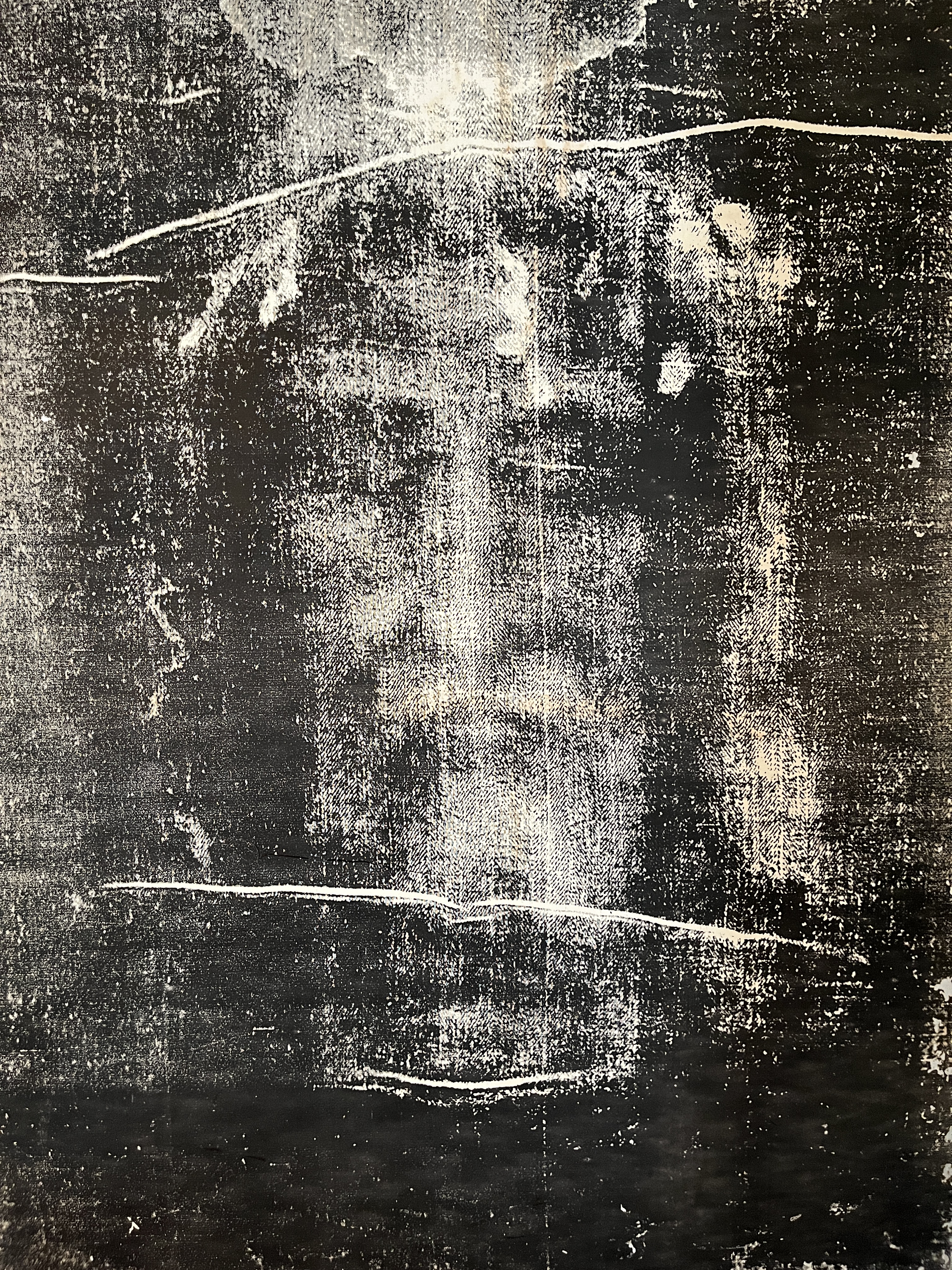
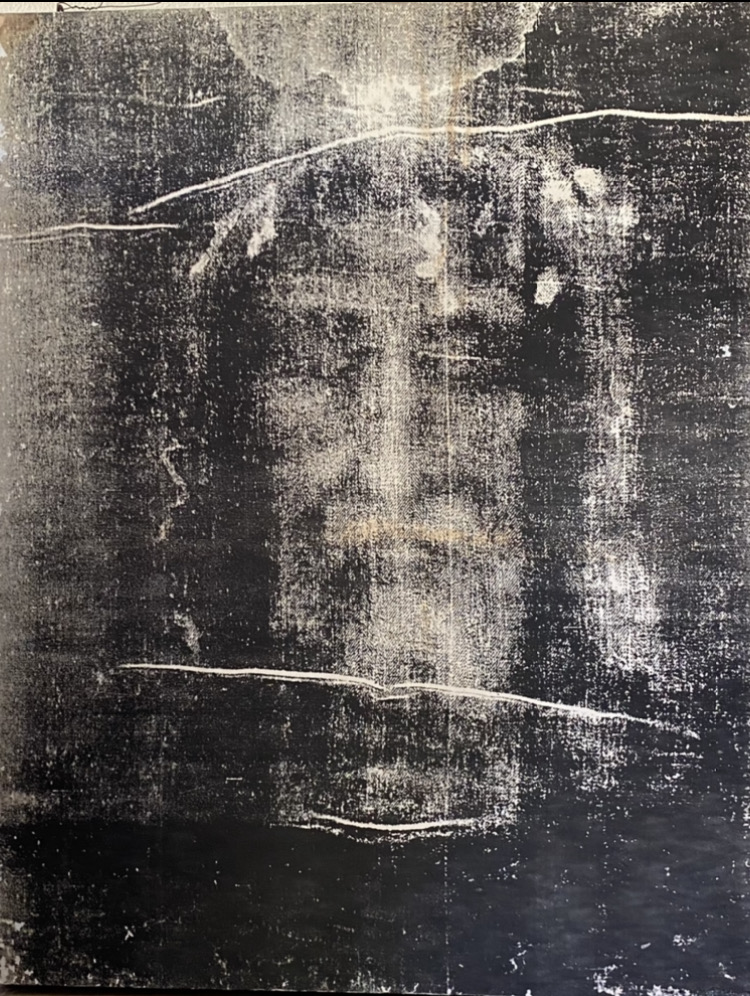
Photo of the Face on the Shroud of Turin
“He went into the tomb and saw the burial cloths there.“
The Shroud of Turin; the sindone, or linen burial shroud, was believed to have been used to wrap the entire body of Christ. It is the most famous and studied of the three cloths. The faint but visible imprint on the Shroud of Turin gives witness to the violent torture of a man as described in the Passion and Death of Jesus in the Scripture. The world was amazed when Secondo Pia first photographed the Face on the Shroud in 1898; the negative of the photo incredibly became visible as a positive image. The Shroud of Turin caused an entire branch of science to be dedicated to its research called Sindonology.
Photo: Holy Face Veil of Manoppello, Italy (Paul Badde/EWTN)
‘…and the cloth that had covered his head, not with the burial cloths but rolled up in a separate place.‘
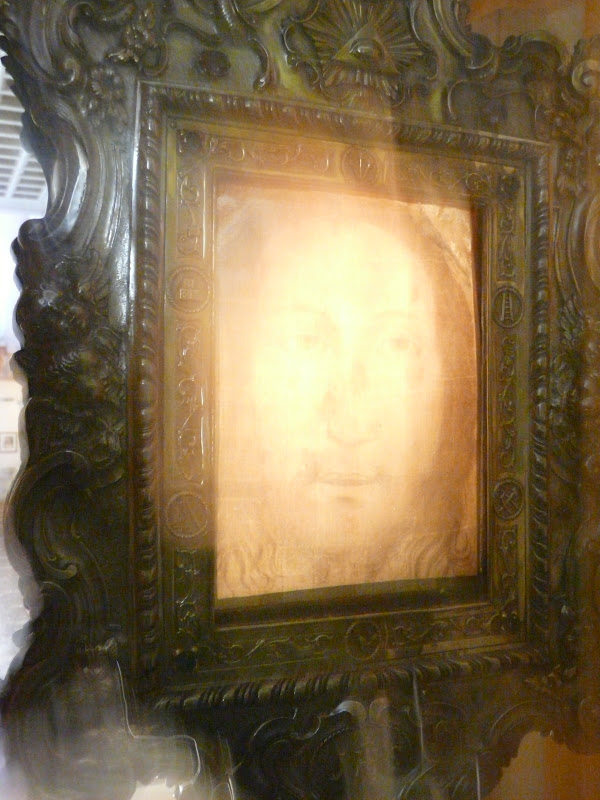
Reliquary containing the transparent veil on which the image of the Holy Face becomes visible, according to the light and position of the viewer. Photo: Paul Badde
The Sudarium Veil of the Holy Face of Manoppello, Italy is perhaps the least known of the three burial “cloths.” The Veil bears the image of the living Face of Jesus. This “miracle of light,” “not made by human hands,” was protected and hidden in an isolated church in the Abbruzzi Mountains for centuries. It is believed to be the “cloth” that covered the Face of Jesus in death, showing traces of the Passion: Bruises, swelling, wounds from the Crown of Thorns, and plucked beard. But, it is also believed to have recorded in light the Face of Jesus at the moment of His Resurrection. No, this is not a contradiction. Yes, the image changes. It shows suffering, but it also shows life! It is believed to be “The cloth that covered His head.”
“Il Volto Santo” The Holy Face Veil of Manoppello. Photo: Patricia Enk
An explanation about the tradition of a face cloth for burial may be helpful in understanding its profound significance: In the funeral rites for priests in some Eastern churches, the veil which was used to cover the chalice and paten were placed on the face of the deceased priest. (The cloth used to cover the chalice and paten had a particular liturgical symbolism linked to the Face of Christ as well.) It was done as a symbol of both the strength and protection of God, and also of the tomb of Christ–an expression of belief in the Resurrection. In Jewish burial custom, a deceased priest’s face would be anointed with oil and then covered with a white cloth, and would have been done for Jesus.
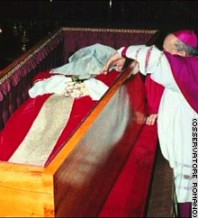
Funeral of Pope St. John Paul II, Archbishop Dziwisz covers the pope’s face with a veil.
When Pope St. John Paul II was being laid in his coffin, Archbishops Marini and Stanley Dziwisz had the honor of placing a white silk veil over the face of the pope. Poignantly, the choir sang the words from Psalm 42, “My soul thirsts for God, the living God; when will I come and see the Face of the Lord?” Many wondered about the action of covering the pope’s face with a veil because this was the first time it had been done, but was at the request of Pope John Paul II, who had dedicated the millennium to the Face of Christ.
Byssus “Pinna Nobilis” fit for a King! Photo: Paul Badde/EWTN
The cloth that would cover the Face of Christ would have to be made of a material fit for a King, a High Priest, and a God. Byssus, mentioned in the Bible forty times, also known as “sea-silk,” is more rare and precious than gold and it has an exceedingly fine texture which can be woven. Made from the long tough silky filaments of Pinna Nobilis mollusks that anchor them to the seabed, it is strong enough to resist the extreme hydrodynamic forces of the sea. Byssus has a shimmering, iridescent quality which reflects light. It is extremely delicate, yet strong at the same time. It resists water, weak acids, bases, ethers, and alcohols. Byssus cannot be painted, as it does not retain pigments, it can only be dyed; and then, only purple. It can also last for more than 2000 years.
Kurt Cardinal Koch contemplates the Veil “not made by human hands” of Manoppello. Sheer and delicate, yet the Face is visible. Photo: Paul Badde/EWTN
The Sudarium Veil of Manoppello is also made of rare, precious, byssus silk. The skill needed to weave a byssus veil as fine as the Veil of the Holy Face of Manoppello is exceedingly great. Chiara Vigo, known as “the last woman who weaves byssus,” has said that neither she nor anyone alive today could duplicate the gossamer-thin veil, which is sheer enough to read a newspaper through. The weave is so delicate, she says, that only the nimble fingers of a very skillful child could weave something so fine.
Photo: Paul Badde
It is only through light that this shimmering image of the Face of Jesus may be seen, and at times appears as a “living image” as though it were reflected in a mirror, at other times the image completely disappears. Although no camera can adequately capture the image, thanks to the many amazing photos of journalist Paul Badde, the changes that occur when viewing the veil may be better appreciated. (Click here for more photos, and information about Paul Badde’s books and videos about the Holy Face.)
While the Face on the Shroud of Turin clearly shows the Face of Jesus in death with eyes closed, the Sudariam of Manoppello has eyes open–bearing witness to the Resurrection. That was the ardent belief of the former Rector of the Basilica Shrine of the Holy Face, Servant of God Padre Domenico da Cese.
Sevant of of God Padre Doemnico da Cese, former Rector of the Shrine of “Il Volto Santo.”
L to R: Pope Benedict XVI came as a pilgrim to Manoppello on September 1, 2006, Fr. Heinrich Pfeiffer, S.J., Paul Badde, and Sr. Blandina Schlomer
There are many physiological reasons too for believing that the Face Cloth captures the first breath of the Resurrection. Sr. Blandina Paschalis Schlomer, who shares that belief, has provided meticulous research about the Veil in her book JESUS CHRIST, The Lamb and the Beautiful Shepherd, The Encounter with the Veil of Manoppello. Sr. Blandina together with Paul Badde, and Fr. Fr. Heinrich Pfeiffer, S.J., Professor at the Pontifical Gregorian University in Rome, have each demonstrated that the Holy Face on the Veil of Manoppello is the proto-image of the earliest icons, and other works of art depicting the Face of Jesus.
“…and he saw and believed. For they did not yet understand the Scripture that He had to rise from the dead.”
What did St. John see in the tomb that would cause him to believe? A cloth of blood, such as the Oviedo? The Shroud of Turin? The Shroud bears a miraculous image, but it shows the Face of a dead man. A third witness was needed in order for the disciple to believe. It could only have been evidence of something as astounding as the Resurrection; proof that Jesus was alive!
Holy Veil of Manoppello. Photo: Paul Badde/EWTN
It is human nature to want to see things for ourselves. Many pilgrims, humble and great, have felt called to make the journey to visit the miraculous relic. If it is God’s handiwork, and I believe that is true, then one can only wonder at its existence, and gaze in silent contemplation, giving thanks for this tremendous gift of God… so we too may “see and believe.”
As the first rays of light entered the tomb, John and Peter, upon entering, “saw and believed.” Sudarium Veil of Manoppello, Photo: Paul Badde/EWTN
Pope Benedict XVI contemplates the ‘Veronica’s Veil’ during a visit to the Shrine of the Holy Face in Manoppello, central Italy, September 1, 2006.
“While we too seek other signs, other wonders, we do not realize that He is the real sign, God made flesh; He is the greatest miracle of the universe: all the love of God hidden in a human heart, in a human face.”
~ Pope Benedict XVI
Holy Face of Jesus of Manoppello (photo: Paul Badde/EWTN)
“We cannot stop at the image of the Crucified One; He is the Risen One!”
Holy Veil of Manoppello said to be the image of the Resurrected Christ Photo: Paul Badde/EWTN
Alleluia! Alleluia! Alleluia!
The Disciples Peter and John Running to the Sepulchre on the Morning of the Resurrection, Eugene Burnand, 1898
So Peter and the other disciple went out and came to the tomb. They both ran, but the other disciple ran faster than Peter and arrived at the tomb first; he bent down and saw the burial cloths there, but did not go in. When Simon Peter arrived after him, he went into the tomb and saw the burial cloths there, and the cloth that had covered his head, not with the burial cloths but rolled up in a separate place. Then the other disciple also went in, the one who had arrived at the tomb first, and he saw and believed. For they did not yet understand the Scripture that he had to rise from the dead. (John 20: 1-9)
At the time of Jesus, the Jewish law required several “cloths” to be used for burial, and as many as six for someone who had died a violent death. Christian tradition has preserved six cloths as relics that are associated with the burial of Jesus – 1.) The Shroud of Turin, 2.) the Sudarium of Oviedo in Spain, 3.) The Sudarium Veil of Manoppello, 4.) The Sudarium of Kornelimunster in Germany, 5.) The SindonMunda of Aachen, Germany, 6.) The Cap of Cahors in France.
Three of the cloths in particular stand out as extraordinary “witnesses” to the Passion, Death, and Resurrection of Jesus, and together they bear a powerful testimony to the truth of the Gospels. Each one bearing an imprint or image of the Face of Jesus. They are: The Sudarium of Oviedo, The Shroud of Turin, and the Sudarium Veil of Manoppello. The remarkable relationship between these three “cloths” leave little doubt that each came in contact with the face of the same man at the time of burial.
Sudarium of Oviedo
The Sudarium of Oviedo directly touched Jesus’s head following His Crucifixion. Blood was considered sacred to the Jews, so this cloth was used to soak up the Precious Blood of Jesus, by wrapping it around Jesus’s Head, as He was taken down from the Cross. The largest bloodstains are from the nose, other stains are from the eyes and other parts of the face. There is also an imprint on the sudarium of the hand of the person who held this cloth to Jesus’s Face to staunch the flow of blood. It takes one’s breath away to see that the bloodstains on the Sudarium of Oviedo, when overlaid with the Face on the Shroud of Turin and the Sudarium Veil of Manoppello, correspond perfectly. The blood type is AB, the same as on the Shroud of Turin.
Face on the Shroud of Turin by photographer Secondo Pia, 1898
“He went into the tomb and saw the burial cloths there”
The Shroud of Turin; the sindone, or linen burial shroud, was believed to have been used to wrap the entire body of Christ. It is the most famous and studied of the three cloths. The faint but visible imprint on the Shroud of Turin gives witness to the violent torture of a man as described in the Passion and Death of Jesus in the Scripture. The world was amazed when Secondo Pia first photographed the Face on the Shroud in 1898; the negative of the photo incredibly became visible as a positive image. The Shroud of Turin caused an entire branch of science to be dedicated to its research called Sindonology. The most recent research was Atomic resolution studies that detected new biological evidences on the Shroud of Turin — the results of which are stunning.
The Sudarium Veil of the Face of Christ, Photo: Patricia Enk
The Sudarium Veil of Manoppello, Italy, is perhaps the least known of the three burial “cloths.” The Veil bears the image of the living Face of Jesus. This “miracle of light,” “not made by human hands,” was protected and hidden in an isolated church in the Abbruzzi Mountains for centuries. It is believed to be the “cloth” that covered the Face of Jesus in death, showing traces of the Passion: Bruises, swelling, wounds from the Crown of Thorns, and plucked beard. But, it is also believed to have recorded in light the Face of Jesus at the moment of His Resurrection. No, this is not a contradiction. Yes, the image changes. It shows suffering, but it also shows life!
“The cloth that had covered his head”
Funeral of Pope St. John Paul II, Archbishop Dziwisz covers the pope’s face with a veil.
An explanation about the tradition of a face cloth for burial may be helpful in understanding its profound significance: In the funeral rites for priests in some Eastern churches, the veil which was used to cover the chalice and paten were placed on the face of the deceased priest. (The cloth used to cover the chalice and paten had a particular liturgical symbolism linked to the Face of Christ as well.) It was done as a symbol of both the strength and protection of God, and also of the tomb of Christ–an expression of belief in the Resurrection. In Jewish burial custom, a deceased priest’s face would be anointed with oil and then covered with a white cloth, and would have been done for Jesus.
When Pope St. John Paul II was being laid in his coffin, Archbishops Marini and Stanley Dziwisz had the honor of placing a white silk veil over the face of the pope. Poignantly, the choir sang the words from Psalm 42, “My soul thirsts for God, the living God; when will I come and see the Face of the Lord?” Many wondered about the action of covering the pope’s face with a veil because this was the first time it had been done, but was at the request of Pope John Paul II, who had dedicated the millennium to the Face of Christ.
Byssus “Pinna Nobilis” fit for a King! Photo: Paul Badde/EWTN
The cloth that would cover the Face of Christ would have to be made of a material fit for a King, a High Priest, and a God. Byssus, mentioned in the Bible forty times, also known as “sea-silk,” is more rare and precious than gold and it has an exceedingly fine texture which can be woven. Made from the long tough silky filaments of Pinna Nobilis mollusks that anchor them to the seabed, it is strong enough to resist the extreme hydrodynamic forces of the sea. Byssus has a shimmering, iridescent quality which reflects light. It is extremely delicate, yet strong at the same time. It resists water, weak acids, bases, ethers, and alcohols. Byssus cannot be painted, as it does not retain pigments, it can only be dyed; and then, only purple. It can also last for more than 2000 years.
Kurt Cardinal Koch contemplates the Veil “not made by human hands” of Manoppello. Sheer and delicate, yet the Face is visible. Photo: Paul Badde/EWTN
The Sudarium Veil of Manoppello is also made of rare, precious, byssus silk. The skill needed to weave a byssus veil as fine as the Veil of the Holy Face of Manoppello is exceedingly great. Chiara Vigo, known as “the last woman who weaves byssus,” has said that neither she nor anyone alive today could duplicate the gossamer-thin veil, which is sheer enough to read a newspaper through. The weave is so delicate, she says, that only the nimble fingers of a very skillful child could weave something so fine.
Miraculous Holy Face Veil Photo: Paul Badde (see “Manoppello Image” tab)
It is only through light that this shimmering image of the Face of Jesus may be seen, and at times appears as a “living image” as though it were reflected in a mirror, at other times the image completely disappears. Although no camera can adequately capture the image, thanks to the many amazing photos of journalist Paul Badde, the changes that occur when viewing the veil may be better appreciated. (Click here for more photos, and information about Paul Badde’s books and videos about the Holy Face.)
Servant of God Padre Domenico da Cese (1915-1978) before the Veil of Manoppello
While the Face on the Shroud of Turin clearly shows the Face of Jesus in death with eyes closed, the Sudariam of Manoppello has eyes open–bearing witness to the Resurrection. That was the ardent belief of the former Rector of the Basilica Shrine of the Holy Face, Servant of God Padre Domenico da Cese.
There are many physiological reasons too for believing that the Face Cloth captures the first breath of the Resurrection. Sr. Blandina Paschalis Schlomer, who shares that belief, has provided meticulous research about the Veil in her book JESUS CHRIST, The Lamb and the Beautiful Shepherd, The Encounter with the Veil of Manoppello. Sr. Blandina together with Fr. Fr. Heinrich Pfeiffer, S.J., Professor at the Pontifical Gregorian University in Rome, have each demonstrated that the Holy Face on the Veil of Manoppello is the proto-image of the earliest icons, and other works of art depicting the Face of Jesus.
As the first rays of light entered the tomb, John and Peter, upon entering, “saw and believed.” Sudarium Veil of Manoppello, Photo: Paul Badde/EWTN
“…and he saw and believed. For they did not yet understand the Scripture that he had to rise from the dead.”
Pope Benedict XVI, who came as a pilgrim to Manoppello on September 1, 2006, Fr. Heinrich Pfeiffer, S.J., Paul Badde, and Sr. Blandina Schlomer
What did St. John see in the tomb that would cause him to believe? A cloth of blood, such as the Oviedo? The Shroud of Turin? It is a miraculous image, but shows the Face of a dead man. A third witness was needed in order for the disciple to believe. It could only have been evidence of something as astounding as the Resurrection; proof that Jesus was alive!
It is human nature to want to see things for ourselves. Many pilgrims, humble and great, have felt called to make the journey to visit the miraculous relic. If it is God’s handiwork, and I believe that is true, then one can only wonder at its existence, and gaze in silent contemplation, giving thanks for this tremendous gift of God… so we too may “see and believe.”
“We cannot stop at the image of the Crucified One; He is the Risen One!” –Pope St. John Paul II
Holy Face of Jesus of Manoppello (photo: Paul Badde/EWTN)
“”While we too seek other signs, other wonders, we do not realize that He is the real sign, God made flesh; He is the greatest miracle of the universe: all the love of God hidden in a human heart, in a human face.” ~ Pope Emeritus Benedict XVI
Pope Benedict XVI gazes at the Veil of the Holy Face in Manoppello, Photo:Paul Badde/EWTN
“Show us, O Lord, we pray you, Your Face ever new; that mirror, mystery-laden, of God’s infinite mercy. Grant that we may contemplate it with the eyes of our mind and our hearts: the Son’s Face, radiance of the Father’s glory and the imprint of His Nature (cf. Hb 1:3), the human Face of God that has burst into history to reveal the horizons of eternity. The silent Face of Jesus, suffering and risen, when loved and accepted, changes our hearts and lives. “Your Face, Lord, do I seek, do not hide Your Face from me.” (Ps. 27:8ff) How many times through the centuries and millennia has resounded the ardent invocation of the Psalmist among the faithful! Lord, with faith, we too repeat the same invocation: “Man of suffering, as one from whom other hide their faces.” (Is. 53:3) Do not hide your Face from us!” (Portion of a prayer in honor of the Holy Face of Manoppello by Pope Benedict XVI)
Happy Easter!
Jesus Christ has truly risen indeed! Alleluia! Alleluia! Alleluia!
The byssus Veil of Manoppello, which is thought to be one of the burial cloths of Jesus, photo: Paul Badde/EWTN
Prayer to the Holy Face for the liberation from the coronavirus
Lord Jesus, Savior of the world, hope that will never disappoint us, have mercy on us and deliver us from all evil! Please overcome the scourge of this virus which is spreading, heal the sick, preserve the healthy, support those who work for the health of all. Show us your face of mercy and save us in your great love. We ask you through the intercession of Mary, Your Mother and ours, who faithfully accompanies us. You who live and reign forever and ever. Amen.
+ Bruno Forte
Archbishop of Chieti – Vasto (Italy)
+++
To learn more about the history of the Holy Face of Manoppello, click here to read “Four Stories, One Face.”
Or watch this wonderful video below, “The Human Face of God.”
Transfiguration over the Holy Veil of Manoppello (Photo: Paul Badde/EWTN)
Beautiful fireworks exploded in the evening skies above Manoppello, Italy to celebrate the Feast of the Transfiguration and to honor in a procession the great gift of God: “Il Volto Santo” — a precious relic bearing the miraculous image of the Holy Face of Jesus, on a sheer veil. The incredible history of the veil providentially brought it to Manoppello several centuries ago. Though at first shrouded in mystery, it was hidden from the world, and thus protected from many dangers. It may now be seen by all. Pilgrims flock from around the world for the opportunity to gaze on the Face of Jesus; to kneel, pray and adore Him; repeating the words of St. Peter on Mount Tabor: “Lord, it is good to be here.”
Fireworks may be seen shimmering through the holy veil at it is carried in procession through the crowded streets, which were captured in this wonderful video of the event by Angelo Ruetz from Switzerland:
This holy veil is so transparent that the decorative lights over the path of procession may be seen through it. At times it appears to the viewer that what is being carried so reverently is merely a white rectangle. Yet, as the veil is exposed to various changes in light, its secret is gradually revealed. Truly a great blessing to see!
“May God be gracious to us and bless us, and cause His face to shine upon us…” (Psalm 67:1)
Holy Veil of Manoppello (Photo:Paul Badde/EWTN)
Veil of Manoppello: Photo: Paul Bade/EWTN)
Holy Veil of Manoppello, photo: Patricia Enk
(To learn more about the veil click the Manoppello Tab above.)
“Kept in a village church in the mountains of Italy is a veil bearing what some believe to be the image of the face of Jesus….”
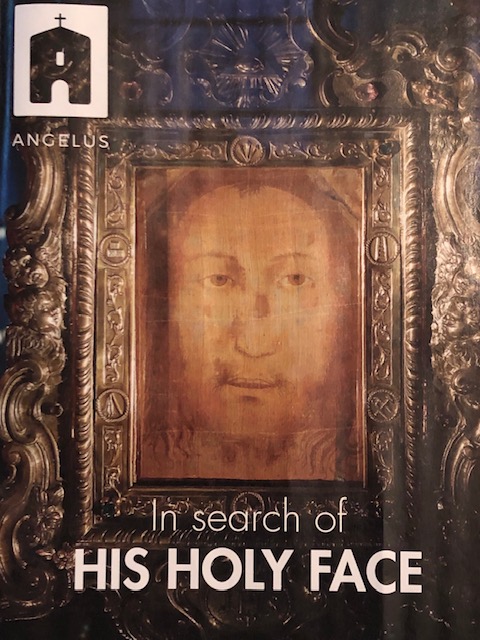
Kathryn Jean Lopez, contributing editor to Angelus Magazine, and editor-at-large of National Review Online has written a fine article about the Veil of the Holy Face of Manoppello, and how devotion to the face of Jesus can make all the difference in our lives. With permission, it has been re-printed here:
A Window Into His Love
by Kathryn Jean Lopez/Angelus
There’s an altar dedicated to the Holy Face of Jesus at St. Patrick’s Cathedral in Manhattan, New York, where I find myself many days for Mass and prayer. It is one of the spots I am always drawn to. It has a cloth with an image of our Lord.
Despite being in the middle of everything — and maybe it’s all the more powerful because it is — there can be great quiet there, right on Fifth Avenue in one of the busiest cities in the world, and opportunities for deep prayer. I’m forever seeing piety from daily visitors, joggers, and tourists who appear to be seeking the face of God whenever the doors of the church are open.
This particular altar is definitely no exception. I’ll often see flowers left behind, a man kneeling, a woman lighting a candle. And I always feel like I am being drawn deeper into a love story — God’s love for us.
From the Holy Face, my route is largely the same every time I’m there on my way to the Blessed Sacrament chapel dedicated to Our Lady. I always stop at the sixth station on the wall and look at the depiction of the face of Jesus there.
I always try to get into the line of sight, between Jesus and Veronica. Veronica is so moved by the suffering of Christ in his passion that she walks up and gives him her veil to wipe his sweat and blood on, to give him a moment’s relief.
Sometimes I see someone working on the frontlines of love — whether it be family life, or supporting struggling families, or another more hidden or thankless ministry; sometimes it’s the priesthood, and I want to do the same.
Whatever church I’m in, truth be told, it does not have to be as grand as the cathedral in Manhattan or anywhere else — I’m always drawn to this station. I imagine myself looking at Jesus in his passion. Sometimes I’m pretty sure I can see him looking at me.
We make him suffer and he knows our suffering. We’re together every day. These two profound realities are how we can more consciously live our lives with God.
Lent is about remembering that, returning to him in love, knowing his presence. Seeing his face — most importantly in the Eucharist, especially after a good Confession — makes all the difference.
It often doesn’t take very long after leaving a church in a city to encounter his face again in the faces of others.
The other day it was the counterterrorism officer who was checking the outside of the cathedral with a dog who was sniffing everything that could be a potential hidden threat (the dirt and grass by the handicap ramp; the box that keeps the traffic light on the corner sidewalk running).
If I’m at St. Patrick’s, frequently the first people I see there are tourists taking selfies. “May they see Christ’s image in them!” I whisper in prayer — sometimes as a plea, because God would appear furthest from their minds, on the surface between Victoria’s Secret and NBA store bags (such is the neighborhood).
Most especially, Jesus’ face can be — and must be, for the sake of our souls and for the love of every man and woman and child on earth, which is how we love God in this mess of a world — seen in a man nesting on concrete, asking for spare change or a meal, desperate to be noticed, never mind loved.
In so many of the artistic depictions of the Holy Face of Jesus, both his love and our need are laid bare. (If you were to Google now, you will find plenty of them. I’m partial to El Greco, but I always am.) There’s something about artistic renditions of his face that always seem to capture the depths of love.
The human imagination captures something both of the truth of God and our longing for him. And as beautiful as so many of them are, they only begin to tell the story. They flow from the love of Jesus on the cross, a love that most of us have not even begun to fully truly appreciate.
There’s no requirement to believe the Shroud of Turin or the Veil of Manoppello are, in fact, evidence of the Lord’s death and resurrection. But they do seem yet more windows into his love for us, not just in the images themselves but in the possible physical evidence for the skeptical and notes of love for the faithful they so many pilgrims believe them to be.
As German journalist Paul Badde has laid out, the two of them, when brought together, show the exact same face — one a man who has died, and one of the same man with his eyes opened — and healed.
Paul Badde pondering the Holy Veil of Manoppello Photo: Alan Holdren
Badde has literally written the book on the Holy Face, which is preserved at a shrine in the mountain village of Manoppello, Italy. Ask him to talk about the face of Christ, and he will immediately be making plans to show you things.
If you can’t plan a day trip to Manoppello with the Holy Face, he will show you a replica in his apartment, and likely hand you a card with its image before you part ways.
He says it was the Blessed Mother under the title of Our Lady of Guadalupe who first brought the Holy Face of Jesus to his attention — because she always brings you to her Son. He’s since written of the Veil of Manoppello as an adventurous investigation.
He’s convinced this is the face of Jesus and that it is about the most important relic there is because of the deeper knowledge it draws us into, the reality of Jesus in our lives and in our world. God “didn’t become a book, he became a person. God became a person. Man.”
Badde is not the only evangelist for Manoppello. In 2006, Pope Benedict XVI took a pilgrimage to the shrine where it resides in the Abruzzo mountains.
He said at the time: “As the Psalms say, we are all ‘seeking the Face of the Lord.’ And this is also the meaning of my visit. Let us seek together to know the face of the Lord ever better, and in the face of the Lord let us find this impetus of love and peace, which also reveals to us the path of our life.”
The “Volto Santo” (“Holy Face”) has very much become a ministry for Badde. He believes it is critical in this age of disbelief to stop and look and consider the implications of a God who would live and die and be resurrected for love of us and to redeem us for our sins for eternity.
He fears that so many — even at high levels in the Church — don’t actually believe in the Resurrection. The Holy Face can change this, he believes. And he’s not only talking about people in the pews, but theologians and bishops, too.
Maybe that explains how scandals can happen — the weakness of belief, the rise of unbelief and outright hostility to real religious faith, even where it would be expected to be most solid. They think resurrection is “good preaching or … a living community.
“No, resurrection is real. Jesus was dead and he resurrected from the dead. He’s alive. From the dead to alive. … That’s so important. It’s so important against all the heresies about it, because all the heresies … at the foundation … are about not believing in the Resurrection anymore.”
Pope Benedict XVI gazes at the Veil of the Holy Face in Manoppello, Photo:Paul Badde/EWTN
He believes the veil bears witness to the reality of the Resurrection, which is why he is somewhat tenderly relentless about telling its story.
In his own reflection on the relic, Cardinal Robert Sarah says: “In Manoppello we encounter God face-to-face. It is such a moving place. One is so touched by the gentleness of Christ’s eyes, with their extraordinary penetrating and calming power. And when we let ourselves be seen by him, his gaze purifies and heals us. We can really sense how much Jesus has loved us — so much as to die for us. For true love is dying for the one you love.”
It’s hard to miss that when I ask Badde about the veil, his morning routine, and how he spends his days. All he can talk about is the love of God and the love he draws us into in the Eucharist and the eyes we see on the face on the veil.
When meditating on the Holy Face of Jesus, whether the Shroud of Turin, the Veil of Manoppello, your parish’s sixth station of the cross, or whatever image your Google search seeking his face lands you on, be drawn in to the truth of what we celebrate as “Good” on that last Friday before Easter year after year.
There’s no guarantee any one of us will live to see another Paschal Triduum — so don’t let Holy Week be reduced to a series of mere obligations and traditions.
Gaze at the Lord in his passion, walk with him even to the gates of hell on Holy Saturday. Go to the empty tomb with Mary Magdalene in prayer. Make his love story for us the story of your life, because this is what he wants, this is our identity as Christians.
Look at him with love and let him look at you with just a touch of a taste of the enormity of his love for you. And you will see this more and more as everything. And you will see his face more and more in the world, just as others will be able to see his face in yours by how you look at them with love.
Manoppello is worth reading more about. But even if you don’t, remember the love with which the Lord looks down at you from the cross, remember the love with which he forgives and heals and makes you new again. Keep seeking his face.
Kathryn Jean Lopez is a contributing editor to Angelus, and editor-at-large of National Review Online.
Editor’s note: Journalist Paul Badde’s book “The Face of God: The Rediscovery of the True Face of Jesus” (Ignatius, $17.95) tells the story of the historical and scientific evidence behind the belief that the Veil of Manoppello is the face cloth laid over the face of Jesus in the tomb.
Daisy Neves in front of her Beloved Holy Face of Jesus
Photo: Paul Badde/EWTN
“We have no need of wings to go and search for Him, but have only to find a place where we can be alone and look upon Him present within us.”
So said St. Teresa of Jesus, and yet even this Doctor of the Church recommended having an image of Jesus before us to come to the aid of our human weakness. “Never set aside the Sacred Humanity of Christ,” she said. We cannot come to the Father except through Him. Intimacy with Jesus draws us into the life of the Trinity. “If we can, we should occupy ourselves in looking at Him Who is looking at us; keep Him company; talk with Him; pray to Him; humble ourselves before Him; have our delight in Him.” This mutual gaze of love, which is prayer, bears fruit in the soul and a burning desire to share in some way the love of Christ with others — to make Him known and loved. Such was the desire of Daisy Neves.
Pope Benedict XVI gazes at the Veil of the Holy Face in Manoppello, Photo:Paul Badde/EWTN
Daisy, first glimpsed the Holy Face of Manoppello in 2006, in a newspaper photo of Pope Benedict XVI in prayer before the holy relic. She made up her mind then that she must see it. Five years later, at Easter in 2011, she found herself face to face before the Holy Veil bearing the Face of Jesus. Her heart was moved to such a degree that she placed all her money in the collection before returning home to America.
From that moment on, she told everyone she met about the Veil with the Face of Jesus in Manoppello, Italy. Daisy travelled the world, in spite of illness and obstacles, and she relentlessly sought whatever means she could to share the love of Jesus made manifest by the veil of His Holy Face. Daisy has now entered into Eternal Life. But by the fruit of her deep love and devotion, she brought the image of Holy Face to basilicas, churches, and orphanages. Through her efforts, replicas of the Holy Veil have been enthroned in many churches throughout the world, drawing many souls to contemplate in prayer and experience, as she did, the merciful loving gaze of her beloved Jesus. May she gaze on God’s Face for all eternity. Daisy Neves, Requiescat in Pace!
Patriarch Bartholomew with Daisy Neves and the “True Icon” the Holy Veil of Manoppello.
Daisy Neves with Raymond Frost, bringing the Holy Face to Los Angeles in 2015, Photo: Paul Badde/EWTN