Jesus Christ is Risen! “The Cloth That Covered His Head”

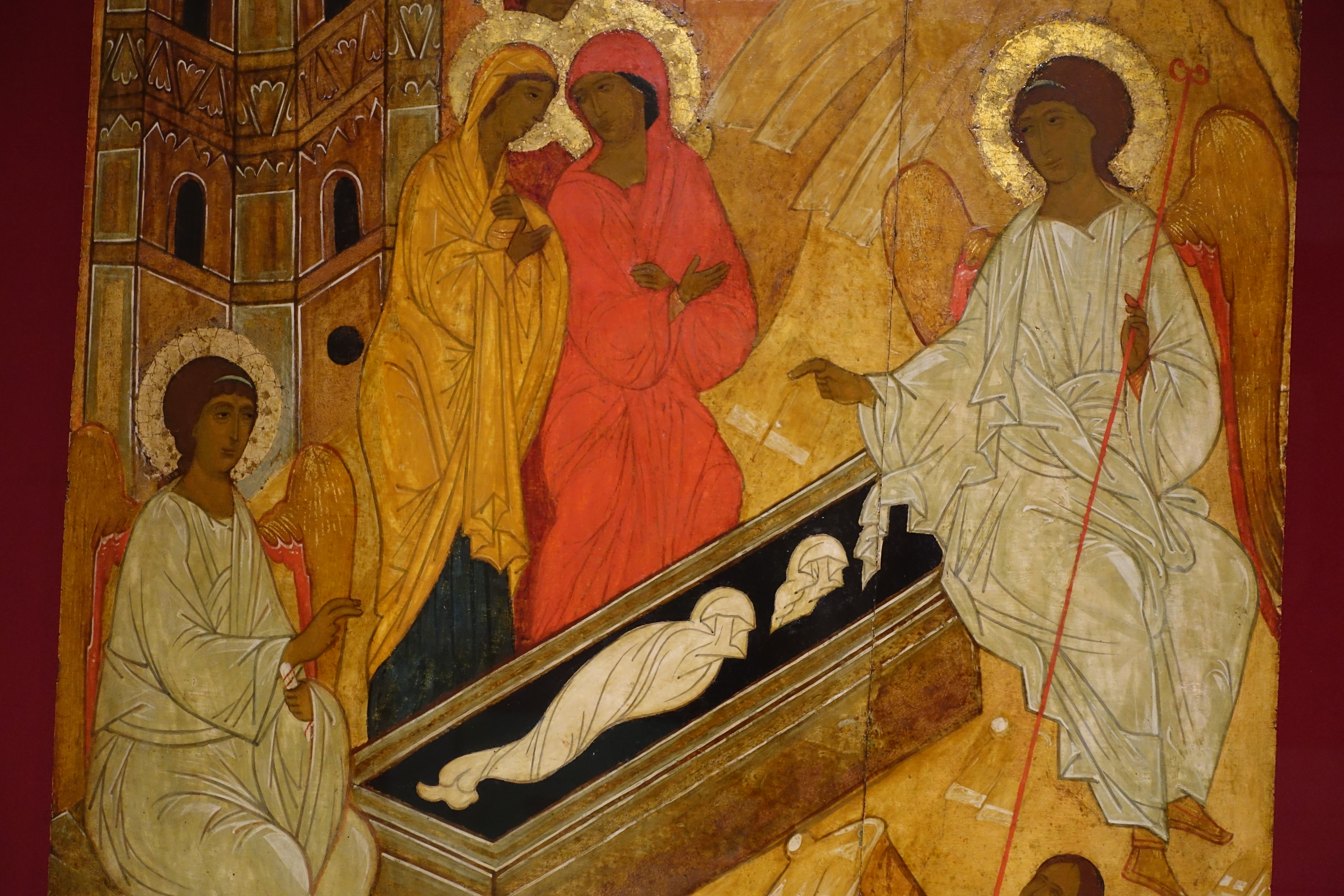
There were several burial cloths of Christ that were found in the tomb; and among them: the Shroud of Turin, the Cloth of Oviedo, and the precious byssus veil that was believed to cover the Face of Christ in the tomb – known as “Il Volto Santo” – The Holy Face of Manoppello. Possibly the very reason that St. John “Saw and believed.”
The Disciples Peter and John Running to the Sepulchre on the Morning of the Resurrection, Eugene Burnand, 1898

So Peter and the other disciple went out and came to the tomb.
They both ran, but the other disciple ran faster than Peter
and arrived at the tomb first;
he bent down and saw the burial cloths there, but did not go in.
When Simon Peter arrived after him,
he went into the tomb and saw the burial cloths there,
and the cloth that had covered his head,
not with the burial cloths but rolled up in a separate place.
Then the other disciple also went in,
the one who had arrived at the tomb first,
and he saw and believed.
For they did not yet understand the Scripture that he had to rise from the dead.  (John 20: 1-9)

At the time of Jesus, the Jewish law required several “cloths” to be used for burial, and as many as six for someone who had died a violent death. Christian tradition has preserved six cloths as relics that are associated with the burial of Jesus – 1.) The Shroud of Turin, Italy 2.) the Sudarium of Oviedo in Spain, 3.) The Sudarium Veil of Manoppello, Italy 4.) The Sudarium of Kornelimunster in Germany, 5.) The Sindon Munda of Aachen, Germany, 6.) The Cap of Cahors in France.

Three  of the cloths in particular stand out as extraordinary “witnesses” to the Passion, Death, and Resurrection of Jesus, and together they bear a powerful testimony to the truth of the Gospels. Each one bearing an imprint or image of the Face of Jesus. They are: The Sudarium of Oviedo, The Shroud of Turin, and the Sudarium Veil of Manoppello. The remarkable relationship between these three “cloths” leave little doubt that each came in contact with the face of the same man at the time of burial.

The Sudarium of Oviedo directly touched Jesus’s head following His Crucifixion. Blood was considered sacred to the Jews, so this cloth was used to soak up the Precious Blood of Jesus, by wrapping it around Jesus’s Head, as He was taken down from the Cross. The largest bloodstains are from the nose, other stains are from the eyes and other parts of the face.  There is also an imprint on the sudarium of the hand of the person who held this cloth to Jesus’s Face to staunch the flow of blood. It takes one’s breath away to see that the bloodstains on the Sudarium of Oviedo, when overlaid with the Face on the Shroud of Turin and the Sudarium Veil of Manoppello, correspond perfectly. The blood type is AB, the same as on the Shroud of Turin.
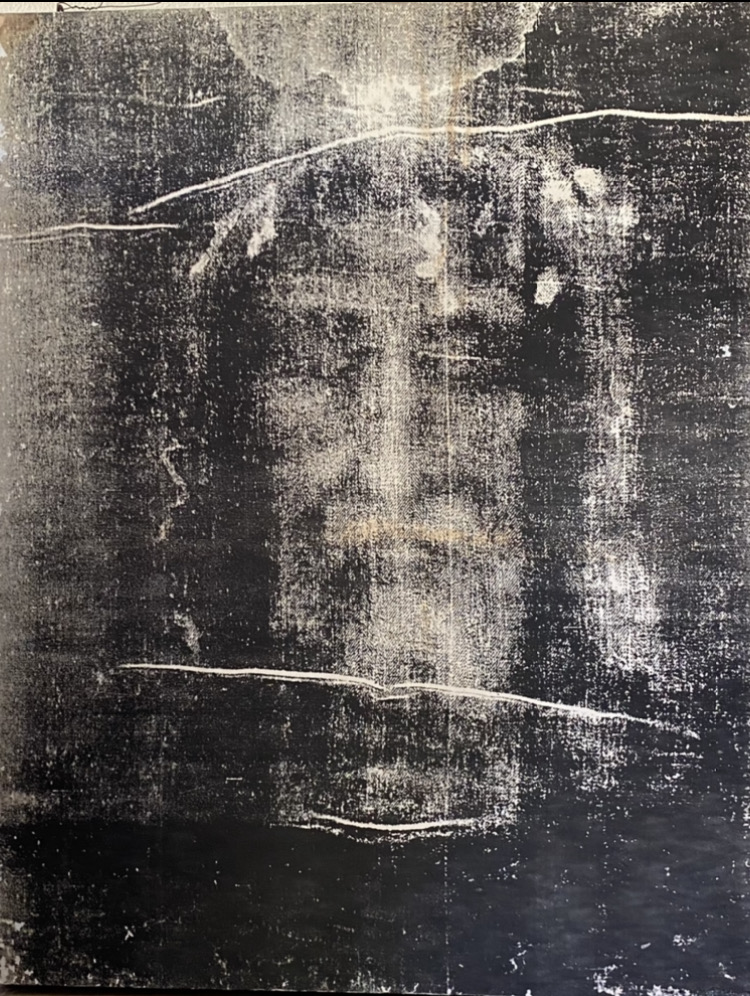
Photo of the Face on the Shroud of Turin

“He went into the tomb and saw the burial cloths there.

The Shroud of Turin; the sindone, or linen burial shroud, was believed to have been used to wrap the entire body of Christ. It is the most famous and studied of the three cloths. The faint but visible imprint on the Shroud of Turin gives witness to the violent torture of a man as described in the Passion and Death of Jesus in the Scripture. The world was amazed when Secondo Pia first photographed the Face on the Shroud in 1898; the negative of the photo incredibly became visible as a positive image. The Shroud of Turin caused an entire branch of science to be dedicated to its research called Sindonology.
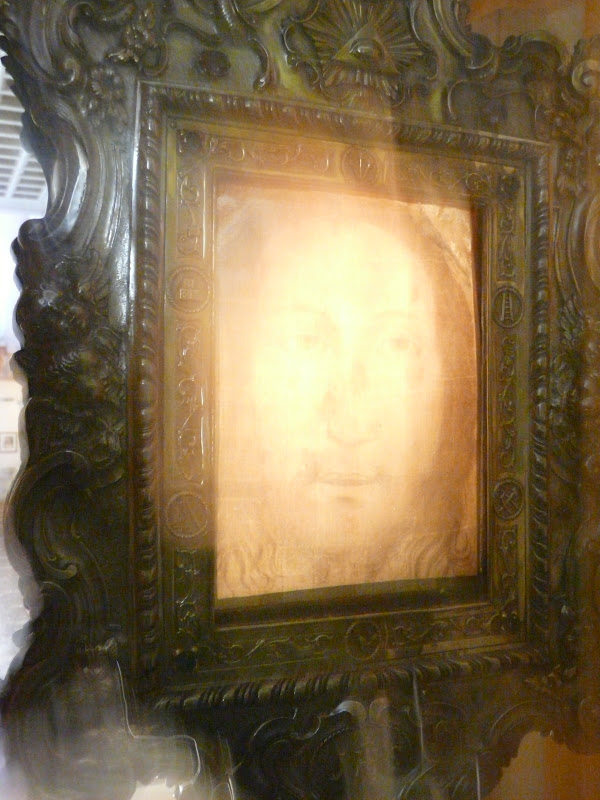
Photo: Holy Face Veil of Manoppello, Italy (Paul Badde/EWTN)

‘…and the cloth that had covered his head,
not with the burial cloths but rolled up in a separate place.

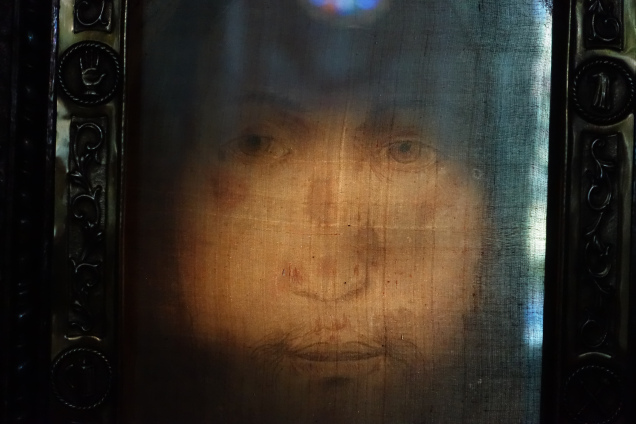
Reliquary containing the transparent veil on which the image of the Holy Face becomes visible, according to the light and position of the viewer. Photo: Paul Badde

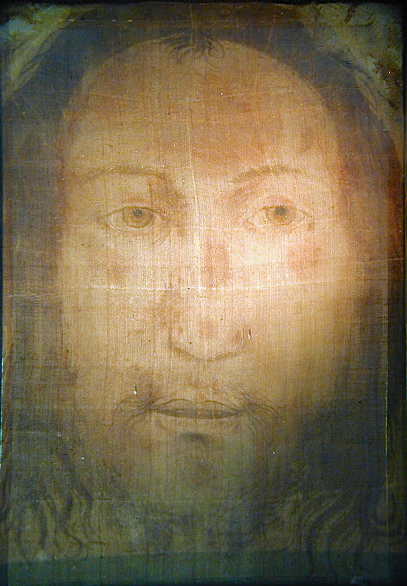
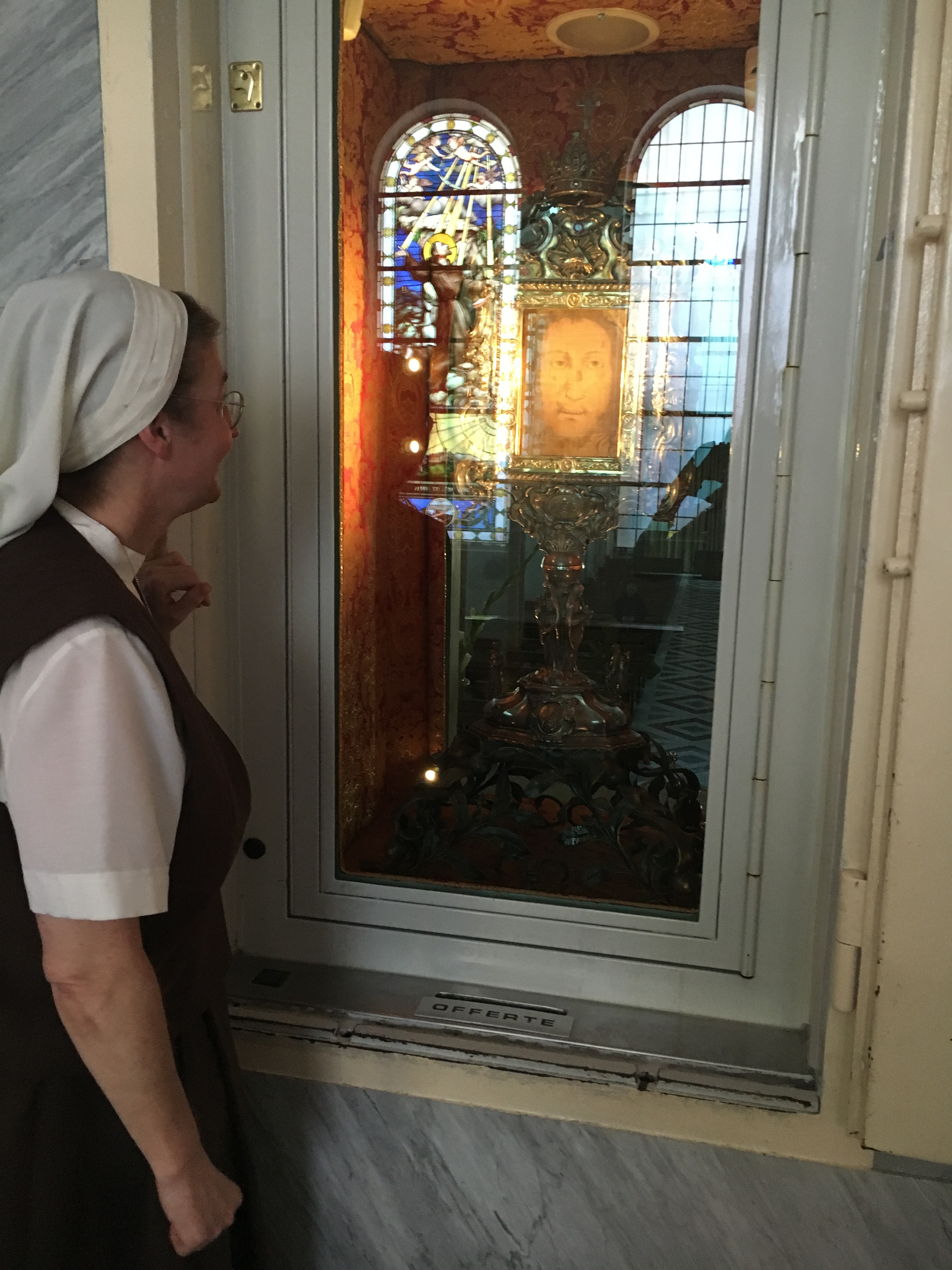
The Sudarium Veil of the Holy Face of Manoppello, Italy is perhaps the least known of the three burial “cloths.” The Veil bears the image of the living Face of Jesus. This “miracle of light,” “not made by human hands,” was protected and hidden in an isolated church in the Abbruzzi Mountains for centuries. It is believed to be the “cloth” that covered the Face of Jesus in death, showing traces of the Passion: Bruises, swelling, wounds from the Crown of Thorns, and plucked beard.  But, it is also believed to have recorded in light the Face of Jesus at the moment of His Resurrection. No, this is not a contradiction. Yes, the image changes. It shows suffering, but it also shows life! It is believed to be “The cloth that covered His head.”

“Il Volto Santo” The Holy Face Veil of Manoppello.
Photo: Patricia Enk

An explanation about the tradition of a face cloth for burial may be helpful in understanding its profound significance:  In the funeral rites for priests in some Eastern churches, the veil which was used to cover the chalice and paten were placed on the face of the deceased priest. (The cloth used to cover the chalice and paten had a particular liturgical symbolism linked to the Face of Christ as well.) It was done as a symbol of both the strength and protection of God, and also of the tomb of Christ–an expression of belief in the Resurrection. In Jewish burial custom, a deceased priest’s face would be anointed with oil and then covered with a white cloth, and would have been done for Jesus.
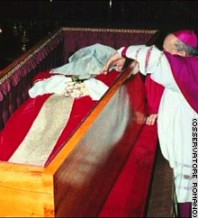
Funeral of Pope St. John Paul II, Archbishop Dziwisz covers the pope’s face with a veil.

When Pope St. John Paul II was being laid in his coffin, Archbishops Marini and Stanley Dziwisz had the honor of placing a white silk veil over the face of the pope. Poignantly, the choir sang the words from Psalm 42, “My soul thirsts for God, the living God; when will I come and see the Face of the Lord?” Many wondered about the action of covering the pope’s face with a veil because this was the first time it had been done, but was at the request of Pope John Paul II, who had dedicated the millennium to the Face of Christ.

Byssus “Pinna Nobilis” fit for a King! Photo: Paul Badde/EWTN

The cloth that would cover the Face of Christ would have to be made of a material fit for a King, a High Priest, and a God. Byssus, mentioned in the Bible forty times, also known as “sea-silk,” is more rare and precious than gold and it has an exceedingly fine texture which can be woven. Made from the long tough silky filaments of Pinna Nobilis mollusks that anchor them to the seabed, it is strong enough to resist the extreme hydrodynamic forces of the sea. Byssus has a shimmering, iridescent quality which reflects light. It is extremely delicate, yet strong at the same time. It resists water, weak acids, bases, ethers, and alcohols. Byssus cannot be painted, as it does not retain pigments, it can only be dyed; and then, only purple.  It can also last for more than 2000 years.

Kurt Cardinal Koch contemplates the Veil “not made by human hands” of Manoppello. Sheer and delicate, yet the Face is visible. Photo: Paul Badde/EWTN

The Sudarium Veil of Manoppello is also made of rare, precious, byssus silk.  The skill needed to weave a byssus veil as fine as the Veil of the Holy Face of Manoppello is exceedingly great.  Chiara Vigo, known as “the last woman who weaves byssus,” has said that neither she nor anyone alive today could duplicate the gossamer-thin veil, which is sheer enough to read a newspaper through.  The weave is so delicate, she says, that only the nimble fingers of a very skillful child could weave something so fine.

Photo: Paul Badde

It is only through light that this shimmering image of the Face of Jesus may be seen, and at times appears as a “living image” as though it were reflected in a mirror, at other times the image completely disappears.  Although no camera can adequately capture the image, thanks to the many amazing photos of journalist Paul Badde, the changes that occur when viewing the veil may be better appreciated.  (Click here for more photos, and information about Paul Badde’s books and videos about the Holy Face.)

While the Face on the Shroud of Turin clearly shows the Face of Jesus in death with eyes closed, the Sudariam of Manoppello has eyes open–bearing witness to the Resurrection. That was the ardent belief of the former Rector of the Basilica Shrine of the Holy Face, Servant of God Padre Domenico da Cese.  

Sevant of of God Padre Doemnico da Cese, former Rector of the Shrine of “Il Volto Santo.”
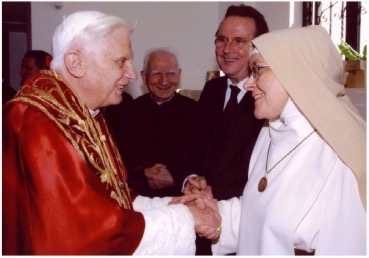
L to R: Pope Benedict XVI came as a pilgrim to Manoppello on September 1, 2006, Fr. Heinrich Pfeiffer, S.J., Paul Badde, and Sr. Blandina Schlomer

There are many physiological reasons too for believing that the Face Cloth captures the first breath of the Resurrection. Sr. Blandina Paschalis Schlomer, who shares that belief, has provided meticulous research about the Veil in her book JESUS CHRIST, The Lamb and the Beautiful Shepherd, The Encounter with the Veil of Manoppello.  Sr. Blandina together with Paul Badde, and Fr. Fr. Heinrich Pfeiffer, S.J., Professor at the Pontifical Gregorian University in Rome, have each demonstrated that the Holy Face on the Veil of Manoppello is the proto-image of the earliest icons, and other works of art depicting the Face of Jesus.

“…and he saw and believed. For they did not yet understand the Scripture that He had to rise from the dead.”

What did St. John see in the tomb that would cause him to believe? A cloth of blood, such as the Oviedo? The Shroud of Turin? The Shroud bears a miraculous image, but it shows the Face of a dead man. A third witness was needed in order for the disciple to believe. It could only have been evidence of something as astounding as the Resurrection; proof that Jesus was alive!

Holy Veil of Manoppello. Photo: Paul Badde/EWTN

It is human nature to want to see things for ourselves. Many pilgrims, humble and great, have felt called to make the journey to visit the miraculous relic. If it is God’s handiwork, and I believe that is true, then one can only wonder at its existence, and gaze in silent contemplation, giving thanks for this tremendous gift of God… so we too may “see and believe.”
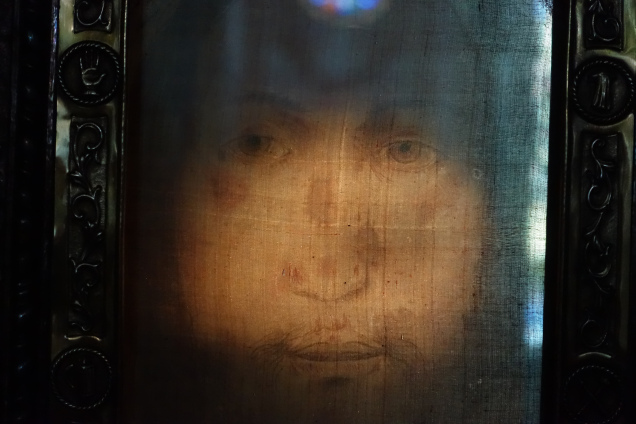
As the first rays of light entered the tomb, John and Peter, upon entering, “saw and believed.”   Sudarium Veil of Manoppello, Photo: Paul Badde/EWTN
Pope Benedict XVI contemplates the ‘Veronica’s Veil’ during a visit to the Shrine of the Holy Face in Manoppello, central Italy, September 1, 2006.

“While we too seek other signs, other wonders, we do not realize that He is the real sign, God made flesh; He is the greatest miracle of the universe: all the love of God hidden in a human heart, in a human face.”

~ Pope Benedict XVI
Holy Face of Jesus of Manoppello (photo: Paul Badde/EWTN)

“We cannot stop at the image of the Crucified One; He is the Risen One!”

~ Pope St. John Paul II

Alleluia! Alleluia! Alleluia!

Waiting With Mary to See God’s Face

“I will wait for the Lord who hath hid His Face from the house of Jacob, and I will look for Him.” (Isaiah 8)

Virgin in Prayer Artist: Sassoferrato 1640-50
Virgin in Prayer, Artist: Sassoferrato, 1640-50

Is there anyone who enjoys waiting? Our human nature rebels against all forms of it: there is the mundane waiting we must endure in lines, in traffic, at ball games, practices, and in doctor’s offices; the anxious waiting for phone calls, for results, or for the end of sufferings; the joyful waiting for birthdays, anniversaries, graduations and other celebrations. Then there is the heavy combination of all three types of waiting–which is of a mother waiting for the birth of her child. And of course, as every child knows, the long waiting for Christmas to finally come.

Our weak human nature does not like to wait. We want to “get there” right away, to “know” right away, for something to be “done” right away.  Waiting requires patience and most of humanity has very little. But wait we must, and since everything in life is permitted by God solely for our good, waiting must be very good for us since we spend so much of our lives doing it.

If waiting is indeed good for us, then it is certain that the evil one will do everything possible to trip us up as he did with the children of Israel while they were waiting, waiting, waiting for Moses to come down from the mountain with the Ten Commandments.  When God was telling Moses, “I am the Lord, thy God: thou shall not have strange Gods before me,” the devil was tempting them to pride; the Israelite’s did not want to endure waiting to see the Face of God so they fashioned an idol, the “work of their own hands.” Here lies the temptation for us all in what should be a grace-filled period of time: distraction in turning the eyes of our soul away from the Face of God and toward the false faces or idols of the world–bright, sparkly, enticing and all around us. How can we resist falling into the traps of idolatry?

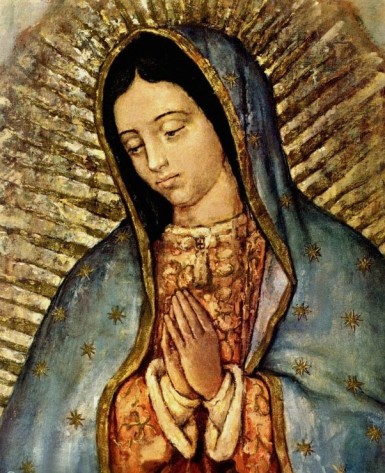
Our Lady of Guadalupe

The ultimate good is to see the Face of God and therefore Mary must have waited like no one has ever waited before!  Mary, for the love of God, waited in patience, humility, faith, charity, in hope, and in supreme fortitude. She did this by fixing the eyes of her soul on Jesus, her Redeemer and God–Whose Face she could not yet see within her womb.  Mary’s uncomplaining acceptance of God’s Will–to seek His Face and only His Face–bore the most sublime fruit in Mary’s soul of divine PEACE, which the world can never take away.  So, this Advent and in all times of waiting, wait with Mary, and her reward will also be ours…to see the Face of her Son!

“She was with child…”

“A great sign appeared in the sky, a woman clothed with the sun, with the moon under her feet, and on her head a crown of twelve stars. She was with child…” (Rev. 12) (Miraculous image of Our Lady of Guadalupe)

She was sent by God to defeat the culture of death at that time in Mexico. Like the “Woman” in Revelation, “clothed in the sun, with moon at her feet,” on December 9, 1531, she appeared to a poor man of no importance or influence, one of Mary’s “little ones,” Juan Diego. The beautiful young woman, whose clothing indicated that she was pregnant, called him by name as a mother would, “Juanito” – “little Juan.”   She spoke to Juan:

“I want you to know for certain, my dear son, that I am the perfect and always Virgin Mary, Mother of the True God from Whom all life comes, the Lord of all things, Creator of heaven and earth.”  

Our Lady to Juan Diego

She is also our Mother — each of us is also her child. Mary says to Juan, “Am I not here, who am your Mother?” As great as was Mary’s longing and anticipation to see the face of her little Jesus, great too, is Mary’s longing to see the face of her Son Jesus reproduced in us. Through love, Jesus was conceived by the Holy Spirit in Mary’s virginal womb, and this is also how Jesus is formed in us as members of His mystical body – by the Holy Spirit and of the Virgin Mary — If we stay close to Mary, He will come and dwell in us, hidden, to be born in our hearts, to suffer, die, and one day rise to eternal life with Him. Come, Lord, Jesus!

By the presence of Mary, you made the desert bloom with flowers, – may the Blessed Virgin Mary’s love transform us into the image of Christ, her Son. Amen.

Prayer for the Feast of Our Lady of Guadalupe

The Beauty of the Trinity in the Face of Jesus

Holy Face of Jesus of Manoppello (photo: Paul Badde/EWTN)

“Jesus has shown us the Face of God, One in substance and Triune in persons; God is all and only Love, in a subsisting relationship that creates, redeems, and sanctifies all: Father, Son, and Holy Spirit.”

— Pope Francis

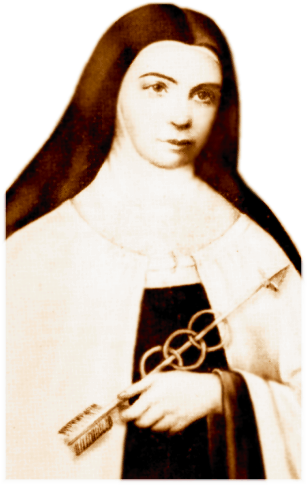
Sr. Marie St. Pierre was a Discalced Carmelite nun who lived in the mid 1800’s. She had had many interior visions regarding the Holy Face of Jesus — including a sublime conception of the The Holy Trinity and the Holy Face — which she tried to express in these words she received from Our Lord:

Discalced Carmelite Nun Sr. Marie St. Pierre, holding “Golden Arrow” with three circles representing the Trinity.

“Remember, O my soul, the instruction which thy celestial Spouse has given thee today on His adorable Face!  Remember that this Divine Head represents the Father who is from all eternity, that the mouth of this Holy Face is a figure of the Divine Word, engendered by the Father, and that the eyes of this mysterious Face represent the reciprocal love of the Father and the Son; for these eyes have but one and the same light, the same knowledge, producing the same love, which is the Holy Spirit.  In his beautiful silken hair  contemplate the infinitude of the adorable perfections of the Most Holy Trinity in this majestic head, the most precious portion of the Sacred Humanity of thy Saviour; contemplate the image of the unity of God.  This, then, is the adorable and mysterious Face of the Saviour, which blasphemers have the temerity to cover with opprobrium: thus they renew the sufferings of His Passion, by attacking the Divinity of which it is the image.”

— Sr. Marie St. Pierre

Our Lord told Sr. Marie St. Pierre that she could comfort and console Him for blasphemy against God by her praises, such as in the words of the “Golden Arrow Prayer:”

May the most holy, most sacred, most incomprehensible and ineffable Name of God be forever praised, blessed, loved, adored and glorified, in Heaven, on earth and in the hells, by all the creatures of God, and by the Sacred Heart of Our Lord Jesus Christ in the Most Holy Sacrament of the Altar. Amen.

— The Golden Arrow Prayer, praises in reparation for blasphemy.
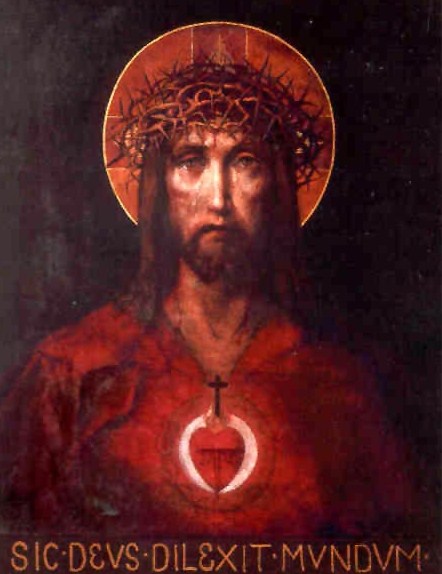
“For God so loved the world”

“According to the diligence you will manifest in repairing my image disfigured by blasphemers, so will I have the same care in repairing your soul which has been disfigured by sin.  I will imprint thereon my image, and I will render it as beautiful as when it came forth from the baptismal font… Oh! could you but behold the beauty of My Face!–But your eyes are yet too weak.”

— Our Lord to Sr. Marie St. Pierre

Another Discalced Carmelite Nun, St. Elizabeth of the Trinity, also directs our gaze to the Face of Jesus in order to contemplate the beauty of the Holy Trinity:

“It is Your continual desire to associate Yourself with Your creatures…How can I better satisfy Your desire than by keeping myself simply and lovingly turned towards You, so that You can reflect Your own image in me, as the sun is reflected through pure crystal? …We will be glorified in the measure in which we will have been conformed to the image of His divine Son.  So, let us contemplate this adored Image, let us remain unceasingly under it’s radiance so that it may imprint itself on us.” –Saint Elizabeth of the Trinity, O.C.D.

“I want to gaze on You always.” –St. Elizabeth of the Trinity, OCD

“O My God, Trinity whom I adore,  help me to forget myself entirely that I may be established in You as still and as peaceful as if my soul were already in eternity.  May nothing trouble my peace or make me leave You, O my unchanging One, but may each minute carry me further into the depths of Your Mystery. Give peace to my soul, make it Your heaven, Your beloved dwelling and Your resting place.  May I never leave you there alone but be wholly present, my faith wholly vigilant, wholly adoring, and wholly surrendered to Your creative action.  O my beloved Christ, crucified by love, I wish to be a bride for Your Heart; I wish to cover You with glory; I wish to love You…even unto death!  But I feel my weakness, and I ask You to clothe me with Yourself, to identify my soul with all the movements of Your Soul, to overwhelm me, to posses me, to substitute Yourself for me that my life may be but a radiance of Your life.  Come to me as Adorer, as Restorer, as Savior, O Word Eternal, Word of my God.  I want to spend my life listening to You, to become wholly teachable that I may learn all from You.  Then, through all nights, all voids, all helplessness, I want to gaze on You always and remain in Your great light.  O my beloved Star, so fascinate me that that I may not withdraw from your radiance.  O consuming Fire, Spirit of Love, come upon me, and create in my soul a kind of Incarnation of the Word; that I may be another humanity for Him, in which He can renew His whole Mystery.  And You, O Father, bend lovingly over your poor little creature; cover her with your shadow, seeing in her only the Beloved in whom You are well pleased.  O my Three, my All, my Beatitude, infinite Solitude, Immensity in which I love myself, I surrender myself to You as Your prey.  Bury Yourself in me that I may bury myself in You until I depart to contemplate in Your light the abyss of Your greatness.  November 21, 1904”

— St. Elizabeth of the Trinity

The Face of Christ and the Priesthood

“I never cease to implore blessings for you from Jesus, and to beg the Lord to transform you totally in Him.  How beautiful His Face, how sweet His eyes and what a good thing it is to stay close to Him…”–St. Padre Pio O.F.M.Cap

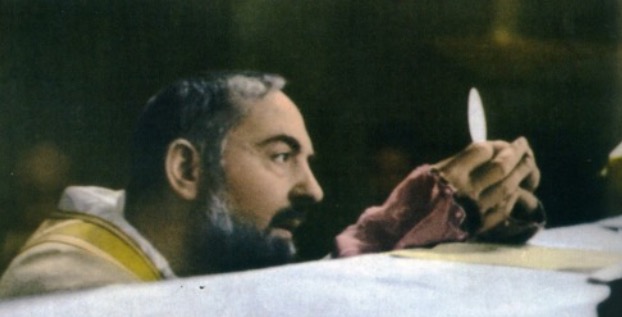
St. Padre Pio gazes at the Eucharistic Face of Christ


At the Last Supper Jesus offers His deeply moving prayer to the Father for his disciples, the priests, which begins, “Father the hour has come…” (John 17) Jesus prays that the Father glorify Him and that He may be glorified in them (his priests) and that He keep them in His name that “they may become one as we are.”  Jesus prays too, “for those who will believe in me through their word.”

“A priest is not a priest for himself,” St. John Vianney said, “he does not give himself absolution; he does not administer the Sacraments for himself. He is not for himself, he is for you.” 

These men, like the first apostles, are fully human and share in the weakened condition of all of mankind since the fall of Adam.  Yet they are called by God for the sanctification of God’s people.  St. Paul writes:

“Every high priest is taken from among men and made their representative before God, to offer gifts and sacrifices for sins.  He is able to deal patiently with the ignorant and erring, for he himself is beset by weakness and so, for this reason, must make sin offerings for himself as well as for the people.  No one takes this honor upon himself but only when called by God, just as Aaron was.  In the same way, it was not Christ who glorified himself in becoming high priest, but rather the one who said to him: “You are my son; this day I have begotten you;” just as he says in another place: “You are a priest forever according to the order of Melchizedek.”  In the days when he was in the flesh, he offered prayers and supplications with loud cries and tears to the one who was able to save him from death, and he was heard because of his reverence.  Son though he was, he learned obedience from what he suffered; and when he was made perfect, he became the source of eternal salvation for all who obey him, declared by God high priest according to the order of Melchizedek. (Heb. 5:1-10)

The faithful are entrusted to the priest’s care, who as a Good Shepherd, walks with them on the path which leads to Christ. Through the gifts of the Holy Spirit, the priest brings the people to a true knowledge of the Father and the Son and “To the contemplation of the living and pulsating reality of the Trinity ‘faciem ad faciem’ (face to face).” (St. Pope John Paul II)  “The Holy Spirit,” says St. Irenaeus, “the stairway of our ascent to God, draws the priest to the Father, stirring in his heart a burning desire to see God’s Face…the Paraclete illumines the priest about his own Person, that the priest may come to see the Spirit in his own heart and history.”

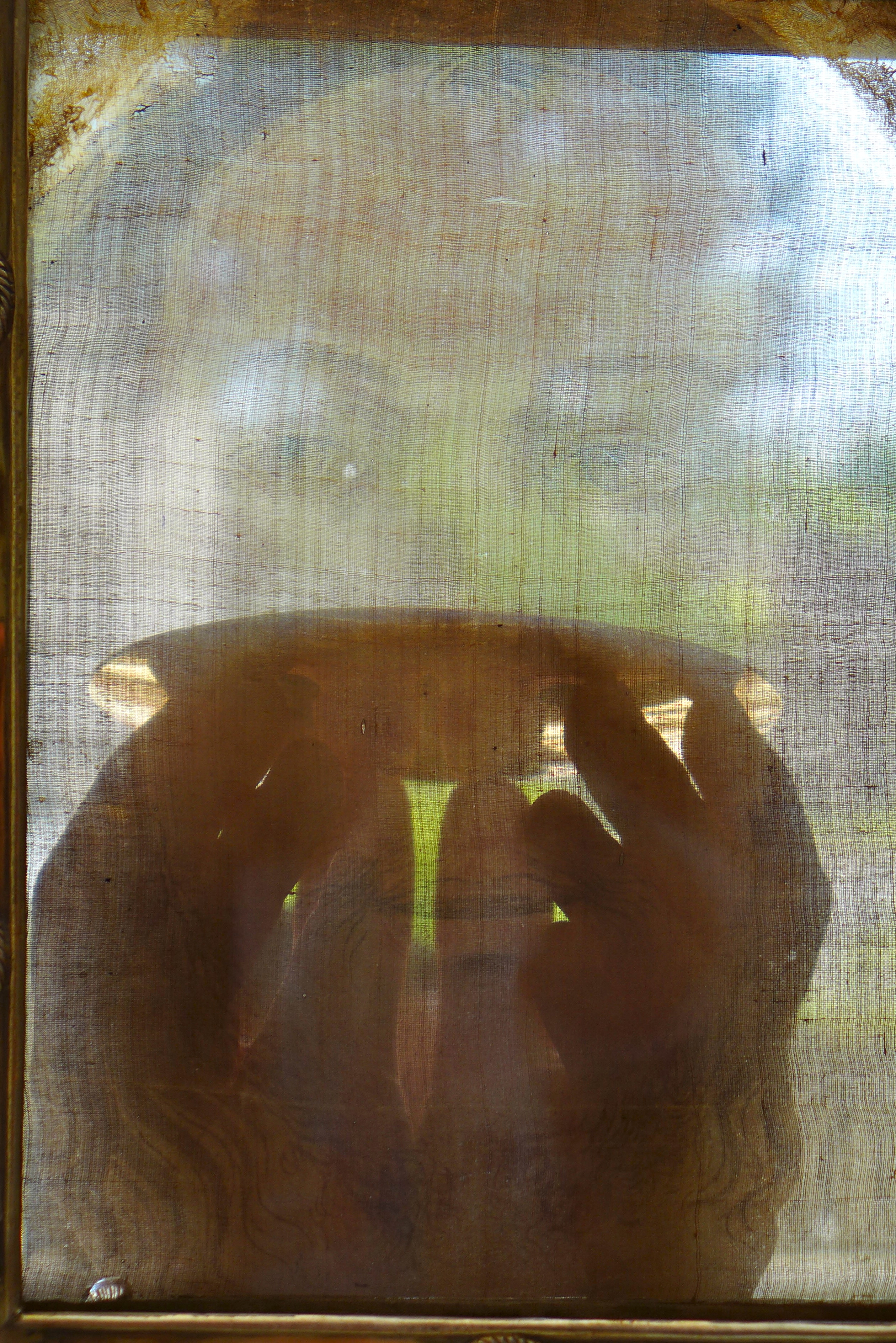
Priest elevating Eucharist on paten viewed through the Veil of the Holy Face of Manoppello. Photo: Paul Badde

Whenever a priest administers the sacraments, says St. Pope John Paul II, “the priest lends Christ his own face and voice:” “Do this in memory of Me.” (Luke 22:19)   “Priests are called to show forth the Face of the Good Shepherd and therefore to have the Heart of Christ Himself.” (St. Pope John Paul II) Therefore, let us pray for all priests and bishops, that the Holy Spirit will strengthen them in all their gifts.  St. Teresa of Avila once said, “When you see a priest you should say, ‘There is he who made me a child of God, and opened Heaven to me by Holy Baptism; he who purified me after I had sinned; who gives nourishment to my soul.’” St. Therese told her sister, Celine, “Let us live for souls, let us be apostles, let us save above all the souls of priests… let us pray and suffer for them and on the last day Jesus will be grateful!” [St. Therese of Lisieux, Letter 94]

The Priest is the Face of Christ to us!

Prayers for Priests

“Eternal Father, we offer Thee, with the hands of Mary, the Holy Face of Jesus, Thy Son, and the entire generous holocaust of all that we are, in reparation for so many sins that are  committed, and, especially, for offenses against the Most Holy Sacrament of the Altar.  We make this offering, in a particular way, so that Priests, by the holiness of their lives, may show the world the adorable features of the Divine Countenance shining with the light of truth and love, for the triumph of the Church, and for the spread of the Kingdom.” Bl. Mother Maria Pierina De Micheli


Suffering with Jesus Christ

“Christ also suffered for you, leaving you an example that you should follow in His footsteps.” (1 Peter 2:21) 

The Divine Prisoner, Holy Face of Manoppello
photo: Patricia Enk

Suffering– it is part of the human condition, and it also human nature to avoid it whenever possible. Even among those rare souls who “suffer well” by following Christ’s example, suffering can be a seemingly unending trial that wears one down. Illness and suffering “can lead to anguish, self-absorption, sometimes even despair and revolt against God.” (CCC 1501)  In times of suffering people could turn to distractions, inward on themselves, or turn their eyes to the Face of Jesus Christ.  It is He who suffers, and no one has suffered more than Him. When He took our human flesh at the Incarnation, He accepted all the suffering of humanity, though completely innocent, to redeem us from our sin.

How do we follow in Christ’s footsteps when we are faced with suffering?

“‘He committed no sin, and no deceit was found in His mouth.’ 

When He was insulted, He returned no insult, when He suffered, He did not threaten; instead, He handed Himself over to the One who judges justly. He Himself bore our sins in His body on the Cross, so that, free from sin, we might live for righteousness. By His wounds you have been healed. For you had gone astray like sheep, but you have now returned to the shepherd and guardian of your souls.” (1 Peter 2: 22-25)

For many though, their suffering may not be a physical one. There is another terrible suffering, experienced worldwide: the separation from our loved ones. And even more painful, the suffering of being separated from “The Loved One,” Jesus, in the sacraments. Again, it is Christ who suffers most, in the Eucharist, isolated in every tabernacle throughout the world.

Perhaps this isolation from loved ones is a warning from Our Loving God of what happens when we turn away from the Face of God by unrepented mortal sin. The result is a painful separation from the love of God for all eternity, which is the suffering of Hell.

What can one do “to suffer with Christ” by staying alone at home? As a Discalced Carmelite nun, St. Edith Stein, contemplated a life of separation from the rest of the world in the cloister. She wrote, “Whoever enters Carmel is not lost to their own, but is theirs fully for the first time; It is our vocation to stand before God for all.”  In quarantine each of us may suffer with Jesus by seeking His Christ’s Face with hearts of prayer, as the Blessed Virgin Mary did at the foot of the Cross – “to stand before God for all.”

“For whoever would love life and see good days must keep his tongue from evil lips,  from speaking deceit, must turn from evil and do good, seek peace and follow after it. For the eyes of the Lord are on the righteous and His ears turned to their prayer, but the Face of the Lord is against evildoers.”  (1 Peter 3:10-12)

Sr. Petra-Maria gazes at the Holy Face Veil of Manoppello (Photo: Patricia Enk)

Prayer to the Holy Face for the liberation from the coronavirus

Lord Jesus, Savior of the world, hope that will never disappoint us, have mercy on us and deliver us from all evil! Please overcome the scourge of this virus which is spreading, heal the sick, preserve the healthy, support those who work for the health of all. Show us your face of mercy and save us in your great love. We ask you through the intercession of Mary, Your Mother and ours, who faithfully accompanies us. You who live and reign forever and ever. Amen. 
+ Bruno Forte
Archbishop of Chieti – Vasto (Italy)

Have We Lost Our Sense of Wonder?

The Transfiguration by Carl Bloch 1872

Our world is filled with amazing technology. Man can fly through the air, and communicate with anyone, anywhere, instantly throughout the globe. A person need never to suffer a moment’s boredom because we have instant gratification for our eyes and ears at our fingertips through our cell phones, computers, and television. Humanity has also never had so little peace, or silence necessary to hear the whisper of God’s voice, or so little desire to turn off the unrelenting images on screens in order to seek His Face.

G.K. Chesterton once wrote: “The world will never starve for want of wonders, only for want of wonder.” “When we are asked why eggs turn into birds, or fruits fall in autumn, we must answer that it is magic.” (Chesterton – “Ethics in Elfland”In other words, they are miracles, willed by God, which we have mistaken for the ordinary. What could be more ordinary, more common than a man?… and what could be a greater wonder than the Incarnation: when God became man?

“While we too seek other signs, other wonders, we do not realize that He is the real sign, God made flesh; He is the greatest miracle of the universe:  all the love of God hidden in a human heart, in a human Face.” ~ Pope Benedict XVI 

God knows our human weakness; we need to see, hear, taste and touch. Jesus took Peter, James, and John up Mount Tabor to witness His Transfiguration in glory; so they would believe that He, Jesus Christ, was also God. He gives us His Word, His Body and Blood in the Eucharist, He gives us tangible proofs of His Life, Death, and Resurrection in ongoing wonders: The Shroud of Turin, the Sudarium of Oviedo, and the Veil of Manoppello. Scoffers abound; they always have. The cynics are ever ready to dismiss these wonders, without even taking the trouble to see them. They refuse to believe that God would leave His image on a shroud, or cloth, or veil.

What happens when mankind becomes blind to God’s wonders? Mankind then seeks substitutes for the real, but seemingly ordinary thing. The result is a deadly one, as Chesterton writes in The Everlasting Man:

 “The effect of this staleness is the same everywhere; it is seen in all drug taking and dram drinking and every form of the tendency to increase the dose. Men seek stranger sins and more startling obscenities as stimulants to their jaded senses. They seek mad oriental religions for the same reason. They try to stab their nerves to life, if it were with the knives of the priests of Baal. They are walking in their sleep and try to wake themselves up with nightmares.”

It is an apt description of the nightmare of evil that has descended upon this world; a world which has turned away from the Face of God.

But God exists, and in His infinite mercy, He continues to hold out His wonders to those with “eyes to see,” to behold, and give Him thanks. On the Feast of the Transfiguration, when Jesus’s Face was “transfigured in glory,” pilgrims from all over the world, join the people of Manoppello as they go forth  in procession  to celebrate the wonderful relic of the Face of Jesus — the Veil of Manoppello — a sign of wonder and God’s love for His children.

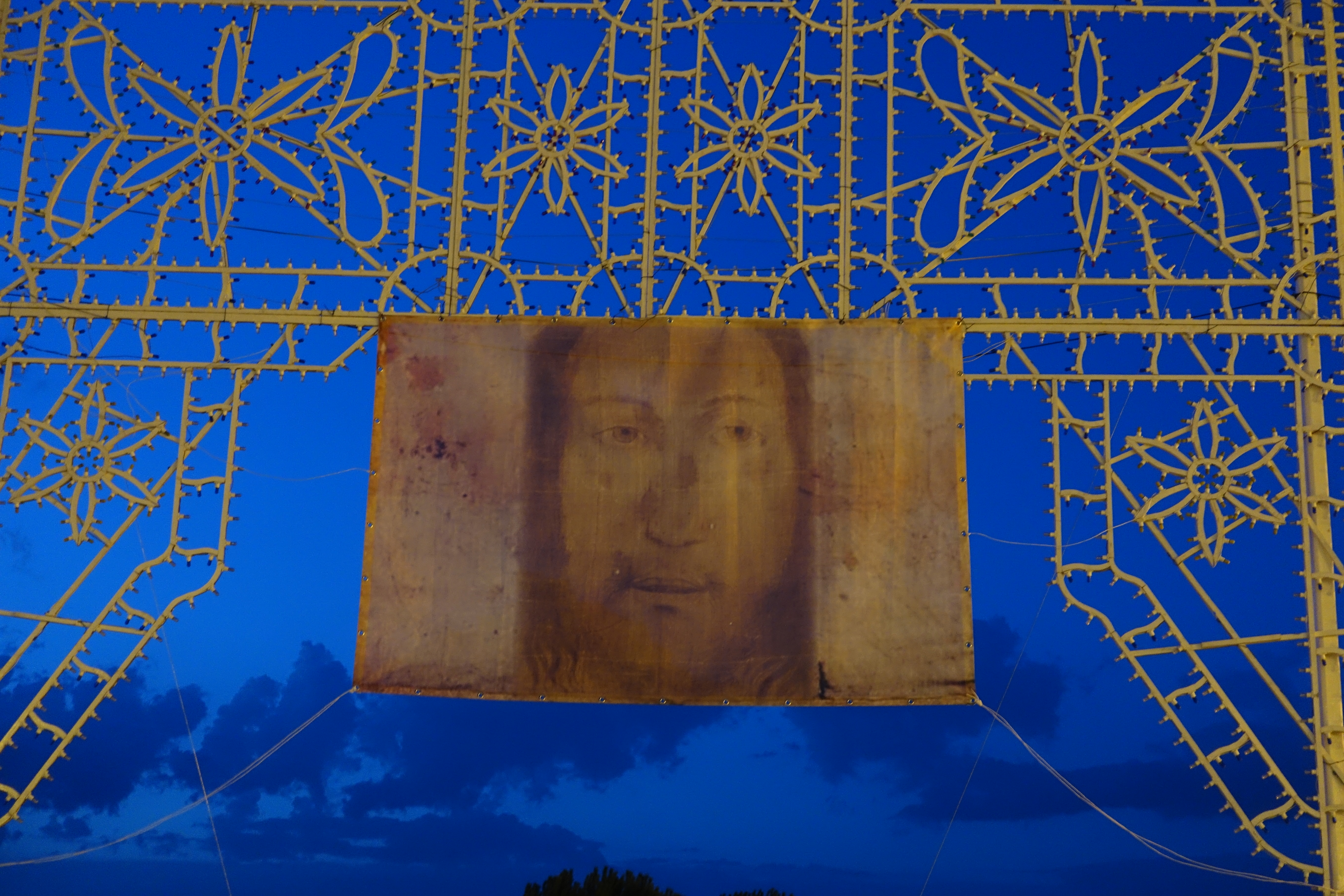
Banner of the Face of Christ hangs above the procession route in Manoppello. Photo: Paul Badde

Hand viewed through the miraculous Veil of Manoppello. Photo: Paul Badde/EWTN

“O Lord, You are my God, I will extol and praise Your Name; for You have worked wonders, plans formed long ago with perfect faithfulness.” (Isaiah 25:1)

Face of Jesus as it appears on the Veil of Manoppello. Photo: Paul Badde/EWTN

Jesus’s Self-Portrait

The Beatitudes by Carl Bloch

Did you know that there exists, in this world, a self-portrait of Jesus?  Yes, it is true. Pope St. John Paul II has written about this self-portrait in Veritatis Splendor, and so did Pope Benedict XVI in Jesus of Nazareth.  Jesus painted this masterpiece of Himself on a mountain, where He prayed “face-to-face with the Father.” On the mountain of the Beatitudes, Jesus painted in deep, rich hues, a self-portrait of crucified love for us to contemplate and imitate:     

The Beatitudes

Blessed are the poor in spirit, for theirs is the kingdom of heaven.

Blessed are they who mourn, for they will be comforted.

Blessed are the meek, for they will inherit the land.

Blessed are they who hunger and thirst for righteousness, for they will be satisfied.

Blessed are the merciful, for they will be shown mercy.

Blessed are the pure of heart, for they will see God.

Blessed are the peacemakers, for they will be called the children of God.

Blessed are they who are persecuted for the sake of righteousness, for theirs is the kingdom of heaven.

Blessed are you when they insult you and persecute you and utter every kind of evil against you [falsely] because of me. Rejoice and be glad, for your reward will be great in heaven.  Thus they persecuted the prophets who were before you. (Mt. 5:1-12)

The Beatitudes, Pope St. John Paul II says in Veritatis Splendor, “are a sort of self- portrait of Christ, and for this very reason are invitations to discipleship and to communion of life with Christ.”  In Jesus of Nazareth, Pope Benedict XVI describes the Sermon on the Mount as a “hidden Christology.” He writes, “Anyone who reads Matthew’s text attentively will realize that the Beatitudes present a sort of veiled interior biography of Jesus, a kind of portrait of His figure.  He who had no place to lay his head (Mt. 8:20) is truly poor; he who can say, “Come to me…for I am meek and lowly of heart” (Mt. 11:28-29) is truly meek; he is the one who is pure of heart and so unceasingly beholds God.  He is the peacemaker, he is the one who suffers for God’s sake.”  

The brushstrokes of the Master are the Christian virtues by which He reveals His Face: Justice, Mercy, Humility, Meekness, Purity of Heart.  Jesus painted this self-portrait as an invitation for those who seek His Face to follow Him as His disciples, calling us to communion with Him, accompanying Him to the Cross. 

“If you say, ‘show me your God,’ I should like to answer you, ‘show me the man who is in you’… For God is perceived by men who are capable of seeing Him, who have the eyes of their spirit open…Man’s soul must be as pure as a shining mirror.”  –Theophilus of Antioch 

“Blessed are the pure of heart, for they shall see God” (Mt. 5)
Holy Face “Il Volto Santo” of Manoppello, photo: Paul Badde/EWTN

Lenten Reflection on the Face of Christ in “Silence”

“In Shusaku Endo’s Silence, Rodrigues’s devotion to the Face of Christ becomes the key to understanding his particular path to Calvary….”

Japanese “fumie” of Jesus Christ

While the release of Martin Scorsese’s film “Silence” stirred up much discussion and controversy about this story of Jesuit missionaries under persecution in Japan, very few have noted the deep significance of the Face of Christ in Shusaku Endo’s original novel.  This article–The Face of Christ: Shusaka Endo’s Silence, by Lauren Enk Mann at Imaginative Conservative explains the pivotal role the Face of Christ plays in the spiritual journey of the central character. The novel “Silence” may also be a good Lenten reflection on suffering, the Passion and humility that we are each meant to share with Christ, as well as a path to self-knowledge, by reflecting upon our own weaknesses in the light of His Face.  

“Behind his closed eyelids he would pass through every scene in the life of Christ. From childhood the face of Christ had been for him the fulfillment of his every dream and ideal.… Even in its moments of terrible torture this face had never lost its beauty. Those soft, clear eyes which pierced to the very core of a man’s being were now fixed upon him. The face that could do no wrong, utter no word of insult….” (full article here)