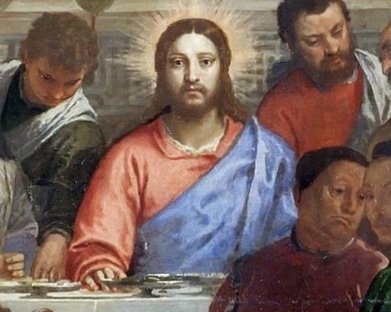
Detail from The Wedding at Cana by Paolo Veronese (1528-1588)
Omnis Terra, Latin for “All the Earth, ” is the name given to the Second Sunday in Ordinary time, when the Gospel of the Wedding at Cana is read. In the midst of the wedding feast, Mary whispers to her son Jesus, “They have no wine.” At Mary’s words, Jesus then performed his first miracle: “the beginning of his signs at Cana in Galilee, and so revealed His glory, and His disciples began to believe in Him.” (John 2: 1-11) The revelation of His glory is the cause for all the earth rejoicing, giving praise to His Name at the wedding feast of the Lamb!
Omnis Terra Celebration 2025
This Holy Jubilee Year of Hope pilgrims from all over the world will be very fortunate to have an opportunity to participate in a Eucharistic celebration, procession, and blessing at the Basilica Shrine of the Holy Face in Manoppello, Italy, on Omnis Terra Sunday, January 19th. The Eucharistic Celebration will be presided over by His Excellency, Mons. Bruno Forte, Metropolitan Archbishop of Chieti-Vasto. Concelebrants will be Fr. Simone Calvarese, Provincial Minister of the Capuchin Friars Minor of Central Italy, and Fr. Antonio Gentili, Rector of the Sanctuary. At the end of the celebration there will be a procession and blessing with the reliquary of the Holy Face.
“To rejoice in the splendor of His Face means penetrating the mystery of His Name made known to us in Jesus, understanding something of His Interior life and of His will, so that we can live according to His plan for humanity. Jesus lets us know the hidden Face of the Father through His human Face; by the gift of the Holy Spirit poured into our hearts.” ~Pope Benedict XVI
This Jubilee Year of Hope, 2024-2025, will mark ten years since the rite of “Omnis Terra,” which had originally begun in 1208, was once again renewed during the Jubilee Year of Mercy, 2015-2016. At that time, a facsimile of the Merciful Face of of Christ on the Holy Veil of Manoppello was carried in a historic procession once again through the streets of Rome. 2016 was the first year that the Holy Face was processed in Rome since the ancient procession of Pope Innocent III from St. Peter’s Basilica to the nearby hospital of Santo Spirito in Sassia in 1208. The Omnis Terra celebration was later continued at the Basilica Shrine of Il Volto Santo in Manoppello. This significant event, celebrating the revelation of His glory is certainly a reason for all the earth to rejoice, as though at a wedding feast!
The first “Omnis Terra” Procession of Pope Innocent III in 1208 carrying “the Veronica” Face of Christ (from “Liber Regulae Sancti Spiritus in Saxia” manuscript 1350)
detail of Face of Jesus on the Holy Veil from the precious manuscript “Liber Regulae Sancti Spiritus in Saxia”
Let all the earth worship and praise You, O God; may it sing in praise of Your Name, O Most High. Shout joyfully to the Lord all the earth; sing a psalm in honor of His Name, praise Him with magnificence!
–Omnis Terra Introit
Salve! Sancta Facies! Hail, Holy Face!
Salve, Sancta Facies! Hail, Holy Face (c. 1450-1455), Willem Vrelant (1481) and associates, Walters Art Gallery, Baltimore, MD.
The exquisite illuminated manuscripts of the Middle Ages reflect the great love and devotion shown to the Holy Face, as well as provide evidence of what the Holy Face of Jesus looked like, as it was seen on a miraculous veil, known as “the Veronica.” “The Veronica,” or Veil of the Holy Face of Jesus, was the greatest relic in Rome at that time. To gaze upon the veil was the great desire of pilgrims, who came from far and wide, to see for themselves the sheer veil bearing the Face of Jesus. Beginning with public exhibitions and processions of the Holy Veil by Pope Innocent III in the mid thirteenth century, the miraculous veil could be viewed by all. Then, the artists got to work on paintings, illustrations, poetry, prayers, and hymns in honor of the Holy Face. ( “The Veronica Route” website wonderfully catalogues many of these “Veronica” artworks that may be found throughout the world.)
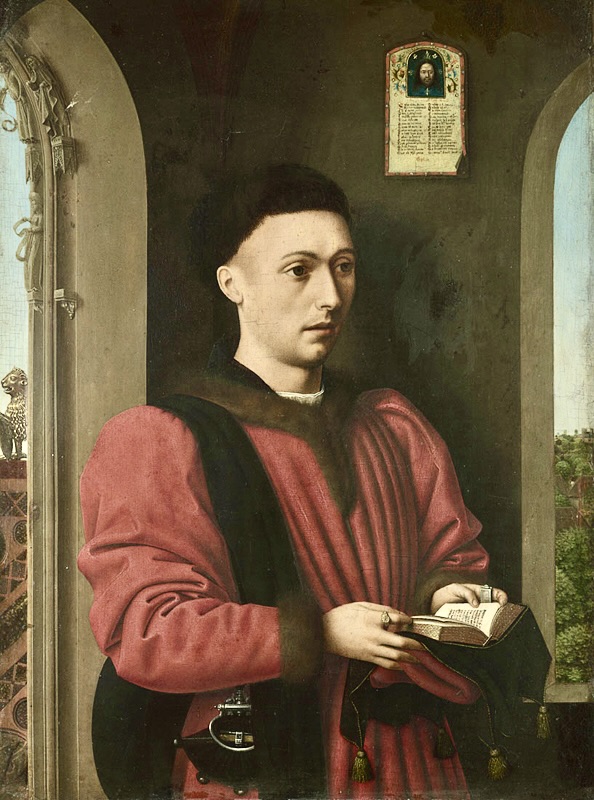
Portrait of a Young Man, 1450-60, Petrus Christus, London National Gallery. Seen above the prayerful young man, on the wall, the Holy Face and the Salve! Sancta Facies Hymn
Pope John XXII, who was elected Pope in 1316, composed a beautiful hymn in honor of the Holy Face, and he also granted a special indulgence to those who recited it — and for those who could could not read, the Pope granted the same indulgence to the faithful for reciting five Our Fathers, Hail Marys, and Glory Be’s. (For an understanding of indulgences, this EWTN article,Primer on Indulgences by James Akin is very helpful.)
Hymn in Honor of the Holy Face by Pope John XXII (translated from the original Latin)
Hail! Holy Face of our Redeemer, hail!
Which shines in all its majesty divine
Upon the spotless veil, a priceless gift
To Saint Veronica; of love the sign.

Hail! Glory of all time, mirror-glass of the Saints,
Wherein the blessed love for eye to gaze;
Destroy within us every stain of sin,
And with the elect our souls towards Thee raise.

Hail, Face of God! With His own gifts adorned,
Whose splendor through the ages shall not cease;
Oh! make Thy light descend into our hearts,
And from their earthly toils our souls release.

Hail! Mighty bulwark of the Christian faith,
Of heresy and lies the Victor Thou;
King in the Sacred Bread, renew the strength
Of all the faithful who before Thee bow.

Hail! all our joy in this hard life below,
So frail and fugitive, so quickly over;
Sweet Picture, lead us onwards to the skies,
That we may there the Face of Christ adore.

Hail! noblest of all gems, celestial pearl,
In Thee innumerable graces shine;
No hand depicted Thee, no chisel carved,
Thou wert of God alone the work divine.

The tints with which Thy features He has traced
Will never alter and will never fade;
Changeless amidst the ravages of time,
The everlasting King Thy Face may see.

Forever incorrupt and free from stain,
The living Christ we honour still in Thee;
Thou turnest into joy our sighs and tears,
Oh! grant that we, in heaven, thy Face may see.

Be thou, we pray, our buckler and defense,
Our consolation and refreshment sweet,
That nothing hostile may our spirits harm,
Till, after death, we rest at Jesus’ feet.  Amen.
Prayer
Shed, O Lord, joy over the faces of Thy faithful, and turn them away from the depths of hell, that, protected by the contemplation of Thy divine Face, we may have strength to tread underfoot the desires of the flesh, and that we may behold Thee face to face, without fear, Lord Jesus Christ, when Thou will come to judge us. Amen.
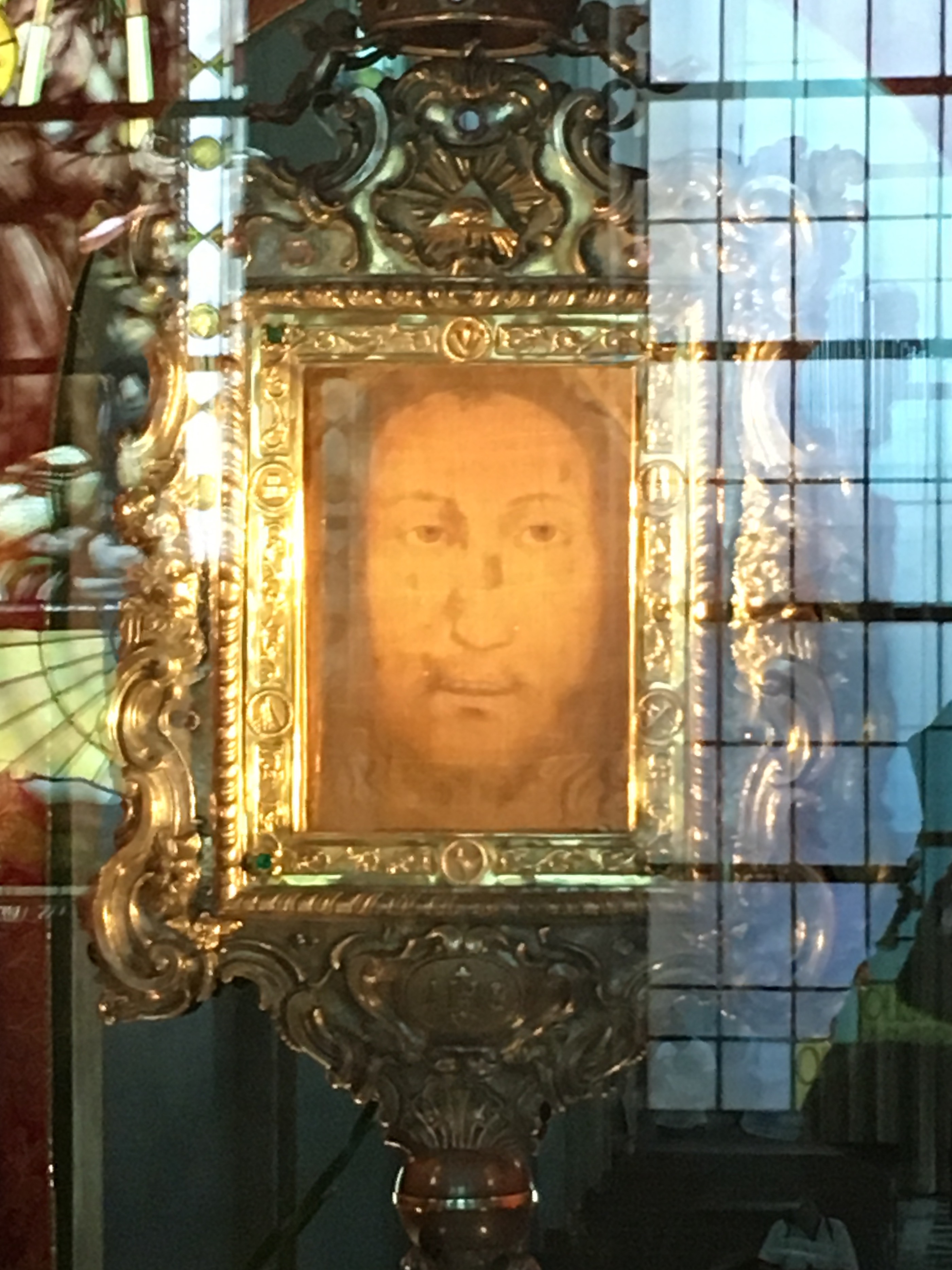
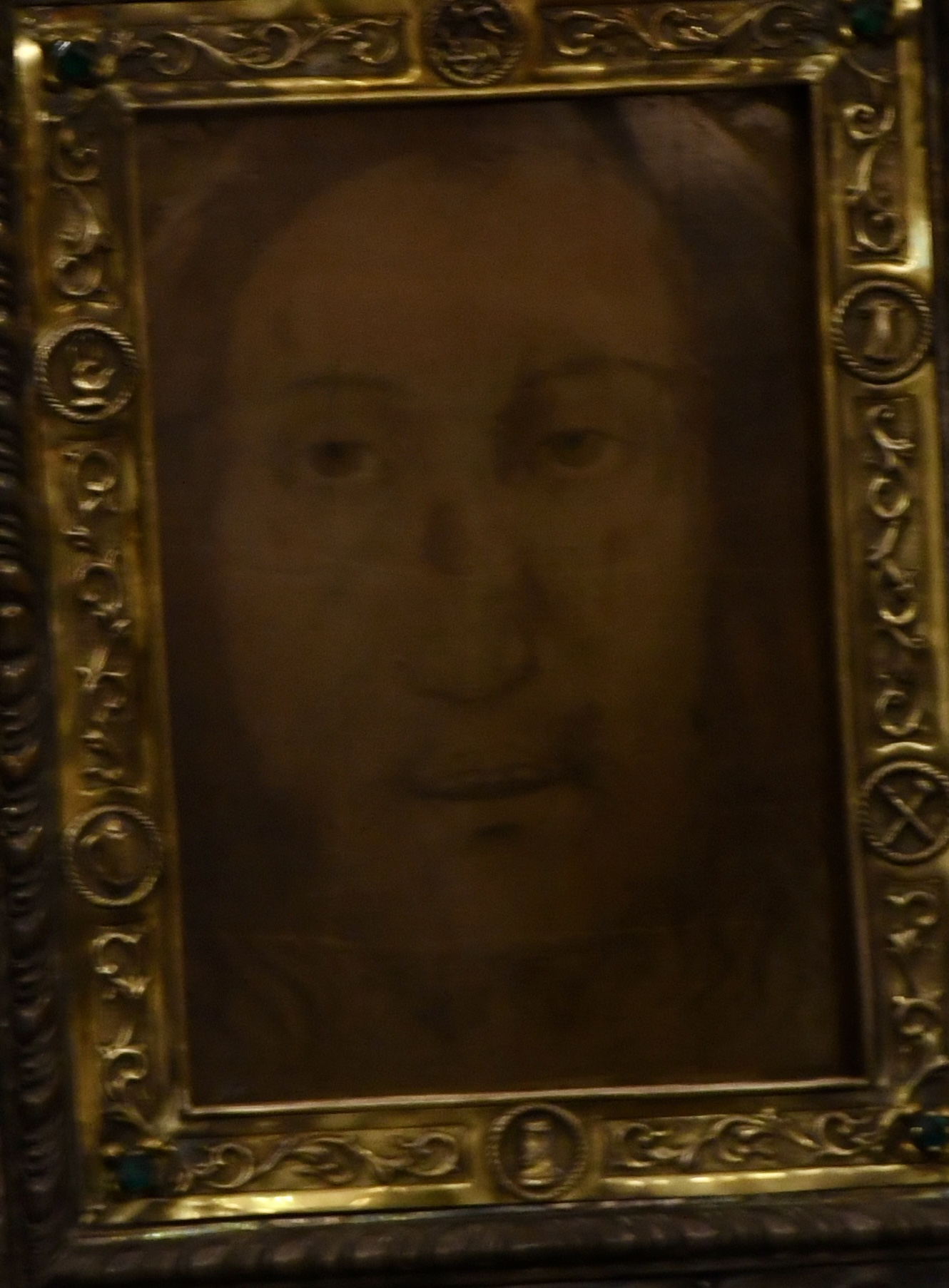
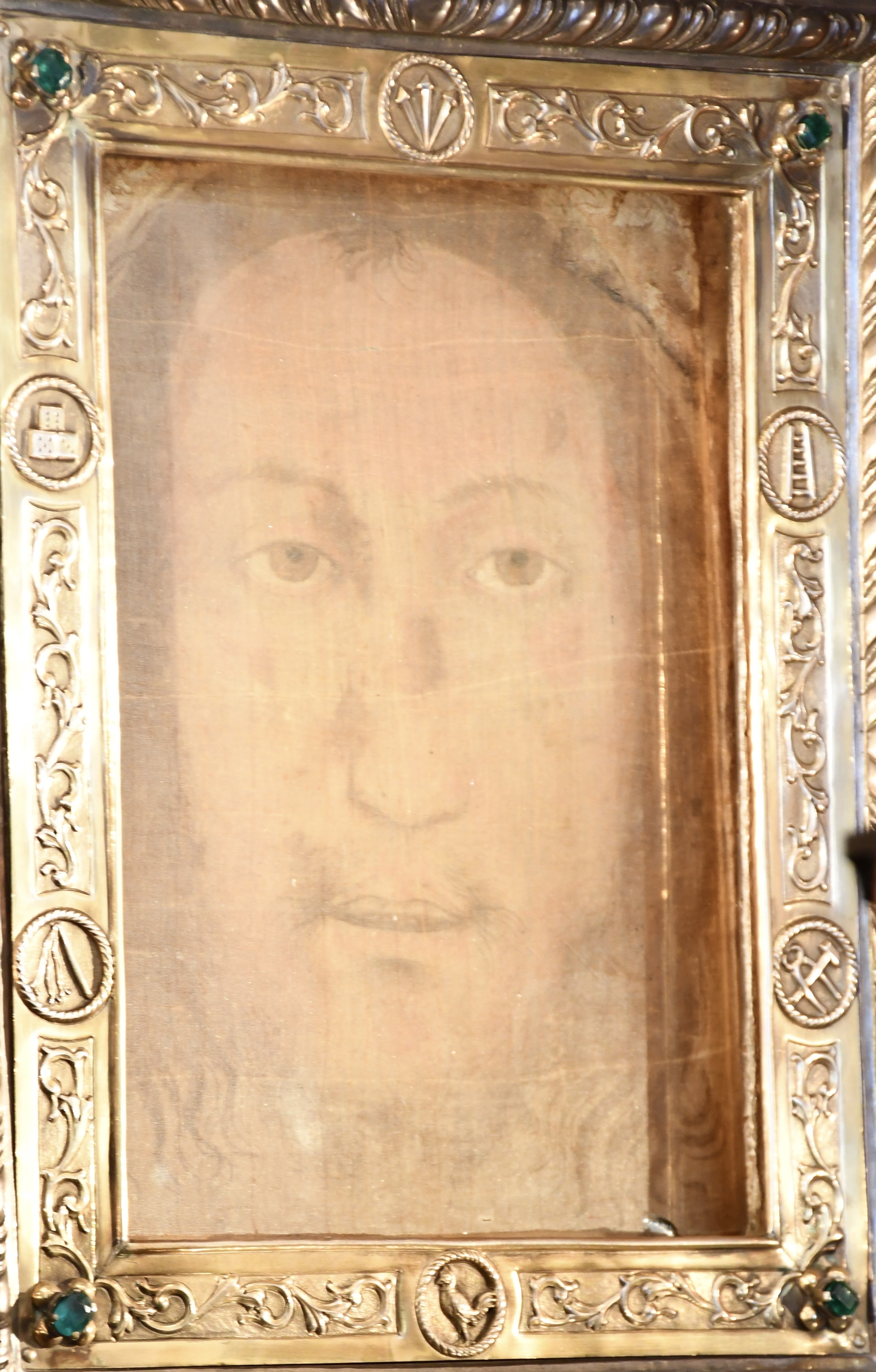
The “tints” of the image, written in light, have never altered or faded through the centuries. Holy Face Veil of Manoppello,( photo: Patricia Enk)
“The tints with which Thy features He has traced, Will never alter and will never fade; Changeless amidst the ravages of time, The everlasting King Thy Face may see.”
Below is a new video of a talk by Fr. Chris Alar, of the Divine Mercy Shrine in Stockbridge, Massachusetts that is well worth a watch!
Christ the king, seated on His throne. Illustration Godescalc Illuminated manuscript, commissioned by King Charlemagne in 781, may be the most important “missing link” in depictions of the Face of Christ from the Holy Sudarium. (Photo:Paul Badde)
The Solemnity of the Feast of Christ the King of the Universe comes at the end of the liturgical year, November 24th, 2024. The feast focuses on Jesus Christ coming in glory at the end of time. An important question for every Christian to ponder is: When Christ the King comes again will we recognize Him, and will he recognize us?
“When the Son of Man comes in his glory, and all the angels with him, he will sit upon his glorious throne, and all the nations will be assembled before him. And he will separate them one from another, as a shepherd separates the sheep from the goats. He will place the sheep on his right and the goats on his left. Then the kind will say to those on his right, ‘Come, you who are blessed by my Father. Inherit the kingdom prepared for you from the foundation of the world. For I was hungry and you gave me food, I was thirsty and you gave me drink, a stranger and you welcomed me, naked and you clothed me, ill and you cared for me, in prison and you visited me.’ Then the righteous will answer him and say, ‘Lord, when did we see you hungry and feed you, or thirsty and give you drink? When did we see you a stranger and welcome you, or naked and clothe you? When did we see you ill or in prison, and visit you?’ And the kind will say to them in replay, ‘Amen, I say to you, whatever you did for one of these least brothers of mine, you did for me.’ Then he will say to those on his left, ‘Depart from me, you accursed, into the eternal fire prepared for the devil and his angels. For I was hungry and you gave me no food, I was thirsty and you gave me no drink, a stranger and you gave me no welcome, naked and you gave me no clothing, ill and in prison, and you did not care for me.’ Then they will answer and say, ‘Lord, when did we see you hungry or thirsty or a stranger or naked or ill or in prison, and not minister to your needs?’ He will answer them, ‘Amen, I say to you, what you did not do for one of these least ones, you did not do for me. ‘And these will go off to eternal punishment, but the righteous to eternal life.” (Mt. 25:31-46)
Devotion to the Holy Face of Jesus can be a helpful means to lead us to an encounter with Jesus in our life-long journey–enabling us to recognize Him–and He, to recognize us. This devotion is comprised of three elements–as characterized by Pope Benedict XVI: Discipleship, Images of the wounded Face of Christ , and the Eucharist.
‘Amen, I say to you, whatever you did for one of these least brothers of mine, you did for me.’ (Pope Francis embracing a young man with special needs.)
Pope Benedict XVI writes, “The first element [of devotion to the Holy Face] is discipleship and the orientation of one’s life toward an encounter with Jesus in the face of those in need. In order to do this, believers first need to become better acquainted with Jesus through the Eucharist.
The second element is relating to the Passion of Jesus, and the suffering expressed by the images of the wounded Face of Jesus, relating this to the Eucharistic experience.
The third element, the Eucharist is woven between the other two. The eschatological element then builds on awakening to Christ by contemplating his face in the Eucharist.“
The Eucharistic Face of Jesus is central to the devotion of the Face of Christ! Clearly, the grace and strength flowing from worthy reception of the Sacrament of the Eucharist is vital to encountering Jesus in the faces of our brothers and sisters in need, as well as for the prayerful contemplation of Christ’s Face in images of His Passion. In Novo Millenio Ineunte, Pope St. John Paul II wrote, “And it is the Church’s task to reflect the light of Christ in every historical period, to make His face shine also before the generations of the new millennium. Our witness, however would be hopelessly inadequate if we ourselves have not first contemplated his face.”
Contemplation of the Face of Jesus is the veil of devotion, with which we may ‘wipe His bruised and wounded Face, ‘woven’ together with “discipleship, and the Eucharist,” which can lead Christians to “the love of God and love of neighbor” that will enable us to see Christ’s Face when He comes again in glory on the final day.
“The invisible Face of Christ,the son of God, is manifest in His Body an Blood in the simplest and, at the same time, the most exalted way possible in this world.
The ecclesial community responds to people in every age who ask perplexed: “We wish to see Jesus” (Jn 12,21), by repeating what the Lord did for the disciples of Emmaus: He broke the bread. In the breaking of the bread, the eyes of those who seek Him with a sincere heart are opened. In the Eucharist, the intuition of the heart recognizes Jesus and His unmistakable love lived “to the end” (Jn 13,1). And in Him, in that gesture, it recognizes the Face of God!“— Pope St. John Paul II
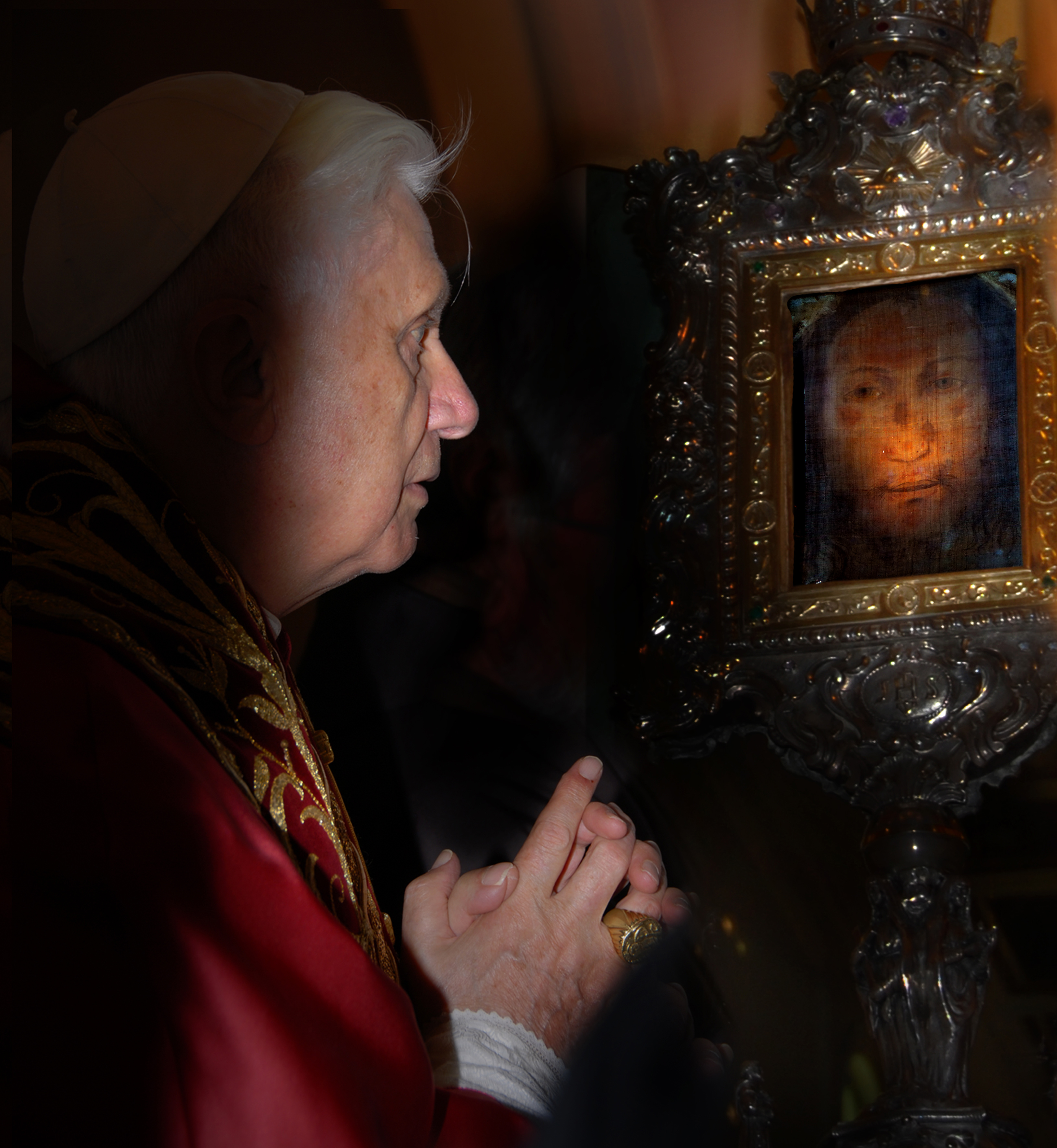
Pope Benedict XVI in prayerful contemplation before the veil of the Holy Face of Manoppello during a visit to the Basilica Shrine of the Holy Face in Manoppello, central Italy, September 1, 2006. (Photo: Paul Badde/EWTN)
***Important and exciting update on the Holy Veil of Manoppello:CNA Deutsch has reported a new discovery, in an article by Paul Badde, pertaining to “Il Volto Santo,” and the inexplicable presence of the Face of Jesus on the sheer veil, which has no traces of paint. An eminent German doctor, Gosbert Weth, has made non-invasive investigations on the relic, using a special nuclear medicine measuring device. The device measures alpha, beta, and gamma rays. Beta rays, which are invisible and energetic, are released during nuclear fission. It has been determined that the veil of Manoppello has such a high level of beta radiation that it fills the Basilica with it! It has also been observed that the veil gives off light in darkness. The upshot of this wonderful discovery is:The Veil of the Holy Face of Manoppello is a source of energy whose strength can be measured objectively.
I will post further details of Dr. Weth’s investigations very soon, but this is amazing news that should be shouted from the rooftops! Thanks be to God!
“O most awe-inspiring King, we bow before You and pray; May Your Reign, Your Kingdom, be recognized on earth.” (Host viewed through the miraculous Manoppello Veil the Holy Face, Photo: Paul Badde/ EWTN)
“Almighty ever-living God, whose will is to restore all things in your beloved Son, the King of the universe, grant, we pray, that the whole creation, set free from slavery, may render your majesty service and ceaselessly proclaim your praise. Through our Lord Jesus Christ, your Son, who lives and reigns with you in the unity of the Holy Spirit, God, for ever and ever.”
— Prayer for Feast of Solemnity of Jesus Christ, King of the Universe.
Novena to Christ the King
Almighty and merciful God, you break the power of evil and make all things new in your Son Jesus Christ, the King of the universe. May all in heaven and earth acclaim your glory and never cease to praise you.
We ask this through our Lord Jesus Christ, your Son, who lives and reigns with you and the Holy Spirit, one God, forever and ever. Amen.
Recite One Our Father, One Hail Mary, and One Glory Be per day followed by the Novena Prayer:
O Lord our God, You alone are the Most Holy King and Ruler of all nations. We pray to You, Lord, in the great expectation of receiving from You, O Divine King, mercy, peace, justice and all good things. Protect, O Lord our King, our families and the land of our birth. Guard us we pray Most Faithful One. Protect us from our enemies and from Your Just Judgment Forgive us, O Sovereign King, our sins against you. Jesus, You are a King of Mercy. We have deserved Your Just Judgment Have mercy on us, Lord, and forgive us. We trust in Your Great Mercy. O most awe-inspiring King, we bow before You and pray; May Your Reign, Your Kingdom, be recognized on earth.
St. Augustine in Meditation, Bartolome Esteban Murillo
“I have sought Thy face. I have sought for Thee and none other beside Thee. Thy face is my only reward. I will seek Thy face, O Lord: in this demand will I persevere. Indeed I will not look for any unworthy object, but only Thy face that I may love Thee more generously, because I find none other more precious. Thy face is the reward of the elect. The righteous shall dwell under Thine eyes, and when they will love Thy face, they will eat the bread of the sweat of their brow.
Let us return, wiping away the sweat, let us end the weariness and the weeping that we may shine in Thy all satisfying face. Neither let us search any more, because there is nothing better. Let us not abandon Thee, and we shall not be abandoned by Thee. Because what was said about the Lord, after the Resurrection? I will be filled with overflowing joy with Thy face, because without Thy face, there would not be joy for us.” ~ St. Augustine
Boticelli’s Deposition
From the Confessions of Saint Augustine, bishop:
“Lord, you know me. Let me know you. Let me come to know you even as I am known. You are the strength of my soul; enter it and make it a place suitable for your dwelling, a possession without spot or blemish. This is my hope and the reason I speak. In this hope I rejoice rightly. As for the other things of this life, the less they be lamented; and the more they deserve tears, the less likely will men sorrow for them. For behold, you have loved the truth, because the one who does what is true enters into the light. I wish to do this truth before you alone by praising you, and before a multitude of witnesses by writing of you. O Lord, the depths of man’s conscience lie exposed before your eyes. Could anything remain hidden in me, even though I did not want to confess it to you? In that case I would only be hiding you from myself, not myself from you. But now my sighs are sufficient evidence that I am displeased with myself; that you are my light and the source of my joy; that you are loved and desired. I am thoroughly ashamed of myself; I have renounced myself and chosen you, recognizing that I can please neither you not myself unless you enable me to do so.
Whoever I may be, Lord, I lie exposed to your scrutiny. I have already told of the profit I gain when I confess to you. And I do not make my confession with bodily words, bodily speech, but with the words of my soul and the cry of my mind which you hear and understand. When I am wicked, my confession to you is an expression of displeasure with myself. But when I do good, it consists in not attributing this goodness to myself. For you, O Lord, bless the just man, but first you justify the wicked. And so I make my confession before you in silence, and yet not in silence. My voice is silent, but my heart cries out.
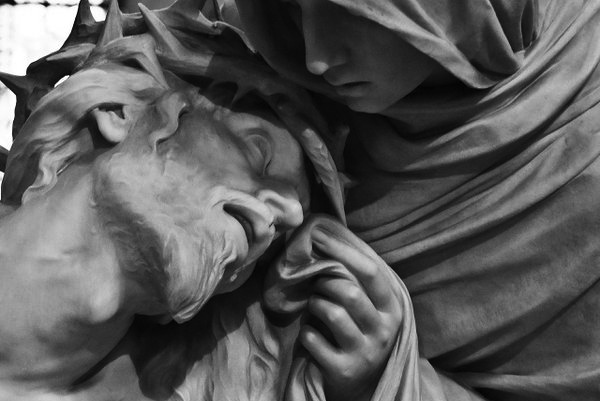
Joan Mates, Mourning over the body of Christ
You, O Lord, are my judge. For though no one knows a man’s innermost self except the man’s own spirit within him, yet there is something in a man which even his own spirit does not know. But you know all of him, for you have made him. As for me, I despise myself in your sight, knowing that I am but dust and ashes; yet I know something of you that I do not know of myself.
True, we see now indistinctly as in a mirror, but not yet face to face. Therefore, so long as I am in exile from you, I am more present to myself than to you. Yet I do know that you cannot be overcome, while I am uncertain which temptations I can resist and which I cannot. Nevertheless, I have hope, because you are faithful and do not allow us to be tempted beyond our endurance, but along with the temptation you give us the means to withstand it.
I will confess, therefore, what I know of myself, and also what I do not know. The knowledge that I have of myself, I possess because you have enlightened me, while the knowledge of myself that I do not yet possess will not be mine until my darkness shall be made as the noonday sun before your face.”
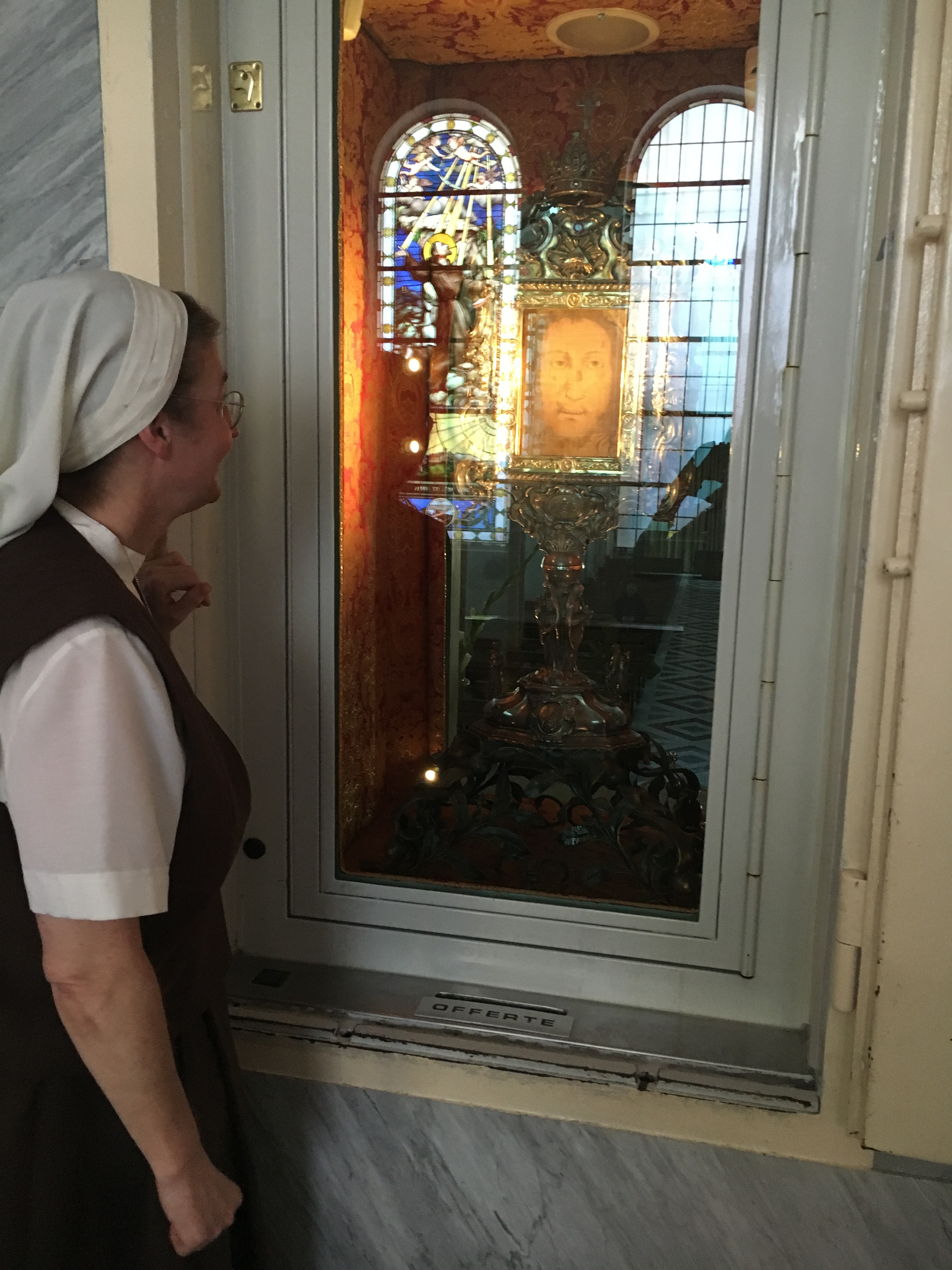
Sr. Petra-Maria before the Holy Face of Manoppello, Italy (Photo: Patricia Enk)
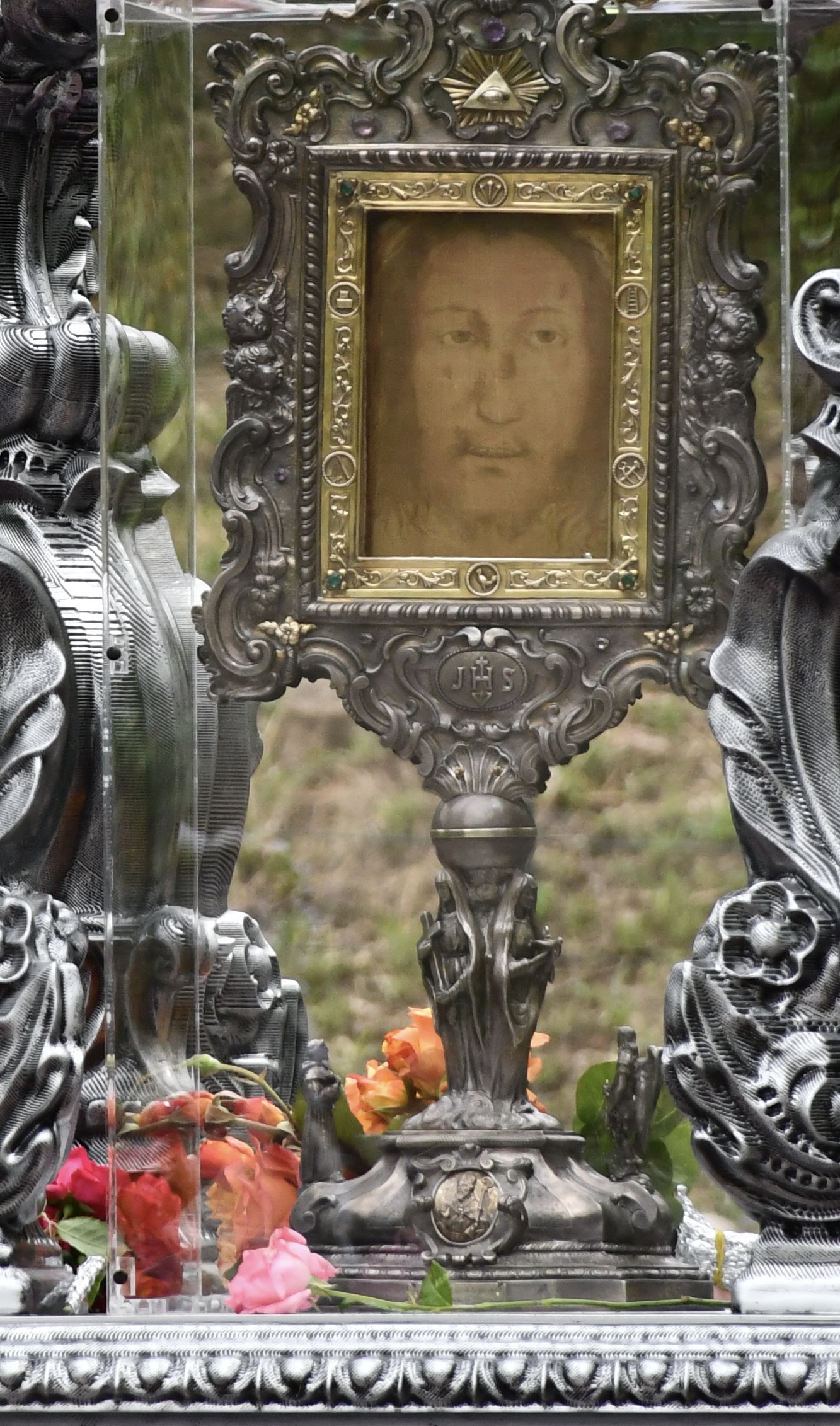
The relic Veil of the Holy Face (on left) carried in procession. (Photo: Alexandra Prandell)
Procession as it winds though the streets of Manoppello (Photo: Alexandra Prandell)
Little Angels accompany the Holy Veil of Manoppello (Photo: Alexandra Prandell)
Rose petals are dropped gently on the reliquary from above. (Photo: Alexandra Prandell)
A centuries old tradition is continued each May in Manoppello, Italy…
There are three solemn feast days celebrated each year to honor of the Holy Face in Manoppello, Italy: the “Transfiguration” on August 6th, “Omnis Terra” in January, and the May memorial of the mysterious arrival of the “Veronica” to Manoppello in the early 1500’s.
Capuchin friars surrounding the Holy Face (Photo: Alexandra Prandell)
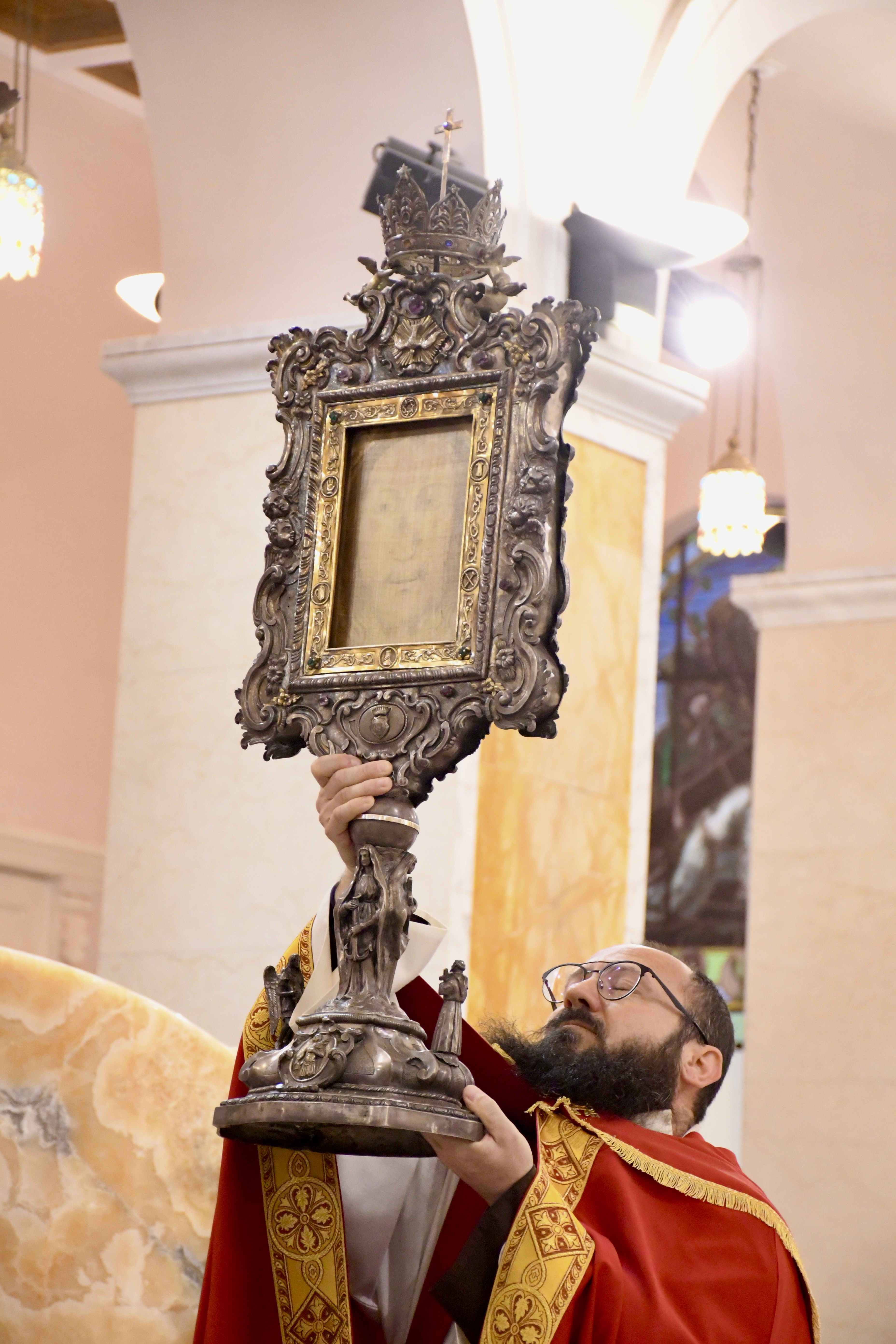
The Capuchin Friar and Rector of the Basilica Shrine of “Il Volto Santo” Padre Antonio Gentili raises the Veil of the Holy Face to bless the people. (Photo: Alexandra Prandell)
The Capuchin Friars minor have guarded the precious “Veronica” relic veil of the Face of Jesus since 1638, when “a devout and well-respected man” named Don Antonio Fabritiis donated the holy veil bearing the Face of Christ to the Capuchin monastery in the small, isolated mountain village of Manoppello. A document entitled Relazione Historica re-telling the local legend of the Veil was written by Capuchin Donato da Bomba and notarized in 1646 and then, certified by sixteen local witnesses. The story told of the arrival of the Veil in Manoppello, “in around 1506,”(the date was vague) in the hands of a mysterious stranger who was thought to have been a holy angel, who later, suddenly disappeared. (Aside from the “angel,” the main characters in the story have been historically verified.)
The recorded story told was this: “There lived in Manoppello the very famous Giacomo Antonio Leonelli, doctor in medicine…one day when he was out in the public square just outside of the door of the Mother church of the town of Manoppello, St. Nicholas Bari, in honest conversation with other peers, and while they were speaking a pilgrim arrived unknown by anyone, with a very venerable religious appearance, who having greeted this beautiful circle of citizens, he said, with many terms of manners, and of humility to Dr. Giacomo Antonio Leonelli that he had to speak with him about a secret thing which would be very pleasing, useful and profitable for him. And thus, taking him aside just inside the doorway of the church of St. Nicholas Bari, gave him a parcel, and without unfolding it told him that he ought to hold this devotion very dear, because God would do him many favors, so that in things both temporal and spiritual he would always prosper.” So the doctor took the parcel and turning towards the holy water fount carefully opened it, and “seeing the Most Sacred Face of Our Lord Christ…he burst into most tender tears…and thanking God for such a gift…turned to the unknown pilgrim to thank him…but he did not see him anymore.” When the good doctor, “shaken” and “filled with wonder,” went outside to his friends and asked where the man went, his friends replied that they never saw him exit the church. They searched high and low but never found the mysterious pilgrim, “hence all judged that the man in the form of a pilgrim to be a heavenly Angel, or else a Saint from Paradise.”
Photo taken of the Holy Veil during the night vigil by Alexandra Prandell.
— Relazione Historica
The Holy Veil remained the property of the Leonelli family for nearly a century, until a family member in need of money sold the Veil to Don Antonio Fabritiis, who in turn gave it to the Capuchins in 1638. The Holy Veil, called the “Il Volto Santo,” was kept in a dimly lit side chapel until the church was renovated in 1960, when it was decided that the Veil should be moved to a more prominent place behind the altar of the church of St. Michael, the Shrine of “Il Volto Santo,” which was elevated to the status of a Sanctuary Basilica by Pope Benedict XVI in 2006.
According to the light, the image fades on the sheer veil. (Photo: Alexandra Prandell)
The Face once again appears! (Photo: Alexandra Prandell)
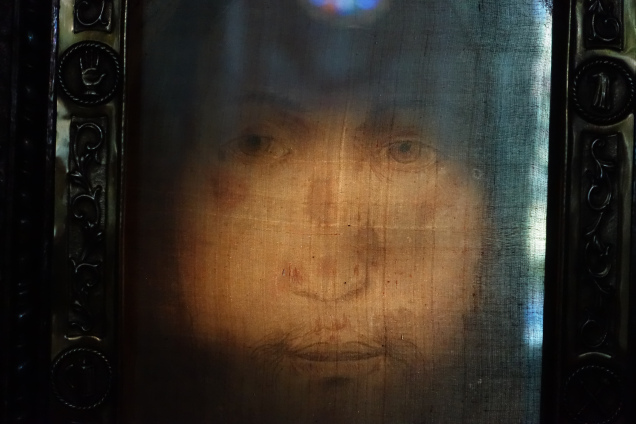
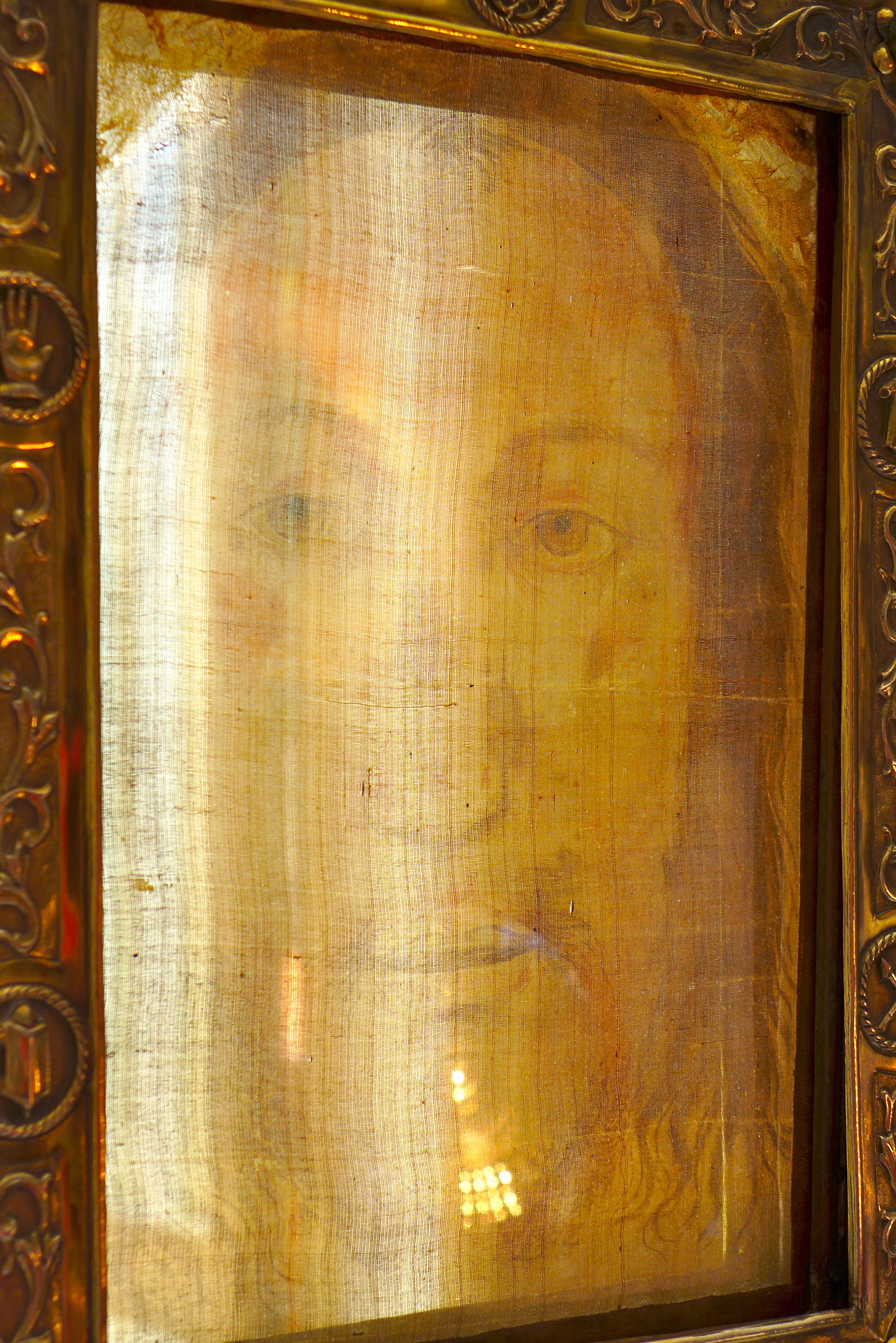
The veil is sheer enough to read through, and in light, can disappear, and yet miraculously appears on each side with subtle differences, such as the lock of hair at the forehead, and even greater differences in the eyes and the mouth. It is not humanly possible to reproduce the image with paint and retain its mysterious changeability as well as transparency. This image is known as an archeiropoieta–made not by human hand but by the Hand of God!
The Face of Christ on the Holy Veil of Manoppello (Photo: Alexandra Prandell)
Grazie mille!!! to Alexandra Prandell, who sent me so many marvelous photos from the festivities that it was very difficult to choose from them! To view more of Alexandra’s remarkable photos of the Holy Face Veil of Manoppello, Italy, please visit her Instagram account at this link: https://instagram.com/voltosantomanoppello?igshid=MmIzYWVlNDQ5Yg==
Holy Veil of Manoppello (Photo: Alexandra Prandell)
Veil of Manoppello, Photo: Alexandra Prandell
Crowds of pilgrims fill the Church as the relic of the Holy Face is brought in. (Photo: Alexandra Prandell)
Light streams through the veil from an open door. (Photo: Alexandra Prandell)
Veil of the Holy Face of Manoppello, (Photo: Alexandra Prandell)
Blessed be God! Now and Forever! (Photo: Alexandra Prandell)
The life of a Christian should be the faithful reproduction of Jesus in their soul — this radiant transformation is the work of love of the Holy Spirit. “Those whom He had foreknown He has also predestined to become conformed to the image of His Son.” (Rom 8:29) He who loves will resemble the thing loved…
Come Holy Spirit!
“God’s love has been poured into our hearts through the Holy Spirit who has been given to us.” (Rom 5:5) “Because we are dead or at least wounded through sin, the first effect of the gift of love is the forgiveness of our sins. The communion of the Holy Spirit (2 Cor 13:14) in the Church restores to the baptized the divine likeness lost through sin.” (CCC 734) The Holy Spirit perfects the soul with the first fruits of eternal glory–so we may more closely resemble Jesus Christ. No one has embodied these virtues more perfectly than the Blessed Virgin Mary, the Spouse of the Holy Spirit. She is the most perfect, pure, and faithful reflection of the Face of Christ.
In his classic work on the Holy Spirit, The Sanctifier, Archbishop Luis M. Martinez wrote of the the “mystical reproduction” that the Holy Spirit brings about in souls: “…because God gives a wonderful mark of unity to all His works…a most perfect unity shines forth from them because the are the fruit of wisdom. This divine contrast of unity and variety stamps the works of God with sublime and unutterable beauty.”
Jesus is reproduced in the soul of a Christian in the same way in which He was brought into the world–the way founded in love, caused by love, and which leads to love: “Jesus was conceived by the Holy Spirit…of the Virgin Mary. That is the way Jesus is always conceived.” That is the way He is reproduced in a Christian soul. Archbishop Martinez reminds us, too, that in order to resemble Christ, Our Lord, we must go through the pain and suffering of the Cross offered in love:
“He whom we love is a God nailed to a cross. Pain makes us resemble him. It is characteristic of love to have a tremendous desire to resemble the beloved. It is characteristic, too, for those who love to resemble each other.” But, as the soul is transformed, it is also filled with joy! Even as Mary suffered at the foot of the Cross she trusted, giving her “Fiat” as she had done at the Incarnation, with hope in the Resurrection; cooperating with God’s design. We, too, must be willing to cooperate with God’s design, as Mary did with docility to the Holy Spirit:
“After Christ had completed his mission on earth, it still remained necessary for us to become sharers in the divine nature of the Word. We had to give up our own life and be so transformed that we would begin to live an entirely new kind of life that would be pleasing to God. This was something we could do only by sharing in the Holy Spirit. As St. Paul writes: ““But we all with unveiled faces, reflecting as in a mirror the glory of the Lord, are being transformed into His very image from glory to glory.” “(2 Cor 3:18)— St. Cyril of Alexandria
The Apostles, “with one accord devoted themselves to prayer, together with the women and Mary, the Mother of Jesus.” (Acts 1:14) Mary, as our mother, will also intercede for us, as she did at the first Pentecost to obtain the gifts of the Holy Spirit: wisdom, understanding, counsel, fortitude, knowledge, piety, and for of the Lord. The Holy Spirit then perfects the soul with the first fruits of eternal glory: charity, joy, peace kindness, goodness, generosity, gentleness, faithfulness, modesty, self-control, and chastity–so we may more closely resemble Jesus Christ.
The Holy Face of Manoppello- photo: Paul Badde/EWTN
Divine Guest of our souls (photo: Patricia Enk)
This is the work of the Holy Spirit of Love, who is the the light and fire of the Face of God: to sanctify our souls, shining upon us the radiance of His light, transforming us into the His own likeness. Holy Spirit wants to dwell in us and convert our bodies into His temple, as He did in the Virgin Mary to bring grace, mercy, and peace. “Love is not a passing visitor who pays us a call and then goes away. He establishes in us his permanent dwelling and lives in intimate union with our souls as their eternal Guest.” (The Sanctifier by Archbishop Martinez)
As Jesus promised on the last night of His mortal life: “And I will ask the Father and He will give you another Advocate to dwell with you forever, the Spirit of truth whom the world cannot receive, because it neither sees Him nor knows Him. But you shall know Him because He will dwell with you and be in you.” (Jn 14: 16-17) So, let us remain, “with one accord in prayer,” with Mary as the Apostles did, for it is “through Mary the Holy Spirit begins to bring men, the objects of God’s merciful love, into communion with Christ.” (CCC 725)
Mary, Spouse of the Holy Spirit
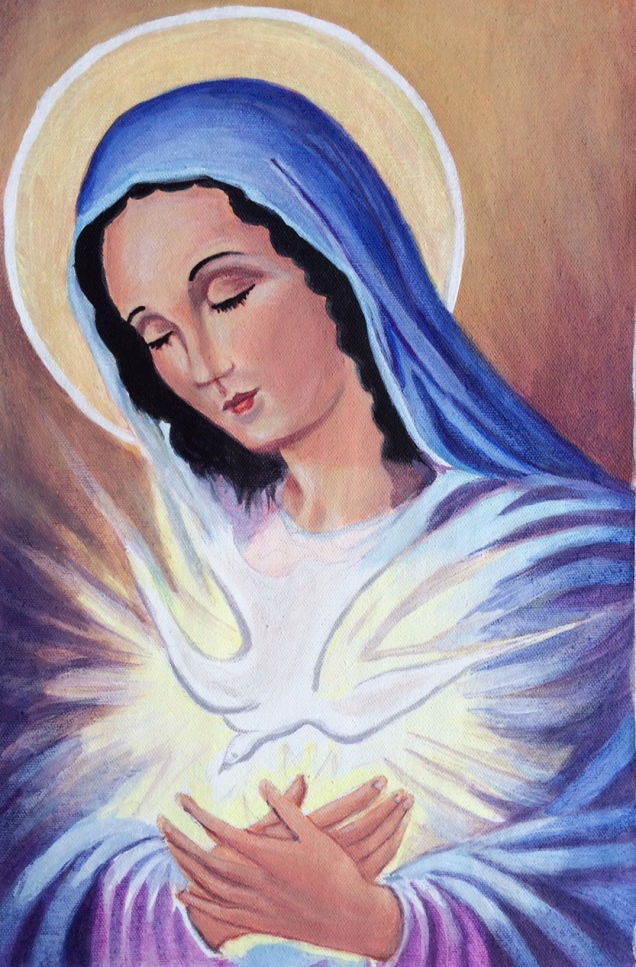
To Mary, Spouse of the Holy Spirit, Daughter of the Most High, Mother of God, faithful Spouse of the Holy Spirit — yet also Mary of Nazareth, Joseph’s wife, my mother– hear my prayer for grace, O Full of Grace. Pray your Spouse the Holy Spirit to come upon me — to shelter from all ill, to strengthen me to do what is right, to teach me all truth. Pray him come to me, and abide with me, and be within me a fountain springing up unto eternal life. May he sustain me in sorrow, sanctify me in life, and receive me at the hour of my death. Holy Mary, Mother of God, Mother of the Church, pray for us.
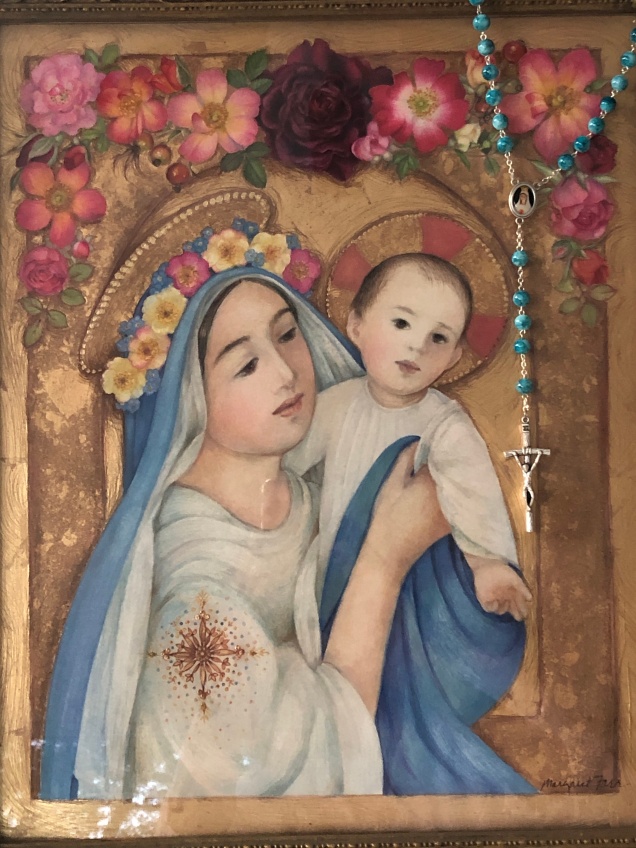
“Hail Mary, Full of Grace, the Lord is with Thee” (Photo: Patricia Enk)
Prayer to Mary, Mother of the Church and Mother of Our Faith
Mother, help our faith! Open our ears to hear God’s word and to recognize his voice and call. Awaken in us a desire to follow in his footsteps, to go forth from our own land and to receive his promise. Help us to be touched by his love, that we may touch him in faith. Help us to entrust ourselves fully to him and to believe in his love, especially at times of trial, beneath the shadow of the cross, when our faith is called to mature. Sow in our faith the joy of the Risen One. Remind us that those who believe are never alone. Teach us to see all things with the eyes of Jesus, that he may be light for our path. And may this light of faith always increase in us, until the dawn of that undying day which is Christ himself, your Son, our Lord!
–Prayer at the conclusion of the Encyclical Lumen Fidei
To those who placed idols before the living and true God, the prophet Micah warned: “One day they will invoke the Lord, but He will not answer them, and on that day He will hide His Face from them because of the evil of their conduct.” (Micah 3:4)
St. Veronica with Sudarium 1420
However, those who who honor and glorify God; those who seek and contemplate the Face of Jesus Christ — they will be transformed into His Image — According to Pope St. John Paul II this is the meaning of the action of the woman known as “Veronica” . The “Veronica” or “Vera Icon” historically referred the the image itself, however, there is a deep message imparted to each Christian in the legend of St. Veronica: each act of charity, every act of compassion will leave the imprint of the Face of Jesus in our souls, transforming us into His own Image.
“But we all, with unveiled face, beholding as in a mirror the glory of the Lord, are being transformed into the same image from glory to glory, just as by the Spirit of the Lord.”
(2 Cor. 3:18)
There is a “Vera Icon” or “True Image” of the Face of Christ, which is kept in the Basilica Shrine of the Holy Face in Manoppello, Italy. It is believed to be the sudarium cloth that covered Jesus head at his burial and found in the tomb after the Resurrection. All are invited to give honor and glory to God on January 28th, 2024, either in person, or via the internet, by joining in the celebration of “Omnis Terra” at the Basilica Shrine of the Holy Face…
“Omnis terra adoret te, Deus, et psallat tibi!”
“The whole earth adores you, O God, and sing hymns to you” (Ps 65:4)
The first “Omnis Terra” procession of Pope Innocent III in 1208 carrying “the Veronica” Face of Christ (from “Liber Regulae Sancti Spiritus in Saxia” manuscript 1350)*
Omnis Terra, is the Latin for “All the Earth.”The revelation of Jesus’s glory is the cause for all the earth rejoicing, giving praise to His Name! Omnis Terra will be celebrated with a solemn Mass and a procession at the Sanctuary Basilica of the Holy Face in Manoppello, Italy. The live-feed will begin at 11:00am local time (Rome time) Archbishop Bruno Forte will be presiding. A blessing will be imparted with the reliquary of the Veil of the Holy Face during the celebration. (Link for Live-stream here)
Since ancient times processions have been a reminder that our Christian life is a constant movement toward God and our eternal home. A procession is a type of pilgrimage and expression of beauty and piety that flows from the liturgy. There is power in this beautiful procession that terrifies the infernal foe and makes all of hell tremble.Processing with the Face of Jesus brings his whole person before us, and for all the earth to adore and glorify Him — to proclaim to the unbelieving world that Jesus Christ is LORD!
The world is not only unbelieving but publicly blasphemes God to His Face, and it is for this reason that Our Lord must be honored publicly. Whether it is within the confines of a church or through the city streets, the procession is a public function of faith, hope, and love. It is an antidote to the poison disseminated by our culture which falsely asserts that religion is “private” and not something to be brought up in polite society or in the public square.
“Vera Icon” Holy Face of Manoppello (Photo: Paul Badde/EWTN)
The “Living Face” becomes visible on the Holy Veil of Manoppello. Photo: Paul Badde/EWTN
The eyes following the onlooker — Holy Veil of Manoppello (Photo: Paul Badde/EWTN)
Il Volto Santo – The Face of Love and Mercy (Photo: Paul Badde/EWTN
“We process toward our heavenly home in the company of God. Procession is the function of faith, which burns in our hearts and beams in our faces, and makes our voices tremulous with emotion as our ‘Lauda Sion’ bids defiance to an unbelieving world.” ~Fr. Frederick W. Faber in his treatise on the Blessed Sacrament
Detail of Face of Jesus on the Holy Veil from the precious manuscript *”Liber Regulae Sancti Spiritus in Saxia”
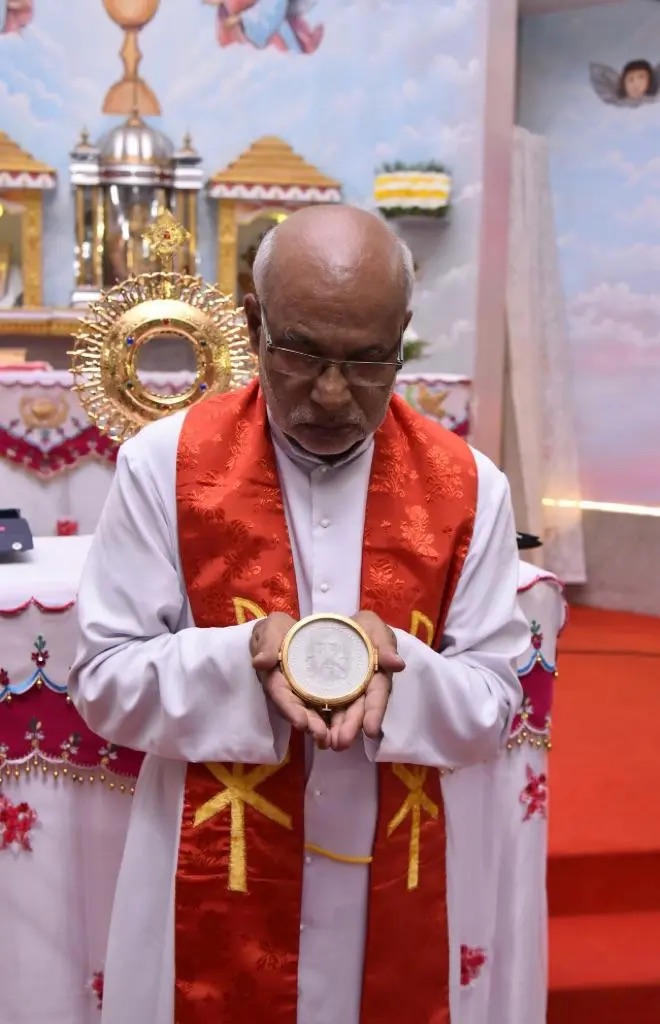
Archbishop Salvatore Cordileone holding the reliquary containing the Veil of the Holy Face of Manoppello on the occasion of Omnis Terra in 2019. Photo: Paul Badde/EWTN
“Do Whatever He Tells You, and You Will Spread the Face of His Love to the Whole World”
“The entrance chant for our Mass today – “All the earth will worship you, O God, and will sing to you, sing to your name” – happens to be the same entrance chant prescribed for last Sunday’s Mass, the Second Sunday in Ordinary Time, popularly referred to as “Omnis terra” Sunday, taken from the first words of the chant in Latin, as we just heard it at the beginning of Mass, “Omnis terra adoret te, Deus.” Every Mass has a prescribed entrance chant, usually a Scripture verse, very often from one of the Psalms, and the Mass gets its name from the first word or two of that chant (such as “Gaudete” Sunday and “Laetare” Sunday).
The Holy Face of Jesus
Why do I bring this up? It recalls a bit of Church history that underscores why Jesus came into the world. The story is told that in pre-Christian Rome the Emperor decided to have all Roman residents originally from other places take soil from their homeland and deposit it in a designated place close to the Vatican Hill, less than a quarter of a mile away. There he built a temple to honor the pagan Roman gods, as it contained soil from all the earth, “omnis terra.”
After Rome became Christian, the Pope built a church over that spot, which we know as the church of the Holy Spirit, and every year on that Sunday, “Omnis terra” Sunday, he would process from St. Peter’s Basilica to the church of the Holy Spirit with a veil bearing the face of Jesus. The veil in question was preserved from antiquity as one of the burial cloths that covered Jesus’ face, and was believed to be such an accurate representation of his face that it was called “the true icon of Rome,” in Latin, vera icona Romana: “vera icona,” whence the name, “Veronica.” This is how the story circulated later in the Middle Ages of a woman by that name who wiped our Lord’s face as he carried his Cross to Calvary.
There are many truly remarkable, even miraculous, features about this cloth that point to its authenticity, but that is a subject for another discourse. The point for us here today is that that procession instituted in the Middle Ages was to claim Jesus Christ as the one Savior of all the world, the Second Person of the Most Holy Trinity, the one, true God to whom all the earth owes worship and allegiance. This is the spiritual lesson of the ritual that developed around that veil.
The story of Veronica, though, also bears for us a spiritual message. As Pope St. John Paul II reflected in his meditation on the sixth Station of the Cross, every act of charity done in the name of Jesus Christ, with the spirit of his love, leaves the imprint of his image. This is how we translate the universality of the salvation Jesus won for us into language people can understand in our own time and place. The love of Christ is truly a universal language, understood everywhere and in every culture, leaving his image and thus changing both persons involved in that encounter of authentic Christian charity.”
Archbishop Ganswain holding the replica of the Holy Veil of Manoppello at Spirito Santo in Rome. 2016
History was also made on “Omnis Terra”(All the earth) Sunday in January of 2016, when bishops, priests, and pilgrims re-enacted the historic “Omnis Terra” Procession of Pope Innocent III (pictured above), carrying a reproduction of the precious image that many scholars identify with “the Veronica” or “true image” of the Face of Jesus. The pilgrim procession began at St. Peter’s in Rome and processed to Spirito Santo church and hospital, drawing attention especially to the Face of Christ in the sick and the poor.
On the occasion of the first “Omnis Terra” procession in 1208, Pope Innocent III wrote this beautiful prayer of devotion to the Veil of Holy Face of Jesus:
“O God, who has marked us with the light of Thy Face as your memorial, and at the request of Veronica, left us Thy Image imprinted on the sudarium; grant we pray, that by your passion and death, to adore, venerate and honor you, in mystery and as through a mirror on earth, so that we might be able to certainly see you, face to face, when you come as our judge.”
On “Omnis Terra” Sunday, January 15, 2017, history was made once again at the Basilica Sanctuary of the Holy Face in Manoppello, Italy, when a third solemn annual procession was introduced–in addition to the two solemn processions already observed in May (commemorating the arrival of the Holy Veil to Manoppello), and the solemn procession in August (on the Feast of the Transfiguration).
The addition of a third procession of the Holy Face at the Shrine of Manoppello is not only Trinitarian, it is a deeply significant and public witness of honor paid by the faithful to His Holy Face and thus also to the Holy Name of Jesus! May all of hell tremble at the sight of His Holy Face!
A Hymn composed by Pope Innocent III from the year 1216:
“Sancte Salve Facies”
Procession of Pope Innocent II in 1208 carrying “the Veronica” *Face of Christ (from “Liber Regulae Sancti Spiritus in Saxia” manuscript 1350)
Hail Holy Face of Our Redeemer on which shines the appearance of divine splendor impressed upon a little cloth of snowy radiance and given to Veronica as a standard of love.
Hail beauty of the ages, mirror of the saints, which the spirits of the heavens desire to see. Cleanse us from every stain of sin and guide us to the fellowship of the blessed.
Hail our glory amidst this hard life, so fragile and unstable, quickly passing away. Point us, O happy figure, to the heavenly homeland to see the Face that is Christ indeed.
Hail, O sudarium, noble encased jewel, both our solace and the memorial of Him who assumed a little mortal body–our true joy and ultimate good!
*The precious miniature manuscript “Liber Regulae Sancti Spiritus in Saxia,” was published around 1350 and is preserved in the State Archives in Rome. The illustration at the bottom of the first page of the Liber is one of the oldest illustrations of “the Veronica,” which depicts Pope Innocent III with “the Veronica” in his right hand and the Rule granted to the brothers of the hospital in his left. Prior to the Jubilee of 2000, the French medievalist Jacques Le Goff wrote, “Over the centuries Rome was enriched with notable relics. One in particular acquired an exceptional prestige: the sudarium of Christ known and revered by the name of “the Veronica.” The circumstances by which the image first came to Rome is a mystery but was mentioned for the first time under Pope John VII (705-707)
Hail Holy Face of Jesus, our Redeemer!
Update: The 2024 Novena of the Holy Face will be from Sunday, February 4th to February 12th. The Feast of the Holy Face for 2024 is Tuesday, February 13th. The Novena will be posted each day on the Home Page, which subscribers will receive by email. The Novena may also be found in the Menu above.




















 Illumina Domine Blog - Devotion to The Holy Face