“Abruzzo is a great producer of silence, wrote Georgio Manganelli.” Manoppello, Italy–hidden deep in the Abruzzo Mountains–had kept a secret: a holy relic veil of the Face of Jesus, treasuring and protecting it through five tumultuous centuries; effectively preventing it from being destroyed many times over. But now, in God’s Providence, the secret has come to light with the dawn of the millennium, which was dedicated to the Face of Christ by Pope St. John Paul II.
An eminent scholar, Fr. Heinrich Pfeiffer, uncovered the secret of Abruzzo and, at a great personal cost, presented his theses to the world. The news was embraced by some; and of course, rejected by others–there is nothing new in that. Opinions are like noses–everyone has one. We all make our own choices, for good or bad; but to make a choice, to believe or disbelieve, we first need an informed conscience, and the desire to know the truth in the first place.
For this reason Antonio Bini has published a free e-book (which is embedded below) which presents the background of the re-discovery of the relic of the Holy Veil of Manoppello bearing an image of the Face of Christ: “Heinrich Pfeiffer, The Scholar Who Recognized the Veronica in the Holy Face”. This essay commemorates Father Heinrich Pfeiffer (1939-2021), professor of Christian art history at the Pontifical Gregorian University in Rome and one of the leading contemporary scholars of the Church’s cultural heritage, who passed away in Berlin on November 26, 2021. With his studies on the Holy Face of Manoppello, which he identified as “the Veronica” (True Image).
Pope Benedict XVI contemplates the Face on the Veil of Manoppello. September 1, 2006. (Photo: Paul Badde/EWTN)
Pfeiffer was met with distrust and hostility from scholars and Church hierarchies for questioning centuries-old silences and beliefs regarding Christ’s burial cloths. The book reconstructs the author’s encounter with Fr. Pfeiffer, the background to the international press conference held in Rome on May 31, 1999, in which the scholar supported his theses. These attracted the interest of the media and many pilgrims to the sanctuary of Manoppello, which until then had been relatively unknown. Among these Pope Benedict XVI, This visit effectively confirmed the validity of Fr. Pfeiffer’s theses. The German Pope was impressed by his encounter with the Holy Face, immediately elevating the church to a basilica and dedicating an intense prayer a year after his visit.
References to the Sack of Rome are also included, when the Veronica disappeared from Rome, as the Vatican press office later admitted in 2011. The photographic and documentary material, much of it previously unpublished, is noteworthy. By the author’s wish, the book, a testimony to the events, is being distributed free of charge in English to promote broader knowledge of the Holy Face among the many interested in the recent history of the mysterious image.
“Once while some Israelites were burying a man, suddenly they saw a band of raiders; so they threw the man’s body into Elisha’s tomb. When the body touched Elisha’s bones, the man came to life and stood up on his feet.” (2 Kings 13:21)
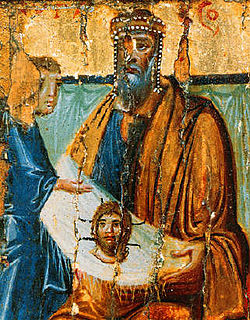
4th century fresco of the King of Edessa, who was healed of leprosy after being brought a miraculous face cloth of Jesus by St. Jude, according to one legend.
“So extraordinary were the mighty deeds God accomplished through the hands of Paul that when face cloths or aprons that touched his skin were applied to the sick, their diseases left them and the evil spirits came out of them.” (Acts 19: 1-12)
“A woman suffering hemorrhages for twelve years came up behind him [Jesus] and touched the tassel on his cloak. ‘She said to herself, ‘If only I can touch his cloak, I shall be cured.’ Jesus turned around and saw her, and said, ‘Courage, daughter! Your faith has saved you.'” (Mat 9:20-22)
The Catholic Church is often criticized for its veneration of relics, but who would not like to touch the “face cloth” mentioned in the Bible that St. Paul may have once used to wipe his brow, or touch the hem of Jesus’s garment? A letter written by Pope Pelagius II in the sixth century declared that any common object placed in contact with the grave of a saint would acquire its sanctifying power. St. Helena discovered the True Cross when God used that relic to bring a dead man from death to life the moment his body came in contact with it.
“How do we know if a relic is true?”
That is a question often heard regarding purported relics. Skeptics often cite the many dubious relics that were forged; such as the “heads” or “teeth” of St. John the Baptist that abounded in the Middle Ages. While the Church wants to treasure and preserve what is genuine, it also seeks answers to the question, “How do we know…?” How does the Church determine the authenticity of a relic? Outside of a miracle, today there are many forms of scientific research, such as carbon dating, that are now available. Naturally, this is a very controversial subject, as testing done the wrong way could degrade or destroy the relic itself. It may also be a very risky business spiritually, with a potential to do something far worse: Disputes over a relic’s authenticity or errors in testing have caused scandal, resulting in the loss of faith of many individuals.
Then, there are also many classes of relics to be considered: Relics are divided into three classifications. A first class relic is a body part of a saint, such as a bone, blood, or flesh. Second class relics are possessions that a saint owned, and third class relics are objects that have been touched to a first or second class relic or to the saints himself or herself. In verifying relics, there is also the great risk to be considered in exposing what may be a very precious ancient relic to invasive tests that could further degrade the relic. Great care must be taken, not only to preserve and protect the Church’s treasures, but also the souls of the faithful. This is why the Church sometimes moves so slowly in these matters.
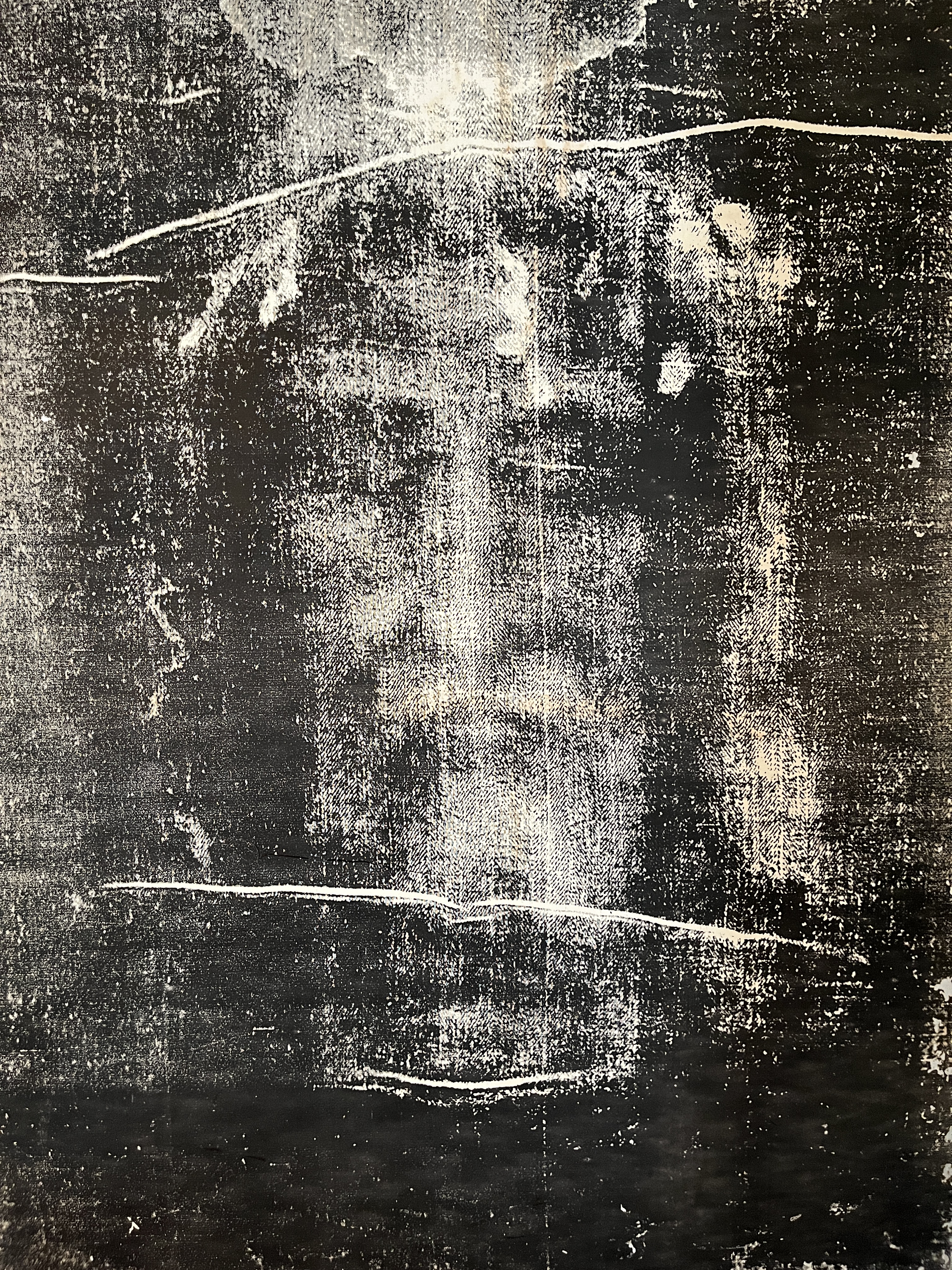
Digital scan of the Face of Christ on the Shroud of Turin
Despite the many scientific advances in carbon dating, and other testing, errors have been made in the past which have led to false results causing a great deal of harm; as was the case in the false carbon dating of the Shroud of Turin to medieval times, which made front page news at the time, labeling the Shroud of Turin a medieval fraud. It was later proven that the sample for the carbon dating of the Shroud was actually taken from a repair patch, and not the original shroud, which, when re-tested, was then dated to the first century–making the back page news, of course.
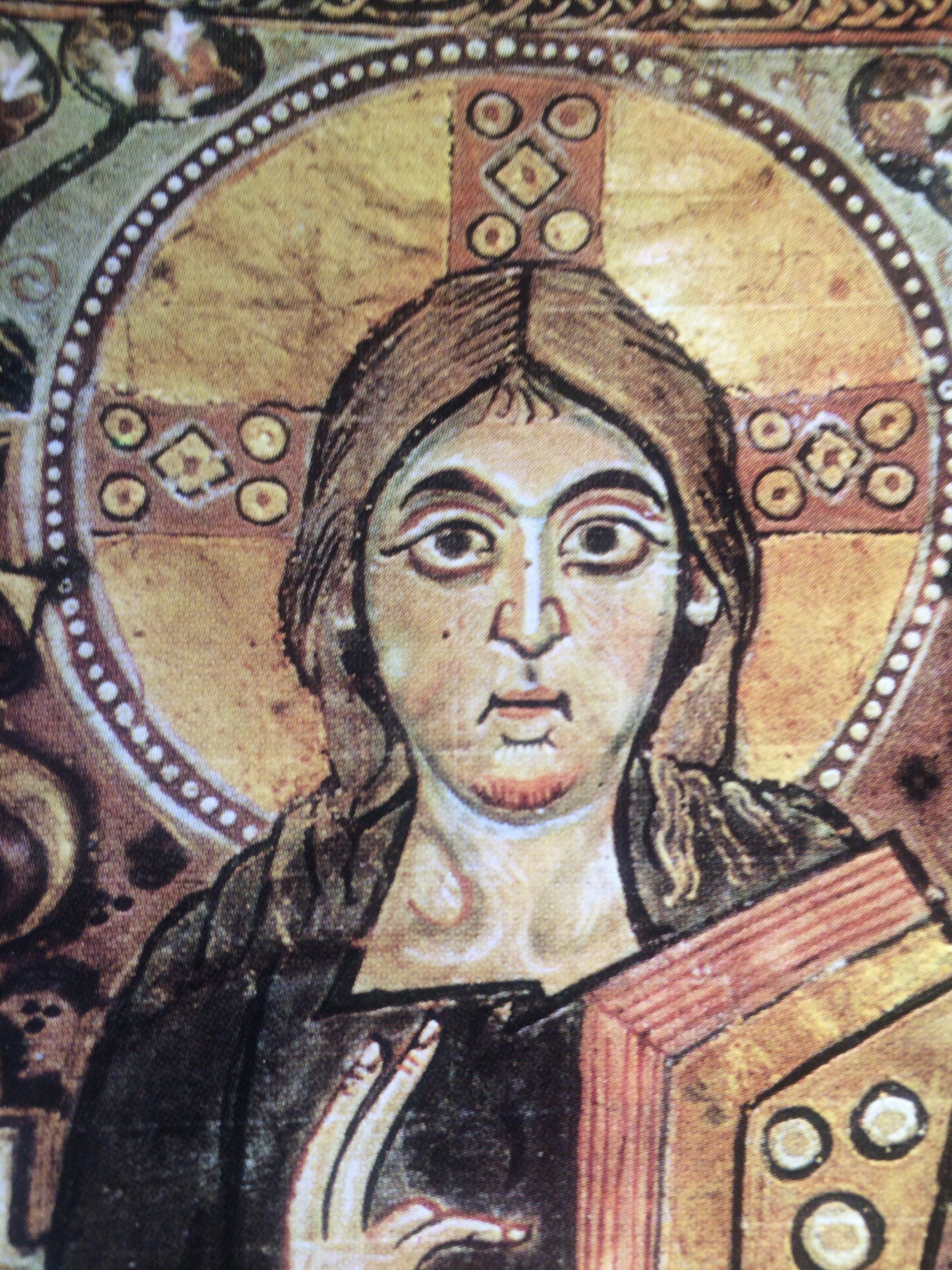
Face of Jesus known as the “Uronica” in the “Holy of Holies Chapel of Sancta Sanctorum in Rome.
Recently, the testing of relics is once more in the news. Most people who have traveled to Rome are familiar with the “Scala Sancta” or the “Holy Stairs,” near St. John Lateran. They are twenty-eight marble steps that were brought from Jerusalem that lead up to a chapel known as “Sancta Santorum or Holy of Holies.” Named for the original place in Jerusalem that contained the ark of the covenant, the chapel is said to contain the some of the holiest relics in Christendom, including relics of the earliest martyrs, and the “Uronica,” an “acheiropoieta,” not made by human hands, of Jesus, Ruler of the Universe, attributed to St. Luke–which, “according to legend,” was finished by the angels. In 816, Pope Leo III placed the reliquary box under the altar of the chapel. The relics remained hidden there, until 1903, when Pope Leo XIII permitted experts to examine them. It turned out to be an arduous task, and, unfortunately, later important data was lost due to a rivalry between French and German scholars. To protect the relics from falling into the wrong hands, they were eventually moved to the Vatican Library, and then, to the Vatican Museum.
Barbara Jatta, head of the Vatican museums, recently gave a press conference, on May 23, 2024, on the Catholic Church’s attempt to bring some “clarity and provenance” to two of the ancient relics that had been kept for centuries in the “Holy of Holies” chapel: the relic tunics of St. Peter and St. John the Evangelist. Jatta announced a new permanent exhibition that will display these two purported relics and the tests they have undergone that have shed light on which of the two may be authentic: EWTN Vatican has a good article by Matthew Santucci summarizing the conference: “The Tunics of St. Peter and St. John, Two Extraordinary Relics of the Sancta Sanctorum.” The Vatican Museum should be applauded for this admirable work that has been carefully carried out in pursuit of the truth.
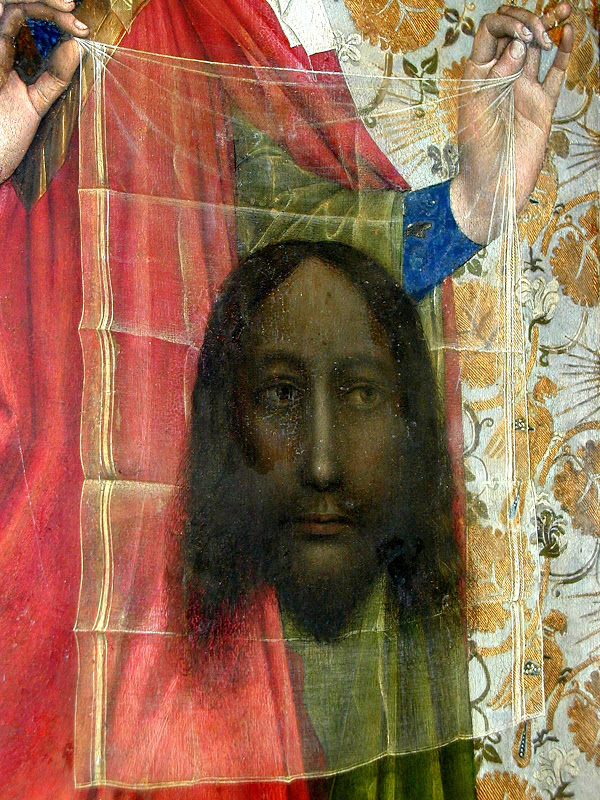
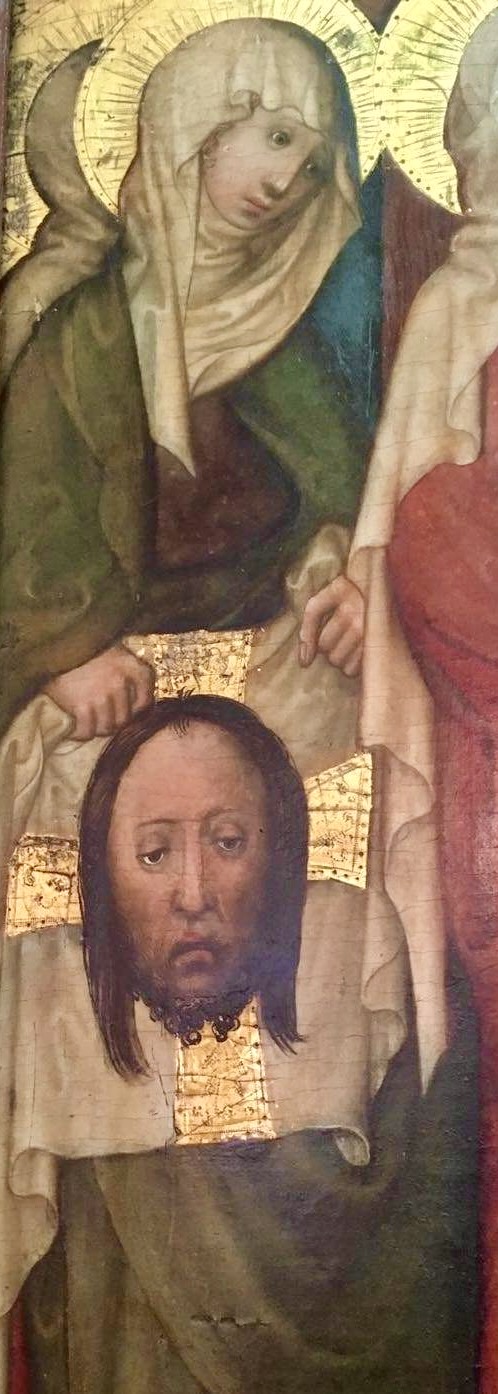
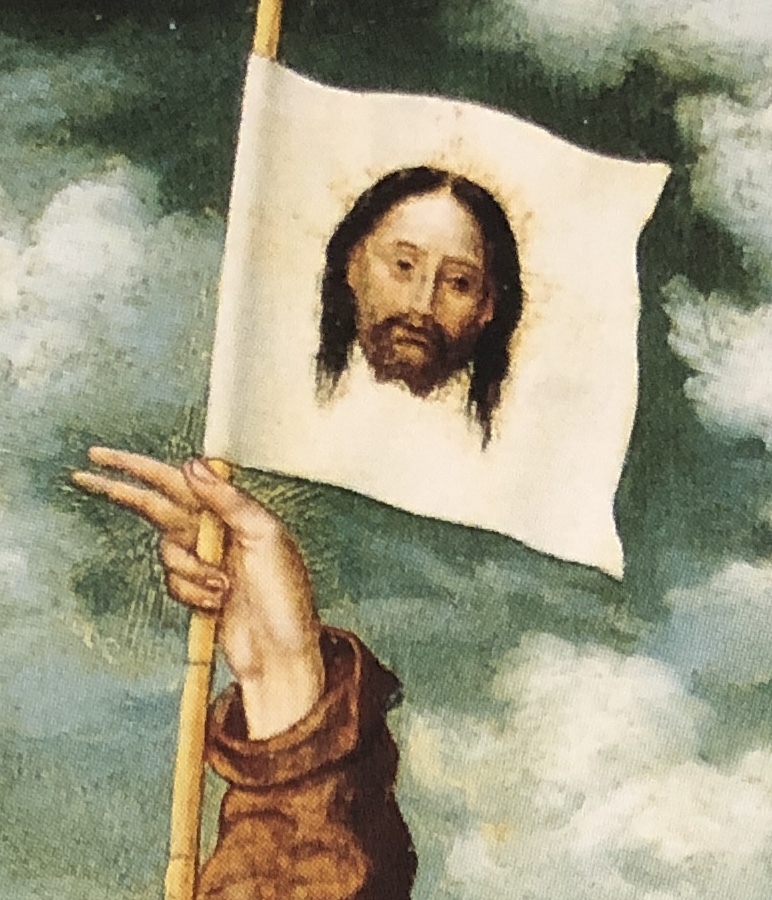
Note the distinctive folds of the veil in this painting detail.
“The Veronica Veils” and the question of which relic is true?
One hopes that the Vatican Museum will continue to seek the truth in the case of other controversial relics, by whatever reasonable means are available, to discover their origins. The issue of testing relics has increasingly been brought up in the case of two “Veronica Veils:” one, held at the Vatican, and another, known as the “Veil of Manoppello.” Acrimonious debates that have erupted in recent decades regarding the two veils have caused division among many Catholic devotees of the Holy Face. Some claim as well that the authority of the Church on the subject the devotion to the Holy Face ended with Pope Leo XIII; thus, passing over what has been been uncovered or written about regarding the devotion since that time, including: the discoveries and research on the Shroud of Turin, or writings by Pope St. John Paul II, Pope Benedict XVI, or Pope Francis; thus, making it very difficult to enter into dialog on the subject. It will ultimately be for the Church to decide whether or not to investigate the relics to help provide the “clarity and provenance” needed to confirm their authenticity.
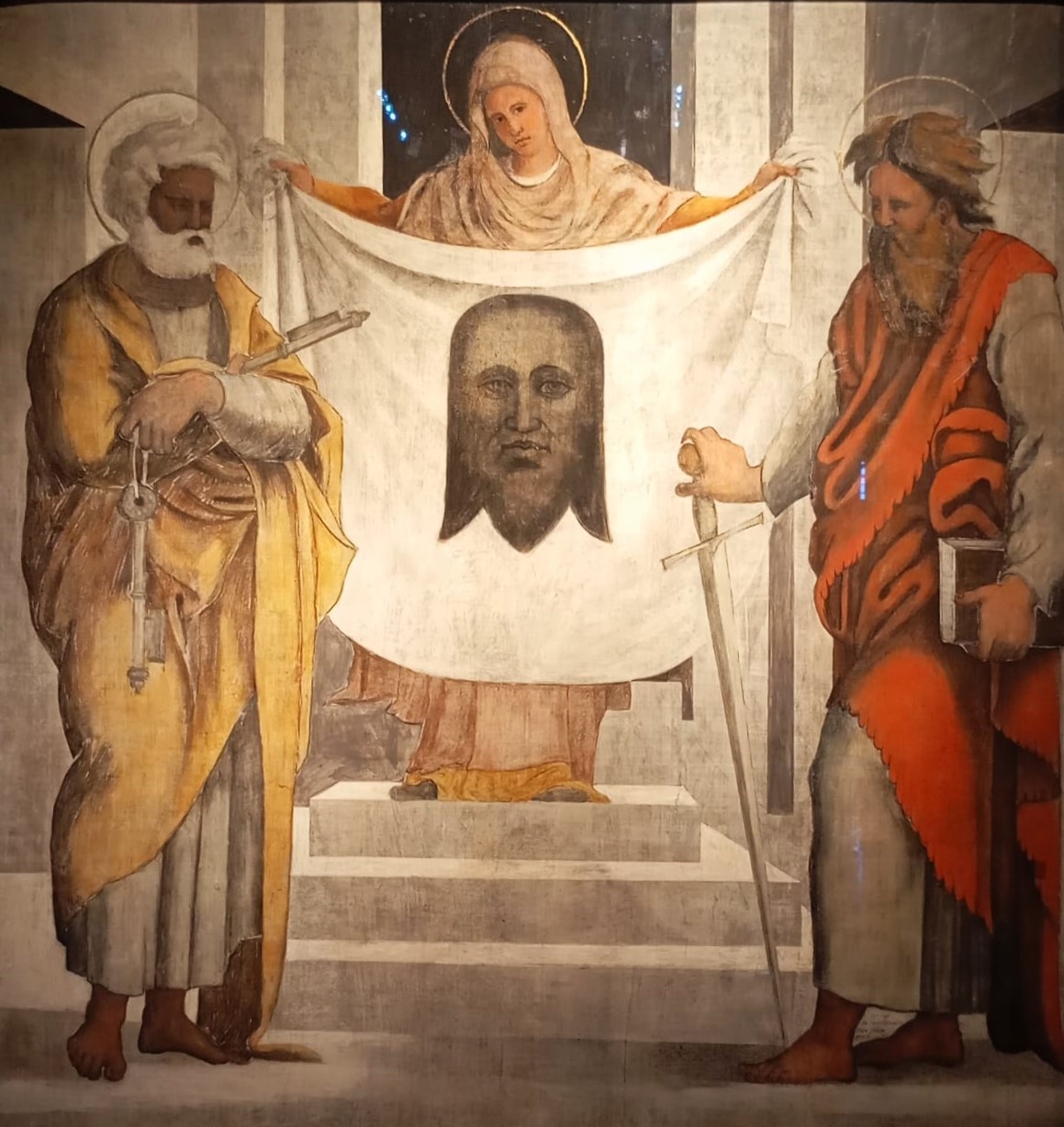
Fresco of ciborium that existed in 708 containing sudarium of the “Veronic” True Icon
The authenticity of the Vatican relic of the “Veronica Veil” has come into question due to the abundant historic research that points to the relic “Veil of Manoppello” as being the original “proto-image” for icons, frescos, and paintings of the face of Jesus, as seen in so many of the earliest works of art depicting the “Veronica”; such as the “Liber Regulae Sancta Spiritus in Saxia,” or in other more ancient works, such as the “Godescic Manuscript” of 781, both pictured below:
Godescic Manuscript, 781
This illustration of the first public procession of the “Veronica” on the feast of “Omnis Terra” (All the Earth), depicts Pope Innocent III, in 1207, carrying the crystal reliquary displaying the “Veronica Veil” (from “Liber Regulae Sancti Spiritus in Saxia” manuscript ,1350).
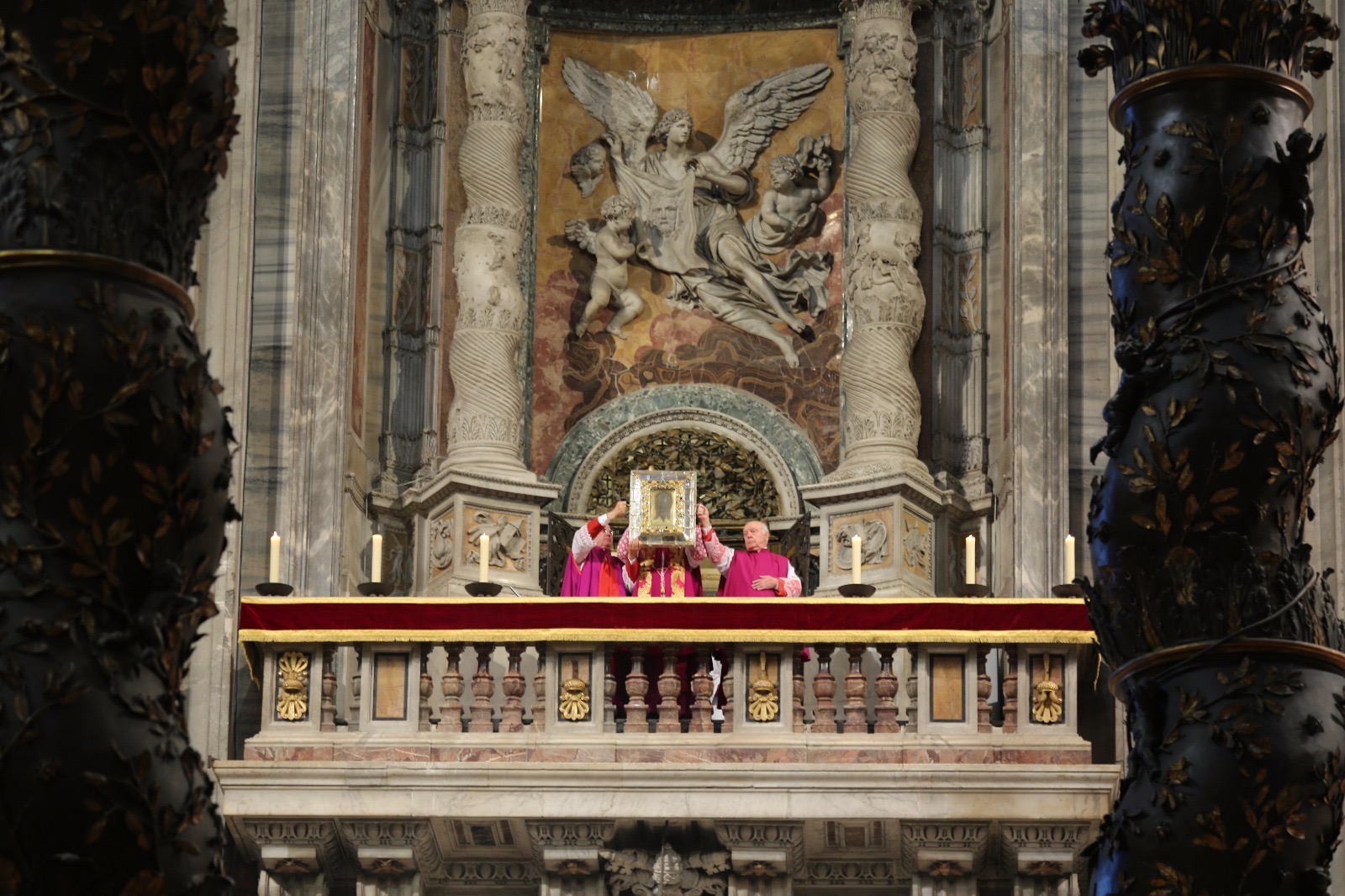
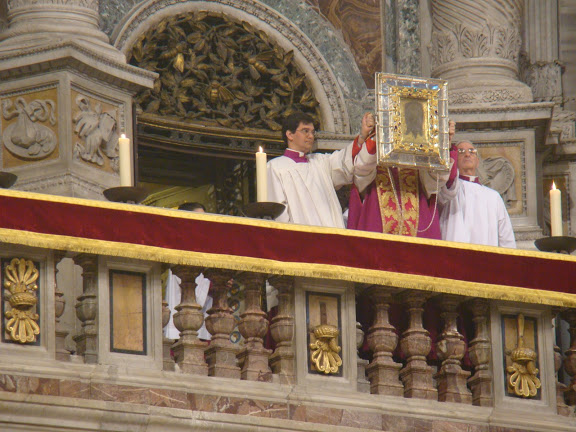
The Vatican “Veronica veil” is displayed at a great distance during Holy Week. No face can be discerned on the darkened cloth that is displayed in a face-shaped frame.
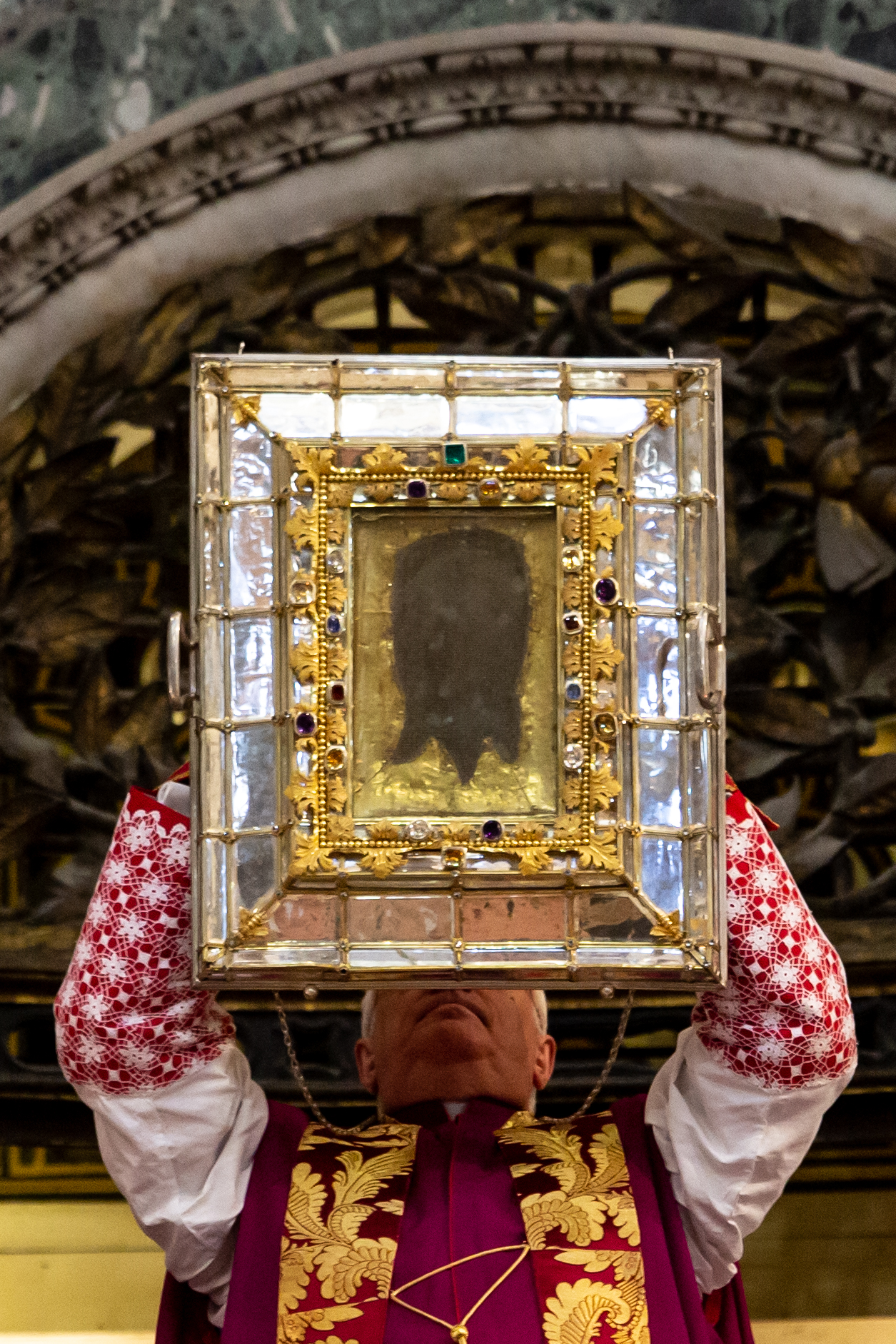
A closer look at the Veronica Veil being presented for veneration at the Vatican, April 7, 2019. Photo: Daniel Ibanez
First, in order to explain anything about the images known as “Veronicas,” it must be understood that the Church has a very rich 2,000 year history, and that there are hundreds, if not thousands, so-called “Veronicas” representing the true image of the Face of Christ in museums, churches and basilicas. Secondly, the term “Veronica” refers to the image itself, and not a Saint called Veronica. The various legends of a St. Veronica did not appear until the Middle Ages. There a many, many earlier legends that name other persons such as woman named Hypatia, who drew the miraculous image from a well; or a woman named Bernice, whose name is associated with the woman with the hemorrhage in the Gospels; or St. Jude; who was said to bring the Holy Face Veil to the King of Edessa to cure him.
The Veronica, Hans Memling, 1479
“These pious traditions cannot be documented, but there is no reason why the belief that such an act of compassion did occur should not find expression in the veneration paid to one called Veronica.” —The Catholic Encyclopedia
Pope St. John Paul II explored the deep meaning behind these legends before he dedicated the millennium to the Face of Christ (Found here) and has written beautifully on the compassionate woman who is known as “Veronica” and what the significance the Image of the Face of Christ on the veil has for Christians. Most “Veronica” images are copies of an original or “proto-image,” others are imaginative, and a few are believed to be of Divine origin, that is, “made by God’s Hand.” Only one, however, can be the original and true image.
For centuries following the first time the Veil was publicly displayed and processed by Pope Innocent III in 1207 any pilgrim could see for themselves the Holy Face of Jesus on a Veil from either side of the sometimes transparent veil. Artistic works also called “Veronicas” were produced at that time for the many pilgrims who flocked to Rome to gain an indulgence by seeing the relic Veil for themselves…and take home a souvenir, of course, of a copy for themselves, or for their local Church. That was up until the Sack of Rome in 1527, when it was feared that the Veronica Veil had been stolen:
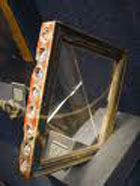
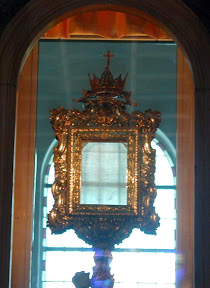
The broken crystal frame that displayed the Veronica, from the Vatican Museum
“A letter written to the Duchess of Urbino by her representative, Urban, dated May 21, 1527, reads, ‘Holy relics have been thrown out onto the streets. The Veronica has been stolen and passed around in taverns from person to person without a word of protest‘”
The large reliquary framed that was created to display the miraculous image from both sides, between two large crystal panes, was found broken. (It is now on display in the Vatican Museum.) When the dust settled, following the Sack of Rome, the image was no longer displayed publicly. Pope Paul V, in 1616, prohibited any copies to be made of the Veronica without permission, and later Pope Urban VII ordered that all copies of the Veronica be handed in to a local priest or bishop under pain of excommunication. In 1629, a noticeably different image with a death-like face was placed in the newly completed Veronica Altar in St. Peter’s basilica–covered with another outer veil–and a notice was placed nearby stating that anyone who removed the veil covering the Holy Face without papal approval would be excommunicated. Some have speculated that the “outer veil” mentioned may have been what remained after the Sack of Rome, and put in the place of the original, or possibly another of the many copies was put in its place–but that is only speculation. The facts were that from then forward, the darkened image was then only shown rarely, once a year from a distance of 20 meters, and its appearance was quite different than what was seen and copied by artists previously. In fact, the difference between early and later depictions of the “Veronica” was shocking. Not surprisingly, the interest in the Veronica and therefore devotion to the Holy Face soon dwindled.( More detail found in “Four Stories–One Face”)
Veronica’s Veil 1420 as it was depicted in paintings prior to the Sack of Rome.
BERTRAM, Holy Face c. 1390-1400
Painting made after the Sack of Rome, in 1617, by Pietro Strozzi
Painting of Veronica Veil which bears strong resemblance to the Holy Veil “Il Volto Santo” of Manoppello, Italy.
Which is the original “true image?” The two relic veils now in question are the Vatican “Veronica Veil” and the “Il Volto Santo” Holy Face Veil of Manoppello, both claiming to be the original Veil of the Face of Christ:
The Vatican “Veronica Veil” which is housed in St. Peter’s Basilica’s “Veronica Pillar” is a darkened brown cloth, in a frame shaped like a face. Pilgrims are now only permitted to see this relic from a great distance. The cloth does not appear to be transparent, and is only shown from one side. It’s measurements are larger than the original, broken frame.
The Vatican Veil Being displayed for veneration
During the exile of the Pope Pius IX at Gaeta in 1849, he ordered that the Veronica Veil be exposed, at a time of crisis, for public prayer and veneration, from Christmas to Epiphany. On the third day of exposition, the Veil, which had darkened to the point that a face could no longer be discerned, became visible, as if it were illuminated by a soft light. The Pope invited artists to make copies of the miraculous image, which were later touched to the relic of the veil, as well as the relics of the Passion, held in the Veronica Pillar at the Vatican.
This image is often associated with the revelations of of Sr. Marie St. Pierre, who died in 1848, and so had never seen the drawings. The “Epiphany Miracle,” as it was called, was regarded by some as a confirmation of her revelations regarding her devotion to the Holy Face. Although many of the prayers related to her revelations were approved, her writings as a whole were not. Sometime later, a layman, Leon Du Pont, who was a friend of Sr. Marie St. Pierre, placed an oil lamp before a reproduction of the image in his home. “The Holy Man of Tours,” as he was known, prayed for the sick there, and anointed them with oil from the lamp. It was said that hundreds of cures were obtained through his intercession before the image. St. Therese of the Child Jesus and the Holy Face had a copy of the image pinned to her bed curtains as she lay dying. She and her family had a great devotion to the Face of Jesus, and belonged to the Archconfraternity of the Holy Face that was in existence at that time, and into the 20th century, but no longer exists today.
“Vera Effigies” drawing of the wounded Holy Face, depicting closed, weeping eyes, and slightly parted lips. The upper forehead and other artistic elements were an imaginative addition to what was originally viewed by witnesses.
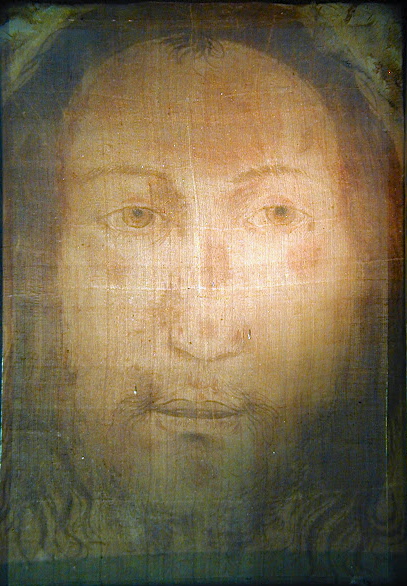
The Holy Face on the Veil of Manoppello (Photo: Paul Badde)The distinctive lock of hair, and folds on the veil may be seen in this photo.
Transparent Veil of Manoppello
The other “Veronica” relic is the Holy Veil of Manoppello. It is not a painting; the image is truly present in a mysterious way on a sheer veil, made of a precious sea-silk called byssus. The Veil and Image itself are a “miracle of light:” the delicate veil, held between two panes of glass, can appear transparent. The image of the Face appears and changes according to light and the direction from which it can be viewed from either side. The veil closely matches centuries-old artwork and written accounts of those witnesses who made pilgrimages to Rome when the “Veronica” was publicly displayed–including written accounts and works of art dating to the early Church–before the veil was known as “the Veronica,” but was known by other names such as the Camulia, or the Edessa, or the Mandylion. The veil was once much larger, but was trimmed down over the centuries. The wounded, yet peaceful countenance of Jesus is visible with open eyes and parted lips, sparse beard, wavy hair, and a distinctive lock of hair at the center of the forehead, which is often depicted in many eastern icons, and paintings of the face of Jesus through the centuries. The Manoppello Veil is not a painting, but an “achieropoieta”–an image not made by human hands.
Hand seen from the other side of the Veil of the Holy Face of Manoppello–which is so sheer a newspaper can be read through it. Photo: Paul Badde
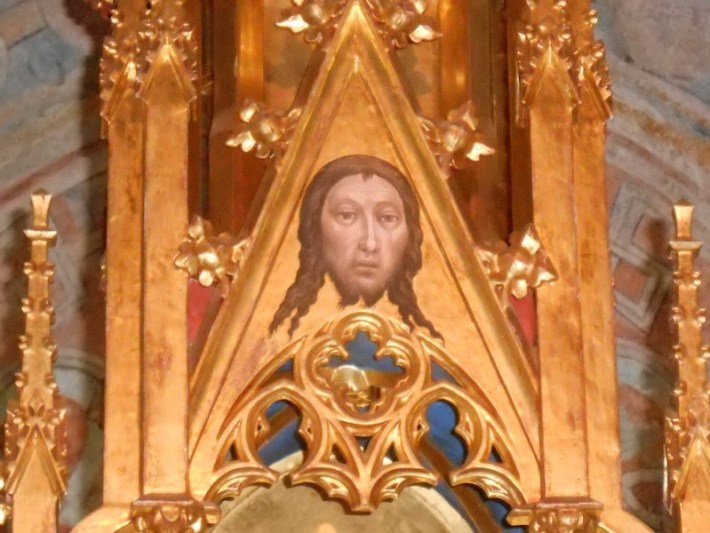
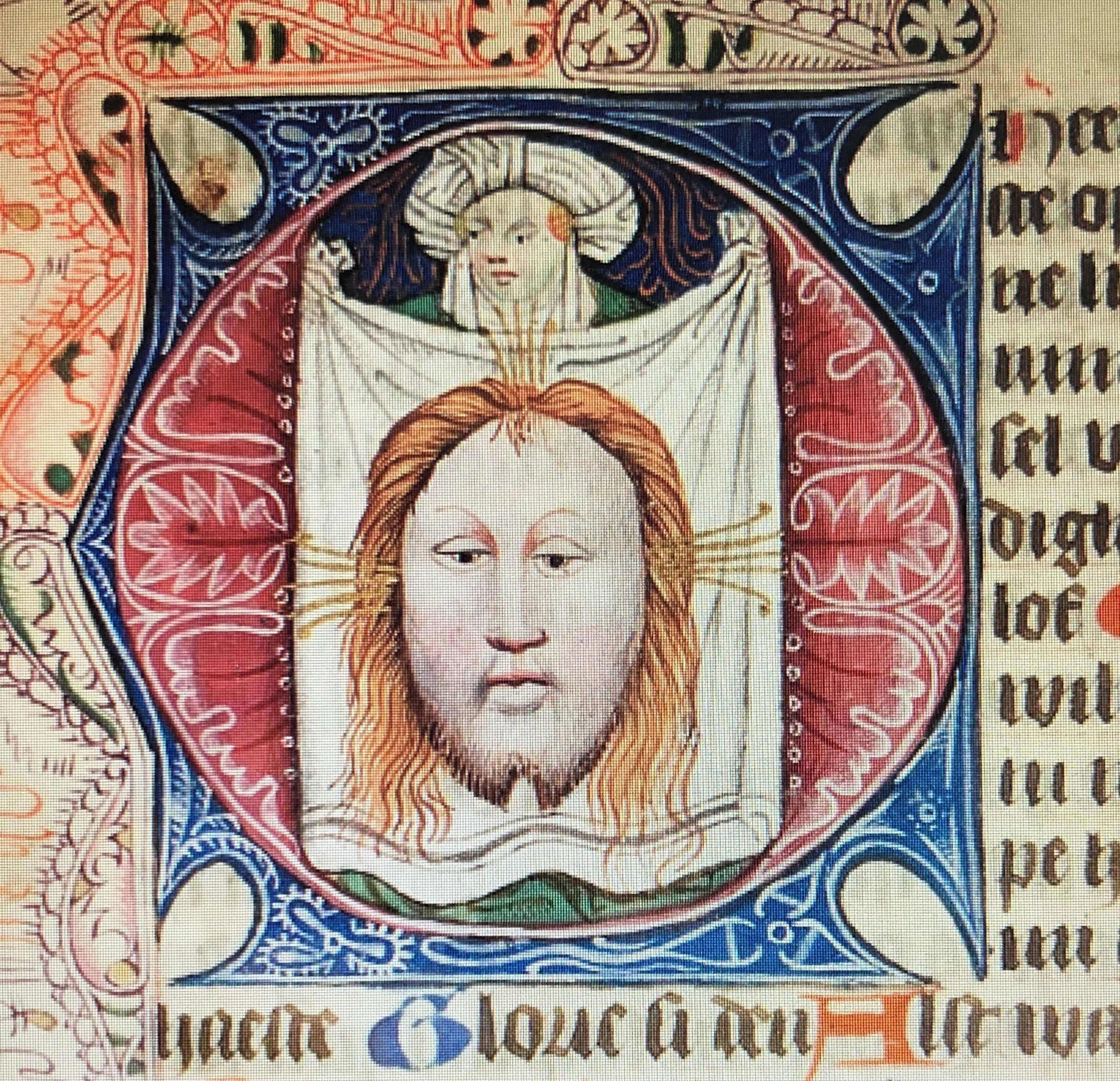
Copy of the “Veronica” from 1373 painted on an altarpiece with the distinctive lock of hair at the center of Jesus’ forehead…
…Also seen in this beautiful depiction of the Veronica that is in the Getty Museum…
…as well as this manuscript and many others.
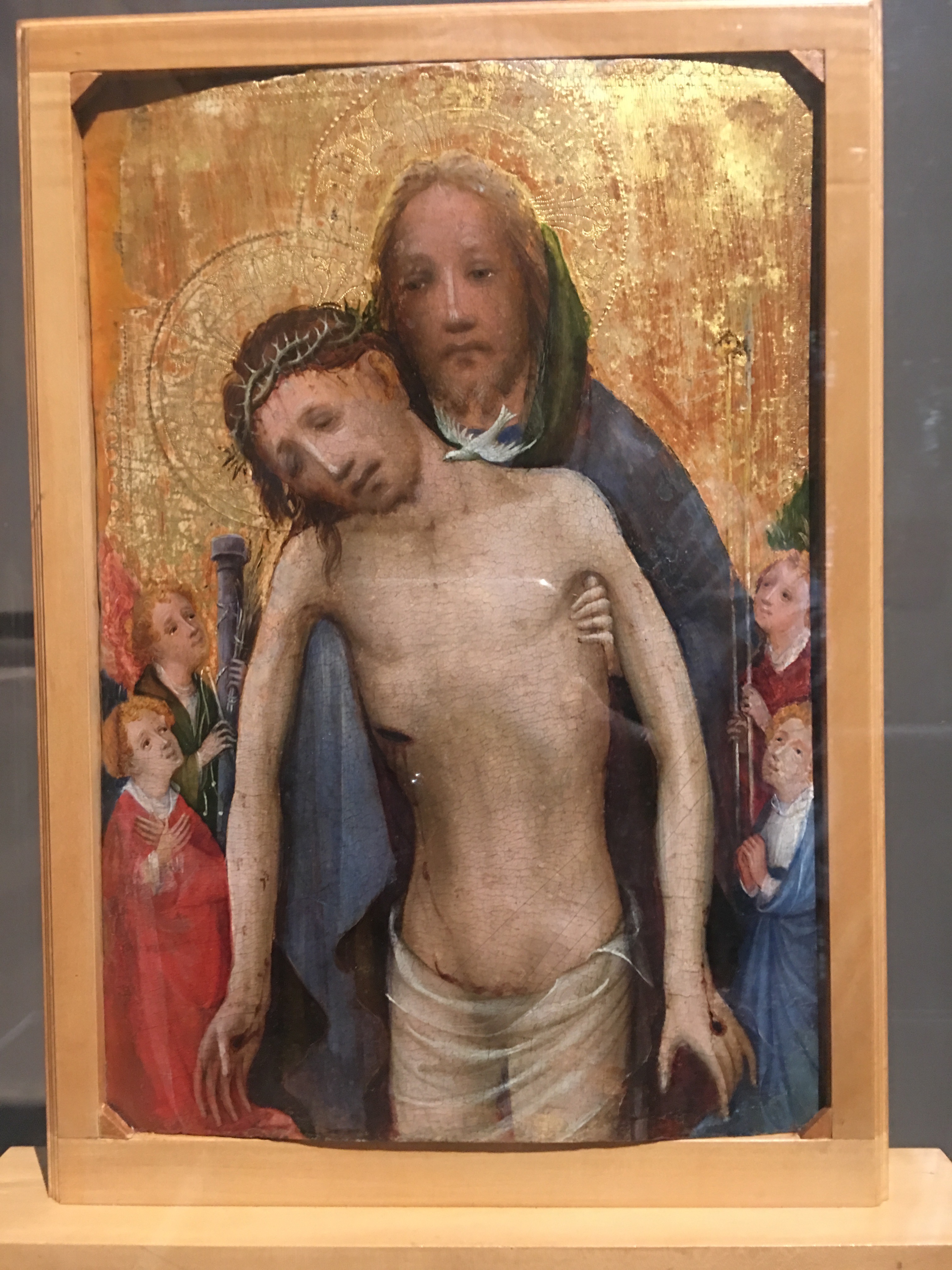
In this remarkable “Meister of St. Laurenz” painting of the Holy Trinity, the faces of both God the Father and the Son are portrayed similarly, each bearing a strong resemblance to the face on the Holy Veil of Manoppello. Photo taken in Cologne, Germany by Paul Badde.
The late, highly respected Heinrich Pfeiffer S.J. was an eminently qualified teacher of art history and Christian iconography at the Pontifical Gregorian University in Rome. He was also an expert “sindonologist.” Sindonology is the study of the Shroud of Turin, which is its own branch of science. In the course of his many years of research he traveled to the Shrine of the Holy Face in Manoppello. Upon seeing the Veil for himself, he immediately recognized it as the “proto-image” or original from which most icons, paintings, and other representations of “the Veronica” had been derived. The incredible “Veronica” of Manoppello was believed to be the veil that covered the Face of Jesus in the tomb. (Author Paul Badde has written much about this search for the “rediscovered face” in his books: The Face of God – the Rediscovery of the True Face of Jesus, The True Icon: From the Shroud of Turin to the Veil of Manoppello, and The Holy Veil of Manoppello: The Human Face of God.)
Christ’s Face being covered with a sheer veil or sudarium in the tomb.
When, as a scholar, Fr. Pfeiffer joyfully and dutifully reported the fruits of his research, “all hell broke loose.” Instead of being met with rejoicing over the historic discovery of the “proto-image” of the Veronica–a miraculous image that corresponds to historic accounts and countless works of art in museums and churches around the world–Fr. Pfeiffer was roundly vilified by persons who, while accusing him of perpetrating fraud, also refused to look at his evidence. Any requests that Fr. Pfieffer or other scholars and researchers made to look into the authenticity of the relic veil held in the Vatican were declined by bureaucrats.
The indisputable abundance of centuries of art history, that even a child can see, points to the Veil of Manoppello as the original proto-image. But piles of comparisons are not enough to satisfy the outraged critics. Fr. Pfeiffer’s vast research that led him to Manoppello continues to be rejected out of hand, and ignored by those who refuse to look at the data. Unless the relic at the Vatican is examined, the controversy between the two relics of the Face of Jesus will remain at a stalemate, and continue to be a unhappy source of division in the Body of Christ. It was the cause of much suffering for Fr. Pfeiffer in his lifetime, but he was committed to speaking and writing about what he had discovered until he died in 2021.
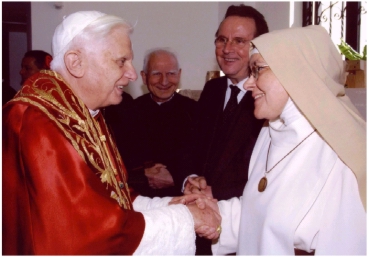
Pope Benedict XVI greets Sr. Blandina Paschalis Schlomer, an expert in iconography, renown for her expertise and forensic comparisons of ancient images of the Face of Christ. Looking on are Fr. Heinrich Pfeiffer S.J., and Paul Badde, author of many books about the Holy Veil of Manoppello (September 1, 2006).
Pope Benedict XVI gazes at the ‘Veronica’s Veil’ during a visit to the Holy Veil in Manoppello, Italy (September 1, 2006).
Streams of pilgrims, from the greatest to the least, have travelled the world to visit the Basilica Shrine of the Holy Face Veil in Manoppello, to see for themselves and experience the grace and peace flowing through their encounter with the Face of Christ. Hopefully, one day the Church will see the way clear to safely examine the relics, as it has done in the case of the relics of Sancta Santorum, to bring light, peace and truth once again to the faithful through their devotion to the Face of Jesus.
“To contemplate The Face of Christ, and to contemplate it with Mary, is the ‘program’ which I have set before The Church at the dawn of the third millennium.” — Pope St. John Paul II
“From contemplation of the Face of God are born, joy, security, PEACE”–Pope Benedict XVI
PAX ET BONUM!
UPDATE: Stunning results of testing on the Veil of Manoppello in November, 2024 conclude that the Holy Veil radiates light energy — May be read here.













 Illumina Domine Blog - Devotion to The Holy Face