During Advent the Church celebrates the longing to see God’s Face, together with the Blessed Virgin Mary, with a Triduum (three days of prayer beginning on December 15) and a Feast (on December 18th)–It is called The Feast of the Expectation of the Blessed Virgin Mary, Longing to See His Face. The prayer may also be continued until Christmas.
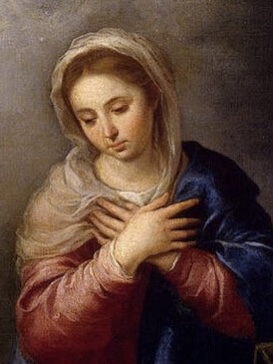
Virgin in Prayer Artist: Sassoferrato 1640-50
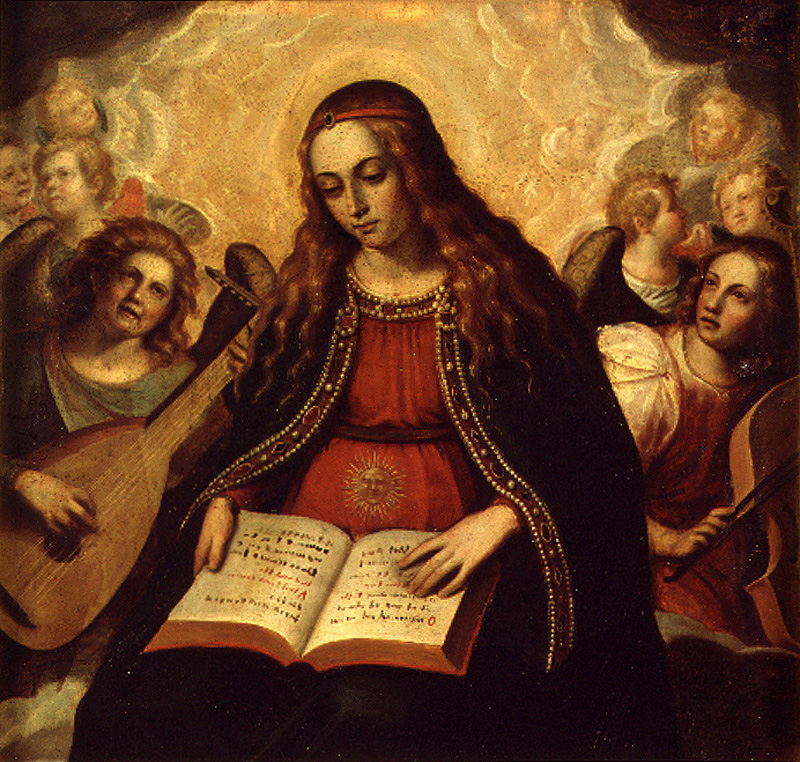
Every expectant mother shares something with the Blessed Virgin Mary — the longing to see the face of her child. The mother cannot yet kiss or caress her baby, she cannot hear the sound of a cry, or smell that baby-sweetness, so she waits in loving attentiveness for the stirring of the babe beneath her heart, that fills her with joy and knowledge of the baby’s presence within.
During the 3rd week of Advent, on December 18th, in some places in the world the Church celebrates a beautifully contemplative feast which is called the Expectation of the Blessed Virgin Mary. The feast has it’s origin in the year 656 in Spain and spread throughout the Middle Ages. Because the ancient law of the Church prohibited the celebration of feasts during Lent, the Church transferred the Feast of the Annunciation from March 25th to the season of Advent. The Tenth Council of Toledo assigned the feast to the 18th of December. It was kept as a solemn octave, eight days leading to Christmas. When the ancient laws regarding fasts were changed, the Annunciation was celebrated twice, on March 25th and December 18th.
The Expectation of the Blessed Virgin Mary
On the days leading up to Christmas we are invited to contemplate, together with Mary, the Divine Child within her womb, who is Our Savior. We too, through sanctifying grace, bear the supernatural image of God within us. Like Mary, we desire to become a peaceful sanctuary for the living God. We are called to be attentive, in prayer, to the faint stirrings of His presence in our hearts, which will fill us with a deep longing to see His Face as we pray:
Prayer for the Triduum and Feast of the Expectation of the Blessed Virgin Mary, Longing to See His Face
“Mary, your life with Jesus was one of the purest, most fervent, most perfect emotions of longing and most eager expectation of the Birth of the Divine Child! How great must have been that longing! You were longing to see the Face of God and to be happy in the vision. You were soon really to see the Face of God, the created image of divine perfection, the sight of which rejoices heaven and earth, from which all being derive life and joy; the Face whose features enraptured God from all eternity, the Face for which all ages expectantly yearned. You were to see this Face unveiled, in all the beauty and grace as the face of your own child.
Most just indeed it is, O Holy Mother of God, that we should unite in that ardent desire which you had to see Him, who had been concealed for nine months in your chaste womb; to know the features of this Son of the heavenly Father, who is also your own; to come to that blissful hour of His birth, which will give glory to God in the highest, and on earth, peace to men of good will. Yes, dear Mother, the time is fast approaching, though not fast enough to satisfy your desires and ours. Make us re-double our attention to the great mystery; complete our preparation by your powerful prayers for us, so that when the solemn hour has come, our Jesus may find no obstacle to His entrance into our hearts. Amen.” (Prayer by Rev. Lawrence Lovasik, S.V.D.)
“Blessed are you, daughter, by the Most High God, above all the women on earth; and blessed be the LORD God, the creator of heaven and earth.” (Judith 13:18)
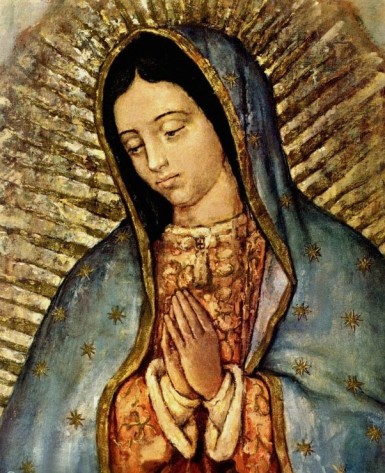
Miraculous image of Our Lady of Guadalupe
The miraculous image of Our Lady of Guadalupe, the Shroud of Turin, and “Il Volto Santo,” the veil of Manoppello all have something in common. They are all Acheiropoieta, a Greek word meaning: “made without hand.” They are said to have come into existence miraculously, not created by a human painter.
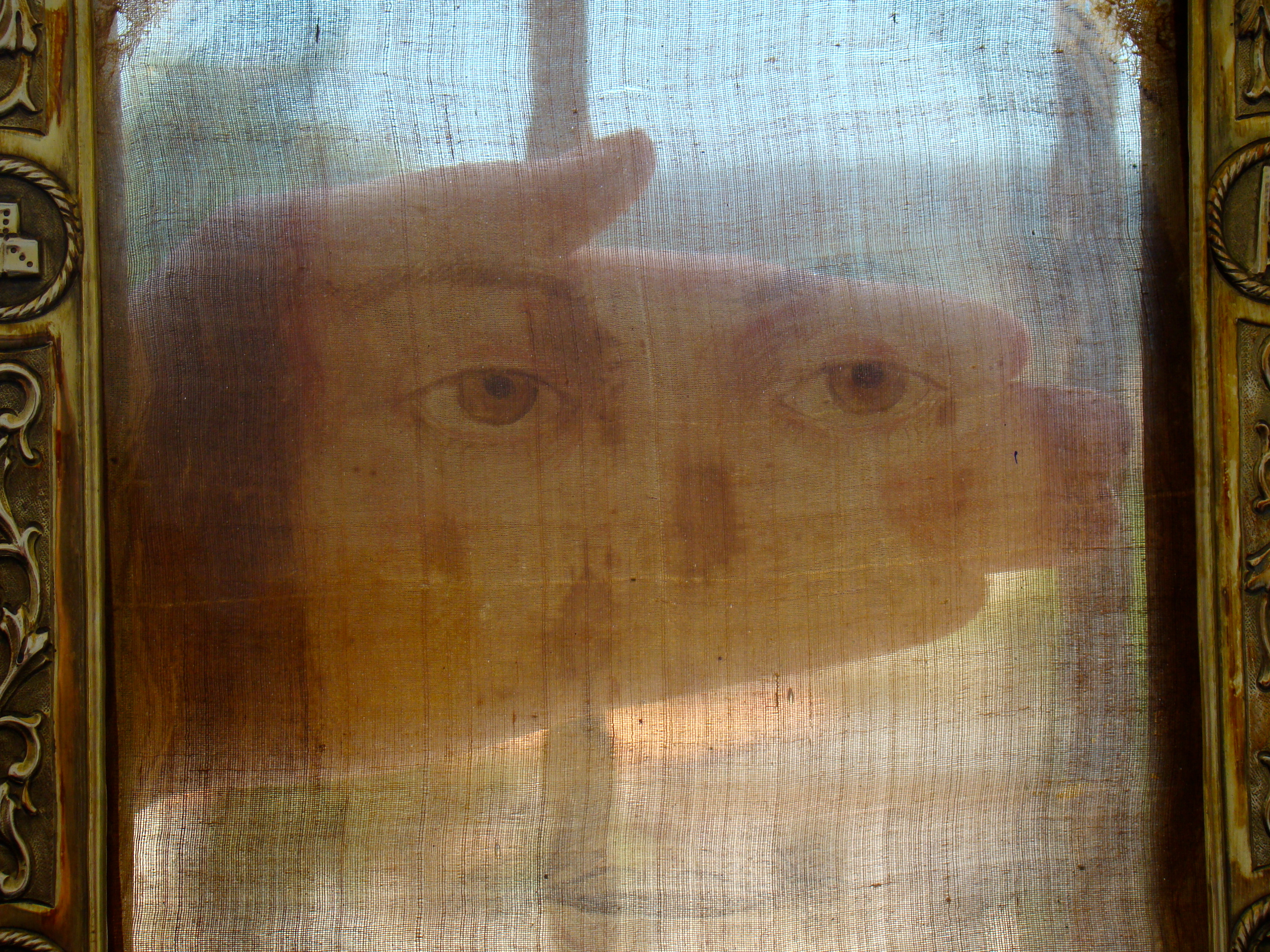
The relic Veil of the Holy Face of Manoppello, faintly seen in the light, through both sides.
Extensive research that has been done on these three images, and the results are astounding. Although I have not been to Mexico to view the miraculous tilma of Our Lady, I have seen both the Holy Shroud of Turin and the Veil of Manoppello in person, and have been deeply affected by them both. Studying them has been my own personal passion over the years.
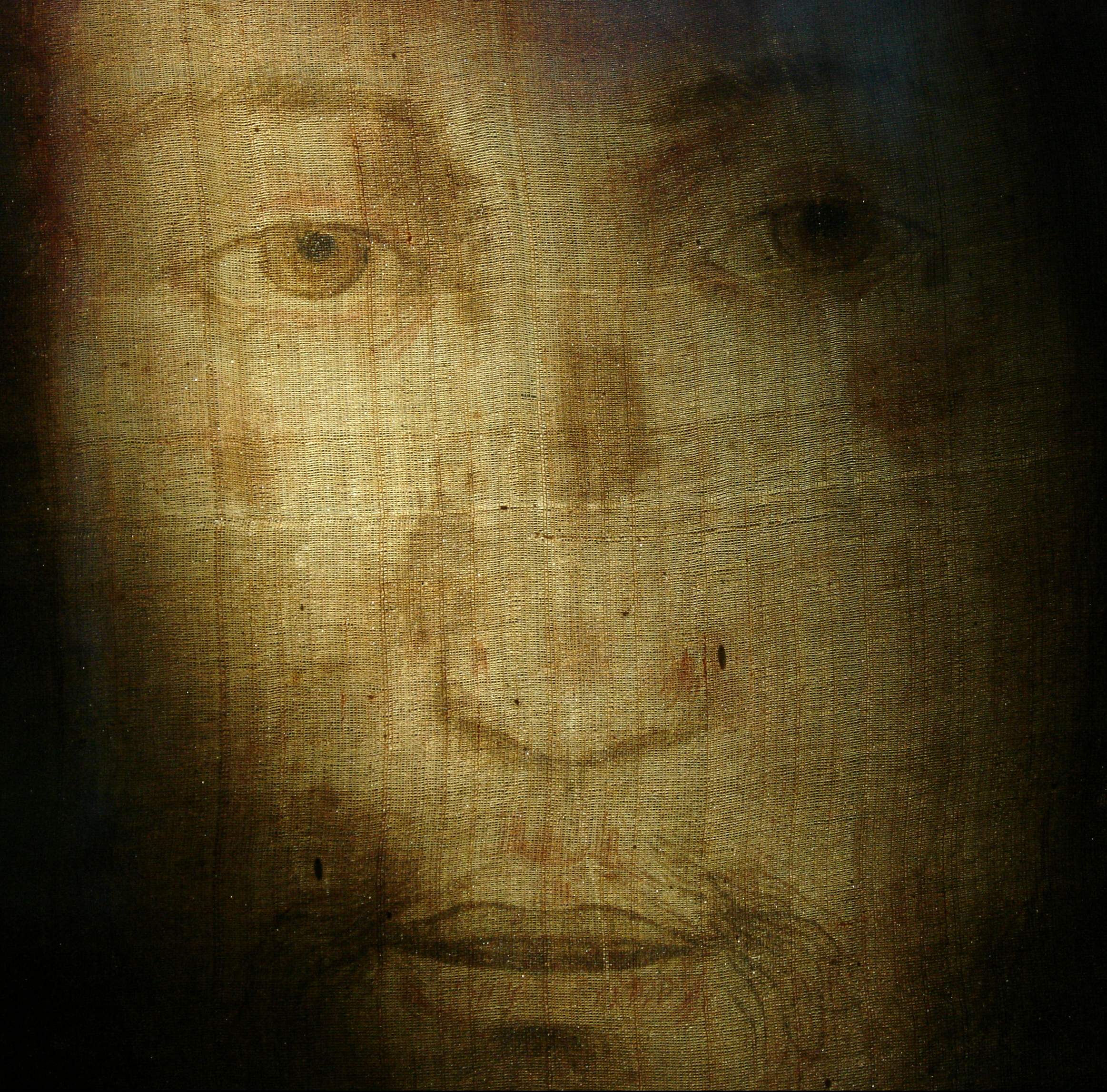
Holy Face Veil of Manoppello, Italy (Photo: Paul Badde/EWTN)
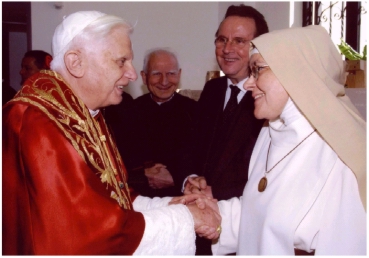
Being an artist, (and near-sighted) I tend to look at things more closely. I love this photo above sent to me many years ago by the late author Paul Badde–The detail is incredible! Zoom in and you will see each fiber of the Veil of Manoppello; examine closely His eyes, nose, lips, teeth, and hair. One never tires of looking! To paint a human face an artist studies each little detail, shape, line, form, color, and value, and may spend hundreds of hours studying as they work. One can’t help but know every little nuance by the time one has finished painting. Sr. Blandina Paschalis Schloemer, a Trappist nun from Germany, is also an artist, a painter of icons. Icon painting is very exact when it is done in the traditional manner. Sr. Schloemer began to notice striking similarities between ancient icons and images of the Face of Christ, and the images on the Shroud of Turin and the Veil of Manoppello. With the permission of her order the research has become her life’s work as well as part of her vocation.
Pope Benedict meets Sr. Blandina at the Sanctuary Basilica for the Holy Face of Manoppello
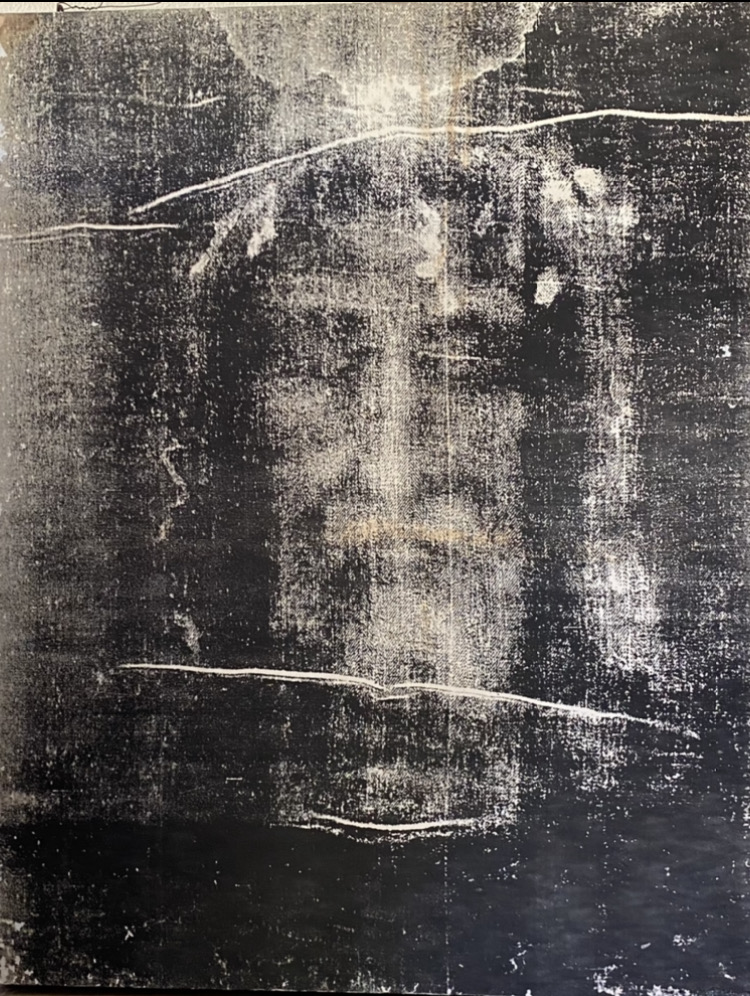
The Holy Face on the Shroud of Turin
Sr, Blandina’s research indicates that both images on the Shroud of Turin and the Manoppello Image are of the same man. I agree with her, wholeheartedly, although it is not at first glance apparent. There are also many similarities between these two images of Jesus’ Face and the image of Our Lady of Guadalupe. First, all are on a cloth. The image of Our Lady of Guadalupe is on cactus fiber, which should have disintegrated hundreds of years ago according to scientists. The Shroud of Turin is on linen and the Manoppello Image is on woven sea-silk, called byssus.
Our Lady of Guadalupe, pilgrim image beside the Veronica Altar, at St. Peter’s Basilica in Rome. Photo: Paul Badde, author of The Face of God: The Rediscovery of the True Face of Jesus, Ignatius Press.
Byssus is more rare and more precious than gold. Mentioned in the Bible, byssus, has a shimmering, iridescent quality which reflects light. Byssus is extremely delicate, yet strong at the same time. It resists water, weak acids, bases, ethers or alcohols. It can’t be painted, as it does not retain pigments, it can only be dyed; and then, only purple. Did I mention that it can last for more than 2000 years?
The veil of Manoppello, woven with byssus, is so sheer that you can read through it. Photo: Paul Badde
Another similarity between the Guadalupe image and the Manoppello image is the changeability of the images. Pilgrims have related how the image of Our Lady on the tilma appears to change in color, brightness and depth. Scientists can’t explain how the Guadalupe image appears on the tilma, it is not painted… it is “just there.” The Shroud of Turin has been described similarly. The veil of Manoppello, or “Il Volto Santo” as it is also known, is even more incredible, if that can be possible, because in addition to the image being on a veil so sheer that it can be read through; it also changes in detail, color, and shape. It even disappears… entirely. It is called a “living image” and so it is. No two people will see it in the same way. No single person will see it in the same way twice.
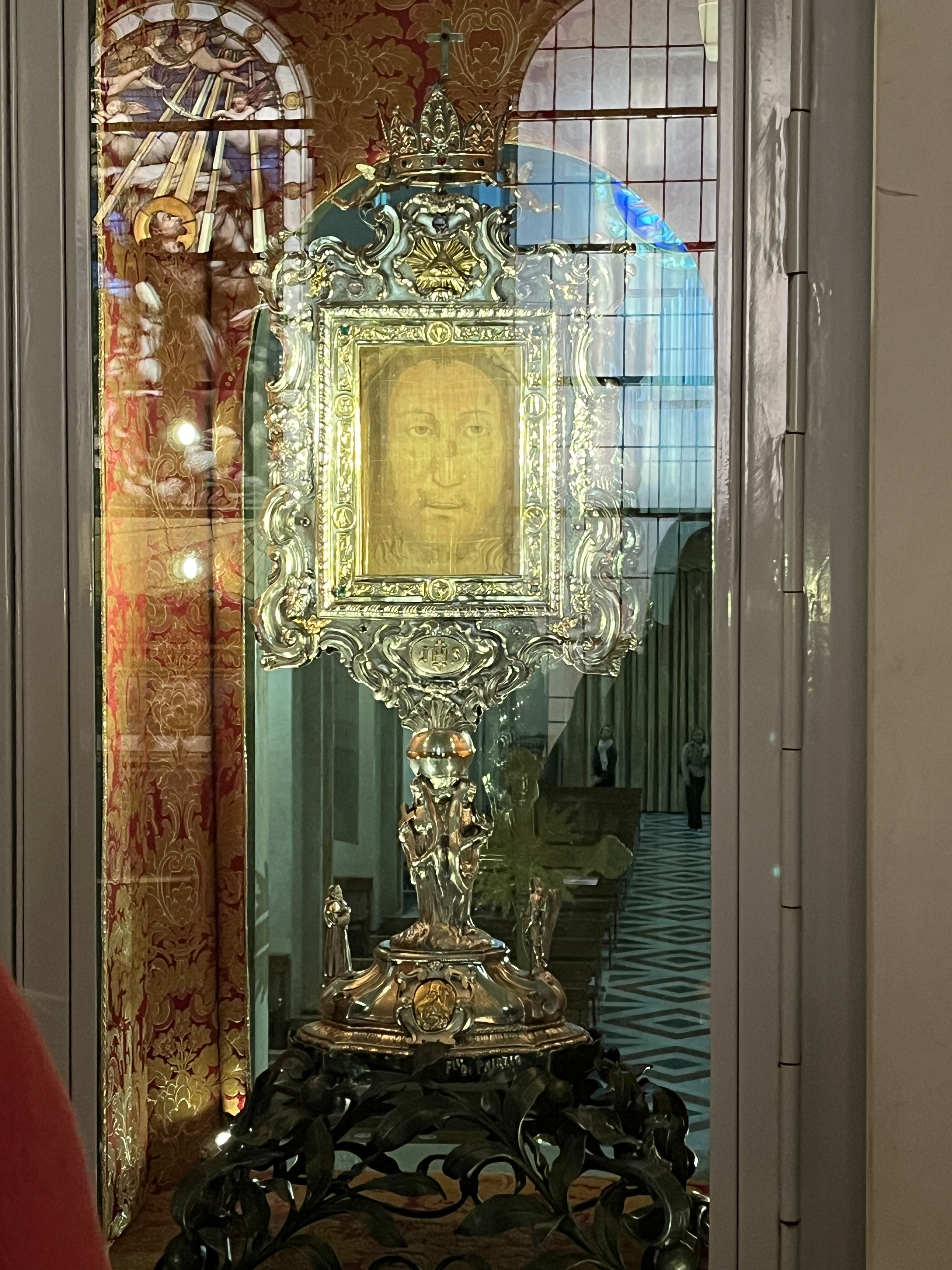
“Il Volto Santo of Manoppello”
Julian of Norwich, the English mystic of the 14th century, mentions changeability as a characteristic of the Veil of Veronica in Rome, “the diverse changing of color and countenance, sometime more comfortably life-like, sometime more rueful and death-like.” The Veil of Veronica, it is now believed, was most likely stolen a hundred years later, during the sack of Rome. But, Julian of Norwichs’ description of the Veil of Veronica certainly fits “Il Volto Santo” of Manoppello.
But, there is more. There is something about the faces… if you study the faces in particular, especially the eyes, as one opthamalogist did. On the eyes of Our Lady of Guadalupe, you will notice that something. Similar research has been done on the eyes of “Il Volto Santo.” There are delicate, natural, details in all three images that cannot be accomplished without the aid of paint or brush, on a rough, cactus cloth, or on a linen burial shroud or on gossamer-thin sea-silk. If you have an opportunity, look closely. Yes, there is something about the faces, and it is something supernatural. They are not made by human hands, but by the Hand of God.
“O Blessed Virgin Mary, Our Lady of Guadalupe,
By your presence you made the desert bloom with flowers
may your love transform us into the image of Your Son, Jesus Christ. Amen.”
+++
Roses in Winter
“A great sign appeared in the sky, a woman clothed with the sun, with the moon under her feet,and on her head a crown of twelve stars. She was with child…” (Rev. 12)
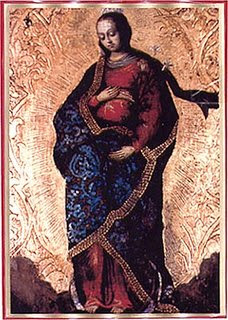
This story of Your Lady of Guadalupe begins in a very dark place. It was time of sin, suffering, and death, when the Aztecs sacrificed human beings to an idol that required human blood. In other words, a time not so different from our own, when millions of unborn children are sacrificed on the altar of “choice” to the idol of death. It was in this dark period of history, in the sixteenth century, that the Blessed Virgin Mary intervened for humanity. She was sent by God to defeat the culture of death at that time in Mexico. Like the “Woman” in Revelation, “clothed in the sun, with moon at her feet,” on December 9, 1531, she appeared to a poor man of no importance or influence, one of Mary’s “little ones,” Juan Diego. The beautiful young woman, whose clothing indicated that she was pregnant, called him by name as a mother would, “Juanito” – “little Juan.” She spoke to Juan:
Virgin Mother Our Lady of Guadalupe “God’s temple in heaven was opened, and the ark of his covenant could be seen in the temple.” (Rev. 11:19)
“I want you to know for certain, my dear son, that I am the perfect and always Virgin Mary, Mother of the True God from Whom all life comes, the Lord of all things, Creator of heaven and earth.”
The Blessed Mother then requested that Juan Diego go to his bishop and ask that a church be built in her honor, in which she would show —
“…all my love, compassion and protection. I am your Mother full of mercy and love for you and all those who love me, trust in me, and have recourse to me. I will hear their complaints, and I will comfort their affliction, and their sufferings.”
However, when Juan repeated her words to Bishop Zumarraga, the bishop, fearing an illusion, was skeptical, and sent Juan away. But in his heart Bishop Zumarraga prayed, asking God for a sign of Castillian Roses, which only grew in the bishop’s native country of Spain.
She appeared again to Juan Diego and finally, early in the morning of December 12th, the Blessed Mother asked him to return to the bishop. She instructing him first to go to the top of Tepeyac Hill “and pick the flowers that you find there and bring them to me.” Although, it was too cold and dry for flowers to grow, Juan obediently climbed the hill and discovered beautiful, sweet-smelling roses growing there, which he gathered up into his tilma – a sort of working cloak made of cactus fiber. Our Lady then, with her own hands, carefully arranged the roses in his tilma. She told Juan to give them to the bishop as a sign that he should build the church.
After running all the way to the bishop’s residence, Juan was made to wait for hours by some servants, who, curious about what he held so closely in his tilma, tried to force Juan to show them. Finally, they informed the bishop that Juan was waiting, and Juan rushed to the bishop, who was meeting with other people in the room, and he unfolded his cloak. The roses, still covered with dew, tumbled to the floor, revealing on the tilma the beautiful image of the Blessed Mother. The bishop and the others fell to their knees.
The Indians, upon seeing the miraculous image, recognized the rich symbolism contained within it as coming from heaven. Thus, they converted by the millions, and their religion of human sacrifice was ended.
The tilma miraculously exists to this day, though the cactus fiber should have disintegrated after forty years. In the past century, even when a load of dynamite was exploded just below it the blast severely damaged everything around it, but did not touch the image. There is no paint or pigment on the image of Our Lady of Guadalupe. It is an “Acheiropoieta,” a Greek word meaning: “made without human hands.” Like other acheiropoieta, such as the Shroud of Turin, and the Veil of Manoppello, there is no scientific explanation for the image’s existence, except, that it was made by the hand of God, “the true God, from Whom all life comes, the Lord of all things, Creator of Heaven and earth.” Images such as these are ongoing miracles – tangible signs of God’s mercy and love. Let us ask Him then, through the intercession of Our Lady of Guadalupe, to redeem this generation, mired in the deep darkness of sin, death, and idolatry, to bring Light and roses of life into the cold darkness — to save the lives of the unborn, and convert souls by turning them, once again, away from idols and back to the Face of her Son and her God; who suffered, died and rose from the dead.
Relic veil of the Holy Face of Manoppelllo (Photo: Patricia Enk)
These three miraculous images created by God have something else in common–They draw us by love, and not by fear to God. He condescends towards mankind to draw us to himself, inviting us to look more closely at the pure and lovely face of His own mother, and his own Holy Face; to contemplate his great humility, goodness, mercy and love.
From a sermon by Saint Peter Chrysologus — Love desires to see God:
“When God saw the world falling to ruin because of fear, he immediately acted to call it to himself by his love. He invited it by his grace, preserved it by his love, and embraced it with compassion. When the earth had become hardened in evil, God sent the flood both to punish and to release it. He called Noah to be the father of a new era, urged him with kind words, and showed that he trusted him; he gave him fatherly instruction about the present calamity, and through his grace, consoled him with hope for the future.
But God did not merely issue commands; rather with Noah sharing the work, he filled the art with the future seed of the whole world. The sense of loving fellowship thus engendered removed servile fear, and a mutual love could continue to preserve what shared labor had effected.
God called Abraham out of the heathen world, symbolically lengthened his name, and made him the father of all believers. God walked with him on his journeys, and protected him in foreign lands, enriched him with earthly possessions, and honored him with victories. He made a covenant with him, saved him from harm, accepted his hospitality, and astonished him by giving him the offspring he had despaired of. Favored with so many graces and drawn by such great sweetness of divine love, Abraham was to learn to loved God rather than fear him, and love rather than fear was to inspire his worship.
God comforted Jacob by a dream during his flight, roused him to combat upon his return, and encircled him with a wrestler’s embrace to teach him not to be afraid of the author of the conflict, but to love him. God called Moses as a father would, and with fatherly affection invited him to become the liberator of his people. In all these events we have recalled, the flame of divine love enkindled human hearts and its intoxication overflowed into men’s senses.
Wounded by love, they longed to look upon God with their bodily eyes. Yet how could our narrow human vision apprehend God, whom the whole world cannot contain? But the law of love is not concerned with what will be, what ought to be, what can be. Love does not reflect; it is unreasonable and knows no moderation. Love refuses to consoled when its goal proves impossible, despises al hindrances to the attainment of its object.
Love destroys the lover if he cannot obtain what he loves; love follows its own prompting, and does not think of right or wrong. Love inflames desire which impels it toward things that are forbidden. But why continue?
It’s intolerable for love not to see the object of its longing. That is why whatever reward they merited was nothing to the saints if they could not see the Lord. A love that desires to see God may not have reasonableness on its side, but it is the evidence of filial love. It gave Moses the temerity to say: If I have found favor in your eyes, show me your face. It inspired the psalmist to make the same prayer:
Show me your face.
Even the pagans made their images for this purpose: they wanted actually to see what they mistakingly revered.”
Basilica of Il Volto Santo in Manoppello, Italy. (Photo:Paul Badde/EWTN)
St. Anselm wrote about the desire of every human soul created in the image and likeness of God; the desire to see God’s Face, especially in the midst of hectic days leading up to Christmas. It is a beautiful reflection for Advent, reminding us to pause often to seek God’s Face.
From the “Prosologian” — the words of St. Anselm, Bishop:
“Insignificant man, escape from your everyday business for a short while, hide for a moment from your restless thoughts. Break off from your cares and troubles and be less concerned about your tasks and labors. Make a little time for God and rest a while in him.
Enter into your mind’s inner chamber. Shut out everything but God and whatever helps you to seek him; and when you have shut the door, look for him. Speak now to God and say with your whole heart: I seek your face; your face, Lord, I desire.
Lord, my God, teach my heart where and how to seek you, where and how to find you. Lord, if you are not here where shall I look for you in your absence? Yet if you are everywhere, why do I not see you when you are present? But surely you dwell in ‘light inaccessible.’ And where is ‘light inaccessible? How shall I approach light inaccessible? Or who will lead me and bring me into it that I may see you there? And then, by what forms shall I seek you? I have never seen you, Lord my God; I do not know your face.
Lord most high, what shall this exile do, so far from you? What shall your servant do, tormented by love of you and cast so far from your face? He yearns to see you, and your face is too far from him. He desires to approach you, and your dwelling is unapproachable. He longs to find you, and does not know your dwelling place. He strives to look for you, and does not know your face.
Lord, you are my God and you are my Lord, and I have never seen you. You have made me, and remade me, and you have given me all the good things I possess and still I do not know you. I was made in order to see you, and I have not yet done that for which I was made.
Lord, how long will it be? How long, Lord, will you forget us? How long will you turn your face away from us? When will you look upon us and hear us? When will you enlighten our eyes and show us your face? When will you give yourself back to us?
Look upon us, Lord, hear us and enlighten us, show us your very self. Restore yourself to us that it may go well with us whose life is so evil without you. Take pity on our efforts and our striving toward you, for we have no strength apart from you.
Teach me to seek you, and when I seek you show yourself to me, for I cannot seek you unless you teach me, nor can I find you unless you show yourself to me. Let me seek you in desiring you and desire you in seeking you, find you in loving you and love you in finding you.”
“Make a little time for God.” Blessed Sacrament Chapel in the Loreto Shrine. (Photo: Patricia Enk)
During Advent the Church celebrates the longing to see God’s Face, together with the Blessed Virgin Mary, with a Triduum (three days of prayer beginning on December 15) and a Feast (on December 18th)–It is called The Feast of the Expectation of the Blessed Virgin Mary, Longing to See His Face. (a bit of the history may be found here.) The prayer may also be continued until Christmas.
The Expectation of the Blessed Virgin Mary
On the days leading up to Christmas we are invited to contemplate, together with Mary, the Divine Child within her womb, who is Our Savior. We too, through sanctifying grace, bear the supernatural image of God within us. Like Mary, we desire to become a peaceful sanctuary for the living God. We are called to be attentive, in prayer, to the faint stirrings of His presence in our hearts, which will fill us with a deep longing to see His Face as we pray:
Prayer for the Triduum and Feast of the Expectation of the Blessed Virgin Mary, Longing to See His Face
“Mary, your life with Jesus was one of the purest, most fervent, most perfect emotions of longing and most eager expectation of the Birth of the Divine Child! How great must have been that longing! You were longing to see the Face of God and to be happy in the vision. You were soon really to see the Face of God, the created image of divine perfection, the sight of which rejoices heaven and earth, from which all being derive life and joy; the Face whose features enraptured God from all eternity, the Face for which all ages expectantly yearned. You were to see this Face unveiled, in all the beauty and grace as the face of your own child.
Most just indeed it is, O Holy Mother of God, that we should unite in that ardent desire which you had to see Him, who had been concealed for nine months in your chaste womb; to know the features of this Son of the heavenly Father, who is also your own; to come to that blissful hour of His birth, which will give glory to God in the highest, and on earth, peace to men of good will. Yes, dear Mother, the time is fast approaching, though not fast enough to satisfy your desires and ours. Make us re-double our attention to the great mystery; complete our preparation by your powerful prayers for us, so that when the solemn hour has come, our Jesus may find no obstacle to His entrance into our hearts. Amen.” (Prayer by Rev. Lawrence Lovasik, S.V.D.)
During Advent the Church celebrates the longing to see God’s Face, together with the Blessed Virgin Mary, with a Triduum (three days of prayer beginning on December 15) and a Feast (on December 18th)–It is called The Feast of the Expectation of the Blessed Virgin Mary, Longing to See His Face. (a bit of the history may be found here.) The prayer may also be continued until Christmas.
The Expectation of the Blessed Virgin Mary
On the days leading up to Christmas we are invited to contemplate, together with Mary, the Divine Child within her womb, who is Our Savior. We too, through sanctifying grace, bear the supernatural image of God within us. Like Mary, we desire to become a peaceful sanctuary for the living God. We are called to be attentive, in prayer, to the faint stirrings of His presence in our hearts, which will fill us with a deep longing to see His Face as we pray:
Prayer for the Triduum and Feast of the Expectation of the Blessed Virgin Mary, Longing to See His Face
“Mary, your life with Jesus was one of the purest, most fervent, most perfect emotions of longing and most eager expectation of the Birth of the Divine Child! How great must have been that longing! You were longing to see the Face of God and to be happy in the vision. You were soon really to see the Face of God, the created image of divine perfection, the sight of which rejoices heaven and earth, from which all being derive life and joy; the Face whose features enraptured God from all eternity, the Face for which all ages expectantly yearned. You were to see this Face unveiled, in all the beauty and grace as the face of your own child.
Most just indeed it is, O Holy Mother of God, that we should unite in that ardent desire which you had to see Him, who had been concealed for nine months in your chaste womb; to know the features of this Son of the heavenly Father, who is also your own; to come to that blissful hour of His birth, which will give glory to God in the highest, and on earth, peace to men of good will. Yes, dear Mother, the time is fast approaching, though not fast enough to satisfy your desires and ours. Make us re-double our attention to the great mystery; complete our preparation by your powerful prayers for us, so that when the solemn hour has come, our Jesus may find no obstacle to His entrance into our hearts. Amen.” (Prayer by Rev. Lawrence Lovasik, S.V.D.)
St. Anselm wrote about the desire of every human soul created in the image and likeness of God; the desire to see God’s Face. It is a beautiful reflection for Advent! From the “Prosologian” — the words of St. Anselm, Bishop:
“Insignificant man, escape from your everyday business for a short while, hide for a moment from your restless thoughts. Break off from your cares and troubles and be less concerned about your tasks and labors. Make a little time for God and rest a while in him.
Enter into your mind’s inner chamber. Shut out everything but God and whatever helps you to seek him; and when you have shut the door, look for him. Speak now to God and say with your whole heart: I seek your face; your face, Lord, I desire.
Lord, my God, teach my heart where and how to seek you, where and how to find you. Lord, if you are not here where shall I look for you in your absence? Yet if you are everywhere, why do I not see you when you are present? But surely you dwell in ‘light inaccessible.’ And where is ‘light inaccessible? How shall I approach light inaccessible? Or who will lead me and bring me into it that I may see you there? And then, by what forms shall I seek you? I have never seen you, Lord my God; I do not know your face.
(Photo: Patricia Enk)
Lord most high, what shall this exile do, so far from you? What shall your servant do, tormented by love of you and cast so far from your face? He yearns to see you, and your face is too far from him. He desires to approach you, and your dwelling is unapproachable. He longs to find you, and does not know your dwelling place. He strives to look for you, and does not know your face.
Lord, you are my God and you are my Lord, and I have never seen you. You have made me, and remade me, and you have given me all the good things I possess and still I do not know you. I was made in order to see you, and I have not yet done that for which I was made.
Lord, how long will it be? How long, Lord, will you forget us? How long will you turn your face away from us? When will you look upon us and hear us? When will you enlighten our eyes and show us your face? When will you give yourself back to us?
Look upon us, Lord, hear us and enlighten us, show us your very self. Restore yourself to us that it may go well with us whose life is so evil without you. Take pity on our efforts and our striving toward you, for we have no strength apart from you.
Teach me to seek you, and when I seek you show yourself to me, for I cannot seek you unless you teach me, nor can I find you unless you show yourself to me. Let me seek you in desiring you and desire you in seeking you, find you in loving you and love you in finding you.”
O Mary, conceived with0ut sin, pray for us who have recourse to thee!
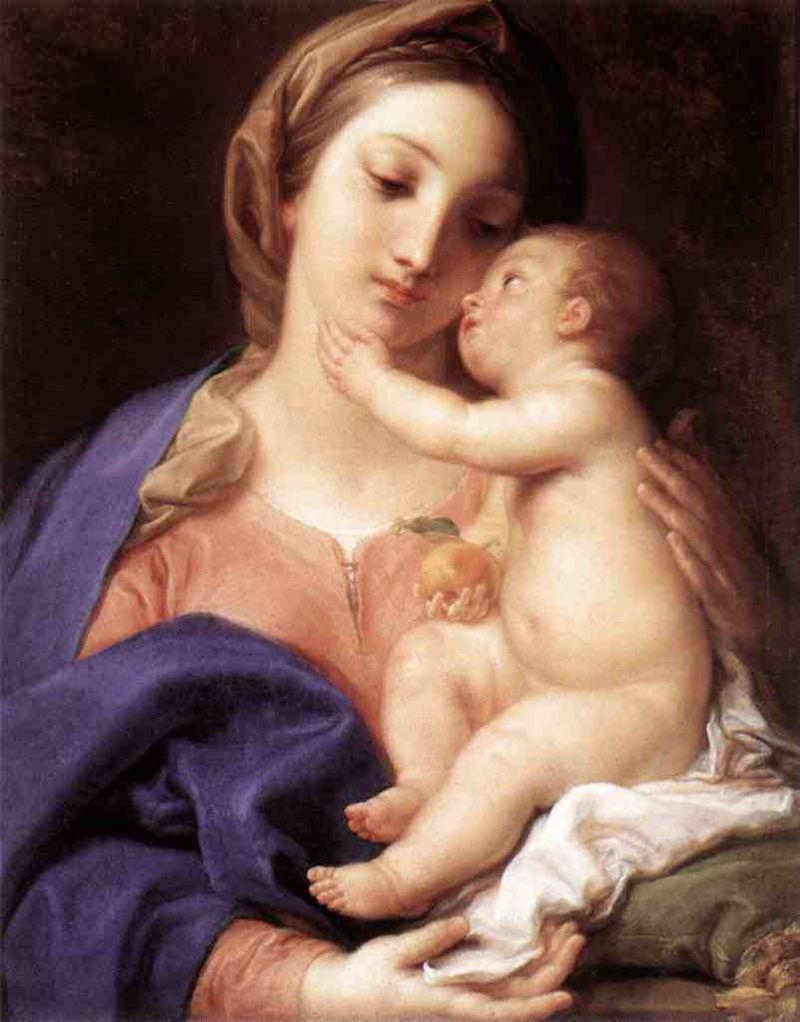
Madonna, Pompeo Battono, 1742
Shutterstock photo
“It is first of all necessary to let the Blessed Virgin Mary take one by the hand to contemplate the face of Jesus. Mary gives us eyes and a heart that can contemplate her Son in the Eucharist.”
~ Pope Benedict XVI
Mary was “Blessed in Christ with every spiritual blessing,” (cf. Eph 1:3) chosen by God from all eternity to be the Mother of the Redeemer. So, ask her to take you by the hand because it is she who leads us to Jesus. Then we may contemplate, together with her, His Holy Face–in His Word, in the Eucharist, and in our neighbor. As the Immaculate Conception, Mary bears in herself the most perfect reflection of the Face of God. Pope St. John Paul II wrote, “The Blessed Virgin saw shining upon her, as no other creature, the face of the Father, rich in grace and mercy.”
This Advent, let us fix our gaze on Jesus and Mary rather than on the profane things of the world. We keep Mary before our eyes in order to contemplate in her everything that is good and true and beautiful — She is “God’s Mirror.” “She is the proclamation of a merciful God who does not surrender to the sin of his children,” Pope St. John Paul II tells us “in Mary shines forth God’s sublime and surprising tenderness for the entire human race. In her, humanity regains its former beauty and the divine plan is revealed to be stronger than evil…” In Mary “the Creator has kept the original beauty of creation uncontaminated” so that in the Immaculate Conception, “the Father’s original, wondrous plan of love was reestablished in an even more wondrous way.”
Virgin and Child,1510
And in Her Morning
The Virgin Mary cannot enter
my soul for an indwelling. God alone
has sealed this land as secretly His own;
but being mother and implored, she comes
to stand along my eastern sky and be
a drift of sunrise over God and me.
God is a light and genitor of light.
Yet for our weakness and our punishment
He hides Himself in midnights that prevent
all save the least awarenesses of Him.
We strain with dimmed eyes inward and
perceive
no stir of what we clamored to believe.
Yet I say: God (if one may jest with God),
Your hiding has not reckoned with Our Lady
who holds my east horizon and whose glow
lights up my inner landscape, high and low.
All my soul’s acres shine and shine with her!
You are discovered, God; awake, rise
out of the dark of Your Divine surprise!
Your own reflection has revealed Your place,
for she is utter light by Your own grace.
And in her light I find You hid within me,
And in her morning I can see Your Face.
~Sr. Miriam of the Holy Spirit, OCD (Jessica Powers)
During Advent the Church celebrates the longing to see God’s Face, together with the Blessed Virgin Mary, with a Triduum (three days of prayer beginning on December 15) and a Feast (on December 18th)–It is called The Feast of the Expectation of the Blessed Virgin Mary, Longing to See His Face. (a bit of the history may be found here.) The prayer may also be continued until Christmas.
The Expectation of the Blessed Virgin Mary
On the days leading up to Christmas we are invited to contemplate, together with Mary, the Divine Child within her womb, who is Our Savior. We too, through sanctifying grace, bear the supernatural image of God within us. Like Mary, we desire to become a peaceful sanctuary for the living God. We are called to be attentive, in prayer, to the faint stirrings of His presence in our hearts, which will fill us with a deep longing to see His Face as we pray:
Prayer for the Triduum and Feast of the Expectation of the Blessed Virgin Mary, Longing to See His Face
“Mary, your life with Jesus was one of the purest, most fervent, most perfect emotions of longing and most eager expectation of the Birth of the Divine Child! How great must have been that longing! You were longing to see the Face of God and to be happy in the vision. You were soon really to see the Face of God, the created image of divine perfection, the sight of which rejoices heaven and earth, from which all being derive life and joy; the Face whose features enraptured God from all eternity, the Face for which all ages expectantly yearned. You were to see this Face unveiled, in all the beauty and grace as the face of your own child.
Most just indeed it is, O Holy Mother of God, that we should unite in that ardent desire which you had to see Him, who had been concealed for nine months in your chaste womb; to know the features of this Son of the heavenly Father, who is also your own; to come to that blissful hour of His birth, which will give glory to God in the highest, and on earth, peace to men of good will. Yes, dear Mother, the time is fast approaching, though not fast enough to satisfy your desires and ours. Make us re-double our attention to the great mystery; complete our preparation by your powerful prayers for us, so that when the solemn hour has come, our Jesus may find no obstacle to His entrance into our hearts. Amen.” (Prayer by Rev. Lawrence Lovasik, S.V.D.)
Virgin in Prayer
Artist: Sassoferrato
1640-50
Advent

I live my Advent in the womb of Mary.
And on one night when a great star swings free
from its high mooring and walks down the sky
to be the dot above the Christus i,
I shall be born of her by blessed grace.
I wait in Mary-darkness, faith's walled place,
with hope's expectance of nativity.

I knew for long she carried me and fed me,
guarded and loved me, though I could not see.
Bur only now, with inward jubilee,
I come upon earth's most amazing knowledge:
someone is hidden in the dark with me.

~Sr. Miriam of the Holy Spirit, OCD
“A great sign appeared in the sky, a woman clothed with the sun, with the moon under her feet,and on her head a crown of twelve stars. She was with child…” (Rev. 12) (Miraculous image of Our Lady of Guadalupe)
She was sent by God to defeat the culture of death at that time in Mexico. Like the “Woman” in Revelation, “clothed in the sun, with moon at her feet,” on December 9, 1531, she appeared to a poor man of no importance or influence, one of Mary’s “little ones,” Juan Diego. The beautiful young woman, whose clothing indicated that she was pregnant, called him by name as a mother would, “Juanito” – “little Juan.” She spoke to Juan:
“I want you to know for certain, my dear son, that I am the perfect and always Virgin Mary, Mother of the True God from Whom all life comes, the Lord of all things, Creator of heaven and earth.”
Our Lady to Juan Diego
She is also our Mother — each of us is also her child. Mary says to Juan, “Am I not here, who am your Mother?” As great as was Mary’s longing and anticipation to see the face of her little Jesus, great too, is Mary’s longing to see the face of her Son Jesus reproduced in us. Through love, Jesus was conceived by the Holy Spirit in Mary’s virginal womb, and this is also how Jesus is formed in us as members of His mystical body – by the Holy Spirit and of the Virgin Mary — If we stay close to Mary, He will come and dwell in us, hidden, to be born in our hearts, to suffer, die, and one day rise to eternal life with Him. Come, Lord, Jesus!
“By the presence of Mary, you made the desert bloom with flowers, – may the Blessed Virgin Mary’s love transform us into the image of Christ, her Son. Amen.”
During Advent the Church celebrates the longing to see God’s Face, together with the Blessed Virgin Mary, with a Triduum (three days of prayer beginning on December 15) and a Feast (on December 18th)–It is called The Feast of the Expectation of the Blessed Virgin Mary, Longing to See His Face. (a bit of the history may be found here.) The prayer may also be continued until Christmas.
The Expectation of the Blessed Virgin Mary
On the days leading up to Christmas we are invited to contemplate, together with Mary, the Divine Child within her womb, who is Our Savior. We too, through sanctifying grace, bear the supernatural image of God within us. Like Mary, we desire to become a peaceful sanctuary for the living God. We are called to be attentive, in prayer, to the faint stirrings of His presence in our hearts, which will fill us with a deep longing to see His Face as we pray:
Prayer for the Triduum and Feast of the Expectation of the Blessed Virgin Mary, Longing to See His Face
“Mary, your life with Jesus was one of the purest, most fervent, most perfect emotions of longing and most eager expectation of the Birth of the Divine Child! How great must have been that longing! You were longing to see the Face of God and to be happy in the vision. You were soon really to see the Face of God, the created image of divine perfection, the sight of which rejoices heaven and earth, from which all being derive life and joy; the Face whose features enraptured God from all eternity, the Face for which all ages expectantly yearned. You were to see this Face unveiled, in all the beauty and grace as the face of your own child.
Most just indeed it is, O Holy Mother of God, that we should unite in that ardent desire which you had to see Him, who had been concealed for nine months in your chaste womb; to know the features of this Son of the heavenly Father, who is also your own; to come to that blissful hour of His birth, which will give glory to God in the highest, and on earth, peace to men of good will. Yes, dear Mother, the time is fast approaching, though not fast enough to satisfy your desires and ours. Make us re-double our attention to the great mystery; complete our preparation by your powerful prayers for us, so that when the solemn hour has come, our Jesus may find no obstacle to His entrance into our hearts. Amen.” (Prayer by Rev. Lawrence Lovasik, S.V.D.)
Virgin in Prayer
Artist: Sassoferrato
1640-50
Advent

I live my Advent in the womb of Mary.
And on one night when a great star swings free
from its high mooring and walks down the sky
to be the dot above the Christus i,
I shall be born of her by blessed grace.
I wait in Mary-darkness, faith's walled place,
with hope's expectance of nativity.

I knew for long she carried me and fed me,
guarded and loved me, though I could not see.
Bur only now, with inward jubilee,
I come upon earth's most amazing knowledge:
someone is hidden in the dark with me.

~Sr. Miriam of the Holy Spirit, OCD














 Illumina Domine Blog - Devotion to The Holy Face