“Then war broke out in heaven; Michael and his angels battled against the dragon. Although the dragon and his angels fought back, they were overpowered and lost their place in heaven. The huge dragon, the ancient serpent known as the devil or Satan, the seducer of the whole world, was driven out; he was hurled down to earth and his minions with him” (Rev. 12)
“Who is like God!” St. Michael, sculpture by Cody Swanson, Old St. Patrick’s New Orleans (photo: Patricia Enk)
The center of this battle raging between Angels and demons — heaven and earth — is the Incarnate Word of God made flesh, Jesus Christ. It is Jesus who is rejected, reviled and persecuted. The devil wants to obliterate the Face of God, not only in churches that have vandalized and desecrated, but in the souls of human beings. The battle lines have been drawn between the culture of life and the culture of death. The devil’s particular object of hatred is the woman and the unborn. Some can no longer recognize that a child in the womb is a human being. Many persons reject their God-given identity as male and female. Racial hatred is causing deeper and deeper division, and human trafficking increases as humanity is blinded to the Face of God in their neighbor made in His image and likeness.
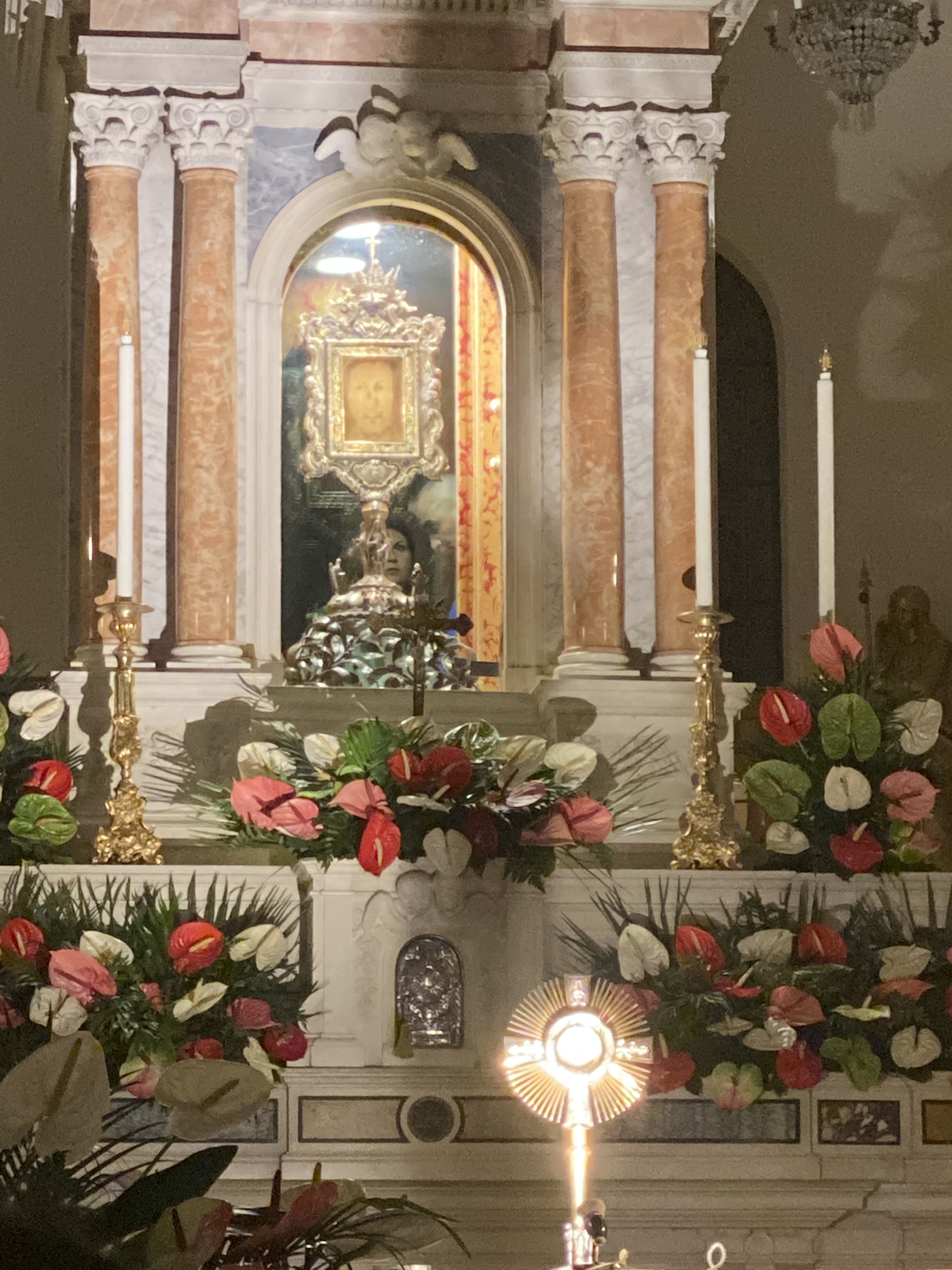
The Archangels present for our adoration — the Holy Face of Jesus! Photo: Paul Badde/EWTN
“When the dragon saw that it had been thrown down to earth, it pursued the woman who had given birth to a male child.” (Rev. 12:13)
Then I heard a loud voice in heaven say: “Now have salvation and power come, the reign of our God and the authority of his Anointed One. For the accuser of our brothers is cast out, who night and day accused then before our God. They defeated him by the blood of the Lamb and by the word of their testimony; love for life did not deter them from death. So rejoice, you heavens, and you the dwell therein! But woe to you, earth and sea, for the devil has come down upon you! His fury knows no limits, for he knows his time is short” (Rev 12). This battle has been fought since the beginning of Creation; between Christ’s Angels and the fallen angels or demons, with humanity at the center of the struggle. St. Michael and the Holy Angels have been given the authority from God by the power of His Holy Name to protect and defend God’s people against both human and diabolical enemies.
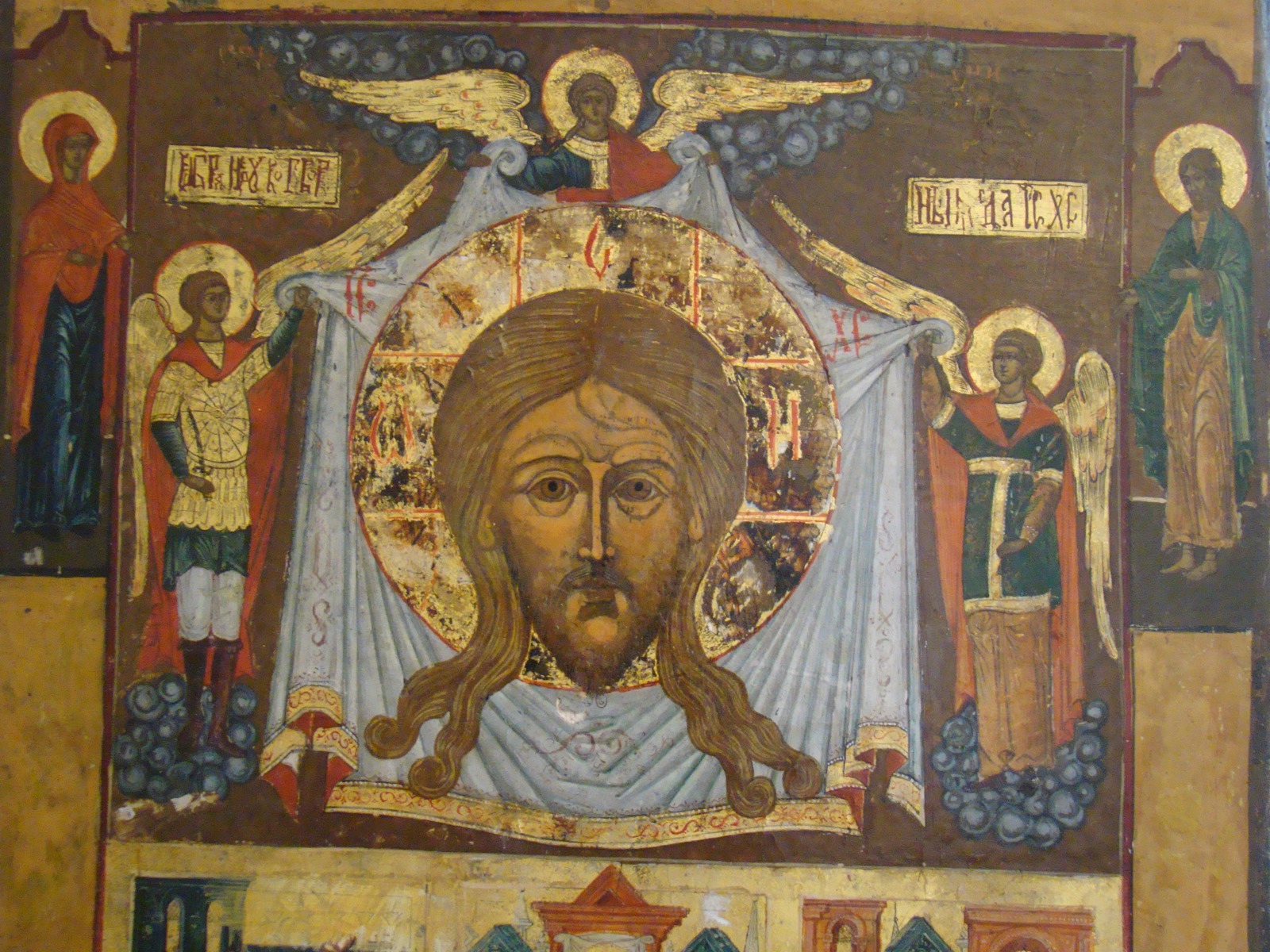
Angels offer to St. Francis, the Holy Face of Jesus, for his contemplation. Photo: Paul Badde/EWTN
Devotion to the Face of Jesus is meant to repair mankind’s broken relationship with God, manifested in the world by the evil of blasphemy, sacrilege, and indifference. This work of reparation honoring His Holy Face and His Name–which is the concrete sign of God’s existence and our relationship with Him–has been given the protection and help of the Holy Angels. Sr. Marie St. Pierre was a French Discalced Carmelite nun to whom Our Lord gave revelations of the devotion to His Holy Face. She wrote on November 18, 1843:
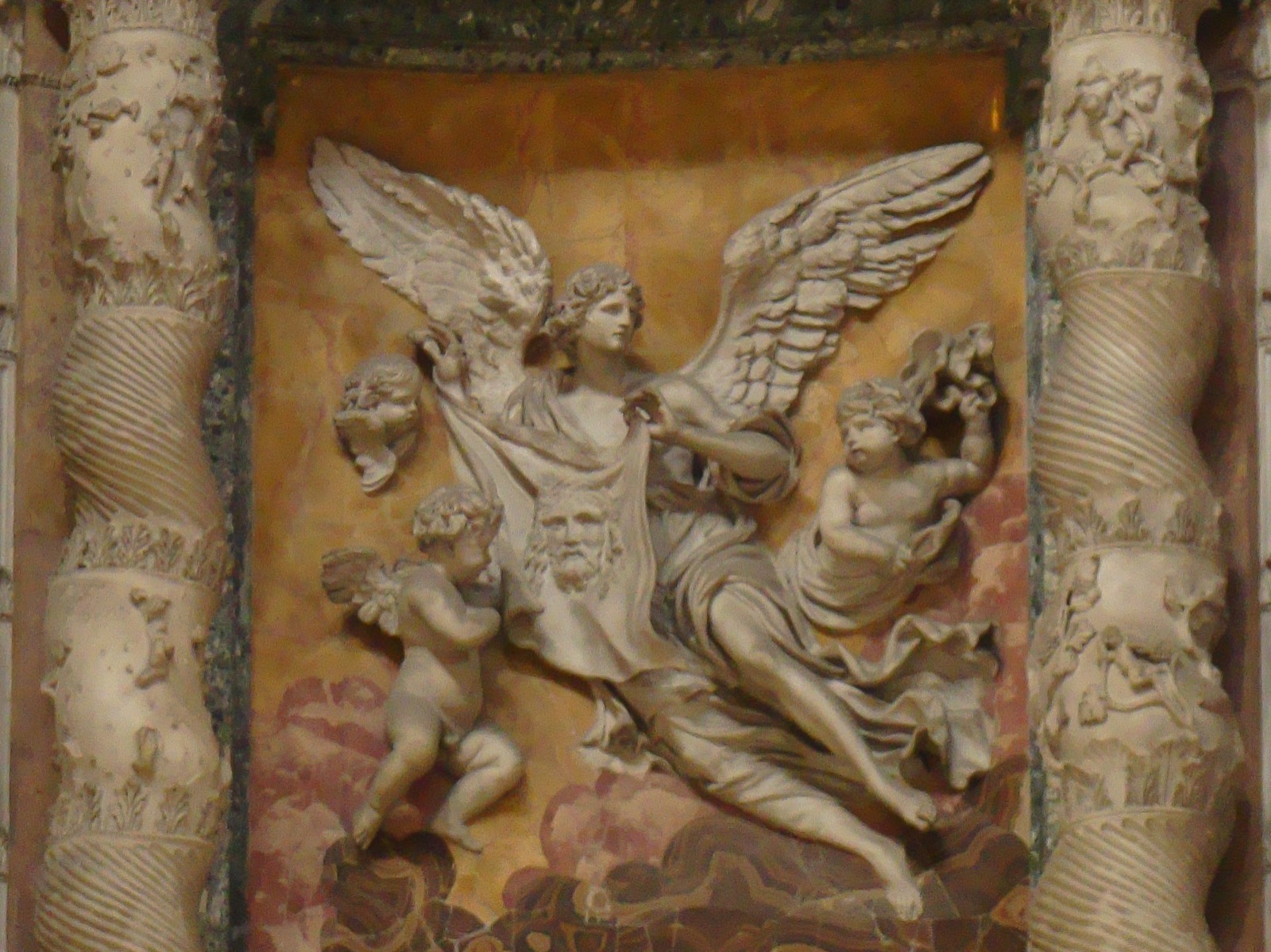
Angels carry the “Veronica Veil” – The sculpture is from the Veronica Pillar in the Vatican. Photo:Paul Badde/EWTN
“One day during prayer, our Lord warned me in advance about the fury of Satan against the holy devotion, but He also consoled me, saying: ‘I give you My Name to be your light in the darkness and your strength in battle. Satan will do all in his power to crush this Work at its roots. But I assure you that the Holy Name of God will triumph, and it will be the Holy Angels who will gain the victory in the conflict.”
The victory will be won with devotion to the Holy Face
Prayer to Our Lady of the Angels, who in her humility, crushed the head of Satan:
Sublime Queen of Heaven, exalted Lady of the Angels, you have the power and commission given by God to crush the head of Satan. Therefore, we humbly beseech you to send to our aid your heavenly legions, so that, under your command and by your power, they may pursue the hellish spirits, fight them everywhere, ward off their impudent attacks, and fling them back into the abyss. Who is like God? You holy angels and archangels, defend and protect us. Good, kind mother, you remain always our love and our hope! Mother of God, send us the holy angels to defend us and keep the evil one far from us. Amen.
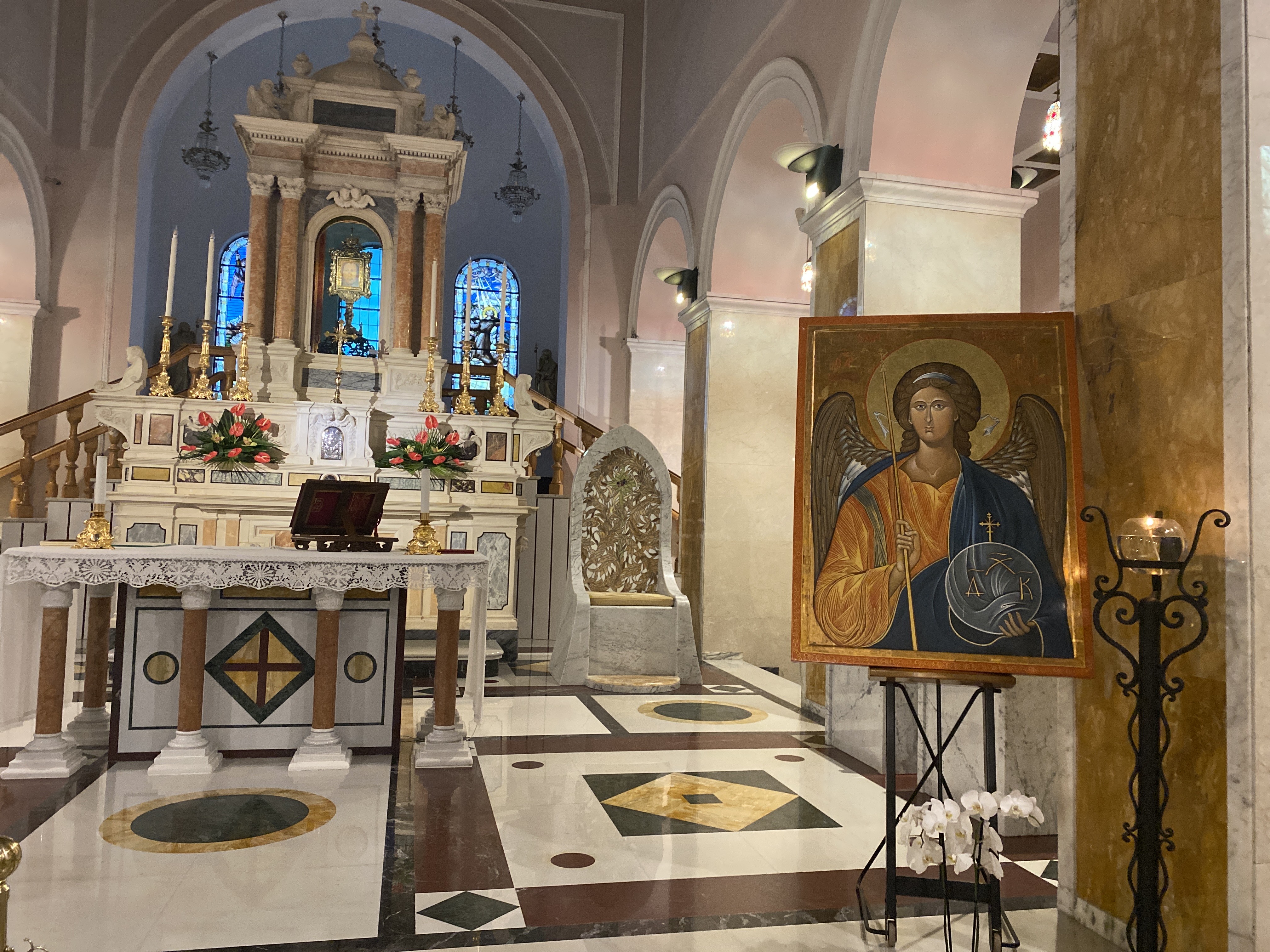
Photo: Paul Badde/EWTN. Novena for the Feast of St. Michael, Manoppello, Italy
On the right, Icon of St. Michael, written by Sr. Blandina Schlomer, in the Sanctuary Basilica of the Holy Face during the novena to St. Michael. The Church is dedicated to St. Michael. Photo: Paul Badde/EWTN
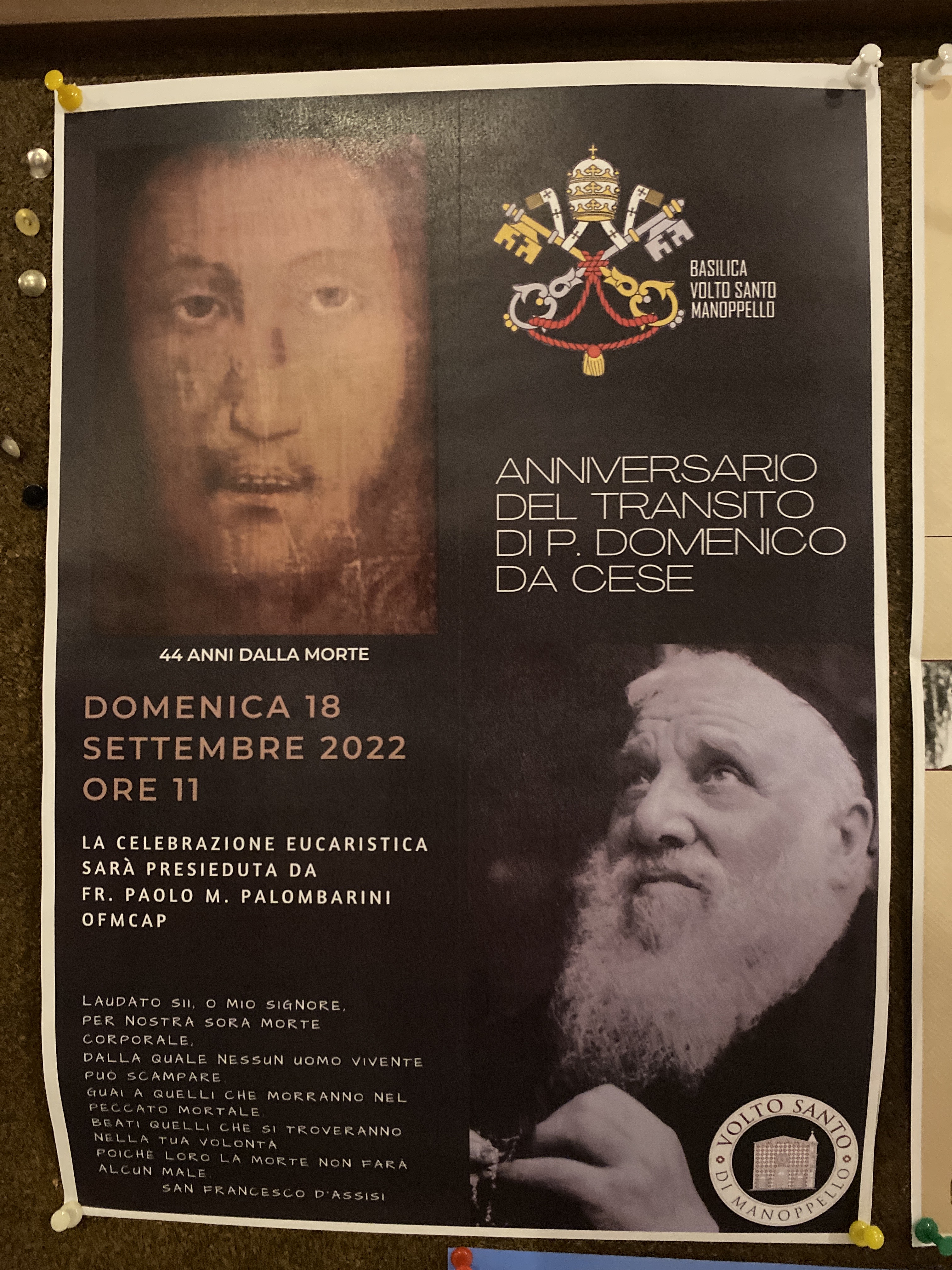
Servant of God Padre Domenico da Cese (1915-1978) before the Veil of Manoppello
September 20th marked the anniversary of the death of the Holy Capuchin priest of Manoppello–the Servant of God, Padre Domenico da Cese. He was born on March 27, 1905, and was baptized Emidio Petracca, named for St. Emidio (c.279-309 AD), the saint who is invoked for protection in earthquakes. As a nine-year old boy in 1915, young Emidio (later Padre Domenico) predicted the devastating Avenzzano earthquake in Italy. A 6.7 earthquake hit that region the next morning, killing more than 30,000 people, including two of his sisters. He and his father were buried in the rubble of their church as they attended Mass that morning.
A man with a bloody face, who young Emidio Petracca didn’t recognize as a relative or friend, pulled him from the rubble to safety. Fifty years later, as a Capuchin priest, while visiting the Shrine of the Holy Face in Manoppello for the first time, he recognized the face of the man on the miraculous veil as the same man who saved him from the rubble. As Padre Domenico knelt before the holy relic “Il Volto Santo,” he exclaimed, “This is the man who saved me from the rubble!” He asked to be transferred to the shrine and remained at the Shrine as Rector until the time of his death.
Like his friend and fellow Capuchin, St. Padre Pio, the humble Padre Domenico was also a mystic and stigmatist who had extraordinary gifts of the Holy Spirit; such as the gift of “reading souls” and bi-location. Penitents who traveled from Manoppello to go to confession with Padre Pio were admonished by him for traveling such a distance when they already had a holy priest in Manoppello. He told them, ” Why did you come all the way here, so far? You’ve got a priest there, my spiritual son, he’s like me!” St. Padre Pio’s last documented case of bi-location, just before he died, was before the relic of the Holy Face of Jesus at the shrine of “Il Volto Santo” in Manoppello, where Padre Domenico was the rector. Padre Pio had told his fellow Capuchins that the Holy Face of Manoppello was “the greatest relic of the Church.”
“Anniversary of the Transition of Padre Domenico Da Cese” Photo: Paul Badde/EWTN
In September of 1968, as Padre Pio lay dying in San Giovanni Rotundo (which is about 200 km south of Manoppello in Italy), his friend Padre Domenico da Cese had just unlocked the doors of the shrine of the Holy Face one morning, and was astounded to find Padre Pio in prayer, in the choir behind the altar before the sacred image of the Face of Jesus. St. Padre Pio spoke then to Padre Domenico saying, “I do not trust myself any more. I am coming to an end. Pray for me. Good-bye until we meet in Paradise.” Twenty-four hours later St. Padre Pio died in his cell in San Giovanni on September 23, 1968. Testimony was later given by witnesses that Padre Domenico da Cese was seen at Padre Pio’s funeral (another case of bi-location). A film was even taken (here) which shows Padre Domenico walking slowly in Padre Pio’s funeral procession, even though Padre Domenico had never left the shrine in Manoppello.
Padre Domenico shared with everyone his ardent love and devotion for the Holy Face of Manoppello, also known as “Il Volto Santo” — a miraculous veil which transmits supernatural beauty, and at the same time indescribable suffering. It is the Face of Mercy, Love and Peace. He would tell pilgrims, “This face is that of Jesus, and it is a great miracle, always love him.” Padre Domenico had done much research on the sheer byssus veil, the image of which is not made with any paint or pigment, and compared the iridescent quality of the colors to the wings of butterflies which also reflect iridescent color naturally. He also made studies of the Face on the Shroud of Turin, and its similarities to the Holy Face of Manoppello. He believed with all his heart that it was the face of the same man, and he was convinced that, like the Shroud of Turin, the Veil of Manoppello was one of the many burial cloths in Jesus’s tomb–the holy sudarium which covered the Face of Jesus in death–and also miraculously bears witness to His Resurrection.
In September of 1978 while visiting Turin to venerate the Holy Face on the Shroud during a rare exposition, Padre Domenico, who was a giant of a man, was hit by the smallest car, a Fiat, as he was stepping out into a street. After suffering for several days in a hospital, and forgiving the man who had hit him, he died on September 17th, offering his life for the Holy Face on the Veil–the Face of the man who saved him as a child.
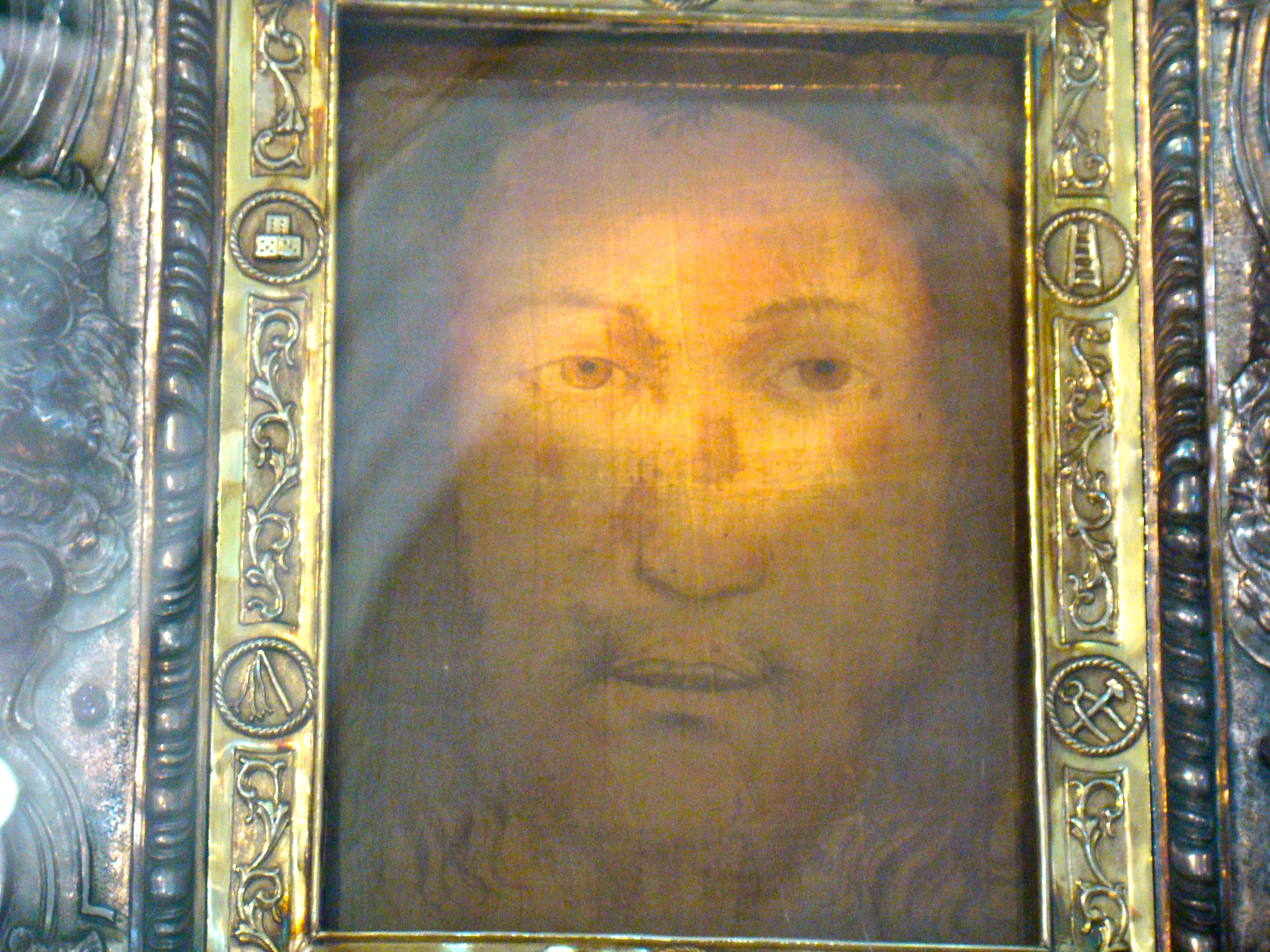
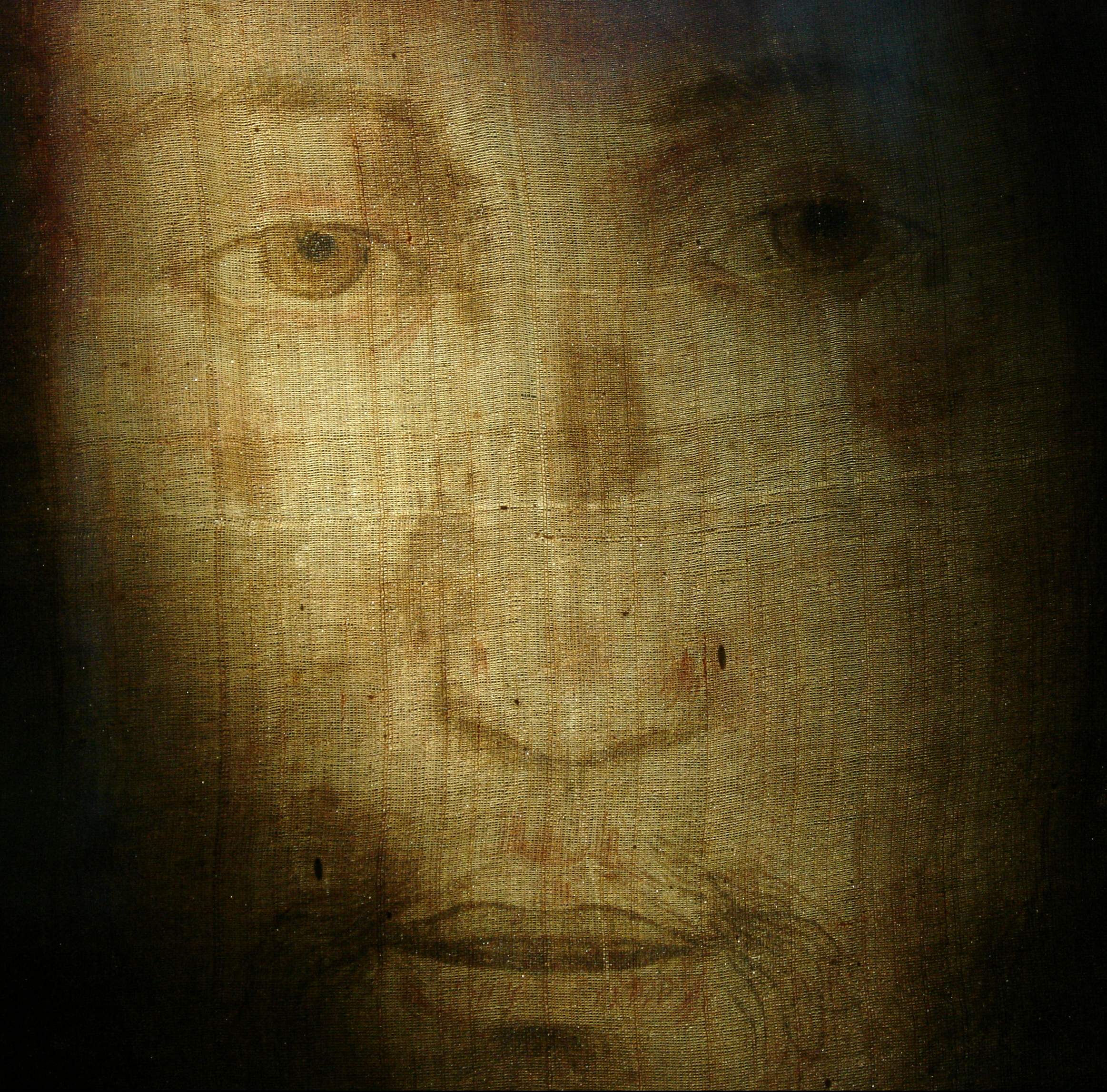
The penetrating and gentle gaze of the Holy Face of Manoppello, Italy Photo: Paul Badde/EWTN
“I never cease to implore blessings for you from Jesus, and to beg the Lord to transform you totally in Him. How beautiful His Face, how sweet His eyes and what a good thing it is to stay close to Him…”
–St. Pio
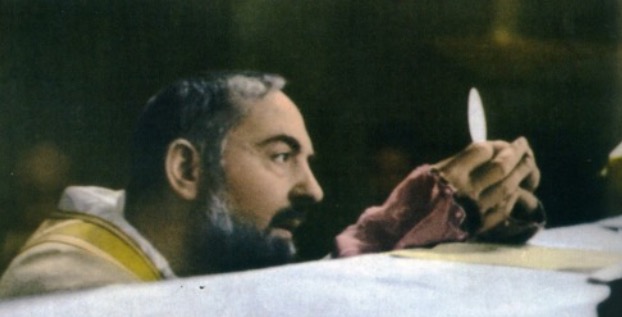
St. Padre Pio gazes at the Eucharistic Face of Christ
St. Padre Pio, a Friar Minor Capuchin priest and mystic, was well-known for his many spiritual gifts such as the stigmata, bi-location, and for his ability to read the hearts of penitents who came to him in confession. During his life St. Padre Pio suffered as Our Lord did, not only through physical pain, but by humiliations, calumny, slander and mistrust that deeply wounded his heart, in this he shared in the suffering of the Face of Christ.
He wrote in his meditations on “The Agony of Jesus” of the Face of Jesus, the “Innocent Lamb,” “His Face covered with sadness and at the same time with love:”
“He [Jesus] seems to be at the extremity of suffering… He is prostrate with His Face to the ground before the majesty of His Father. The Sacred Face of Him Who enjoys through the hypostatic union the beatific vision of the Divine Glory accorded to both Angels and Saints in Heaven, lies disfigured on the ground. My God! My Jesus! Art Thou not the God of Heaven and earth, equal in all things to Thy Father, Who humiliates Thee to the point of losing even the semblance of man? …It is to repair and expiate for my haughtiness, that Thou bowest down thus before Thy Father.”
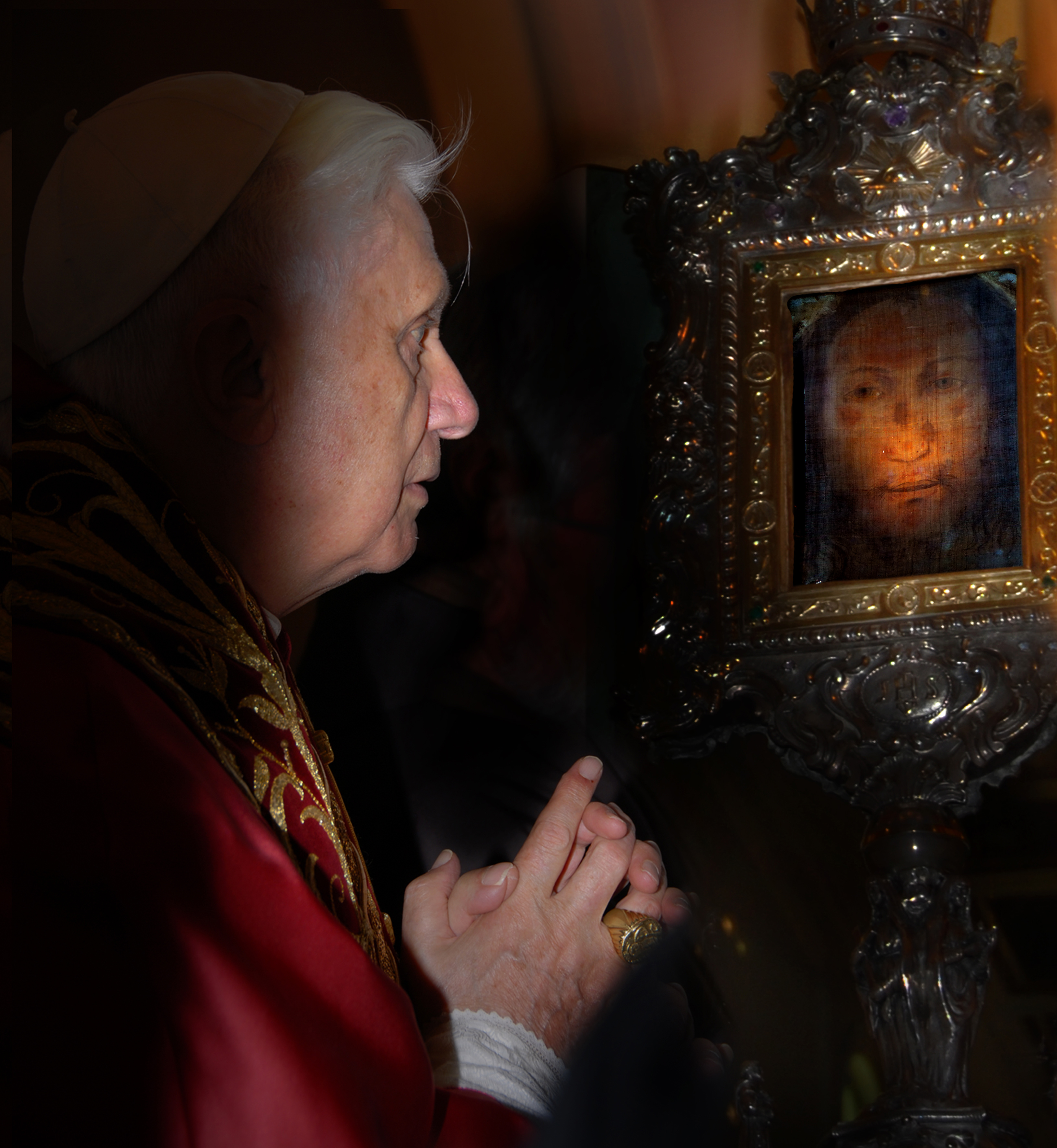
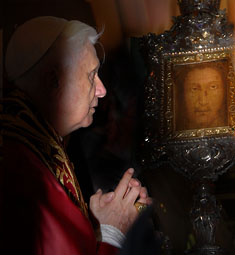
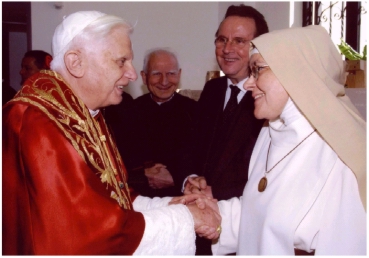
Pope Benedict XVI contemplates the Veil of the Holy Face in Manoppello, 2006. Photo:Paul Badde/EWTN
At the Last Supper Jesus offers His deeply moving prayer to the Father for his disciples, the priests, which begins, “Father the hour has come…” (John 17) Jesus prays that the Father glorify Him and that He may be glorified in them (his priests) and that He keep them in His name that “they may become one as we are.” Jesus prays too, “for those who will believe in me through their word.” “A priest is not a priest for himself,” St. John Vianney said, “he does not give himself absolution; he does not administer the Sacraments for himself. He is not for himself, he is for you.”
These men, like the first apostles, are fully human and share in the weakened condition of all of mankind since the fall of Adam. Yet they are called by God for the sanctification of God’s people. St. Paul writes: “Every high priest is taken from among men and made their representative before God, to offer gifts and sacrifices for sins. He is able to deal patiently with the ignorant and erring, for he himself is beset by weakness and so, for this reason, must make sin offerings for himself as well as for the people. No one takes this honor upon himself but only when called by God, just as Aaron was. In the same way, it was not Christ who glorified himself in becoming high priest, but rather the one who said to him: “You are my son; this day I have begotten you;” just as he says in another place: “You are a priest forever according to the order of Melchizedek.” In the days when he was in the flesh, he offered prayers and supplications with loud cries and tears to the one who was able to save him from death, and he was heard because of his reverence. Son though he was, he learned obedience from what he suffered; and when he was made perfect, he became the source of eternal salvation for all who obey him, declared by God high priest according to the order of Melchizedek. (Heb. 5:1-10)
The faithful are entrusted to the priest’s care, who as a Good Shepherd, walks with them on the path which leads to Christ. Through the gifts of the Holy Spirit, the priest brings the people to a true knowledge of the Father and the Son and “To the contemplation of the living and pulsating reality of the Trinity ‘faciem ad faciem’ (face to face).” (St. Pope John Paul II) “The Holy Spirit,” says St. Irenaeus, “the stairway of our ascent to God, draws the priest to the Father, stirring in his heart a burning desire to see God’s Face…the Paraclete illumines the priest about his own Person, that the priest may come to see the Spirit in his own heart and history.”
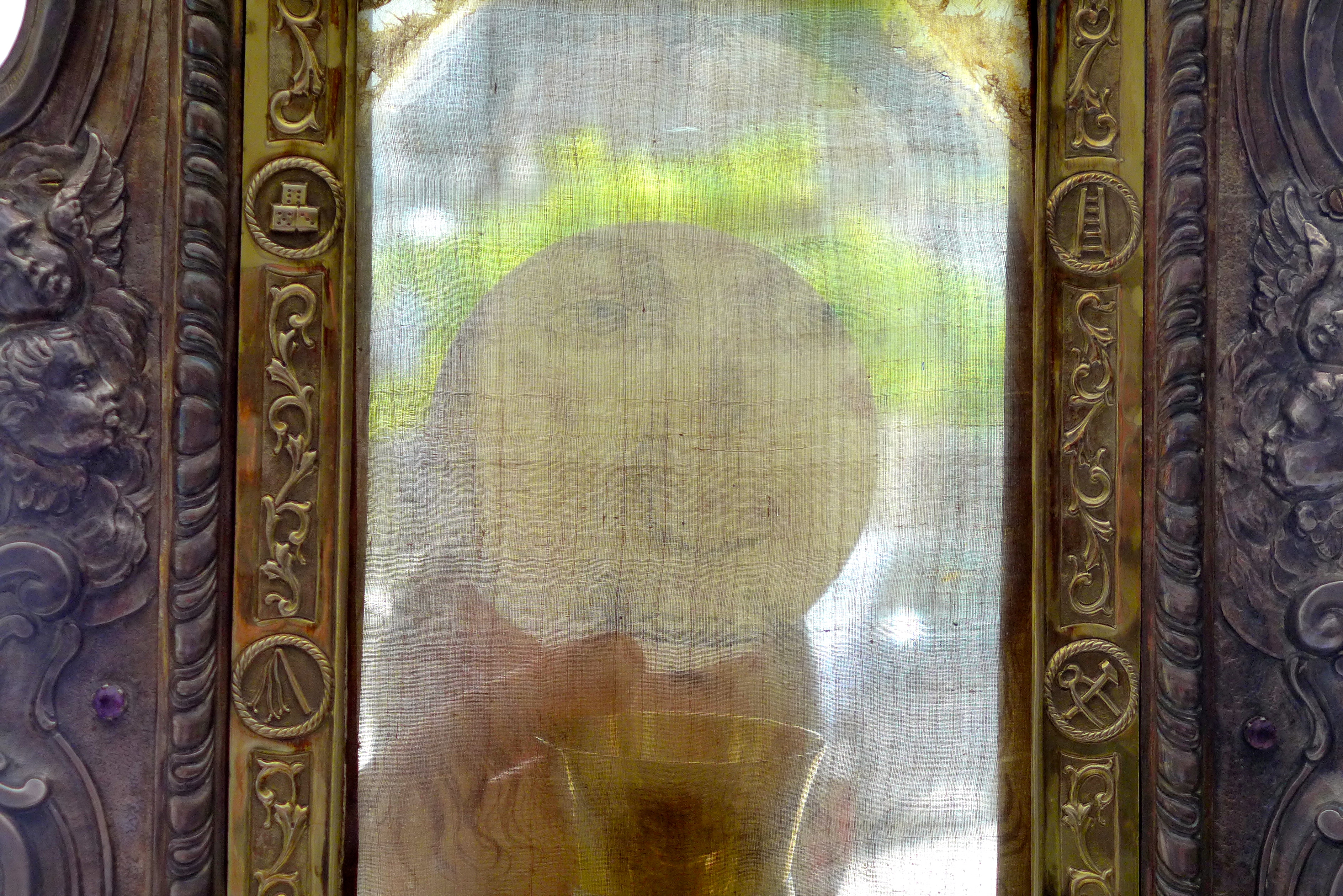
Priest elevating Eucharist on paten viewed through the Veil of the Holy Face of Manoppello. Photo: Paul Badde
Whenever a priest administers the sacraments, says St. Pope John Paul II, “the priest lends Christ his own face and voice:” “Do this in memory of Me.” (Luke 22:19) “Priests are called to show forth the Face of the Good Shepherd and therefore to have the Heart of Christ Himself.” (St. Pope John Paul II) Therefore, let us pray for all priests and bishops, that the Holy Spirit will strengthen them in all their gifts. St. Teresa of Avila once said, “When you see a priest you should say, ‘There is he who made me a child of God, and opened Heaven to me by Holy Baptism; he who purified me after I had sinned; who gives nourishment to my soul.’” St. Therese told her sister, Celine, “Let us live for souls, let us be apostles, let us save above all the souls of priests… let us pray and suffer for them and on the last day Jesus will be grateful!” [St. Therese of Lisieux, Letter 94] The Priest is the Face of Christ to us!
Prayers for Priests:
“Eternal Father, we offer Thee, with the hands of Mary, the Holy Face of Jesus, Thy Son, and the entire generous holocaust of all that we are, in reparation for so many sins that are committed, and, especially, for offenses against the Most Holy Sacrament of the Altar. We make this offering, in a particular way, so that Priests, by the holiness of their lives, may show the world the adorable features of the Divine Countenance shining with the light of truth and love, for the triumph of the Church, and for the spread of the Kingdom.” Bl. Mother Maria Pierina De Micheli
To learn more about his incredible life and passionate love for the Holy Face you can watch this wonderful video of his life, “The Long Road of Fr. Domenico, from Cese to Turin” by clicking here.
Servant of God, Padre Domenico da Cese… Pray for us!
Salve, Sancta Facies! Hail, Holy Face (c. 1450-1455), Willem Vrelant (1481) and associates, Walters Art Gallery, Baltimore, MD.
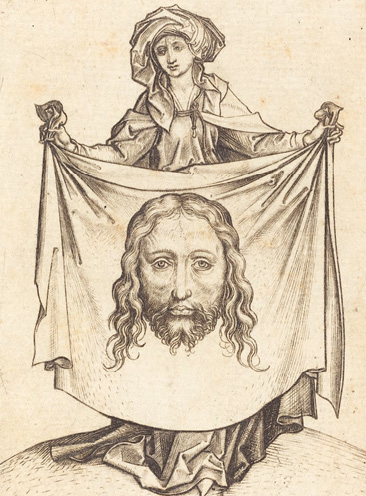
The exquisite illuminated manuscripts of the Middle Ages reflect the great love and devotion shown to the Holy Face, as well as provide evidence of what the Holy Face of Jesus looked like, as it was seen on a miraculous veil, known as “the Veronica.” “The Veronica,” or Veil of the Holy Face of Jesus, was the greatest relic in Rome at that time. To gaze upon the veil was the great desire of pilgrims, who came from far and wide, to see for themselves the sheer veil bearing the Face of Jesus. Beginning with public exhibitions and processions of the Holy Veil by Pope Innocent III in the mid thirteenth century, the miraculous veil could be viewed by all. Then, the artists got to work on paintings, illustrations, poetry, prayers, and hymns in honor of the Holy Face. ( “The Veronica Route” website wonderfully catalogues many of these “Veronica” artworks that may be found throughout the world.)
Omnis Terra Procession of Pope Innocent III in 1208 carrying “the Veronica” Face of Christ (from “Liber Regulae Sancti Spiritus in Saxia” manuscript 1350)
Pope John XXII, who was elected Pope in 1316, composed a beautiful hymn in honor of the Holy Face, and he also granted a special indulgence to those who recited it — and for those who could could not read, the Pope granted the same indulgence to the faithful for reciting five Our Fathers, Hail Marys, and Glory Be’s. (For an understanding of indulgences, this EWTN article,Primer on Indulgences by James Akin is very helpful.)
Hymn in Honor of the Holy Face by Pope John XXII (translated from the original Latin)
Hail! Holy Face of our Redeemer, hail!
Which shines in all its majesty divine
Upon the spotless veil, a priceless gift
To Saint Veronica; of love the sign.

Hail! Glory of all time, mirror-glass of the Saints,
Wherein the blessed love for eye to gaze;
Destroy within us every stain of sin,
And with the elect our souls towards Thee raise.

Hail, Face of God! With His own gifts adorned,
Whose splendor through the ages shall not cease;
Oh! make Thy light descend into our hearts,
And from their earthly toils our souls release.

Hail! Mighty bulwark of the Christian faith,
Of heresy and lies the Victor Thou;
King in the Sacred Bread, renew the strength
Of all the faithful who before Thee bow.

Hail! all our joy in this hard life below,
So frail and fugitive, so quickly over;
Sweet Picture, lead us onwards to the skies,
That we may there the Face of Christ adore.

Hail! noblest of all gems, celestial pearl,
In Thee innumerable graces shine;
No hand depicted Thee, no chisel carved,
Thou wert of God alone the work divine.

The tints with which Thy features He has traced
Will never alter and will never fade;
Changeless amidst the ravages of time,
The everlasting King Thy Face may see.

Forever incorrupt and free from stain,
The living Christ we honour still in Thee;
Thou turnest into joy our sighs and tears,
Oh! grant that we, in heaven, thy Face may see.

Be thou, we pray, our buckler and defense,
Our consolation and refreshment sweet,
That nothing hostile may our spirits harm,
Till, after death, we rest at Jesus’ feet.  Amen.
Prayer
Shed, O Lord, joy over the faces of Thy faithful, and turn them away from the depths of hell, that, protected by the contemplation of Thy divine Face, we may have strength to tread underfoot the desires of the flesh, and that we may behold Thee face to face, without fear, Lord Jesus Christ, when Thou will come to judge us. Amen.
“The tints with which Thy features He has traced, Will never alter and will never fade; Changeless amidst the ravages of time, The everlasting King Thy Face may see.”
The Heavens proclaim the glory of God over the Abruzzo mountains as the sun shines through the clouds — while the faithful celebrate the Tri-duum, three days of Eucharistic Adoration, for the Feast of the Transfiguration in Manoppello, Italy, at the Basilica Shrine of the Holy Face. Photo: Paul Badde/EWTN
“Jesus took Peter, James, and John, and led them up a high mountain where they were alone. There, before their eyes, he was transfigured. His face shone like the sun, and his clothes became as white as light. Then the disciples saw Moses and Elijah appear, and they were talking to Jesus.”
— Matthew 17:2
The faith of Peter, James, and John was confirmed by the sight of the wonderful vision of God’s glory shining from the Face of Jesus on Mount Tabor foreshadowing the kingdom of Heaven. So too, Our Lord continues to bless and strengthen in faith those who turn to gaze at the Face of Christ in celebration of the Transfiguration. Many faithful from around the world are drawn by God on this day to the Basilica Shrine of the Holy Face, “Il Volto Santo,” in Manoppello Italy. The holy, miraculous veil transforms from a sheer, white bysuss veil to a visible image of the Face of Jesus — a sign of the deep mystery of God’s desire for us to be transformed into the likeness of His Son, to rise with Him, and to share in His glory.
“And we all, who with unveiled faces contemplate the Lord’s glory, are being transformed into his image with ever-increasing glory, which comes from the Lord, who is the Spirit.”
— 2 Corinthians 3:18
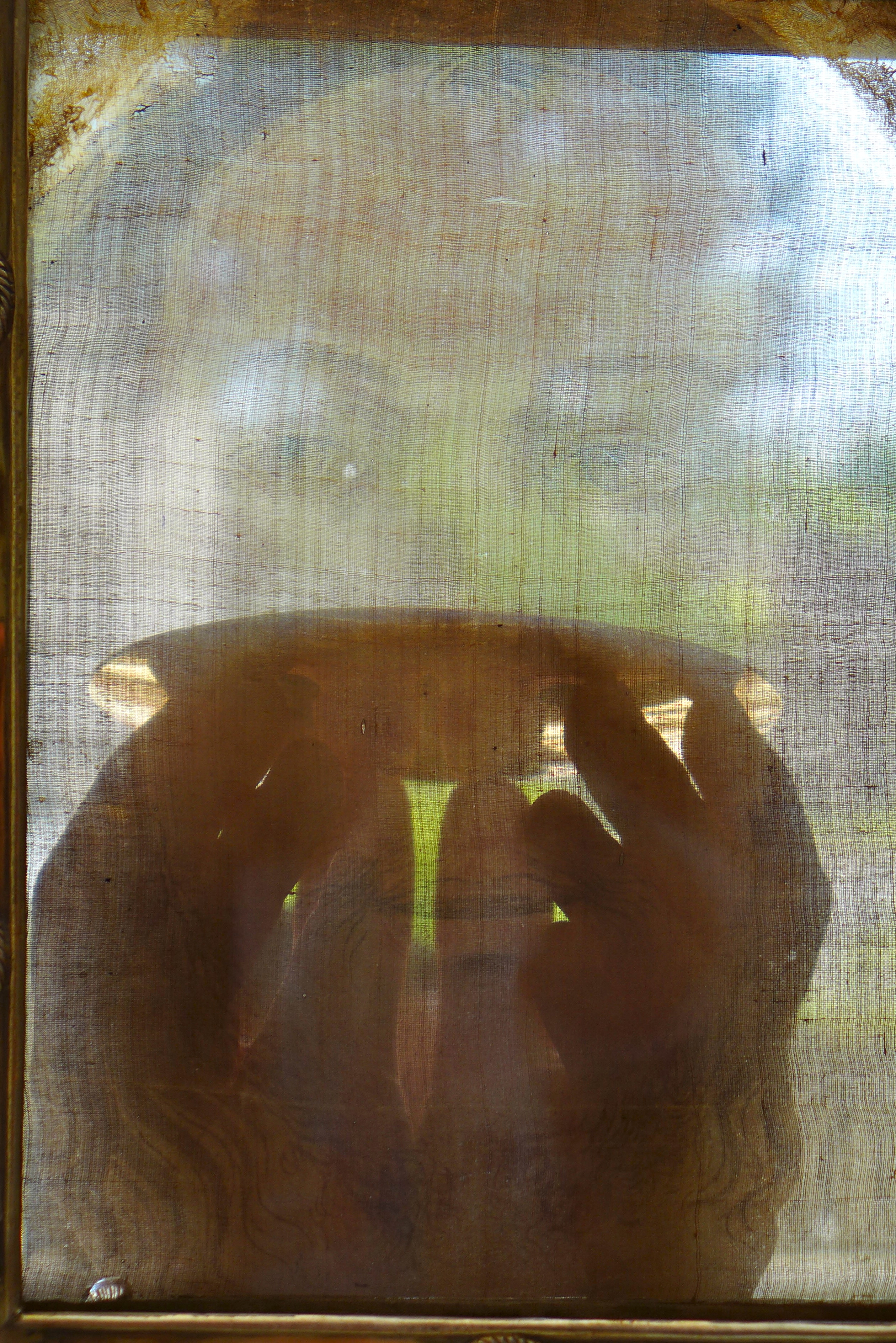
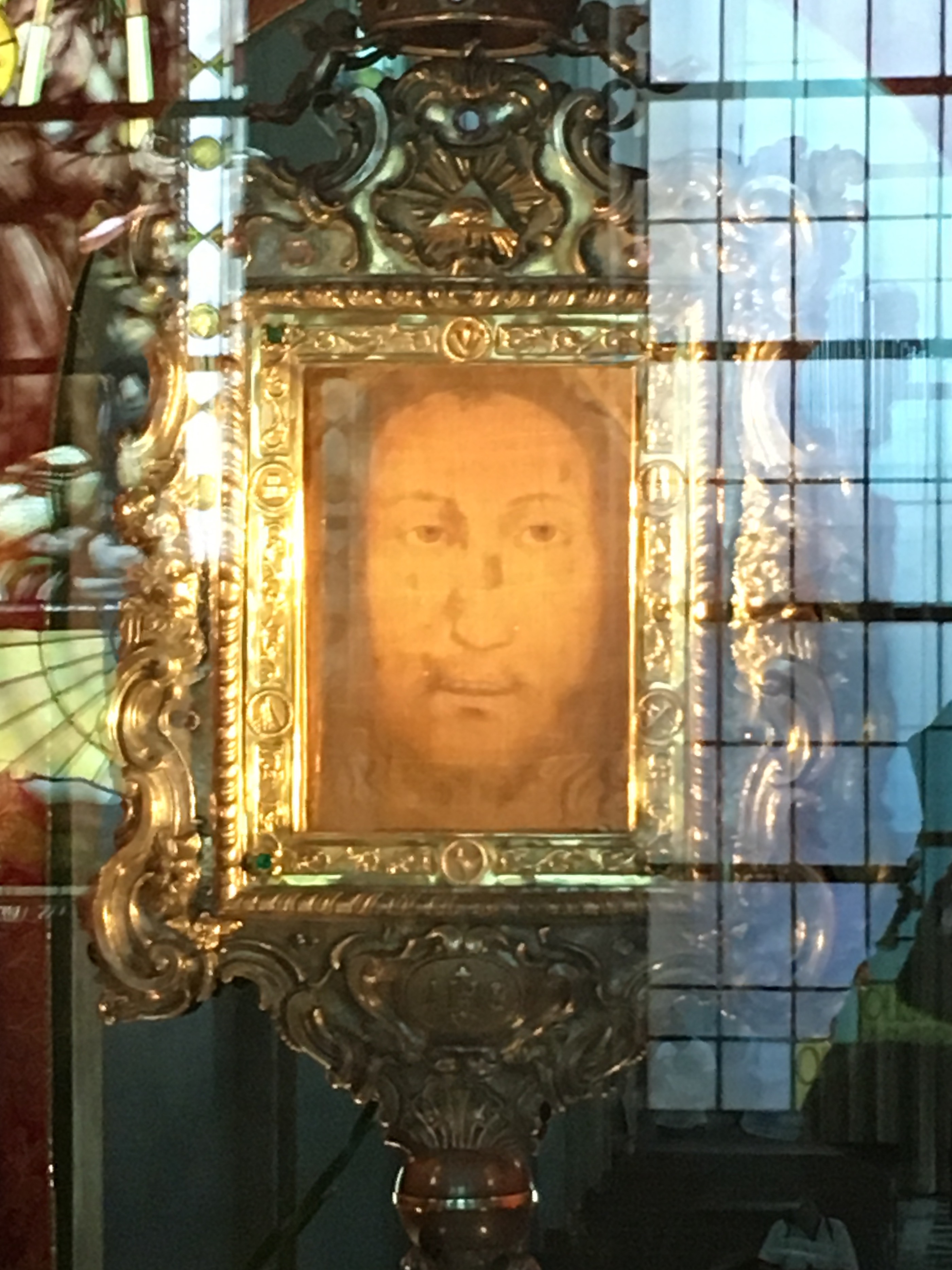
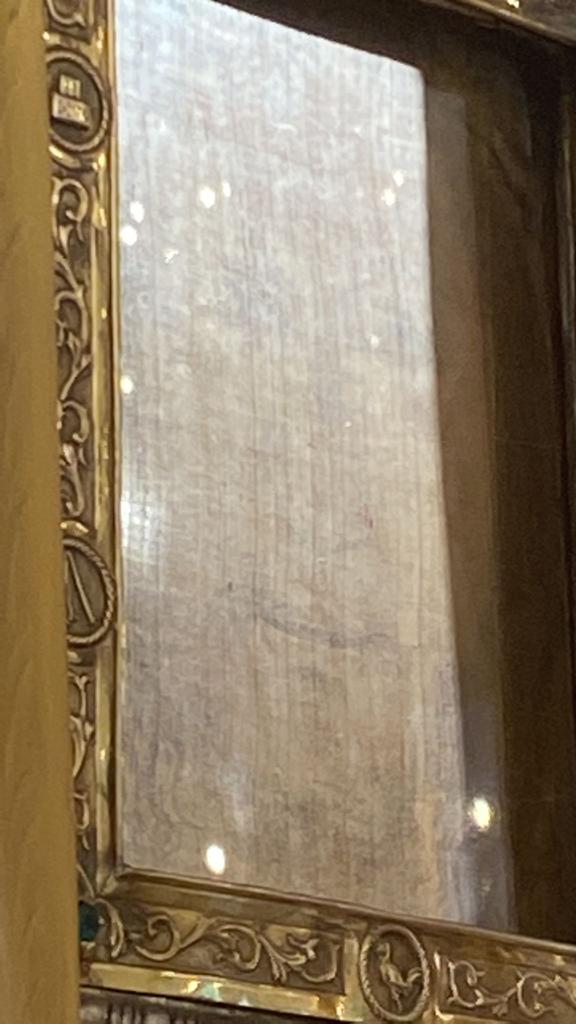
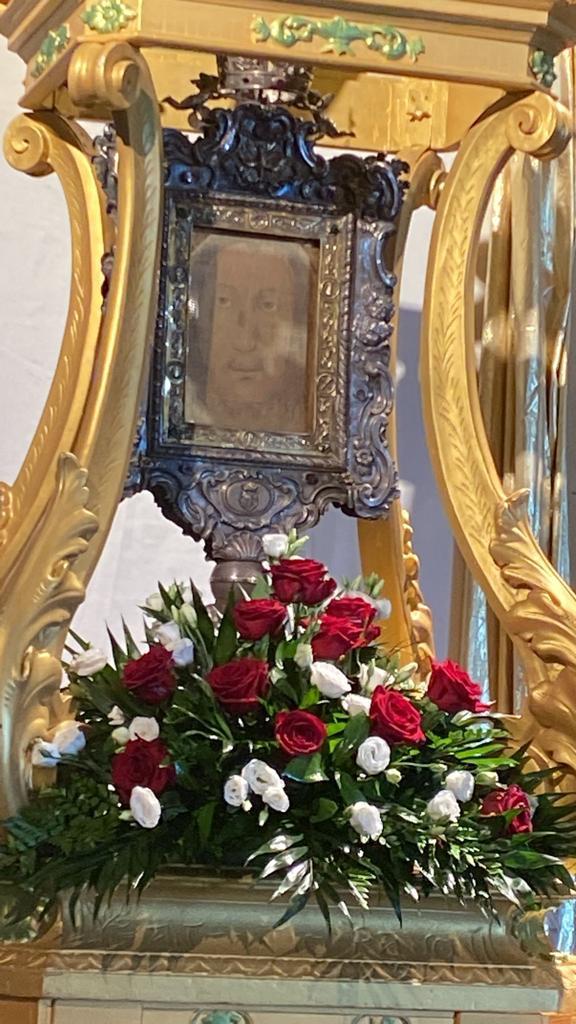
Many thanks to Paul Badde who has graciously shared the following photos which so wonderfully capture the visual changes which occur on the Veil according to light and the position of the viewer.
Veil of the Holy Face of Manoppello (Photo: Paul Badde/EWTN)
Veil of the Holy Face of Manoppello (Photo: Paul Badde/EWTN)
“Il Volto Santo” (Photo: Paul Badde/EWTN)
Veil of the Holy Face of Manoppello (Photo: Paul Badde/EWTN)
Celebration of the Tri-duum for the Feast of the Transfiguration in Manoppello, Italy (Photo: Paul Badde/EWTN)
Then Peter said to Jesus in reply, “Lord, it is good that we are here. If you wish, I will make three tents here, one for you, one for Moses, and one for Elijah.” While he was still speaking, behold, a bright cloud cast a shadow over them, then from the cloud came a voice that said, “This is my beloved Son, with whom I am well pleased; listen to him.”
When the disciples heard this, they fell prostrate and were very much afraid. But Jesus came and touched them, saying, “Rise, and do not be afraid.” And when the disciples raised their eyes, they saw no one else but Jesus alone.
Matthew 17: 4-8
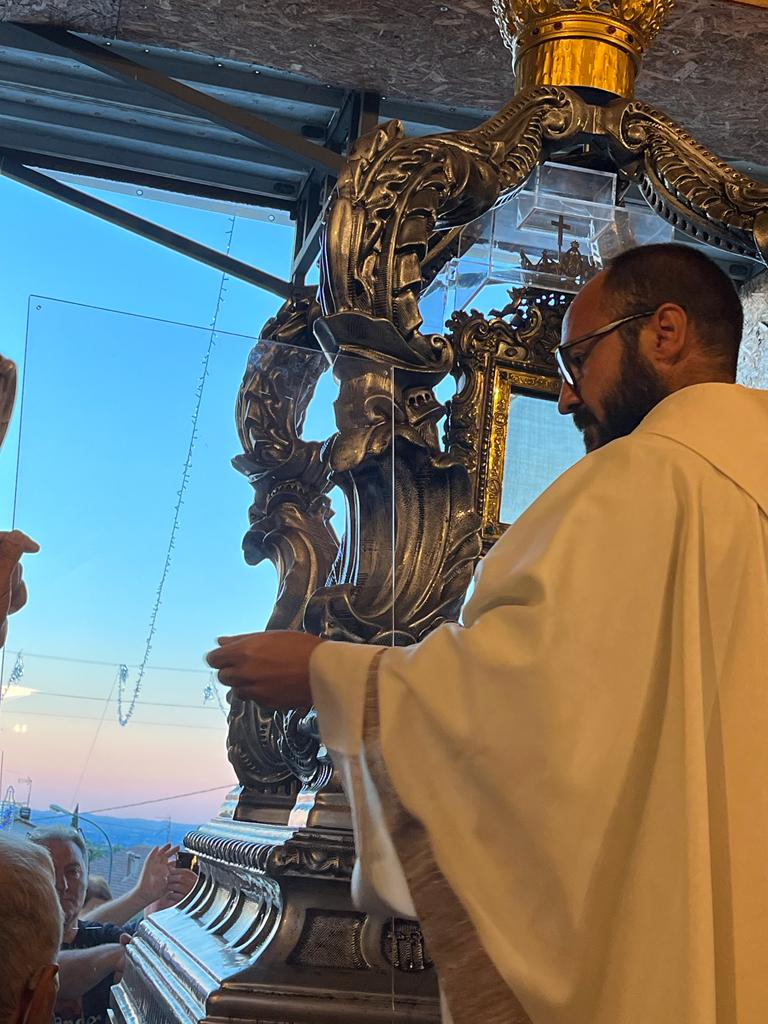
“This is my beloved Son, with whom I am well pleased; listen to him… they saw no one else but Jesus alone.” Photo: Paul Badde/EWTNLooking through the sheer veil to give a benediction with the relic. (Photo: Paul Badde/EWTN)
Benediction (Video: Paul Badde/EWTN)One last view from the Feast of the Transfiguration of the transparent Veil of the Holy Face of Manoppello within the frame in front of the Padre’s face. (Photo: Paul Badde/EWTN)
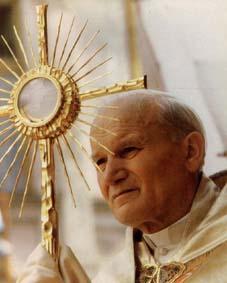
“Christ is the One who looks into our eyes and He wants us to look into His eyes: ‘He who has seen me has seen the Father.’ We are called to see God, we are continually called to look at Christ.”
Pope St. John Paul II (Hand holding a Host viewed through the Face on Holy Veil of Manoppello in Italy. Photo: Paul Badde/EWTN)
The Radiant sign of the Face of Christ is Jesus’ Real Presence in the Eucharist
Many Catholics are unaware of the fact that this millennium was dedicated to the Face of Christ by Pope St. John Paul II. He lifted high before the Church the banner of the Holy Face of Jesus at the dawn of the millennium. The Face of Christ was to be the standard for the faithful to follow in this spiritual battle that exists in the world between light and darkness.
On the Solemnity of Corpus Christi, in 2001, Pope St. John Paul II wrote:
The invisible Face of Christ, the son of God, is manifest in His Body and Blood in the simplest and, at the same time, the most exalted way possible in this world.
The ecclesial community responds to people in every age who ask perplexed: “We wish to see Jesus” (Jn 12,21), by repeating what the Lord did for the disciples of Emmaus: He broke the bread. In the breaking of the bread, the eyes of those who seek Him with a sincere heart are opened. In the Eucharist, the intuition of the heart recognizes Jesus and His unmistakable love lived “to the end” (Jn 13,1). And in Him, in that gesture, it recognizes the Face of God!
— Pope St. John Paul II
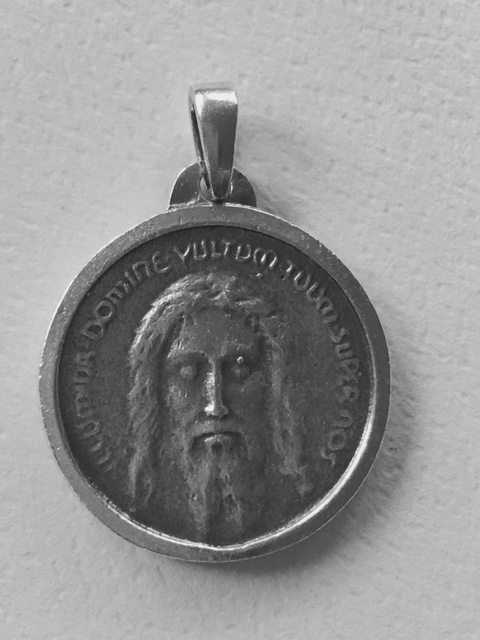
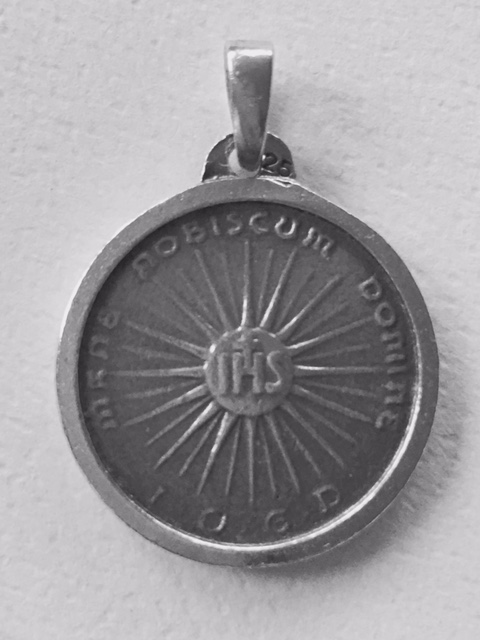
In 1997, St. Pope John Paul II asked for an International Congress for studying the Holy Face Medal and Devotion to The Holy Face as a preparation for the Millennium, which he later placed under “The Radiant sign of The Face of Christ.” The front of the medal bears an image of the Holy Face from the Shroud of Turin and an inscription based on Psalm 66:2: “Illumina, Domine, vultum tuum super nos”, “May, O Lord, the light of Thy countenance shine upon us.” The other side of the medal, bears an image of a radiant Sacred Host, representing the Eucharistic Face of Christ, the monogram of the Holy Name (“IHS”), and the inscription “Mane nobiscum, Domine” or “Stay with us, O Lord,” which are the words of the disciples on the road to Emmaus when they recognized Jesus in the breaking of the bread. The Holy Face medal is a tangible reminder of the “invisible face of Christ” made manifest in His Most Holy Body and Blood in the Blessed Sacrament.
“Illumina Domine, Vultum Tuum Super Nos” “Shine the Light of Your Face Upon Us, O Lord”
The medal of the Holy Face of Jesus was made by Bl.Mother Marie Pierina De Micheli, following the request of Jesus and The Blessed Mother. Mother Pierina, with the help of her spiritual Director received the permission of the Curia of Milan, Italy.
In 1936, Our Lord told Bl. Mother Pierina, “I will that My Face, which reflects the intimate pains of My Spirit, the suffering and the love of My Heart, be more honoured. He who meditates upon Me, consoles Me. Every time that My Face is contemplated, I will pour My love into the hearts of men and through My Holy Face will be obtained the salvation of many souls.”
“Mane Nobiscum Domine” “Stay with us, O Lord”
The Blessed Mother also told Sr. De Micheli, “This medal is a weapon of defense, a shield of courage, a guarantee of love and of mercy that Jesus wishes to give to the world in these times of sexuality and of hatred towards God and His Church. Diabolical snares are laid to tear the faith from the hearts of men, evil is spreading, the true apostles are few, a divine remedy is necessary and this remedy is the Holy Face of Jesus.
Pope John Paul II: “The Eucharist is the great school in which we learn to see The Face of God.” “In The Eucharist, The Face of Christ is turned toward us.”
“Your Face, O Lord, I seek” (Ps. 27:8). The ancient longing of the Psalmist could receive no fulfilment greater and more surprising than the contemplation of the Face of Christ. God has truly blessed us in Him and has made “His Face to shine upon us” (Ps 67:1). At the same time, God and man that He is, He reveals to us also the true face of man, “fully revealing man to man himself” (Gaudium e spes, 22).
Gazing on the face of Christ, the Bride contemplates her treasure and her joy. ‘Dulcis Iesus memoria, dans vera cordis gaudia‘: how sweet is the memory of Jesus, the source of the heart’s true joy! Heartened by this experience, the Church today sets out once more on her journey, in order to proclaim Christ to the world at the dawn of the Third Millennium: he ‘is the same yesterday and today and forever’” (Heb 13:8).
— Pope St. John Paul II
““Illumina, Domine, vultum tuum super nos”, “May, O Lord, the light of Thy countenance shine upon us — “Mane nobiscum, Domine” or “Stay with us, O Lord!”
Adoro Te Devote by St. Thomas Aquinas
"Jesu, whom I look at shrouded here below,
I beseech thee send me what I thirst for so,
Some day to gaze on thee face to face in light
And be blest for ever with thy glory’s sight. Amen."
--Last Stanza of "Adoro Te Devote"
The Virgin of the Host, by Jean-Auguste-Dominique Ingres
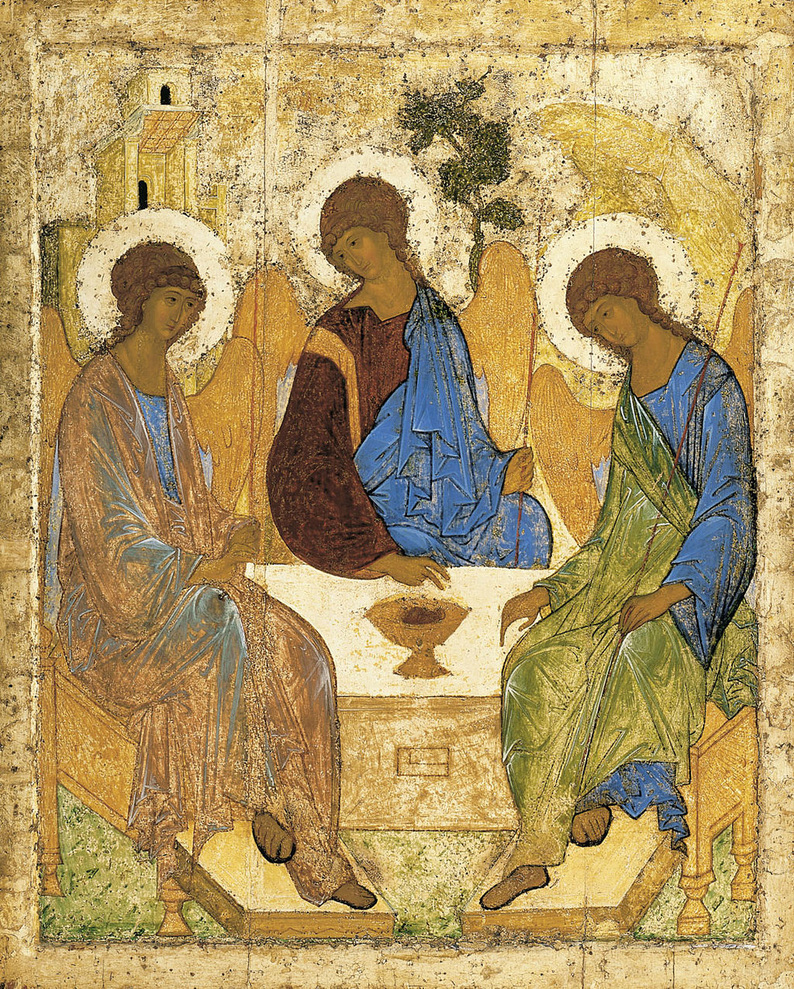
“Jesus, has shown us the Face of God, One in substance and Triune in Persons; God is all and only Love, in a subsisting relationship that creates, redeems, and sanctifies all: Father, Son, and Holy Spirit.” ~Pope Francis, Holy Trinity Sunday, 2017
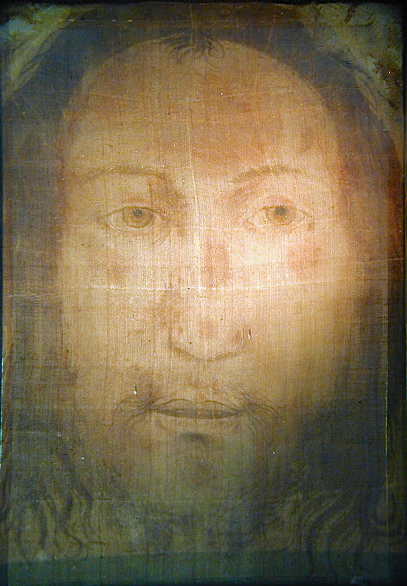
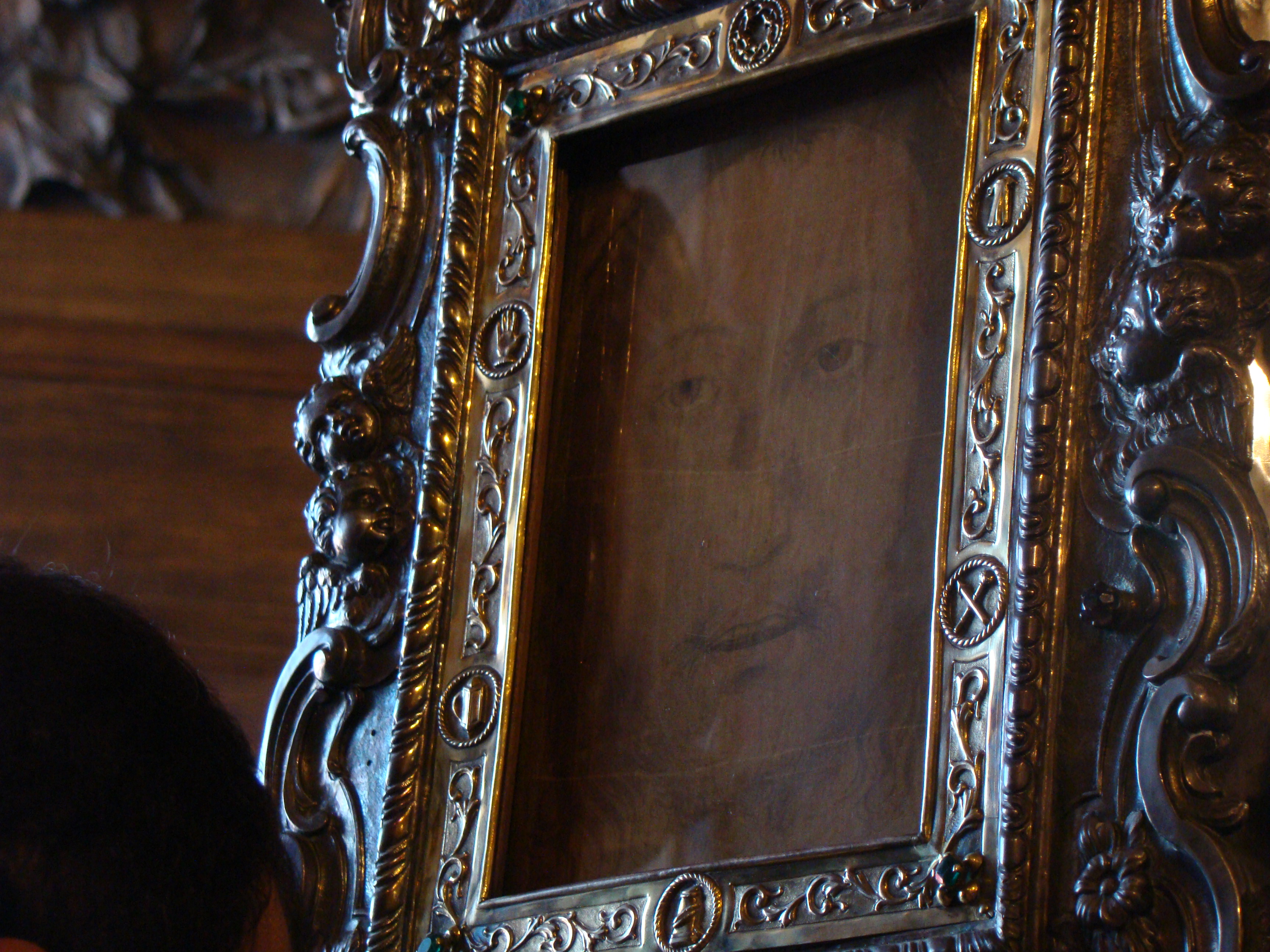
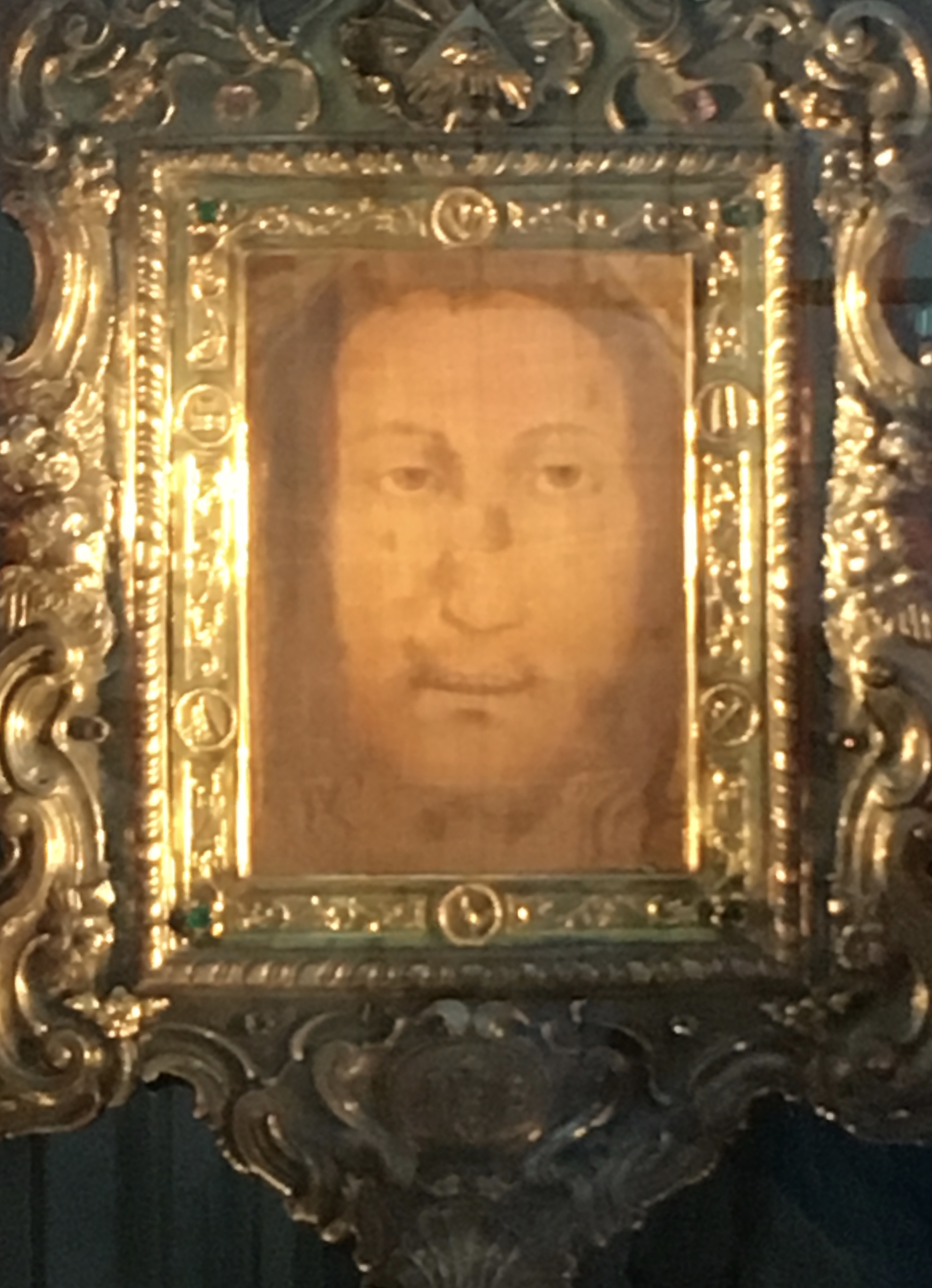
Holy Face of Jesus of Manoppello (photo: Paul Badde/EWTN)
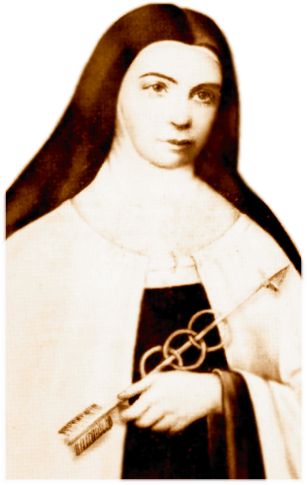
A Discalced Carmelite nun who lived in the mid-1800’s, Sr. Marie St. Pierre, had many interior visions regarding the Holy Face of Jesus — including a sublime conception of the The Holy Trinity and the Holy Face — which she tried to express in these words she received from Our Lord:
Discalced Carmelite Nun Sr. Marie St. Pierre, holding “Golden Arrow” with three circles representing the Trinity.
“Remember, O my soul, the instruction which thy celestial Spouse has given thee today on His adorable Face! Remember that this Divine Head represents the Father who is from all eternity, that the mouth of this Holy Face is a figure of the Divine Word, engendered by the Father, and that the eyes of this mysterious Face represent the reciprocal love of the Father and the Son; for these eyes have but one and the same light, the same knowledge, producing the same love, which is the Holy Spirit. In his beautiful silken hair contemplate the infinitude of the adorable perfections of the Most Holy Trinity in this majestic head, the most precious portion of the Sacred Humanity of thy Saviour; contemplate the image of the unity of God. This, then, is the adorable and mysterious Face of the Saviour, which blasphemers have the temerity to cover with opprobrium: thus they renew the sufferings of His Passion, by attacking the Divinity of which it is the image.”
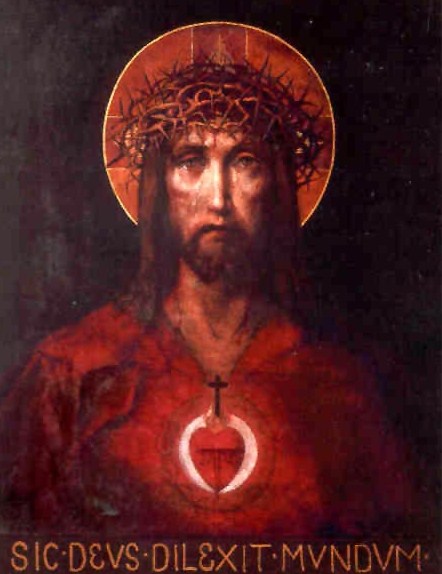
“For God so loved the world”
Our Lord told Sr. Marie St. Pierre that she could comfort and console Him by her praises, such as in The Golden Arrow Prayer: “May the most holy, most sacred, most incomprehensible and ineffable Name of God be forever praised, blessed, loved, adored and glorified by all the creatures of God, and by the Sacred Heart of Our Lord Jesus Christ in the Most Blessed Sacrament of the Altar. Amen.
Holy Face Veil of Manoppello, Italy (Photo: Paul Badde/EWTN)
“According to the diligence you will manifest in repairing my image disfigured by blasphemers, so will I have the same care in repairing your soul which has been disfigured by sin. I will imprint thereon my image, and I will render it as beautiful as when it came forth from the baptismal font… Oh! could you but behold the beauty of My Face!–But your eyes are yet too weak.” –Our Lord to Sr. Marie St. Pierre
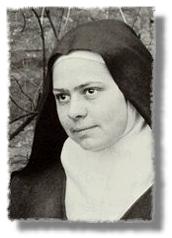
St. Elizabeth of The Trinity
Another Discalced Carmelite Nun, St. Elizabeth of the Trinity, also directs our gaze to the Face of the Son in order to contemplate the beauty of the Holy Trinity and and reflect God’s image:
“It is Your continual desire to associate Yourself with Your creatures…How can I better satisfy Your desire than by keeping myself simply and lovingly turned towards You, so that You can reflect Your own image in me, as the sun is reflected through pure crystal? …We will be glorified in the measure in which we will have been conformed to the image of His divine Son. So, let us contemplate this adored Image, let us remain unceasingly under its radiance so that it may imprint itself on us.” –Saint Elizabeth of the Trinity, O.C.D.
O My God, Trinity Whom I Adore
O My God, Trinity whom I adore, help me to forget myself entirely that I may be established in You as still and as peaceful as if my soul were already in eternity. May nothing trouble my peace or make me leave You, O my unchanging One, but may each minute carry me further into the depths of Your Mystery. Give peace to my soul, make it Your heaven, Your beloved dwelling and Your resting place. May I never leave you there alone but be wholly present, my faith wholly vigilant, wholly adoring, and wholly surrendered to Your creative action. O my beloved Christ, crucified by love, I wish to be a bride for Your Heart; I wish to cover You with glory; I wish to love You…even unto death! But I feel my weakness, and I ask You to clothe me with Yourself, to identify my soul with all the movements of Your Soul, to overwhelm me, to posses me, to substitute Yourself for me that my life may be but a radiance of Your life. Come to me as Adorer, as Restorer, as Savior, O Word Eternal, Word of my God. I want to spend my life listening to You, to become wholly teachable that I may learn all from You. Then, through all nights, all voids, all helplessness, I want to gaze on You always and remain in Your great light. O my beloved Star, so fascinate me that that I may not withdraw from your radiance. O consuming Fire, Spirit of Love, come upon me, and create in my soul a kind of Incarnation of the Word; that I may be another humanity for Him, in which He can renew His whole Mystery. And You, O Father, bend lovingly over your poor little creature; cover her with your shadow, seeing in her only the Beloved in whom You are well pleased. O my Three, my All, my Beatitude, infinite Solitude, Immensity in which I love myself, I surrender myself to You as Your prey. Bury Yourself in me that I may bury myself in You until I depart to contemplate in Your light the abyss of Your greatness. November 21, 1904 — St. Elizabeth of the Trinity
The life of a Christian should be the faithful reproduction of Jesus in their soul — this radiant transformation is the work of love of the Holy Spirit. “Those whom He had foreknown He has also predestined to become conformed to the image of His Son.” (Rom 8:29) He who loves will resemble the thing loved.
Solemn Vigil of Pentecost 2022 in Manoppello, Italy. “The Holy Spirit, whom the Father will send in my name, will teach you all things” (photo image: Paul Badde)
“God’s love has been poured into our hearts through the Holy Spirit who has been given to us.” (Rom 5:5) “Because we are dead or at least wounded through sin, the first effect of the gift of love is the forgiveness of our sins. The communion of the Holy Spirit (2 Cor 13:14) in the Church restores to the baptized the divine likeness lost through sin.” (CCC 734) The Holy Spirit perfects the soul with the first fruits of eternal glory: charity, joy, peace, patience, kindness, goodness, generosity, gentleness, faithfulness, modesty, self-control, and chastity — so we may more closely resemble Jesus Christ.
In his classic work on the Holy Spirit, The Sanctifier, Archbishop Luis M. Martinez reminds us that in order to resemble Christ, Our Lord, we must go through the pain and suffering of the Cross: “He whom we love is a God nailed to a cross. Pain makes us resemble him. It is characteristic of love to have a tremendous desire to resemble the beloved. It is characteristic, too, for those who love to resemble each other.” But, as the soul is transformed, it is also filled with joy!
After Christ had completed his mission on earth, it still remained necessary for us to become sharers in the divine nature of the Word. We had to give up our own life and be so transformed that we would begin to live an entirely new kind of life that would be pleasing to God. This was something we could do only by sharing in the Holy Spirit. As St. Paul writes: “But we all with unveiled faces, reflecting as in a mirror the glory of the Lord, are being transformed into His very image from glory to glory.” (2 Cor 3:18)
— St. Cyril of Alexandria
Divine Guest of our souls (photo: Patricia Enk)
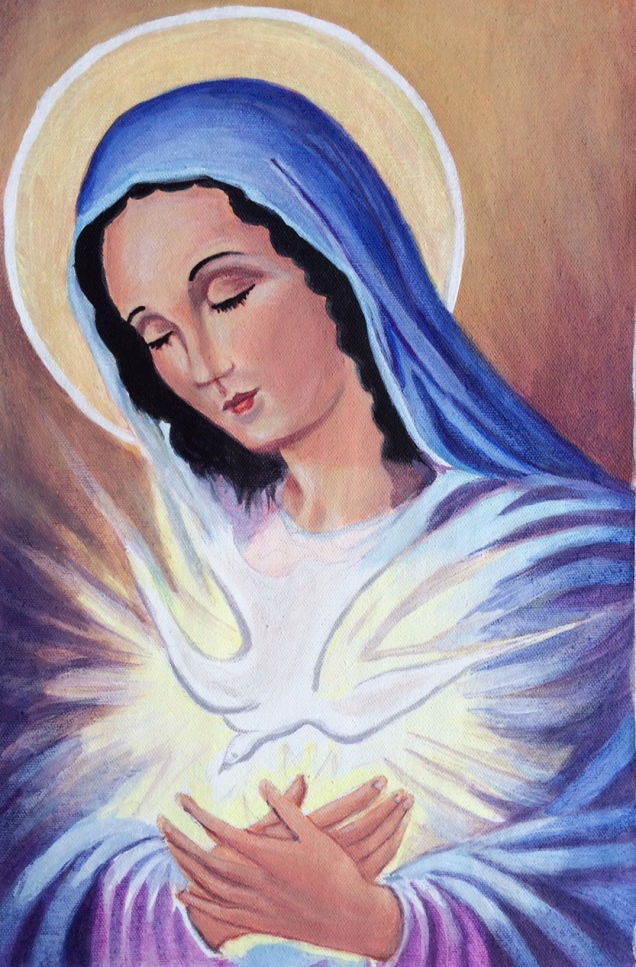
This is the work of the Holy Spirit of Love, who is the the light and fire of the Face of God: to sanctify our souls, shining upon us the radiance of His light, transforming us into the His own likeness. Holy Spirit wants to dwell in us and convert our bodies into His temple, as He did in the Virgin Mary to bring grace, mercy, and peace. “Love is not a passing visitor who pays us a call and then goes away. He establishes in us his permanent dwelling and lives in intimate union with our souls as their eternal Guest.” (The Sanctifier) As Jesus promised on the last night of His mortal life: “And I will ask the Father and He will give you another Advocate to dwell with you forever, the Spirit of truth whom the world cannot receive, because it neither sees Him nor knows Him. But you shall know Him because He will dwell with you and be in you.” (Jn 14: 16-17)
Mary, Spouse of the Holy Spirit
To Mary, Spouse of the Holy Spirit, Daughter of the Most High, Mother of God, faithful Spouse of the Holy Spirit — yet also Mary of Nazareth, Joseph’s wife, my mother– hear my prayer for grace, O Full of Grace. Pray your Spouse the Holy Spirit to come upon me — to shelter from all ill, to strengthen me to do what is right, to teach me all truth. Pray him come to me, and abide with me, and be within me a fountain springing up unto eternal life. May he sustain me in sorrow, sanctify me in life, and receive me at the hour of my death. Holy Mary, Mother of God, Mother of the Church, pray for us.
UPDATE: Thanks to his unfailing devotion to the Holy Face, the intrepid (and no doubt exhausted) Paul Badde has captured more outstanding photos from the celebrations commemorating the historic arrival of the miraculous Holy Face Veil in Manoppello, Italy. Paul noted that the Sanctuary Basilica of the Holy Face was as packed with devotees as it had been before the arrival of the Corona viruses. Although Paul was disappointed at what he called “a meager harvest” of photos, due to his camera not being in automatic mode, I think you will agree that his photos below have beautifully captured this Holy event, and precious gift from God — the “Il Volto Santo!” May God reward him for his dedication and please keep Paul Badde in your prayers!
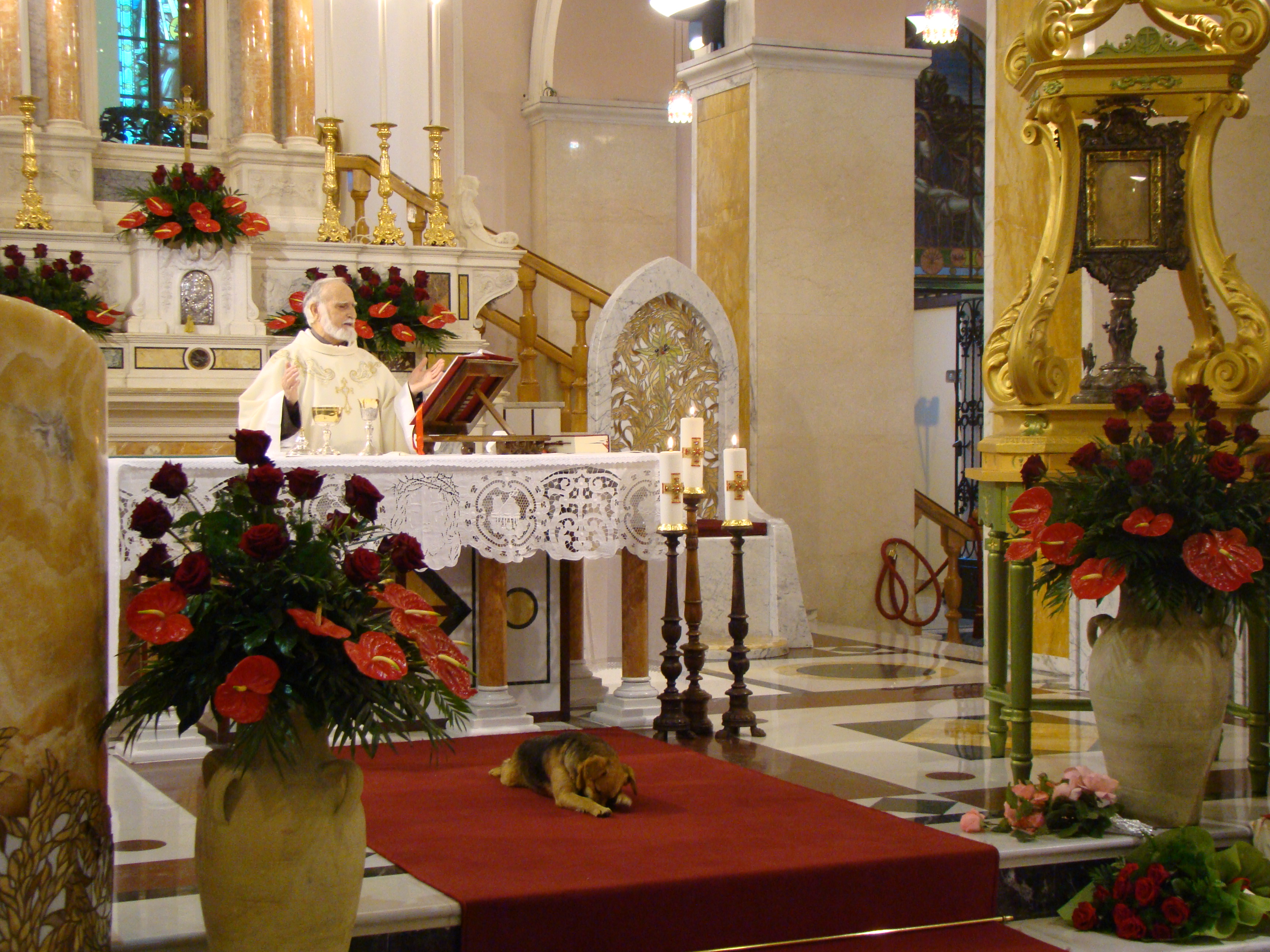
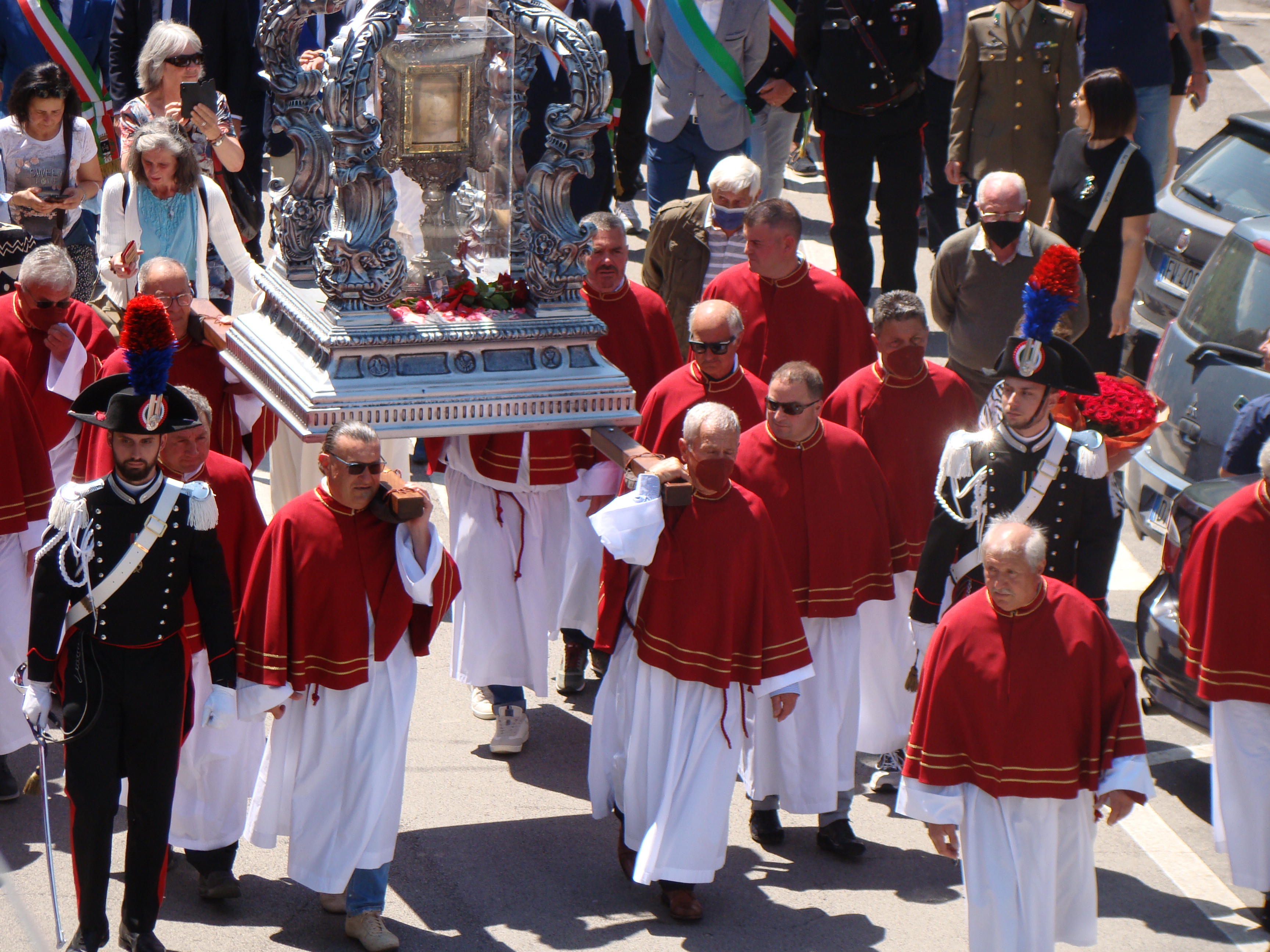
Procession through the streets of Manoppello with the Holy Veil. Photo: Paul Badde/EWTNThe Rector of the Basilica, Capuchin Fr. Antonio Gentili, contemplates the Holy Face on the sheer veil. Photo: Paul Badde/EWTN“Il Volto Santo” – The Holy Face. Photo: Paul Badde/EWTNAll creation bows before His Holy Face! The Solemn Mass was concelebrated by Fr. Mateo Sero, Capuchin Provincial, Fr. Antonio Gentili, Rector of the Basilica, and Fr. Girolomo, pastor of the Church of San Nicola do Bari… and bowing reverently before the altar “Kameles.” Photo: Paul Badde/EWTN
All God’s creatures give Him Praise! Photo: Paul Badde/EWTN
Rose petals tossed before His Holy Face as the procession passes. Photo: Paul Badde/EWTNProcession with the “Il Volto Santo” Photo: Paul BaddeFix your eyes on Him, who is always gazing at you! Photo: Paul Badde/EWTN
Video of the Solemn Exposition of the Holy Face of Manoppello, Italy, May 14, 2022, recorded by Ramona Robben
Photo: Paul Badde/EWTN of the Basilica Shrine of Il Volto Santo, Monoppello, Italy
Let Your Face Shine Upon Us, O Lord!
Beautiful phenomena appearing in the sky above the Sanctuary Basilica during the Benediction ceremony with the Holy Face of Manoppello, Italy. Photo: Paul Badde/EWTN
The Holy Face of Jesus is honored by a May Feast celebrating the mysterious arrival of the “Veronica” to Manoppello in the early 1500’s. The Capuchin Friars minor have guarded the precious “Veronica” relic veil of the Face of Jesus since 1638, when “a devout and well-respected man” named Don Antonio Fabritiis donated the holy veil bearing the Face of Christ to the Capuchin monastery in the small, isolated mountain village of Manoppello. A document entitled Relazione Historica re-telling the local legend of the Veil was written by Capuchin Donato da Bomba and notarized in 1646 and then, certified by sixteen local witnesses. The story told of the arrival of the Veil in Manoppello, “in around 1506,”(the date was vague) in the hands of a mysterious stranger who was thought to have been a holy angel, who later, suddenly disappeared. (Aside from the “angel,” the main characters in the story have been historically verified.)The recorded story told was this: “There lived in Manoppello the very famous Giacomo Antonio Leonelli, doctor in medicine…one day when he was out in the public square just outside of the door of the Mother church of the town of Manoppello, St. Nicholas Bari, in honest conversation with other peers, and while they were speaking a pilgrim arrived unknown by anyone, with a very venerable religious appearance, who having greeted this beautiful circle of citizens, he said, with many terms of manners, and of humility to Dr. Giacomo Antonio Leonelli that he had to speak with him about a secret thing which would be very pleasing, useful and profitable for him. And thus, taking him aside just inside the doorway of the church of St. Nicholas Bari, gave him a parcel, and without unfolding it told him that he ought to hold this devotion very dear, because God would do him many favors, so that in things both temporal and spiritual he would always prosper.” So the doctor took the parcel and turning towards the holy water fount carefully opened it, and “seeing the Most Sacred Face of Our Lord Christ…he burst into most tender tears…and thanking God for such a gift…turned to the unknown pilgrim to thank him…but he did not see him anymore.” When the good doctor, “shaken” and “filled with wonder,” went outside to his friends and asked where the man went, his friends replied that they never saw him exit the church. They searched high and low but never found the mysterious pilgrim, “hence all judged that the man in the form of a pilgrim to be a heavenly Angel, or else a Saint from Paradise.”
— Relazione Historica
Transparent Holy Face Veil Photo: Paul Badde/EWTN
The Holy Veil remained the property of the Leonelli family for nearly a century, until a family member in need of money sold the Veil to Don Antonio Fabritiis, who in turn gave it to the Capuchins in 1638. The Holy Veil, called the “Il Volto Santo,” was kept in a dimly lit side chapel until the church was renovated in 1960, when it was decided that the Veil should be moved to a more prominent place behind the altar of the church of St. Michael, the Shrine of “Il Volto Santo,” which was elevated to the status of a Sanctuary Basilica by Pope Benedict XVI in 2006.
Pope Benedict XVI, a pilgrim to the Holy Face of Manoppello in 2006, Photo: Paul Badde/EWTN
Veil of the Holy Face of Manoppello, Italy Photo: Paul Badde/EWTN
O LORD God of hosts, restore us; Cause Your face to shine upon us, and we will be saved. (Ps 80:19)
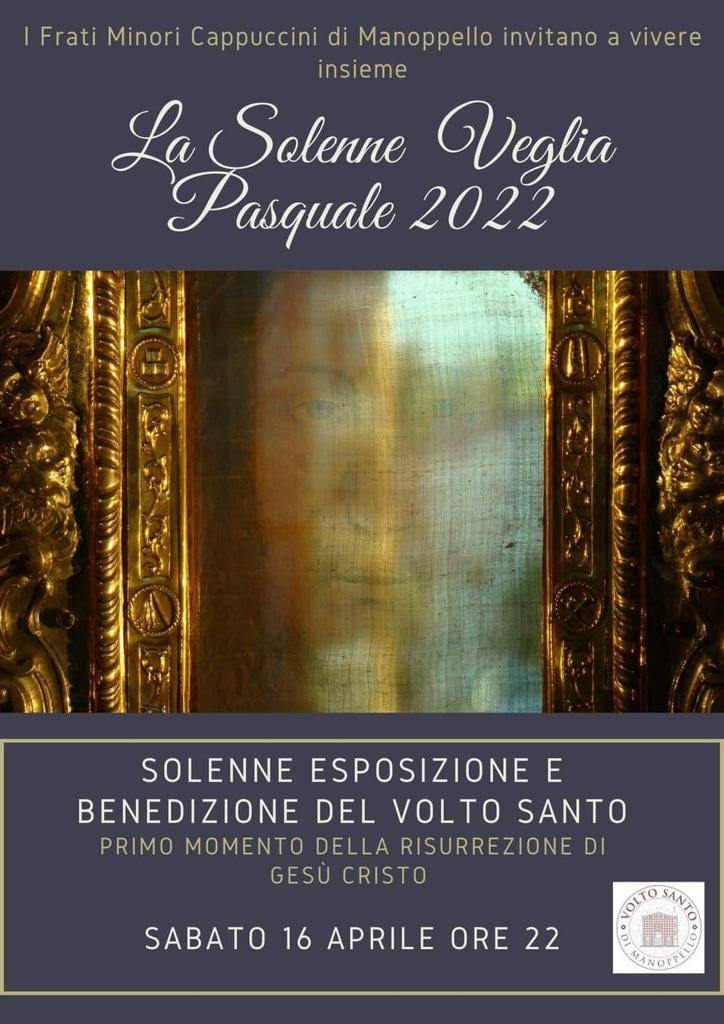
Easter 2022, Solemn Exposition and Benediction of the Holy Face (the Sudarium Veil of Manoppello, Italy), Photo:Paul Badde
Why do the mysterious burial cloths of Jesus have such a tremendous impact on the faith of believers? After all, isn’t faith “the substance of things hoped for, the evidence of things not seen“? (Heb 11:1) But Christ Himself left tangible evidence of the Resurrection for future generations to seein faith and hope. “Faith is both hearing and seeing” (Encyclical Lumen Fidei). The Apostles Peter and John knew Jesus, the man, who appeared as any other man: “There was no stately bearing to make us look at him, nor appearance that would attract us to him” (Isaiah 53: 2). They had heard and believed the words of Jesus; they were witnesses to His miracles, Passion and death; and yet, it was the burial cloths that were left behind in the tomb at the Resurrection of Jesus that caused the Apostle to see and believe “For they did not yet understand the Scripturethat he had to rise from the dead ” (John 20: 1-9).
After Christ’s Passion, in the darkest hours, when the first light of dawn appeared, Saints Peter and John were running to the tomb. One can imagine a gaze of wonder, as they found the tomb empty, except for the burial cloths. There are, in existence today, two miraculous cloths that are believed to be from Christ’s tomb which bear His image: an image on linen, of Christ’s Passion and death known as Shroud of Turin, Italy; and the shimmering, sudarium veil that covered His Face, woven from precious byssus. This fragile, transparent veil bears a changing, image of the living Face of Christ that still shows traces of the Passion, and is kept at the Basilica Shrine of “Il Volto Santo” in Manoppello, Italy. It is believed to be “the cloth” written about in Scripture that had covered the head of Jesus and had been rolled up in a separate place (John 20:7). These unfading, miraculous images exist to confirm and strengthen our faith, and to unleash the power of Christ’s Resurrection on the faithful who see and believe that Jesus Christ has truly risen indeed. Alleluia!
The Disciples Peter and John Running to the Sepulchre on the Morning of the Resurrection, Eugene Burnand, 1898
So Peter and the other disciple went out and came to the tomb. They both ran, but the other disciple ran faster than Peter and arrived at the tomb first; he bent down and saw the burial cloths there, but did not go in. When Simon Peter arrived after him, he went into the tomb and saw the burial cloths there, and the cloth that had covered his head, not with the burial cloths but rolled up in a separate place. Then the other disciple also went in, the one who had arrived at the tomb first, and he saw and believed. For they did not yet understand the Scripture that he had to rise from the dead. (John 20: 1-9)
Holy Veil of Manoppello said to be the image of the Resurrected Christ Photo: Paul Badde/EWTN
” The light of faith is the light of a countenance in which the Father is seen.”
(Lumen Fidei)
“Whoever believes in me believes not only in me but also in the one who sent me, and whoever sees me sees the one who sent me. I came into the world as light, so that everyone who believes in me might not remain in darkness.”
(John 12:44-46)
From the Encyclical Lumen Fidei (Light of Faith): …faith itself leads to deeper vision: “If you believe, you will see the glory of God” (Jn 11:40). In the end, belief and sight intersect: “Whoever believes in me believes in him who sent me. And whoever sees me sees him who sent me” (Jn 12:44-45). Joined to hearing, seeing then becomes a form of following Christ, and faith appears as a process of gazing, in which our eyes grow accustomed to peering into the depths. Easter morning thus passes from John who, standing in the early morning darkness before the empty tomb, “saw and believed” (Jn 20:8), to Mary Magdalene who, after seeing Jesus (cf. Jn 20:14) and wanting to cling to him, is asked to contemplate him as he ascends to the Father, and finally to her full confession before the disciples: “I have seen the Lord!” (Jn 20:18).
How does one attain this synthesis between hearing and seeing? It becomes possible through the person of Christ himself, who can be seen and heard. He is the Word made flesh, whose glory we have seen (cf. Jn 1:14). The light of faith is the light of a countenance in which the Father is seen.”
— Encyclical Lumen Fidei, Ch. 2,30
“The Cloth that Covered His Head”
At the time of Jesus, the Jewish law required several “cloths” to be used for burial, and as many as six for someone who had died a violent death. Christian tradition has preserved six cloths as relics that are associated with the burial of Jesus – 1.) The Shroud of Turin, 2.) the Sudarium of Oviedo in Spain, 3.) The Sudarium Veil of Manoppello, 4.) The Sudarium of Kornelimunster in Germany, 5.) The SindonMunda of Aachen, Germany, 6.) The Cap of Cahors in France.
Three of the cloths in particular stand out as extraordinary “witnesses” to the Passion, Death, and Resurrection of Jesus, and together they bear a powerful testimony to the truth of the Gospels. Each one bearing an imprint or image of the Face of Jesus. They are: The Sudarium of Oviedo, The Shroud of Turin, and the Sudarium Veil of Manoppello. The remarkable relationship between these three “cloths” leave little doubt that each came in contact with the face of the same man at the time of burial.
Sudarium of Oviedo
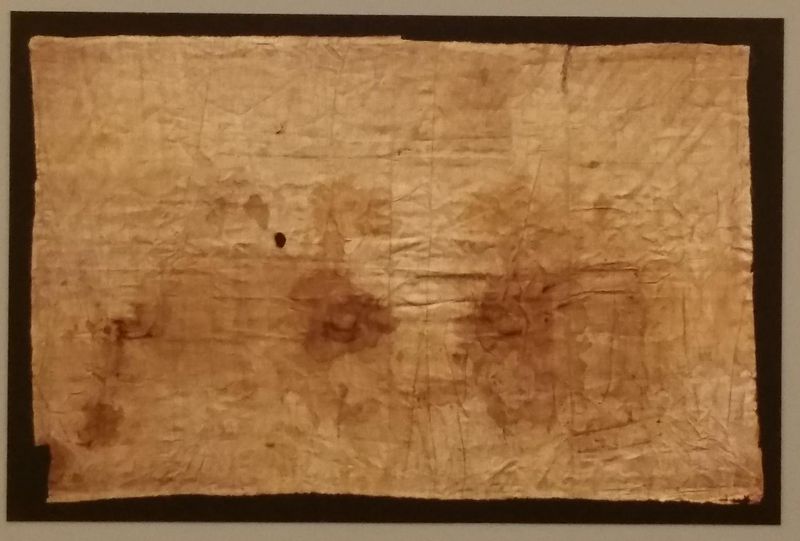
The Sudarium of Oviedo directly touched Jesus’s head following His Crucifixion. Blood was considered sacred to the Jews, so this cloth was used to soak up the Precious Blood of Jesus, by wrapping it around Jesus’s Head, as He was taken down from the Cross. The largest bloodstains are from the nose, other stains are from the eyes and other parts of the face. There is also an imprint on the sudarium of the hand of the person who held this cloth to Jesus’s Face to staunch the flow of blood. It takes one’s breath away to see that the bloodstains on the Sudarium of Oviedo, when overlaid with the Face on the Shroud of Turin and the Sudarium Veil of Manoppello, correspond perfectly. The blood type is AB, the same as on the Shroud of Turin.
Face on the Shroud of Turin by photographer Secondo Pia, 1898
“He went into the tomb and saw the burial cloths there”
The Shroud of Turin; the sindone, or linen burial shroud, was believed to have been used to wrap the entire body of Christ. It is the most famous and studied of the three cloths. The faint but visible imprint on the Shroud of Turin gives witness to the violent torture of a man as described in the Passion and Death of Jesus in the Scripture. The world was amazed when Secondo Pia first photographed the Face on the Shroud in 1898; the negative of the photo incredibly became visible as a positive image. The Shroud of Turin caused an entire branch of science to be dedicated to its research called Sindonology.
The Sudarium Veil of the Face of Christ, Photo: Patricia Enk
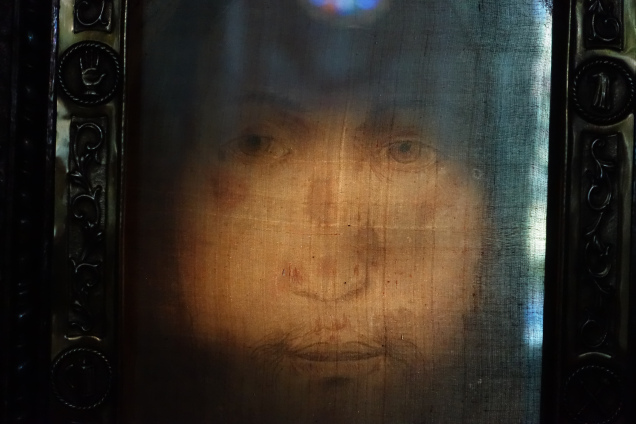
The Sudarium Veil of Manoppello, Italy, is perhaps the least known of the three burial “cloths.” The Veil bears the image of the living Face of Jesus. This “miracle of light,” “not made by human hands,” was protected and hidden in an isolated church in the Abbruzzi Mountains for centuries. It is believed to be the “cloth” that covered the Face of Jesus in death, showing traces of the Passion: Bruises, swelling, wounds from the Crown of Thorns, and plucked beard. But, it is also believed to have recorded in light the Face of Jesus at the moment of His Resurrection. No, this is not a contradiction. Yes, the image changes. It shows suffering, but it also shows life!
“The cloth that had covered his head”
Funeral of Pope St. John Paul II, Archbishop Dziwisz covers the pope’s face with a veil.
An explanation about the tradition of a face cloth for burial may be helpful in understanding its profound significance: In the funeral rites for priests in some Eastern churches, the veil which was used to cover the chalice and paten were placed on the face of the deceased priest. (The cloth used to cover the chalice and paten had a particular liturgical symbolism linked to the Face of Christ as well.) It was done as a symbol of both the strength and protection of God, and also of the tomb of Christ–an expression of belief in the Resurrection. In Jewish burial custom, a deceased priest’s face would be anointed with oil and then covered with a white cloth, and would have been done for Jesus.
When Pope St. John Paul II was being laid in his coffin, Archbishops Marini and Stanley Dziwisz had the honor of placing a white silk veil over the face of the pope. Poignantly, the choir sang the words from Psalm 42, “My soul thirsts for God, the living God; when will I come and see the Face of the Lord?” Many wondered about the action of covering the pope’s face with a veil because this was the first time it had been done, but was at the request of Pope John Paul II, who had dedicated the millennium to the Face of Christ.
Byssus “Pinna Nobilis” fit for a King! Photo: Paul Badde/EWTN
The cloth that would cover the Face of Christ would have to be made of a material fit for a King, a High Priest, and a God. Byssus, mentioned in the Bible forty times, also known as “sea-silk,” is more rare and precious than gold and it has an exceedingly fine texture which can be woven. Made from the long tough silky filaments of Pinna Nobilis mollusks that anchor them to the seabed, it is strong enough to resist the extreme hydrodynamic forces of the sea. Byssus has a shimmering, iridescent quality which reflects light. It is extremely delicate, yet strong at the same time. It resists water, weak acids, bases, ethers, and alcohols. Byssus cannot be painted, as it does not retain pigments, it can only be dyed; and then, only purple. It can also last for more than 2000 years.
Kurt Cardinal Koch contemplates the Veil “not made by human hands” of Manoppello. Sheer and delicate, yet the Face is visible. Photo: Paul Badde/EWTN
The Sudarium Veil of Manoppello is also made of rare, precious, byssus silk. The skill needed to weave a byssus veil as fine as the Veil of the Holy Face of Manoppello is exceedingly great. Chiara Vigo, known as “the last woman who weaves byssus,” has said that neither she nor anyone alive today could duplicate the gossamer-thin veil, which is sheer enough to read a newspaper through. The weave is so delicate, she says, that only the nimble fingers of a very skillful child could weave something so fine.
Miraculous Holy Face Veil Photo: Paul Badde (see “Manoppello Image” tab)
It is only through light that this shimmering image of the Face of Jesus may be seen, and at times appears as a “living image” as though it were reflected in a mirror, at other times the image completely disappears. Although no camera can adequately capture the image, thanks to the many amazing photos of journalist Paul Badde, the changes that occur when viewing the veil may be better appreciated. (Click here for more photos, and information about Paul Badde’s books and videos about the Holy Face.)
Servant of God Padre Domenico da Cese (1915-1978) before the Veil of Manoppello
While the Face on the Shroud of Turin clearly shows the Face of Jesus in death with eyes closed, the Sudariam of Manoppello has eyes open–bearing witness to the Resurrection. That was the ardent belief of the former Rector of the Basilica Shrine of the Holy Face, Servant of God Padre Domenico da Cese.
There are many physiological reasons too for believing that the Face Cloth captures the first breath of the Resurrection. Sr. Blandina Paschalis Schlomer, who shares that belief, has provided meticulous research about the Veil in her book JESUS CHRIST, The Lamb and the Beautiful Shepherd, The Encounter with the Veil of Manoppello. Sr. Blandina together with the late Fr. Heinrich Pfeiffer, S.J., who had been Professor at the Pontifical Gregorian University in Rome, have each demonstrated that the Holy Face on the Veil of Manoppello is the proto-image of the earliest icons, and other works of art depicting the Face of Jesus.
As the first rays of light entered the tomb, John and Peter, upon entering, “saw and believed.” Sudarium Veil of Manoppello, Photo: Paul Badde/EWTN
“…and he saw and believed. For they did not yet understand the Scripture that he had to rise from the dead.”
Pope Benedict XVI, who came as a pilgrim to Manoppello on September 1, 2006, Fr. Heinrich Pfeiffer, S.J., Paul Badde, and Sr. Blandina Schlomer
What did St. John see in the tomb that would cause him to believe? A cloth of blood, such as the Oviedo? The imprint of the crucified Lord as seen on the Shroud of Turin? The Shroud is a miraculous image, but shows the Face of a dead man, not a man who has ressurected. A third witness was needed in order for the disciple to believe. It could only have been evidence of something as astounding as the Resurrection; proof that Jesus was alive!
It is human nature to want to see things for ourselves. Many pilgrims, humble and great, have felt called to make the journey to visit the miraculous relic. If it is God’s handiwork, and I believe that is true, then one can only wonder at its existence, and gaze in silent contemplation, giving thanks for this tremendous gift of God… so we too may “see and believe.”
“We cannot stop at the image of the Crucified One; He is the Risen One!” –Pope St. John Paul II
Holy Face of Jesus of Manoppello (photo: Paul Badde/EWTN)
“”While we too seek other signs, other wonders, we do not realize that He is the real sign, God made flesh; He is the greatest miracle of the universe: all the love of God hidden in a human heart, in a human face.” ~ Pope Emeritus Benedict XVI
Pope Benedict XVI gazes at the Veil of the Holy Face in Manoppello, Photo:Paul Badde/EWTN
“Show us, O Lord, we pray you, Your Face ever new; that mirror, mystery-laden, of God’s infinite mercy. Grant that we may contemplate it with the eyes of our mind and our hearts: the Son’s Face, radiance of the Father’s glory and the imprint of His Nature (cf. Hb 1:3), the human Face of God that has burst into history to reveal the horizons of eternity. The silent Face of Jesus, suffering and risen, when loved and accepted, changes our hearts and lives. “Your Face, Lord, do I seek, do not hide Your Face from me.” (Ps. 27:8ff) How many times through the centuries and millennia has resounded the ardent invocation of the Psalmist among the faithful! Lord, with faith, we too repeat the same invocation: “Man of suffering, as one from whom other hide their faces.” (Is. 53:3) Do not hide your Face from us!” (Portion of a prayer in honor of the Holy Face of Manoppello by Pope Benedict XVI)
Happy Easter!
Jesus Christ has truly risen indeed! Alleluia! Alleluia! Alleluia!
The byssus Veil of Manoppello, which is thought to be one of the burial cloths of Jesus, photo: Paul Badde/EWTN
+++
To learn more about the history of the Holy Face of Manoppello, click here to read “Four Stories, One Face.”
Or watch this wonderful video below, “The Human Face of God.”
“To live from love is to dry your Face, it is to obtain pardon for sinners.”
— St. Therese of the Child Jesus and the Holy Face
True love must be the care for the other, seeking only the good of the beloved. Love is renunciation, a willingness to sacrifice even unto death. What is this Divine madness that may be contemplated in His Face? In his book, “God is Love,” Pope Benedict XVI wrote:
“God’s passionate love for his people — for humanity — is that is turns God against himself, his love against his justice. Here Christians can see a dim prefigurement of the mystery of the Cross: so great is God’s love for man that by becoming man he follows him even unto death and so reconciles justice and love.”
— Pope Benedict XVI
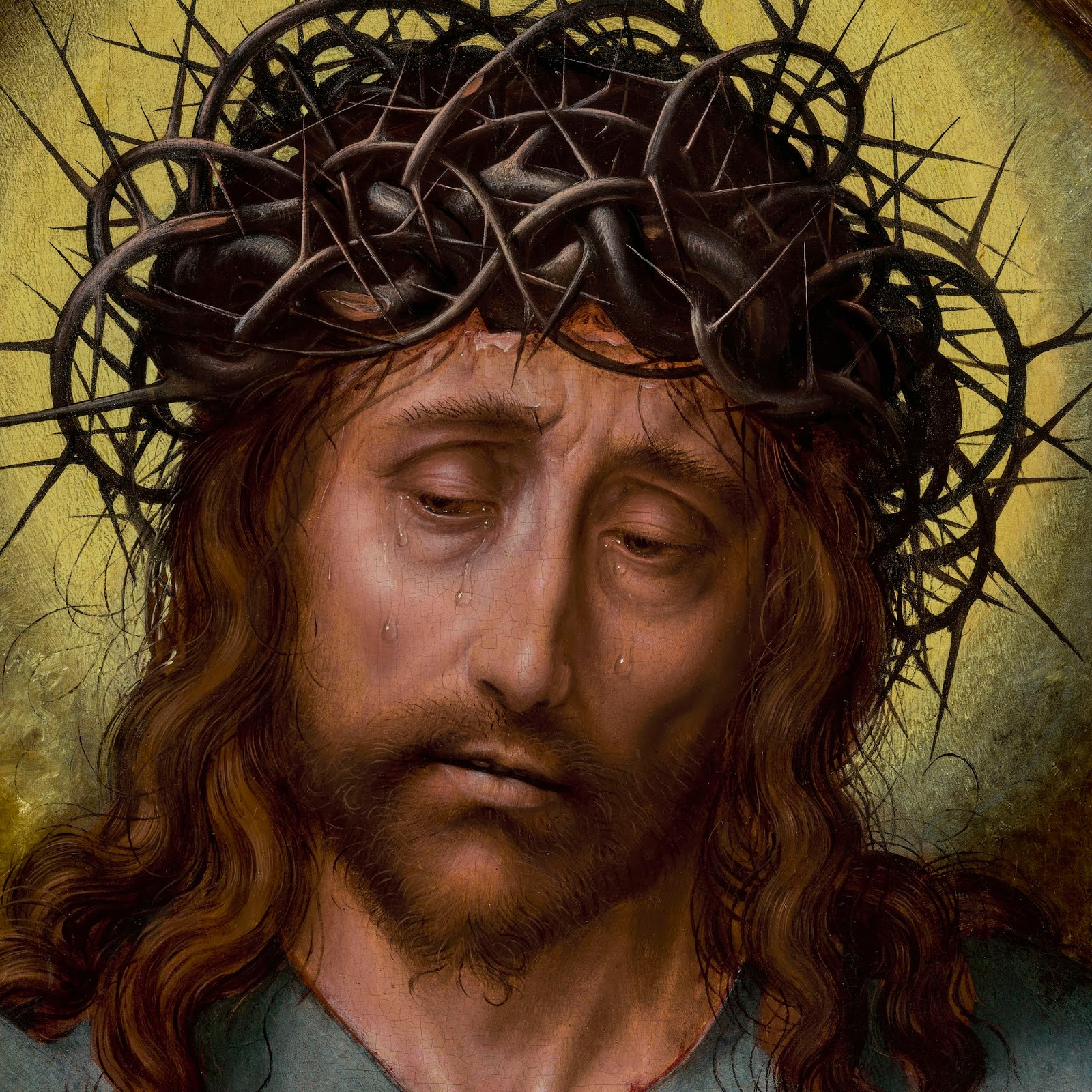
Christ as the Man of Sorrows; Quentin Metsys (Netherlandish, 1465 or 1466 – 1530); Belgium; 1520–1530; Oil on panel; 49.5 × 37 cm (19 1/2 × 14 9/16 in.); 2018.54
Pause a moment to contemplate the innocent, humiliated, and suffering Face of Jesus in order to grow in His love…
“Let us reflect a little. I am convinced that if we apply ourselves diligently to meditate on the soul of Jesus suffering, if we often cast our eyes upon His Countenance, we shall fall in love with His virtue, and that He will Himself gradually infuse it into us.”
— St. Claude La Colombiere
Silence in suffering can make the space for God’s grace to fill and transform our souls in love…
“When you experience something unpleasant, look at Jesus crucified and be silent.”































 Illumina Domine Blog - Devotion to The Holy Face