O LORD God of hosts, restore us; Cause Your face to shine upon us, and we will be saved. (Ps 80:19)
Why do the mysterious burial cloths of Jesus have such a tremendous impact on the faith of believers? After all, isn’t faith “the substance of things hoped for, the evidence of things not seen“? (Heb 11:1) But Christ Himself left tangible evidence of the Resurrection for future generations to seein faith and hope. “Faith is both hearing and seeing” (Encyclical Lumen Fidei). The Apostles Peter and John knew Jesus, the man, who appeared as any other man: “There was no stately bearing to make us look at him, nor appearance that would attract us to him” (Isaiah 53: 2). They had heard and believed the words of Jesus; they were witnesses to His miracles, Passion and death; and yet, it was the burial cloths that were left behind in the tomb at the Resurrection of Jesus that caused the Apostle to see and believe “For they did not yet understand the Scripturethat he had to rise from the dead ” (John 20: 1-9).
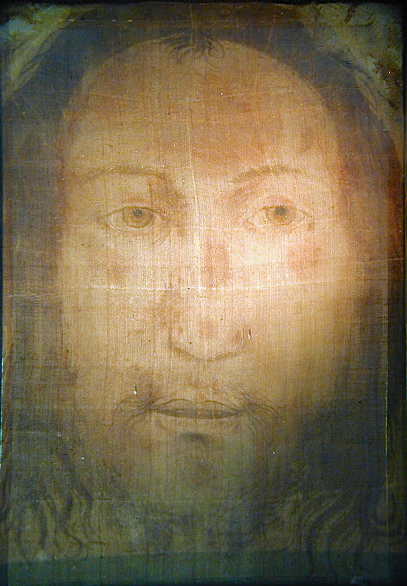
After Christ’s Passion, in the darkest hours, when the first light of dawn appeared, Saints Peter and John were running to the tomb. One can imagine a gaze of wonder, as they found the tomb empty, except for the burial cloths. There are, in existence today, two miraculous cloths that are believed to be from Christ’s tomb which bear His image: an image on linen, of Christ’s Passion and death known as Shroud of Turin, Italy; and the shimmering, sudarium veil that covered His Face, woven from precious byssus. This fragile, transparent veil bears a changing, image of the living Face of Christ that still shows traces of the Passion, and is kept at the Basilica Shrine of “Il Volto Santo” in Manoppello, Italy. It is believed to be “the cloth” written about in Scripture that had covered the head of Jesus and had been rolled up in a separate place (John 20:7). These unfading, miraculous images exist to confirm and strengthen our faith, and to unleash the power of Christ’s Resurrection on the faithful who see and believe that Jesus Christ has truly risen indeed. Alleluia!
The Disciples Peter and John Running to the Sepulchre on the Morning of the Resurrection, Eugene Burnand, 1898
So Peter and the other disciple went out and came to the tomb. They both ran, but the other disciple ran faster than Peter and arrived at the tomb first; he bent down and saw the burial cloths there, but did not go in. When Simon Peter arrived after him, he went into the tomb and saw the burial cloths there, and the cloth that had covered his head, not with the burial cloths but rolled up in a separate place. Then the other disciple also went in, the one who had arrived at the tomb first, and he saw and believed. For they did not yet understand the Scripture that he had to rise from the dead. (John 20: 1-9)
Holy Veil of Manoppello said to be the image of the Resurrected Christ Photo: Paul Badde/EWTN
” The light of faith is the light of a countenance in which the Father is seen.”
(Lumen Fidei)
“Whoever believes in me believes not only in me but also in the one who sent me, and whoever sees me sees the one who sent me. I came into the world as light, so that everyone who believes in me might not remain in darkness.”
(John 12:44-46)
From the Encyclical Lumen Fidei (Light of Faith): …faith itself leads to deeper vision: “If you believe, you will see the glory of God” (Jn 11:40). In the end, belief and sight intersect: “Whoever believes in me believes in him who sent me. And whoever sees me sees him who sent me” (Jn 12:44-45). Joined to hearing, seeing then becomes a form of following Christ, and faith appears as a process of gazing, in which our eyes grow accustomed to peering into the depths. Easter morning thus passes from John who, standing in the early morning darkness before the empty tomb, “saw and believed” (Jn 20:8), to Mary Magdalene who, after seeing Jesus (cf. Jn 20:14) and wanting to cling to him, is asked to contemplate him as he ascends to the Father, and finally to her full confession before the disciples: “I have seen the Lord!” (Jn 20:18).
How does one attain this synthesis between hearing and seeing? It becomes possible through the person of Christ himself, who can be seen and heard. He is the Word made flesh, whose glory we have seen (cf. Jn 1:14). The light of faith is the light of a countenance in which the Father is seen.”
— Encyclical Lumen Fidei, Ch. 2,30
“The Cloth that Covered His Head”
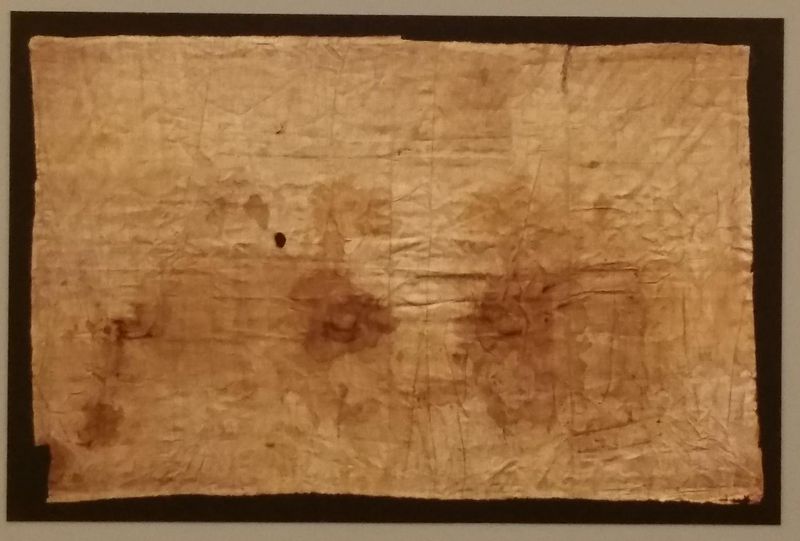
At the time of Jesus, the Jewish law required several “cloths” to be used for burial, and as many as six for someone who had died a violent death. Christian tradition has preserved six cloths as relics that are associated with the burial of Jesus – 1.) The Shroud of Turin, 2.) the Sudarium of Oviedo in Spain, 3.) The Sudarium Veil of Manoppello, 4.) The Sudarium of Kornelimunster in Germany, 5.) The SindonMunda of Aachen, Germany, 6.) The Cap of Cahors in France.
Three of the cloths in particular stand out as extraordinary “witnesses” to the Passion, Death, and Resurrection of Jesus, and together they bear a powerful testimony to the truth of the Gospels. Each one bearing an imprint or image of the Face of Jesus. They are: The Sudarium of Oviedo, The Shroud of Turin, and the Sudarium Veil of Manoppello. The remarkable relationship between these three “cloths” leave little doubt that each came in contact with the face of the same man at the time of burial.
Sudarium of Oviedo
The Sudarium of Oviedo directly touched Jesus’s head following His Crucifixion. Blood was considered sacred to the Jews, so this cloth was used to soak up the Precious Blood of Jesus, by wrapping it around Jesus’s Head, as He was taken down from the Cross. The largest bloodstains are from the nose, other stains are from the eyes and other parts of the face. There is also an imprint on the sudarium of the hand of the person who held this cloth to Jesus’s Face to staunch the flow of blood. It takes one’s breath away to see that the bloodstains on the Sudarium of Oviedo, when overlaid with the Face on the Shroud of Turin and the Sudarium Veil of Manoppello, correspond perfectly. The blood type is AB, the same as on the Shroud of Turin.
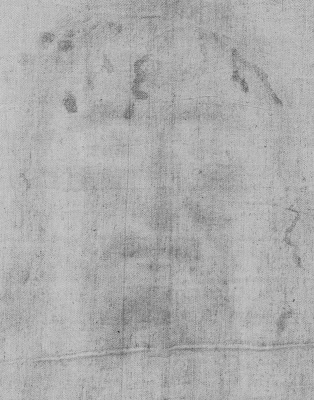
Face on the Shroud of Turin by photographer Secondo Pia, 1898
“He went into the tomb and saw the burial cloths there”
The Shroud of Turin; the sindone, or linen burial shroud, was believed to have been used to wrap the entire body of Christ. It is the most famous and studied of the three cloths. The faint but visible imprint on the Shroud of Turin gives witness to the violent torture of a man as described in the Passion and Death of Jesus in the Scripture. The world was amazed when Secondo Pia first photographed the Face on the Shroud in 1898; the negative of the photo incredibly became visible as a positive image. The Shroud of Turin caused an entire branch of science to be dedicated to its research called Sindonology.
The Sudarium Veil of the Face of Christ, Photo: Patricia Enk
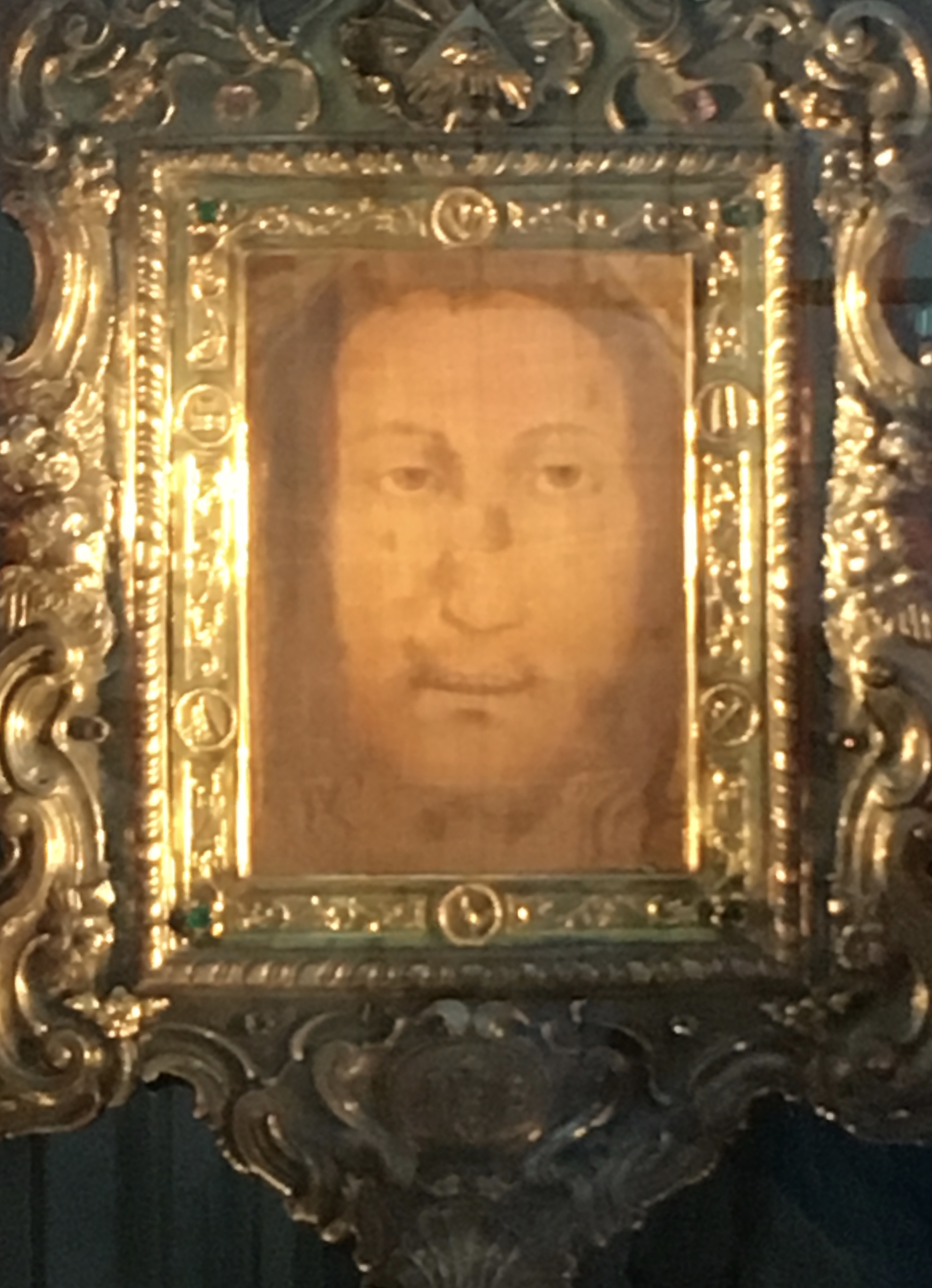
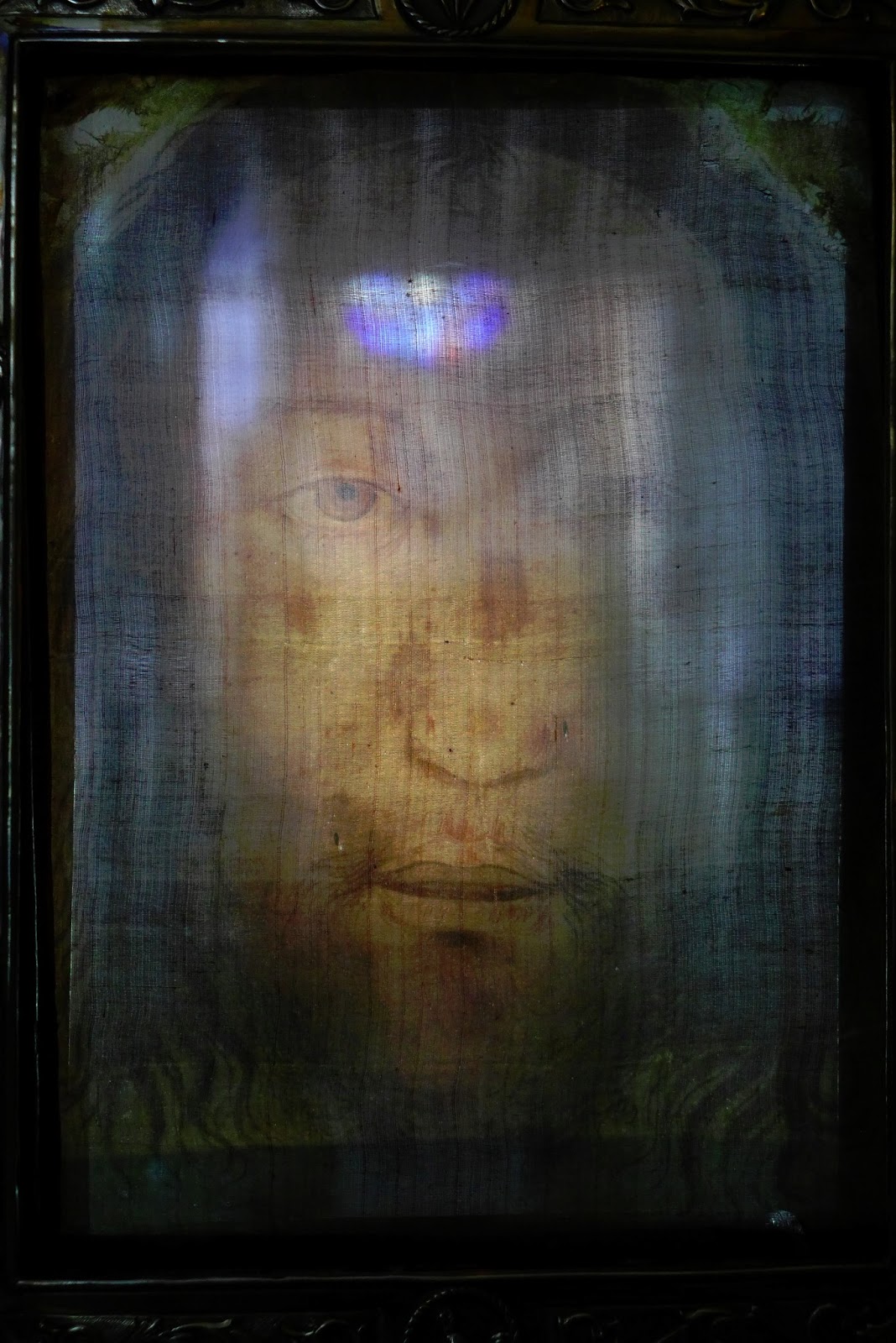
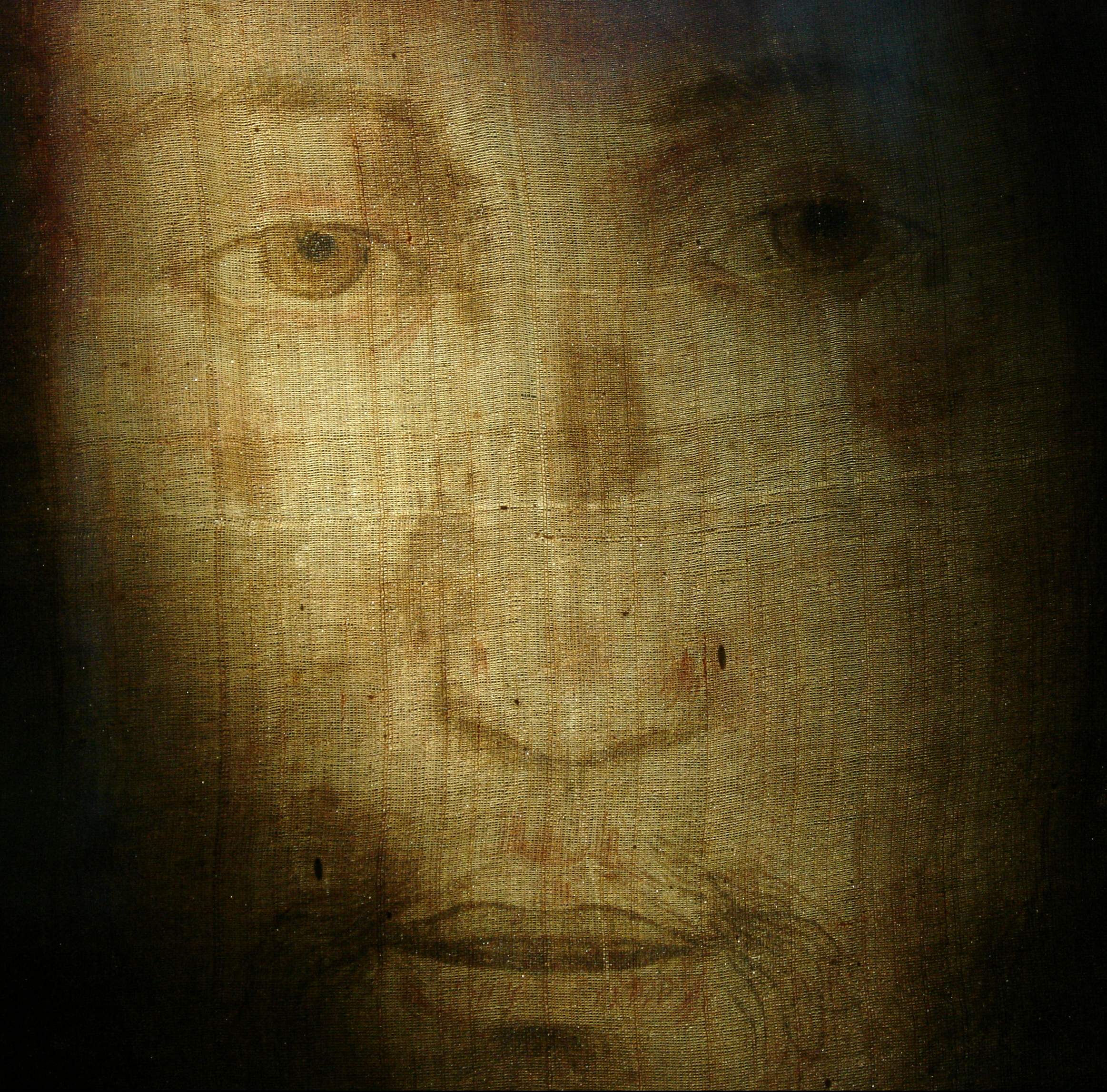
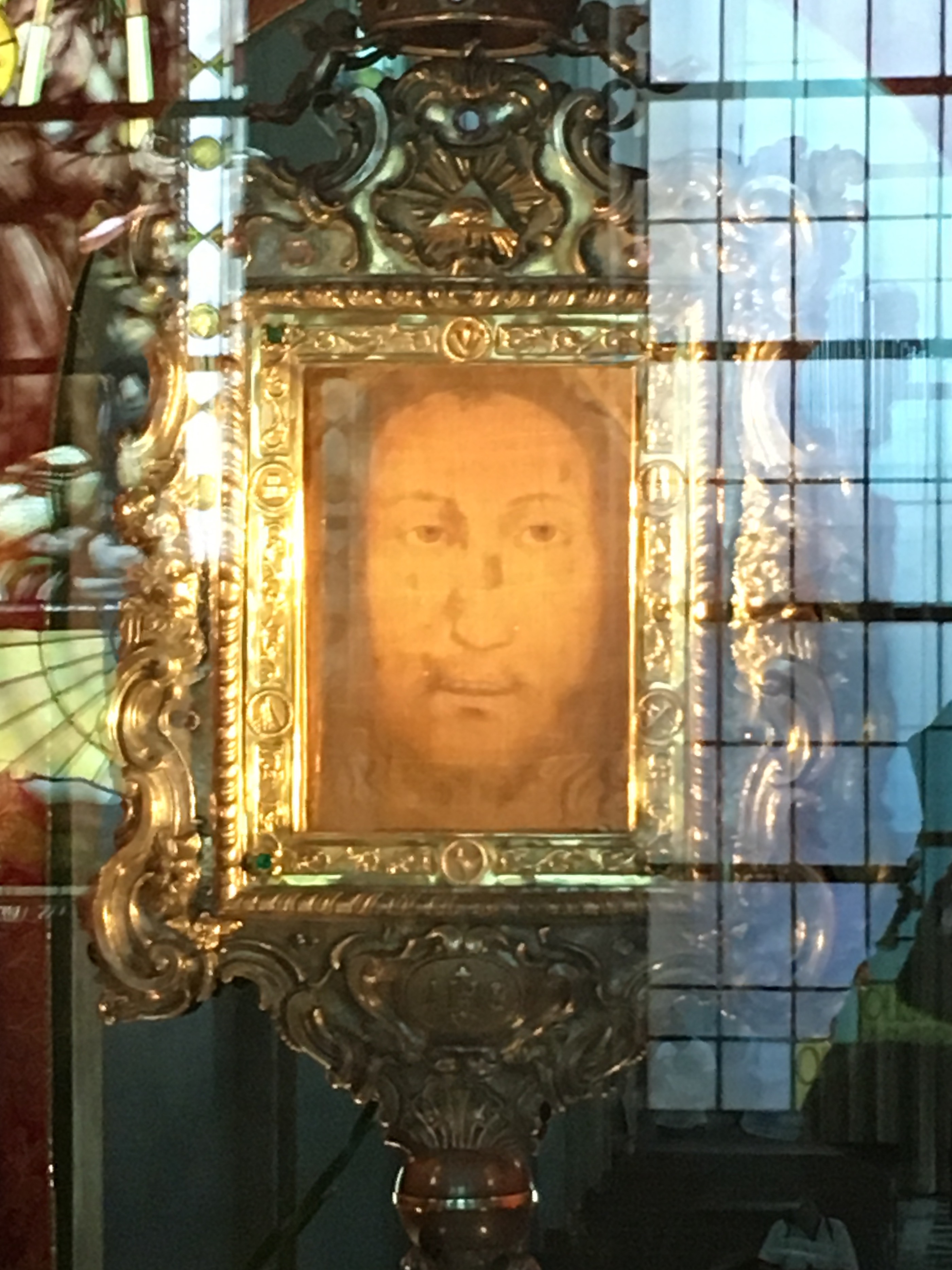
The Sudarium Veil of Manoppello, Italy, is perhaps the least known of the three burial “cloths.” The Veil bears the image of the living Face of Jesus. This “miracle of light,” “not made by human hands,” was protected and hidden in an isolated church in the Abbruzzi Mountains for centuries. It is believed to be the “cloth” that covered the Face of Jesus in death, showing traces of the Passion: Bruises, swelling, wounds from the Crown of Thorns, and plucked beard. But, it is also believed to have recorded in light the Face of Jesus at the moment of His Resurrection. No, this is not a contradiction. Yes, the image changes. It shows suffering, but it also shows life!
“The cloth that had covered his head”
Funeral of Pope St. John Paul II, Archbishop Dziwisz covers the pope’s face with a veil.
An explanation about the tradition of a face cloth for burial may be helpful in understanding its profound significance: In the funeral rites for priests in some Eastern churches, the veil which was used to cover the chalice and paten were placed on the face of the deceased priest. (The cloth used to cover the chalice and paten had a particular liturgical symbolism linked to the Face of Christ as well.) It was done as a symbol of both the strength and protection of God, and also of the tomb of Christ–an expression of belief in the Resurrection. In Jewish burial custom, a deceased priest’s face would be anointed with oil and then covered with a white cloth, and would have been done for Jesus.
When Pope St. John Paul II was being laid in his coffin, Archbishops Marini and Stanley Dziwisz had the honor of placing a white silk veil over the face of the pope. Poignantly, the choir sang the words from Psalm 42, “My soul thirsts for God, the living God; when will I come and see the Face of the Lord?” Many wondered about the action of covering the pope’s face with a veil because this was the first time it had been done, but was at the request of Pope John Paul II, who had dedicated the millennium to the Face of Christ. Pope Benedict XVI had also requested that a veil be placed over his face in death.
Diego Giovanni Ravelli (L), Papal Master of Ceremonies, and Archbishop Georg Gänswein, Prefect of the Papal Household, place a cloth over the face of the body of Pope Emeritus Benedict XVI, during the rite of closing the coffin, in St. Peter’s Basilica in the Vatican on January 4, 2023, which provides for the covering of the deceased’s face with a cloth. (Thank you, Paul Badde/EWTN for this stunning photo.) Byssus “Pinna Nobilis” fit for a King! Photo: Paul Badde/EWTN
The cloth that would cover the Face of Christ would have to be made of a material fit for a King, a High Priest, and a God. Byssus, mentioned in the Bible forty times, also known as “sea-silk,” is more rare and precious than gold and it has an exceedingly fine texture which can be woven. Made from the long tough silky filaments of Pinna Nobilis mollusks that anchor them to the seabed, it is strong enough to resist the extreme hydrodynamic forces of the sea. Byssus has a shimmering, iridescent quality which reflects light. It is extremely delicate, yet strong at the same time. It resists water, weak acids, bases, ethers, and alcohols. Byssus cannot be painted, as it does not retain pigments, it can only be dyed; and then, only purple. It can also last for more than 2000 years.
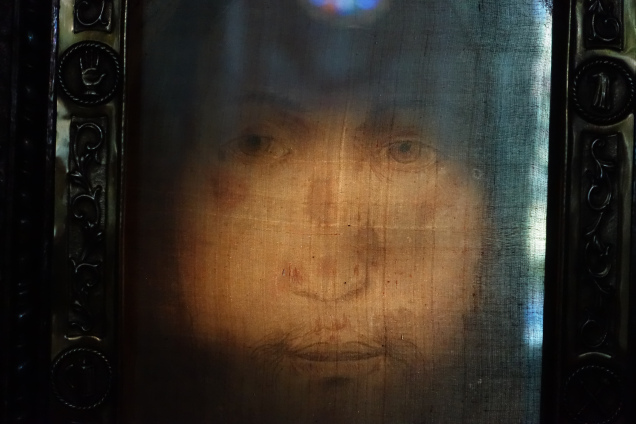
Kurt Cardinal Koch contemplates the Veil “not made by human hands” of Manoppello. Sheer and delicate, yet the Face is visible. Photo: Paul Badde/EWTN
The Sudarium Veil of Manoppello is also made of rare, precious, byssus silk. The skill needed to weave a byssus veil as fine as the Veil of the Holy Face of Manoppello is exceedingly great. Chiara Vigo, known as “the last woman who weaves byssus,” has said that neither she nor anyone alive today could duplicate the gossamer-thin veil, which is sheer enough to read a newspaper through. The weave is so delicate, she says, that only the nimble fingers of a very skillful child could weave something so fine.
Miraculous Holy Face Veil Photo: Paul Badde (see “Manoppello Image” tab)
It is only through light that this shimmering image of the Face of Jesus may be seen, and at times appears as a “living image” as though it were reflected in a mirror, at other times the image completely disappears. Although no camera can adequately capture the image, thanks to the many amazing photos of journalist Paul Badde, the changes that occur when viewing the veil may be better appreciated. (Click here for more photos, and information about Paul Badde’s books and videos about the Holy Face.)
Servant of God Padre Domenico da Cese (1915-1978) before the Veil of Manoppello
While the Face on the Shroud of Turin clearly shows the Face of Jesus in death with eyes closed, the Sudariam of Manoppello has eyes open–bearing witness to the Resurrection. That was the ardent belief of the former Rector of the Basilica Shrine of the Holy Face, Servant of God Padre Domenico da Cese.
There are many physiological reasons too for believing that the Face Cloth captures the first breath of the Resurrection. Sr. Blandina Paschalis Schlomer, who shares that belief, has provided meticulous research about the Veil in her book JESUS CHRIST, The Lamb and the Beautiful Shepherd, The Encounter with the Veil of Manoppello. Sr. Blandina together with the late Fr. Heinrich Pfeiffer, S.J., who had been Professor at the Pontifical Gregorian University in Rome, have each demonstrated that the Holy Face on the Veil of Manoppello is the proto-image of the earliest icons, and other works of art depicting the Face of Jesus.
As the first rays of light entered the tomb, John and Peter, upon entering, “saw and believed.” Sudarium Veil of Manoppello, Photo: Paul Badde/EWTN
“…and he saw and believed. For they did not yet understand the Scripture that he had to rise from the dead.”
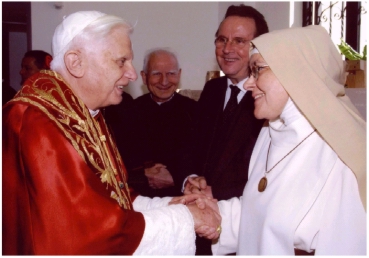
Pope Benedict XVI, who came as a pilgrim to Manoppello on September 1, 2006, Fr. Heinrich Pfeiffer, S.J., Paul Badde, and Sr. Blandina Schlomer
What did St. John see in the tomb that would cause him to believe? A cloth of blood, such as the Oviedo? The imprint of the crucified Lord as seen on the Shroud of Turin? The Shroud is a miraculous image, but shows the Face of a dead man, not a man who has ressurected. A third witness was needed in order for the disciple to believe. It could only have been evidence of something as astounding as the Resurrection; proof that Jesus was alive!
It is human nature to want to see things for ourselves. Many pilgrims, humble and great, have felt called to make the journey to visit the miraculous relic. If it is God’s handiwork, and I believe that is true, then one can only wonder at its existence, and gaze in silent contemplation, giving thanks for this tremendous gift of God… so we too may “see and believe.”
“We cannot stop at the image of the Crucified One; He is the Risen One!” –Pope St. John Paul II
Holy Face of Jesus of Manoppello (photo: Paul Badde/EWTN)
“”While we too seek other signs, other wonders, we do not realize that He is the real sign, God made flesh; He is the greatest miracle of the universe: all the love of God hidden in a human heart, in a human face.” ~ Pope Emeritus Benedict XVI
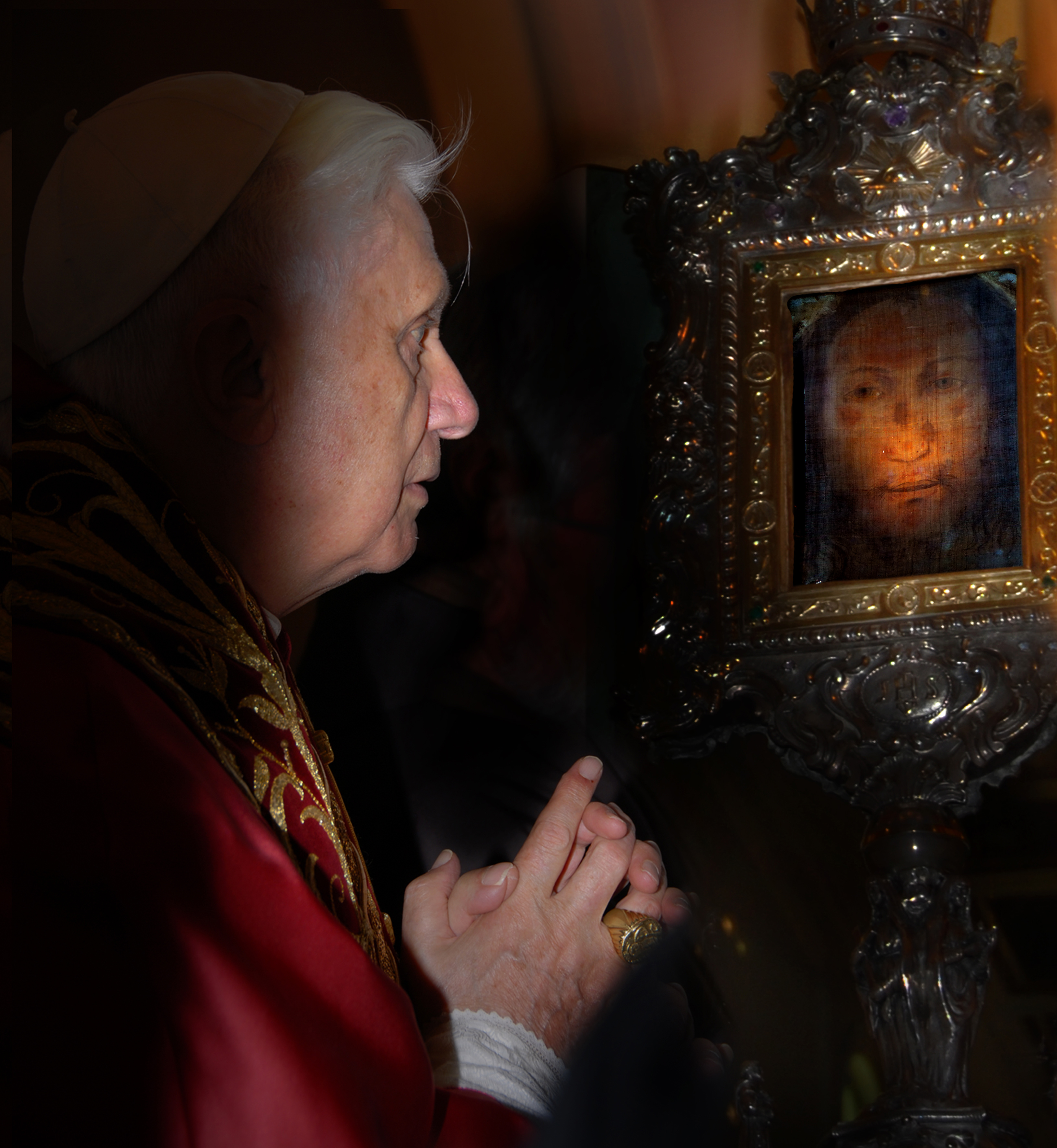
Pope Benedict XVI gazes at the Veil of the Holy Face in Manoppello, Photo:Paul Badde/EWTN
“Show us, O Lord, we pray you, Your Face ever new; that mirror, mystery-laden, of God’s infinite mercy. Grant that we may contemplate it with the eyes of our mind and our hearts: the Son’s Face, radiance of the Father’s glory and the imprint of His Nature (cf. Hb 1:3), the human Face of God that has burst into history to reveal the horizons of eternity. The silent Face of Jesus, suffering and risen, when loved and accepted, changes our hearts and lives. “Your Face, Lord, do I seek, do not hide Your Face from me.” (Ps. 27:8ff) How many times through the centuries and millennia has resounded the ardent invocation of the Psalmist among the faithful! Lord, with faith, we too repeat the same invocation: “Man of suffering, as one from whom other hide their faces.” (Is. 53:3) Do not hide your Face from us!” (Portion of a prayer in honor of the Holy Face of Manoppello by Pope Benedict XVI)
Happy Easter!
Jesus Christ has truly risen indeed! Alleluia! Alleluia! Alleluia!
The byssus Veil of Manoppello, which is thought to be one of the burial cloths of Jesus, photo: Paul Badde/EWTN
+++
To learn more about the history of the Holy Face of Manoppello, click here to read “Four Stories, One Face.”
Or watch this wonderful video below, “The Human Face of God.”
We are created in love by God in His image and likeness, but through sin and brokenness, the love of God grows cold within us, and our “likeness” to God becomes less and less. Only God can help us, only He can heal us; and so He has given us His only Son, Jesus Christ as the perfect model for us of transformation in love through sacrifice and suffering. Only God, the Divine Physician, can transform the evil of suffering into healing, and restoring our souls to a likeness to God in love.
Crucifixion – Diego Velàzquez, 1632
St. John of the Cross wrote that “love effects likeness between the lover and the loved.” (Ascent Book 1) But what if the thing that is loved is not God, but an idol? Idols are those disordered desires, and things, that take the place of God in our hearts. King David wrote: “Let all who set their hearts on idols become like them.” It is a frightening prospect to become “like” idols. The good news is that “God sustains every soul and dwells in it substantially, even though it may be that of the greatest sinner in the world.” (St. John of the Cross)
We also know that God does not will the eternal death of the sinner, but that the sinner may be converted and live. (Ezekiel 18:32) God desires the restoration of His likeness in us. So, in cooperation with God, we must first get rid of all that that is not God, who is all light and love. Light and darkness have nothing in common. St. John of the Cross writes that the souls union with and transformation in God occurs when everything that is “unlike and unconfirmed to God’s Will” is “cast out” so that it “may revive the likeness of God.”
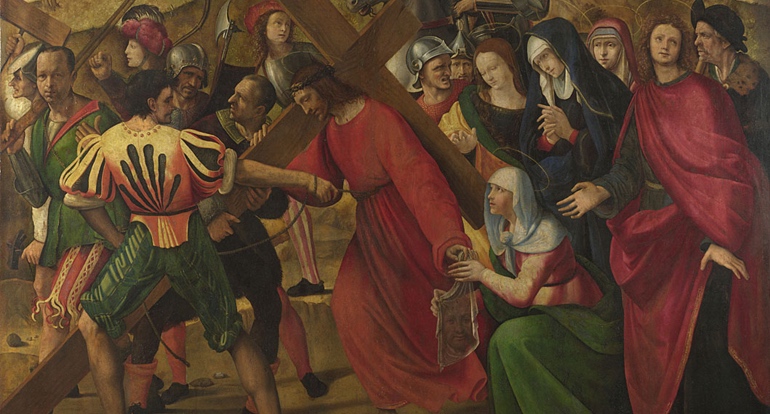
Ridolfo Ghirlandaio, 1483 – 1561
The Procession to Calvary
ca. 1505, detail
Lent is an opportunity for us to participate in God’s work of transformation by removing all that has distorted His Image and Likeness within. First, to root out the idols, we have the grace of the sacrament of Reconciliation. We may also participate by offering to God, through Jesus Christ, the suffering that inevitably comes into every person’s life. Then, to offer willingly, in love, those voluntary sacrifices of prayer, fasting and almsgiving — acts of love — that are necessary to overcome, or cast out, the disordered appetites that have lead us to sin, resulting in the disfiguring of God’s likeness. It is work– at times very hard work. But by denying ourselves, taking up our cross and following Christ, the transformation of the soul in God through love can be brought about. “…for love is to labor to divest and deprive oneself, for God, of all that is not God. When this is done the soul will be illumined by and transformed in God” (St. John of the Cross).
Since casting out all that is not God can be heavy lifting, it is helpful to keep our eyes on the goal, in Faith, Hope and Love, so we may “share in the joy of the Resurrection,” and one day, God-willing, to be counted worthy of seeing God face to face.
Here is a little Lenten encouragement from a beautiful letter about what it means to be “a coheir with Christ” by St. Ambrose, Bishop:
“A coheir of Christ is one who glorified along with Christ. The one who is glorified along with Him is one who, by suffering for Him, suffers along with Him.
To encourage us in suffering Paul adds that all our sufferings are small in comparison with the wonderful reward that will be revealed in us; our labors do not deserve the blessings that are to come. We shall be restored to the likeness of God, and counted worthy of seeing Him face to face.
He enhances the greatness of the revelation that is to come by adding that creation also looks forward to this revealing of the sons of God. Creation, he says, is at present condemned to frustration, not of its own choice, but it lives in hope. It’s hope is in Christ, as it awaits the grace of his ministry; or it hopes that it will share in the glorious freedom of the sons of God and be freed from its bondage to corruption, so that there will be one freedom, shared by creation and by the sons of God when their glory will be revealed.
At present, however, while this revealing is delayed, all creation groans as it looks forward to the glory of adoption and redemption; it is already in labor with that spirit of salvation, and is anxious to be freed from its subjection to frustration.
The meaning is clear: those who have the first fruits of the Spirit are groaning in expectation of the sons. This adoption of sons is that of the whole body of creation, when it will be as it were a son of God and see the divine goodness face to face. The adoption of the sons is present in the Church of the Lord when the Spirit cries out: Abba, Father, as you read in the letter to the Galatians. But it will be perfect when all who are worthy of seeing the face of God rise in incorruption, in honor and glory. Then our humanity will know that it has been truly redeemed. So Paul glories in saying: We are saved by hope. Hope saves, just as faith does, for of faith it is said: Your faith has saved you.
“Christ’s response, ‘Whoever has seen me, has seen the Father, lead us into the heart of Christological faith.’ ” — Pope Benedict XVI
The Veil of the Holy Face of Manoppello, photo by Paul Badde/EWTN
The Act of Consecration to the Holy Face of Jesus
O Lord Jesus, we believe most firmly in You, we love You. You are the Eternal Son of God and the Son Incarnate of the Blessed Virgin Mary. You are the Lord and Absolute Ruler of all creation. We acknowledge You, therefore, as the Universal Sovereign of all creatures. You are the Lord and Supreme Ruler of all mankind, and we, in acknowledging this Your dominion, consecrate ourselves to You now and forever. Loving Jesus, we place our family under the protection of Your Holy Face, and of Your Virgin Mother Mary most sorrowful. We promise to be faithful to You for the rest of our lives and to observe with fidelity Your Holy Commandments. We will never deny before men, You and Your Divine rights over us and all mankind. Grant us the grace to never sin again; nevertheless, should we fail, O Divine Saviour, have mercy on us and restore us to Your grace. Radiate Your Divine Countenance upon us and bless us now and forever. Embrace us at the hour of our death in Your Kingdom for all eternity, through the intercession of Your Blessed Mother, of all Your Saints who behold You in Heaven, and the just who glorify You on earth. O Jesus, be mindful of us forever and never forsake us; protect our family. O Mother of Sorrows, by the eternal glory which you enjoy in Heaven, through the merits of your bitter anguish in the Sacred Passion of your Beloved Son, our Lord Jesus Christ, obtain for us the grace that the Precious Blood shed by Jesus for the redemption of our souls, be not shed for us in vain. We love you, O Mary. Embrace us and bless us, O Mother. Protect us in life and in death. Amen.
Glory to the Father, and to the Son, and to the Holy Spirit. As it was in the beginning, is now, and will be forever. Amen.
Derick Baegert, 1470
The Sudarium Veil of the Human Face of God
Holy Veil of Manoppello said to be the image of the Resurrected Christ Photo: Paul Badde/EWTN
Since ancient times a veil bearing the image of the Face of Christ has been venerated in the Church. How did we come to recognize this face as the Human Face of Jesus Christ?
“When Simon Peter arrived after him [John], he went into the tomb and saw the burial cloths there, and the cloth that had covered his head, not with the burial cloths but rolled up in a separate place.” –John 20:6-7
Scripture goes on to say that “the disciple” John, who had arrived at the tomb first went in after St. Peter, “and he saw and believed.” (John 20: 8) What did St. John see that caused him to believe in the Resurrection? Perhaps the body was stolen. The cloths used to soak up the sacred blood? (The sudarium of Oviedo) That would be expected. The cloth now known as the Shroud of Turin? The faint marks on the cloth could not be seen clearly, especially within a darkened tomb, and the image on the Shroud of Turin is that of Jesus in death. Perhaps what had caused St. John to believe was the “cloth that had covered his head,” revealing in a miraculous way the Face of the living and Risen Christ.
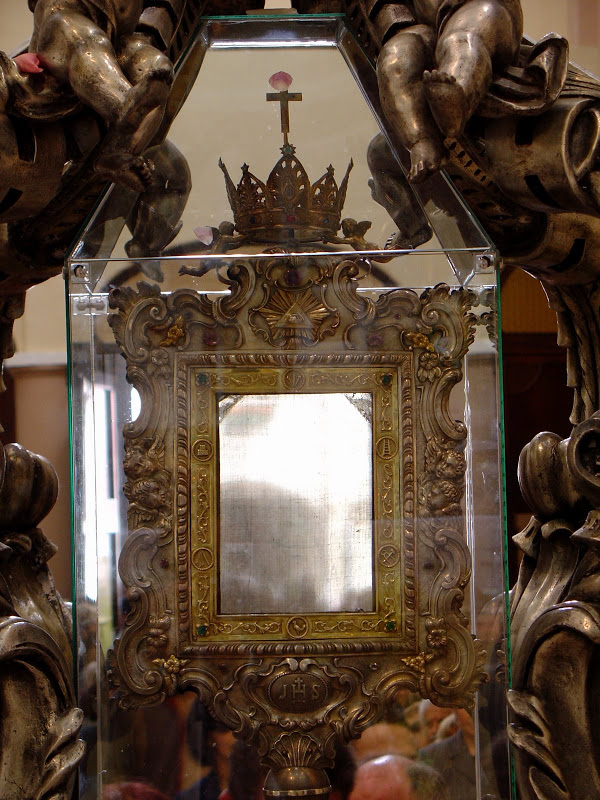
The Holy Veil of the”Holy Face of Manoppello” in Italy Photo:Paul Badde/EWTNSt. Veronica sudarium displaying the Veil of the Holy Face
We can look at ancient mosaics and paintings and immediately recognize the Face of Jesus. But why this particular face, one that bears signs of the Passion yet at the same time is a living face miraculously present on a veil?
Legends and traditions have varied through the centuries but the face is the same. The image was known by many names, but the veil came to be known as “the Veronica,” Vera Icon, the true image. (See Four Stories, One Face)
Later, in the twelfth century legends sprang up about a woman who wiped the Face of Jesus on Calvary, who came to be known as “St. Veronica.” The story of St.Veronica points to the deepest truth about devotion to the Face of Christ — which is that each act of charity, every act of compassion, will leave the imprint of the Face of Jesus in our souls, transforming us into His own Image.
Detail of the Veil of the Face of Jesus from the precious manuscript “Liber Regulae Sancti Spiritus in Saxia” Fresco of ciborium that existed in 708 containing sudarium of the “Veronic” True Icon
Pilgrims traveled great distances to see the relic veil of the “Veronica” at the Vatican. During the Sack of Rome, in 1527, it was rumored that the “Veronica” had been stolen, and another “Veil” had taken its place –it was not a sheer cloth on which the face of Jesus could be seen from both sides — but instead, it showed the face of Christ in death, with his eyes closed. The faithful, under pain of excommunication, were to return copies of the Veronica showing the living Face of Jesus. Devotion to the Face of Christ gradually dwindled. The “Veronica” was no longer shown publicly, except at a great distance. However, the Face as it had been seen on the original veil could still be seen in the artwork of churches across Europe.
Detail depicting the Blessed Virgin Mary holding the “Veronic” Veil. Opusculum by Jacopo Grimaldi (altered date of 1618) shows a living face of “the Veronica Veil” on Vatican inventory After the Sack of Rome, Opusculum of the Holy Face by Francesco Speroni inventory shows the face of a dead man. Copy made of the later “Veronica Veil ” by Pietro Strozzi, Vienna, which looked nothing like the original “living face.”
Many centuries later, in 1849, a time of great crisis in the Church, Pope Pius IX asked that the darkened cloth, held at the Vatican be exposed for the faithful to pray and beg God’s mercy and help. After three days, the faithful were rewarded for their perseverance in prayer: a face, with eyes closed, appeared to glow for three hours on the greatly darkened cloth. This was known as the Epiphany Miracle. Copies were made at once by artists, and once again devotion to the Holy Face was renewed for a time. The Archconfraternity of the Holy Face was approved and prayers were offered before the Holy Face in reparation for blasphemy, sacrilege, the profanation of the Holy Name, and the Holy day of Sunday, as well as prayers for then end of atheistic communism, which was then just rearing its ugly head in the world.
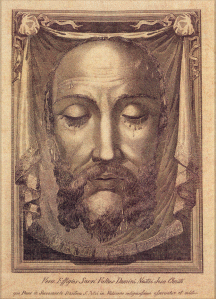
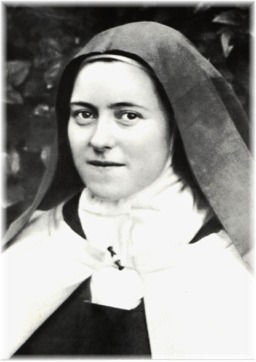
Image venerated after “The miracle of the Vatican” in 1849 – known also as the “Holy Face of Tours” St. Therese
St. Therese of the Child Jesus and the Holy Face is most often associated with the “Holy Face of Tours,” the image which was promoted in France in her lifetime; in fact, the whole Martin family joined the Confraternity of the Holy Face.
“Jesus, Your ineffable image is the star which guides my steps. Ah, You know, Your sweet Face is for me Heaven on earth. My love discovers the charms of Your Face adorned with tears. I smile through my own tears when I contemplate your sorrows.”
“O Jesus, Whose adorable Face ravishes my heart, I implore Thee to fix deep within me Thy Divine Image and to set me on fire with Thy Love, that I may be found worthy to come to the contemplation of Thy glorious Face in Heaven. Amen.” ==St. Therese
After the death of St. Therese (in 1897), the first photographic negatives of the Shroud of Turin could be seen thanks to the photographer Secondo Pia in 1898, revealing the face of a crucified man in death:
The Shroud of Turin
The sister of St. Therese, Sr. Genevieve of the Holy Face (Celine), while marveling at the beautiful photographic negatives of the Face of Jesus on the Shroud of Turin, heard the voice of her sister St. Therese telling her,“Paint Him! Paint Him as He truly is!”
Drawing of the Shroud of Turin by Sr. Genevieve of the Holy Face (Celine Martin, the sister of St. Therese)
Sr. Genevieve of the Holy Face, who was also an excellent artist, rendered a beautiful drawing of the Face on the Shroud of Turin, which won a silver medal in a Canadian exhibition.
Veronica’s Veil, Flemish 15th Century “Veronica” or “true image”
But what happened to the “Vera Icon”, the true image, the recognizable living face of Jesus on a precious sheer veil, as portrayed in this artwork centuries before?
Another image of the Face of Jesus fits the unique characteristics of the stolen miraculous “Veronica” veil of the Vatican — a sheer byssus veil with a living face — It is the Holy Veil of Manoppello. History throughout the centuries recorded what the original “True Icon” looked like.
Pope Benedict XVI gazes at the Veil of the Holy Face in Manoppello, Photo:Paul Badde/EWTN
Although the Veil of Manoppello had been hidden away for centuries in the mountain village of Manoppello, Italy, it has been recently “re-discovered.” (Paul Badde has written about this inThe Human Face of God: the Holy Veil of Manoppello)Pilgrims throughout the world are now able to see this “miracle of light” on a sheer veil which reveals the Face of Jesus from both sides.
Like the Shroud of Turin, the image is “not made by human hands,” and shows no traces of pigment. The former Rector of the Shrine of the Holy Face, the Servant of God Padre Domenico da Cese, believed the Holy Veil of Manoppello to be the sudarium veil — “the cloth that had covered His Head.” The Veil shows not only traces of the Passion but is also said to have recorded the first moment of the Resurrection — something so amazing that it caused Sts. Peter and John to believe that Jesus had Ressurected from the dead! Pope St. John Paul II, who dedicated the millennium to the Face of Christ, has said, “We cannot stop at the image of the Crucified One; He is the Risen One!” The Holy Veil of Manoppello bears witness to the Incarnation, the life, passion, death and resurrection of Jesus Christ; “true God and true man.” St. Padre Pio called the Veil of Manoppello “the greatest relic of the Church.”
“It is the Church’s task to reflect the light of Christ in every historical period, to make His Face shine before the generations of the new millennium. Our witness, however, would be hopelessly inadequate if we ourselves had not first contemplated His FACE!” – Pope St. John Paul II
While there are many beautiful images of the Face of Christ, the great gift of the Holy Face of Manoppello has been made known to the world in our time to give us hope in His Mercy, and His Peace in the midst of trial — to shine the light of His Face upon us – bringing light to the darkness of our world. If you cannot go to Manoppello as a pilgrim, as Pope Emeritus Benedict XVI did in 2006, you can enjoy these incredible, beautiful photos of the Holy Veil by Paul Badde:
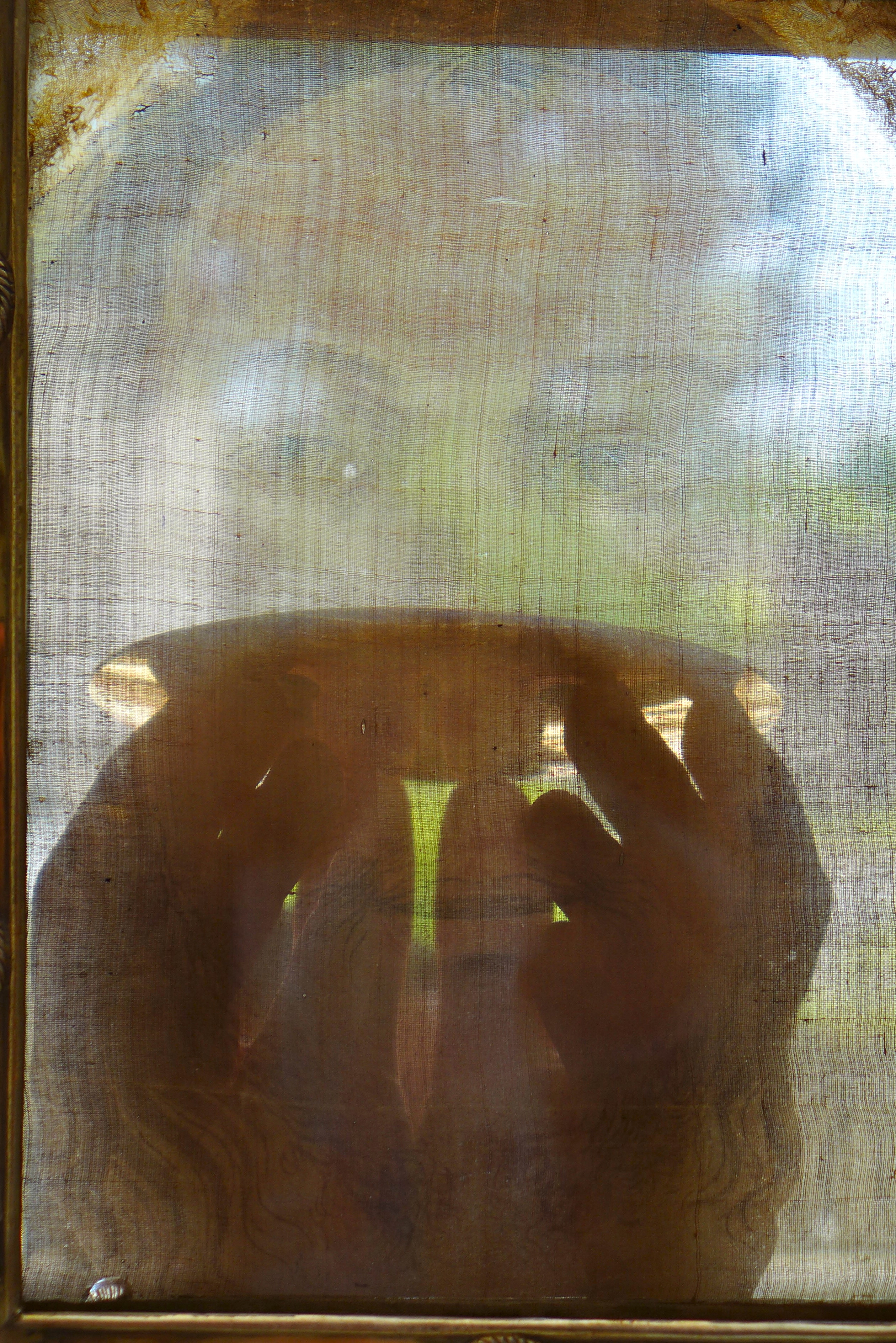
The sheer Veil of Manoppello Photo: Paul Badde/EWTN Hand behind the sheer Veil of Manoppello, “not made by human hand” clearly shows the miraculous nature of “Il Volto Santo” Photo: Paul Badde/EWTN Gossamer-thin veil of Manoppello Photo by Paul Badde Holy Veil of Manoppello, Photo: Paul Badde/EWTN Holy Face of Manoppello Veil, Photo by Paul Badde/EWTN “Il Volto Santo” The Holy Face of Manoppello. (Photo by Paul Badde/EWTN) The Holy Face of Manoppello, (Photo: Paul Badde) Holy Face of Manoppello, Italy Photo: Paul Badde The Veil of the Holy Face of Manoppello “the Living Face” Photo: Paul Badde/EWTN
Prayer to reproduce the Image of God in our souls
Our Lord told Sr. Marie St. Pierre, a Discalced Carmelite Nun, from France, that the image of His Holy Face is like a Divine stamp, which if applied to souls, through prayer, has the power of imprinting anew within them the Image of God.
I salute You! I adore you and I love you, O adorable face of my beloved Jesus, as the noble stamp of the Divinity! Completely surrendering my soul to You, I most humbly beg You to stamp this seal upon us all, so the image of God may once more be reproduced in our souls. Amen.
May the Lord bless and keep you; may He make His Face shine upon and be merciful to you; may He turn His Countenance toward you and grant you His PEACE! (Num 6:22-27)
Padre Pio called the Holy Veil of Manoppello the “greatest relic of the Church” photo: Patricia Enk
“Oh Savior Jesus, who did will that reparation should be as public and universal as had been the offense, penetrate us with the true spirit of reparation. Give us the grace to love Your Divine Face, to make it known and loved by the whole world, in order that it may be to us a source of light and means of salvation. Amen.” –Bl. Maria Pierina de Micheli, “Missionary of the Holy Face”
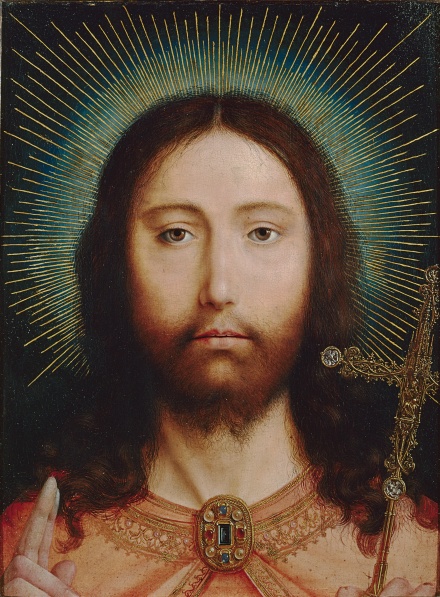
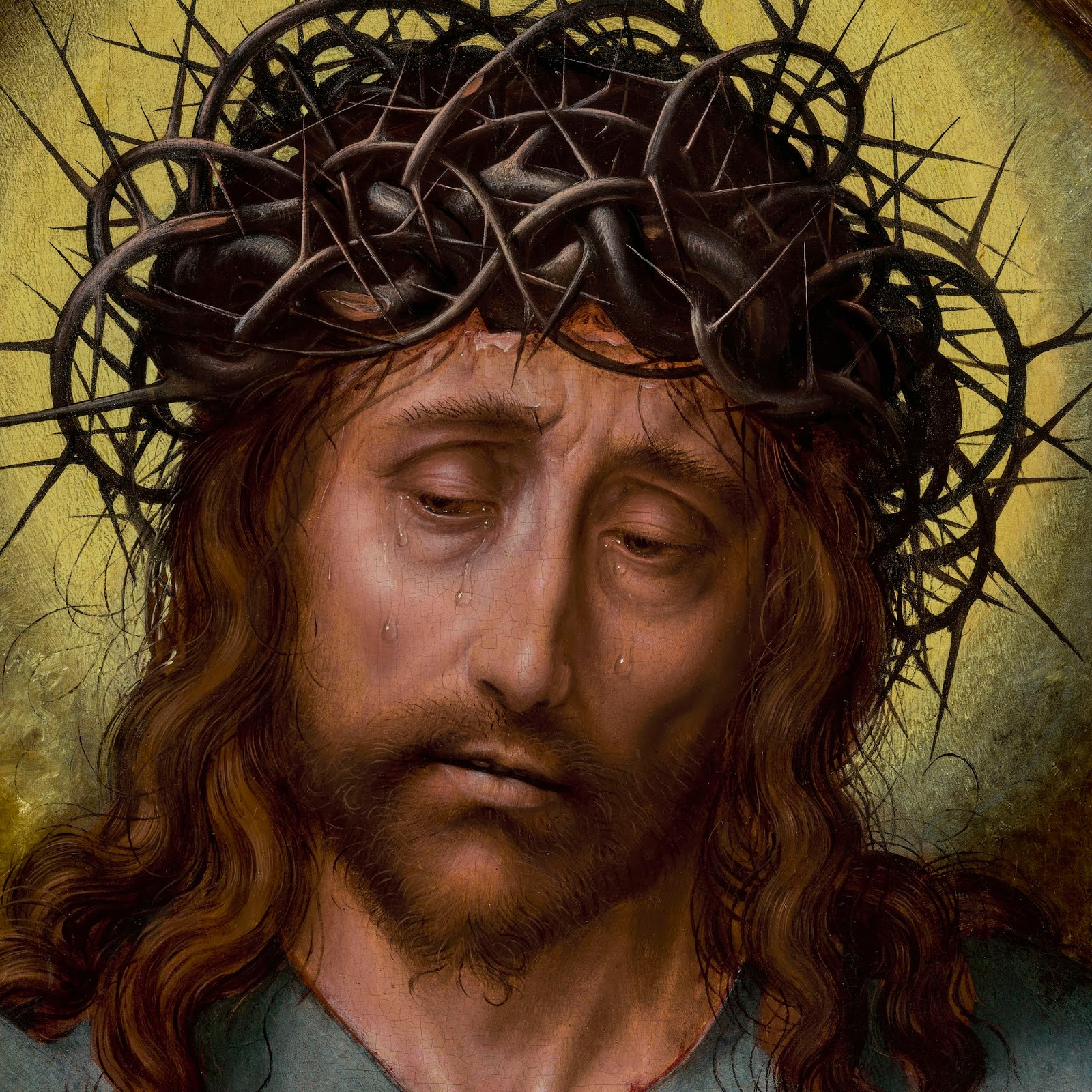
Christ as the Man of Sorrows; Quentin Metsys (Netherlandish, 1465 or 1466 – 1530); Belgium; 1520–1530
Lord Jesus Christ, Saviour of the World, by Thy Passion death and Ressurection, by Thy Holy Face and Holy Name Save us! Holy Mary, Intercede for your poor children around the world! Diptych with Christ as Salvator Mundi and Mary Praying by Quintin Metsys
Prayer to the Holy Trinity
The Man of Sorrows in the arms of the Virgin Mary, by Hans Memling
O Most Holy and Blessed Trinity, through the intercession of Holy Mary, whose soul was pierced through by a sword of sorrow at the sight of the passion of her Divine Son, we ask your help in making a perfect Novena of reparation with Jesus, united with His sorrows, love and total abandonment.
We now implore all the Angels and Saints to intercede for us as we pray this Holy Novena to the Most Holy Face of Jesus and for the glory of the most Holy Trinity, Father, Son and Holy Spirit. Amen.
Ninth Day
Psalm 51: 18-21
For in sacrifice you take no delight, burnt offering from me you would refuse, my sacrifice a
Altar of The Holy Face, St. Patrick’s Cathedral, New York
contrite spirit. A humbled, contrite heart you will not spurn. In your goodness, show favor to Zion; rebuild the walls of Jerusalem. Then you will be pleased with lawful sacrifice, holocausts offered on your altar.
Sacred Face of our Lord and our God, what words can we say to express our gratitude? How can we speak of our joy? That you have deigned to hear us, that you have chosen to answer us in our hour of need. We say this because we know that our prayers will be granted. We know that you, in your loving kindness, listened to our pleading hearts, and will give, out of your fullness, the answer to our problems.
Mary our Mother, intercede for us, St. Joseph, pray for us.
Through the merits of your precious blood and your Holy Face, O Jesus, grant us our petition, …Pardon and mercy.
Prayer to the Holy Trinity
Sr. Lucia’s vision of The Trinity
Most Holy Trinity, Godhead indivisible, Father, Son and Holy Spirit, our first beginning and our last end. Since you have made us after your own image and likeness, grant that all the thoughts of our minds, all the words of our tongues, all the affections of our hearts and all our actions may be always conformed to your most Holy Will, so that that after having seen you here on earth in appearances and in a dark manner by the means of faith, we may come at last to contemplate you face to face, in the perfect possession of you forever in paradise. Amen.
Pray one (1) Our Father, three (3) Hail Mary’s, one (1) Glory Be.
Tomorrow is the Feast of the Holy Feast and Act of Consecration
Our Lord told Sr. Marie St. Pierre that the image of His Holy Face is like a Divine stamp, which if applied to souls, through prayer, has the power of imprinting anew within them the Image of God.
Holy Face on the Shroud of Turin
Prayer to reproduce the Image of God in our souls
I salute You! I adore you and I love you, O adorable face of my beloved Jesus, as the noble stamp of the Divinity! Completely surrendering my soul to You, I most humbly beg You to stamp this seal upon us all, so the image of God may once more be reproduced in our souls. Amen.
Tomorrow, Tuesday, February 21st, will be The Feast of the Holy Face and The Act of Consecration to the Holy Face
“Living” Face of Jesus on the miraculous Veil of Manoppello. Photo: Paul Badde/EWTN
“All of us, with unveiled faces, seeing the glory of the Lord as though reflected in a mirror, are being transformed into the same image.”
“It is the Church’s task to reflect the light of Christ in every historical period, to make His Face shine before the generations of the new millennium. Our witness, however, would be hopelessly inadequate if we ourselves had not first contemplated His FACE!” –St. Pope John Paul IIMay the Lord bless and keep you; may He make His Face shine upon and be merciful to you; may He turn His Countenance toward you and grant you His PEACE! (Num 6:22-27)
Padre Pio called the Holy Veil of Manoppello the “greatest relic of the Church” photo: Patricia Enk
Adorable Face of my Jesus, my only love, my light and my life, grant that I may see no one, except Thee, that I may love Thee alone, that I may live with Thee, of Thee, by Thee and for Thee. Amen
“Gaze at Jesus, our model. Let us copy Him; He is our example in all. Let us study Him in all the moments of His Life,, and let us not be content with an intellectual study, but with love that penetrates the divine teachings, and let us transform them into our very being.” –Bl. Mother Pierina de Micheli, “Missionary of the Holy Face”
Daily Preparatory Prayer
O Most Holy and Blessed Trinity, through the intercession of Holy Mary, whose soul was pierced through by a sword of sorrow at the sight of the passion of her Divine Son, we ask your help in making a perfect Novena of reparation with Jesus, united with His sorrows, love and total abandonment.
We now implore all the Angels and Saints to intercede for us as we pray this Holy Novena to the Most Holy Face of Jesus and for the glory of the most Holy Trinity, Father, Son and Holy Spirit. Amen.
Eighth Day
Psalm 51: 16-17
O rescue me, God my helper, and my tongue shall ring out your goodness. O Lord, open my lips, and my mouth shall declare your praise.
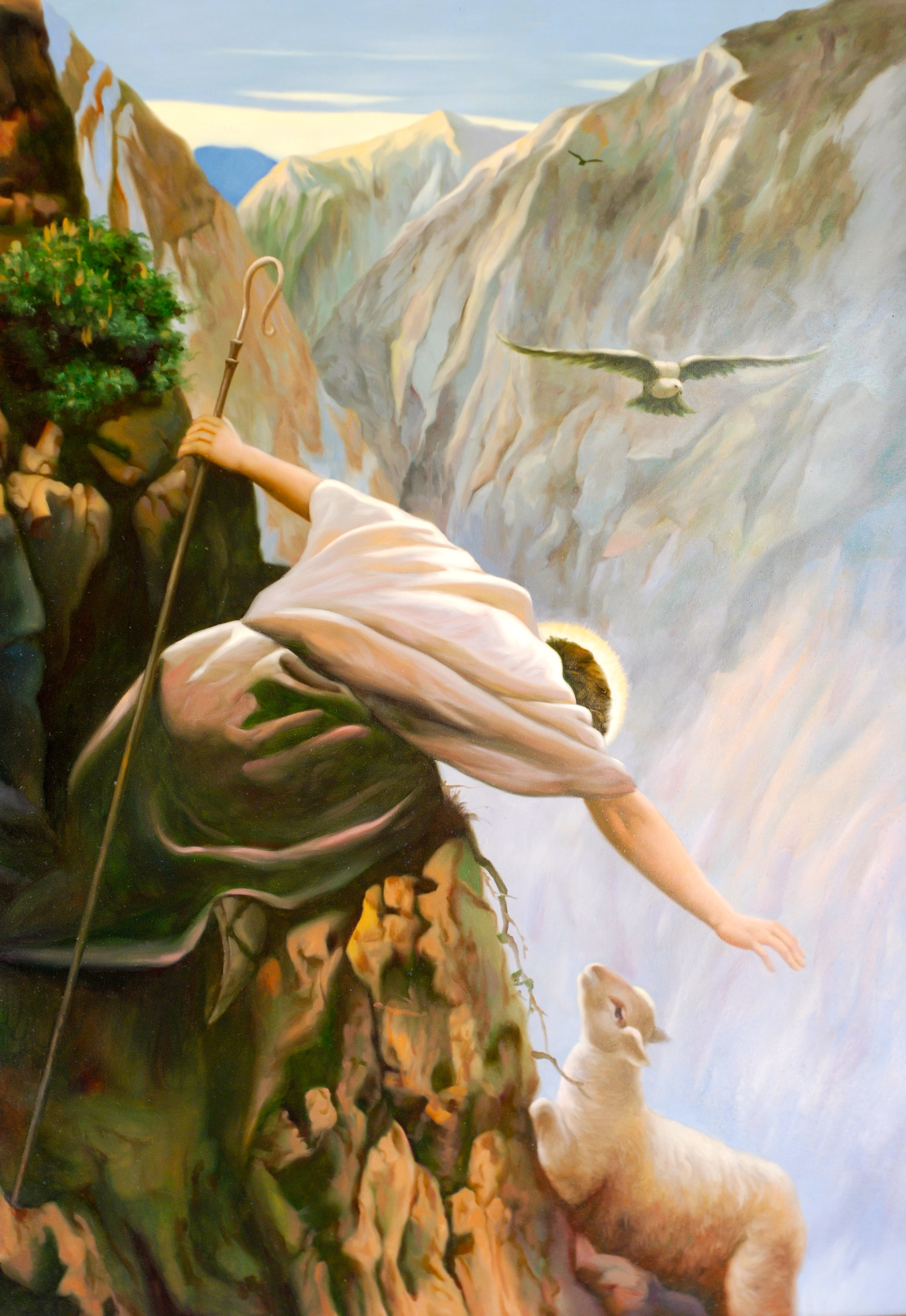
The Good Shepherd
Most merciful Face of Jesus, who in this vale of tears was so moved by our misfortunes to call yourself the healer of the sick, and the Good Shepherd of the souls gone astray, allow not satan to draw us away from you, but keep us always under your loving protection, together with all souls who endeavor to console you.
Mary our Mother, intercede for us, St. Joseph, pray for us.
Through the merits of your precious blood and your Holy Face, O Jesus, grant us our petition, …Pardon and mercy.
Prayer to St. Peter
O Jesus, the divine look of whose adorable Face wounded the heart of Peter with repentant sorrow and love, have mercy on us.
O glorious St. Peter, who in return for thy lively and generous faith, thy profound and sincere humility and thy burning love, was honored by Jesus Christ with singular privileges, and in particular, with the leadership of the other apostles and the primacy of the whole church, of which thou was made the foundation stone, do thou obtain for us the grace of a lively faith, that shall not fear to profess itself openly in its entirety and in all of its manifestations, even to the shedding of blood, if occasion should demand it, and to the sacrifice of life itself in preference to surrender. Obtain for us likewise a sincere loyalty to our Holy Mother the Church. Grant that we may ever remain most closely and sincerely united to The Holy Father, who is the heir of thy faith and of thy authority, the one true visible head of the Catholic Church. Grant moreover, that we may follow, in all humility and meekness, the Church’s teaching and counsels and may be obedient to all her precepts, in order to be able here on earth to enjoy a peace that is sure and undisturbed, and to attain one day in heaven to everlasting happiness. Amen.
Pray one (1) Our Father, three (3) Hail Mary’s, one (1) Glory Be.
O Bleeding Face, O Face Divine, be every adoration Thine. (3 times)
Sorrowful Mother of The Holy Face, Shirburn Chapel England
“This novena which Jesus desires transforms us to correspond with His love, and thus unites us to the Divine Victim, offering ourselves on all the altars of the world to be with Him–true souls of reparation, in union with the Immaculate Virgin–the first Reparatrix.” –Bl. Mother Maria Pierina de Micheli, “Missionary of the Holy Face”
Daily Preparatory Prayer
O Most Holy and Blessed Trinity, through the intercession of Holy Mary, whose soul was pierced through by a sword of sorrow at the sight of the passion of her Divine Son, we ask your help in making a perfect Novena of reparation with Jesus, united with His sorrows, love and total abandonment.
We now implore all the Angels and Saints to intercede for us as we pray this Holy Novena to the Most Holy Face of Jesus and for the glory of the most Holy Trinity, Father, Son and Holy Spirit. Amen.
Seventh Day
Psalm 51: 14-15
Give me again the joy of your help, with a spirit of fervor sustain me, that I may teach
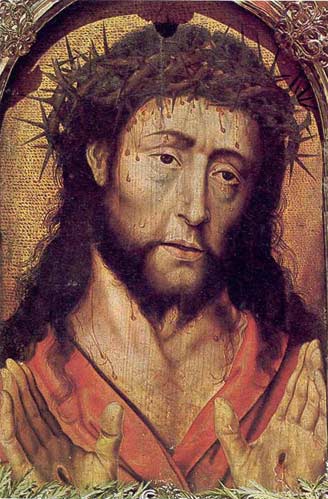
ECCE HOMO! “Behold the Man!”
transgressors your ways and sinners may return to you.
Lord Jesus! After contemplating Thy features, disfigured by grief, after meditating upon Thy passion with compunction and love, how can our hearts fail to be inflamed with a holy hatred of sin, which even now outrages Thy Adorable Face! Lord suffer us not to be content with mere compassion, but give us grace so closely to follow Thee in this Calvary, so that the opprobrium destined for Thee may fall on us. O Jesus, that thus we may have a share, small though it may be, in expiation of sin. Amen.
Mary our Mother, intercede for us, St. Joseph, pray for us.
Through the merits of your precious blood and your Holy Face, O Jesus, grant us our petition, …Pardon and mercy.
“Lord, grant to your Church to stand like Your Virgin Mother, at the glorious Cross and all the crosses of all people to bring about consolation, hope and comfort.” — St. Pope John Paul II
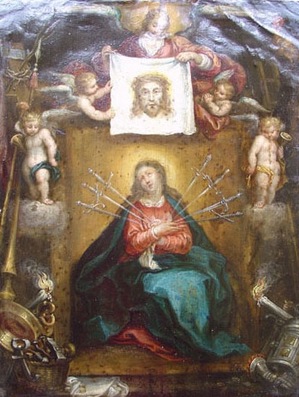
Mater Dolorosa by Dieric Bouts, 1470-75
Prayer in Honor of Mary
Hail Mary, Daughter of God the Father! Hail Mary, Mother of God the Son! Hail Mary, Spouse of the Holy Spirit! Hail Mary, Temple of The Most Holy Trinity! Hail Mary, our mistress, our wealth, our mystic rose, Queen of our hearts, our Mother, our life, our sweetness and our dearest hope! We are all thine, and all we have is thine. O Virgin blessed above all things, may Thy soul be in us to magnify the Lord; may Thy spirit be in us to rejoice in God. Place Thyself, O faithful Virgin, as a seal upon our hearts, that in Thee and through Thee we may be found faithful to God. Grant, most gracious Virgin, that we may be numbered among those who Thou are pleased to love, to teach and to guide, to favor and to protect as Thy children. Grant that with the help of Thy love, we may despise all earthly consolation and cling to heavenly things, until through the Holy Spirit, Thy faithful spouse and through Thee, His faithful spouse, Jesus Christ, Thy Son, be formed within us for the glory of the Father. Amen. (St. Louis De Montfort)
Pray one (1) Our Father, three (3) Hail Mary’s, one (1) Glory Be.
O Bleeding Face, O Face Divine, be every adoration Thine. (3 times)
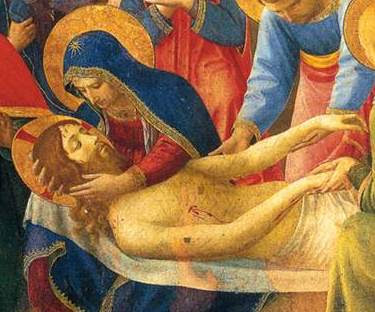
Pieta, with Holy Trinity and Blessed Mother, (Jean Malouel 1400-1410) Met Museum
Click here to learn “What does it mean to be a Veronica?”
What are our sufferings when we think of those of Jesus? Have we perhaps sweated blood? Have we received blows and spittle, been scourged and crowned with thorns?…And what can we possibly give Jesus save a heart desirous of loving Him…to desire nothing save His Will? — Bl. Mother Maria Pierina de Micheli
Daily Preparatory Prayer
O Most Holy and Blessed Trinity, through the intercession of Holy Mary, whose soul was pierced through by a sword of sorrow at the sight of the passion of her Divine Son, we ask your help in making a perfect Novena of reparation with Jesus, united with His sorrows, love and total abandonment.
We now implore all the Angels and Saints to intercede for us as we pray this Holy Novena to the Most Holy Face of Jesus and for the glory of the most Holy Trinity, Father, Son and Holy Spirit. Amen.
A pure heart create for me, O God, put a steadfast spirit within me. Do not cast me away from your presence not deprive me of your Holy Spirit.
Mary, Spouse of the Holy Spirit
May our hearts be cleansed, O Lord, by the in-pouring of the Holy Spirit, and may He render them fruitful by watering them with His heavenly dew. Mary, the most chaste spouse of the Holy Spirit, intercede for us, St. Joseph, pray for us.
Through the merits of your precious blood and your Holy Face, O Jesus, grant us our petition, …Pardon and mercy.
“Who is like God?” St. Michael holding high the Face of Jesus (Sculpture by Cody Swanson)
O Victorious Prince, most humble guardian of the Church of God and of faithful souls, who with such charity and zeal took part in so many conflicts and gained such great victories over the enemy, for the conservation and protection of the honor and glory we all owe to God, as well as for the promotion of our salvation; come, we pray Thee, to our assistance, for we are continually besieged with such great perils by our enemies, the flesh, the world and the devil; and as Thou wast a leader for the people of God through the desert, so also be our faithful leader, and companion through the desert of this world, until Thou conduct us safely into the happy land of the living, in that blessed fatherland from which we are all exiles. Amen. (St. Aloysius)
Pray one (1) Our Father, three (3) Hail Mary’s, one (1) Glory Be.
O Bleeding Face, O Face Divine, be every adoration Thine. (3 times)
St. Michael, sculpture by Cody Swanson, Old St. Patrick’s New Orleans (photo: Patricia Enk)
“So may sins of impurity are committed in this city, but true souls of reparation are few, do thou at least console and comfort me.”–words of Our Lord to Bl. Mother Pierina de Micheli, “Missionary of the Holy Face”
The Divine Prisoner, Holy Face of Manoppello photo: Patricia Enk
“O Holy Face of Christ, light that enlightens the darkness of doubt and sadness, life that has defeated forever the force of evil and death, O inscrutable gaze that never ceases to watch over mankind; Face concealed in the Eucharistic signs and in the faces of those that live with us! Make us pilgrims in his world, longing for the infinite and ready for the final encounter, when we shall see you, Lord, “face to face” (Cor. 13-12) and be able to contemplate you forever in Heavenly Glory.” — Pope Benedict XVI (Excerpt from his prayer in honor of his visit to the Basilica Shrine of the Holy Face of Manoppello.)
Daily Preparatory Prayer
O Most Holy and Blessed Trinity, through the intercession of Holy Mary, whose soul was pierced through by a sword of sorrow at the sight of the passion of her Divine Son, we ask your help in making a perfect Novena of reparation with Jesus, united with His sorrows, love and total abandonment.
We now implore all the Angels and Saints to intercede for us as we pray this Holy Novena to the Most Holy Face of Jesus and for the glory of the most Holy Trinity, Father, Son and Holy Spirit. Amen.
Make me hear rejoicing and gladness, that the bones you have crushed may revive. From my sins turn away your Face, and blot out all my guilt.
Holy Face of Jesus, Sacred Countenance of God, how great is your patience with humankind, how infinite your forgiveness. We are sinners, yet you love us. This gives us courage For the glory of your Holy Face and of the Blessed Trinity, hear and answer us. Mary our Mother, intercede for us, St. Joseph, pray for us.
Through the merits of your precious blood and your Holy Face, O Jesus, grant us our petition, …Pardon and mercy.
Prayer to St. Joseph
“Blessed are the pure of heart; for they shall see God” (Mt. 5:8)
St. Joseph
Dear St. Joseph! Adopt us as thy children, take charge of our salvation; watch over us day and night; preserve us from occasions of sin; obtain for us purity of body and soul, and the spirit of prayer, through thy intercession with Jesus, grant us a spirit of sacrifice, of humility and self-denial; obtain for us a burning love for Jesus in the Blessed Sacrament, and a sweet, tender love for Mary, our Mother. St. Joseph, be with us in life, be with us in death and obtain for us a favorable judgement from Jesus, our merciful Savior. Amen.
Pray one (1) Our Father, three (3) Hail Mary’s, one (1) Glory Be.
O Bleeding Face, O Face Divine, be every adoration Thine. (3 times)
[The prayer to St. Joseph in this novena reminds us of the love of God the Father. He looks upon us with infinite pity, mercy and love through the Face of His Son, Jesus Christ. The Holy Face of Jesus shows us the eternal, tender love that God the Father has for us.]
“Love is tireless, it feeds on silence and humility and is heart to heart with our Beloved, deriving from His Heart the powerful force which makes love tireless to do much, to do well the tiniest everyday things to please Him alone. How many pearls we can collect each day to make Jesus forget the insults He receives each day? How many kisses–it will be a smile–a word held back–an act of charity–docile obedience–temptation promptly resisted–and in moments in which nature, pride, self-love, sensuality, desire to hold sway–a glance at the Holy FACE–that blood, those Divine Eyes veiled with grief and love and we will say nothing?” –Blessed Mother Maria Pierina de Micheli, Missionary of the Holy Face
Day 4:
Alpha-Omega Holy Face of Jesus Novena Prayer
Veil of Veronica C. 1618-22 National Gallery
Daily Preparatory Prayer
O Most Holy and Blessed Trinity, through the intercession of Holy Mary, whose soul was pierced through by a sword of sorrow at the sight of the passion of her Divine Son, we ask your help in making a perfect Novena of reparation with Jesus, united with His sorrows, love and total abandonment.
We now implore all the Angels and Saints to intercede for us as we pray this Holy Novena to the Most Holy Face of Jesus and for the glory of the most Holy Trinity, Father, Son and Holy Spirit. Amen.
Fourth Day
Psalm 51: 8-9
Indeed you love truth in the heart; then in the secret of my heart teach me Wisdom. O purify me, then I shall be clean; O wash me, I shall be whiter than snow.
O Lord Jesus, who has said, learn of me for I am meek and gentle of heart, and who did manifest upon The Holy Face the sentiments of Thy divine heart, grant that we may love to come frequently and meditate upon Thy divine features. We may read there Thy gentleness and Thy humility, and learn how to form our hearts in the practice of these two virtues which Thou desires to see shine in Thy servants. Mary our Mother and St. Joseph, pray for us.
Through the merits of your precious blood and your Holy Face, O Jesus, grant us our petition, …Pardon and mercy.
Sorrowful Mother
“O Holy Face of my sweet Jesus, by the tenderness of the love and most deep sorrow with which Mary most holy contemplated You in Your Passion, grant to our souls to share in her love and grief and fulfill Your Most Holy Will as perfectly as possible. Amen. “
–Bl. Mother Maria Pierina de Micheli, “Missionary of the Holy Face”
Prayer in Honor of the Sorrows of The Blessed Virgin
O Most Holy and afflicted Virgin, Queen of Martyrs! Who stood beneath the Cross, witnessing the agony of your dying Son, look down with a mother’s tenderness and pity on us as we kneel before you to venerate your Sorrows and place our requests, with filial confidence, in the sanctuary of your wounded heart. Present them on our behalf to Jesus, through the merits of His most sacred Passion and Death, together with your sufferings at the foot of the Cross, and through the united efficacy of both, obtain the favor which we humbly ask. To whom shall we go in our wants and miseries if not to you. O Mother of Mercy, who having so deeply drunk of the chalice of your Son, graciously alleviate the sufferings of those who still sigh in this land of exile. Amen.
Prayer to the Souls in Purgatory
My Jesus, by the sorrows you suffered in your agony in the garden, in your scourging and crowning with thorns, in the way to Calvary, in your crucifixion and death, have mercy on the souls in Purgatory, and specially on those that are most forsaken. Deliver them from the dire torments they endure. Call them and admit them to your most sweet embrace in Paradise. Amen.
Pray one (1) Our Father, three (3) Hail Mary’s, one (1) Glory Be.
O Bleeding Face, O Face Divine, be every adoration Thine. (3 times)
Pope Benedict XVI gazes at the Veil of the Holy Face of Manoppello. Photo: Paul Badde
“While we too seek other signs, other wonders, we do not realize that He is the real sign, God made flesh; He is the greatest miracle of the universe: all the love of God hidden in a human heart, in a human face.” — Pope Benedict XVI
“Oh Jesus, who in Thy Cruel Passion didst become the “Reproach of men and the Man of Sorrows,” I worship Thy Divine Face.” –St. Therese
Daily Preparatory Prayer
“Every time that anyone gazes at my Face, I will pour my love into hearts and by means of the Holy Face, the salvation of many souls will be obtained.” –Our Lord to Bl. Mother Pierina de Micheli, “Missionary of the Holy Face”
Face of Christ: Fra Angelico, c. 1427
Daily Preparatory Prayer:
O Most Holy and Blessed Trinity, through the intercession of Holy Mary, whose soul was pierced through by a sword of sorrow at the sight of the passion of her Divine Son, we ask your help in making a perfect Novena of reparation with Jesus, united with His sorrows, love and total abandonment.
We now implore all the Angels and Saints to intercede for us as we pray this Holy Novena to the Most Holy Face of Jesus and for the glory of the most Holy Trinity, Father, Son and Holy Spirit. Amen.
Third Day – Holy Face Novena
Psalm 51: 6-7
You are just when you pass sentence on me, blameless when you give judgement. You know I was born guilty, a sinner from the moment of conception.
Bl. Pope Pius IX “Reparation is a work destined to save society”
Prayer of Pope Pius IX
O Jesus! Cast upon us a look of mercy; turn your Face towards each of us as you did to Veronica; not that we may see it with our bodily eyes; for this we do not deserve, but turn it towards our hearts, so that, remembering you, we may ever draw from this fountain of strength the vigor necessary to sustain the combats of life. Amen. our Mother Mary, and St. Joseph, pray for us.
Through the merits of your precious blood and your Holy Face, O Jesus, grant us our petition, …Pardon and mercy.
Prayer of St. Francis
All highest, glorious God, cast your light into the darkness of our hearts, give us true faith, firm hope, perfect charity and profound humility, so that with wisdom, courage and perception, O Lord, we may do what is truly your holy will. Amen.
To the Angels and Saints
We salute you, through the Holy Face and Sacred Heart of Jesus, all you holy Angels and Saints of God. We rejoice in your glory, and we give thanks to our Lord for all the benefits which He has showered upon you; we praise Him, and glorify Him, and offer you for an increase of your joy and honor, the most Holy Face and gentle Heart of Jesus. Pray that we may become formed according to the heart of God. Amen.
Pray one (1) Our Father, three (3) Hail Mary’s, one (1) Glory Be.
O Bleeding Face, O Face Divine, be every adoration Thine. (3 times)
“Their Face is the Face of Christ” –Pope Francis
“The Face of God is like that of a merciful Father that always has patience and is willing to forgive…All of us have felt joy, sadness, and sorrow in our lives. Have we wept during the darkest moment? Have we that gift of tears that prepare the eyes to look, to see the Lord?” — Pope Francis



























 Illumina Domine Blog - Devotion to The Holy Face