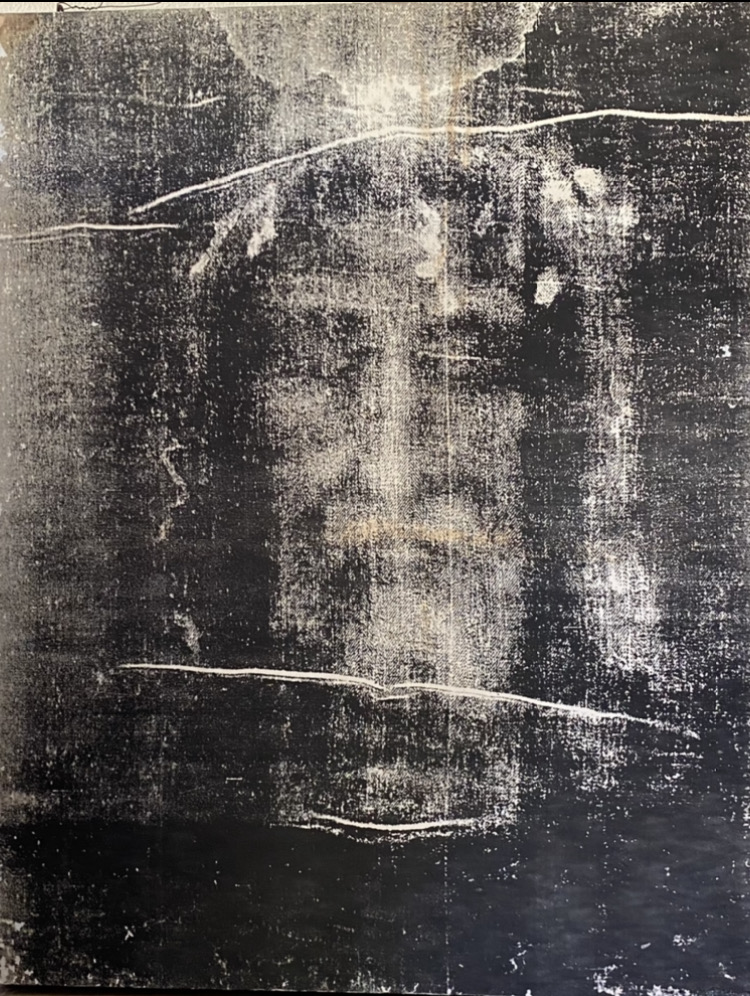
The Veil of the Holy Face of Manoppello, (Photo: Paul Badde/EWTN) Unique among other images of the Holy Face, in that it is an “achieropoeta” (as is the Shroud of Turin), not made by human hands. This “living image” of the Suffering and Risen Face of Jesus, bears traces of the Passion, and is believed to have been created at the moment of the Resurrection. It could be said that it is an “Icon of Easter”–the “Face of the Risen Christ” which we look forward to in Hope at the beginning of Lent.
“I wish that all the world could celebrate the Face of my Beloved. If I could at least honor Him for all those who honor Him not.” –Bl. Mother Maria Pierina De Micheli
Consecration to the Holy Face
O Lord Jesus, we believe most firmly in You. You are the Son Incarnate of the Blessed Virgin Mary. You are the Lord and Absolute Ruler of all creation. We acknowledge you, therefore, as the Universal Sovereign of all creatures. You are the Lord and Supreme Ruler of all mankind, and we, in acknowledging this Your dominion, consecrate ourselves to You now and forever. Loving Jesus, we place our family under the protection of Your Holy Face, and of Your Virgin Mother Mary most sorrowful. We promise to be faithful to You for the rest of our lives and to observe with fidelity Your Holy Commandments. We will never deny before men, You and Your Divine rights over us and all mankind. Grant us the grace to never sin again; nevertheless, should we fail, O Divine Saviour, have mercy on us and restore us to Your grace. Radiate Your Divine Countenance upon us and bless us now and forever. Embrace us at the hour of our death in Your Kingdom for all eternity, through the intercession of Your Blessed Mother, of all Your Saints who behold You in Heaven, and the just who glorify You on earth. O Jesus, be mindful of us forever and never forsake us; protect our family. O Mother of Sorrows, by the eternal glory which you enjoy in Heaven, through the merits of your bitter anguish in the Sacred Passion of your Beloved Son, Our Lord Jesus Christ, obtain for us the grace that the Precious Blood shed by Jesus for the redemption of our souls, be not shed in vain. We love you, O Mary. Embrace us and bless us, O Mother. Protect us in life and in death. Amen.
Glory to the Father, and to the Son, and to the Holy Spirit. As it was in the beginning, is now, and will be forever. Amen.
The Holy Face on the Shroud of Turin
“Christ’s response, ‘Whoever has seen me, has seen the Father, lead us into the heart of Christological faith.'” — Pope Benedict XVI
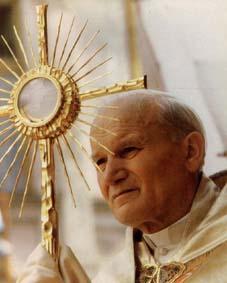
St. Pope John Paul II “In the Eucharist, the Face of Christ is turned towards us.”
“Thy Face is my only Homeland” by P. Ioannes Maria, O.S.B. (with permission)
The sources of devotion to the Most Holy Face of Jesus are found, first of all, in the Sacred Scriptures. One might say that the entire Bible, from beginning to end, glows with the light that shines from the Face of God. “Scripture,” writes Maurice Zundel, “is a person. Scripture is Jesus. Before or after His advent, it is full of Him.”1 The Greek word for person (πρόσωπο) also means face or countenance. Nothing, in fact, is more personal than a man’s face, for a man’s face reveals the movements of his heart. So often as the Church, in her liturgy, opens the Sacred Scriptures, she contemplates “the light of the knowledge of the glory of God, in the Face of Christ Jesus.” Only in the light of the human Face of God”2 can believers chant, read, and hear the Scripture rightly, compelling Maurice Zundel to say: “Scripture can be understood only on our knees, as we feed upon it and become aware of an invisible current of air that moves all its leaves in an unconstrainable aspiration towards the glorious Countenance of Jesus Christ.”3
The features of a child’s face are formed very early in pregnancy, at about the same time as the heart begins to beat. The face and the heart are inseparable, even from the womb. Just as the Heart of Jesus was “formed by the Holy Ghost in the womb of the Virgin Mother,” so too was His Face. We can, therefore, pray, Vultus Jesu, in sinu Virginis Matris a Spiritu Sancto formatus, miserere nobis. Face of Jesus, formed by the Holy Ghost in the womb of the Virgin Mother, have mercy on us.” The human Face of God,” hidden in His Mother’s womb as in a tabernacle, sanctifies John, the son of Zachary and Elizabeth; eight days after his birth, his father addresses him, saying: “Thou, child, shalt be called the prophet of the Most High: for thou shall go before the Face of the Lord to prepare his ways.”4
In Advent, the Divine Office makes us sing every evening at Vespers, Ostende faces tuam, et salvo erimus, Domine. “Show us Thy Face, O Lord, and we shall be saved.”5 And then, we open the First Vespers of Christmas, singing, Rex Pacific’s magnificatus set, jujus vultum desiderat universa terra. The King of Peace shines forth, whose Face all the world desires to see.”6 The first adorers of the “human Face of God” were His Virgin Mother and Saint Joseph. Then the shepherds “came with haste, and found Mary and Joseph, and the Infant lying in the manger.”7 What would the shepherds have desired to see more than the Face of the Saviour whose birth was announced to them by an angel? Wise men, coming from the East, were guided to the Infant King by a star, “and entering into the house, they found the Child with Mary His mother, and falling down, they adored Him.”8 What must have been their joy at beholding the Face of the Child!
“And when the time had come for purification according to the law of Moses, they brought Jesus up to Jerusalem, to present Him before the Lord there.”9 Simeon, “led by the Spirit into the temple,”10 took the Infant Jesus into his arms, and gazing at “the human Face of God,” said, “Now Thou dost dismiss Thy servant, O Lord, according to Thy word in peace; because my eyes have seen Thy salvation, which Thou hast prepared before the face of all peoples: a light to the revelation of the Gentiles, and the glory of Thy people Israel.11 An antiphon for the feast of Candlemas sings: “The ancient carried the Infant, but the Infant guided the steps of the ancient.”12 Simeon, the image of all that in us has grown old with waiting, carries Divine Mercy in his arms, but Divine Mercy, by the light that shines on his Face, guides the old man’s steps. Let anyone guided by Divine Mercy follow the example of Simeon by fixing his gaze on the Face of Christ.
Simeon, beholding the Face of God made visible, was “borne aloft to the love of things invisible.”13 Illumined by the Holy Face, the old priest recognised the new High Priest, “holy, innocent, undefiled, separated from sinners, and made higher than the heavens.”14 In this, Simeon models the holiness of every priest who, taking the Host into his hands, raises it for the faithful to see. By looking at the “Eucharistic Face of Christ,”15 day after day, the priest, like Simeon, becomes capable of bearing witness to “things no eye has seen, no ear has heard, no human heart conceived, the welcome God has prepared for those who love Him.”16
At the same time, there entered the Prophetess Anna the daughter of Phanuel, whose name means “Face of God.” Anna had made the temple her home. Abiding day and night in the temple, Anna served God with fasting and prayer. Drawn by the radiance of the Face of Christ and by a mysterious operation of the Holy Ghost, Anna emerged from the shadowy recesses of the temple to praise God and speak of the Child to all that patiently waited for the deliverance of Israel. Anna of the Face of God models the vocation of every consecrated woman.
When Jesus, at the age of twelve, remained in Jerusalem after the solemn feast of the Pasch, the greatest sorrow of His Mother and of St, Joseph was that, for three days, they lost sight of His Holy Face. There is, in the Office for the Feast of the Finding of the Child Jesus in the Temple,17 an antiphon that expresses the anguish of the Most Holy Virgin and Saint Joseph as they sought Jesus: Quasi illum, et non inveni: vocaviet non responded mini. “I sought Him, and found Him not: I called, and He did not answer me.”18 If the finding of the Child Jesus in the Temple numbered among the Joyful Mysteries of the Rosary, rather than the Sorrowful, it is because the sight of the Holy Face filled His Mother and Saint Joseph with surpassing gladness.
Nearly two decades later Jesus “took Peter and John and James with Him, and went up into a mountain to pray.”19 And He was transfigured before them, and His Face shone like the sun.”20 Saint John beheld the same Face on the island of Patmos; “His Face,” he testifies, “was like the sun when it shines at its full strength.”21 Between these two manifestations of the Holy Face of Jesus shining like the sun, Saint John beheld the same adorable Face darkened and disfigured in the agony of Gethsemane and on Calvary, without “form or comeliness that we should look at Him, and no beauty that we should desire Him, despised and rejected by men; a man of sorrows, and acquainted with grief; and as one from whom men hide their faces.”22
In the glory of the Resurrection, the divine majesty of the Holy Face of Jesus remained mysteriously veiled. Mary Magdalene took Him for the gardener,23 and the disciples on the road to Emmaus, for a stranger,24 and when He showed Himself to the disciples at the sea of Tiberius, standing at daybreak on the shore, “the disciples knew not that it was Jesus.”25 It was only after Jesus said, “Cast to the right of the boat, and you will have a catch,” causing them to catch a prodigious shoal of fish, that “the disciple whom Jesus loved said to Peter, It is the Lord.”26
The same adorable Face remains mysteriously veiled in the Most Holy Sacrament of the Altar, the Deus absconditus,27 unrecognised by most and forsaken in the abandoned tabernacles of the world. Saint Gaetano Catanoso, canonised by Pope Benedict XVI in 2005, at the conclusion of the Year of the Eucharist, said, “If we wish to adore the real Face of Jesus…, we can find it in the divine Eucharist, where the Body and Blood of Jesus Christ, the Face of Our Lord is hidden under the white veil of the Host.”28
The Feast of the Ascension, the Sunday that follows it, and the Feasts of the Epiphany and Transfiguration have long been kept as days particularly suited to the contemplation and adoration of the Holy Face of Jesus. With the mystery of the Ascension, “the human Face of God” fills the heavenly sanctuary with a new brightness. God prays to God with a human voice. God having a human Face, intercedes with God on behalf of men.
Saint John Henry Newman remarked that there is a certain sadness about the Ascension of Our Lord, the last glimpse of His adorable Face. 29 At the same time, there is a joy in knowing that the Holy Face of Our High Priest, forever turned to His Father in the heavenly sanctuary, is no less turned towards us in the tabernacles of our churches, where, silent and hidden, He waits. “We see Him not,” says the new Doctor of the Church, “but we are to believe that we possess Him, that we have been brought under the virtue of His healing hand, of His life-giving breath, of the manna flowing from His lips, and of the blood issuing from His side.”30 We see Him not, but one who tarries close to the tabernacle will go away a changed man, for the Eucharistic Face of Jesus will have shone in the innermost places of his soul, purifying what is clean, warming what is cold, and healing what is sick.
The “modern” feast of the Holy Face, instituted by Pope Pius XII in 1958, at the request of Blessed Maria Pierina De Micheli31 and Venerable Abbot Idldebrando Gregori,32 synthesises all that the great Christological feasts of the liturgical year and the Mysteries of the Holy Rosary pass in review: the human Face of God in Bethlehem, in Jerusalem, and in Egypt; on Mount Thabor, in Gethsemani, and on Calvary; on the road to Emmaus and, finally on the Mount of Olives. All these converge in the Most Holy Sacrament of the Altar. The Holy Face of Jesus is in the Sacrament of His Love as it was in His life on earth: as it was in nearly every moment of His Passion; as it was in the agony of His death upon the Cross; and as it is now and for all eternity, in the glory of heaven. To contemplate and adore the Holy Face of Jesus, “hidden under the white veil of the Host,” is to enter into His own priestly work of reparation to the Father and reparation of the ravages of sin in souls.
Italy is stupendously rich in sanctuaries of the Holy Face of Jesus: the Veil of Manoppello, the Shroud of Turin, the Volto Santo of Lucca, that of Sansepolcro (Arezzo), the Mandylion of Genoa, and the Casa of Madre Flora De Santis at Capodimonte, among others. It is not, however, necessary to undertake pilgrimages far from home. It is enough to go, quietly and humbly, to the nearest tabernacle, and to remain there in adoration and reparation, repeating the Royal Prophet’s heartfelt plea: “Thy Face, O Lord, do I seek; hide not Thy Face from me.” One who prays in this way, adoring the Deus absconditus, will, at length, begin to say with Saint Therese: Ta Face set ma seule Patrie. “Thy Face is my only Homeland.”
Maurice Zundel, The Splendor of the Liturgy (New York: Sheed & Ward, 1939), 284. ↩︎
“The human Face of God that has burst into history to reveal the horizons of eternity. The silent Face of Jesus, suffering and risen, when loved and accepted, changes our hearts and lives.” Pope Benedict XVI, Prayer at Manoppello, 1 September 2006. ↩︎
Senex puerum portabat, Puer autem senem regebat: quem Virgo pepent, et post partum Virgo permansit: Ipsum quem genuit, adoravit. “The old man bore the Child, but the Child ruled the old man’s steps; even the Child Whom a Virgin bore, and remained a Virgin as before; and when that Virgin had brought Him the world, bowing low, she adored Him.” (Antiphon of the Magnificat at First Vespers. ↩︎
This is expressed in the Preface of the Nativity: Quia per incarnati Verbi mysterium nova mantis nostril oculus lux tuae claritatis infulsit: ut dum visibiliter Deum cognoscimus, per hunch in invisibilum amorem rapiamur. “Because by the mystery of the Word made flesh the light of Thy glory hath shone anew upon the eyes of our mind: that while we acknowledge Him to be God seen by men, we may be borne aloft to the love of things unseen.” ↩︎
The hidden God, following the word of the Prophet Isaias, who says, “Verily thou art a hidden God, the God of Israel the Saviour” (Isaias 45:15).↩︎
Homily of Pope Benedict XVI, Saint Peter’s Square, 23 October 2005. ↩︎
John Henry Newman, “Sermon 10: The Spiritual Presence of Christ in the Church,” in Parochial and Plain Sermons (London: Longmans, Green, and Co., 1918), 121. ↩︎



 Illumina Domine Blog - Devotion to The Holy Face