The life of a Christian should be the faithful reproduction of Jesus in their soul — this radiant transformation is the work of love of the Holy Spirit. “Those whom He had foreknown He has also predestined to become conformed to the image of His Son.” (Rom 8:29) He who loves will resemble the thing loved.
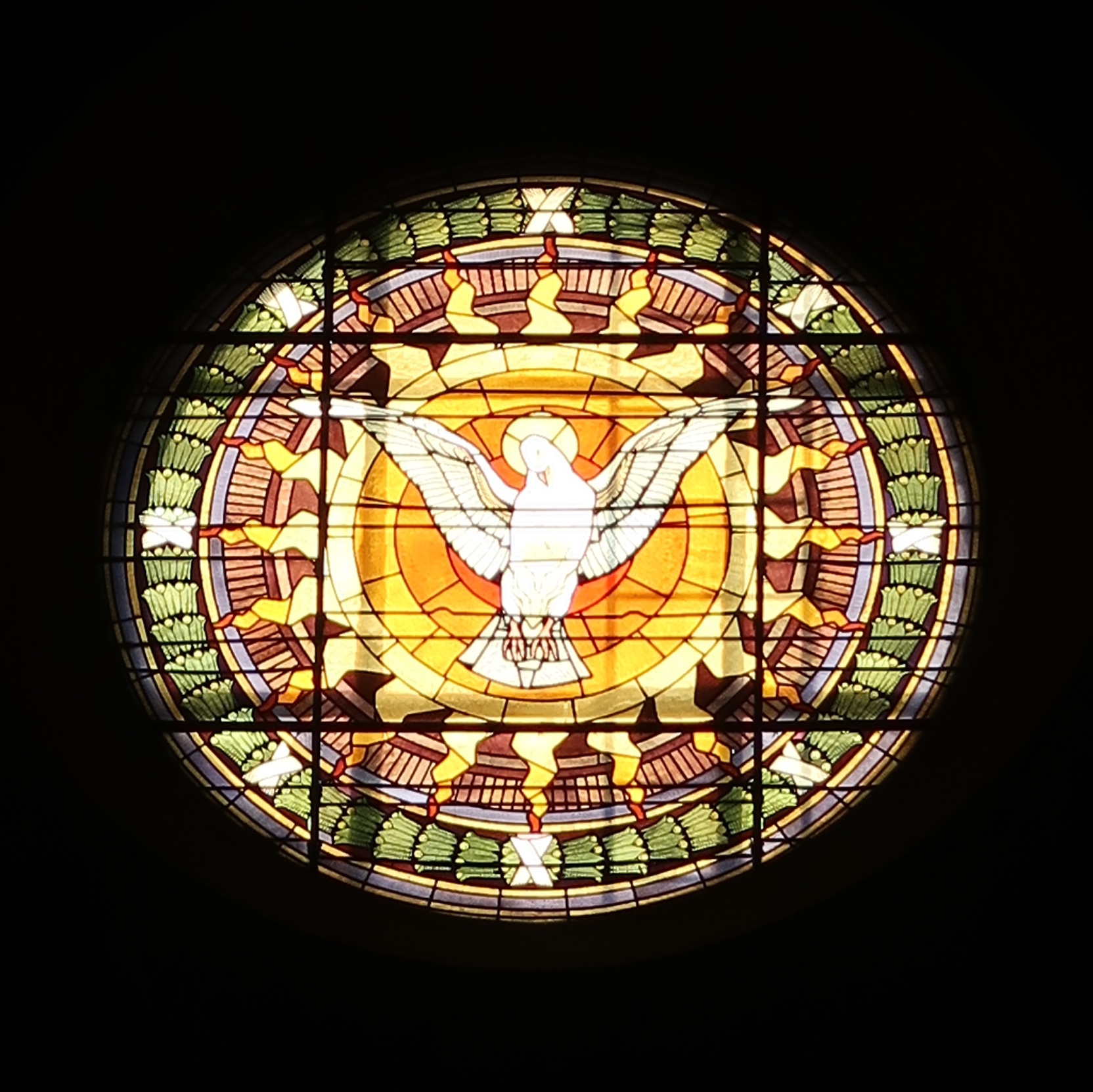
Holy Spirit Window in Loreto, Italy
“God’s love has been poured into our hearts through the Holy Spirit who has been given to us.” (Rom 5:5) “Because we are dead or at least wounded through sin, the first effect of the gift of love is the forgiveness of our sins. The communion of the Holy Spirit (2 Cor 13:14) in the Church restores to the baptized the divine likeness lost through sin.” (CCC 734) The Holy Spirit perfects the soul with the first fruits of eternal glory: charity, joy, peace, patience, kindness, goodness, generosity, gentleness, faithfulness, modesty, self-control, and chastity — so we may more closely resemble Jesus Christ.
Face of Jesus Christ, crowned with thorns.
In his classic work on the Holy Spirit, The Sanctifier, Archbishop Luis M. Martinez reminds us that in order to resemble Christ, Our Lord, we must go through the pain and suffering of the Cross: “He whom we love is a God nailed to a cross. Pain makes us resemble him. It is characteristic of love to have a tremendous desire to resemble the beloved. It is characteristic, too, for those who love to resemble each other.” But, as the soul is transformed, it is also filled with joy!
After Christ had completed his mission on earth, it still remained necessary for us to become sharers in the divine nature of the Word. We had to give up our own life and be so transformed that we would begin to live an entirely new kind of life that would be pleasing to God. This was something we could do only by sharing in the Holy Spirit. As St. Paul writes: “But we all with unveiled faces, reflecting as in a mirror the glory of the Lord, are being transformed into His very image from glory to glory.” (2 Cor 3:18)
— St. Cyril of Alexandria
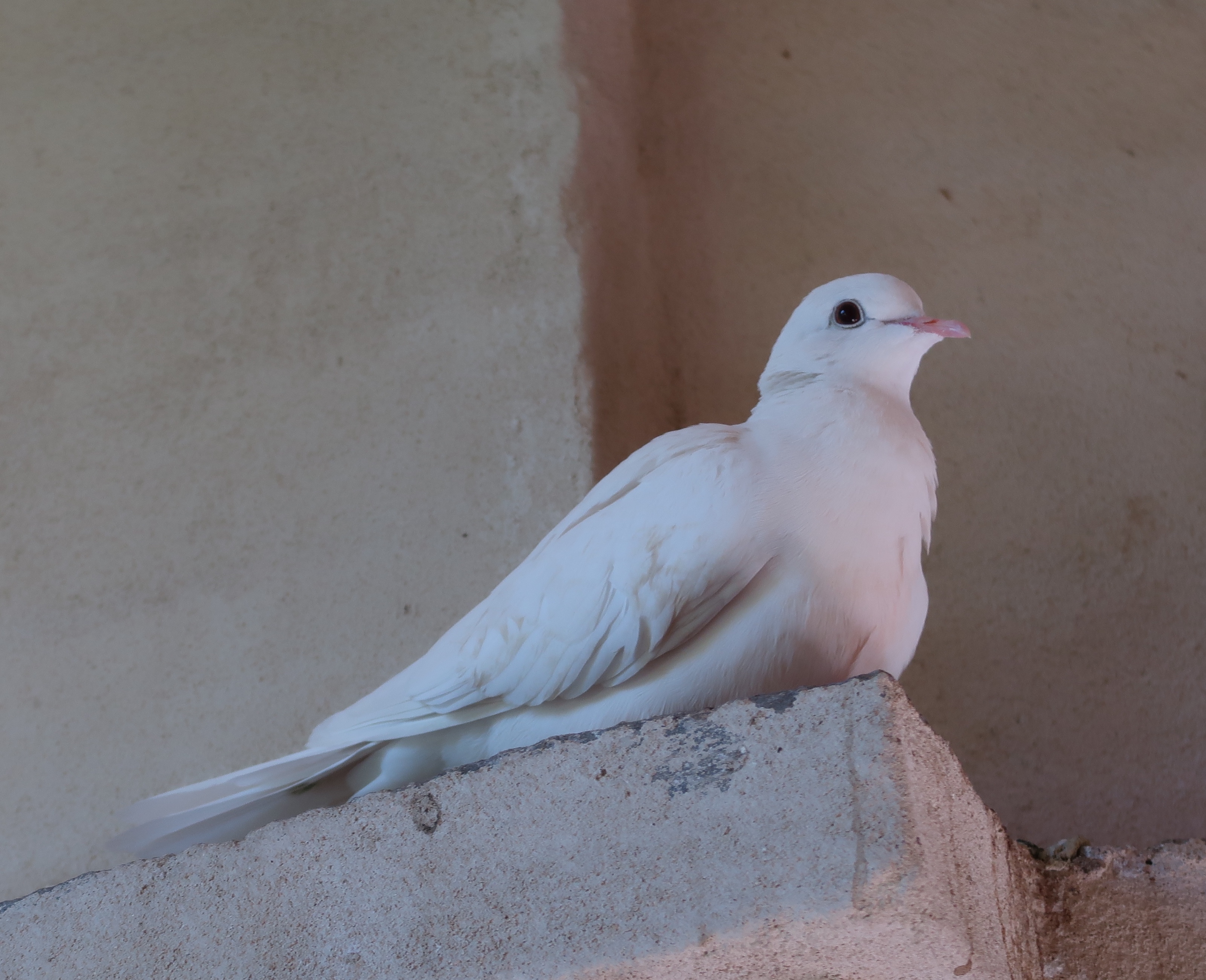
Divine Guest of our souls (photo: Patricia Enk)
This is the work of the Holy Spirit of Love, who is the the light and fire of the Face of God: to sanctify our souls, shining upon us the radiance of His light, transforming us into the His own likeness. Holy Spirit wants to dwell in us and convert our bodies into His temple, as He did in the Virgin Mary to bring grace, mercy, and peace. “Love is not a passing visitor who pays us a call and then goes away. He establishes in us his permanent dwelling and lives in intimate union with our souls as their eternal Guest.” (The Sanctifier) As Jesus promised on the last night of His mortal life: “And I will ask the Father and He will give you another Advocate to dwell with you forever, the Spirit of truth whom the world cannot receive, because it neither sees Him nor knows Him. But you shall know Him because He will dwell with you and be in you.” (Jn 14: 16-17)
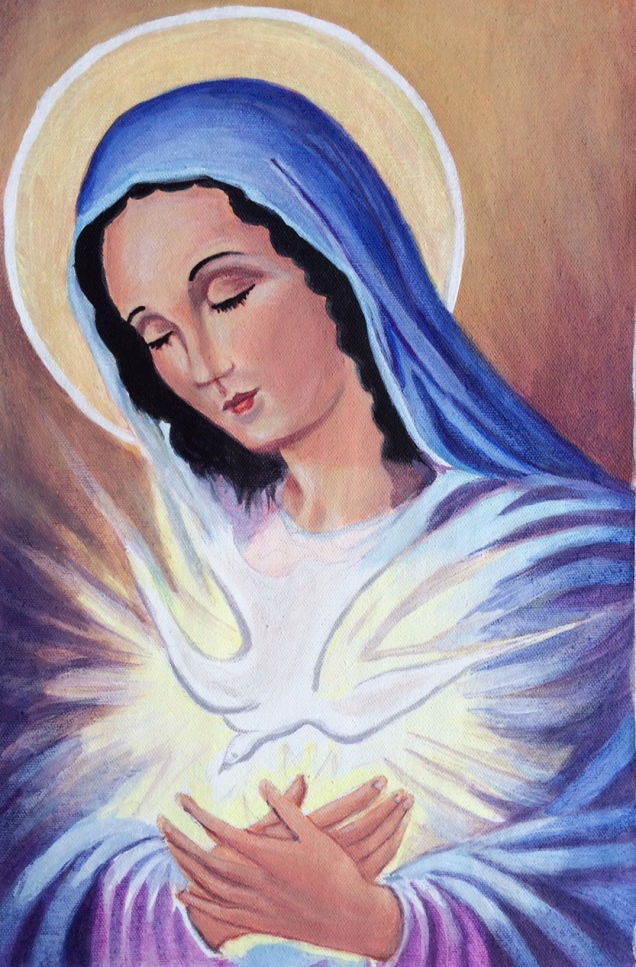
Mary, Spouse of the Holy Spirit
To Mary, Spouse of the Holy Spirit, Daughter of the Most High, Mother of God, faithful Spouse of the Holy Spirit — yet also Mary of Nazareth, Joseph’s wife, my mother– hear my prayer for grace, O Full of Grace. Pray your Spouse the Holy Spirit to come upon me — to shelter from all ill, to strengthen me to do what is right, to teach me all truth. Pray him come to me, and abide with me, and be within me a fountain springing up unto eternal life. May he sustain me in sorrow, sanctify me in life, and receive me at the hour of my death. Holy Mary, Mother of God, Mother of the Church, pray for us.
Derick Baegert, 1470 The Veronica — Acts of compassion and love never fade, but restore the image of God in our souls.
Prayer to Reproduce the Image of God in Our Souls
I salute You! I adore You and I love you, Oh adorable face of my beloved Jesus, as the noble stamp of The Divinity! Completely surrendering my soul to You, I most humbly beg You to stamp this seal upon us all, so the image of God may once more be reproduced in our souls. Amen.
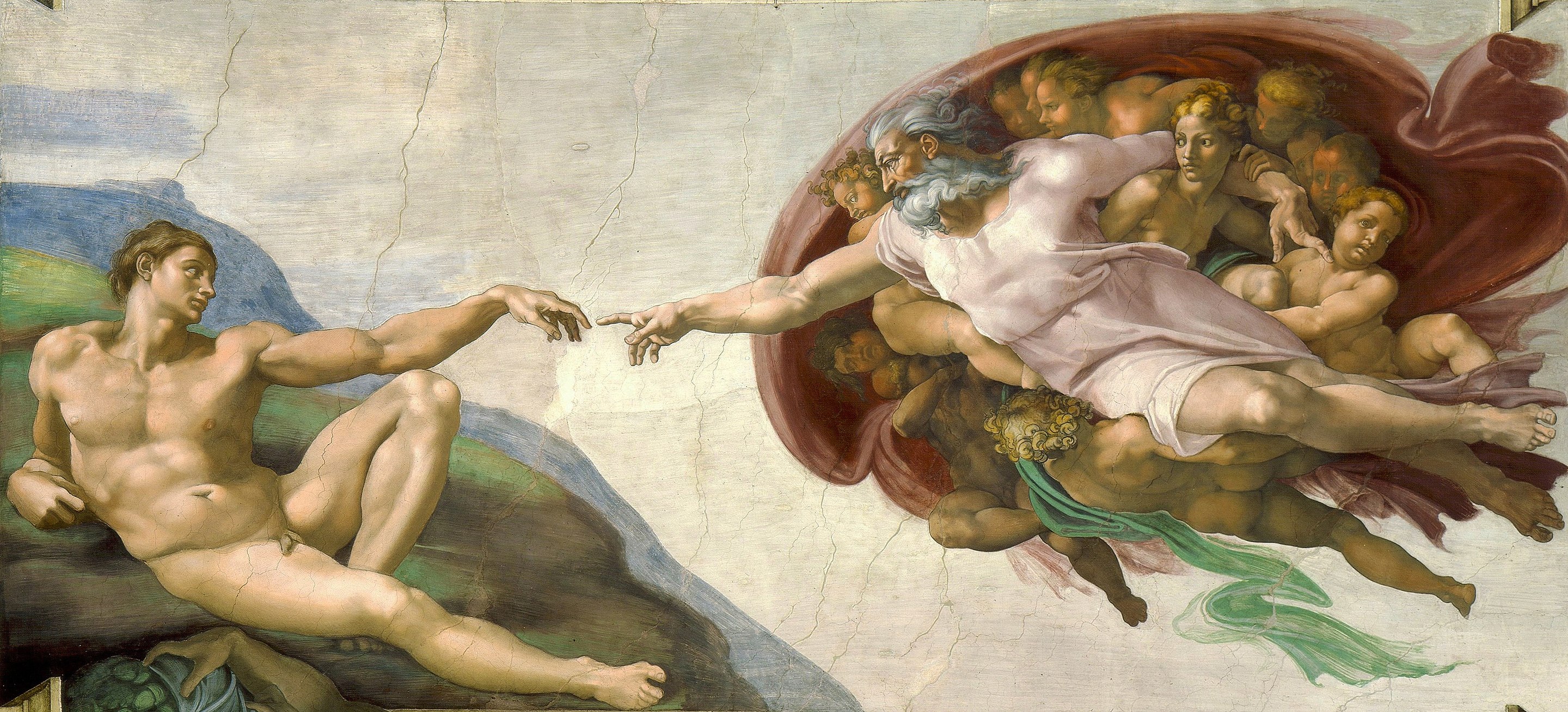
The Creation of Adam by Michelangelo, in the Sistine Chapel
What does it mean to be human, and why does it matter? The understanding of the human person has tremendous consequences for the world, which can lead humanity to–or away from–the Face of God, because “it is only in God that man has meaning.” (Gaudium et Spes)
The newly elected Pope Leo XIV, when first meeting with the college of cardinals, mentioned serious challenges to human dignity, in particular, regarding “developments in the field of artificial intelligence:”(Read also: Pope Leo XIV to Cardinals: Church must respond to digital revolution ) This poses many questions: What are the “serious challenges” mentioned? What should our response be to this rapidly developing technology and its misuse? What exactly is “artificial intelligence,” and what does it mean to be a “human person?” And what does all this have to do with the Face of God?
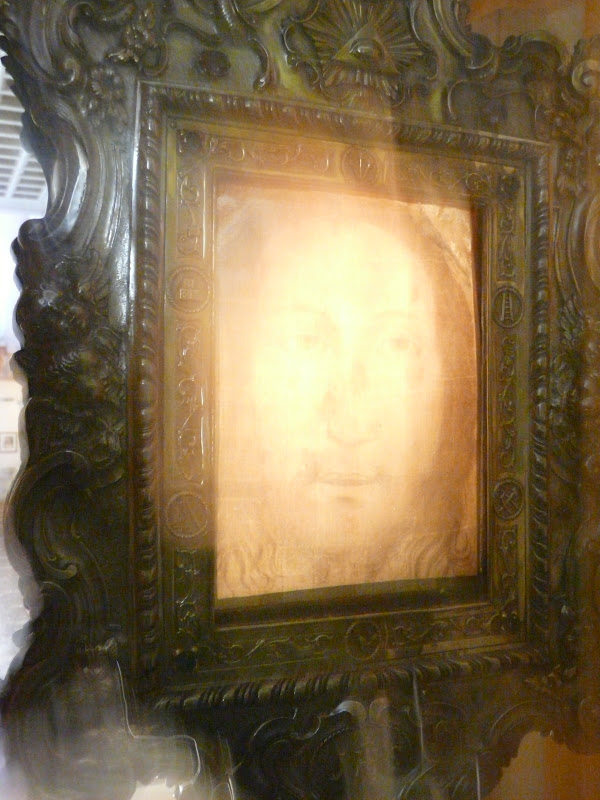
Holy Face of Manoppello, an “achieropoieta” — made by the Hand of God. (Photo: Paul Badde)
Pope St. John Paul II dedicated the millennium to the Face of God. And it is my own belief that devotion to the Face of Christ, *as studied and characterized by Card. Ratzinger (Pope Benedict XVI) at the request of Pope St. John Paul II, is the answer to a rapidly approaching crisis that will soon face all humanity. God bless Pope Leo XIV, who has now brought the Church’s concerns about AI and human dignity to the forefront at the beginning of his pontificate.
Several news items that are related to artificial intelligence have caught my attention this past year: One was regarding an Apple advertisement for their new iPad which depicted crushing various instruments of human creativity, such as art objects and musical instruments, implying that the new iPad would take the place of human creativity, and unceremoniously dump it all in the ash heap of human history. The others were related to the “deep fakes” emerging from AI technology that are greatly alarming a great many people, notably in the entertainment industry, and the increasingly horrifying news related to the nefarious use of images of innocent persons to generate pornography.
Calling attention to the emerging, hyper-realistic, and increasingly disturbing AI capabilities, many writers, and artists, and people in all walks of life, have called on their governments to act to protect the creative works, images, and voices of persons living and dead, from being manipulated or stolen by unsavory persons lurking in the dark doorways of the internet.
One popular singer, Sheryl Crow, hit the nail on the head when said she was “terrified” by the AI fakes of her work; that AI “crushes the spirit of music.” “It feels like an assault on my spirit.” “It [AI technology] has consumed me with questions about who we will forever be in our humanity…” The music artist has touched on the deepest question of mankind–what does it mean to be human?
The great theologian John Zizioulas wrote in his book The Meaning of Being Human that “the key to understanding being human is understanding personhood as a relationship between the ‘giver,’ who is God, and the one who receives ‘the gift’ given them through the language of love.”
Mankind’s relationship with God seems to be gravely threatened in recent years by an iniquitous use of AI that begins in simple laziness. When AI makes it possible to take the easy path to get something done, very few may first look toward God for inspiration and help. A person need only ask AI for what he desires, and it appears within seconds on a screen effortlessly, and seemingly perfect. Or is it? AI seems to offer freedom, but it can lead to enslavement.
In our fast-paced world of technology we are losing the patience to think and create, and feel we lack the time to think, or learn the the skills to: create a job resume, a love letter, a song, a painting, or find a medical diagnosis. But we are meant to use our God-given gifts of intellect and free will — “to seek His Face” in all things –God, Our Father, Jesus, Our Savior, and the Holy Spirit, Our Advocate — the Holy Trinity with Whom mankind is made for relationship. However, in mankind’s inability to satisfy his desires quickly enough, many no longer look to God, who has given us the gifts we need to do the work, but instead reach for the easy, wide path of AI — an algorithm — thereby, gradually exchanging God’s gifts of freedom for slavery. The human ability to create is one of the ways we are imago Dei, the image of God; to shortcut our creativity is to violate, deny, or deprive that essential part of our identity as sons and daughters of God.
This is the truth which is amplified in Gaudium et Spes: “The truth is that only in the mystery of the Incarnate Word does the mystery of man take on light. For Adam, the first man, was a figure of Him Who was to come, namely Christ the Lord. Christ, the final Adam, by the revelation of the mystery of the Father and His love, fully reveals man to man himself and makes his supreme calling clear. It is not surprising, then, that in Him all the aforementioned truths find their root and attain their crown.”
“Veronica” is the example of the soul’s transformation in love into the Image of Christ through love of God and neighbor.
Human persons are made for relationship–in communion, freedom, and love with God. We are made in His Image and likeness in this way. God Himself is a personal being, eternally three persons in relationship–Trinity–and love. Therefore, as John Zizioulas writes, “the notion of a person is to be found only in God,” and human personhood is never satisfied with itself until it becomes an image of God.” Becoming an image of God requires a transformation in love that is needed to enable us to see God face to face in Heaven. And that requires a relationship with Him.
You cannot have a relationship with an algorithm.
As Pope Francis wrote in Evangelii Gaudium, “[Many people] want their interpersonal relationships provided by sophisticated equipment, by screens and systems which can be turned on and off on command. Meanwhile, the Gospel tells us constantly to run the risk of a face-to-face encounter with others. . . . True faith in the incarnate Son of God is inseparable from self-giving, from membership in the community, from service, from reconciliation with others.”
Pope Benedict XVI has written that in the Psalms we learn the attitude for seeing the face of God: “Let the hearts of those who seek the LORD rejoice! Seek the LORD and his strength, seek his presence continually” (Ps 105:3-4). In Psalm 24, we learn the prerequisites of “clean hands and a pure heart” “Such is the generation of those who seek him, who seek the face of the God of Jacob.”
John Zizioulas points out the tragedy of human personhood is manifested in his “capacity” and “incapacity;” these are the means, Zizioulas says, through which we relate to God and the rest of creation. Human capacity includes the intellect and the will. Intellectual human capacities are knowledge, creativity, and skills. Capacities of the will would be commitment, trust, perseverance, or the choice to sacrifice for a greater good. Our incapacities as human persons are as numerous as the sands on the seashore. But that is exactly the place where God meets us in the mystery of the Incarnate Word. It is the place where God reveals man to himself — where we recognize our need for His Love and salvation.
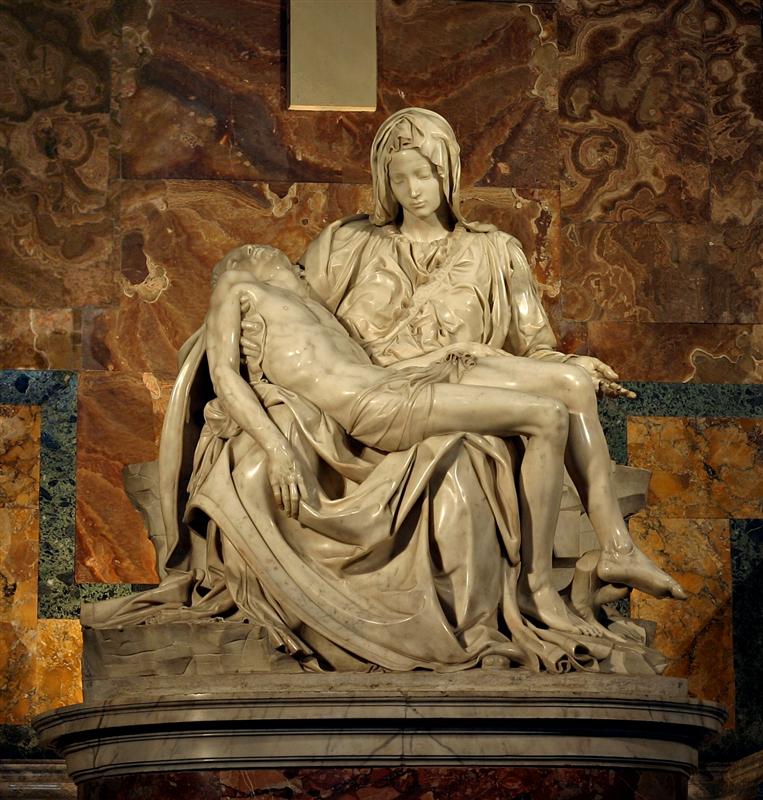
Being a person made in the image of God is the highest form of human “capacity.” We are capable of communion with God Himself! We are capable of creating, enabling our presence to be revealed even in our absence, as John Zizioulas demonstrates in his book The Meaning of Being Human by his analogy of the “absent artist.” By creating something himself, an artist’s presence is revealed in what he has created. We know from looking at the Pietà, for instance, there is such a person as Michelangelo who existed.
“In so far, therefore, as the human person is an entity whose being or particularity is realized by way of transcendence of its boundaries in an event of communion, its personhood reveals itself as presence.” ~ John Zizioulas
The one and only Elvis Presley
When AI produces something–for example an AI-generated Elvis Presley, singing new AI songs, generated by algorithm–it is not the true “presence in absence” of the human person known as Elvis; it is a perversion of truth and an assault on the dignity of his personhood, even in death.
In other words, human persons are capable of creating which enables the person’s presence to be revealed in absence. From the drawings of unknown artists on cave walls to Michelangelo’s Sistine Chapel, great symphonies, or even the songs of Elvis Presley, art testifies to a unique human person’s presence–their presence is revealed in what they have created. When someone manipulates the creation of another through AI, it is a misrepresentation of the person–a false face; a distortion of their unique personhood, a degradation of their humanity.
The Pietà by Michelangelo, 1499
The great paradox is that death through and in Jesus Christ becomes life! Or as St. Paul has written: “When I am weak, I am strong.” ( 2 Cor 12:10)
Our relationship with God is also one of “presence in absence,” writes Zizioulas. When sin entered the world as idolatry, freedom led to slavery, and communion with God was ruptured. Before that rupture caused by sin can be healed, we must first in His absence seek God’s Face, that is, His Divine Presence. It is only through Jesus Christ, and in communion with Him, that our lives have meaning, and that the image of God may be restored in our souls.
As a result of sin, mankind’s greatest incapacity came through death. But because Christ became man at the Incarnation, he became both the source and meaning of the human person, and his very death– which “signifies human incapacity par excellence,” per Zizioulas–paradoxically reverses that incapacity.
God has a face and a name: by His Incarnation, Jesus Christ gave us a human face that revealed the face of God. In our Baptism, we are united to Christ and find our identity by living in Christ, in love, which cannot be isolated from presence. Christianity is a loving relationship with Christ, who transforms us in himself. Through the incapacity of death Jesus restores “the communion of natures in and through his personhood, turns the created realm into a presence of God,” writes John Zizioulas, thus lifting all creation up to communion with God through man.
In communion with an immortal God — when we come before the face of Christ (in His Presence) — we are then capable of everything. “I can do all things in Christ.” (Phil. 4:13); the capacity of the human person is found only in the incapacity of our creature-hood in communion with Christ. This is especially true even in striving for holiness, as St. Bernard has written, “In our incapacity we can only appropriate holiness from Jesus himself, since only God is holy.”
The human person’s greatest freedom is in Christ, which destroys the slavery to sin; and it is surprisingly the freedom to choose to suffer with him. Zizioulas writes: “It is the capacity of man to fully embrace his incapacity, that is, to turn weakness into strength or rather to realize his power in weakness. This paradox is nothing other than what St. Paul means when he writes in 2 Cor 12:10– after mentioning his full acceptance of suffering: ‘for when I am weak, I am strong.'”
Zizioulas explains further that “human freedom in its true meaning, abolishes the scheme ‘capacity versus incapacity’ and replaces it with the paradox of ‘capacity in incapacity.'” In man’s fallen state, even the greatest sinner is still a person created in the image and likeness of God and thus deserving of the greatest respect, during their life and after their death. In communion with Christ, man has the freedom to suffer, and therefore, in Christ, it is possible to be transformed in love in Him. Embracing our weakness in the suffering of the Cross is the way to the Resurrection.
“The weak can manifest the Power of God. So when you yell and scream over all your faults and weaknesses and imperfections, you’re fighting against the very tool that God wants to make us holy.” ~ Mother Angelica
This understanding of the human person has tremendous consequences for the world, in relation to the use of AI, which can lead to God or away from God. Because “it is only in relationship with God that man has meaning.” Man has a capacity for faith, which is experienced as a painful absence which makes us long for God’s presence — the deep longing within our souls to see God’s Face. “Seeking the face of God,” writes Pope Benedict XVI, “is an attitude that embraces all of life; in order for man to see God’s face at last, he must himself be illuminated entirely by God.”
“Artificial intelligence” is actually a misnomer–even the name falls short of the truth. AI can only simulate intelligence. AI cannot create, therefore, it cannot communicate God’s love; it is a tool that can only generate data by imitation, manipulating or altering the creations of man. AI is incapable of relationship, even though some misguided lonely souls are deceived into believing it can. AI can never enter into communion with a human being, with God, or act as images of God, as a human person can.
Through the misuse of AI we run the risk of losing sight of what makes us distinctly unique as human persons. Only a person made in the image and likeness of God can have the intelligence to understand, contemplate, and grasp reality or be capable of insights, moral judgments, or an understanding of beauty, truth and goodness, or the freedom “to lay down one’s life for one’s friends (John 15:13).
In his own suffering, St. Dismas, the Good Thief, turns to the Face of Jesus on the Cross.
The act of human creation is only done in imitation of our Creator. The freedom of choosing to suffer for love in union with Jesus Christ, in imitation of Christ, is the greatest mystery of what Zizioulas calls “capacity in incapacity.” Through that union with Christ, God, in His infinite mercy, will grant grace to the smallest, most humble, weakest, the very least capable human person; even the worst sinner who turns toward His Face, in a relationship of love, as did the Good Thief on Calvary; so they may enter into the joy of eternal life with Him forever.
“Let Your Face shine, that we may be saved!” (Ps 80:3, 7, 19)
*Benedict XVI has characterized devotion to the Holy Face as having three separate components: 1. Discipleship – an encounter with Jesus, to see Jesus in the Face of those in need. 2. The Passion of Jesus, and suffering expressed by images of the wounded Face of Jesus. 3. The Eucharist, “the great school in which we learn to see the Face of God”, which is woven between the other two. The eschatological element then builds on awakening to Christ by contemplating His Face hidden in the Eucharist.
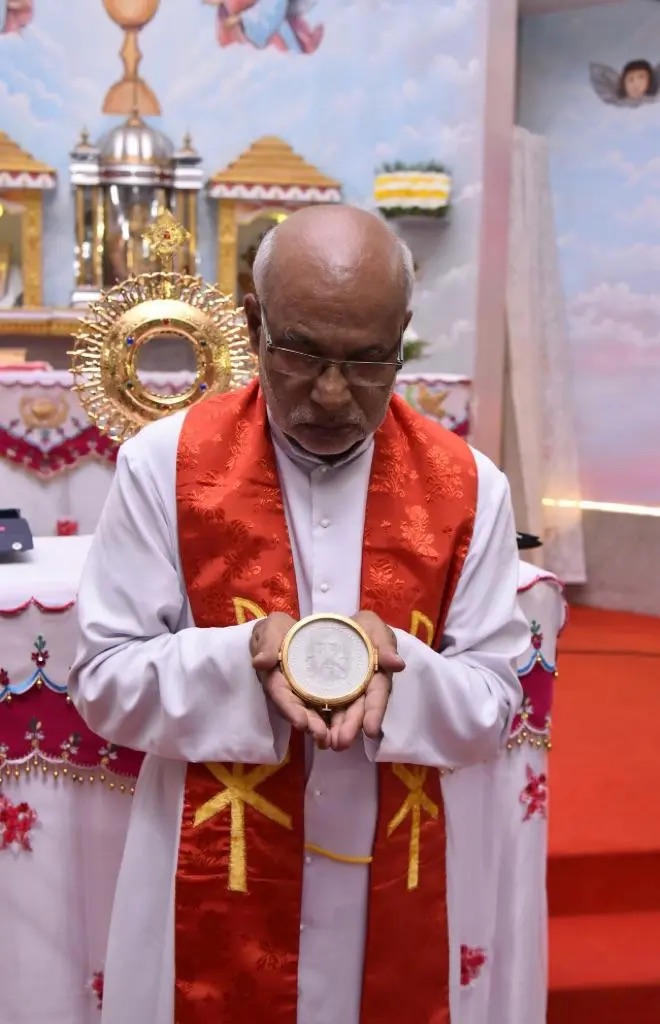
Vilakannur Miracle. The Priest carefully holds in his hands the Holy Eucharist on which the Face of Christ miraculously appeared during Mass.
“On November 15, 2013, a face resembling that of Jesus appeared on the host during Mass at the Christ the King Church, Vilakkannur, a parish under the Syro-Malabar Archdiocese of Tellicherry in the southern Indian state of Kerala.
The “Miracle” Host was sent to Rome for scientific study on January 10, 2020, through Apostolic Nuncio Archbishop Giambattista Diquattro who had come to the Syro-Malabar headquarters in Kochi, some 330 km south of Vilakkannur.
Devotion to the Holy Face of Jesus can be a helpful means to lead us to an encounter with Jesus in our life-long journey–enabling us to recognize Him–and He, to recognize us. This devotion is comprised of three elements–as characterized by Pope Benedict XVI: Discipleship, Images of the wounded Face of Christ , and the Eucharist.
Pope Benedict XVI writes, “The first element [of devotion to the Holy Face] is discipleship and the orientation of one’s life toward an encounter with Jesus in the face of those in need. In order to do this, believers first need to become better acquainted with Jesus through the Eucharist.
The second element is relating to the Passion of Jesus, and the suffering expressed by the images of the wounded Face of Jesus, relating this to the Eucharistic experience.
The third element, the Eucharist is woven between the other two. The eschatological element then builds on awakening to Christ by contemplating his face in the Eucharist.“
The Eucharistic Face of Jesus is central to the devotion of the Face of Christ! Clearly, the grace and strength flowing from worthy reception of the Sacrament of the Eucharist is vital to encountering Jesus in the faces of our brothers and sisters in need, as well as for the prayerful contemplation of Christ’s Face in images of His Passion. In Novo Millenio Ineunte, Pope St. John Paul II wrote, “And it is the Church’s task to reflect the light of Christ in every historical period, to make His face shine also before the generations of the new millennium. Our witness, however would be hopelessly inadequate if we ourselves have not first contemplated his face.”
Contemplation of the Face of Jesus is the veil of devotion, with which we may ‘wipe His bruised and wounded Face, ‘woven’ together with “discipleship, and the Eucharist,” which can lead Christians to “the love of God and love of neighbor” that will enable us to see Christ’s Face when He comes again in glory on the final day.
“The invisible Face of Christ,the son of God, is manifest in His Body an Blood in the simplest and, at the same time, the most exalted way possible in this world.
The ecclesial community responds to people in every age who ask perplexed: “We wish to see Jesus” (Jn 12,21), by repeating what the Lord did for the disciples of Emmaus: He broke the bread. In the breaking of the bread, the eyes of those who seek Him with a sincere heart are opened. In the Eucharist, the intuition of the heart recognizes Jesus and His unmistakable love lived “to the end” (Jn 13,1). And in Him, in that gesture, it recognizes the Face of God!“— Pope St. John Paul II
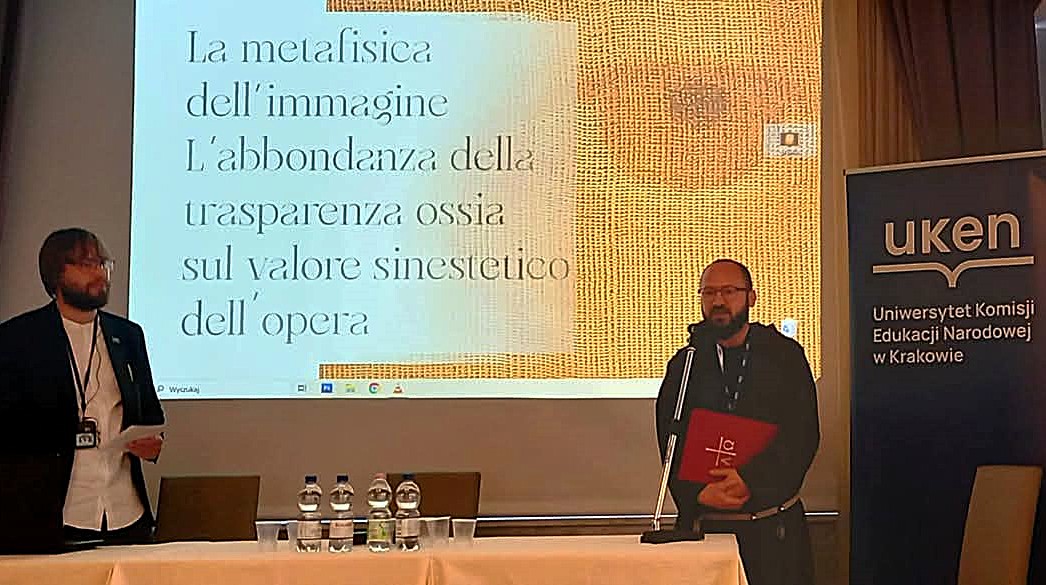
Rector of the Sanctuary Basilica of “Il Volto Santo,” Padre Antonio Gentili (R), greets Prof. Lukas Murzyn (L), and participants of the unique conference on the “Metaphysics of the Image.” Promoted by the UKEN University of Krakow, held at the Sanctuary of the Holy Face in Manoppello, Italy, on May 2-3, 2025.
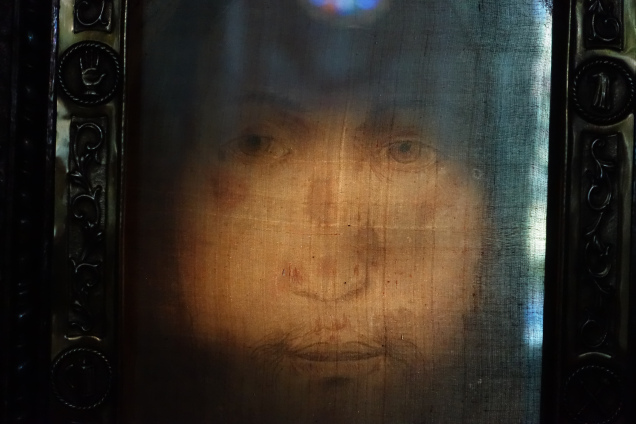
The Holy Veil of Manoppello –so sheer, and yet, without paint, an image my be seen of the Face of Jesus. (Photo: Paul Badde/EWTN)
For those who may be unfamiliar with “Il Volto Santo,” it is a precious relic veil considered to be an “Acheiropoieta” — meaning that its existence is supernatural — made by the Hand of God. The sheer veil, in a miraculous way, bears an image that is seemingly “written in light” of the Holy Face of Jesus Christ. This extraordinary relic has been the subject of intense study and renewed devotion at the dawn of this new millennium dedicated by Pope St. John Paul II to the Holy Face of Jesus Christ.
Padre Antonio Gentili, Rector of the Sanctuary Basilica, “face to face” with the Holy Veil of Manoppello. (Photo:Alexandra Prandell)
Antonio Bini, who was also invited to make a presentation on the important research on the Holy Veil by Fr. Heinrich Pfeiffer (1939-2021), has graciously provided a summary of a conference:
The Face of Christ on the Holy Veil becomes visible, according to the light, and at times appears to be a reflection of a living face. (Photo: Paul Badde/EWTN)
Antonio Bini writes: The relic veil of the Holy Face of Manoppello was the main focus of the conference, as it [The Holy Face of Manoppello] is considered “the source and root of the representations contained in tradition and an element of intellectual and supernatural conquests of Christian art,” as Prof. Lukas Murzyn, dean of the Faculty of Art and head of the Art and Metaphysics Study Group, explained in his introduction.
The Group, which operates at the Institute of Painting and Artistic Education of the Faculty of Fine Arts of the University of the National Commission for Education in Krakow (UKEN), promoted the conference held on May 2nd and 3rd, 2025, in Manoppello, Italy, having conducted research for several years on the changes in contemporary iconography, operating in the field of visual anthropology, the history of the philosophy of art, both in the field of experimental artistic activities and in that of the language of visual arts.
The professors of UKEN University during a break (Photo: Antonio Bini)
The speakers were welcomed in the conference room of the Casa del Pellegrino by the Rector of the Sanctuary, Padre Antonio Gentili and by the Mayor of Manoppello, Giorgio De Luca.
The conference was intended to respond to the question of what remains today of those roots [of representations of the Holy Face], how they are understood and what the metaphysics of the image can open up today.
The Holy Face of Manoppello (Photo: Alexandra Prandell)
From the “Relatione Historic, 1640, a description of the Face by Padre Donato da Bomba: “He has a rather long, well-proportioned face, with a venerable and majestic look. His hair, or locks are long with thin twisted curls–in particular at the top of the forehead about fifty hairs wind into a little corkscrew, distinct from each other and well arranged. His left cheek is swollen and bigger than the other because of a strong blow across the cheek. The lips are very swollen. His teeth show. It seems the Holy Face is made of living flesh, but flesh that is afflicted, emaciated, sad, sorrowful, pale and covered in bruises around the eyes and on the forehead. The eyes of Christ are similar to those of a dove…He is serene and tranquil.”
Historical-religious themes were also developed, with the intervention of Padre Ceslao Gedacz OfmCap, who recalled some important figures in the history of the Holy Face belonging to the Capuchin order, such as Padre Donato da Bomba, who was responsible for drafting the Relatione Historic (1640), following the donation of the veil to the Capuchins. Padre Fillipo da Tussio, author of the first essay on the Holy Face published in 1875, and then Padre Domenico da Cese, the first to convincingly spread the divine nature of the sacred image. There were also references to some scientific tests and the findings of two commissions of doctors; the first composed of Germans and Austrians, the second of Italian doctors, who worked at the Sanctuary in 2011 and 2012, which Padre Ceslao himself followed, being part of the community of religious men of Manoppello at that time.
Servant of God Padre Domenico da Cese (1915-1978, former Rector of the Shrine) prays before the Veil of Manoppello.
Metaphysics of the Image conference hall. (Photo: Antonio Bini)
These researches were recently published in the essay by Sr. Blandina Paschalis Schloemer, with the title “Sali al tramonto”(2025), her first book published in Italian after various essays published in Austria, Germany, Poland, and France. The German iconographer was present at the proceedings.
Sr. Monika Gutowska of the Ancelle dei Santissimo Sangue in Manoppello, summarized her experience of welcoming and contact with many pilgrims, presenting several cases, including non-believers, of people who have seen their lives transformed, but also the desire of many devotees to return to the Sanctuary several times a year, from Italy and abroad, for a deep need to periodically encounter again that Holy Face, whose reproductions are present in many Polish homes. [And many others, as well, around the world!]
Among those present was also Padre Carmine Cucinelli, former rector of the Sanctuary, involved in recent years in enthronements of the Holy Face in Poland, and also in the Sanctuary of Krakow dedicated to Pope St. John Paul II.
In addition to the aforementioned Prof. Lukas Murzyn, the following speakers then gave presentations: Sebastian Stankiewicz, Rafal Slewski, Kazimierz Piotrowski, Bernadeta Stano, Anna Grabczewska, Agnieszka Daca, Jacek Pasieczny and Stanisław Wójcicki from the Study Group of the Uken University of Krakow.
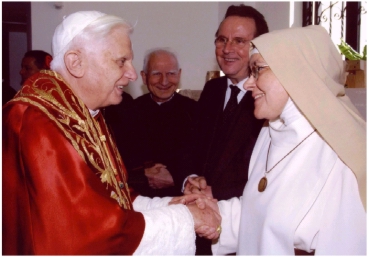
2006 – Pope Benedict XVI meets Sr. Blandina Paschalis Schlomer on his visit to the Sanctuary of the Holy Face in Manoppello, as Fr. Heinrich Pfeiffer, and Paul Badde look on.
We summarize the papers presented, whose simultaneous translation was edited by Agnieszka Kiedzik, from the University of Warsaw. The same papers may be the subject of further study in the publication of the proceedings, which will be edited by Sebastian Stankiewicz, with the title “Beautiful God: The Veil of Manoppello and the Iconography of the Incarnation,” with reference to a theological reflection on the “Beautiful God” present in the Middle Ages, expressed by Cardinal Joseph Ratzinger during a conference held at the Pontifical Urbaniana University in Rome, later taken up by Pope Benedict XVI.
“Being struck and overcome by the beauty of Christ is more real, more profound knowledge than mere rational deduction…We must rediscover this form of knowledge; it is a pressing need of our time.” ~ Excerpt from “The Feeling of Things, the Contemplation of Beauty” by Card. Joseph Ratzinger
The Group’s commitment also led to the creation of a portal — https://diafanitas.uken.cracow.pl — which collects experiences and initiatives on the study of the transparency of bodies crossed by light in a Christian dimension.
Dirk Bouts, 1400? – 1475
Christ Crowned with Thorns,about 1470
Various interpretative readings of the Holy Face have been developed, with the assumption that “whoever has come into contact with the Veil of Manoppello attests to its uniqueness and mystery.”
For representatives of the art sciences, many questions remain open: the origin of the image and history, the relationship between the relic and image, the role of the Veil of Manoppello in the creation of iconographic models in Christian art and in the evolution of ways of representation in Western Culture, the role of the veil among other representations considered acheiropoieta or formal similarities with the images of Christ depicted in the art of old masters; for example Dirk Bouts, Leonardo Da Vinci and Albrecht Durer, among others, and in the Eastern tradition. For contemporary art scholars, philosophers, theologians and anthropologists, the encounter with the Holy Face raises questions such as the relationship between sensual beauty and transcendent beauty, the idea of transparency and lights, the Christian sources of the idea and concept of a person, the meaning of the gaze and the encounter, the presence and contemporary reception of religious themes in art and sacred art and the importance of metaphysical references in contemporary art.
Veronica’s Veil Flemish 15th Century This is a fine example of the “Veronica” as portrayed by artists who saw the original for themselves, before it disappeared from view from the Vatican in 1527.
In my [Antonio Bini’s] presentation, I recalled the studies of Fr. Heinrich Pfeiffer (1939-2021), former professor of Christian history at the Gregorian University in Rome, who identified the Holy Face [of Manoppello] with the Veronica (vera icon), on the the occasion of the International Conference of the Institute for Research on the Face of Christ, chaired by Cardinal Fiorenzo Angelini, and then during a press conference held in Rome on May 31, 1999, on the eve of the Great Jubilee of 2000, which spread knowledge of the Abruzzo Sanctuary [of the Holy Face in Manoppello] throughout the world. Some sequences of that press conference with the interview of the German scholar, on Italian and foreign television, were repurposed in a video that the organizers wanted to show at the opening of the proceedings.
Fr. Pfeiffer’s position was then an isolated one, long contested, more or less openly. But his theses were later shared by Pope Benedict XVI, who visited the Shrine on September 1, 2006, composing a prayer that he dedicated to the “human face of God who entered history to reveal the horizons of eternity.”
Pope Benedict XVI contemplates the Face on the Veil of Manoppello. September 1, 2006. (Photo: Paul Badde/EWTN)
Also under the pontificate of Pope Benedict XVI, a statement from the Holy See on July 11, 2011 reported that the “Veronica disappeared from St. Peter’s following the Sack of Rome in 1527.” This circumstance was confirmed by the (then) director of the Vatican Museums, Prof. Antonio Paolucci (Former Minister of Culture of the Italian Government), in an interview with the Bologna newspaper Il Resto del Carlino on August 11, 2011.
The admission [of the Director of the Vatican Museums] put an end to almost five centuries of silence that had fueled doubts and uncertainties for a long time, also through works of disinformation carried out also through modifications of the same original image, through reproductions that presented a “Veronica” with eyes closed. In this regard, the Veronica Route Project was started in recent years by a group of Milanese scholars, which led to a collective search, still ongoing, of 6200 ancient depictions of the true icon of Christ (Veronicas) with the eyes open, collected in a multimedia catalogue.
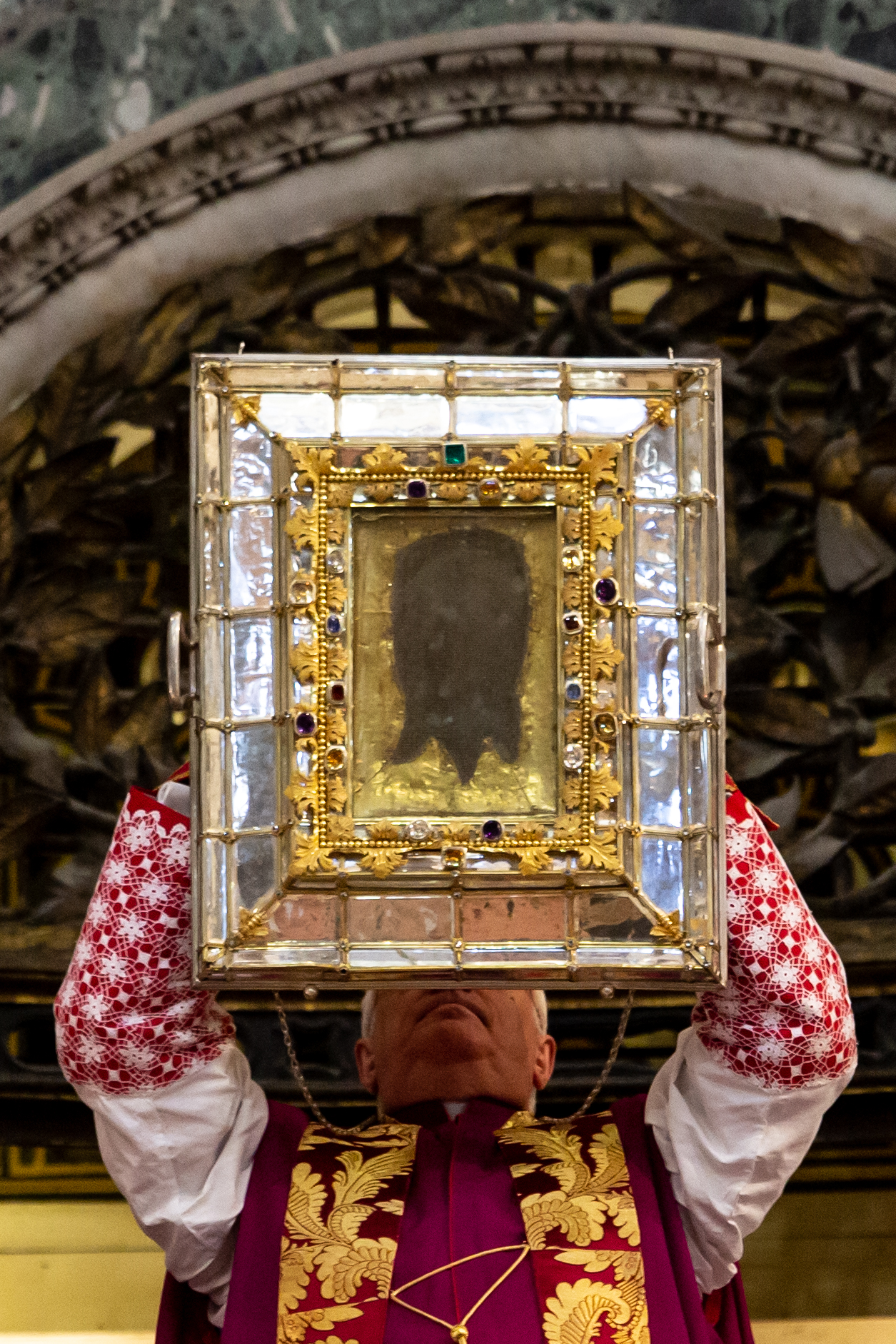
And yet, on April 6, an article published on the Vatican News website reported the presence of the “Veronica” in St. Peter’s (or, a copy of it, a black background. No image is seen.), while the Holy Face [of Manoppello] is indicated as a “shroud,” [A burial face-cloth] reiterating its acheiropoieta nature [As supernatural–made by the Hand of God]. Evidently, the writer was unaware of the painful path that led to the admissions [of the Director of the Vatican Museums] of 2011. Fr. Pfeiffer would still be busy arguing his reasons.
This is an example of a reproduction, made by Pietro Strozzi after 1527, when the original could no longer be viewed. The dark image of a dead man’s face bore no resemblance to previous descriptions and paintings of the Veil.
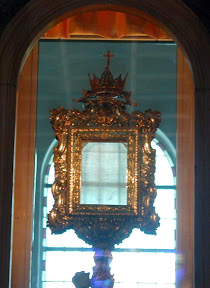
The dark cloth in a face-shaped frame that is currently presented, from a great distance, at the Vatican. (Photo: Daniel Ibanez)
Finally, during the conference, the exhibition of artist-teachers and students entitled “Face to Face” was presented, delicately entering the space of the Sanctuary, to offer a unique forum for interdisciplinary dialogue.
“At the basis of the concept of the exhibition,” declared the curator, Prof. Stanisla Wojcicki, “is the face-to-face encounter with the image of the Veil [Of the Holy Face of Manoppello], treated by scholars as a prototype of other representations of Christ. We would like our works to be considered a votive offering, something that we leave here to express gratitude, for the fact that we were able to meet in this place–particularly important to us.”
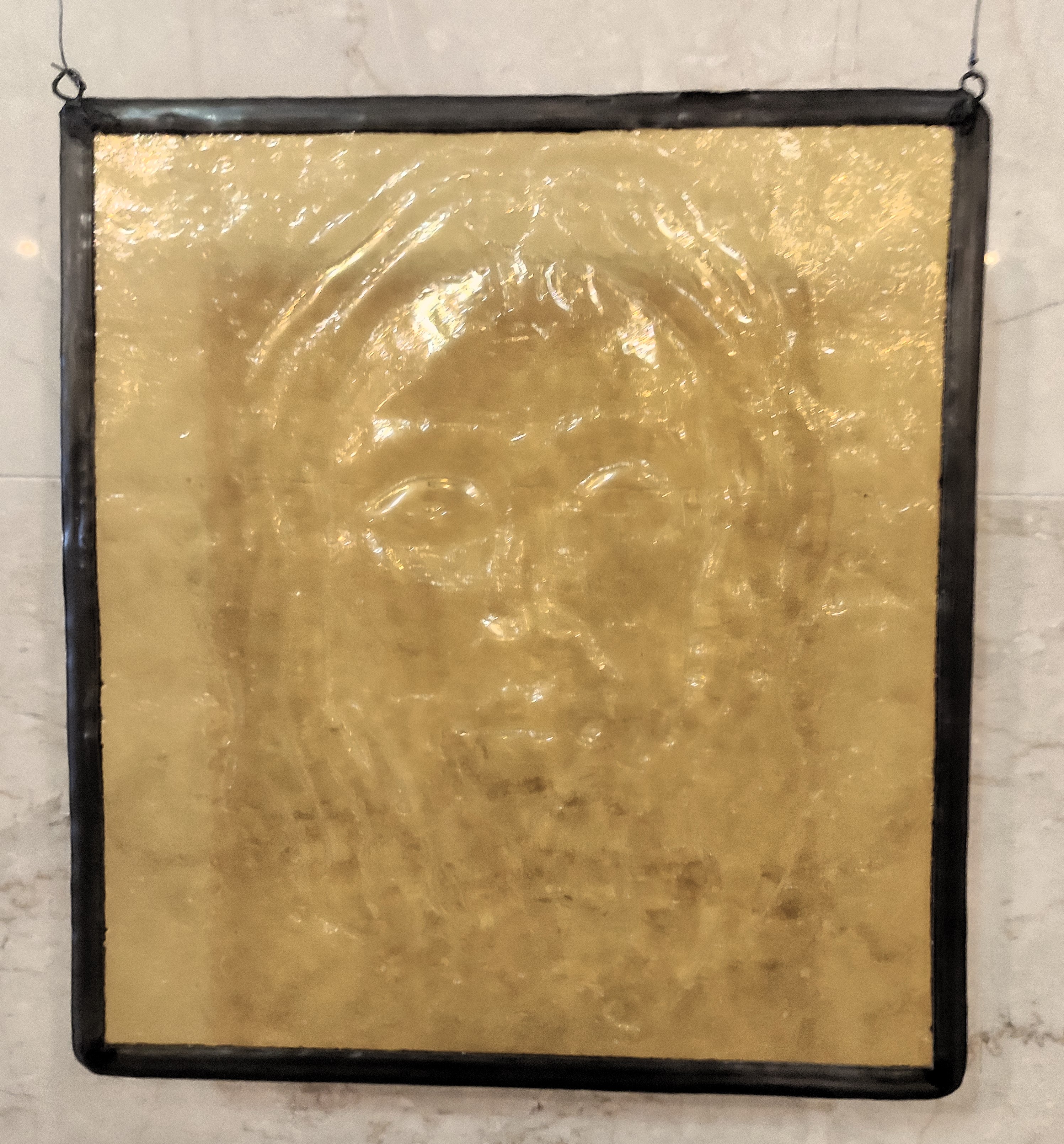
“Not matter but image,” a work by Jacek Pasieczny
“Not matter but image,” a work by Jacek Pasieczny, was exhibited in the Basilica as part of the “Face to Face” exhibition. The author described the work as “reflections of light, with the author” through the “use of glass of a particular color recalling golden byssus.” [of which the Holy Veil is believed to be woven.] The artist specified that it is not a copy of the original, but an attempt to paint a picture with light.
At the end of the conference we asked for an overall assessment from Don Arturo Alcántara Arcos, professor of spiritual theology and collaborator of the Soumaya Museum in Mexico City, also in Manoppello for the occasion, who stated: “It is particularly interesting to consider multidisciplinary points of view from a secular university. Here one can appreciate the different areas in which theology can be present, both directly and indirectly. The Uken of Krakow, inspired by the National Commission for Education established in the eighteenth century by the Polish King Poniatowski, open doors to a new dialogue between theology and the different artistic and aesthetic disciplines of our days in the contemplation of the Face of the Lord.” From what emerged during the conference and on the basis of the same conclusions of Prof. Lukas Murzyn, the belief that the Holy Face can also represent today the reference to the contemporaneity of Christ for art appears to be shared. An analytical perspective that the professors of the University of Krakow — the first to organize a similar event in Manoppello — intended to offer the art world.
Grazie Mille! Antonio Bini for this beautiful summary of the Conference on the Metaphysics of the Image!
One last thought from the beloved Cardinal Ratzinger — and later — Pope Benedict XVI:
Holy Face of Manoppello, (Photo: Paul Badde/EWTN)
“The encounter with the beautiful can become the wound of the arrow that strikes the heart and in this way opens our eyes…” “Inner perception must free itself from the impression of the merely sensible, and in prayer and ascetical effort acquire a new and deeper capacity to see, to perform the passage from what is merely external to the profundity of reality, in such a way the artist can see what the senses as such do not see, and what actually appears in what can be perceived: the splendor of the glory of God, the “glory of God shining on the face of Christ.” (11 For 4,6). –“The Feeling of Things, the Contemplation of Beauty” by Card. Joseph Ratzinger
Shroud of Turin, Veil of Manoppello and Vilnius image of Divine Mercy are examined in new film THE FACE OF JESUS, a stunning documentary set for release in U.S. theatres nationwide on June 3 by Fathom Entertainment
MAY 1, 2025 –DENVER. Can we see the face of the invisible God? Do we know what our Savior looked like? Fathom Entertainment, Sonovision and Candelaria Productions Inc. announce the upcoming nationwide release of the new documentary feature The Face of Jesus in U.S. theatres for one-day only on June 3. Produced and directed by Polish filmmaker Jaroslaw Redziak, the movie brings audiences a powerful experience of the most mysterious, rare and revered images of Jesus and brings audiences a cinematic face-to-face encounter with God that is compelling, provocative and awe inspiring!
“There is endless fascination with who God is, what he looked like and if it’s possible that he has left us an image of himself,” said Jaroslaw Redziak, producer and director of The Face of Jesus. “We set out to examine three of the most popular images that reveal the face of God – two divine images not made by human hands – the famous Shroud of Turin and the Veil of Manoppello. We also weave in the third image of Jesus made by human hands, the divinely inspired image known as the Vilnius image of the Divine Mercy. Audiences will be fascinated by what they see and what they hear about these astounding images of the face of Jesus.”
Known throughout the world, the Shroud of Turin is an ancient linen cloth with the image of a man believed by many to be Jesus Christ and is kept in the Cathedral of St. John the Baptist in Turin, Italy. The Shroud has been the subject of extensive scrutiny, scientific study and thousands of news stories that have probed its authenticity. The Veil of Manoppello is another ancient cloth that is lesser known, discovered in the early 1900s, but gained wider awareness and popularity when the late Pope Benedict XVI made a visit during his Papacy in 2005 to the remote village to see for himself. This veil has been the subject of research and writing by documentary subject and renowned German journalist and historian Paul Badde whose work has exposed the veil to a global audience. The veil reveals another image of Jesus and according to experts corresponds to the face of Christ in the Shroud of Turin. The last image to be explored is the Vilnius image of the Divine Mercy, a divinely inspired image made by human hands based on visions and messages of Jesus given to Saint Faustina Kowalska. The image was painted by Eugeniusz Kazimirowski and created under the guidance of Saint Faustina and her confessor Blessed Michael Sopocko.
Throughout the film, several prominent experts from around the world bring forward the authenticity of the Shroud of Turin and the Veil of Manoppello as well as the story behind the painting of the stunning Vilnius image of the Divine Mercy that has become a central image within the popular contemporary Catholic devotion to the Divine Mercy.
“The compelling hypotheses, observations and even miracles connected to these images, will lead audiences to ponder the reality of the seen and unseen God,” said Konrad Sosnowski, President of Sonovision. “I am grateful that Fathom Entertainment is partnering with us to bring a film of deep mystery, inspiration and worthy consideration to U.S. movie-goers.”
Featured experts in the documentary include:
Fr. Zbigniew Drzal, author of “Show Me Your Face”
Marcin Kwaśny (narrator), acclaimed Polish actor (Triumph of the Heart), screenwriter and director
Krzysztof Sadlo, curator of the exhibition dedicated to the Turin Shroud at the John Paul II Center in Krakow
Professor Wojciech Kucewicz, expert in silicon detectors of ionizing radiation
Professor Tomasz Graff, Pontifical University of John Paul II in Krakow
Anna Krogulska, PhD, Polish lay missionary with a focus on the Shroud of Turin
Paul Badde, renowned German journalist and writer, author of best-sellers “Divine Face” and “Face to Face: Witness to the Resurrection”
Fr. Carmine Cucinelli, OFM Cap, Italian Capuchin friar and former custodian of the Shrine of the Holy Face in Manoppello; hosted Pope Benedict XVI at the Basilica
Sr. Petra-Maria Steiner, Vita Communis – Maria of the Holy Family and expert on the history of Manoppello
Following the main feature documentary, a short bonus presentation will include commentary from prominent U.S. clergy, Fr. Robert Altier, priest of the Diocese of St. Paul and author of God’s Plan for Your Marriage, and Fr. Lawrence Daniel Carney III, priest of the Diocese of Wichita, who eloquently add further context to The Face of Jesus, its themes and the growing devotion to the Holy Face in contemporary Catholicism.
“The U.S. clergy that we tapped for the bonus feature add beautiful spiritual context to what audiences will experience in the main film and will help people to go deeper,” said Oscar Delgado, producer and founder of Candelaria Productions Inc. “Did you know there is a secret to the Holy Face? Father Carney will teach and instruct about Jesus’ countenance and the yearning we all have to see the face of God. Father Altier will provide historical and theological context for greater understanding.”















 Illumina Domine Blog - Devotion to The Holy Face