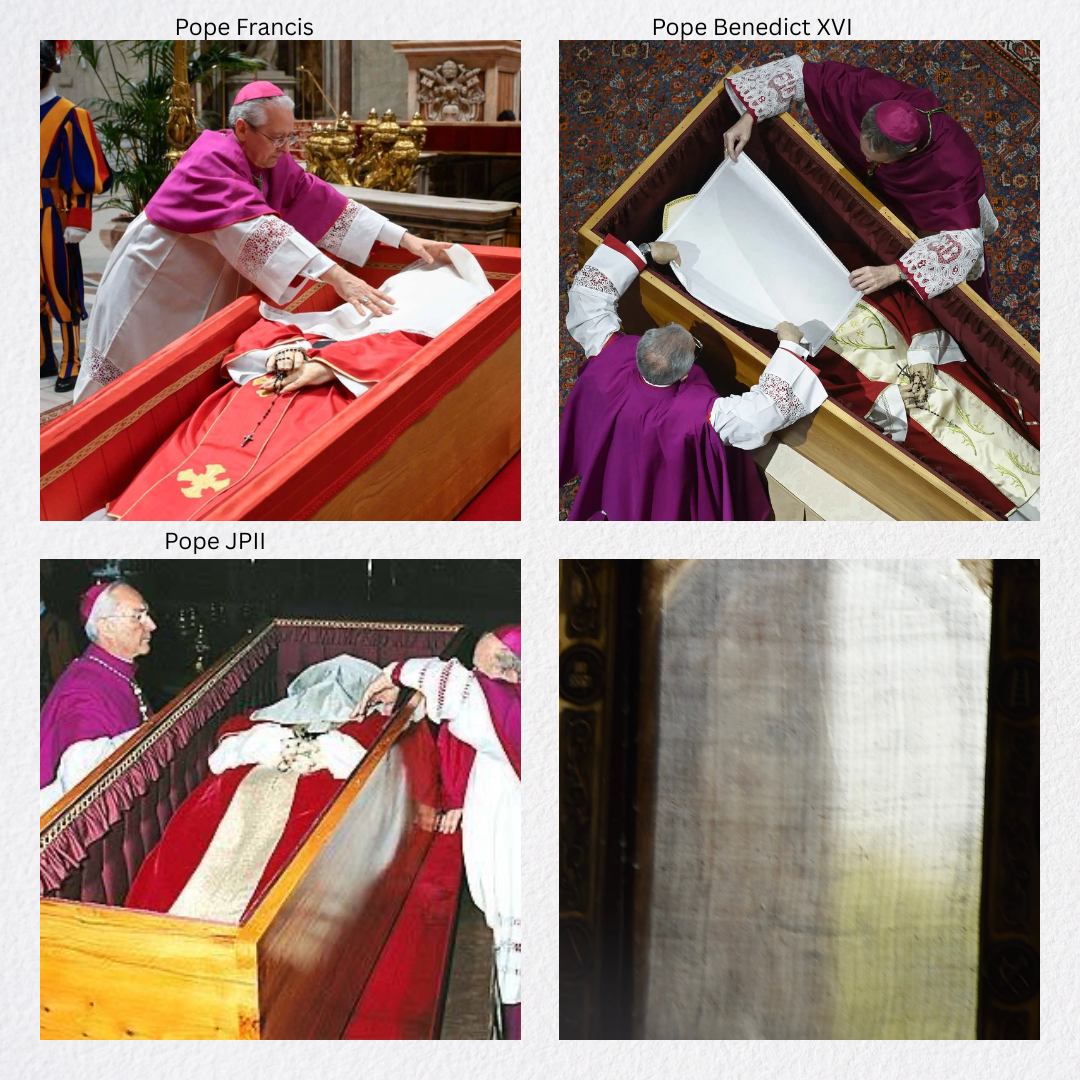
Photos of the Papal funeral ceremonies by Vatican Media. Bottom right photo — the Holy Veil of Manoppello. Thank you to Alexandra Prandell for putting these beautiful images together!
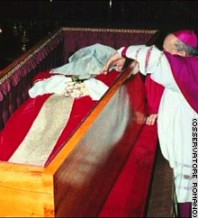
Although Pope Francis made many changes to the funeral traditions of the Popes, One deeply meaningful tradition was preserved — that of placing a sudarium veil over the face of the Holy Father — and it is connected to the Sudarium Cloth that would have been put on the Face of Christ in the Tomb. An unmistakable message! As we die with Him, we will rise with Him! Alleluia!
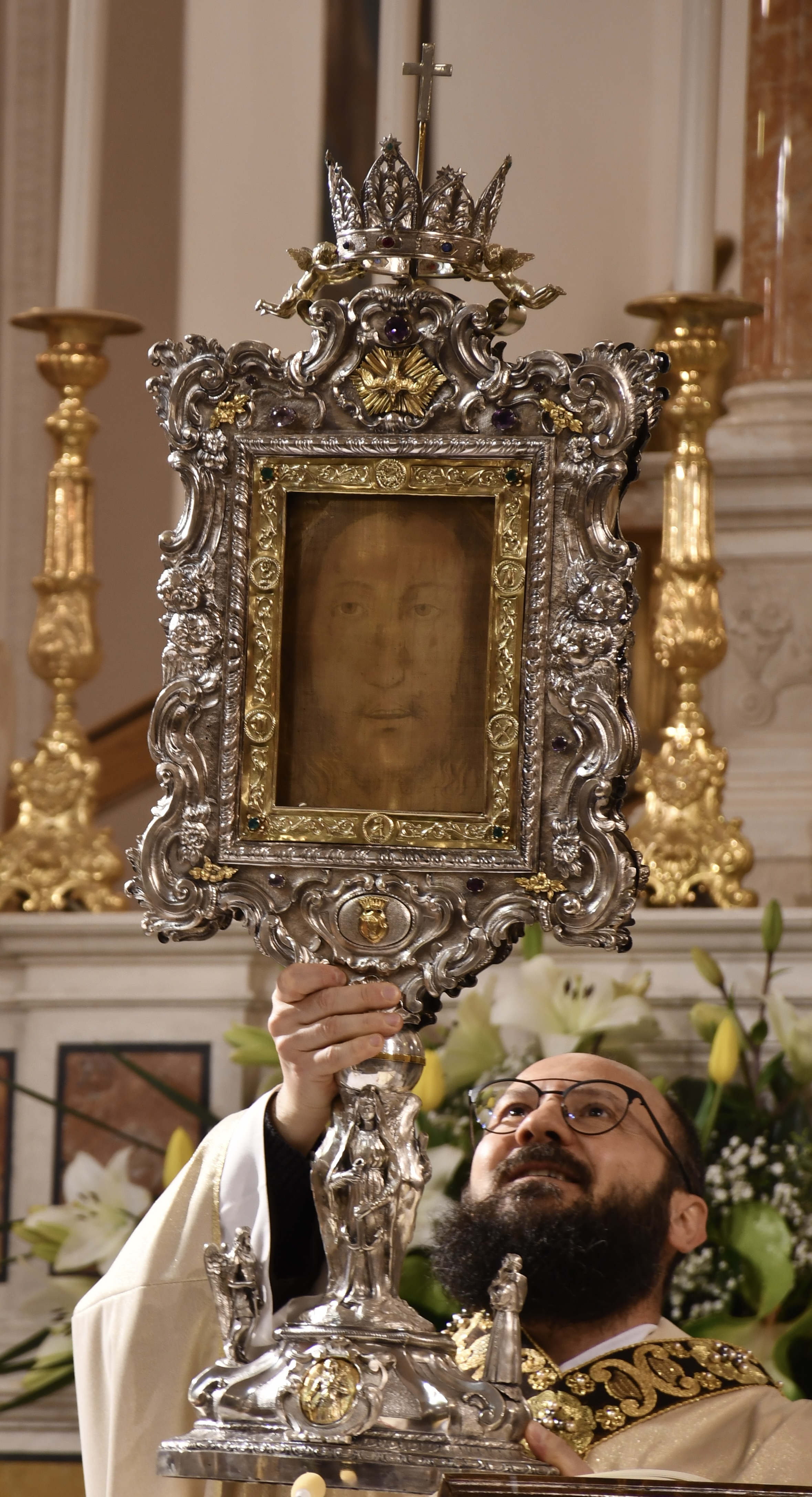
Padre Antonio Gentile before the Sudarium Veil of the Holy Face on Easter, at the Basilica Sanctuary of the Holy Face in Manoppello, Italy. Photo: Alexandra Prandell
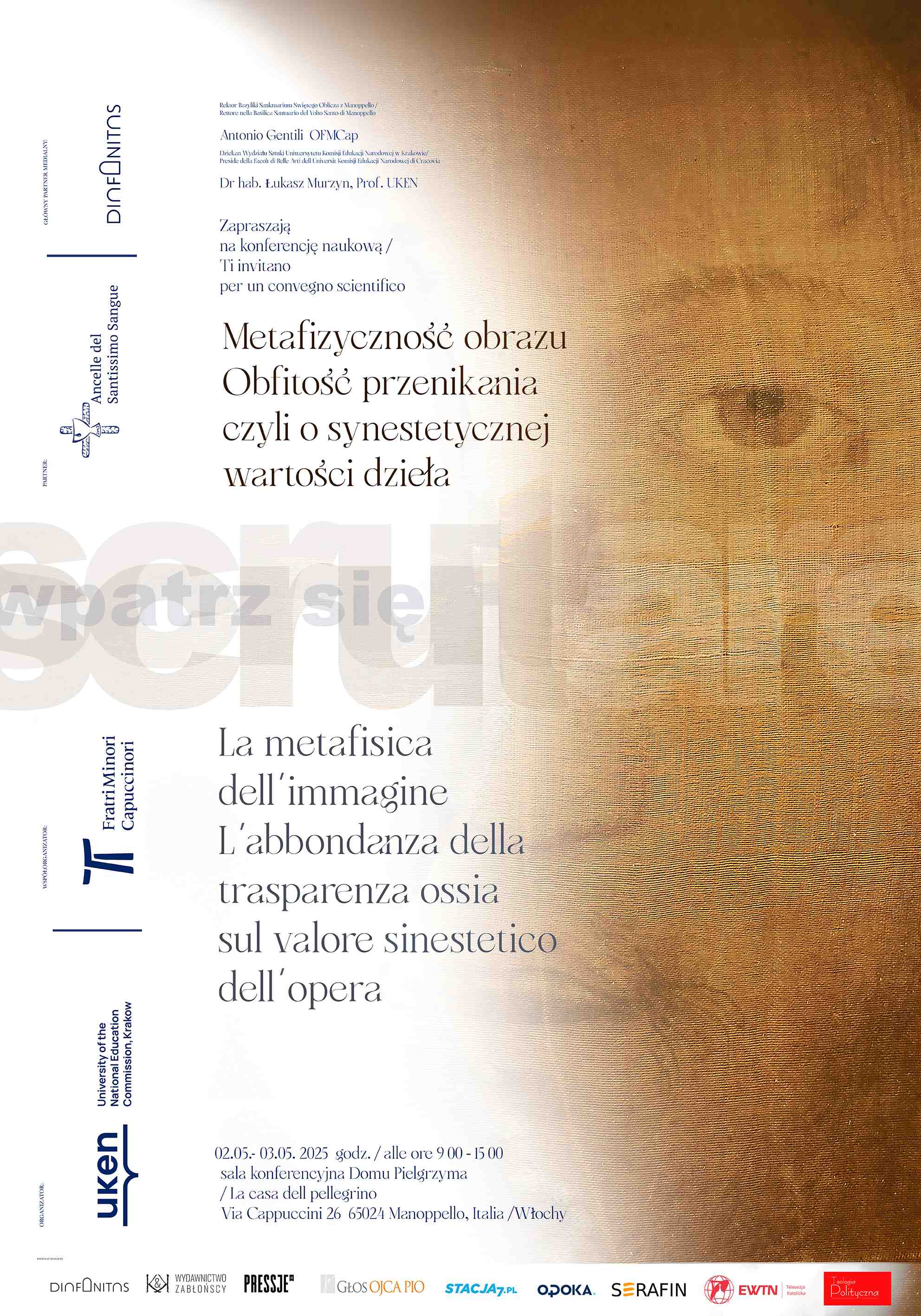
Poster for the upcoming May 2-3 conference to be held at the Sanctuary in Manoppello.
Pope St. John Paul II’s words “Be not afraid!” immediately came to mind after I read the daunting title of the unique scientific conference that will be hosted by the Sanctuary of the Holy Face in Manoppello, Italy, on May 2-3, 2025:
“The Metaphysics of the Image. The Abundance of Interpenetration, or on the Synesthetic Value of the Work.”
But, as intimidating as the title may be, the words are an open invitation to all (admission is free) for those who “seek the Face of God” to come to the Sanctuary Basilica of Manoppello to listen, prayerfully contemplate, and discuss the beautiful and profoundly deep meaning of the existence of the mysterious “Acheiropoieta”–made by the Hand of God–that is known as “Il Volto Santo” – a miraculous image of the Face of Jesus that is inexplicably present on sheer veil.
Veil of Manoppello,photo: Paul Badde/EWTN
“Duc in Altum”
One certainly must admire those who have organized this wonderful event, uniting science, faith, and art, for not fearing “to put out into the deep” (Luke 5:4): The Art and Metaphysics Research Team of the University of the Commission of National Education in Krakow, Poland, and the congregation of the Friars Minor Capuchin in Manoppello, Italy. The conference will take place in person and will be accompanied by an exhibition of artists, lecturers and students of the Uken University of Krakow entitled “Face to Face.”
The organizers have provided further details for those who may like to attend this important event:
The first day of the conference, May 2, the “speakers’ presentations and discussion will focus on the historical and contemporary contexts of the Holy Face, with particular emphasis on the influence of the centuries-old cultural and religious heritage of this image on the iconography of Christianity and the role it has to play in the contemporary world.” Prof. Antonio Bini will give a presentation on Fr. Heinrich Pfeiffer, S.J. and his great contribution to the research on the Holy Veil of Manoppello in the 1990’s.
The second day of the conference, May 3, a panel will be held on “contemporary religious art and its contexts. The topics of the presentations will include attempts to apply scientific interpretative tools from the fields of philosophy, theology, and art history to the Image of Manoppello and other relics ‘not made by human hands.’ Artists, participants of the ‘Face to Face’ exhibition, will also share their reflections on the influence of the Bible and hagiography on their creative process. It will therefore, not only be a space for the exchange of knowledge, but also for reflection on the role of the artist and the Church in the face of the challenges of modernity.”
The conference “is intended to be not only an opportunity for scientific reflection, but also to learn about the diverse attitudes and ways of expression represented in the environment of artists working our Art and Metaphysics Research Team. During the conference an exhibition of artists-pedagogues and students entitled ‘Face-to-Face’ will be presented. It is intended to enter the space of the Sanctuary in the most delicate way possible, but also to be a unique forum for interdisciplinary dialog.
The artists generously desired to leave the fruits of their work as a permanent exhibition in Manoppello for the edification of Pilgrims to the Sanctuary Basilica: “We would like our works to be a votive offering, something that we will leave to express our gratitude for being able to be in this place that is particularly important to us. Together with the works we bring, we would like to bring our own intentions and reflections related to the most intimate possible relationship, with God” –Declaration of the artists of the “Face-to-Face” exhibition
“This exhibition is a kind of prayer of thanksgiving and an introduction through artistic means to the contemplation of the Divine Face of Manoppello…and at the same time a preface (Latin: praefatio) for [the artists] further activities.
This photo was taken on Easter by Alexandra Prandell, of the Rector of the Shrine, Padre Antonio Gentili, whose face reflects the joy of the Risen Christ.
“The international scientific session at La Casa Pellegrino in Manoppello will be honored by the presence of His Excellency Mons. Archbishop Bruno Forte, Archbishop of the Diocese of Chieti, and will be attended by: clergy, journalists, researchers, art historians, philosophers and artists: Czeslaw Gadacz OFMCap, Prof. Antonio Bini, S.M. Monika Gutowska SAS, Prof. Lukas Murzyn, Dr. Sebastian Stankiewicz, Prof. Rafael Solewski, Dr. Bernadeta Stano, Anna Grąbczewska, Dr. Agnieszka Daca, Dr. Jacek Pasieczny, Mgr. Stanislaw Wojcicki.
During the session, the film directed by Jaroslaw Redziak entitled “The Face of Jesus” will also be presented.
This important event, I believe, will greatly enrich our understanding and knowledge of “Il Volto Santo.” The precious veil of the Holy Face is not a mere curiosity. Such a great gift from God must be taken very seriously and approached prayerfully, with reverence, love, and a deep desire for a better understanding of God’s ultimate Gift of His Son to us.
Padre Antonio Gentili elevates and contemplates the “Eucharistic Face of Christ” in the Host, where Jesus is truly present, “Body, Blood, Soul and Divinity.” Photo: Alexandra Prandell
One last thought… Do not be afraid to dive into “The Metaphysics of the Image of the Face of Christ.” The artists and Our Creator both know that “A picture paints a thousand words,” and prove the existence of the artist, as well as the Divine Artist!
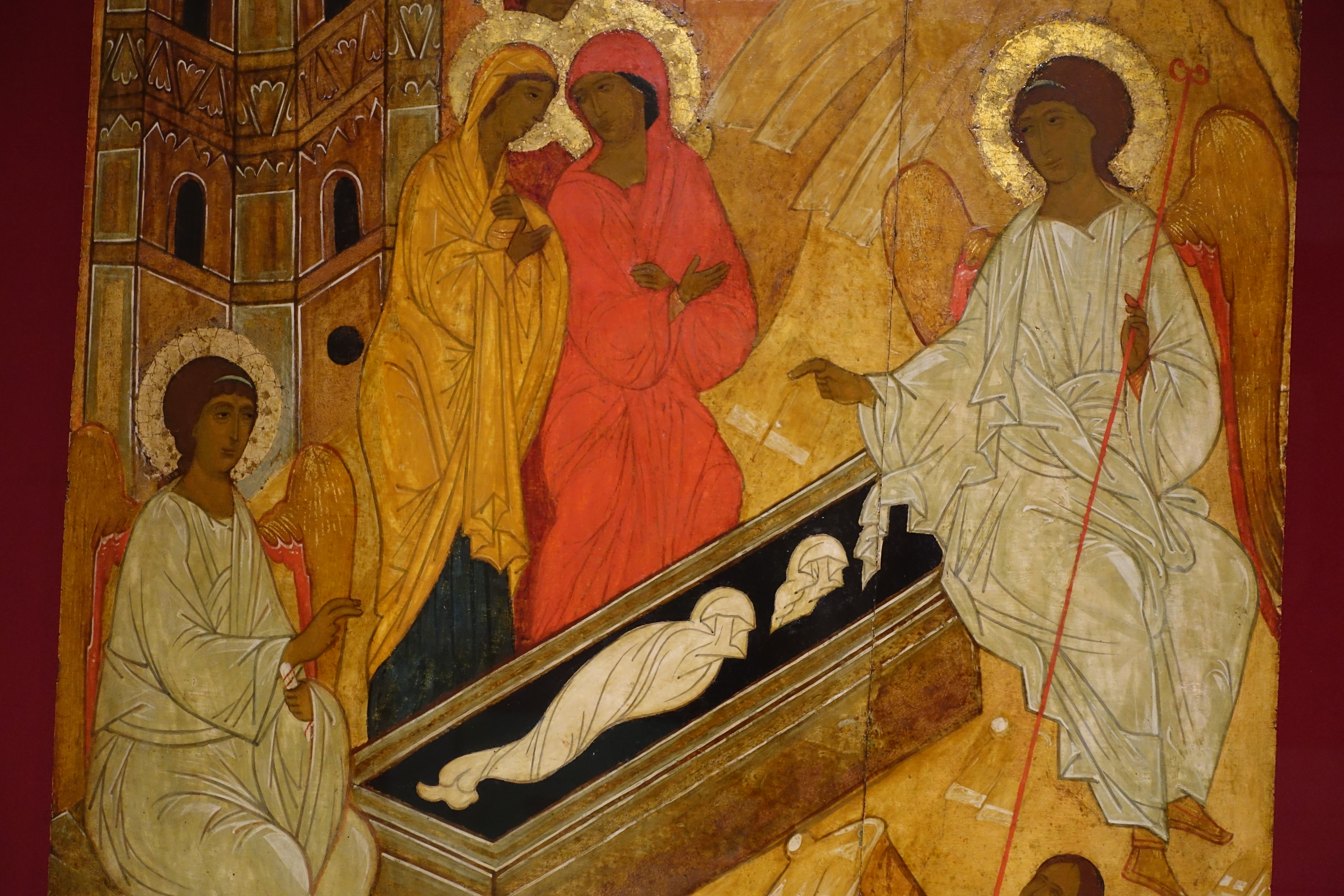
There were several burial cloths of Christ that were found in the tomb; and among them: the Shroud of Turin, the Cloth of Oviedo, and the precious byssus veil that was believed to cover the Face of Christ in the tomb – known as “Il Volto Santo” – The Holy Face of Manoppello. Possibly the very reason that St. John “Saw and believed.”
The Disciples Peter and John Running to the Sepulchre on the Morning of the Resurrection, Eugene Burnand, 1898
So Peter and the other disciple went out and came to the tomb. They both ran, but the other disciple ran faster than Peter and arrived at the tomb first; he bent down and saw the burial cloths there, but did not go in. When Simon Peter arrived after him, he went into the tomb and saw the burial cloths there, and the cloth that had covered his head, not with the burial cloths but rolled up in a separate place. Then the other disciple also went in, the one who had arrived at the tomb first, and he saw and believed. For they did not yet understand the Scripture that he had to rise from the dead. (John 20: 1-9)
At the time of Jesus, the Jewish law required several “cloths” to be used for burial, and as many as six for someone who had died a violent death. Christian tradition has preserved six cloths as relics that are associated with the burial of Jesus – 1.) The Shroud of Turin, Italy 2.) the Sudarium of Oviedo in Spain, 3.) The Sudarium Veil of Manoppello, Italy 4.) The Sudarium of Kornelimunster in Germany, 5.) The Sindon Munda of Aachen, Germany, 6.) The Cap of Cahors in France.
Three of the cloths in particular stand out as extraordinary “witnesses” to the Passion, Death, and Resurrection of Jesus, and together they bear a powerful testimony to the truth of the Gospels. Each one bearing an imprint or image of the Face of Jesus. They are: The Sudarium of Oviedo, The Shroud of Turin, and the Sudarium Veil of Manoppello. The remarkable relationship between these three “cloths” leave little doubt that each came in contact with the face of the same man at the time of burial.
The Sudarium of Oviedo directly touched Jesus’s head following His Crucifixion. Blood was considered sacred to the Jews, so this cloth was used to soak up the Precious Blood of Jesus, by wrapping it around Jesus’s Head, as He was taken down from the Cross. The largest bloodstains are from the nose, other stains are from the eyes and other parts of the face. There is also an imprint on the sudarium of the hand of the person who held this cloth to Jesus’s Face to staunch the flow of blood. It takes one’s breath away to see that the bloodstains on the Sudarium of Oviedo, when overlaid with the Face on the Shroud of Turin and the Sudarium Veil of Manoppello, correspond perfectly. The blood type is AB, the same as on the Shroud of Turin.
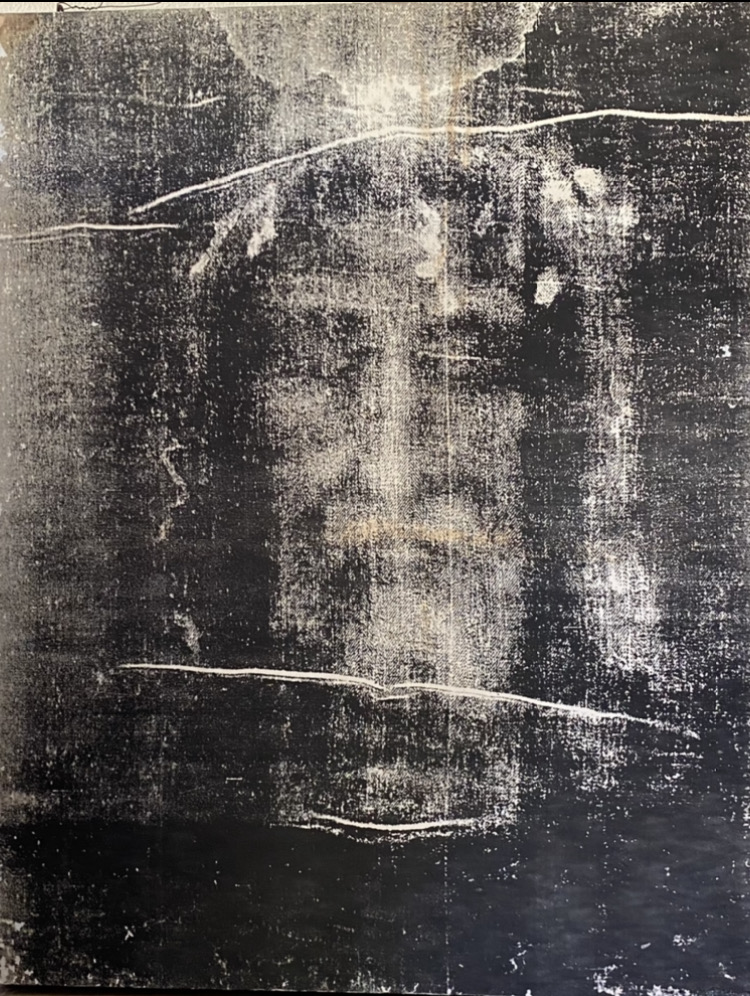
Photo of the Face on the Shroud of Turin
“He went into the tomb and saw the burial cloths there.“
The Shroud of Turin; the sindone, or linen burial shroud, was believed to have been used to wrap the entire body of Christ. It is the most famous and studied of the three cloths. The faint but visible imprint on the Shroud of Turin gives witness to the violent torture of a man as described in the Passion and Death of Jesus in the Scripture. The world was amazed when Secondo Pia first photographed the Face on the Shroud in 1898; the negative of the photo incredibly became visible as a positive image. The Shroud of Turin caused an entire branch of science to be dedicated to its research called Sindonology.
Photo: Holy Face Veil of Manoppello, Italy (Paul Badde/EWTN)
‘…and the cloth that had covered his head, not with the burial cloths but rolled up in a separate place.‘
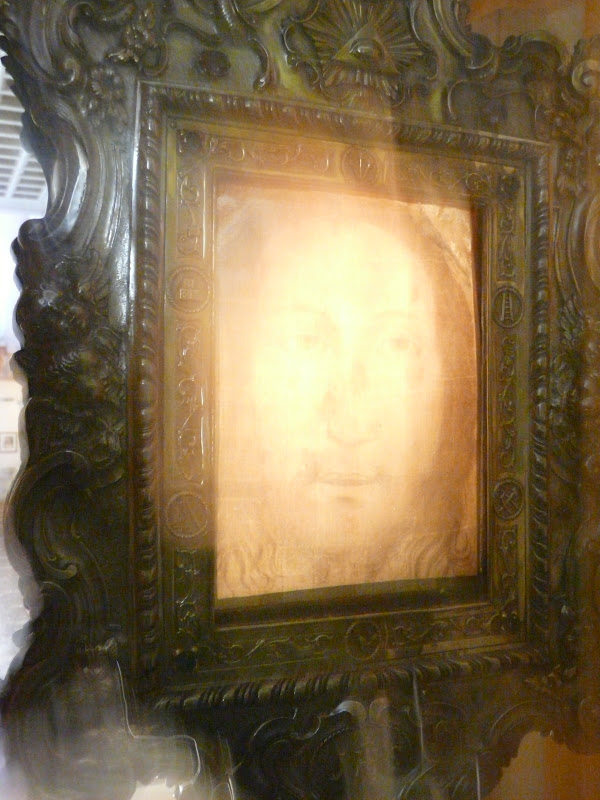
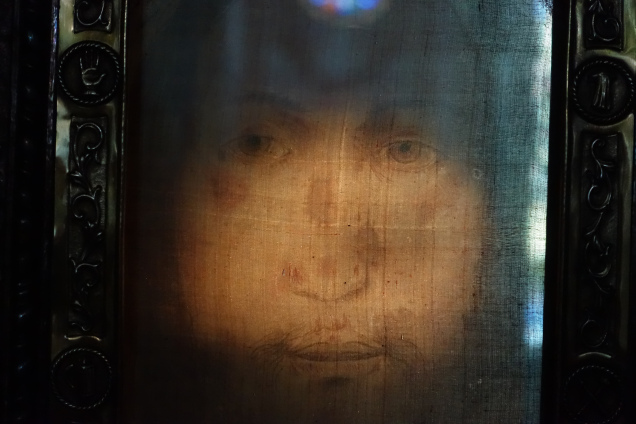
Reliquary containing the transparent veil on which the image of the Holy Face becomes visible, according to the light and position of the viewer. Photo: Paul Badde
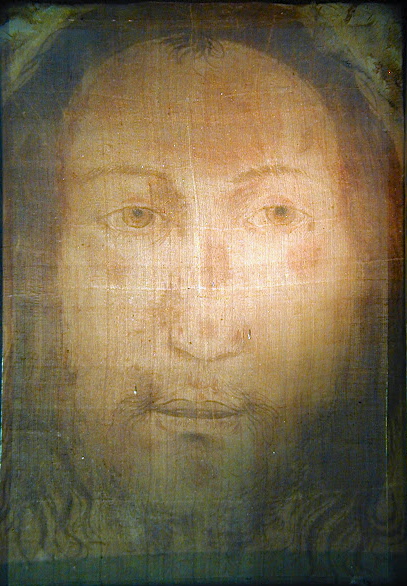
The Sudarium Veil of the Holy Face of Manoppello, Italy is perhaps the least known of the three burial “cloths.” The Veil bears the image of the living Face of Jesus. This “miracle of light,” “not made by human hands,” was protected and hidden in an isolated church in the Abbruzzi Mountains for centuries. It is believed to be the “cloth” that covered the Face of Jesus in death, showing traces of the Passion: Bruises, swelling, wounds from the Crown of Thorns, and plucked beard. But, it is also believed to have recorded in light the Face of Jesus at the moment of His Resurrection. No, this is not a contradiction. Yes, the image changes. It shows suffering, but it also shows life! It is believed to be “The cloth that covered His head.”
“Il Volto Santo” The Holy Face Veil of Manoppello. Photo: Patricia Enk
An explanation about the tradition of a face cloth for burial may be helpful in understanding its profound significance: In the funeral rites for priests in some Eastern churches, the veil which was used to cover the chalice and paten were placed on the face of the deceased priest. (The cloth used to cover the chalice and paten had a particular liturgical symbolism linked to the Face of Christ as well.) It was done as a symbol of both the strength and protection of God, and also of the tomb of Christ–an expression of belief in the Resurrection. In Jewish burial custom, a deceased priest’s face would be anointed with oil and then covered with a white cloth, and would have been done for Jesus.
Funeral of Pope St. John Paul II, Archbishop Dziwisz covers the pope’s face with a veil.
When Pope St. John Paul II was being laid in his coffin, Archbishops Marini and Stanley Dziwisz had the honor of placing a white silk veil over the face of the pope. Poignantly, the choir sang the words from Psalm 42, “My soul thirsts for God, the living God; when will I come and see the Face of the Lord?” Many wondered about the action of covering the pope’s face with a veil because this was the first time it had been done, but was at the request of Pope John Paul II, who had dedicated the millennium to the Face of Christ.
Byssus “Pinna Nobilis” fit for a King! Photo: Paul Badde/EWTN
The cloth that would cover the Face of Christ would have to be made of a material fit for a King, a High Priest, and a God. Byssus, mentioned in the Bible forty times, also known as “sea-silk,” is more rare and precious than gold and it has an exceedingly fine texture which can be woven. Made from the long tough silky filaments of Pinna Nobilis mollusks that anchor them to the seabed, it is strong enough to resist the extreme hydrodynamic forces of the sea. Byssus has a shimmering, iridescent quality which reflects light. It is extremely delicate, yet strong at the same time. It resists water, weak acids, bases, ethers, and alcohols. Byssus cannot be painted, as it does not retain pigments, it can only be dyed; and then, only purple. It can also last for more than 2000 years.
Kurt Cardinal Koch contemplates the Veil “not made by human hands” of Manoppello. Sheer and delicate, yet the Face is visible. Photo: Paul Badde/EWTN
The Sudarium Veil of Manoppello is also made of rare, precious, byssus silk. The skill needed to weave a byssus veil as fine as the Veil of the Holy Face of Manoppello is exceedingly great. Chiara Vigo, known as “the last woman who weaves byssus,” has said that neither she nor anyone alive today could duplicate the gossamer-thin veil, which is sheer enough to read a newspaper through. The weave is so delicate, she says, that only the nimble fingers of a very skillful child could weave something so fine.
Photo: Paul Badde
It is only through light that this shimmering image of the Face of Jesus may be seen, and at times appears as a “living image” as though it were reflected in a mirror, at other times the image completely disappears. Although no camera can adequately capture the image, thanks to the many amazing photos of journalist Paul Badde, the changes that occur when viewing the veil may be better appreciated. (Click here for more photos, and information about Paul Badde’s books and videos about the Holy Face.)
While the Face on the Shroud of Turin clearly shows the Face of Jesus in death with eyes closed, the Sudariam of Manoppello has eyes open–bearing witness to the Resurrection. That was the ardent belief of the former Rector of the Basilica Shrine of the Holy Face, Servant of God Padre Domenico da Cese.
Sevant of of God Padre Doemnico da Cese, former Rector of the Shrine of “Il Volto Santo.”
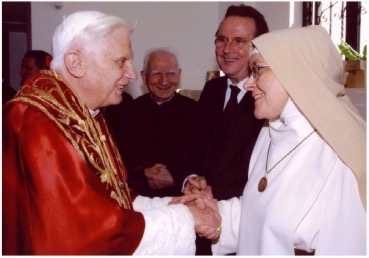
L to R: Pope Benedict XVI came as a pilgrim to Manoppello on September 1, 2006, Fr. Heinrich Pfeiffer, S.J., Paul Badde, and Sr. Blandina Schlomer
There are many physiological reasons too for believing that the Face Cloth captures the first breath of the Resurrection. Sr. Blandina Paschalis Schlomer, who shares that belief, has provided meticulous research about the Veil in her book JESUS CHRIST, The Lamb and the Beautiful Shepherd, The Encounter with the Veil of Manoppello. Sr. Blandina together with Paul Badde, and Fr. Fr. Heinrich Pfeiffer, S.J., Professor at the Pontifical Gregorian University in Rome, have each demonstrated that the Holy Face on the Veil of Manoppello is the proto-image of the earliest icons, and other works of art depicting the Face of Jesus.
“…and he saw and believed. For they did not yet understand the Scripture that He had to rise from the dead.”
What did St. John see in the tomb that would cause him to believe? A cloth of blood, such as the Oviedo? The Shroud of Turin? The Shroud bears a miraculous image, but it shows the Face of a dead man. A third witness was needed in order for the disciple to believe. It could only have been evidence of something as astounding as the Resurrection; proof that Jesus was alive!
Holy Veil of Manoppello. Photo: Paul Badde/EWTN
It is human nature to want to see things for ourselves. Many pilgrims, humble and great, have felt called to make the journey to visit the miraculous relic. If it is God’s handiwork, and I believe that is true, then one can only wonder at its existence, and gaze in silent contemplation, giving thanks for this tremendous gift of God… so we too may “see and believe.”
As the first rays of light entered the tomb, John and Peter, upon entering, “saw and believed.” Sudarium Veil of Manoppello, Photo: Paul Badde/EWTN
Pope Benedict XVI contemplates the ‘Veronica’s Veil’ during a visit to the Shrine of the Holy Face in Manoppello, central Italy, September 1, 2006.
“While we too seek other signs, other wonders, we do not realize that He is the real sign, God made flesh; He is the greatest miracle of the universe: all the love of God hidden in a human heart, in a human face.”
~ Pope Benedict XVI
Holy Face of Jesus of Manoppello (photo: Paul Badde/EWTN)
“We cannot stop at the image of the Crucified One; He is the Risen One!”
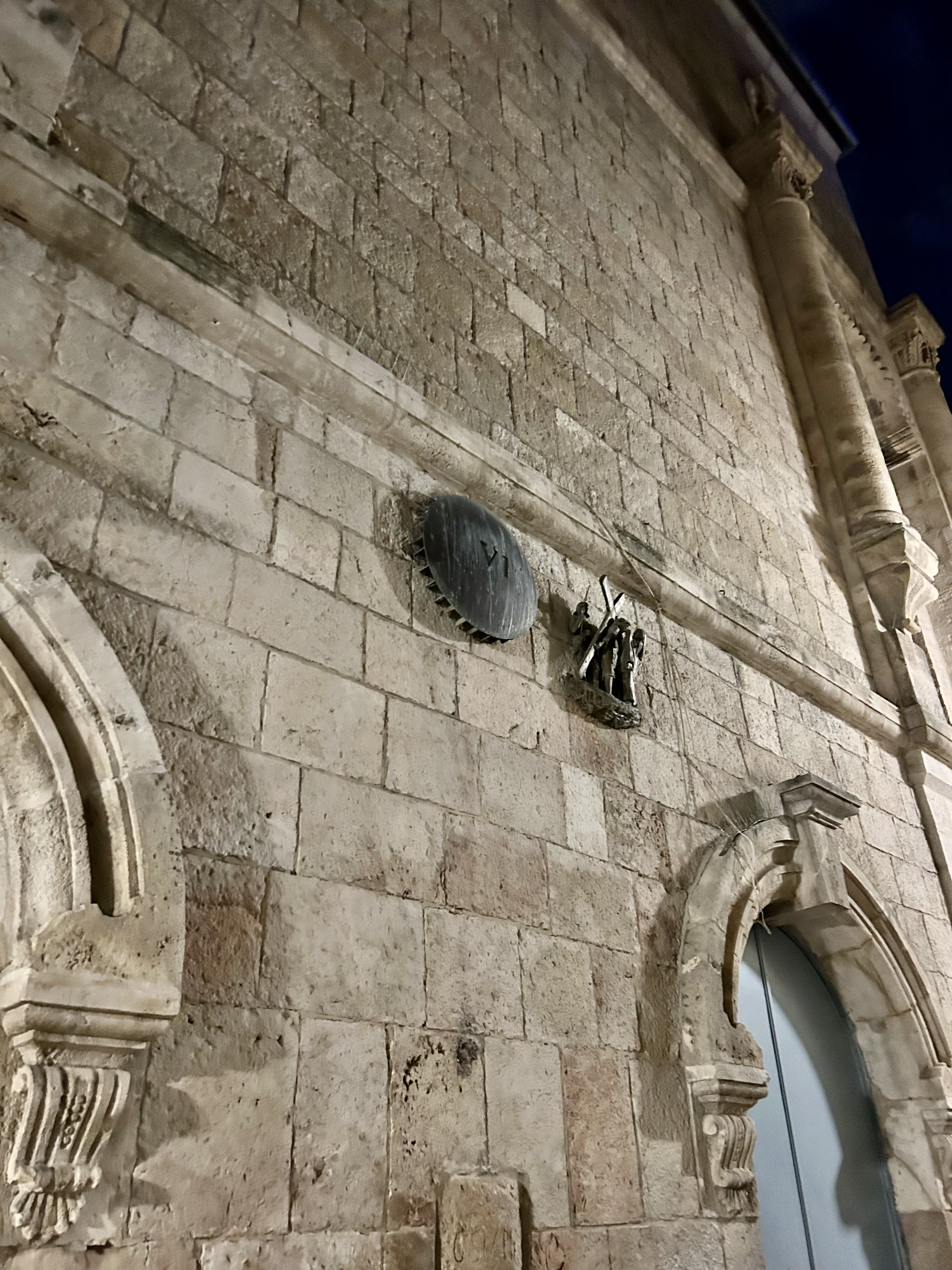
Was there actually a St. Veronica? It is an important question, and a very personal one to me and many others. According to tradition, “Veronica,” is the compassionate woman who wiped the Face of Jesus, who is commonly depicted in every Catholic church, at the Sixth Station of the Cross, yet her name does not appear in the Gospels, and the legends did not appear until the Middle Ages.
Pope St. John Paul II pondered this very question many years before dedicating the Millennium to the Holy Face of Jesus. The fruit of his prayerful contemplation unveils a profound truth for every Christian as he answers another question; What does it mean to be “a Veronica?”
The Sixth Station on the Via Dolorosa in Jerusalem
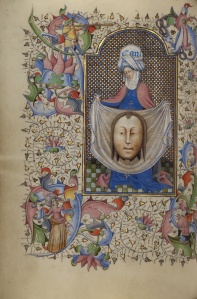
Veronica’s Veil, Flemish 15th Century
“St. Veronica”
The Catholic Church tells us that a veil bearing a miraculous image of the Face of Jesus has existed since the earliest centuries, recorded in history and in art, such as the Camulia, or the Mandylion. Explanations for the existence of such a veil were all different (see “Four Stories, One Face“). About the time this miraculous veil first appeared in Rome, the name “Veronica” referred to the veil itself, and not a person–“Veronica” meaning “vera” or true, and “icon” meaning image, or even more precisely, “to be present.” Those who gazed upon the veil bearing the true Face of Jesus stood in God’s presence. They were turned toward His Face. The Veil became the greatest relic that Pilgrims traveled to see in the Vatican.
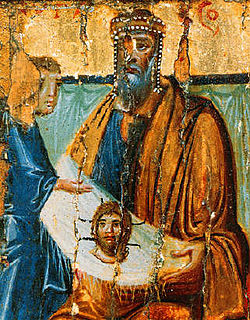
King of Edessa receiving the miraculous veil from St. Jude, and was healed of leprosy.
“Veronica” holding a sheer veil bearing the living Face of Christ on a sheer veil with distinctive folds.
Legends sprang up much later, in the Middle Ages, about a woman named “Veronica,” who was sometimes associated with the woman “Berenice” or “Bernice,” the bleeding woman who touches the hem of Jesus’s garment in the Gospel. There is a version, written in 1191 by Robert de Boron, that tells of a woman named “Veronica” wiping sweat from the Face of Jesus. The stories are many and varied, but the legend that most people are familiar with today is traced to a version by Roger d’Argenteuil in the 1300s, which tells of a woman “Veronica,” associated with the sixth station of the Cross–the compassionate woman, wiping the Face of Jesus on the way to Calvary with a cloth, upon which He leaves an image of His Face.
“These pious traditions cannot be documented, but there is no reason why the belief that such an act of compassion did occur should not find expression in the veneration paid to one called Veronica.” —The Catholic Encyclopedia
What did the Veil look like? A “living, changing, face” on a sheer veil, with distinctive folds, that could be viewed from either side; the eyes are open and glance to one side or the other; a lock of hair graces the center of the forehead; a sparse beard, wavy hair, as well as signs of bruising and trauma to the face are seen…. which despite the obvious suffering, remains peaceful and serene.
The Holy Veil of Manoppello- photo: Paul Badde/EWTN
Pope St. John Paul II expressed the answer to this profound question addressing the origin of the name of Veronica most beautifully in his poem, “The Name:”
The Name
In the crowd walking towards the place
[of the Agony]–
did you open up a gap at some point or were you
[opening it] from the beginning?
Veronica’s Veil by Hans Memling
And since when? You tell me, Veronica.
Your name was born in the very instant
in which your heart
became an effigy: the effigy of truth.
Your name was born from what you gazed upon.
–Karol Wojtyla
Miraculous Holy Face Veil Photo: Paul Badde (see “Manoppello Image” tab)
Since the detailed historical facts about the veil itself cannot be verified with absolute certainty in this life, the more important and answerable question is, “What does it mean to be a Veronica–a “true image?”
“Your name was born from what you gazed upon.”
When a soul performs an “act of compassion,” Jesus leaves His image on the “veil” of the soul. In other words, while contemplating the Face of Jesus in an image, in the Word of God in the Scriptures, in a person made in the image and likeness of God, or above all, in the Eucharist, the soul places itself in the Presence of God. When we are turned completely toward the Face of God, through a daily face-to-face encounter in prayer–by the power of the Holy Spirit–God gradually transforms the soul into the “True Image” of His Son, Jesus Christ. As Pope St. John Paul II says, our hearts must become an “effigy of truth,” a “true icon.” Then our name too will be born from what we gaze upon. It will be “Veronica.”
The Deepest Truth About St. Veronica
St. Veronica statue by Francesco Mochi, 1629
Within the center of St. Peter’s Basilica are four massive niches. In each niche there are four titanic statues of saints, standing 10 meters high: St. Andrew, the first disciple called by Christ, St. Longinus, the soldier who pierced Jesus’s side with his lance, St. Helena, who discovered the True Cross. The fourth statue depicts “St. Veronica,” an unknown woman, not mentioned in the Bible, yet immortalized in every Catholic church at the Sixth Station of the Cross, for her act of compassion to Jesus who left the image of His Face on her veil. (The relic that is now in the Veronica Pilar is quite different in description than what was previously recorded–a mystery yet to be solved. More may be read on the subject here: The Church, Testing of Relics, and the Holy Face)
Pope St. John Paul II wrote this beautiful meditation on St. Veronica in 2000, the same year in which he dedicated the millennium to the Face of Christ:
Sixth Station, St. Theresa Church, Ashburn, Virginia
“Veronica does not appear in the Gospels. Her name is not mentioned, even though the names of other women who accompanied Jesus do appear. It is possible, therefore, that the name refers more to what the woman did. In fact, according to tradition, on the road to Calvary a woman pushed her way through the soldiers escorting Jesus and with a veil wiped the sweat and blood from the Lord’s face. That face remained imprinted on the veil, a faithful reflection, a “true icon”. This would be the reason for the name Veronica. If this is so, the name which evokes the memory of what this woman did carries with it the deepest truth about her.
One day, Jesus drew the criticism of onlookers when he defended a sinful woman who had poured perfumed oil on his feet and dried them with her hair. To those who objected, he replied: “Why do you trouble this woman? For she has done a beautiful thing to me . . . In pouring this ointment on my body she has done it to prepare me for burial” (Mt 26:10, 12). These words could likewise be applied to Veronica. Thus we see the profound eloquence of this event.
The Redeemer of the world presents Veronica with an authentic image of his face. The veil upon which the face of Christ remains imprinted becomes a message for us.
In a certain sense it says: This is how every act of goodness, every gesture of true love toward’s one’s neighbor, strengthens the likeness of the Redeemer of the world in the one who acts that way. Acts of love do not pass away. Every act of goodness, of understanding, of service leaves on people’s hearts an indelible imprint and makes us ever more like the One who “emptied himself, taking the form of a servant” (Phil 2:7). This is what shapes our identity and gives us our true name.” –Pope St. John Paul II
This is the deep meaning and call to every Christian revealed in the presence of the unknown woman we call “St. Veronica”– each act of charity, every act of compassion will leave the imprint of the Face of Jesus in our souls, transforming us into His own Image.
Pope Benedict XVI looks at the ‘Veronica’s Veil’ during a visit to the Holy Veil monastery in Manoppello, central Italy, September 1, 2006.
Pope Benedict wrote, “To rejoice in the splendor of His Face means penetrating the mystery of His Name made known to us in Jesus, understanding something of His interior life and of His will, so that we can live according to His plan for humanity. Jesus lets us know the hidden Face of The Father through His human Face; by the gift of The Holy Spirit poured into our hearts.” This, the Pope says, is the foundation of our Peace, which nothing can take from us.
Benedict XVI has characterized devotion to The Holy Face as having three separate components: 1. Discipleship – an encounter with Jesus, to see Jesus in the Face of those in need. 2. The Passion of Jesus, and suffering expressed by images of the wounded Face of Jesus. 3. The Eucharist, “the great school in which we learn to see The Face of God”, which is woven between the other two. The eschatological element then builds on awakening to Christ by contemplating His Face hidden in The Eucharist.
“Our whole life should be directed toward encountering Him,” writes Benedict, “toward loving Him; and in it, a central place must be given to love of one’s neighbor, that love that in the light of The Crucified One, enables us to recognize the Face of Jesus in the poor, the weak, the suffering.” The pope goes on to explain the fruits of this contemplation: “From contemplation of the Face of God are born, joy, security, PEACE.”


















 Illumina Domine Blog - Devotion to The Holy Face