Contemplation of the Face of Christ in the Rosary

IMG_1246

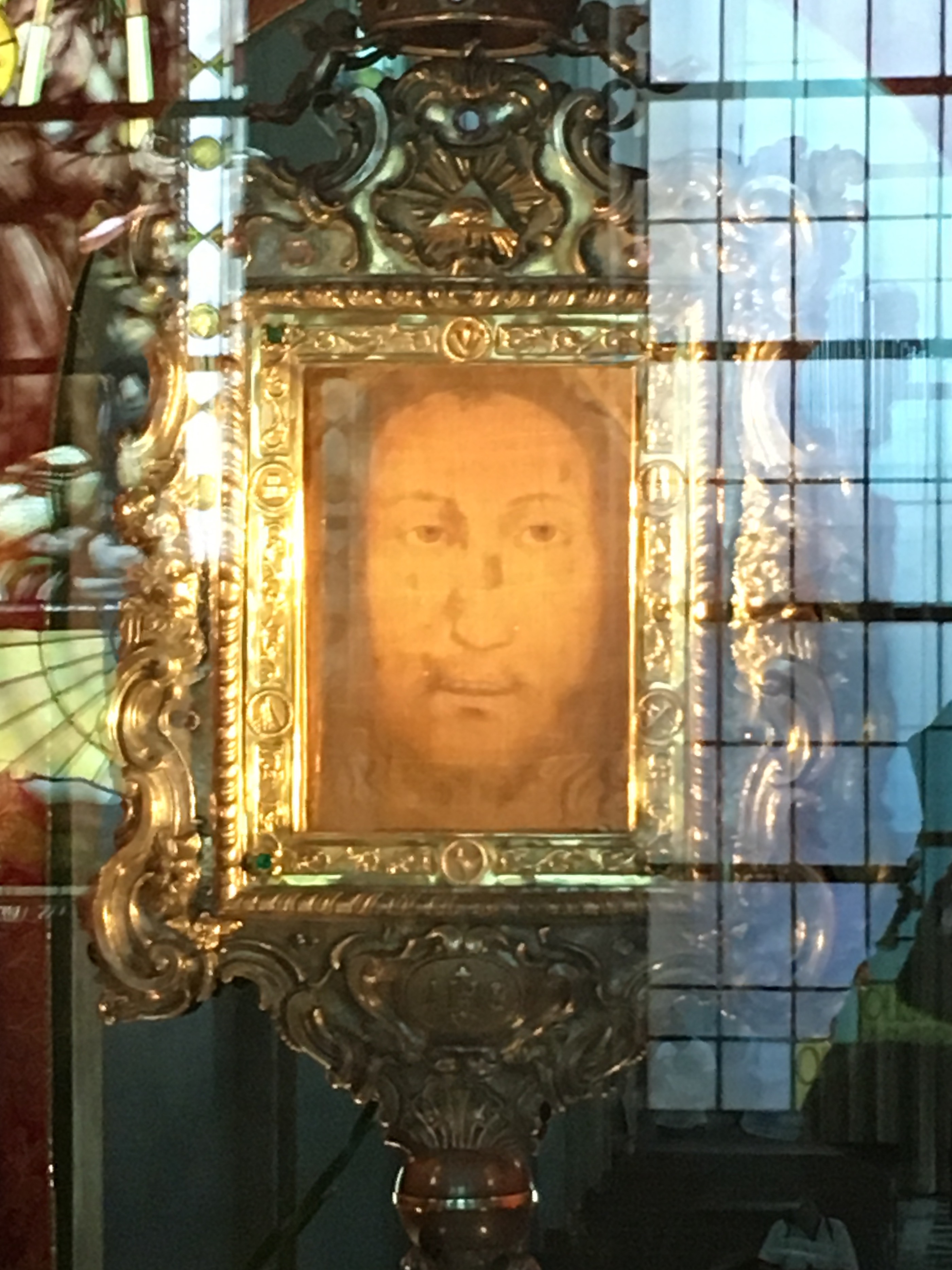
When he placed the New Millennium under “the Radiant sign of the Face of Christ” Pope St. John Paul II wrote, “To contemplate the Face of Christ, and to contemplate it with Mary, is the ‘program’ which I have set before the Church at the dawn of the third millennium…It is the Church’s task to reflect the light of Christ in every historical period, to make His Face shine also before new generations of the new millennium. Our witness, however, would be hopelessly inadequate if we ourselves had not first contemplated His Face.”  The Rosary is a traditional Christian prayer directed to the contemplation of Christ’s Face. “Without contemplation, the Rosary is a body without a soul,” says Pope St. John Paul II, “and runs the risk of becoming a mechanical repetition of formulas, in violation of the admonition of Christ.”

Contemplation is a gift, a grace, from God. It is a communion in which God transforms a soul into His likeness. To put it more simply, as St. Teresa of Jesus says, contemplation is “a close sharing between friends…taking time frequently to be alone with Him who we know loves us.”  Contemplation is not something beyond our reach however–we have an incomparable model in Mary; the eyes of her heart were always turned toward His Face. To dispose our souls to receive this great gift of God we need only reach for a Rosary and pray it with humility, listening attentively in the Spirit together with Mary, in silent love–that veil of mystery–to the Father’s voice. When we contemplate the scenes or mysteries of the Rosary in union with Mary, the Rosary becomes an unceasing praise of God; a way to learn from her about her son, Jesus, to discover His secrets and understand His message for us.
IMG_0915-1

To recite the Rosary, which can be called a compendium of the Gospel, Pope St. John Paul II says, “is to contemplate the Face of Christ in union with, and at the school of, His Most Holy Mother…Against the background of the words of the Ave Maria the principal events of the life of Jesus Christ pass before the eyes of the soul. They take shape in the complete series of the joyful, [luminous,] sorrowful and glorious mysteries, and they put us in living communion with Jesus through–we might say through the heart of his Mother…The Rosary belongs among the finest and most praiseworthy traditions of Christian contemplation…To look upon the Face of Christ, to recognize its mystery amid the daily events and sufferings of His human life, and then to grasp the divine splendor definitively revealed in the Risen Lord, seated in glory at the right hand of the Father; this is the task of every follower of Christ and therefore the task of each one of us. In contemplating Christ’s Face we become open to receiving the mystery of Trinitarian life, experiencing ever anew the love of the Father and delighting in the joy of the Holy Spirit. St. Paul’s words can then be applied to us ‘Beholding the glory of the Lord, we are being changed into His likeness, from one degree of glory to another; for this comes from the Lord who is the Spirit.'” (Rosarium Virginus Mariae) 
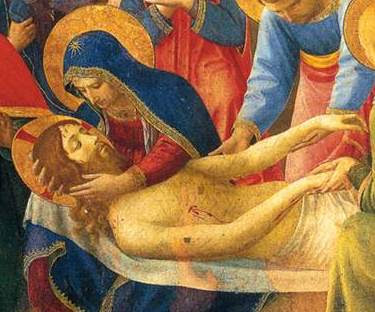
"The contemplation of Christ's Face cannot stop at the image of the Crucified One. He is the Risen One!"~St. Pope John Paul II
“The contemplation of Christ’s Face cannot stop at the image of the Crucified One. He is the Risen One!”~ Pope St. John Paul II

The entire month of October is dedicated to the Holy Rosary and October 7th is celebrated as the feast of Our Lady of the Rosary. The feast, originally named for Our Lady of Victory, commemorated the stunning victory, against all odds, obtained by Our Lady in the Battle of Lepanto through the prayer of the Rosary–which saved Christendom on October 7th, in 1571. By keeping our eyes fixed on the Face of Jesus as we pray the Rosary, together with Mary, through her maternal intercession, we too may obtain great victories through the heart of her Son Jesus, who obtained for all mankind the greatest victory over sin and death by His Resurrection.
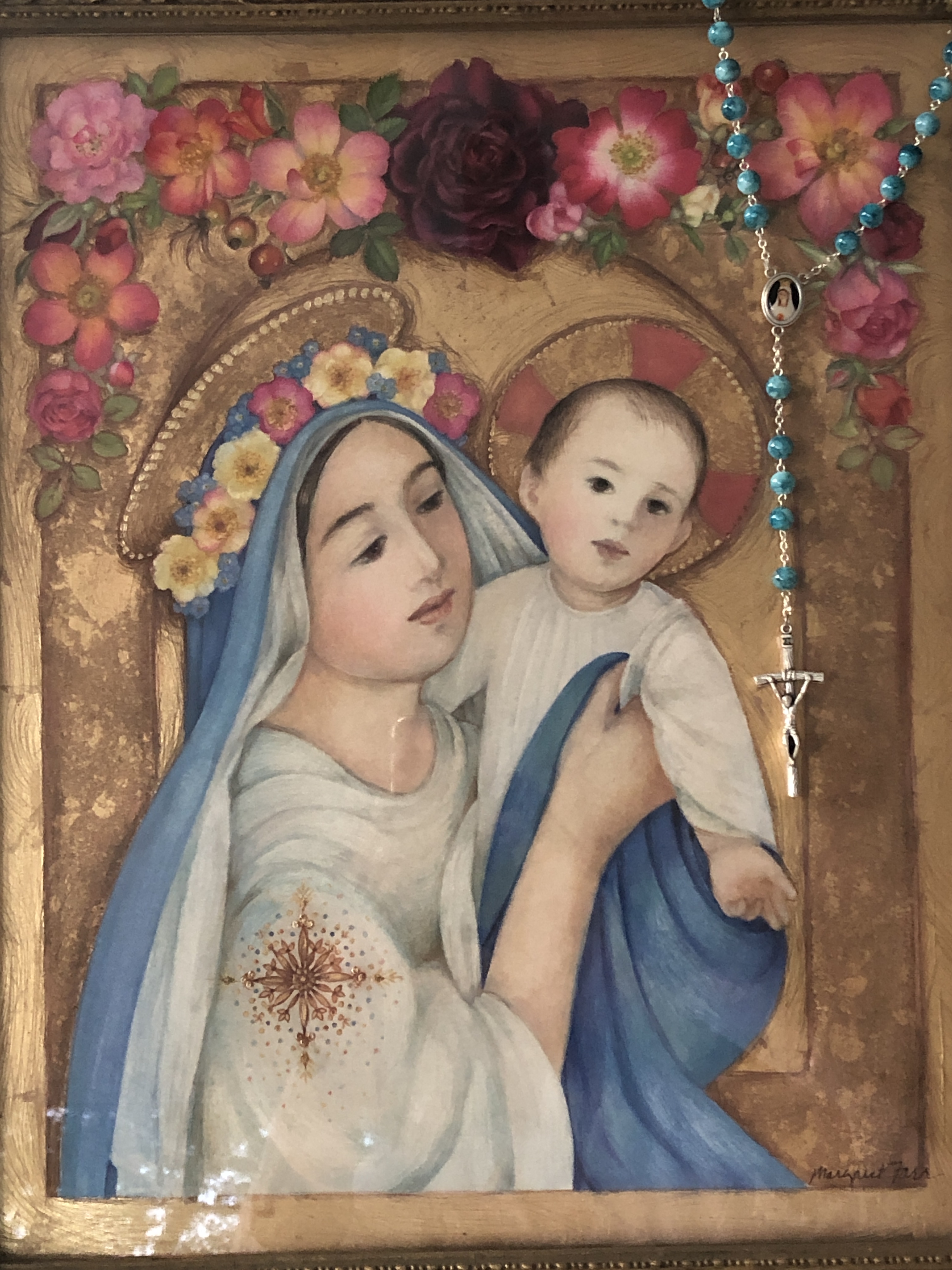
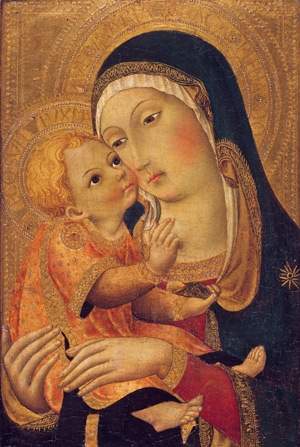
“Through her, may we see Him. Made sweeter, not made dim. And her hand leaves His light, sifted to suit our sight.” ~ Gerard Manley Hopkins (Painting of the Blessed Mother and the Child Jesus by Margaret Farr)

The Blessing of St. Francis

“The one you are looking for is the one who is looking.” ~St. Francis of Assisi

Within the Basilica of St. Francis in Assisi is a precious relic: a small, crumpled piece of yellowed parchment with the writing of St. Francis, now displayed in a silver reliquary. It was written on Mount La Verna after St. Francis received the stigmata. The first biographer of St. Francis, Bl. Thomas of Celano wrote that for a long time St. Francis’s friend, Brother Leo, had greatly desired to have some memorial from the words of Our Lord written by St. Francis to be prayed in times of temptation:

“One day Blessed Francis called him, saying, ‘Bring me paper and ink, for I wish to write the words of God and His praises which I have been meditating in my heart.’ What he asked for being straightway brought, he writes with his own hand the praises of God and the words which he [his companion] wished, and lastly a blessing of the brother, saying: ‘Take this sheet for thyself and until the day of thy death guard it carefully.’ All temptation was at once driven away; the letter is kept and worked wonders for the time to come.” Brother Leo kept it faithfully; folding it in four, he carried it in his pocket and guarded it jealously for a good forty-six years.  The text in the middle, written in black, and marked with a large “Tau” cross is in Francis’s own handwriting, he writes the praises of God* and grants to Brother Leo the blessing from the Book of Numbers 6: 22-27 which later became known as “the Blessing of St. Francis.”

“The Blessing of St. Francis” in reliquary.

*(St. Francis’s “Praises of God” are now now quite faded, but, this much can be still read: “Thou art holy, Lord God, who alone workest wonders. Thou art strong. Thou art great. Thou art most high. Thou art the Almighty King, Thou, holy Father, King of heaven and earth. Thou art the Lord God Triune and One; all good. Thou art good, all good, highest good, Lord God living and true. Thou art charity, love. Thou art wisdom. Thou art humility. Thou art patience. Thou art security. Thou art quietude. Thou art joy and gladness. Thou…”  That is all that has been preserved.) 

St. Francis in Ecstasy before the Veil of the Holy Face, 17th century (photo:Paul Badde/EWTN)

Pope Emeritus Benedict XVI, in his homily for the World Day of Peace, 2013, spoke of this blessing from the Book of Numbers that was so precious to St. Francis:

“The blessing repeats the three times Holy Name of God, a Name not to be spoken, and each time linked to two words indicating an action in favor of man. Peace is the summit of these six actions of God in our favor, His most sublime gift, in which He turns toward us the splendor of His Face.”

This is the same, great blessing that St. Francis desired to impart to his friend, Brother Leo:

“May the Lord bless and keep you; may He make His Face shine upon you and be merciful to you; may He turn His Countenance toward you and give you His Peace!”  (Num. 6:22-27)

A Veronica to St. Francis — Lady Jacoba 

In the Relic Chapel of the Basilica of St. Francis, in addition to St. Francis’s patched and tattered tunic and other precious relics, there is a display case which contains a beautifully embroidered silken veil and a small plaque with the name: “Jacoba Settesoli.” The plaque reads: “Like Jesus on his way to Calvary, Francis also had a Veronica.” (Veronica is the woman, tradition tells us, who wiped the Face of Jesus. She is the model of those who make reparation to the Face of Christ.)

Frate Jacopa de Settesoli

Lady Jacoba was a noblewoman and widow, with two children from Rome, who became a follower of St. Francis. After having heard him preach she sought his guidance on how to be charitable.  When Francis traveled to Rome, he would stay with Lady Jacoba as her guest and she cared for him when he was sick. She gave some of her property in Trastevere to the brothers, which they used to care for lepers.  She gave up her life of comfort in order to help the poor.  Woman were not normally permitted to be in company of the brothers, however, St. Francis made an exception in her case, jokingly referring to her as “Brother Jacoba.”

As Francis lay dying he sent an urgent letter by messenger to Lady Jacoba: “Brother Jacoba, the servant of the Most High, health in the Lord and communion in the Holy Ghost.  Dearest, I want you to know that the blessed Lord has done the grace of revealing that the end of my life is nigh.  So, if you want to find me still alive, hurry to Santa Maria degli Angeli as soon as you receive this letter.”  He went on to request that she bring a gray cloth to wrap his body in, candles for burial, and almond cookies that she had made for him in Rome when he was sick. Before the messenger arrived in Rome, Lady Jacoba had already anticipated St. Francis’s needs by the light of the  Holy Spirit and was on her way to Francis’s deathbed.

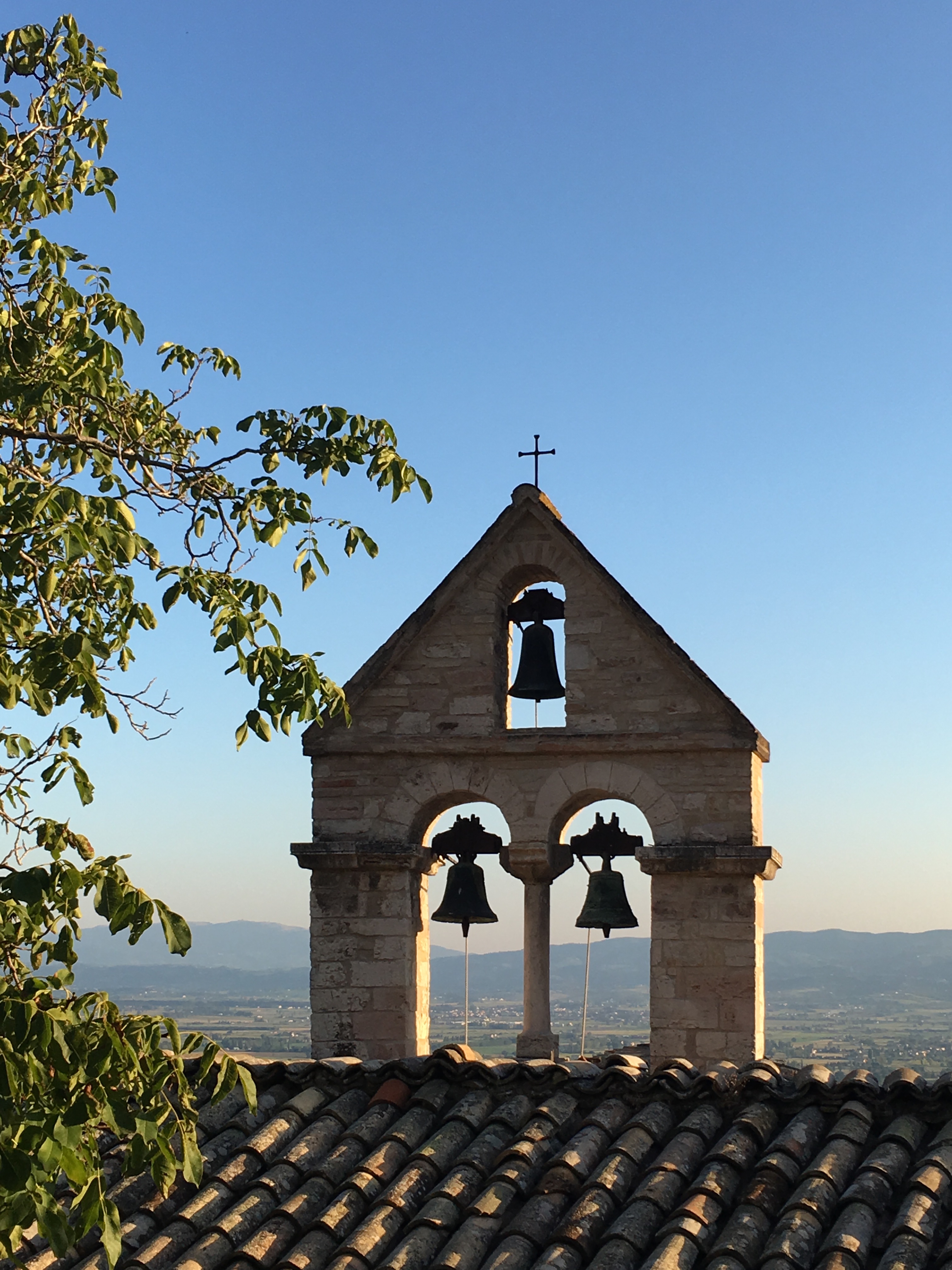
The bells of the church of Santo Stefano the Martyr which rang by themselves when St. Francis died.

St. Francis’s biographer, Bl. Thomas Celano, wrote that Lady Jacoba brought not only the gray cloth, the candles, and the almond cookies, but also a pillow for his head, and a“sindomen pro facie” (a veil to cover his face in death, which was displayed in the Relic Chapel). It had been her own sheer, embroidered wedding veil that she placed on the face of St. Francis in death. So, St. Francis, an alter Christus who bore the stigmata, also had his “Veronica” in Lady Jacoba, who brought him consolation in his passion.

St. Francis, Pray for us